
By Muriel Bristol | June 1, 2025
Prior to Milton establishing its own town Poor Farm or Alms Farm, its Selectmen would contract with an individual householder to support an indigent with them in their own family home or farmstead. Such arrangements were put out to bid annually and the contract given to the lowest bidder. (The full title of elected Selectmen was Selectmen & “Overseers of the Poor” (and the indigent were termed “paupers”)).
Notice. ALL persons are hereby forbid hiring, trading with, or harboring in any way Daniel Wentworth, a town pauper, as I have contracted with the selectmen of Milton for his earnings for the support of his family, and shall take the course of the law if any one violates said contract. JOHN H. VARNEY. Milton, May 29, 1837 (Dover Enquirer, June 13, 1837).
NOTICE. THE subscriber having contracted with the town of Milton for the support and maintenance of Hiram Dore, a town Pauper, for the term of one year from the first of April 1839, and having made suitable provisions for the same do hereby forbid all persons harbouring or trusting him on my account or on account of the town of Milton, as no debts of that kind will be paid or allowed. JACOB G. PIKE. Middleton, June 15, 1839 (Dover Enquirer, July 2, 1839).
Milton received a return of some State budget surplus money, in 1837, which would be unimaginable in this modern day of inexhaustible “general funds.”
Alms Farm, etc. – On the 14th day of March, 1837, the town voted to receive its proportion of the surplus revenue, and at a meeting held June 4, 1838, a vote was passed authorizing the town agent to expend that money in the purchase of a farm to used for a home and the support of the poor.
Although there was a large majority in favor of this action, the minority felt aggrieved thereat, being of the opinion that this money should be divided per capita.
These malcontents immediately took measures intended to frustrate the action of the majority. They at once asked for a meeting to be called to reconsider the vote for the purchase of the farm, and being again defeated at this meeting, and the farm being soon purchased, they at once petitioned for a meeting to sell the farm and divide the money. They were again defeated … (Hurd, 1882).
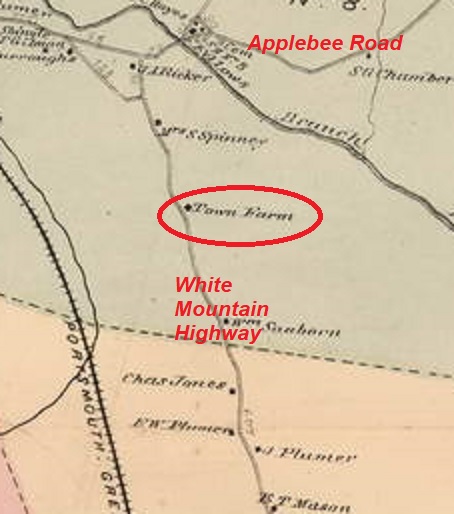
Milton is said to have purchased a 140-acre Town Poor Farm or Alms Farm, on Plummers Ridge, in 1839.
In 1839 the town of Milton acquired a poor farm of 140 acres to care for the needy. At that time and for years the land remained mostly open pasture and mowings (NH Forest Commission, 1926).
Note: This place is linked to a bit of interesting history. In 1837, it was voted to deposit with the States, payable to the Sec’y of the Treasury of the United States on demand, the U. S. Treasury surplus, accumulated from tariff after the debt was paid in excess of $5,000,000. Three of four installments to the states were paid when the financial crash of 1837 came. New Hampshire divided what it received among its towns. Milton received its share 14 Mar. 1837 and decided to buy a “town farm” with it. The James Chesley Hayes farm of 140 acres was bought of his son James Hayes, Jr., for $500 (Richmond, 1936).
The newly-established Milton Poor Farm appeared as a bound in a September 1839 description of several mortgaged Hanson Hayes properties that were being foreclosed. Hayes’ homestead farm was bounded southerly by the Poor Farm.
THE subscriber hereby gives notice that for the purpose of foreclosing a mortgage of a certain piece of land and the buildings thereon situate in Milton in the County of Stratford and State of New Hampshire, he entered upon and took possession of said land on the fourth day of September 1839, it being the land conveyed to him by Hanson Hayes of said Milton by his deed of mortgage dated September fourth, 1839, for the consideration of thirty-nine dollars, said land is bounded westerly by land of Levi Jones and James Moulton, southerly by the poor farm, northerly by the Barry road, containing one hundred and sixty acres more or less, it being said Hayes’s homestead farm. Also one other piece of land in said Milton bounded northerly by the road leading to John Mills, southerly by land of Levi Jones, easterly by land of Adam Brown, westerly by land of Joseph Evans, containing seventy acres more or less. Also one other piece of land in said Milton bounded northerly and easterly by land of Samuel Chamberlain southerly by land of James Applebee, westerly by land of H. Applebee, containing seventy acres more or less. The subscriber further gives notice that he has, this day, entered upon and took possession of the abovementioned premises for the purpose of foreclosing a mortgage for the consideration of the payment of a note for one hundred and seventy dollars. Said mortgage was given on the 14th September 1838, by the abovementioned Hanson Hayes to Stephen M. Mathews of said Milton, and by said Mathews assigned and set over to the subscriber for a valuable consideration. JOHN GREENFIELD. Rochester, Sept. 10, 1839 (Dover Enquirer, September 24, 1839).
NOTICE. ALL persons are hereby forbid harboring or trusting Stephen Goodwin and his wife, Mary Goodwin, or their children, Eliza Goodwin, Sarah Goodwin, Mary Goodwin and Stephen Goodwin, paupers, on account of the town of Milton, as suitable provisions have been made at the Alms House by said Town for their support. JAMES M. TWOMBLY, CHARLES SWASEY, EPHRAIM HAYES. Milton, Jan. 2, 1841 (Dover Enquirer, January 26, 1841).
Strafford County Treasurer George W. Roberts listed in the County’s debtor accounts the January 1842 payments for a Dover pauper order, $332.10; a Somersworth pauper order, $300.00; a New Durham pauper order, $126.84; a Centre Harbor pauper order, $29.27; and a Milton pauper order, $13.48 (Dover Enquirer, June 14, 1842).
The per-capita distribution minority continued to seek special meetings, in order to sell the Poor Farm and divide the proceeds.
… with a persistency worthy of a better cause they continued to ask for meetings for the same purpose as often as they could legally be called, until at last the selectmen refused to notice them any further. They then applied to a justice of the peace to call a meeting, on the 31st day of May, 1842, a meeting was held at which a vote was passed to sell the farm and stock, and divide the proceeds equally between all the inhabitants of the town, and a committee chosen to carry this vote into effect.
The committee at once advertised the farm and stock to be sold at public auction on the fourth day of July following, at which time all was struck off to the highest bidders.
At a meeting held on the 28th of the same month a resolution was passed declaring the former meeting and the action of the committee illegal and void, and instructing the selectmen to demand of said committee all the property, both real and personal, taken into their possession.
In accordance with these instructions, the selectmen commenced a suit against the committee for the recovery of said property. This suit was prosecuted to final judgement and execution. The farm continued to be used as an alms farm until a county home was prepared for the poor, since which time it has been allowed, in a great measure, to run to waste for lack of proper care and cultivation (Hurd, 1882).
Some of the townspeople wanted the money distributed instead of being put into this farm and attempted to have an auction sale of it 4 July 1842, But the selectmen stopped that with a suit, and the home was used as an almshouse until a county farm was established for the poor. The land has given full value in wood and timber for its cost to the town (Richmond, 1936).
Strafford County Treasurer Joseph Jones listed in the County’s debtor accounts the January 1847 payments for two Dover pauper orders, $1040.45, and $61.08; a Durham pauper order, $702.42; a Somersworth pauper order, $413.80; a New Durham pauper order, $332.70; a Lee pauper order, $211.00; a Strafford pauper order, $195.00; a Barrington pauper order, $178.75; a Madbury pauper order, $145.46; a Rochester pauper order, $178.75; and a Milton pauper order, $26.96 (Dover Enquirer, June 8, 1847).
Nathaniel W. Burnham, overseer of alms farm, aged forty-two years (b. NH), headed a Milton household (“Alms House”) at the time of the Seventh (1850) Federal Census. His household included Ruth [(Davis)] Burnham, aged thirty-nine years (b. NH), Jay Pike, a farmer, aged sixteen years (b. NH), Sarah Wentworth, a pauper, aged eighty-eight years (b. ME), Mary Wentworth, a pauper & idiotic, aged sixty-three years (b. NH), Mary Wingate, a pauper, aged thirty-seven years (b. NH), and Clarissa Scates, a pauper & idiotic, aged twenty-five years. Nathaniel W. Burnham had real estate valued at $2,500. Their household appeared in the enumeration between those of Sarah Spinney, aged sixty-two years (b. NH), and Joseph Plumer, a farmer, aged thirty years (b. NH).
In a published compilation of the municipal expenses of various Strafford County cities and towns, for the year 1856, Milton had Receipts of $6,621.24 and Expenses of $6,667.40. It had spent $807.44 on Schools, and $484.93 on Support of the Poor. Its Town Debt stood at $2,492.56 (Dover Enquirer, April 10, 1856).
Notice. TO WHOM IT MAY CONCERN. Whereas the Overseers of the Poor for the Town of Milton, have made suitable provision at the Alms House in said town, for the support of Jonathan Miller, Lydia H. Miller, wife of said Jonathan, and Charles Miller, Mary Miller, minor children of said Jonathan Miller, paupers belonging to said town, and also suitable provisions for conveying said paupers to said Alms House, and whereas said paupers refuse to accept such provisions, this is to forbid all persons harboring, trusting or furnishing any support to either of said paupers on account of said town of Milton, as said town will not furnish said paupers any support except at their Alms House after this date. DAVID WALLINGFORD, JR., S.S. WAKEHAM } Overseers of Poor in Milton. Milton, February 16, 1858 (Dover Enquirer, February 18, 1858).
James N. Palmer, a superintendent, aged thirty-eight years, headed a Milton household (“Poor House”) at the time of the Eighth (1860) Federal Census. His household included Joanna [(Smith)] Palmer, aged thirty-five years, E.W. Palmer, aged five years, S.B. Palmer, aged three years, Ida M. Palmer, aged one year, Mary Wentworth, a pauper, aged seventy-five years, Martha Drew, idiotic, aged thirty-four years, and Clara Scates, a pauper, aged thirty-five years. James N. Palmer had real estate valued at $2,500 and personal estate valued at $400. Their household appeared in the enumeration between those of Joseph G. Rines, a laborer, aged thirty-six years (b. NH), and Parker Spinney, a farmer, aged fifty-six years (b. NH).
Strafford County Treasurer Shubael B. Cole listed in the County’s debtor accounts a February 12, 1862, payment for a Milton pauper bill, $169.45; and a February 28, 1862, payment for a Milton pauper bill, $21.32 (Dover Enquirer, June 5, 1862).
Strafford County Treasurer Russell B. Wiggin listed in the County’s debtor accounts a February 11, 1864, payment for a Milton pauper bill, $262.22 (Dover Enquirer, June 9, 1864).
The Strafford County Commissioners visited the several town alms-houses of their county in 1864 and issued a report on their activities and findings. Their visitations included a stop at the Milton Town Farm. The commissioners of that term were Joseph F. Lawrence, Stephen S. Chick, and Luther Hayes.
… Our next stopping place was at the Milton Town Farm under the care of Mr. Dore. Mrs. Dore is one of the motherly women everyone likes because they cannot help it, everything looked cheerful and neat. It was a bitter cold night, and it might have been the blazing fire that made it seem so pleasant and homelike, and we had anticipated the coming answer, when in response to our enquiry of the paupers if they had any complaints to make they answered, none. We here found another subject for removal, a man who acknowledged he had received support at fifty-two different farms (Dover Enquirer, November 24, 1864).
A distinction had always been made between Town paupers, supported at the town level, and County paupers, who may “belong” in the County, but not the particular town that was caring for them. Their support was financed by the County. Part of what the County Commissioners sought during their perambulations was the removal of other paupers originating outside their county jurisdiction. They found one in Milton and had him removed. Their report touted the advantages, including removal of non-County paupers, and economies of scale, that might accrue if a new County facility would take over maintenance of the poor.
The Strafford County Commissioners returned for another visitation of town poor farms – their third – in the following year of 1865.
... We found at Milton only one person whose bills are to be paid by the county, and only a limited number of town poor. We cannot think the small number we found here can be ascribed to the fact that the alms house is of only one story, or Mr. Dore at all unkind, for we know that the paupers here have every accommodation they really need in all respects, and if Mr. and Mrs. Dore have any failing, it is because their hearts are larger than their house, and are at first prompted to take care of all who call. The small number here in comparison to the number upon the farms of the adjacent towns, containing not half of Milton’s population speaks well for her intelligence and prosperity. Without desiring to say a word of disparagement of this town, we could but ask ourselves why every town in the lower part of the county, where almost every rod of land is fit for a garden, should be burdened with paupers, while the people of Milton in their stony valleys, and upon their bleak hills, seem so prosperous, independent and happy. No man in either town of Strafford county manages the pauper affairs of his town better than Mr. Jones [Dore] does here, and we often wish the citizens of every town would select only those to manage town business, who carefully attended to their own (Dover Enquirer, December 7, 1865).
The Strafford County Commissioners began hiring staff for their new Strafford County Farm complex by 1867. Cornelius E. Caswell appeared in the Dover, NH, directories of 1867, and 1869, as Superintendent of the County Farm, with his house on Old Factory road. (Caswell had been Superintendent of the Dover Poor Farm at the time of the Seventh (1850) Census and the Eighth (1860) Census, prior to becoming Superintendent of the Strafford County Farm in 1867).
Wanted. AT the Strafford County Farm, a female competent to teach the children at the Farm and to assist in making the clothing for the inmates. Application may be made to the Commissioners at the Farm, on Friday afternoon, May 31st. LUTHER HAYES, J.F. LAWRENCE, ANDREW ROLLINS } Commissioners (Dover Enquirer, May 23, 1867).
And the various Strafford County towns shifted their town and county paupers to the new Strafford County Farm complex in Dover, NH. Many sold their own town farms.
The Barrington Town Farm, advertised in our paper a few weeks ago, has been sold to Mr. Freeman Babb of Watertown, Mass. Price $4500. Several other towns in the county have disposed, or are about disposing, of their farms, and sending their paupers to the County Farm (Dover Enquirer, April 18, 1867).
Dr. John R. Ham of Dover, NH, reported to the NH Medical Society regarding the new County Farm complex in Dover, NH. “The old system, followed until the year 1867, in the case of the poor; the new system then inaugurated, in bringing the poor from the several towns in the county to the new County Asylum in Dover …” (NH Medical Society, 1871).
New Hampshire. An old soldier of 1812, 75 years old, and a native of Rochester now lies in the alms-house of Strafford county, utterly unbefriended by his townsmen (Springfield Weekly Republican (Springfield, MA), February 29, 1868).
Cornelius Caswell, superintendent of the Strafford County Farm, aged fifty-four years (b. NH), headed a Dover, NH, household at the time of the Ninth (1870) Federal Census. His household included Betsy T. [(Chase)] Caswell, aged fifty-two years (b. NH), Charles F. Caswell, aged eighteen years (b. NH), attending school, and Emma B. Caswell, aged twelve years (b. NH), attending school. Cornelius Caswell had real estate valued at $2,500 and personal estate valued at $1,500.
It also included staff members Caleb Hanson, a laborer, aged fifty-five years (b. NH), Ephraim Stratton, a laborer, aged fifty-seven years (b. NH), Lizzie Edgerly, a school teacher, aged twenty-three years (b. NH), Mary Patch, a seamstress, aged twenty-eight years (b. NH), and Sarah Stiles, a domestic, aged nineteen years (b. NH). Caleb Hanson had personal estate valued at $5,000. There were also eighty-seven “Inmates of County Poor House,” whose ages ranged from three years to ninety years. Sixty-eight of them were natives of New Hampshire, thirteen of Ireland, one of Scotland, three of Maine, and two of Massachusetts. Among them was Clarissa Scates, aged forty-one years (b. NH), last enumerated at the Milton Poor House in 1860.
Cornelius E. Caswell, superintendent of the Strafford County Farm, aged sixty-two years (b. NH), headed a Dover, NH, household at the time of the Tenth (1880) Federal Census. His household included his wife, Betsey T. [(Chase)] Caswell, keeps house, aged fifty-nine years (b. NH), his daughter, Emma Belle Caswell, a County school teacher. aged twenty-one years (b. NH), and his sister, Deborah Caswell, a cook, aged forty-seven years (b. NH).
The Strafford County Farm also included staff members Charles N. Thompson, Superintendent of the Insane Department, aged forty-eight years (b. NH), his wife, Martha Thompson, a Matron, aged forty-eight years (b. NH)., their son, Frank Thompson, works on farm, aged sixteen years (b. NH), and Abby Caverly a seamstress, aged forty-nine years (b. NH).
It included also hundred sixty-eight inmates (157) and prisoners (11) of the “County Asylum,” whose ages ranged from six months to eighty-eight years. ninety-eight of them were natives of New Hampshire, thirty-three of Ireland, eleven of Maine, ten of Massachusetts, six of England, four of Canada, three of Maryland, two of Vermont, and one of New Jersey.
LOCAL MATTERS. Mr. Cornelius E. Caswell, Sup’t of the County Farm, is dangerously ill of heart disease, and is not expected to recover (Dover Enquirer, December 9, 1880).
The Strafford County Farm, having become the one basket in which all the County’s indigent eggs were kept, suffered two tragic fires, one in 1881, with fourteen inmates dead, and the other in 1893, with forty-five inmates dead.
FROM NEW HAMPSHIRE. The Burning of Strafford County Alms House. HEROISM OF MANY OF THE INMATES. A Brave Irishwoman Saves the Lives of Several Children. DOVER, N.H., Jan. 7. At the burning of the Strafford county poor farm house some of the women exhibited great presence of mind, and aided in saving others. One Irish woman stood barefooted in the snow, catching in her arms children as they were thrown from the windows. Everything possible was done by the superintendent and others to save the lives of the inmates, but without water or means of applying it, little could be done. Nothing remains of the building, but the walls. Within, amid a mass of embers, may be seen two human bodies burning (Lewiston Sun-Journal (Lewiston, ME), January 7, 1881).
Strafford County Farm Superintendent Cornelius E. Caswell resigned due to ill health in March 1881.
New Hampshire Secular News. Strafford County. CORNELIUS E. CASWELL, for several years past superintendent of the county farm, has resigned that position on account of ill health, and his resignation has been accepted (Vermont Chronicle (Bellows Falls, VT), March 12, 1881).
Cornelius E. Caswell died of heart disease in Dover, NH, July 7, 1881, aged sixty-six years.
New England Specials. Mr. Cornelius Caswell, late overseer of the Strafford county (N.H.) farm, died in Dover yesterday of heart disease. He was in charge of the county farm on the occasion of the fire last January, when fourteen lives were lost (Boston Globe, July 8, 1881).
Subsequent Strafford County Farm Superintendents were William T. Wentworth (1832-1907), in 1881-88, Josiah G. Stiles (1845-1905), in 1888-90, and Charles E. Demeritt, in 1890-93 (1835-1926), who held that position during the second major fire (Foster’s Daily Democrat (Dover, NH), July 1, 1908).
FORTY-FIVE LIVES LOST. Strafford County Insane Asylum, Near Dover, N.H., Burned. Nearly Fifty Patients in the Building When the Fire Started. Blaze was Discovered In an Inmate’s Cell by the Night Watchman. DOVER, N.H., Feb. 9.-Forty-five inmates of the insane asylum connected with the Strafford county farm were burned to death tonight in one of the most horrible disasters that ever occurred in this country. Despite the fact that only a few rods away there were 100 persons in the main buildings attached to the county farm, but three lives were saved of all those confined in the asylum, and those made their escape without assistance. Charred bones and remnants of flesh are all that remain of the others, whose deaths were attended by all the horrors of helpless and frenzied people whose struggles availed them nothing. … (Boston Globe, February 10, 1893).
Edward A. Willand (1846-1915) took over as Strafford County Farm Superintendent and held that position until he was shot and fatally wounded by a drunken Strafford County Farm employee, July 8, 1915 (Foster’s Daily Democrat, July 9, 1915).
References:
Find a Grave. (2015, July 8). Cornelius E. Caswell. Retrieved from www.findagrave.com/memorial/148866737/cornelius-e.-caswell
Find a Grave. (2010, January 5). Charles Edwin Demeritt. Retrieved from www.findagrave.com/memorial/46372981/charles-edwin-demeritt
Find a Grave. (2011, August 23). Josiah Granville Stiles. Retrieved from www.findagrave.com/memorial/75367121/josiah-granville-stiles
Find a Grave. (2017, September 27). William Trickey Wentworth. Retrieved from www.findagrave.com/memorial/183768654/william-trickey-wentworth
Find a Grave. (2017, January 7). Edward A. Willand. Retrieved from www.findagrave.com/memorial/175028377/edward-a-willand
Hurd, Duane Hamilton. (1882). History of Rockingham and Strafford Counties, New Hampshire, with Biographical Sketches of Many of its Pioneers and Prominent Men. Retrieved from books.google.com/books?id=ta0AEQAAQBAJ&pg=PA653
NH Forest Commission. (1926). Biennial Report of the Forest Commission. Retrieved from books.google.com/books?id=KNhDAAAAIAAJ&pg=RA1-PA79
NH General Court. (1843). Revised Statutes of the State of New Hampshire: Passed December 23, 1842. Retrieved from books.google.com/books?id=jw5LAAAAYAAJ&pg=PA135
NH Medical Society. (1871). Transactions of the NH Medical Society. Retrieved from books.google.com/books?id=SO8hZwj45UsC&pg=RA1-PA61
US Bureau of the Census. (1915). Paupers in Almshouses 1910. Retrieved from books.google.com/books?id=pZCoA_uBet8C&pg=PA68
Richmond, Katherine F. (1936). John Hayes, of Dover, New Hampshire; a Book of His Family. Tyngsboro, MA
Scales, John. (1914). History of Strafford County, New Hampshire, and Representative Citizens. Retrieved from books.google.com/books?id=nGsjAQAAMAAJ&pg=PA52

 Milton Observer