By Muriel Bristol | June 22, 2025
Milton gained its independence from its parent town, Rochester, NH, in 1802, during what historians have called the “First Party System,” which ran between about 1792 and 1824. The two political parties competing during this period were the Federalist-Republicans, or “Federalists,” as formed by Alexander Hamilton, and the Democratic-Republicans, or “Republicans,” as formed by Thomas Jefferson and James Madison.
With a few notable exceptions, Milton tended to vote Federalist during the time of the “First Party System.” The Federalists favored a stronger national government, with a central bank, assumption of the Revolutionary War debts of the states, a national army and navy, and a focus on manufacturing and mercantile issues and interests. The Democrat-Republicans favored instead stronger state governments, with state-level banks, a militia military, and a focus on agrarian issues and interests. The Federalists tended to be stronger in the northern states, especially in New England, while the Democrat-Republicans were stronger in the southern (and western) states.
These political differences played out against a backdrop of the French Revolutionary and Napoleonic wars in Europe. Napoleon established his anti-British economic “Continental System” and the British blockaded that Continental economic bloc. The Federalists tended to be somewhat pro-British (or anti-French), while the Democrat-Republicans tended to be somewhat pro-French (or anti-British).
At its inaugural Town Meeting, held in the tavern of Lt. Elijah Horne, August 30, 1802, Milton voted for a replacement U.S. Representative to complete the 1801-02 term of Federalist Rep. Joseph Pierce, Esq., who had resigned.
JOSEPH PIERCE, Esq., has resigned his seat as one of the Representatives of New Hampshire in the Congress (Greenfield Recorder (Greenfield, MA), July 5, 1802).
Milton voters gave 71 votes [92.2%] for Federalist Samuel Hunt, 4 votes for Jonathan Steele [5.2%], and 2 votes for Democrat-Republican Nahum Parker [2.6%].

PORTSMOUTH, (N. H.) AUGUST 7. FEDERAL TICKET. Members of Congress. To fill the vacancy occasioned by the resignation of Joseph Peirce, esq., SAMUEL HUNT, esq., Charleston.
For the Next Congress.-SAMUEL TENNEY, Exeter. SAMUEL HUNT, Charleston. CLIFTON CLAGGETT, Litchfield. SILAS BETTON, Salem. DAVID HOUGH, Lebanon.
Nothing under heaven is wanting to secure the handsome majority to this ticket but a tolerable share of activity in the Federalists throughout the State – and shall this be withheld? while the most precious of our elections, our representation in Congress is pending, shall Federalists quietly retire to repose? Shall New-Hampshire be given up without one struggle on their part to maintain her weight and respectability – while their enemies are at the work of misrepresentation at morning, at noon, and at night, are they to be idle? God forbid! Let every one then repair to his post and act – Let the system pursued in the last session of Congress stiffen every breast, give double activity to every mind. Let it be the duty. of every one to expose the conduct of public measures – Let truth circulate free as the wind, and we need not fear the result (US Gazette (Philadelphia, PA), August 17, 1802).
At that same Town Meeting, they voted also for U.S. Representatives for the upcoming 1803-04 term. Milton gave a mode of 65 votes [86.7%] to the five Federalist candidates and 10 votes [13.3%] to the five Democrat-Republican candidates. (New Hampshire had then five at-large Congressional seats). Federalist Samuel Tenney of Exeter, NH, led the other four Federalist candidates in Milton with the higher total of 68 votes [90.7%].
Milton gave 103 votes [76.9%] for incumbent Federalist Governor John Taylor Gilman, and 31 votes [23.1%] to Democrat-Republican John Langdon, in the NH Gubernatorial election of March 1803.
ELECTIONS. By the late papers, it appears that His Excellency, JOHN TAYLOR GILMAN, is chosen Governor of Newhampshire, by a much larger majority than at the last election (Green Mountain Patriot, March 16, 1803).
Democrat-Republican President Thomas Jefferson directed his envoys, James Monroe and Robert R. Livingston, to negotiate the purchase of New Orleans from Napoleonic France in July 1803. Their efforts would lead to the purchase of the much larger Louisiana territory.
Milton gave 22 votes [57.9%] for incumbent Federalist Governor John Taylor Gilman, 15 votes [39.5%] to Democrat-Republican John Langdon, and 1 vote [2.6%] to John Bridger, in the NH Gubernatorial election of March 1804. Governor John Taylor Gilman won re-election.
NEW HAMPSHIRE. PORTSMOUTH, June 11. On Wednesday last, the Legislature of this state convened at Concord. The Hon. NICHOLAS GILMAN was elected President of the Senate. The votes for Speaker, were, for Hon. JOHN PRENTICE, 71 – Hon. JOHN LANGDON, 83. On Tuesday the votes for Governor were canvassed – of which His Excellency Governor GILMAN had 12216, Hon. JOHN LANGDON, 12039; Majority for Gov. GILMAN, 177. The votes of Society Land, Piermont, and Strafford were lost, being illegal, or not returned in season. There were only 27 scattering votes. Or the Counsellors three are federalists, and two are democrats. The Executive is therefore wholly federal; and as it requires two-thirds of each branch of the Legislature to pass any law to which the Governor may dissent, there is no danger that any violent democratic measure will have the stamp of law in New Hampshire this year (Greenfield Recorder (Greenfield, MA), June 18, 1804).
Democrat-Republican Vice President Aaron Burr shot and wounded Federalist former Secretary of the Treasury Alexander Hamilton in a duel at Weehawken, NJ, July 11, 1804. Hamilton died the following day.
DEEP LAMENTATION. Died Yesterday afternoon, GENERAL ALEXANDER HAMILTON, of a wound which he received on the morning of the preceding day, in a duel with Col. Burr. Never was a death more sincerely and justly lamented; and his loss will be sensibly felt throughout the United States. – In him were united the most splendid talents and the strictest political integrity. There was no man more universally beloved by those who knew him, and in whom such unbounded confidence was placed. The circumstances which occasion the melancholy event of his death, and deprived this country of its first citizen, will no doubt be fairly and fully stated; the public voice demands it; his character will be drawn; and his name go down with the highest honours to all posterity. The General, during his short illness, expressed his strong abhorrence of the practice of duelling, and has left in writing (as is said) his testimony against it; he partook of the holy sacrament; and died in the explicit profession of his belief in the Christian religion, and a declaration that he had “a tender reliance on the mercy of Almighty God, through the merits of the Lord Jesus Christ.” The ships in the harbour will show the respect which is due, the merchants are recommended to shut up their stores, and the citizens attend the funeral of one of the greatest and most beloved of men. From Lang’s Gazette (Greenfield Recorder (Greenfield, MA), July 23, 1804).
(George Clinton replaced Aaron Burr as Vice President on the Democrat-Republican ticket for Jefferson’s re-election campaign).
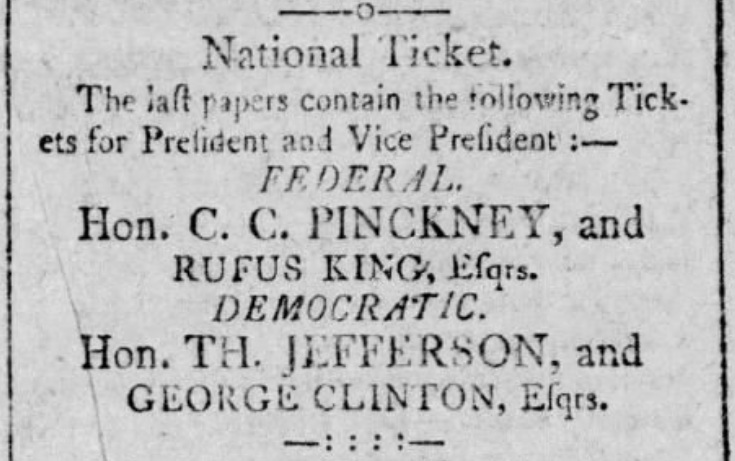
Milton gave 71 votes [73.2%] for the electoral college electors pledged to Federalist Charles C. Pinckney and 26 votes [26.9%] for the electors pledged to incumbent Democrat-Republican President Thomas Jefferson in the Presidential election of November 1804. (There were multiple electors. Others were elected along the same party lines, 69-28). This election would have been the first to be held in the Milton Town House. President Thomas Jefferson won re-election.
Beard Plumer was Milton’s NH State Representative in 1805-08. He was a Democrat-Republican.
Congress passed the Embargo Act of 1807, and President Jefferson signed it in December 1807. It was not popular in mercantile New England and the declining opposition Federalists would experience a bit of a political revival due to their opposition to it.
Letters from Washington, are extremely contradictory: – While some talk of an embargo, and of inevitable War; others state the strongest probability of an accommodation, in the event of reparation being made for the attack on the Chesapeake; that some points, which cannot be settled, will be postponed indefinitely; and that the Non-Importation law, and the various offensive and defensive measures reported and talked of, will die abortions. We have seen letters, as late as the 11th, which hold out the prospect of accommodation. Perhaps the opinions of the writers, on both sides, have been influenced by their wishes. – Whether or not – we think the crisis is at hand. – Ere this, the Administration must be in possession of all the intelligence it can want, to decide on Peace or War. – Mr. Munroe, Mr. Rose, the British King’s Proclamation, and the dispatches by the Revenge must all have reached Washington, on the heels. of each other. The uneasy, tiptoed expectation of the public cannot therefore long remain unsatisfied. Dec. 23. (Greenfield Recorder (Greenfield. MA), December 28, 1807).
Milton gave 58 votes [70.7%] for incumbent Democrat-Republican Governor John Langdon, 21 votes [25.6%] for Federalist William Hale, and 3 votes [3.7%] for Samuel Nute, in the NH Gubernatorial election of March 1808. Governor John Langdon won re-election.
NEW-HAMPSHIRE RISING. Very pleasing accounts have lately been received from New Hampshire.- The profound sleep in which the once active and patriotic Owners of the Soil in that State have been wrapped for two or three years, is found not to have been the sleep of death. – The Embargo night-mare has broken their repose ; and they begin to open their eyes. Awake, they have removed from their Councils many blind persons who mis represented and betrayed them; and have chosen and men, who have the use of their eyes; and who in the better days of WASHINGTON and ADAMs, devised things which insured the industrious Husbandmen a rich return of their labors. These men will, in time, restore the golden days which have been gone by. Complete changes of Representatives, we are told, have been made in many towns, and in district No. 12, the Hon. Mr. Payson, an enemy to unnecessary War, and ruinous Embargoes, has been elected a Senator in the room of Mr. Bedel – a democrat. These changes have been spontaneous; and though not perhaps sufficient to a complete change in the State, are the first fruits of a federal harvest the next year. The votes for Gov. Langdon cannot be considered a test of the politics of the State. The Friends of Peace did not nominate any candidate for Governor; and many of those friends who attended the elections to vote for Senators and Representatives rather than throw away their vote for Governor, voted for Langdon. Cent. (Greenfield Recorder (Greenfield, MA), March 28, 1808).
Milton gave a mode of 97 votes [84.3%] to the five Federalist candidates and 18 votes [15.7%] to the five Democrat-Republican candidates in the U.S. Representatives election of August 1808. (New Hampshire had then five at-large Congressional seats). Federalist William Hale of Dover, NH, led the other four Federalist candidates in Milton with the even higher total of 106 votes [92.2%].
New Hampshire Election. An election of 5 Representatives to the XIth Congress, by a general ticket, was held on Monday last, in the State of New Hampshire. The votes, in 74 towns which we have heard from, stand – for the Federal Ticket, 7227; Demo. Do., 4421. Federal Majority, 2806 (Greenfield Recorder (Greenfield, MA), September 5, 1808).
Election. It is reduced to a certainty, that the Federal Ticket for Members of Congress in Newhampshire, has been carried by a majority of between 3 and 4,000 votes. It consists of Nathaniel A. Haven, William Hale, James Wilson, John C. Chamberlin, and Daniel Blaisdel, Esqrs. (Vermont Watchman (Montpelier, VT), September 23, 1808).
Milton gave 84 votes [68.3%] for the electoral college electors pledged to Federalist Charles C. Pinckney and 39 votes [31.7%] for the electors pledged to Democrat-Republican Secretary of State James Madison in the Presidential election of November 1808. (There were multiple electors. Others were elected along similar party lines).
PRESIDENTIAL ELECTION. We have the satisfaction to learn from information collected from every part of the Union, that one common sentiment prevails among the Federalists with respect to the Candidates for the two first offices in the National Government, and that the men selected by the approving voice of the whole AMERICAN PARTY, to preserve the Union and prevent a calamitous war, are, for President, the Hon. CHARLES COTESWORTH PINCKNEY, of South Carolina, and for Vice President, the Hon. RUFUS KING, of New York (Greenfield Recorder (Greenfield, MA), October 24, 1808).
Democrat-Republican Secretary of State James Madison won the Presidential election.
On Friday, December 2, 1808, Democrat-Republican Rep. Beard Plummer voted with the House majority (96-68) that disagreed with Democrat-Republican Governor Langdon’s November 1808 address supporting the Federal Embargo Act of 1807.
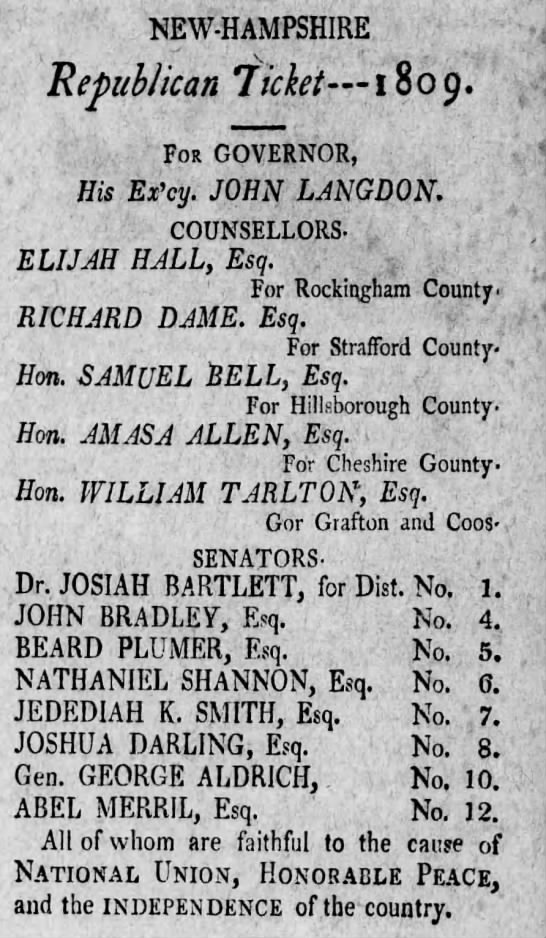 Beard Plummer ran for NH State Senator (for the district (District 5) that included Milton) on a Republican ticket, i.e., a Democrat-Republican ticket in 1809. He won the election and served in that position between 1809 and 1813.
PORTSMOUTH, (N. H.) June 17. The following officers bear rule in New Hampshire this year -His Excellency John Langdon, (elected by 17552 out of 32094 votes.) Hon. Elisha Hall, Nathaniel Upham, J.K. Smith, Ithamar Chase, Jona. Franklin, Counsellors. – Hon. Wm. Ham, Wm. Plummer [President.] Wm. Adams, Josiah Sanborn, Beard Plumber, Samuel Quarles, Wm. Fisk, Joshua Darling, Josiah Wilder, T.C. Drew, Caleb Ellis, and Moore Russel, Senators. – Hon. Clermont Storer, speaker of the house, Samuel Sparhawk, Efq. secretary of state -Nathaniel Gilman, Esq. Treasurer (Greenfield Reccorder (Greenfield, MA), July 2, 1811).
The United States declared war on Great Britain, June 18, 1812. In the Congressional and Presidential elections of that year, the Federalists presented their candidates as being the “Peace Ticket” while the Democrat-Republicans were presented by them as being the “War Ticket.”
New-Hampshire Election. – We have seen returns from twenty-four towns in New-Hampshire, which give for the Peace Ticket – 4007; War do. – 2169; Majority – 1838. In the election of governour in March last, the same towns gave for Gilman – 3451; Plumer – 2197; Federal Majority – 1254. (US Gazette (Philadelphia, PA), November 12, 1812).
Milton gave a mode of 118 votes [86.8%] to the six Federalist candidates and 18 votes [13.2%] to the six Democrat-Republican candidates in the U.S. Representatives election of November 1812. (New Hampshire had then six at-large Congressional seats). Federalist William Hale of Dover, NH, again led the other five Federalist candidates with the higher Milton total of 134 votes [98.5%]. Federalist Daniel Webster won a seat at the mode level of 118 votes.
Milton gave 123 votes [95.3%] for the electoral college electors pledged to Democrat-Republican DeWitt Clinton and 6 votes [4.7%] for the electors pledged to incumbent Democrat-Republican President James Madison in the Presidential election of November 1812. (There were multiple electors. Others were elected along similar same party lines). President James Madison won re-election.
Milton gave 102 votes [58.6%] for incumbent Federalist Governor John Taylor Gilman, and 72 votes [41.4%] to Democrat-Republican William Plumer, in the NH Gubernatorial election of March 1814. Governor John Taylor Gilman won re-election.
Eastern Elections. JOHN TAYLOR GILMAN is re-elected Governor of New Hampshire by a majority of about 500 votes (Pennsylvania Gazette, May 4, 1814).
Milton gave a mode of 94 votes [71.2%] to the six Federalist candidates and 38 votes [28.8%] to the six Democrat-Republican candidates in the U.S. Representatives election of August 1814. (New Hampshire had then six at-large Congressional seats). Federalist Daniel Webster was among those that won a seat.
Federalist Governor John Taylor Gilman called out the militia for the defense of Portsmouth, NH, in September 1814.
The Governor of Newhampshire has ordered 1200 militia to repair to Portsmouth without delay. The citizens of Portsmouth are actively engaged in fortifying and making preparations for defence (Portland Gazette (Portland, ME), September 19, 1814).
Milton sent a company of militiamen to Portsmouth, NH, under Capt. William Courson, in September 1814. (See Milton in the War of 1812).
MARRIED. At Exeter, N.H., on Thursday evening, 29th ult., His Excellency JOHN TAYLOR GILMAN, Governor of the state of New Hampshire, to Mrs. CHARLOTTE HAMILTON (NY Evening Post, January 10, 1815).
Milton gave 104 votes [63.4%] for incumbent Federalist Governor John Taylor Gilman, and 60 votes [36.5%] to Democrat-Republican William Plumer, in the NH Gubernatorial election of March 1815. John Taylor Gilman won re-election as the last Federalist Governor of New Hampshire.
ALL IN A SNARL! Federalism, never exhibited itself in a condition so disconcerted and confused, as at present. Since the confusion of tongues among the builders of Babel, there never has appeared such a complete Jargon, as the present various and contradictory opinions of federalists. One insists that Mr. Madison’s speech and measures are federal, and that he has himself turned federalist; yet keeps up his opposition, notwithstanding. Another insists that Madison is the same abominable Democrat, in federal disguise, yet recommends a cessation of opposition, and declares federalism to be at a “stead stand!” One wants Rufus King to be run for President, all against a Democratic leader, though all democratic leaders have adopted federal principles! Another wants De Witt Clinton; another Mr. Crawford. Indeed, we have not time to enumerate call their clashing notions. We know of but one thing in which they entirely agree – they all want to get into office! It is expected, however, that some uniform policy will be soon re-established. The federal forces will soon be disbanded, or put into a, train of rigid discipline; probably the latter. They will, in this case, drop the ides of the federal policy of the Democratic administration; for that would figure very ridiculously by the side of a federal opposition! (Vermont Republican (Windsor, VT), January 22, 1816).
Milton gave 99 votes [56.6%] for Federalist former Senator James Sheafe, and 76 votes [43.4%] for Democrat-Republican former Governor William Plumer, in the NH Gubernatorial election of March 1816.
The Federalists of New Hampshire have agreed to support James Sheafe as their candidate for governor in March next. We have no doubt but the Republicans will elect Mr. Plumer (Susquehanna Democrat (Wilkes-Barre, PA), February 9, 1816).
And so it happened. Despite Milton’s preference, it was Democrat-Republican William Plumer that won the election statewide.
Democrat-Republican Beard Plummer of Milton was elected again to the NH Senate for the 1816-17 term. His death in office, October 7, 1816, upset the Democrat-Republican majority in the NH State Senate.
NEW-HAMPSHIRE. … In the Senate of this State there are of the Legislature, two vacancies, one occasioned by the acceptance of a judiciary appointment by the Hon. B. Badger, and the other by the decease of the Hon. Beard Plumer. These vacancies are likely to occasion some embarrassment in the government of that state. They are required by the constitution to be filled by election by the other House, from the two remaining highest candidates in their several districts. In each of the present cases it is said that the highest remaining candidates are federalists, so that the other House, though democratic, will be under the necessity of supplying the vacancies with federalists, an event which would destroy the predominance of the democratic party in the Senate, and give the federalists a check upon the proceedings. Another report is, that there are no two highest candidates in either distinct, all the votes in each being given to one man, except that two other persons in each district had each one vote (Burlington Gazette (Burlington, VT), December 5, 1816).
Milton gave a mode of 51 votes [59.3%] to the six Federalist candidates and 35 votes [40.7%] to the six Democrat-Republican candidates in the U.S. Representatives election of November 1816. (New Hampshire had then six at-large Congressional seats).
Milton gave 57 votes [58.8%] for the electoral college electors pledged to Federalist Rufus King, 39 votes [40.2%] for the electors pledged to Democrat-Republican Secretary of State James Monroe, and 1 vote [1.0%] for the electors pledged to Democrat-Republican Secretary of Treasury William H. Crawford in the Presidential election of November 1816. Secretary of State James Monroe won the election.
IN NEW HAMPSHIRE. The entire republican ticket has prevailed by a majority probably as great if not greater than at the last spring election. By this glorious result, six republicans will take their seats in the next Congress in the place of six federalists; and New Hampshire will give 8 votes for James Monroe as President, and for Daniel D. Tompkins as Vice President of the United States -thus evincing, here as elsewhere, the truth of the axiom, that “federalism sinks as the country rises.” The gentlemen elected to Congress are Hon. Messrs. Josiah Butler, John F. Parrott, Nathaniel Upham, Clifton Clagett, Salma Hale and Arthur Livermore; and the Electors are Hon. Thomas Manning, Benjamin Butler, William Badger, Amos Cogswell, Richard. H. Ayres, Jacob Tuttle, Thomas C.. Drew and Dan Young (Bangor Register (Bangor, ME), November 23, 1816).
The Federalist party more or less dissolved after 1816. Some of its members would become anti-Jackson Democrat-Republicans. Others would become, after a time as independents, National-Republicans or Whigs, when that party formed. Some of those that had become for a time anti-Jackson Democrat-Republicans, would also become Whigs.
The U.S. Post Office Department appointed storekeeper Simon Chase as Milton’s first postmaster, March 3, 1818. (See Milton’s First Postmasters (1818-c1840)). Simon Chase would be on the Executive Committee of the Strafford County Anti-Slavery Society in May 1836 (The Liberator (Boston, MA), May 7, 1836). He would cast a vote in Rochester, NH, nearly sixty years later for Republican candidates [Rutherford B.] Hayes & [William A.] Wheeler, in the Presidential election of 1876 (Dover Enquirer, November 23, 1876).
Milton gave 90 votes [72.0%] for Democrat-Republican Governor William Plumer, 30 votes [24.0%] to George Sullivan, and 5 votes [4.0%] to John Witham, in the NH Gubernatorial election of March 1818. William Plumer won the election.
Milton gave 60 votes [95.2%] for Democrat-Republican incumbent Governor Samuel Bell, 2 votes [3.2%] to NH Attorney General George Sullivan, and 1 vote [1.6%] to William Hale, in the NH Gubernatorial election of March 1819. (George Sullivan had formerly been a Federalist NH State Representative and NH State Senator). Samuel Bell won the election.
Milton gave 103 votes [51.5%] for Democrat-Republican incumbent Governor Samuel Bell, 90 votes [45.0%] to Independent Richard Odell, and 7 votes [3.5%] to NH Attorney General George Sullivan, in the NH Gubernatorial election of March 1820. (George Sullivan had formerly been a Federalist NH State Representative and NH State Senator). Governor Samuel Bell won re-election.
State Elections – In New-Hampshire, Excellency SAMUEL BELL is again nominated as candidate for Governor. No opposing candidate has yet been proposed. Election the second Tuesday in March next (Vermont Journal, February 21, 1820).
Milton gave a mode of 30 votes [100.0%] to the six Democrat-Republican candidates in the U.S. Representatives election of November 1820. (New Hampshire had then six at-large Congressional seats). Federalist Josiah Butler of Deerfield, NH, led the other five Democrat-Republican candidates with the higher total of 32 votes.
Milton gave 33 votes [100%] for the electoral college electors pledged to Democrat-Republican incumbent President James Monroe, in November 1820. President Monroe had no major opponent, which accounts for the Milton’s low voter turnout.
One of those Democrat-Republican electoral college electors, William Plumer, formerly a NH Representative, NH Senator and NH Governor, and a U.S. Senator, as well having been formerly a Federalist, refused to cast his electoral vote for James Monroe, and instead voted for John Quincy Adams. Nevertheless, President James Monroe won re-election.
Gov. PLUMER – It is stated in a New-Hampshire paper, that the only vote given against Monroe and Tompkins, during the late Presidential election, was given by Governor Plumer, of that state.; and the reasons assigned by that gentleman for his vote are, that Mr. Monroe had “mismanaged the finance of the country, and that Mr. Tompkins had neglected his official duties.” Had these reasons emanated from a political opponent, they would hate been ascribed to those feelings of irritation and of error which have been so long enlisted against the republican officers of the union; but we must confess our inability to discover what motives could have induced a republican, possessing the esteem of the Union like Gov. Plumer, not only to have disappointed the expectations of his fellow-citizens in his vote, but to justify himself by reasons so much at variance with common sense, with justice, and his own character (Pittsfield Sun (Pittsfield, MA), January 3, 1821).
The U.S. Post Office Department appointed Lewis Hayes as the first Chestnut Hill [West Milton] Postmaster, March 17, 1821. (See Milton’s First Postmasters (1818-c1840)). Lewis Hayes would be later a National-Republican delegate in 1828.
The U.S. Post Office Department appointed Norton Scates received appointment as Milton’s second postmaster, April 8, 1822. (See Milton’s First Postmasters (1818-c1840)).
 Milton gave 57 votes [62.0%] for the electoral college electors pledged to anti-Jackson Democrat-Republican John Quincy Adams in the Presidential election of November 1824. The Federalist party had by this time dissolved and the four contestants represented – or were supported by – four differing factions of the Democrat-Republican party. They were Andrew Jackson, John Quincy Adams, Henry Clay and William H. Crawford. The electoral college results were inconclusive and a contingent election took place instead in the US House of Representatives, which selected John Quincy Adams.
The U.S. Post Office Department appointed John Nutter as Milton Mills’ first postmaster, November 13, 1826. Then President John Quincy Adams was a National-Republican. (See Milton’s First Postmasters (1818-c1840)). Nutter would be later a National-Republican delegate in 1828.
The U.S. Post Office Department appointed Benjamin Gerrish as Milton’s third postmaster, April 16, 1826. James M. Twombly received appointment as Milton’s fourth postmaster, September 18, 1827. Both men served during the term of U.S. President John Quincy Adams. President Adams was a National-Republican. (See Milton’s First Postmasters (1818-c1840)). Twombly would be later a Whig delegate in 1840.
Milton gave 173 votes (93.5%) to National-Republican Sheriff John Bell of Chester, NH, and 12 votes (6.5%) to Democratic-Republican Gov. Benjamin Pierce of Hillsborough, NH, in the NH Gubernatorial election of March 1828. Bell won the election. In the following year, Milton gave 138 votes (77.1%) to incumbent Gov. Bell and 41 votes (22.9%) to Pierce. This time Pierce won the statewide election.
New-Hampshire Election – The annual election in New-Hampshire took place on the 11th inst. There are two entire tickets, one supported by the friends of the Administration, and the other by Mr. Isaac Hill and the friends of Gen. Jackson. Mr. John Bell is the candidate of the former party for Governor, and the present Gov. Benjamin Pierce is the candidate of the other party (Springfield Weekly Republican (Springfield, MA), March 12, 1828).
 The U.S. Post Office Department appointed Israel Nute as the second Chestnut Hill [West Milton] Postmaster on August 3, 1828. Jotham Nute and David Nute stood surety for him.
Levi Jones represented Milton at a District Meeting of the “friends of the present National Administration.” The “present National Administration” was that of President John Q. Adams (Dover Enquirer, September 30, 1828).
Continued in Milton’s Ante-Bellum Party Affiliations.
References:
McFarland & Jenks. (1868). Political Manual and Annual Register for the State of New Hampshire, 1868-69. Retrieved from books.google.com/books?id=GoABAAAAYAAJ&pg=RA3-PA31
NH General Court. (1808). Journal of the House of Representatives of the State of New-Hampshire. Retrieved from books.google.com/books?id=i_5BAQAAMAAJ&pg=RA1-PA39
Wikipedia. (2025, April 25). John Quincy Adams. Retrieved from en.wikipedia.org/wiki/John_Quincy_Adams
Wikipedia. (2024, November 30). John Bell (New Hampshire Politician). Retrieved from en.wikipedia.org/wiki/John_Bell_(New_Hampshire_politician)
Wikipedia. (2025, April 21). Henry Clay. Retrieved from en.wikipedia.org/wiki/Henry_Clay
Wikipedia. (2025, May 1). DeWitt Clinton. Retrieved from en.wikipedia.org/wiki/DeWitt_Clinton
Wikipedia. (2025, April 4). William H. Crawford. Retrieved from en.wikipedia.org/wiki/William_H._Crawford
Wikipedia. (2025, April 6). Democratic-Republican Party. Retrieved from en.wikipedia.org/wiki/Democratic-Republican_Party
Wikipedia. (2025, April 22). Embargo Act of 1807. Retrieved from en.wikipedia.org/wiki/Embargo_Act_of_1807
Wikipedia. (2025, April 6). Federalist Party. Retrieved from en.wikipedia.org/wiki/Federalist_Party
Wikipedia. (2025, March 30). First Party System. Retrieved from en.wikipedia.org/wiki/First_Party_System
Wikipedia. (2025, April 16). John Taylor Gilman. Retrieved from en.wikipedia.org/wiki/John_Taylor_Gilman
Wikipedia. (2025, April 29). Alexander Hamilton. Retrieved from en.wikipedia.org/wiki/Alexander_Hamilton
Wikipedia. (2024, December 17). Samuel Hunt (New Hampshire Politician). Retrieved from en.wikipedia.org/wiki/Samuel_Hunt_(New_Hampshire_politician)
Wikipedia. (2025, January 13). William Hale (New Hampshire Politician). Retrieved from en.wikipedia.org/wiki/William_Hale_(New_Hampshire_politician)
Wikipedia. (2025, March 7). William Hale House. Retrieved from en.wikipedia.org/wiki/William_Hale_House
Wikipedia. (2025, April 28). Andrew Jackson. Retrieved from en.wikipedia.org/wiki/Andrew_Jackson
Wikipedia. (2025, April 29). Thomas Jefferson. Retrieved from en.wikipedia.org/wiki/Thomas_Jefferson
Wikipedia. (2025, April 29). Rufus King. Retrieved from en.wikipedia.org/wiki/Rufus_King
Wikipedia. (2025, February 10). John Langdon (Politician). Retrieved from en.wikipedia.org/wiki/John_Langdon_(politician)
Wikipedia. (2025, April 9). Louisiana Purchase. Retrieved from en.wikipedia.org/wiki/Louisiana_Purchase
Wikipedia. (2025, April 28). James Madison. Retrieved from en.wikipedia.org/wiki/James_Madison
Wikipedia. (2025, April 13). James Monroe. Retrieved from en.wikipedia.org/wiki/James_Monroe
Wikipedia. (2024, December 14). Nahum Parker. Retrieved from en.wikipedia.org/wiki/Nahum_Parker
Wikipedia. (2024, December 16). Benjamin Pierce (Governor). Retrieved from en.wikipedia.org/wiki/Benjamin_Pierce_(governor)
Wikipedia. (2025, April 14). Charles Cotesworth Pinckney. Retrieved from en.wikipedia.org/wiki/Charles_Cotesworth_Pinckney
Wikipedia. (2024, December 19). William Plumer. Retrieved from en.wikipedia.org/wiki/William_Plumer
Wikipedia. (2025, April 23). War of 1812. Retrieved from en.wikipedia.org/wiki/War_of_1812

 Milton Observer