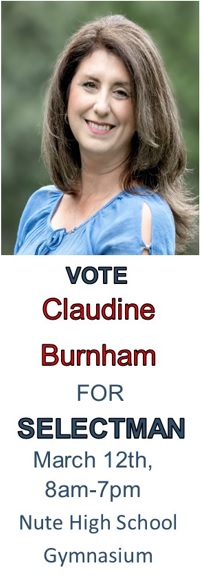
Burnham for Selectman – 2024

By Claudine Burnham | March 11, 2024

Over the last three years, I have enjoyed being one of your three Selectmen. As a Burnham for SelectmanBoard member I have kept my word about keeping the tax rate as low as possible and returning as much surplus back to the Milton taxpayers. Being on the Budget Committee and CIPC (Capital Improvements Plan Committee) the last three years and getting a better understanding of the where and why money is needed and its level of importance to our departments and residents have been a tremendous source of knowledge in making difficult decisions as a Selectman. Since my appointment in 2020 and election in 2021, I have been a strong supporter in tightening the town budget and returning your tax dollars by reducing the tax rate while maintaining with our 2% tax cap. Milton’s taxpayers have received back over $1.5 million dollars over the last three years.

Two years ago when Strafford County increased our county tax significantly by 20%, I invited the County Commissioners to give an explanation to our residents at a Board meeting. This was a first for Milton and a first for one of our forty-year Commissioners. Milton now has a dialogue with the county. Just because we are a small town, does not mean we do not matter. As a Selectman, moving forward we will have a better strategy to help keep those county tax increases down and be treated fairly among the county community. As your Selectman, I invited out State Representatives and Executive Councilmen to give reports to our residents and to open communications for better representation at our State level, as well as keeping us in the loop with important local concerns that are decided for us at the State House.

When issues with residents and businesses were raised, I addressed them with urgency and assisted in resolutions quickly. However, in 2023, the town had numerous challenges that no one could have predicted. The number of road washouts and bridge issues due to storms and increased rain weather had the Board moving as quickly as possible to find the funding to help residents restore their roads, driveways and homes. I, along with our Road Agent, met with our State DPW Commissioner and Executive Councilman to assess the infrastructure issues and how the state could better assist us in the future. This of course came at the heels of when the Board was moving forward with refurbishing the new Town office in hopes of moving in before the Fall. As in any building project, communications issues developed which led to delays. And just to note that most of the expenses for this project and office move was supported by ARPA (American Rescue Plan Act) and did not raise local tax dollars. Much thanks to the tremendous support from our departments and staff to get this project completed.

As we move forward with several road construction and bridge projects, the major project ahead is the wastewater treatment facility. This project not only concerns the 330 residents relying on the wastewater service, but will be the burden to all Milton taxpayers, costing us over $20 million. Connecting to the Rochester line will force additional residents up and down Route 125, who will be at the mercy of Rochester costs and fees. We need to explore alternative solutions to find the most cost-effective and bring the final say back to YOU, the voters of Milton.

Thank you for considering me for a second term.

Claudine Burnham

Ayers for School Board – 2024

By Katherine Ayers | March 11, 2024

Why am I running for re-election as a school board member?

I care about Milton as my home community and am concerned about the empty commercial buildings and others in our town center that are up for sale and/ or recently or likely scheduled to be torn down. What has happened to our vitality of yesteryear and why are we not growing in population like our neighbors?  A good part of the answer lies in the state of our schools which is of prime importance when young families consider the best place to move. In the past few decades, we have been most attractive to retirees and summer vacationers because they don’t care if our schools have been performing in the lowest 5% academically within the state.  I ran for school board last year to help find a way to provide a finer academic offering to our children as well as to bring value and commercial viability back to our town.  This is not an easy nor simple task, but progress can be seen.

There has been some improvement in our test scores in 2022-23 with, hopefully, more to come in the 2023-24 academic year which ends in June, but we are still way below the state average in language arts, math and science throughout the district.

What other improvements have been made you ask?

NEW GOALS

I am pleased to have been part of the formulation of new Milton school board goals for this year and next which are focused on 3 critical arenas:

1)   Substantial and measurable academic improvement
2)  Teacher retention and quality enhancement
3)   Building sustainable grant funding to support these 2 goals.

The school board has been focused on these 3 goals which are printed on the back of every school board meeting agenda sheet.

NEW TEACHER PAY

Two of the things that have hurt Milton’s school standing is our teacher turnover and their experience level mostly due to lower-than-average pay. As a step in the right direction, we have put a proposed increased teacher compensation plan before the voters in next week’s election with the sincere hope that you will support it.

NEW CURRICULA

We are also continuing to study, add and evaluate innovative educational curricula in order to drive our academic standing to a higher plain.

DEVELOPMENT of 5 C’s

But academic success is only one measure of preparing our youth to be ready for the challenges of adulthood.  Our ever-changing world will require big doses of what I call the 5 Cs of education: critical thinking, character, communication, collaboration, and creativity. These attributes cannot be measured by an annual standard test but should be considered when developing curriculum, individual projects and group assignments throughout the year.

Every child deserves to feel ready to meet the world upon high school graduation. Milton cares about their children and wants them all to succeed in their chosen pathways.

Milton needs a concerned and committed school board, administration, teachers and support staff working together to provide great schooling for our youth, a good value for the town taxpayers, and a great future for our town! The work continues and I would very much like to continue as part of it.  A vote for Katherine Ayers for School Board will be a vote for a brighter future. Hope to see you all at the polls.

Katherine Ayers

Bureaucrat, May I?

By Ian Aikens | January 2, 2024

Should a person get fined or jailed for failing to obtain permission to work from the government? Does government licensing and certification actually keep the public safer? Should government officials or consumers decide who is allowed to serve the public?

I bring up these questions because of a bill that hit the State House this year. HB507 was a controversial bill that would have removed penalties for failing to get a license to practice in certain occupations. Contrary to claims made that it would have eliminated all licensing and turned New Hampshire into the Wild West, the bill would have simply removed the penalties but left the current licensing system in place without dismantling it.

This shouldn’t have been a big deal, but when it comes to “stakeholders” in the status quo, this was like a declaration of war. Players with vested interests—and lots of dollars at stake—weren’t about to allow other competitors into their coveted and protected occupations without a fight, so they descended upon the State House to lobby all the state reps to kill the bill. A Realtor friend of mine told me that he received numerous emails from his trade association for a “Call to Action” to bombard the state reps with emails to ensure defeat of the bill. It was laid on the table by a vote of 308 to 71, so it is history for the balance of this legislative session.

A little background on state licensing is helpful to understand the forces at work on this issue. If you want to see an area of public policy that makes no sense at all—and is truly a Wild West of its own—just take a look at state occupational licensing. It is a crazy patchwork of laws and rules that boggle the mind and vary drastically from state to state. Their only common feature is that the rules are completely arbitrary but are always framed as being necessary for “public health” and “safety.” Heaven forbid that the government might not keep us all “safe.”

To fully appreciate the absurdity of state licensing, here are some of the occupations currently licensed by some states: florists (Louisiana), social and human services assistants (Ohio), home entertainment installers (3 states), hypnotists (3 states), interior designers (3 states), travel agents (5 states), title examiners (7 states), furniture upholsterers (9 states), farm labor contractors (10 states), bartenders (12 states), locksmiths (12 states), and interpreters of sign language (22 states). Yes, an unlicensed florist might sell droopy flowers, and the sounds from your newly installed home entertainment system might not hit the perfect notes, but are these really matters of life and death? Obviously, if “public health” were really the issue, then all states would be licensing these occupations; rather it looks like certain “stakeholders” are more active in some states than others.

Let’s start with the not insignificant costs of licensing. Estimates are that consumers pay a premium of 15% extra to receive services licensed by the state. This translates to an annual loss of 2.8 million jobs and a cost of $203 billion. While states do the bulk of licensing, cities, counties, and the federal government sometimes require additional licenses in order to work as they want their “fair share” of the loot too.

Despite America having the reputation for being free-er, government licensing is actually a heavier burden here than in the European Union. Depending on the European country, licensing ensnares 9-24% of all jobs, whereas in the United States, it’s now 25-30% of all jobs, which is up significantly from less than 5% in the 1950’s. By field, it’s now more than 75% for healthcare, 67% for the law profession, and 50% for education. The way things are going, one may soon need a license and degree to work at McDonald’s!

So how does New Hampshire compare to other states when it comes to economic freedom to work? Generally a lot better than many other states, but there’s still plenty of room for improvement. It licenses 37 of 102 of the lower income occupations; that’s 36% for New Hampshire, while the national average is 53%. For burden rank, where first is the worst, New Hampshire ranks 19th in the country. For a combined ranking of the number of licenses times the average burden, New Hampshire does better at 42nd in the country. Our average licensing fees here are $209, while the national average is $284.

We do have 54 different licensing boards here under the Office of Professional Licensure and Certification. The roster doesn’t look as crazy as in some states, but right off the top, a few definitely are ridiculous if one is really concerned about “public health” and “safety”: CPA’s, architects, auctioneers, court reporters, engineers, family mediators, foresters, genetic counselors, geologists, land surveyors, natural scientists, real estate agents, real estate appraisers, recreational therapists, and septic system evaluators. Most of these professions are white-collar jobs, and of course everyone wants competent, ethical professionals, but can you really say with a straight face that, if a white- collar worker messes up, someone will expire? I don’t think so, but that hasn’t stopped vested interests from using the public health and safety cover for protectionism.

I went through all 54 boards to examine board actions taken against individuals or companies in violation of the law. Out of the 54 boards, a full 18 boards had taken not a single board action at all. That right there should be reason enough to thank them for their services—and disband them permanently. The boards of Barbering, Cosmetology, and Esthetics; Electricians; and Nursing had the most board actions. Pharmacy and Medicine had a modest number of actions taken, and all the rest of the boards had either few board actions taken or none at all.

Many of the actions taken by the bureaucrats on the various boards clearly were administrative violations. Common problems were lapsed licenses, not having your photo on your license, not completing all your continuing education hours, and supervising unlicensed contractors. Working without a license also popped up a lot, and that is considered an especially serious violation. As Milton Friedman noted, “Hell hath no fury like a bureaucrat scorned.” To government officials, there really is nothing more important than that magical piece of paper with an official government stamp to ensure safety. Unfortunately, it might actually make the public less safe by providing a false sense of security to the public that every licensed professional by the state has been completely vetted, and there is no need to do any further due diligence on the person or firm.

The next category of board actions contained more legitimate concerns but didn’t rise to the level of “public safety.” Often, they were complaints of not living up to the terms of a contract. One real estate broker didn’t pay commissions. A funeral director did not secure headstone engraving services that had already been paid for in advance. Complaints such as these could be handled by the courts as tort law is one of the few legitimate functions of government. Even a non-governmental organization such as the Better Business Bureau (BBB) could resolve such conflicts. I once had some work done around my home and was unhappy with how it turned out. When the contractor refused to return my calls, I filed an official complaint with the BBB, and I received a call from the contractor the very next day. Within a week, I had received a check as compensation for a less than satisfying job.

Let’s not forget the importance of reputation when it comes to serving the public. Customer satisfaction is the number one factor in determining the success or failure of a business. If word of mouth gets around that an individual or company is pleasing its customers, it will likely succeed and grow. Obviously, the reverse is also true: if it performs poorly, it will soon run out of customers. A golden reputation and happy customers—not government busybodies—are what drive best business practices.

Another category of board actions was directed at various forms of unprofessional conduct. A drug counselor told inappropriate jokes and used foul language. A recreational therapist “crossed boundaries” and smoked pot with a former client. A guardian ad litem didn’t maintain “professional boundaries.” These types of problems could and should be handled by professional trade associations, not government bureaucrats. I checked all 54 boards and found specific trade organizations for every single board category except Manufactured Housing, which is a special board created by the state legislature in 1994 to settle disputes between park owners and residents. (Arbitration, or the courts if necessary, could have handled such disputes.)

Professional trade organizations of every sort exist at the local, state, national, and even international levels. These professional associations do their own policing and maintain higher standards than those set by government licensing bureaucrats. Obviously, they aren’t doing this out of the goodness of their hearts, but rather because it makes good business sense. If they have rogue members of their trade out there serving the public poorly, that reflects negatively on all of their members, so they have every incentive to discipline (or banish if necessary) members who don’t live up to the standards of the association. My Realtor friend told me that his trade association has ethics and judicial committees to deal with unprofessional members. As always, reputation is key.

The downside to the trade associations is that they have gotten lazy over the years and are tending to rely on government licensing administrators to do some of their policing. And of course they don’t mind a little dose of good old-fashioned protectionism to keep out competitors—and charge higher prices—by lobbying for more licensing boards and raising the requirements for licensing. Trade associations operating almost like trade guilds in the past still serve an important purpose today, but they could be even more effective without the presence of government bureaucrats.

There were definitely some licensing board actions that actually dealt with “public health” issues. Nursing, pharmacy, and medicine all had a lot of substance abuse problems: stealing drugs, under the influence, found asleep in patient’s bed drunk, and mixed up prescriptions. Also, there were a fair number of complaints of sexual assault and “inappropriate touching.” Again, these kinds of complaints should be investigated by professional associations, and if found guilty, the culprits should be disciplined. The loss of professional standing would be a red flag to potential customers or employers. The sexual assault complaints could very easily lead to law enforcement involvement and possible civil suits.

The Barbering, Cosmetology, & Esthetics Board clearly had the most board activity of all 54 boards. Aside from the usual administrative problems like expired licenses, licenses without pictures, and licenses not displayed, most of the fines issued by the board were for sanitation problems: tables not cleaned properly, unopened pack of bladed rasp files, whirlpool/foot spa/spa not disinfected and covered as required, bowl not maintained or covered as required, and so forth. I’m not so sure that each of these violations really threatened anyone’s health to the point of actually getting sick or infected, but let’s be on the conservative side of sanitation and assume these problems threatened the public. If government inspections didn’t occur, how would the public be protected?

When it’s the facility, rather than the professional, with a problem, it should be the insurance company that checks up on the business. As with trade associations, the insurance company wouldn’t be doing inspections out of altruism, but rather out of pure business sense. If a nail shop, for instance, is unsanitary enough that a customer gets infected there and sues the business, it would be the insurance company that gets stuck with paying the claim. Therefore, it behooves the insurance company to ensure the sanitary standards of the business are high. Unfortunately, the downside to government bureaucrats doing the inspections is that the insurance companies have also gotten slack and rely on the bureaucrats to do their job. And if the bureaucrats miss a violation or two (due to sloppiness or even possible corruption), who will be held accountable?

I know for a fact that the market sometimes works this way—even with government busybodies—because I used to work in the bedding industry. Our facility was always inspected in person when we changed insurance companies because our employees tended to store samples in closets, and they would pile them up to the ceiling causing a possible fire hazard. The insurance company would always make a fuss about this, so our employees scrambled to “clean house” before an insurance company visit.

So, what can be done to rein in the licensing-industrial complex in New Hampshire? We can look to other states to see what has worked elsewhere. There are very few successful instances where de-licensing has worked, despite many attempts all over the country. Sunset committee reviews have often recommended de-licensing only to have legislators vote against the recommendations. Conversely, legislators have often sponsored bills for licensing reform only to have their bills die in committee.

Colorado provides as good an example as any for successful de-licensing. Per recommendations by its state auditor and sunset committee reviews, the legislature repealed the mandatory licensing of funeral directors in 1981 and abolished its 70-year-old licensing board. It did, however, keep a “title protection” requirement in place that does not allow anyone to advertise or present themselves as a “funeral director” unless they have practiced for 2,000 hours, interned as a “funeral director,” or handled at least 50 funerals or graveside services. This is a reasonable alternative to government licensing as those consumers in need of such services who are more comfortable with the government-sanctioned title can choose a “funeral director” and those consumers less concerned with titles—who just need the services performed—might choose the less glamorous “mortician” or “undertaker.” I say, let the consumer choose!

HB507, by the way, did include such a title protection clause with the wording, “Nothing in this section shall prevent an unlicensed person engaged in providing services of any profession regulated by the Office of Professional Licensure and Certification under this chapter as long as the person does not advertise or hold themselves out as being licensed.” So, it was a good first step—and actually a very tame one—to offer consumers more choices for services. This might have actually forced state-sanctioned licensees to provide or offer better services to their customers.

I hope in the near future a similar attempt to dismantle the licensing cartels materializes again. Not only do they keep the costs of goods and services higher for everyone than they would be otherwise; they also keep those on the lower end of the economic ladder on the bottom rung. Shamefully these are often the very same folks who profess to “help” the working poor. The hypocrisy is breath-taking. How about something novel like just letting the working poor … work?

(Editor: NH State Representatives Bailey, Burnham, and Granger, who represent Strafford District 2 (Milton and Rochester Ward 5), were among the 71 representatives that voted against tabling HB507. They may or may not have been in favor of it, but they voted against not voting on its issues).


References:

Flatten, Mark. (2016, December 6). Goldwater Institute. Protection Racket: Occupational Licensing Laws and the Right to Earn a Living. Retrieved from www.goldwaterinstitute.org/protection-racket-occupational-licensing-laws-and/

Institute for Justice. (2023). New Hampshire Occupational Licensing. Retrieved from ij.org/report/license-to-work-3/ltw-state-profile/new-hampshire/

LegiScan. (2023). HB507: Relative to unauthorized practice in occupational licensing and certification. Retrieved from legiscan.com/NH/text/HB507/id/2636197

NH OPLC. (2023). Find a Board. Retrieved from www.oplc.nh.gov/find-board

U.S. Bureau of Labor Statistics. (2015, May). The de-licensing of occupations in the United States. Retrieved from www.bls.gov/opub/mlr/2015/article/the-de-licensing-of-occupations-in-the-united-states.htm

Boots on the Ground

By Ian Aikens | October 30, 2023

Do you ever get tired of the US government’s involvement in overseas wars? Can its addiction to a perpetual state of interventionism in other countries’ conflicts ever be cured?

I believe there is cause for optimism. Recently I was at the State House for a working session meeting of the Federal-State Relations and Veterans Affairs Committee considering HB299. This bill, known as the “Defend the Guard Act,” would insist on the US Congress officially declaring war before any New Hampshire Guardsmen could be deployed overseas. As the committee had already been through more than six hours of testimony at a public hearing on February 3, it only allowed further testimony at this meeting by a few selected individuals who could add something new to the discussion.

First some basic facts about National Guard deployment overseas. They made up 45% of the US armed forces that fought in the Iraq and Afghanistan wars—and 18.4% of the total American casualties. New Hampshire gave its “fair share” of lost lives. Over the years, since World War II, National Guardsmen have been sent all over the planet to such faraway lands as Vietnam, Saudi Arabia, Kuwait, Iraq, Bosnia, Honduras, and Afghanistan under the noble-sounding slogans of “Operation Iraqi Freedom,” “Operation Enduring Freedom,” “Operation Spartan Shield,” “Operation Inherent Resolve,” and “Operation New Dawn.” Those arguing against the bill reinforced this point that the US military is very dependent on the National Guard to do its job. Never mind that the specific goal in mind is never quite clear, especially since the “war on terror” began in 2001. They viewed this as a risk to our country’s “national security,” should the supply of foot soldiers ever run out.

Ah yes, that holy grail “national security” used to justify every military adventure overseas. They neglected to mention that the only two times that America was attacked within its own borders in modern times (Pearl Harbor and 9/11), people were signing up to join the military left and right. Lack of manpower to fight an attack on US soil has never been a problem; however, when the wars have been for other countries’ conflicts, that’s a completely different matter that explains why folks might not be so keen to soldier up.

Of course, there’s nothing in the bill actually forbidding the New Hampshire Guard from being deployed overseas, except for one pesky little detail—the US Constitution. Article I, Section 8, Clause 11 delegates the exclusive power to declare war to Congress, not the President. Unfortunately, that duty of Congress has been ignored for the last 81 years as World War II was the last time Congress bothered to declare war, even as America’s participation in foreign conflicts goes on and on.

Real accountability is what’s been missing all these years. If Congressional representatives know that their constituents are going to see that they voted to risk American lives in overseas exploits, there’s going to be a robust discussion in Congress about whether to declare war or not. There’s bound to be pushback on foreign conflicts, but there’s virtually no chance of Congress having any trouble declaring war when an attack occurs on American soil; after Pearl Harbor, only one member of Congress voted against declaring war.

Accountability to the public slices two ways. As opponents of the bill pointed out, Congress already controls the purse strings of military funding by voting on appropriations, so it could reduce or end National Guardsmen deployment overseas right now by defunding such spending. So, they asked why this bill is even needed. Indeed, they were correct, but in the real world of Congressmen getting their political donations from military contractors, it is considered political suicide to cut military spending. Congress is perfectly OK with funding “national security” with easily printed dollars, and amazingly there has been no significant pushback from the public, even as many have tried over the years. But, if there were a debate forced by the requirement of a declaration of war, lawmakers would incur more political risk of backlash from the public. Easy money—no problem; boots on the ground—possible pushback from constituents.

Indeed, it’s about time for some pushback against the warmongers in both parties. Have you heard some of the crazed statements coming out of the mouths of some public officials and pundits in response to the latest trouble in the Middle East: “Finish them!” and “…we should go after Iran.” To the warmonger mentality, there is an enemy under every rock, and America must take the lead to save the world for “democracy.” That the United States government often goes into battle overseas under the guise of consensus of the United Nations isn’t fooling anyone; it pressures other nations to go along and the bulk of the fighting soldiers are always from the United States.

A sobering report from the US Army War College (appropriately named) recently predicted casualties of 3,600 per day if the US government were to get into a war with Russia or China. (Never mind that the warmongers are now calling for war with Iran, Syria, and Lebanon too.) The US military would need not only the life of every New Hampshire Guardsman it could get its hands on—the report recommended bringing back partial conscription. Even the return of (partial) slavery would be acceptable to the warmonger mindset.

One thing that came up during the hearing was that somehow the bill would undermine veterans and their benefits. Two veterans gave extensive testimony for many reasons to oppose the bill, and I think favorable public support for veterans pushed some committee members to vote against the bill later during executive session after the hearing. I see it differently. If Congress had to declare war before deploying New Hampshire Guardsmen overseas, that would keep a lot more of them here—and alive—or in other states, if needed, helping out during emergencies and natural disasters. Keeping them on US soil helping Americans rather than risking their lives and adding to death and destruction abroad—how would that demoralize them?

The threat of a cutoff of federal funding if this bill were to pass was another problem noted. Yes, the federal government does fund 96%-98% of New Hampshire Guardsmen costs—$395 million annually—but wouldn’t much of that cost be reduced if less (and hopefully not any) New Hampshire Guardsmen were deployed overseas? War and its aftermath are expensive—deaths, injuries, suicides, substance abuse, and psychological and family problems. Thus the $395 million threat is way too high, and surely a few useless state bureaucrats could be deployed to more useful work in the voluntary sector to help make up the budget shortfall.

Another objection raised was the recent situation in the US House of Representatives where there was no Speaker of the House. How could war be declared in an emergency if there’s no speaker? Wouldn’t this tie the hands of the military in a real emergency? To me, this sounded like grasping at straws because, if the country were really attacked again, I have no doubt that both parties would pull themselves together very quickly and elect a speaker so they could formally declare, just as they did after Pearl Harbor.

Another issue discussed in the hearing was about deploying National Guardsmen overseas when they are needed at home during a natural disaster like Hurricane Katrina. One of the vets opposing the bill insisted that the federal response in Louisiana was not compromised by National Guardsmen serving overseas. That was countered by supporters of the bill who felt that less lives would have been lost in that disaster had more Guardsmen been available in New Orleans, because in a flood, every helping hand counts.

During the hearing there was some very informative and compelling testimony. Representative Granger gave moving testimony noting how one of the co-sponsors of the bill (former Representative Adjutant) read out loud all 23 names of the New Hampshire Guardsmen killed in action in the Iraq on the New Hampshire House of Representatives floor and led a moment of silence to remember them. He also noted that the list of 23 was probably not the final toll because it didn’t include suicides of veterans who returned from the war that are never included in the official figures. All this for a “conflict” which included about 4,500 American military casualties and at least 200,000 civilian deaths (several estimates are much higher). There was also persuasive testimony from Representatives Mannion, Potenza, Wheeler, and Gerhard.

Representative Pauer put forth an extremely detailed analysis of the bill supporting it but noting a few shortcomings. She felt that the words “instrumentality of war” in the bill went beyond the original intent of the bill by eliminating any services provided by New Hampshire Guardsmen with military equipment (mostly training, not actual combat duty), so she introduced an amendment deleting that clause but leaving everything else intact. That amendment was voted down 8-11.

For those who keep track of partisan politics, support of and opposition to the bill was mostly determined by party line—Republican committee members supported it, and Democrats opposed it. But there were notable crossovers to the other side on both sides. The second vote on the bill was to ITL (Inexpedient to legislate) it—essentially kill the bill for the rest of this legislative session, and thankfully the motion failed by a vote of 8-12. A final vote of OTP (Ought to pass) ended in a 10-10 deadlock. It will go to the full New Hampshire House of Representatives for a vote in early January with No Recommendation since there was no majority.

Interestingly three of the committee members who voted against the bill on the final vote took the time to explain their votes before they cast them. All expressed support for veterans, but for a variety of reasons could not support the bill. I have to say I respect these folks though I disagree with them. At least they made the effort to explain to a room full of citizens who came out to support the bill—many of them veterans themselves—their reasons.

As for the remaining opponents, I must say I feel disdain for them. Are war, foreign interventionism, military deployment, massive spending of tax dollars, and the accompanying collateral damage—not to mention following the Constitution—not important enough issues to at least offer a thought or two?

We will find out next year what happens with this bill. Will New Hampshire be the first state to finally help bring real accountability to Congress? Will our legislators take a stand to finally force a more thoughtful foreign policy? Will a first step finally be taken not to sacrifice more American lives in vain for the mad dreams of empire builders?


References:

Brown, Daniel and Haroun, Azmi. (2022, August 26). Business Insider. The wars in Iraq and Afghanistan have killed at least 500,000, according to a report that breaks down the toll. Retrieved from www.businessinsider.com/how-many-people-have-been-killed-in-iraq-and-afghanistan

Cerre, Mike. (2021, July 5). NH PBS. After wars in Iraq and Afghanistan, rethinking how National Guard are deployed. Retrieved from www.pbs.org/newshour/show/after-wars-in-iraq-and-afghanistan-rethinking-how-national-guard-members-are-deployed

Crombe, Katie and Nagl, John A. (2023, August 25). The US Army War College Quarterly. A Call to Action: Lessons from Ukraine for the Future Force. Retrieved from press.armywarcollege.edu/cgi/viewcontent.cgi?article=3240&context=parameters

Jean-Louis, Magda; Fetterhoff, Whitney; and Hadar, Mary. Washington Post. (2013, February). Faces of the Fallen. Retrieved from apps.washingtonpost.com/national/fallen/branches/army-national-guard/

LegiScan. (2023). HB229: Relative to requiring an official declaration of war for the activation of the New Hampshire national guard. Retrieved from legiscan.com/NH/text/HB229/id/2626383

NGAUS. (2021, December 14). U.S. Combat Mission in Iraq Ends. Retrieved from www.ngaus.org/about-ngaus/newsroom/us-combat-mission-iraq-ends

NH General Court. (2023, October 11). House State-Federal Relations and Veteran Affairs. YouTube. Retrieved from www.youtube.com/watch?v=9ZAGT0omCEE&list=PLfTxvjbRJcUKnAlv3Ujgy_EEwFW3Th4te&index=6

Wikipedia. (2023, September 28). Casualties of the Iraq War. Retrieved from en.wikipedia.org/wiki/Casualties_of_the_Iraq_War

Early Dismissal

By Ian Aikens | October 6, 2023

When is a child no longer a child? And who will decide that? This is an age-old question that all parents have to ponder within their own families sooner or later. The reason I bring this up is an amazing bill that was introduced this past legislative session. It was laid on the table (will be reconsidered at a later date), but the word on the street is that it will be resubmitted again next year with some modifications.

HB399 would have exempted any child aged 13 or older from compulsory school attendance if the child has passed “a test that evaluates skills appropriate to a New Hampshire high school graduate.” It also included a clause forbidding burdensome regulations for graduation intended to reinforce compulsory high school attendance. Furthermore, if a college or university accepts any state funding, it may not turn away a student who passed the test or its state funding will be reduced or cut off.

This would have been an excellent opportunity to allow gifted students to move on with their lives and not languish for years in substandard government schools. This would have allowed those few Wolfgang Mozart’s or Pablo Picasso’s that occasionally materialize to start college early, get an early start on a trade certification, perhaps start a business, or maybe even invent something new. Who knows? Sky’s the limit when it comes to the mind—even a very young mind.

Why hold the real brainy or talented kids back if they can pass a high school literacy exam? Don’t ask the educational establishment! It has loads of objections, but the one it won’t be mentioning is the real reason: if we start allowing kids—even a small number—to escape the system, this will be a direct threat to our jobs. The teachers’ unions will fight to the death to “save public education” by ensuring that the current one-size-fits-all system allows no escapees. As it is, they’re completely triggered by any and all forms of school choice—homeschooling, tax credits, education freedom accounts (EFA’s), even charter schools.

The most obvious objection to the bill is that 13-year-olds are simply too young to be released into the wild. But isn’t “public education” supposed to be about literacy? Part II, Article 83 of the New Hampshire Constitution is very specific about the purpose of public education: “Knowledge and learning, generally diffused through a community, being essential to the preservation of a free government.” It says nothing about age or emotional maturity. Why should a child’s birth age be a factor when it comes to literacy? As we all know, some children are “old souls” at a very young age—and unfortunately some adults still behave like children. Shouldn’t it be up to the parents to decide if their child is mature enough not to be babysat in school anymore? Wouldn’t they know better than anyone else—especially government bureaucrats—when their child is ready to start taking charge of his or her life?

Then we have the objection that “public schools have made accommodations for exceptional students through tutors, advanced programs, dual enrollment programs at community colleges.” Tutors—that’s insane! A child who can pass a high school literacy test early definitely doesn’t need a tutor. As for community colleges, they are widely known for remedial work these days due to the dismal academic track record of government schools, so this option makes little sense for the gifted. While it’s good that these “accommodations” are in place, none of them might be quite the right fit for each really bright student, so why force these students into one of these options? Why not allow these students to opt out and choose their own paths for the future? No reason to remove any of the current options—simply allow a test-out option. 

Another objection is that the bill “would lower the level of difficulty and the intellectual content of academic/graduation standards.” How so? Why would a literacy test for early graduation lower the standards? Right now, there are no standards at all. Routinely thousands of New Hampshire high school students graduate every year who are not proficient in the basic areas of reading, mathematics, and science (see my article last month), so how would an optional literacy test that few students would be taking lower non-existent standards?

Yet another objection is that there is already a process in place “for parents to sign off for the best interest of their child to appeal (my emphasis) to their local high school counselor to seek a HiSet (high school equivalency test) exam.” Appeal?! You’re the parents and know your child better than anyone else on this planet, and you’re going to “appeal” to a bureaucrat for permission for your child to take the test? Who works for whom? Not to mention that an educational bureaucrat who is a member of the local teachers’ union that always feeds on having more kids in the system is unlikely to grant divine permission.

Another objection is state control versus local control. The argument is that, if the state designs a special test for early graduation, that takes away local school districts’ discretion about deciding what the standards should be. This is total nonsense. I spoke to an official at the New Hampshire Department of Education earlier this year about why the state doesn’t have a graduation test requirement, and I was told that there is nothing in the law to stop any local school district from creating their own graduation test right now—no need to wait for the state to produce one. Obviously with their sorry state of academic “achievement,” school districts are in no rush to design anything that might hold them accountable to the taxpayers, and I am not aware of any school district in New Hampshire that has a mandatory graduation test. Of course, the moment you bring up a graduation test, then suddenly they are worried about loss of local control.

We also have the issue of cost. The New Hampshire Department of Education had 327 employees in 2022 (up from 302 in 2021). I don’t think it’s a stretch to expect that out of all those 327 employees, some could be tasked with the job of designing a literacy test for early graduation—without any additional hiring. The fiscal note of the bill mentions that local school districts could have to pick up some additional expenses to cover the cost of administering extra exams if more students take them. I can’t imagine these costs to be significant with the current state of bloated government school budgets, but if there were a run of students wanting to take the test to escape from high school early, the solution would be to charge the students themselves for taking the test. Such a user fee would discourage frivolous taking of the test on the taxpayer dime.

In the end, will our folks in Concord decide that the obsession with age serves no one but the educational establishment? Will they honor individuality and allow a few students to get an early start on adulthood and flourish?


References:

CitizensCount. (2023, March 12). Should NH allow students to test out of the requirement to attend high school? Retrieved from Should NH allow students to test out of the requirement to attend high school? | Citizens Count

LegiScan. (2023). HB399: Allowing for a testing exception for graduation from high school. Retrieved from Bill Text: NH HB399 | 2023 | Regular Session | Introduced | LegiScan

Accountability Time

By Ian Aikens | September 6, 2023

Do you ever wonder where your property taxes go and if the money is well spent for “the common good?” A cursory look at your property tax bill tells you most of your money goes to government schools for “education.” For the “well spent” part of the equation, let’s take a look at the proficiency results for Milton’s schools:

Cost Per Pupil Entity 2019
ELA* Math Science
$17,561 Milton District 36% 15% 16%
$25,294 Nute High School 36% < 10% < 10%
$20,307 Nute Middle School 33% 12% 15%
$17,725 Milton Elementary School 39% 19% 27%
Cost Per Pupil Entity 2022
ELA* Math Science
$19,828 Milton District 25% 17% 22%
$26,976 Nute High School 36% < 10% < 10%
$21,088 Nute Middle School 27% 17% 17%
$21,501 Milton Elementary School 21% 17% 32%

*English Language Arts

I have included the figures for 2019 to counter the oft-repeated excuse for this dismal failure of Milton’s government schools that it was the remote learning during the pandemic that caused the scores to slip.  The fact is that they were lousy before the pandemic, and they are just a little worse now.  (Actually, they are a little higher in Science now).

If it’s any comfort to Milton’s taxpayers, the rest of New Hampshire’s government schools are not in much better shape as proficiency scores of less than 50% are common throughout the state, especially in math and science.  However, it looks like Milton’s government schools could qualify for the booby prize for both years as they rank in the lower 25% range across all levels in all areas except for Milton Elementary, which ranked in the middle 50% statewide in science in 2022.  Not that 32% proficiency is anything to write home about.

One question you might ask is why the New Hampshire Department of Education reports “less than 10%” in some categories, rather than the actual figures.  Could it be the new avant-garde math that has many parents (and apparently students) so confused?  No, not really.  I’ve been told the bureaucrats’ reason is because when the number is so low, the public could presumably figure out who the student is, and that would be a violation of confidentiality.  Heavens to Betsy, even if there is only one student that is proficient in math (and at Nute High School, that’s a real possibility), and the public could figure it out, would that be so tragic?  These days, apparently so.  I suspect that sheer embarrassment for school bureaucrats has more to do with the imprecise score than privacy concerns.

Another thing I might point out is how consistently the government spends more per student as the child progresses from elementary to high school.  (That doesn’t quite hold true in 2022 comparing Milton Elementary to Nute Middle School).  Does it make sense to put more resources into educating students once they are able to read and learn a few things for themselves?  Shouldn’t a high school student be able to work more independently than a grade school child?  Do high school students still need to be babysat?  This emphasis on spending more on young adults than children is completely twisted and an indication that something is very amiss.

So, what are we going to do about this mess?  Well, forced taxpayer funding of “education” isn’t going away anytime soon, but one thing could help lessen “the tragedy of the commons.”  I hang out at the State House, and the word on the street is that some state representatives are working on a bill for this upcoming session to introduce an actual high school literacy test as a graduation requirement.  Yes, rather than graduating virtually anyone who shows up at school somewhat regularly (under threat of fines to their parents for noncompliance)—whether they are actually literate or not—students will have to pass a high school literacy test in order to be awarded a diploma.

Of course, the teachers’ unions will recoil in horror if the bill progresses along, as they like the current setup of no accountability just fine, but they shouldn’t lose too much sleep.  After all, these are government schools—let’s not reach for the moon!  The test will likely be similar to the Massachusetts Comprehensive Assessment System (MCAS), which isn’t all that tough.  Students in Massachusetts start taking the test in the 10th grade, and they have two additional years to pass it.  Furthermore, they have all kinds of accommodations for English Language Learners (ELLs) and students with disabilities.  But it is finally a step in the right direction because it puts the incentive for students in the right place that just showing up and coasting along will not cut the grade in New Hampshire anymore.

It also puts teachers and school bureaucrats on notice that they have to do a better job of promoting literacy.  Isn’t that what they get paid for?


References:

MA DESE. (2023, August 29). Massachusetts Graduation Requirements and Related Guidance. Retrieved from www.doe.mass.edu/mcas/graduation.html

NH DOE. (2022). School And District Report Card. Retrieved from dashboard.nh.gov/t/DOE/views/iReport/FrontPage?%3Aembed=y&%3Aiid=1&%3AisGuestRedirectFromVizportal=y&%3Atabs=no&%3Atoolbar=no

Milton Town Election (March 28, 2023)

By John S. Frum | March 27, 2023

The Town election, delayed by the snowstorm of March 14, will take place instead tomorrow, March 28, 2023, at the Nute High School Gymnasium (22 Elm Street), between 8 AM and 7 PM.

As previously, the Milton Observer has been willing to publish statements from any and all candidates.

I received this candidate slate leaflet last weekend in front of the Transfer Station. I publish it here on election eve for your consideration.

March Election Slate - 2023

One may find a link in the References below to the Town Warrant, including all those candidates that filed (Article 1 of the Town Warrant (minus any “Write-In” candidates)).

Best of luck to all who have put themselves forward for Town offices!

References:

Milton Town. (2023). Town of Milton Voters Guide. Retrieved from https://www.miltonnh-us.com/sites/g/files/vyhlif916/f/news/2023_voters_guide_2b.pdf

Milton Budget Committee Candidate

By Renata Gamache | March 12, 2023

Hello Milton Residents,

My name is Renata Gamache and I am running as a Write-In candidate for the Two-Year Budget Committee position. I have a degree in accounting, and I believe in fiscal responsibility. I am a fiscally responsible individual and would be an asset to the Budget Committee in helping analyze the School and Town expenses.

On Tuesday, March 14, 2023, please Write-In my name for the Two-Year Budget Committee position.

Renata Gamache

Signage- Gamache, Renata - 2023


[Editor: Per usual, the Milton Observer is willing to publish such statements from candidates for Milton town offices.]


References:

Town of Milton. (2023). 2023 Town of Milton Voter’s Guide. Retrieved from www.miltonnh-us.com/sites/g/files/vyhlif916/f/news/2023_voters_guide_2b.pdf

The Impossible Nightmare

By Ian Aikens | June 4, 2021

Re-education camps for white executives of Sandia National Laboratories in Livermore, California? An infographic at the African-American History Museum in Washington D.C. that lists “self-reliance, objective and linear thinking, hard work, the nuclear family, planning for the future, written tradition, and politeness” as aspects of “White Culture”? A white high school student at a Las Vegas charter school forced to take a mandatory civics class for graduation that required students to reveal their race, gender, sexual orientation, and disabilities and then determine if privilege or oppression is attached to any of these identities?

What madness is going on here? It’s called Critical Race Theory (CRT), and it’s been around for decades festering in the academic world, but it is now in full bloom in the corporate world and educational system. Under the guise of equity and diversity, CRT’s alleged goal is to make this a more just society. In reality, it will only make things worse for minority members of society.

CRT’s basic premise is that American society is inherently and hopelessly racist and can only be fixed with a total restructuring. The most basic tenet of CRT is the complete absence of individualism. All of us are not individuals but rather part of socially constructed groups. Furthermore, there are two basic groups—oppressors (whites) and the oppressed (non-whites). To say that CRT proponents are obsessed with race is the understatement of our time.

So, what has all this to do with the Live Free or Die state? HB544, a bill introduced this year and now included in the budget that was sent to the governor, has been one of the most explosive and bitterly contested bills in the state house this session. The bill is entitled “Propagation of Divisive Concepts Prohibited,” and the basic goal of the bill is to outlaw advocating CRT with tax dollars. This would mainly apply to schools and government contractors.

One of the objections to HB544 has been that it is akin to censorship since it ties the hands of teachers from teaching about CRT and the country’s racial problems. That’s nonsense. According to Chapter 10-C:3 Section II,

Nothing in this chapter shall be construed to prohibit discussing, as part of a larger course of academic instruction, the divisive concepts listed in RSA 10-C:1, II in an objective manner and without endorsement.

Discussing OK—advocating not OK. It should be obvious that teachers should not be bringing their politics into the classroom anyway.

“Divisive concepts” are defined in the bill as:

  1. One race or sex is inherently superior to another race or sex.
  2. The state of New Hampshire or the United States is fundamentally racist or sexist.
  3. An individual, by virtue of his or her race or sex, is fundamentally racist, sexist, or oppressive, whether consciously or unconsciously.
  4. An individual should be discriminated against or receive adverse treatment solely or partly because of his or her race or sex.
  5. Members of one race or sex cannot and should not attempt to treat others without respect to race or sex.
  6. An individual’s moral character is necessarily determined by his or her race or sex.
  7. Meritocracy or traits such as a hard work ethic are racist or sexist, or were created by a particular race to oppress another race.

While some people (who may have forgotten that a black man was elected President of the United States not once but twice) might feel the second statement above is true and should not be considered a “divisive concept,” surely all the other statements should be abhorrent to all well-meaning people of different backgrounds and affiliations. You wouldn’t think there would be a major brouhaha about outlawing the advocacy of such ideas, let alone with tax dollars.

You better think again. The pro-CRT troops are very vocal, and they showed up (virtually) at the committee hearings earlier this year in masse. The very first thing that became obvious at the hearings is that the CRT supporters all tend to sound alike after a while, which isn’t surprising since groupthink is an essential characteristic of CRT. Beware when you hear the term “lived experience”! They all use it since that’s part of the script of the oppressed. Storytelling or “counter-storytelling,” rather than science and factual information, is the preferred method for advancing knowledge, according to the gospel of CRT.

The complete lack of civility was very much on display by those opposing the bill. Rather than bringing up legitimate points of discussion supporting their objections to the bill—if they had any—the CRT mob immediately descended into personal attacks against anyone who supported the bill. Allegations of “white supremacist” and “racist” were uttered often. It is rumored that the committee chair (normally a mellow person) at one of the public hearings “lost her cool” due to the rudeness from those who profess “social justice” but couldn’t honor The Golden Rule personally themselves.

This complete lack of tolerance toward any other point of view other than their own is a familiar characteristic of CRT. According to CRT, white people don’t even have a say in the matter of racism in American society since as oppressors it is not their “lived experience.” And even if white people don’t oppress minorities consciously, they do it unconsciously through implicit bias. To top this twisted thinking off, when white people finally become anti-racist, even then they don’t get high marks because of “interest convergence.” This means that they only allowed the advancement of the oppressed to make themselves feel good, protect themselves from criticism, and avoid confronting their own inherent racism. Truly a “Dammed if you do, damned if you don’t” situation—and by design too.

The CRT crowd takes this nonsense a step further. Even a black person isn’t safe from the wrath of the CRT believers if he doesn’t subscribe to the CRT religion. When musician Kanye West donned a MAGA hat, critical race theorist Nehisi Coates suggested that West is “not really black.” The same could be said of senior associate justice of the Supreme Court Clarence Thomas due to his conservative views. On the other hand, President Biden (who rescinded President Trump’s executive order banning CRT from federal training programs) could be considered black. The difference here is “racially black” versus “politically black.” CRT theorists are really only interested in the “politically black.” If you don’t toe the CRT line, don’t bother to apply because you’re “not really black.”

CRT sees racism in every single transaction in all aspects of life. That’s the “critical” part of the movement that all devoted CRT activists are expected to perform 24/7. They see The White Supremacist Boogeyman everywhere. Even ordinary day-to-day activities become suspect.

Did you read about the cafeteria worker and campus staff at Smith College in Northampton, Massachusetts who were accused of being racist when they questioned a black student for eating her lunch in a building that was closed for the summer? A simple misunderstanding became a cause célèbre for the CRT crowd that went viral. A public apology by the college, threats made, lives changed forever—all despite an independent investigation that found no evidence of racial discrimination. Is it any surprise that Ibram X. Kendi, another esteemed high priest of the movement, who directs the Center for Antiracist Research at Boston University, has proposed the creation of a federal Department of Antiracism?

Another perverse trait of CRT is its rejection of science as the primary method of the gaining and transmission of knowledge. Because modern science was predominately produced by white males in Western civilization, that immediately makes it suspect to CRT scholars. Per Robin DiAngelo (who by the way was paid $12,000 plus travel expenses for a 2-hour racial justice speech at the University of Kentucky) and Ozlem Sensoy, “…a key element of social injustice involves the claim (my emphasis) that particular knowledge is objective, neutral, and universal. An approach based on critical theory calls into question the idea that objectivity is desirable or even possible.”

If this isn’t an anti-science piece of muddled thinking, I don’t know what is. Obviously, universality and objectivity are the basics of all science, with the goal of discovering truth, wherever it might be. While “following the science” is easier said than done, at least most people would agree that it serves the human race well. But CRT thinkers discourage even following the science because, by their thinking, white people’s interests are primarily served by science in order to oppress black people.

In place of science and objectivity, CRT encourages storytelling for black people as a better way to gain knowledge. Science for white people and storytelling for black people. It’s not hard to see why CRT advocates are primarily opposed to testing, grades, and mathematics in the schools. Can you imagine a doctor performing surgery on you who gained his operating skills from “storytelling” rather than what he learned in his biology classes? Or, back to the Sandia scientists who work on nuclear weapons, would you prefer they learned their trade through “counter-stories” or technical science books and lab experiments? By the CRT way of thinking, if you feel that 2 + 2 = 5, then indeed why can’t that be your reality?

In the end, CRT is a hopeless effort that can never be satisfied. Kate Slate, another revered local CRT expert at the University of New Hampshire, proclaimed this zinger of wisdom: “I am white. White people can never be anything but oppressors…I will work on my anti-racism my whole life but will continually fail. I will never get to a space where I am good enough.” As for encouraging black people to turn away from science, hard work, long-term goals, and their own individuality, and choose victimhood, how is this ever going to lift them out of poverty?

The hard, cold truth is CRT “scholars” have designed a black hole of destructive, circular thinking that thrives on constant strife that can never eliminate racism but only feed into it. If ivory-tower intellectuals want to immerse themselves in this warped view of life, they should be free to do so—but not on the taxpayers’ dime.


References:

Administrator, A Disillusioned. (2021, April 2). I Work in the Public School System. Critical Race Theory Is Everywhere. Retrieved from I Work in the Public School System. Critical Race Theory Is Everywhere. – American Thinker

Bernstein, Brittany. (2021, May 8). Disney Employee Training Claims U.S. Was Founded on ‘Systemic Racism,’ Includes ‘White Privilege Checklist’. Retrieved from Disney Employee Training Claims U.S. Was Founded on ‘Systemic Racism,’ Includes ‘White Privilege Checklist’ (yahoo.com)

Chait, Jonathan. (2020, July 16). Is the Anti-Racism Training Industry Just Peddling White Supremacy? Retrieved from Is Anti-Racism Training Just Peddling White Supremacy? (nymag.com)

Dima, Jake and Hasson, Peter. (2019, July 28). $12K A Day: How White Liberals Profit From Pushing ‘White Privilege’. Retrieved from $12K A Day: How White Liberals Profit From Pushing ‘White Privilege’ | The Daily Caller

Eden, Max. (2020, September 18). Critical Race Theory in American Classrooms. Retrieved from Critical Race Theory in American Classrooms | City Journal (city-journal.org)

Griffith, Keith and Alexander, Harriet. (2021, April 16). Smith College cafeteria worker who was smeared with false racism claim says her life has ‘never been the same’ as she files internal complaint. Retrieved from Smith College cafeteria worker who was smeared with false racism claim speaks out | Daily Mail Online

Jacobson, William A. (2021, May 11). As “Critical Race Theory” Becomes Toxic Term, New Codenames and Keywords Emerge. Retrieved from As “Critical Race Theory” Becomes Toxic Term, New Codenames and Keywords Emerge (legalinsurrection.com)

Karimi, Faith. (2021, May 10). What critical race theory is—and isn’t. Retrieved from What critical race theory is — and isn’t – CNN

Lindsay, James. (2020, June 12). Eight Big Reasons Critical Race Theory Is Terrible for Dealing with Racism. Retrieved from Eight Big Reasons Critical Race Theory Is Terrible for Dealing with Racism – New Discourses

Rufo, Christopher F. (2020, August 12). Nuclear Consequences. Retrieved from Nuclear Consequences (christopherrufo.com)

Rufo, Christopher F. (2021, February 11). In a Philadelphia elementary school, teachers are putting a premium on radicalism, not reading. Retrieved from Philadelphia 5th Graders Forced to Celebrate “Black Communism” (city-journal.org)

Safi, Marlo. (2020, December 4). ‘You Are Upholding Racist Ideas’: Teachers Reportedly Required To Attend ‘White Privilege’ Training At Public School. Retrieved from ‘You Are Upholding Racist Ideas’: Teachers Reportedly Required To Attend ‘White Privilege’ Training At Public School | The Daily Caller

Wikipedia. Critical race theory. Retrieved from Critical race theory – Wikipedia

Lemonade May Flow Unvexed

By S.D. Plissken | April 12, 2021

Among other matters of perhaps greater moment, Milton-Middleton Representatives Hayward and Bailey both voted last week in the NH House in favor of HB183Prohibiting Municipalities from Requiring a License for a Soft Drink Stand Operated by a Person Under the Age of 18.

Municipalities of other states and even Federal authorities have appeared in the news from time to time – in a very bad light – when shutting down and even occasionally arresting those that set up lemonade stands. Those thus imposed upon are usually children.

New Hampshire has not been so prone to this as other more-benighted places, although it has happened here too. Much of NH might retain still some shred of allegiance to its motto: Live Free or Die.

One might assume that passage of such a measure would be a “no brainer,” but some 163 representatives actually voted against budding entrepreneurs living free in the matter of lemonade stands. (Their names may be found here. It comes as no surprise to find that the representative who left her dog in the car throughout most of that warm day’s ten-hour session was among those voting “Nay”).

A majority of 211 representatives voted in favor. (The Speaker does not vote, except in case of a tie; and some 25 representatives were absent, excused, or did not vote).

HB183 passed in the NH House and goes next to the NH Senate. Governor Sununu has said in regard to other matters that he thinks the NH House is “silly,” so there is no telling whether he will deign to sign it if it reaches his desk.


I believe that starting any business should be as easy as a 10-year-old starting a lemonade stand. – Mark Cuban


References:

CBS19 News. (2021, April 7). Little Girl Holds Lemonade Stand to Buy Stuffed Animals for Kids in Need. Retrieved from www.cbs19news.com/story/43623611/little-girl-holds-lemonade-stand-to-buy-stuffed-animals-for-kids-in-need

CBSN. (2018. May 29). Child’s Lemonade Stand Shut Down For Lack Of Permit. Retrieved from denver.cbslocal.com/2018/05/29/lemonade-stand-shut-down/

Fox 10 TV. (2021, March 25). Mesa Kids’ Lemonade Stand Raising Money for Cancer Patients. Retrieved from www.fox10phoenix.com/video/915006

KABC TV. (2021, April 1). 4th Grader on Mission to Change World with Lemonade Stand. Retrieved from abc7.com/localish/4th-grader-on-mission-to-change-world-with-lemonade-stand/10450174/

MacDonald, Steve. (2021, April 10). What Did Deb “Hot Dog” Stevens Think About Mitt Romney’s Dog on the Roof Story in 2012? Retrieved from granitegrok.com/blog/2021/04/what-did-deb-hot-dog-stevens-think-about-mitt-romneys-dog-on-the-roof-story-in-2012

NY Times. (2018, August 19). Boy’s Lemonade Stand, Shut Down for Lack of Permit, Reopens With Fanfare. Retrieved from www.nytimes.com/2018/08/19/nyregion/brendans-lemonade-stand-reopens.html

Schiewe, Jessie. (2020, June 23).  Lemonade Stands Are Illegal in Most of the United States. Retrieved from www.okwhatever.org/topics/wtf/are-lemonade-stands-illegal

Washington Post. (2018, June 12). Bullies were Shutting Down America’s Lemonade Stands. These Lawyers Work for Big Lemonade. Retrieved from www.washingtonpost.com/news/business/wp/2018/06/12/bullies-were-shutting-down-americas-lemonade-stands-these-lawyers-work-for-big-lemonade/

WFMZ-TV. (2021, March 23). Lafayette College Sorority Hosts Lemonade Stand to Raise Funds for Breast Cancer Research. Retrieved from www.wfmz.com/news/area/lehighvalley/lafayette-college-sorority-hosts-lemonade-stand-to-raise-funds-for-breast-cancer-research/article_33597f4c-8c3d-11eb-b92f-83f91e0e887d.html

WGME. (2021, April 8). Bill Could Allow Maine kids to Operate Lemonade Stands Without a License, Retrieved from wgme.com/news/local/bill-could-allow-maine-kids-to-operate-lemonade-stands-without-a-license