Non-Public BOS Session Scheduled (November 19, 2018)

By Muriel Bristol | November 17, 2018

The Milton Board of Selectmen (BOS) have posted their agenda for a BOS meeting to be held Monday, November 19.

The meeting is scheduled to begin with a Non-Public preliminary session at 5:30 PM. That agenda has two Non-Public items classed as 91-A:3 II (c) and 91-A:3 II (d).

91-A:3 II (c). Matters which, if discussed in public, would likely affect adversely the reputation of any person, other than a member of the public body itself, unless such person requests an open meeting. This exemption shall extend to any application for assistance or tax abatement or waiver of a fee, fine, or other levy, if based on inability to pay or poverty of the applicant.

These (c) items are perennial favorites. At this point there have been dozens of them. Perhaps they are deciding finally to come clean regarding what went down with the Police last summer, but do not count on it. Personnel departures, necessitating secret meetings with sealed minutes, which are then unsealed for the Chief alone, so that he may reference them in personnel files. All that is on a “need to know” basis and the BOS feels the public does not need to know.

91-A:3 II (d) Consideration of the acquisition, sale, or lease of real or personal property which, if discussed in public, would likely benefit a party or parties whose interests are adverse to those of the general community.

One would certainly hope that nothing additional is being acquired or leased. Sales might extend to old fire stations or the condemned properties, now owned by the Town, whose demolitions are out to bid.

The BOS intend to adjourn their Non-Public BOS session at approximately (*) 6:00 PM, when they intend to return to Public session.


The Public portion of the agenda has New Business, Old Business, and housekeeping items.

Under New Business are scheduled five agenda items: 1) Historical Society Discussion (Milton Historical Society), 2) TTPA 2018 Year End Review (Steve Baker), 3) Accept Recycling Grant (Pat Smith), 4) Approve Transfer Funds from Highway Vehicle CRF to General Fund (Pat Smith), and 5) Warrant Article Discussion (Heather Thibodeau).

The Historical Society discussions have appeared several times already. They need a new roof, accession of new blood, and some way for selectmen to attend their meetings without it constituting a meeting of their own.

TTPA? A typographical error no doubt. (We do those too). One supposes it to be actually a Three Ponds Protective Association’s (TPPA) Year End Review.

Recyling Grant. The BOS might actually ask what strings, er, conditions, are attached this time. That would be due diligence. There is also a transfer from a DPW Capital Reserve Fund (CRF) into the recently-tapped General Fund? This might be interesting.

A Warrant Article discussion. One might expect a bumper crop of them this year, in the wake of the abject budget failures of the BOS and Town government. Administrator Thibodeau likely wants to let everyone know the relevant requirements and deadlines. Maybe she will announce a workshop, with the Town attorney present to advise petitioners on finer points of law.

We would want needed reforms to succeed, would we not? Einstein is frequently credited with observing that “insanity is doing the same thing over and over again, but expecting different results.” Chairman Thibeault has repeated this himself, several times. And we have been overtaxed for so many years. Time to try some different things that might achieve different results.

Under Old Business is scheduled one item: 6) Proposed Heavy Hauling Ordinance Discussion Follow up (Heather Thibodeau). (Note that the other items referred do not remain on the old business list).

The Proposed Heavy Hauling Ordinance Discussion Follow up continues from past meetings. This is one of the items remaining on Selectman Lucier’s bucket list. He wants no-passing signs posted, but has been told they are useless without first passing an ordinance. So, here is the ordinance. It is all about forbidding logging trucks from passing and repassing on Governors, Hare, and Ford Farm roads to and from Middleton Lumber (on NH Route 153 in Middleton). He has been told that he can not affect similar heavy-duty traffic by Milton residents over those very same roads.

Finally, there will be the approval of prior minutes (from the BOS Meeting of November 5), the expenditure report, Public Comments “Regarding Discussed Meeting Material,” Town Administrator comments, and BOS comments.


Ms. McDougall has called a third meeting of her Milton Advocates group. It will take place again in the Nute Library’s Community Room, on Saturday, December 1), at 10:00 AM to 11:30 AM. All town residents are invited. Bring your best manners. (Not her words).


References:

Our Milton Home Facebook Group. (2018, November 13). Lynette McDougall Posting. Retrieved from www.facebook.com/groups/OurMiltonHome/permalink/1971690139591941/

State of New Hampshire. (2016, June 21). RSA Chapter 91-A. Access to Governmental Records and Meetings. Retrieved from www.gencourt.state.nh.us/rsa/html/VI/91-A/91-A-3.htm

Town of Milton. (2018, November 16). BOS Meeting Agenda, November 19, 2018. Retrieved from www.miltonnh-us.com/uploads/bos_agendas_843_3934517289.pdf

Youtube. (1965). Cone of Silence. Retrieved from www.youtube.com/watch?v=g1eUIK9CihA&feature=youtu.be&t=19
Things Seen and Not Seen

By S.D. Plissken | November 10, 2018

The nineteenth-century French economist Frédéric Bastiat (1801-1850) revealed to us the important distinction that must be made between That Which Is Seen and That Which Is Not Seen.

He began his argument with his now-famous “Parable” of the Broken Window. A boy breaks a window accidently. Onlookers console the father by observing that the glazier benefits by six francs in replacing the window, which he will spend with some other tradesman, who will spend it with someone else again. The boy’s mistake has benefitted the economy to the amount of six francs. That is what is seen: six francs has been set in motion to benefit the economy and society, as represented by a succession of tradesmen, merchants and others along its way.

Bastiat points out that what is just as important, if not more so, is that which is not seen. Had the window not been broken, or wasted, the father might have spent the money on something else, something of his own choosing, such as a book or a new pair of shoes. That would have benefitted the economy too, but along a different path.

The father’s choice and that potential different path are not the only difference. The destruction of the window, or any  waste of resources, is a net loss to the society. If the father did not have to replace the window, he would have had the enjoyment of both the window and the book. As it happened, he paid twice for the window alone.

Bastiat goes on to apply this principle of things that are seen and not seen to taxes, maintenance of standing armies, publicly-funded arts, public works projects, and the support of bureaucracies in general. In each case, there is some obvious visible benefit or, at least, some visible partial benefit. (Those that exact the taxes, organize the armies, and administer publicly-funded arts, public works, and services, subtract their own carrying charges along the way). Those visible partial benefits are the things that are seen.

The things that are not seen cannot be known. They are what society loses. There might already have been a cure for cancer, an end to hunger and homelessness, shorter work weeks, sounder money, hover cars, everlasting gobstoppers, and a myriad of other benefits. Milton restaurants. Who can know?

We would almost certainly be living better lives in a better world than that which can be seen around us.

Our load would be lighter to the extent of not carrying the dead weight of things that bureaucracies choose for us. (A camel is a horse that was designed by a committee). We would certainly be enjoying more of our own preferences, which is in itself an essential element of a better life.

Modern economists express this same concept in terms of paying an Opportunity Cost. If you choose Option A, you cannot also choose mutually-exclusive Option B. Not having Option B is the opportunity cost that you pay for selecting Option A. And vice versa. It is expressed also in the adage “You cannot have your cake and eat it too.”

You may see the same idea deployed in the beloved Christmas movie It’s a Wonderful Life. Had George Bailey never existed – if he had remained unseen – then he could not have influenced events towards the satisfying life of Bedford Falls. The hapless residents would have been forced to live instead the less palatable existence to be seen in Potterville. (Back to the Future “reboots” the same theme).

It is well worth a read (below). You might enjoy also Bastiat’s devastatingly funny satire of protectionism: the Candlemakers’ Petition.

References:

Bastiat, Frédéric. (1850). That Which Is Seen, and That Which Is Not Seen. Retrieved from en.wikisource.org/wiki/Essays_on_Political_Economy/That_Which_Is_Seen,_and_That_Which_Is_Not_Seen

Wikipedia. (2018, November 4). Frédéric Bastiat. Retrieved from en.wikipedia.org/wiki/Frédéric_Bastiat

YouTube. (2016, January 30). I Call This Enemy: The Sun (The Simpsons) [a spoof of the Candlemakers’ Petition]. Retrieved from www.youtube.com/watch?v=L3LbxDZRgA4

Robbing Peter to Pay Paul

By S.D. Plissken | November 6, 2018

One of the 91-A meeting codes posted on the agenda for last night’s Board of Selectmen’s (BOS) meeting was in error. The 91-A:3 II (g) item, which seemed to be related to the County jail or State prison, should have appeared on the meeting agenda as  a 91-A:3 II (i) item instead.

91-A:3 II (i) Consideration of matters relating to the preparation for and the carrying out of emergency functions, including training to carry out such functions, developed by local or state safety officials that are directly intended to thwart a deliberate act that is intended to result in widespread or severe damage to property or widespread injury or loss of life.

I guess they were talking about the vital need for a previously unneeded grant-funded All Purpose Hazard trailer. They must think that Milton is on somebody’s target list. Maybe not so prominently featured as Washington, D.C., major metropolitan centers, minor metropolitan centers, military facilities, important infrastructure, large towns, even larger small towns, etc. But we must be there somewhere, right? Those super villains would not omit Milton entirely from their target lists. And now we are covered.

Comedian Lucier even verified that it would come at “no cost to the taxpayers,” just before joining the other board members in voting unanimously for its first $180. Only moments old and it had already its very first expense, so cute. You just can not make this stuff up.

The next agenda item should have been Selectmen Lucier’s Updates to Past BOS Meetings, but this was interrupted for a very special announcement.

The BOS decided to apply $500,000 taken from the fund balance to setting the tax rate at $25.48, which Selectman Lucier noted was 41 cents per thousand lower than last year’s rate. No leveling funding, budget cuts, or other reforms were mentioned. The BOS approved it unanimously.

Yes, that is right. They did not touch the 4.19% increase in the budget – twice the rate of inflation. The spending spree of many years continues unabated. But they got themselves out of this particular frying pan by using most, if not all, of your fund balance to prevent taxes from rising as fast as their budget did. They kicked the can down the road to next year’s board.

Of course, that hoary old politicians’ trick does not solve our basic problem and it only works once. They used up the fund balance. The runaway budget train continues on its course unchecked. Last year’s budget amount increased by 4.19% to this year’s $4,707,008.48, an increase of $197,395.85, or 4.19%, over last year. (Inflation was “only” 2.1%). Should nothing change, next year’s budget will increase by at least that percentage – likely more, as inflation is picking up speed – to something over $4,904,232.14. That is next year’s over-under.

Yes, fundamental failure. To soothe his wounded amour propre, Selectman Lucier dug in his heels on several matters of less import that were outstanding from prior meetings. That is what he meant by Updates on Past BOS Meetings. Yes, deck chairs, he wants to rearrange deck chairs.

He insisted upon definite action on weight limit-signs for Governors Road, Hare Road, and Ford Farm Road; LED streetlights; parking signs in the downtown; and Town Reports with a new – well, new wine in old bottles – feature of valuations and tax delinquents. It seems that the Town agenda item protocol, like their budget and personnel change protocols, lacks rigor. Things tabled for additional information just keep disappearing into a fog.

Vice-chairwoman Hutchings said that Townhouse heating and cooling expenses need to go into the CIP plan. Yes, I know, the Tax Acceleration Program plan. It is still hungry.

If you are the last one leaving Town, will you turn out the LED streetlights please?

References:

State of New Hampshire. (2016, June 21). RSA Chapter 91-A. Access to Governmental Records and Meetings. Retrieved from www.gencourt.state.nh.us/rsa/html/VI/91-A/91-A-3.htm

Town of Milton. (2018, November 2). BOS Meeting Agenda, November 5, 2018. Retrieved from www.miltonnh-us.com/uploads/bos_agendas_836_1230989733.pdf

Town of Milton. (2018, November 5). BOS Meeting, November 5, 2018. Retrieved from www.youtube.com/watch?v=cUrFKYBXC4c

Non-Public BOS Session Scheduled (November 5, 2018)

By Muriel Bristol | November 3, 2018

The Milton Board of Selectmen (BOS) have posted their agenda for a BOS meeting to be held Monday, November 5.

The meeting is scheduled to begin with a Non-Public preliminary session at 5:00 PM. That agenda has nine Non-Public items classed as 91-A:3 II (d), 91-A:3 II (j), 91-A:3 II (j),  91-A:3 II (c), 91-A:3 II (j), 91-A:3 II (g), 91-A:3 II (c), 91-A:3 II (c), and 91-A:3 II (j).

91-A:3 II (d) Consideration of the acquisition, sale, or lease of real or personal property which, if discussed in public, would likely benefit a party or parties whose interests are adverse to those of the general community.

One would certainly hope that nothing additional is being acquired or leased. And most of what the Town has acquired already might be difficult to sell: used police pistols, used police cruisers, old fire stations, used pumper fire trucks, GIS systems, spare copies of Robert’s Rules of Order. There are a lot of things that could go on the block, at discount prices.

91-A:3 II (j). Consideration of confidential, commercial, or financial information that is exempt from public disclosure under RSA 91-A:5, IV in an adjudicative proceeding pursuant to RSA 541 [Rehearings and Appeals in Certain Cases] or RSA 541-A [Administrative Procedure Act].

There are four of these. This appears so frequently that it might be worthwhile to look up the three RSAs to which it refers.

91-A:5 IV. Records pertaining to internal personnel practices; confidential, commercial, or financial information; test questions, scoring keys, and other examination data used to administer a licensing examination, examination for employment, or academic examinations; and personnel, medical, welfare, library user, videotape sale or rental, and other files whose disclosure would constitute invasion of privacy. Without otherwise compromising the confidentiality of the files, nothing in this paragraph shall prohibit a public body or agency from releasing information relative to health or safety from investigative files on a limited basis to persons whose health or safety may be affected.

RSA 541 defines the various aspects of hearings. It defines hearing, rehearing, motion, appeal, petition, arguments, burdens of proof, evidence, exceptions, even contempt of court. This seems tough going for anyone not trained as a lawyer. The next one is even worse.

RSA 541-A begins with a lot of legal definitions. If you are permitted, or required, to take a drink of water, this is the sort of text that would define “you,” “drinking,” and “water.” Definitions, a lot happens with definitions and redefinitions. The remainder of the chapter is taken up with over forty sections explaining how rules and procedures may be created, how they must relate to county, state, and federal rules and regulations, emergency rules, interim rules, rules for sunny afternoons. A real mare’s nest.

91-A:3 II (c) Matters which, if discussed in public, would likely affect adversely the reputation of any person, other than a member of the public body itself, unless such person requests an open meeting. This exemption shall extend to any application for assistance or tax abatement or waiver of a fee, fine, or other levy, if based on inability to pay or poverty of the applicant.

There are three of these. Good luck to those seeking abatements or other relief under these conditions..

91-A:3 II (g) Consideration of security-related issues bearing on the immediate safety of security personnel or inmates at the county or state correctional facilities by county correctional superintendents or the commissioner of the department of corrections, or their designees.

This would seem to be a County matter. Did someone escape? Perhaps threats have been made against County personnel that reside here and need additional police protection.


The BOS intend to adjourn their Non-Public BOS session at approximately (*) 6:30 PM, when they intend to return to Public session.

The Public portion of the agenda has new business, old business, and housekeeping items.

Under new business are scheduled two items: 1) Purchase of Grant-Funded All Hazard Response Trailer (Nick Marique), and 2) Update on Past Board of Selectmen Meetings (Andy Lucier).

The obvious question regarding the purchase of a grant-funded All Hazard Response Trailer is: does it have an entail through the coming years of any not grant-funded expenses? For instance, will any paid personnel have to be redirected from their current duties, or hired, to maintain the “free” All Hazard Response Trailer? Will it have any maintenance expenses? If so, then we simply cannot afford to accept a grant-funded All Hazard Response Trailer.

It is difficult to imagine what Selectmen Lucier might have to say about past BOS meetings. Maybe, “we were just kidding,” or, “we are so sorry,” or even, as staunch proponents of accountability, “we are all resigning to make way for replacements that can ‘get the job done.'” More likely it will be some sort of excuse, deflection of responsibility, or inadequate solution. But, there could be a surprise. We shall see.

Under old business are scheduled two items: 3) Board of Selectmen By-Law Adjustment Acceptance (Ryan Thibeault), and 4) Town House Heating/Cooling Discussion (Erin Hutchings) .

Upon due consideration, the BOS will likely allow concluding Public Comments, to which they will pay the same degree of attention as they have the introductory Public Comments. The Town House heating/cooling discussion continues from past meetings.

On a side note, Ms. McDougall has called a second meeting of her Milton Advocates group. She struggled for a while in finding a suitable location. It seems that citizens groups are not authorized to meet in most Town buildings. She finally obtained permission to meet in the Nute Library’s Community Room, tomorrow (Saturday, November 3), at 10:00 AM to 11:30 AM. All town residents are invited. Bring your best manners. (Not her words).

Finally, there will be the approval of prior minutes (from the BOS Meetings of October 15 and October 29), the expenditure report, Town Administrator comments, and BOS comments. A second Public Comment section is not listed.


Mr. S.D. Plissken contributed to this article.


References:

Milton NH Community News. (2018, November 2). Lynette McDougall Posting. Retrieved from www.facebook.com/ourmiltonnews/photos/a.1555177584807282/2229426870715680/

State of New Hampshire. (2016, June 21). RSA Chapter 91-A. Access to Governmental Records and Meetings. Retrieved from www.gencourt.state.nh.us/rsa/html/VI/91-A/91-A-3.htm

Town of Milton. (2018, November 2). BOS Meeting Agenda, November 5, 2018. Retrieved from www.miltonnh-us.com/uploads/bos_agendas_836_1230989733.pdf

Happy Halloween

By S.D. Plissken | October 31, 2018

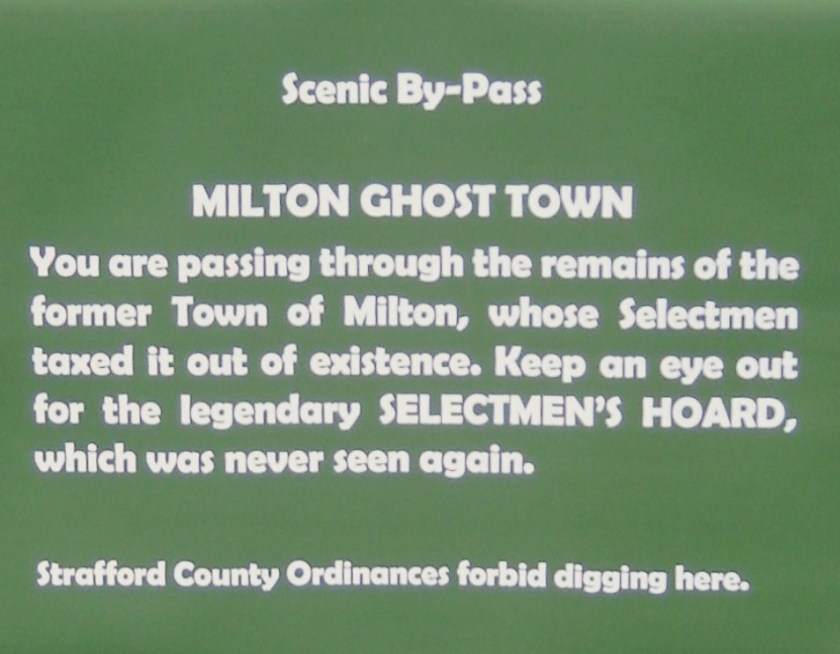
A commenter sent me this, which they photographed on some spooky Milton street. The lost revaluation treasure. According to this sign, it must still be out there, somewhere …

Selectmen's Hoard

Happy Halloween!

Feckless or Gormless?

By S.D. Plissken | October 30, 2018

Yes, they did it again. At last night’s Board of Selectmen (BOS) Meeting, the BOS voted unanimously to raise our taxes by 4.19%. For those that live in the real world, yes, that would be double the 2.1% rate of inflation.

The BOS meeting was recorded for Youtube, but the audio failed. Ms. Nancy Faith Wing made a partial recording with her cell phone, which may be found at her Our Milton Home Facebook group page.

The 4.19% increase failure was going to be much larger and – get this – the BOS was going to be okay with that. That is our basic problem.

Cost savings or cuts were not deployed. They even threw in the lesser pumper truck ($5,500), as a stop-gap, a new cemetery position, with rather vague back-of-the-envelope cost calculations, which will certainly rise, and a round of eleven new Glock pistols for the police force, as a sort of cherry on top.

I mean, really, are police pistols, like police cars, on some sort of automatic renewal plan? I suppose pistols must wear out, eventually, but did that really happen so soon?

As expected, insurance was the elephant in the room. There were four possible options on the table, ranging from worse to bad and then worst of all. That was what scared them last time. Even the BOS was having trouble swallowing the bitter pill.

Chief Krauss stepped up and performed some in-his-head calculations at the lectern, through which he was able to merge two awful insurance options to make a merely bad one. Deus ex machina! One wonders why that had not been done before. Chief Marique was projecting the budget spreadsheet onto a screen, but his PC had no power cord and turned itself off. A bit of comic relief.

Then the BOS looked glum. Vice-chairwoman Hutchings and Selectman Lucier, at least, finally grasped the nature of their utter failure to manage the Town government:

Lucier: It would have been nice to have all this information prior to doing the budgets. You know, we get this at the last meeting. [Long pause]. I wouldn’t have done this budget the way we did the budget. I personally would not have supported any new positions, and I probably would have looked at cutting some positions. ‘Cause this is just …

Hutchings: They’ve also … next year in the budget, I mean, the whole process, I really think that employees need to be put into like … Pat’s people need to be in his budget, Rich’s need to be in his, Nick’s need to be in … 

Thibodeau: You mean the health benefits …

Hutchings: Yeah, all the benefits. When we’re looking at the budgets, we’re really not looking at a true budget for a department when we don’t have all the information. I think we need to go back to putting those people into those individual budgets, so we can truly look at it and see … what each budget is …

Hutchings: I agree with Chief Krauss, I think … 

Lucier: I don’t think we have much choice.

Hutchings: No. … and Chief Marique.

In the end, they took up at Chief Krauss’ miraculous bad option and approved it unanimously. Actually, they all voted first for an incorrect amount, unanimously, which totaled to 4.18% increase. Then they discovered something had been left out of the shopping cart. When that was added, it came to 4.19%. The new bottom line will be $4,707,008.48, an increase of. $197,395.85, or 4.19%, over last year. Those that chose “over” in the pool can collect their winnings.

The Scots have a formulation for all this in their Lallans or Lowlands dialect. They would ask if our Selectmen are feckless or gormless? Gormless may be defined as lacking understanding. (We would say clueless). Feckless may be defined as lacking any “feck,” or effect. Under that interpretation, the BOS knows what should be done, but are unable to carry it through. Their actions lack effect, they are useless.

Some might say that this is a false question: the BOS has been both feckless and gormless, in turn. They began as being gormless and, in so being, did not address these issues in a timely manner. They frittered away the year; they wasted our time. By-laws indeed. Now, at the end, with looming statutory deadlines, they realize the full extent of their folly. But there is nothing to be done. They are now feckless.

How many will suffer under their new 4.19% increase? That is, 4.19% if you are gormless enough to think it will not rise yet further. How many neighbors will we lose this year? How dare the BOS, and you, speak of “community” while voting to destroy its financially weaker members? Shame, shame is what we should feel. Unless, we are all as gormless as Selectmen.

Next come the default budgets. You know, the ones that are carefully crafted, as specified by the RSAs, to make the greater amounts on the ballot seem like they are in fact the lesser amounts and vice versa.


P.S. A commenter corrects us to say that the Budget Committee is not responsible for the amounts in the default budgets. The paragraph above has been corrected to reflect that information.


References:

Wikipedia. (2018, October 29). Deus Ex Machina. Retrieved from en.wikipedia.org/wiki/Deus_ex_machina

Wiktionary. (2018, June 18). Feckless. Retrieved from en.wiktionary.org/wiki/feckless

Wiktionary. (2017, May 24). Gormless. Retrieved from en.wiktionary.org/wiki/gormless

Wing, Nancy Faith. (2018, October 29). Partial Cell Phone Video of BOS Meeting, October 29, 2018. Retrieved from www.facebook.com/gniwgniw22/videos/10155515676606260/


Non-Public BOS Session Scheduled (October 29, 2018)

By Muriel Bristol | October 27, 2018

The Milton Board of Selectmen (BOS) have posted their agenda for an “Extra” BOS meeting to be held Monday, October 29.

The meeting is scheduled to begin with a Non-Public preliminary session at 5:45 PM. That agenda has a single Non-Public item classed as 91-A:3 II (j).

91-A:3 II (j). Consideration of confidential, commercial, or financial information that is exempt from public disclosure under RSA 91-A:5, IV in an adjudicative proceeding pursuant to RSA 541 [Rehearings and Appeals in Certain Cases] or RSA 541-A [Administrative Procedure Act].

The sole Non-Public item (the “j” item) might be a further discussion of revisions of employee manuals and employee insurance buyouts, issues that have been mentioned in the open sessions. The old fire station us still out there. And, of course, the budget.

There seem to be quite a few critical budget issues that remain unresolved. When last seen, various BOS meeting participants were declaring that aspects of the budget were “out of control.” It does make one wonder how and when overall budget solutions get discussed. In a Non-Public meeting?

Do phone calls between them constitute a 91A Public or Non-Public Meeting quorum? Chance meetings at public events make for a BOS meeting, but not phone calls between Selectmen? That seems peculiar. Or is it all done by playing “telephone” through the Town Administrator?


The BOS intend to adjourn their Non-Public BOS session at approximately (*) 6:15 PM, when they intend to return to Public session.

The Public portion of the agenda has new business and old business only.

Under new business is scheduled a single item: 1) Purchase of 1994 Spartan Pumper Truck (Nick Marique).

A new $500,000 leased pumper was rejected by the last ballot, yet it reappeared as a CIP plan item, and now it arises yet again as an agenda item regarding an older and, presumably, somewhat cheaper one. (Perhaps they should have started with a cheaper one last year?). The fire chief missed perhaps the dramatic conclusion of the last meeting. Or perhaps he just does not understand the meaning of the word “no.”

Under old business is scheduled a discussion of some of the departmental budget submissions of October 15: Recreation, Cemetery, and Insurance / Benefits.

Insurance / Benefits seems to be the item that drove the budget beyond anyone’s wildest imaginings. This should be interesting.

On a side note, Ms. McDougall published her notes from a preliminary meeting of her new ad-hoc brainstorming group, the Milton Advocates. Insurance and other possibilities were discussed. It seems that there is not a single insurance plan or rate prevailing across, or even within, departments. Consolidating them all under the least expensive alternative would be difficult, as their terms do not coincide. It would have to be done gradually as they separately expire over the 2019-20 time frame. It would seem that no immediate relief is to be found in consolidation of insurance plans.

The usual approval of prior minutes, expenditure report, Town Administrator comments, and BOS comments are not scheduled. Nor are any Public comments scheduled, either before or after.


Mr. S.D. Plissken contributed to this article.


References:

Milton NH Community News. (2018, October 22). Lynette McDougall Posting. Retrieved from https://www.facebook.com/ourmiltonnews/posts/2221777698147264

State of New Hampshire. (2016, June 21). RSA Chapter 91-A. Access to Governmental Records and Meetings. Retrieved from www.gencourt.state.nh.us/rsa/html/VI/91-A/91-A-3.htm

Town of Milton. (2018, October 26). BOS Meeting Agenda, October 29, 2018. Retrieved from www.miltonnh-us.com/uploads/bos_agendas_835_529023279.pdf

Milton Tax Increases on Social Security

We received the following information as a comment from a Social Security recipient and pass it along, as is, for your consideration.

John S. Frum


The Town of Milton’s tax rate has been increasing steadily for over 10 years now at about 5% per year. Has your income increased that amount? One part of the population that definitely has not seen increases anywhere near that is the town’s senior citizens that are on Social Security.

The average Social Security benefit (SSI) was $1,413.37 per month in June 2018. Yes, some get more, but many get less.  Often, that is a senior’s only source of income. From that, $134 is automatically deducted each month to pay for Medicare Part B insurance.  Now let’s look at SSI yearly increases. OOPS, what increases??  Seniors on SSI do not  get a cost of living increase every year. Over the past 10 years since 2009 there were 3 years when no increase was given, one year the increase was only 0.3%, four years showed  increases of just 1.5-2.0% The other 2 years were 2.8% and 3.6%. The greatest increase of 3.6%  was back in 2011. Think about Milton’s tax increases during those same years averaging 5% per year.

If you are employed and receive medical insurance from your employer, you might think seniors have quite the racket at $134/month. Believe me they don’t!!  Medicare does cover  most in-patient (overnight hospitalization) services at a 100% after a small deductible.  Out-patient services are a different story – only covered at 80%. Out-patient services include your doctor visits, lab work, X-rays, MRI’s and CT scans; day surgery procedures (many surgeries now are done in a Day Surgery Center that previously would have been done an in-patient setting); chemotherapy and much more.  Most services in this day and age are done as an out-patient. To cover that 20% you have to buy a Supplement Policy and they vary in price, but to get good coverage many are well over $200 a month. You also need to get a separate plan for prescription medications as Medicare does not cover them. So you buy a Part D plan and pay a co-pay for each prescription. Another cost that varies with each plan. Dental and eye exams are generally not covered on most plans. That $1,400 a month is dwindling fast.

Just imagine if you are single, a widow or widower, or even a couple, on SSI in Milton  and trying to  maintain your home and your health these past 10 years and being presented each year with a higher tax bill then the previous year. Each year you set aside a little more to cover this expense, but it seems it is never enough. So you control what you can … less home repairs, adjust your food budget, lower the heat and AC or use fans in summer. Some even limit medications. You control what you can. Like the Town, seniors have little control over insurance costs so they make major cuts elsewhere. The Town needs to do the same – make major cuts that will lower the tax rate by well more than 7.5% and continue to do it for many years. We all make sacrifices and can live with less if needed. If the Town of Milton does not lower the tax rate now, many seniors and younger residents will either lose their homes or move elsewhere. I know that many residents are hurting with such high taxes not just seniors. For the younger population, those under 65, this might help you to understand the situation from the perspective of  SSI  recipients.

Milton and Mathematical Progression

By S.D. Plissken | October 18, 2018

At last Monday’s Board of Selectmen’s (BOS) Meeting, a silent alarm was triggered. Did you see the flashing red lights behind the dais? During that meeting, the proposed budget totals departed from the actual 2.1% rate of inflation to their usual unsustainable doubling of that, at 3.8%. That is not news. But then, they proceeded from there to an insane near-quadrupling of inflation, at 7.5%. Warning! Collision Alert!

In so doing, the proposed budget increases changed upwards from an Arithmetic Progression into the beginning steps of a Geometric Progression.

Arithmetic Progression

Arithmetic Progression occurs when a number, such as taxes, increases over time at a constant rate. Milton’s tax rate has been following such an arithmetic progression for a very long time. A problem has emerged recently by which the slope of that increase line has been increased. Since that happened, the tax rate has increased by about 5% per year, which has been approximately double the rate of inflation. The function of this would be y = nx, where n = 5 and x = the sequence number of the year. It would chart to the right as a steadily increasing straight line.

A problem arises when wages, i.e., the ability to pay, do not rise either at or above the same rate. A chart of the two lines together would show a gap emerging between them. That gap increases in size as the chart extends out rightwards over time. Each year, the increase amount comes more and more out of the taxpayer’s disposable income, i.e., their “capital.” At each step, the tax burden becomes less sustainable, but in a steady way.

This is bad. This increasing gap will drive you out of your home at sometime in the future. Exactly when will depend upon the rate of increase (the slope) of your particular pay envelope. But, unless your pay rate line is running above the tax increase line, you may run your finger out along the chart from left to right and find the date when you will be driven out.

Geometric Progression

Geometric Progression occurs when a number, such as taxes, increases over time not at a steady rate, but at an increasing rate.

Milton progressed to this type of increase last Monday night. Inflation ran at 2.1% last year. That is where our increase should be, below would be even better. Milton’s Town government budget increases at the end of the prior meeting, by which time they had added up the first two tranches of proposed departmental budgets, were projected to be a 3.8% increase. That is to say, they were on their usual straight line of arithmetic progression, at an unsustainable double the rate of inflation.

But, the addition of those final departmental budgets, as well as receipt of the increases in insurance and retirement rates changed the rate of increase radically. The new rate being discussed was suddenly a 7.5% increase. This begins to be a Geometric Progression, specifically y = 2^x, or 2 raised to the power of x, and the resulting y is successively = 2, 4, 8, etc., times the rate of inflation. (Sorry, this software doesn’t do superscripts). It would chart as a curved line, rather than straight, and curving upward.

The difference between an Arithmetic Progression and a Geometric Progression has to do with the rate of increase. An Arithmetic Progression increases constantly, but at a steady rate, while a Geometric Progression also increases constantly, but at a constantly increasing rate. You are getting into trouble faster.

Will Robinson’s robot should have been shouting “Danger! Danger!” in the background. If you run your finger out along the gap on this new chart, you will find that the gap is getting wider much, much faster. Your home exodus happens much further to the left, i.e., much, much sooner.

This is very bad and getting worse. It is the difference between you driving towards a collision with another car and you driving towards another car that is also driving towards you.

Exponential Progression

Exponential Progression is where the exponent, or power, in the equation is the variable. It would be ever so much worse than Geometric Progression. We probably need not dwell on its mechanics. Essentially, this is where both you and the car driving towards you are both stomping on the gas. And have nitrous turbo boosters or something. Think Venezuela or Zimbabwe, but with snow and no zoo animals to eat. We are on track to be New Detroit, but not yet on the track to be Nueva Venezuela. Not yet.

Is the End Near?

That depends. The breaking point is certainly approaching much more quickly now. Usually, when you arrive at this point, the more rational politicians have long since been blathering about “bending the cost curve.” That is to say, bending it back down to where it should have been all along – back below the rate of inflation.

If you wish to change the course of an ocean liner, or a Town government, the best way is to begin turning very far in advance. (Trucks often have signs that warn the vehicles behind them of their Wide Turns). Town governments have very large turning radii. To turn closer to an obstacle requires a much more exaggerated, even alarming, degree of turn and the application of much greater motive power. Delayed too long, it becomes impossible to turn enough. You hit the iceberg.

To bend the cost curve, the BOS would have to reduce their costs, by a lot. There is no other way. We are far past wide, gentle turns back to reality.

Yes, the various BOS administrations of the past decade or more – all those that approved increases that were double inflation rates – have completely failed us. They should have turned back on the right course long ago – and certainly turned back hard when the recession took hold. But the taxpayers are to blame also for not overriding the Town government. Adult supervision is required.

The last administration might have endorsed the Deliberative Session motion for a 10% cut instead of fighting it. Had they done so, what we face now might be less painful. Instead, they staged a sort of dog-and-pony-show to keep the game going, just a bit longer. It is now apparent that we needed that 10% cut, desperately, in order to turn the ship more smoothly.

Even this current administration wasted the first half of their tenure voting unanimously for every shiny thing. By-Laws, CIP Plans, GIS systems with ongoing annual fees, memberships, lawyers, websites with ongoing annual fees, hiring, more hiring, even COLA.

COLA? Wake up: few in the private sector have experienced COLA for a generation, maybe two. Social Security recipients maybe, but for that they use a special “Chained” CPI that intentionally understates inflation. Their COLA increases, if any, are largely paid over for their Medicare increases, which do not use “Chained” CPI.

This late in the game, the necessary course change will be a jarring lurch. But this runs completely counter to what politicians deeply desire and believe, which is that handing out stuff is beneficial. And organizing the world around them. The French economist Frederic Bastiat famously explained that

The State is the great fiction through which everyone endeavors to live at the expense of everyone else.

Margaret Thatcher put her finger on the problem of this great fiction: eventually you run out of other people’s money.

Will the BOS grit their teeth and turn the wheel hard over? There is reason to doubt it. They might instead use the $1.4 million taken last year – the taxation without representation – to kick the can down the road just a little further. That particular trick might buy as much as two years, longer perhaps if they made changes. But then we would be right back here again when the stolen money ran out, still on the wrong course.

We shall see.


As I write this, I am informed that Ms. Lynette McDougall has called for a brainstorming session at Dunkin’ Donuts, Saturday, at 9:00 AM. She is seeking constructive suggestions, rather than generalized whining. (Not her words).


References:

Wikipedia. (2018, September 5). Arithmetic Progression. Retrieved from en.wikipedia.org/wiki/Arithmetic_progression

Wikipedia. (2018, October 14). Geometric Progression. Retrieved from en.wikipedia.org/wiki/Geometric_progression

Wikipedia. (2018, October 13). Exponential Growth. Retrieved from en.wikipedia.org/wiki/Exponential_growth

And Eat Out Their Substance

By S.D. Plissken | October 17, 2018

He has erected a multitude of New Offices, and sent hither swarms of Officers to harass our people and eat out their substance.

Oh, excuse me, I was just rereading something. What were we talking about? Oh, yes, last Monday’s Board of Selectmen’s (BOS) Meeting.

The BOS tidied up a bit first. They retracted a prior invalid parking ordinance, authorized crossing guards for Halloween events, added (on a trial basis) an additional concluding Public Comment time, authorized acceptance of Highway Grant money (with its attendant strings), and unsealed minutes from Non-Public Meetings held on July 10, 2018, and September 24, 2018. Well, they unsealed them for Chief Krauss alone.

Therein hangs a tale apparently, but not one about which we will know much more, at least not for now. The July 10 meeting was not posted. It must have been a secret Non-Public Meeting, sort of like a double Non-Public Meeting. The September 24 meeting began as a Public meeting, but adjourned to consider a 91A:3 II (c) matter. That would be something that concerns “Matters which, if discussed in public, would likely affect adversely the reputation of any person.” The BOS surfaced again in order to adjourn again to consider a 91A:3 II (j) matter: “91-A:3 II (j). Consideration of confidential, commercial, or financial information that is exempt from public disclosure.” Finally, they went again into a third Non-Public session under 91A:3 II (c), the one that might adversely affect reputations.

Previously, Ms. Bristol supposed that all this folderol had something to do with abatements. But now, due to this unsealing of the minutes, but for Chief Krauss alone, we know it had to do with the Police. Chairman Thibeault said that

These are being unsealed to be released to the Police Chief because of Police personnel file matters and its not for public release. This is to be compliant with State statutes.

So, something happened, back in the July time-frame, that “would likely affect adversely” reputations, and something that involves also confidential, commercial, or financial information. Did something happen that we need to know about?

From there, they proceeded to the main event, the conclusion of the second round of departmental budget presentations and moving on to the third and final round of budget presentations.

When last seen, the BOS had accepted departmental budget presentations that would move us already above the Federal inflation rate of 2.1% to a CIP plan recommendation of “no more that 3%.” That 3% would itself exact 43% above inflation. But, as they say, “hold my beer.” That was just the recommendation, the actual Cloud-Cuckoo-Land amount “as it stands” was 3.8%, which would exact 81% above inflation (where 100% would be a doubling).

According to the Federal government, your household costs went up 2.1%. Few will have had their incomes rise so much. The Town budget was projected by the Planning board to rise 3.8%. The difference between 3.8% and 2.1% is 1.7%. Assuming you actually got a 2.1% raise, which most did not, it would go entirely to the Town government. They also want an additional 1.7% from whatever you had before the 2.1% raise that you did not get.

Queue up Selectman Lucier:

Selectman Lucier: One thing, I just … can I make a comment before? – you know, we just got, as we sat down here tonight, just got handed insurance adjustments, for health insurance for next year.

Administrator Thibodeau: That’s one of the presentations that we do tonight.

Lucier: Yeah, well. In that … but that ties into everything in the budgets. We’re looking at 236 in $600,000 increase over this year, just in health insurance. You know, that changes a whole bunch of things going on in Andy’s head as far as everything else that we’ve already done. You know, how much, how much can people swallow? I mean this is – we’re already looking at almost a 7.5% increase in, you know, this year’s budget, so …

Vice-chairwoman Hutchings: And the rate of inflation is 3%. We told them that a 3.8%, I think is what was discussed. Is that correct, or am I?

Well no, Vice-chairwoman Hutchings, 2.1% was the actual inflation rate, and the 3% was the Planning Board’s ruinous recommendation to continue spending way above inflation. The 3.8% figure was the completely absurd place, the Cloud-Cuckoo-Land if you will, in which we found ourselves when actual departmental budgets proposals are totaled.

Thibodeau: 3.7. 

Hutchings: 3.7%. So … I mean, that’s …

Thibodeau: We just don’t have any control over insurance. All that insurance, and retirement. That’s something … those are the costs we don’t control.

Lucier: I know we don’t have any control over it, but it’s just ….

Hutchings: Out of control.

Lucier: I mean, … I can’t … I don’t know. I’m almost, I leaning almost to say … cap … level fund it and then …. I don’t know …

Thibeault: If you level fund it, I think your insurance is still going to … that’s not really going to solve our issue.

Lucier: Oh, I understand that. But we have some serious issues here. You know, I personally have no problem with the welfare. I mean … I … I’m kind of backtracking, I don’t think we should do any new employees. In the light of things that … I don’t know.

Thibeault: So do we want to table Item 6 discussion and move on to the departments that haven’t presented yet?

The light begins to dawn on Selectman Lucier. Perhaps Vice-chairwoman Hutchings, but she had to go home sick. [Get well soon]. They lack control over insurance rates and retirement expenses. It will come to them when they have time to think about it. Hint: Personnel expenses are your largest cost. The only thing that you do control is the number of employees and their status as either part or full-time employees. That is the only variable with which you can work.

When you are in a hole, you should stop digging. So, hiring is completely out of the question. And capping was due back during the “Great Recession.” When everyone else was seeking new employment, pulling in their belts, and having trouble making ends meet, the Town government just kept right on spending. Do you remember all the foreclosure signs? The Town government barely missed a beat. They took a bit of a check step, just one year with a slower rate of increase, but that was all. Then it was right back to business as usual.

Selectman Lucier, we are way past capping. That was so 2009. And you can forget about hiring. The BOS needs to be cutting, and not little shavings or a little final sanding, but great big whacks. You have said that we are not Wakefield with its ten lakes. Right. It follows that we cannot afford what they can. We should have a tax rate like they do, if not lower. Keep cutting until you get there.

A concerned citizen, Ms. Lynette McDougall, rose to offer some advice during the new secondary Public Comment.

Lynette McDougall. As a taxpayer, I’m kind of appalled at these numbers I’m seeing, you guys. It seems like to me we’re in a management overload or something. We need to do some cutting, somewhere – training people, cross-training people, things of that sort. [Editor’s note: so that you have some coverage after cuts, presumably]. Maybe get somebody professional to show us how to do this, because this is taxpayer’s money going out. I agree with you, if you present this to the taxpayers. I’m surprised they’re aren’t people out there screaming. I’m kind of sad they aren’t. I know you guys are doing the best you can, but we’ve got to have better than this. We’re a small town, this is small, and these expenditures are not small. And I know that’s not your fault, but you should maybe think about having somebody professional, that knows how to do these things, come in and cut some things, because we need to save the people that are here. I’m sorry, that’s all.

Good for you, Ms. McDougall. Brava!

References:

Independence Hall Association. (2018). Declaration of Independence. Retrieved from www.ushistory.org/declaration/document/

Town of Milton. (2018, October 15). BOS Meeting, October 15, 2018. Retrieved from www.youtube.com/watch?v=1C1AS4syCJU&feature=youtu.be&t=1071