
By Muriel Bristol | June 4, 2023
Continued from Milton Mills Sketch of 1911 – 1
In researching something else, several lengthy articles on Milton Mills were encountered in the Sanford Tribune of October 6, 1911. This second article dealt with the Townsend family and their mills.
The original immigrant John Townsend (1807-1891) took over and transformed the Milton Mills Manufacturing Company. His son, Henry H. Townsend (1842-1904), created the nearby but separate Miltonia Mills, and the original immigrant’s grandson, John E. Townsend (1871-1914), was at the time of this 1911 sketch managing those same Miltonia Mills.
(This new information may require some minor revisions or additions to some earlier Observer articles).
MILTONIA MILLS. There is in Milton Mills another of the few old-time woolen mills that is still doing a good business and keeping up the standard both as to quality of product and economic and social conditions. The history of the mill runs back to the generation before the civil war to the days when the small mill had superseded the one-man shop and home manufactory but before the gigantic trust-sustained corporations had been born.
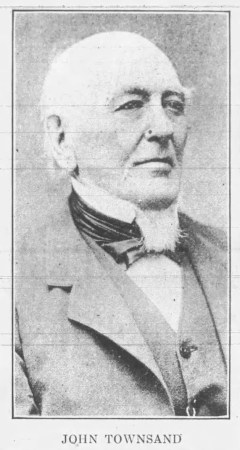 John Townsand one of the many able men who came from England to America about that period and established factories for the manufacture of woolen goods, went to Milton Mills in 1846 and bought the small factory then being operated on the privilege now known as the Waumbeck. He began the manufacture of flannels and continued that product until the mill was burned in 1861. After the mill was rebuilt Mr. Townsand made what was called army flannel. The mill was sold to E.R. Mudge & Sawyer company and Mr. Townsand moved to Boston and afterwards made his home in Brookline, where he died in 1890.
Mr. Townsand was a man of extraordinary energy and one of the strong characters in that period of manufacturing development in New England. In those times twelve or more hours a day was the lot of the workingman, but the proprietor limited his hours of work to the limit of his ability to stand the strain. It is remembered that Mr. Townsand worked early and late. For some years after starting business there the nearest railway station was Somersworth. He made a trip to Boston once a week. As he felt that one day was all he could spare from the mill, he used to start from the mills at three o’clock in the morning and drive to Somersworth, thence by train to Boston. Returning he would take the last train at night for Somersworth arriving there about eight He would then drive the twenty miles to Milton Mills, reaching there about midnight having made a day of twenty hours.
Mr. Townsand came to America in 1827 in company with Moses Stevens who afterwards established the business in Andover, Mass., that now bears his name. They together went to that town and worked for several years. Mr. Townsand going to Milton Mills to make a name and fortune, and Mr. Stevens staying there to do the same.
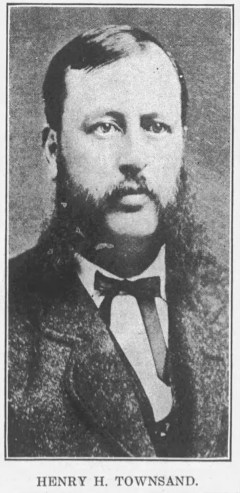 Henry H. Townsand, son of John and father of the present owner of the business, acquired a knowledge of the business as a part of his education and when his father went away bought the privilege where the Miltonia mills are now located. There was a small mill there. He then made felt. It was in 1880 that the business of making bed blankets was originated. Mr. Townsand made blankets that had a peculiar quality that made the demand for them large. The capacity of the mill was soon outgrown and in 1888 the main mill, No. 2, was built. Gradually additions were made. In 1894 the new boiler house was built and following that the power plant for generating electricity was erected. The weave room is run by electric power and the entire mill is lighted by it. The mills are well kept, lighted and aired in a thoroughly sanitary manner and the too frequently noticed mill pallor in many places is never seen on the faces of the employees of this mill.
Henry H. Townsand conducted the business until his death in 1904. The business that he started had then grown to be one of the important industries of the county, and the quality of the goods made was such that they hardly had any competition in the market. He showed the ability that had made his father successful as a manufacturer, and left, as had his father, the village 0f Milton Mills the gainer because he had lived and done business there. In 1904 John E. Townsand, the present owner, succeeded to the business by agreeable arrangement with his sister.
John E. Townsand was born in Milton Mills, and following the example of his father, made it his home and grew up in the mill business. The business has prospered under his management and shows that the same talents that made his father and grandfather successful survive in him. Milton Mills people had recognized those qualities, as well as others, long before. In 1901 they chose him to represent the town in the legislature and he is now, as he was then, a man whose abilities and good citizenship place him in the front rank of business men and companionable fellows. He is prominent in Masonry, being a 32nd degree Mason. He is also an Odd Fellow.
Harry E. Wentworth has been bookkeeper and paymaster for the last three years. He is a native of the place and a young man of excellent qualities (Sanford Journal-Tribune (Biddeford, ME), October 6, 1911).
John E. Townsend died in Milton Mills just three years after this Sanford Tribune article, September 8, 1914, aged forty-two years. (See Milton in the News – 1914).
John C. Townsend, a brother-in-law (and cousin) of John E. Townsend, was mentioned elsewhere in the Sanford Tribune article as having been at times Miltonia’s superintendent. However, he died of pneumonia (and uremic poisoning) in Milton Mills just over four years after this Sanford Tribune article, February 14, 1916, aged forty-four years, four months, and twenty-seven days.
Another brother-in-law (through their having married sisters), Miltonia’s “bookkeeper and paymaster” Harry E. Wentworth, would manage things until John E. Townsend’s ten-year-old son, Henry A. Townsend, could come of age.
(See also H.E. Wentworth’s Diary Entries, Miltonia Mills – 1910-27, H.E. Wentworth’s Diary Entries, Miltonia Mills – 1928-34, and H.E. Wentworth’s Diary Entries, Miltonia Mills – 1935-54).
Continued in Milton Mills Sketch of 1911 – 3
References:
Find a Grave. (2013, August 4). Henry A. Townsend. Retrieved from www.findagrave.com/memorial/114893218/henry-a-townsend
Find a Grave. (2013, August 12). Henry H. Townsend. Retrieved from www.findagrave.com/memorial/115352239
Find a Grave. (2022, October 27). John Townsend. Retrieved from www.findagrave.com/memorial/245080146/john-townsend
Find a Grave. (2013, August 12). John C. Townsend. Retrieved from www.findagrave.com/memorial/115352317/john-c-townsend
Find a Grave. (2013, August 12). John E. Townsend. Retrieved from www.findagrave.com/memorial/115352496/john-e-townsend
Find a Grave. (2013, August 5). Harry E. Wentworth. Retrieved from www.findagrave.com/memorial/114938247/harry-e-wentworth

 Milton Observer
The Sanford Tribune article alone with the Harry Wentworth’s diaries have been quite a gold mine. You do such great work.
LikeLike