By Muriel Bristol | October 20, 2024
Continued from Milton’s Initial Party Affiliations.
The ante-bellum period (Latin for “pre-war,” i.e., pre-Civil War) between 1828 and 1854 is sometimes characterized by historians as the Second Party System period, with the principal parties being the Democratic-Republicans or Democrats, initially led by Gen. Andrew Jackson of Tennessee and Martin Van Buren of New York, and the National-Republicans or Whigs, initially led by John Quincy Adams of Massachusetts and Henry Clay of Kentucky. (These new parties or configurations replaced the original First Party System of Jefferson’s Democratic-Republicans and Madison’s Federalist-Republicans).
Milton gave 173 votes (93.5%) to National-Republican Sheriff John Bell of Chester, NH, and 12 votes (6.5%) to Democratic-Republican Gov. Benjamin Pierce of Hillsborough, NH, in the NH Gubernatorial election of March 1828. Bell won the election. In the following year, Milton gave 138 votes (77.1%) to incumbent Gov. Bell and 41 votes (22.9%) to Pierce. This time Pierce won the statewide election.
Levi Jones of Milton was chosen for a five-man National-Republican District committee, September 30, 1828, which would prepare and report resolutions on potential candidates for President and Vice President of the U.S. They recommended the incumbent President John Q. Adams as their preferred candidate for President and Richard Rush for Vice President. Stephen Drew of Milton was appointed to a six-man committee tasked with sounding out the sentiments of “the People” on those choices.
John Nutter, John H. Varney, and Lewis Hayes were Milton Delegates to the National [-Republican] Young Men’s Convention, which was held at Wolfeborough, NH, October 1, 1828 (Times & Dover Enquirer, October 27, 1828).
Milton gave 160 votes (78.0%) to incumbent National-Republican President John Quincy Adams and 45 votes (22.0%) to Democratic-Republican Gen. Andrew Jackson in the Presidential election of November 1828. Jackson won the election (Times & Dover Enquirer, November 11, 1828).
Stephen Drew of Milton was Secretary of the NH Senatorial District No. 5 Republican Convention held in Dover, NH, January 21, 1830 (Times & Dover Enquirer, January 26, 1830). The term “Republican” in this context may be understood to be mean National-Republican, or what would come to be known as “Whig.”
Levi Jones of Milton was one of two Secretaries for a Republican, i.e., National-Republican, Strafford County Convention, which was held at the Court House in Dover, NH, January 21, 1830. The Convention chose Timothy Upham as their candidate for NH Governor (Times & Dover Enquirer, January 26, 1830). He would lose to the Democratic-Republican candidate, Matthew Harvey. (Harvey had been originally a National-Republican, who had switched to Democratic-Republican).
Milton gave 161 votes (77.8%) to National-Republican NH State Senator Ichabod Bartlett and 46 votes (22.2%) to Democratic-Republican Judge Samuel Dinsmoor in the NH Gubernatorial election of 1831. Judge Dinsmoor won the statewide election. In the following year, Milton gave 128 votes (71.9%) to NH State Sen. Ichabod Bartlett and 50 votes (28.1%) to incumbent Gov. Samuel Dinsmoor. Dinsmoor won reelection in the statewide election.
Stephen M. Mathes was the Milton Delegate to the Republican State Convention held in Concord, NH, June 19, 1832. In this context, Republican meant National-Republican. Henry Clay was their Presidential nominee (Times & Dover Enquirer, June 26, 1832). The National-Republicans would come to be known as the “Whig” party.
The “Whig” name became attached to the National-Republican party due in part to its adherents’ vociferous opposition to President Andrew Jackson, whom they regarded as having monarchial tendencies – as in “King” Jackson – and for which reason they regarded his fellow Democratic-Republicans as having become “Tories.” That characterization left themselves occupying the other pole, that of “Whigs.” (It is perhaps ironic that both terms had originated in English politics as insults meaning “bandits” and “robbers”).
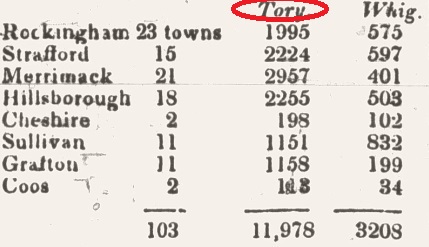 Milton was considered in this period to be a Whig “stronghold,” along with Dover, Rochester, Somersworth, and Rollinsford. This was not always the case for the State as a whole, which tended to have more of a Democrat or “Tory” majority overall. This strength of feeling no doubt arose partly due to slavery being so thoroughly opposed by Milton inhabitants, which was a position where the Democratic-Republican “Tories” neither felt nor acted as forthrightly as Milton inhabitants felt they should have (See Milton and Abolitionism).
Milton gave 153 votes (75.0%) to National-Republican Henry Clay, and 51 votes (25.0%) to incumbent Democratic-Republican President Andrew Jackson, in the US Presidential election of November 1832. President Andrew Jackson won reelection.
Milton gave 92 votes (64.3%) to National-Republican Hon. Joseph Healey and 51 votes (35.7%) to Democratic-Republican Gov. William Badger in the NH Gubernatorial election of 1835. Gov. Badger won reelection in the statewide election.
William B. Wiggin was appointed to a Dover, NH, Whig Committee of Vigilance, February 27, 1836. The Whig Central Committee appointed the Vigilance Committee to oversee the election and notify them of any irregularities. (Wiggin was a former Milton Selectman that had moved to Dover, NH, circa 1832).
Milton gave 40 votes to incumbent Democrat NH Governor Isaac Hill in his March 1836 reelection bid. Gov. Hill was running unopposed. The “scattering” write-in votes went to a number of others.
ELECTION ITEMS. Isaac Hill is elected Governor, – because there was no candidate against him. In some towns the whigs threw a few votes for Healey; in others for Sullivan; in others for Davy Crockett or Jack Downing, anybody or nobody, whom they thought better qualified for the office than the tory candidate (Dover Enquirer, March 15, 1836).
The Hon. Joseph Healey and the Hon. George Sullivan being written-in were NH Whig politicians. Col. Davy Crockett was a folk hero. (News of the fall of the Alamo, March 6, 1836, and Col. Crocketts’ death there, would not reach New Hampshire until mid-April). Maj. Jack Downing was a fictional character featured in an ongoing series of humorous political satires by author Seba Smith.
 The Presidential election of November 1836 brought Democrat President Andrew Jackson’s intended successor, Vice President Martin Van Buren, to the fore. Joseph and Rebecca (Ricker) Cook of Milton would name their son Martin Van Buren Cook after him (in 1838). One might assume that they were likely Democratic-Republicans.
President Jackson is famous, or infamous, for having eliminated the inflationary U.S. central bank. In so doing, he effectively favored the inflationary state-level banks. The Whigs abhorred his closing of the central bank. As Abraham Lincoln would say later regarding another issue rather than the central bank:
In great contests, each party claims to act in accordance with the will of God. Both may be, and one must be, wrong.
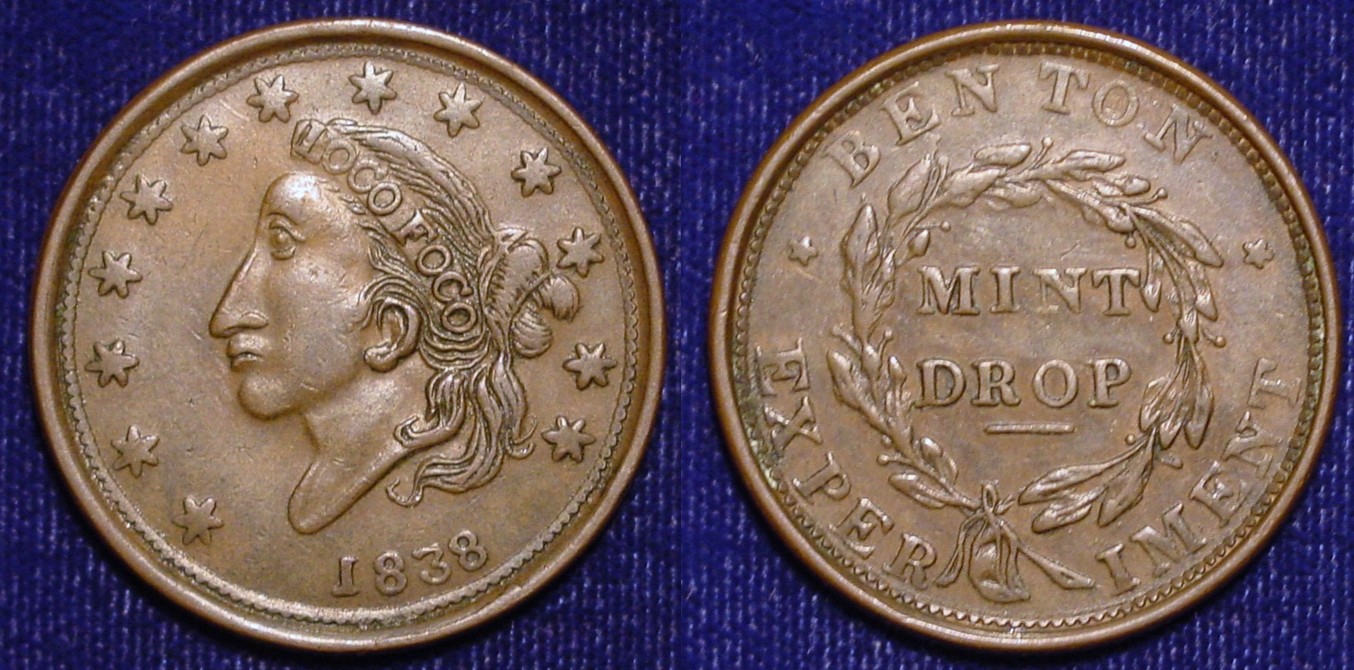
Newly-elected President Van Buren inherited the resulting economic “Panic of 1837,” which caused bank failures (40% of them), unemployment, foreclosures, economic depression, and a specie (hard money) shortage, all of which lasted well into the next decade. (See below a picture of a 1838 substitute private specie “penny,” with Liberty depicted ironically as wearing a “Loco Foco” crown).
Thomas Chapman and Enoch W. Plummer were the Milton Delegates to the NH State Whig Convention, which was held in Concord, NH, Tuesday, November 21, 1837 (Times & Dover Enquirer, November 28, 1837).
Asa Fox and Reuben J. Witham were the Milton Delegates to the NH Fifth Senatorial District Whig Convention, which was held in Rochester, NH, January 16, 1838. The Convention selected the Hon. Andrew Pierce of Dover, NH, as their preferred candidate (Times & Dover Enquirer, January 23, 1838).
Stephen M. Mathes and Edward Hart were the Milton Delegates to the Strafford County Whig Convention, which was held in Rochester, NH, Tuesday, January 16, 1838 (Times & Dover Enquirer, January 23, 1838).
 Theodore C. Lyman and Benjamin Roberts were the Milton Delegates to the Strafford County Whig Convention, which was held in Farmington, NH, Monday, January 14, 1839 (Times & Dover Enquirer, January 22, 1839).
Ichabod H. Wentworth and Thomas Y. Wentworth were the Milton Delegates to the Strafford County Whig Convention, which was held in Farmington, NH, Monday, January 20, 1840 (Times & Dover Enquirer, January 28, 1840).
James Berry and James M. Twombly were the Milton Delegates to a Strafford County Whig Convention, which was held in Ossipee, NH, on Thursday, April 24, 1840 (Times & Dover Enquirer, April 28, 1840).
Milton gave 182 votes (72.5%) to Whig Gen. William Henry Harrison (“Tippecanoe & Tyler Too”) of Ohio, and 69 votes (27.5%) to incumbent Democrat President Martin Van Buren, in the US Presidential election of November 1840. Whig William Henry Harrison won the election but died a month into his term, after which he was succeeded by his Vice-President, John Tyler.
John H. Varney and S. Watson Drew were the Milton Delegates to a Strafford County Whig Counsellor Convention, which was held at the Dodge Hotel in Rochester, NH, January 18, 1841 (Times & Dover Enquirer, January 26, 1841). The Dodge Hotel was a popular lodging at the center of the regional stagecoach hub.
Joseph Pearl and E.W. Plummer were the Milton Delegates to the NH Fifth Senatorial District Whig Convention, which was held at the Jonathan T. Dodge Hotel in Rochester, NH, January 18, 1841. The Convention selected Daniel Winkley, Esq., of Strafford, NH, as their preferred candidate (Times & Dover Enquirer, January 26, 1841).
John H. Varney and Micah Hanson were the Milton Delegates at a Strafford County Whig Convention held at the Jonathan Dodge Inn in Rochester, NH, January 31, 1843. Joseph Pearl of Milton was nominated as Whig candidate for Strafford County Road Commissioner.
A Dover Enquirer editorial mocked the Belknap Gazette for having incorrectly classified four Strafford County NH State Representatives, including Charles Swasey of Milton, as being “… locofocos, when they are as staunch whigs as any in the State” (Times & Dover Enquirer, March 26, 1844).
 (The Locofocos were a hardline economic populist faction of the Democrat party. Their name originated as the brand name of a type of stick matches and their use of such matches in order to see when the gaslights were intentionally turned off to disrupt a New York Tammany Hall political meeting in October 1835. (Tammany Hall would become a watchword for corrupt “machine” politics). Over time, the Whigs took to calling Democrats of all stripes Locofocos).
Milton gave 94 votes (56.6%) to Whig Henry Clay, 45 votes (27.1%) to Democrat James K. Polk of Tennessee, and 27 votes (16.3%) to abolitionist Liberty candidate James G. Birney of Kentucky, in the US Presidential election of November 1844. Democrat James K. Polk won the election.
Stephen Shores of Milton was nominated as the Liberty party candidate for Strafford County Road Commissioner at their Dover, NH, convention, January 24, 1845 (Times & Dover Enquirer, January 28, 1845). The Liberty party was an abolitionist party, which was most active in the 1840s. Many of its members went on to join later the Free Soil party and the Republican party.
J.D. Lyman and H.V. Wentworth were the Milton Delegates to the NH State Whig Convention, which was held in Concord, NH, October 20, 1847 (Times & Enquirer, November 2, 1847).
Milton gave 100 votes (50.5%) to Whig Gen. Zachary Taylor of Kentucky, 79 votes (39.9%) to Democrat Lewis Cass of Michigan, and 19 votes (9.6%) to Whig Millard Fillmore of New York, in the US Presidential election of November 1848. Whig Zachary Taylor won the election. (Fillmore was Taylor’s Vice President and would complete Taylor’s term, when he died in office in 1850).
Eli Wentworth and Harrison “Harris” Kimball were the Milton Delegates to the Strafford County Whig Convention, which was held in Farmington, NH, Monday, January 14, 1850 (Dover Enquirer, January 22, 1850).
By the late 1840s the Whig coalition was beginning to unravel as factions of “Conscience” (antislavery) Whigs and “Cotton” (proslavery) Whigs emerged. In 1848 the party returned to its winning formula by running a military hero – this time Zachary Taylor – for president. But the Compromise of [September] 1850, fashioned by Henry Clay and signed into law by Millard Fillmore (who succeeded to the presidency on Taylor’s death in 1850), fatally estranged the Conscience Whigs from their party (Encyclopedia Britannica, 2024).
Robert Mathes [Jr.] was sent as the Milton Delegate to the NH State Constitutional Convention of 1850. His name was italicized in the newspaper listing, i.e., by which the accompanying key tells us he was a Whig (Dover Enquirer, October 15, 1850).
Ebenezer Osgood and James Doldt of Milton were listed among the Whigs in a roster of NH State Representatives, in March 1852 (Dover Enquirer, March 16, 1852). The other listed party affiliations were “Dem.,” “F.S.,” [“Free Soil], and one “F.S. Whig.”
Eben’r Osgood, Josiah N. Witham, Eli Wentworth, and Harris Kimball were the Milton Delegates to the NH Whig State Convention held in Concord, NH, in September 1852 (Dover Enquirer, September 7, 1852).
Milton gave 102 votes (45.9%) to Whig Gen. Winfield Scott of New York, 93 votes (41.9%) to Democrat Franklin Pierce, and 27 votes (12.2%) to Free Soiler John P. Hale, in the US Presidential election of November 1852. Democrat Franklin Pierce won the election. (Both Pierce and Hale were New Hampshire men, Hale “hailing” originally from Rochester, NH, although he then lived in Dover, NH). The Whig party declined and began to dissolve after its Presidential defeat in 1852.

Josiah N. Witham, Francis D. Horne, and Edward Hart were Milton Delegates to a Strafford County Whig Convention, which was held in Dover, NH, January 18, 1854 (Dover Enquirer, January 24, 1854).
Milton NH State Representative Elect Samuel Washburn maintained that he was a “true” Democrat in 1854, and not a so-called “Hunker” or “Nebraska” [Kansas-Nebraska Act of 1854] Democrat, as has been said of him.
A few weeks since we stated, on what we deemed good authority, that Samuel Washburn, one of the representatives elect from Milton, who had been claimed as a Hunker Democrat, did not rank himself with that party. Mr. Washburn, in a note to the last Gazette, declares himself ‘a true democrat,’ – meaning, we suppose, that he is of the hunker and Nebraska stripe – and we are bound to believe him. The gentleman who gave us the information, and who told us that he had Mr. Washburn’s word as a voucher for his statement, must have misunderstood him, or Mr. W., talks one way and writes another. That’s all (Dover Enquirer, April 11, 1854).
A “Hunker” Democrat would have been one that favored state banks and internal improvements, while minimizing the slavery issue, and they were out of alignment with the minority “Barnburner” Democrats, who openly opposed slavery.
Whig U.S. Senator William P. Fessenden of Maine presented to the U.S. Senate a petition from the voters of Milton, in June 1854, seeking repeal of the Fugitive Slave Law.
In the Senate yesterday Mr. Fessenden presented a petition for a repeal of the Fugitive Slave Law [of 1850], signed, as he stated, by all the voters of the town of Milton, New Hampshire, the birthplace of Gen. Pierce. Mr. Sumner presented a similar petition. Both were referred (NY Post, June 30, 1854).
CONGRESS. … On Thursday, Mr. Fessenden presented a petition from New Hampshire, praying for the repeal of the Fugitive Slave Law. He said “the petition was not open to the objections of locality which had been urged against the memorial of the men of Boston. – It came from a town whose population was about 2000, and was signed by over 300 voters, which, he supposed comprised all its voters. Moreover, the town was Milton, which was the birthplace of the President. (Either the telegraph, or Mr. F., is mistaken. Milton claims no such honor [as being the birthplace of Franklin Pierce]). (Dover Enquirer, July 4, 1854).
(Sen. William P. Fessenden would be reelected to the U.S. Senate as a Republican, and President Lincoln would appoint him as Secretary of the Treasury in 1864).
The Third Party System of Democrats versus Republicans is said to have emerged, or begun to emerge, in 1854 with the decline of the Whigs and the birth of the anti-slavery Republican party.
The anti-slavery Republican Party emerged in 1854. It adopted many of the economic policies of the Whigs, such as national banks, railroads, high tariffs, homesteads, and aid to land grant colleges (Wikipedia, 2024).
In the collapse of the Whig party, southern “Cotton” Whigs tended to merge into the Democrat Party, while northern “Conscience” Whigs tended to join the newly founded Republican party.
SHIPWRECK IN NEW HAMPSHIRE. Our despatches from New Hampshire proclaim the triumphant success of the combined forces of the Whigs, Free-Soilers, Know-Nothings, and Anti-Nebraska Democrats, over the Pierce-Nebraska party of the state. … (Dover Enquirer, March 22, 1855).
Eli Wentworth and David Wallingford made another stop along the way. They were characterized as being (or being also) American party (“Know Nothing”) adherents when elected as NH State Representatives in March 1856 (Dover Enquirer, March 20, 1856). The short-lived nativist and anti-slavery “Know Nothing” party gained a majority in the NH legislature in this biennium, but it proved to be a short-lived movement. Its anti-slavery elements would soon transfer their affiliation to the recently-founded anti-slavery Republican party.
John D. Lyman, Eli Wentworth, James H. Nutter, and G.W. Scates were the Milton Delegates to the NH Whig State Convention, in June 1856. John D. Lyman was selected for the Whig NH State Committee (Dover Enquirer, June 27, 1856).
Milton gave 281 votes (75.3%) to Republican John C. Fremont of California, 92 votes (24.7%) to Democrat James Buchanan of Pennsylvania, and 0 votes (0.0%) to Know-Nothing/Whig Millard Fillmore, in the US Presidential election of November 1856. Fremont was the first Republican Presidential candidate. Democrat James Buchanan won the election.
The Republicans of Wakefield, Brookfield, and Milton threw a post-election Jubilee at the Masonic Hall in Union, Wakefield, NH, March 18, 1858,
… to congratulate each other on the triumph of Republican principles in these several towns, and notwithstanding the unfavorable conditions of the roads and weather a pretty large assembly collected.
A dinner for seventy-five guests was served at the Hotel, with many toasts and speeches. There were songs by the Whitehouse Bards, followed by a dance, with music by the Milton Mills Quadrille Band. At the close, “all seemed highly gratified by the success of the entertainment” (Dover Enquirer, April 1, 1858).
Milton gave 252 votes (71.0%) to Republican Abraham Lincoln of Illinois, 129 votes (26.0%) to Democrat Stephen A. Douglas, also of Illinois, 6 votes (1.7%) to Southern Democrat Vice President John C. Breckenridge of Kentucky, and 5 votes (1.4%) to Constitutional Unionist John Bell of Tennessee, in the US Presidential election of November 1860. Republican Abraham Lincoln won the election.
Eli Wentworth of Milton was a Republican State Committee member in January 1861 (Dover Enquirer, January 17, 1861). (He would die of a fever at Snyder’s Bluff, Milldale, MS, two and one-half years later, while serving as an officer in the Union army).
See also Milton’s NH State Representatives – 1803-1902 and Milton and Abolitionism
References:
Wikipedia. (2024, September 5). Barnburners and Hunkers. Retrieved from en.wikipedia.org/wiki/Barnburners_and_Hunkers
Wikipedia. (2024, October 10). Democratic Party (United States). Retrieved from en.wikipedia.org/wiki/Democratic_Party_(United_States)
Wikipedia. (2024, September 21). Free Soil Party. Retrieved from en.wikipedia.org/wiki/Free_Soil_Party
Wikipedia. (2024, September 7). Kansas Nebraska Act. Retrieved from en.wikipedia.org/wiki/Kansas%E2%80%93Nebraska_Act
Wikipedia. (2024, September 27). Know Nothing. Retrieved from en.wikipedia.org/wiki/Know_Nothing
Wikipedia. (2024, October 11). Locofoco. Retrieved from en.wikipedia.org/wiki/Locofocos
Wikipedia. (2024, September 8). Panic of 1837. Retrieved from en.wikipedia.org/wiki/Panic_of_1837
Wikipedia. (2024, October 14). Republican Party (United States). Retrieved from en.wikipedia.org/wiki/Republican_Party_(United_States)
Wikipedia. (2024, October 6). Whig Party (United States). Retrieved from en.wikipedia.org/wiki/Whig_Party_(United_States)

 Milton Observer