
By Muriel Bristol | November 15, 2026
James N. Palmer, a superintendent, aged thirty-eight years, headed a Milton household (“Poor House”) at the time of the Eighth (1860) Federal Census. His household included Joanna [(Smith)] Palmer, aged thirty-five years, E.W. Palmer, aged five years, S.B. Palmer, aged three years, Ida M. Palmer, aged one year, Mary Wentworth, a pauper, aged seventy-five years, Martha Drew, idiotic, aged thirty-four years, and Clara Scates, a pauper, aged thirty-five years. James N. Palmer had real estate valued at $2,500 and personal estate valued at $400. Their household appeared in the enumeration between those of Joseph G. Rines, a laborer, aged thirty-six years (b. NH), and Parker Spinney, a farmer, aged fifty-six years (b. NH).
Strafford County Commissioners’ Report. The County Commissioners respectfully represent to the citizens of Strafford County, that they have just concluded their visit to the several alms-houses of the county, for the purpose of viewing the condition of the county poor there supported, and beg leave to submit the following report, believing that the tax-payers of the county after even a cursory view of the increasing amount of pauperism, will unite with us in demanding a more frequent and searching investigation of the cause of one our greatest pecuniary burdens.
The system of annual visits, to every part of the county, was inaugurated a year ago, although long the custom in several other counties of the state, whose commissioners inform us that it certainly conduces towards the reduction of their county expenses. First on account of the decrease in numbers of the paupers, occasioned by directions of removal to other counties and states, of persons there properly belonging and second, by directions and rules enforced in person by the commissioners, in relation to receiving poor persons claiming assistance, their proper treatment, employment of physicians, and other considerations incidentally brought to their notice.
The year before the present chairman assumed the duties of his office, the amount allowed for the support of the county poor was about $6000, but partly on account of a change of law in relation to settlements, and partly on account of the large number of foreigners claiming assistance, the commissioners were compelled the last year to allow the sum of over $15000, and that too after putting such a strict construction of the law on all cases, as in many cases to cause complaints of injustice by, the overseers of the poor of several towns.
In view of this fact of the alarming increase of expense in this particular, we think the tax payers of this county will sustain us in putting the strictest construction upon the law in each case, admitting no case except on undeniable evidence, and the establishment of even severe rules to govern the action of town overseers, indeed the adoption of all needful regulations, calculated to lessen the expenses of the county in this respect.
Thinking that a detailed report of the number and condition of the poor in each of the several towns of the county, would be interesting to those who are yearly called upon to pay the expense of their maintenance, we propose briefly to report the number supported at each town, awarding to the superintendents of the poor, cither the praise or censure to them due.
Our first call was at the Rollinsford alms-house in charge of Mr. Hayes. The number here supported during the year, was thirteen, some however for only a portion of the time. The number last year was eight. The poor here seemed contented, looked neat, as did everything about the house and premises, with ample accommodations for room, as even an outside glance would convince any one knowing the number of inmates.
We found the Somersworth poor in charge of Mr. Spencer, a good man for the place, with a wife to match. All looked neat, comfortable, contented, and in as good order as the limited amount of room provided Mrs. Spencer, would admit of. We noticed a great improvement in the grounds and fences in view of the house, showing a good amount of labor expended since our last visit. The number occasionally or wholly supported during the year was fourteen, last year eleven.
We here found the family of a man, consisting of a mother and four children supported, while the husband and father had been employed during the season on the rail road, at one dollar and a half per day. In a case of this kind the duty of the commissioners was plain, and before we left town had the satisfaction of knowing that we had completed arrangements to entirely relieve the county of supporting these and others making eight in all. The other three cases were persons belonging to other states liable to be sent thereby the law of 1862.
Mr. ____ has charge of the Alms House at Rochester. The Commissioners can but express their pleasure at the decided improvement of everything and everybody connected with this establishment. Last year we had just occasion to complain of the manner in which things were conducted here, although to their limited accommodations for room perhaps some of this censure should be ascribed.
Mr. ____ was absent, but we think that the Selectmen of Rochester appreciated the fact when hiring their Superintendent, that a smart, economical, and faithful woman is just as necessary for the place, as the same qualities in the husband. Perhaps we should in justice to the citizens of Rochester, state that their limited amount of room is because they have delayed building in the belief that the portion supported by the County would soon be in charge of the Commissioners at a County Farm. We made arrangements here for the removal of several to other States where they justly belong. We also here found a woman and two children, claimed by the Selectmen to be County paupers to whose father the Town of Rochester actually owed the payment of a note of $200, given two years before This note was however holden without the knowledge of the present Selectmen, they only holding office since last March. It was only by the strictest enquiry into their former circumstances that the Commissioners discovered this fact from the statement of the woman herself. We of course decline to allow anything for her support after this discovery. We find at Rochester some of the worst cases brought to our notice in the County, persons old, infirm, helpless, and insane, requiring constant care and watching.
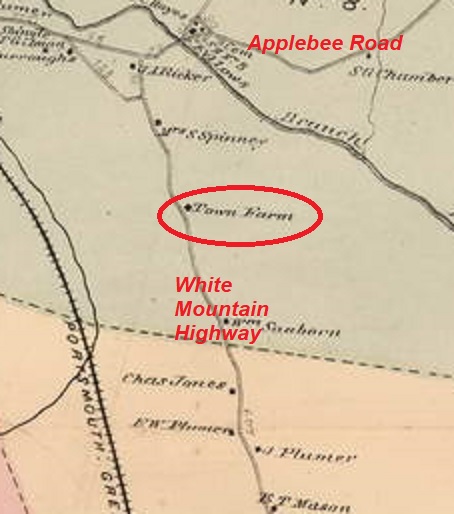
Our next stopping place was at the Milton Town Farm under the care of Mr. Dore. Mrs. Dore is one of the motherly women everyone likes because they cannot help it, everything looked cheerful and neat. It was a bitter cold night, and it might have been the blazing fire that made it seem so pleasant and homelike, and we had anticipated the coming answer, when in response to our enquiry of the paupers if they had any complaints to make they answered, none. We here found another subject for removal, a man who acknowledged he had received support at fifty-two different farms.
 At New Durham, in a little brown house, a long ways from the road, we found the home of the poor in charge of Mr. Gray. Although things here did not seem to be kept on a very complicated system, still we saw no cause for complaint on the part of the inmates The house was not however sufficiently far from the road, but that four additions had been made to its numbers within the year. For the presence here of three of the number of the Selectmen are almost entirely to blame.
This subject, a woman coming from Maine in August bringing a child four years old and after two months residence there gave birth to another. It was plainly the duty of the Selectmen to have instantly returned her, but through their inefficiency or neglect she still remains, and from the nature of her present condition must be here supported for a long time to come. Under these circumstances the Commissioners decline to have any connection with the case, preferring to let the Selectmen choose whether they will as soon as possible, perform their hitherto neglected duty of getting her away or make New Durham bear the expense of her maintenance. And while on this point, allow us to urge the selection of at least one person in each town, qualified by legal knowledge or natural shrewdness, to properly manage pauper affairs, and ready to avail themselves in all cases of all legal chances to avoid the maintenance of persons not belonging to them to support. The number here supported by the county is five.
The Farmington Alms House came next in course, which was in charge of Mr. Berry, although the poor there did not seem to be in charge of anyone in particular. We presume that the persons there maintained had enough to eat, but in all other aspects it seemed to us to be the opposite of what a well ordered or even a cheerful homes should be. We heard no particular complaints, still there seemed such an absence of system, order, neatness, or even that proper dignity of the mistress, which in our opinion, is so necessary to command the respect and proper behavior of those under her charge. There was nothing in the appearance of the woman in charge to distinguish her as the one to answer our enquiries, or conduct us about the establishment in the absence of Mr. Berry and when a question was asked, a half dozen stood ready to respond, each eager to answer first. Trusting a hint is sufficient, we hope to witness improvement here at our next visit.
Mr. Goodwin has charge of the Strafford poor, twelve in number, is a good man for the place, and his wife, in our opinion, possesses in a good degree the necessary qualifications of a housekeeper. There are evidently, some very difficult cases here to manage, still Mr. and Mrs. Goodwin seemed to have the obstinate in subjection, the insane safe, and the infirm and aged comfortable. The farm isa good one, Mr Goodwin a good farmer, his wife a capable housekeeper, and it is no disparagement to other Superintendents to say that the Strafford Alms House is as well conducted as any other in Strafford County.
The County poor at Barrington are in charge of Mr. Tibbetts, and are eight in number. These with the town poor together comprise “a hard set,” but considering their age and condition seem comfortable. We judge Mr. and Mrs. Tibbetts well adapted to the places they occupy, doing everything their means accommodations allow to keep their family in such a condition as to show marked improvement over their appearance one year ago. During the year we have removed four from this town to other States.
The Town Farm in Lee is superintended by Mr. Jones. The persons there supported, three in number, made no complaints, seemed comfortable, and during the short time we were there saw nothing to particularly commend or condemn.
Durham came next in course. Mr. and Mrs. Jones seem well qualified for their places. The number supported by the County here is seven, appeared comfortable, looked neat and cheerful, as did every thing about them. Durham is so situated upon the line of the B. & M. Rail Road, that it is often visited by foreigners and others desiring to stop, but Mr. Jones has skillfully managed to prevent their making his home theirs for any length of time. – In this town, for three years past, the Commissioners have had to fight most zealously bills in the famous Shuttleworth case. During that time the bills allowed Durham, in this case alone, amounted to over $1200, although greatly reduced from their first amount when presented. The Commissioners nearly a year ago assumed the responsibility, although at considerable cost to send them away, and we have good reasons to believe they will never trouble us again. By this arrangement the County has already saved over $200.
Neither Middleton or Madbury have Town Farms. Their County poor are let out by the Selectmen, and are at this time in good families and well cared for. We presume the number in each town is not sufficient to induce the purchase of Town Farms, and so long as their poor have such places, at their present prices, we shall not complain.
Our last visit was at Dover. The poor here supported, forty-one in number, are in charge of Mr. and Mrs. Carswell, and seem contented and properly cared for. – Both Mr. and Mrs. Carswell seem admirably fitted for their places, and maintain that order, and adopt that system so much needed, but wanting in some other Towns of the County. We found here several that we shall put in places, relieving the County of their support. We also found here a man supported by the public, who has drawn a pension of ninety-six dollars per year since the Mexican war. In two weeks after each semi-annual payment his pension would be entirely spent in dissipation, and the remaining forty-eight weeks requiring support of the public. In this case the Commissioners propose to procure the appointment of a guardian for him, by whom the money may be profitably expended, relieving the public of his support.
We have endeavored in brief terms to give our fellow citizens an insight into the present condition of the County poor, and their treatment at their several homes. – While we have always asked the Superintendent’s family of the behavior of those under their charge, and the restraints they are occasionally obliged to subject them to, we have also invariably enquired of the inmates if they had complaints to make, as to their food, clothing, and treatment, and when in our opinion justly made, have give directions to remedy the particular evil of which they complain. And while we have not required for them luxuries or expensive clothing, we have demanded that proper care, clothing, and attention be bestowed on them, some of whom have years before seen better days, but by that misfortune none can avoid are compelled to spend their remaining years in places from which they would have once turned in horror, and compelled to mingle with those whose natural depravity, or extravagance have made them a public charge.
We cannot close this report without again urging the selection of one good man as overseer of the poor in every Town of the County. We feel safe in saying that fully one third of those supported by the County, are here simply through the neglect of overseers for years past, to avail themselves of their legal rights, and return to those States where they justly belong, newcomers claiming assistance. Overseers allege in many towns their fear of assuming the responsibility of removing such persons but are often so destitute of legal knowledge applying to their case, that when informed by us of their plain duty, they show themselves wholly incapable of availing themselves of those rights, so essential to the pecuniary welfare of the tax-paying public.
We also present our protest against the system so much in practice of granting assistance off the farm. There are instances undoubtedly where such assistance is judiciously expended, but we think the practice is wrong in the main. We feel confident that there are families partially supported by orders of the overseer, who would entirely support themselves by their own exertions, rather than go to the Poor Farm. The system in time encourages feelings of indifference on their part, they relax their own exertions, in proportion as they are assisted, and in a few years become members of that independent class who rely entirely on the authorities for support, feeling no gratitude for their maintenance, and looking down with disdain on that class of our fellow citizens who “work for a living.”
This system is scarcely known in the small towns, but is practiced to a considerable extent in the more populous ones, particularly in Dover. This city drew last year over $500 for the support of the County poor, about three fifths of which came in orders and assistance off the farm. Complaints are constantly coming to our ears, be cause the city of Dover the past year was allowed nearly one half the amount expended in the whole County for pauper expenses.
The overseer here seems to be a competent man, appears conscientiously honest, keeps his accounts in perfect order, sends many away by our directions, still it is evident that something is “out of joint.” While disclaiming to impugn the honesty or ability of the city overseer, for whom we personally entertain none but the kindest feelings still, in justice to ourselves, and our oath, and in behalf of the tax-payers of the remainder of the County, we object to the appointment by the city government of a dealer in groceries, or of any man interested in trade, as overseer of the poor in the city of Dover. And we promise our fellow citizens a searching investigation of all cases incurring expense off the city farm.
In conclusion we state what is not only our united opinion, but that of every Commissioner who has preceded us, that the town and County poor can be much more cheaply sustained at one County establishment than separately on Town Farms. – We ask the candid attention of the tax paying public to this point. In Strafford County there are thirteen towns, and a dozen Town Farms maintaining some one hundred and forty-five paupers. Is this number too large for a competent man to successfully manage? The experiment of County Farms in other Counties has been eminently successful. In no County of the State having a farm, does the average weekly expense of each pauper amount to one dollar, and in some, Belknap County for instance, falling very much short of it. A system is there adopted, requiring an amount of labor from each inmate, suited to his capacity, resulting in benefit to their health and spirits. – We feel confident, that at a County Farm rightly located, in the one item of physicians’ fees the County could save $800. The services of eleven of the twelve Superintendents now employed could be dispensed with – the expense of the board of their families, in many instances large ones, be saved, the expense of keeping in repair eleven sets of buildings be avoided, while we are sure that every town could find debts to pay with the money resulting from the sale of their farms.
The Commissioners of Hillsborough and Belknap Counties inform us that since their poor have been maintained at their County institutions, their number has materially decreased, especially in Hillsborough County. The reason for this they allege is that a large proportion of their poor are foreigners, who associate the idea of a County institution with something of the kind in their former home, where every species of cruelty and privation is practiced, and rather than be sent there, make renewed exertions for their own maintenance. One thing we know, that in removing paupers from this County, they will never consent to be sent into any County having a County Farm, while we, having none, are constantly troubled with their subjects coming to us. We might go on enumerating reasons to support our position, but prefer simply drawing the attention of our fellow citizens to this point, feeling confident that their good sense, after reflection will compel them to join us in our view of the subject.
Disclaiming any interested motives in awarding censure or approbation, and happy to find our general affairs more prosperous and successful than we anticipated, we respectfully submit this report, trusting that out fellow-citizens will not consider our tour wholly unsuccessful in improving the condition of our County poor, or lessening the pauper expenses of Strafford County.
JOSEPH F. LAWRENCE, STEPHEN S. CHICK, LUTHER HAYES, Commissioners for the county of Strafford (Dover Enquirer, November 24, 1864).
“The old [Town Farm] system, followed until the year 1867, in the case of the poor; the new system then inaugurated, in bringing the poor from the several towns in the county to the new County Asylum in Dover …” (Scales, 1914).
New Hampshire. An old soldier of 1812, 75 years old, and a native of Rochester now lies in the alms-house of Strafford county, utterly unbefriended by his townsmen (Springfield Weekly Republican (Springfield, MA), February 29, 1868).
Cornelius Carswell [Caswell], Supt. of Strafford County Farm, headed a Dover, NH, household at the time of the Ninth (1870) Federal Census. His household included Betsy T. [(Chase)] Carswell, aged fifty-two years (b. NH), Charles F. Carswell, attending school, aged eighteen years (b. NH), Emma B. Carswell, attending school, aged twelve years (b. NH), Caleb Hanson, a laborer, aged fifty-five years (b. NH), Ephraim Stratton, a laborer, aged fifty-seven years (b. NH), Lizzie Edgerly, a schoolteacher, aged twenty-three years (b. NH), Mary Patch, a seamstress, aged twenty-seven years (b. NH), and Sarah Stiles, a domestic, aged nineteen years (b. NH). Cornelius Carswell had real estate valued at $2,o00 and personal estate valued at $1,500. Caleb Hanson had personal estate valued at $5,000. His household included also eighty-seven “Inmates of County Poor House.”
Cornelius E. Caswell, Supt. Strafford County Farm, aged sixty-two years (b. NH), headed a Dover, NH, household at the time of the Tenth (1880) Federal Census. His household included his wife, Betsy T. [(Chase)] Caswell, keeps house, aged fifty-nine years (b. NH), his daughter, Emma Belle Caswell, a County schoolteacher, aged twenty-one years (b. NH); his boarder, Charles N. Thompson, Supt. Insane Dept., aged forty-eight years (b. NH), his [boarder’s] wife, Martha Thompson, Matron, his [boarder’s] son, Frank Thompson, works on farm, aged sixteen years (b. NH); his boarder, Henry S. Avery, works on farm, aged twenty-three years (b. NH); his sister, Deborah Caswell, Cook, aged forty-seven years (b. NH); and Abby Caverly, a seamstress, aged forty-nine years (b. NH). His household included also eleven prisoners, and one hundred fifty-seven County Asylum inmates.
The Strafford County Almshouse and its inhabitants suffered two major fires in its first quarter century: the first one in January 1881, in which thirteen inmates died (including Milton’s Clara Scates), and the second in February 1893, in which forty-one inmates died.
FROM NEW HAMPSHIRE. The Burning of Strafford County Alms House. HEROISM OF MANY OF THE INMATES. A Brave Irishwoman Saves the Lives of Several Children. DOVER, N.H., Jan. 7. At the burning of the Strafford county poor farm house some of the women exhibited great presence of mind, and aided in saving others. One Irish woman stood barefooted in the snow, catching in her arms children as they were thrown from the windows. Everything possible was done by the superintendent and others to save the lives of the inmates, but without water or means of applying it, little could be done. Nothing remains of the building, but the walls. Within, amid a mass of embers, may be seen two human bodies burning (Lewiston Sun-Journal (Lewiston, ME), January 7, 1881).
FORTY-ONE ARE DEAD. Further Details of the Strafford County Horror. A HORRIBLE SPECTACLE PRESENTED At the Taking Out of the Charred Bodies from the Ruins. DOVER, N.H., Feb. 11. – The horror of Thursday night’s fire deepens with succeeding details. A catastrophe, that for appalling features and large loss of life will go on record as the direst ever known in the annals of the Granite state. The night was wild with the ragings of the elements; winds blowing, snow falling and sleet freezing.
To these add the fateful grandeur of the flames, as they leaped skyward, and the sight will never be forgotten. Forty-one persons were burned beyond all semblance of human form. Poor, decrepit old people were they; weak in mind as well as body. They were locked in like rats in a burning ship. Strong hands and willing hearts were on hand to render aid, yet fate had ordained that they must perish, and in a pile of debris were found the blackened Embers of Man and Womankind.
The search for the dead in the heated, distorted cellar sepulcher was simply awful.
A ghastly array on rough boards in the chapel morgue was the sickening result. Thus was the closing scene in the awful drama of misery presented to the thousands of visitors at the farm.
Evening pinned down the curtain over the scene, and a hush fell over the group of buildings on the eminence overlooking the winding branches of the old Cocheco river.
Forty-one is the correct number of persons perished. The work of searching for the remains of the victims progressed systematically, and the greater portion of the bodies were recovered, but in such condition that only a few of them could be positively identified.
Positive identification, however, does not cause the authorities great concern, as very few of the unfortunates have friends who would see that they had a proper burial, were the identifications ever so complete.
Exhuming the Bodies. Not until after a hearty meal did the work of raking over the mass of cinders, scrap iron, water pipes and coal for dead bodies begin. By this time the roads leading to the buildings were black with all kinds of vehicles.
The people gathered around the cellar by the hundreds, and they interfered greatly with the work.
Soon the laborers put up ropes and drove the vast crowd back. It was almost impossible to search in the cellar under the main building, as the water was two feet deep. Then the pipes used for heating purposes fell in all directions and were buried under masses of bricks and stone.
There were sixteen bodies, or rather portions of them, visible when the work began. No body too large for a bushel basket was exhumed.
It was a deathly sickening sight. Twisted and bent, and the flesh turned back, they lay, some covered with ashes, and others Wholly Exposed.
The stench was enough to drive away any ordinary crowd, but nothing seemed too harrowing for the sightseers. There were a number of ladies there, and many a wet handkerchief told of woe and sorrow over the untimely end of a dear friend.
No artist could paint a scene so full of sadness, despair and horror. No pen could describe the awful sight of destruction told within the walls of that cellar. No person who gathered around the ruins on the hill overlooking the vast farm probably will ever see such a spectacle again.
The undertaker would scrape up a few bones and attach a card which told no tale, save that Potter’s field would be the the resting place for another unknown. friends or kin will know where to strew flowers over the loved one.
The search was completed in about an hour, and all that was mortal was laid on rough boards in the chapel.
“Unknown” will be the mark on the little slab over the mound in the vale.
Keeper Driscoll and Undertaker A.N. Ward brought out the remains. Albert Ashley assisted them, and Dr. Daniels, coroner, superintended the work. Dr. Newcombe examined the bodies.
“Si” Perkins’ Bravery. The basement of the almshouse is fitted up with cells and is used as a house of correction. There were five prisoners here, confined for slight offenses. Superintendent Demerrit, when he saw the building in danger, went to these to relieve them. Shackles were placed upon them to prevent their getting away. One of them was James Perkins, called “Si,” who had been confined for a couple of weeks for being drunk and disorderly in the streets of Dover.
When the superintendent snapped the bracelets on his wrists, he said: “Take them off. I don’t want to be burned alive, and besides I want to get in and help.”
The key was turned, the irons thrown in a corner, and Perkins in his stocking feet ran out and climbed to the roof of the barn, which showed a small blaze and would, in another minute, have been wrapped in flames.
He ran along the eaves of the roof like a rat, carrying water, and was almost alone instrumental in saving the barn, the destruction of which would have doubtless meant the burning also of the almshouse building.
All the prisoners in the “correction” department of the house are on probation.
To Be Investigated. CONCORD, N.H., Feb. 11. – The house adopted resolutions authorizing the state board of health to investigate the causes of the disaster at the Strafford county farm, with instructions to report as early as possible (Quincy Daily Ledger (Quincy, MA), [Friday,] February 11, 1893).
Strafford County had the third largest number of New Hampshire county almshouse inhabitants in 1910. The Hillsborough County Farm had 314 inhabitants, the Merrimac County Almshouse had 115, the Strafford County Almshouse had 100, the Grafton County Farm and Almshouse had 85, the Cheshire County Almshouse had 85, the Rockingham County Farm had 82, the Belknap County Farm had 56, the Carroll County Almshouse had 55, the Coos County Almshouse had 54, and the Sullivan County Farm had 41.
References:
Hurd, Duane Hamilton. (1882). History of Rockingham and Strafford Counties, New Hampshire, with Biographical Sketches of Many of its Pioneers and Prominent Men. Retrieved from books.google.com/books?id=ta0AEQAAQBAJ&pg=PA653
NH General Court. (1843). Revised Statutes of the State of New Hampshire: Passed December 23, 1842. Retrieved from books.google.com/books?id=jw5LAAAAYAAJ&pg=PA135
NH Medical Society. (1871). Transactions of the NH Medical Society. Retrieved from books.google.com/books?id=SO8hZwj45UsC&pg=RA1-PA61
US Bureau of the Census. (1915). Paupers in Almshouses 1910. Retrieved from books.google.com/books?id=pZCoA_uBet8C&pg=PA68
Scales, John. (1914). History of Strafford County, New Hampshire, and Representative Citizens. Retrieved from books.google.com/books?id=nGsjAQAAMAAJ&pg=PA52


