
By Muriel Bristol (Transcriber) | January 13, 2019
In this first year of the Civil War, Milton suffered a fire that burned three buildings, heard of its Second NH Regiment men departing for the front, held a birthday celebration for another centenarian, heard reports of the first Battle of Bull Run, and saw John Townsend’s Milton Mills Manufacturing Co.’s woolen mill burn down.
Two months after the Civil War began in April 1861, John Colbath and the Goodwin family lost three buildings to a fire in West Milton.
The store of G.W. Goodwin, the shoe manufactory of John Colbath, with their contents, and the dwelling house of C.H. Goodwin, at West Milton, N.H., were destroyed by fire on Sunday morning, Loss about $6500; insured $3000 (Hartford Courant, [Wednesday,] June 19, 1861).
Five Goodwin households appeared sequentially in the Eighth (1860) Census, which suggests they all lived either side-by-side or zig-zagged down the same street in Milton (West Milton P.O.). The enumerator visited them all on June 1, 1860, i.e., only fifteen days before the fire.
Joseph Goodwin, a farmer, aged seventy-seven years, headed the first household in the sequence. His household included Anna [(Hanson)] Goodwin, aged sixty-two years. (Anna might have lied about her age: she was actually seventy-three). He had $2,000 in real estate and $350 in personal estate. The George W. Goodwin (1817-1869), Shepherd K. Goodwin (1823-1891), and Charles H. Goodwin (1825-1904) that follow were sons of this couple and brothers to each other.
Hannah Goodwin, aged sixty-seven years, headed the second household in the sequence. She was Joseph Goodwin’s sister.
Shepherd K. Goodwin, a farmer, aged thirty-seven years, headed the third household in the sequence. His household included Sophrona J. [(Young)] Goodwin, aged thirty-five years, George H. Goodwin, aged fourteen years, Augustine P. Goodwin, aged ten years, and John W. Twombly, a merchant, aged twenty-five years. Stephen H. Goodwin had $1,500 in real estate and $400 in personal estate. John W. Twombly had $150 in personal estate, presumably much of that was his stock in trade. Both children had attended school within the last year. (He would appear also in the US Class II military draft list of 1863).
Geo. W. Goodwin, a merchant, aged forty-two years, headed the fourth household in the sequence. His household included M.C. [Marietta (Chamberlain)] Goodwin, aged thirty-eight years, and Abba A. Moulton, aged eleven years. Geo. W. Goodwin had $3,000 in real estate and $7,000 in personal estate. Abba A. Moulton had attended school within the last year. This house burned.
C.H. [Charles H.] Goodwin, a shoe manufacturer, aged thirty-five years, headed the fifth household in the sequence. His household included Susan E. [(Wentworth)] Goodwin, aged twenty-five years, and Abba A. Goodwin, aged six years. C.H. Goodwin had $1,500 in real estate and $600 in personal estate. Abba A. Goodwin had attended school within the last year. This house burned.
Next in the census sequence below C.H. Goodwin was an “Unoccupied” building. The “shoe manufactory of John Colbath” might have been considered unoccupied in the sense that it had no residents, outside of working hours that is. If this was the shoe manufactory, this building burned.
John Colbath (1828-1915) resided in Charles H. Goodwin’s Milton household in 1850. He married in Milton, NH, November 10, 1853, Adaline Augusta Wentworth (1834-1873). She was born circa 1834, daughter of Joseph C. and Tryphena B. (Roberts) Wentworth
John Colbath, a shoe maker, aged thirty-five years, headed a Somersworth [Great Falls P.O.] household at the time of the Eighth (1860) Federal Census. His household included Augusta Colbath, aged thirty years, and [——] Plummer, a shoe maker, aged twenty-five years.
The Second NH Regiment, in which Milton men had enlisted, passed through Boston, MA, on Thursday, June 20, 1861.
Military Movements. The 2d New Hampshire Regiment, Col. Gilman Marston, passed through this city on Thursday. We are unable to give any particulars this week (New England Farmer (Boston, MA), [Saturday,] June 22, 1861).
Military Movements. The 2d New Hampshire Regiment, which passed through here last week Thursday, is a fine body of men, and won much praise from the spectators as it passed through our streets. They were given a grand collation at Music Hall, which was appropriately decked for the occasion. Short speeches were made by Hon. Marshall P. Wilder, Col. Marston, and others. As the regiment was passing over the Camden and Amboy Railroad, near Westfield, N.J., Friday night, Lieut. Chas. W. Walker, of Co. B, Concord, fell from the train, which passed over one of his legs, and inflicted such injuries that he survived but a few hours. His remains were taken to Concord, and interred with impressive ceremonies, on Wednesday. He was a native of Fryeburg, Me. (New England Farmer (Boston, MA), [Saturday,] June 29, 1861).
Monroe J. Corson, John O. Hayes, Charles E. Jones, Christie L. Jones, Robert Miller, Moses L. Smith, James H. Tibbetts, John S. Varney, Theron F. Varney, and James M. Venner were among those that enlisted in the Second NH Regiment from Milton. (John Brown, Herbert E. Cook, and John Godfrey enlisted in the Second from elsewhere, but were “credited” towards Milton’s total)).
The Second NH Regiment fought in the First Battle of Bull Run (aka Manassas), just a month later, on July 21, 1861.
As mentioned previously, people who lived to an advanced age were of great interest formerly, as they are now.
A Centenary Celebration. The descendants and relatives of the widow of the late Daniel Hayes gathered at the homestead, in Milton, N.H., on which day the old lady was one hundred years of age. There were nearly 300 persons present, including five of the fifth generation (Baltimore Sun, July 20, 1861).
Daniel Hayes headed a Milton household at the time of the Sixth (1840) Federal Census. His household included one male aged 60-69 years and one female aged 70-79 years.
Eunice (Pinkham) Hayes was the “widow of the late Daniel Hayes.” He died in Milton, December 4, 1846, aged eighty-seven years, two months. Eunice lived subsequently in the Milton household of her daughter, Betsy (Hayes) Pearl, and son-in-law, Joseph Pearl.
Joseph Pearl, a farmer, aged sixty-four years, headed a Milton household at the time of the Seventh (1850) Federal Census. His household included Betsy Pearl, aged fifty-eight years, James Rowe, a farmer, aged fifteen years, and Eunice Hayes, aged eighty-nine years. Joseph Pearl had real estate valued at $10,000.
Joseph Pearl, a farmer, aged seventy-three years, headed a Milton (West Milton P.O.)household at the time of the Eighth (1860) Federal Census. His household included Betsy Pearl, aged sixty-eight years, and Eunice Hayes, aged ninety-nine years. Joseph Pearl had real estate valued at $4,000 and personal estate valued at $5,000.
The Federal government assessed Joseph Pearl for his two-horse carriage in the US Excise Tax of May 1864 and the US Excise Tax of May 1866.
The Second NH Regiment, in which some Milton men were serving, was engaged at the first Battle of Bull Run (aka Manassas).
Latest. Our Thursday morning dispatches relate chiefly to the correcting of reports concerning our loss in the late engagement and the preparations being made for the increase of the army at Washington. The following summary embraces everything of importance: The list of the dead and wounded is every day being made more complete. The War Department is still busily employed in organizing the troops. Offers of more troops are coming in, thick and fast, from all parts of the country. 80,000 men have been accepted. The rebels refuse to admit flags of truce for the purpose of taking charge of the wounded, within their lines, but promise that every attention shall be given them. There is no authentic confirmation of the current report that the rebels are evacuating Manassas Junction. The impression, founded upon a dispatch from Capt. Gibson to Capt. Tyler, that some of our troops remain in Centreville, also lacks confirmation. The ordnance department at the Washington Navy Yard is employing extra force in the manufacture of rifled cannon. The blockade of the Virginia shore of the Potomac is still maintained. Two more spies have been arrested at Alexandria.
[Excerpt:]
The Second New Hampshire Regiment went into the action with 856 men, and returned with 800, 52 of whom are wounded; of the others, 12 are dead and 44 missing. Col. Marston is doing well (New England Farmer (Boston, MA), July 27, 1861).
Towards the end of the year, John Townsend’s Milton Mills Company woolen factory burnt in the small hours of Saturday, October, 19, 1861.
Destruction of a Flannel Factory. Great Falls, N.H., Oct. 19. The flannel factory of John Townsend, at Milton Mills, N.H., was burnt this morning. The loss is estimated at $30,000, on which there is a partial insurance. The factory was running on a government contract for army flannels (Baltimore Sun, October 22, 1861).
Miscellaneous Items. The flannel factory belonging to John Townsend. at Milton Mills, N.H., was burnt Saturday morning, at about 2 o’clock. Loss about $30,000; partially insured. The mill was running on a government contract (New England Farmer (Boston, MA), October 26, 1861).
The “flannel factory belonging to John Townsend” was denominated as The Milton Mills in a Milton Gazetteer of 1859.
John Townsend, a woolen manufacturer, aged fifty-two years, headed a Milton (Milton Mills P.O.) household at the time of the Eighth (1860) Federal Census. His household included Eliza A. Townsend, aged thirty-seven years, Jane R. Townsend, aged twenty-four years, Caroline F. Townsend, aged twenty years, Henry H. Townsend, aged seventeen years, Ermina Townsend, aged fourteen years, Willie B. Townsend, aged ten years, and Frank A. Townsend, aged four years. Caroline F. Henry H., Ermina, and Willie B. Townsend had all attended school within the last year. John Townsend had real estate valued at $2,000 and personal estate valued at $8,000.
John Townsend’s house stood in close proximity to the households of L.D. Reed, landlord of the Milton Mills Hotel, aged thirty-one years; E. Osgood, a blacksmith, aged fifty-four years; Joseph Townsend, a wool manufacturer, aged thirty-seven years, and Joseph P. Swasey, a tailor, aged thirty-five years.
John Townsend rebuilt his Milton Mills Co., or Milton Mills Manufacturing Co., factory larger than the one that burnt. The new mill is mentioned in Vulpes’ letter of 1864 as running “full blast” and it paid the US Excise Tax of May 1864.
The Fifth NH Regiment, in which Milton men had enlisted, arrived in Jersey City, NJ, on its way to Washington, DC, in October 1861.
From Yesterday’s Second Edition. The 5th N.H. regiment, Col. Cross, arrived in the Norwich boat at Jersey City this forenoon and left at seven for Washington. Several friends of Major Cook, formerly of the Boston “Tigers,” as well as sons of New Hampshire, gave them friendly greetings (Buffalo Commercial (Buffalo, NY), October 31, 1861).
The Sixth NH Regiment, in which Milton men had enlisted, passed through New York City in December 1861, bound for Washington, DC.
News by Telegraph. New York, Dec. 26. The 6th N.H. Regiment passed through here to-day tor Washington (Buffalo (NY) Weekly Express, December 31, 1861).
Previous in sequence: Milton in the News – 1860; next in sequence: Milton in the News – 1862
References:
Find a Grave. (2013, January 9). Lieut. Charles W. Walker. Retrieved from www.findagrave.com/memorial/103341372/charles-w-walker
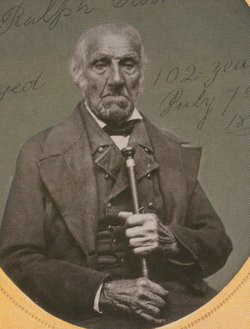 The statement has frequently been made by the newspapers and endorsed by Mr. Everett in his late Fourth of July oration, that there is no one left of that band of heroes who first withstood the shock of British arms in the open field. Eighty-five years having elapsed since that world renowned struggle, the burden of probabilities would favor that conclusion; yet the statement is not correct. There is one who took part in that memorable battle, and in subsequent events of the revolution, yet living, “full of years,” and venerated for his moral worth as well as for his age and public services. In the town of Acton, Maine, on a beautiful ridge of land, situated about a mile from Milton Mills, N.H., stands a cottage farm house, unpretending in its appearance, and bearing evidence of a very respectable antiquity. The passer-by will often notice a gray-haired man reading attentively by the window or walking about with a single cane perchance engaged in the ordinary labors of the husbandman. The stranger will perceive nothing very remarkable in the thick set, slightly bent figure, and well preserved, swarthy features of this old man of apparently eighty years, but the residents of the adjacent country involuntarily bend with reverence as they pass him. And well they may as he is the last of the Bunker Hill patriots. David Kinnison, who long survived his confederates of the famous Boston tea party, was living in 1831, in Chicago, at the extraordinary age of one hundred and fifteen years. He has since passed away. Ralph Farnham, the last of the Bunker Hill heroes, still lives, although he has nearly attained a span and a half of the space allotted to man. His one hundred and fourth birthday was celebrated at Milton Mills on the 7th. We have already given from the pen of a correspondent, some notice of this interesting affair. Although no pains were taken to extend a notice of the event beyond the immediate vicinity of the veteran’s residence, a very large concourse of people were in attendance. The features of the occasion were an address and one hundred and four greetings from a twelve pounder, and a dinner enlivened with toasts and speeches. Mr. Farnham, we learn, was not in the midst of the battle. Having been enrolled only on the day previous, it was his lot to be detailed among a guard to take charge of artillery and baggage, at some distance from the redoubt. In so close a proximity to the principal scene of strife, the observations he made and distinctly recollects to this day, are highly interesting, and we trust they will be given to the public by some competent pen. When we reflect how few persons living can even remember the event itself as a child of twelve at that time would now be ninety-five years old a living actor in that bloody drama becomes at once an object of interest, respect and veneration. – Boston Journal (St. Johnsbury Caledonian, July 20, 1860).
 Milton Observer