Remote Local Government Efficiency Task Force Meeting Scheduled – June 29, 2020

By S.D. Plissken | June 29, 2020

The Local Government Efficiency Task Force announced that its inaugural quasi-public meeting will be held today at 6:00 PM.

Its published agenda prefixed its title with the adjective “Remote,” which is meant apparently to signify a “public” meeting under the Governor’s Covid-19 workaround of closed meetings, without any public comment at all, that are “public” only in the sense that they are broadcast to the public or that the public may listen by telephone. Presumably, it is not intended to signify a remote local meeting, which would be to pile on another oxymoron. (The original one having been “government efficiency” or “local government efficiency”).

This new “task force” was initially identified also as an “independent” committee, which it would not be, – even in government speak – if constituted as discussed previously. An actual independent committee would be one composed mostly – if not entirely – of members who are not Town officials or apparatchiks.

A “Joint” committee would be one whose members are drawn from several different bodies or authorities, such as from the Board of Selectmen and School Board. A “Select” or “Special” committee is one appointed for a defined and limited time period for a particular purpose only. This might be termed alternatively an “Ad Hoc” (Latin for “to this” or “for this” purpose) committee.

The time period put forward for this Local Government Efficiency Task Force to fulfill its purpose has been estimated at twelve to eighteen months, or even longer, i.e., well after the current budget process, well after the next election, and perhaps even after the next budgeting process. It is truly amazing how these things “work.”

It would seem that those seeking tax reductions as precipitate as the tax increases have been might have to look elsewhere.

The Task Force’s agenda has six main topics: [1)] Introductions and Statements of Individual Goals, 2) Discussion of Ideas and Approaches, 3) Revenue / Tax Base Growth and Diversification, [4)] Operational Efficiencies, [5)] Organization, and [6)] Other Business.

Introductions and Statements of Individual Goals. In which we meet the members.

Discussion of Ideas and Approaches. In which we might hear of their general approach and their initial thoughts. I had once a boss that explained that consultants mostly return and support what management asked them to find at the outset. And that lies in the questions being asked below.

Revenue / Tax Base Growth and Diversification. a) What grows the tax base? b) What kinds of impacts do different types of growth have on the community? c) What opportunities do we have to create revenue brainstorming session (additional Solar Panel Farm, leasing of town facilities, advertising revenue possibilities), d. Other Ideas and Suggestions.

The questions all suggest that the Town government hopes still to continue merrily along at current or even larger levels, but that someone else might be found to foot the ever-increasing bill.

The questions do suggest some dim awareness that regulatory restrictions have hampered growth and, consequently, tax revenues. In this, the task force seems to have identified already the well-known Kindergarten principle: don’t hit people and don’t take their stuff. Regrettably, they seem to have taken away the wrong lesson. They hope to find and take more stuff.

They do not seem to consider “growth” to be a concern of property owners, as such, but a “communal” one. One supposes that they might next to be speaking of taxes as an “investment.”

Operational Efficiencies. a) What ideas do you have that might increase efficiencies? [E.g.,] Energy Conservation, Cooperative purchasing with school, regionally, Are there opportunities to combine departments / functions?, Are there other opportunities to regionalize?

It is better late than never to eliminate duplication, but it has been inexplicable that it has taken so long. There is an organizational efficiency that taxpayers should consider. Why would one ever establish, depend, or expand upon an organization that spends first and considers organizational efficiencies last?

Organization. a) Election of Chair, Vice Chair, Secretary; b) Review of and proposed amendments to Task Force By-laws (you are a subcommittee of the Board of Selectmen, so these are samples – any by-laws ultimately would need approval by the Select Board); c) Do you want to put together subcommittees for the areas Identified Above?

Strictly speaking, a subcommittee of the BOS would be composed entirely of members of the parent committee, i.e. the Board of Selectmen.

Well, we shall see, will we not?


We always carry out by committee anything in which any one of us alone would be too reasonable to persist.  – Frank Moore Colby


References:

Town of Milton. (2020, June 26). Remote Local Government Efficiency Task Force Agenda, June 29, 2020. Retrieved from www.miltonnh-us.com/sites/g/files/vyhlif916/f/events/06-29-2020_et_agenda.pdf

Opting Out

By Ian Aikens | June 15, 2020

While “Staying at Home” recently, I decided to get my taxes out of the way once and for all. I was unpleasantly surprised to discover that I owed a larger-than-expected amount on my state income tax. I know they say we have no state income tax here in New Hampshire, but that’s baloney. If you have received more than $2,400 in income in interest, dividends, or annuities in one year, you will pay the State of New Hampshire a 5% tax on the total. Of course, they do have some of the usual exemptions for age and blindness (and why not deafness too – isn’t that discrimination?), but if that isn’t a tax on income, then I don’t know what is. They say it’s a tax on passive income, not earned income, but a tax is a tax, no matter what you call it.

However, what I did discover is New Hampshire has a great option available to take a credit against this income tax by making a donation to a school scholarship program. This 85% credit, not deduction, is part of the New Hampshire Education Tax Credit Program. It serves two worthwhile purposes: it helps children from families with less financial means attend non-government schools, and it gives state bureaucrats less money to waste. The latest data shows there were 413 students in the state benefiting from this program at 58 participating schools. This is a lowly participation rate of less than 1% of the 47,584 students who are income-eligible statewide. Still, to the families of those 413 students, even a mere scholarship of 15% of government school per-student spending means a lot.

So, how does the program work? As with all government programs, they come with their share of rules, conditions, and requirements. That said, the requirements don’t appear to be particularly onerous. To be eligible, the family members must be New Hampshire residents, the child must be between the ages of 5 and 20 (and not graduated from high school) or must be entering kindergarten for the first time or entering 2nd-12th grades and coming from a government school. The family’s income cannot exceed 300% of the federal poverty level, which in lay terms means $51,720 for a family of 2, $65,160 for a family of 3, and exponentially an additional $13,440 for each additional family member. There are only two government-approved scholarship organizations that qualify for the education tax credit program – the Children’s Scholarship Fund and the Giving and Going Alliance. I checked out both organizations before I gave my donation, and both seemed just fine to me. The Children’s scholarship Fund is for nonsectarian schools, and the Giving and Going Alliance is for the more faith-based crowd. Most important, the scholarships are awarded to students struggling in their current government schools to allow them to attend any school—private, religious, out-of-district government school, even home schooled—that the parents deem best for their child.

The tax credit program was established in 2012 by SB372 and launched in 2013. It only applied to business organizations, which could utilize the 85% credit against the Business Profits Tax (BPT) and/or Business Enterprise Tax (BET) or Interest & Dividends Tax (I&D). However, HB1686 extended the same credit to individuals to use against any I&D tax owing. The program has an annual cap of $6 million, and while contributions from donors have increased over the years from $20,000 in fiscal year 2014 to $381,000 in fiscal year 2018, it still has never gotten anywhere close to the cap.

For years, those who purport to help the poor have been on the offensive to kill the program or chop it down as much as possible. One of their favorite arguments is the program is for the benefit of “the rich.” The data does not support their claim. In the 2018-2019 school year, 61.4% of the students in the Children’s Scholarship Fund and 44.9% of the students in the Giving and Going Alliance qualified for free or reduced-price lunches.

Their next favorite argument is that the program “carves out” $6 million that would otherwise go to government schools. More bunk. Firstly, the maximum tax credit is 85% of the $6 million, which is $5.1 million. Secondly, up through March 8, 2019, the total tax credits claimed since the program started are only $2,218,254. That’s only 7.25% of what could have been claimed over a 6-year period.

Another favorite rant against the program is that it drives up property tax rates. Considering how small the program is, this is completely laughable. The funds that would have been paid to the state if the tax credits had not been claimed go to the general fund (a big black hole), and since only 24% of state funding goes to education, there’s a 76% chance the funds would have gone to other priorities than education. If you count every dollar given out on a per-student basis since the program began, it would only come to $12.66 per student. However, per the Department of Education’s Office of Student Finance, the total annual cost at government schools is an average of $18,991/student. Looking at it another way, even if you included all the educational tax credits claimed from 2014-2019 (6 years) and compared that to what the state spent in just the last fiscal year ($1.4 billion), that’s .16 of just 1%. Any way you slice it, the program is a drop in the ocean of what is spent at government schools.

If they were really so concerned about property tax increases, maybe they should look at the Veterans Tax Credit Program. Its numbers are huge compared to the peanut Education Tax Credit Program. In 2016, 54,790 veterans claimed $26.76 million in property tax credits through the veterans’ program as compared to a few hundred students. As an example, looking at Manchester, New Hampshire’s largest school district, in 2016, 2,797 veterans claimed the credit for a loss in tax revenue of $1.2 million. Contrast that with 27 students who received scholarships at a total loss in tax revenue of $133,534, which includes the additional grant for the federal lunch program. That’s roughly 11% of the veterans’ credit, so why go after peanuts if your real concern is high property taxes?

Of course, the real elephant in the room is the increase in state spending on education despite the steady drop in student populations. From 2009-2018, the statewide average decline in enrollment was 10.1%. However, spending and adding staff have gone in the opposite direction. From 1992-2015, New Hampshire government schools’ student-staff ratio declined from 8.6 to 5.8 (national average was 8.0 in 2015). It is the dramatic increase in non-teaching staff that is driving the wild spending. In 1992 the schools had an average of 19.6 students for every non-teaching staff member; by 2015, the number was down to 10.8 students for every non-teaching staff member. If schools are for teaching, why are so many non-teachers needed?

Despite all these extra resources at government schools, clearly one-size-fits-all doesn’t work for every child. Why begrudge children who do better in non-government schools (and for the most part are not from the upper echelons of society)? Such a large pool of students who are eligible for the federal school lunch program suggests that students who use the scholarship program tend to do worse in government schools and need extra attention and resources. So, by leaving government schools, that should not only reduce the burden there, it should reduce it even more since those who leave require more services. If the money truly followed the child, then this miniscule number of students should actually get more resources, not less. However, under the education tax credit program, the average scholarship for 2018-2019 was $2,301, and the rest of the tuition costs was shouldered by the families. Not to mention transportation costs, which parents have to arrange themselves. And yet these families manage to get their kids into better schools at great expense to themselves and are grateful for the program due to better outcomes for their children.

This is a win-win for everyone. Certainly, the parents and children are happier with the expanded choices afforded by the program. In surveys required by the program, 93.8% of the parents in the Children’s Scholarship Fund and 96.9% of the parents in the Giving and Going Alliance indicated that they were satisfied with the program. Government schools get to lose a few “customers” who are better served elsewhere anyway, and the foregone revenue has a negligible effect on their budgets. Perhaps the only losers are the power control freaks who cannot stand it when anyone opts out of their centralized control plans.

References:

Cline, Andrew. (2019, March 27). The Education Tax Credit Program: Fact vs. Fiction. Retrieved from jbartlett.org/wp-content/uploads/The-Education-Tax-Credit-Program-Fact-vs.-Fiction.pdf

ed Choice. (2020). School Choice – New Hampshire Education Tax Credit Program. Retrieved from www.edchoice.org/school-choice/programs/new-hampshire-education-tax-credit-program/

NH Department of Revenue Administration. (2017). The NH Education Tax Credit Program. Retrieved from www.revenue.nh.gov/quick-links/education-tax-credit.htm

NH Department of Revenue Administration. (2018 and 2019 ED-05). Children’s Scholarship Fund Organization Report. Retrieved from www.revenue.nh.gov/quick-links/documents/childrens-scholarship-fund-ed-5.pdf

NH Department of Revenue Administration. (2018 and 2019 ED-05). Giving and Going Alliance Scholarship Organization Report. Retrieved from www.revenue.nh.gov/quick-links/documents/giving-and-going-alliance.pdf

Public BOS Session Scheduled (June 15, 2020)

By Muriel Bristol | June 12, 2020

The Milton Board of Selectmen (BOS) have posted their agenda for a quasi-Public BOS meeting to be held Monday, June 15, at 4:30 PM.

Due to their concerns regarding Covid-19, there will be no public in attendance and, therefore, no public comment. The session may be watched remotely through the usual YouTube means or by teleconference. The links for both are in their original agenda, for which there is a link in the References below.


The Public portion of the agenda has a Limited Agenda, and some housekeeping items.

Under New Business is scheduled a single agenda item, albeit with two parts: 1) Update Regarding Covid-19 (Novel Coronavirus) Operational Activities/Plans. a). Beach and Summer Camp Operations Discussion with Possible Action, b). Town Hall Hours and Operations Discussion with Possible Action.

ReopenNH
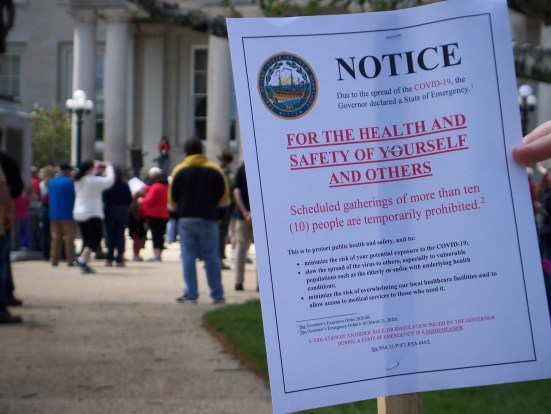
Third ReopenNH Rally at NH State House, May 16 (Milton Observer)

Update Regarding Covid-19 (Novel Coronavirus) Operational Activities/Plans. One supposes, by the very terms of the meeting announcement, that the Covid-19 is still among us. We will evidently hear an update on those things with which the BOS has been active.

Governor Sununu announced yesterday, June 11, that his “Stay at Home” order expires Monday, June 15, i.e., the day of the BOS meeting. Gatherings will no longer be limited to ten people. Gyms, racetracks, charitable gaming facilities, libraries and funeral homes will be allowed to reopen, with modifications. Indoor movie theaters, amusement parks, performing arts venues and adult day centers may reopen Monday, June 29, with some restrictions.

a). Beach and Summer Camp Operations Discussion with Possible Action. Newspapers have published photographs of fair-sized crowds at Jenness State Beach in Rye, NH, from Friday June 5. In Milton, the BOS discussion might feature red tape X’s on the beach at six-foot intervals?

b). Town Hall Hours and Operations Discussion with Possible Action. As of today, open “by appointment.”


There will be the approval of prior minutes (from the Workshop session of May 20, 2020, the quasi-Public session of May 29, 2020, the quasi-Public session of June 1, 2020, and the Non-Public session of June 1, 2020), and BOS comments.


Mr. S.D. Plissken contributed to this article.


References:

Town of Milton. (2020, June 12). BOS Meeting Agenda, June 15, 2020. Retrieved from www.miltonnh-us.com/sites/miltonnh/files/agendas/06-15-2020_bosagenda_final.pdf

A Tight Place

By S.D. Plissken | May 28, 2020

The Milton Board of Selectmen (BOS) find themselves in a tight place. Their government has simply grown too large, and, as a consequence, their budgets and the levels of taxation needed to fund them, have simply grown too large too.

Pooh Bear Stuck in Rabbit's Door - Back End
Pooh as a Towel Rack

One is reminded of a tale from A.A. Milne’s Winnie the Pooh: “In Which Pooh Goes Visiting and Gets into a Tight Place.” In the story, Pooh visits Rabbit’s burrow and, while there, greedily consumes Rabbit’s stock of honey (for which Pooh has a bottomless appetite). When it comes time to leave, the now larger Pooh gets stuck in Rabbit’s front door. He can neither be pushed through to the outside or pulled back into the inside. Not as he is now, anyway. They simply have to wait until Pooh loses the weight that he gained by eating all the honey. In the meantime, Rabbit tries to make the best of a bad situation by using Pooh’s back end for other purposes.

Now, Pooh – elsewhere described as being a “bear of very little brain” – eventually loses enough weight to escape this particular predicament.

Over their last few meetings, the BOS have been pondering where they have become stuck. Their overly large budgets having been roundly rejected by Milton’s voters, already rejected more often than not in recent years, and now two years in succession. (To be fair, these particular selectmen are responsible only for the most recent in a long train of abuses).

These selectmen began their year well enough by acknowledging their budget problem – a first step in a recovery – and proposing freezes until they could extricate themselves. However, they have evidently not yet reached bottom, as they posted job openings the very next day, and voted yet another in a subsequent meeting. (Vice-Chairman Rawson was a rare dissenting vote on that one).

They are meanwhile seeking applicants to be the minority on a “Local Government Efficiency Task Force,” which is to seek the Lost Dutchman’s Mine of government efficiency. One of its several objectives is to find other sources of revenue. A cynic might suppose that little or no actual changes are proposed and that spending is to continue at current levels, simply through finding other people to pay for it.

The solar panel farm and a cell tower were cited as examples of other sources. As in mathematical proofs, some elements might be “necessary,” but are not in and of themselves “sufficient.” Such money as those examples added was spent long ago on increased government, rather than tax reduction. And there have been also less exciting instances of this sort put forward in the past – for example, the contentious landfill proposal of some years ago.

Space aliens from the eighth dimension might present themselves at the Emma Ramsey Center for a thorough probing. However, it is much more likely that any “other sources” of revenue will just come from the other pockets of the present victims. For example, transfer station fee changes, i.e., fee increases, have appeared on a recent agenda. (Some might remember that these fees did not exist at all just a few years ago).

Several bills were put forward at the State level in this most recent biennium, whereby some legislators sought to add back-door income taxes to our burden. They too sense that property taxation has reached already its outer limits, but are unwilling to curb their appetite. They are seeking instead to add other revenue sources rather than to push back from the table. It would have been, as the British have it, just the “thin end of the wedge.”

The Task Force is expected to take twelve to eighteen months, or longer, to reach its conclusion, if any there be. Its majority of Town officials might be expected to have a vested interest in continuing to feed the beast. How likely are they to discover any redundancies, even those right under their noses? That Milton has both an Assessor and a Contract Assessor can be seen at a glance, as well as its having both a Planning Board and a Contract Town Planner. The BOS is under no obligation to adopt its recommendations, if any there will be.

Meanwhile, the BOS will have gained twelve to eighteen months, or longer, in which they might proceed blithely along their “tried and true” rut. Let’s help them with their annual calculation: a now smaller annual percentage increase (thank God for the Tax Cap’s small blessing) multiplied by much too much government will yield a yet more expensive government. (Nobody there has heard of zero-based budgeting). Under ordinary circumstances, they might be able to kick the can down the road for a few more years, before arriving right back where they started.

But we live in extraordinary times. The “Black Swan” of the Coronavirus just punctured the carefully nurtured economic bubble. (If it had not been that, it would have been something else). Let us suppose optimistically that the whole economic lockdown ends right now, this very week. This year’s GDP, that faulty measure of the nation’s economic progress and wealth, would be smaller by the two-plus months of the lockdown. (And New Hampshire’s and Milton’s GDPs smaller along with it). Yes, of course it would, that much is obvious.

Unfortunately, the usual inanities are being deployed again at the national level. Congress voted and the President approved trillions of dollars in additional stimulus spending. They have done so four, or five, times now in quick succession, one loses count. Now, the Federal government does not actually have any trillions to spend in this manner. And we have just seen that the GDP – the national wealth, if you will – just got smaller, rather than larger.

You see, at the Federal level they have the advantage of possessing a magical money tree. They just borrow the money from the future, i.e., expand the money supply, which is the very dictionary definition of inflation. This has the effect of creating greater numbers of devalued dollars. This reduction in dollar value extends to those in your pocket, as well as those in your bank account, those in your retirement savings, and, for those poor souls on a fixed income, those in their pensions or annuities.

Milton’s last two DRA “flash” valuation increases of recent years have been based upon the wildly-inflated prices of the last two housing bubbles. New Hampshire’s tax model assumes a rough correlation between property valuations and ability to pay. That assumption no longer tracks in these recent Federally-induced housing bubbles. (One cannot slice off a piece of a fantasy valuation and use it to pay taxes). It would require sensible State and Town governments – rather than bears of very little brain – to recognize this disparity and to restrain their spending. The large and increasing gulf between fantasy valuations and the reality paychecks might be compared with our large and increasing dissatisfaction with these methods.

In the longer term, one might expect that housing valuations will tend to fall, given that we have a smaller GDP, a probable recession, unemployment approaching already 20%, and some businesses likely shuttered forever. Does anyone suppose the State DRA will be demanding any “flash” valuation decreases? Of course not, they will want to overtax us through one more cycle.

Our Town government, which was already unsustainable, might try desperately to preserve its bubble size. It might raise tax rates to compensate for declining values. (It did this last time around). It might raise its existing fees, fines, and taxes, across the spectrum, and even create new ones. (Ask any refugee from Massachusetts). It might punish us for not approving their budgets.

Or they might more reasonably scale back our Town government. They might reduce the amount of its annual “fund balance” exaction, which they could do immediately, and extend the timelines of their so-called “plans.”

Homer Holding on to the Can
Homer, are you just holding on to the can?

In Homer Simpson one encounters a more contemporary fictional character, but one with a cognitive capacity similar to Winnie the Pooh. In one episode, a soft drink vending machine accepts his money, but does not dispense his can of soda. He reaches up inside the machine to pull it out, but cannot. He grasps the can, but his hand becomes “stuck.” Various people try to extricate him from the machine. They arrive finally (and improbably) at a solution of just sawing off his hand. Just before they take that drastic step, one technician poses a final question: “Homer, are you just holding on to the can?” In the next scene we find him rubbing his arm while departing amidst howls of laughter.

Watching our wise overlords struggle to retain their current budget levels, one might well ask them the same question: “Selectmen, are you just holding on to the can?”

References:

Wikipedia. (2020, May 22). Black Swan Theory. Retrieved from en.wikipedia.org/wiki/Black_swan_theory

Wikipedia. (2020, May 21). Winnie the Pooh (Book). Retrieved from en.wikipedia.org/wiki/Winnie-the-Pooh_(book)

YouTube. (n.d.). Homer, Are You Just Holding on to the Can? Retrieved from www.youtube.com/watch?v=6qcipCQalzA

Non-Public BOS Session Scheduled (May 18, 2020)

By Muriel Bristol | May 17, 2020

The Milton Board of Selectmen (BOS) have posted their agenda for a quasi-Public BOS meeting to be held Monday, May 18, at 4:00 PM. (Followed by Workshop meeting and a Non-Public session at the conclusion of the meeting).

Due to their concerns regarding Covid-19, there will be no public in attendance and, therefore, no public comment. The session may be watched remotely through the usual YouTube means or by teleconference. The links for both are in their original agenda, for which there is a link in the References below.


The Public portion of the agenda has New Business, Old Business, Other Business, and some housekeeping items.

Under New Business are scheduled two agenda items: 1) Update Regarding Covid-19 (Novel Coronavirus) Operational Activities/Plans, and 2) Accept a Donation of up 58 chairs from Target in Somersworth (rec’d 30, possible that we could get an additional 28 chairs) (Karen Brown).

Update Regarding Covid-19 (Novel Coronavirus) Activities. One supposes, by the very terms of the meeting announcement, that the Covid-19 is still among us. We will evidently hear an update on those things with which the BOS has been active.

People are becoming restive. Wisconsin’s Supreme Court struck down the Wisconsin Governor’s stay-at-home orders. A third End the Lockdown rally was held at the Statehouse in Concord, NH, on Saturday, May 16. This one focused on opposing church closures.

Accept a Donation of up 58 chairs from Target in Somersworth (rec’d 30, possible that we could get an additional 28 chairs) (Karen Brown). Accepting, bet on the BOS accepting the chairs. But where will they put them?


Old Business has two items: 1). Final Review and Possible Adoption of Select Board By-laws, and 2) Review of Letters of Interest Received for the Local Government Efficiency Task Force and possible appointments.

Final Review and Possible Adoption of Select Board By-laws. Possible adoption? Hanging on the cliff edge, as the suspense mounts.

Review of Letters of Interest Received for the Local Government Efficiency Task Force and possible appointments. Chairwoman Hutchings’ disquisition spoke of a hiring freeze, followed immediately by job postings. This is not the way to get better, people.

If this “task force” were to be successful, i.e., successful in its task of discovering the efficiencies that have eluded the Milton Town government for years, should it then simply replace the Milton Town government? You know, as having just proven themselves more capable and efficient.

No, Cincinnatus would then return to his plow. And that assumes that the Town government would actually implement any efficiencies such a task force might find, which is a big assumption.


Other Business That May Come Before the Board has no scheduled items.

There will be the approval of prior minutes (from the quasi-Public sessions of May 4, and May 7, 2020), the expenditure report, Town Administrator comments (regarding Headstart Building Correspondence), and BOS comments.


There will be a follow-on BOS Workshop Meeting without a named subject.


The BOS meeting is scheduled to conclude their meeting with a Non-Public Session. That agenda has one Non-Public item classed as 91-A3 II (c).

(c) Matters which, if discussed in public, would likely affect adversely the reputation of any person, other than a member of the public body itself, unless such person requests an open meeting. This exemption shall extend to any application for assistance or tax abatement or waiver of a fee, fine, or other levy, if based on inability to pay or poverty of the applicant.


Mr. S.D. Plissken contributed to this article.


References:

State of New Hampshire. (2016, June 21). RSA Chapter 91-A. Access to Governmental Records and Meetings. Retrieved from www.gencourt.state.nh.us/rsa/html/VI/91-A/91-A-3.htm

Town of Milton. (2020, May 16). BOS Meeting Agenda, May 18, 2020. Retrieved from www.miltonnh-us.com/sites/miltonnh/files/agendas/05-18-2020_bosagenda_final.pdf

Wikipedia. (2019, November 19). Washington Monument Syndrome. Retrieved from en.wikipedia.org/wiki/Washington_Monument_Syndrome

Youtube. (1965). Cone of Silence. Retrieved from www.youtube.com/watch?v=g1eUIK9CihA&feature=youtu.be&t=19

Public BOS Session Scheduled (May 4, 2020)

By Muriel Bristol |May 4, 2020

The Milton Board of Selectmen (BOS) have posted their agenda for a quasi-Public BOS meeting to be held Monday, May 4, at 4:00 PM. (And a follow-on Workshop meeting at the conclusion of the meeting).

Due to their concerns regarding Covid-19, there will be no public in attendance and, therefore, no public comment. The session may be watched remotely through the usual YouTube means or by teleconference. The links for both are in their original agenda, for which there is a link in the References below.


The Public portion of the agenda has New Business, Old Business, Other Business, and some housekeeping items.

Under New Business are scheduled three agenda items: 1) Update Regarding Covid-19 (Novel Coronavirus) Operational Activities in Response to Governor Sununu’s Update (as of the development of this agenda, Governor had not yet spoken), 2) Update on Status of Recreation Summer Programs (Karen Brown), and 3) 2020-2021 Capital Improvement Program Development and Coordination (Bruce Woodruff).

Update Regarding Covid-19 (Novel Coronavirus) Activities. One supposes, by the very terms of the meeting announcement, that the Covid-19 is still among us. We will evidently hear an update on those things with which the BOS has been active.

The World Health Organization (WHO) has done an about-face and is now recommending Sweden’s approach: voluntary measures, with no restrictions.

Some U.S. states have never had any state-level restrictions. Some states have begun removing their restrictions in phases. Some of the constitutional justifications for state-level restrictions – and they were somewhat thin ones – have been undercut by recent federal declarations. (The states derived their supposed authority to impose many restrictions from the original federal emergency declaration).

People are becoming restive. Michigan’s legislature is suing Michigan’s governor over her restrictions. A second End the Lockdown rally was held at the Statehouse in Concord, NH, on Saturday, May 2.

Update on Status of Recreation Summer Programs (Karen Brown). One imagines Summer is on schedule. New Hampshire’s current restrictions have a “Best By” date of May 15, unless extended further.

2020-2021 Capital Improvement Program Development and Coordination (Bruce Woodruff). Might it be that the Town planners plan to “flatten” their spending curve? That would be long overdue.


Old Business has a single item: 1). Update on Letters of Interest Received for Possible Appointment to Local Government Efficiency Task Force.

Update on Letters of Interest Received for Possible Appointment to Local Government Efficiency Task Force. When last heard on April 20, the BOS was in favor of weighting its “Task Force” with a majority of Town officials.


Other Business That May Come Before the Board has no scheduled items.

There will be the approval of prior minutes (from the quasi-Public session of April 20, 2020), the expenditure report, Town Administrator comments, and BOS comments.


There will be a follow-on BOS Workshop Meeting whose subject is 1) Public Works Staffing Levels (Patrick Smith).


Mr. S.D. Plissken contributed to this article.


References:

Town of Milton. (2020, May 1). BOS Meeting Agenda, May 4, 2020. Retrieved from www.miltonnh-us.com/sites/miltonnh/files/agendas/05-04-2020_bosagenda.pdf

Town of Milton. (2020, May 1). Expenditure Report, May 4, 2020. Retrieved from www.miltonnh-us.com/sites/miltonnh/files/agendas/05-04-2020_expenditurereport.pdf

Wikipedia. (2019, November 19). Washington Monument Syndrome. Retrieved from en.wikipedia.org/wiki/Washington_Monument_Syndrome

Milton’s Hierarchy of Needs

By S.D. Plissken | April 19, 2020

An acquaintance of a philosophical bent brought up in a discussion recently Maslow’s “Hierarchy of Needs.” Psychologist Abraham Maslow put forward his theory of a hierarchy of needs in a 1943 paper and, more fully, in his 1954 book Motivation and Personality.

In Maslow’s theory, usually depicted as a pyramid, with the most essential needs grouped as a foundation at the bottom, and the other categories of needs stacked each upon the other in a possible progression upwards. At the bottom, would be one’s Physiological needs, with Safety needs stacked upon that foundation (when Physiological needs have been satisfied), and then in succession Love/Belonging, Esteem, and finally Self-Actualization at the top.

Maslow's Hierarchy of NeedsAt the lowest level of Physiological needs there are basic health and homeostasis, because it is difficult to live with a massive physical trauma or adverse conditions of massively extreme heat, cold, pressure, lack of oxygen, etc. Under those conditions, one’s higher needs and aspirations are not even remotely a consideration.

Assuming one is not going to die instantly, the next need to be satisfied would be water. People cannot live more than a few days without water, perhaps even less than that, depending upon conditions. Then would come food. People cannot live more than a couple of weeks without food, perhaps even less. Sleep is vital too. Anyone who has worked several days and nights with little or no sleep will have learned how essential sleep is to our function. Shelter is next in the Physiological sequence.

Assuming that one’s Physiological needs may be satisfied, one can continue to exist. At that point, one might pursue higher needs from the next level above: Safety or Security needs of different types. This category includes Physical safety, Emotional security, Financial security, and longer-term Health and Well-Being, etc.

We should note that this second category of Safety or Security is less essential as a whole than the basic foundation one of Physiological needs. And the third category is less essential than the second and so on.

Under Maslow’s schema, none of Milton’s Town government services – not a single one, not even its Police and Fire departments – should or would take precedence over the Physiological needs, including the need for shelter, i.e., the need to retain one’s home.

This is why a speaker – I think it was at a Candidates’ Night several years ago – warned correctly that the Town’s rate of tax increases had begun to constitute an “existential threat.” (Their warning fell on deaf ears). Our friends and neighbors dislike hearing anecdotes of neighbors struggling here before being forced to leave town for places with better “price points.” (“Price point” being a term more appropriate for a voluntary transaction that might be refused, and misapplied when speaking of forcible taxation).

This is why the “sledge hammer” Tax Cap passed so readily: taxpayers sought to staunch the bleeding.

Chairwoman Hutchings in her disquisition took Police and Fire positions and salaries “off the table.” Despite employee salaries, benefits, COLA [!!!], and pensions making up the largest portion of the Town budget.

She was utterly wrong, of course. Nothing that the Town does is more important, in the Maslovian sense discussed above, than the ability of homeowners to remain in their “shelters.” Therefore, it necessarily follows everything the Town spends is most definitely on the table. If all Town expenses are not on her table, then they might appear instead on the table of petitioners and voting taxpayers.

Not mentioned in her discussion was disgorging “fund balance” monies as tax relief. After all, the monies were ostensibly collected for CIP items that were not passed at the ballot. Nor was there any mention of reducing the excessive “fund balance” percentages that drive them each and every year. Nor was any mention made of extending the so-called CIP timelines in order to “flatten the curve.”

Nobody undertook to cease mining zombie job slots – some vacant for years now – to cover extra-budgetary raises.

Nor was there any mention of bundling boating expenses (repair of ramp, costs of the Police navy, costs of collecting the fees, boat inspections, European Naiad remediation, etc.), under a self-sustaining boat launch fee, rather than a general tax burden.

And let us not even mention the “elephant in the room”: the Milton School District, whose much larger budget – double? triple? – was also rejected. They need to get themselves under control also.

The plan is evidently to form a “Task Force,” most likely composed of people that participated in making the problem, to see if there even is a problem. (This is not Leyte Gulf and you are not Taffy 3). “We investigated ourselves and found we did nothing wrong.”

The Town government is in a deep hole, but not solely a budgetary one. It has serious credibility and trust issues too. In December 2017 the BOS “mistakenly” over-taxed us by an amount which was then estimated at $1.4 million. The BOS has never explained either the nature or size of its error.

At that time, there should have been immediate resignations all around. Some assumed then that the disgraced board remained in place only for the opportunity to “make things right.” Instead, they said nothing and when “surprised” by post-budget employee benefit cost increases, the BOS claimed the people’s money as their own to cover that and other budgetary increases.

Yes, it was an outright theft, a legal theft (per Mr. Brown), but a theft nevertheless. For many that was the “last straw.”

Disgorge the fund balance overages. Make sure they can never again rise so high. Damn the DRA and their “recommendations.” Absolutely everything is “on the table.” Retention of homes comes before any and all Town notions in the taxpayers’ hierarchy of needs. Way before, it is not even close.


“All other priorities are rescinded.”


References:

McEvoy, Eleanor. (2014, November 8). Trapped Inside. Retrieved from www.youtube.com/watch?v=tiK-I-cRqfg

Wikipedia. (2020. April 18). Maslow’s Hierarchy of Needs. Retrieved from en.wikipedia.org/wiki/Maslow%27s_hierarchy_of_needs


Public BOS Session Scheduled (April 20, 2020)

By Muriel Bristol | April 18, 2020

The Milton Board of Selectmen (BOS) have posted their agenda for a quasi-Public BOS meeting to be held Monday, April 20 at 5:00 PM.

Due to their concerns regarding Covid-19, there will be no public in attendance and, therefore, no public comment. The session may be watched remotely through the usual YouTube means or by teleconference. The links for both are in their original agenda, for which there is a link in the References below.


The Public portion of the agenda has New Business, Old Business, Other Business, and some housekeeping items.

Under New Business are scheduled three agenda items: 1) Update Regarding Covid-19 (Novel Coronavirus) Activities; 2) Department of Public Works a) Update of Transfer Station Operations b) Schoolhouse on Plummer’s Ridge – Roof Bids and Possible Action; and 3) Qualifications for the Local Government Efficiency Task Force.

Update Regarding Covid-19 (Novel Coronavirus) Activities. One supposes, by the very terms of the meeting announcement, that the Covid-19 is still among us. We will evidently hear an update on those things with which the BOS has been active.

People are becoming restive. For example, there will be an End the Lockdown rally at the Statehouse in Concord, NH, at noon on Saturday, April 18. Yes, [correction: two days] before the quasi-Public BOS meeting.

Update of Transfer Station Operations. Those who went to the Transfer Station a week ago will have found that they were unable to drop off their paper and cardboard. (Many simply burned at home that which was refused).

One assumes that we will hear that paper and cardboard will be accepted again in some manner.

Schoolhouse on Plummer’s Ridge – Roof Bids and Possible Action. Sounds like a job for the newly-established Heritage Commission.

Qualifications for the Local Government Efficiency Task Force. One might suppose that it will be also an Independent Local Government Efficiency Task Force, i.e., one appointed by the BOS from a broad cross-section of current and former Town officials.

Oxymoron. Noun. plural oxymorons or, less commonly, oxymora: a combination of contradictory or incongruous words (such as cruel kindness [or government efficiency]); broadly, something (such as a concept) that is made up of contradictory or incongruous elements.


Old Business has a single item: 1). Consideration of Selectmen By-Laws.

Consideration of Selectmen By-Laws. Put off from before.


Other Business That May Come Before the Board has no scheduled items.

There will be the approval of prior minutes (from the quasi-Public session of April 6, 2020), the expenditure report, Town Administrator comments, and BOS comments.


Mr. S.D. Plissken contributed to this article.


References:

Town of Milton. (2020, April 17). BOS Meeting Agenda, April 20, 2020. Retrieved from www.miltonnh-us.com/sites/miltonnh/files/agendas/04-20-2020_bosagenda_posted_0.pdf

Wikipedia. (2019, November 19). Washington Monument Syndrome. Retrieved from en.wikipedia.org/wiki/Washington_Monument_Syndrome

How They Made the Sausages

By S.D. Plissken | April 14, 2020

Commenters have occasionally questioned exactly why Milton’s Board of Selectmen have held so very many closed-door 91A sessions. A number of them, including even several legislators, have suggested that there is something amiss there.

Chairwoman Hutchings’ disquisition of Monday, April 6, 2020, as well as the other selectmen’s remarks that followed, revealed finally why at least some of those secret sessions were “necessary.”

The BOS has been using money from unfilled positions, which positions were authorized at the ballot – at certain amounts – to hand out raises and benefit increases, whose increased budget amounts were not authorized at the ballot. They “mine” the unauthorized amounts from the unfilled positions.

To cite the example given by Selectman Rawson, they have five positions at some rate of pay. Some one of the five leaves to follow another opportunity, perhaps a better-paying one. The selectmen are then able to “mine” that unfilled position’s authorized salary and benefit amounts to hand out unauthorized increases – in this example, increases of up to 20% – to the remaining four positions.

They won’t likely ever get “caught.” It will all be papered over when the voters approve the next budget, which will include the temporarily-unauthorized increased amounts. They can even fill the fifth position at that time and begin their “process” all over again.

Selectman Rawson: Well, when we initially gave the raises … I don’t know if these … I don’t know if Erin [Hutchings] and Matt [Morrill] were even … I know Matt wasn’t, but Erin … You might have been on the Board when we gave the DPW all those raises . were you here or not?

Chairwoman Hutchings: Uh-hum.

Rawson: Well, just out of transparency, the Public Works [DPW] gave some concessions, and that was one man. So, it’s not like … I just want to make it clear that it’s not like we were just giving out these huge raises – well, not huge, but raises at least – to keep people, good people here in Milton. You know, they gave a concession, and that was to lose a body, and, you know, when you don’t have a lot of bodies and you lose a body, you know, it’s just people have to work a little harder and, if I was an employee down there and I was going to get a raise, and I had to work a little harder, I would be on board. So, that is what happened with that. I just want to make that clear, because there was some concessions already from DPW. So, like on some of the large-ticket items … so, what are some of the large-ticket items that were being proposed this year? Do you know what some of those ticket items were, or were going to be?

Creveling: Most of ones that I am aware of were the phone systems in Town hall, but those were covered by the [State-provided] Unanticipated Revenue.

The “good people” with whom they should be concerned primarily are the taxpaying voters. What happens if those hard-pressed taxpaying voters – they are a nuisance, aren’t they? – do not approve your increased proposed budget, with its poison pill of already-granted raises? Well, the BOS can just continue to mine the vacant position for another year and catch up later. (Not to pick on the DPW. There is no reason whatsoever to think that this peculiar workaround is limited to the DPW budget and TO&E).

But what happens if the voters chose the default budget two times running? Let us imagine some alternate universe in which the voters become unhappy with the rate at which their taxes have increased. Well, now the BOS would have a problem – one that they might actually care about – as opposed to the apparently negligible problem of increasing taxes yet again. They discover suddenly that they have been skating on rather thin ice.

The Town can evidently function without these positions, except as yet another slush fund to be tapped. The ostensible reason for all of this sleight-of-hand was a bidding war in a competitive job market. Well, the bottom just dropped out of that. Pessimists are saying it will be a long time coming back, if ever it fully does.

Might it be that these unfilled positions, vacant for several years now and apparently preserved only to pay raises that lack proper budget authorization, should be removed finally from the Town table of organization?

Just in the interests of transparency, you know.

References:

Town of Milton. (2020, April 16). BOS Meeting, April 6, 2020. Retrieved from youtu.be/AseNUlSoUK8?t=2351

Thoughts of Chairwoman Hutchings

By Muriel Bristol (Transcriber) | April 12, 2020

Item #4 on the agenda for the Board of Selectmen (BOS) meeting of Monday, April 6, 2020, was a Default Budget Discussion. Chairwoman Hutchings led off the discussion by reading a statement compiled by she and Town Administrator Ernest Creveling.

Chairwoman Hutchings: Okay, I’ve been kind of talking to [Town Administrator] Ernie a little bit, and we’ve been throwing some ideas back and forth, and that on the default budget, with the coronavirus and that, so, since I’ve gotten so great at reading this evening, do you all mind if I go ahead and just read?.

Vice-Chairman Rawson: No.

Selectman Morrill: Have at it.

Hutchings: You might get to have some input.

Hutchings [reading from a prepared text]: The voters have stated very clearly that they want to see budget cuts. Department heads and members of the previous Board of Selectmen were stating the same thing as early as last September when we really got started in developing the budget. The mantra for many became “We need to come in with a budget that is no more than the default budget in order for it to pass.” 

To clarify, last year’s voter-adopted budget was the default budget, as developed in the 2018 budget season for the 2019 warrant. This year’s voter-adopted budget was the default budget as developed in the 2019 budget season for the 2020 warrant. That scenario has played itself out six times since 2009. Once the selectmen submitted their proposed budget to the Budget Committee in 2019, the Budget Committee met several times and made the budget its own by carving the numbers down by $45,514 to a point $1,376 less than last year’s adopted [default] budget. Hoping that their efforts would put Milton on the path to adopted operating budget as proposed, instead of a rejection, which would again placed us under a default budget.

Complicating the matter further, there have been errors made in calculating the default budget in 2018, making it over $30,000 higher than it should have been. So, even though the Budget Committee did offer a budget on the 2020 warrant that was less than 2019’s adopted budget, the competing default budget on the ballot this past March was substantially lower. In fact, $34,679 lower to be exact, and the voters chose the lower number, once again sending their message loudly and clearly.

Not only did the voters reject the proposed operating budget, in favor of the default budget, but they also rejected every appropriation warrant article on the ballot this year, except for two capital reserve fund articles related to technology. I think that was the GIS and then the Technology Fund itself. Together totaling only $5,000, and another article in the amount of $10,000 to fight the invasive plant species in Milton Three Ponds. [See Town Election Results for March 10, 2020].

Finally, the voters accentuated their message with a sledge hammer, with the approval of a tax cap that was placed on the warrant by petition. It seems that despite the fact that the voters have over and over, as many times as not, rejected proposed budgets in favor of default budgets, both the Budget Committee and the selectmen have misinterpreted the message the voters have been trying to send.

That message, I believe, is this: voters want a substantial cut in the amount of money it costs to live in Milton, specifically, in terms of what they have to pay in property taxes. This Board has responsibility to heed that message. Milton voters, as a legislative body of the town of Milton, established budgetary limitations within which we must operate. For every year they are given only two options, the proposed and default budgets. Everyone who said that the goal should be to bring our budget proposals to the voters at or below the default budget were correct, but only partially correct.

What we really need to do is to understand voters’ collective price point and then develop a budget that brings the most responsible and safe level of services possible to them. Our job now is to determine that price point by communicating with our residents, educating them about regulatory mandates with which we have no choice but to comply, and then translating what we all learn together into responsible policies by the Board of Selectmen.

We know there are variables which cannot always be predicted accurately: hard winters with an abundance of snow, prolonged rain events resulting in flooding, wind, non-weather-related public safety issues with police and fire, and others that may not be even on our radar when a budget is developed, like this pandemic for example. In order to safeguard us from budget over expenditures this year, the selectmen need to make some early decisions.

Hutchings: And I listed some of the things I believe we need to consider. Do you want to take a minute to look at them?

Rawson: I mean, I wish we would have gotten this prior to the meeting.

Hutchings: It was a lot of work. And this is just a discussion, that is all it is, just talking about …

Chairwoman Hutchings continued with her “list of things”:

One. Large-ticket purchases. An operating budget spending freeze on non-Covid19-related large-ticket items should be enacted right away until we can get a handle on where things are going as a result of both the default budget and the pandemic. This does not include items for which money has been encumbered from last year’s budget, items encumbered from the unanticipated revenue that the town received at the end of the year last year, the what, $74,000?, or scheduled or needed purchases from existing capital reserve funds.

Two. Staff shortages. As of April 17, Public Works will be down four employees. We are presently down one part-time position in the Recreation Department – the assistant rec. director – two officers in the Police Department, one is militarily deployed, so that is a reserved vacancy that cannot be filled. Keeping positions filled in the Police Department has been difficult, as it always is when small municipalities are forced to compete with larger and/or wealthier communities for law-enforcement professionals.

The same issues are at play with the Fire Department for that reason, and also because smaller communities have had less success in recent years recruiting and maintaining responsive volunteer call rosters than was possible in the past. That is no reflection on the incredible men and women who do work on a volunteer or on-call basis. It’s more of a reflection of what people’s work and family situations are, and the fact that many of those volunteer first-responders have full-time jobs in other communities, along with the increased time commitment that is required to meet more stringent training and certification requirements which have grown over the years.

We have had similar issues in the Department of Public Works, which at the beginning of 2019 compelled the Board of Selectmen to approve a change in wages because a number of talented and experienced people left their jobs for better pay with other employers. Several other adjustments in wages were made at the end of 2019 in other departments to try and maintain equity in the wage structure, which is always a complicated endeavor in any organization. None of these increases could be carried forward into the default budget.

The economy, up until at least a few weeks ago when the coronavirus pandemic hit us with unexpected fury, was firing on all cylinders, creating a shortage of qualified workers and insurmountable competition from larger communities with more resources. That has changed rapidly, with 6.6 million people in the United States filing for unemployment just last week, with rapidly growing numbers here in the State of New Hampshire as well. According to Richard Lavers, the deputy commissioner of New Hampshire Unemployment Security who stated in response to a question posed to him by news anchor Tom Griffith that under normal circumstances in the week before the coronavirus crisis, they saw 500 new applications for unemployment; the first week of the crisis they received 28,000 new claims, and in the second another 29,000 new claims.

We don’t know for certain what that will mean for Milton, but we will begin to understand better over the next few weeks. What we do know is that we need to be prudent in our spending now and that this will also require the same approach in developing a budget for 2021. Some of the positions mentioned above will remain vacant to ensure that there is money available for any short-term needs that arise due to the pandemic. Also, we do not want to fill positions that may be eliminated as we work through the redevelopment of the budget for 2021. Responding to the message our friends and neighbors keep sending us, over and over again, year after year.

[Three.] Transfer to cover the raises. This is the one that hurts, the numbers don’t lie. There will be budgetary transfers required from areas of the operating budget this year to cover wage increases that were given by the Board of Selectmen last year and in 2018. These adjustments total roughly $95,566. This has required us also to leave some of the above described positions vacant, [and] to lay off one part-time position from Administration.

I have met with the Town Administrator and through information we have compiled the following are reservations of money that we think should be considered earmarked for the time being to offset the Covid-related expenses until we can reassess where we stand as this crisis continues into the year. And there’s a list of suggestions.

Obviously, I’ll say it up front, police and fire department, it’s kind of hard to touch them, as first-responders they’re out there on the front lines, especially right now dealing with the Covid. We don’t know from one day to the next if somebody’s going to have to be quarantined or, you know, what’s going to happen there. They’re in a … there are no adjustments that I think that we can make to that. Highway and government buildings, as I said, they’re down, or going to be down April 17, four employees. Do you want me to read the rest, or are you …?

Creveling: Do you want me to just explain that?

Hutchings: Yeah, how about … can we?

Creveling: Under the highway and government buildings, I’ve worked with [DPW Director] Pat to take a look at, you know, what is going on. Now, just to go back to the transfers to cover the raises, I think, you know, a couple of years ago, it sort of started, people were under the impression that when some of these raises were given they would be carried forward in the default budget, but that just isn’t the case. But you were losing people, you still had to make the decision to give raises to keep people from leaving and, so, what that ends up casting into when you do that kind of thing is that $95,000, because any of the raises that were given at the end of 2018 and into 2019, none of them were able to carry forward in the default budget and that’s what you got in both of those years.

So, moving forward into the … what we looked at was a 5% reservation from the administration budget itself, which totals a little over $14,000, and then there was the remaining salary line in Welfare, which was another $14,400, for a total of about $28,000 [$28,400], just to sort of earmark for any of these unexpected expenses. Again, Police and Fire, just don’t touch them at this point, they’re out there doing the dangerous work in this environment, and it’s hard enough to keep folks anyway in those areas, so kudos to them and thank you for the work you’re doing.

Highway and government buildings, I mean, these folks, they work hard as well, but they will be down four employees. As of April 17, we just got a notice here from someone we will be very sorry to lose. But the budget for both highway and building and grounds together is about $845,000.

The default budget contained the amount for two unfilled positions that, again, were at the old rate of pay, $16 per hour essentially, So, figuring out the amount of leaving two of those positions unfilled, one in highway and one in buildings and grounds, it ends up keeping about $71,600. So, as a result of that, looking at a 10% of the combined budgets set aside of about $84,555.

And then in the health insurance, you’ve got one, two, three, four, five, six vacancies now that you’ve just counted in that bunch, so I think you can go into the health insurance and set aside the cost of two family plans, which is an additional $668088.

So, by the time you add up those reservations, if you call them – if you look at the – must finish the handout, which we will put up on the website when the meeting is over – the total reservation is $180,285 less than the $95,566 that needs to be redistributed for the previously town-approved …, or the raises given beyond the previously town-approved wage plans, that leaves a balance of about $84,700 to be reserved for Covid-related expenditures until re-evaluated.

And then, again, you know, it’s one of those things, I think I had put together an article to put out there in a blog that we’re working on, you know, to keep people informed but then the Covid crisis hit and it just kind of threw everything over to the side. So, there are some proposals that we can … I’ll be happy to talk about them later on, if you want to discuss this yourselves.

The other selectmen did favor us with their thoughts (which have not been transcribed here (perhaps separately)).


Ed. note: One of our correspondents has pointed out that, by the terms of Article 28A of the New Hampshire constitution, Milton is not required to comply with any unfunded State programs or regulatory mandates:

[Art.] 28-a. [Mandated Programs.] The state shall not mandate or assign any new, expanded or modified programs or responsibilities to any political subdivision in such a way as to necessitate additional local expenditures by the political subdivision unless such programs or responsibilities are fully funded by the state or unless such programs or responsibilities are approved for funding by a vote of the local legislative body of the political subdivision. November 28, 1984.

Unless, of course, the “local legislative body” is misguided enough to vote to adopt and pay for such measures through increased local taxation and without the required State funding.

State legislators and regulators spend much of their time devising ever more costs for us. They seem to feel that they are always just one law, regulation or tax away from achieving some sort of perfection. Obviously, they are wrong, and they’ll be back next year with the next step. Live your life and just say “No.”

References:

State of New Hampshire. (2019). State Constitution. Retrieved from www.nh.gov/glance/constitution.htm

Town of Milton. (2020, April 6). BOS Meeting, April 6, 2020. Retrieved from www.youtube.com/watch?v=AseNUlSoUK8&t=1327