
Bolting the Door

By Ian Aikens | April 4, 2020

One of the many revelations that has come out of the current health crisis is the lack of available hospital beds in the state. True, it is a national problem and not confined to New Hampshire, but how did this come about? As has been written about extensively lately, the culprit is Certificate of Need (CON) laws that force applicants who want to build new hospitals or expand health facilities to be approved by bureaucrats at existing hospitals within 15 miles of the proposed facility. Yes, you read that right: if you want to construct a new health facility or expand health services to serve the public, the hospital nearby has to approve your right to serve the public. Hmm … is it any wonder that such applications have generally been turned down? To New Hampshire’s credit, the legislature did away with the state’s CON laws back in 2016, but the collateral damage persists to this day.

I happened to take a look at recent House Bill 1243 and noticed the same problem again, though in a different area. The bill would have added a clause to the law that no higher education institution will be granted permission to issue degrees unless first recommended by the New Hampshire Higher Education Commission. Obviously, no post-secondary school can go into business if it can’t issue degrees, so what we’re talking about here is whether such schools can open up for business in the state or not. Currently, permission to grant degrees rests with the legislature, but this bill would have given the power to recommend the applicant – if at all – before having the legislature give its authorization. Hence, a double roadblock instead of just one. Fortunately, the bill got bogged down in the Education Committee, as a majority of members felt it was ceding control from the legislature to the Department of Education. The committee ended up recommending “Inexpedient to Legislate,” which is a good thing since educational bureaucrats already have too much political power.

When you look at the make-up of the current New Hampshire Higher Education Commission, it becomes pretty obvious how the system is rigged: the president of New England College, the president of Plymouth State University, the president of United Way of Greater Nahua, the president of Rivier University, a litigation attorney, the president of the University of New Hampshire, a commissioner of the New Hampshire Department of Education, the chancellor of the Community College System of New Hampshire, the chancellor of the University System of New Hampshire, the president of White Mountain Community College, the president of University College at Southern New Hampshire University, the president of Franklin Pierce University, a lawyer who was formerly an adjunct professor at the University of New Hampshire Franklin Pierce School of Law, the president of Granite State College, the president of Colby-Sawyer College, the president of Keene State College, and the president of River Valley Community College. See a pattern here?! It’s these individuals who currently have the legal authority to evaluate and approve the plans of any out-of-state institution of higher learning that wants to enter the New Hampshire market. Is this not a bizarre conflict of interest? Does it make any sense? Why would any business allow a direct competitor for its customer dollars to possibly hurt its own business? Obviously, the business is going to find every reason in the book to deny approval.

No matter if they’re for-profit or non-profit or how they’re funded, all schools are still businesses – or at least should be – so it would be too much to expect elite administrators of schools already in operation to approve the entrance of new competing businesses. No one is that noble when such a conflict of interest exists.

To add insult to injury, there are special exceptions for some schools that don’t have to go through this approval process: any institution now granting degrees which has been in continuous operation since before 1775, and institutions of the university and community college systems of New Hampshire. So, the rules don’t apply to schools that have been around as long as Methuselah and government schools.

Instead of protectionist thinking that goes back to colonial times, how about a novel idea: let the students themselves decide which schools are worth attending or not. If investors, shareholders, lenders, donors, and students are willing to take a chance on investing in a new school – risking their own money, not the taxpayers’ – why does a new school have to go through this rigged approval process involving competitors with vested interests and politicians who often answer to special interests? If the teachers turn out to be lousy, the school’s reputation will suffer, and it will have a hard time attracting new students and staying in business. Do grown adults really need educational “experts” to protect them from poor choices?

Is the protection for the students or the elites’ schools? Just as CON laws are once again getting the spotlight turned on them, it’s time to take another look at educational paternalism and monopoly privileges and end the racket.

References:

Bosse, Grant D. (2012, February). Do Certificate of Need laws reduce costs or hurt patients? Retrieved from www.jbartlett.org/wp-content/uploads/2012/02/Irrational-Certificate-of-Need-Laws.pdf

LegiScan. (2020). HB1243: Relative to the degree-granting authority of an educational institution in New Hampshire. Retrieved from legiscan.com/NH/bill/HB1243/2020

New Hampshire Department of Education. (2020). Higher Education Commission Members. Retrieved from www.education.nh.gov/who-we-are/higher-education-commission/higher-education-commission-members

New Hampshire Revised Statutes Annotated (2019, August 24). The State and Its Government – Department of Education – Chapter 21-N. Retrieved from www.gencourt.state.nh.us/rsa/html/I/21-N/21-N-8-a.htm

Wikipedia. (2020, April 1). Certificate of Need. Retrieved from https://en.wikipedia.org/wiki/Certificate_of_need
Public BOS Session Scheduled (April 6, 2020)

By Muriel Bristol | April 6, 2020

The Milton Board of Selectmen (BOS) have posted their agenda for a quasi-Public BOS meeting to be held Monday, April 6 at 5:00 PM.

Due to their concerns regarding Covid-19, there will be no public in attendance and, therefore, no public comment. The session may be watched remotely through the usual YouTube means or by teleconference. The links for both are in their original agenda, for which there is a link in the References below.


The Public portion of the agenda has New Business, Old Business, Other Business, and some housekeeping items.

Under New Business are scheduled six agenda items: 1) Update Regarding Covid-19 (Novel Coronavirus) Activities, 2) Update of Transfer Station Operations, 3) Consideration of Boat Ramp Opening, 4) Default Budget Discussion, 5) Town-owned, Tax-Deeded Properties, and 6) Revolution Food Pantry Request.

Update Regarding Covid-19 (Novel Coronavirus) Activities. One supposes, by the very terms of the meeting announcement, that the Covid-19 is still among us. We will evidently hear an update on those things with which the BOS has been active.

Update of Transfer Station Operations. Those who have been lately to the Transfer Station will have found that they were unable to drop off their paper and cardboard.

The laws of supply and demand tell us that when there is some level of demand for recycled paper and cardboard and a limited supply, then one might obtain a good price for paper and cardboard. As the supply increases – through a governmental intervention or by other means – then the price would tend to fall. Should the supply exceed the demand, it would become necessary to dispose of these materials in some other way or even pay to get rid of them, rather than being paid.

Mr. Brown recently observed in a public comment session that the good thing about elections is that the voters get what they want, but that the bad thing is that the voters get what they want. Might we be seeing the opening move of a Washington Monument gambit?

Consideration of Boat Ramp Opening. One would hope that the fees charged are sufficient to cover all the costs of Boat Ramp maintenance, having a police navy, European Naiad control, and the expenses of collecting the money. Otherwise, those costs would be laid upon those not using the boat ramp.

Default Budget Discussion. The fictional Mr. Spock once explained his use of the terms “fascinating” and “interesting.” He said that he reserved the term “fascinating” only for the unexpected. Chairwoman Hutchings alluded recently to having heard the voters. Will something more than interesting – something “fascinating” perhaps – emerge in this discussion?

Town-owned, Tax-Deeded Properties. Sell them, but they will bring in less – probably a lot less – than the tax valuations for which they were taken. This might be an occasion to reflect on what that simple fact might be telling us in terms of both the accuracy of those valuations (and Milton’s budgets and tax rates).

Revolution Food Pantry Request. Always a good cause, but perhaps now more than usual.


Old Business has a single item: 1). Consideration of Selectmen By-laws (Attached).

Consideration of Selectmen By-Laws. Each board member has two ears with which to listen and but one mouth with which to speak. This adage suggests the board should spend more time listening and less time saying “aye” to every single thing. As regards governance of a free people, less is more.


Other Business That May Come Before the Board has no scheduled items.

There will be the approval of prior minutes (from the Public and Non-Public sessions of of March 16, 2020, the Public session of March 20, 2020, and the Public and Non-Public sessions of March 24, 2020), the expenditure report, Public Comments “Pertaining to Topics Discussed,” Town Administrator comments, and BOS comments.


Mr. S.D. Plissken contributed to this article.


References:

Town of Milton. (2020, April 3). BOS Meeting Agenda, April 6, 2020. Retrieved from www.miltonnh-us.com/sites/miltonnh/files/agendas/04-06-2020_bosagendawebsite_0.pdf

Wikipedia. (2019, November 19). Washington Monument Syndrome. Retrieved from en.wikipedia.org/wiki/Washington_Monument_Syndrome

What Might They Have Learned?

By S.D. Plissken | March 21, 2020

A Milton official got up on his hind legs this past year to misinform the Board of Selectmen (BOS) that they have “The Power” to “prudentially manage” the affairs of the town, and that their use of that Power is unquestionable.

Of course, he was fundamentally wrong, and wrong in several ways. The “American system” is based upon the Lockean principle that sovereignty resides in the people, who lend it only to a government of their choosing, and that they do so for a very few limited purposes. Should that government fail, or otherwise abuse its people, such that it loses its their support, it does not just go merrily along unquestioned. Sovereignty reverts instead to those that lent it.

Both the Federal and New Hampshire constitutions acknowledge this. The New Hampshire one is actually clearer and firmer than the U.S. Constitution in setting forth its terms. Parenthetically, I witnessed this last year – with some displeasure – a New Hampshire judge override a witness who cited their rights as set forth in the NH Constitution. The judge translated for the record the witness’ words – and their meaning – into terms of the less protective US Constitution. There was a presiding “NH” judge denying the very constitution that authorized his actions. That judge needs to be both questioned and perhaps recalled. (Time to elect judges?).

Many have asserted, with some underlying logic, that groups of people can not assert aggregate rights and powers that they do not possess themselves as individuals.

Consider, if you will, the well-known “How Many Men?” progression, or reductio ad absurdum, that illustrates their point.

  1. Is it a theft if I take my neighbor’s twelve-pack of toilet paper (“ripped from the headlines!”) – or any other resource belonging to them – at gunpoint?
  2. Is it a theft if five or six of us take my neighbor’s resources at gunpoint?
  3. Is it a theft if twenty or a hundred of us agree together – let us call it an election – to take my neighbor’s resources at gunpoint, and then do so?
  4. Is it a theft if the group votes to take my neighbor’s resources at gunpoint, but allows that neighbor to vote too?
  5. Is it a theft if the group, now including the neighbor, votes to take the neighbor’s resources at gunpoint, but gives some of them to some other, less fortunate neighbors?

And so on. Obviously, Step One is an outright theft, but at which step did it cease to be so? How did a group of people somehow acquire the “right” to commit thefts that would be crimes if perpetrated by them individually? Those making this argument – we might think of them as logical purists – claim that this progression to superhuman rights is just “magical thinking.” Groups do not have and can never acquire any aggregate rights above those possessed by them as individuals, and that their actions remain forcible thefts throughout the progression.

George Washington is credited with having observed honestly (he could not tell a lie) that “Government is force; like fire it is a dangerous servant – and a fearful master.” Effectually, he acknowledged the underlying force employed, warned against it, and went on to use it nevertheless.

If we were to be less pure than the purists, and join George in putting aside moral questions of forcible theft and try to go on nevertheless, what are the limits?

Obviously, the cleanest course of action would be achieving consensus – everyone agreeing unanimously on what needs to be done or spent. No force at all would be required if a consensus could be achieved.

From there, the lesser next option would be gaining some sort of overwhelming majority. However, it must be acknowledged that such a majority would be forcing its will upon a minority. (“Two wolves and a sheep voting on what to have for lunch”).

The constitutions mentioned above seek to limit the types of things that might be forced upon an unwilling minority, even forbidding some altogether. (“Shall make no law” and “Shall not be infringed”). Of course, governments try always to redefine or extend their limits beyond those paper walls. (It remains a well-known legal principle that unconstitutional laws are not laws at all).

Bringing this back down to our particular patch of earth, Milton officials should tread quite lightly indeed. None of them have received anything like an overwhelming majority. (Not entirely their fault). Most hold their offices through bare majorities of a minority of the electorate. Some hold their offices through having received minorities of that minority. And some have been appointed to their positions by others whose own mandates are not particularly strong. These “mandates,” if we may call them that, should not be overstated or extended very far at all.

Given that all of that is true, one might expect them to restrict themselves to managing a minimal government at the lowest possible cost. Grand views of “prudentially managing” the property and lives of others should be entirely out of the question. (“Any government powerful enough to give you everything you want will be powerful enough to take from you everything you have”).

For some years now, Milton officials have gone inexplicably in quite the other direction. They have been voting unanimously for measures and expenses that do not enjoy anything like unanimous support from those they purport to represent, quite the contrary in fact. They just last week discovered their error. (Yes, a bit slow in the uptake). Should they fail to set a truer course going forward, one imagines they might find themselves facing default budgets for years to come.

A reasonable course correction would have them disgorging most of their hoarded “fund balance” as tax reductions. Most of the proposals for which they took it got rejected anyway. After that, they should make certain that it never again resembles a dragon’s hoard, by adjusting the percentage through which it is forcibly taken downwards, way downwards.

Likely, that would require extending their CIP acquisition timelines much further out. (Assuming that a CIP plan that needs a dragon’s hoard to sustain it is not simply dismantled altogether, which is a distinct possibility).

It would require some planning on their part, some actual planning that takes into account what the least among us can afford. Otherwise, it would just be theft.

Authoritarianism & Homework

By Ian Aikens | March 17, 2020

Does voting really count? Why bother to vote? These are questions that came to mind recently when I read the text of House Bill 1309. It would amend current law by adding in the following: “Unless restricted by any provision of law, the vote on a petitioned warrant article shall be binding upon the town” and “Unless restricted by any other provision of law, the vote on a petitioned warrant article shall be binding upon the school district.” So, what’s the issue here? If voters approve a warrant, then it becomes law, right?

Not necessarily. It turns out some towns and school boards are totally ignoring the will of the voters. There are several examples of this outrage, but for brevity, I will concentrate on only two instances here. The Newfound Area School Board dismissed as a “giant hindrance” petitioned warrant Article 5, which passed by a margin of 921 to 625 on March 12, 2019, that would have required large capital improvements to be approved by voters in separate warrant articles. On April 9, 2019, Merrimack voters passed, by a margin of 1,771 to 1,478, Article 8, which “seeks to require the following amendment to the “IKB Homework” Merrimack School Board Policy: “At the discretion of the individual teacher, homework assignments will be (1) collected, reviewed, and graded; and (2) the accumulative average of the semester’s homework grade will be counted towards the student’s total cumulative semester grade.” The school board had instituted a policy in 2017 that homework no longer counted toward students’ grades, and angry parents had presented the warrant article for the voters to decide. The school board ruled that the warrant was only “advisory in nature” and ignored it. A local parent filed a civil suit against the school board, but the New Hampshire Board of Education and New Hampshire Supreme Court both ruled in favor of the local school board. As is often the case, judges defer to bureaucrats over regular citizens.

I see a couple of issues here. The most obvious is who works for whom, and who bestowed the bureaucrats with divine knowledge? If you’re going to have representative government—and preferably a republican form that protects individual rights over mob rule—then obviously elected representatives need to listen to what voters have to say. Otherwise that makes a mockery of the whole process, and no wonder so few citizens bother to take the responsibility of voting seriously. Of course, with any issue, honorable people will disagree on the best way to do things, but majority approval for non-fiscal issues and super-majority approval of taxes are the generally accepted and tried-and-true ways to run a government in a civil society. Naturally, it would be best to have as few as possible of these critical areas in the realm of government and leave them up to individuals to decide their priorities—and fund them themselves rather than expecting their neighbors to fund them—but if you’re going to have government, elected representatives have to consider the folks they represent. If they don’t, you can always “throw the bums out” at the next election, but while they’re still in office, they can cause quite a bit of mayhem.

The school board’s attitude on homework is reflective of the dismal state of government schools these days. The board insists that homework is still required, but it just doesn’t count towards students’ grades. So why would students even bother doing it? No homework—what’s next? No grades? The standards just get lower and lower all the time. Why not let the teachers decide? In my time, homework was assigned to reinforce what was taught in school that day. It was also part of a curriculum that stressed time management, discipline, and personal responsibility. It is true that for the very bright, sometimes homework was more busy work than anything of real value, but in a one-size-fits-all compulsory education scenario, that’s inevitable. That’s all the more reason to expand school choice to accommodate individual needs, interests, and abilities.

But what about the less scholarly-inclined students who don’t fare so well in testing? Homework has always been their avenue to making it through school by boosting their grades. It’s generally accepted these days that testing isn’t always the best gauge of what a student actually learned, so why deny those kids the chance to succeed? Even more important, there’s an important life lesson to be learned by doing homework and having it count towards your grade: hard work is to be rewarded. And isn’t that how it is out in the real world? It’s not always the smartest that succeed the most, but those who apply themselves the most. There have been plenty of complaints already of students’ grades dropping due to the new school board policy, which has left some students at a disadvantage when competing for colleges and scholarships. Isn’t it strange that those who deride testing these days are the very same folks who would force the scholastically-challenged to rely more on testing for their grades? Strange or not, hypocritical or not, school board bureaucrats know better.

It is interesting that the school board was unanimous in deciding to keep the new policy, but the voters were about 55% to 45% in favor of going back to the old system. Clearly the bureaucrats felt one way and a significant portion of “the people” felt differently. Perhaps the bureaucrats truly believed they were doing what was “best” for the students and stuck to their guns. Or was it power lust? The truth of the matter is that there is no “best” way for all students, and any attempt to impose it will always give some students the short end of the stick.

By the way, the new homework policy instituted three years ago dictates that teachers may assign homework, and it must be “evaluated” by teachers, but “evaluated” does not mean graded. In my time, part of a teacher’s job was to actually read and grade homework. That was part of their homework. Should a labor contract dispute come up in the future, how convenient for government teachers to have their time freed up to walk the picket line for higher wages and benefits.

As always, I will see how Milton’s representatives vote on HB 1309, it if it ever comes up for a roll call vote in the state house. Unfortunately, the bill was “laid on the table” this past week, which doesn’t bode well for its passage. Apparently, school board bureaucrats and selectmen aren’t the only ones infected with authoritarianism virus.


References:

Bevill, Robert T. (2020, February 20). Why HB 1309 is So Important. Retrieved from bedfordresidents.com/bra/2020/02/20/why-hb-1309-is-so-important/

Caldwell, T.P. (2019, September 8). School Board Chooses To Ignore Voters’ Will. Retrieved from www.libertymedianh.org/school-board-chooses-to-ignore-voters-will/

Houghton, Kimberly. (2019, February 21). Merrimack’s debate on homework & grades continues to the ballot box. Retrieved from www.unionleader.com/news/education/merrimack-s-debate-on-homework-and-grades-continues-to-the/article_dadd8a85-83e1-51f4-bcb5-2a1d363e9bf9.html

LegiScan. (2020). HB1309: Relative to the effect of warrant articles. Retrieved from legiscan.com/NH/bill/HB1309/2020

Markhlevskaya, Liz. (2019, May 7). Merrimack School Board In Legal Litigation Over Homework Policy. Retrieved from patch.com/new-hampshire/merrimack/merrimack-school-board-legal-litigation-over-homework-policy

Pecci, Grace. (2019, May 9). Homework policy still debated by area parents. Retrieved from www.nashuatelegraph.com/news/local-news/2019/05/09/homework-policy-still-debated-by-area-parents/

Teach 4 the Heart. Why You Should Grade Homework (But Not How You Think). Retrieved from teach4theheart.com/why-you-should-grade-homework-but-not-how-you-think/

Non-Public BOS Session Scheduled (March 16, 2020)

By Muriel Bristol | March 14, 2020

The Milton Board of Selectmen (BOS) have posted their agenda for a BOS meeting to be held Monday, March 16.

The BOS meeting is scheduled to begin with a lengthy Non-Public session beginning at 4:00 PM. That agenda has one Non-Public item classed as 91-A3 II (a).

(a) The dismissal, promotion, or compensation of any public employee or the disciplining of such employee, or the investigation of any charges against him or her, unless the employee affected (1) has a right to a meeting and (2) requests that the meeting be open, in which case the request shall be granted.

This likely has to do with compensation, rather than the other possibilities, as the various additions and increases with which the BOS was “just fine” were not approved by the voters. A roll-call vote, presumably a secret one, on something or other is noted in the agenda.

The BOS intend to adjourn their Non-Public BOS session at 6:00 PM, when they intend to return to Public session.


The Public portion of the agenda has New Business, Old Business, Other Business, and some housekeeping items.

Under New Business are scheduled six agenda items: 1) Re-Organization of Board of Selectmen, 2) Swearing in of Newly-Elected Board & Committee Members, 3) Board of Selectmen Committee/Board Assignments, 4) Board of Selectmen By-Law Discussion, 5) 2020 Election and Warrant Article Results, and 6) Multi-Board Meeting (presently scheduled for April 6th).

Re-Organization of Board of Selectmen. In which the BOS determines who will be Chairman and Vice-Chairman.

Swearing in of Newly-Elected Board & Committee Members. In which the newly-elected board and committee members swear to be agreeable.

Board of Selectmen Committee/Board Assignments: a) Budget Committee, b) Planning Board, c) Zoning Board of Adjustment, d) Economic Development, e) Recreation Commission, and f) School Board. In which the BOS members determine who will sit ex-officio (by virtue of their office) on the various boards and committees.

Board of Selectmen By-Law Discussion. In which the BOS determines whether or not to continue to run their meetings using the Chairman Thibeault™ method.

2020 Election and Warrant Article Results. Well, the BOS just got “told,” in the clearest possible manner. But they got told last year too. Perhaps this latest instructional experience may engender in them a desire to implement necessary reductions and reforms. Tune in to see.

Multi-Board Meeting (presently scheduled for April 6th). Likely a collective “What just happened?” spread across multiple boards and committees.


Old Business had no scheduled items.


Other Business That May Come Before the Board has no scheduled items.

There will be the approval of prior minutes (from the BOS Meeting of March 2, 2020), the expenditure report, Public Comments “Pertaining to Topics Discussed,” Town Administrator comments, and BOS comments.


The BOS meeting is scheduled to end with another Non-Public session. That agenda has another Non-Public item classed as 91-A3 II (a): investigation, discipline, dismissal, promotion or compensation of employees.

(a) The dismissal, promotion, or compensation of any public employee or the disciplining of such employee, or the investigation of any charges against him or her, unless the employee affected (1) has a right to a meeting and (2) requests that the meeting be open, in which case the request shall be granted.

Likely a continuation of the 91-A3 II (a) session with which they began the meeting. There is a lot to discuss. One might ask why it needs to be in secret.


Mr. S.D. Plissken contributed to this article.


References:

State of New Hampshire. (2016, June 21). RSA Chapter 91-A. Access to Governmental Records and Meetings. Retrieved from www.gencourt.state.nh.us/rsa/html/VI/91-A/91-A-3.htm

Town of Milton. (2020, March 13). BOS Meeting Agenda, March 16, 2020. Retrieved from www.miltonnh-us.com/sites/miltonnh/files/agendas/3.16.20_bos_agenda_0.pdf

Youtube. (1965). Cone of Silence. Retrieved from www.youtube.com/watch?v=g1eUIK9CihA&feature=youtu.be&t=19

School District Election Results for March 10, 2020

By Muriel Bristol | March 14, 2019

Milton had the second part of its annual School District election (the first being the Deliberative Session), on Tuesday, March 10, 2020.

Voter attendance of 813 was lighter than last year’s 1,047. One might suppose that Coronavirus concerns played a role.

School District offices appear first, followed by School District Warrant Articles. (Both are listed in the order of the percentages of votes received).


School District Offices (in Descending Order by Percentages Received)

In the prior year’s election, by a 593 (56.6%) vote in favor, the Article 11 of that year altered the School District Moderator, School District Clerk, and School District Treasurer terms from one year to three years.

School District Moderator – One for Three Years

Chris Jacobs won the seat with 655 (80.6%) votes. He ran unopposed. None-of-the-above received 143 (17.6%) votes and “Scattering” received 5 (0.6%) votes. (He received 668 (82.2%) votes in his unopposed race for Town Moderator).

School District Clerk – One for Three Years

Tammy J. Crandall won the seat with 631 (77.6%) votes. She ran unopposed. None-of-the-above received 175 (21.5%) votes and “Scattering” had 7 (0.9%) votes.

School District Treasurer – One for Three Years

Mackenzie Campbell won the seat with 610 (75.0%) votes. He ran unopposed. None-of-the-above received 197 (24.2%) votes and “Scattering” received 6 (0.7%) votes. (He received 616 (75.8%) in his unopposed race for Town Treasurer).

School Board Member – One for Three Years

Margaret “Peg” Hurd won the seat with 303 (37.3%) votes. Travis J. Corriveau received 289 (35.5%) votes, None-of-the-above received 117 (14.4%) votes, Lynnette McDougall received 100 (12.3%) votes, and “Scattering” received 4 (0.5%) votes.

***The School District has posted a notice that a recount of this School Board Member result will take place at the SAU #64 office at 6:00 PM on Monday, March 16. 2020.***


School District Warrant Articles (in Descending Order by Percentages Received)

Article 6: Air Handling SystemPassed – 519 (63.8%) votes in favor, 221 (27.2%) votes opposed, and 73 (9.0%) votes for neither.

Article 8: Maintenance TruckRejected – 243 (29.9%) votes in favor, 505 (62.1%) votes opposed, and 65 (8.0%) votes for neither.

Article 13: AREA Agreement StudyPassed – 497 (61.1%) votes in favor, 251 (30.9%) votes opposed, and 65 (8.0%) votes for neither.

Article 9: Educationally Disabled Children Trust FundRejected – 264 (32.5%) votes in favor, 483 (59.4%) votes opposed, and 66 (8.1%) votes for neither.

Article 12: Technology Expendable Trust FundRejected – 275 (33.8%) votes in favor, 480 (59.0%) votes opposed, and 58 (7.1%) votes for neither.

Article 10: Building Maintenance, Repair, Renovation, and Capital Project Reserve FundPassed – 480 (59.0%) votes in favor, 266 (32.7%) votes opposed, and 67 (8.2%) votes for neither.

Article 11: School Bus Trust FundPassed – 461 (56.7%) votes in favor, 285 (35.1%) votes opposed, and 67 (8.2%) votes for neither.

Article 2: Operating BudgetRejected – 298 (36.7%) votes in favor, 453 (55.7%) votes opposed, and 62 (7.6%) votes for neither.

Article 3: Collective Bargaining AgreementRejected – 311 (38.3%) votes in favor, 449 (55.2%) votes opposed, and 53 (6.5%) votes for neither.

Article 7: Vehicle Capital Reserve Fund CreationRejected – 314 (38.6%) votes in favor, 436 (53.6%) votes opposed, and 63 (7.7%) votes for neither.

Article 4: Article 3 Special MeetingPassed – 399 (49.0%) votes in favor, 345 (42.4%) votes opposed, and 69 (8.5%) votes for neither.

Article 4: Library MediaPassed – 396 (48.7%) votes in favor, 354 (43.5%) votes opposed, and 63 (7.7%) votes for neither.

[Editors note: “Errors excepted”].


See School District Election Results for March 9, 2021 and School District Election Results for March 12, 2019. (See also Town Election Results for March 10, 2020)


References:

SAU #64. (2020, March 10). 2020-21 Election Results. Retrieved from www.sau64.org/sites/miltonnhps/files/uploads/election_results_0.pdf

Town Election Results for March 10, 2020

By Muriel Bristol | March 11, 2020

Milton had the second part of its annual Town election (the first being the Deliberative Session), on Tuesday, March 10, 2020.

Voter attendance of 813 was lighter than last year’s 1,047. One might suppose that Coronavirus concerns played a role.

Town offices appear first, followed by Town Warrant Articles. (Both are listed in the order of the percentages of votes received).


Town Offices (in Descending Order by Percentages Received)

Zoning Board of Adjustment – One for Three Years

None-of-the-above received 805 (99.0%) votes. Steve Baker won with 8 (1.0%) write-in votes.

Budget Committee – One for One Year

None-of-the-above received 788 (96.9%) votes. Lawrence D. “Larry” Brown won with 11 (1.4%) write-in votes. Matthew S. “Matt” Morrill received 8 (1.0%) write-in votes, and Susan Marique received 6 (0.7%) write-in votes.

Cemetery Trustee – One for Three Years

Jonathan W. Nute won with 668 (82.2%) votes. None-of-the-above came second with 141 (17.3%) votes, and “Scattering” received 4 (0.5%) votes.

Moderator – One for Two Years

Chris Jacobs won with 668 (82.2%) votes. None-of-the-above came second with 143 (17.6%) votes, and “Scattering” received 2 (0.2%) votes.

Treasurer – One for One Year

Mackenzie Campbell won with 616 (75.8%) votes. None-of-the-above came second with 194 (23.9%) votes, and “Scattering” received 3 (0.4%) votes.

Supervisor of the Checklist – One for Six Years

Karen J. Brown won with 641 (78.8%) votes. None-of-the-above received 163 (20.0%) votes and “Scattering” received 9 (1.1%) votes.

Budget Committee – Two for Three Years

Lisa M. Gautreau and Lawrence D. “Larry” Brown won seats with 625 (76.9%) votes and 6 (0.7%) write-in votes respectively. None-of-the-above came in second with 187 (23.0%) and 807 (99.1%) respectively. Susan Marique received 2 (0.2%) write-in-votes.

Planning Board – One for Two Years

Brian Boyers won with 612 (75.3%) votes. None-of-the-above came in second with 182 (22.4%) votes, “Scattering” received 19 (2.3%) votes.

Planning Board – Two for Three Years

Jonathan W. Nute and Ryan Thibeault won seats with 479 (58.9%) and 475 (58.4%) votes respectively. None-of-the-above came in second in each race with 326 (40.1%) and 322 (39.6%) votes respectively. Scattering received 8 (1%) votes.

Library Trustee – One for Three Years

Anne Nute won with 470 (57.8%) votes. Lawrence D. “Larry” Brown came second with 282 (34.7%) votes, None-of-the-above came third with 60 (7.4%) votes, and “Scattering” with 1 (0.1%) vote.

Trustee of the Trust Funds – One for Three Years

Karen J. Brown won with 383 (47.1%) votes. Anne Nute came second with 338 (41.6%) votes, None-of-the-above received 90 (11.1%) votes, and “Scattering” received 2 (0.2%) votes.

Selectman – One for Three Years

Matthew S. “Matt” Morrill won the seat with 327 (40.2%) votes, Humphrey Williams came second with 252 (31.0%) votes, and Larry Brown came third with 192 (23.6%) votes. None-of-the-above received 41 (5.0%) votes and “Scattering” received 1 (0.1%) vote..


Town Warrant Articles (in Descending Order by Percentages Received)

Milton’s Board of Selectmen (BOS) might well ask themselves to what extent they were aligned with those they “represent.” Thirteen (56.5%) of the twenty-three warrant articles that they recommended – mostly unanimously – were rejected by the voters. Another (4.3%) warrant article that the BOS voted unanimously not to recommend passed. In terms of representation, it would seem that BOS proved to be “wrong” 60.7% of the time.

Article 3: School Resource OfficerRejected – 217 (26.7%) in favor, 570 (70.1%) opposed, and 26  (3.2%) neither.

Article 16: Eradicate Invasive SpeciesPassed – 527 (64.8%) in favor, 243 (29.9%) opposed, and 43 (5.3%) neither.

Article 18: Elected to Appointed Fire ChiefRejected – 251 (30.9%) in favor, 508 (62.5%) opposed, and 54 (6.6%) neither.

Article 24: Adoption of a Tax Cap (Submitted by Petition)Passed – 505 (62.1%) in favor, 280 (34.4%) opposed, and 28 (3.4%) neither.

Article 19: Land or Roof Solar Lease Agreement RatificationPassed – 505 (62.1%) in favor, 253 (31.1%) opposed, and 55 (6.8%) neither.

Article 20: Land or Roof Solar Lease Agreement AMENDMENT RatificationsPassed – 489 (60.1%) in favor, 263 (32.3%) opposed, and 61 (7.5%) neither.

Article 11: Municipal Buildings Capital Reserve FundRejected – 324 (39.9%) in favor, 469 (57.7%) opposed, and 20 (2.5%) neither.

Article 12: Milton Free Public Library Capital Reserve FundPassed – 466 (57.3%) in favor, 325 (40.0%) opposed, and 22 (2.7%) neither.

Article 5: Optional Tax Credit for Service-Connected DisabilityPassed – 448 (55.1%) in favor, 338 (41.6%) opposed, 27 (3.3%) neither.

Article 6: Strafford Regional Planning Commission Membership DuesRejected – 342 (42.1%) in favor, 443 (54.1%) opposed, and 28 (3.4%) neither.

Article 4: Contingency FundRejected – 344 (42.3%) in favor, 445 (54.7%) opposed, 24 (3.0%) neither.

Article 9: Highway Department Special Equipment Reserve FundRejected – 354 (43.5%) in favor, 443 (54.5%) opposed, and 16 (2.0%) neither.

Article 10: Highway Department Capital Reserve Vehicle Fund – Rejected – 356 (43.8%) in favor, 441 (54.2%) opposed, and 16 (2.0%) neither.

Article 13: Technology Upgrade Capital Reserve FundPassed – 434 (53.4%) in favor, 362 (44.5%) opposed, and 17 (2.1%) neither.

Article 7: Highway and Road Reconstruction FundRejected – 363 (44.6%) in favor, 428 (52.6%) opposed, and 22 (2.7%) neither.

Article 8: Fire Department Equipment and Capital Reserve FundRejected – 360 (44.3%) in favor, 428 (52.6%) opposed, and 25 (3.1%) neither.

Article 22: Establishment of Heritage CommissionPassed – 426 (52.4%) in favor, 362 (44.5%) opposed, and 25 (3.1%) neither.

Article 2: Operating BudgetRejected – 273 (33.6%) in favor, 421 (51.8%) opposed, and 119 (14.6%) neither.

Article 17: Establishment of Independent Capital Improvement CommitteeRejected – 345 (42.4%) in favor, 418 (51.4%) opposed, and 50 (6.2%) neither.

Article 15: Bridge Capital Reserve FundPassed – 416 (51.2%) in favor, 352 (43.3%) opposed, and 45 (5.5%) neither.

Article 21: Adopt RSA 41:11-a Governing Body Authority to Rent/Lease Town Property for Up to Five (5) YearsRejected – 352 (43.3%) in favor, 410 (50.4%) opposed, and 51 (6.3%) neither.

Article 14: Geographic Information SystemPassed – 406 (49.9%) in favor, 388 (47.7%) opposed, and 19 (2.3%) neither.

Article 23: Optional Tax Exemption: Solar, Wind Powered, Woodburning Systems (Submitted by Petition)Rejected – 386 (47.5%) in favor, 399 (49.1%) opposed, and 28 (3.4%) neither.


See Town Election Results for March 9, 2021 and Town Election Results for March 12, 2019. (See also School District Election Results for March 10, 2020)


References

Milton Town Clerk. (2020, March 10). March 10, 2020 Town Election Results. Retrieved from www.miltonnh-us.com/sites/miltonnh/files/news/march_10th_2020_milton_election_results.pdf

Milton Town Clerk. (2019, March 14). March 12, 2019 Town Election Results. Retrieved from www.miltonnh-us.com/sites/miltonnh/files/news/march_12_2019_town_results.pdf

Article #24: A Safety Guide Rail

By S.D. Plissken | March 9, 2020

If one takes the kiddies down to the Hilltop Fun Center (“Seacoast’s Largest Attraction Center!”) in Somersworth, they might drive a Go-Kart on one of the four Go-Kart Tracks. Of course, for safety’s sake, the child must have reached certain heights for this Go-Kart or that Go-Kart, the minimum being that they must be able to reach the pedals.

And beyond those minimum age and size requirements, the tracks themselves are equipped with a “Complete rail system” that runs down the center of the trackway. The Go-Karts have their left-side wheels on one side of this center guide rail and their right-side wheels on the other side. This rail system is intended to keep the Go-Karts on the track, regardless of where its inexperienced driver might steer. (The more advanced Go-Kart tracks are bounded by rubber barriers on either side of the trackway). It would cease to be “Fun” if the Go-Karts crashed into each other, ran off the track, or even flipped over.

In the matter of Milton’s Town taxation, our officials ran off the track and into a ditch quite some time ago. And they have shown little inclination to get back on the right track, a sustainable one.

Fortunately, the Milton Taxpayers’ Association (MTA) has devised a “rail system” to keep our officials on the track. Officials will no doubt continue to veer wildly back and forth, but will be less able to flip the Go-Kart, run into a ditch, or even cross onto other tracks where they might crash into our homes and livelihoods.

The MTA gathered and filed sufficient signatures to put their safety “rail system” – a Tax Cap – on the ballot.

Article 24: Adoption of a Tax Cap (Submitted by Petition)

Shall we adopt the provisions of RSA 32:5-b, and implement a tax cap whereby the governing body (or budget committee) shall not submit a recommended budget that increases the amount to be raised by local taxes, based on the prior fiscal year’s actual amount of local taxes raised, by more than the lesser amount of (a) 2%; or (b) the percentage by which the U.S. Consumer Price Index – All Urban Consumers for the Northeast, published by the U.S. Bureau of Labor Statistics (“the index”) as of the month of January of each year, increased, if any, over the index for the month of January of the immediately-preceding year (3/5 Majority Vote Required).

Not recommended by the Board of Selectmen (0,3,0).

Such measures are in place already in most New Hampshire cities. Milton is not a city, but its Town government seems strangely to have urban aspirations, especially as regards increasing itself beyond all reason, and in perpetually increasing taxes to sustain that aggrandized government.

The Milton Board of Selectmen, in unanimously not recommending this measure have, in effect, given it the very highest recommendation possible.

References:

Hilltop Fun Center. (2020). 4 Go-Kart Tracks. Retrieved from hilltopfuncenter.com/attractions/rookie-racers/

Article #1: Some Contested Races

By S.D. Plissken | March 8, 2020

Article #1 is the list of the fourteen Milton Town offices to be filled and the candidates vying to fill them.


Uncontested Elections

Three seats (one one-year and two three-year terms) on the Budget Committee have but a single candidate, one three-year seat as Cemetery Trustee has but a single candidate, one two-year seat on the Planning Board has but a single candidate, another two three-year seats on the Planning Board have but two candidates, one six-year seat as Supervisor of the Checklist has but a single candidate, the Treasurer’s position has but a single candidate, and one three-year seat on the Zoning Board of Adjustment (ZBA) has no candidates at all.

There is little point in voting for (or against) any of the uncontested candidates. The candidates themselves bear no fault in having no actual competition for these offices. However, it should be a matter of great concern that so many offices can be assumed simply by filling out a form. It is worse still that when nobody does even that much, the BOS simply “selects” a winner. That is pretty much having offices and boards run by the selectmen, but with extra steps. All of this suggests strongly that there should simply be fewer Town boards, committees, and offices.

For example, the Planning Board and the Zoning Board of Adjustment (ZBA) were formerly a single board. One assumes they were separated so that the ZBA could function as a sort of “appeal” from the Planning Board’s delicious concoctions. But if the ZBA simply refers such appeals back to the Planning Board, as was the case in the Binker Brothers’ startup and the Mi-Te-Jo meetings, or if the same people sit on both boards, as has been the case, or if the BOS can threaten to ‘sic “its” various boards onto unoffending property owners, as Chairman Thibeault did recently to the new owner of the old firehouse, then having two boards is entirely pointless, even dangerous.

And now the BOS has recommended a warrant article that would hive off the Planning Board’s dubious Capital Improvement Program (CIP) plan to yet another board, whose seats will be entirely “in the gift” of the Selectmen. (Their interest perhaps arises out of the Planning Board’s failure to process the CIP plan in a timely manner – Standing Idle). All of this would seem to be giant steps in the wrong direction. It might be that if the Planning Board and the ZBA were recombined, the CIP plan simply discontinued (as it should be), and the number of seats on the recombined board were reduced, there might be enough candidates for an actual election.


Contested Elections

Only the offices of Selectman, Library Trustee, and Trustee of the Trust Funds have contested elections.

For Selectman

For the single three-year Board of Selectmen seat, there are three candidates: Lawrence D. “Larry” Brown, Matthew S. Morrill, and Humphrey Williams.

The Candidates’ Night recording was only partial, and its parts appeared in several places, so the candidate statements must be relied upon here.

Lawrence D. “Larry” Brown has held nearly every Town office, as well as having been for multiple terms Milton’s NH State Representative. He does not appear to have issued a statement on this occasion (nor has his usual signage appeared yet). However, at a Board of Selectmen’s meeting nearly a year ago, he gave a fairly comprehensive review of his views and career, which we then reported under the title Milton as Brigadoon. Mr. Brown held positions this last year as a Library Trustee, an Alternate member of the Planning Board, and as a member of the Zoning Board of Adjustment (ZBA).

At last year’s candidate’s night, Mr. Brown declared that he felt it would be impossible to reduce or even hold the line on taxes.

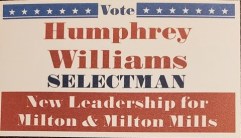
Williams, Humphrey - 2020Humphrey Williams held a seat this last year on the Budget Committee, as well as on the Milton Economic Development Committee (MEDC), and as an Alternate on the Zoning Board of Adjustment (ZBA). His campaign statement from the last election (Meet Mr. Williams) made much sense. His statement this year follows:
Humphrey Williams. I will work to insure the Select Board:

    • Takes the lead in creating a cooperative environment amongst the various boards and committees.
    • Establishes sound financial goals for the town – including setting spending limits & funding actual “needs” versus “wants.”
    • Works with Town Administrator, Department Heads & Employees to find Cost Saving Measures to reduce the operating budget.
    • Find ways to clean up downtown and bring in new businesses such as Restaurants, Deli or Meat Market, Sports or Recreation.
    • Maintains the scenic beauty and heritage of our community while creating new business and revenue stream opportunities.
    • Find ways to develop Commercial Opportunities in the Exit 17 and Exit 18 areas.

Mr. Williams has me right down to cleaning up the downtown and bringing in new businesses, and creating revenue streams. Those are tasks for the free market, rather than any government. Bring government taxes back down to earth, cut back on government committees, and the regulations and restrictions that they foster, and the free market could fix the rest.

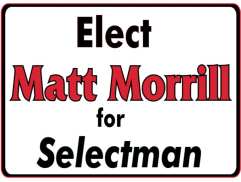
Matthew S. “Matt” Morrill introduces himself here as a candidate for selectman – he has spent two years already on the Planning Board – in the following statement:

Matt Morrill for Selectman

Morrill, Matt - 2020I would like to introduce myself for anyone who does not already know me, My name is Matt Morrill, I am 32 years old and was born and raised in Milton Mills, NH. I graduated from Bishop Brady High School, and shortly after that, I entered the Military. I am still an active Army Reserve Member, after serving my country in the Middle East attaining the rank of Staff Sargent.

I have served on the Planning Board for the past 2 years, and I am aware of all the issues facing us as a small town in need of alternative tax revenue and growth, while still keeping the town a great place to live. I am a local business owner and the father of two children. My wife and I have chosen to raise our family in Milton Mills. My family has been part of the Milton Mills landscape for over 70 years. I have been active in some local organizations such as End 68 Hours of Hunger and the Recreation Department, and have led fundraising events for both organizations.

At this point in my life, I feel our town is in need of some changes. As a local businessman, I have concerns with the rate in which our taxes are accelerating. I feel that we need to seriously take a look at all our options for our children. Whether our students remain being educated in Milton, or if we decide to tuition them out to another town, I would like to be part of that process.

Our current school system is our most expensive tax burden, it is imperative for us to figure out what our options are as a town. If we choose to keep our children in town, we need to figure out a better system than just taxing our residents out of their homes. If we tuition them out, we need to find the best system to fit our children’s needs. I will come to the table with an open mind, and work hard to help figure this out.

My military background has served me well in the area of leadership, self mindedness, and making tough decisions. I would lead with the town’s best interest as my moral compass. I would stand behind my decisions, and work hard to make this town a great place to live. I have lived here my entire life, and would like to retire here and have my children have the ability to do so as well, if they chose to.

I hope you will consider me as your candidate to do so. We as a town need to make some tough decisions, I ask you for your vote, and hope you will help me get elected so we can make these changes together and make Milton Great Again!

Welcome, Mr. Morrill. Much of his statement concerns itself with School taxation, which is certainly our largest problem, but perhaps not within a selectman’s purview.

As for Town taxes, seeking “alternative” tax sources (such as some variant of income taxes) might imply maintaining current spending levels, while tapping some other poor souls, or different pockets of the same poor souls, in order to keep the game afloat. That would be just kicking an “accelerating” tax problem further down the road. But, perhaps I misunderstand.

Mr. Walden, a BOS candidate from last year, posted some further details regarding Mr. Morrill’s positions that enlarge upon his original statement.

Why vote for Matt Morrill?

    • Availability. As a local business owner He is Around town throughout the day, you’ll probably see him face to face quite often and he is always willing to speak with people about their concerns in a language that everyone can understand.
    • Proven Commitment to Improving the Town’s Image. Matt has been involved with various community projects and has never hesitated to donate his time or resources when the situation has presented itself.
    • A Commitment to Our Children. As a father with a family of his own, Matt understands that even though we all don’t agree on the direction of our school system we still need to make the best of what we have, Matt actively participates in and organizes events for school supply drives and programs such as end 68 hours of hunger.
    • Fiscal Accountability. Matt believes that we need to start tasking our department heads with decreasing their budgets by 2% a year annually in conjunction with spending more of YOUR leftover money at the end of the year on paying down the tax rate versus trying to spend it in deceptively worded warrant articles.

Matt, more than any candidate running for selectman is in touch with the pulse of the town and understands the real struggles and frustrations that families are having in town with the way things are being handled.


For Library Trustee

For the single three-year Library Trustee seat, there are two candidates: Lawrence D. “Larry” Brown and Anne Nute.

I have seen no statement by Ms. Nute, but one would hope her positions present a contrast to those of Mr. Brown.

(Subject to revision should statements become available).


For Trustee of the Trust Funds

For the single three-year Trustee of the Trust Funds seat, there are two candidates: Karen J. Brown and Anne Nute.

Ms. Brown is running as an incumbent. She is also running unopposed for Supervisor of the Checklist. She has long been Recreation Director.

I have seen no statements by Ms. Brown or Ms. Nute.

(Subject to revision should statements become available).

Articles #17 and #18: Less Democracy for You

By S.D. Plissken | March 3, 2020

Article #17 shares with Article #18 a proposed structural change to the Town government, sought by that same Town government, by which democracy in Milton is to be reduced.

That would be sufficient reason – in and of itself – to vote against both of these articles. In a 1947 speech before the British House of Commons, Winston Churchill observed that “it has been said that democracy is the worst form of Government, except for all those other forms.” If Churchill’s witticism is correct, Milton’s Board of Selectmen proposes changing our worst form of government to one of those other forms that are even worse. Worser? Worstest?

(Having just participated in Hitler’s downfall and facing then Stalin’s erection of the Iron Curtain, Churchill had some experience of authoritarian socialist forms of government, whether of either the National or the International variety).

The “Independent” Capital Improvement Committee, To Be Appointed by the Milton Board of Selectmen

Article 17: Establishment of Independent Capital Improvement Committee

Shall the Town vote to authorize the Board of Selectmen to establish an independent committee pursuant to RSA 674:5 to prepare and amend the recommended program of municipal Capital Improvement Projects and to make budgetary recommendations to the Board of Selectmen. The committee, to be known as the Capital Improvement Program Committee, will have five (5) voting members to be appointed by the Board of Selectmen, and shall include at least One (1) member of the Planning Board.

Recommended by the Board of Selectmen (3,0,0).

RSA 674:5. LOCAL LAND USE PLANNING AND REGULATORY POWERS. Capital Improvements Program. 674:5 Authorization. – In a municipality where the planning board has adopted a master plan, the local legislative body may authorize the planning board to prepare and amend a recommended program of municipal capital improvement projects projected over a period of at least 6 years. As an alternative, the legislative body may authorize the governing body of a municipality to appoint a capital improvement program committee, which shall include at least one member of the planning board and may include but not be limited to other members of the planning board, the budget committee, or the town or city governing body, to prepare and amend a recommended program of municipal capital improvement projects projected over a period of at least 6 years. The capital improvements program may encompass major projects being currently undertaken or future projects to be undertaken with federal, state, county and other public funds. The sole purpose and effect of the capital improvements program shall be to aid the mayor or selectmen and the budget committee in their consideration of the annual budget.

The Capital Improvement Program has proven itself to be an abject failure in its stated objective of preventing tax spikes. It has instead produced a single rapidly-increasing tax slope – the upslope of single giant tax spike. Okay, anyone can see that, and feel it in every tax increase, so it is well past time to just get rid of it. Aah, therein lies the problem. It is in the very nature of government, and its interventions of every kind, that its abject failures are never “backed out” as they should be. Instead, government prefers always to “fix” its mistakes through applying more money and time in further interventions, which also fail.

For example, government-imposed wage freezes during WW II caused labor shortages. Naturally, due to nature’s laws of supply and demand, anyone would know that. Thus constrained, employers sweetened their wage offers with additional health care expense coverage. Now, wages and health care do not belong together in the normal course of events. The connections should have been dissolved when victory was achieved and price controls no longer necessary. But post-war governments instead enshrined, codified, regulated, and even required such employer health care coverage. And every subsequent problem and intervention by them has led us further and further down the garden path to the unaffordable health care we see today.

But, back to our failed cost-smoothing CIP intervention which (in conjunction with bloated fund balances) instead drives Milton taxes higher, ever higher. Government cannot bring itself to back out its failed intervention, so there must be instead further interventions. This particular intervention would remove the taxpayer’s check-and-balance of voting democratically for more reasonable, and thus slightly more accountable, Planning Board members (I know, “reasonable” central planning is an oxymoron).

We will have instead an appointed CIP Committee, whose members will be accountable only to the Board of Selectmen, who have themselves proven to be generally unaccountable.

Less democracy for you.

(See also Standing Idle, Capital Reduction Program (CRP)Milton and the Knowledge Problem, and Rubber Stamps).


The Milton Fire Chief, To Be Appointed by the Milton Board of Selectmen

The current fire chief is a fine man, although I have disagreed with some of his initiatives. (We could talk about that some other time). Although he has been challenged at the polls, he would likely be re-elected in perpetuity. But the Town’s “Master Plan” – a term usually associated with movie super-villains – plans for “us” to have an appointed fire chief rather than an elected one. You have to love these guys, right?

Article 18: Elected to Appointed Fire Chief

To see if the Town will vote in accordance with RSA 154:1, IV to change the organization of the fire department from RSA 154:1(c) where the Fire Chief is elected by the legislative body to RSA 154:1(a) where the Fire Chief is appointed by the Board of Selectmen and with the firefighters being appointed by the Fire Chief. When approved, the change from an elected to an appointed Fire Chief would take place no sooner than one (1) year following this vote. (Majority vote required).

Recommended by the Board of Selectmen (3,0,0).

The “when approved” portion of this is perhaps a bit presumptuous, even for misguided authoritarians. “If approved” would have been more correct when seeking to know “if the Town will vote.”

Imagine, if you will, that in the fullness of time our current fire chief – who currently holds his office through election – retires. The Board of Selectmen would appoint his replacement. It would be “in their gift,” as they say. I cannot see how that might be preferable to the election of his replacement by the voters of that distant time.

It works the other way round too. Imagine some tyrannical future Board of Selectmen simply dismissing this now-electable fire chief for some reason of their own, some unreasonable reason. Future voters will have little recourse, as you will have given up their democratic choice.

Less democracy for you, no democracy for them.