
What Is the Zodiac, Anyway?

By Peter Forrester |  December 20, 2018

Many people know the term “zodiac” from astrology, or fortune-telling based on stars and planets. But how many know the astronomical, scientific use of the word?

First of all, I need to introduce another term, the “ecliptic”. This can be imagined as an invisible line in the sky through which the Sun appears to move every year. I use the word “appears” because we are on a spinning Earth, which is the real source of the Sun moving across the sky every day. The Moon and planets always stay very close to this line. The ecliptic gets its name because eclipses only occur when the Moon is crossing it during full moon or new moon.

The ecliptic is inclined 23.4 degrees from the “celestial equator”, the line in the sky lying directly over the Earth’s equator. This corresponds to the well-known tilt in the Earth’s axis, in its orbit around the Sun.

From our vantage point in the Northern Hemisphere, the ecliptic rises from the horizon in the east, reaches its highest point to the south, and then descends to the west. So if you want to see a zodiac constellation, or a planet, or the Moon, your best bet is to start by looking south.

The concept behind assigning a Zodiac constellation to each month is a rough approximation of the scientific reality. The idea is that every month, the Sun occupies the space between the Earth and one of the twelve classic Zodiac constellations, and hence is said to be “located” in that constellation. Here the zodiac uses 12 divisions of the ecliptic into 30 degrees each, regardless of how big each of these constellations actually is.

However there are a couple of little catches here. There are actually 13 constellations through which the ecliptic passes. The one not used in the common 12-sign version of astrology is called Ophiuchus, the Serpent Bearer, and is located between and above Sagittarius and Scorpius. The constellations are different sizes and thus the astrological divisions reflect simplifications of where the Sun and planets are.

A further problem with the signs of the Zodiac is that they do not align properly with the current position of the Sun. For example, the astrological sign Aries is from March 21 to April 20, but the Sun actually passes in front of Aries between late April and mid-May. This is because of long-term fluctuations in the orbit and rotation of the Earth. The dates of the signs were assigned over 2000 years ago, and now are out of alignment.

I need say very little about the third major problem with astrology in general. There is no scientific evidence that a person’s life or personality, or future prospects have anything to do with the position of the stars or planets at the time of their birth, or at any other time. Astrology is a pseudo-science, a cool belief system that has very little basis in reality. I am here to explain the reality to you, as harsh as it may sound.

The zodiac, as used in astronomy, is a small band in the sky, about 8 degrees above and below the ecliptic, in which the Sun, Moon, and Solar system planets are usually located (there are as many as 10 other constellations in which planets can occasionally be found). Besides the 13 constellations mentioned above, which all cross the line of the ecliptic, there is a 14th one that nearly touches it and which the solar system objects more commonly occupy. This constellation is called Cetus, the Whale, and lies just below Pisces.

I’ll discuss the various zodiac constellations later, but for now I just want to list them, with the dates that the Sun is actually located there. You will notice these dates are about a month later than the traditional astrological  dates, which I will not give here. You can easily find them if you want to.

Aries: April 18 – May 13

Taurus: May 13 – June 21

Gemini: June 21 – July 20

Cancer: July 20 – August 10

Leo: August 10 – September 16

Virgo: September 16 – October 30

Libra: October 30 – November 23

Scorpio: November 23 – November 29

Ophiuchus: November 29 – December 17

Sagittarius: December 17 – January 21

Capricorn: January 20 – February 16

Aquarius: February 16 – March 11

Pisces: March 11 – April 18

Just one further point – it will be difficult to see the constellation in the month of its “sign”, since it is too close to the Sun, which means the sky will be too bright to see it when it is up.

Some of the zodiacs are dim, and others are very bright. We’ll get into the easiest ones to see on another occasion.

For now, your friendly Milton astronomer signing off.


See also: Skies Over Milton, December Edition.


References:

Wikipedia. (2018, December 20). Cetus. Retrieved from https://en.wikipedia.org/wiki/Cetus.

Wikipedia. (2018, December 20). Ecliptic. Retrieved from https://en.wikipedia.org/wiki/Ecliptic#Plane_of_the_Solar_System.

Wikipedia. (2018, December 20). Ophiuchus. Retrieved fromhttps://en.wikipedia.org/wiki/Ophiuchus

Wikipedia. (2018, December 20). Sidereal and Tropical Astrology. Retrieved from https://en.wikipedia.org/wiki/Sidereal_and_tropical_astrology.

Wikipedia. (2018, December 20). Zodiac. Retrieved from https://en.wikipedia.org/wiki/Zodiac.
Milton in the News – 1842

By Muriel Bristol (Transcriber) | December 20, 2018

Milton had over a foot of snow in late November 1842, which “much impeded” local travel.

Snow. At Milton, N.H., about 20 miles from Dover, the snow, ten days ago, was 14 inches deep, and travelling was much impeded in consequence (Philadelphia Public Ledger, December 8, 1842).

That would not seem to be an outlandish amount of snow for Milton, although it might have been a bit early in the season. (Such as we have had this year). Perhaps a run-of-the-mill news item for New England seemed more notable further south in Philadelphia.

No one plowed the roads. Some might travel by horse. For the few that possessed a horse and a carriage, they might now break out their sleigh. In the Christmas song “Over the River and Through the Woods,” the family is traveling by sleigh to Grandmother’s house. Larger places might have “rolled” their roads, packing down the snow, which would facilitate travel by sleigh.

Most would have simply trudged through the snow, either with snowshoes or without, or just stayed put where they were. Various church denominations reported low attendance and closures, sometimes for weeks at a time.

It was a good thing that they had earlier engaged in “making hay while the sun shines,” so they might feed their animals now. New England farmhouses frequently had the barn attached or connected to the house by an enclosed passage. No need to go outside.

They would have laid in a good supply of firewood before winter. Historians have estimated that the average Colonial-era household consumed an acre of woodland every year in their open hearths. Many households would by now have a Ben Franklin-style wood stove. Much more efficient. Smart guy, that Ben.


Previous in sequence: Milton in the News – 1839; next in sequence: Milton in the News – 1843


Thinking ‘Outside the Box’

By S.D. Plissken | December 19, 2018

Chairman Thibeault is fond of saying that “we,” meaning the Board of Selectmen (BOS), and Milton in general, “need to think ‘outside the box.'”

The catchphrase regarding thinking “outside the box” originates with management consultants of the 1970s and 1980s. It is the pop psychology of yesteryear. You should be concerned whenever you hear it.

The sad fact is that he, the BOS, and Milton governance in general, for well over a decade, represent the ne plus ultra of conventional thinking. Everything they do is very much within “the box.”

They cannot help themselves, poor things. Their approach is inherent in the nature of government. It is impossible to rationally allocate resources. If ten of something seems desirable, wouldn’t twenty be even better? It is impossible to say, because government lacks a price mechanism with which to measure its decisions. It relies to a very great extent – some have even said that it relies entirely – upon “magical thinking.” That is why government should never be engaged for any task or service that might be provided by the free market.

While it is always instructive, and sometimes amusing, to examine their more absurd premises more thoroughly, – and I have tried – let us confine ourselves this time to the most recent BOS meeting. Issues are rarely explained in these meetings, as such, but it is sometimes possible to extract some sense – some rumor – of what is happening from the little tidbits that are dropped along the way.

In our last episode, the Town Clerk had objected – through intermediaries – to being the Central Repository for all Town monetary transactions. Her objection is not fundamental or constitutional, although objections could certainly be made along those lines. She was willing to undertake the increased tasks. Her problem arises only from the principle that increased tasks should be accompanied by increased personnel hours. Well, that makes sense. (The BOS should consider deeply how this same principle might be applied in their own dealings with the State government).

Past meetings have informed us that the State government forbids the Town government to keep more than $1,500 in the house at any one time. Are you with me so far? The larger in-the-box thinkers have given the smaller in-the-box thinkers a directive. This unfunded imposition comes with costs. Was any out-of-the-box thinking employed? No, we have been given an order and are rushing to fulfil it. The taxpayers can pay the freight. All very much within “the-box.”

Now the Town government’s new bank wants to change the way that they take in their deposits. This is just a bank “policy.” It is something that works well for them. (Note that, on the market, the customer is always right, and there are other banks in the world).

The Town’s bank “recommended” that we establish a central repository for all the Town’s exactions, excuse me, deposits. The Town Treasurer agreed, the Auditors were insistent, the Town Counsel approved it, the Town department heads loved it, the Town Administrator said that all the cool Towns are doing it. We take orders from banks too. All very much within “the box.”

Whenever they cite this “all the other Towns” reasoning, as they do frequently, I hear my mother’s voice: “If all the other kids were jumping off a bridge, would you jump too?” Her point being that it’s not that you can’t do what the others are doing, if they are acting wisely, but that it is folly to be a lemming just to be like the other lemmings.

By itself, citing “all the other Towns” is really the same as having no reason at all. It is a confession of having no reason. Completely ridiculous, but very much within “the box.”

Anyway, the Town Treasurer restructured Town monetary procedures such that the various departments off-loaded portions of their deposit accounting to the Town Clerk. Just like all the other Towns. The various departments all spend less time on those fiddly bookkeeping details. And the money is all in one place. Less is more. They love it. Win-win, right?

Well, no. None of these apparatchiks gave up any personnel hours to the Town Clerk when they piled on their extra tasks. It was more like a zero-sum game: she got their tasks, while they retained the hours with which they formerly did those tasks. She reportedly tried to juggle these increased tasks, for a time, but finds it is not working for her.

Will all those that are surprised please raise their hands?

I see, the BOS have their hands up. (They raise their hands for everything). They seem to be baffled. To their minds, it apparently makes perfect sense that the Town Clerk should do more so that others might do less. It adds up somehow?

So, the BOS dug in their heels regarding full-time status for her administrative assistant. Nor did they arrange for any extra assistance from the departments that were relieved from the tasks with which she now struggles. The BOS provided no solutions. Instead, they told all of the children to sort it out for themselves. They have until the end of January to do so. Don’t make me come in there.

It is impossible to accept yet another Town personnel expansion. (The Town needs to move in the opposite direction). One might hope that some interdepartmental reallocation or redistribution of budget money or personnel hours is made instead. Cutting elsewhere to pay for this latest shiny initiative would work quite well.

But the Town Clerk is to be much admired. Her spirited defense of her department showed true grit. She demonstrated exactly the qualities that the BOS has so sadly lacked in defending the taxpayers’ interests.

One might well imagine that we will see these issues emerge again in some form.

References:

Town of Milton. (2018, December 17). BOS Meeting, December 17, 2018. Retrieved from youtu.be/SLBEx1a45pQ?t=5245

Wikipedia. (2018, December 18). Thinking Outside the Box. Retrieved from en.wikipedia.org/wiki/Thinking_outside_the_box


Milton’s NHES Community Profile – 2018

By Muriel Bristol | December 17, 2018

New Hampshire Employment Security (NHES) produced an update to its Milton statistics in its NH Community Profiles in March 2018. Most of its figures were updated to June 2017, while some were based still upon figures from the prior profile.

It included US Census Bureau figures, which estimated Milton’s population at 4,591 inhabitants as of 2016. This would be an decline of 0.3% from the 4,606 inhabitants estimated in 2015.

Milton’s net population has not increased significantly since the 2010 census, when it had 4,598 inhabitants.

238 (5.2%) of Milton’s 4,591 inhabitants were aged under 5 years of age, 866 (18.9%) were aged 5-19 years of age, 830 (18.1%) were aged 20-34, 1,157 (25.2%) were aged 34-54 years of age, 929 (20.2%) were aged 55-64 years of age, and 571 (12.4%) were aged 65 years of age or over. There were 2,279 males (49.6%) and 2,312 (50.4%) females. The median age was 43.6 years (an increase of 1.2% over that stated in the prior year).

Milton had 2,040 housing units in 2016, a decline of 0.9%. Single-Family Units, Detached or Attached accounted for 1,557 (76.3%) of them, Mobile Homes (and Other Housing Units) accounted for 304 (14.9%), 2-4 Unit Multi-family Structures, i.e., apartment buildings, accounted for 61 (3.0%), and 5-or-more Unit Multi-family Structures accounted for 118 (5.8%) housing units.

This represented a slight decline in both number and proportion of Single Family Units and a slight increase in both number and proportion of Mobile Homes and Multi-Family Structures.

By computation, the average Milton housing unit sheltered 2.3 inhabitants, an increase of 0.1 inhabitants.

Milton’s single largest employer by far was the Milton town government, whose 247 employees (132 Municipal Services and 115 Education) made up 11.0% of the 2,250 employed inhabitants. Next largest was Index Packaging with 157 employees, Eastern Boats with 38 employees, Iron Mountain with 20 employees, and ProLine with 13 employees. (Note: none of these employer figures appear to have been updated from 2017, except the number of employed inhabitants).

Most of Milton’s Working Residents (88.0%) commuted to employment out of town, an increase of 0.5%. Most of them (77.9%) commuted to another NH community, while some (10.1%) commuted to employment out of state. The mean travel time increased to 32.1 minutes. Only 12.0% worked in Milton.

Some 124 inhabitants (5.4%) were unemployed in 2015. This had declined to 73 inhabitants (3.1%) by 2016.

The Per Capita income was $28,403 in 2016 (a decrease of 15.2% over the previous year’s $33,495). The Median Family income was $72,226 and the Median Household income was $65,679. Individuals below the poverty level were 6.7% of the population, a decrease of 2.1%.


See also Milton’s NH Employment Security (NHES) Community Profile – 2017


References:

New Hampshire Employment Security (NHES). (2018, March). New Hampshire Community Profiles. Retrieved from https://www.nhes.nh.gov/elmi/products/cp/

Non-Public BOS Session Scheduled (December 17, 2018)

By Muriel Bristol | November 17, 2018

The Milton Board of Selectmen (BOS) have posted their agenda for a BOS meeting to be held Monday, December 17.

The meeting is scheduled to begin with a Non-Public preliminary session at 5:00 PM. That agenda has five Non-Public items classed as 91-A:3 II (a), 91-A:3 II (c), 91-A:3 II (d), 91-A:3 II (e), and 91-A:3 II (c).

91-A:3 II (a) The dismissal, promotion, or compensation of any public employee or the disciplining of such employee, or the investigation of any charges against him or her, unless the employee affected (1) has a right to a meeting and (2) requests that the meeting be open, in which case the request shall be granted.

While the language of this RSA encompasses dismissals, that would run very much against trend in the Milton Town government. The Town has had a truck driver position posted and there is that whole matter of the Town Clerk/Tax Collector Central Deposit.

91-A:3 II (c). Matters which, if discussed in public, would likely affect adversely the reputation of any person, other than a member of the public body itself, unless such person requests an open meeting. This exemption shall extend to any application for assistance or tax abatement or waiver of a fee, fine, or other levy, if based on inability to pay or poverty of the applicant.

These (c) items are perennial favorites. There are two of them this time. At some point, the “public body itself” might begin to wonder why there are so very many. Might it be something they are themselves causing?

91-A:3 II (d) Consideration of the acquisition, sale, or lease of real or personal property which, if discussed in public, would likely benefit a party or parties whose interests are adverse to those of the general community.

Again, one would certainly hope that nothing additional is being acquired or leased. Sales might extend to old fire stations or the condemned properties, now owned by the Town, whose demolitions are out to bid. There is also the proposed $1 sale of historic District No. 1 Schoolhouse.

91-A:3 II (e) Consideration or negotiation of pending claims or litigation which has been threatened in writing or filed by or against the public body or any subdivision thereof, or by or against any member thereof because of his or her membership in such public body, until the claim or litigation has been fully adjudicated or otherwise settled. Any application filed for tax abatement, pursuant to law, with any body or board shall not constitute a threatened or filed litigation against any public body for the purposes of this subparagraph.

It would seem that the public body, or some part of it, or some member of it, is being sued. Quelle surprise!

The BOS intend to adjourn their Non-Public BOS session at approximately (*) 6:00 PM, when they intend to return to Public session.


The Public portion of the agenda has New Business, Old Business, and housekeeping items.

Under New Business are scheduled seven agenda items: 1) Approval of 2019 Holiday Schedule (Heather Thibodeau), 2) Discuss Casey Road Land Protection Committee Warrant Article (Karen Golab), 3) MFPL & LCHIP Grant (Betsy Baker), 4) Eversource Contract Payment (Richard Krauss), 5) 2018 Encumbrances (Heather Thibodeau), 6) Public Hearing: No Thru Trucking Ordinance (Heather Thibodeau) *7:00PM, and 7) Open Bids for RFPs (Heather Thibodeau).

The initial agenda item seeks approval of a proposed 2019 holiday schedule. How many days?

It seems that Casey Road Land needs its own Protection Committee. This sort of begs a question: is the Conservation Committee’s protection insufficient in some way?

The Milton Free Public Library (MFPL) has announced that they will be receiving a $36,000 Land & Community Heritage Investment Program (LCHIP) grant. LCHIP is “an independent state authority.” Its taxpayer money comes from county registry of deeds fees and Moose license plates. (TANSTAAFL).

Eversource Contract Payment is a bit vague. Higher than expected energy costs have been mentioned previously. But the Fire Department was mentioned then as being a bigger problem than the Police Department. The Town does get some money off from its solar farm at the transfer station.

The 2017 Encumbrances below has to do with the Three Ponds Protective Association’s (TPPA) grant not having had a legal vote to “encumber,” i.e., carry over, unused monies from last year to this year. This agenda item would have to do with not making the same mistake again. Encumber early and often.

The Proposed Heavy Hauling Ordinance Discussion Follow up continues from past meetings. This would be the second of two hearings. It is all about forbidding logging trucks from passing and repassing on Governors, Hare, and Nute roads to and from Middleton Lumber (on NH Route 153 in Middleton). This can not affect similar heavy-duty traffic by Milton residents over those very same roads.

Under Old Business is scheduled six items: 8) Review Cemetery Budget (Heather Thibodeau), 9) Warrant & CIP Warrant Article Discussion & Approval (Heather Thibodeau), 10) TPPA 2017 Encumbrance Discussion Follow-up (Heather Thibodeau), 11) Department Budget Updates (Heather Thibodeau), 12) Adjustment to Town Department Holiday Celebration (Heather Thibodeau), and 13) Town Clerk/Tax Collector Central Deposit Discussion Follow-up (Board of Selectmen).

Previously, the BOS had discussed adding someone to the Cemetery Budget. That person would handle the administrative aspects of having a Town Cemetery. The previous discussion was notable for being completely free of any actual facts in setting the budget amount.

A Warrant Article discussion and approval. And Tax Acceleration Program (CIP) discussion and approval. Expect unanimous votes. Because that is certainly not what will happen when the taxpayers speak for themselves. Draw your own conclusions about “representation.”

The TPPA 2017 Encumbrance has to do with the Three Ponds Protective Association’s (TPPA) grant not having had a legal vote to “encumber,” i.e., carry over, unused monies from last year to this year. Yes, the prior BOS (Rawson, Thibeault, and Long) did vote, but they did so after the legal deadline, so the original money is incapable of being carried over. It drops instead into the General Fund. At the last meeting, all sorts of wild schemes were afoot to reallocate new money and make it as if it was the old money encumbered. Truth is stranger than fiction.

Town budget updates. The annual insurance increases walked in the door at the conclusion of the departmental budget submissions. That would occasion departmental budget increases.

An adjustment to the Town Department Holiday Celebration. The dual Christmas and New Year’s Day holidays fall this year on successive Tuesdays. Imagine that decisions must be made regarding closing Town Hall for all or part of the Mondays. One supposes Boxing Day could be in the mix too.

The Town Clerk/Tax Collector Central Deposit Discussion Follow-up is a bit of a misnomer. The Town Clerk has the BOS over a barrel. The Town Treasurer has recommended giving her whatever she wants. As has the financial advisor (did you know they even had one?), the Town Counsel, and everyone else. Expect to learn how things are folded: cheap suits, houses of cards, and, especially, poor poker hands.


There is a new boxed item list at the margins entitled Outstanding Items. No, there is nothing particularly deserving about them; it is just that they have been held over from prior sessions. The alternative name might be Selectman Lucier’s Bucket List. They include Town Owned Property, Recreation Revenue & Office Discussion, Website Update, Property Maint. Code, Town Report, Atlantic Broadband Contract, NH Listens, and Junkyard. In no particular order.

By the way, do not forget to add the taking down of the invalid no parking signs from the invalid and now rescinded no parking ordinance. They are still there.


Finally, there will be the approval of prior minutes (from the BOS Meeting of November 5, and the Joint BOS-BC Meetings of December 5 and December 11), the expenditure report, Public Comments “Pertaining to Topics Discussed,” Town Administrator comments, and BOS comments.


Ms. McDougall has called a fourth meeting of her Milton Advocates group. It will take place again in the Nute Library’s Community Room, on Saturday, December 29), at 10:00 AM to 11:30 AM. All town residents are invited. Bring your best manners. (Not her words).


Mr. S.D. Plissken contributed to this article.


References:

LCHIP. (2018). Land & Community Heritage Investment Program. Retrieved from lchip.org/

State of New Hampshire. (2016, June 21). RSA Chapter 91-A. Access to Governmental Records and Meetings. Retrieved from www.gencourt.state.nh.us/rsa/html/VI/91-A/91-A-3.htm

Town of Milton. (2018, November 16). BOS Meeting Agenda, December 17, 2018. Retrieved from www.miltonnh-us.com/uploads/bos_agendas_860_3404723203.pdf

Youtube. (1965). Cone of Silence. Retrieved from www.youtube.com/watch?v=g1eUIK9CihA&feature=youtu.be&t=19

Milton in the News – 1839

By Muriel Bristol (Transcriber) | December 16, 2018

Here follows an 1839 Federal request-for-proposal (RFP) for carrying the mail weekly along a 40-mile post road or route from Pittsfield, NH, to Alfred, ME, and back again. The Milton Mills post office is one of the stops.

PROPOSALS. FOR carrying the mails of the United States, from the 1st of July, 1839, to the 30th of June, 1841; inclusive, on the following post routes in New England. will be received at this Department until the 25th day of May next, at 3 o’clock, p m, to be decided on the 1st day of June following.

[Extracted from a lengthy list of routes]

155a. From Pittsfield, by the store of George Nutter, in Barnstead, over New Durham bridge, by Middletown, Wakefield, Union, Milton Mills, Alfred, Me., 40 miles and back, once a week. Leave Pittsfield every Tuesday at 5 a.m., arrive at Alfred same day by 7 p.m. Leave Alfred every Wednesday at 5 a.m., arrive at Pittsfield same day by 7 p.m. (Burlington Sentinel and Democrat, June 26, 1839).

Taken together with the previously published 1827 route, the Milton Mills post office functioned as a node or outpost on a network, connected to others by several spokes or attachments.


See also Milton in the News – 1827, Milton’s First Postmasters (1818-c1840), and Milton in the News – 1848


Previous in sequence: Milton in the News – 1838; next in sequence: Milton in the News – 1842


Milton Cookies of 1895-96

By Muriel Bristol | December 14, 2018

Mrs. N.W. and P., of Milton, NH, corresponded with the True and Tried Cooking column of the Boston Globe in 1895 and 1896. They submitted recipes of their own as well as making requests for those of others.

I have transcribed below their cookie and drop-cake recipes, which might be fun to try over the holidays. (Cakes and other things might follow sometime). The recipes are mostly just lists of ingredients with little or nothing in the way of instructions. Why waste space on instructions when everybody and their mother knows what to do? I have supplied some general parameters from other sources.

These women were using wood-fired ovens or chimney-side ovens. There were no temperatures settings. They had to guess the temperature and manage it, by stoking the oven with wood kindling. The temperature could be assessed by gauging how long one could keep one’s hand in the oven. Yikes!

A few of these recipes guide their user somewhat by suggesting a “rather quick” oven or a “quick” oven. A “quick” oven temperature is said have been in the 400° to 425° range. Lower temperatures and longer times tend to produce thinner, crisper cookies (and need wider spacing), while higher temperatures and shorter times tend to produce thicker, softer cookies. No times were given.

Modern cookie recipes tend to fall more to the 350° to 375° range, with times of between 8 and 11 minutes (larger cookies requiring more time). One imagines a “quick” oven would require less time. Good luck.

Cookies

Newport Cookies. One egg, 1½ cups of sugar, ⅔ cup of butter, ½ cup of sweet milk. 4 cups of flour, 1 cup of chopped raisins, 1 teaspoon of cream of tartar, ½ teaspoon of soda, cinnamon, nutmeg, ginger and salt to taste. Drop out in teaspoon and bake. Mrs. N.W. Wilton [Milton], N.H. (Boston Globe, April 7, 1895).

Mama’s Molasses Cookies. In looking over some February papers I saw where a lady in Sanford, Me, asked for my mama’s molasses cookies. One cup of molasses, 1 cup of sugar, 1 cup of sour milk, 1 cup of shortening. 1 small tablespoon of saleratus, ginger and salt to taste. My mama uses a coffee cup. These cookies are very nice, and will keep as long as you wish. Mix with pastry flour. All cookies should be made of it. Nine-Year-Old. Ayer. (Boston Globe, April 19, 1895).

Saleratus was the precursor to baking soda.

Spice cookies for M.J.B. – One cup of sugar, ½ cup of butter, ½ cup of milk, 2 cups of flour, 1 cup of currants, 1 teaspoon of soda, spice of all kinds. Cheap marble cake – Two eggs, 1 cup of sugar, ½ cup of shortening, ½ cup of milk, 2 cups of flour, 2 teaspoons of cream of tartar, 1 teaspoon of soda. Take ½ the above. and add 2 tablespoons of molasses and spice of all kinds. and marble the two kinds together in the tin. Milton. N.H. Mrs. N.W. (Boston Globe, May 9, 1895).

Cocoanut Cookies. One egg, 1 cup of sugar, ⅓ cup of butter, 1 cup of cocoanut, 2 tablespoons of sweet milk, 1 teaspoon of cream of tartar, ½ teaspoon of soda. Mrs. N.W. Milton, N.H. (Boston Globe, May 12, 1895).

Date Cookies. If Mrs. N.W. will make date cookies like this recipe, I think she will find them nice: One large cup of dates, stoned and cut in small pieces, 1 cup of sugar, 1 egg, little salt, ⅔ cup of butter or lard, or half of each, little cinnamon and nutmeg, ½ teaspoon of vanilla, 2 cups of flour sifted together with 1 teaspoon of soda and 2 of cream of tartar; then add ½ cup of sweet milk or water; use more flour if needed, roll quite thin and bake in rather quick oven. South Berwick. (Boston Globe, May 15, 1895).

Sugar Cookies. Two eggs, 2 full cups sugar, large, 1 cup butter, ½ cup milk, 1 teaspoon cream of tartar, ½ teaspoon soda. Flour to roll stiff. Currants may be rolled lightly on the dough, and are very nice. P. Milton. N H. (Boston Globe, July 12, 1896).

Drop Cakes

Newton Puffs. One cup of molasses. 1 cup of milk, 1 cup of sugar, 4 cups of flour, ½ cup of butter and lard mixed, scant teaspoon of soda, 1 teaspoon of cinnamon, scant measure, salt to taste; mix the ingredients all together at once. adding soda last; drop in great spoonfuls in a pan a little way apart, and bake. Children like these very much. Mrs. H. C. L. North Weymouth. (Boston Globe, February 22, 1895).

Vanilla Drop Cakes. A cup of sugar and ¼ cup of butter, creamed together; 1 egg well beaten, 1 tablespoon of vanilla, 10 tablespoons of sweet milk, 1 teaspoon of cream of tartar, ½ teaspoon of soda. 2½ cups of flour. Drop out in teaspoonfuls on a biscuit tin and bake in a quick oven. Milton, N.H. (Boston Globe, April 7, 1895).

Sponge Drops. Three eggs; beat the whites to a stiff froth. add yolks, 1 cup of sugar, and a heaping cup of flour, into which 1 teaspoon of cream of tartar and ½ teaspoon of soda are mixed. Flavor and drop on buttered tin sheets, three inches apart. Bake instantly. Please try and report. Mrs. N.W. Wilton [Milton], N.H. (Boston Globe, April 11, 1895).

Recommendations

I tried Mrs. N.W.’s sponge drops, and found them very nice, also L.B.S.’s sponge ginger bread, which was splendid. Minnie M. Arlington Heights. (Boston Globe, April 28, 1895).

All of The Globe recipes which I have tried have been nice. Among them are orange pie by Mrs. F.H.C., May’s silver cake, which is lovely; cream pies by M.L.G., molasses chewing candy by N., banana pudding by Mrs. E.M.H., and molasses cookies by Nine-Year-Old. Milton, N.H. Mrs. N.W. (Boston Globe, May 9, 1895).

Questions and Answers. Will the lady from Rockland (I think) please send recipe for molasses cookies that called for 1 pint of molasses boiled 15 minutes? I have misplaced it, and would like it, as they were the best I ever ate. P. Milton, N.H. (Boston Globe, January 5, 1896).

And, for those that might want to go professional:

Female Help Wanted. WANTED – To pay $1 per day for first-class cook, steady job. Milton hotel, Milton, N.H. (Boston Globe, June 29, 1896).


Milton in the News – 1838

By Muriel Bristol (Transcriber) | December 13, 2018

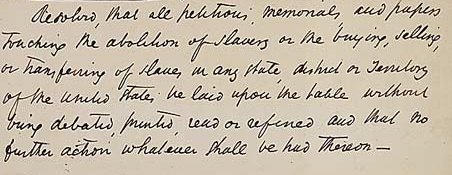
Some 98 Milton women and 60 Milton Mills women submitted a memorial, i.e., a petition, in opposition to the Congressional “Gag Rule” resolution of December 21, 1837.

21st December 1837
The “Gag Rule” Resolution of the 21st December, 1837

The resolution against which the Milton women fought was a cheap parliamentary technique or trick designed to suppress any and all opposition to slavery.

CONGRESS. MEMORIALS AGAINST THE RESOLUTION OF 21ST DECEMBER, 1837. In the House of Representatives, on the 12th March, 1838, Mr. Cushing presented the following memorials, praying the House to rescind the resolution of the 21st December, 1837, viz:

[Extracted from a lengthy list of petitions]

Sarah W. Ricker, and 97 others, women of Milton, N.H.; Mary Goldsmith, and 59 others, women of Milton Mills, N.H. (The Liberator (Boston, MA), June 15, 1838).

These 158 women represented over half (about 58%) of Milton’s adult women, in whom Milton can take great pride.


See also Milton and Abolitionism and Milton in the News – 1854


Previous in sequence: Milton in the News – 1830; next in sequence: Milton in the News – 1839


References:

Town of Milton. (2018, April 16). Board of Selectmen By-Laws. Retrieved from www.miltonnh-us.com/uploads/bos_71_1509444456.pdf

US House of Representatives. (n.d.). The House “Gag Rule.” Retrieved from history.house.gov/Historical-Highlights/1800-1850/The-House-of-Representatives-instituted-the-“gag-rule”/

Wikipedia. (2018, November 5). Gag Rule. Retrieved from en.wikipedia.org/wiki/Gag_rule


Milton in the News – 1830

By Muriel Bristol (Transcriber) | December 11, 2018

People who lived to an advanced age were of great interest formerly, as they are now.

DIED. In Milton, N.H., Widow Patience Clements, aged 101 years and 6 months (Middlebury Free Press (Middlebury, VT), July 22, 1830).

Patience Bunker, daughter of John Bunker, married (1st), after 1753, John Twombly, Jr., who died in 1764. (She was his second wife). She married (2nd), circa 1768, John Clements, who died in Dover, NH, May 8, 1776.

“Patience Clements of Dover, widow, quit claim to Andrew Torr of Dover, all right to piece of land where I now live,” being part of her thirds “in the estate of John Twombly late of Dover deceased” 6 June 1792 (Strafford County Deeds, 87:321). (A widow was entitled to a life-estate in one-third of her late husband’s estate).

Other sources say that Patience died “at the house of Jonathan Nute, Esq.,” June 12, 1830. There was no such Milton household at that time, although the household headed by Jotham Nute did have one female, aged over 100 years (the only person in town in that age range), at the time of the Fifth (1830) Federal Census: June 1, 1830. (She died less than two weeks after the enumeration).

Jotham Nute, Esq., was a Revolutionary veteran, who had served with Ralph Farnham and Enoch Wingate. His wife, Sarah (Twombly) Nute, was a daughter of Patience Clements, i.e., the widow Patience ((Bunker) Twombly) Clements died in the Milton household of her daughter and son-in-law.

They must have had some tales to tell around the fireplace.


Previous in sequence: Milton in the News – 1829; next in sequence: Milton in the News – 1838


Joint BOS-Budget Committee Meeting Scheduled (December 11, 2018)

By Muriel Bristol | December 4, 2018

The Milton Board of Selectmen (BOS) have posted their agenda for a joint BOS-Budget Committee meeting to be held Tuesday, December 11, 2018.

The BOS intend to begin their joint BOS-BC meeting at approximately (*) 6:00 PM.


Its agenda is described in the single sentence:

Be advised the Budget Committee & Board of Selectmen will conduct a joint meeting to discuss the Town Budget.

One follow-on meeting is scheduled for Tuesday, December 18, also at 6:00 PM


References:

Town of Milton. (2018, November 30). Joint Budget Committee Meeting Agenda, December 11, 2018. Retrieved from www.miltonnh-us.com/uploads/bos_agendas_850_1411371321.pdf