
Milton in the News – 1860

By Muriel Bristol (Transcriber) | January 8, 2019

In the year 1860, the newspapers discovered the venerable Mr. Ralph Farnham (1756-1860). These articles were copied very widely. Farnham was said to be a native of Milton Mills, NH, who was then living with his son, John Farnham (born 1797), in Acton, ME.

The Last Survivor of Bunker Hill.Farnham, Ralph The statement has frequently been made by the newspapers and endorsed by Mr. Everett in his late Fourth of July oration, that there is no one left of that band of heroes who first withstood the shock of British arms in the open field. Eighty-five years having elapsed since that world renowned struggle, the burden of probabilities would favor that conclusion; yet the statement is not correct. There is one who took part in that memorable battle, and in subsequent events of the revolution, yet living, “full of years,” and venerated for his moral worth as well as for his age and public services. In the town of Acton, Maine, on a beautiful ridge of land, situated about a mile from Milton Mills, N.H., stands a cottage farm house, unpretending in its appearance, and bearing evidence of a very respectable antiquity. The passer-by will often notice a gray-haired man reading attentively by the window or walking about with a single cane perchance engaged in the ordinary labors of the husbandman. The stranger will perceive nothing very remarkable in the thick set, slightly bent figure, and well preserved, swarthy features of this old man of apparently eighty years, but the residents of the adjacent country involuntarily bend with reverence as they pass him. And well they may as he is the last of the Bunker Hill patriots. David Kinnison, who long survived his confederates of the famous Boston tea party, was living in 1831, in Chicago, at the extraordinary age of one hundred and fifteen years. He has since passed away. Ralph Farnham, the last of the Bunker Hill heroes, still lives, although he has nearly attained a span and a half of the space allotted to man. His one hundred and fourth birthday was celebrated at Milton Mills on the 7th. We have already given from the pen of a correspondent, some notice of this interesting affair. Although no pains were taken to extend a notice of the event beyond the immediate vicinity of the veteran’s residence, a very large concourse of people were in attendance. The features of the occasion were an address and one hundred and four greetings from a twelve pounder, and a dinner enlivened with toasts and speeches. Mr. Farnham, we learn, was not in the midst of the battle. Having been enrolled only on the day previous, it was his lot to be detailed among a guard to take charge of artillery and baggage, at some distance from the redoubt. In so close a proximity to the principal scene of strife, the observations he made and distinctly recollects to this day, are highly interesting, and we trust they will be given to the public by some competent pen. When we reflect how few persons living can even remember the event itself as a child of twelve at that time would now be ninety-five years old a living actor in that bloody drama becomes at once an object of interest, respect and veneration. – Boston Journal (St. Johnsbury Caledonian, July 20, 1860).
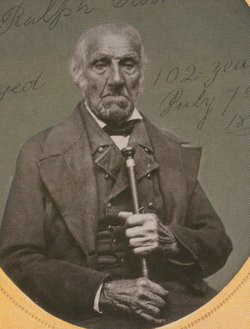
Massachusetts Governor Nathaniel P. Banks, Boston Mayor Frederic W. Lincoln, Jr., and other luminaries invited Farnham to visit Boston, MA, in October 1860.

HONOR TO A VETERAN. The Boston Journal says, that Gov. Banks, Mayor Lincoln, Edward Everett, Amos A. Lawrence, Judge Shaw, J.A. Andrew, William Appleton and many other citizens, have sent an invitation to Mr. RALPH FARNHAM, of Acton, Me., to visit Boston. Mr. Farnham is 104 years of age and the only survivor of Bunker Hill. It is understood that he has accepted the invitation, and will be here early in October.- The occasion will be one of high enjoyment, as “all the world, with his wife and children,” will desire to see him. This visit of Mr. Farnham will, doubtless, attract thousands from the country to Boston to welcome the old veteran (Vermont Journal (Windsor, VT), October 6, 1860).

While in Boston, Farnham had also an audience with Albert Edward, Prince of Wales (eventually King Edward VII), who was then on a North American tour.

Interview of the Prince with Ralph Farnham. By appointment, Ralph Farnham, the Revolutionary veteran, had an interview with the Prince this morning. The meeting was very cordial. The Duke of Newcastle, who, with most of the suite, was present, asked the veteran if he saw Burgoyne when he surrendered, adding, “You rather had him there.” The old soldier then remarked chuckingly, that hearing so much said in praise of the Prince, he began to fear that the people were turning royalists. This and Mr. Farnham’s manner elicited much laughter, in which the Price joined. The Prince then sent for pen and ink and exchanged autographs with his visitor – one of the men who had stood before British soldiers in 1776 [SIC], in a manner and with a bearing very different from that with which he received the Prince’s courtesies and exchanged glances with the majors, colonels and guardsmen of the suite this morning. Mr. Farnham speaks of the interview with the greatest pleasure, and says he wished to show the boy and his soldiers that he bore no anger for old times. The old man represents the general feeling. Till within the last three months the American public wore not aware that a survivor of one of the bloodiest and most heroic and first struggles of the Revolution is still “a monument of mercy” in our midst. Like most of signers of the Declaration of Independence, Ralph Farnham, who is the only survivor of battle of Bunker Hill now left of band who so nobly resisted the overpowering efforts of the British soldiery in that struggle, has been spared to a good old age, having recently attained his 104th year. Mr. Farnham, who has just been introduced to the Prince of Wales in Boston, was born in Milton Mills, New Hampshire, July 7, 1756. His last birthday was celebrated at that place by the firing of a gun for every year the veteran had attained, by a dinner, speeches, and all the usual honors of patriotic demonstrations of a like description. Since the public were apprised of the existence among them of this time honored veteran be has been flooded with visitors, and letters for the purpose of obtaining autographs, or who wish to enquire of him various matters connected with the Revolution, of which they suppose he has personal cognizance and recollection. He receives all his visitors courteously and kindly, replying to all their questions. He relates anecdotes of Washington and General Putnam, the hero of Bunker Hill, and other leaders of newborn republic. Of Washington he says, with truth, he was “a fine man,” and with sad truth that “there are no such men as Washington living in these days.” He says of Putnam that “he was a rough old fellow, but as brave as a lion, and feared nothing nor anybody.” After Bunker Hill the venerable Ralph served three campaigns, during the years 1775-76, -77, and in 1780 he was settled in the village where he has still resided. He was the first settler the place, which was then an immense “forest wild,” abounding in fierce animals and remote from civilized communities. He resided in this “desolate place” for four years, when he at length brought home a wife to cheer his loneliness. His wife presented him with seven children of whom four still survive, and it is one of them, his second son, John, that the veteran of Bunker Hill now dwells. The old warrior is still vigorous, and does not seem near so old as he really is. He observes regular habits, going to rest at 7 P.M. and rises at 5 A.M. He eats heartily, steps firmly and sleeps soundly, and may yet live many years and survive millions of his contemporaries of the present generation. He has been a member of the Baptist persuasion for eighty years. He spends much of his time reading the Scriptures with a pair of spectacles formerly the property of his maternal ancestor, and now 160 years old. He possesses all his faculties perfectly, except his hearing, which is slightly defective. What must have been the reflections of the Prince during his interview with this venerable man? Let the muses reply. – N.Y. Herald (Dawson’s Fort Wayne Daily Times (Fort Wayne, IN), October 26, 1860).

Farnham attended a concert held in his honor on Monday, October 15, and set out for home again on Friday, October 19, 1860.

The Bunker Hill Veteran. A complimentary concert was given to Ralph Farnham, the Bunker Hill Veteran, at the Music Hall, on Monday evening. A large company was present. He was to leave for home on Friday morning (New England Farmer (Boston, MA), [Saturday,] October 20, 1860).


The Veteran of Bunker Hill – His Journey Home – Acknowledgements – How to Prolong Life.

Acton, Me., Oct. 23, 1860.

Editors of the Boston Traveller: I will give you a brief account of my journey home. When we arrived at Lawrence there was a largo crowd at the depot. They requested me to hold my hat out of the window, which I did, when they showered the “needful” into it, as I never expected to see in my life. Then as the train moved on, we left them amid such cheers as I never shall forget.

At Dover, N.H., I received the like reception, and the Mayor very kindly attended me over to Great Falls, and presented me with a ten dollar bill.

At Great Falls I met with the same kind reception as at Lawrence and Dover, and the ticket master at the Great Falls Branch Railroad invited me to a dinner, which I enjoyed very much.

After leaving Great Falls, I was received with hearty cheers all the way along until I arrived at Acton. I told them when I got home, that “I had seen the elephant,” and I was very glad to get back. I am in good health, and my friends think I am better than when I left homo. I am sure that I am as well. I am very grateful for the honor done me by the invitation to visit Boston, and the many attentions which I received when there. I remember with special pleasure my visit to Bunker Hill, attended by the Charlestown City Authorities, the Military and the Music; also, the addresses delivered on that occasion by the Mayor and Mr. Frothingham. I am also greatly indebted for the liberal sums of money, and the many presents I received. My thanks, which is all have to offer, seem but a poor return for so many favors.

I ought especially to mention Mrs. W. Farnham Lee, and the company of Lancers, and Mayor Dana of Charlestown, and Mr. Gilmore’s Concert Band for their liberal presents.

Though I am in my 105th year, I am not past all usefulness; I split my own kindling wood and build my own fires; I am the first one up in the morning, and the first one in bed at night; I never sleep or lay down in the day time, but rise at 5 and retire at 7, and this I continue summer and winter. I have always been temperate, and for over thirty years past I have not tasted a drop of spirituous liquors or even cider. I was never sick in my life, so as to require the attendance of a physician.

About 25 years ago I broke my thigh, by falling on the ice, and had a surgeon to set it, but this is the only time a doctor ever attended me. I live on plain farmer’s diet, drink tea and coffee, and eat a very light supper, never eating meat at supper, I have no doubt it is owing to these abstemious and regular habits, and the avoidance of medicine at all little ailments, that my life has been so prolonged.

I voted for General Washington for President, and have voted at every Presidential election since, and hope to vote at the next election. This is the duty of every Christian freeman.

This letter, which my grand-son has written at my direction, I have carefully read and approved, and I sign it with my own hand. (Signed) RALPH FARNHAM (Burlington Weekly Free Press, November 1, 1861).


Two months later, Ralph Farnham died of “dropsy” [edema] in Acton, ME, December 26, 1860. (He is buried in the Farnham Cemetery there).

GREAT FALLS, N.H., Dec. 26. Ralph Farnham, the last survivor of the battle of Bunker Hill, died this morning at the residence of his son, in Acton, Me., aged one hundred and four years, five months and nineteen days (Vermont Chronicle (Windsor Falls, VT), January 1, 1861).


See also Milton in the News – 1877 (and Milton in the News – 1894), regarding a daughter, Joanna Farnham; Milton in the News – 1909, for a reprise of Ralph Farnham; and Milton in the News – 1925, regarding a grandson, William P. Farnham.


Previous in sequence: Milton in the News – 1857; next in sequence: Milton in the News – 1861


References:

Find a Grave. (2018). Ralph Farnham. Retrieved from www.findagrave.com/memorial/13754805

Wikipedia. (2018, December 6). Edward VII. Retrieved from en.wikipedia.org/wiki/Edward_VII

Wikipedia. (2018, December 14). Edward Everett. Retrieved from en.wikipedia.org/wiki/Edward_Everett

Milton in the News – 1857

By Muriel Bristol (Transcriber) | January 6, 2019

In this year occurred a tragic accident in which a toddler died when he disturbed a pile of logs.

Miscellaneous Items. A son of Mr. Richard Thompson, of Milton Mills, N.H., aged four years, attempted to climb upon a pile of logs, when the logs gave way and crushed him beneath them, causing instant death (New England Farmer (Boston, MA), October 17, 1857).

Richard Thompson had been born in Scotland, June 11, 1828, son of William and Mary (Dunce) Thompson. He died in Rochester, NH, February 23, 1901.

He married, probably in NH, circa 1850-51, Sarah I. McIlroy. She was born in Glasgow, Scotland, April 15, 1827, daughter of John and Elizabeth (Kennedy) McIlroy. She died in Rochester, NH, July 29, 1907.

Richard Thompson, a spinner, aged thirty-four years (born Scotland), headed an Acton, ME, household at the time of the Eighth (1860) Federal Census. His household included his wife, Sarah I. Thompson, a lady, aged thirty-four years (born Ireland [SIC]), their children,  John W. Thompson, aged eight years (born NH), Elizabeth Thompson, aged five years (born NH), Mary H. Thompson, aged three years (born, NH), and Isabell Thompson, aged one year (born ME), and [her father] John McRoy, a day laborer, aged seventy years (born Ireland). Thompson owned $250 worth of real estate, likely their Acton home, and $100 worth of personal estate.

One may note the sad gap in their listed children between John W. and Elizabeth; also, whether it was related or not, that they moved from the scene of the accident in Milton Mills to nearby Acton after 1857, i.e., after the accident.


Previous in sequence: Milton in the News – 1854; next in sequence: Milton in the News – 1860


References:

Find a Grave. (2018, June 1). Richard Thompson. Retrieved from www.findagrave.com/memorial/190239779/richard-thompson

Wikipedia. (2018, September 6). Panic of 1857. Retrieved from en.wikipedia.org/wiki/Panic_of_1857

Non-Public BOS Session Scheduled (January 7, 2019)

By Muriel Bristol | January 5, 2019

The Milton Board of Selectmen (BOS) have posted their agenda for a BOS meeting to be held Monday, January 7.

The meeting is scheduled to begin with a Non-Public preliminary session at 4:30 PM. That agenda has six Non-Public items classed as 91-A:3 II (c), 91-A:3 II (a), 91-A:3 II (a), 91-A:3 II (d), 91-A:3 II (b), and 91-A:3 II (d).

91-A:3 II (a) The dismissal, promotion, or compensation of any public employee or the disciplining of such employee, or the investigation of any charges against him or her, unless the employee affected (1) has a right to a meeting and (2) requests that the meeting be open, in which case the request shall be granted.

As before, the language of this RSA encompasses dismissals, but that would run very much against trend in the Milton Town government. Likely, this has to do with a promotion, or raise, or both.

91-A:3 II (b) The hiring of any person as a public employee.

Probably having to do with the truck driver posting.

91-A:3 II (c). Matters which, if discussed in public, would likely affect adversely the reputation of any person, other than a member of the public body itself, unless such person requests an open meeting. This exemption shall extend to any application for assistance or tax abatement or waiver of a fee, fine, or other levy, if based on inability to pay or poverty of the applicant.

These (c) items are perennial favorites. There is only one of them this time.

91-A:3 II (d) Consideration of the acquisition, sale, or lease of real or personal property which, if discussed in public, would likely benefit a party or parties whose interests are adverse to those of the general community.

Again, one would certainly hope that nothing additional is being acquired or leased. The Town owns quite a few properties, which have been abandoned or seized by the Town. The Town has RFPs for demolitions out for bid. There is also the proposed $1 sale of historic District No. 1 Schoolhouse.

The BOS intend to adjourn their Non-Public BOS session at approximately (*) 6:00 PM, when they intend to return to Public session.


The Public portion of the agenda has New Business, Old Business, a smörgåsbord of Outstanding Items, and some housekeeping items.

Under New Business are scheduled three agenda items: 1) Discussion on [SIC] the Demolition of Town Owned Properties (Stan Nadeau), 2) Adjust BOS Meeting Dates Due to Town Observed Holidays (Heather Thibodeau), 3) Request BOS Approval to Pay CAI Technologies from the GIS CRF (Dana Crossley).

ZBA Vice-chairman Stan Nadeau wants to speak to the Town’s planned demolition of its condemned properties. This has become a much-discussed issue lately, with some favoring demolition (paid by the Town) and sale, while others would prefer sale and demolition (paid by the new owner). Or some mix of the two approaches. And now we will hear from the ZBA Vice-chairman.

It being much too early to concern ourselves with St. Swithin’s Day, or even Employee Appreciation Day, one assumes that the holidays to be worked around are Martin Luther King Jr. Day (Monday, January 21, 2019) and President’s Day (Monday, February 18, 2019).

Paying CAI Technologies from the GIS Capital Reserve Fund is likely paying for this year’s subscription for the GIS online mapping system. When the BOS approved the GIS online-mapping system, they also set up for perpetual subscription fees.

Under Old Business are scheduled five items: 4) Sign LCHIP Agreement (Betsy Baker), 5) Vote on Warrant Articles (Heather Thibodeau), 6) Town Beach Associated Fees (Andy Lucier), 7) Status of Recreation Commission (Andy Lucier), and 8) 2015 International Property Maintenance Code (Andy Lucier).

Sign LCHIP Agreement. The title leaves little doubt that the BOS will sign the Milton Free Public Library’s (MFPL) Land & Community Heritage Investment Program (LCHIP) grant. LCHIP is “an independent state authority.” Its taxpayer money comes from county registry of deeds fees and Moose license plates. (TANSTAAFL).

Voting on Warrant Articles. Ordinarily, one might expect everyone to get out their inkpads and rubber stamps, but Selectman Lucier had formerly some concerns about the traditional pro forma addendum to warrant articles.

The Town Beach Associated Fees, as well as the Status of Recreation Commission, reach back to the beginnings of this administration. Several meetings have devoted time to seeking an exact breakdown of fees: admission fees, boat ramp, etc. Early meetings questioned too whether the Recreation Commission, which reportedly had gaps both on its board and in its minutes, was even still a valid commission.

2015 International Property Maintenance Code. Selectman Lucier wants to install this Trojan Horse in Milton’s ordinances. He claims its use will never go beyond his personal hobby horse of “cleaning up in this town.”

One need not look very far to find it being misused to require: display of visible addresses on all property, establishment of appropriate size of bedrooms and occupancy requirements in dwelling units, setting water temperature requirements for hot water in dwelling units, insect screen requirements, length of grass, exterior paint standards, etc., etc. Cities implementing this have also “Neighborhood Assessment Teams” to assess violations.


There is also the boxed item list at the margins entitled Outstanding Items, as held over from prior BOS sessions. It features much from Selectman Lucier’s Bucket List. They include this time: Town-Owned Property (see Non-Public Session above), Recreation Revenue and Office Discussion (see Town Beach Associated Fees above), Website Update, Property Maintenance Code (see 2015 International Property Maintenance Code above), Town Report, Atlantic Broadband Contract, NH Listens, and Junkyard. In no particular order.


Finally, there will be the approval of prior minutes (from the BOS Workshop Meeting of December 17, BOS Meeting of December 17, Joint BOS-BC Meeting of December 18, and the BOS Meeting of December 26), the expenditure report, Public Comments “Pertaining to Topics Discussed,” Town Administrator comments, and BOS comments.


Ms. McDougall has called a fifth meeting of her Milton Advocates group. It will take place again in the Nute Library’s Community Room, on Saturday, January 19), at 10:00 AM to 11:30 AM. All town residents are invited. Bring your best manners. (Not her words).


Mr. S.D. Plissken contributed to this article.


References:

International Code Council. (2015). 2015 International Property Maintenance Code. Retrieved from codes.iccsafe.org/content/IPMC2015

LCHIP. (2018). Land & Community Heritage Investment Program. Retrieved from lchip.org/

State of New Hampshire. (2016, June 21). RSA Chapter 91-A. Access to Governmental Records and Meetings. Retrieved from www.gencourt.state.nh.us/rsa/html/VI/91-A/91-A-3.htm

Town of Milton. (2018, January 4). BOS Meeting Agenda, January 7, 2019. Retrieved from www.miltonnh-us.com/uploads/bos_agendas_866_1532474265.pdf

Town of Milton. (2019). 2019 Town-Observed Holidays. Retrieved from miltonnh-us.com/uploads/page_right_491_2175221961.pdf

Youtube. (1965). Cone of Silence. Retrieved from www.youtube.com/watch?v=g1eUIK9CihA&feature=youtu.be&t=19

A Blind Squirrel Finds a Nut

By S.D. Plissken | January 4, 2019

Selectman Lucier dug in his heels again over a fine point of wording at the Board of Selectman’s (BOS) Meeting of December 17, 2018. (This is a bit dated at this point, but it has still some points of interest).

Selectman Lucier objected strongly to the boilerplate that concludes many warrant articles, notably the Capital Improvement Program (CIP) variety. The conventional obfuscation states that

This sum to come from the fund balance and no amount to be raised from taxation.

And well might he object. Note that there aren’t any actual verbs in this word salad. They have omitted the verb “is.” And there is no actor spending or taking the money from the fund balance, it just “comes” of its own accord. They call this the “passive voice.” A prominent politician formerly favored the passive voice: it is the evasive difference between “mistakes were made”and “I made a mistake.” It is meant to obscure the truth. These are well-crafted “weasel words.”

But the part that stuck in Selectman Lucier’s craw was his sudden realization that the fund balance is tax money too. It is just last year’s tax money. “No amount to be raised from taxation” because it was already raised from prior taxation, not spent, and never returned to its rightful owners. (“Soylent Green is made out of people!”).

Selectman Lucier: Before we start the CIP [warrant articles], can I make a statement?

Chairman Thibeault: Yep.

Lucier: Just about every one of these has one line in it, and if this line stays in it, I will not vote for any of these CIPs. And that line is “This sum is to come from the fund balance and no amount to be raised from taxation.” And I want that line … I totally disagree with it, that’s one of the reasons I ran for Selectman. It is taxation, the money is the taxpayers’ money. So, it is being raised from taxation.  I will not approve any of the CIP Warrant Articles with that line in it. So, either it’s … that line is removed from all of the Warrant Articles …

Thibeault. Well, the intent is to say …

Lucier: I know what the intent is, but it’s still … it comes … it still comes from taxation. The taxation … the taxpayers paid for that money. That money came from the taxpayers. It’s not coming directly out of taxation, I get that part. The bottom line is that it came from taxation. People paid their taxes, that’s where that money came from.

Thibeault: I don’t disagree.

Lucier: I will not support … if you want to go down through them and … I will not support one article with that wording in it.

Thibeault: So, that kind of defeats … that’s the whole intent …

Lucier: Well, you don’t have to put that line in there.


At this point, an audience member – not me and not known to me – whispered sotto voce an actual out-of-the-box solution:

Audience Member: Just stop lying.

Few even heard it. I found it as difficult to suppress a guffaw, as he had evidently found it impossible to muzzle the truth. He stated an a priori truth: local government should have less lying in preference to more lying. (Discuss).

Selectman Lucier was on fire with this one. Even a blind squirrel occasionally finds a nut.

The blather that followed was tedious at best. Just the same old same old. The out-of-the-box thinkers on the board boldly questioned whether it would be quite legal to proceed further with this novel idea of just-not-lying.

They thought it might be wise to consult the Town lawyer in this whole matter of just-not-lying, as well as soliciting the insights of other out-of-the-box advisors. Sort of like asking your barber if you need a haircut. Should we recognize the Chief of Police? And our Department of Revenue Administration (DRA) masters might have something to say about this whole just-not-lying thing. We could consult the oracle RSAs. Maybe ask other towns if they are still lying.

Or, they could just stop lying. Too funny. Rest assured: some degree of lying will feature in this year’s warrant articles.


Some of you may recall the BOS meeting of November 5. A tag team of Chairman Thibeault and this very same Selectman Lucier announced, with evident pleasure, that $500,000 would be taken from this very same fund balance in order to reduce this year’s tax rate. (Just the rate, mind you, the budget amount would increase, per usual).

Selectman Lucier: I’m going to make a motion that we take $500,000 from the fund balance towards the tax rate … and you want to set the new taxes.

Chairman Thibeault: And that will bring the tax rate to $25.48.

Obviously, Selectman Lucier did not see then the great big nut over which he would stumble in December.

And it is a tough nut. That fund balance – from which the BOS took $500,000 – is the very same fund balance that would trigger his December language qualms. The BOS arranged for a marginally decreased tax rate (41¢) to cover a vastly increased budget – presto! – through the mechanism of shoveling other taxpayer funds into the deficit. Yes, the $500,000 came from last year’s taxation. You know, the year with the stupefying revaluation. Not exactly a loaves and fishes miracle was it?

Unfortunately, Selectman Lucier did not feel his just-stop-lying urge prior to uttering November’s big $500,000 lie. He had his revelation – his road to Damascus moment – while poring over similarly lying boilerplate in CIP warrant articles in December.


Let us see if we can help him find some other tasty nuts. Why was there such a huge fund balance in the first place? The Town overcharged each taxpayer an average of at least $185 last year. Some more and some less. (Do the math: $500,000 / 2700 = $185.19). Just stop lying.

Might this perennial over-taxation be intentional, a sort of rolling overage, so as to have always a fund balance from which to “top off” CIP funds? If so, then the CIP program demonstrably does not prevent tax hikes and spikes, it guarantees them. (At the end of the last administration, the Town revealed that it had at least twenty-nine bank accounts). Just stop lying.

The BOS spoke openly of leaving $1 in one or more of those voter-approved accounts. The accounts’ purposes have been fulfilled, and the accounts should be closed, but the presence of a solitary $1 allows them to be kept on life support indefinitely. Through this trick, the BOS need not seek voter authorization again in the future. (Pledge allegiance at the start of each meeting, but subvert democracy immediately thereafter).  Just stop lying.

Proposed budget increases on the ballot are engineered to look smaller than default budgets. Heads they win, tails you lose. More sleight of hand. Just stop lying.

One could go on and on. Keep looking, Selectman Lucier, you might find another nut or two. They’re all around you.

References:

O’Brien, Mollie. (2014). Looking for Trouble. [2nd Verse: The first time you shade the truth]. Retrieved from www.youtube.com/watch?v=jGXK0doxsp8

Town of Milton. (2018, November 5). BOS Meeting, November 5, 2018. Retrieved from youtu.be/cUrFKYBXC4c?t=418

Town of Milton. (2018, December 17). BOS Meeting, December 17, 2018. Retrieved from youtu.be/SLBEx1a45pQ?t=7924

Skies over Milton, January Edition

By Peter Forrester | January 3, 2019

Greetings, everyone!

Here are your stargazing news and events for the month of January.

Thursday, January 3: Quadrantid Meteor Shower, active from Dec 28 to January 12, peaks tonight at 9:00 PM. Up to 120 meteors per hour. The radiant (location in sky where meteors appear to originate) is in the constellation Bootes.

Saturday, January 5: New Moon at 8:28 PM. Also partial eclipse of the Sun visible in northeast Asia and the North Pacific. Unfortunately we can’t see it here as the Sun has already set.

Tuesday, January 8: Moon at apogee (furthest from Earth) at 11:00 PM.

Saturday, January 12: Moon near Mars in the evening, 8:00 PM.

Monday, January 14: First Quarter Moon at 1:45 AM.

Monday, January 21: Total eclipse of the Moon, this one is visible here from 11:41 PM on January 20 until 12:43 AM on the 21st. Mid-eclipse at 12:31 AM. Partial phases start at 10:34 PM and end at 1:51 AM . Moon at perigee (closest to Earth, this one is considered a Supermoon). A lunar eclipse is always the Full Moon as well.

Tuesday, January 22: Venus near Jupiter at 11:00 AM, though we’ll have to wait until after sunset to see this spectacle. Also that same day, Moon near Regulus (bright star in the constellation Leo) at 11:00 PM.

Sunday, January 27: Last Quarter Moon at 4:00 PM.

Wednesday, January 30: Moon near Jupiter at 9:00 PM.

Here’s wishing you all a happy month of skywatching! For other events, and more stargazing tips, check out the link to skymaps.com.


Previous in series: Skies Over Milton, December Edition

| Next in series: Skies Over Milton, February Edition


See also: peterforresterimages.wordpress.com, where I will be posting images from a planetarium program I am now using. I just uploaded images for the articles on Orion and Venus.


References:

Thalassoudis, Kym. (2000-18). Skymaps. Retrieved January 3, 2019 from www.skymaps.com.

Wikipedia. (2019, January 3). January 2019 Lunar Eclipse. Retrieved from https://en.wikipedia.org/wiki/January_2019_lunar_eclipse.

Wikipedia. (2019, January 3). Quadrantids. Retrieved from https://en.wikipedia.org/wiki/Quadrantids.

Wikipedia. (2019, January 3). Regulus. Retrieved from https://en.wikipedia.org/wiki/Regulus.

Wikipedia. (2019, January 3). Solar Eclipse of January 6, 2019. Retrieved from https://en.wikipedia.org/wiki/Solar_eclipse_of_January_6,_2019.

Milton Social Library – 1822

By Muriel Bristol | January 2, 2018

Nine Milton men joined together as proprietors of the Milton Social Library in 1822. The following act of the New Hampshire legislature established them as a corporation, June 14, 1822.

The Milton Social Library was a private subscription library. Likely, its original books came from the personal collections of the proprietors. The act authorized them to set rules, choose officers, take subscriptions, receive donations (not to exceed $1,000), assess fines (not to exceed $4), and perform other necessary functions.

No hint is given here of the location of the Milton Social Library, other than it being somewhere in Milton. The proprietors came from all parts of Milton.


{State of New Hampshire}

AN ACT TO INCORPORATE CERTAIN PERSONS BY THE NAME OF MILTON SOCIAL LIBRARY 

[Approved June 14, 1822. Original Acts, vol. 27, p. 33; recorded Acts, vol. 22, p. 117]

Be it enacted by the Senate and House of Representatives General Court convened, That Gilman Jewett, Stephen Drew, David Wentworth, John Scates, Isaac Worster, Josiah Witham, Charles Ricker, Samuel Blaisdell, Hanson Hayes, and their associates, proprietors of said Library, and all who may hereafter become proprietors of the same be, and they hereby are incorporated into, and made a body politic and corporate, by the name and Style of the Milton Social Library with continuance and succession forever; and in that name may sue and be sued, prosecute and defend to final Judgment and execution, and are hereby vested with all powers and privileges of Corporations of a similar nature, and may enjoin penalties of disfranchisement or fine not exceeding four dollars for each offence, to be recovered by action of debt to their use in any court of competent Jurisdiction; and may purchase and receive subscriptions, grants and donations of personal property not exceeding the sum of one thousand dollars for the use of their association.

Sec. 2. And be it further enacted that said proprietors be and hereby are authorized and empowered to meet at Milton aforesaid on the first Saturday of October annually, to choose all such officers as may be found necessary for the orderly conducting of the affairs of said association, who shall continue in office until others are chosen in their room. And the said corporation may convene as often as may be found necessary for the filling up of any vacancies may happen in said officers, and for transacting all other business for the benefit of said corporation except the raising of money, which shall be done at the annual meeting and at no other time, at which annual meeting they shall vote all such sums as shall be necessary to defray the annual expense of preserving said Library, and for enlarging the same; and may make and establish a constitution, rules and bye laws for the government of said corporation, provided the same be not repugnant to the constitution and laws of this State. 

Sec. 3. And be it further enacted that Gilman Jewett before named be, and he hereby is authorized and empowered to call the first meeting of said proprietors at such time and place as may be Judged proper in said town of Milton by posting up a notification of the same at the Meeting house in said town, and at some other public place therein, at least fifteen days before the time of holding said meeting, and the said Gilman Jewett may preside in said meeting until a Moderator be chosen; and the proprietors at said meeting shall have all the power and authority to establish such bye laws, and choose all such officers as they may or can do by virtue of this act at their annual meeting.


This act of incorporation designated Gilman Jewett (1777-1856) as moderator of the first library meeting, until someone might be chosen to fulfill that role. Gilman Jewett had been Milton’s first town clerk (1802-1806); he served on the executive committee designated to oversee construction of Milton’s first meeting-house.

Library proprietors Gilman Jewett, David Wentworth (1770-1832), John Scates (b. 1774), Josiah Witham (b. c1768), and Hanson Hayes had signed the Milton incorporation petition of twenty years before (May 28, 1802). (The other four library proprietors were either too young or resided elsewhere at the time).

Library proprietor Stephen Drew (1791-1872) was Milton’s first physician; he was a selectman in 1828. Isaac Worster (1772-1838) served as a Milton selectman in 1809-10 and 1814 (his son (1804-1870) and namesake was the ardent early supporter of abolitionism). Josiah Witham (b. 1768) served as a Milton selectman in 1812-13 and 1815-17.

Library proprietor Charles Ricker (1784-1836) served in Milton’s War of 1812 militia company. Hanson Hayes (1792-1851) served as lieutenant of that militia company; he served later as a Milton selectman in 1819-24.

Ichabod Hayes (1770-1830) of West Milton was said to have been one of the organizers of the Milton Social Library. He died in Dover, NH, July 8, 1830, aged sixty years, from injuries sustained when he was thrown from his horse, who had been frightened by a clap of thunder. He left behind among his papers this list of books contained then in the Milton Social Library (with his opinions of their literary merit in quotes) (Richmond, 1936). [Where possible, authors’ names, book titles, and publication dates have been added in brackets].

List of Books in Milton, N.H., Social Library. [Charles] Rollins, Hist. Egyptians, Cartheginians & Venetians. “good;” [John & William Langhorne,] Plutarch’s Lives, 6 vol. [1792] “50 lives – statesmen &c.;” [Jeremy] Belknap’s Hist. [1813] “good;” Josephus, 3 Vol.; [William] Allen’s [American] Biog., 1 Vol. [1809] “lives of divines & statesmen in America;” [Jeremy] Belknap’s Biog., 1 Vol. “do;” [Rev. Joseph] Buckminster’s Sermons, 1 Vol.; [Anthony F.M. Willich & Thomas Cooper] Domestic Encyclopedia [or Dictionary of Useful Knowledge, Chiefly Applicable to Rural & Domestic Economy], 4 Vol. [1821] “good;” [Jane Porter,] Scottish Chiefs, 3 Vol. [1809] “Romance;” [Henry Fielding,] Thomas Jones or Navie (?), 4 Vol. [1780]; Life of Washington, 1 Vol., by [David] Ramsey [1807]; American Revolution, 3 Vol; [J.] Goldsmith’s [A General View of the] Manners & customs [& Curiosities of Nations] [1818], 2 Vol; [James Cook,] Cook’s Voyages [Round the World] [1806], 2 V.; [John] Evens’ sequell [to Sketch] in 1 V. [1811]; [William] Paley, [Principles of Moral and Political] Philosophy [1794]; [Dubroca,] Life of Bonaparte [First Consul of France] [1802]; [John Mason,] Self Knowledge, 1 V. [1758]; [Notes of Nathan] Smith’s Lectures, 1 V. [1816]; [William Giles,] Guide & refuge, 1 V. “divinity;” [John Trumball], M’Fingal [A Modern Epic Poem in Four Cantos] [1799]; Life of [?]; [Ann Radcliffe,] Romance of the forrests [1791]; Mythology “not good;” Natural History.


Public libraries, as we know them, hardly existed at this time. (Maybe in a major city). Books were expensive. Only private subscription libraries could make them available for a subscribing clientele. Portsmouth’s private library, the Portsmouth Athenaeum, had been established just a few years earlier, in 1817.

Here follow some published notifications for similar Vermont libraries. They give some idea of the terms one might encounter at such private libraries: an initial subscription fee and signing of articles, followed by semi-annual fees or dues.

A LIBRARY. The utility, and benefit arising to every class of people, from Social Libraries, must be apparent to every intelligent mind. There is no member of society, who has not, at some Seasons, leisure to attend to the cultivation of his mind, and the increase of his knowledge, or to amusing himself by reading and perusing books of wit and humor. To effect this, a Subscription paper has been circulated, and a considerable number of subscribers obtained, who have had two meetings, formed and accepted a Constitution, and adjourned till Monday evening, the 21st inst. Any persons in this, or the neighboring towns, who are desirous of becoming Sharers in this Library are hereby requested to attend at the Academy, on that evening, at SIX o’clock (Green Mountain Patriot, January 11, 1799).

SOCIAL LIBRARY. THE Proprietors of the SOCIAL LIBRARY, in Rutland, are hereby informed, that the meeting of the said proprietors, is adjourned to the first Monday in April next, at two o’clock in the afternoon in the Library Room in Rutland. The Proprietors are requested to give a general attendance at that time, and to return all the books they shall then have taken out.

The Library, at present contains ONE HUNDRED AND SIXTY-ONE VOLUMES, OF VALUABLE BOOKS, which will be increased, as fast as the monies arising from new subscriptions, shall enable the proprietors to purchase new books. Any person living in Rutland, in Clarenden, as far south as the Mill River, and east of the hills, next west of Otter Creek, in Pittsford, as far north as the Meeting-House, and east of Otter Creek, and in Medway, west of the west mountain, may become a proprietor on subscribing the articles of the Library, and (if a minor) giving security to observe them, and paying two dollars at the time of subscribing, and securing to the librarian, the payment of two dollars, at the end of 6 months, and two dollars more at the end of twelve months, from the time of subscribing.

Frederick Hill, Clerk. March 11th, 1794 (Farmer’s Library, March 11, 1794).


References:

Belknap, Jeremy. (1813). History of New Hampshire. Retrieved from www.google.com/books/edition/The_History_of_New_Hampshire/_m8rAAAAYAAJ?

Boston Library Society. (1844). Catalogue of the Books of the Boston Library Society. Retrieved from books.google.com/books?id=5uTTV2GYNxIC

Goldsmith, Joseph. (1818). A General View of the Manners, Customs and Curiosities of Nations. Retrieved books.google.com/books?id=QFyJ6_lUE3cC

Find a Grave. (2013, July 29). Gilman Jewett. Retrieved from www.findagrave.com/memorial/114597023

John B. Clarke Co. (1921). Laws of New Hampshire: Second Constitutional Period, 1821-1828. Retrieved from books.google.com/books?id=Ku8KAQAAMAAJ&pg=PA80

Richmond, Katherine F. (1936). John Hayes, of Dover, New Hampshire: A Book of His Family. Tyngsboro, MA.

Wikipedia. (2018, December 13). Subscription Library. Retrieved from en.wikipedia.org/wiki/Subscription_library

Authority and the Lack Thereof

By S.D. Plissken | January 1, 2019

Many have written on authority and its nature: what it is, how it is asserted, acknowledged, or granted, and how it may be ignored, withdrawn, lost, or refused.

Auctoritas

The English word authority is derived from the Latin auctoritas. The Romans took that to refer to someone having a certain amount of prestige. Such a one would have the ability to rally others to support his (or her) endeavors. While it did have a political aspect, its use was not limited to politics. It would be possible to exert this quality in religious, judicial, commercial, familial, personal and other spheres.

It was partly a respect granted to those who were deemed wise, successful, or otherwise blessed. They had influence. Their endorsement or recommendation had weight.

For the Romans, it had roots also in ownership. The auctor was the author, creator, or founder. He (or she) was the maker, the homesteader, the originator, the inventor, the owner, or the one who augmented, enlarged, or expanded an existing property or enterprise.

The Romans made a political distinction between auctoritas (authority) and potestas (power). The Roman orator Cicero said, “Cum potestas in populo auctoritas in senatu sit,” which may be translated, “While power resides in the people, authority rests with the Senate.” The Classicist Theodor Momsen defined auctoritas as being “more than advice, but less than a command.”

Note that, as described, the components of auctoritas may be lost or withdrawn. The prestige of those whose advice, endeavors, or endorsements fail might be shaken. A succession of poor outcomes might cause one’s authority to diminish markedly or even evaporate entirely.

The Mandate of Heaven

The Chinese had a similar concept, which they expressed as the Mandate of Heaven. Its manifestation or evaluation seems to have been retrospective. Its expression might even be termed post hoc (or after the fact).

Heaven embodied the natural order and will of the universe. It bestowed its mandate on a just ruler. Heaven did not say so out loud or at the outset. The just and successful ruler was assumed to be enjoying the Mandate (or approval) of Heaven. The poor or unjust ruler, who experienced a succession of calamities, be they natural, military, or political, or who was overthrown or defeated, was presumed to have experienced Heaven’s disapproval: they lost the Mandate of Heaven.

Intrinsic to the concept of the Mandate of Heaven was the right of rebellion against an unjust ruler (Wikipedia, 2018)

A successful rebellion was taken as a sign that Heaven had withdrawn its approval from an unjust ruler and shifted it to the rebel leader. By virtue of his success, the new ruler now held the Mandate of Heaven.

The New England author, Miss Sedgwick expressed a similar line of thought, in which talent and worth deserve distinction, and of which the Almighty signifies his approval:

Talent and worth are the only eternal grounds of distinction. To these the Almighty has affixed His everlasting patent of nobility.

Voluntary Servitude

The sixteenth century Frenchman Étienne de la Boétie penned his seminal essay, the Discourse on Voluntary Servitude in or around 1576. (A fascinating read). In this essay, he introduced the concept of voluntary servitude, or political acquiescence, so to speak. Even the tyrant will have always his active supporters, his beneficiaries and hangers-on, his toadies, if you will. Those who benefit directly from his rule.

But neither these active supporters, nor the several layers of similar beneficiaries and partial beneficiaries beneath them, are enough to keep the ruler in his seat. It requires also that the bulk of the ruled at least acquiesce in their own enslavement. The tyrant remains in place only because the ruled permit it, albeit passively, and perhaps even contribute to it.

De la Boétie advised them:

Resolve to serve no more, and you are at once freed. I do not ask that you place hands upon the tyrant to topple him over, but simply that you support him no longer; then you will behold him, like a great Colossus whose pedestal has been pulled away, fall of his own weight and break in pieces.

Many writers, across a wide variety of academic disciplines, have acknowledged and echoed De la Boétie’s fundamental insight. Tyrants rule only because those ruled acquiesce in it. If the subjects withdraw their support, continued misrule becomes impossible.

The Lack Thereof

I have intended to write on this topic for some time. A recent social media post caught my interest and draws me out now. (Perhaps half-cocked). It pointed out that Milton’s various Boards and Committees have trouble finding members to serve upon them. Their meetings are sparsely attended. Voter apathy is at an all-time high. (A substantial majority of the registered voters do not bother to vote). These have not been my words. Its author is well intentioned, but is mistaken in thinking exhortations alone can change anything at this point.

Confucius said that the beginning of wisdom is to call things by their proper names. Milton is a failed state. A succession of unjust rulers, running from near the turn of the current century, have all imposed the impossible: tax increases that were more than the rate of inflation. The current administration is only the most recent iteration of this pernicious run of failures.

Less than a year ago, one-sixth of the voters chose to dissolve the Town government entirely. Talk about withdrawing support. Bravo! I challenge the selectmen to put that measure back on the ballot themselves. Have the Town lawyer spruce it up, give it some real teeth. Do it as a sort of vote of confidence. You do imagine you enjoy the voters’ support, don’t you? The numbers of disincorporaters could not possibly increase.

From the social media description, it seems that Milton’s voters – those bearing the burden of its unconscionable tax increases – have already taken De la Boétie’s advice: few vote, fewer attend, and fewest of all fill seats on the boards and committees. The electorate need not put its hands upon the Town government, but only cease to support it.

And the effects may be seen in the Roman sense too. A succession of failures have reduced the Town government’s auctoritas. Its most recent budget failure has certainly diminished its authority, as it well it should have. No one wants to be a part of that.

The next administration must reverse course immediately, right from the outset, or they will fail too. One hopes that the change is not already too late. Budget cuts, large ones, with concomitant tax cuts, large ones, are the only path to restoring any kind of authority. Otherwise, it is just another exercise in potestas. And support ebbs even faster in the face of that.

Milton has not yet lost the Mandate of Heaven, although that must inevitably come. Nobody can say exactly when the tipping point will come. It is only after the Mandate is irretrievably lost that it is acknowledged to have been lost.

References:

De la Boétie, Étienne. (1576). The Politics of Obedience: The Discourse of Voluntary Servitude. Retrieved from mises.org/library/politics-obedience-discourse-voluntary-servitude

Wikipedia. (2018, November 11). Auctoritas. Retrieved from en.wikipedia.org/wiki/Auctoritas

Wikipedia. (2018, December 4). Catherine Sedgewick. Retrieved from en.wikipedia.org/wiki/Catharine_Sedgwick

Wikipedia. (2018, November 21). Discourse on Voluntary Servitude. Retrieved from en.wikipedia.org/wiki/Discourse_on_Voluntary_Servitude

Wikipedia. (2018, December 24). Mandate of Heaven. Retrieved from en.wikipedia.org/wiki/Mandate_of_Heaven