
Milton’s Murderous Lover – 1907

By Muriel Bristol (Transcriber) | July 7, 2019

A crazed Milton shoe-worker tried to murder his “sweetheart” when she refused his proposal. Fortunately, she survived, although it was a very close thing.


Boston Post, June 17, 1907
“Pretty Milton, N.H., young woman and how she was attacked by a sharp knife and left for dead by a man in the woods outside the village” (Boston Post).

MURDEROUS LOVER FORGIVEN BY GIRL. Arthur Marcoux, Who Cut Sweetheart’s Throat, Weeps in Jail. MILTON, N.H., June 16. “I bear no malice against Arthur for what he did; I think just as much of him and I know he loves me. They shall never make me testify against him.”

Lying wan and pale on a bed in the Milton Hotel Miss Annie Drapeau received a Post reporter and in these words proved her devoted love for the youth who assaulted and nearly killed her in the lonely woods of the old Flume and who will be arraigned in Rochester in the morning, charged with the attempted murder of his 19-year-old sweetheart. Tonight Arthur Marcoux, himself barely 20, is guarded in the Strafford county jail at Dover without bail.

Moans and Weeps

When brought over from Milton this afternoon by High Sheriff Frank I. Smith and Deputies Bert Wentworth and Charles Roscoe Allen he collapsed completely, and when Rochester was reached a stop had to be made while the moaning, weeping boy was attended by Dr. Edson M. Abbott. He was in a pitiable condition when taken to a cell in the Dover [revolving] jail, but will in any case be taken to Rochester on the 8.30 electric to be arraigned before Judge McGill. Dr. M.A.H. Hart of Milton is attending Marcoux’s victim, and also looked after the youth this morning. He alone has heard the true story of this mysterious affair from the lips of the lovers and consented to tell the story of the tragedy for the readers of the Post.

M.A.H. [Malcolm Allen Hayes] Hart, a general practice physician, aged forty-eight years (b. NH), headed a Milton (“Milton 3 Ponds”) household at the time of the Thirteenth (1910) Federal Census. His household included his wife (of twenty years), Estelle [(Draper)] Hart, aged forty-six years (b. VT), and his children, Wentworth Hart, aged nineteen years (b. NH), and Ezra Hart, aged sixteen years (b. NH).

By Doctor M.A.H. Hart

“The stories that are being told around of this affair are far from the truth. Both Marcoux and the girl have told me the truth, and while there are some things I may not tell, I shall be glad to tell what I can. Annie Drapeau is 19 and, while not pretty, she is rather a pleasant companion. Arthur Marcoux is a handsome young chap of 20, and has admired Annie for some time, but she did not pay him much attention. She was not feeling well lately and left her employment at Thayer’s shoe shop to go under the care of a Rochester physician. Saturday noon she came from a trip to Rochester from her home in Sanbornville and stopped off at Milton to keep an appointment with Marcoux. They went to his home to dinner, and about 2.30 they started on a walk to the old Flume, a famous trysting place for lovers a mile down Main street in South Milton. Here it is densely wooded, and they walked down towards the Salmon Falls River.
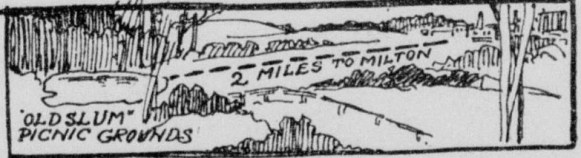
Old Slum Picnic Grounds.jpg
The scene of the crime

She Refused to Wed

“The boy asked the girl to marry him and she refused. From here on the memory of both is hazy. He had his razor with him by pure accident. He had just gotten it from Arthur Marchand, the [Rochester] barber who had honed it. Well, he got the girl down, so they say, and slashed her across the throat. Then he ran across lots straight home. Apparently the girl was dazed, but not unconscious, for although the blood was pouring from a great gash in her throat, she started for home. She was so confused that she went the wrong direction, falling, crawling, staggering along through the woods and underbrush till she reached the brook.

“This she waded and finally staggered into the old leatherboard mill. Some Greeks there were terrified by her appearance, disheveled, her clothing blood-soaked, and that terrible gash across her throat. They called to their boss, William S. Drew, and he telephoned to me. I hastily got some necessary things together and drove there. I found the cut had not severed the jugular, although it was six inches long and exposed the epiglottis. The girl seemed rational and as much as she could told me what had happened. “Arthur didn’t mean to hurt me,” she said again and again.

“She kept asking us to take her to her home in Sanbornville. When I saw what a serious affair it was I sent for Selectman Hazen Plummer and Chief of Police Fred Howard. We got the girl to the Milton Hotel on an improvised stretcher, and then Marcoux was arrested. He tried to conceal nothing, and later told me the whole story. He said from the time the girl refused his mind is blank. Annie says the same. Marcoux is a fine boy and the last fellow I would pick to do such a thing. He is now a complete nervous wreck.”

When the Post reporter arrived in Milton he was admitted to Miss Drapeau’s room at the Milton Hotel and presented to her.

Girl May Live

While very weak she is able to talk a little and Dr. Hart believes she will ultimately recover unless blood poisoning develops. She is being nursed by Mrs. Charles [Lydia (Marcoux)] Welch, a married sister of the youth who assaulted her, and when the Post writer called he found a brother of Marcoux with the wounded girl. To the reporter Miss Drapeau whispered the amazing message that she now loved Arthur more than ever and wanted him to know it. She is not a pretty girl, but yet is rather attractive. She is very tall, while Marcoux is undersized. This morning Arthur Marcoux was taken from the town lockup and willing took the officers to where he attempted his crime. Here he found the razor and Sheriff Smith now has it. It is a cheap razor with a black rubber handle. The blade is stained with blood and rusted. On one side a large clot of blood can be seen. In this connection Marcoux’s clothes were blood-stained. Before starting for the jail he asked to see his mother, and an affecting scene took place. He has five brothers and the same number of sisters.

Later his mother drove to Rochester, where she retained Attorney Walter Scott to defend her son. Attorney Scott went to Dover jail this evening to have a talk with the prisoner, but could do nothing because of Marcoux’s condition. Sheriff Smith sent out summons for Dr. Hart, Chief of Police Fred Howard and Selectman Plummer to testify at the preliminary hearing in the morning.

Marcoux’s father, Joseph Marcoux, a laborer, had his house on Charles street in Milton, near its intersection with Tappan court, in 1905 (Dover Directory, 1905). Marcoux’s mother, Theotiste Adelaide “Addie” (Cyr) Marcoux, would have set out for Rochester from there. They moved to Farmington after these terrible events (Dover Directory, 1908).

Feeling Against Youth

The feeling against the boy would-be murderer is very intense, and it is said that even if his victim refuses to testify against him and he will not confess on the stand, he will be prosecuted to the full extent of the law by County Solicitor Dwight Hall. The maximum penalty is 20 years at hard labor. The members of Marcoux’s family are heartbroken.

“I know Arthur did not mean it,” said his sister, who is nursing Miss Drapeau. “He loved the girl and we all liked her. He wanted to marry her and she wouldn’t say yes. She said she loved Arthur but they were too young. If Annie dies they will never have a chance to punish Arthur, for it will kill him.”

Annie Drapeau had been employed as a shoe stitcher in Thayer’s shoe factory and went back and forth from her home in Sanbornville every day. Her mother is very ill, but her father came to her today (Boston Post, June 17, 1907).

Eusebe Drapeau, a farmer (working out [i.e., working off his farmstead]), aged forty-eight years (b. Canada), headed a Wakefield (“Sanbornville Village”) household at the time of the Thirteenth (1910) Federal Census. His household included his wife (of twenty-five years), Aurelia [(Carrier)] Drapeau, aged forty-nine years (b. Canada), and his children, Eusebe G. Drapeau, odd jobs, aged sixteen years (b. NH), Leda Drapeau, aged fourteen years (b. NH), Heliodore Drapeau, aged twelve years (b. NH), Valore Drapeau, aged ten years (b. NH), Euclide Drapeau, aged eight years (b. NH), and Eliana Drapeu, aged three years (b. NH).


LEFT FOR DEAD, GIRL CRAWLS FAR WITH THROAT CUT. Attacked by Lover Who Confesses Crime to Police. Jugular Vein Missed by Thinness of Tissue Paper. MILTON, N.H., June 18. With a gash five and one-half inches long in her throat inflicted, she said, by her sweetheart, Annie Crapau crawled half a mile before she found assistance. Arthur Marcoux, the man accused by the girl, has been arrested, and he will be arraigned in court in Rochester.

“I don’t know why I did it,” he said. After he had been taken to the police station, he confessed, the police say, and told substantially the same story of the crime that had been related previously by the wounded girl. 

Slashed on Throat. “We left our homes and started out together in the woods to hunt for wildflowers,” the girl said after her wound had been dressed. “When we arrived at the Old Flume we sat down beside the brook to rest. We had been there several minutes when Arthur, without a word of warning or explanation, pulled a long knife from his pocket. He attempted to stab me with it. I noticed that his eyes were wild, and so I jumped up and ran away. I screamed as I went, but no one heard me. Arthur pursued me. He could run faster than I and he soon overtook me. Then he caught me by the hair, drew my head back, and slashed me across the throat with the knife. I must have fainted from fright, because I do not remember anything more. When I came to I was lying in a clump of bushes near the brook. I guess he threw me there. I called for help, but nobody came. Then I began crawling.”

Fainting Saves Life. Almost dead, she reached Spaulding’s mill. Several men there rushed to her assistance and carried her into the mill. She accused Marcoux of the crime, and action was taken at once to effect his arrest. The chief of police rushed off to Marcoux’s home. He found the man in the yard unconcernedly drawing a pail of water. The chief accused him flatly of having cut the girls throat and he admitted it, but would give no motive for the crime.

Dr. Hart reached the mill a few minutes after he had been summoned. He examined the wound and expressed the opinion that unless blood poisoning should result the girl would survive.

“Both the jugular vein and the windpipe were missed by the thinness of a sheet of tissue paper,” he said.

The girl was brought to her home here. It is believed her life was saved by the fact that she fainted when the knife ripped her throat open, and that Marcoux, when he left her, believed she was dead (Washington Times, June 18, 1907).

Marcoux, Arthur


Milton. Another trouble is the assault at the Flume in Milton, Arthur J. Marcoux having drawn a razor upon Miss Annie Drapeau, whom he had proposed to marry. He had cut her throat in a way that barely avoided the jugular vein, after which he left his victim supposedly to die. But she recovered consciousness sufficiently to drag herself to the road, where she was discovered by persons driving, who carried her to the office of Dr. Hart, and gave the alarm which was followed by the arrest of Marcoux. The assailant was taken to Rochester in care of Sheriff F.I. Smith and one of his deputies, and it was ordered by Judge McGill that he be held without bail at Dover jail, for appearance at the September term of the superior court. Miss Drapeau expresses opinion that the man is not right in his head. She had objected to immediate marriage as she thought they were both too young. There may be other opinions as to this assault, but this seems to be as nearly correct a report as can be made at this time. Such an event confirms the assertion of many that a good chaperon never is out of place, when young men and women are together. (Farmington News, June 21, 1907).


PARENTS REFUSED CONSENT. Young Man Could Not Marry Girl and Cut Her Throat In Revenge. Milton, N.H., June 17. Mamie Trebeau of Sanbornvllle, aged 19, is suffering from knife wounds in the throat alleged to have been inflicted by her sweetheart, Arthur Marcoux of this village. Although there is a cut in her neck nearly six inches long, she is thought to have a chance of recovery, as the wound is not of great depth. Marcoux, who was arrested after the wounded girl had been found in a lonely spot near a picnic ground, was taken to Dover jail to await the outcome of her injuries. Marcoux is said to have told the officers that he was infatuated with the girl, but that her parents refused to allow her to marry him. Marcoux accompanied the officers to the scene of the attack and assisted in finding the knife which he used upon the girl’s throat. Marcoux is a shoe factory employe, 21 years old (North Adams Transcript, June 23, 1907).

Arthur J. Marcoux was committed to the New Hampshire State Hospital early in February of the following year. Annie Drapeau married someone else in May of that year.

BOTH SENT TO ASYLUM. Morgan Charged With Killing Lowell Man in Dover, Marcoux With Attempt to Kill Woman. DOVER, N.H., Feb. 27. Two defendants before the superior court, one charged with murder and the other with assault with intent to kill, were committed to the state asylum at Concord today after entering pleas of not guilty by reason of insanity. The murder case was that in which Patrick Morgan was accused of having killed Dennis Doherty of Lowell in a quarrel in this city last February. The assault case was that of Arthur J. Marcoux of Milton against Miss Annie Drapeau of the same place. Both men had been under examination at the Concord institution since last August, and Dr. Charles E. Bancroft, the superintendent, informed the court that both undoubtedly were insane (Boston Globe, February 27, 1908).

Arthur Marcoux, an inmate, aged twenty-two years (b. NH), resided in the New Hampshire State Hospital in Concord, NH, at the time of the Thirteenth (1910) Federal Census.

Arthur Joseph Xavier Marcoux registered for the WW I military draft in Strafford County, October 21, 1918. He was an unemployed shoemaker, aged thirty years. He gave his address as PO Box 776, in Farmington, NH. His physical appearance was given as a medium height, a medium build, with brown eyes and black hair. His nearest relative was his brother, Fredk. Jos. Marcoux, at the same Farmington PO Box.

Arthur J. Marcoux’s obituary says that he lived and worked in Boston for many years, returning later in life to work in Rochester. He never married. When he fell ill, he lived his last six months in a rotation through his sisters’ houses in Farmington.

Arthur J. Marcoux died in Farmington, NH, October 28, 1935, aged forty-nine years. (His birthday). Annie died in Sanford, ME, July 12, 1941.


References:

Find a Grave. (2012, July 8). Arthur J. Marcoux. Retrieved from www.findagrave.com/memorial/93325461

Milton in the News – 1906

By Muriel Bristol (Transcriber) | July 4, 2019

In this year, we encounter a Massachusetts ice scarcity, a ministerial anecdote, an au pair wanted, a train connection missed, two apparent arson fires, Nute High school bullies, a new ice season, and pullers-over wanted at Milton Mills.

This was also the first year (beginning September 1) in which New Hampshire motorists were required to have automobile registrations and driver’s licenses.


Massachusetts had significant warm stretches during the winter of 1905-06, which interfered with its ice harvest.

Ice Scarce in Lynn. [Lynn Item] The Lynn ice men are not cutting much ice just now in any form. The Lynn Ice Co., M.S. Coolidge, and Z.J. Chase & Sons, who are working at Milton, N.H., have been bothered there by weather, warm spells coming along to interfere with the piling up of ice in the houses there. The Lynn Ice Co. has not cut a pound in Lynn this winter, though the engines have been ready to strike at any minute. Dealers who have cut on Sluice, Floating Bridge, Cedar and Spring ponds have a few tiers in. but not enough to more than carry along the daily trade. All the ice dealers have been buying ice where they have been able to find it outside of Lynn, and some of the New Hampshire men who have small ponds and are near railways have been selling briskly. Far up in New Hampshire there is a plenty, but the cost of getting it to the cities is high, and the cost of lumber is also so high and the lumber so scarce that it is almost impossible to get it on the spot quickly enough to cover the stacks of ice made, and that means melting pretty fast where the sun strikes the cakes.

At Milton, N.H., Tuesday night, there was a big blow. Report came to Lynn today that some of the local firms had lost ice houses, but later the information reached Lynn that the houses that were put out of business for a while are those of the Boston Ice Co., which was building 13 new houses there. The uprights were erected and boarding in had begun, but a high wind during the night blew the standing timbers down and the work will have to be gone over again The Boston Ice Co. people say that where they need 450,000 tons they have but 100,000. and they don’t know what to do any more than the Lynn dealers. Providence, R.I., and New Bedford and Fall River are without ice, or will be after April 1, if some cannot be found to fill the houses.

“I have been m the ice business 25 years,” said a Lynn man today, “and the situation is the worst I ever knew. A man who has been in the trade 19 years told me the other day that he never saw anything like it. We don’t know what to do and that’s a fact. We can just plug along cutting what we can in Milton and trusting that something will happen to fill our houses. We are in a fix and wondering. Yes, ice will be high for next summer. I don’t see how it can be helped. It is costing high to get what little we can find as it is, and if we have to go farther north then the cost will jump to bigger figures and that means that the retail trade must go up.” (Fitchburg Sentinel, March 2, 1906).

ICE SHORTAGE, Hallstram Says It Is Here Already. Avers Dealers Will Have Hard Time Till New Crops. Fourteen Icemen Indicted in Philadelphia. Charles W. Hallstram, secretary of the Massachusetts ice dealers’ association, treasurer of the Union ice company, and prominent among the Ice dealers recently summoned before the grand jury, says it will be a tight squeak for Boston to get through warm weather without a shortage of ice. “Our company,” said Mr. Hallstram, “last week used up the entire supply of one of our houses, where it would ordinarily last two weeks at least. There were 2500 tons of ice in that house, but it was all used up in a week. “People who do not understand the situation may talk as they will, but the fact is there is a shortage of ice, and many of the dealers will find it pretty hard work to drag along until the new crop comes. “Our company has only four houses left with ice up at Milton, N.H. At Wilmington, Mass, we have six small houses full since last year. We supply the fish trade mostly, and I know that we will have a pretty hard time to pull through with what supply we have.” Mr. Hallstram said his company put their price up only 50 cents a ton this year, and that the price now is $3 a ton (Boston Globe, August 8, 1906).

See also Milton’s Ice Harvest of 1906 and Milton’s Ice Industry.


Elder Daniel B. Goodwin seems to have been the last of Milton’s Christian Church Elders – 1846-1888. He had died in Milton, October 10, 1888, and was here remembered nearly twenty years later for his large hands.

Mr. Goodwin’s Hands. A story comes from Milton, N.H., of an old clergyman named Goodwin. He was a tall, broad-shouldered man and was said to have the largest hands of any man for miles around. One noon a young man named Allen was taking dinner at the elder’s house. It was the elder’s custom to ask a blessing at the table, and Allen had not been used to this sort of thing, for instead of waiting he began to eat. The elder raised his hand with restraining gesture and said: “Pause, young man.” “Paws,” was the reply, “I should think they was paws.” – Chicago Inter Ocean (Funk & Wagners, 1906).


Berthold Isaac Demeritt married in Milton, July 9, 1892, Musetta Ardella Dorr. He was born in Newfield, ME, November 30, 1874, son of David and Hannah A. (Nason) DeMeritt; she was born in Milton, NH, in July 1875, [adopted?] daughter of Simon C. and Hannah W. (Hill) Dorr.

Bert DeMeritt, a packer of boots and shoes, aged twenty-five years (b. ME), headed a Boston, MA, household at the time of the Twelfth (1900) Federal Census. His household included his wife (of eight years), Musetta A. DeMeritt, aged twenty-four years (b. ME [SIC]), and his daughters, Merribel DeMeritt, aged six years (b. NH), and Bonneville DeMeritt, aged five years (b. NH). They resided in a rented two-family house at 48 Fairview Street, which they shared with the household of John Hunter, a gas collector, aged thirty-eight years (b. Scotland). Musetta was the mother of four children, of whom two were still living.

Exchange of Ideas in Members’ Letters. Who Needs This Work? I would like very much to have a lady, from 40 to 60, help with care of three children, mostly. She could do whatever she wished of the other work, with the price accordingly. I would rather help care for them, but I must have help, and some one well recommended, whom I could trust, who would be willing to stay with them so I could go out of doors. I would try to make it a pleasant home in every way – the help are one with the family here In the country. We are near churches, postoffice and healthy mountains, woods and water. It is an ideal place for one who cares more for country quiet than city streets. I would like to hear from any one answering these requirements, with good references. I will try to have a fair understanding, as regards price and privileges, and will return answers to all with any information asked for. House very convenient and roomy. Children made to mind and respect elders. One girl, two boys, 1 years to 2 months. Mrs. M.A. De M. (Milton, N.H.). An excellent chance for some one. (Los Angeles Times, April 29, 1906).

Berthold I. DeMeritt, a shoe factory foreman, aged thirty-five years (b. ME), headed a Milton household at the time of the Thirteenth (1910) Federal Census. His household included his wife (of seventeen years), Musetta DeMeritt, aged thirty-four years (b. NH), and his children, Bonneville I. DeMeritt, aged fifteen years (b. NH), Bruce R. DeMeritt, aged seven years (b. NH), Roscoe E. DeMeritt, aged four years, Delphine H. DeMeritt, aged two years, and Hannah D. DeMeritt, aged four months (b. NH). Musetta was the mother of eight children, of whom five were still living.

Mrs. M.A. Demeritt donated flowers to the New England Hospital for Women and Children, in Boston, MA, in 1918-19 (See Mrs. DeMerritt’s Arbutus).

Berthold I. DeMeritt died in Milton Mills, January 11, 1940. Musetta A. (Dorr) DeMeritt died in Rochester, NH, April 12, 1946.


Edgar M. Churchill, a clergyman, aged forty-one years (b. ME), headed an Acton, ME, household at the time of the Twelfth (1900) Federal Census. His household included his wife (of eight years), Amy M. Churchill, aged thirty-one years (b. ME), and his daughter, Dorothy M. Churchill, aged three years (b. ME). (Their household appeared on the same page as that of Eugene H. Ayer (see below).

CHURCH NOTES. There were no services in the Free Baptist church Sunday owing to the detainment in North Conway, N.H., of the Rev. A.W. Churchill of Milton, N.H., who was to have supplied there. Mr. Church understood that the summer train service was in effect and so missed connections. He will have charge of the services at the church next Sunday (St. Johnsbury Republican, May 9, 1906).


Jacob F. Staples married in Milton, March 9, 1863, Amaney J. Pike. Rev. James Doldt performed the ceremony.

Jacob F. Staples appeared on Page 5 of Milton in the Veterans Schedule of 1890. He and his family seem to have been missed in the Twelfth (1900) Federal Census. The Milton section of the Dover Directory of 1900 listed him as a farmer, boarding at H.W. Staples. Harry W. Staples appeared as a farmer, on the U.V. [Union Village] road, 2 m. west of M.M. [Milton Mills].

FAMILY BURNED OUT TWICE. Town of Milton, N.H. Stirred Up Over Two Fires Which Officials Believe to Have Been of incendiary Origin. MILTON, N.H., Aug 7. This town is considerably stirred up over what is believed to have been two incendiary fires. On the morning of June 2, between the hours of 2 and 3, the home of Jacob F. Staples, about one mile out of the village on the road to Union, was burned, together with the barn which contained five horses, other live stock and farming implements. When the family, which consisted of Mr. Staples and his wife, his son Harry and the latter’s child, awakened, the house was one mass of flames and the occupants had barely time to get out without saving any of their effects. They moved to a small house owned by the son, and their neighbors assisted them in furnishing their new home. Early Sunday July 29 this house, together with the barn, three horses and wagons were completely destroyed by fire. As in the case of the previous fire, the family barely escaped with their lives. Owing to the circumstances connected with both fires the selectmen of the town have placed the matter in the hands of county solicitor Dwight Hall, and a systematic investigation will be made in hope of clearing up the mystery (Boston Globe, August 7, 1906).

Jacob F. Staples made out his last will in Milton, October 4, 1906. He devised his farm tools of every description to his son, Harry W. Staples; $1 to his daughter, Susie A. Hatch, wife of Frank Hatch of Kennebunk, ME; and all the rest and residue to his wife, Amancy J. Staples, who was also named as executrix. The will was proved November 7, 1906, i.e., Jacob F. Staples had by then died.


Eugene H. Ayer, a carriage painter, aged forty-five years (b. ME), headed an Acton, ME, household at the time of the Twelfth (1900) Federal Census. His household included his wife (of seventeen years), Charlotte Ayer, aged thirty-six years (b. NY), and his children, William Ayer, at school, aged ten years (b. [Parsonfield,] ME), Francese Ayer, aged seven years (b. ME), and Gladys H. Ayer, aged three years (b. ME). (Their household appeared on the same page as that of Rev. Edgar M. Churchill (see above)).

VICTIM OF HAZING. William Ayer Suffering from Blood Poisoning Said to Have Been Caused by Milton, N.H., High Schoolmates. MILTON MILLS, N.H., Sept. 19. William Ayer, 15, son of Eugene Ayer of this place, is suffering from blood poisoning it is caused, it is alleged, by being hazed by the sophomores of the Nute high school at Milton, which young Ayer entered this fall (Boston Globe, September 19, 1906).

Mr. Clarence E. Kelley was Nute High school principal at the time, and Misses Anna F. Berry and Theresa A. Gerould were the teachers. Despite this Nute High school experience, William R. Ayer went on to become a teacher too. He attended three years of college. He was a teacher, resident on Church Street in Milton Mills, in 1917; and a grammar school teacher, resident in Milton Mills, in 1920. He was a farmer, resident on Church Street in Milton Mills, in 1930 and 1940.

William R. Ayer died in 1954.


Here we find two of Milton’s ice merchants attempting to put the ice shortages of the winter of 1905-06 behind them. Hopefully, the winter of 1906-07 would be more successful.

MALE HELP WANTED. WANTED – 2 or 3 laborers to go to Milton, N.H. Apply to J.R. DOWNING CO, 128 Kenrick st., Brighton, at office or by phone, 2t* n13 (Boston Globe, November 13, 1906).

FOR SALE. ICE. NEW ICE, f.o.b. Milton, N.H., $1 per ton, railroad weight. Address JOHN O. PORTER, Milton, N.H. (Boston Globe, December 9, 1906).

Porter states his terms as being F.O.B.. i.e., the “sale” took place when the ice was loaded at Milton. Ownership, loss in transit, and any liability, all shifted at that time to the buyer.


McKay Leather Stitching Machine.jpg
McKay Leather Stitching Machine

The Boynton Shoe Company had been active in various locations since at least 1898. Its founder, William H. Boynton, died in Marblehead, MA, in December 1901. It had a Candia, NH, operation from around 1903. It first advertised for a stock-fitter for women’s and misses’ shoes at a Milton Mills branch in October 1904. (Boynton was the successor there of the Gale Shoe Company).

MALE HELP WANTED. PULLERS-OVER and operator, McKay sewer, steady work, good chance for family to move where they can all have work. BOYNTON SHOE CO. Milton Mills, N.H., or ANDREWS CO., Everett. SuW d23 (Boston Globe, December 26, 1906).

(Details of a Puller-Over’s task may be found in Milton in the News – 1901). The Boynton Shoe Company produced shoes at Milton Mills through at least 1908.


Previous in sequence: Milton in the News – 1905; next in sequence: Milton in the News – 1907


References:

Beehive (MA Historical Society). (2014, February 7). The McKay Stitcher: The Machine That Revolutionized Footwear Production. Retrieved from www.masshist.org/beehiveblog/2014/02/the-mckay-stitcher-the-machine-that-revolutionized-footwear-production/

Find a Grave. (2013, August 12). William R. Ayer. Retrieved from www.findagrave.com/memorial/115348574

Sampson & Murdock Company. (1908). New England Business Directory and Gazetteer for 1908. Retrieved from books.google.com/books?id=11ZEAQAAMAAJ&pg=PA460

Wikipedia. (2019, June 23). FOB (Shipping). Retrieved from en.wikipedia.org/wiki/FOB_(shipping)

Wikipedia. (2018, August 27). Gordon McKay. Retrieved from en.wikipedia.org/wiki/Gordon_McKay


Concord Beat – Early July 2019

By Ian Aikens | July 1, 2019

As promised in my last article, this time I examined Jeb Bradley’s recent legislative record. I culled my impression not only from his voting record but also from the bills he either sponsored or co-sponsored. While Bradley has a tendency to allow individuals and their employers to negotiate voluntarily between themselves on important issues like pay and benefits, sadly, in other areas, he shows no reluctance to give government bureaucrats the power to mandate all sorts of things.

First a little background on Bradley himself. He has been active in New Hampshire politics since 1986, when he was first elected to the Wolfeboro Planning Board. He was elected to the New Hampshire House in 1990 and re-elected five times. He was elected to Congress in 2002, but in an upset he lost his seat to Carol Shea-Porter, an anti-war activist, in 2006. He was elected to the New Hampshire Senate in 2010 and served as the Majority Leader from 2010-2018. He currently serves as District 3 Senator, representing 19 towns in Carroll County, Waterville Valley in Grafton County, and Middleton and Milton in Strafford County. Outside of the political sphere, he ran an organic bakery, a painting business, a real estate office, and even worked as a street magician in Switzerland at one time.

Now down to business:

HB1319 – Prohibiting discrimination based on gender identity in housing, employment, and public accommodations. Bradley co-sponsored the bill and it was signed by the governor. While it is proper to prohibit all discrimination on government property and for all government services, since “the commons” are owned by all taxpayers, is it really the proper role of government to dictate to private (voluntarily-run) businesses who they must serve? In the olden days, the argument that a traveler had few, if any, choices when traveling, so it would have been uncivil to allow a private business to deny lodging to a traveler may have been plausible, but in this day and age with most businesses scrambling for more customers, it makes little sense to mandate fairness. Besides, the biggest obstacles to more choices for consumers these days are government regulations and occupational licensing.

SB1 – Granite Caregiving Act of 2019. This bill was vetoed by the governor, and Bradley had the good sense to vote NO on it. This would have actually been a tax on earned income—which in any other state is called an income tax—but politicians produce flowery-named titles for bills that might not otherwise be well-received when they are trying to pull the wool over voters’ eyes. This TAX would have been deducted out of all employees’ wages at the rate of .5%. While it would have been a nice fringe benefit for employees, and there is broad-based support for “Family Leave,” once you inform folks that they have to pay for it themselves, support for the program drops dramatically. This would have a mandate too—and the only opt-out would have been for companies that already offer the benefit.

SB10 – Minimum wage up to $12.00 per hour. Bradley voted NO on this one. Another mandate forcing businesses to pay employees more than their skills are worth on the open market. There’s been plenty written about minimum wages and their consequences over the years, so it should come as no surprise that those on the bottom of the economic ladder are hurt the most by these mandates. Those with the lowest skills just starting out lose out on the opportunities to advance their skills. It should also come as no surprise that minimum wage laws were originally pushed by union workers to keep non-Caucasians from competing for their jobs. The racism continues today, but they call it a “Living Wage.”

SB148 – Notification to public employees of right to join or not join a union. Bradley was a co-sponsor on this bill. While one part of this bill that requires new employees’ personal information to be released to unions is alarming, overall this was a net good bill because of the requirement that new employees be informed that they have a choice of joining a union or not. No mandatory forced extortion to join the union or lose your job.

SB255 – Dementia training for direct care staff in residential facilities and community-based services. Co-sponsored by Bradley, this bill demonstrates that he believes that those who choose a residential home for their loved ones don’t have sense enough to choose a facility where the health care workers have adequate training for the jobs they perform. It also assumes the residential facilities have no business interest in maintaining properly trained employees and need to be nudged by a mandate. What business can survive if its reputation is marred by poor care of its customers?

SB270 – Establish tax credit against business profits tax for donations to career and technical schools. Another bill co-sponsored by Bradley, this one would serve to help finance apprenticeships and training programs at technical schools that teach their students actual job skills for the real world, rather than traditional schools supported by tax dollars that do little to prepare students for the working world. An added plus is the tax credit serves to deprive government bureaucrats of more money to waste.

SB272 – Enforce the Paul Wellstone and Pete Domenici Mental Health Parity and Addiction Equity Act of 2008. Bradley co-sponsored this bill, which would force health insurers to treat mental illness as seriously as physical illnesses. Of course, we all want extra goodies we don’t have to pay for, but all these extra services increasingly mandated by politicians and bureaucrats—that’s why the cost of medical insurance and services continue to increase dramatically. Besides, I’m not so sure all this obsession with mental health is so healthy. With the ever-increasing number of new laws, bans, and mandates—that’s enough to increase mental illness in itself.

SB274 – Mothers with newborns on Medicaid entitled to “free” home visits. Another bill co-sponsored by Bradley, this is a new, small entitlement program. I have nothing against mothers—either with newborns or older children—but who will pay for these special home visits? After all, they’re not free. If Bradley and the other co-sponsors were to personally pay for these home visits themselves, that would be highly commendable, but forcing everyone else to pay—that’s forced giving.

SB279 – Requires health insurers to cover fertility treatment on all policies. Another bill co-sponsored by Bradley. Not everyone is interested in having every sort of medical option (that they will have to pay for), so forcing all insurers to cover more and more expenses drives up the costs for most people (and employers who could otherwise pay their employees more). Health insurance—like all other services that folks (and their employers) pay for—should have as much variety as possible to suit individual needs of consumers, but mandating more and more services results in less choices for all.

SB282 – Requires school districts and chartered government schools to provide suicide prevention training. Bradley was the primary sponsor on this one. Suicide, especially by a young person, is always a tragic event, but is mandating all teachers to attend two hours of suicide training annually going to actually save lives? I doubt it. More likely, it will be yet another administrative burden for teachers to fulfill in an ever-increasing list of required non-teaching duties. If politicians were really serious about suicide prevention among youth, perhaps they should consider making school attendance non-compulsory. First, there would be the obvious savings to taxpayers of not chasing down kids who hate being in school and often cause the most disruption. More important, forcing all kids to attend government schools—and face it, unless the family is well-off, the option of a private (voluntary) school is very limited—which are often dangerous (bullying, gangs, drugs) may actually increase suicides. One-size-fits-all doesn’t work for everyone.

SB290 – Changes to New Hampshire Granite Advantage Health Care Program. This bill has several parts to it, but the main thrust is to reduce work requirements for those who qualify for what is essentially totally free health care—no deductibles, premiums, or co-pays. We’re talking about able-bodied adults here, not the disabled or pregnant women. Encouraging people away from self-sufficiency leads to dependence on others and ill will from tax-weary taxpayers. Fortunately, Bradley voted against the bill.

All in all, Bradley at best has a spotty record in Concord. His view of what government should be doing borders on paternalism at best and authoritarianism at worst.

[Editor’s note: see also NH SB 154 Amended and SB 154 on the House Floor].


Previous in sequence: Concord Beat – May 2019


References:

LegiScan. (2019). NH Legislation | 2018 | Regular Session. Retrieved from  legiscan.com/NH/bill/HB1319/2018

LegiScan. (2019). NH Legislation | 2019 | Regular Session. Retrieved from legiscan.com/NH/bill/SB1/2019

LegiScan. (2019). NH Legislation | 2019 | Regular Session. Retrieved from legiscan.com/NH/bill/SB10/2019

LegiScan. (2019). NH Legislation | 2019 | Regular Session. Retrieved from legiscan.com/NH/bill/SB148/2019

LegiScan. (2019). NH Legislation | 2019 | Regular Session. Retrieved from legiscan.com/NH/bill/SB255/2019

LegiScan. (2019). NH Legislation | 2019 | Regular Session. Retrieved from legiscan.com/NH/bill/SB270/2019

LegiScan. (2019). NH Legislation | 2019 | Regular Session. Retrieved from legiscan.com/NH/bill/SB272/2019

LegiScan. (2019). NH Legislation | 2019 | Regular Session. Retrieved from legiscan.com/NH/bill/SB274/2019

LegiScan. (2019). NH Legislation | 2019 | Regular Session. Retrieved from legiscan.com/NH/bill/SB279/2019

LegiScan. (2019). NH Legislation | 2019 | Regular Session. Retrieved from legiscan.com/NH/bill/SB282/2019

LegiScan. (2019). NH Legislation | 2019 | Regular Session. Retrieved from legiscan.com/NH/bill/SB290/2019

Wikipedia. (2019, April 15). Jeb Bradley. Retrieved from en.wikipedia.org/wiki/Jeb_Bradley