
Tax-Titled Property Auction Results

By S.D. Plissken | May 6, 2016

The James R. St. Jean auctioneers held an auction at the Emma Ramsey Center in Milton, on Saturday, May 4, 2019. Eight tax-titled (tax seizure) Milton properties were on the block.

The descriptions below appeared in their auction brochure (see References below). One of our correspondents found the sale prices quoted below in a social media posting by an auction attendee.

(Ed. Note: The sale prices of the following properties have been revised through receipt of exact figures: #2 (added), #3 (revised downwards), #4 (revised downwards), and #7 (sale cancelled) (May 7)).

A follow-up discussion of this auction is scheduled as the tenth agenda item on tonight’s Board of Selectmen (BOS) meeting agenda.


The Two Properties Sold with Covenants

The first two properties had some serious problems – health hazards – frequently mentioned in Board of Selectmen (BOS) meetings. The following conditions (or covenants) were attached to those properties.

Auctioneer’s Note for Sales 1 & 2: The Grantee agrees that within 45 days of the date of the execution of the deed, the Grantee will apply to the Town for a building permit for all work necessary to return the property to livable condition. Further, the Grantee agrees that within 1 year from the date of execution of the deed all necessary work will be completed and a certificate of occupancy obtained.

In effect, each of these two properties comes with a rather expensive albatross tied around its neck, even should they become “tear downs.”

(Their problems are not unlike those present on a much larger scale in the Town’s so-called Lockhart Field site).


Sale #1 is the so-called “Blue House” property discussed in so very many BOS meetings.

SALE #1: Tax Map 22, Lot 19, 1121 White Mountain Highway • Cape style home on a 2.64± acre lot includes 3,256± SF GLA, 4BR, 2 BA, & FHW/oil heat • Attached garage & detached shed • Zoned Low Density Residential • Assessed value $168,300. 2018 taxes $4,289. DEPOSIT: $5,000

Sold for $11,000. This would be 6.5% of its previously assessed value.


SALE #2: Tax Map 9, Lot 2, 16 Spruce Lane • Single family home on 0.4± acre lot on a dead end street • Property features 968± SF GLA, 1 BR & 1 BA • Storage Shed, FHA/gas heat, & wood deck • Assessed value $69,000. 2018 taxes $1,759. DEPOSIT: $5,000

Sold for $69,000. This would be exactly its assessed value.


The Six Undeveloped Lots Sold “As Is”

The following six properties are undeveloped lots. Note that in some cases there was a considerable variance between their auction prices – their actual value as determined by the market – and their assessed values. This variance should be a matter of some study by the assessors, who will likely want to make some adjustments in similar properties – for accuracy’s sake.


SALE #3: ABSOLUTE – Tax Map 43, Lot 24-6, Campbell Road • Undeveloped 1.51± acre lot located on a cul-de-sac street in the Briar Ridge development • Lot is wooded and gently rolling in topography • Zoned Low Density Residential • Assessed value $33,600. 2018 taxes $857. DEPOSIT: $2,500

Sold for $24,000. This would be 71.4% of its previously assessed value.


SALE #4: ABSOLUTE – Tax Map 43, Lot 24-8, Campbell Road • Undeveloped 1.58± acre lot located on a cul-de-sac street in the Briar Ridge development • Lot is wooded and gently rolling in topography • Zoned Low Density Residential • Assessed value $33,800. 2018 taxes $862 DEPOSIT: $2,500

Sold for $21,000. This would be 62.1% of its previously assessed value.


SALE #5: ABSOLUTE -Tax Map 5, Lot 7, Willey Road • Undeveloped 11.98± acre lot along a quiet paved road • Lot is wooded and slopes down from the road • Zoned Low Density Residential • Assessed value $45,000. 2018 taxes $1,147. DEPOSIT: $2,500

Sold for $12,000. This would be 26.7% of its previously assessed value.


SALE #6: ABSOLUTE – Tax Map 47, Lot 27-1, White Mountain Highway • Undeveloped 10.83± acre lot along heavily traveled Rte. 125 • Lot is wooded, level to gently rolling and has water frontage along the Salmon Falls River • Zoned Commercial/Residential • Assessed value $50,800. 2018 taxes $1,295. DEPOSIT: $2,500

Sold for $20,000. This would be 39.4% of its previously assessed value.


SALE #7: ABSOLUTE -Tax Map 37, Lot 64, Ford Farm Road • Undeveloped 0.4± acre lot along a paved road in a quiet residential neighborhood • Lot is wooded and gently rolling in topography • Zoned Low Density Residential • Assessed value $8,100. 2018 taxes $207. DEPOSIT: $1,000

This property reportedly sold for between $4,000 and $5,000. That would have been between 49.4% and 61.7% of its previously assessed value However, the winning bidder withdrew, so the property remains available. .

Quiet residential neighborhood would be one way to describe it. This property is situated along one of the proposed “no through trucking” routes mentioned at the BOS meetings of last year.


SALE #8: ABSOLUTE – Tax Map 39, Lot 9, Middleton Road • Undeveloped 4± acre lot along a paved road close to the Farmington Town Line • Lot is rolling in topography and much of the lot is made of wetlands • Zoned Low Density Residential • Assessed value $2,200. 2018 taxes $56. DEPOSIT: $1,000

Sold for $100. This would be 4.5% of its previously assessed value. The auction attendee described this as “the wetlands lot.”

Assessors should take note, with an eye to adjusting their cards, that the market values wetland properties as virtually worthless, at least for small-scale building purposes. Neither Rome nor Washington, DC,  achieved their current values until after they had drained their pestilential swamps. (Their actual swamps, rather than their metaphorical ones).


Overall, the seven properties, with a combined assessed value of $402,700, sold at auction for $157,100. That would be an average of 39.0% of their previously assessed value.

References:

Town of Milton. (2019, April 11). Tax-Titled Property Auction, May 4, 2019. Retrieved from www.miltonnh-us.com/sites/miltonnh/files/news/one_page_brochure.pdf

NH SB 154 Amended

By S.D. Plissken | April 26, 2019

A legislative correspondent informs us that New Hampshire Senate Bill 154 (2019), which is principally concerned with creating a tax credit for workforce housing, has had an unrelated section inserted into it:

4. Town of Milton; Authorization to Sell Property. Notwithstanding RSA 41:14-a, II(c), the town of Milton is hereby authorized to sell property located at 460 White Mountain Highway, known as “the old fire station,” which has been listed for sale with a real estate broker in order to satisfy the requirements of the division of charitable trusts, department of justice.

The relevant part of RSA 41:14-a to be notwithstood:

RSA 41:14-a,

II. The provisions of this section shall not apply to the sale of and the selectmen shall have no authority to sell:

(c) Any real estate that has been given, devised, or bequeathed to the town for charitable or community purposes except as provided in RSA 498:4-a or RSA 547:3-d.

References:

State of New Hampshire. (2016, June 21). RSA Chapter 41:14-A. Acquisition or Sale of Land, Buildings, or Both. Retrieved from www.gencourt.state.nh.us/rsa/html/III/41/41-14-a.htm

Legiscan. (2019). New Hampshire Senate Bill 154. Retrieved from legiscan.com/NH/text/SB154/id/1975233/New_Hampshire-2019-SB154-Amended.html

Wikipedia. (2018, December 22). Sausage Making. Retrieved from en.wikipedia.org/wiki/Sausage_making

Milton as Brigadoon

By S.D. Plissken | April 23, 2019

I had occasion to see the 1954 film adaptation of the 1947 Broadway musical Brigadoon. It starred Gene Kelly, Van Johnson, and Cyd Charrise. It is a musical romance, with several memorable songs, and did well in its time. (It has an 85% on Rotten Tomatoes). Two American travelers wander into a Scottish village of apparently two hundred years earlier.

The fantastical premise of the film: in order to protect the village of Brigadoon from experiencing any change, its minister prayed for a miracle, and his prayer was answered. Brigadoon was removed from the world entirely, reappearing for but one day in every hundred years. Only those that truly love Brigadoon, or one of its inhabitants, can remain there when its single day in a hundred years has elapsed.

A local contractor once told me the similar fantastical premise underlying Milton’s recent existence, as well as that of many of its surrounding towns. In the early 1980s, its zoning laws were created or rewritten such as, as he put it, “to make sure that nothing ever changed.” I have heard the same characterization from many others too. And several generations of Town “planners” have been screwing down the lid more tightly ever since the early 1980s. They hope to achieve our very own Brigadoon-like “miracle.”

And they are now in the seventh or eighth year of their Fourth Ten-Year Plan. (Shudder).

Now, Milton is very far Off Broadway and the free market, as a force of nature, is ultimately irrepressible. It exists wherever people would like to better their condition, through the peaceful means of exchanging their goods or services for those of others. This force of nature might be discouraged, delayed, diverted, forbidden, and even driven underground (to become gray or black markets), but it can never be entirely suppressed. It will eventually reassert itself.

Some sort of market exists everywhere despite Town, State, County, Federal, and International plans and edicts. It persists in some form even in communist, fascist, and other authoritarian regimes. It thrives even in prisons and concentration camps. (Witness the fictional characters Sefton (William Holden) in Stalag 17 and Red (Morgan Freeman) in the Shawshank Redemption). It defied Prohibition and overpowered the Soviet Union. It created Milton. It defeats all comers, eventually.

Another commenter explained the ridiculous mechanism employed to remove Milton from the world, to keep it in stasis. Milton’s zoning laws have been carefully crafted so as to forbid virtually everything.

But how could that possibly work? They might keep new businesses out, but they cannot keep the old ones alive. It will eventually “wind down.”

Well, there is a Zoning Board of “Allowance” (ZBA) empowered to grant selected exceptions to the rules. It “allows” certain businesses or certain uses of private property, according to its own criteria. (“Silence, whippersnapper, the beneficent Oz has every intention of granting your request”).

But that is certainly an invitation to corruption, if not the very definition of it. A very few people, some of them appointed, i.e., not even elected by a majority of a minority, get to decide if a property owner may use their own private property as they wish?

Yes, I know. You see, you do not really “own” your property, you only think you do. The “community” owns your property and it – well, actually, “its” majority-of-a-minority Town government – allows only certain uses of it. Things they might like. Because they are wise, and overlords, they are wise overlords.

For example, there is a certain economic logic to the placement of grocery stores: any cluster of 5,000 inhabitants can sustain a grocery store. And that might have been nice. It certainly might have been the “attraction” that so many claim to want. But it was forbidden.

We all know how China Pond’s expansion foundered on State and local parking restrictions. At last Monday’s BOS meeting, they were comically authorizing the Town Planner to negotiate with the State regarding parking places. If we surrender some existing spaces, to the detriment of any future business owners that front them, we might, just might – if we ask nicely, and with our cap in hand – secure State authorization to retain some lesser number of the already existing parking spaces. What a sorry solution.

Index Packaging nearly decamped, when their proposed expansion was forbidden. (Their departure has been shelved, for the present). A chain restaurant might have found a home here, but those are forbidden. It would be difficult to catalog the economic opportunities – the “attractions” – we have forgone in a vain effort to keep Milton out of the world.

Last Monday’s Board of Selectmen meeting had much of this authoritarian thinking on display. Some claim to love Milton, or certain aspects of it anyway, and maybe they do, in their own peculiar way. But they definitely dislike freedom. One might feel bad for them, if one were not manacled to them, and trying to stay afloat in some very deep waters.

The highlight of the evening was Mr. Larry Brown’s agenda item. His presentation featured nearly everything. He complained that his agenda item was not taken up in a secret session, as he had requested. He is a strong advocate of transparency, no doubt.

What did he want to discuss in secret? It seems that some taxpayer had dared to question the ethics of transferring public properties – for $1 apiece – between public and private boards while sitting on both boards. Mr. Brown took umbrage at that instance of lèse-majesté. He would have counseled the board, in private, that such outrages need not be endured. They have the Power (his emphasis) to do pretty much as they please. Evidently, he is not a big fan of “speaking truth to power.”

From there, he proceeded to tout historic preservation. He desires an influx of more taxpayers that have more taxable money. Through more planning. He expressed his profound gratification over Milton Mills’ progress towards “gentrification.” He disapproved of manufactured homes, which constitute some 14.9% of Milton’s homes (See Milton’s NHES Community Profile – 2018). There are entirely too many of them. (“Few tourists travel anywhere to see the double-wides of New Jersey”). He recounted how he had prevented several businesses from establishing themselves at Plummer’s Ridge and elsewhere. (He stands astride it like a Colossus). He has spent “thousands” of his own money on lawsuits.

As a Town official, Mr. Brown splits his time between the Planning Board, where businesses are restricted, and the Zoning Board of Allowance, where he has the Power to stifle those few that may slip through the cracks. (A legislative acquaintance told me this double-office holding was formerly not permitted, as an obvious conflict of interest, but that the legal restriction has been withdrawn recently). He is also a Library Trustee. And very nearly gained a seat on the Board of Selectmen.

Only one thing could disrupt the continuance of Brigadoon’s “miracle”: if even one of its inhabitants ceased to entirely love it and wished to depart, the miracle would cease and the village return to the world.

References:

Town of Milton. (2019, April 15). BOS Meeting, April 15, 2019. Retrieved from youtu.be/Oxzie5qj6NQ?t=849

Wikipedia. (2019, April 3). Brigadoon. Retrieved from en.wikipedia.org/wiki/Brigadoon

Wikipedia. (2019, April 7). Lèse-majesté. Retrieved from en.wikipedia.org/wiki/Lèse-majesté

Wikipedia. (2019, January 30). Robinson Crusoe Economy. Retrieved from en.wikipedia.org/wiki/Robinson_Crusoe_economy

Reply: That Name Thing Again

By S.D. Plissken | March 24, 2019

Ms. McDougall,

Thank you for your comment of March 20 in regard to my own piece on the Board of Selectmen (BOS) meeting of March 18. There is a lot to unpack here. I will attempt to address your various points (in several replies), although not necessarily in the order in which you made them.

I can agree with your conclusion of support for freedom of speech, commerce [a free market], and low taxes [a free people].

That Name Thing Again

Everyone wants to know our names. But why? The arguments deployed here are either valid or they are not, regardless of the name attached to them. Names are useful only for use in ad hominum fallacies – arguments applied against the man (or woman), rather than against the argument.

And, frankly, this Town government is not to be trusted with names. It was reported on the eve of the March 2018 election, in response to a 91-A request by a local Facebook administrator, that the Town Treasurer was under “criminal investigation.” She had displeased the Board of Selectmen in some way, only partially visible in their public sessions. Now, this accusation was patent nonsense, of course. And when she lost the election, the “criminal investigation” evaporated. It was apparently no longer necessary.

She won re-election as Strafford County Treasurer. The County seems to have had no problems with her whatsoever.

This episode begs many questions. Who initiated the purported “criminal investigation”? On what basis? Who did the investigating? Just following orders? What were the results? Is the information sought under 91-A now publicly available? And, finally, where does the erstwhile Treasurer go to regain her good name?

You might think that the current Treasurer has also cause for complaint: his own electoral victory appears to have been influenced, and thereby tainted, by this “February surprise.” Where is his “mandate”?

And there have been other similar occurrences, in which Town officials have threatened to use Town money – your money and mine – to sue someone into oblivion if they did not comply. By whatever means necessary, to the outer limits of our money. Aah, I’d like a vote on that expenditure, please.

Those who follow the BOS meetings will have seen occasionally other causes for concern. I might cite just a couple of them. The RSAs, whatever I might think of them, have some very few checks on the power of selectmen. Some decisions are reserved for the electorate alone.

Our selectmen do not care much for that nonsense. They find it inconvenient. They have voted amounts of money just one dollar less than statutory amounts that would trigger a vote of that electorate. They have stated outright that they are voting that dollar-smaller amount so as to not trigger the requirement for voter approval. Because they love … democracy?

In a like manner, they have stated publicly that they are keeping one dollar in a fund that, having fulfilled its approved purpose, should have been closed. They have stated clearly that they were doing so in order to avoid the need for voter authorization in the future. Because they respect … the taxpayers?

One might make a case that this Town government, when thwarted or facing some perceived impediment, sometimes reacts in a manner more akin to a criminal gang than an assemblage of our friends and neighbors.

And you want our names available to them. Yeah, right.

Chairman Thibeault’s Rube Goldberg Machine

By S.D. Plissken | March 20, 2019

Many of those that hold Milton’s Town government offices suffer from one or more commonly-held delusions.

One is reminded of various medical practitioners of the past who, though well meaning, aggravated patient problems and probably even hastened their deaths. For example, George Washington is said to have been “bled” in his final hours by such a practitioner, which certainly did not do him any good.

Now, they were not entirely bad doctors, but merely doing their best according to the state of medical knowledge of their day. Had they persisted in employing antiquated methods, disproven theories, or even some illogical and unproven notions of their own, we might term them “quacks.”

At the most recent Board of Selectmen (BOS) meeting (March 18, 2019), some of our very own economic and political quackery was on display yet again. This needs to stop.


The Atlantic Broadband representative confirmed, in answer to a query, that his company has not extended their network to every house in town. He explained that is financially unremunerative to run lines where there are less then ten customers per mile. He further explained that potential customers in such areas might still get Atlantic Broadband connections, but would need to contribute themselves, at least in part, to run the lines out to their location.

The representative was not presenting some sort of bizarre formulation. I have heard similar things about Eversource (and their predecessor PSNH). You may build as far off the street as you may like, but you will be paying yourself to run the poles from your house out to a connection at the street.

Enter our Town Planner, Bruce W. Woodruff. He wondered if – in this day and age – internet access is really more akin to a public utility than merely a service. Step carefully, Mr. Woodruff. Didn’t we just have a rather close call on Article #3 in trying to fiddle meanings and definitions for political purposes? Of course, Mr. Woodruff’s hint led nowhere with the vendor. Milton cannot yet compel companies to engage in unprofitable practices.

But Mr. Woodruff was willing to have the taxpayers build upon that poor foundation. He would have the Town tax everybody in town, put that tax money in a “Broadband Fund,” and use that tax money to subsidize an extension of the internet to the purportedly underserved areas. (Thinly-settled areas may be served with as many satellite connections as they like).

Planner Woodruff: Other communities have invested some of their tax dollars into a fund called a “Broadband Fund,” and then they would use that “Broadband Fund” toward these goals. And I think it’s very important to consider.

Go carefully there too, Mr. Woodruff, I think I got just a whiff of some Socialism. We would not want to step in that.

Subsidizing broadband connections is not a legitimate governmental function. Not at all, no matter how you might wish to redefine it.


Newly-returned Selectman Rawson delivered a stunner in the Town-Owned Properties discussion. He proposed adding the 1121 White Mountain Highway property – the so-called “Blue House” – to the proposed auction list.

Chairman Thibeault had a sort of Rube Goldberg contraption planned for that property. Giving it to the Milton Historical Society would allow them to move the Plummer’s Ridge Schoolhouse No. 1 property – which he would also give them – across the street to the “Blue House” land. (See also Not Yours to Give). The “Blue House” would have to be demolished first, of course, but his plan did not mention who would be paying for that. Any guesses?

That would create an “attraction,” which would be – as he said – a “huge asset” for Milton. Tell us Chairman Thibeault, why would that be such a great thing for Milton taxpayers?

Self-Operating Napkin
Soup spoon (A) is raised to mouth, pulling string (B) and thereby jerking ladle (C), which throws cracker (D) past parrot (E). Parrot jumps after cracker and perch (F) tilts, upsetting seeds (G) into pail (H). Extra weight in pail pulls cord (I), which opens and ignites lighter (J), setting off skyrocket (K), which causes sickle (L) to cut string (M), allowing pendulum with attached napkin to swing back and forth, thereby wiping chin.

Well, as an attraction, it might bring in out-of-town visitors, who might spend money here, which might “encourage” businesses, which might somehow reduce taxes. The “logic” trails off there. (They having already more than spent any conceivable tax advantage that might accrue from phantom businesses, if they were to ever arrive).

But “encouraging” businesses (at public time and expense) is not a legitimate governmental function at all.


Now, you won’t believe this newest twist (at least the one most recently revealed): Chairman Thibeault’s Historical Society scheme would have the additional “advantage” of preventing occupation of the “Blue House” by a family with children. Quelle horreur!

Chairman Thibeault: You talk about tax revenue, but remember when you talk about tax revenue, right, there’s what you are going to bring in for that house, and what it’s going to cost the Town. Right? So, say that house is fixed up, and a family moves into it, – And I’m not saying I don’t want families moving to Milton, I’m not saying that at all  – But it’s going to cost you more money, because of the cost of the School system. So, you’re not …

He’s not saying that at all, except when he is saying exactly that. In his view, a childless or elderly couple, or a business, or the Historical Society are to be preferred at that location because a young family, with children, would cause an additional cost to the School District. One older audience member described this sort of calculation as “crooked and dystopian.”

Milton’s population has been more or less stagnant since 2010. (While its taxes have skyrocketed). Are attitudes such as Chairman Thibeault’s contributing to its lack of growth?

Shouldn’t the Town and School District be looking more to reducing its higher-than-State-average per-pupil expenses rather than its number of pupils?


We have been told that Milton is a wholly-owned subsidiary of the NH State government. The NH Constitution clearly states that government’s raison d’etre: the inhabitants surrender a very few of their acknowledged natural rights in order to preserve some others, i.e. some of their other natural rights.

Subsidizing internet connections, encouraging businesses, or, worst yet, discouraging children, do not come under the heading of surrendering some natural rights to preserve others.

Town officials need to step back and take a deep breath. Open the windows to let some fresh air in there. Get their heads straight. Stop employing the political means where the economic means are more appropriate (which is true for nearly everything).

Ms. McDougall prompted the board to remember who they represent. (The correct answer: the taxpayers).

Kudos to Selectman Rawson for his “Blue House” motion and to Vice-Chairwoman Hutchings for voting with him. One hopes they may continue to remember who they represent.


See also A Reply to Chairman Thibeault’s Rube Goldberg Machine


(Editor’s note: Ms. Bristol compiled accounts of a prior failed Milton business “encouragement,” which resulted in the Milton Mills Shoe Strike of 1889).


References:

State of New Hampshire. (2019). [NH] State Constitution: Bill of Rights. Retrieved from www.nh.gov/glance/bill-of-rights.htm

Town of Milton. (2019, March 18). BOS Meeting, March 18, 2019. Retrieved from www.youtube.com/watch?v=Ktrwn9qoUIo

Wikipedia. (2018, December 11). Rube Goldberg Machine. Retrieved from en.wikipedia.org/wiki/Rube_Goldberg_machine

Wintry Mix – Selectmen

By S.D. Plissken | March 10, 2019

The Milton Meet the Candidates night went forward as planned. The winter storm had largely dissipated by late afternoon. High winds followed.

As for the presentations, they were … interesting.

Continued from Wintry Mix – Fire Chief


New Hampshire’s Daniel Webster (he of the Daniel Webster Highway) observed that

There are men, in all ages, who mean to exercise power usefully; but who mean to exercise it. They mean to govern well; but they mean to govern. They promise to be kind masters; but they mean to be masters.


Candidates for Selectman – Five for One Three-Year Position

The five candidates for the single three-year seat on Milton’s Board of Selectmen are James M. Beaulieu, Larry Brown, Andrew Rawson, Adam G. Sturtevant, and Billy Walden.

Messrs. Beaulieu and Rawson

Former selectmen Beaulieu and Rawson did not appear at the Meet the Candidates Night event.

Mr. Dennis Woods, a write-in candidate for the one-year slot on the Budget Committee, asked this question on the Milton, NH Community News Facebook page:

Why would we re-elect [former] Selectmen that are, at least in part, responsible for current conditions?

That is a good question, Mr. Woods. These are the very men, along with current Chairman Thibeault, that created the 2017-18 valuation fiasco. (Mr. Beaulieu’s responsibility, if any, is not as clear as Mr. Rawson’s).

Now, it might be, just possibly, that they have seen the error of their ways since and wish to repair, to the extent possible, all of the damage that they have done?

Mr. James M. “Mike” Beaulieu has not explained his absence from the Meet the Candidates Night event, nor has he issued any statement as a substitute. It is rumored that he might favor cutting taxes, but that is perhaps an uncertain foundation on which to build the necessary reforms.

He is said to be available by phone to answer any questions. (I will not give the number here because … the internet). At any rate, Mr. Beaulieu’s “retail” campaign strategy does not suggest someone running seriously to win. (He is engaged also in an uncontested race for a seat on the ZBA).

Rawson, AndyMr. Andrew “Andy” Rawson explained in a statement that he was away on a vacation that he had planned for two years. Okay. The remainder of his statement does not suggest that he has learned anything at all since he was turned out of office last year (by current Vice-Chairwoman Erin Hutchings with a very narrow margin).

Mr. Rawson arranged for a statement to be handed out, which the moderator read into the record. It did not address any tax reduction, as such, except to provide the usual formulation about being “careful” when spending tax money. Translation: he would not be cutting taxes. Former Selectman Long, who completed Mr. Beaulieu’s last term, used his question time to instead make an endorsement of Mr. Rawson.

The Question

Messrs. Brown, Sturtevant, and Walden all appeared at the Meet the Candidates Night event.

No one in the audience asked The Question, as such, although they were restive. Mr. Bailey asked something similar of his own.

Moderator Jacobs: Alright, next question. Anyone. Sir.

Glen Bailey: I was just wondering … a couple of people behind me asked, “was there a limit to all this … this taxation?” I was a little disappointed … this is the School Board, obviously … I was a little disappointed that they didn’t seem to think there was. Or they were confused, one or the other. So, the same question for you – which of you, or maybe all of you, is going to cut my taxes? Not cut the rate of increase, not everything else on the planet. Who is going to cut the bottom line of my taxes?

Moderator Jacobs put in his oar to argue for the status quo of increasing taxes. (You will want remember to thank him at his next election). He asked Mr. Bailey the “muh services” question.

Jacobs: Can I ask a counter question? I one time thought we could just shut down the transfer station and send everybody to Rochester – when I was a selectman – close out the fire department and just go to Rochester; close the ambulance service and ask Rochester, Frisbee, to come up here; and contract out with somebody to plow the roads.

Bailey: Don’t forget the police.

Jacobs: It meant a huge level of service decrease. Is that acceptable?

Bailey: It’s not acceptable to keep raising the taxes to the point that you’re driving people out of town.

Audience member: That’s happening a lot.

Bailey: It’s not acceptable, so something has to go. So, which of you will cut my taxes?

Thank you, Mr. Bailey, for helping us cut the … get to the point.

Messrs. Brown and Sturtevant

Messrs. Brown, Sturtevant, and Walden were present and answered questions. Our interest here is in whether the candidate would work to reduce taxes.

Sturtevant, AdamMr. Adam G. Sturtevant went first. He spoke of efficiencies of scale, return on investment (as well as its acronym ROI), brick and mortar, “muh services,” etc. When prodded, he offered this final answer:

I’d be lying if I said I’d be cutting your taxes without seeing the full budget and knowing what you’d be getting. So, the answer is I would cut it if it was possible, but I don’t know that answer.

Mr. Laurence D. “Larry” Brown went third. He used his time, but did not need to be prodded for his conclusion. His final answer:

I’ll say it straight: I don’t think I can reduce your taxes in any substantial fashion. The structure of Town government, the structure of the School system, the structure of New Hampshire State tax system preferences are stacked against the lower income property owner in New Hampshire.

Mr. Billy Walden

Mr. Billy Walden went second. His final answer:

Walden, Billy[Regarding Milton Town taxation as an “existential threat”:]. Yes, it is. You hear a lot of people say that. Older folks. I don’t want to be eating cat food. But the way the Town is going right now, with the tax increases and things like that, that’s where it’s headed. I am going to do whatever I can, within my capacity, to lower taxes. I mean, that’s the goal. It really is a sinking ship when you look at the amount of people that are trying to possibly move out of Town or find a better place with a lower tax rate. What I really want to do is try to grab a bucket and bail some of the water out of the ship. That’s really my goal. And whatever I need to do to make that happen, that’s what I’m going to do. Within my capacity, because I’m one of three.
The Answer to The Question

Of all the five candidates only Mr. BILLY WALDEN committed himself to work, vote and act to reduce Milton’s oppressive taxation.

He purports to be not another George. It might be that we will get to see.


See also Wintry Mix – School Board Candidates, Wintry Mix – Budget Committee, and Wintry Mix – Fire Chief.


References:

Town of Milton. (2019). Meet the Candidates Night. Retrieved from youtu.be/nOmRUcqTf08?t=6803

Not Yours to Give

By S.D. Plissken | March 8, 2019

The Properties

According to the Town’s Avitar listings, the Plummer’s Ridge Schoolhouse No. 1 property at 1116 White Mountain Highway is valued at $89,600. That includes $29,800 for 0.18 acres of land, $59,000 for the Schoolhouse itself, and $800 for its 10’x15′ wooden shed.

The “Blue House” property across the street at 1121 White Mountain Highway is valued at $168,300. That includes $40,400 for 2.64 acres of land, $124,200 for the house itself, and $3,700 for its “features” ($749 for its 18’x20′ wooden shed and $3,000 for its Fireplace 1-Stand). (I know the features do not add up).

Now, we all know that Town valuations are questionable at best. Few will ever realize the inflated bubble prices that the Town asserts for tax purposes. But, for the sake of argument, let us suppose their valuations are accurate.

The Proposal

Board of Selectmen (BOS) Chairman Thibeault proposed “selling” both properties – valued together at $257,900 – to the Milton Historical Society (MHS), on whose board he sits, for $2. The whole BOS was on the verge of rubber-stamping this proposal as a Warrant Article on this year’s ballot.

It so happens that BOS Chairman Thibeault and the MHS’s own Vice-Chairman Thibeault are the very same person; just as BOS Vice-Chairwoman Hutchings is a member of that same society. Outgoing Selectman Lucier has never announced his affiliation, if any there be, with the MHS.

A Question

An audience member asked if the BOS were not concerned with the apparent conflict of interest: BOS members arranging to virtually “give” away “Town-Owned” property to a private society in which they have an interest.

Mr. Larry Brown, helpful as always, pointed out that it was for the board alone to decide if they had a conflict of interest. According to Mr. Brown, it would not be a conflict of interest if they received no money and did not hold paid positions with the society.

The audience member pointed out that money need not be the only consideration. Which is why legal boilerplate is often included in real estate deeds that mentions also “other valuable considerations.” Thank you, Mr. Brown. (You have an opportunity of thanking him yourself, if you wish: he is a currently a candidate for a seat on that same Board of Selectmen).

That proposed Warrant Article did not go forward. Vice-Chairwoman Hutchings and Selectman Lucier apparently saw the problem and voted “nay” in a rare 2-1 split. (Chairman Thibeault dug in his heels).

Nobody with a lick of sense supposes that the Town will ever realize anything like its fantasy valuation of $257,900 for the two properties at an auction. The “Blue House” was seriously overvalued. (Its original Corcoran valuation of $208,600 dropped by 19.3% to $168,300). It has developed serious problems since. But those are the absurd values that the Town claimed as being valid when it was busy over-assessing, overtaxing, charging penalties and interest (I have heard 18%, like some kind of insane credit card), and finally seizing the property.

Even so, the Town will likely realize much more than the $2 that Chairman Thibeault was proposing – the difference being at least some tens of thousands of dollars. And that difference – four orders of magnitude – belongs to the taxpayers.

So, “No” Means “Yes” Now?

At this most recent BOS meeting, that of March 4, 2019, the BOS, Town Administrator, and Town Assessor went around in circles again on “Town-Owned” properties. (They seem to enjoy covering always the same ground).

There are three-year properties, for which the dispossessed owner will get nothing at all; less than three-year properties, for which the dispossessed owner might get some residue; as well as phantom properties, slivers, old fire stations, gifts versus seizures, etc., etc.

Chairman Thibeault: I think the ones that we’ve had for three years were all set to go for auction. The only one that I would not support selling was the 1121 White Mountain Highway … until there’s further discussion with the Historical Society and what that could potentially become … but other than that, all the three-year ones?

Well, we knew the Chairman never “supported” selling that one – at a market price – because he wanted to give it away to his other board. He lost that vote. Even the other selectmen could see that it was a “questionable” proposition, but the erstwhile Chairman just can not give it up.

Not Yours to Give

Thanks to these same selectmen, there are fewer saved dollars – less actual capital – going spare in Milton these days.

Whether fairly or foully obtained – these “Town-owned” properties belong now to the taxpayers. The BOS has no right to give away taxpayer properties – valued together at over a quarter-million dollars ($257,900) – to Chairman Thibeault’s buddies at the Milton Historical Society for a measly $2. For philanthropically-minded selectmen: these properties are just not yours to give.

If the Milton Historical Society wants to pony up the $257,900 right now, or even bid some much smaller amount at a “tax-title” auction, they can make it happen. The BOS can set the auction date and the society can start its fundraiser.

Or the Chairman, who feels that the taxpayers just cannot give enough, can prove the strength of his own “support.” He can take out another mortgage on his own home, buy the properties in question, and donate them to the Historical Society himself.


References:

Lilley, Floy. (2012). Not Yours to Give | Davy Crockett. Retrieved from www.youtube.com/watch?v=daay8yvgsGM

Town of Milton. (2019, March 4). BOS Meeting, March 4, 2019. Retrieved from youtu.be/-io2f380xjE?t=3478


Wintry Mix – Fire Chief

By S.D. Plissken | March 5, 2019

The Milton Meet the Candidates night went forward as planned. The winter storm had largely dissipated by late afternoon. High winds followed.

As for the presentations, they were … interesting.

Continued from Wintry Mix – Budget Committee

For Fire Chief – One Three-Year Term

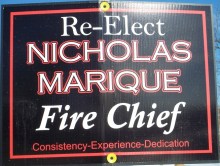
Incumbent Fire Chief Nicholas Marique provided handouts. One was his resume and the other a description of the interim pumper truck. The challenger is Mr. Stephen Duchesneau, a former Milton firefighter, who has run several times before.

The Point

Lest we forget: the point of this exercise is to determine which candidate can perform this task adequately at the lowest cost to the taxpayer.

Marique - 2Much concern arises from the vast sums of money that have been spent already, such as the exceedingly expensive Fire palazzo, for which Chief Marique claimed the credit and responsibility. I have heard many, including some highly-placed officials, question the basic wisdom of this purchase. Whether it was money well spent is perhaps no longer an issue, but the scale of it hardly whets the appetite for still more. Many are feeling fairly “stuffed” right now, thank you. And engendering that overfed feeling was a part of the station’s cost too.

Chief Marique claimed that, in terms of such grand and ever increasing expenditures, we are very nearly there. If we will just stay the course – the one he has set – we will very soon reach an equilibrium point where the CIP plan can maintain us.

Of course, that plan is itself very much in question. It fuels constant spending at a level that one might well dispute. CIP oversight seems quite weak, both as regards the additions to the plan, the size of the expenditures, and the pace at which those acquisitions are scheduled.

The EMT Department

The moderator, Mr. Jacobs, helpfully pointed out that it might be possible to just eliminate the fire department altogether. It also emerged in discussion that the fire department spends 70% of its time on EMT ambulance service. Perhaps even calling it a fire department is then a bit of misnomer: it would seem to be principally an ambulance service that spends some of its time fighting fires.

DuchesneauMr. Duchesneau, put forward an overall claim that he could run the EMT Department at a lower cost than the incumbent, Chief Marique.

In broad strokes, Mr. Duchesneau’s plan seems to be that he would “Stop the Spending.” He spoke to increasing the proportion of resident firefighters relative to the number of out-of-town firefighters. The need to pay out-of-towners for sleeping-over would be reduced thereby, if not eliminated. Other cost-saving measures were on the table also.

He seems to assume, at least for daylight hours, that the resident firefighters would be drawn from the extremely small segment of Milton’s population that actually work in town. Otherwise, they would also be coming from afar.

That Pumper Truck

A brand-new $550,000 pumper truck was rejected on last year’s ballot and many were surprised and displeased to see it appear again this year. Because “‘no,’ should mean ‘no’.” Chief Marique heard them (somewhat belatedly) and substituted in a used pumper, at a very good price, but as a stop-gap. The planned $550,000 expenditure did not go away. It is still lurking around as a part of the CIP plan.

Chief Marique explained at one point that a thousand-gallon pumper truck will dispense water for about four minutes only. Two will do so for eight minutes, and so on. Not mentioned was how much time was required to put out the average house fire.

It might be argued that Milton should never buy a brand-new pumper truck. I have known people who have never had a new car in their entire lives. For them, that is basic frugality. Milton’s small (and stagnant) population size might require us to restrict ourselves always to the used market.

Uneven Coverage

It also emerged that the average response, given the distances involved and the need for firefighters to assemble, is about fifteen minutes. The response times should be shorter for those closest to the Fire palazzo, or, to some extent, for those near the Milton Mills substation.

The longest response times would be experienced by homeowners in South Milton, West Milton, outlying stretches between the two stations, and out on NH Route 153.

The time differential of a response to fires close to the Fire palazzo and those occurring on the outskirts is far greater than the additional four minutes that another pumper truck provides.

You have parts of town that are basically in the “Fire District” and those that are not. Not unlike the Water District. Perhaps that basic fact of uneven coverage should be reflected in the assessments and the bottom line of the taxes paid by those with the lesser coverage.

That Truck Fire

Mr. Duchesneau cited a truck fire that occurred near the fire station as an example of the current situation not working. The details remain hazy. It seems that there were two staff firefighters (rather than the volunteers) who were both out of town when the truck fire took place. They were picking up a vehicle that had undergone some maintenance. It seems that both staffers had been required for this vehicle pick-up because that is the minimum required to “man” this sort of vehicle.

I am not persuaded that this was in fact necessary. Has no one ever seen a taxi or bus with an “out of service” sign? This vehicle was out of service while being serviced and could no doubt continue to be out of service while some single firefighter or even some non-firefighter returned it from out-of-town. Where it could then be put back “in service.” Meanwhile, there would have been coverage.

But neither am I persuaded that this single fumble tells the tale all by itself. The point remains: who can maintain a fire department that we can actually afford?

Mr. Duchesneau’s points spoke largely to improved coverage, rather than reduced costs, except to the extent that it might reduce or eliminate the need for paid sleepovers. A smaller – but closer – staff might reduce costs (including breathing and other per-person equipment outlays).

Per-Person Expenses

A $70,000 expense for replacement breathing devices has been much mentioned lately. Each firefighter, or perhaps each seat of the fire vehicles (?), needs one of these. The Chief has said that they have a life-span of fifteen years and that ours are at the ten to twelve year mark.

Some have questioned why this expense comes all at once and not in some “rolling” sequence of, say, three or four a year. The Chief says that the equipment changes over time – their features, capabilities, and the placement of their dials and settings – and differences in equipment would emerge with phased purchases. That would be confusing at critical moments.

No one doubts the necessity for such equipment. But, if this is a per-firefighter expense, the size of Chief Marique’s roster has been questioned. A smaller personnel roster would require fewer personal devices.

Veering Off the Point

Unfortunately, both the challenger, the incumbent, and the audience seemed to veer off the point: coverage at the lowest possible cost.

There seemed to be a strong animosity between the two camps, whose origin remains unclear. Mr. Duchesneau said that neither he nor the Milton-resident firefighters that he would engage will work (or work again) for the current Chief. The reason – assuming they all have the same reason – was not explained.

Many of the questions seemed designed to highlight a perceived difference in qualifications between the two candidates. The difference seemed rather slight – one having, I believe, thirteen years experience versus the other’s twenty years. The Chief has been chief for over nine years.

Were Mr. Duchesneau’s firefighter’s certifications current? No, you need to be an active firefighter for that, which he would be if he won the election. Was his EMT license current? Yes, he has a national one. And so on.

This line of attack – it was quite heated, and repetitive – seemed weak to me. Ad hominem arguments – arguments against the man, rather than against his premise  –  are by definition fallacies.

First of all, licensing is when your right to do something is taken away and then sold back to you.

Secondly, all of the licensing demanded by the inquisitors – both the firefighter and the EMT certifications – were of the sort that only current employees may hold. There is no way that an ex-employee – even one with thirteen years experience – may secure the licensing in advance. This is the case in many fields. Mr. Duchesneau claimed to have the necessary classes and experience and, if he won the election, licensing would drop into place.

Mr. Duchesneau may have given the impression that he had more certifications than he presently does. He should clarify that in some way.

But this absolute faith in certifications and licensures is puzzling and somewhat misplaced. The College of Cardinals is not required to pick a cardinal, or even a Catholic, to be the Pope. Theoretically, anyone  in Christendom might be selected as Pope. Likewise, there is no requirement that a Supreme Court Justice be selected from among judges of lower Federal courts, or State Courts, or even country lawyers. Anyone at all can occupy that seat.

Likewise, another firefighter/EMT with similar experience, though with a slightly briefer tenure, could be Fire Chief. It might even be that someone with no experience or licensing at all could occupy that position, albeit in a administrative or managerial capacity only.

We will likely never know the cause of all the animus on display. But, that does not mean we do not note that it was present.

One might wish the inquisitors had stuck to the relevant issue: which candidate will run this department with the lowest possible tax expenditure?


See also Wintry Mix – School Board Candidates, Wintry Mix – Budget Committee, and Wintry Mix – Selectmen.


References:

Town of Milton. (2019, February 24). Meet the Candidates Night (Fire Chief). Retrieved from youtu.be/nOmRUcqTf08?t=9986

Wikipedia. (2019, January 31). Ad Hominem. Retrieved from en.wikipedia.org/wiki/Ad_hominem


Wintry Mix – Budget Committee

By S.D. Plissken | March 2, 2019

The Milton Meet the Candidates night went forward as planned. The winter storm had largely dissipated by late afternoon. High winds followed.

As for the presentations, they were … interesting.

Continued from Wintry Mix – School Board Candidates

For the Budget Committee – Two Three-Year Slots

Mr. Thomas McDougall and Mr. Humphrey Williams both made statements (see also Meet Mr. Williams). Both spoke to the need for beginning the budget process much earlier in the year and for setting definite goals. No more November surprises.

Both spoke also to the need for the Board of Selectmen (BOS) to manage actively the sizes of departmental budgets. (The BOS has had in spades the same diminishing marginal returns problem that puzzled so many School Board candidates).

The “new dog,” Mr. Williams, cited his experience of creating large budgets in his career at the shipyard, and seemed to be appalled at the incomprehensibility and duplication in Milton Town budgets and budget processes.

Mr. Williams claimed that it should be possible, for a time, to have every year a lower budget. Well, of course. He cited an example of having implemented a 10% annual reduction, which was carried forward over a number of years, until the budget was halved. Over the same period twice as much was being accomplished, i.e., production increases. In this case, the product is termed “services.”

These two candidates are running for two seats. They will both be “elected.”

Mr. McDougall is running for re-election. He thought the budgets are more complicated than they need to be. He has not proposed cuts in the past, as he felt it might impact services. He thought the budget process has a lot of repetition.

Mr. McDougall twice expressed his disappointment at not having any competition for his seat. And, with that kind of thinking, he would have had a good chance even in a contested race.

For the Budget Committee – One One-Year Slot

Two other candidates have thrown their hats into the ring as write-in candidates for the third empty seat. That would be the empty one-year Budget Committee spot on the ballot, and the candidates would be Mr. John Gagner and Mr. Dennis Woods.

Mr. Gagner posted a statement on February 2:

I believe that I have the technical fortitude and never-back-down attitude that our town desperately needs. It would be my honor to better my home. Please feel free to ask me about any of my ideas.

Mr. Woods has had a vacation home here for many years and is now retired here. You may find his posting of February 25 at the Milton NH Community News Facebook site. The portion that states his intentions regarding the budget process is excerpted here:

Like most Milton residents, I’m concerned about the increased spending that leads to higher taxes, and would like to apply my experience in Corporate management and finance, to see if we can make some changes that will provide relief without sacrifice.

Neither of these postings really commit their candidates to reducing Milton’s taxes. Mr. Gagner claims to have the technical “chops” and never-back-down attitude required. Unfortunately, he does not say whether he would be applying that attitude towards increasing or decreasing taxes. Mr. Woods is “concerned” about increased spending, but commits only to “relief without sacrifice.”

Muh Services

The departments will present ever larger budgets, as they have for many years. If they encounter any “never-back-down attitude,” they put on a pantomime regarding cuts to “muh services.” The last full-on Washington Monument show presented by the Town featured the claim that a 10% cut would require 20% staff reductions, i.e., an apparently disproprotionate “sacrifice.”

There used to be an old but effective shell game played on clueless managers or, in this case, budget committeemen. They would be presented with three choices: something catastrophic, something requiring “sacrifice”, and finally the thing that they are intended to choose. Not infallible, but very reliable.

Turkey VultureA “concerned” tax cutter is going to need intestinal fortitude as well as technical fortitude in order to choose lower taxes. The usually-proffered third choice also entails a less obvious “sacrifice”: sacrificing the interests of struggling taxpayers and, ultimately, sacrificing those taxpayers entirely.

Never forget Selectman Lucier gloating over the tax seizure of a home: “We’ll own that property soon, right?” It needed to be done … in the interests of the “community” … to preserve “muh services.”

Without a firm commitment to tax reduction, it is difficult to see why fence-sitters’ names should be even remembered, let alone “written in.” Perhaps they might wish to “amend” their statements?

SB2 Town Discussion

The panel’s discussion ended with a interesting description of the SB2 Town format and what would be needed to revert to the former Town Meeting format, which would permit also department-level budget votes, rather than the current whole-Town Budget up or down votes.


See also: Wintry Mix – School Committee, Wintry Mix- Fire Chief, Wintry Mix – Selectmen, and Meet Mr. Williams


References:

Town of Milton. (2019, February 24). Meet the Candidates Night (Budget Committee). Retrieved from youtu.be/nOmRUcqTf08?t=8564

Wikipedia. (2019, January 27). Marginal Utility. Retrieved from en.wikipedia.org/wiki/Marginal_utility

Wikipedia. (2018, June 22). Washington Monument Syndrome. Retrieved from en.wikipedia.org/wiki/Washington_Monument_Syndrome

Wintry Mix – School Board Candidates

By S.D. Plissken | February 26, 2019

The Milton Meet the Candidates night went forward as planned. The winter storm had largely dissipated by late afternoon. High winds followed.

As for the presentations, they were … interesting.

They certainly revealed some differences between candidates, which may be helpful, but, sadly, more often than not they revealed differences between the candidates and reality.

Candidates for the School Board – Two Three-Year Seats

The candidates were incumbent Ms. Melissa J. Brown, challengers Ms. Emily Meehan, Mr. Carter Wentworth Terry, and write-in candidate Mr. Alfred “Mr. Al” Goodwin.

I usually stay away from school issues, although they are certainly the tax elephant in the room.

Many of the same issues that plague the Town are also affecting the School District. However, the School District has been generally more prudent than the Town in terms of the rate at which their demands increase. They have even returned overages. It is still too much.

Who Owns You?

Mr. Brown definitely “put the stick about a bit” when he asked for opinions about a bill before the legislature. It would allow for state grant money to be redirected – on a per pupil basis – to alternative vendors, such as charter schools, parochial schools, technical schools, etc. None of the candidates, including the former homeschooler, favored this purely theoretical proposition. Nor did much of the audience.

Both the candidates and some in the audience made it sound as if Milton-resident students somehow “belong” to the School District. No one should be permitted to study elsewhere and, thereby, take “our” state tax money with them. Astonishing, really.

Escaped slave and abolitionist Frederick Douglass once spoke to this conception:

I appear this evening as a thief and a robber. I stole this head, these limbs, this body from my master, and ran off with them.

Does the Milton School District “own” the students? Does it “own” State money set aside for them?

Accreditation

One woman asked about school accreditation. Was it true that Milton’s schools are not accredited? I looked into this accreditation issue myself some years ago. It seems that many, if not most, of New Hampshire’s schools are not accredited. It has more to do with infrastructure failings then academic ones. Which makes one wonder about the accreditation process.

Standardized Testing

Low test scores were also queried and not easily explained. Milton ranks near the bottom of statewide test scores and has for many years. In some years it has “won” the race to the bottom.

The candidates seemed to be agreed, to a great extent, that standardized testing is of doubtful value and legitimacy. According to them, they deform education by causing teachers “to teach to the test.” I have heard this argument many times over many years. Samples of prior years’ tests are publicly available, and seem to be pretty basic reading, ‘riting, and ‘rimatic. “Teaching to the test” should not fall much out of alignment with just plain teaching.

These “teaching to the test” arguments may not be as persuasive or comprehensive as some seem to think.

There is another explanation available, which comes from the business world: “Project teams detest progress reporting because it so vividly manifests their lack of progress.”

Meanwhile, Milton is paying about a quarter over the state average on a per pupil basis. So, insufficient expenditure can hardly be the sole explanation.

Where Does It End?

Several members of the audience asked if there was some upper limit to constantly rising school taxes. Will there finally come a day when there is “enough” – some high plateau where we might rest? Or must the increases go on forever?

For most of the candidates, this seemed to be genuinely a “poser.”

Evidently, an upper limit is a difficult concept. Sort of like: what lies outside the universe, or when was before time? And therein lies a problem, because there is such a limit.

Why are such expenditures never enough? Because of marginal utility. The first dollar spent might bring more than a dollar’s worth of utility, as might the second, and so on. Each additional expenditure is at the leading “margin” of an increasing sequence. But, and this is the point, somewhere in the sequence the value returned is less than the dollar spent. As one proceeds further out in the sequence, the value returned for each additional dollar spent becomes smaller and smaller. This is what is meant by the term “diminishing marginal returns.”

Once the point of diminishing returns has been reached, each additional dollar provides less value than the one spent before it. Eventually, it will bring no additional value at all.

Now, compare the expenditure of that next dollar – that expenditure that brings diminished returns – with the tax dollar extracted from a struggling taxpayer. You propose to take money from a new family setting out in life, or a pensioner struggling on a fixed income. (Businesses might struggle too). For them, that dollar is still returning value – mortgage, groceries, heat, etc. You propose to take dollars from where they have value still – productive value – and spend them where the value is diminishing, or even gone altogether.

Are you really so sure that you are making the world a better place by taking that next dollar?

So, for the School Board candidates: the answer was “yes.” We will arrive at a place where the next dollar is just wasted. There is such a place. (Some might say that we arrived there quite some time ago).

You need to know that, in order to represent us, you must justify each additional dollar spent as bringing increased value, rather than diminishing value.


See also: Wintry Mix – Budget Committee, Wintry Mix – Fire Chief, and Wintry Mix – Selectmen


References:

Town of Milton. (2018, February 24). Meet the Candidates Night (School Committee). Retrieved from youtu.be/nOmRUcqTf08?t=271

Wikipedia. (2019, January 27). Marginal Utility. Retrieved from en.wikipedia.org/wiki/Marginal_utility