
Concord Beat – Early July 2019

By Ian Aikens | July 1, 2019

As promised in my last article, this time I examined Jeb Bradley’s recent legislative record. I culled my impression not only from his voting record but also from the bills he either sponsored or co-sponsored. While Bradley has a tendency to allow individuals and their employers to negotiate voluntarily between themselves on important issues like pay and benefits, sadly, in other areas, he shows no reluctance to give government bureaucrats the power to mandate all sorts of things.

First a little background on Bradley himself. He has been active in New Hampshire politics since 1986, when he was first elected to the Wolfeboro Planning Board. He was elected to the New Hampshire House in 1990 and re-elected five times. He was elected to Congress in 2002, but in an upset he lost his seat to Carol Shea-Porter, an anti-war activist, in 2006. He was elected to the New Hampshire Senate in 2010 and served as the Majority Leader from 2010-2018. He currently serves as District 3 Senator, representing 19 towns in Carroll County, Waterville Valley in Grafton County, and Middleton and Milton in Strafford County. Outside of the political sphere, he ran an organic bakery, a painting business, a real estate office, and even worked as a street magician in Switzerland at one time.

Now down to business:

HB1319 – Prohibiting discrimination based on gender identity in housing, employment, and public accommodations. Bradley co-sponsored the bill and it was signed by the governor. While it is proper to prohibit all discrimination on government property and for all government services, since “the commons” are owned by all taxpayers, is it really the proper role of government to dictate to private (voluntarily-run) businesses who they must serve? In the olden days, the argument that a traveler had few, if any, choices when traveling, so it would have been uncivil to allow a private business to deny lodging to a traveler may have been plausible, but in this day and age with most businesses scrambling for more customers, it makes little sense to mandate fairness. Besides, the biggest obstacles to more choices for consumers these days are government regulations and occupational licensing.

SB1 – Granite Caregiving Act of 2019. This bill was vetoed by the governor, and Bradley had the good sense to vote NO on it. This would have actually been a tax on earned income—which in any other state is called an income tax—but politicians produce flowery-named titles for bills that might not otherwise be well-received when they are trying to pull the wool over voters’ eyes. This TAX would have been deducted out of all employees’ wages at the rate of .5%. While it would have been a nice fringe benefit for employees, and there is broad-based support for “Family Leave,” once you inform folks that they have to pay for it themselves, support for the program drops dramatically. This would have a mandate too—and the only opt-out would have been for companies that already offer the benefit.

SB10 – Minimum wage up to $12.00 per hour. Bradley voted NO on this one. Another mandate forcing businesses to pay employees more than their skills are worth on the open market. There’s been plenty written about minimum wages and their consequences over the years, so it should come as no surprise that those on the bottom of the economic ladder are hurt the most by these mandates. Those with the lowest skills just starting out lose out on the opportunities to advance their skills. It should also come as no surprise that minimum wage laws were originally pushed by union workers to keep non-Caucasians from competing for their jobs. The racism continues today, but they call it a “Living Wage.”

SB148 – Notification to public employees of right to join or not join a union. Bradley was a co-sponsor on this bill. While one part of this bill that requires new employees’ personal information to be released to unions is alarming, overall this was a net good bill because of the requirement that new employees be informed that they have a choice of joining a union or not. No mandatory forced extortion to join the union or lose your job.

SB255 – Dementia training for direct care staff in residential facilities and community-based services. Co-sponsored by Bradley, this bill demonstrates that he believes that those who choose a residential home for their loved ones don’t have sense enough to choose a facility where the health care workers have adequate training for the jobs they perform. It also assumes the residential facilities have no business interest in maintaining properly trained employees and need to be nudged by a mandate. What business can survive if its reputation is marred by poor care of its customers?

SB270 – Establish tax credit against business profits tax for donations to career and technical schools. Another bill co-sponsored by Bradley, this one would serve to help finance apprenticeships and training programs at technical schools that teach their students actual job skills for the real world, rather than traditional schools supported by tax dollars that do little to prepare students for the working world. An added plus is the tax credit serves to deprive government bureaucrats of more money to waste.

SB272 – Enforce the Paul Wellstone and Pete Domenici Mental Health Parity and Addiction Equity Act of 2008. Bradley co-sponsored this bill, which would force health insurers to treat mental illness as seriously as physical illnesses. Of course, we all want extra goodies we don’t have to pay for, but all these extra services increasingly mandated by politicians and bureaucrats—that’s why the cost of medical insurance and services continue to increase dramatically. Besides, I’m not so sure all this obsession with mental health is so healthy. With the ever-increasing number of new laws, bans, and mandates—that’s enough to increase mental illness in itself.

SB274 – Mothers with newborns on Medicaid entitled to “free” home visits. Another bill co-sponsored by Bradley, this is a new, small entitlement program. I have nothing against mothers—either with newborns or older children—but who will pay for these special home visits? After all, they’re not free. If Bradley and the other co-sponsors were to personally pay for these home visits themselves, that would be highly commendable, but forcing everyone else to pay—that’s forced giving.

SB279 – Requires health insurers to cover fertility treatment on all policies. Another bill co-sponsored by Bradley. Not everyone is interested in having every sort of medical option (that they will have to pay for), so forcing all insurers to cover more and more expenses drives up the costs for most people (and employers who could otherwise pay their employees more). Health insurance—like all other services that folks (and their employers) pay for—should have as much variety as possible to suit individual needs of consumers, but mandating more and more services results in less choices for all.

SB282 – Requires school districts and chartered government schools to provide suicide prevention training. Bradley was the primary sponsor on this one. Suicide, especially by a young person, is always a tragic event, but is mandating all teachers to attend two hours of suicide training annually going to actually save lives? I doubt it. More likely, it will be yet another administrative burden for teachers to fulfill in an ever-increasing list of required non-teaching duties. If politicians were really serious about suicide prevention among youth, perhaps they should consider making school attendance non-compulsory. First, there would be the obvious savings to taxpayers of not chasing down kids who hate being in school and often cause the most disruption. More important, forcing all kids to attend government schools—and face it, unless the family is well-off, the option of a private (voluntary) school is very limited—which are often dangerous (bullying, gangs, drugs) may actually increase suicides. One-size-fits-all doesn’t work for everyone.

SB290 – Changes to New Hampshire Granite Advantage Health Care Program. This bill has several parts to it, but the main thrust is to reduce work requirements for those who qualify for what is essentially totally free health care—no deductibles, premiums, or co-pays. We’re talking about able-bodied adults here, not the disabled or pregnant women. Encouraging people away from self-sufficiency leads to dependence on others and ill will from tax-weary taxpayers. Fortunately, Bradley voted against the bill.

All in all, Bradley at best has a spotty record in Concord. His view of what government should be doing borders on paternalism at best and authoritarianism at worst.

[Editor’s note: see also NH SB 154 Amended and SB 154 on the House Floor].


Previous in sequence: Concord Beat – May 2019


References:

LegiScan. (2019). NH Legislation | 2018 | Regular Session. Retrieved from  legiscan.com/NH/bill/HB1319/2018

LegiScan. (2019). NH Legislation | 2019 | Regular Session. Retrieved from legiscan.com/NH/bill/SB1/2019

LegiScan. (2019). NH Legislation | 2019 | Regular Session. Retrieved from legiscan.com/NH/bill/SB10/2019

LegiScan. (2019). NH Legislation | 2019 | Regular Session. Retrieved from legiscan.com/NH/bill/SB148/2019

LegiScan. (2019). NH Legislation | 2019 | Regular Session. Retrieved from legiscan.com/NH/bill/SB255/2019

LegiScan. (2019). NH Legislation | 2019 | Regular Session. Retrieved from legiscan.com/NH/bill/SB270/2019

LegiScan. (2019). NH Legislation | 2019 | Regular Session. Retrieved from legiscan.com/NH/bill/SB272/2019

LegiScan. (2019). NH Legislation | 2019 | Regular Session. Retrieved from legiscan.com/NH/bill/SB274/2019

LegiScan. (2019). NH Legislation | 2019 | Regular Session. Retrieved from legiscan.com/NH/bill/SB279/2019

LegiScan. (2019). NH Legislation | 2019 | Regular Session. Retrieved from legiscan.com/NH/bill/SB282/2019

LegiScan. (2019). NH Legislation | 2019 | Regular Session. Retrieved from legiscan.com/NH/bill/SB290/2019

Wikipedia. (2019, April 15). Jeb Bradley. Retrieved from en.wikipedia.org/wiki/Jeb_Bradley
The More Things Change …

By S.D. Plissken | June 26, 2019

Last week’s Board of Selectmen (BOS) meeting had some few points of interest.

Chief Krauss added some new expense requests. An upgraded police phone system was added to his nautical items already on the agenda. His combined police-pursuit / boat-hauling vehicle was described as having been approved already at a prior meeting. He sought only permission to include the prior unnecessary boat-hauling vehicle in a trade-in deal for the new unnecessary police-pursuit / boat-hauling vehicle.

The Town (or Town Police) boat dock “Concern” was the damaged Town boat dock that had damaged also the Town Police boat. Or vice versa. It seems that the dock is inadequate at its current length, as more dock length is needed when the pond water level goes down. No one could have predicted that (as it goes down every year). Thus the damage to the dock, and to the boat.

There was some discussion of whether some beach funds might be redirected to cover some or all of this. We know that is unlikely, at least to any significant degree, as the Milton Town Beach Has Its Own Government. But the BOS chose to pretend that such a thing might happen, for purposes of discussion.

Note well that the other side of the ponds has no corresponding Lebanon Police navy. In fact, our larger neighbor (population 6,031 in 2010), has had no police department at all since 1991. An effort to create one was defeated at the ballot in 2009 (498 (60.8%) to 321 (39.2%)). (They rely on state and county police).

One looks in vain for the nightly light of a burning Lebanon reflected in the ponds, or for its daily riots, or its pond pirates, or for its warlords fighting over territories within it.

Thank God the bridge is down and that we have a Police navy.


Under Old Business, the Town Administrator put forward a suggested September Saturday meeting, in which a combined BOS and Budget Committee would hear the departmental budget presentations. The board was in favor of this. The administrator would next seek similar approval from the Budget Committee.

Chairman Thibeault asked Town Administrator Ernest Creveling about the current budget.

Town Administrator Creveling: We’ve already started working on [Budget] things. One of the things we’re working on is we’ve put together a spreadsheet and gave it to all the department heads. Because we’re on a Default Budget and I wanted people to go through it and analyze their budgets and take a look at exactly what it is and exactly what it is they think they absolutely need to spend, these are all absolute necessities, things that are dealing with public safety, employee safety, contracts – the police phone system may become one of those things – it is important to be able to reach the police department and leave messages if you have to, so they are are things in the process of going through that exercise.

The Town Administrator has here suggested to the department heads a sort of “party line”: express all your desired budget increases in terms of either public or personnel safety. Yes, that should do the trick.

Creveling: Hopefully, that will give us an amount that we can sort of pool together out of each line item, for a total, so that we know, if other things pop up, we’re able to pull from there, and once we get through that, I’ll make sure that you all get a copy and are you’re fully aware of what we’ve done.

Selectman Rawson: It seems a good idea.

From there, they moved on to the payroll aspect of next year’s budget. Note that they begin with the assumption that the baseline is correct and that there will be an increase above that. It is then just a question of how large that increase will be.

Chairman Thibeault: Alright. Did you also want to discuss the guidance on the employee wages for 2020, or is that just …

Creveling: Well, on … Oh, yes, we can do that as well. As far as putting budgets together, people are starting to do that now. So, as far … in the recent past, you’ve gone 2% for merit and 1.7% for Cost of Living. People just wanted to know if that is what they should move forward with in the budget development, at this point.

Now, as we have mentioned previously, very few in the real world might expect to receive any Cost-of-Living Adjustment (COLA) increase at all. (We have heard that Social Security recipients recently got some pittance, after a gap of some years without any). But, based upon this discussion, 2% raises and additional annual COLA would seem to be de rigueur in Milton Town budget thinking.

Which might go some ways at least towards explaining why Town budgets increase always faster than – usually double – the rate of inflation.

What might “our” representatives have to say? Doubtless something innovative, something bold.

Selectman Rawson: Yeah, I’m fine with that. It’s always been that way, since my tenure of being in town.

Creveling: If you look at the New England region, its been that for the last couple of years.

The Argumentum ad Populum fallacy. Your mother has an answer for that: If all the other Towns were jumping off a bridge, would you jump off too?

Thibeault: I’m alright with that. Erin, do you want …

Vice-Chairwoman Hutchings: That’s … that’s … I mean you’re just pulling it together to look at it, so …

It seems fairly obvious that once you tell the department heads to assume 3.7% raises, they are going to budget 3.7% raises and that will be what you will “look at” later. Then will come the unanimous approval of what they will have before them.

So, you see, they just lost the budget increase battle right there. Not much of a struggle to represent the taxpayers’ interests, was it?

Creveling: Right, right. By no means is it a final budget. It would just give people guidance on what to use.

One hears around town several variations of the old saw: If one does again what one always has done before, one might reasonably expect to get again what one has always gotten before. In our case, that would be budgets and taxes that rise at twice the rate of inflation.

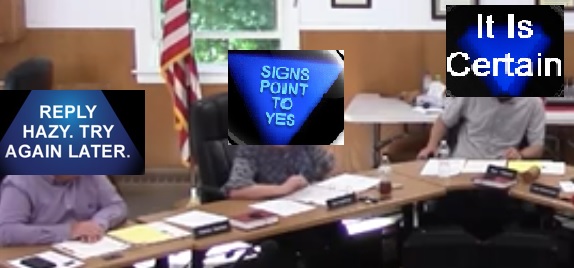
Chairman Thibeault is fond of talking about “out of the box” solutions. One commenter suggested that we might replace the BOS with a simple computer “app” to be always just “fine with that.”

Magic BOS-Ball
Magic BOS-Ball

I thought perhaps a Magic 8-Ball, which would at least give a negative answer one-quarter of the time. Each board member would give it a shake and read off their answer.


Plus ça change, plus c’est la même chose [The more things change, the more they remain the same] – Jean-Baptiste Alphonse Karr


References:

Foster’s Daily Democrat. (2017, December 18). Does Lebanon Need Its Own Police Force? Retrieved from www.fosters.com/news/20171218/does-lebanon-need-its-own-police-force

Town of Milton. (2019, June 17). BOS Meeting, June 17, 2019. Retrieved from https://youtu.be/4RLXxlP8rFA?t=1386

Wikipedia. (2019, June 20). Argumentum ad Populum. Retrieved from en.wikipedia.org/wiki/Argumentum_ad_populum

Wikipedia. (2019, March 11). Jean-Baptiste Alphonse Karr. en.wikipedia.org/wiki/Jean-Baptiste_Alphonse_Karr

Wikipedia. (2019, June 7). Magic 8-Ball. Retrieved from en.wikipedia.org/wiki/Magic_8-Ball

Public BOS Session Scheduled (June 17, 2019)

By Muriel Bristol | June 15, 2019

The Milton Board of Selectmen (BOS) have posted their agenda for a Public BOS meeting to be held Monday, June 17, beginning at 6:00 PM.


The Public portion of the agenda has New Business, Old Business, Other Business, and some housekeeping items.

Under New Business are scheduled two agenda items or, rather, two Town officials, each of them with two or more sub-items: 1) Library Director Betsy Baker, a) Library Update, and b) July 4th, Parade Information; 2) Police Chief R. Krauss, a) Axon Evidence Camera Storage Contract, b) Town Dock Concern, and c) Vehicle Purchase.

1) Library Director Betsy Baker is on the agenda to provide a MFPL update and some parade information.

  • Library Update. There were to be repairs, funded by a grant. How is that going?
  • July 4th, Parade Information. Presumably dates, times, and route of the Fourth of July parade.

2) Police Chief R. Krauss is on the agenda because he would like to spend more money.

  • Axon Evidence Camera Storage Contract. Axon is a body camera company. In April 2017, it offered body cameras “free” for a year, with payments to follow at the end of the year. Those payments were then said to be $400 per camera and $200 per docking. There would be a perpetual ongoing charge of $80 per camera per year for data storage (CNN, 2017). One supposes those quoted costs may have risen since 2017.
  • Town Dock Concern. The Chief has a Concern about the Town Dock. How many knew we even had one? Many taxpayers have a concern about increased Town spending. Does the Town government and the Chief share their concern?
  • Vehicle Purchase. This item might be a return of the multi-purpose pursuit vehicle/boat trailer hauler mentioned at previous meetings. This would be necessary because we do not need another pursuit vehicle and because the DPW has already vehicles capable of pulling a boat trailer.

Under Old Business are scheduled two items: 3) Budget Follow Up; and 4) Status of 565 White Mountain Highway.

3) Budget Follow Up. A Default budget, the BOS is on a default budget, although one might wonder if they know this.

4) Status of 565 White Mountain Highway. Obviously, this building remains a problem. A recent visit did not find the previously discussed fencing in place. One supposes this will be about a tear-down.


Other Business That May Come Before the Board has no scheduled items.


Next, there will be the approval of prior minutes (from the BOS meeting of June 3, 2019), the expenditure report, Public Comments “Pertaining to Topics Discussed,” Town Administrator comments, and BOS comments.


Mr. S.D. Plissken contributed to this article.


References:

CNN. (2017, April 5). This company is offering body cameras to every cop in the U.S. Retrieved from money.cnn.com/2017/04/05/technology/police-body-camera-taser-international-axon/index.html

Town of Milton. (2019, June 14). BOS Meeting Agenda, June 17, 2019. Retrieved from www.miltonnh-us.com/sites/miltonnh/files/agendas/6.17.19_bos_agenda.pdf

Town of Milton. (2019). Press Release: Milton Names New Town Administrator. Retrieved from www.miltonnh-us.com/sites/miltonnh/files/news/press_release-milton_names_new_town_administrator.pdf

Wrong Way – Go Back

By S.D. Plissken | June 3, 2019

Wrong Way SignIt was announced last year that the State had postponed the long-awaited replacement of the Milton-Lebanon bridge for a further two years
At the time, some Town officials put forward a theory that this would not have happened if only we were represented on the Strafford County Planning Commission. They are wrong, of course.

Logically Fallacious

Central planning can never work, because of Hayek’s “Knowledge Problem.” It is a logically impossible. I pointed this out formerly (Milton and the Knowledge Problem), but the Town government clings to its pet notion regardless.

Such methods survive partly through a need to control and order the world (and people) around its adherents. St. Augustine termed it the libido dominandi: the lust for domination.

Town planners might serve us better in figuring out how to deal with their own Town messes: “Lockhart Field,” the Emma Ramsey Center’s failing foundation, invasive plants, unsustainable budget increases, etc. I have heard even that we have a toxic bloom in town.

There is plenty to occupy their time without attempting to plan and direct our economic lives.

We have spoken to government interventions in the market before (PawSox Put One Over the Fence). These hot-house creations must  be perpetually tended. Even so, they will fail to thrive when market forces change or if there is a better offer. Milton need look no further for instructive examples than its own economic history. (As transcribed by Ms. Bristol).

Empirically Disproven

Propping Up Marginal Businesses

Some portion of Milton Mills’ residents engaged at shoe-making at home, at least part-time, with components shipped in from outside. This might have been the economically viable level of production. You see, while Milton Mills had an ample supply of water power (Milton Water Power in 1885), as did many places in New England, it was easily five miles from the railhead at Union station.

A group of wealthier Milton Mills residents sought to “encourage” the establishment of a shoe factory in 1888. (They had wanted this since at least 1864). They purchased a disused factory building (with their own money) and offered it – free of charge – to anyone who would set up such a shoe factory in Milton Mills. The townspeople even voted to relieve the factory of all taxation – thus taking that tax burden upon themselves – for a period of ten years.

But it was not enough. Transport costs, and the limitations of a village-level (“country”) labor pool, and other factors, all required wages that were lower than those paid in the city. That occasioned discontent and the subsidized factory did not even last a year (Milton Mills Shoe Strike of 1889).

Their Ends Do Not Align with Ours

Federal central planners wanted a military road network like the Autobahn they so admired when conquering Germany. So, they created the Federal Interstate highway system. For their own reasons. Any benefits for the civilian areas through which it passed were purely incidental.

Milton enjoyed a twenty-year tourist boom when the Spaulding Turnpike funneled an increased number of people right though its business district. That ended when the Federal and State central planners bypassed Milton in the next phase of their construction (Milton and the Spaulding Turnpike).

Those planners did nothing to either help or hurt Milton. They simply did not care. They were as oblivious to Milton’s needs in diverting the traffic away from here as they had been in directing it here in the first place. Our needs are just not in their plans.

Since then, our own Town planners have for some reason worked diligently in ensuring that Milton experiences no economic resurgence. They have planned that we remain a bedroom community only and that is what they have largely achieved.

There are fewer businesses here than when they first set out to “plan” in 1982, and there is certainly much less economic activity here now than at any time since the so-called Gilded Age. One wonders how much of their oeuvre would survive if the whole package were put to a vote.

Why should we continue to abide by the unsuccessful plans of these Town, County, State, Federal, and, now, even international planners? There is simply no reason at all for us to do so.

Alton Shows the Way

On Alton’s 2014 ballot, resident petitioners placed warrant articles on the ballot to eliminate the offices of Town Planner and Town Assessor, in favor of a contract planner and a contract assessor, and to withdraw Alton from the Lakes Region Planning Commission (LRPC). They did not succeed at this initial outing, but this was merely the beginning.

(We may note that Milton has both a Town Assessor and a contract assessor, whereas Alton seemed to regard it as an either/or proposition).

In 2018, the Alton Town government put forward a warrant article to fund Alton’s membership in the Lakes Region Planning Commission. The selectmen recommended it by three votes in favor and two against. (Note that split votes are possible). The budget committee opposed it.

The Coalition of New Hampshire Taxpayers (CNHT) claims that these planning commissions – their ideas, plans, and goals – come straight from the American Planning Commission, a non-governmental organization that “promotes United Nations Agenda 21/2030 regional principles.” There is State and Federal nonsense in there too.

Despite the recommendation of the Alton Board of Selectmen, town residents rejected continued funding for the regional planning commission, with 401 votes (70%) opposed and 172 votes (30%) in favor. (Note that the BOS majority was the complete opposite of the voters. So, we might well ask, who was the Alton BOS representing?)

Remember, it was an attempted insertion of plug-and-play planning code that caused the virulent opposition – hysterical even – by its very creators, of last year’s Article #3.

One Alton resident remarked, “If only more towns would get out of these regional boondoggles.” Or, better yet, if only more towns never entered into them in the first place.

Ask yourselves too, whose business district is doing better, Alton’s or Milton’s? The answer argues for less planning, a great deal less. But, if we cannot manage that, we should at least stop making it worse.

What Is to Be Done?

Take heart. If Milton officials are deluded enough to proceed along this route, – this wrong way – we can undo it as they did in Alton.

The danger for Town officials, and for their “plans” of many years, is that we might not stop at withdrawing from County planning.


There are none so blind as they who will not see. – John Heywood


References:

CNHT. (2018, March 15). Alton Residents Dump Lakes Region Planning Commission. Retrieved from www.cnht.org/news/2018/03/15/alton-residents-dump-lakes-region-planning-commission/

Laconia Daily Sun. (2014, February 20). Petitioned warrant articles would do away with Alton planner & Assessor. Retrieved from www.laconiadailysun.com/news/local/petitioned-warrant-articles-would-do-away-with-alton-planner-assessor/article_121a954d-94f5-5e2f-b2c1-505edb77ee72.html


Non-Public BOS Session Scheduled (June 3, 2019)

By Muriel Bristol | May 31, 2019

The Milton Board of Selectmen (BOS) have posted their agenda for a BOS meeting to be held Monday, June 3.


The BOS meeting is scheduled to begin with a Non-Public session beginning at 5:30 PM. That agenda has one Non-Public item classed as 91-A3 II (c) – Reputation.

91-A:3 II (c) Matters which, if discussed in public, would likely affect adversely the reputation of any person, other than a member of the public body itself, unless such person requests an open meeting. This exemption shall extend to any application for assistance or tax abatement or waiver of a fee, fine, or other levy, if based on inability to pay or poverty of the applicant.

The specific “Reputation” annotation again. This will be the second meeting in a row to discuss matters that would likely affect someone’s reputation, although not necessarily having to do with an application for assistance, tax abatement, or waiver. Perhaps Mr. Brown secured his private chat?

[Added from the court filings database, October 23, 2019: “New Hampshire Supreme Court, Report on Status of Cases, As of September 30, 2019. Case 2019-0278. Three Ponds Resort, LLC v. Town of Milton. 05/15/2019 – Case Filing. 06/04/2019 – Accepted.”]

The BOS intend to adjourn their Non-Public BOS session at approximately (*) 6:00 PM, when they intend to return to Public session.


The Public portion of the agenda has New Business, Old Business, Other Business, and some housekeeping items.

Under New Business are scheduled four agenda items: 1) Strafford Regional Planning Commission Presentation 2. Resident Concerns (Skip Bridges) 3. 174 Ford Farm Road and abutting town-owned lot (Kathy Wallingford / Jim Flanagan) 4. Proposed Budget Committee Schedule / Process and Selectmen Guidance.

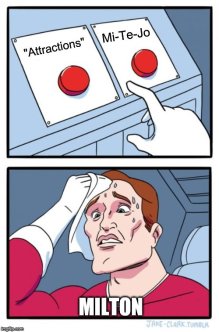
Mi-Te-Jo.jpgStrafford Regional Planning Commission Presentation. The Strafford County Planning Commission will be making a presentation. Some have said that our bridge repairs would not have been put on the back burner if we had been represented on this commission.

Central planning is an oxymoron because of Hayek’s Knowledge Problem. While it is bad at the Town level, it is even worse at the County level, worse still at the State level, and so on.

Milton would be better served by building a replacement bridge from old pallets than it would be in joining the Strafford County Planning Commission.

Resident Concerns (Skip Bridges). Resident concerns? That takes in a lot of territory. The smart money says that he is concerned about Mi-Te-Jo.

174 Ford Farm Road and abutting town-owned lot (Kathy Wallingford / Jim Flanagan). “Out-Buildings possibly encroaching on L34 – Town property … deferred maintenance, yard cluttered.” Overvalued, overtaxed. Placed on the agenda by the Town Assessor and by Jim Flanagan. According to Avitar, James R. Flanagan owns a property at 66 Ford Farm Road.

Proposed Budget Committee Schedule / Process and Selectmen Guidance. The Budget Committee has indicated that they will meet at the Police station to go over the Police budget. They hope to do the same for the other departments.

Guidance for a game with “the house” and using their baseline? Get a brand-new deck. Shuffle it. I have heard that seven shuffles are necessary. Then cut the cards.


Under Old Business are scheduled four items: 5) Request to Repurchase Town-owned Property, Tax Map 37 – Lot 64 6. Acceptance of $5,000 from Atlantic Broadband for the Purchase of Equipment 7. Proposals from Law Firms – Process for Evaluation 8. Disposition of Brookfield Drive Parcel, Tax Map 17 – Lot 5.

Request to Repurchase Town-owned Property, Tax Map 37 – Lot 64. Returning from the last BOS meeting, when the Town’s offer seemed a bit pricey to them. The Town took the land for taxes and then wanted to sell it back for both the value of the land and the back taxes. Crazy. The value of the land or the back taxes with interest, but not both. Only government thinks this way. Thank God for auctions.

Acceptance of $5,000 from Atlantic Broadband for the Purchase of Equipment. Hopefully, more meetings are to be recorded or even just better versions of the current meetings.

Proposals from Law Firms – Process for Evaluation. Definitely something different from the prior evaluation process. The Town has been so poorly advised by a succession of lawyers. Issues of State pre-emption: plain wrong; the whole old fire station saga: wrong and wrong again; and several other issues: just wrong. And there was that whole threatening to sue thing. Perhaps the town needs somebody better acquainted with municipal law than they are with Town officials.

Disposition of Brookfield Drive Parcel, Tax Map 17 – Lot 5. A 4.87-acre lot on Brookfield Drive, seized for taxes in 2015. Avitar says it has 2.87 acres whose condition is 50% and 2.0 acres whose condition is 25%.

Isn’t this the lot the auctioneer described as having one possibly useful acre and the rest all wetlands? If so, it seems like the Town valuation has been putting a shine on a sneaker. A poor piece of land, overvalued, overtaxed, and foreclosed. Color me surprised. Perhaps we could re-designate it as the “Town vernal pool.”


Other Business That May Come Before the Board has no scheduled items.


Finally, there will be the approval of prior minutes (from the BOS meeting of May 20, 2019), the expenditure report, Public Comments “Pertaining to Topics Discussed,” Town Administrator comments, and BOS comments.

The expenditure report has had short shrift for quite some time now. Nobody ever mentions it. By the time of this June 3 meeting, eleven (21.2%) of the year’s fifty-two weeks will have elapsed. It might be nice to know that the amount of money spent so far does not exceed 21.2% or, even better, has been less than 21.2% of the default budget.

Conceivably, there might be higher beginning-of-year costs that will taper off or cease at some point in some planned way. That the BOS might be allowing expenditures to run amok is difficult to imagine. That could never happen.

Imagine, if you will, a second year with a default budget. That could happen.


Mr. S.D. Plissken contributed to this article.


References:

State of New Hampshire. (2016, June 21). RSA Chapter 91-A. Access to Governmental Records and Meetings. Retrieved from www.gencourt.state.nh.us/rsa/html/VI/91-A/91-A-3.htm

Town of Milton. (2019, May 31). BOS Meeting Agenda, June 3, 2019. Retrieved from www.miltonnh-us.com/board-selectmen/agenda/board-selectmen-agenda-63

Youtube. (1965). Cone of Silence. Retrieved from www.youtube.com/watch?v=g1eUIK9CihA&feature=youtu.be&t=19

SB 154 on the House Floor

By S.D. Plissken | May 31, 2019

New Hampshire Senate Bill (SB) 154 (2019) passed out of the House Municipal and County Government Committee and reached the House floor last Thursday afternoon, May 23, at 3:18:29 PM.

This is the bill originally authorizing a study of workforce housing tax deductions, but now including a “problematic” side order of authorizing the sale, sans voter approval, of Milton’s “Old Fire Station.” (See NH SB 154 Amended).

House Speaker Steve Shurtleff (D-Concord): The majority of the Committee on Municipal and County Government, to which was referred Senate Bill 154, an Act – new title – “Allowing municipalities to adopt a credit against property taxes for certain workforce housing, and authorizing the sale of certain property by the Town of Milton,” having considered the same, report the same, with the following amendment, and with a recommendation that the bill Ought-to-Pass [OTP] with amendment. – Representative Clyde Carson [D-Warner)] for a majority of the committee. The minority of the committee, having considered the same, and being unable to agree with the majority, report with the following resolution: “Resolved, that it is Inexpedient-to-Legislate [ITL].” – Representative Mona Perrault [(R-Rochester)], for the minority of the committee. The question before the House is on the adoption of the majority amendment, 1577 H, printed in House Record 25, and found on Pages 29 to 30. Are you ready for the question? All those in favor, say Aye.

Some number of House members: Aye.

House Speaker: Opposed, Nay.

Some number of House members: No.

House Speaker: The Ayes have it, and the motion carries. [Looking stage right]. I’m sorry … We’re in the voting mode… I heard … you wanted …

Representative Michael Sylvia (R-Belmont): To make a motion.

House Speaker: Please come, state your motion.

House Clerk: The motion to divide.

Representative Sylvia: Sorry, Mr. Speaker, I was off on my timing. I would like to move to divide the question to remove section six of the bill.

This would have the effect of splitting Senate Bill 154 into two separate bills: 1) the original workforce housing bill, and 2) authorization of the sale of Milton’s old fire station.

House Speaker: I’ve talked with the clerk about this motion to divide, and the issue that has arisen and we have, and I have as the speaker, in having to make a decision, to take out section six, dealing with the Town of Milton, would be fine. But by leaving in sections one through five, and section seven – section seven being the effective date of the bills – which say that this shall take effect upon passage – the section six, if the motion was to prevail, that that section six should pass, and the House votes that way, section six has no effective date, so it would be out there in limbo. So, it would be in … it’s not divisible, is what I am trying to tell you. But I am trying to give you an explanation for why it is not divisible.

Representative Sylvia: Thank you, Mr. Speaker, then I would like to speak against the bill.

House Speaker: Yeah. Well, first we have to fix our computer again. Oh, that’s good. Thank you. I have you signed up to speak again. So, the member from Belmont is recognized. And thank you for your forbearance.

Representative Sylvia: Thank you, Mr. Speaker. I apologize for the confusion. I have no intent to affect the study committee section of this bill, but the reference to the section on the Town of Milton being allowed to sell the old fire house is very problematic. So, my first opposition to this bill is when we make statutes that particularly point out one Town, and in this particular case, one specific property, I think those sorts of bills are problematic.

The … Once I started looking into it, when you look at RSA 41:14a Roman 2C, this essentially prohibits the selectmen from selling a property that is held in trust, which has been bequeathed to the Town, and that certainly brought a bit of curiosity to my mind, whereas somebody had very generously given a property to the Town and now the Town was looking to dispose of it. And certainly if they [the original donors] had intended some particular purpose for the property, the statute as it currently reads is very clear, and it’s very fine. That, we have a section within the Attorney General’s office, which is for charitable trusts and they track the purposes of assets.

For instance, the University of New Hampshire probably has many, and we took one up in Judiciary this year, referencing a school in agriculture, and assuring … the Attorney General’s trust division assures that what was promised, when the property was given, is adhered to.

And in this process that particular line of statute has a provision which directs if the Town, the property, the use perhaps fades away, and it no longer really fits within the trust it was given for, there is a fancy legal French term, which is Cy-Près, which is a doctrine which says, well, the Attorney General’s office of  trusts, or the probate court, or superior court, depending on which way these things go, they would look into this intended purpose of the property, and find the next closest match for either using the property, or if it is sold, then continuing those funds, on the direction of what they were intended for.

So, doing further research, as I should, if you are going to get up and oppose a bill that is mostly very well supported, I called the Attorney General’s division of charitable trusts, and asked them about the property, and tried to figure out what the purpose was that it was given to the Town for, and as it turns out, the property was given to the Town with no restrictions.

Now, this creates a bit of a problem, because we are exempting the Town from using this particular statute, when this particular statute is not applicable. Now, there is another process for the select-board of the Town to sell property, and it’s just before that in 41:14a Roman I.

As I understand it, the … it seems like, and I don’t have all of the facts, I haven’t talked to the Town, but they seem to not quite read the statute correctly. They believe that they would have to bring this to the Town Meeting on a Warrant Article to sell. That is part of a possible solution, and it’s going to be what they will have to do anyway, because we’re not really affecting anything with this change. It’s a nullity.

So, to the Town of Milton, I would say, you need to look at that first part again. It does not require, automatically, that it goes on a warrant article. The statute says they will have the planning commission and the conservation commission look at this, and then they will have two public meetings, fourteen days apart, and unless fifty Town citizens challenge that with a petition, which would require it to go onto a warrant article, and postpone the sale of the property, they can … they are going to have to go through this regular process anyway.

And I think we should really consider, as Memorial Day approaches, [that] the legislature made laws, and there is nothing wrong with the laws, and this little section is totally unnecessary, uncalled for. Further, I think that anytime that some good citizen bequeaths to a Town a property, it should be treated with great respect. And I think that that’s my story and I think that we should not approve this process, and I am sorry that we approved the amendment. Perhaps we could find someone who wanted to reconsider. That’s my spiel, thank you for listening.

House Speaker: The question before the house is the recommendation that the bill Ought-to-Pass as amended. The chair recognizes Representative Carson to speak in support of the recommendation.

Representative Carson: Thank you, Mr. Speaker. I just want to talk to the fire station aspect of this bill, because I have looked into it, and I want to talk a little bit [about] what I found out about it. In 1880, some volunteers in the Town of Milton built a fire house for the Town and donated it to the Town.

Recently, that Town of Milton, as you might expect, outgrew that fire station and built a new fire station. And they would like to find a new owner for the old fire station, so they can get it back on the tax rolls. There’s a statute that says, as the good representative mentioned, that if selectmen have the authority to buy and sell property, they can do so, except in a few situations, and one of those is when something is donated.

So, the Town went, and they did go through the due diligence of going to the division of charitable trusts. They checked out this charitable trust and said, there’s no strings here, all you have to do is go back and bring it to your Town Meeting and get the authority to do it.

I’m a selectmen in a Town that has a fire station up for sale.  There’s not a lot of market for used fire stations. When you have a buyer, you’d like to do it, and that’s what the Town of Milton has.

They missed getting it on the warrant for this Town Meeting. They have a willing buyer that wants to buy the fire station. And they went to their state senator [Jeb Bradley] in Wolfeboro and said could you help us out, This good senator said, I’ll add it to one of my bills. He’s a private sponsor of this bill. And it came to our committee and we thought it was a good idea to help out the Town of Milton as well. We’ve done this before for other Towns when they need to make something happen in a hurry. They’ve done all their due diligence. And with regards to the fire station, I ask you to support the bill on that behalf. Thank you.

House Speaker: Will the speaker yield for a question?

Representative Carson: No.

Representatives Max Abramson (R-Seabrook) and Laurel Stavis (D-West Lebanon) rose to speak against and for the workforce housing aspect of SB 154.

Representative Carson rose to explain the parliamentary aspect of what a yes or no vote would mean in terms of passage.

SB 154 passed with 250 votes [73.7%] in favor and 89 [26.3%] opposed. The votes of particular representatives are not available at this time.


“Sovereignty resides in the people.” – John Locke. “Unless you flub the deadline of getting it on the people’s warrant.” – NH House Majority.


References:

NH General Court. (2019). RSA 41:14a. Acquisition or Sale of Land, Buildings, or Both. Retrieved from www.gencourt.state.nh.us/rsa/html/iii/41/41-14-a.htm

NH House of Representatives. (2019, May 23). House Session, May 23, 2019. Retrieved from sg001-harmony.sliq.net/00288/Harmony/en/PowerBrowser/PowerBrowserV2/20190523/1029/21374#agenda_

Wikipedia. (2019, May 25). Cy-Près Doctrine. Retrieved from en.wikipedia.org/wiki/Cy-près_doctrine


Concord Beat – May 2019

By Ian Aikens | May 21, 2019

I’ve been going to Concord almost every week for the last two months to give my two cents worth in public hearings on various bills making the rounds in the state legislature, I thought it might be interesting to see how Milton’s representatives measure up.  Forget the grandstanding and rhetoric one normally hears before elections – it’s only their actual votes on actual bills that count in assessing their records.

When I look at legislators’ voting records, I’m looking to see if they respect individual rights and if they treat their constituents like adults or children.  Are they voting for bills that put ever more laws on the books?  Are they voting for bills that make goods and services more expensive?  Are they voting for bills that make it harder to start a new business due to onerous regulation and fees?  Do their votes reflect that their constituents can decide how to conduct their own lives or do they need supervision from politicians to make the “right” decisions?  Do their votes reflect “Live and let live” or “There ought to be a law …”?

I looked at a varied range of current 2019 bills to get a rounded, comprehensive picture of Milton’s representatives’ records.  Milton’s House representatives are Abigail Rooney and Peter Hayward, and both were elected for the first time last November.  I am pleased to report that their records are quite good.  Generally, they have been mindful of their constituents’ pocketbooks and not into micromanaging their lives with meddlesome “feel good” laws that create more problems than they solve.  Both Rooney and Hayward have tended to vote the same way on almost all of the bills.  Here’s a sampling of their actual votes.

TAXES / SPENDING:

CACR11 – This bill would have prohibited a sales tax, but it was tabled in the House.  Both Rooney and Hayward voted against the tabling, so presumably that means they supported the bill.

CACR12 – This bill would have prohibited an income tax on earned income, but it was voted down by the House.  Both Rooney and Hayward voted against “Inexpedient to Legislate,” so presumably that means they supported the bill.

HB680 – This bill would have enacted a 65.03% tax – yes, you read that right – on vaping products, but I was at the committee hearing on this one, and there was a lot of pushback, so the bill was retained in a committee.  Both Rooney and Hayward voted against this bill.

HB686 – This bill would have added a capital gains tax to the interest and dividends tax that the politicians are still saying is not an income tax.  Both Rooney and Hayward voted against it.

HB2 – The House-passed budget of $12.9 billion, which includes $417 million of new taxes more than the governor’s budget, garnered a NO vote from both Rooney and Hayward.

SECOND AMENDMENT:

HB564 – This bill passed in the House already and will make it against the law to carry a firearm on school grounds, unless school authorities give one permission to carry a firearm.  (Will the deranged who perpetuate school shootings be requesting permission as required?)  As you might expect, of all the hearings I testified at, this one attracted the most attention, and the room was filled to the gills.  Both Rooney and Hayward voted against the bill.

HB109 – This bill passed in the House already and mandates background checks for commercial sales of firearms.  (Will background checks nab the criminals who get their firearms from the black market?)  Both Rooney and Hayward voted against this bill.

HB514 – This bill, which passed in the House already, mandates a 7-day waiting period between the purchase and delivery of firearms.  Again, I doubt the crazies and criminals will bother following the law on this one either.  Both Rooney and Hayward voted NO on this one.

EMPLOYMENT ISSUES:

HB186 – This bill, which passed in the House, will increase the minimum wage in stages, up from the current $7.25/hour to $12.00/hour by the beginning of 2022.  Most economists say minimum wages hurt those on the bottom of the economic scale the most because it denies the unskilled the opportunity to gain marketable skills, but evidently many politicians like to feel that they’re “doing something” to help the downtrodden.  Also, minimum wage mandates do nothing to increase the purchasing power of the downtrodden because the cost increases make goods and services more expensive.  Both Rooney and Hayward voted NO on this one.

HB211 – This bill would prohibit employers from inquiring about salary history prior to an offer of employment.  The House approved the bill, and it is now in a Senate committee.  This bill treats employees like children who need protection from Big Bad Employers – shouldn’t it be between the employee and employer to figure out how much information each wants to share?  Hayward voted against this bill, and Rooney did not vote on this one for some reason.

HB253 – This bill would have made it against the law to inquire about a potential employee’s criminal background prior to an interview.  It also passed in the House and is now in a Senate committee.  The obvious goal here is to give felons a better chance to become gainfully employed after incarceration – a worthwhile goal – but wouldn’t it be better to have less laws on the books so there would be less felons struggling to rebuild their lives?  Especially in the case of victimless crimes.  Hayward voted NO, and Rooney did not vote on this one for some reason.

HB293 – This bill, which would prohibit employers from asking potential employees about their credit history during the hiring process, passed in the house with a voice vote.  There was a motion to table the bill but it failed.  While some people with bad credit still make excellent employees (and others with great credit end up not being such great employees), it might still be another helpful tool for an employer to determine if the employee is right for the company.  More important, it should be up to the employee to decide if he/she wants to consent to releasing their credit info, not busybody politicians with threats of civil penalties sticking their noses where they don’t belong. Hayward voted to table the bill, and Rooney was absent on that vote.

NANNY STATISM:

HB558 – This bill, which passed in the House but fortunately died in the Senate, would have made it against the law to give a customer a plastic straw unless he/she requested it.  The state would have been authorized to hire a “straw cop” to “provide enforcement, outreach and education” to the tune of around $100K per year.  Both Rooney and Hayward voted against this nonsense.

HB560 – This bill, which passed in the House and looks like it will make it through the Senate and become a law, will ban single-use plastic bags and mandate no less than a dime charge for each recycled plastic or paper bag stores give their customers.  I hail from California, where most of this silliness comes from, and I can assure you that it’s just a big nuisance for consumers and does nothing to make this a cleaner world.  First of all, it starts with a dime per bag, but believe me, that can and does increase.  Some counties in California are now charging a quarter per bag, and I’m sure that will increase, like everything else in California.  Second, people still like to use plastic bags because they are convenient, so banning stores from giving them out free only caused people to buy them in bulk for use at home.  So, plastic bag usage did not go down – the mandate only added an extra cost to consumers.  Then there’s the carbon cost of the reusable bags that people start bringing into stores to avoid the 10 and 25 cent charges – there’s a whole lot of “carbon footprint” that goes into producing those bags, not to mention that they have to be washed periodically.  Both reps voted NO on this bill.

Interestingly, there were three bills where Rooney and Hayward voted differently.  HB628, which would have mandated universal changing stations for people with physical disabilities in all places of public accommodation (constructed after 01-01-2021) that serve 1,500 people or more per day, passed in the House and is currently being considered by the Senate.  It is reasonable to require all government buildings to adhere to such standards, since all taxpayers in one way or another pay for government buildings, but forcing all private businesses to go to this extra expense is unnecessary in most cases, since most businesses already want to attract more customers.  Rooney voted against this mandate, and Hayward voted for it.

HB480, which passed in the House and looks like it will pass in the Senate, would allow legal sports betting.  Another laudable goal, since people should be able to spend their hard-earned money any way they want (and if those few who become addicted and mortgage away the house, let them suffer the consequences, not everyone else who enjoys a harmless pastime without excess), but this bill is a classic example of “crony capitalism.”  It limits the number of places that would be allowed to host such events to 10 and is extremely regulation-heavy, not to mention setting up a new “Council for Responsible Gambling” and hiring 9 new permanent government bureaucrats.  Citizens would be better served by just decriminalizing the activity and letting the market develop freely without all the micromanagement – and not limiting the competition.  Rooney opposed it, and Hayward voted for the bill.

Lastly, HB632, which would have eliminated the educational tax credit program, was tabled in the House overwhelmingly by members of both parties.  The program currently serves hundreds of low- and middle-income families who are able to choose non-government schools that better serve their children with voluntary contributions from individuals and businesses allowed to deduct the contributions as a credit on their BPT, BET, and I&D tax returns.  Keeping the current program in place seems like a win-win-win situation to me – better schools for those unable to afford private schools, less students for government schools to educate poorly, and less money for the government to waste—but perhaps Hayward viewed the situation differently, as Rooney voted to table the bill and Hayward voted not to table the bill.

All in all, I think both representatives have done a reasonable job so far in keeping the heavy hand of government on the lighter side.  Next time, I’ll take a look at Jeb Bradley, Milton’s State Senator, and see what his voting record looks like.


Next in sequence: Concord Beat – Early July 2019


References:

Legiscan. (2019). NH Legislation | 2019 | Regular Session. Retrieved from  legiscan.com/NH

The Josiah Bartlett Center for Public Policy. (2019). Budget Visions:  2020-21. Retrieved from jbartlett.org/wp-content/uploads/Budget-Visions-2020-21-4.pdf

Public BOS Session Scheduled (May 20, 2019)

By Muriel Bristol | May 17, 2019

The Milton Board of Selectmen (BOS) have posted their agenda for a Public BOS meeting to be held Monday, May 20, beginning at 6:00 PM.

There will be also a concluding Non-Public session (regarding a matter whose discussion “would likely affect adversely the reputation” of someone) after the Public portion of the BOS meeting (see below).

Ernest M. Cartier Creveling received his appointment as the new Town Administrator as of Monday, May 15. This would be his first meeting as Milton Town Administrator.


The Public portion of the agenda has New Business, Old Business, Other Business, and some housekeeping items.

Under New Business are scheduled four agenda items: 1) Appoint Board of Selectmen Liaison Townhouse Stewardship Committee, 2) Approval of Public Works Employee Hiring (Pat Smith), 3) Public Hearing – Acquisition and Possible Disposition of Land Parcel; Tax Map 17, Lot 5, and 4) Request to Purchase Tax Map 37 Lot 64 (Jackie Monahan).

Appoint Board of Selectmen Liaison Townhouse Stewardship Committee. At their inaugural meeting, the BOS neglected to appoint one of their members for all of the ex-officio BOS seats. Some lucky selectman will win an ex-officio seat on the Townhouse Stewardship Committee.

Approval of Public Works Employee Hiring (Pat Smith). The BOS began the Default Budget year already “in the hole” from last year’s employee medical insurance increases. This agenda item heralds a fifth new hire since then: two policemen, a town administrator, a land use clerk, and now a DPW employee.

Newton’s third law of default budgets informs us that for every budget expenditure there must be an equal and opposite budget cut (probably to a service).

Public Hearing – Acquisition and Possible Disposition of Land Parcel; Tax Map 17, Lot 5. At the last meeting, we were informed that this property was already acquired in 2015, but without the proper rigmarole, and that two Public Hearings would be necessary to set things straight.

Request to Purchase Tax Map 37 Lot 64 (Jackie Monahan). Ms. Jackie Monahan, of Ford Farm Road, might like to purchase a roughly $200 addition to her annual tax bill, in the form of another 0.4-acre parcel on Ford Farm Road.


Under Old Business is scheduled one item: 5) Approve Economic Development Committee & Recreation Commission Appointments.

Approve Economic Development Committee & Recreation Commission Appointments. Rather than dissolve the various boards, committees, and commissions that lacked candidates at the recent election, evidently due to a lack of interest, the BOS will designate their personal favorites from among such as asked them for post-election appointments.


Other Business That May Come Before the Board has no scheduled items.


Next, there will be the approval of prior minutes (from the Special BOS meeting of May 4 (the tax-titled property auction), and the BOS meeting of May 6, 2019), the expenditure report, Public Comments “Pertaining to Topics Discussed,” Town Administrator comments, and BOS comments.


Non-Public Session: 91-A:3 II (c) – Reputation

Earlier in the week, this Public BOS meeting was to have begun with a Non-Public session at 5:30 PM, for a Non-Public agenda item classed as 91-A3 II (c). The BOS appears to be holding that Non-Public session at the conclusion of their Public BOS meeting instead of at the beginning as they usually do.

91-A:3 II (c). Matters which, if discussed in public, would likely affect adversely the reputation of any person, other than a member of the public body itself, unless such person requests an open meeting. This exemption shall extend to any application for assistance or tax abatement or waiver of a fee, fine, or other levy, if based on inability to pay or poverty of the applicant.

An additional annotation of “Reputation” was added to the usual 91-A justification. Someone thought we should know that this particular Non-Public session would deal specifically with a matter that might affect adversely the reputation of some person, other than a member of the public body. (And that it would not deal with any application for assistance, tax abatement, or waiver).

Peekaboo. Everyone can see who comes and goes from these Non-Public sessions. Only an ostrich or a toddler think that if they cannot see you, you cannot see them.

(Well, maybe it works for truck drivers and their rear-view mirrors. And group photos and the camera).

[Added from the court filings database, October 23, 2019: “New Hampshire Supreme Court, Report on Status of Cases, As of September 30, 2019. Case 2019-0278. Three Ponds Resort, LLC v. Town of Milton. 05/15/2019 – Case Filing. 06/04/2019 – Accepted.”]


Mr. S.D. Plissken contributed to this article.


References:

State of New Hampshire. (2016, June 21). RSA Chapter 91-A. Access to Governmental Records and Meetings. Retrieved from www.gencourt.state.nh.us/rsa/html/VI/91-A/91-A-3.htm

Town of Milton. (2019, May 2). BOS Meeting Agenda, May 4, 2019. Retrieved from www.miltonnh-us.com/sites/miltonnh/files/agendas/5.4.19_bos_agenda-town_property_auction_0.pdf

Town of Milton. (2019, May 2). BOS Meeting Agenda, May 6, 2019. Retrieved from www.miltonnh-us.com/sites/miltonnh/files/agendas/5.6.19_bos_agenda.pdf

Town of Milton. (2019, May 17). BOS Meeting Agenda, May 20, 2019. Retrieved from www.miltonnh-us.com/sites/miltonnh/files/agendas/5.20.19_bos_agenda.pdf

Town of Milton. (2019). Press Release: Milton Names New Town Administrator. Retrieved from www.miltonnh-us.com/sites/miltonnh/files/news/press_release-milton_names_new_town_administrator.pdf

Wikipedia. (2019, April 25). Newton’s Laws of Motion. Retrieved from en.wikipedia.org/wiki/Newton%27s_laws_of_motion

Youtube. (1965). Cone of Silence. Retrieved from www.youtube.com/watch?v=g1eUIK9CihA&feature=youtu.be&t=1

Taxation Is Theft

By S.D. Plissken | May 16, 2019

For well over a month now, some of New Hampshire’s Republican legislators have been working the phrase “Taxation is theft” into their speeches on the House floor in Concord. (See video compilation in the References below).

One might ask what they mean by this. By way of explanation, the classic “How Many Men?” thought experiment took us along a continuum of theft. It comes in many variations, of which we will here provide but two. You are challenged to identify the point at which theft ceases to be theft.

British theologian J. Budziszewski provided the following How Many Men? sequence.

  1. On a dark street, a man draws a knife and demands my money for drugs.
  2. Instead of demanding my money for drugs, he demands it for the Church.
  3. Instead of being alone, he is with a bishop of the Church who acts as bagman.
  4. Instead of drawing a knife, he produces a policeman who says I must do as he says.
  5. Instead of meeting me on the street, he mails me his demand as an official agent of the government.

If the first is theft, it is difficult to see why the other four are not also theft. Expropriation is wrong not because its causes are wrong, but because it is a violation of the Eighth Commandment: Thou shalt not steal.

[Ed. note: the church in this example is an “established” church, i.e., an arm of the British government].

Strictly speaking, the menaces threatened make taxation more of an Extortion, or perhaps a Robbery, but the Taxation is Theft phrase reaches for some degree of alliteration.

American jurist Andrew Napolitano provided a similar How Many Men? sequence from a legal point of view.

  1. Is it theft if one man steals a car?
  2. What if a gang of five men steal the car?
  3. What if a gang of ten men take a vote (allowing the victim to vote as well) on whether to steal the car before stealing it?
  4. What if one hundred men take the car and give the victim back a bicycle?
  5. What if two hundred men not only give the victim back a bicycle but buy a poor person a bicycle, as well?

The experiment challenges an individual to determine how large a group is required before the taking of an individual’s property becomes the “democratic right” of the majority.

For many, there is no point at which it ceases to be a theft. They claim there can never be such a point. Individuals lack the right to perpetrate theft. Aggregate groups of individuals, such as democratically-voting majorities or their democratically-elected representatives, also lack that right, as groups cannot acquire any extra rights above and beyond those of the individuals of which they are composed.

One might hope that this newly-expressed awareness of majority theft spreads like wildfire throughout the Republican caucus. Perhaps it might temper their own actions when they regain the majority.

One might hope also that this awareness is infectious and crosses over the aisle to the current majority Democrat caucus too.

In fact, awareness of the true nature of taxation should permeate through every level of government, right down to Milton selectmen. It might have the happy effect of limiting some of their wilder fancies.

As the WW II posters asked when seeking to save scarce resources, “Is this trip really necessary?”

Meanwhile, those of us in the peanut gallery may watch these interesting floor speeches by these few “woken” representatives. Too funny.

References:

Wikipedia. (2019, May 15). Extortion. Retrieved from en.wikipedia.org/wiki/Extortion

Wikipedia. (2019, May 16). Robbery. Retrieved from en.wikipedia.org/wiki/Robbery

Wikipedia. (2019, May 12). Taxation as Theft. Retrieved from en.wikipedia.org/wiki/Taxation_as_theft

Wikipedia. (2019, May 13). Theft. Retrieved from en.wikipedia.org/wiki/Theft

Yokela, Josh (Concord Monitor). (2019, April 1). My Turn: Taxation is Theft – and Here’s Why. Retrieved from www.concordmonitor.com/Taxation-is-theft-2441211

Youtube. (2019, April 4). NH Representatives Stating That Taxation Is Theft. Retrieved from www.youtube.com/watch?v=cGO7m8O83ZQ

NH Legislative Hearings, May 14 and 15

By S.D. Plissken | May 12, 2019

A Concord correspondent informs us that there will be thirty-one NH legislative hearings in the upcoming week. Because the next bill will create Utopia.

Every proposed bill passing though the New Hampshire legislature gets a hearing. No exceptions. Any citizen may sign up to testify in support or opposition of those bills. Or you can just go to “hear,” and perhaps to buttonhole our legislators. (Rep. Peter T. Hayward (R), Rep. Abigail Rooney (R), and Sen. Jeb Bradley (R)).

Our correspondent felt that three hearings of the thirty-one hearings held particular interest. They concern proposed bills seeking to prohibit government restrictions on free speech, to increase registry-of-deeds fees, and to increase fees for snowmobile registrations.


HB 154 Hearing – Prohibiting Government Settlement Restrictions on Free Speech

House Bill 154 seeks to “prohibit non-disparagement clauses in settlement agreements involving a governmental unit.”

So, you reached a settlement of your lawsuit against some government entity. But that entity demands as a condition of the settlement that you never speak of how completely overbearing and unconstitutional its original overreach was. Government bureaucrats do not want others to know when they have gone too far, and that they can be successfully opposed. They would prefer to muzzle you as a part of their settlement.

This bill would squash that practice. Some rate this free speech-oriented bill as being moderately partisan, in that it was put forward and supported largely by Democrats. It does have some Republican sponsors. It should have 400 sponsors, including our own state representatives Hayward and Rooney.

Its hearing will be held at 10:00 AM on Tuesday, May 14, in Room 100 of the State House. (Yes, at the very same time as the SB 74 hearing (below)).


SB 74 Hearing – Increasing Registry of Deeds Fees

Senate Bill 74 seeks to increase the “… Register of Deeds fees used to support the Land and Community Heritage Investment Program (LCHIP), and establishing a committee to study the economic impact of land conservation.”

A tax by any other name would smell as sour. We have seen Milton officials seeking “grants” from this LCHIP fund. This is another one that should bear Selectman Lucier’s warning label: It comes also from taxation, just taxation exacted at another level of government. It is not “free money.”

Some rated this fee-increasing bill as strongly partisan (from the Democrat side). Do you want to be New Massachusetts, people? This is how you turn into New Massachusetts: constantly increasing fees, fines, and taxes. Always for a “good cause,” of course. Except when they play bait and switch, as they did already with the supposedly ear-marked Keno money.

Its hearing will be held at 10:00 AM on Tuesday, May 14, in Room 202 of the Legislative Office Building. (Yes, at the very same time as the HB 154 hearing (above)).


SB 187 Hearing – Increasing Snowmobile Fees

Senate Bill 187 seeks to increase “OHRV dealer and rental agency registration fees and snowmobile registration fees.”

Again, a tax by any other name would smell as sour. Some rated this as a bipartisan bill. Apparently, increasing snowmobile registration fees is a bipartisan thing. No “good cause” specified; just more for government.

Evergreen Valley Snowmobile Club, the NH Senate is calling your name. They would like to hear your opinion regarding snowmobile registration fee increases at their SB 187 hearing.

The hearing will be held at 10:45 AM on Wednesday, May 15, in Room 202 of the Legislative Office Building. (Yes, the very same place as the SB 74 hearing of the previous day (above)).


“No man’s life, liberty or property are safe while the Legislature is in session” – Gideon J. Tucker


References:

Legiscan. (2019). New Hampshire House Bill 154. Retrieved from legiscan.com/NH/bill/HB154/2019

Legiscan. (2019). New Hampshire Senate Bill 74. Retrieved from legiscan.com/NH/bill/SB74/2019

Legiscan. (2019). New Hampshire Senate Bill 187. Retrieved from legiscan.com/NH/bill/SB187/2019

NH General Court. (2019). Directions to the State House and Legislative Office Building. Retrieved from www.gencourt.state.nh.us/misc/directions/default.html

NH General Court. (2019). Representative Peter T. Hayward. Retrieved from www.gencourt.state.nh.us/house/members/member.aspx?member=408928

NH General Court. (2019). Representative Abigail Rooney. Retrieved from www.gencourt.state.nh.us/house/members/member.aspx?pid=9274

NH General Court. (2019). Roster of the New Hampshire State Senators (including Senator Jeb Bradley). Retrieved from gencourt.state.nh.us/Senate/members/senate_roster.aspx

NH Government. (2019). Concord State Office Locator. Retrieved from www.nh.gov/government/locator-map.htm