Milton 3-Ponds’ automobile owners and drivers of 1910 were: George E. Jordan, a shoe factory cutter; Wilbur C. Knight, a machine man [a machine repairman] for United Shoe Machinery; and James J. Buckley, a general practice physician. The single motorcyclist was George N. Corson, a drug store clerk. (His Indian-brand motorcycle would have been more like a motorized bicycle than a modern motorcycle).
REO Advertisement (Portsmouth Herald, February 23, 1909)
Milton Mills’ automobile owners and drivers of 1910 were: Arthur M. Flye, a dry goods and grocery merchant; Asa A. Fox, an undertaker; Forrest L. Marsh, a general practice attorney; R. Seth Pike, a butcher; John C. Townsend, a farmer; and John E. Townsend, a woolen blanket manufacturer. Frank D. Stevens was a general farm laborer and, apparently, a chauffeur (without automobile), perhaps for the elderly John E. Townsend.
Nordyke & Marmon’s Marmon Model 32 (Indianapolis Star, February 7, 1909)
Automobiles were relatively expensive items at this time. Most of those listed above had some business use for an automobile, such as deliveries or travel, or were wealthy men, or both. For example, one may imagine Milton Mills manufacturer John E. Townsend sending an automobile to pick up business associates or clients at the Union railroad station. (See also Milton Businesses in 1909).
Elmore Model 36-B Touring Car (Boston Globe, May 28, 1911).
The automobile registration numbers below would have appeared with the prefix “N.H.” on license plates.
Automobile Registrations, September 1, to December 31, 1909
Forrest L. Marsh, Milton
New Hampshire Automobile Registrations, January 1, 1910, to September 1, 1910
Asa A. Fox of Milton Mills took his friends for a drive whose route passed through Farmington.
PERSONAL. On Wednesday, Mr. A.A. Fox of Milton Mills was in [Farmington] town with a party of friends, in his automobile (Farmington News, August 24, 1906).
Some tourists stopped over at Milton Mills’ Central House on their automobile trip to Bretton Woods.
PERSONAL. A distinguished party from Brookline, Mass., were guests at the Central House Tuesday night. They included Mrs. J.M. Longyear, her two daughters and one son, Miss Margaret Glum of Columbus, Ohio, and Countess Hedda Levenhaupt of Stockholm, Sweden, and their chauffeur. They were enjoying a trip to Bretton Woods in their touring car (Farmington News, September 20, 1907).
There were no driving tests or automobile inspections at this time. Licenses and registrations were a by-mail process. Apparently, one could even learn to be a chauffeur through taking a correspondence course.
WANTED – Young men to learn automobile business by mail and prepare for positions as chauffeurs and repair men. We make you expert in ten weeks; assist you to secure position. Pay big; work pleasant; demand for men great; reasonable; write for particulars and sample lesson. Empire Automobile Institute, Rochester, N.Y. – ch-hm28-29 (Portsmouth Herald, May 29, 1909).
Wind chill was a factor when driving an open car. One would want to have a driving coat (with a turn-up collar), a cap and gloves. Goggles and a scarf would be useful too.
Automobile Toggery. We can fit you out in anything you may wish for in this line. We have a large variety and all the latest things in Coats, Caps and Gloves. Lothrops-Farnham Co., 21-23 No. Main Street, Rochester, N.H. Tel 123-3 (Farmington News, June 18, 1909).
Coastal motorists jammed Portsmouth roadways on weekends even as early as 1909.
CITY BRIEFS. It is estimated that three hundred automobiles passed through here [Portsmouth] on Sunday (Portsmouth Herald, August 2, 1909).
LOCAL DASHES. The Overland touring cars are handsome, reliable, quiet running and the equal of any $2000 car on the market. No extra charge for “fore door” bodies (Portsmouth Herald, February 13, 1911).
Here we find some Wakefield ladies out for a weekend drive through Milton Mills and Milton.
UNION. Mrs. Ernest Walker and Miss Mary Horne were given an auto ride through Milton Mills and Milton Saturday, kindness of Mrs. E.F. Hamlin (Farmington News, July 28, 1911).
Just after the 1910 registration period mentioned here, the number of New Hampshire’s automobile registrations rose from 2,100 in 1911 to 3,000 in 1912.
Interesting Items. New Hampshire registration of automobiles has reached nearly 3,000, which is about 900 over last year’s figures at the same time, and most of the auto dealers report larger sales of new cars than ever before (Farmington News, May 10, 1912).
Mechanics – blacksmiths, H. Duntley & Son; carpenters Joseph Mathes, E.H. Hersom; painter, G.F. Hodgdon; wheelwrights, Joseph Matthes, Daniel Jenness.
Merchants – Looney & Avery, G.A. Gilmore, J. Hart, Daniel Plummer, Jas. R. Horne; — fancy goods, Mrs. Ira L. Knox, Mrs. J.F. Hart; millinery, Mrs. C.M. Roberts.
The Boston Globe reported a Milton Mills factory suspension in this year:
MILL SUSPENDED. GREAT FALLS, N.H., Aug. 10 – Brierley’s felt mills, at Milton, N.H., have suspended, throwing forty hands out of employment. Cause assigned, no sale for the goods already on hand (Boston Globe, August 11, 1875).
This is not a new article in itself, but serves merely to advise our readers that new information has come to hand that allowed for a significant expansion of our earlier study of the Milton Classical Institute (1867-c1889).
Prior to the Milton Classical Institute, Milton students who wanted to continue past the district or “common” school level might avail themselves of the resources at the subscription Milton Social Library – 1822.
Briefly, the Milton Classical Institute was a private secondary school that operated in the former Union church at Milton Three Ponds between 1867 and circa 1889. As such it was a precursor to the Nute High School that would establish itself corporately on February 15, 1889.
The Milton Classical Institute building was sold at auction on Saturday, August 29, 1891. Its new owner, merchant Joseph D. Willey, intended to convert it for residential use. Nute High School opened its doors (under Principal William K. Norton) on Tuesday, September 8, 1891.
A NH-wide business directory for 1868 (or 1868-69) has come to hand, from which the Milton entries have been extracted below. (Some revisions or additions to pre-existing articles are now possible).
POPULATION OF NEW HAMPSHIRE, According to the Census of 1860. STRAFFORD COUNTY. 31,493. Milton, 1,862.
Box Manufacturers (See also Paper Box Manufacturers). Tuttle, William P., (sugar), South Milton.
Carpenters and Builders.Lucas, John; Mathes, Joseph; Simes, George E.; Swasey, George A.; Milton.
Carpet Manufacturers. Pine Valley Co., Milton.
Clergymen.Doldt, James (C.T.), Milton; Lothrop, Nathan C. (F.B.), Milton; Page, —- (C.T.), Milton Mills; Lang; Larkin A. (F.B.), West Milton.
Country Stores.Where is kept a general assortment of dry goods, groceries, agricultural implements, etc. Those who deal in but one kind of goods will be found under their appropriate headings. Hart, Mark H., Milton; Sayward, Joseph, Milton; Twombly, John E., Milton; Fox, Asa & Son, Milton Mills; Hubbard, Benjamin F., Milton Mills; Simes, Bray U., Milton Falls; Simes, John U., Milton Falls; Goodwin, Edward L., West Milton.
Briggs & Co. (1868). The New Hampshire Business Directory, for the Year Commencing April 1, 1868. Boston, MA: Briggs & Company, Publishers, 25 Kilby Street
The Milton Board of Selectmen (BOS) have posted their agenda for a BOS meeting to be held Monday, March 16.
The BOS meeting is scheduled to begin with a lengthy Non-Public session beginning at 4:00 PM. That agenda has one Non-Public item classed as 91-A3 II (a).
(a) The dismissal, promotion, or compensation of any public employee or the disciplining of such employee, or the investigation of any charges against him or her, unless the employee affected (1) has a right to a meeting and (2) requests that the meeting be open, in which case the request shall be granted.
This likely has to do with compensation, rather than the other possibilities, as the various additions and increases with which the BOS was “just fine” were not approved by the voters. A roll-call vote, presumably a secret one, on something or other is noted in the agenda.
The BOS intend to adjourn their Non-Public BOS session at 6:00 PM, when they intend to return to Public session.
The Public portion of the agenda has New Business, Old Business, Other Business, and some housekeeping items.
Under New Business are scheduled six agenda items: 1) Re-Organization of Board of Selectmen, 2) Swearing in of Newly-Elected Board & Committee Members, 3) Board of Selectmen Committee/Board Assignments, 4) Board of Selectmen By-Law Discussion, 5) 2020 Election and Warrant Article Results, and 6) Multi-Board Meeting (presently scheduled for April 6th).
Re-Organization of Board of Selectmen. In which the BOS determines who will be Chairman and Vice-Chairman.
Swearing in of Newly-Elected Board & Committee Members. In which the newly-elected board and committee members swear to be agreeable.
Board of Selectmen Committee/Board Assignments: a) Budget Committee, b) Planning Board, c) Zoning Board of Adjustment, d) Economic Development, e) Recreation Commission, and f) School Board. In which the BOS members determine who will sit ex-officio (by virtue of their office) on the various boards and committees.
Board of Selectmen By-Law Discussion. In which the BOS determines whether or not to continue to run their meetings using the Chairman Thibeault™ method.
2020 Election and Warrant Article Results. Well, the BOS just got “told,” in the clearest possible manner. But they got told last year too. Perhaps this latest instructional experience may engender in them a desire to implement necessary reductions and reforms. Tune in to see.
Multi-Board Meeting (presently scheduled for April 6th). Likely a collective “What just happened?” spread across multiple boards and committees.
Old Business had no scheduled items.
Other Business That May Come Before the Board has no scheduled items.
There will be the approval of prior minutes (from the BOS Meeting of March 2, 2020), the expenditure report, Public Comments “Pertaining to Topics Discussed,” Town Administrator comments, and BOS comments.
The BOS meeting is scheduled to end with another Non-Public session. That agenda has another Non-Public item classed as 91-A3 II (a): investigation, discipline, dismissal, promotion or compensation of employees.
(a) The dismissal, promotion, or compensation of any public employee or the disciplining of such employee, or the investigation of any charges against him or her, unless the employee affected (1) has a right to a meeting and (2) requests that the meeting be open, in which case the request shall be granted.
Likely a continuation of the 91-A3 II (a) session with which they began the meeting. There is a lot to discuss. One might ask why it needs to be in secret.
Milton had the second part of its annual School District election (the first being the Deliberative Session), on Tuesday, March 10, 2020.
Voter attendance of 813 was lighter than last year’s 1,047. One might suppose that Coronavirus concerns played a role.
School District offices appear first, followed by School District Warrant Articles. (Both are listed in the order of the percentages of votes received).
School District Offices (in Descending Order by Percentages Received)
In the prior year’s election, by a 593 (56.6%) vote in favor, the Article 11 of that year altered the School District Moderator, School District Clerk, and School District Treasurer terms from one year to three years.
School District Moderator – One for Three Years
Chris Jacobs won the seat with 655 (80.6%) votes. He ran unopposed. None-of-the-above received 143 (17.6%) votes and “Scattering” received 5 (0.6%) votes. (He received 668 (82.2%) votes in his unopposed race for Town Moderator).
School District Clerk – One for Three Years
Tammy J. Crandall won the seat with 631 (77.6%) votes. She ran unopposed. None-of-the-above received 175 (21.5%) votes and “Scattering” had 7 (0.9%) votes.
School District Treasurer – One for Three Years
Mackenzie Campbell won the seat with 610 (75.0%) votes. He ran unopposed. None-of-the-above received 197 (24.2%) votes and “Scattering” received 6 (0.7%) votes. (He received 616 (75.8%) in his unopposed race for Town Treasurer).
School Board Member – One for Three Years
Margaret “Peg” Hurd won the seat with 303 (37.3%) votes. Travis J. Corriveau received 289 (35.5%) votes, None-of-the-above received 117 (14.4%) votes, Lynnette McDougall received 100 (12.3%) votes, and “Scattering” received 4 (0.5%) votes.
***The School District has posted a notice that a recount of this School Board Member result will take place at the SAU #64 office at 6:00 PM on Monday, March 16. 2020.***
School District Warrant Articles (in Descending Order by Percentages Received)
Article 6: Air Handling System – Passed – 519 (63.8%) votes in favor, 221 (27.2%) votes opposed, and 73 (9.0%) votes for neither.
Article 8: Maintenance Truck – Rejected – 243 (29.9%) votes in favor, 505 (62.1%) votes opposed, and 65 (8.0%) votes for neither.
Article 13: AREA Agreement Study – Passed – 497 (61.1%) votes in favor, 251 (30.9%) votes opposed, and 65 (8.0%) votes for neither.
Article 9: Educationally Disabled Children Trust Fund – Rejected – 264 (32.5%) votes in favor, 483 (59.4%) votes opposed, and 66 (8.1%) votes for neither.
Article 12: Technology Expendable Trust Fund – Rejected – 275 (33.8%) votes in favor, 480 (59.0%) votes opposed, and 58 (7.1%) votes for neither.
Article 10: Building Maintenance, Repair, Renovation, and Capital Project Reserve Fund – Passed – 480 (59.0%) votes in favor, 266 (32.7%) votes opposed, and 67 (8.2%) votes for neither.
Article 11: School Bus Trust Fund – Passed – 461 (56.7%) votes in favor, 285 (35.1%) votes opposed, and 67 (8.2%) votes for neither.
Article 2: Operating Budget – Rejected – 298 (36.7%) votes in favor, 453 (55.7%) votes opposed, and 62 (7.6%) votes for neither.
Article 3: Collective Bargaining Agreement – Rejected – 311 (38.3%) votes in favor, 449 (55.2%) votes opposed, and 53 (6.5%) votes for neither.
Article 7: Vehicle Capital Reserve Fund Creation – Rejected – 314 (38.6%) votes in favor, 436 (53.6%) votes opposed, and 63 (7.7%) votes for neither.
Article 4: Article 3 Special Meeting – Passed – 399 (49.0%) votes in favor, 345 (42.4%) votes opposed, and 69 (8.5%) votes for neither.
Article 4: Library Media – Passed – 396 (48.7%) votes in favor, 354 (43.5%) votes opposed, and 63 (7.7%) votes for neither.
Milton had the second part of its annual Town election (the first being the Deliberative Session), on Tuesday, March 10, 2020.
Voter attendance of 813 was lighter than last year’s 1,047. One might suppose that Coronavirus concerns played a role.
Town offices appear first, followed by Town Warrant Articles. (Both are listed in the order of the percentages of votes received).
Town Offices (in Descending Order by Percentages Received)
Zoning Board of Adjustment – One for Three Years
None-of-the-above received 805 (99.0%) votes. Steve Baker won with 8 (1.0%) write-in votes.
Budget Committee – One for One Year
None-of-the-above received 788 (96.9%) votes. Lawrence D. “Larry” Brown won with 11 (1.4%) write-in votes. Matthew S. “Matt” Morrill received 8 (1.0%) write-in votes, and Susan Marique received 6 (0.7%) write-in votes.
Cemetery Trustee – One for Three Years
Jonathan W. Nute won with 668 (82.2%) votes. None-of-the-above came second with 141 (17.3%) votes, and “Scattering” received 4 (0.5%) votes.
Moderator – One for Two Years
Chris Jacobs won with 668 (82.2%) votes. None-of-the-above came second with 143 (17.6%) votes, and “Scattering” received 2 (0.2%) votes.
Treasurer – One for One Year
Mackenzie Campbell won with 616 (75.8%) votes. None-of-the-above came second with 194 (23.9%) votes, and “Scattering” received 3 (0.4%) votes.
Supervisor of the Checklist – One for Six Years
Karen J. Brown won with 641 (78.8%) votes. None-of-the-above received 163 (20.0%) votes and “Scattering” received 9 (1.1%) votes.
Budget Committee – Two for Three Years
Lisa M. Gautreau and Lawrence D. “Larry” Brown won seats with 625 (76.9%) votes and 6 (0.7%) write-in votes respectively. None-of-the-above came in second with 187 (23.0%) and 807 (99.1%) respectively. Susan Marique received 2 (0.2%) write-in-votes.
Planning Board – One for Two Years
Brian Boyers won with 612 (75.3%) votes. None-of-the-above came in second with 182 (22.4%) votes, “Scattering” received 19 (2.3%) votes.
Planning Board – Two for Three Years
Jonathan W. Nute and Ryan Thibeault won seats with 479 (58.9%) and 475 (58.4%) votes respectively. None-of-the-above came in second in each race with 326 (40.1%) and 322 (39.6%) votes respectively. Scattering received 8 (1%) votes.
Library Trustee – One for Three Years
Anne Nute won with 470 (57.8%) votes. Lawrence D. “Larry” Brown came second with 282 (34.7%) votes, None-of-the-above came third with 60 (7.4%) votes, and “Scattering” with 1 (0.1%) vote.
Trustee of the Trust Funds – One for Three Years
Karen J. Brown won with 383 (47.1%) votes. Anne Nute came second with 338 (41.6%) votes, None-of-the-above received 90 (11.1%) votes, and “Scattering” received 2 (0.2%) votes.
Selectman – One for Three Years
Matthew S. “Matt” Morrill won the seat with 327 (40.2%) votes, Humphrey Williams came second with 252 (31.0%) votes, and Larry Brown came third with 192 (23.6%) votes. None-of-the-above received 41 (5.0%) votes and “Scattering” received 1 (0.1%) vote..
Town Warrant Articles (in Descending Order by Percentages Received)
Milton’s Board of Selectmen (BOS) might well ask themselves to what extent they were aligned with those they “represent.” Thirteen (56.5%) of the twenty-three warrant articles that they recommended – mostly unanimously – were rejected by the voters. Another (4.3%) warrant article that the BOS voted unanimously not to recommend passed. In terms of representation, it would seem that BOS proved to be “wrong” 60.7% of the time.
Article 3: School Resource Officer – Rejected – 217 (26.7%) in favor, 570 (70.1%) opposed, and 26 (3.2%) neither.
Article 16: Eradicate Invasive Species – Passed – 527 (64.8%) in favor, 243 (29.9%) opposed, and 43 (5.3%) neither.
Article 18: Elected to Appointed Fire Chief – Rejected – 251 (30.9%) in favor, 508 (62.5%) opposed, and 54 (6.6%) neither.
Article 24: Adoption of a Tax Cap (Submitted by Petition) – Passed – 505 (62.1%) in favor, 280 (34.4%) opposed, and 28 (3.4%) neither.
Article 19: Land or Roof Solar Lease Agreement Ratification – Passed – 505 (62.1%) in favor, 253 (31.1%) opposed, and 55 (6.8%) neither.
Article 20: Land or Roof Solar Lease Agreement AMENDMENT Ratifications – Passed – 489 (60.1%) in favor, 263 (32.3%) opposed, and 61 (7.5%) neither.
Article 11: Municipal Buildings Capital Reserve Fund – Rejected – 324 (39.9%) in favor, 469 (57.7%) opposed, and 20 (2.5%) neither.
Article 12: Milton Free Public Library Capital Reserve Fund – Passed – 466 (57.3%) in favor, 325 (40.0%) opposed, and 22 (2.7%) neither.
Article 6: Strafford Regional Planning Commission Membership Dues – Rejected – 342 (42.1%) in favor, 443 (54.1%) opposed, and 28 (3.4%) neither.
Article 4: Contingency Fund – Rejected – 344 (42.3%) in favor, 445 (54.7%) opposed, 24 (3.0%) neither.
Article 9:Highway Department Special Equipment Reserve Fund – Rejected – 354 (43.5%) in favor, 443 (54.5%) opposed, and 16 (2.0%) neither.
Article 10: Highway Department Capital Reserve Vehicle Fund – Rejected – 356 (43.8%) in favor, 441 (54.2%) opposed, and 16 (2.0%) neither.
Article 13: Technology Upgrade Capital Reserve Fund – Passed – 434 (53.4%) in favor, 362 (44.5%) opposed, and 17 (2.1%) neither.
Article 7: Highway and Road Reconstruction Fund – Rejected – 363 (44.6%) in favor, 428 (52.6%) opposed, and 22 (2.7%) neither.
Article 8: Fire Department Equipment and Capital Reserve Fund – Rejected – 360 (44.3%) in favor, 428 (52.6%) opposed, and 25 (3.1%) neither.
Article 22: Establishment of Heritage Commission – Passed – 426 (52.4%) in favor, 362 (44.5%) opposed, and 25 (3.1%) neither.
Article 2: Operating Budget – Rejected – 273 (33.6%) in favor, 421 (51.8%) opposed, and 119 (14.6%) neither.
Article 17: Establishment of Independent Capital Improvement Committee – Rejected – 345 (42.4%) in favor, 418 (51.4%) opposed, and 50 (6.2%) neither.
Article 15: Bridge Capital Reserve Fund – Passed – 416 (51.2%) in favor, 352 (43.3%) opposed, and 45 (5.5%) neither.
Article 21: Adopt RSA 41:11-a Governing Body Authority to Rent/Lease Town Property for Up to Five (5) Years – Rejected – 352 (43.3%) in favor, 410 (50.4%) opposed, and 51 (6.3%) neither.
Article 14: Geographic Information System – Passed – 406 (49.9%) in favor, 388 (47.7%) opposed, and 19 (2.3%) neither.
Article 23: Optional Tax Exemption: Solar, Wind Powered, Woodburning Systems (Submitted by Petition) – Rejected – 386 (47.5%) in favor, 399 (49.1%) opposed, and 28 (3.4%) neither.
Ira Miller was born in Acton, ME, December 13, 1826, son of Caleb and Mary (Kennerson) Miller.
He was left motherless when a babe of six weeks and was twelve years old when his father died. He was reared by his uncle, Woodman Miller. When sixteen years of age he started out to take care of himself and assisted farmers during the haying season, feeling sufficiently well paid when he received twenty-five cents for a day’s work. He then went to Lebanon, Me., where he worked for Millett Wentworth for seven months, thereby earning the sum of seven dollars, after which during the summers he again assisted farmers and attended school in the winters in Acton, Me., where he afterward was employed by Simon Tuttle at a wage of ten dollars a month, which in his second season was increased to thirteen dollars (Scales, 1914).
Woodman Miller headed an Acton, ME, household at the time of the Sixth (1840) Federal Census. His household included one male aged 30-39 years, one female aged 30-39 years, two males aged 5-9 years, one female aged 5-9 years, one male aged under 5 years, and two females aged under 5 years.
He married, May 29, 1849, Frances W. “Fanny” Merrill. She was born in Acton, ME, December 7, 1825, daughter of Asa and Fannie (Wood) Merrill.
Ira Miller, a shoemaker, aged twenty-four years (b. ME), headed an Acton, ME, household at the time of the Seventh (1850) Federal Census. His household included Frances Miller, aged twenty-four years (b. ME), Winfield S. Miller, aged six months (b. ME), Ezra Farnham, a shoemaker, aged seventeen years (b. ME), and Ezriah Brackett, a shoemaker, aged fifteen years (b. ME). Ira Miller had real estate valued at $500. (He was a neighbor of Ralph Farnham).
He then learned the shoemaking trade at Milton Mills and then opened a shop and soon had a trade that made necessary the employment of six or eight men. In 1855 he erected the first shoe factory ever built at Acton, Me., and embarked in shoe manufacturing on a large scale, having a shoe store in connection, later selling his factory and buying the Roberts’ grist mill. This he remodeled and made it the best plant of its kind in the county, operating it from 1859 until 1866 (Scales, 1914).
Ira Miller, a miller, aged thirty-two years (b. ME), headed an Acton, ME, household at the time of the Eighth (1860) Federal Census. His household included Fanny Miller, a lady, aged thirty-three years (b. ME), Windfield L. Miller, aged ten years (b. ME), and Fanny L. Miller, aged eleven months (b. ME). Ira Miller had real-estate valued at $1,000 and personal estate valued at $200.
Ira Miller registered for the Class II military draft in Acton, ME, July 1, 1863. He was a miller, aged thirty-six years (b. ME). Ira Miller enlisted in the Third State Militia Cavalry (2d Organization) in 1863.
The Miller’s youngest child, Fannie L. Miller, died October 3, 1863. One might suppose that her death date was actually October 3, 1862, as their next child, Fannie L. Miller, who was born in Acton, ME, August 15, 1863, received her name.
Ira Miller was Town Clerk of Acton, ME, in 1863 through 1865.
He then sold out and went into the hotel business, becoming proprietor of the Central House at Milton Mills which he conducted until 1877 (Scales, 1814).
Ira Miller appeared in the Milton directories of 1868, 1869-70, 1871, as proprietor of the Central House hotel at Milton Mills.
Ira Miller, a hotel keeper, aged forty-three years (b. ME), headed a Milton household at the time of the Ninth (1870) Federal Census. His household included Fannie W. Miller, a landlady, aged forty-four years (b. ME), Winfield L. Miller, a clerk in hotel, aged twenty years (b. ME), Fannie L. Miller, aged six years (b. ME), Samuel Kershaw, a laborer, aged twenty-five years (b. NH), and Hattie Young, a domestic servant, aged twenty-five years (b. NH). Ira Miller had real estate valued at $5,500 and personal estate valued at $2,500.
Ira Miller appeared in the Milton directories of 1873, 1874, 1876, 1877, as proprietor of the Central House hotel and Livery Stable, at Milton Mills.
He then opened the largest general store at Milton Mills, putting in a heavy stock, including groceries, boots, shoes, oil, drugs, hardware and farm implements, and this proved a very prosperous enterprise. He had acquired 400 acres of valuable land together with his town property (Scales, 1914).
Ira Miller was one of the Milton Mills merchants and manufacturers that had business with some rival soap salesman in or around 1878.
Ira Miller, a storekeeper, aged fifty-three years (b. ME), headed a Milton (“Milton Mills Village”) household at the time of the Tenth (1880) Federal Census. His household included his wife, Fannie W. Miller, keeping house, aged fifty-four years (b. ME), and his child, Fannie L. Miller, at school, aged sixteen years (b. ME).
Ira Miller appeared in the Milton directories of 1880, 1881, 1882, 1884, 1887, 1889, 1892, 1894, and 1898, as a Milton Mills merchant. He appeared also as Town Treasurer and a Justice of the Peace in 1880, 1881, 1882, 1884, 1887, 1889, 1894, and 1898. He was Town Treasurer in 1901.
MILTON. Town meeting passed with but very little excitement. Ira Miller. Officers elected are as follows: MODERATOR, Abram Sanborn; TOWN CLERK, Charles H. Looney; SELECTMEN, Henry B. Scates, David Wallinford, Elbridge W. Fox; TREASURER, Ira Miller. Voted to purchase a safe for the benefit of the town. Voted to build a road to the new mill, which will be done as soon as the weather will permit. OLD HUNDRED (Farmington News, March 25, 1881).
LOCALS. Ira Miller, of Milton Mills, recently slaughtered four hogs whose aggregate weight was 2667 pounds (Farmington News, January 30, 1885).
The following substantial real estate transaction might have been the purchase of the 400-acre farm mentioned in the Scales history.
REAL ESTATE TRANSFERS. E.D. Farnham to Ira Miller, land in Milton, $4,350 (Farmington News, August 12, 1887).
ROBBERY AT MILTON MILLS.About $200 in Goods and Money Taken. On Opening the store of Ira Miller, at Milton Mills, Tuesday morning, it was found that burglars had been at work during the night. Hardly a thing was in its proper place. The safe door was lying upon the floor, and the contents of the safe, with the exception of the money it contained, were also upon the floor. About $100 worth of goods, mostly cigars, tobacco and cutlery were taken, and about $80 in money. Mr. Miller received, Monday, for safe keeping, $2,000, and it is supposed that this was what the thieves were after, but the money was where they could not find it (Farmington News, September 23, 1887).
York. Ira Miller’s safe at Acton, was burglarized a short time ago, and about thousand dollars in cash and three thousand in securities stolen, reports the Biddeford Journal (Bangor Daily Whig and Courier (Bangor, ME), October 10, 1887).
Fannie W. (Merrill) Miller died January 30, 1897. Her daughter Fannie L. (Miller) Lowd died in the Maine General Hospital in Portland, ME, May 25, 1898, aged twenty-four years.
ACTON. Mrs. Ira Miller, who lives just across the line in Milton Mills, died Saturday night, after a long illness (Portland Daily Press (Portland, ME), February 2, 1897).
Ira Miller, a widowed merchant (retired), aged seventy-three years (b. ME), headed a Milton (“Milton Mills Village”) household at the time of the Twelfth (1900) Federal Census. His household included his son-in-law, Freeman H. Lowd, a widowed storekeeper, aged forty-six years (b. ME), his grandchildren, Grace M. Lowd, at school, aged sixteen years (b. NH), and Alice M. Lowd, at school, aged thirteen years (b. MA), and his servant, Susie B. Clarke, a housekeeper, aged twenty years (b. NH). Ira Miller owned their farm, free-and-clear.
I. Miller appeared in the Milton directory of 1901, as a Milton Mills merchant of shingles and clapboards.
Ira Miller died in Milton Mills, December 12, 1902, aged seventy-five years, eleven months, and thirty days.
ACTON. Ira Miller, a former resident of this town, but for several years a resident of Milton Mills, N.H., passed away Dec. 12, aged 75 years, 11 months, and 30 days. He was a man highly respected by everyone, and his familiar figure at the old store will be greatly missed (Sanford Journal Tribune (Biddeford, ME), December 19, 1902).
French immigrant John M. Carrecabe, of Lynn, MA, who would later be remembered as the pioneer of the leatherboard trade, lost his North Shapleigh, ME, satellite mill to a fire in 1884. He erected the Milton Manufacturing Co. paper mill, which adjoined Mill No. 2, a leatherboard mill, alongside the Salmon Falls River in Milton, in that same year. He produced paper and leatherboard there for some eight years prior to selling out to Seth F. Dawson, of Lawrence, MA, in 1892.
English immigrant Seth F. Dawson ran his mill operation as the Milton Leatherboard Company. He was its president, visiting Milton two days a week, until he placed it in charge of his son and namesake, Seth F. Dawson, Jr., around 1908-09. The son took up residence in Milton and presided over the mill for much of his life. The elder Dawson continued as Treasurer.
According to the Merriam-Webster dictionary, leatherboard is an artificial leather made by a pulping and compressing process, typically from scrap leather or fibrous materials (as waste paper and wood pulp). Leatherboard replaced pure leather as a cheaper and tougher substitute in the making of shoe heels.
Power is a big factor in making leather board, as leather is a very hard stock, and in consequence leather board mills are situated where water power is available. A small leather board mill uses more power than would be required to run a large shoe factory. Proximity to centers where leather is cut is necessary and low priced coal is a factor. Sole leather pieces and skivings from sole leather are used but no upper leather waste. The leather is defiberized in large beating engines, a process which takes many hours. When the material leaves these engines it is in the form of a fibrous pulp. This pulp is formed into sheets on a machine which is an adaptation of a paper machine and these sheets are then dried. After the sheets are thoroughly dry they are rolled and finished (Shoe and Leather Facts, 1913).
LOCALS. A large quantity of old newspapers and papers of various kinds was shipped from this station to the leatherboard mill at Milton last week where it will be used in the production of leatherboard (Farmington News, July 27, 1894).
John M. Carrecabe – 1884-93
John M. Carrecabe was born in Laas, France, October 16, 1838, son of John M. and Rose Carrecabe.
Near the end of his life, John M. Carrecabe told the story of his origins to the American Shoemaking periodical of Boston, MA.
John Carrecabe of Lynn has had a remarkable career. He was born in Laas, France, 77 years ago. He ran away when ten years old and became an apprentice to a tanner. His father wanted him back home, but the tanner asked that he be allowed to stay. After serving a few years as an apprentice, his father gave him money. He went to London and then to Barcelona, from where he took a ship to South America. He worked in a tannery in Brazil for a while. Next he went to Cuba to visit a cousin. This cousin was killed by lightning and young Carrecabe took charge of his tannery and ran it until 1866. Then came an insurrection and his tannery was burned and he felt lucky to escape with his life and $3,000 in gold which he had inside of his belt. He came to New York and called on some Lynn men, with whom he had done business. They induced him to come to Lynn. He got work in the Tapley tannery, after much difficulty, for he was so small the tanners didn’t want to hire him. He was promised $5 a week, but he showed that he knew about leather exceptionally well, and $15 was put in his pay envelope. He tried to return it thinking a mistake had been made. Forty years ago he and his associates engaged in the manufacture of leatherboard. He has continued to make leatherboard and leatherboard products ever since. He built mills in Maine and in Milton, N.H., and he was among those who started the O.K. Shank Co. He recently started a shop at 460 Union street, Lynn, for making leatherboard products (McLeish, 1915).
John M. Carracabe, a morocco dresser, aged twenty-seven years, married in Lynn, MA, June 29, 1872, Annie Louisa Potter, aged eighteen years, both of Lynn. She was born in Annapolis, Nova Scotia, Canada, September 3, 1854, daughter of John P. “Polhemus” and Ellen M. (Balcolm) Potter.
[Ed.: Morocco leather was made from goatskin; a morocco dresser was one who tanned such leather].
LYNN, At 1.40 yesterday afternoon a blaze was discovered on the roof of an L of the house [at the] corner of Washington and Union streets, occupied by John M. Carrecabe, and owned by F.E. Abbott of the firm of R.A. Spalding & Co., Market street. The damage was very slight, but a small hole being burned. Sparks falling from the chimney of a shop adjoining caused the trouble (Boston Globe, March 13, 1879).
John M. Carracabe, a junk dealer, aged thirty-six years (b. France), headed a Lynn, MA, household at the time of the Tenth (1880) Federal Census. His household included his wife, Annie L. Carracabe, keeping house, aged twenty-five years (b. Nova Scotia), his children, John A. Carracabe, aged five years (b. MA), Mary E. Carracabe, aged three years (b. MA), Arthur M. Carracabe, aged two years, and <blank> Carracabe, aged one month, and his servant, Hannah Cahill, a domestic servant, aged fifteen years (b. Ireland). They resided on High Rock Avenue.
John M. Carrecabe of Lynn, a junk dealer, petitioned for U.S. citizenship in Lynn, MA, October 26, 1880. He renounced the government of France, where he had been born October 16, 1840 [SIC]. His application claimed that he had arrived as a child in New York, in April 1855 [SIC].
John M. Carrecabe of Lynn, MA, had a leatherboard mill at North Shapleigh, ME, from as early as 1881, until it burned February 5, 1884.
NORTH SHAPLEIGH – York Co. Pop. 25. On Portland and Rochester R.R.; Adams, N.Y. and B. Ex. Carrecabe, J.M. P.O., Lynn, Mass. Shapleigh Mill. S.P., East Wakefield, N.H., 8 miles. One 650-lb. and two 550-lb. engines. One 36-inch Cylinder. Water. Leather Board. 2500 lbs., 24 hours (Vance, 1881).
Trade Gossip. John M. Carricabe, leather-board manufacturer, North Shapleigh, Me., has been burned out (Lockwood, 1884).
NORTH SHAPLEIGH – York Co. Nearest Station Springvale, on Portland and Rochester R.R. American Ex. Tel. M.O., Springvale. Nearest bank, Rochester N.H., 33 miles. Carrecabe, John M. Office, Lynn, Mass. SHAPLEIGH MILL. Established 1860. One 600-lb. and two 500-lb. engines. One 38-inch cylinder. Water. One wheel 100-HP. Employes 5. Leather Board. 2,000 lbs., 24 hours. (Burnt February 5, 1884. Probably will not be rebuilt) (Bryan, 1884).
“10. [Left] Milton Mfg. Co. Erected by John M. Carrecabe, 1884. … 12. [Right] Mill No. 2, Leather Board”
According to the “Bird’s Eye View” map of Milton of 1888, John M. Carrecabe erected his Milton Manufacturing Co. paper mill, in 1884, at the foot of Mill Street. The map showed it (to the left of the smokestack) as being beside his Mill No. 2, the leatherboard mill (to the right of the smokestack).
John M. Carrecabe & Co., and others, of Lynn, MA, petitioned the Massachusetts Senate, in February 1887, requesting that telephone rates might be limited by law (Massachusetts Senate, 1887). They also petitioned the Massachusetts House of Representatives. (One wonders why, in so doing, they did not foresee the possibility of leatherboard prices being also set by law, rather than by the market).
LYNN. A horse attached to John Carracabe’s team, driven by John Pequette, ran away on Central square this morning, throwing the driver from his seat. The animal continued, and struck Alden Choate, a gentleman 73 years old, injuring him severely. Mr. Choate was removed to his home on Mason street. The driver was severely injured (Boston Globe, August 29, 1887).
MILTON – Strafford Co. Pop. 1,512. On Conway Branch, N. Div. of B. & M. R.R. Tel. office; nearest bank, Farmington, 5 miles; American Ex. Carrecabe, J.M., & Co. (Succeed John M. Carrecabe). P.O., Lynn, Mass. Two mills. Carrecabe Mills. Five 550-lb. and one 700-lb. engines. Three 40-inch Wet Machines. Water. Leather Board. 7000 lbs., 24 hours. New Mill. Six 550-lb. engines; one 72-inch Cylinder Machine. Water. Manilla and Wrapping. 8000 lbs., 24 hours (Vance, 1887).
John M. Carrecabe appeared in the Milton directories of 1887, 1889, and 1892 as a leatherboard manufacturer.
John M. Carricabe of Lynn, MA, was one of 20,000 “rich” New England residents that paid more than $100 in taxes in 1888. Lynn’s tax rate was $18.60 per thousand; Carricabe paid $478 (Luce, 1888). (Lewis W. Nute of Boston, MA, paid $1,744 (Boston’s tax rate was $13.40 per thousand)).
John M. Carricabe’s Milton Manufacturing Co. was running “day and night” in the Fall of 1888. After which it appears to have shut down for several months.
MILTON. The Milton Manufacturing Company is running at its utmost capacity, manufacturing leather board and paper. They employ some forty hands, running the twenty-four hours day and night. Burley & Usher, shoe manufacturers of the same place, are turning out twenty cases per day and have orders on hand to last well into the winter months. They give employment to some 200 hands, with a weekly pay roll of $1,400 (Farmington News, September 28, 1888).
NEW ENGLAND NEWS. The Carricabe paper works in Milton, N.H., are being run day and night (Essex County Herald, November 2, 1888).
NEW ENGLAND NEWS. The paper mill at Carricabe’s works, Milton, N.H, will start again soon, after having been shut down several months (Londonderry Sifter (South Londonderry, VT), June 27, 1889).
John M. Carrecabe appeared in the Lynn directory of 1890, as president of Milton Manufacturing Co., at 36 Harbor street, with his house at 64 Hamilton ave. By the time of the Lynn directory of 1891, i.e., at sometime during 1890, he had “removed to Milton, N.H.”
MILTON. J.M. Carricabe and family are at Drew’s Hotel for a few weeks (Farmington News, August 1, 1890).
MILTON. The Milton Manufacturing Co. are to resume work, next Monday, at the paper mill (Farmington News, August 29, 1890).
MILTON. J.M. Carricabe is doing business at the leatherboard mill, having increased the capacity this summer. He has also erected a large boiler for the manufacture of pulp, but it is not yet in operation (Farmington News, October 10, 1890).
From the following, it would seem that John M. Carrecabe suspended production again in 1892. His engineer spent the summer making shoes in Portsmouth, and he himself spent time at his home base in Lynn, MA. He sold his Milton leatherboard mill to a party of capitalists from Lawrence, MA, in late 1892. The next owner, Seth F. Dawson of Lawrence, presumably led that party.
WEST MILTON. Willie Swinerton, who was engineer for Carrecabe so long, is lasting in Portsmouth this summer (Farmington News, July 29, 1892).
MILTON. John Carrecabe returned from Lynn, Mass., Monday, for a few days (Farmington News, October 28, 1892).
MILTON. A party of Lawrence, Mass., capitalists have purchased the leatherboard factory of John M. Carrecabe and with several improvements will continue the business. Mr. Carrecabe will remain on hand until the stock is used up (Farmington News, December 9, 1892).
MILTON. Mr. John M. Carrecabe gives up possession of the leatherboard mill this week. The new company will take possession immediately (Farmington News, February 3, 1893).
Carrecabe’s teenage son, John A. Carrecabe, who had been cashier at the Milton factory, might not have wanted to return to Lynn, MA. He took briefly a clerk’s job at J.D. Willey’s Milton grocery store. The younger Carrecabe perhaps remembered his father’s beginnings as a French runaway. He ran away himself to Manchester, NH, where he took another clerk’s job under an assumed name.
MILTON. John A. Carrecabe is clerking at J.D. Willey’s grocery store (Farmington News, February 17, 1893).
BOY LOST AND FOUND. Chief of Police Miller received word Saturday morning from John M. Carrecabe of Boston that he had good reason to believe that his 18-year-old son was here, having run away from home a few weeks before. Mr. Miller found the boy clerking for W.B. Atwood under the name of Frank Roberts. He immediately wired his father, who came here on the 3 o’clock train Saturday night. Accompanied by Mr. Miller, they went to Bina Hastings’ house where the boy was boarding. The boy was taken completely by surprise and promised to go home with his father. Both left for Boston on the midnight train. No motive was discovered for the boy’s running away. His father is a twine merchant in comfortable circumstances and the boy had received a good education and been cashier in his father’s factory at Milton, N.H. He first went to Manchester, N.H., and was under police surveillance there when his father arrived to bring him home, but escaped as soon as he caught sight of his father in the Manchester depot. Mr. Carrecabe was very grateful to Chief Miller for his prompt detention of the boy (St. Johnsbury Caledonian, March 9, 1893).
MILTON. Dana Tasker and John Carrecabe have returned from the World’s Fair. Several will leave Milton for Chicago the first week in October (Farmington News, September 22, 1893).
John M. Carrecabe reappeared in the Lynn, MA, directory of 1893, as being employed in Boston, MA, and having a house at 324 Western av. in Lynn, MA. His son, John A. Carrecabe, appeared as a clerk, who boarded at 324 Western av.
John M. Carrecabe appeared in the Lynn, MA, directory of 1897, as a dealer in leather, strawboard, and shoe findings, at 543 Washington street, but also for L.J. Richards & Co, at 587 Washington street, with his house at 324 Western av. His newly married son, John A. Carrecabe, had “removed to Salem,” MA. (Whose directory listed him as a manufacturer in 1897: John A. Carrecabe, shoe stock manufr, 277 Derby, h. 12 Dearborn).
Lynn Directory, 1897
Business Troubles. F.L. Bragdon & Co. shoe manufacturers, Peterboro, N.H., have assigned. A meeting of the creditors will be held Monday. Some of the Boston creditors are Mullen Brown, T.F. Boyle & Co, L.B. Southwick & Co., J.M. Carrecabe, W. E. Gilman & Co., Tripp giant leveler company, and the Wire grip fastening company. The assignees are A.J. Walt, S.M. Smith and E.W. Jones, all of Peterboro (Boston Globe, June 9, 1897).
John M. Carracabe, a leather dealer, aged sixty-one years (b. France), headed a Lynn, MA, household at the time of the Twelfth (1900) Federal Census. His household included his wife, Annie L. Carracabe, aged forty-five years (b. Canada (Fr.)), his children, Mary E. Carracabe, aged twenty-three years, Espert W. Carracabe, a clerk, aged twenty years, Sabrina J. Carracabe, at school, aged eighteen years, and Annie L. Carracabe, at school, aged sixteen years, and his brother-in-law, Frederick Potter, a shoe stock fitter, aged nineteen years (b. MA). They resided at 324 Western Avenue.
George A. Leighton, a roofer, was found guilty of receiving 800 pounds of tar paper, which was delivered to him without the knowledge or consent of John M. Carracabe, the owner. Leighton, it appeared, made a deal with the shipper. He will be sentenced tomorrow (Boston Globe, October 10, 1900).
It would seem that John A. Carrecabe, the runaway son of 1893, was in some respects not quite right. He married in Lynn, MA, July 5, 1896, Angelina R. Hogue. But then he married again, bigamously, in Boston, MA, November 26, 1901, Angela M. O’Connor.
MISS O’CONNOR IN GOTHAM. LYNN, Dec. 6. – Angela O’Connor has not yet returned to the home of her youth, at 130 Fayette street, nor up to 11 o’clock tonight had her irate father found John A. Carrecabe, the alleged married man with whom she eloped. Mr. O’Connor contemplates doing all sorts of rash things to the man who he says enticed his daughter away – when he catches him. At the present time Mr. Carrecabe would be considered a fairly good risk by any insurance company, he being at least as far west as New York, while Mr. O’Connor remains in Lynn. Miss O’Connor has written to her sister from New York and expressed entire satisfaction with her new life (Boston Post, December 6, 1901).
POLICE WANT HIM. After John Carrecabe, a Lynn Man. Deserted His Wife to Marry Miss Angela O’Coancr. Visited Wife In Nashua Alter Wedding. She Had No Suspicion of Double Dealing. Believes the Young Woman Was Deceived by Him. LYNN, Dec. 11. The whereabouts of John Carrecabe and Miss Angela O’Connor, who left this city a week ago, after being married in Boston is still puzzling the police and Mrs. Carreeabe, who returned to this city today from a visit to Nashua. Carrecabe and Miss O’Connor were married Nov. 26, and two days afterwards he visited his wife at Nashua and told her he was going to New York, as he had secured a permanent position there. That the affair was planned far ahead is now generally conceded, and it is believed that Miss O’Connor was an innocent victim of his schemes. The return of the marriage has been made to the Boston city clerk, and this convinces the friends and relatives of the young woman that she insisted upon a ceremony being performed before she would accompany him. Since his desertion of his wife here and elopement with Miss O’Connor he has written his wife from Albany, N.Y., telling her he would return within a short time and advising her to be prepared to accompany him to New York. “The letter was kind and affectionate,” she said today, “and there was absolutely nothing about it to arouse my suspicions.” “I do not blame Miss O’Connor. She bas been made his dupe. He has deceived both of us, and especially me, for he visited me at Nashua after he had been married to Miss O’Connor. I do not know what I will do.” The story is a strange one. The O’Connors and Carrecabes live but a short distance apart, and Miss O’Connor was Carrecabe’s bookkeeper in the office of the small business he conducted. For nearly two years past he has been visiting the house of the young woman and her parents all the time believed him to be single. Repeatedly he spent evenings at the house. when his wife was at her home but a short distance away, and he also escorted the young woman to many places of amusement. Her friends are sure she did not know he was married. Mrs Carrecabe, who is also a young woman about 23, returned to this city today from Nashua, where she has been visiting for a week past. Her husband spoke about her going there to see friends, and she departed. Just after her departure he married Miss O’Connor and then spent a day and night in the company or his first wife In the New Hampshire town, returning to this city and departing with Miss O’Connor. Mrs. Carrecabe said today: “My husband and I have not had a quarrel, and if I had thought he was calling on another woman this thing would not have happened. While I was in Nashua I received letters from him, and all were in a loving vein. Of course I suspected nothing and it all seems like a nightmare. “While visiting he called on me, and we were together some time, and by never an action or word did he show that he was inconstant or tired of me. He told me he had a position in New York, and we planned to live there. He was to go on and see about the place, and send for me. When he left we had agreed on everything, and I looked forward with much pleasure to a life in New York. “Since his departure I received a letter from Albany, N.Y. I wondered what he was doing there. The letter explained that he would not go to work for several days, and so had taken a trip to that city. He said for me not to worry if I did not hear from him for some time.” “I certainly thought nothing was wrong until receiving word from my parents to return home, and I have come here to learn of this terrible affair.” Mrs. Carrecabe is prostrated over the action of her husband. She is a fine looking young woman and a good housekeeper. Application has been made for a warrant for the arrest of Carrecabe, and the police of the country will be asked to look out for him and the young woman (Boston Globe, December 12, 1901).
Mrs. John A. [Angelina R. (Hogue)] Carrecabe appeared at her own separate address on Minot street in the Lynn directories of 1902 and 1903. Her erstwhile husband, John A. Carrecabe, appeared as bookkeeper in the San Francisco, CA, directory of 1905. He was a hardware clerk, aged thirty-five (b. MA), and his wife (of nine years (first marriage!)), Angela M. (O’Connor) Carrecabe, aged twenty-nine years (b. MA), were both boarders in Portland, OR, in 1910.
John M. Carrecab, a shoe finding co. proprietor, aged seventy-two years (b. France), headed a Lynn, MA, household at the time of the Thirteenth (1910) Federal Census. His household included his wife (of thirty-eight years), Annie L. Carrecab, aged fifty-five years (b. Canada (Eng.)), his children, May E. Carrecab, aged thirty-three years (b. MA), and Sabrina J. Carrecab, a shoe machinery co. forewoman, aged twenty-eight years (b. MA). John M. Carrecab owned their house at 324 Western Avenue, free-and-clear. He had immigrated to the U.S. in 1860; Annie L. Carrecabe had immigrated in 1872. She was the mother of seven children, of whom five were still living.
THE REAL ESTATE MARKET. FOR SALE at 693 Western av., Lynn, Mass., brick house, 16 rooms, stable, garage, 2300 ft. land, great for investment, next block to the electric works on Center st; low price, $12,000. Inquire within or of JOHN M. CARRECABE, 78 High st., Boston, Mass. (Boston Globe, October 23, 1910).
MILTON. Mr. and Mrs. Espert Carricabe and little daughter of North Rochester were guests at Garland farm last Sunday (Farmington News, February 27, 1914).
One is reminded constantly that truth can truly be stranger than fiction. Long after his divorce John A. Carrecabe returned from years spent on the west coast and [re-] married (2nd) in Boston, MA, July 28, 1915, his bigamous wife of 1901, Angela M. Connor. He was a salesman, aged forty years, and she a bookkeeper, aged thirty-five years.
MALE HELP WANTED. WANTED. Man to run iron press; must know how to set dies. Apply 78 High st, Boston, JOHN M. CARRECABE (Boston Globe, July 9, 1916).
John M. Carrecabe died in Lynn, MA, April 7, 1918, aged seventy years.
DEATHS. CARRECABE – In Lynn, April 7, John M. Carrecabe, 70 yrs. Home private. High mass of requiem at St. Jean de Baptiste Church, Franklin St., Tuesday at 10 a.m. Relatives and friends invited (Boston Post, April 8, 1918).
John Andrew Carrecabe registered for the WW I military draft in Melrose, MA, September 12, 1918. He was forty-three years of age (b. March 17, 1875), and resided at 50 Warwick Road, Melrose, MA. He was employed as manager of John M. Carrecabe [Co.], at 307 Fourth Street, Chelsea, MA. His wife, Angela M. Carrecabe, of 50 Warwick Road, Melrose, MA, was his nearest relative. He was of medium height, with a medium build, blue eyes, and brown hair.
CHELSEA. John M. Carrecabe [Co.] of 307 4th st. informed the police that his factory was entered and an attempt made to open the safe by hammering the handle. Nothing appears to be missing (Boston Globe, September 9, 1919)
“Interior View at John M. Carrecabe Plant” (Shoe and Leather Facts, January 1920)
In 1921, the late John M. Carrecabe was “remembered as the pioneer of the leather-board industry” (Nickelson, 1921).
John A. Carrecabe of Lynn, MA, drowned in a boating accident at Buck’s Cove, on Sebec Lake, in Dover-Foxcroft, ME, June 9, 1929, aged fifty-four years. He was holding his wife Angela’s hand until, apparently exhausted, he sank in twenty feet of water, only fifty feet from shore (North Adams Transcript, June 10, 1929).
Annie L. (Potter) Carrecabe died in Swampscott, MA, November 8, 1934, aged eighty years.
DEATHS. CARRECABE – In Swampscott, Nov. 8, Annie L., aged 80 years. Funeral services will be held at her late residence, 23 Linden av., Swampscott. on Sunday at 2 p.m. Relatives and friends invited (Boston Globe, November 10, 1934).
Angela M. (Connor) Carrecabe died in Lynn, MA, in February 1944.
Seth Franklin Dawson [Sr.] – 1893-09
Seth Frank Dawson was born in Huddersfield, Yorkshire, England, July 19, 1847, son of William and Hannah M. “Anna” (Earnshaw) Dawson.
S.F. Dawson, Sr., who is treasurer of the Milton Leather Board Company of Milton, N.H., was born in England, in 1846, and was a babe of six months when his parents brought him to the United States and established the home at Lawrence, Mass. There he was reared and still resides (Scales, 1914).
Wm. Dawson, an operative, aged thirty-seven years (b. England), headed a Lawrence, MA, household at the time of the First (1855) Massachusetts State Census. His household included Anna Dawson, aged thirty-seven years (b. England), David Dawson, an operative, aged sixteen years (b. England), Henry Dawson, aged fifteen years (b. England), Firth Dawson, aged thirteen years (b. England), Anna Dawson, aged eleven years (b. England), Seth Dawson, aged eight years (b. England), Jane Dawson, aged seven years (b. England), and Joshua Dawson, aged three months (b. MA). They shared a two-family dwelling with the household of Benjamin Simpson, a mason (b. NH).
Seth F. Dawson’s father, William Dawson, died of “lung fever” in Lawrence, MA, May 8, 1860, aged forty-two years. Hannah Dawson, a housekeeper, aged forty-two years (b. England), headed a Lawrence, MA, household at the time of the Eighth (1860) Federal Census. Her household included Abel Dawson, a butcher, aged twenty-three years (b. England), Henry Dawson, an operative, aged twenty-one years (b. England), Seth Dawson, an operative, aged seventeen [thirteen] years (b. England), Anna Dawson, an operative, aged sixteen years (b. England), Firth Dawson, aged thirteen years (b. England), and Jane Dawson, aged eleven years (b. England). Hannah Dawson had personal estate valued at $50.
Hannah M. Dawson, a widow keeping house, aged fifty-two years (b. England), headed a Lawrence, MA, household at the time of the Ninth (1870) Federal Census. Her household included William H. Dawson, a provisions dealer’s clerk, aged thirty-one years (b. England), Seth F. Dawson, a provisions dealer, aged twenty-two years (b. England), and Emma Jane Dawson, a woolen mill worker, aged twenty-one years (b. England). Seth F. Dawson had real estate valued at $1,500 and personal estate valued at $500. They shared a two-family dwelling with the household of John Haigh, a woolen mill worker, aged forty-seven years (b. England).
The first step in his business career was in the meat and grocery line, but eighteen years ago he established himself in the leather board business, in which he has successfully been engaged since that time. He is also an extensive dealer in real estate and has done much to improve and increase the real values of the township. He has taken an active part in the councils of the Republican party, has served as councillor two terms and as president of the school board two terms. He is a member of the Independent Order of Odd Fellows, Pilgrim Fathers, and trustee and superintendent of the Methodist Sunday school. He married, October 26, 1876, Lizzie Abigail, daughter of Daniel Darius and Harriet (Standridge) Cutting, who were the parents of three daughters and two sons. Daniel D. Cutting was a farmer in Standridge, Canada, and came to the United States in 1854. He settled in Vermont, where he had purchased a farm and cultivated the same ten years. He then removed to the state of New York. Seth Frank and Lizzie A. (Cutting) Dawson had children: 1. Rose Edith, born November 3, 1877, married Arthur Barker, has three children. 2. Seth Frank. Jr. born June 17, 1879. 3. Florence Cutting, born November 20, 1887 (Cutter, 1908).
Seth F. Dawson appeared in the Lawrence directory of 1873, as proprietor of Seth F. Dawson & Co., provisions, on Garden street, at its corner with Newbury street. His house was at 22 Spring street. His widowed mother, Hannah Dawson, as well as his brothers, Henry Dawson, who was a clerk at Seth F. Dawson’s, and William H. Dawson, who was a clerk, all resided at 22 Spring street. Seth F. Dawson appeared also as Recording Steward, and Treasurer of Stewards, of the Garden Street Methodist Episcopal Church.
He married in Lawrence, MA, October 26, 1876, Elizabeth A. Cutting. She was born in Clarenceville, Quebec, Canada, August 30, 1853, daughter of Daniel D. and Harriet E.S. (Standridge) Cutting.
Seth F. Dawson was a city councilor in Lawrence, MA, in 1878.
MASSACHUSETTS. Wm. D. Stevens, formerly employed in the provision store of Seth F. Dawson in Lawrence, and who was arrested for selling mortgaged property in the fall of 1878, and was sentenced to nine months in the House of Correction, but appealed, furnished bonds, and afterward fled to Canada, was arrested at South Paris, Me., Friday, and brought to Lawrence Saturday and lodged in jail. While absent, Stevens figured prominently in the role of a reformed temperance lecturer, and brought a suit for $5,000 damages against a Conticook paper in consequence of alleged slanderous articles concerning his previous career (Boston Post, February 9, 1880).
Seth Dawson, provisions, aged thirty-three years (b. England), headed a Lawrence, MA, household at the time of the Tenth (1880) Federal Census. His household included his wife, Elizabeth Dawson, aged twenty-eight years (b. Canada), and his children, Rose Dawson, aged one year (b. MA), and Frank Dawson, aged one year (b. MA). They resided at 46 Summer street.
He was brought up in the leather business and about 1882 entered this business at Lawrence, Mass., carrying it on under the style of S.F. Dawson. In 1892 he removed the concern to Milton, organizing the Milton Leather Board Company. Here a large business has been built up, the output being 20,000 pounds every twenty-four hours, and employment being given to twenty-five men. He married Eliza A. Cutting, who was born at Potsdam, N.Y. They have two children, Mrs. Arthur Barker of Mass., and S.F., Jr. Mr. Dawson maintains his home at Lawrence but spends two days of the week at the plant in Milton. In politics he an independent voter. He belongs to the Odd Fellows and to the Pilgrim Fathers and with his family attends the Methodist Episcopal Church (Scales, 1914).
Seth F. Dawson appeared in the Lawrence, MA, directory of 1883, as a leatherboard manufacturer, at the lower end of Canal street, with his house at 46 Summer street. His mother, the widow Hannah [(Earnshaw)] Dawson, appeared as having died March 11, 1882. His brother, William H. Dawson, appeared as a clerk at S.F. Dawson’s, with his house at 68 Haverhill street. Another brother, Henry Dawson, had also his house at 68 Haverhill street.
Seth F. Dawson of Lawrence, MA, was one of 20,000 “rich” New England residents that paid more than $100 in taxes in 1888. Lawrence’s tax rate was $16.00 per thousand; Dawson paid $280 (Luce, 1888).
Seth F. Dawson experienced a destructive fire when his Lawrence mill storehouse burned on Saturday morning, April 20, 1889. (The suicide in the article below was merely an unrelated Lawrence event; Dawson would experience two more fires in Milton).
FIRE AND SUICIDE AT LAWRENCE. Lawrence, Mass., April 20 – The storehouse of the leather board mill of Seth F. Dawson, on the lower canal, containing 100 bales of jute and leather board pulp, was, with its contents, damaged $8000 by fire this morning. The cause of the fire is said to have been spontaneous combustion. Andrew Moyes, a section baud at the Pacific Mills, shot himself through the head this morning with a revolver. He left a letter saying that he was tired of life. He has been contributing to the press articles on Home rule in Ireland, and on the condition of the workingmen in this country. His employers recently discovered that he was the author of these articles, which fact seemed to worry Moyes. He leaves a wife (Fall River Daily Evening News, April 20, 1889).
LAWRENCE. An alarm of fire was rung in from box 72 at 12.35 this morning, caused by the discovery of flames issuing from the stock of leather board and jute in S.F. Dawson’s storehouse on Island street, which was partially burned Saturday morning (Boston Globe, April 22, 1889).
Seth F. Dawson was one of the party of Lawrence capitalists that purchased John M. Carrecabe’s leatherboard mill at Milton in late 1892. He and the Lawrence investors incorporated their venture in Maine, December 17, 1892, as the Milton Leatherboard Company.
MILTON. A party of Lawrence, Mass., capitalists have purchased the leatherboard factory of John M. Carrecabe and with several improvements will continue the business. Mr. Carrecabe will remain on hand until the stock is used up (Farmington News, December 9, 1892).
The Milton Leatherboard Company cut back on its staff in November 1893, as a consequence of the Panic of 1893.
NEW ENGLAND MILL NOTES. The Milton Leatherboard Co., of Milton, N.H., has made a reduction in the number of its employes (Burlington Independent, November 25, 1893).
Mr. John Morin, Morain, or Morian, of Lawrence, MA, lost his arm at the Milton Leatherboard Co., when it got caught in a moving driving belt that he sought to adjust. The accident was described in January 1894 as having occurred “recently.”
LOCALS. Deputy Sheriff J.E. Hayes served a writ on the Milton leather board mill proprietors last week in favor of a Mr. Morin who recently lost an arm by an accident in the factory and claims damages (Farmington News, January 19, 1894).
LOCALS. The case of John Morain vs. the Milton Leatherboard Company will be tried again at the coming term of the supreme court here in Dover, beginning Tuesday of next week. Morain claims damages in the sum of $10,000 for the loss of an arm while operating a machine in the company’s mill a few years ago. The case was first tried at the September term of court. Worcester, Gaffney, and Snow are counsel for Morain – Foster’s (Farmington News, February 8, 1895).
Verdict for Defense in a $10,000 Suit. DOVER, N.H., Sept. 14. The jury in the $10,000 damage suit brought by John Morian of Lawrence against the Milton Leatherboard company for the loss of an arm while adjusting a belt, returned a verdict for the defendant last night, and were discharged. The case was tried a year ago, when the jury disagreed, 11 to 1, in favor of the plaintiff (Boston Globe, September 14, 1895).
Milton Leatherboard Co. appeared in the Milton directories of 1894, 1898, 1901, 1904, and 1905-06.
LOCALS. On Tuesday morning the gong on the leatherboard mill at Milton could be plainly heard [from Farmington], the air was so clear (Farmington News, June 8, 1894).
The Milton Manufacturing Co. paper mill portion of the Mill Street mill complex was sold at auction to Alvah Shurtleff in June 1897. (Milton Leatherboard Co. continued under the Dawsons). After Shurtleff resumed active operation, there were a spate of worker injuries, some quite serious, over the next few years. The paper mill building burned down in June 1909. Twin State Gas and Electric thought to setup an electric power plant there in 1916.
MILTON. The paper mill, which was sold at auction last week, was purchased by Alvah Shurtleff for $13,000. Mr. Shurtleff will resume active operation in the mill at once (Farmington News, June 25, 1897).
MILTON. Ed Chipman, the boss finisher at the Milton leatherboard mill, is spending a few days with relatives in Lynn and vicinity. Both of the leather board mills and the paper mill are running full force night and day, there being a ready sale for all the goods that they can manufacture (Farmington News, March 30, 1900).
Edwin Chipman, a leather-board hand, aged thirty-one years (b. MA), headed a Milton (“Milton Village”) household at the time of the Twelfth (1900) Federal Census. His household included his wife (of thirteen years), Mary B. [(Drew)] Chipman, aged thirty-three years (b. NH),and his children, Bessie Chipman, aged twelve years (b. MA), and Alta D. Chipman, aged four years (b. NH). Mary B. Chipman was the mother of three children, of whom two were still living.
MILTON. Miss Susie Haley, daughter of Rev. Frank Haley, entered the employ of Milton Leather Board Company as bookkeeper on Monday (Farmington News, May 18, 1900).
Seth F. Dawson, a leatherboard manufacturer, aged fifty-two years (b. England), headed a Lawrence, MA, household at the time of the Twelfth (1900) Federal Census. His household included his wife (of twenty-three years), Lizzie A. Dawson, aged forty-nine years (b. Canada), and his children, Rose E. Dawson, aged twenty-two years (b. MA), Seth F. Dawson, [Jr.,] aged twenty years (b. MA), and Florence C. Dawson, at school, aged twelve years (b. MA). Seth F. Dawson had arrived in the U.S. in 1850, and was a naturalized citizen; Lizzie A. Dawson had arrived in 1853. Seth F. Dawson owned their house at 46 Summer street, with a mortgage. Lizzie A. Dawson was the mother of three children, of whom three were still living.
MILTON. R.T. Barker is working for S.F. Dawson (Farmington News, December 7, 1900).
Camp Hedding was a Methodist camp meeting revival site founded in East Epping, NH, in 1863. It was sufficiently large and active that it had its own post office and railroad station by 1896.
HEDDING CAMP-MEETING ASSOCIATION (M.E.), HEDDING, N.H. Pres. Rev. J.E. Robins, Dover; sec., Rev. Wm. Ramsden, Rochester, N.H.; treas., Seth F. Dawson, Lawrence, Mass.; ex com., Christopher Button, Exeter, N.H., Rev. G.W. Norris, Lawrence, Mass., Alanson Palmer, Brooklyn, N.Y., John Young, Rochester, N.H., Wm. Brown, Auburn, N.H., Rev. J.L. Felt, Suncook, N.H. Annual meeting in August 1898 (Tower, F.L., 1897).
HEDDING CAMPGROUND. News of Interest to Portsmouth Friends of the Chataqua Meetings. On Sunday morning, Sunday school was held at Grace church Haverhill, under the charge of Rev. Otis Cole, and the junior department met in the Rochester house under the charge of Seth F. Dawson of Lawrence (Portsmouth Herald, August 5, 1901).
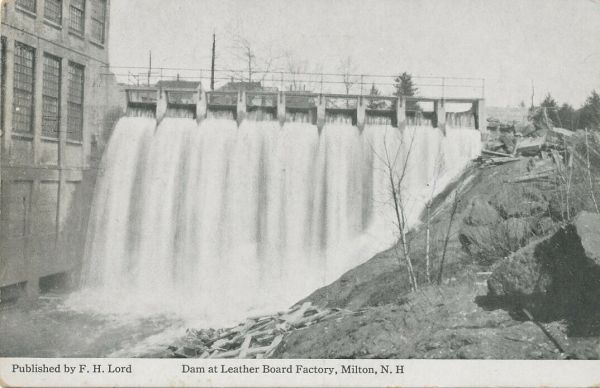
The Milton Leatherboard Company had a stone dam with a 25-foot fall in the 1901 U.S. Geological Survey report. Its water could generate between 200-300 horsepower.
MILTON. Frank Norton is making a trip through New Hampshire and Massachusetts in the interests of the leather board mill (Farmington News, November 15, 1901).
Seth F. Dawson experienced his second destructive mill fire when the Milton Leatherboard mill burned down on January 8, 1902. (The first having been his Lawrence storehouse).
MILLS DESTROYED BY FIRE. One Man Burned and Seventy-Five Out of Employment. Milton, Jan. 9. – The Milton Leather Board mills here, were burned yesterday, causing a loss of between $55,000 and $60,000. One man was badly burned. The fire started from an overheated pulley. Seventy-five men are thrown out of employment. The mill and yard cover over two acres of land, and on the premises a large quantity of lumber was piled, which was destroyed. The steam plant of them all had recently been fitted up with an additional new engine, and steam apparatus at the cost of $20,000 (Portsmouth Herald, January 9, 1902).
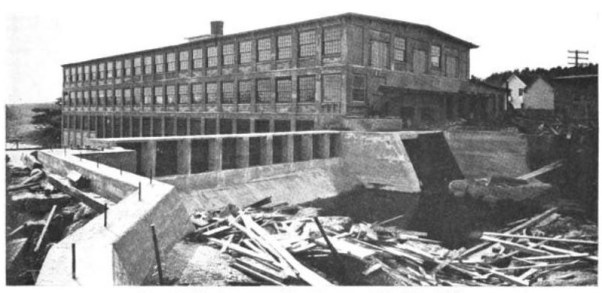
FIRE AT MILTON. The town of Milton was visited by a bad fire at an early hour Wednesday morning when the large leather board and shoe findings factory, owned by the Milton leather board company, was totally destroyed. The loss will be a bad blow to the people as well as the owners. The alarm was given at 7.45 and the Milton fire department responded promptly but the fire had such a start that their work amounted to but little. A man by the name of Dresser, who was among the last to get out of the mill, was badly burned about the head and arms, and was taken to his home in Lebanon, Me., after having his wounds dressed by Dr. Hart. The cause of the fire is supposed to be due to an overheated pulley, but the owners were unable to state sure. The loss is estimated at about $60,000, and is well covered by insurance. The machinery, which was of the latest improved pattern, is wholly destroyed, also the boiler and engine. The employees feel their loss badly, as some valuable watches and clothes were destroyed. The factory was a good one having been built about 12 years. It was two stories high, 185 feet long and 52 feet wide, with a boiler room 40×60, two stories in height. At this time business was rushing, a day and night crew being employed, in all about 80 hands. A large amount of stock was on hand (Farmington News, [Friday,] January 10, 1902).
MILTON. January 8, 1902. Wood building, used as leatherboard mill; owned and occupied by Milton Leatherboard Co.; building valued at $9,000; damage to building, $9,000; insurance upon building, $7,000; contents valued at $35,000; damage to contents, $35,000; insurance upon contents, $25,000; loss total, cause, slipping of belt (Brett, et. al., 1913).
Herman C. Dyer of Milton, who had been employed at the Milton Leatherboard Company for ten years, died accidentally when he fell off of a train in Rochester, NH, in December 1904. (His death was initially thought to have been a murder).
MILTON – Strafford Co. Pop. 1,625. On B.&M. R.R. M.O. and Tel. office; nearest bank, Rochester, 8 miles; Am. Ex. MILTON LEATHER BOARD CO. (S.F. Dawson, Jr., Pres.; S.F. Dawson, Treas.) S.P. at mill. Eight Beating and one Jordan engines; six Cylinder machines. Water and Steam. Leather board. 14,000 lbs., 24 hours (Lockwood, 1905).
MILTON – Strafford Co. Pop. 1,625, On B. & M. R.R. M.O. and Tel. office; nearest bank, Rochester, 8 miles; Am. Ex. MILTON LEATHER BOARD CO. (S.F. Dawson, Jr., Pres.; S.F. Dawson, Treas.). S.P. at mill. Eight Beating and two Jordan engines; six Cylinder machines. Water and Steam. Leather Board. 14,000 lbs., 24 hours (Vance, 1908).
Florence Cutting Dawson, of Lawrence, MA, died of tuberculosis in New York, NY, August 15, 1909, aged twenty-one years, eight months, and seventeen days. (She was the youngest daughter of Seth F. and Lizzie A. (Cutting) Dawson).
Franklin Dawson, a leatherboard manufacturer, aged sixty-two years (b. England), headed a Lawrence, MA, household at the time of the Thirteenth (1910) Federal Census. His household included his wife, Elizabeth A. Dawson, aged fifty-nine years (b. Canada). Franklin Dawson rented their house at 8 Jackson Terr. Elizabeth A. Dawson was the mother of three children, of whom two were still living (daughter Florence C. Dawson having died in the prior year).
Seth F. Dawson, a manufacturer, aged seventy-five years (b. England), headed a Lawrence, MA, household at the time of the Fourteenth (1920) Federal Census. His household included his wife, Elizabeth Dawson, aged sixty-nine years (b. Canada). Seth F. Dawson rented their house at 81 Saunders street.
Elizabeth A. (Cutting) Dawson died in Lawrence, MA, April 30, 1926. Seth F. Dawson, Sr., died in North Reading, MA, August 7, 1926.
Seth Franklin Dawson, Jr. – 1909-32
Seth Franklin Dawson, Jr., was born in Lawrence, MA, June 17, 1879, son of Seth F. and Lizzie A. (Cutting) Dawson.
S.F. Dawson, Jr., was educated at Lawrence, Mass. As soon as school days were over, he became actively connected with his present business, subsequently becoming head of the concern. On March 23, 1909, he was married to Miss Edith Ackerman, who is a daughter of Rev. G.E. and Eugenia Ackerman, and they have two children. Seth Willard, who was born at Lawrence, Mass., and Harold Cleveland, who was born at Milton, N.H., which is the family home. Mr. and Mrs. Dawson are members of the Congregational church. In politics Mr. Dawson is a Republican and fraternally is a Mason (Scales, 1914).
Seth Frank Dawson, Jr., married (1st) in Lawrence, MA, May 24, 1909, Edith Willard Ackerman, both of Lawrence. He was a manufacturer, aged twenty-nine years, resident at 8 Jackson Terrace; she was a teacher, aged twenty-two years, resident at 156 Garden street. She was born in Warsaw, NY, circa 1887, daughter of Rev. George E. and Eugenia (Van Wormer) Ackerman. Her father performed the ceremony.
MILTON. Robert M. Looney has gone to Lawrence, Mass., to act as best man at the marriage of Miss Edith Willard Ackerman to Mr. Seth Frank Dawson, Jr., which is to occur in that city on Wednesday evening, March 24, at 8 o’clock, in the Garden street Methodist church of which Rev. George Everett Ackerman, father of the bride, is pastor. Mr. Dawson has been engaged for quite a number of years in the leather board business in Milton, his father being the senior partner. Miss Ackerman is said to be an accomplished musician, having been organist at the University of Syracuse, N.Y. The spacious and pleasant house on South Main Street, owned and once occupied by Charles Tasker of Boston, has been fitted with electricity and otherwise prepared and furnished for immediate use and will be occupied by Mr. and Mrs. Dawson, on their return to Milton, which will be on Thursday, March 25, the day after their marriage. Mr. Dawson is most highly esteemed by all who know him and Milton may feel well honored by this addition to its numbers. Surely their many friends will wish the young couple a long and happy life (Farmington News, March 26, 1909).
Chiefly About People. Personal. Married, on the evening of March 24th, in the Garden Street Methodist church, Lawrence, Mass., in the presence of several hundred invited guests, by Rev. G.E. Ackerman, pastor of the church, Mr. Seth Frank Dawson, Jr., and Edith Willard Ackerman, daughter of officiating clergyman. Mr. Dawson is secretary and treasurer of the Milton Leather Board Company, and they will reside Milton, N.H. (Holliday, et al., 1909).
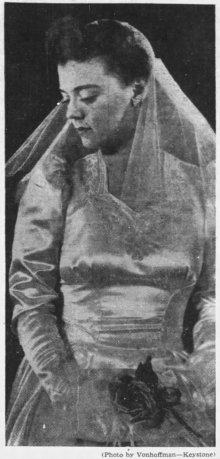
Dawson-Ackerman Wedding in Lawrence, Mass. Friends here of Dr. and Mrs. G.E. Ackerman, former residents of Chattanooga will be interested in the news of the marriage of their daughter Edith to Seth Frank Dawson, Jr., of Lawrence, Mass., where Dr. Ackerman has charge of the Garden Street M.E. church. Dr. Ackerman was for fourteen years a professor in the University of Chattanooga. According to the Lawrence Telegram: One of the prettiest of this season’s weddings took place last night at 8 o’clock in the Garden Street M.E. church when Miss Edith Willard Ackerman, daughter of the Rev. Dr. George E. Ackerman, became the bride of Seth Frank Dawson, Jr. The double ring service was used. The Rev. Dr. Ackerman officiated. Following the ceremony, which was attended by hundreds of friends and acquaintances of both the young folks, a wedding reception was held in the parsonage. A bounteous wedding supper was served by-a caterer. The bride looked charming in a gown of white sheath satin. Her tulle veil was caught up with orange blossoms sent to her by her uncle from Florida. She carried handsome white roses. The bride was attended by her sister, Miss Edna M Ackerman, in a handsome creation of point de spray lace over pink silk. She carried handsome white roses. Mr. Robert Looney of Milton, N.H., was best man. The auditorium of the church was adorned with potted plants and palms. The attendance was so large in the church that the following efficient corps of ushers were busy for an hour previous to the ceremony showing the parishioners and friends of the contracting couple into seats: Arthur Barker, Jerome W. Cross, Walter F. Lillis, Frank W McLanathan, Alexander Wilson and H. Christopher Chubb. Just previous to the wedding march, which was played by Miss Sadie Fearon, Miss Carrie Frazer of Syracuse, N.Y., sang “O Fair, O Sweet and Holy.” Following the ceremony, Mr. and Mrs. Dawson held a reception in the parsonage at which a large number of friends took the opportunity to shower congratulations on the newly wedded couple. The couple were the recipients of many handsome, costly and useful gifts, notably a complete set of valuable silverware from the parishioners of the church. They will reside at Milton, N.H, where a cozily furnished home awaits them. Master Richard Lord was ring bearer and little Janice Barker was flower girl. The two little ones gave the affair an additional charm. Seth Frank Dawson, Jr., the bridegroom, is the son of Seth F. Dawson, one of Lawrence’s best known and respected residents, who resides at 8 Jackson terrace. At present both Mr. Dawson and his son are engaged in the manufacture of leather board in Milton, N.H., where they are proprietors of the Milton Leatherboard Co. Mr Dawson, Jr., has long been a member of the Garden Street M.E. church and enjoys an extended circle of friends who were liberal In their well wishes for a most successful future in the new life into which he has just entered (Chattanooga Daily Times, March 30, 1909).
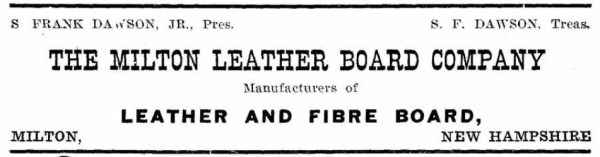
Milton Leather-Board Advertisement, 1912
MILTON. An alarm of fire was given Thursday evening of last week at about half past eight which proved to be the paper mill. It was all ablaze in a few minutes after it was discovered and soon fell to the ground. It has been considered unsafe for sometime past. Thirty-five or forty men were thrown out of employment by its loss (Farmington News, June 18, 1909).
Seth F. Dawson, Jr., a leatherboard manufacturer, aged thirty years (b. MA), headed a Milton household at the time of the Thirteenth (1910) Federal Census. His household included his wife (of one year), Edith W. Dawson, aged twenty-three years (b. NY), his child, Seth B. Dawson, aged three months (b. NH), and his mother-in-law, Eugenia Ackerman, a widow, aged fifty-eight years (b. NY). Seth F. Dawson, Jr., rented their house. Emma E. Looney, a widow [of Charles H. Looney], aged fifty-six years, was their neighbor. (Her household included her son (and Dawson wedding Best Man), Robert M. Looney, principal of Milton Grammar School). Eugenia Ackerman was the mother of three children, of whom two were still living. (Edith W. Dawson should have been listed as the mother of one child, of whom one was still living, but that information was omitted).
Chi – Syracuse University. [Class of] ’08 – Born to Mr. and Mrs. Seth Frank Dawson (Edith Ackerman) a son, Willard (Kappa Alpha Theta, 1910).
Fire in Milton. Fire early Wednesday destroyed the big mill of the Milton Leather Board Company and caused a loss that will reach $100,000. Fifty employees of the concern were thrown out of work by the fire. Starting from a cause not yet determined, the blaze sped with great rapidity and soon the whole mill was enveloped. The fire brigade of the mill assisted the Milton fire department in fighting the flames, but the building was doomed from almost the start of the fire. When the fire was discovered six persons were working in the mill and they escaped and gave the alarm. The president of the company owning the mill is S. Frank Dawson of Milton, and Seth F. Dawson of Lawrence is treasurer. Partial insurance (Farmington News, [Friday,] March 22, 1912).
“The New Plant of the Milton Leather Board Co., Milton, N.H.,” July 1913
See also Milton in the News – 1912 for further details of the Milton Leatherboard fire of March 1912.
State News. A large crew of Italians started on the construction of a concrete mill for the Milton Leatherboard Co., Monday (Farmington News, May 10, 1912).
A detailed description of the new mill facilities and features, complete with blueprints and photographs, appeared in a Concrete-Cement Age article of July 1913 (from which the following has been excerpted).
In 1912, there was constructed by Milton Leatherboard Co., at Milton, N.H., a new reinforced concrete mill, on the site of the former plant destroyed by fire. This mill is located on the west bank of the Salmon River in Milton village, about ¼-mi. below the reservoir dam. Mills of various kinds have occupied this site for a century and at least four are known have been destroyed by fire. Two wooden mills have been lost by the company in the past 12 years from fire [1902 and 1912]. A large proportion of the product manufactured by this company consists of leatherboards, made from leather scrap used for heeling in the manufacture of shoes. The location of the mill is admirably adapted to this purpose. First, by reason of an excellent water power; second, in having a spur track from the main line of the Boston & Maine R.R. closely paralleling the mill its entire length, and extending past the mill, over a trestle, several hundred feet. This simplifies the handling of raw stock into, and the finished product out of the mill. … Unique and distinguishing features of this plant are the beating engine tubs and wet machine vats which are entirely of reinforced concrete, and it is thought that this is the first instance of the kind in this country. Much credit is due S.F. Dawson [Sr.], treas. of the Milton Leatherboard Co., for originating the idea, and also for courage in opposition to adverse criticism in carrying it into execution. The results have thus far been most gratifying, as so smooth and symmetrical are the tubs in appearance that they may classed almost as works of art … The plant was designed, all plans furnished, and construction supervised by I.W. Jones, Cons. Engr., Milton, N.H. (Brett, et al., 1913).
MILTON – Strafford Co. Pop. 1,625. On B.&M. R.R. M.O. and Tel. office; nearest bank, Rochester, 8 miles; Am. Ex. MILTON LEATHER BOARD CO. (S.F. Dawson, Jr., Pres.; S.F. Dawson, Treas.) S.P. at mill. Eight Beating and two Jordan engines; six Cylinder machines. Water and Steam. Leather board. 14,000 lbs., 24 hours (Lockwood, 1913).
MILTON – Strafford Co. Pop. 1,625. On B.&M. R.R. M.O. and Tel. office; nearest bank, Rochester, 8 miles; Am. Ex. MILTON LEATHER BOARD CO. (S.F. Dawson, Jr., Pres.; S.F. Dawson, Treas.) S.P. at mill. Eight Beating and two Jordan engines; six Cylinder machines. Water and Steam. Leather board. 14,000 lbs., 24 hours (Lockwood, 1915).
A fire crew from the Milton Leatherboard Company turned out for the Hotel Milton fire of November 1915.
MILTON. It is now reasonably assured that Milton village will be illuminated with electricity and Twin State Gas and Electric Co. has looked over the site of the old paper mill with the view of locating the power plant there. If plans are consummated Milton Mills and Union also will be lighted (Farmington News, December 8, 1916).
Milton Leather-Board Advertisement, 1917
S. Frank Dawson, Jr., appeared in the Milton directory of 1917, as president and manager of the M.L.B. Co, at the foot of Mill street, with his house at 53 So. Main street, corner of Farmington road.
Seth Frank Dawson, Jr., of Milton, registered for the WW I military draft in Milton, September 12, 1918. He was thirty-nine years of age (b. June 17, 1879), and employed as president of the Milton Leatherboard Co. of Milton. His nearest relative was Edith A. Dawson of Milton. He was of a medium height, with a medium build, blue eyes, and brown hair.
Mrs. Edith W. (Ackerman) Dawson died in Milton, October 14, 1918, aged thirty-two years, and three days. (She was one of the Milton victims of the Spanish Flu epidemic of 1918).
LOCAL. Local club women and many friends learn with sincere regret of the death of Mrs. S. Frank Dawson, Jr., wife of the manager of the Milton Leatherboard Co., which occurred at her home in Milton, Monday, after a short illness of influenza. She was a splendid woman and very prominent in the affairs of the church, the Red Cross and the Woman’s Club (Farmington News, [Friday,] October 18, 1918).
Seth F. Dawson [Jr.] married (2nd) in Philadelphia, PA, November 27, 1919, Elizabeth Tennant. She was born in Ashly, PA, February 11, 1882, daughter of Linus E. and Sarah J. (Strong) Tennant. (The John Curtis Tennant in the announcement below was her brother, rather than her father).
MARRIAGES. DAWSON-TENNANT. At Philadelphia, Nov. 27. 1919, S.F. Dawson of Philadelphia and Miss Elisabeth H. Tennant, daughter of John Curtis Tennant, formerly of Wilkes-Barre (Wilkes-Barre Record, November 29, 1919).
S. Franklin Dawson, a manufacturing owner, aged forty years (b. MA), headed a Milton household at the time of the Fourteenth (1920) Federal Census. His household included his wife, Elizabeth Dawson, aged thirty-seven years (b. PA), and his children, S. Willard Dawson, aged ten years (b. MA), and Harold C. Dawson, aged six years (b. NH). S. Franklin Dawson owned their house on Lower Main Street, Milton Village, free-and-clear. Emily E. Looney, a widow, aged sixty-five years (b. NH), was still their neighbor.
Milton Leatherboard company, of Milton, had eighteen male employees and zero female employees, for a total of eighteen employees, at the time of a New Hampshire state inspection in 1920 (NH Bureau of Labor, 1920).
MILTON – Strafford Co. P 1,128. On B. & M. R.R. M.O. and Tel. office; nearest bank, Rochester, 8 miles. MILTON LEATHER BOARD CO. (S.F. Dawson, Jr., Pres. and Supt; S.F. Dawson, Treas.) S.P. at mill. Five 3500-lb. Beating and three Jordan engines; six Wet Machines. Widest trimmed sheet, 48 inches. Water and Steam. Heeling Board. 30,000 lbs, 24 hours (Lockwood, 1922).
Seth F. Dawson, Jr., was elected as a Milton state representative in November 1924. He ran as a Republican (Portsmouth Herald, November 21, 1924).
Young Seth W. Dawson died in Tilton, NH, March 20, 1926, aged sixteen years, one month, and twenty days. (He died of influenza, as had his mother before him). Tilton, NH, was the site of the Tilton Seminary.
Milton Leather Board Co. appeared in the Milton directory of 1927, as leather board manufacturers, with Seth F. Dawson as Manager. Seth F. (Elizabeth T.) Dawson had their house on Main street.
Milton Leatherboard employee, William T. Wallace, was seriously wounded in a freak accident there on October 31, 1928. He died that same day in the Rochester hospital following an operation there, aged sixty-seven years, and nine months. His Rochester death certificate (signed by Dr. M.A.H. Hart of Milton) explained that he had been
Struck by a flying blade from a heavy steel fan in the drying room of the Milton Leatherboard mill on the side of his abdomen causing the bursting of a section of the intestines. He was taken to the Rochester Hosp. and died after his operation before recovering from the anesthetic.
MILTON. Many local friends, and especially the orders of Red Men and Pocahontas throughout the state, regret the untimely and tragic death of William S. Wallace of Milton, who died at the Rochester hospital last Monday as the result of injuries while at his employment in the Dawson paper mill last week. Mr. Wallace was a past great sachem of the Red Men of New Hampshire. For many years he was an employe of the Boston and Maine R.R. as the station master at Milton. Also he was a former business man of Milton (Farmington News, November 9, 1928).
MILTON – Strafford Co. Pop. 976. On B. & M. R.R. M.O. and Tel., nearest bank, Rochester, 8 miles. MILTON LEATHER BOARD Co. (S.F. Dawson, pres.; Chas. F. Jameson, treas.; M.J. Guild, supt.). S.P. at mill. Five 3500-lb. Beaters and three Jordans. Six Wet machines; widest trimmed sheet, 48 inches. Water and steam. Fibre and Innersole Board. 20,000 lbs., 24 hours (Vance, 1930).
Seth F. Dawson, a leatherboard manufacturer, aged fifty years (b. MA), headed a Milton household at the time of the Fifteenth (1930) Federal Census. His household included his wife (of eleven years), Elizabeth T. Dawson, aged forty-eight years (b. PA), and his son, Harold Dawson, aged seventeen years (b. NH). Seth F. Dawson owned their house on South Main Street, which was valued at $4,000. They had a radio set.
Seth F. Dawson Retires. Seth F. Dawson, president of the Milton Leather Board Company, Milton, N.H., manufacturers of high grade fibre boards, retired last week after more than 35 years with the company. Mr. Dawson will spend a well earned vacation at his summer home at Great East Lake in Maine, before making his plans for the future. The remaining members of the firm are W.T. Rich, Jr., president; C.F. Jameson, treasurer and M.J. Guild, mill manager. Mr. Rich and Mr. Jameson are at the Boston office of the company, C.F. Jameson and Company, Inc., 142 Cambridge Street (Paper Trade, 1932).
Mrs. Elizabeth (Tennant) Dawson died in Rochester, NH, October 28, 1933, aged fifty-one years, eight months, and sixteen days.
Mrs. Elizabeth T. Dawson. Rochester, N.H., Oct. 28. (AP.) Mrs. Elizabeth T. Dawson, 51, former teacher of music at the University of Virginia and Stephen Girard College in Philadelphia, died suddenly today. Mrs. Dawson, prominent in church and fraternal circles in this city, was born in Ashley, Pa. She leaves her husband, Seth F. Dawson, a son, Harold C. Dawson, and a brother, J. Curtis Tennant of Philadelphia (Hartford Courant, October 29, 1933).
LOCAL. The sudden death of Mrs. Seth Dawson of Rochester, last Saturday, is sincerely mourned by many Farmington friends. She was an officer in Fraternal Chapter, O.E.S., in this town and was prominent in many other fraternal orders in Rochester. She was the daughter of the late Mr. and Mrs. Tennant of Pennsylvania and was married to Mr. Dawson in 1919. She was a fine musician. Much sympathy is expressed for the bereaved husband (Farmington News, [Friday,] November 3, 1933).
Miss Helen Anderson, 1942
Seth F. Dawson [Jr.] married (3rd) in Rochester, NH, September 5, 1936, Ruth H. ((Svenson) Anderson) Iovine, he of Milton, and she of Waco, TX. He was a manufacturer, aged fifty-seven years; she was a school teacher, aged forty-two years. Gardner S. Hall, a Rochester, NH, judge, waived the five-day waiting requirement. She was born in Boston, MA, circa 1894, daughter of Rev. Svante and Hilda C. (Lundgren) Svenson. (Her elder sister, Ingeborg V. “Ivy” Svenson, married Henry A. Townsend of the Townsend blanket mill family).
Mrs. Ruth H. Dawson’s son, Robert R. Anderson, was the principal of Nute High School in 1939-42. Her daughter, Helen Anderson, married in North Easton, PA, during WW II.
Today in SOCIETY. MARRIED YESTERDAY in North Easton [PA,] to Corp. George Healey of that town was Miss Helen Anderson, daughter of Mrs. Seth Dawson of Milton, N.H. (Boston Globe, December 22, 1942).
Seth Frank Dawson of Milton registered for the WW II military draft in Milton, April 27, 1942. He was retired, aged sixty-two years (b. Lawrence, MA, June 17, 1879). His contact was Ruth H. Dawson, Milton; their telephone number was Milton 62. He stood 5′ 7″ tall, weighed 162 pounds, with gray eyes, gray hair, and a light complexion.
Seth F. Dawson, Jr., died in Rochester, NH, April 15, 1955, aged seventy-five years.
TUESDAY, APRIL 26, 1955. Resolutions. Mr. Evans of Milton offered the following resolution: Whereas, Seth F. Dawson of Milton has passed away, and Whereas, Mr. Dawson was a former representative from Milton, therefore be it Resolved, That we, the members of the House of Representatives of the New Hampshire Legislature, express our deep Sympathy to the family in its bereavement, and be it further Resolved, That the Clerk of the House transmit to the widow, Mrs. Seth F. Dawson, a copy of these resolutions (NH House, 1955).
His widow went on to have a career in politics, which included over a decade as Milton’s NH State Representative. She was Milton’s NH State Representative as late as the 1974-75 biennial term (Portsmouth Herald, March 4, 1974).
MILTON CANDIDATES. Milton. – Local candidates in the primary next month include: For representative, Mrs. Mildred Galarneau, former correspondent for the News; Mrs. Ruth Dawson of the Mills, who served in 1958-59; both Republicans. For checklist supervisors, all Republican, George Longley, Charles Piper, Marion Roberts, Fred Eldridge. For Moderator, Lewis Piper, Republican; Everett McIntire, Democrat (Farmington News, August 7, 1962).
Pond Water Level Slated for Hearing. A piece of legislation of interest to Portsmouth area residents with property on Milton Three Ponds is due for public hearing tomorrow in Concord. The bill would bar draw down of water in the ponds to a level below 14.5 feet between June and Labor Day, this depth to be on the gauge at the dam gate in Milton. The bill, introduced by Clayton E. Osborn, R-Portsmouth, and Ruth H. Dawson, R-Milton, is due for a hearing by the House Resources, Recreation and Development Committee at 1:30 p.m. in Room 207 of the State House annex. A $200 fine is proposed for violation of the draw down limit (Portsmouth Herald, March 4, 1963).
MRS. DAWSON NAMED CHAIRMAN. CONCORD. – Mrs. Ruth Dawson of Milton has been appointed New Hampshire Conference Chairman for the 16tb Annual Republican Women’s Conference which is to be held April 22, 23 and 24 at the Washington Hilton Hotel, Washington, D.C. National Committeewoman Mrs. Rose Bovaird in announcing the appointment expressed pleasure in Mrs. Dawson’s acceptance of this important post. Long active in Republican affairs, Mrs. Dawson is the only woman ever elected from the towns of Milton and Middleton as Representative to the General Court. She has been elected a Representative for five terms and is a past Legislative Department Chairman for the American Legion. Mrs. Dawson will strive to have a record-breaking number of Delegates to the Conference in April. Mrs. Bovaird also appoint Mrs. Anita Carmen of Manchester as Publicity Chairman for the Conference (Farmington News, February 29, 1968).
Area Solons All Favor H.B. No. 1. Governor Walter Peterson’s controversial Citizens’ Task Force bill No. 1 found no opposition with legislators whose constituencies cover an area served by this newspaper. Representatives Ralph Canney, Robert Drew, Fred Tebbetts, all of Farmington; Rep. Ruth Dawson, New Durham-Milton; and Rep. Jakob Mutzbauer of Alton all cast favorable votes. The bill passed easily by a 246-127 margin in the House (Farmington News, February 6, 1969).
This afternoon, the Senate Judiciary Committee will hold its hearing on HB 81, a bill which passed the House on a voice vote and would prohibit law enforcement officers from also serving as bail commissioners. The bail commissioner operates on a fee basis, being paid for each call to determine whether bail is necessary, and how much, after an arrest. Each town or city has three commissioners and, in some cases, convenience has led them to also be police officers. The bill’s sponsor, Rep. Ruth H. Dawson, R-Milton, and Rep. Shirley Merrill, R-Lebanon, both testified against this practice at a House hearing, feeling “the prosecutor should not also set bail.” Rep. Merrill also testified as to complaints in Lebanon about the system. The bill passed the House on an uncontested voice last week (Portsmouth Herald, February 18, 1969).
Mrs. Ruth H. (((Svenson) Anderson) Iovine) Dawson died in Wolfeboro, NH, August 15, 1985.
To be continued …
References:
Brett, Allen, and Whipple, Harvey. Concrete-Cement Age (1913, July). Reinforced Concrete in Factory Construction. Some Details of Mill and Dam Work in Reinforced Concrete in Milton, N.H. Retrieved from books.google.com/books?id=D8VLAAAAYAAJ&pg=PA3
Luce & Bridge. (1888). Twenty Thousand Rich New Englanders: A List of Taxpayers Who Were Assessed in 1888 to Pay a Tax of One Hundred Dollars Or More. Retrieved from books.google.com/books?id=aAkPAAAAYAAJ&pg=RA2-PA100
McLeish Communications. (1915). American Shoemaking, Volume 57. Boston, MA: American Shoemaking Publishing Co.
By Muriel Bristol (Transcriber) | February 23, 2020
Here we find a 1916 recollection of two competing industrial soap salesmen – “No. 34” and “Jim” – and their sales trip to Milton Mills.
Based upon the manufacturers, hotelier, and storekeeper mentioned, it would seem that the sales trip described must have taken place in or around 1877. The Waumbeck Company had its origins in the early 1870s; Ira Miller (1826-1902) had by this time transferred his Central House hotel to Crosby B. Remick (1849-1919), and opened his eponymous store, as he did in 1877; and Edward Brierley (1817-1878) was still living. David H. Buffum (1820-1882), a principal at the Great Falls Manufacturing Company, has not yet arrived on the scene. John Townsend (1807-1891), retired founder of the Townsend blanket mill, was then about seventy years of age, while his son, Henry H. Townsend (1842-1904), founder of the Miltonia Mills, was then about thirty-six years of age.
A GREEDY COMPETITOR.
In my early days in the soap trade, there seemed to be a broader field than there is to-day. True, there were fewer salesmen on the road selling mill soaps. As I recollect, there were two of us in New England territory, representing large houses, and, occasionally, a small maker of soap among the competitors would go out himself, and sell some mill. But the bulk of the trade was handled by my competitor and myself, I will call him Jim. There surely ought to have been trade enough for both of us. One morning I met him on the Eastern Division of the Boston & Maine Railroad, coming from Boston. He was not very amiable, rather out of sorts with me. For the truth was, I had been rather busy with the mills on that division. I had been to Great Falls the day before and sold them. The son of the owner had told me that his father had gone to Milton Mills, together with Mr. Briarly, superintendent of a felt mill he owned there to Briarly’s camp at East Pond on a fishing expedition. This is in explanation of what happened after Jim and I reached Milton Mills. We both got off at Union, N.H., and took the stage over to Milton Mills. Jim rode on the inside, I on the outside. He
DID NOT MAKE MUCH TALK,
and I, after one or two attempts to converse with him, subsided. The facts were that on a previous trip I had been to the mills and sold the Waumbec Company a car and sold a sample five-cask lot to Briarly Felt Mills; also sold Townsend a sample order, I have forgotten the number of packages, and had run over the month before and got encouragement from Briarly that my soap was proving very satisfactory and that he expected to give me a car order, which was my errand on the day Jim and I were on the way to Milton Mills. We arrived about dinner time, went in to dinner together. We had begun to eat when Jim started up from the table and said he had a bad attack of the toothache and could not eat. I finished my meal, while Jim walked down to the Briarly mill at least one-half mile from the hotel. Before he came back I had interviewed Henry Townsend, whom I saw coming across the square, and sold him. This left nothing for Jim except a possibility of changing Briarly
AWAY FROM HIS PROMISE
to me. Jim came back, hot and mad clean through. “Why couldn’t you have told me Briarly was down to East Pond fishing,” he said, and “saved me this walk?” It was a very hot day In August. I asked him how long he supposed I was running his business. He made me no answer, but turned to Remick, the hotel proprietor, and said, “How many horses have you got in the barn?” Remick said, “Six.” “I want them,” said Jim, “and I want you and the fastest one of the lot to drive me to Briarly’s camp.” I had not been on the road long, but I had learned a little forbearance against pushing business on a mill man when he was on a pleasure hunt away from his mill. So I began to remonstrate with Jim against going to the camp. He just laughed at me. I tried to get one of the six horses that Jim had commanded, but Remick reminded me that I had heard Jim hire the whole bunch. I told Remick that would be the last time he would have the pleasure of my company, and was making a few other
REMARKS NOT COMPLIMENTARY
to him. When a salesman for a dye-stuffs house who was at dinner with me and had driven in from Sanford, Me., saw the fix Jim had me in, he stepped up and said it was his first trip to this country, that he had no acquaintance, and if I would introduce him to the owner of the felt mill I might ride with him. I gladly accepted his invitation. Meanwhile, Jim and Remick had started for East Pond. The dye man drove a piebald horse, not any snap to him. When he got opposite Briarly’s mill, he balked up. I sprang over the wheel, saying to my friend that his horse couldn’t do me any good. I ran all the way back to the village, and entered a grocery store kept by Ira Miller. I will say that, before going on the road to sell soap, I was eight years in a wholesale grocery store in Boston. Miller had been a customer, and when he came in to buy goods, he was always boasting about the fine horses he had. I had not him for three or four years. As soon as I got my breath, I said, “Ira, have you got a good horse?” “The best in the state,” he replied.
“HITCH HIM UP,”
and drive me to East Pond.” That horse was harnessed and put in a rig in very quick time. As we rode along, I explained to Ira the trouble I was in. That was a grand horse of Ira’s. We overtook friend Jim and Remick about five miles out. I said, “That is what I am after, Ira,” pointing to Jim. They were moping along, thinking they had done me up, I suppose. When I spoke to Ira, he said, “Hang on to the seat,” and like a shot we went by them. I looked back, and Jim had the reins away from Remick, and the whip in his hand, and was lashing that horse into a run, but that horse was not in it with Ira Miller’s animal. We left them out of sight and drove into the lake shore. “Change sides,” said Ira, who rose up and I slipped under him. At the camp I found Mr. Briarly, booked his order for a car of soap, just as he had promised me, when Jim and his friend drove into the woods. I told Ira to drive me to Wolfboro Junction, which he did. Pretty soon Remick left Jim there. But he would not fraternize with me, and staid up at the end of a long platform away from me. I had mischief enough left in me to go to the telegraph office and wire in the order I had taken. No 34.



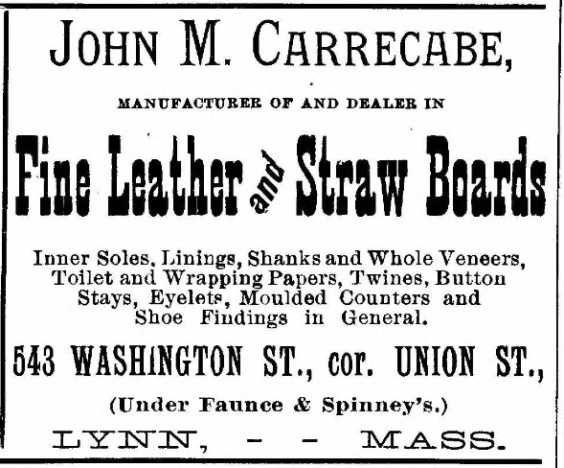

 Seth F. Dawson appeared in the Lawrence directory of 1873, as proprietor of Seth F. Dawson & Co., provisions, on Garden street, at its corner with Newbury street. His house was at 22 Spring street. His widowed mother, Hannah Dawson, as well as his brothers, Henry Dawson, who was a clerk at Seth F. Dawson’s, and William H. Dawson, who was a clerk, all resided at 22 Spring street. Seth F. Dawson appeared also as Recording Steward, and Treasurer of Stewards, of the Garden Street Methodist Episcopal Church.