By Muriel Bristol (Transcriber) | October 10, 2019
In this year, we encounter the death of Leander M. Nute, a horserace at Milton Three-Ponds, high waters brought by heavy rains, Rev. Arthur Jeffries accepting a call, the Bunker Hill sesquicentennial, a toddler’s drowning, a suicide, waitresses wanted, Harry Pinker’s close call, and the return of a lost pin.
Violin maker Leander Munroe Nute, a first cousin to Lewis Worster Nute, died in Portland, ME, on February 9. He was born in Milton, April 16, 1831, son of David and Lavina (Cook) Nute.
LEANDER M. NUTE, 94, DEAD AT PORTLAND. Oldest Dartmouth Graduate and a Violin Maker. PORTLAND, Me., Feb. 9 – Leander M. Nute, 94, oldest Dartmouth graduate, a violin maker, died this morning. Leander M. Nute was born in Milton, N.H., in 1831. After leaving school he taught for a time in the Pittsfield, N.H., Academy. He then entered Dartmouth, getting credit for one year on account of his teaching. He was graduated from the college in 1854 and had been for several years the sole survivor of his class. After leaving college he took a scientific course and thought that he wanted to be a railroad builder. His first job was on a project to run a railroad line from Saratoga to Sacketts Harbor. This was a failure, and the young man went West and worked in Michigan and Iowa. He then returned to the East and went into business as a shoe manufacturer in Berwick, Me., living in Somersworth, N.H. When he retired at the age of 68 he had 250 men on his payroll and his output was 1200 pairs a day. Then Mr. Nute decided to start a new career – one which perhaps had been for years his heart’s desire. He began making violins. Twenty years later he won first honors with one of his violins – his 278th – in the State competition of the Maine Violin Makers’ Association. For more than 20 years before his death Mr. Nute had made his home in Portland, Me. He had a shop there where he made his violins. Specimens of his work went all over the East. Mr. Nute was a Mason. His wife died many years ago (Boston Globe, February 9, 1925).
Trotter Early Dreams appeared in horse races as early as July 1915, and as far away as Detroit, MI. Early Dreams once won a $5,000 race.
Hoof Prints. Early Dreams, 2:03¾, and Peter C., 2:19¼, have been matched for a return race $100 side for next Saturday at Milton Three Ponds, N.H. Early Dreams is owned by Fred Young of Farmington and Peter C. by Frank Osgood of Rochester (Boston Globe, February 23, 1925).
Fred Young, a shoe shop sole layer, aged thirty years (b. NH), headed a Farmington, NH, household at the time of the Fourteenth (1920) Federal Census. His household included his wife, Maude M. [(Young)] Young, aged twenty-nine years (b. NH), and his child, Doris M, Young, aged eight years (b. NH). They resided in a rented house on Silver Street Road.
Frank H. Osgood, a livery stable proprietor, aged fifty-nine years (b. NH), headed a Rochester, NH, household at the time of the Fourteenth (1920) Federal Census. His household included his wife, Elizabeth I. Osgood, aged thirty-seven years (b. NH), his children, Ernest L. Osgood, U.S. Army sergeant, aged twenty-three years (b. NH), and Donald G. Osgood, aged nineteen years (b. NH), and his lodgers, Frank Scicalo, a barbershop barber, aged twenty-seven years (b. MA), and Frank Salice, a barber shop barber, aged thirty-seven years (b. Italy).They resided in a rented house on South Main Street.
Heavy March rains required the removal of dam flashboards, but did not demand removing machinery belts.
SALMON FALLS FLOODED AS MILTONS PONDS FILL. EAST ROCHESTER, N.H., March 23. The heavy rainfall of the past 36 hours has caused Salmon Falls River to go on a rampage. The three ponds at Milton, which feed the Salmon Falls, have reached a high point and it was necessary this noon to remove flash-boards from the dam. Ice commenced to go out of the ponds this afternoon. The river lacks only a few inches of flowing over the abutments of the dam at Cocheco Company power house. Lowlands above the dam are completely inundated, while the interval below the brick mill is rapidly being flooded. Tonight mill officials stated that it had not been necessary to remove the belts at the mill. The only damage that the storm has done thus far is to leave rural roads in bad condition. In the North Rochester section at the Spaulding Pond, four rows of flash-boards were removed from the dam (Boston Globe, March 30, 1925).
Heavy rains washed away the flashboards of the Kennebunk Manufacturing Company dam at Milton Mills in December 1923.
Rev. Arthur Jeffries left the First Baptist Church in Athol, MA, to accept a call from Milton.
ATHOL CHURCH CALLS REV. H.T. JOSLYN. Formerly Was Minister at Charlestown. Word has been received from Athol that Rev Howard T. Joslyn, a former pastor at the First Baptist Church, Charlestown, has been extended a call to occupy the pulpit of the First Baptist Church in that town. Since the resignation of Rev. Arthur Jeffries, to accept a pastorate at Milton, N.H, the Athol church has been without a Lutheran pastor (Boston Globe, April 4, 1925).
Luther B. Roberts, of Milton Mills, and William P. Farnham, of Lynn, MA, both attended the Battle of Bunker Hill sesquicentennial celebrations. Their grandfathers had participated in the battle.
GRANDSON OF BUNKER HILL SOLDIER HERE. Luther B. Roberts, Milton Mills, N.H., Is Nearly 80.Luther B. Roberts of Milton Mills. N.H. nearly 80 who has been visiting relatives near Boston, is a grandson of John Roberts who fought in the Battle of Bunker Hill. His grandfather was born in 1753 at Dover Point. N.H., where the Roberts’ ancestors settled on land they bought from the Indians in 1673. John Roberts came to Boston in 1774 just in time to join the Revolutionary forces at Bunker Hill. He served for two years and was one of the men sent to Montreal by way of Lake Champlain. While on this trip he stopped at a hospital where an older brother, Moses, had died and there he found the man who had attended his brother in his last illness and who had buried him. Moses served in the French and Indian War. John Roberts married in 1778. There were 10 children. Luther’s father, Jere, was next to the youngest. John Roberts lived to be 93. His son, Jere, outlived all the other children and passed his 85th birthday. Mr. Roberts, who has been visiting his niece, wife of Speaker Hull of the Massachusetts House of Representatives, is going home to Milton Mills in a day or two but he will return to witness the celebration of the 150th anniversary of the Battle of Bunker Hill in Charlestown, June 17. He is active, his mind is as keen as ever and he has been mentally lively always, At his age he does look back a bit and reflects about friends. Luther Roberts was born in Waterboro in 1845. He learned his A B C’s in a red schoolhouse. “I’ve come from driving an ox team when I was 16 to see all the great improvements that there are now,” he says. He has been in active mercantile life. In 1878 he was a member of the New Hampshire legislature. In 1915 and 1916 he was in the legislature in Maine, representative from Portland. For four years he was a member of the Supreme Lodge of the order of Knights of Pythias. He and his wife, who was Nellie C. Berry, live now at the Berry homestead. Their one child living is Mrs. Eva Roberts Wood of White Plains, N.Y., who has two children. William R., and Janice. (Boston Globe, April 9, 1925).
Agusta Berry, aged eighty-four years (b. NH), headed a Milton Mills household at the time of the Fourteenth (1920) Federal Census. Her household included her brother-in-law, Luther B. Roberts, a lumberman, aged seventy-four years (b. ME), and her sister, Nellie C. Roberts, aged seventy-five years (b. NH). Augusta Berry owned their house on Main Street in Milton Mills Village free-and-clear.
“HARDLY A MAN IS NOW ALIVE.” (By International News Service.) Milton Mills, N.H., June 24. William P. Farnham, eighty-six, of Lynn, Mass., is the only man on record who can remember having seen and talked with a survivor of the battle of Bunker Hill. He visited the grave of his grandfather, a revolutionary soldier, to refresh his memory in order to help entertain the guests of the Bunker Hill day celebration in Charleston, Mass. (Huntington Herald (Huntington, IN), June 24, 1925).
William Farnham, a shoe factory cutter, aged eighty years (b. ME) headed a Lynn, MA, household at the time of the Fourteenth (1920) Federal Census. He resided at 97 Essex Street.
Idroiga L. “Edith” Pasjkowska, daughter of Joseph E. and Mary (Kenpskoi) Pasjkowska, died in an “accidental drowning” at Depot Pond, August 12, 1925, aged four years, five months, and seventeen days. She had been visiting in Milton for four days at the time of her death.
REVERE GIRL 4, LOSES LIFE AT MILTON. N.H. MILTON, N.H., Aug. 12 – Miss Edith Podeski, from Revere, Mass. was drowned at Depot Pond today. She was 4 years of age, and was on a vacation in care of Mrs. Conley of 98 Proctor av., Revere. The child wandered from the cottage where she was stopping, and a search resulted in the finding of the body in a few feet of water. The body was brought ashore by Raymond Boyle of Rochester (Boston Globe, August 13, 1925).
FOUR LOSE LIVES IN NEW ENGLAND WATERS. WILLIAM IRVING BOYCE, 17, Roxbury, at Foxboro. MARGARET McNAY. 13, of Manchester, N.H., at Crystal Lake. EDITH PODESKI, 4, of Revere, at Milton, N.H. HAROLD BRIDGHAM, 45, of Maine, at Sunset Lake, South Braintree (Boston Globe, August 13, 1925).
Henry J. Connolly, a fish store salesman, aged thirty-eight years (b. MA), headed a Revere, MA, household at the time of the Fourteenth (1920) Federal Census. His household included his wife, Margaret Connolly, aged thirty-six years (b. MA), and his children, Mary H. Connolly, aged thirteen years (b. MA), Elizabeth E. Connolly, aged eleven years (b. MA),and Margaret G. Connolly, aged seven years (b. MA). They resided in a mortgaged house at 98 Proctor Avenue.
Ernest O. Day, of Acton-side in Lebanon, ME, shot himself with a revolver in the early hours of August 13, 1925.
Ernest O. Day, a sawmill laborer, aged thirty-five years (b. ME), headed an Acton, ME, household at the time of the Fourteenth (1920) Federal Census. His household included his wife, Beatrice R. Day, aged thirty-three days (b. ME), and his children, Alice M. Day, aged thirteen years (b. ME), and Harlan W. Day, aged ten years (b. ME). They resided in a mortgaged house on the South Acton Road (near its intersection with the Springvale Road).
MILTON MILLS, N.H., MAN TAKES OWN LIFE. MILTON MILLS, N.H., Aug. 13 – Ernest A. Day, 28, a farmer of this town, shot and killed himself with a revolver about 2 o’clock this morning. His home was at Mothers Corner. He was the son of Mr. and Mrs. Samuel Day (Boston Globe, August 13, 1925).
BRIEF BITS OF WORLD NEWS. Kills Self at So. Acton. Sanford, Me. Ernest Day, 40, killed himself by shooting himself through the left temple with a revolver at his home In South Acton. He leaves a wife and one son (Portsmouth Herald, August 15, 1925).
We cannot know why at this remove – who can know another’s heart? – but it is a fact that he and his wife were at odds, and that his daughter had died in May (after the birth of her own daughter). He may have been ill, perhaps painfully, incurably ill..
Union’s Tox-a-Way Inn sought three refined girls to work as waitresses. The Tox-a-Way Inn was a 200-year-old wayside inn that had reopened in 1924 under new management (who had a Milton Mills telephone number).
ATTRACTIVE TEA SHOPPE AT UNION. One of the most attractive Tea Shoppes and Auto Inns has opened at Union, N.H., known as Tox-A-Way Inn. Its furnishings are wonderfully attractive, cuisine most excellent and entirely different than usually found at such places. There is nothing in New England that will compare with it. Kitchen is all electrically equipped with electric ranges, broilers, toasters, percolators, waffle irons, etc. All the furniture was made to order, being reproductions of old Windsor Colonials. It has a large dining room for regular guests finished in dark birch, a large tea room finished in colonial gray, and private dining rooms, the chambers are furnished in Belgian gray oak and birch, many of the rooms having running hot and cold water. It is sure to be not only popular with autoists and friends entertaining, but will prove a most attractive place for fishermen and hunters. It is under the management of Mrs. J.R. Huey and Mrs. Robert Smith, her daughter. 1t j17 (Portsmouth Herald, July 17, 1924).
WANTED. WANTED – 3 refined girls for waitresses at Tox-a-Way Inn, Union, N.H. Tel. Milton Mills 35-21 or Ports. 297-6 (Portsmouth Herald, August 20, 1925).
The refined girls hired here would have waited upon inventor Thomas A. Edison, orchestra leaders Paul Whiteman and Jacques Renard, Mrs. Susanna Tarkington (wife of author Booth Tarkington), and governors of both Massachusetts and New Hampshire.
Frank L. Smith was going too fast on the steep down-grade on Wiggin Hill when his car went into a ditch and turned turtle. (One of the few driving restrictions of 1906 was reducing speed when proceeding downhill).
AUTO CRASHES CLAIM TOLL OF FIVE DEAD. Five May Die as Result of Injuries – Quincy Man Crushed Beneath Car on Way to New Hampshire. NORTH WAKEFIELD, N.H., Aug. 23 – Frank L. Smith, 44 years old, of 79 Glendale road, Quincy, was instantly killed; Mrs. Clara Isora Dustin of Tremont st., Quincy, and Mrs. Henry T. Cushman, now of Milton Mills, N.H., and recently of Boston, received minor injuries when a large touring car in which they were riding overturned on Wiggin hill shortly after 8 o’clock this morning. According to witnesses of the accident Smith was driving at high speed. Attempting to lessen the speed of the machine in order to negotiate the steep down grade he applied the brakes. The machine went into a ditch. Smith was crushed beneath the overturned car. The two passengers were thrown clear. Mrs. Dustin sustained a fractured arm, cuts about the head and face, and Mrs. Cushman suffered with body bruises. Little information could be obtained about Smith other than he lived in Quincy and was employed as an auditor. The automobile bore a Massachusetts registration plate 110,012 (Boston Globe, August 24, 1925).
Frank L. Smith, a shipyard bookkeeper, aged thirty-eight years (b. MA), headed a Quincy, MA, household at the time of the Fourteenth (1920) Federal Census. His household included his wife, Elizabeth J. Smith, aged thirty-five years (b. MA), and his children, Hazel L. Smith, aged fourteen years (b. MA), and Elizabeth Smith, aged thirteen years (b. MA). They resided in a rented dwelling at 118 Sagamore Street.
Despite Clara Isora Duncan’s injuries being characterized as minor ones, she died in the Rochester Hospital, on Charles Street in Rochester, NH, September 15, 1925, aged forty-nine years, two months, and twenty-one days. Her primary cause of death was a general sepsis of wounds on her back; the contributing causes were a fractured left elbow, fractured right clavicle, wounds on her forehead and her whole back, which were macerated and had become infected. (Alexander Fleming discovered penicillin in 1928, but it was not in general use until 1942).
Mrs. May E. (Thayer) Cushman, who was bruised only, was the sole long-term survivor. She and her husband were living in Farmington, NH, in 1930.
BOY BURIED IN SAND CAVE AT MILTON. Milton Mills, Sept. 4 – The sudden collapse of the top of a cave which he and four young companions had been digging, almost cost the life of little Herman Pinker yesterday afternoon, when he was buried several feet deep. His companions dug furiously for a few minutes, but seemed to make no headway. One of them, Lester Marsh, ran to his home and summoned his brother, Ithal, who finally reached the boy. He was still breathing, but was unconscious. He was hurried to his home, where he was revived by a pulmotor (Portsmouth Herald, September 4, 1925).
Lester E. Marsh, aged fourteen years at this time, and his older brother, Ithiel E. Marsh, aged sixteen years, were children of George W. and Eva M. (Burrows) Marsh of Acton, ME.
Edward L. Osgood married (2nd) in Lebanon, ME, May 24, 1925, Edith M. Whitehouse, both of Lebanon.
The new Mrs. Osgood is here said to have been sorting potatoes when she found another woman’s gold pin. (Properly prepared and stored potatoes may last for between four and nine months).
PIN, LOST SIX YEARS, FOUND IN POTATO. Special Dispatch to the Globe. MILTON, N.H., Dec. 15 – While sorting a few potatoes at her home yesterday Mrs. Edward L. Osgood found a large gold pin attached to one of them. The pin, which was made from a gold piece, bore the date 1888 and the initial W. Inquiries resulted in the information that the pin had been lost in her garden nearly six years ago by Mrs. Eliza Wentworth of Sanbornville, N.H. It was returned to the owner (Boston Globe, December 16, 1925).
Mrs. Eliza M. (Hanson) Wentworth, the source of the potatoes, had presumably lost her gold pin in her potato field, nearly six years before. It had attached itself there to her 1925 crop and passed thereby on potatoes sold to Mrs. Edith M. (Whitehouse) Osgood. (The two women may have been related: Mrs. Wentworth’s mother had been also an Edith Whitehouse: Edith (Whitehouse) Hanson.
Eliza M. (Hanson) Wentworth, widow of Fred M. Wentworth, and a forty-eight year resident of Sanbornville, Wakefield, NH, died in Milton, April 11, 1926, aged sixty-three years, nine months, and seven days. She died of cancer, with which she had been afflicted for eight months, i.e., from about the harvest time of the potatoes in which her gold coin pin was discovered. M.A.H. Hart, M.D., of Milton, reported her death.
In this year, we encounter the annual ice harvest, a poultry farm for sale, another train death, the police chief hospitalized, an ice worker returned home, a barber sought, ice horses auctioned, a grange meeting, a Rochester fire truck’s response, a drowning death, a dancing policeman, another visit from the fisher queen, Rev. H.E. Whitcomb visits Haverhill, the death of “ice king” John O. Porter, Kittery Boy Scouts camping, a fruit farm for sale, a barber sought still, the Grand Master Workman’s visit, hound dogs for sale, Rev. H.E. Whitcomb returned from Haverhill, Rev. Newell W. Whitman called away, a Milton Mills fire, and NH scholastic test scores.
Warmer weather in greater Boston again favored Milton’s ice industry, which “enjoyed” zero weather.
NEW HAMPSHIRE ICE FOR BOSTON. Harvesting Begins This Week on Milton Ponds. Lakes Frozen to Depth of About 12 Inches. Product Will Be Shipped in Freight Cars. Special Dispatch to the Globe. MILTON, N.H., Jan. 19 – For the next few weeks there will be more than usual activity in the ice harvesting business in this town and Sanbornville by reason of the very thin ice on the ponds in the Bay State, causing dealers to look elsewhere for their supply. To relieve the situation in Boston it is planned to ship ice by freight to the city not only from Milton Three Ponds, and Sanbornville, but from Mt. Major and other points along Lake Winnipesaukee. Ice in this section is about a foot thick, and ice cutting will begin the coming week. With good weather and normal conditions the work should be completed in a month or six weeks. Hundreds of men will be employed among the Boston firms which will harvest ice in this vicinity are the Boston Ice Company, Metropolitan Ice Company and the Porter Milton Ice Company. There has been some zero weather the past few weeks, and many mornings the thermometer has registered only a few degrees above that point. Fifteen inches is the desired thickness for ice cutting (Boston Globe, January 20, 1924).
William Sears Perry sought to sell his Milton poultry farm on the [Nute] Ridge Road in West Milton.
REAL ESTATE TRANSACTIONS. BUYS FOR OCCUPANCY. The E.A. Strout Farm Agency, Inc., reports the sale of the 40-acre poultry farm of Willard S. Perry on the Ridge road at Milton, N.H., to Elizabeth A. Varney. There is a six-room frame house with modern improvements, a large barn and several other outbuildings. Included in the sale is a large amount of machinery, tools and other personal property. (Boston Globe, February 7, 1924).
Willard S. Perry, a general work laborer, aged fifty-three years (b. MA), headed a Bridgewater, MA, household at the time of the Fourteenth (1920) Federal Census. His household included his wife, Clara L. Perry, aged forty-five years (b. MA), and his children, Evering E. Perry, aged fifteen years (b. MA), Lillian E. Perry, aged eleven years (b. MA), Charles T. Perry, aged ten years (b. MA), and Walter L. Perry, aged seven years (b. MA). They owned their house at 314 Pine Street free-and-clear.
Willard S. Perry died in Brewster, MA, September 11, 1925. Clara L. (Howland) Perry died in West Milton, NH, February 23, 1955.
A Boston Ice Company worker was killed while crossing the railroad tracks. (A Porter Ice Company foreman met a similar fate in 1916).
SNOW-BLINDED MAN KILLED ON CROSSING. Melville Cameron, Lynn, Train Victim. Special Dispatch to the Globe MILTON, N.H., Feb 10 – Blinded by snow, Melville Cameron, 60, of Lynn, Mass, walked onto a crossing near the ice house of the Boston Ice Company this afternoon and was killed by a train. Cameron was walking with two other employes of the ice company: Eli Doucette and John Goode. Doucette got across the crossing safely. Goode drew back just in time.
LYNN, Feb. 10 – Melville Cameron, who was killed today when struck by a train in Milton, N.H., had been a resident of this city three years, coming here from Wakefield. He lived at 52 Waterhill st. with his daughter, Gladys (Boston Globe, February 11, 1924).
Melvin Cameron appeared in the Lynn city directory of 1920, as a driver, rooming at 700 Western avenue. A Melville Cameron, with a house at 52 Waterhill street, appeared in Lynn city directories of 1921, 1923, and 1924.
According to Milton vital records, Melvin Cameron, an ice plant worker, aged fifty-eight years, died accidentally when he was “struck by R.R. train,” February 10, 1924. He had resided in Milton for two weeks; his previous residence, i.e., his actual residence, being Lynn, MA. M.A.H. Hart, MD, reported the death. Cameron was buried, at least temporarily, in a receiving tomb in Rochester, NH.
Police Chief Arthur F. Remick was hospitalized from injuries he sustained in felling a tree.
FALLING TREE STRIKES MILTON POLICE CHIEF. Rochester, March 3 – Chief of Police Arthur M. Remick of Milton is in a serious condition at the Rochester hospital with his name on the danger list as the result of an accident. He was at work felling a large tree and misjudged the direction in which it fell, with the result that he was struck in the face and pinned underneath the tree (Portsmouth Herald, March 3, 1924).
Arthur F. Remick, a house carpenter, aged thirty-eight years (b. MH), headed a Milton household at the time of the Fourteenth (1920) Federal Census. His household included his wife, Angie E. [(Page)] Remick, aged thirty-one years (b. NH), his children, Anly D. Remick, aged eight years (b. NH), Florence M. Remick, aged six years (b. NH), Marguerite E. Remick, aged four years (b. NH), Bessie M. Remick, aged one year (b. NH), and his grandfather, Charles H. Durrell, a widower, aged eighty-four years (b. NH). Arthur F. Remick owned their house on Lower Main Street in Milton Village.
Another recently-married young Kittery man spent some time in Milton’s ice industry. (Similar to his neighbor, Allen Barker, in the previous year).
KITTERY NEWS. Myron Woods has returned home from several weeks at Milton, N.H., where he was employed on the ice fields (Portsmouth Herald, March 4, 1924).
Charles M. Woods married in Dover, NH, May 6, 1922, Dorothy A. Bowdoin, he of Boston, MA, and she of Kittery, ME. He was a student, aged twenty-one years; and she was aged twenty years.
C. Myron Woods, a navy yard electrician, aged twenty-eight years (b. ME), headed a Kittery, ME, household at the time of the Fifteenth (1930) Federal Census. His household included his wife, Dorothy A. Woods, aged twenty-seven years (b. ME), and his children, Mary E. Woods, aged six years (b. ME), and Barbara L. Woods, aged four years and five months (b. ME). They rented their part of a two-family dwelling at 34 Whipple Road, from his parents, Charles E. and Julie E. Woods, both aged fifty-three years.
Charles L. Burke advertised still for a barber, as he had in the previous year. His offer now included a commission. He was still looking in September.
MALE HELP WANTED. BARBER WANTED – First-class, good wages and commission. C.L. BURKE. Milton, N.H. 3t* mh27 (Boston Globe, March 27, 1924).
Milton ice companies typically sold off their horses once their annual ice harvest was complete. (Similar auction sale advertisements may be seen in 1912, 1914, and 1918).
AUCTION SALES OF HORSES AND CARRIAGES. MCKINNEY BROS. Brighton Sale and Exchange Stable Draft. Business, Family and Saddle Horses and Pony Outfits. 421 MARKET ST., BRIGHTON. TELEPHONE BRIGHTON 0058. ONE LOAD of good Indiana horses in matched pairs and single horses, varying In weight from 1300 lbs. to 1800 lbs., as good as can be found; 10 head of good acclimated horses, weighing from 1300 to 1600 lbs., ready for hard work. REGULAR AUCTION SALE WEDNESDAY, APRIL 2, AT 1 P.M. 75 head of good second-hand horses of all descriptions, consigned by teaming, trucking and expressing firms in and around Boston; some very useful horses among these consignments; wagons, tip carts and harness of all descriptions. AT 3 P.M. 12 head of horses from the Porter Milton Ice Co. that have been used this Winter at their plant at the Weirs and Milton, N.H.; some extra good horses in good condition. D.L. McKinney, L.L. Hall. Auctioneers (Boston Globe, March 30, 1924).
The regional grange held a meeting at the Lewis W. Nute Grange in Milton. Baptist Rev. George H. Chambers gave an opening prayer and Grange Master Leroy J. Ford gave a welcoming address.
Leroy J. Ford, a farmer, aged twenty-eight years (b. NH), headed a Milton household at the time of the Fourteenth (1920) Federal Census. His household included his wife, Ella B. [(Bliss)] Ford, aged thirty-four years (b. CT). They resided in a rented house at the Plummer’s Ridge Road.
EASTERN N.H. POMONA GRANGE MEETS AT MILTON. MILTON, N.H., April 24 – Eastern New Hampshire Pomona Grange met today with Lewis W. Nute Grange, with a large attendance. A public session was held in the afternoon and was opened by singing by the patrons of the local lodge, followed by prayer by Rev G.H. Chambers of Milton and the addresses of welcome by Leroy J. Ford, master of Lewis W. Nute Grange. The response was by Past Master James B. Young of Rochester, after which the following question was discussed: “Resolved, that the State and Federal acquisition of forest lands should not be encouraged or permitted unless means are provided for the annual payment of taxes thereon to the towns, equaling the rate of tax levied under the same valuation as if privately owned.” The disputants were Charles D. Colman, Jr., Charles W. Varney and Charles H. Ward of Rochester and Albert H. Brown of Strafford. There was an address on “Neighbors” by Mrs. Edna Crewe of Dover, director of the Dover Neighborhood House; vocal solos by Harold Lincoln and Miss Agnes Rogers of Rochester, readings by Arthur W. McDaniel of Nottingham and the reading of the “Cornucopia,” Pomona Grange paper, by John S. Kimball of Rochester. A closed session was held in the evening, when the fifth degree was conferred (Boston Globe, April 25, 1924).
From this item we learn that Rochester, NH, had now motorized fire trucks, rather than horse-drawn ones, and that they responded to Milton fires.
AMONG THE FIREMEN. At a recent fire in Milton, N.H., the motor trucks from Rochester made the trip at eight miles in record time and laid 3000 feet of hose (Boston Globe, June 29, 1924).
Rochester fire trucks responded also to a serious Milton Mills fire in November.
Elmer John Martin, of 46 Pond Street, Georgetown, MA, aged forty-five years (b. August 28, 1873), registered for the WW I military draft in Georgetown, MA, September 12, 1918. He worked as an ice laborer. His nearest relation was Delia Martin, also of 46 Pond Street, Georgetown, MA. He was of medium height, with a medium build, light blue eyes, and dark brown hair.
DROWNED YESTERDAY IN NEW ENGLAND. JOSEPH P. LUCEY, 25, of Melrose, at Graniteville. JAMES BURBINE, 7, at Andover. ELMER MARTIN, at Milton, N.H. MISS IDA E. FOSTER, 30, at Portland, Me. ANDREW MORIARTY, 12, at Enfield Falls. Conn. THOMAS MORIARTY, 10, at Enfield Falls, Conn. GEORGE MARR, 10, at New London, Conn. (Boston Globe, July 14, 1924).
According to Milton vital records, Elmer Martin died in an “accidental drowning (while in bathing),” July 13, 1924. He was a laborer, aged fifty years (b. Westville, NH), who had lived in Milton for ten [SIC] years.
Rochester’s Ex-City Marshal had been primarily a barber. In this year, he engaged in a dance contest at the Milton pavilion against a much younger railroad signalman. (It brings to mind former White House spokesman, Sean Spicer, and his surprising foray onto “Dancing with the Stars”).
Rochester, N.H., Ex-Police Chief Will Jazz It Up As Result of Challenge. ROCHESTER, N.H., July 22. Tomorrow evening at the pavilion at Milton Three Ponds, there will be a challenge dancing contest between Ex-City Marshal Charles M. Cook and partner and Leo Brennan and partner, as the result of a wager (Boston Globe, July 22, 1924).
Charles M. Cook, a barber, aged forty-six years, headed a Rochester, NH, household at the time of the Fourteenth (1920) Federal Census. His household included his wife, Nancy M. Cook, aged forty-five years (b. Nova Scotia), and his children, Florence E. Cook, aged twenty-two years (b. NH), Mildred M. Cook, a public school teacher, aged twenty-one years (b. MA), and Edna W. Cook, aged seventeen years (b. NH). They resided in a rented house at 85 Wakefield Street.
Dennis Brennan, a railroad signalman, aged fifty-five years (b. Ireland), headed a Rochester, NH, household at the time of the Fourteenth (1920) Federal Census. His household included his wife, Catherine Brennan, aged fifty-three years (b. NH), his children, Elizabeth Cook, a shoe shop stitcher, aged twenty-seven years (b. NH), Leo Cook, a railroad signalman, aged twenty-two years (b. NH), Josephine Cook, a shoe shop packer, aged twenty-one years (b. NH), and Alice Cook, aged ten years (b. NH), his son-in-law, John Berry, a bleachery bleacher, aged twenty-seven years (b. NH), and his daughter, Mary Berry, aged twenty-six years (b. NH). They resided at 6 Bryan Street, which they owned free-and-clear.
Miss Hazel White, the prodigious eight-year-old angler of September 1916 (now aged sixteen years), returned to Milton for a week’s vacation. (She had visited also in the previous year).
KITTERY NEWS. Miss Hazel White is the guest of friends at Milton, N.H., for the week (Portsmouth Herald, August 7, 1924).
Rev. Harvey E. Whitcomb and his family visited his sister, Bertha C. (Whitcomb) Wells, in Haverhill, MA.
HAVERHILL. Mrs. George Wells is entertaining her brother, Rev. Whitcomb and his wife and daughter from Milton Mills this week (Groton Times, August 8, 1924).
Here we bid farewell to ice magnate John Oliver Porter of Marblehead, MA, who had retired several years previously. His first appearance in a Milton business directory was in that of 1892.
DEATH OF JOHN O. PORTER, MARBLEHEAD BUSINESS MAN. MARBLEHEAD, Aug. 13 – The death of John O. Porter in Boston this morning was received here with great surprise. It was reported that his death was due to acute indigestion, which came on suddenly yesterday. Mr. Porter, who was the head of the Porter Ice Company of this town, was born In Ipswich and received his education there. He came to Marblehead about 55 years ago, and was the owner of much real estate as well as a large livery stable. He was a member of Atlantic Lodge, I.O.O.F., and also the Massachusetts Ice Dealers’ Association. He is survived by his wife, Mrs. Mary Porter; one daughter, Mrs. James Skinner, and one son, Charles Porter (Boston Globe, August 13, 1924).
JOHN O. PORTER OF MARBLEHEAD DEAD. MARBLEHEAD, Aug 13 – Stricken with acute indigestion while on a business trip to Boston Tuesday afternoon. John O. Porter, 73, one of the wealthier citizens of this town, died at the Peter Bent Brigham Hospital shortly after 1 this morning. He was born in Ipswich, but came to live in Marblehead In 1873, entering the business of harness making in a small shop at the foot of Tucker st. Later he entered the livery business, and in the early 80’s became an ice dealer. Up to four years ago, when he retired, he was one of the leading ice dealers in this section, having large holdings on ice properties in Milton, N.H., and Brookfield. Recently he has been interested in real estate. A wife, a son and a daughter survive him (Boston Globe, August 14, 1924).
DEATHS. PORTER – In Marblehead [SIC], suddenly, August 13, John O. Porter, 73 years of age. Funeral from the Universalist Church, Marblehead, Friday, at 2 p.m. (Boston Globe, August 14, 1924).
The Boy Scouts of America were a relatively new organization. It had been founded in February 1910, and Federally chartered in June 1916.
KITTERY NEWS. The Kittery troop of Boy Scouts will leave Sunday morning at 8 for Milton, N.H., to spend one week in camp (Portsmouth Herald, August 22, 1924).
The Brown Brothers fruit farm on White Mountain “Boulevard” sold to Daniel D. Steele, with all its appurtenances.
THE REAL ESTATE MARKET. OUT-OF-TOWN SALES. An important sale closed at Milton, N.H., is through the Chas. G. Clapp Company. It involves the large fruit farm of Brown Bros, on White Mountain boulevard, there being 150 acres. There is also an apple orchard of 1600 trees and other fruit. The buildings comprise a large mansion house, bungalow, barns, etc. A large amount of personal property was included in the sale. Daniel D. Steele buys for improvement and occupancy (Boston Globe, August 24, 1924).
Barber shop proprietor Charles L. Burke’s “good wages” of March are set forth as being $25 per week, plus commissions. (This represented a 19% increase over the $21 offered in October 1919).
MALE HELP WANTED. BARBER WANTED – At once, must be good workman, steady job, $25 and commission. C.L. BURKE, Milton, N.H. Sud3t* au31 (Boston Globe, September 1, 1924).
Grand Master Workman Thomas H. Canning visited a number of local A.O.U.W. lodges, including Milton’s Strafford Lodge. G.M.W. Canning resided in Boston, MA, and oversaw A.O.U.W. activities in both Massachusetts and New Hampshire. He had been also a leader for many years in the Knights of Labor.
Ancient Order United Workmen. Grand Master Workman Thomas H. Canning will visit Aurora Lodge of Claremont, N.H., Monday evening. Mt. Support Lodge of Lebanon, N.H., Tuesday evening, Winnipiseogee Lodge of Franklin and Belknap Lodge of Tilton, N.H., Wednesday evening, Granite Lodge of Laconia, N.H., Thursday evening, Strafford Lodge of Milton, N.H., and Rochester Lodge, Friday evening, and Marlboro Lodge, Saturday evening. The Minute Men and Women of Salem and vicinity will hold a demonstration meeting Sept. 17 (Boston Globe, [Sunday,] September 7, 1924).
Two local residents offered hound dogs for sale. (Other residents had sold dogs in 1917 and 1918).
DOGS, CATS, PETS, ETC. FOR SALE. BLUE-TICKED RABBIT HOUND, thoroughly broken; 2 year old; 18 inches high. L.W. WESTON, Milton Mills, N.H. (Boston Globe, September 14, 1924).
Lewis W. Weston, a farming teamster, aged forty-three years (b. NH), was a hired man in the Milton household of Allie J. Laskey, a general farmer, aged seventy years (b. NH), at the time of the Fifteenth (1930) Federal Census. They resided on Branch Hill Road.
DOGS, CATS, PETS, ETC. COON HOUNDS. GOOD as lives; one pair, fox and rabbit proof; trial allowed; the real goods. A.H. STACKPOLE, Milton Mills, N.H. (Boston Globe, September 21, 1924).
Arthur H. Stackpole, a salesman, and his wife, Bertha Stackpole, resided in West Lebanon, ME, in 1930.
Rev. Harvey E. Whitcomb returned from Haverhill, MA, to his home at Willow Mills, i.e., Milton Mills.
HAVERHILL. Rev. Harvey Whitcomb, who has been helping at W.G. Atkins’, has returned to his home in Willow Mills (United Opinion (Bradford, VT), October 10, 1924).
Rev. Newell W. Whitman received and accepted a call to a Congregational church in Ashby, MA.
ASHBY. Rev. Newell Wordsworth Whitman, who was recently called to the pastorate of the Orthodox Congregational church in Ashby, has moved with his family into the parsonage. He came to Ashby from Milton, N.H., where during the three years as pastor of the Congregational church he has done constructive work building the church financially and numerically. His most notable achievement was the federation of the Baptist and the Congregational churches in town. Next Sunday Mr. Whitman will preach on “New birth – the greatest fact in a man’s life work. What it is; what it does; how to get it” (Fitchburg Sentinel, November 7, 1924).
Milton Mills suffered a serious fire in the early hours of Thursday, November 20. The Townsend mill firemen and those of Rochester, NH, responded to the fire.
Among the affected properties were those of Milton Mills druggist, E.W. Emerson, and his drug clerk, Fred Carswell. (See more about Eugene W. Emerson in 1913; and Fred Carswell in August 1914).
FIRE SWEEPS MILTON MILLS. Houses Destroyed in New Hampshire Town. MILTON MILLS, N.H., Nov. 20. Several barns and houses, as well as a large pile of lumber, were a complete loss to their owners as the result of a fire in this town at 5 o’clock this morning, which caused a damage estimated at $17,100. Help was called from Rochester, 18 miles away, and the Fire Department at the Townsend Mills in the village also responded and aided the local firemen to fight the blaze. It took the Rochester fire apparatus just 20 minutes to reach the scene. The fire started in a blacksmith shop on Main st. owned by John E. Horn and occupied by Hiram Burrows. Fanned by a strong wind, the wooden building was soon a roaring furnace, and sparks and embers had spread to an adjoining pile of lumber valued at $300, which made ready fuel for the flames. The blaze then spread to a two-story house with a french roof owned by Arthur Flye of Arlington, Mass., and occupied by Fred Carswell and his wife and son. The house was of wooden structure and was soon blazing on all sides and the Carswell family made frantic efforts to move their valuables to the street. The structure was badly burned and the household effects were a complete loss. It is said that there is $1600 insurance on the property. The fire then spread to a barn 50 feet by 40 feet and only a shell was left standing. The flames continued to spread, in spite of the work of the firemen, and caught the buildings owned by Luther B. Roberts, which included a long house and a barn. The house was occupied by George Fogg. The sparks and embers then ignited the cottage house owned by Henry Townsend and occupied by Robert Alexander. The roof and windows caught fire and soon the structure was beyond saving. Another barn nearby, which was stocked with about $200 worth of furniture, the property of E.W. Emerson, also caught fire from the flying burning debris, and that, too, was soon a roaring furnace. At this point the combined efforts of the firemen checked the flames. It was one of the worst fires this town has ever known and the smoke could be seen for miles around. Persons who came to watch the firemen turned firemen themselves and aided the fire-fighters. Although no cause is given, it is said that a fire was left burning in a stove in the blacksmith shop over night, and that in some manner the inside of the structure caught fire. The firemen from the Townsend Woolen Mills ran lines of hose from the mills and pumped water at the rate of 800 gallons a minute onto the burning buildings (Boston Globe, November 20, 1924).
N.H. State News. Milton Mills was visited by a $17,000 fire Nov. 20 which burned down six buildings and damaged three others (Groton Times, November 28, 1924).
N.H. State News. Recent tests in 8th grades in the state schools, taken by 5,000 pupils, showed an average of 67.42 in spelling with 76 towns having an average of 75, or better. Tests in arithmetic showed that 8th graders in New Hampshire this year are better than 9th graders of Springfield, Mass., were in 1846, for they did the same examples and had an average of 49.29 against an average in Springfield in 1846 of 29.41 (Groton Times, November 28, 1924).
In the latest available test results – those of 2016-17 – New Hampshire’s eighth grade reading average was 58%, and its eighth grade mathematics average was 45%. (Milton’s eighth grade reading average was 20%, and its eighth grade mathematics average was 11%, in 2016-17).
The Milton Board of Selectmen (BOS) have posted their rather lean agenda for a BOS meeting to be held Monday, October 7.
The BOS meeting is scheduled to begin with a Non-Public session beginning at 5:45 PM. That agenda has one Non-Public item classed as 91-A3 II (e).
91-A:3 II (e) Consideration or negotiation of pending claims or litigation which has been threatened in writing or filed by or against the public body or any subdivision thereof, or by or against any member thereof because of his or her membership in such public body, until the claim or litigation has been fully adjudicated or otherwise settled. Any application filed for tax abatement, pursuant to law, with any body or board shall not constitute a threatened or filed litigation against any public body for the purposes of this subparagraph.
It would seem that the Town faces still – or faces again – litigation by someone who does not agree unanimously.
[Added from the court filings database, October 23, 2019: “New Hampshire Supreme Court, Report on Status of Cases, As of September 30, 2019. Case 2019-0278. Three Ponds Resort, LLC v. Town of Milton. 05/15/2019 – Case Filing. 06/04/2019 – Accepted.”]
The BOS intend to adjourn their Non-Public BOS session at approximately (*) 6:00 PM, when they intend to return to Public session.
The Public portion of the agenda has New Business, Old Business, Other Business, and some housekeeping items.
Under New Business are scheduled two agenda items: 1) Silver Street Reconstruction Discussion (David Cormier Jr.), and 2) Approval of In-Town Trick-or-Treat Crossing Guard (Jeffery Zajicek).
Silver Street Reconstruction Discussion (David Cormier Jr.). Mr. Cormier would like to discuss reconstruction of the Silver Street intersection.
Approval of In-Town Trick-or-Treat Crossing Guard (Jeffery Zajicek). While it is difficult to imagine this not getting approved, it might be a bit of a spoiler to put “approval” right in the title.
Under Old Business is scheduled nothing at all.
“That government is best which governs least.” – Henry D. Thoreau
Other Business That May Come Before the Board has no scheduled items.
“The best rulers are scarcely known by their subjects.” – Lao Tze
Finally, there will be the approval of prior minutes (from the BOS meeting of September 23, 2019), the expenditure report, Public Comments “Pertaining to Topics Discussed,” Town Administrator comments, and BOS comments.
In this year, we encounter Milton blanketed in snow five feet deep, a flu epidemic at Milton Mills, an ice-cutting job, an entirely unintentional fall, an auto accident, a rare wedding, a barber wanted, a farm for sale, a sanity test, a return of the fisher queen, the route to Milton, radio reception, a Nute High tuition student, Rev. Whitcomb assisting his daughter, a houseworker wanted, and a problem wrought by heavy rains.
Milton has had storms that brought three feet of snow in recent years, but five would have been a “good deal” of snow indeed.
EDITORIAL POINTS. Perhaps you thought there was a good deal of snow to shovel, but supposing that snowfall had been five feet on a level around Boston, as it was in Milton, N.H.! (Boston Globe, January 6, 1923).
It might have been comparable – although for Milton alone – to the “Great Snow” of 1717, which left five-plus feet of snow all over New England, with drifts of up to twelve feet deep.
A recurrence of the so-called Spanish Flu of 1918-19 struck Milton Mills during the winter of 1922-23. The second wave was less deadly than the original. NH newspaper accounts mentioned the double difficulty of the epidemic and the difficulty doctors had in reaching patients through deep snow, some doctors having to resort to snowshoes.
Charles Tinker, a [Waumbeck] blanket mills loom fixer, aged sixty-five years (b. ME), headed an Acton, ME, household at the time of the Fourteenth (1920) Federal Census. His household included his wife, Elizabeth A. Tinker, house working out, aged sixty-three years (b. MA), his child, Dora M. Colbath, a widow, aged forty-one years (b. MA), and his grandchildren, Lizzie E. Colbath, aged nineteen years, Jessie M. Colbath, aged ten years, Ernest F. Colbath, aged six years, Catherine L. Colbath, aged four years and one month, and Herman F. Clough, aged eleven years. They resided in a rented house on French Street.
EPIDEMIC HITS MILTON MILLS. Rochester, Feb. 7 – Reports received last night from Milton Mills, a small town about 20 miles north of here, indicated that the epidemic of influenza which has prevailed there for the past few days is increasing. More than 100 cases have been reported, but so far only one death has resulted, Mrs. Charles Tinker, 62 years old, whose illness developed into pneumonia. Several new cases were reported yesterday (Portsmouth Herald, February 8, 1923).
NEWMARKET. The epidemic resembles the “flu” but seems to be of shorter duration. It is none the less serious for all that (Portsmouth Herald, February 20, 1923).
Allen E. Barker of Whipple Road in Kittery, ME, was quite young – not yet nineteen years of age – when he signed on to work in Milton’s ice industry. He was a clerk when he married in Kittery, May 1, 1922, Ella M. Williams, both of Kittery.
KITTERY. Allen Barker of Whipple Cove has taken employment at Milton, N.H., cutting ice (Portsmouth Herald, February 20, 1923).
An earnest little Milton girl knew more about mens rea than many modern state and federal legislators.
The Globe Man’s Daily Story. A little girl at Milton, N.H., who went into the woods to gather mayflowers, came home bringing a bunch of the flowers, but completely drenched. “How in the world did you get so wet?” asked her mother, while the little girl was being husked and rubbed down with a towel. “I fell into the brook,” she answered sweetly. “Fell into the brook!” exclaimed her mother. “How did a big girl like you happen to fall into the brook?” “I was watching some frogs,” the child said, “and I fell in.” “Watching some frogs” repeated her mother, “and you fell in!” “Mother,” said the little girl earnestly, “it was entirely unintentional” (Boston Globe, May 19, 1923).
This accident reminds one of the famous insurance claim in which a tree “jumped out” and hit an automobile.
BEVERLY MAN INJURED IN ACCIDENT AT MILTON. N.H. BEVERLY, June 19 – Word was received here tonight that Henry J. Cottrell of Broadway, Beverly, who started this morning on a two-weeks’ vacation, was severely injured today in an automobile accident at Milton, N.H. According to the police of Rochester, N.H., Cottrell was riding with a friend, whose name was not taken, when the automobile crashed into a boulder. Cottrell was thrown out. He was taken to the Rochester, N.H. Hospital. It was found that his right leg was broken in two places. Cottrell was to have spent his vacation in Wolfboro, N.H. He is employed at the hospital of the United Shoe Machinery Company plant. He is a Holy Cross graduate and is much interested in politics. He is married and has a small son (Boston Globe, June 20, 1923).
Henry J. Cottrell, a machine shop secretary, aged forty-eight years (b. RI), headed a Beverly, MA, household at the time of the Fourteenth (1920) Federal Census. His household included his wife, Elizabeth L. Cottrell, aged forty-five years (b. Canada (Eng.)), and his child, Lawrence Cottrell, a telegraph messenger, aged seventeen years (b. MA). They resided in a rented two-family dwelling at 26 Broadway, which they shared with the household of Charles A. Blake, a druggist, aged forty-seven years (b. MA).
It is truly remarkable that Milton’s Free-Will Baptist Church went over thirty years without having a wedding performed there.
30-YEAR-OLD MILTON, N.H., CHURCH’S FIRST WEDDING. MILTON, N.H., June 26 – Miss Gladys M. St. John, daughter of Mr. and Mrs. Napoleon St. John, and Elwood M. Dixon, son of Mr. and Mrs. Stephen E. Dixon, were married Sunday morning at the Free Baptist Church here. They are the first to be married in this church, which has been built more than 30 years. Rev G.H. Chambers performed the ceremony and the double ring service was used. The picturesque little church was beautified with flowers and ferns. Miss Stella Wentworth played the wedding march. The bride wore white crepe de chine and carried a bouquet of pink peonies. Miss Enaise St. John, sister of the bride, and Paul J. Dixon, brother of the groom, were the attendants, with little Ruth Dixon as flower girl. The bride is a graduate of the Rochester High School, ’17, and for the past three years has been employed in the office of I.W. Jones & Co. The couple left for an automobile trip through Vermont and New York. They will spend the Summer at Camp Fairview, Milton (Boston Globe, June 26, 1923).
For those following Milton’s active barber trade, Charles Lyman Burke sought to hire a steady man for his barber shop. His barber shop and pool room were situated in 1917 at 23 Main street, near the Cocheco dam, while his house was further north, at 47 Main street.
MALE HELP WANTED. WANTED – At once, barber, steady man; good pay; ½ day and evening off. Address C.L. BURKE, Milton, N.H. 2t* jy13 (Boston Globe, July 13, 1923).
We last encountered Mr. Burke and his barber shop in October 1919, when he was offering $21 per week in wages.
Charles L. Burke, a barber (owner), aged thirty-seven years (b. NH), headed a Milton household at the time of the Fourteenth (1920) Federal Census. His household included his wife, Lillian M. [(Dennett)] Burke, aged thirty-one years (b. ME), and his roomer, Laura H. Williams, a grammar school teacher, aged fifty years (b. ME). They resided in a rented house on Upper Main street, at or near its intersection with the Wakefield road.
Chamberlain & Burnham seemed willing to accommodate a wide range of payment options to sell this Milton Mills farm. (The asking price of $8,000 would be worth $119,343 in 2018 dollars).
Exchange Your Home FOR THIS EQUIPPED FARM. THINK OF THIS BARGAIN on State road, 1 mile from Milton Mills, N.H., electric lights, churches of all denominations, 215 acres, 2 horses, registered bull, 9 head of stock, 3 registered; 6 calves; 3 of which are thoroughbreds; 5 horse power gasoline engine with wood sawing outfit: all kinds of farming tools: large amount of wood and timber; maple sugar orchard; 75 acres tillage; balance pasture and wood; pretty 1½ story white 10-room house with 8×20 piazza; 40×80 stock barn clap-boarded; ice house; 2 poultry houses and hay storage .barn; farm borders Salmon River; all free and clear; only $8000; owner would take $2500 down or would consider a single or two family house in exchange; shown from Concord, N.H., office, 28 North Main St., tel. 1814-J or Portsmouth, N.H., office, 16 Market Sq., tel. 186. CHAMBERLAIN & BURNHAM, Inc., 204 Washington St., Boston. FSu Jy20 (Boston Globe, July 20, 1923).
Arthur McKay may have once lived in Milton Mills. At the time of the Thirteenth (1910) Federal Census, he was being held as a prisoner in the Massachusetts State Prison. His “occupation before entering” prison was shoemaker, and his age was twenty-four years (b. MA).
RAN AMUCK ON ESPLANADE. McKay Said He Once Lived at Milton Mills, N.H. A man about 36, who said he had no home, but later told the police he used to live at Milton Mills, N.H., ran amuck this morning, just before 1 o’clock, on the Charles River Esplanade, at the foot of Dartmouth st. He threatened to knock down every man who came near him. Three men walking together were stopped and the man not only abused them, but threatened to clean “’em up” if they even spoke another word. My name is Arthur McKay, he said. Some distance away were special officers Kenneth Chisholm and Mrs. Mary McKinnon of the Metropolitan Police. Each had a young fellow under arrest, but stepped up to McKay. “We are police officers. What are you doing around here and why are you stopping and abusing people?” said policeman Chisholm. “You get out of here or I’ll throw you into the river,” was the retort. Policeman O’Brien, also of the Metropolitan police, quickly responded to a call and the man was arrested. He was charged with using profanity to the police. Appearing before Judge Duff in the Municipal Court, policeman Chisholm explained in detail what occurred, telling how McKay stopped several men, threatened to lick them and how he threatened to throw him into the river. A question as to the man’s mental condition was raised and he was held in $300 until July 26 for trial (Boston Globe, July 24, 1923).
SANITY TEST FOR MAN WHO ABUSED TRIO ON ESPLANADE. A man, claiming to be Arthur McKay, 36, formerly of Milton Mills, N.H., was arrested on Charles River Esplanade yesterday morning, after he had stopped, abused and threatened three pedestrians and had offered to throw a policeman into the river when asked what he meant by holding up and insulting people. The prisoner, when taken to the Municipal Court, was held in $300 till July 26, owing to a suspicion as to his sanity (Boston Globe, July 25, 1923).
Miss Hazel White, the prodigious eight-year-old angler of September 1916 (now aged fifteen years), returned to Milton for a two-week vacation.
KITTERY. Mr. and Mrs. Charles Woods and family and Miss Hazel White of Whipple road, have returned from two weeks’ stay at Milton, N.H. (Portsmouth Herald, July 31, 1923).
A Fitchburg Sentinel reader asked for directions to Milton. In the answer we find the “Yellow Belt line” mentioned in an April 1915 realty advertisement explained. In lieu of road signage, color-coded telephone poles marked the route. The route of the White Mountain Highway is described as being marked by poles colored with Yellow and Black bands.
OUR LETTER BOX. Route to Milton, N.H. Sentinel: Will you through your paper tell me the best road to Milton, N.H. – A.R. Follow the yellow detour arrows from the Upper common to Sheldon bridge, West Townsend and Townsend. At Townsend take the road to Pepperell and East Pepperell and at East Pepperell take the road to Hollis Depot and Nashua. There follow the brown bands of telephone poles, this route carrying you to Manchester, NH., and then across the state through Candia, Raymond, Epping, and to Exeter. From Exeter follow the brown and yellow bands, through Newmarket, Durham, and to Dover. At Dover pick up the yellow and black bands, through Somersworth and Rochester to Milton (Fitchburg Sentinel, August 6, 1923).
This newspaper query informs us of two radio stations at least that might be heard in the Milton of 1923: WKAV, broadcasting from Laconia, NH, and WFAR, broadcasting from Sanford, ME.
RADIO INFORMATION. All inquiries concerning radio matters should be mailed to the Radio Department, Globe office, Boston, and they will be answered through the regular radio columns. Information of this kind cannot be given over the telephone or by personal interview at the Globe office. Anonymous letters will receive no attention, but initials will be used in answering questions through the column when the writer so requests.
QUERIES AND ANSWERS. Q 3032, E.L.L., Milton Mills, N.H. – “Do stations WKAV, Laconia, N.H., and WFAR, Sanford, Me., broadcast every night?” A. These stations do not have any regular operating schedules (Boston Globe, September 26, 1923).
WEZS (1350 AM) is the modern successor of WKAV, which went on the air in 1922 as New Hampshire’s first broadcast station.
The initials of radio enthusiast E.L.L suggests Edwin L. Leighton, a Milton Shoe Company foreman in 1917, except that he lived on lower Main street at Milton Three-Ponds, rather than Milton Mills. Perhaps he had moved by 1923.
Here we find a Temple, NH, student attending Nute High School and residing with her Milton aunt. We may recall that Nute High was a privately-endowed school for Milton residents that accepted tuition students from elsewhere.
TEMPLE. Eleanor Smart is going to high school in Milton, N.H., and boarding with her aunt, Mrs. Ruth Dorr (Fitchburg Sentinel, September 27, 1923).
William W. Dorr, a leather-board laborer, aged thirty-eight years (b. NH), headed a Milton household at the time of the Fourteenth (1920) Federal Census. His household included his wife, Ruth M. [(Edwards)] Dorr, aged twenty-six years (b. NH), his children, Edwin F. Dorr, aged four years and six months (b. NH), and Clifford F. Dorr, aged two years and four months (b. NH), and his brothers, Irving G. Dorr, aged thirty-five years (b. NH), and Fred H. Door, aged forty-one years (b. NH). They resided in a rented house on Charles Street in Milton Village.
Rev. Harvey E. Whitcomb accepted a call to the Milton Mills Baptist church in Spring 1921. Here we find him traveling to Washington, DC, to assist his newly-widowed daughter in settling her deceased husband’s estate.
HAVERHILL. People who knew Lucy Whitcomb, who resided in Pike a few years ago, will be saddened to learn that she has just lost her husband, Mr. Charles McDonald, by death. They have been residing in Washington, D.C. Mr. McDonald was an aviator and had been an instructor at Yale college. He was also a Mason and marched as a Shriner in President Harding’s funeral procession. He received a sunstroke, and was ill for two weeks. He apparently recovered, but recently became worse. It was thought best to go to Boston to his mother’s home. While en route he had a sudden serious turn and died before reaching the city. The Rev. Harvey Whitcomb, pastor of the Baptist church at Milton Mills, and father of Mrs. McDonald, a bride of only two years, has gone to Washington to assist his daughter in settling the estate. Mrs. McDonald is a niece of Mrs. Williard Atkins and Mrs. George Wells (Groton Times, October 5, 1923).
Spaulding Shoe superintendent William A. Dickson had hired a housekeeper in August 1915, who took a month or so off in March 1916.
FEMALE HELP WANTED. GIRL FOR GENERAL housework in family of five. Address W.A. DICKSON, Milton, N.H. (Boston Globe, October 10, 1923).
Whomever that housekeeper might have been, she would seem to have left his employ, which necessitated her replacement.
Heavy rains damaged the Kennebunk Manufacturing Company’s dam at Milton Mills on Saturday, December 1.
Kennebunk Manufacturing (their dam at lower left)
BIG RAIN WASHES AWAY TOP OF DAM. Milton, N.H.. Dec. 3 – Early Saturday the entire top of the 60-foot dam of the Kennebunk Manufacturing Company Mill, including the flash boards, was washed away as a result of the big rain of Friday. The debris floated down the river, stopping against the power house. The company will obtain power from the Electric Light Company until the dam is repaired. It may be necessary to build a new dam, which would mean an expense of $10.000. Work is brisk at the mill. Three shifts each working eight hours, manufacturing radio horns in addition to the regular line of fiber goods, employed (Portsmouth Herald, [Monday,] December 3, 1923).
J. Spaulding & Sons had purchased the Kennebunk Manufacturing Company in 1902, which they relocated to the N.B. Thayer & Company shoe mill at Milton Mills. Their “regular line” of fiber goods included lunch boxes, valises, suit cases, etc., as well as phonograph and radio “horns,” i.e., megaphone speakers.
By Muriel Bristol (Transcriber) | September 29, 2019
In this year, we encounter some ice cutting, the Brockton death of Mrs. Merrill, Dr. Hart’s house burned, a Milton Mills farm for sale, Rev. H.E. Whitcomb accepting a call, and more Boston city slickers.
This was also the year in which we heard the tale of Mother Barker, although her Milton residence had been considerably earlier.
The year began, as it often did, with a description of ice quality, ice cutting, the ice market, and even current ice wages.
FIRST ICE TAKEN FROM ECHO LAKE. Harvesting Will Continue Five or Six Weeks — Supply Late But Plentiful. MILTON, N.H., Jan. 12. – The first ice cut this winter for the Boston market was taken out of Echo Lake yesterday where the ice is twelve and a half inches thick. Although this is nothing more than the usual thickness, the ice has been declared by experts to be of good quality and a plentiful though late supply is predicted. HARVEST AT HEIGHT. Echo Lake, which is 80 miles from the State House at Boston, is one of the largest contributors to the ice market at Boston, Lynn and Salem. During the next five or six weeks, when the ice harvest will be at its height, the lake is expected to furnish 100,000 tons for the summer supply of those cities. Although this is only a small part of the total supply, it will require the labor of 500 men and horses to harvest it. This year the quality of the ice will more than offset the lateness of the harvest, according to John Alexander Burbine, foreman for the Boston Ice Company, who has been cutting ice on the lake for the past 35 years. “It’s all solid water,” said he with a smile on his weather beaten face as he examined the first cutting today. “The crust of frozen snow is only an inch and a half thick, so that the cakes will be excellent. With good weather we ought to be able to fill the four houses on the lake during the next four weeks.” Every train is bringing seasoned ice handlers into Milton, scrapers, sawyers, groovers, floaters, chainmen, splitters and housemen. Some are old employees of the ice companies sent up from Boston, but the majority hail from neighboring cities and towns. The ice companies are able to employ only a very small portion of those who apply for work, so that hundreds have been turned away. Last year the wages paid were $4 to $4.50 for a 10-hour day. This year the schedule, it is said, will be $3 to $3.50 a day (Boston Post, January 13, 1921).
The Boston Ice Company foreman, John Alexander Burbine, registered for the WW I military draft in Reading, MA, June 5, 1917. He was an ice man, employed in Reading by E.E. Nichols. He was twenty-four years of age, having been born in Wakefield, MA, July 11, 1892. He resided at 13 John Street in Reading with his wife and two children. He was a tall man, with a medium build, blue eyes, and dark brown hair.
Burbine’s employer of 1917 ran the Reading Citizens’ Ice company, which suffered a suspected arson fire just a few years before.
ICE HOUSES BURNED. Three Small Boys Were Seen Running Away Shortly Previous to $9000 Fire in Wakefield. WAKEFIELD, May 7 – Firemen of this city and adjacent places were kept busy today by forest fires, and early this evening the ice houses of the Reading Citizens Ice company at the bead of lake Quannapowitt were destroyed with 2500 tons of ice, all the property of Edward E. Nichols of Reading. The establishment consisted of three connected wooden buildings measuring collectively about 100 feet ln length and valued at $2000. The ice that was melted was valued at $7000. The property was partly insured. As three small boys were seen running away from the ice houses shortly before the fire was discovered, it is thought they may have been responsible for it. The police have been unable to learn their identity, however. A fire in the woods at the intersection of the boundary lines of Wakefield, Stoneham and Melrose kept firemen from all three of those cities busy for four hours during the afternoon. Five acres of woodland were burned over. Five acres in Melrose woods were extinguished during the day (Boston Globe, May 8, 1911).
Edward E. Nichols, an ice dealer, aged fifty-three years (b. MA), headed a Reading, MA, household in 1920.
John A. Burbine, a laborer, and his wife, Lavinice C. Burbine, appeared in the Reading directory of 1921, with their home at 8 Pleasant street.
Here we bid farewell to Mrs. Susan F. (Randall) Merrill of Milton Mills, who died in her sister’s Brockton, MA, home in February.
MILTON MILLS, N.H. WOMAN DIES ON BROCKTON VISIT. BROCKTON, Feb. 18 – Mrs. Susan S. Merrill, aged 83, of Milton Mills, N.H., died yesterday at the home of her sister, Mrs. John H. Lawton, 40 Tilton av., where she had been visiting. Mrs. Merrill is survived by her husband, Asa Merrill, who is aged 93 (Boston Globe, February 18, 1921).
She and her husband, Asa Merrill, appeared previously in a 1919 article about them spending their winters in Brockton with her sister.
Dr. Malcolm Allen Hayes Hart’s barn, home, and office burned down in the early hours of Tuesday, March 22.
Malcolm A.H. Hart, physician, home 30 So. Main street, appeared in the Milton directory of 1917. Marion W. Hart, machinist, had his home there too. This address would have been close to So. Main [or Lower Main street] street’s intersection with Church street [now Steeple], which intersected at 32 So. Main street.
Malcolm A.H. Hart, a physician, aged fifty-eight years (B. NH), headed a Milton household at the time of the Fourteenth (1920) Federal Census. His household included his wife, Estell L. Hart, aged fifty-six years (b. VT), his son, Ezra G. Hart, aged twenty-three years (b. NH), and his boarder, Clara M. Roberts, a widow, aged eight years (b. NH). He owned his house on Lower Main Street, in Milton Village, free-and-clear. They appeared in the census enumeration between the households of Natt E. Young, a draftsman, aged forty=three years (b. ME), and Fred C. Downs, an ice company laborer, aged forty-two years (b. NH).
MILTON, N.H. HOME AND BARN BURNED. Special Dispatch to the Globe. MILTON, N.H., March 22. – At 4:30 this morning fire was discovered in the barn of Dr. Malcolm H. Hart by members of the family, and the two-story residence and barn were destroyed with the contents, including a valuable automobile. At one time five other buildings were afire, but suffered but little damage. The loss to the Hart property will amount to $7000, partly covered by insurance. The cause of the fire is supposed to be a defective wire (Boston Globe, March 22, 1921).
INTERESTING SMALL ITEMS OF THE WEEK IN TOWN. Miss Sarah Draper had a letter the first of the week from her sister, Mrs. Malcom Hart of Milton, N.H., informing her that their home and contents were destroyed by fire and that members of the family narrowly escaped with their lives. Dr. Hart lost all his equipment and supplies (Fair Haven Era, March 24, 1921).
THE REAL ESTATE MARKET. FOR SALE, in Milton Mills. N.H., house, barn, 17 acres land, orchard, small fruit; high elevation and scenery. HOLDING, 57 Lincoln st., Maiden. Mass. (Boston Globe, March 27, 1921).
THE REAL ESTATE MARKET. 17-ACRE FARM at Milton Mills, N.H., for $1800, $300 down. W.E. PORTER, 204 Main St.. Malden; tel. 2283-W (Boston Globe, March 27, 1921).
Rev. Harvey E. Whitcomb accepted a call from the Milton Mills Baptist Church, as his first parish after his later-in-life ordination.
Harvey E. Whitcomb, an Ord. Dept. auditor, aged fifty-four years (b. Canada (Eng.) “Am. Citizen”), headed a Laurel, MD, household at the time of the Fourteenth (1920) Federal Census. His household included his wife, Alice E. [(Eaton)] Whitcomb, aged fifty years (b. VT), and his daughter, Lucy E. Whitcomb, a For. Services Field Secretary, aged twenty-six years (b. MA). They resided in a rented unit of a two-family dwelling on Washington Ave. Both of Harvey E. Whitcomb’s parents were born in Vermont, i.e., they were citizens. Although Whitcomb himself was born in Canada, he was an American citizen by virtue of having citizen parents.
JEFFERSONVILLE. Harvey E. Whitcomb, a former resident, was ordained at the First Baptist Church at Somerville. Mass., Sunday evening, May 15, and has accepted a call to preach at the Baptist Church at Milton Mills, N.H., and began his pastorate there April 1 (Burlington Free Press, May 21, 1921).
Our Own Folks. A Rare Ordination. It was that of Deacon Harvey E. Whitcomb of the First Church, Somerville. Think of a downright good man quite sixty [fifty-five] years old, who with the heartiest godspeed of his church and his brethren without, leaving a lucrative occupation to give the remaining years of his strength to the Christian ministry! He is equipped by training both as a doctor and an architect, and best of all by years of Christian experience and teaching. The council was refreshed by his unconventional Biblical intelligence,, his sincerity, and his ripe spiritual preparation to lead a Christian church. The public service of ordination was hearty and impressive. Drs. C.H. Watson, F.F. Peterson, W.A. Kinzie, and Pastor Chellis W. Smith officiated. The candidate continues a pastorate already begun, at Milton Mills, N.H., one of the strong rural churches in the Granite State (The Baptist, June 4, 1921).
Here we encounter another tale of Boston city slickers or, as they were also known, “sharpers,” robbing a Milton Mills man.
LIBBEYS VISIT TO BOSTON COST $150. A ‘Guide’ and an ‘Actress’ Proved His Undoing. William Libbey, 56, of Milton Mills, N.H., made his first trip down to Boston a couple of days ago and he has told the police that it will be his last visit to Boston, unless he returns with a sheriff.
Libbey would like to find a “guide” and an “actress,” for between them, he says they got $150 from him.
Libbey says he never would have been in Boston if it was not for the fact that Boston Summer visitors to New Hampshire told him what a great place Boston was and how all the sights, the Boston Common, the ocean, Public Garden, the Elevated structure, Tunnel and subways could be seen for the paltry sum of $1. When Libbey arrived at the North Station the day before yesterday he fell in with a sharper, who took him around to see the wonderful sights.
“I’m Alderman-at-Large and chief guide,” the stranger told Libbey, and to back up his claim produced some sort of a badge. Libbey didn’t know what it said on the badge. Libbey, however, was glad to meet the “Alderman,” who incidentally found out considerable about Milton Mills, N.H.
“I heard the word ‘sharper’ often in New Hampshire, but never knew what it meant,” said Libbey to his new found friend. The latter explained what sharpers were, but added they were now cleaned out, that the policemen knew them and they decided to quit the city.
Libbey understood sharpers were always hanging around the depots, and the “Alderman” admitted it was true, that they met the trains from Maine, New Hampshire and Vermont.
The “Alderman” took Libbey to the South End, showing him all the sights, including the Subway and the Elevated structure, and Boston Common. The thing that caught Libbey’s fancy the most seemed to be the Elevated trains as they passed Blackstone and Franklin-sq Parks.
Along about 9 o’clock Wednesday night Libbey and his guide were in the vicinity of Arlington sq. when a young woman came along who was introduced as Miss Bertha Smith, an actress, playing at the Fayette Opera House. In this introduction, Libbey became the guide’s uncle from Canada, who was in Boston to buy horses. The trio went to a nearby drinking resort where, it is said, some very bad moonshine was bought.
Some one rapped on the window and the “Alderman” and “actress” went to see what was wanted. They didn’t return and Libbey quickly discovered that some one had got to his back pocket and had stolen $150.
Libbey furnished descriptions to the police, but his descriptions would fit hundreds, and are considered of little or no value.
Libbey showed a policeman the name and address of the guide, which, Libbey said, was given him soon after his arrival at the railroad station. As near as it could be made out it read: “Nicholas H. Fagan, 200 North Broadway, between Shawmut av. and Hanover st.” (Boston Globe, August 5, 1921).
This particular William Libbey left no trace yet found in the Milton record. Perhaps, as they say, the names were changed to protect the innocent. The thieving Alderman-at-Large’s false calling card in the name of “Nicholas H. Fagan,” i.e., Fagin, was a nice touch.
The Nute Chapel was often described as a “union” church, which is to say it functioned as a non-denominational church or, as our sources more charmingly put it, as an “undenominational” church. Various sources identified it as the Nute Chapel, Nute’s Chapel, Nute Memorial Chapel, Nute Ridge Chapel, Nute Bible Chapel, Nute Ridge Bible Chapel, Union Nute Chapel, or even as the West Milton church.
The Milton historical sketch in the Mitchell-Cony directory of 1907 informs us that Rev. William A. Bacon was the first pastor of the Nute Chapel, and that he remained there for “several years.”
NUTE CHAPEL. NUTE RIDGE. The Nute Chapel was built about 1891 or 1892, to be used for “Union” meetings, from a fund left by the late Hon. Lewis W. Nute, of this town, to whom Milton owes so much. The first pastor was Rev. Wm. A. Bacon, who remained several years. The present pastor of the church is Rev. Robert M. Peacock, who has been here about ten years. There was a Christian Church at West Milton about fifty years ago, but no services have been held there by that society for many years (Mitchell-Cony, 1907).
In unpacking and arranging the Mitchell-Coney time hints a bit, it would seem that Rev. William A. Bacon did occupy the Nute Chapel’s pulpit for “several years” from some point after the chapel’s October 1890 dedication, and that Rev. Robert M. Peacock did arrive there about 1896, continuing for “about ten years” to the directory’s 1907 publication date (but then beyond).
But that account overlooks the October 1890 news account of the chapel’s dedication, which identified Rev. H.H. Hamilton as its pastor. It might be that his tenure was brief – perhaps only for the ceremony itself – or that he had only the status of a “supply” pastor, but he was listed as its first pastor nevertheless.
A more complete Nute Chapel minister list, and one that extends out through its first thirty years, would be: Rev. Henry H. Hamilton, Rev. William A. Bacon, Rev. Charles S. Bates, Rev. Robert M. Peacock, Rev. Edward P. Eastman, Rev. Danville A. Gammon, and Rev. George A. Bennett.
There might conceivably have been still others, perhaps filling interstices in the latter years of this sequence, but no records have come to hand that would identify them.
Rev. Henry Harrison Hamilton – October 1890
Henry H. Hamilton was born in Chester, MA, January 31, 1841, son of John and Sarah (Burton) Hamilton.
Henry H. Hamilton married in Derry, NH, June 4, 1872, Helen McGregor, he of Andover, MA, and she of Derry. He was a clergyman, aged thirty years; she was aged twenty-three years. She was born in Brooklyn, NY, October 12, 1848, daughter of Daniel and Elizabeth W. (Tucker) McGregor.
Rev. Henry H. Hamilton, born in Chester, Mass., February 1, 1842, fitted for college at Williston seminary and graduated from Amherst in 1868, from Union Theological seminary, New York, in 1871, and also passed an extra year at Andover Theological seminary. He was installed pastor of the Union Congregational church of Westfield [Westford], Mass., June 4, 1872, and continued its pastor just five years. His next settlement was over the Congregational church of Hinsdale, March 1, 1878, where he still remains (Hurd, 1886).
NEW ENGLAND BY MAIL. MASSACHUSETTS. Townsend. The Middlesex Northwest Temperance Union will bold an all-day meeting at Townsend Centre, today, Judge Wallace presiding. Addresses will be made by the Rev. C.Y. Swan of Boston, the Rev. H.H. Hamilton of Westford and others (Boston Globe, September 14, 1875).
Died. HAMILTON. – In Westford, 16th inst., very suddenly, of cholera infantum, Allan McGregor, only child of the Rev. H.H. and Helen McGregor Hamilton, I year 9 months (Boston Globe, July 19, 1876).
Henry H. Hamilton, a minister, aged thirty-eight years (b. MA), headed a Hinsdale, NH, household at the time of the Tenth (1880) Federal Census. His household included his wife, Helen M.G. Hamilton, keeping house, aged thirty-one years (b. NH), his child, John B. Hamilton, aged one year (b. NH), and his servant, Elizabeth B. Flynn, a nurse, aged twenty-eight years (b. MA).
The Connecticut Valley. The Hinsdale, N.H., Congregationalists, Rev. H.H. Hamilton pastor, and the Methodists of that town, Rev. Mr. Eaton pastor, propose union meetings, this month, with evangelistic aid from abroad and, with the joint efforts of these earnest ministers and of their best people, the meetings cannot but be a success (Berkshire County Eagle, September 9, 1886).
Rev. Henry H. Hamilton was in Hinsdale, NH, as late as 1887. He was said to have been pastor of West Milton’s Nute Chapel at its October 1890 dedication. (He cannot have been there very long after without crowding out Rev. Bacon’s tenure of “several years”). He was settled in Lexington, MA, as early as October 1893.
Rev. Henry H. Hamilton and his family hosted a “musicale” at their Lexington home in July 1897, which featured some of his own compositions (Ditson, 1897).
HINSDALE, N.H. The Christian Endeavor society has had enlarged a picture of Rev. H.H. Hamilton, who was pastor of the church for several years, and It will be hung in the church vestry. The pastor recently presented the Sunday school a picture of Rev. E. Payson Hammond, which is already bung in the vestry (Boston Globe, January 21, 1898).
Henry Hamilton a clergyman, aged fify-eight years, (b. MA), headed a Lexington, MA, household at the time of the Twelfth (1900) Federal Census. His household included his wife (of twenty-eight years), Hellen Hamilton, aged fifty-one years (b. NY), his children, Lillian Hamilton, aged eighteen years (b. NH), Samuel G. Hamilton, aged fourteen years (b. NH), and McGregor Hamilton, aged twelve years (b. MA). Hellen Hamilton was the mother of seven children, of whom four were still living. He owned their house at 5 Bedford Street, but with a mortgage.
HINSDALE, N.H. Rev. H.H. Hamilton of York, Me., who was pastor of the Hinsdale Congregational church from 1879 [1878] to 1887, was in town calling on old parishioners Thursday and Friday (Vermont Phoenix (Brattleboro, VT), August 19, 1904).
Church and Ministerial Record. Material Gain. York, Me., Second, Rev. H.H. Hamilton. Foundation of edifice relaid, with other improvements including steel sheathing and choir removed from rear of auditorium to side of pulpit. Cost, $1,000 (Pilgrim Press, 1907).
YORK. Miss Lillian McG. Hamilton, daughter of Rev. H.H. Hamilton of Boston, Mass., is a guest at the Shaw farm (Portsmouth Herald, July 30, 1909).
Henry H. Hamilton, a church clergyman, aged sixty-eight years (b. MA), headed a Somerville, MA, household at the time of the Thirteenth (1910) Federal Census. His household included his wife (of thirty-eight years), Helen Hamilton, aged sixty-one years (b. NY), his children, John Hamilton, aged thirty-one years (b. NH), Vivian Hamilton, a church concert prof. singer, aged twenty-seven years (b. NH), and McGregor Hamilton, aged twenty-three years (b. MA). They resided in a rented house at 5 Banks Street.
Henry H. Hamilton, no occupation listed, aged seventy-seven years (b. MA), headed a Somerville, MA, household at the time of the Fourteenth (1920) Federal Census. His household included his wife, Helen Hamilton, aged seventy-one years (b. NY), his children, John B. Hamilton, a brokerage office general clerk, aged forty years (b. NH), and McGregor Hamilton, an auto accessories salesman, aged thirty-two years (b. MA). They resided in a rented two-family dwelling at 45 Banks Street, which they shared with the household of Kinsman S. Blois, a cracker bakery machinist, aged fifty-nine years (b. Canada (Eng.)).
SOMERVILLE. The funeral of Rev. Henry H. Hamilton, retired Congregational minister, who died yesterday at his home, 31 Burnside av., will take place Friday afternoon at 1 o’clock. Rev. David Fraser, pastor of the West Somerville Congregational Church, will officiate. Burial will be in Derry, N.H. He was 83, a native of Chester. In 1872 he married Miss Helen MacGregor, who survives with four children. He was educated at Amherst, Union Theological Seminary and Andover Theological Seminary. He held pulpits in Maine and New Hampshire towns, his last in York, Me. He was a composer of anthems (Boston Globe, June 3, 1925).
Rev. William Augustus Bacon – circa 1890-92
William Augustus Bacon was born on Main Street in the Amesbury Mills district of Amesbury, MA, October 11, 1869, son of William F. and Mary W. (Beal) Bacon. His father was a clergyman.
He attended school at the Williston Seminary, in Easthampton, MA, and Dartmouth College, in Hanover, NH, where he graduated with the Class of 1890. Nute Chapel would have been his first parish.
… Mr. [Charles H.] Hayes found pleasure in the religious services made available by the building of the Nute chapel, and the close companionship of the young pastor, Mr. Bacon, has been very dear to him and his family. That it was sweet also to Mr. Bacon to be thus held as a brother in familiar intimacy, none can doubt who heard the tender words spoken by him in accents broken by grief, succeeding Mr. Sweet’s sympathetic remarks upon the text “For me to live is Christ, and to die is gain” (Farmington News, April 29, 1892).
William A. Bacon graduated also from Hartford Theological Seminary in 1895, after his time in West Milton.
William A. Bacon married in Miller’s Falls, Erving, MA, December 3, 1896, Sarah B. Mahoney, he of Amesbury, MA, and she of Erving. He was a minister of the gospel, aged twenty-seven years (b. Amesbury, [October 11, 1869,] son of William F. and Mary W. (Beal) Bacon); and she was a houseworker, aged twenty-three years (b. Northampton, MA, [January 3, 1873,] daughter of J.H. and Anna Mahoney). His father, W.F. Bacon, of Medford, MA, performed the ceremony.
Mrs. William A. Bacon Dead. BEVERLY, Jan. 24 – In the death of Mrs. Sara B., wife of Rev. William A. Bacon, this city has lost one of its noblest women. She was born at Millers Falls, Mass., Jan. 5, 1873, her parents being deacon and Mrs. J.H. Mahoney. Dec. 30, 1896, she was married to Rev. William A. Bacon, pastor of the Washington st. church. The burial will be at Millers Falls (Boston Globe, January 25, 1898).
William A. Bacon, a widowed clergyman, aged thirty years (b.MA), headed a Shelburne, MA, household at the time of the Twelfth (1900) Federal Census. His household included his sister, Julia Bacon, aged twenty-two years (b. MA), and his aunt, Adeline A. Wilkins, widow, aged seventy-three years (b. MA).
A Dartmouth College Alumni catalog of 1900 listed him as
CLASS OF 1890. William Augustus Bacon. Hartford Theol. Sem., 1895; b. 16 Oct. 1869, Amesbury, Mass.; Pastor Shelburn Falls, Mass.
William Augustus Bacon married (2nd) in Shelburne, MA, August 6, 1902, Lucy Annette Stebbins, he of Springfield, MA, and she of Shelburne. She was born in Shelburne, circa 1883, daughter of Edwin A. and Adelle (Smith) Stebbins. His father, W.F. Bacon, of Medford, MA, performed the ceremony.
Springfield Pastor Resigns. Springfield, Mass., Jan. 18. Rev. William A. Bacon, who is now in London, Eng., has resigned the pastorate of Park Congregational Church in this city. Mr. Bacon went abroad with his bride last August and has been detained in London by Mrs. Bacon’s illness. He came to this city from Shelburne Falls a year ago (Hartford Courant, January 19, 1903),
The Granite State. Northern New Hampshire. Two of our largest churches have recently taken to themselves pastors. Littleton has shown commendable speed in securing a successor to Mr. Cooley, allowing only two months to pass without a resident pastor. In the meantime only one candidate was considered, so that when Rev. W.A. Bacon assumed the pastorate Dec. 1 the unanimous sentiment of church and society was with him. Mr. Bacon is to the manner born. The son of a minister now in active service, Rev. W.F. Bacon of Medford, Mass., educated at Williston Seminary, Dartmouth College and Hartford Theological Seminary, he has ministered to churches in Milton, N.H., Beverly, Shelburne Falls and Springfield, Mass. Obliged by illness in his family to go abroad, has spent the last three years in England, where he became a member of the London Union, was acting pastor of the Canning Town Church, a director in the settlement work of Mansfield House, and a member of the school board of West Ham, when the new Act was first put in force. He now returns to the state where his ministry began with accumulations of faith and experience that make him a preacher, a wise pastor and an inspiring leader (Pilgrim Press, 1906).
Dartmouth College listed William Augustus Bacon, of the Class of 1890, as being a minister, resident at High Street, Littleton, NH, in its Alumni directory of 1906. The same information appeared in the Theta Delta Chi fraternity catalog of that same year.
William A. Bacon, a preacher, aged forty years (b. MA), headed a Littleton, NH, household at the time of the Thirteenth (1910) Federal Census. His household included his wife (of seven years), Lucy A. Bacon, aged twenty-seven years (b. MA), his children, Lawrence E. Bacon, aged six years (b. England), Mary A. Bacon, aged three years (b. NH), and Marshall W. Bacon, aged two months (b. NH), and his servant, Lillian M. McVety, a private family servant, aged seventeen years (b. VT). Lucy A. Bacon was the mother of three children, of whom three were still living. They resided in a rented house in Littleton Village.
SHELBURNE FALLS. CHURCH SERVICES. Congregational church: The preacher of the day will be the Rev. William A. Bacon, now of the Congregational church In Littleton, N.H., but who was formerly pastor of the local church. No doubt but the church will be well filled tomorrow tor the services as all are pleased to have the opportunity of hearing Mr. Bacon in this pulpit again after an absence of several years. The regular session on the Sunday school and Men’s forum will be held at the close of the morning service under the direction of the regular leaders (North Adams Transcript, May 24, 1919).
SHELBURNE FALLS. REV. WILLIAM BACON TO OCCUPY HIS OLD PULPIT. Rev. William A. Bacon of Littleton, N.H., who was pastor of the local Congregational church about 20 years ago is visiting in town and will occupy his old pulpit Sunday morning. Rev. Mr. Bacon has met with considerable success in his work since leaving the local parish and is considered one of the strongest preachers in his section of the state. He will have a stirring message for his old parishioners Sunday morning. Rev. Thomas Lutman, the present pastor, left today for Centerville, R.I. He will occupy the Congregational pulpit there on Sunday (North Adams Transcript, August 15, 1919).
William A. Bacon, a Congregational minister, aged fifty years (b. MA), headed a Littleton, NH, household at the time of the Fourteenth (1920) Federal Census. His household included his wife, Lucy A. Bacon, aged thirty-six years (b. MA), his children, Lawrence E. Bacon, aged sixteen years (b. England “Am. Cit.”), Mary A. Bacon, aged twelve years (b. NH), and Marshall W. Bacon, aged nine years (b. NH). They resided in a rented house in Littleton Village.
ACCEPTS CALL TO CONG’L CHURCH IN LYNDONVILLE. Rev. William A. Bacon of Littleton Coming February 15th. The call which the Congregational church at Lyndonville extended to the Rev. W.A. Bacon of the Congregational church in Littleton, N.H., has been accepted and the New Hampshire clergyman will begin his labors in Lyndonville February 15. The church has been without a pastor since last November when the Rev. H.T. Hinman went to a charge in Tuckahoe, New York . An effort was made to unite the Congregational and Methodist churches in Lyndonville but this failed and various supplies and candidates have looked after the services since the resignation of Mr. Hinman. “Mr. Hinman [Bacon] has been in Littleton for the past 17 years” says the Littleton Courier, and has endeared himself to many. He is a very able preacher and the Vermont town is fortunate in the addition of Mr. Bacon and his family to its residents” (St. Johnsbury Republican, January 11, 1923).
LYNDONVILLE CLERIC GOES TO BAY STATE. (Special to The Herald.) LYNDONVILLE, Dec. 30. Rev. William A. Bacon, who resigned as pastor of the Congregational church in April has accepted a call to the Mystic Side Congregational church in Everett, Mass., and begins his work there next Sunday. He is a graduate of Dartmouth college and Hartford theological seminary and came here from Littleton about five years ago, having been pastor of the New Hampshire church 17 years. During his pastorate here the church has prospered and its membership steadily increased. Mr. Bacon inaugurated the vested choir and was instrumental in raising a fund for a thorough renovation of the church edifice. Since his resignation he has supplied in various New England churches, occupying the pulpit of the South Congregational church today in the absence of its pastor (Rutland Daily Herald, December 31, 1928).
William A. Bacon, a Congregational Church clergyman, aged sixty years (b. MA), headed a Malden, MA, household at the time of the Fifteenth (1930) Federal Census. His household included his wife, Annette S. Bacon, aged forty-six years (b. MA), and his children, Mary A. Bacon, an electric co. clerk, aged twenty-three years (b. NH), and Marshall W. Bacon, aged twenty years (b. NH). William A. Bacon rented their house at 67 Converse Ave, for $55 per month. They did not have a radio set.
William A. Bacon died during a heatwave in Saugus, MA, July 28 1931, aged sixty-one years.
FOUR DEAD, MANY STRICKEN BY HEAT. Mercury Rises to 97.4 on the Hottest July 28 for Boston. Crowd Rushes to Beaches, Remaining There After Midnight. Deaths, Prostrations on Year’s Hottest Day. Deaths.
REV. WILLIAM A. BACON, 61, Pastor of Mystic Side Congregational Church, West Everett, Collapsed on Saugus Bus and died.
JOSEPH BOYLE, 45, 184 Union st., Lynn, fruit pedler. Collapsed in front of home at 6 o’clock. Died in hospital.
JOHN J. MAHONEY, 47, 477 Medford st., Somerville. Died on Somerville-Charlestown bus.
RICHARD MOODY, 65, Somerville. Died while bathing at Revere Beach (Boston Globe, July 29, 1931).
SERVICES TODAY FOR FORMER PASTOR. Funeral of Rev. William A. Bacon. IN WEST EVERETT. Malden Resident, Formerly of Local Congregational Church, Stricken by Heat. Funeral services were held in West Everett today for Rev. William A. Bacon, a former pastor of the local Congregational church, who died Tuesday in Saugus. The services were conducted in the Mystic Side Congregational church of which Rev. Mr. Bacon had been pastor since January 1, 1929. Interment will be in the family lot in Arms cemetery here at 2 o’clock tomorrow afternoon. Rev. Mr. Bacon was overcome early Tuesday night while riding on a bus in Saugus and died before medical attention could reach him. Physicians said that a weak heart, aggravated by the extreme heat, caused his death. He was on his way to his home at 67 Converse avenue, Malden, accompanied by his wife. When he was stricken ill, Mrs. Bacon sent the driver of a bus to call a doctor, but nothing could be done to save him. Mr. Bacon had been pastor of the West Everett church for two years, coming there January 1, 1929, from Lyndonvllle, Vt. He had previously held pastorates in Beverly, Shelburne Falls, Springfield, Littleton, N.H., and London, England. He was born in Amesbury 61 years ago, was graduated from Dartmouth college in 1890, and from the Hartford Theological seminary in 1895. He is survived by his wife, Mrs. Annette S. Bacon, formerly of this place, two sons, Lawrence E., a teacher in the high school at Unadilla, N.Y., and Marshall W., a student at Boston university, and a daughter, Mrs. Mary A. Winchell of Malden, and three brothers, George P. of Medford, Theodore of St. Louis, and Arthur of Beirut, Syria (North Adams Transcript, July 30, 1931).
This obituary list of his pastorates omitted his first parish: Nute Chapel, West Milton, NH.
Annette L. (Stebbins) Bacon died in 1979.
DEATHS. BACON – In Mashpee, June 15, formerly of Malden, Annette (Stebbins) Bacon. Wife of the late Rev. William A Bacon, who was the former Pastor of Mystic Side Congregational Church in Everett. Mother of Mr. William Bacon of Dayton, Ohio. Also survived by 10 grandchildren. 18 great grandchildren and 7 great great grandchildren. Memorial services will be held on Thursday, June 21 at the Mystic Side Congregational Church, Main St., Everett. Burial will be private. Visiting hours have been omitted. Gifts in Mrs. Bacon’s memory may be made to the Mystic Side Congregational Church. Arrangements by the Jenkins Funeral Home, WEST FALMOUTH (Boston Globe, June 19, 1979).
Rev. Charles Sumner Bates – 1892-95
Charles S. Bates was born in Marshfield, MA, November 26, 1865, son of Henry S. and Bethia C. (Ewell) Bates. (He may have been a namesake for Massachusetts’s US Senator Charles Sumner, who was brutally beaten on the US Senate floor, by a pro-slavery US Representative in 1856. Massachusetts’s other US Senator, Henry Wilson, originally of Farmington, NH, was threatened also).
He graduated from the Bangor Theological Seminary in 1890, and was ordained in Lee, NH, in June 1890.
MINISTERIAL PERSONALS. C.S. Bates was installed as pastor of the church in Lee, N.H., on June 25 (Christian Union, July 10, 1890).
LEE. Monday, Jan. 4, the annual business meeting of the church and society was held. The usual number was in attendance, and a unanimous vote was passed to procure the services of the pastor, Rev. C.S. Bates, the coming year. His efforts in our behalf have been duly appreciated, and he seems to have won the respect and esteem of all his people. The treasurer’s report shows there are funds in the treasury, and more has been raised for benevolent purposes than for many years. Resolutions were p[assed expressing gratitude to one of our number who so generously donated a handsome sum, the income of which is to be devoted yearly to the support of the Gospel in this place (Newmarket Advertiser, January 8, 1892).
Religious Intelligence. New Hampshire. Lee. At the Christmas celebration of the Congregational church the pastor, Rev. C.S. Bates, was presented with a fur overcoat and dogskin driving gloves, worth together over $32, with $6 in cash, a silver napkin ring and several minor gifts. Deacon N.C Spell, superintendent of the Sunday school, received a pair of gold-bowed spectacles, valued at $6. from the members of the school (Vermont Chronicle, January 8, 1892).
LEE. Rev. Charles Bates is taking a three weeks vacation, and rumor says – well she’s always saying things (Newmarket Advertiser, February 6, 1892).
Charles S. Bates married in Solon, ME, April 20, 1892, Nellie E. Bean, he of Lee, NH, and she of Solon. He was a clergyman, aged twenty-six years; she was a teacher, aged twenty-five years. She was born in Concord, ME, [January 1, 1867,] daughter of Amos J. and Angie M. (Grant) Bean.
LEE. There will be services in the Union meeting house every Sabbath afternoon, commencing May 1st. Rev. Charles Bates will conduct them. … Our genial young minister, Charles S. Bates, has demonstrated the fact that it is not well for man to live alone in a great parsonage, and has taken unto himself a helpmeet. May their life’s journey together be a happy one (Newmarket Advertiser, April 30, 1892).
LEE. On Tuesday evening, May 3, the Rev. Charles Bates, who has recently taken a prize ticket in the “matrimonial lottery,” was treated to a donation party by his parishioners. These days are unlike the old times, when donation parties meant, give the poor “Elder” something that nobody wanted, and eat up all that he needed himself. Therefore, we are able to chronicle that Mr. Bates’ pantry and cellar were generously filled and an enjoyable evening spent (Newmarket Advertiser, May 14, 1892).
LEE. Our esteemed pastor, Chas. S. Bates, has received an invitation to take the pastorate at Milton, with a largely increased salary. He has not yet decided whether to accept or not. His people here are very anxious to have him remain here (Newmarket Advertiser, July 2, 1892).
LEE. Rev. Charles S. Bates will exchange pulpits Sunday with Rev. Mr. Bacon of Milton (Newmarket Advertiser, July 16, 1892).
Religious Intelligence. New Hampshire. Milton. The reported call of the Rev. C.S. Bates of Lee to this town is true, notwithstanding the doubt occasioned by the fact that the Congregational church here was already provided with a pastor. Mr. Bates’ call is not to this church but to the undenominational Nute’s chapel. He will enter upon his new duties on the 10th instant. His post-office address will be Farmington (Vermont Chronicle, August 5, 1892).
LEE. Chas. S. Bates preached his farewell sermon Sunday, both at the Chapel, and the Union meeting house. It is a matter of regret to all that he has decided to leave us (Newmarket Advertiser, August 6, 1892).
Strafford (N.H.) Conference. The sixty-fifth annual meeting of this conference was held in Durham on Tuesday and Wednesday, June 6 and 7. It was called to order Tuesday morning by the moderator, Rev. R.H. Davies of North Conway. The devotional service was conducted by Rev. C.S. Bates of Nute chapel. The first prayer of the service and of the conference was made by Rev. George E. Hall of Dover. The thought of the devotional service was the presence of Christ as promised, Matthew xxviii: 20 (Vermont Chronicle, June 23, 1893).
A Bangor Theological Seminary catalog of 1895 listed Charles Sumner Bates, Class of 1890, as having a Parish in Farmington, NH. (His post-office address had been listed in 1892 as Farmington, NH. The Nute Chapel Association has been based also at various times in Farmington) (Smith, 1895).
Rev. Charles S. Bates occupied a pulpit in Hanson, MA, by November 1896.
Charles S. Bates, a minister, aged thirty-four years (b. MA), headed a Hanson, MA, household at the time of the Twelfth (1900) Federal Census. His household included his wife (of eight years), Nellie E. Bates, aged thirty-three years (b. ME), and his mother-in-law, Angie M. Bean, a houseworker, aged fifty-eight years (b. ME). Angie M. Bean was the mother of three children, of whom three were still living. They resided in a rented house.
Charles S. Bates, a Congregational church clergyman, aged forty-four years (b. MA), headed a Wendell, MA, household at the time of the Thirteenth (1910) Federal Census. His household included his wife (of seventeen years), Nellie E. Bates, aged forty-three years (b. ME). They resided in a rented house on Main Street in Wendell Centre.
Charles S. Bates gave up the ministry after 1917. He appeared in the Portland directory of 1919 as a laborer, resident at 25 Summit street in South Portland, ME. His wife, Nellie E. (Bean) Bates of 25 Summit Street, South Portland, ME, died of breast cancer in South Portland, January 26, 1919. (She was buried in Solon, ME).
Charles S. Bates, a marine hardware laborer, aged forty-eight years (b. ME), headed a South Portland, ME, household at the time of the Fourteenth (1920) Federal Census. He shared a rented two-family dwelling at 25 Summit Street with the household of Jennie Jewett, a widow, aged fifty-one years (b. ME).
Charles S. Bates appeared in the Portland directory of 1922 as a Buxton teacher, resident at 25 Summit street in South Portland, ME.; a Yarmouth teacher, with the same address, in 1923; and as having removed to Yarmouth, ME, in 1924.
Charles S. Bates, a grammar school teacher, aged sixty-four years (b. MA), boarded in the Pownal, ME, household of Lauren H. Tuttle, a farmer, aged forty-four years (b. ME), at the time of the Fifteenth (1930) Federal Census.
Charles S. Bates, aged seventy-four years (b. MA), boarded in the Pownal, ME, household of Lauren H. Tuttle, a farmer, aged fifty-four years (b. ME), at the time of the Sixteenth (1940) Federal Census.
Charles S. Bates died in Eloise, MI, December 17, 1949.
Rev. Robert MacQueen Peacock – 1896-11
Robert M. Peacock was born in Rosetta, Lanark, Ontario, Canada, September 15, 1848, son of Robert and Catherine (MacQueen) Peacock.
John Cummings, a farmer, aged forty-five years (b. ME), headed a Bingham, ME, household at the time of the Tenth (1880) Federal Census. His household included his wife, Lydia S. Cummings, keeping house, aged thirty-eight years, Blanche Cummings, at home, aged thirteen years (b, ME), and Harry Cummings, aged seven years (b. ME), and his boarder, Robert H. Peacock, a clergyman, aged twenty-eight years (b. Canada),
He married, September 4, 1880, Ada Mabel Lee. She was born in Vassalborough, ME, September 5, 1859 daughter of Alfred and Nancy J. Lee.
BUILT FOR TWO, SURE. Pigeon Cove Couple Start on Their Wedding Tour on a Tandem. GLOUCESTER, Oct. 17 – James Arthur Vincent Hurd, formerly of Lowell, and Arliss Lottie Whittredge Tuttle, two of Pigeon Cove’s two most popular young people, were married Monday afternoon at the residence of the bride’s parents, Rev. R.M. Peacock performing the ceremony. Both are expert bicyclists. Mr. Hurd being one of the first wheelmen on cape Ann. Instead of taking the customary departure on a train, with a host of admiring friends to scatter rice. etc., they mounted a tandem bicycle, and in a few minutes disappeared over the hills of Rockport. Their objective point is the White mountains (Boston Globe, October 17, 1894).
Robert M. Peacock, a clergyman, aged fifty-one years (b. Canada (Eng.)), headed a Milton household at the time of the Twelfth (1900) Federal Census. His household included his wife (of twenty years), Ada M. Peacock, aged forty years (b. ME), and his children, Ellie M. Peacock, at school, aged eighteen years (ME), Harold L. Peacock, at school, aged fourteen years (MA), Robert B. Peacock, aged five years (MA), and Alfred G. Peacock, aged one year (NH). Ada M. Peacock was the mother of four children, of whom four were still living. Robert M. Peacock was a permanent alien, having immigrated in 1875. They resided in a rented house.
Robert M. Peacock appeared in the Milton directories of 1905-06 and 1909 as pastor of the Union Nute Chapel, Nute Ridge, Milton.
Church and Ministerial Record. Anniversaries. PIGEON COVE, MASS., Rev. E.P. Kelley. 50th of Sunday school. Original members and former teachers gathered home and participated. Greetings from former pastors superintendents, among them Rev. R.M. Peacock, now of Milton, N.H. Original hymn by another former pastor (Pilgrim Press, 1907).
Robert M. Peacock, a clergyman, aged sixty-one years (b. Canada (Eng.)), headed a Milton household at the time of the Thirteenth (1910) Federal Census. His household included his wife (of thirty years), Ada M. Peacock, aged fifty years (b. ME), and his children, Robert B. Peacock, aged fifteen years (MA), and Alfred G. Peacock, aged eleven years (NH), and his niece, Winifred Langley, aged fourteen years (b. NH). Ada M. Peacock was the mother of five children, of whom four were still living. Robert M. Peacock was a naturalized citizen, having immigrated in 1875. They resided in a rented house.
REGISTRAR’S REPORT. Necrology. Robert M. Peacock died in the hospital at Augusta, January 30, 1918. He was born in Rosetta, Ontario, September 15, 1848, graduating from Bangor Seminary June, 1878, and later taking post-graduate work in Bowdoin College. His first parish was the churches of Solon and Bingham, where he was ordained. On September 4, 1880, he was married to Miss Ada Lee of Riverside, Maine, where he had preached as a student. He was pastor in Monmouth, Maine, from 1884 to 1887; Somerset, Mass., 1887 to 1892; Pigeon Cove, Mass., 1892 to 1896. In 1896, Mr. Peacock was called to the Nute Chapel, Milton, N.H., an undenominational work established and endowed by a former resident of the town, and here for fifteen years he ministered in this community service. In 1911, he was called to the churches of Vassalboro and Riverside. This proved to be his last, as it was his hardest and most difficult parish and here he was stricken with the disease of which he died. Of him it can be said that he “died in the harness.” He is survived by Mrs. Peacock, a daughter and three sons (Congregational Conference, 1918).
Mrs. Nancy J. Lee, a widow, aged eighty-five years (b. ME), headed a Vassalborough, ME, household at the time of the Fourteenth (1920) Federal Census. Her household included her children, Mrs. Ada L. Peacock, a widow, aged sixty years (b. ME), and Clarence W. Lee, a general farm laborer, aged forty-one years, and her grandson, Alfred G. Peacock, a general farm laborer, aged twenty-one years (b. NH). Mrs. Nancy J. Lee owned their house free-and-clear.
FUNERAL IN MELROSE FOR MRS. ADA PEACOCK. MELROSE, Nov. 19 – The funeral of Mrs. Ada M. Peacock, widow of Rev. Robert M. Peacock, who died Monday at the home or her son, Dr. Harold L. Peacock, 40, Woodland av., Melrose Highlands, was held this morn in the home at 11 o’clock. Rev John H. Leamon of the Melrose Highlands Congregational Church officiated. Burial was this afternoon in Nute Ridge Cemetery, Milton, N.H. Mrs. Peacock was born in Riverside, Me, 1859, and was married to Rev. Mr. Peacock in 1880. Immediately after their marriage they went to Solon, Me, where he assumed pastorate of the Congregational Church. They also lived in Monmouth, Me; Somerset and Pigeon Cove, Mass; Milton, N.H., and Vassalboro, Me., where Rev. Mr. Peacock held pastorates. Besides her son, she leaves two other sons, Robert B. of Boston and Rev. Alfred G. Peacock of Lisbon, N.H., and a daughter, Mrs. Seth A. Moulton of California (Boston Globe, November 19, 1930).
Rev. Edward Payson Eastman – 1912
Edward P. Eastman was born in Conway, NH, July 15, 1838, son of John L. and Margaret (Douglas) Eastman. (He may have been a namesake for Rev. Edward Payson, a famous Maine divine).
Edward P. Eastman of North Conway, NH, was a “Middle” classman at the Bangor Theological Seminary in 1865 (the 1864-65 academic year). There were three student classes or cohorts there: Junior, Middle, and Senior. His education appears to have been interrupted by the Civil War. (He graduated with the Class of 1871, rather than his original Class of 1866) (Smith, 1865).
Edward P. Eastman of Conway, NH, enlisted in Co. E of the First NH Heavy Artillery, in Conway, NH, September 1, 1864. He mustered out in Washington, DC, June 15, 1865.
Edward P. Eastman married in Conway, NH, March 8, 1868, Elvira N. Sawyer, he of Conway and she of Westbrook, ME. He was a student, aged thirty years; she was aged twenty-four years. She was born in Westbrook, ME, circa 1843-44, daughter of Frederick and Harriet (Merrill) Sawyer.
John L. Eastman, a farmer, aged sixty-five years (b. NH), headed a Conway (North Conway P.O.), NH, household at the time of the Ninth (1870) Federal Census. His household included Margaret Eastman, keeps house, aged fifty-five (b. ME), Charles Eastman, a carpenter, aged twenty-nine (b. NH), John L. Eastman, Jr., a farm laborer, aged nineteen years (b. NH), Edward P. Eastman, a clergyman, aged thirty-two years (b. NH), and Eliza Eastman, housework, aged twenty-seven years (b. NH).
Maine. The following graduates of the last class at Bangor Theological Seminary are engaged in labor: Mr. J.E. Walker, Forest Grove, Oregon, goes as a missionary to Turkey; Mr. John T. Rea of Boston, goes to Taftsville, Conn.; Mr. Alvin B. Jordan of Raymond, to Turner; Mr. Wm. C. Hulse of Johnston, Wis., to Mich.; Mr. D.W. Hardy, of Chicago to Sherman Mills; Mr. Edward P. Eastman of North Conway, N.H., to Conway; and Mr. Wm. H. Bolster of South Park, to Wiscasset (Vermont Chronicle, June 24, 1871).
Edward P. Eastman, a clergyman, aged forty-one years (b. NH), headed an Ossipee, NH, household at the time of the Tenth (1880) Federal Census. His household included his wife (of thirty-two years), Eliza N. Eastman, keeping house, aged thirty-seven years (b. ME), his children, Fred L. Eastman, aged ten years (b. NH), Louisa S. Eastman, aged eight years (b. NH), Hattie F. Eastman, aged five years (b. ME). They resided in a rented house.
Edward P. Eastman, a clergyman, aged sixty-one years (b. NH), headed a Danbury, NH, household at the time of the Twelfth (1900) Federal Census. His household included his wife (of thirty-two years), Eliza N. Eastman, aged fifty-seven years (b. ME), his children, Louisa S. Eastman, aged twenty-eight years (b. NH), Harriet F. Eastman, aged twenty-five years (b. ME), Charlotte H. Eastman, aged eighteen years (b. ME), and Grace F. Eastman, at school, aged fifteen years (b. ME), and his mother in law, Harriet E. Sawyer, aged ninety years (b. NH). Eliza N. Eastman was the mother of six children, of whom five were stilling living. Harriet E. Sawyer was the mother of six children, of whom three were stilling living. They resided in a rented house.
Edward P. Eastman was settled at Union village, in Wakefield, NH, in at least the years 1902-11. The Mitchell-Cony directory of 1907 included him in a list of Union Congregational church pastors as being the current pastor.
… and Rev. E.P. Eastman, who came Dec. 1, 1902, and still continues as pastor of the church. The members of the church at the present time number fifty-two, of whom thirty-two are residents at Union village. Mr. Chas. W. Page and Mr. Chas. S. Boody are the deacons of the church, and Mrs. Helen M. Hanson is clerk (Mitchell-Cony, 1907).
Edward P. Eastman, living on his own income, aged seventy-one years (b. NH), headed a Wakefield (“Union Village”), NH, household at the time of the Thirteenth (1910) Federal Census. His household included his wife (of forty-two years), Elvira N.S. Eastman, aged sixty-eight years (b. ME), and his daughter, Charlotte H. Eastman, aged twenty-eight years (b. ME). Elvira N.S. Eastman was the mother of six children, of whom five were still living. They resided in a rented house on Main Street.
Edward P. Eastman appeared in the Milton directory of 1912 as pastor of the Union Nute Chapel, Nute Ridge, Milton.
Edward P. Eastman died in Wakefield, NH, January 20, 1917. Eliza N. (Sawyer) Eastman died in 1935.
Rev. Danville A. Gammon – 1914-18
Danville A. Gammon was born in Canton, ME, July 20, 1861, son of Charles E. and Matilda T. (Brown) Gammon.
Danville Gammon appeared in the Maine Register directories of 1890 and 1892, as the F. Bap. pastor of the West Church of Peru, ME.
He married in Roxbury, ME, May 6, 1891, Carrie A. Locke. She was born in Roxbury, ME, May 10, 1866, daughter of Silas M. and Elizabeth T. (Kimball) Locke.
Danville Gammon appeared in the Maine Register directory of 1893, as the F. Bap. pastor of the East Church of Hebron, ME. “Rev. D.A. Gammon and 63 others of Hebron,” ME, submitted a remonstrance, i.e., a petition, to the Maine State legislature, February 14, 1893.
Danville A. Gammon appeared in an Androscoggin, ME, county directory of 1898-99 as an Auburn, ME, clergyman. He resided at 107 Pleasant street in Auburn.
Danvill A. Gammon, a clergyman, aged thirty-eight years (b. ME), headed a Jefferson, ME, household at the time of the Twelfth (1900) Federal Census. His household included his wife (of nine years), Carrie A. Gammon, aged thirty-four years (b. ME).
Rev. D.A. Gammon succeeded Rev. W.H. Newell as pastor of the Free-Will Baptist church of New Gloucester, ME, in 1903 (Gray and New Gloucester Register, 1905).
Carrie A. (Locke) Gammon became a minister in her own right. In a historical piece discussing the Free-Will Baptists receiving ordained women from other denominations, her name was given as an example. (We have seen already the example of Rev. Mrs. Elizabeth S. Barker having preached initially for the Baptists, before being ordained by the Methodists).
A few previously ordained women were received into the Free-Will Baptist denomination from other origins. Ella S. Cheney’s previous ordination by a holiness sect was recognized in 1905. Jennie Jackson’s previous ordination by the World Faith Mission was recognized in 1907. And some switched. In 1903 Mrs. S.W. Treworgy who had been preaching for Free-Will Baptists became a Northern Baptist. In 1904 Mrs. Carrie A. Gammon, formerly a Northern Baptist, became a Free-Will Baptist (American Baptist Historical Society, 1994).
In a 1909 statistical tabulation of ordained Free-Will Baptists in the New Durham Quarterly Meeting, New Hampshire Yearly Meeting, Maine Conference, the names of both D.A. Gammon and Carrie A. Gammon appeared in the column for Ordained and Licensed Ministers for the 2 Strafford church, i.e., the Strafford Second or Strafford Corner church. His name had the designation “p” for pastor, but she was also ordained (the names of unordained persons were italicized in the list, which hers was not). Their parish had thirty-nine Resident members, and a total of seventy-six members in the Whole church. Their address was Rochester, R.F.D. 1 (General Conference, 1909).
FREE BAPTISTS AT GONIC. Many Attended Second Day of Two Counties Convention. Rochester, Jan. 27 – The second day of the joint session of New Durham quarterly meeting and Rockingham association of Free Baptist churches, held in the Free Baptist church at Gonic, on Wednesday, was largely attended. The program In the morning consisted of a devotional exercise, led by Rev. L.W. Pease of Stratford Center, a service conducted by Rev. S. Phillips of Hampton and a conference sermon by Rev. B.H. Tilton of Somersworth. In the afternoon- the exercises opened with a devotional service in charge of Rev. D.A. Gammon of Strafford Corner, followed by an address on “New Hampton Institute” by Principal Frank W. Preston of New Hampton after which Rev. A.E. Kenyon of Dover conducted an experience meeting and communion. In the evening there was a song and prayer service, led by Rev. E.P. Moulton of Kittery, Me., and a sermon by Rev. M.L. Gregg of Laconia. The meetings will close this afternoon (Portsmouth Herald, January 27, 1910).
In a 1911 statistical tabulation of ordained Free-Will Baptists in the Wolfeboro Quarterly Meeting, the names of both D.A. Gammon and Carrie A. Gammon appeared in the column for Ordained and Licensed Ministers for the Chocorua church. On this occasion, both of their names had the designation “p” for pastor, but her name was italicized. L.C. Clark was also listed there. Their parish had twenty-two Resident members, and a total of forty-five members in the Whole church. Their address was Chocorua (General Conference, 1911).
Clergyman D.A. Gammon of Tamworth, NH, of which Chocorua is a village, performed a Tamworth marriage for a couple from Madison, NH, May 21, 1912 (Madison VRs).
Danville A. Gammon of Milton, clergyman, performed marriages in Milton as early as August 1914.
D.A. Gammon of Farmington, NH, replied to a poultry query by a fellow minister in the American Poultry Advocate issue of March 1915. We have seen that Nute Chapel ministers sometimes based themselves in Farmington village, as being closer to the chapel than Milton Three-Ponds.
An Experience With Parcel Post. Rev. Edgar Warren, Hampton, N.H. Dear Sir, In response to your inquiry in the January POULTRY ADVOCATE I will say that I have not been successful in making a market for eggs by parcel post. In the Wright egg boxes the eggs went safely, and I have used the same carton three or four times. After the Postoffice department advertised to take eggs and produce as ordinarily packed to ship express, I sent five shipments (15 dozen case) to Winthrop Highlands, Mass., insuring each package or shipment. Two of the five were badly smashed (31 in one case and in the last 51) and then I quit. I entered complaints, put in my claims. One was paid for in about six months; the other has never been settled. Not much value to such insurance. In small packages parcel post is expensive to suit. It looks as if city people were not willing to pay the producer what they must pay the retailer, even if the former gives them fresher goods. D.A. GAMMON, Farmington, N.H. (Depuy, 1915).
D.A. Gammon appeared in the Milton directory of 1917 as pastor of the Union Nute Chapel, Nute Ridge, Milton. He appeared as pastor of the West church, i.e., the Nute Chapel, in 1918.
Danville A. Gammon appeared in the Maine Register directories of 1919 and 1920, as the pastor of the North Lebanon F. Bap. church.
Danville A. Gammon, a Free Baptist Ch. clergyman, aged fifty-eight years (b. ME), headed a Lebanon, ME, household at the time of the Fourteenth (1920) Federal Census. His household included his wife, Carrie A. Gammon, aged fifty-three years (b. ME). They resided in a rented house on the Milton Mills road.
OLD HOME EXERCISES HELD AT NORTH LEBANON CHURCH. LEBANON, Me., Sept. 1 – Old Home Day was observed this afternoon at the North Lebanon Church. Many former residents came back for the event. Rev. Franklin Blake, Rev. George Kneeland and Rev. D.A. Gammon were the speakers (Boston Globe, September 2, 1929).
Carrie A. and Danville A. Gammon (Photo: Carrie L. Russell)
Danville A. Gammon, aged sixty-eight years (b. ME), headed an Alfred, ME, household at the time of the Fifteenth (1930) Federal Census. His household included his wife, Carrie A. Gammon, aged sixty-three years (b. ME). They rented their house on Waterboro Street for $15 per month. They had a radio set.
Danville A. (Carrie A.) Gammon, retired, appeared in the Alfred, ME, directories of 1932, 1935, 1938, and 1939. They resided on the Waterboro road.
FIRST TIME IN PROBATE COURT PRAYER IS HEARD. When the Probate Court for York County opened at Alfred today in the new county courthouse, prayer was offered by Rev. Danville A. Gammon, retired Baptist preacher. This is the first time in the history of Maine, as far as known, that this branch of a county court has listened to a preacher of any denomination (Portsmouth Herald, October 10, 1934).
ODD ITEMS from EVERYWHERE. Every couple married by the Rev. Danville A. Gammon of Alfred, Me., stand on “the wedding rug,” which has been in constant use for 45 years now. Mrs. Gammon confesses that between ceremonies it is kept wrong side up on the floor to preserve its beauty (Boston Globe, March 31, 1938).
Danville A. Gammon died December 26, 1940. Carrie A. (Locke) Gammon died July 4, 1950.
Sanford Woman’s Will Probated. (Special Dispatch). Alfred, Sept. 13 – The will of Carrie A. Gammon, widow of Rev. Danville A. Gammon who died in Sanford on July 14, was also allowed Tuesday. The Gammons had lived at Alfred many years after their retirement as pastors of Baptist churches in several Maine and New Hampshire towns including Alfred. Mrs. Gammon bequeathed $1,000 to the Rev. Lawrence N. Selfridge of the First Baptist Church, West Boylston, Mass., and the residue of her estate to the American Baptist Foreign Missionary Society, the American Home Mission, and the Ministers and Missionaries Benefit Board, all of the Northern Baptist Convention, 182 Madison Avenue, New York City (Portland Press Herald, September 14, 1950).
Rev. George Alfred Bennett – 1920-21
George A. Bennett was born in Groton, MA, October 11, 1852, son of Alfred L. and Mary R. (Nutting) Bennett. (His father died in 1853 and his mother married (2nd) Thomas E. Bennett).
George A. Bennett married (1st) in Ashby, MA, September 25, 1879, Ella S. Robbins, he of Ashby and she of Pepperell, MA. She was born in Lynborough, NH, circa 1856-57, daughter of Milo and Lavinia [D. (Bailey)] Robbins. She died in Pepperell, MA, October 14, 1882, aged twenty-six years, two months, and three days.
Thomas E. Bennett, a farmer, aged fifty-five years, headed an Ashby, MA, household at the time of the Tenth (1880) Federal Census. His household included his wife, Mary A. Bennett, keeping house, aged fifty-six years, his children, George A. Bennett, a shoe shop worker, aged twenty-seven years (b. MA), Lizzie A. Richardson, at home, aged twenty years, Lewis R. Bennett, works on farm, aged sixteen years, and his daughter-in-law, Ella Bennett, at home, aged twenty-three years.
George A. Bennett married (2nd) in Brockton, MA, September 20, 1884, Abbie V. Hartland, both of Brockton. He was a confectionary dealer, aged thirty-one years; she was at home, aged twenty years. She was born in Sandwich, MA, September 20, 1863, daughter of Charles and Hannah Hartland.
BENNETT, GEORGE ALFRED, son of Alfred L. and Mary A. (Nutting) Bennett, was born at Groton, Mass., Oct. 11, 1852. He attended Wilbraham Academy. Was ordained to the Congregational ministry at Acworth, N.H., July 3, 1900. Pastorates: Ripton, Vt., 1895-8; Acworth, N.H., 1899-1903; Brookline, N.H., 1903-8; Fremont, N.H., 1908-11; Wakefield, N.H., 1911-18; Acworth, N.H., 1918-20. Supply work: Green Hill Chapel, Barrington, N.H., 1920; Nute’s Chapel, Milton, N.H., 1920-21. He was married (first) Sept. 25, 1878, at Pepperell, Mass., to Ella S. Robbins, who is deceased. He was married (second) Sept. 20, 1884, at Brockton, Mass., to Abbie V. Hartford, who survives. Three children living. He died Oct. 12, 1921, at Milton, N.H., of heart failure (National Council, 1921).
George A. Bennett, a clergyman, aged forty-seven years (b. MA), headed a Langdon, NH, household at the time of the Twelfth (1900) Federal Census. His household included his wife (of fifteen years), Abby Bennett, aged thirty-six years (b. MA) and his children, Gladys H. Bennett, aged ten years (b. MA), and Charles A. Bennett, aged three years (b. VT). Abby Bennett was the mother of two children, of whom two were still living. They resided in a rented house.
BROOKLINE. Rev. George A. Bennett of Ackworth has accepted a call to the Cong’l church here to take effect the first of March (Hollis Times (Hollis, NH), January 30, 1903).
BROOKLINE. Pleasant Reception Held. A reception was tendered to Rev. and Mrs. George A. Bennett at the Cong’l church vestries on Friday evening, about eighty being present. Piano selections were rendered by Misses Goldie Swett and Grace Whitcomb. Remarks were made by Rev. George Bennett and Dr. C.H. Holcombe. Cake and cocoa were served and a general good time enjoyed. (Hollis Times (Hollis, NH), March 20, 1903).
BROOKLINE. Rev. George Bennett, pastor of the Congregational church, has read his resignation and will soon remove to Fremont where he has accepted a call. Many friends are sorry to have him go and wish him and family success in the new field (Hollis Times (Hollis, NH), October 9, 1908).
George A. Bennett, a church clergyman, aged fifty-six years (b. MA), headed a Fremont, NH, household at the time of the Thirteenth (1910) Federal Census. His household included his wife (of twenty-five years), Abbie V. Bennett, aged forty-six years (b. MA) and his children, Gladys H. Bennett, aged twenty years (b. MA), and Charles A. Bennett, aged thirteen years (b. VT). Abbie V. Bennett was the mother of two children, of whom two were still living. They resided in a rented house on Sundance Street.
In early January 1911, Mr. Baker preached his last sermon. He did not resign but just severed connection with the [Wakefield, NH, First Congregational] church. In February, Rev. Mr. Smith, the Home Missionary Secretary, came to confer with the people of the church, and promised to send a candidate when he could. With the exception of one Sunday, when many were sick, Sabbath School was held and Christian Endeavor meetings were also held on Sunday evenings. Rev. George A. Bennet of Tremont [Fremont] supplied the pulpit, both morning and evening, and proved to be very acceptable to the congregation. He served for seven years (Banks, 1985).
Pepperell Locals. Rev. George Bennett of Wakefield,. N.H., was in town Tuesday, being on his way to Brookline to officiate at the funeral of Mrs. Henry Shattuck (Hollis Times (Hollis, NH), February 18, 1916).
Pepperell Locals. After being in Wakefield, N.H., at the home of her father, Rev. George Bennett, for several weeks, Mrs. James Hill returned Tuesday. Her son Lester, who has been there very ill, was sufficiently recovered to return with her (Hollis Times (Hollis, NH), July 7, 1916).
Pepperell. Double Funeral. Lester James Hill, eldest son of James and Etta L. (Bennett) Hill, died in Boston at the Massachusetts General hospital on Monday, Nov. 19, and when the death message reached town that day, his mother was at the bedside of his sister, Violet Etta, who was holding to life by a frail thread at the St. Joseph hospital in Nashua, where on Wednesday, Nov. 21, she passed away about 1 a.m., nearly at the same hour of her brother’s death. The entire community is affected by the unusual and doubly sad occurrence and the heartfelt sympathy of all goes out to the grief-stricken parents. Both were born in Brookline, N.H. Lester, the elder, was born Aug. 18, 1899 and died at the age of 18 years, 3 months, 1 day. He was a bright, energetic lad and nearly everybody knew him. He was the paper boy for some time, delivering the morning papers, and this last summer assisted F.J. Dunlap at his automobile supply shop, when his health permitted him to do so. He has not been well for about two years. He suffered from a nervous trouble and since an attack of rheumatic fever his heart has been badly affected. Endocarditis, a form of heart trouble, was the cause of his death. He had been in the hospital several weeks. His illness interfered with his school work, but be was an interested member of the M.E. Sunday school, also of Pepperell Boy Scouts. Both he and his sister were members of the Congregational church in Brookline, where their grandfather, Rev. George Bennett, was formerly pastor. Violet, aged 14 years, 8 months and 3 days, was taken sick two or three weeks ago also with a nervous trouble and complications, and last Thursday night a decided change for the worse developed. She was removed Friday morning to the St. Joseph hospital. She was a member of the Babbatassett Camp Fire and the M.E. Sunday school, and had many friends among the young people. She was devoted to her brother and was a regular little mother. While her mother has been employed in the Nashua River Paper Co. mills she has shouldered quite a little of the work in the home, caring for her little sister. Violet’s death was doubtless hastened by worry over her brother, as she has also bad a heart trouble with her nervous disease. The two children now surviving are George, aged 11 and Gladys, 6 years of age., A double funeral was held this afternoon at 2 o’clock at the Methodist church, conducted by Rev. W.H. Beers, assisted by Rev. J.B. Lewis, pastor of the Congregational church A quartet composed of Mrs. Alice Bartlett, Miss Eva Shepardson and Messers. Spurgeon Cuthbertson and Ralph W. Buck, sang with sympathy, “One by One” and “Beautiful Isle of Somewhere.” The Boy Scouts and Junior Camp Fire attended in a body, while the Boy Scouts acted as bearers, Harold. Copp, Barrett Jacobs, Leon Winch and Glen Parker bearing the remains of their young comrade, and Vernon Bancroft, Leonard Dow, Alfred Parker, Charlie Dennen, were bearers for his sister. Large numbers attended, and it was the most affecting service probably ever held here. There was a profusion of beautiful flowers. The two bodies were placed side by side in one grave in Woodlawn cemetery (Hollis Times (Hollis, NH), November 23, 1917).
Pepperell Locals. Rev. George Bennett of Wakefield was in town the last of the week to be present at the double funeral of his two grandchildren, Lester James Hill and Violet Etta Hill, who were buried from the Methodist church Friday afternoon (Hollis Times (Hollis, NH), November 30, 1917).
George A. Bennett, a clergyman, aged sixty-six years (b. MA), headed an Acworth, NH, household at the time of the Fourteenth (1920) Federal Census. His household included his wife, Abbie V. Bennett, aged fifty-six years (b. MA). They resided in a rented house.
George A. Bennett died in Milton, NH, October 12, 1921, aged sixty-eight years and one day.
LOCAL. The community and a wide circle of friends and acquaintances were shocked to learn of the death of Rev. George A. Bennett, who was found dead in bed at his home at Nute chapel parsonage at West Milton by a neighbor, Martin Wentworth, late Wednesday afternoon. Mrs. Bennett was absent visiting relatives out of town for a few days, and not having seen Mr. Bennett about his usual activities for the day, suspicions of the Wentworth family were aroused and investigation led to the discovery. Funeral will be held from Nute chapel Sunday. Full details will be published next week (Farmington News, [Friday,] October 14, 1921).
REV. GEORGE A. BENNETT. Sunday, Oct. 16, the funeral of Rev. George A. Bennett was held in the Nute Ridge Chapel, West Milton, N.H., of which he had been pastor for the past year. Seemingly in usual health he had passed away peacefully in his sleep just as his 68th year began. The burial was at Lee. He had been in the settled ministry since 1894 after a year as an evangelist. He was pastor at Ripton, Vt., and in New Hampshire at (twice) Brookline, Fremont, Wakefield and Nute Ridge. His faithful, warm-hearted, ministries in pulpit and parish, his love of children, his cheerfulness under illness and trying circumstances were strongly marked, endearing him to all. His ministerial brethren held him in high esteem. He is survived by his widow, one son, two daughters, and several grand-children (Congregational Publishing, 1921).
Banks, Marjorie G.H. (1985). Through the Open Doors of the First Congregational Church, Wakefield, New Hampshire. Retrieved from books.google.com/books?id=Qw_nAAAAMAAJ
By Muriel Bristol (Transcriber) | September 22, 2019
Here we encounter the story of Rev. Mrs. Elizabeth S. “Lizzie” (Morton) Barker, and her lifelong path to the Methodist Church pulpit of Peterborough, NH.
One of the stations through which she passed was superintendent of the stitching room of a Milton shoe factory (in the late 1880s and much of the 1890s). She said that it was in Milton that “the Lord called her a second time.”
Elizabeth Storer “Lizzie” Morton was born in New Vineyard, ME, April 4, 1842, daughter of George W. and Catherine (Storer) Morton.
George W. Morton, a farmer, aged thirty-seven years (b. ME), headed a New Vineyard, ME, household at the time of the Seventh (1850) Federal Census. Hs household included Catherine Morton, aged thirty-six years (b. ME), Betsy S. Morton, aged eight years (b. ME), Norris Morton, aged six years (b. ME), and Mary Norton, aged four years (b. ME). George W. Morton had real estate valued at $600.
Woman Struggles 80 Years from Shoe Factory to Pulpit. At 80 years of age, a New England woman has just become the proud possessor of a license to preach in the Methodist church.
For many years she longed for an opportunity to obey “the call” that insistently rang in her ears. But to do the work she longed to do meant great hardship and sacrifice – meant that she must first support and raise her family, for her husband had died and left her penniless.
She worked for years in a shoe factory, and when her children were grown, she gave them both to the Lord, and now at last she is free to occupy a pulpit and live in a parsonage.
Like a mother hen among her chicks the white-spired Methodist Church of Peterboro broods over the little white houses nestling all around.
Close beside it is the parsonage, old as the church itself – a century old; the two of them a refuge for the heavy laden of four generations and a shelter for many a minister till the missionary urge sent him on to conquer other souls in this world or the next.
They are part of the history of Peterboro’s earliest days; summer visitors and winter sport lovers, year after year, pause on Concord street to admire their simplicity of line and their fresh defiance, equally picturesque, peering through the green or wrapped in snow as white as the hair of the aged.
Yet church and parsonage were very young when Mrs. Elizabeth Barker, their present incumbent, was born.
Perhaps that is why she fits so well there. Hardy and straight as a New England pine, ruddy with an unquenchable youth, fearless of being called “radical,” Mrs. Barker sends forth from her pulpit the clarion call of the gospel in all its pristine simplicity.
It was not in her pulpit that I found her, however. When I knocked for admittance in the latticed porch of the parsonage, a faithful follower with snowy hair led me at once into the study.
There was nothing of the modern “den” about this study. “Waste not. want not,” spoke sternly from plain furniture. The two small lamps stared with unshaded eyes into the naughty world.
There was a sort of unfettered power in the unbending back of the woman who sat writing at an old-fashioned desk, and in the deliberate manner in which she turned to face a stranger. The sum total of long and hard life experience tempered with an unshaken faith and love had put an almost martial strength in every feature up to the soft gray hair. She was like a female George Washington.
She wore – what you would have expected her to wear – a plain black dress with a bit of old lace at the neck fastened with a cameo brooch.
“I’m sure I don’t know why a newspaper should want to tell about me.” You might have guessed she would say that.
“Because New England people would like very much to hear about you,” I came back. She chuckled. Her voice was as vigorous. clear, and deep-toned as a mountain brook’s song. “I have never done anything sensational. The Lord called me, and I obeyed – that’s all.”
Wanted to Be Missionary. That’s all – and that is why in Peterboro they all call her “Mother Barker,” known her helping hand and unselfish devotion.
George W. Morton, a farmer, aged forty-seven years (b. ME), headed a New Vineyard, ME, household at the time of the Eighth (1860) Federal Census. His household included Catherine Morton, aged forty-six years (b. ME), Elizabeth Morton, aged eighteen years (b. ME), Norris Morton, aged seventeen years (b. ME), Edith E. [Mary C.] Morton, aged fifteen years (b. ME), and Mary C. [Edith E.] Morton, aged seven years (b. ME). George W. Morton had real estate valued at $600 and personal estate valued at $500.
“The call came twice.” she told me. “The first time when I was converted at 17 years of age. I wanted to obey it then and be a foreign missionary; but I was only a country girl down in Maine, and apart from the unusualness of a woman of those days going off alone to a foreign land, I felt I did not have sufficient education for the work.” Her thoughts were far from the geraniums on the stand in the window upon which her eyes rested. “I am not today what you would call a well educated woman. I have never been to college. My religious training was received at Northfield and by taking Dr. Scofield’s Comprehensive Bible Course, but I found,” her voice rang with conviction, “you don’t have to be educated up to God, for ‘out of the mouths of babes and sucklings he has ordained praise.’”
Elizabeth S. Morton married in Boston, MA, July 7, 1870, Timothy B. Barker, she of Wilton, ME, and he of Boston. He was a painter, aged twenty-five years (b. Boston, son of Rensselaer and Harriet S. Barker); she was aged twenty-eight years (b. New Vineyard, ME, daughter of George W. and Catherine Morton). Rev. D.B. Cheney of Boston, MA, performed the ceremony.
Timothy B. Barker died in Stoneham, MA, March 25, 1876, aged thirty years, two months, and twenty-two days. He was a married man and a painter. Middlesex County Probate Judge George M. Brooks appointed Mrs. Lizzie S. Barker of Stoneham as administratrix of his estate, April 4, 1876.
Apart from what she then considered her lack of education, there were other much greater difficulties in the way to her coveted goal. She married a veteran of the Civil war, and shortly before her second child was born her husband died, leaving her to support herself and little family. There was nothing to do, of course, but set to work to make an immediate living. She could not wait then to study for the ministry – there were two little hungry mouths to feed, two small bodies to clothe, two infant intellects to educate, to say nothing of her own needs, but she never thinks of those.
Elizabeth S. Barker, working in shoe factory, aged thirty-eight years (b. ME), headed a Stoneham, MA, household at the time of the Tenth (1880) Federal Census. Her household included her children, Robert S. Barker, aged six years (b. MA), and Mabel E. Barker, aged three years (b. MA), her mother-in-law, Harriet S. Barker, keeping house, aged sixty-one years (b. MA), and her brother-in-law, Benjamin G. Barker, a commercial traveler, aged thirty-seven years (b. MA).
And so she spent the day working and half the night baking bread and beans for her hungry family, and washing and mending their clothes, and many a time as the bread sang in the oven Mrs. Barker would be sitting at her table studying the Sunday school lesson or reading the Bible.
Worked in Shoe Factory. It was when she was working as superintendent of the stitch room of a shoe factory in Milton, N.H., that the Lord called her a second time, as she expresses it.
Elizabeth S. Barker, widow of Timothy B. Barker, applied for a Civil War widow’s pension in New Hampshire, July 14, 1890. (She does not appear in Milton in the Veterans Schedule of 1890). Her mother, Catherine Morton, died in Milton, January 5, 1894, aged seventy-eight years, one month, and fourteen days. M.A.H. Hart, M.D., Milton, N.H., reported the death.
Her son, Robert S. Barker, married in Rochester, NH, November 29, 1897, Alice B. Thompson, both of Milton, NH. He was a shoe cutter, aged twenty-four years; she was a shoe stitcher, aged twenty-one years. His mother, Elizabeth S. Barker, an evangelist, aged fifty-five years, resided in Milton. Her parents, Frank H. Thompson, a laborer, aged forty-five years, and Kate [(Simpson)] Thompson, a housekeeper, aged forty-four years, resided in Milton.
“My children were grown up then and could take care of themselves. It was a source of rejoicing to me that both of them chose to serve the Lord. My boy became a minister and now holds the pulpit at West Rindge and my girl doing Institutional work in Boston. Would you like to see them?”
There was pride In her eye as she reached for two of the long row of photographs of young folk and grown folk hat adorned the back of her desk. To her this man and woman of mature years would always be her “boy” and “girl,” even though her grandchildren were also fully grown. It is an interesting fact that when Mrs. Barker began her church work in earnest she became the assistant to her own son in church at Haverhill and elsewhere. Her first preaching experience, began at Twin Mountain, New Hampshire.
But she still dreamed dreams of the foreign mission field. Having made such a good start as a preacher, she felt the Lord must open the way for her to obey his call to the fullest.
Worked Among Mountaineers. When an opportunity came to serve in the wilderness districts of South Carolina her heart responded readily. This was surely equivalent to “foreign” experience.
Ask some of the lowly mountain people in the wilds of South Carolina today what it was that endeared Mrs. Barker to their hearts and they will tell you her unfailing sympathy with them; ability to meet them on their own ground – to journey cheerfully through dangerous places to reach their cabins, and then to eat their hoe-cake with them and sleep in their plank and straw beds in one-roomed huts where whole families slept.
Robert S. Barker, a shoe factory cutter, aged thirty-six years (b. MA), headed a Stoneham, MA, household at the time of the Thirteenth (1910) Federal Census. His household included his wife (of twelve years), Alice B. Barker, a shoe factory vamper, aged thirty-four years (b. MA); his children, Robert T. Barker, aged eleven years (b. NH), Ruth M. Barker, aged nine years (b. NH), Catherine E. Barker, aged seven years (b. MA), and Franklin I. Barker, aged three years (b. MA); his mother, Lizzie S. Barker, a traveling evangelist, aged sixty-eight years (b. ME); his father-in-law, Frank H. Thompson, a laboratory caretaker, aged fifty-eight years (b. NH), and his mother-in-law, Catherine E. Thompson, aged fifty-seven years (b. MA). They resided in a rented house at 12 Pine Street.
At this time she was a licensed preacher in the Free Baptist Church to which her husband had belonged. But she had been raised a Methodist and the old call came back to her once more. So she went to work for the Methodists. But here again she came up against an obstacle hat looked insurmountable.
“There was no provision in the Methodist Church for granting a license to a woman to preach,” she explained to me. But that didn’t daunt her spirit at all. “So I went to the authorities and said, ‘Look here, I can get a license any time in the Free Baptist Church. If I can’t get a license in the Methodist Church I may have to go back to the Baptists; I’ve got to preach.’”
She got the license, due to a special ruling of the Methodist conference which lately convened at Des Moines, la., which provided for the licensing of women preachers. About a week ago Mrs. Barker received her license. So eager, however, were the people of Peterboro to have her occupy their pulpit that they called her to preach to them over a year ago (Boston Globe, February 27, 1921).
Elizabeth S. Barker, Methodist Church clergy, aged seventy-seven years (b. ME), headed a Peterborough, NH, household at the time of the Fourteenth (1920) Federal Census. Her household included her lodger, Dorothy Putnam, aged fourteen years (b. NH). Elizabeth S. Barker rented her house at 43 Concord Street.
METHODISTS ADMIT WOMAN TO SESSION. N.H. Conference Is in Session at Nashua. NASHUA, N.H., April 7 – The New Hampshire Methodist Episcopal conference today admitted as the second woman member, Rev. Mrs. Elizabeth S. Barker, who, when she was licensed to preach last Summer, was the first in the State to obtain the authority. Mrs. Baker [Barker], who is 79 years of age, was applauded as she took her seat at the conference session. A proposal that the laymen be given equal representation in the conference sessions was defeated today, and a suggestion was made that it be amended and brought up again next year. The laymen’s organization voted 38 to 24 for a redistricting of the State into halves, instead of the three-district arrangement now existing. The conference yesterday voted against such a change. C.C. Smith of Lebanon was elected president of the laymen (Boston Globe, April 8, 1921).
Mrs. Elizabeth S. Barker appeared in the Exeter, NH, directory of 1927, as boarding in the Dearborn avenue house of R.S. Barker. Robert S. Barker appeared as pastor of the Methodist Church, with a house on Dearborn avenue. His wife, Alice B. Barker, and Miss Ruth M. Barker, a NJ teacher, resided there too.
Rev. Mrs. Elizabeth S. (Morton) Barker died in Bristol, NH, February 23, 1929, aged eighty-six years, ten months, and eight days.
And did the Countenance Divine, Shine forth upon our clouded hills? And was Jerusalem builded here, Among these dark Satanic Mills? – Blake.
By Muriel Bristol (Transcriber) | September 19, 2019
In this year, we encounter two boarding-house thieves, a postal complaint, a father’s lesson in sharp trading, a poultry farm for sale, the Rev. Goodheart on a visit, a village home for sale, a boarding-house for sale, the death of the Rev. Tingley, a fatal auto accident, and Mrs. Demerritt gaining a daughter-in-law.
This was also the year in which the Nineteenth Amendment, which extended the franchise to women, passed (August 18, 1920).
Two departing ice workers decided to steal some luggage from a fellow lodger on their way out of town in February. The victim, Scott E. Howe, was likely an ice worker too.
Scott E. Howe, registered for the WW I military draft in Medford, MA, June 5, 1917. He was then a married grounds-worker at Tufts College, in Somerville, MA, aged twenty-seven years (b. Laconia, NH, June 25, 1889), and resided at 170 Main street, in Medford, MA. He was of medium height, and medium build, with blue eyes and brown hair.
Just a couple of weeks before the theft, he had been enumerated in his sister’s Portsmouth, NH, household. Etta B. [((Howe) Weeks)] Heath, a Navy Yard bookkeeper, aged thirty-two years (b. NH), headed a Portsmouth, NH, household at the time of the Fourteenth (1920) Federal Census. Her household included her children, Winifred M. Weeks, aged fifteen years (b. NH), and Willis J. Weeks, aged fourteen years, and her brother, Scott E. Howe, a Navy Yard helper, aged twenty-nine years (b. NH). Etta B. Heath had a rented house at 6 Chauncy Street.
ARRESTED ON THE WAY TO BOSTON. Boston Men Charged with Larceny at Milton, N.H. The local police received a telephone message from the chief of police at Milton, N.H. this morning to watch out for William Brown and Herman Esquedilis [?], both of Boston, whom the Milton police want for larceny. Both men had been working for the Boston Ice Company and this morning they left the town, and a hand bag from a lodging house, belonging to Scott Howe, disappeared at the same time. Patrolmen Philbrick and Ellingswood boarded the 10.20 train from the north and found both men. When questioned they denied owning the bag found in the seat beside them. The officers then searched the bag and found clothing and other property that matched the description, valued at $75. The men were placed under arrest and taken from the train to headquarters. An officer from Milton will take them in charge on Friday (Portsmouth Herald, February 5, 1920).
Scott E. Howe married (2nd), circa 1920, Hazel Gertrude Reed. They resided in Union village, Wakefield, NH, from circa 1921 through 1925, and Scott E. Howe, a timber chopper, aged forty years (b. NH), headed a Wakefield household in 1930.
The U.S. Postal Department delivered an ordinary package to Milton more quickly than a much more expensive Special Delivery one.
EDITORIAL POINTS. Those who may have thought that calling special delivery stamps “special delay” stamps was rather rough may be interested to know that a parcel-post package with an S.D. stamp mailed in Everett Wednesday morning was delivered in Milton, N.H., Saturday noon. Another parcel-post package mailed in Cambridge without a special delivery stamp Thursday evening was delivered in Milton. N.H., Friday evening (Boston Globe, May 6, 1920).
The standard boilerplate disclaimer “results may vary” comes to mind.
A Milton mill owner allowed his son to learn something about free enterprise.
Odd Items From Everywhere. A boy at Milton, N.H., conceived the idea of gathering old newspapers around town and selling them to his father, who has a mill, at 50 cents a hundred pounds, and did this for a long time until he learned that at another mill they were paying 65 cents a hundred pounds. Without saying anything, he began selling his papers to the other mill. After a while his father asked if he had given up the business, and the boy explained that the other mill was paying him 65 cents a hundred for his papers now. “Huh!” said his father, “we’ve been paying everybody else 65 cents, but I wasn’t going to give it to you if you hadn’t enterprise enough to ask for it” (Boston Globe, May 14, 1920).
James Lewis appeared in the Milton directory of 1912 as being employed in Michigan, with a house on School street, 2nd west of Union street, in Milton Mills. A John Lewis appeared as being deceased.
James Lewis appeared also in the Milton directory of 1917 as a poultry raiser, eggs, etc., house School street, 2nd west of Union road, Milton Mills.
James Lewis – 1917
POULTRY, PIGEONS. FOR SALE – On account of death, will sell my homestead in Milton Mills, N.H., fourteen miles from Rochester, on State road, close to school and Postoffice, easy auto ride to good fishing; consisting of up-to-date poultry farm, seven rooms furnished, and barn in best of repair; an ideal Summer home; five acres of good, productive land; twenty bearing apple trees; brooder house for one thousand chicks, with brooder stoves; one open-front laying house, 104×16, been used one season; large yards, tools; all equipped, ready for business, price $3500. JAMES LEWIS, Milton Mills, N.H. (Boston Globe, June 6, 1920).
Rev. Simon F. Goodheart left Milton for Shirley, MA, in 1918, but returned for a visit in 1919, and now, in 1920.
Shirley Locals. Rev. S.F. Goodheart returned last Saturday from a visit of four days to his former parish in Milton, N.H., where he delivered an address at the annual ladies’ night of the Brotherhood (Hollis Times, June 11, 1920).
THE REAL ESTATE MARKET. VILLAGE HOME, on State road to White Mountains, Milton, N.H.; fine 8-room house, hot-water heat, large stable, henhouse, about 2 acres land, orchard 80 trees, well water, pump in kitchen; year-round or Summer home; $3200, terms. N 303, Globe office (Boston Globe, July 11, 1920).
This particular opportunity to run a company boarding house was at N.B. Thayer’s East Rochester, NH, plant, but it is of a type with similar establishments in Milton
BUSINESS CHANCES. BOARDING HOUSE. – Opportunity for man and wife to continue a well-established house with 50 table boarder. For particulars apply to N.B. THAYER & CO., East Rochester, N.H. (Boston Globe, July 19, 1920).
REAL ESTATE. ONLY $600 DOWN. SACRIFICED FOR $1200. 20-ACRE VILLAGE FARM, ¼ mile from village and blanket mills; plenty of work at mill if desired; 1½ miles to beautiful lake; 50 nice fruit trees; 20 acres; wood for home use; abundance blueberries; 6-room cottage with one unfinished chamber; painted and blinded; and barn 32×32; beautiful high location. overlooking Milton Mills, N.H„ and shown by W.S. Shorey, E. Rochester, N.H. CHAMBERLAIN & BURNHAM, Inc., 204 Washington st. (Boston Globe, June 20, 1920).
Rev. James W. Tingley, a Boston Baptist minister, died in Milton while assisting at a Union church service at the Baptist church.
James W. Tingley, a city clergyman, aged sixty-six years (b. Canada), headed a Boston, MA, household at the time of the Fourteenth (1920) Federal Census. His household included his wife Naomi Tingley, aged fifty-seven (b. Canada), and his son, Harold E. Tingley, a general practice dentist, aged twenty-three years (b. Canada). Rev. Tingley had immigrated in 1885, while his wife and child had immigrated in 1887. (The son had “immigrated” by virtue of being born in the US to an alien mother). They were all naturalized when the father was in 1899. They shared a rented two-family dwelling at 62 Hobson Street with the household of George Holbrook, a shoe machinery manager, aged forty-three years (b. MA).
DEATHS. TINGLEY – In Milton, N.H., the Rev. James W. Tingley, suddenly. Funeral from the home of Dr. L.M. Crosby, 31 Avon st., Wakefield, Mass. Notice of time of funeral later (Boston Globe, July 13, 1920).
GREENVILLE. Rev. .lames W. Tingley. a former pastor of-the Baptist church here, died while assisting at a union service last Sunday evening at the First Baptist church at Milton. N.H. The body is taken to Brighton, Mass. for burial. Mr. Tingley made and held fast many friends while here, both within his church and without, and all were grieved to hear of his death. He leaves a wife, son and daughter (Fitchburg Sentinel, July 15, 1920).
Two salesmen were killed when their automobile was struck by a train at Porter’s Crossing.
TWO KILLED WHEN TRAIN HITS AUTO. Hurled Over 100 Feet in Milton, N.H., Crash. Providence and New York Men Were Victims at Porters Crossing. Special to the Globe MILTON, N.H., Aug. 6 – Albert W. Cox, 37, of 11 Angell st., Providence, R.I., and Charles B. Brewster, 34, of 385 Fort Washington av., New York city, were instantly killed today by the southbound Mountain express at Porters Crossing, over which they were riding in an automobile on their way home from the White Mountains. At this crossing several years ago Joseph O’Brien and Miss Nora Collins of Rochester suffered a similar fate. The crossing is on the Conway branch of the Boston & Maine Railroad, is protected by bells, but is considered a blind one. The train was running about 45 miles an hour and was in charge of conductor Boynton and engineer Powers. Mr. Cox was driving the car, which was nearly over the crossing when the locomotive struck one of the rear wheels. He was thrown 120 feet, landing in a field. Mr. Brewster’s body was found 150 feet from the crossing. The automobile was progressing at about 15 miles an hour and men employed at the icehouses warned the occupants of the car to be on the lookout for the train. The crossing bells worked well and the engineer sounded his whistle. Medical Referee Forrest L. Keay of Rochester viewed the bodies and ordered their removal to a Rochester undertaker’s establishment (Boston Globe, August 7, 1920).
Albert Cox, an automobile company salesman, aged thirty-seven years (b. PA), and his mother, Anne Cox, a widow, aged sixty years (b. PA), boarded with Mrs. Stella M. Wilcox, a private estate secretary, aged sixty-four years (b. RI) at the time of the Fourteenth (1920) Federal Census. Mrs. Wilcox headed the household, with six servants (a cook, two waitresses, and three chambermaids), and twenty-seven boarders. It was a rented establishment at 181 Angell Street.
According to Milton death records, Albert W. Cox, an auto salesman, aged thirty-seven years (b. Philadelphia, PA, September 3, 1882, son of Albert W. and Anna (Holson) Cox), died of a skull fracture, when the “automobile in which he was riding was hit by locomotive.” His passenger, Charles B. Brewster, a salesman, aged thirty-four years (b. Rynland, NY, son of [Rev.] Charles A. and Gertrude (Taylor) Brewster) died of the same cause. Forrest L. Keay, M.D., medical referee, noted somewhat laconically that the duration of their illnesses was “short.”
TRAIN KILLS TWO IN AUTO. Struck on Crossing at Milton, N.H. MILTON. N.H.. Aug. 6. Charles B. Brewster of New York and Albert W. Cox of 181 Angell street. Providence, were killed when their automobile was struck by an express train on the Boston & Maine railroad here, late today. The two men had been visiting the White Mountains and were on their way to their homes. The crossing where their car was struck is protected by a bell signal, and the engineer of the train said that he blew his whistle when he saw the car. Cox was driving the automobile (Boston Post, August 7, 1920).
TWO KILLED. MILTON, N.H., Aug. 6. – Charles B. Brewster of Newark and Albert W. Cox of Providence were killed when their automobile was struck by an express train on the Boston & Maine railroad here late today (Bridgeport Telegram (Bridgeport, CT), August 7, 1920).
Bruce R. Demerritt married in Milton, September 6, 1920, Mary E. Hunter, he of Milton and she of Roslindale, MA. Rev. Owen E. Hardy of Milton performed the ceremony.
West Roxbury District. Mr. and Mrs. John Hunter of 43 Ashfield st., Roslindale, have just announced the marriage of their second daughter, Mary E. Hunter, to Bruce R. DeMerritt at the latter’s home at Milton, N.H., on Sept. 6. Mr. and Mrs. DeMerritt will be at home at Milton, N.H., on Oct. 1 (Boston Globe, September 21, 1920).
Berthold I. Demerritt, a shoe shop foreman, aged forty-five years (b. ME), headed a Milton household at the time of the Fourteenth (1920) Federal Census. His household included his wife, Musetta Demerritt, aged forty-four years (b. NH), and his children, Bruce R. Demerritt, a shoe shop laborer, aged sixteen years (b. NH), Rossbert E. Demerritt, aged fourteen years (b. NH), Delphin C. Demerritt, aged twelve years (b. NH), Hannah E. Demerritt, aged ten years (b. NH), and V. Dorethea Demerritt, aged eight years (b. NH).
By Muriel Bristol (Transcriber) | September 15, 2019
In this year, we encounter returning Great War soldiers (mixed throughout), the death of a Milton Mills native inventor, ice for sale, a Milton Mills nonagenarian’s advice on longevity (and other matters), a visit from Rev. S.F. Goodheart, camp sites for rent, a farm for sale, West Milton squash pie, Mrs. Lessard’s restaurant auction, a barber wanted, and a maple syrup mail mishap misreported.
The Great War having concluded in November of the previous year, relatives of soldiers sought information from newspaper columns as to where their soldiers might be and when they would be coming home.
This was also the year in which the Eighteenth Amendment, which prohibited the manufacture or sale of alcohol, was passed (January 16, 1919). It took effect on January 17, 1920.
“Many Thanks” of Milton made an inquiry about the status of the 314th Ambulance Company. He or she presumably had a friend or relative in that unit. Vacheronville was near Verdun, France, scene of several sanguinary battles.
WHAT PEOPLE TALK ABOUT. Anonymous communications will receive no attention, nor will any notice be paid those of undue length. Denominational or sectarian questions will not be acceptable. Location of Divisions.
Many Thanks, Milton, N.H. The 314th Ambulance Company is attached to the 79tb Division. Was at Vacheranville Nov. 28 (Boston Globe, January 23, 1919).
N. Nelson of Milton made an inquiry about the status of Battery F, 106th Field Artillery. He or she presumably had a friend or relative in that unit. Montford was in Normandy, France.
About Soldiers Overseas. N. Nelson, Milton, N.H. – Battery F, 106th Field Artillery, was at Montford Jan. 2 (Boston Globe, January 28, 1919).
Charles E. Wootton of Milton Mills, who appeared in the news as a Canadian casualty (illness), had a varied and unusual backstory.
Charles E. Wootton was baptized in Southwark, London, September 4, 1892, son of Osborne C. and Alice [(Huggett)] Wooton.
Charles Ernest Wootton, a hawker, b. Westminster, London, January 18, 1891, enlisted as a “boy sailor” in the Royal Navy, at the age of sixteen years, June 6, 1907. He served in a short time on a variety of ships, including several state-of-the-art British battle cruisers: HMS Ganges, HMS Cochrane, HMS Sutlej, HMS Vivid, HMS Isis, where his “character” was rated “V.G.” (very good), and where he was promoted to Ordinary Seaman, and HMS Defence. There he was separated from his ship for twenty-eight days (the reason is difficult to read). He was transferred to HMS Argyll, August 14, 1909. His character was rated “fair” on HMS Argyll, right up until he “run” or “ran,” i.e., “jumped ship,” when the ship was anchored near Grant’s Tomb at New York, NY, October 2, 1909. (He missed thereby Wilbur Wright’s ground-breaking flyover of the city, Statue of Liberty, and HMS Argyll four days later. Yes, that Wilbur Wright, one of the Wright Brothers).
He married in Milton, NH, December 27, 1910, Jennie S. Wentworth, both of Milton. He was a [shoe] vamper, aged twenty years (b. London), and she was a shoe stitcher, aged twenty-three years (b. Milton). O.J. Faunce performed the ceremony. She divorced him in Carroll County, NH, November 28, 1913.
Charles Ernest Wootton of Acton, ME, registered for the WW I military draft in Acton, ME, June 5, 1917. He was an alien, having been born in London, England, January 18, 1891. He was single and self-employed as a farmer. He was of medium height, with a medium build, blue eyes and brown hair.
But Wootton did not wait around to be drafted, nor did he enlist in any U.S. force. Charles Ernest Wootton of Acton, ME, enlisted in the Canadian Over-Seas Expeditionary Force (CEF) at Frederickton, New Brunswick, June 15, 1917. He was assigned to the 236th O.S. Battalion, also known as the “Sir Sam’s Own” New Brunswick Kilties. His attestation papers include a separate undated marginal note identifying a wife, Mrs. Violet [(Lapsley) Bell)] Wooton, with an address 42 C[raig]foot Terrace, Bo’ness, Scotland. The medium height of his U.S. draft registration was given here as 5′ 8″; his complexion was fair, eyes blue, and hair brown. He had a “Tattoo of a girl’s head or snowshoe and a sailor and girl embracing, bird with letter, and hands clasped on right arm. Snake and eagle in fight on left.” Presumably, his “tats” were souvenirs of his time in the Royal Navy.
The 236th Battalion (CEF) was absorbed into the 20th Battalion (CEF) in France in March 1918. The 20th Battalion (CEF) participated in the Battle of Amiens, in August 1918, which was the opening phase of the Last Hundred Days offensive.
CANADIAN CASUALTIES. OTTAWA, Feb. 10 – C.E. Wootton of Milton Mills, N.H., and W.F. Bevan of Wallingford. Conn, are ill, according to today’s casualty list (Boston Globe, February 10, 1919).
Having recovered from his illness – likely the Spanish flu – he received his discharge, May 2, 1919. He appeared in a US immigration pre-clearance record, taken in St. John, New Brunswick, as intending to travel from Halifax, Nova Scotia, to the United States on board the Regina, May 30, 1919. He was then a telephone lineman, aged twenty-eight years. The Canadian military paid his fare.
Charles E. Wootton, a blanket mill weaver, aged twenty-eight years (b. England), headed an Acton, ME, household at the time of the Fourteenth (1920) Federal Census. His household included his wife, Violet [((Lapsley) Bell)] Wootton, aged twenty-seven years (b. Scotland), and his step-children, Violet B. Bell, aged seven years (b. Scotland), Margaret C. Bell, aged five years (b. Scotland), and Hugh Bell, aged four years and nine months (b. Scotland). They were all classed as Aliens. He had immigrated to the US in 1909, as we have seen, while his second wife and her children all came over from Scotland in 1919. That is to say, they all joined him when he returned from his Canadian service. Charles E. Wootton owned their farm, free-and-clear. It was on the Horn’s Mills Road, in Acton Corner.
Wooton’s parents appeared also in Acton, ME, just doors away from their son. They had immigrated in 1912. Osborne C. Wootton, a blanket mill napper, aged fifty-seven years (b. England), headed an Acton, ME, household in 1920. His household included his wife, Alice Wootton, aged fifty-two years (b. England), and his grandson, James O.N. Mucci, aged two years and one months (b. NH (parents born Italy and England)). Osborne C. Wootton owned their farm, free-and-clear.
Charles E. Wootton, a painter, aged thirty-nine years (b. England), was in Wolfeboro, NH, in 1930, after which he eludes us. His wife was there still in 1940, while his parents were in Buxton, ME, in 1930 and 1940.
A Milton “Mother” made an inquiry about the status of Co. N, 21st Engineers. She presumably had a son in that unit.
Soldiers Overseas. Mother, Milton, N.H. – Co. N, 21st Engineers, is not in the Army of Occupation. Has not been ordered home (Boston Globe, February 11, 1919).
Albert L. Simes of Milton Mills made an inquiry about the status of Co. D, 401st, Tel. Br. He presumably had a friend or relative in that unit.
Soldiers Overseas. A.L. Simes, Milton Mills, N.H. – It is not announced when Co. D, 401st, Tel. Br., will sail (Boston Globe, February 18, 1919).
David F. Hartford, a Milton-native shoe machinery inventor and manufacturer died in the Dorchester district of Boston, MA.
His father, David P. Hartford, a wood farmer, aged thirty-three years (b. NH), headed a Rochester, NH, household at the time of the Seventh (1850) Federal Census. His household included Mary [((Hurd) Thurston)] Hartford, aged forty-one years (b. NH), John G.C. Thurston, a wood turner, aged seventeen years (b. NH), Mary C. Thurston, aged fourteen years (b. NH), Sarah F. Hartford, aged eight years (b. [Milton,] NH), David F. Hartford, aged six years (b. [Milton,] NH), and Thomas F. Hartford, aged four years (b. [Milton,] NH). David P. Hartford had real estate valued at $800.
D.F. HARTFORD. RETIRED INVENTOR, DIES, AGED 75. David F. Hartford of Alban st., Dorchester, a retired machine inventor, died yesterday at his home, in his 76th year, following a long illness. He lived in Boston 50 years, during which period with his brother Thomas he conducted a business house under the name of Hartford Brothers on South st. He was a shoe machine inventor. Mr. Hartford retired from active business 12 years ago. He was born in Milton Mills, N.H., in August, 1843. He made his home in Dorchester for 20 years. He is survived by a daughter, Mrs. Augustus Bickerson of Milton, and a stepson, Edmund Tarbell. The funeral will be held Monday afternoon at 2 o’clock from the residence (Boston Globe, February 23, 1919).
David F. Hartford, a shoe machinery manufacturer, aged sixty-six years (b. NH), headed a Boston, MA, household at the time of the Thirteenth (1910) Federal Census. His household included his housekeeper, Nellie Kelley, a private family housekeeper, aged twenty-eight years (b. Ireland (Eng.)). David F. Hartford owned his house at 52 Albans Street, free-and-clear.
FOR SALE. ICE. PURE New Hampshire Ice, direct from water, ready to ship now. Full Information at PORTER MILTON ICE CO., Reading, Mass.; phone Reading, Mass., 144, or Milton, N.H., 25. Sud3t* f23 (Boston Globe, February 23, 1919).
Note that the Porter Milton Ice Co. had shifted its base from Marblehead, MA, to Reading, MA. The founder, John Oliver Porter, of Marblehead, MA, retired at about this time. The company continued, but with other hands at the helm.
A Milton “Sister” made an inquiry about the status of 18th Company, Transportation Corps. She presumably had a brother in that unit. The newspaper had little with which to alleviate her concerns.
Soldiers Overseas. Sister, Milton, N.H. – The location of the 18th Company, Transportation Corps, is not announced. Not ordered home. (Boston Globe, March 15, 1919).
Asa Merrill is here said to have been a school teacher in Lebanon, Sanford, and Berwick, ME, and Milton Mills, NH. This can only have been the late 1840s and early 1850s. He was already in Massachusetts by the mid to late 1850s.
Asa’s father, Nathan Merrill, a farmer, aged sixty-one years (b. ME), headed an Acton, ME, household at the time of the Seventh (1850) Federal Census. His household included Sally [(Brackett)] Merrill, aged fifty-nine years (b. ME), George W. Merrill, a farmer, aged twenty-three years (b. ME), John Merrill, a schoolteacher, aged twenty-one years (b. ME), Asa Merrill, aged nineteen years (b. ME), and Nathan Merrill, Jr., aged twelve years (b. ME). Nathan Merrill had real estate was valued at $2,500.
Asa Merrill
SAW WOOD AND LIVE TO BE AS OLD AS METHUSALEH. That Is Advice of Asa Merrill of Milton Mills, N.H., Who at Age of 90 Tackles Brockton Woodpile. Special Dispatch to the Globe BROCKTON, March 6 – There’s nothing like a little exercise for keeping young. That’s why I saw wood every day. If more men, as they advanced, would do a little something, instead of “sitting in a chair all day, they would feel better and live still longer,” said Asa Merrill, who has just arrived at the 90th milestone. He was a guest of honor at a dinner party in the home of Mr. and Mrs. John Lawton, 24 Tilton av., In recognition of the anniversary. He was a veteran teacher in the Boston schools. Mr Merrill lives in Milton Mills, N.H. His wife enjoys just as remarkable health. Mr. Merrill, besides being remarkably active, is a student of current events. His eyes are unimpaired after his 90 years of long activity and he reads without glasses. Some of his pithy sayings are: “If a man keeps active and exercises both mind and body, ordinarily he will live to a ripe old age. “Keep smiling. There’s nothing like health with all the worries banished, particularly in these times when the world pace is maddening. “I’d wished most of all to see the war end, and now I’m at rest. But I hope they give the Kaiser his just reckoning. But may all our boys be home soon. “Teddy Roosevelt was a great man. I was deeply grieved when he died. “This country owes a great deal to Wilson. He is a wonderful man in the right place. Nothing we could ever do would pay our debt to him. “I don’t know but what prohibition is a good thing after all. Liquor is a curse to millions and a trial without it won’t do any harm.” “Yes, I believe in woman’s suffrage. There are hundreds of thousands of women just as intelligent as men.” Up in Milton Mills, where Mr. and Mrs. Merrill live, there is a small backyard garden each year, rows straight, no weeds and well cultivated, the pride of the local nonagenarian and his thrifty wife. Mrs. Merrill does her own housework. Mr. Merrill was born In Acton, Me. in 1829. He was graduated from Parsonfield Academy, Parsonfield, Me. after which he taught school in Lebanon. N.H. [ME?], Berwick and Sanford, Me, and Milton Mills, N.H. He later went to Boston, where he also taught school, making a specialty of bookkeeping. Later he accepted a position as a bookkeeper in a mercantile house in Boston. About 30 years ago he bought a farm in Union, N.H, living there for a while until his age made it impossible for him to work the farm longer. He then removed to Milton Mills, N.H. Winters Mr. and Mrs. Merrill pass with Mr. and Mrs. Lawton here. After hanging about the house for several days Mr. Merrill dispatched Mr. Lawton to purchase a pair of overhauls for him. Mr. Lawton did. A day later Mrs. Lawton heard the swish of the saw in the cellar and started to rush down. “Leave him alone!” Mrs. Merrill warned. “He’s got to have his exercise” (Boston Globe, March 17, 1919).
Asa Merrill married (1st), circa 1855, Susan C. Mudgett. She was born in Acton, ME, January 26, 1832, daughter of Samuel and Nancy (Cram) Mudgett. The Boston phase of their life was shorter than it might appear in his telling. He was a trimmer in the Roxbury district of Boston in 1860, but was a tailor in Ossipee, NH, by 1870. They were in Wakefield, NH, i.e., Union, by 1880, where he was again a tailor, and a farmer there in 1900.
Susan C. (Mudgett) Merrill died in Union village, Wakefield, NH, October 20, 1903. Asa Merrill married (2nd) in Milton Mills, October 25, 1904, Susan F. (Randall) Titcomb, both of Wakefield. Rev. E.W. Churchill of Milton Mills performed the ceremony. She was born in Great Falls, i.e., Somersworth, NH, circa 1837-38, daughter of Benjamin and Melinda (Stillings) Randall. They were retired in Milton Mills by 1910.
Asa Merrill and his second wife were recorded twice in the Fourteenth (1920) Federal Census. John W. Lawton, a lumber dealer, aged fifty-nine years (b. MA), headed a Brockton, MA, household on January 3, 1920. His household included his wife, Emma F. [(Randall)] Lawton, aged sixty-four years (b. ME), his daughter, Florence R. Lawton, a City of Boston clerical worker, aged twenty-seven years (b. MA), his brother-in-law, Asa Merrill, aged ninety years (b. NH), his sister-in-law, Susan Merrill, aged eighty-one years (b. NH), and his hired man, Anthony Arzekawski, a jobbing teamster, aged fifty-four years (b. Poland (Lithuania)). Lawton owned their house at 40 Tilton Avenue, but with a mortgage. Arzekawski resided in a shed in the rear [!].
Asa Merrill, aged eighty-nine years (b. ME), headed a Milton household on January 21, 1920. His household included his wife, Susan Merrill, aged eighty years (b. NH). They appeared in the enumeration between the households of Robert S. Pike, a retail butcher, aged sixty years (b. NH), and William Cronin, a Town laborer, aged fifty-four years (b. NH). (Merrill appeared in the Milton directory of 1917 at “9 Highland, Milton Mills.” Pike appeared at “18 Highland, on hill, Milton Mills).
Lloyd Francis Ellis of Milton registered for the WW I military draft in Milton, June 5, 1917. He was an ice man for the Boston Ice Company, aged twenty-one years (b. Milton, April 17, 1896). He was a single man, of medium height, with a medium build, with blue eyes and brown hair.
NEW ENGLANDERS OF 26TH ON THE AMERICA. Completion of Names of Soldiers Who Arrived Saturday. Following are additional names of New England soldiers arriving in Boston Saturday in the troopship America. The units not given in Sunday morning’s Globe are printed this morning.
CO. E, 103D INFANTRY. LLOYD F. ELLIS, Milton, N.H. (Boston Globe, April 17, 1919).
George E. Ellis, a Boston ice company seam straightener, aged fifty years (b. NH), headed a Milton household at the time of the Fourteenth (1920 Federal Census. His household included his wife, Gertrude I. Ellis, aged thirty-nine years (b. NH), and his children, Lloyd F. Ellis, an Met. ice company ice puller, aged twenty-three years (b. NH), Ethel M. Remick, a leather-board skiver, aged nineteen years (b. NH), Nellie B. Ellis, a leather-board skiver, aged sixteen years (b. NH), Ruby Ellis, aged fourteen years (b. NH), Myrtle M. Ellis, aged twelve years (b. NH), Rosalie A. Ellis, aged six years (b. NH), and Edward G. Ellis, aged four years and eight months (b. NH). They resided in a rented house on Lower Main Street in Milton Village.
Corporal George Wentworth Drew, of Company A, 125th Infantry [Regiment], 32nd Infantry Division, son of Ina [(Wentworth)] Drew, home address Milton, NH, appeared in a list of 125th Regiment soldiers aboard a transport ship in Hoboken, NJ, February 18, 1918. It was a typewritten list, composed mostly of Michigan men. They were bound for France.
ONLY ONE DEATH IN 55 CASUALTIES. Most of New England War Losses Slightly Wounded. The casualty list released for publication this morning contains 311 names, classified as follows: Killed in action, 5; died from wounds, 4; died from accident and other causes, 4; died of disease, 14; wounded severely, 11; wounded (degree undetermined), 36: wounded slightly, 233; missing in action, 4. New England casualties number 55, of whom one died of wounds, one is wounded severely, 10 wounded (degree undetermined), and 43 slightly wounded. There are seven corrections. Following are the named of New England men in the official casualty lists, with some sent in by relatives in advance of the official announcement.
WOUNDED SLIGHTLY. DREW, George Wentworth, Milton, N.H. (Boston Globe, April 17, 1919).
The 32nd Infantry Division fought in the Second Battle of the Marne (July-August 1918), the Battle of Oise offensive (as part of the French 10th Army), and the Meuse-Argonne offensive (September-November 1918).
George W. Drew married in Detroit, MI, September 20, 1919, Izetta Olysworth, both of Detroit. He was a salesman, aged twenty-six years (b. NH, son of Samuel and Ina (Wentworth) Drew); she was a clerk, aged twenty-two years (b. MI, daughter of Robert and Elizabeth (Forbes) Olysworth). Their marriage record had, as did many on the same page, am interlineated notation: “In war against Germany.”
Mark L. Thompson appeared in the Milton directory of 1917 as a painter and Spaulding employee, with his house off South Main street, near Spaulding’s mills. His mother, Lizzie S. Thompson, widow of Otto S. Thompson, resided on South Main street, near Spaulding’s. (His father, Otis S. Thompson, who died in 1911, appeared in the Veterans Schedule of 1890).
LIST OF NEW ENGLAND TROOPS ON THE PATRICIA. Following is a list of New England boys returning on the Patricia.
HEADQUARTERS AND SUPPLY DETACHMENT, 101ST FIELD SIGNAL BATTALION. Corp. Mark L. Thompson, Milton, N.H. (Boston Globe, April 18, 1919).
Mark L. Thompson, a building foreman, aged thirty-nine years (b. ME), headed a Beverly, MA, household at the time of the Fourteenth (1920) Federal Census. His household included his wife, Mary I. Thompson, aged twenty-four years (b. MA), and his child, George M. Thompson, aged one year and nine months (b. MA). They resided in a three-family dwelling at 26 Cabot Street.
Rev. Simon F. Goodheart, who had transferred to a parish in Shirley, MA, in the previous year, returned to speak at a Brotherhood meeting in April.
Shirley Locals. Rev. S.F. Goodheart, Mrs. Edwin H. Conant, Mr. and Mrs. John G. Conant, Mrs. W.H. Coddington, Mrs. Herbert E. Lawrence and Mrs. Nellie W. Holbrook attended the meeting of the Middlesex Association of Congregational Churches at Dunstable Wednesday, Mr. Goodheart giving one of the addresses of the day. Mr. Goodheart left yesterday for Milton, N.H., where he was to speak before the Brotherhood, which he organized there in 1916 (Hollis Times, April 25, 1919).
George Lawrence Tanner of Milton registered for the WW I military draft in Milton, June 5, 1917. He was a laborer in the shoe counter factory of J. Spaulding & Sons of North Rochester, NH, aged twenty-eight years (b. Farmington, NH, September 18, 1889). He was a single man, of medium height, with a medium build, and blue eyes and brown hair. He had served previously for three months in the NH Guard.
NEW ENGLAND MEN WHO CAME TO BOSTON ON SANTA ROSA. Following is a partial list of New England passengers who arrived yesterday on the U.S.S. Santa Rosa, some of the named not being obtainable from the ship’s papers last evening.
BATTERY B, 302D FIELD ARTILLERY. George L. Tanner, Milton, N.H. (Boston Globe, April 27, 1919).
Mary A. [(O’Hara)] Tanner, aged fifty-four years (b. Ireland), headed a Milton household at the time of the Fourteenth (1920) Federal Census. Her household included her children, Eva M. Tanner, a shoe shop stitcher, aged thirty-one years (b. NH), George L. Tanner, an ice company laborer, aged thirty years (b. NH), Marion L. Tanner, a shoe shop stitcher, aged twenty-eight years (b. NH), Stanley C. Tanner, an ice company fireman, aged twenty-seven years (b. NH), Charles Edwin Tanner, a leather-board laborer, aged twenty-five years (b. NH), Consuelo Tanner, aged twenty-two years (b. NH), Patrick J. Tanner, a tire repair shop owner, aged twenty-one years (b. NH), Eleanor T. Tanner, aged eighteen years (b. NH), Audrey Y. Tanner, aged sixteen years (b. NH), and Herbey C. Tanner, aged fifteen years (b. NH); her daughter-in-law, Vila L. [(Kimball)] Turner, aged nineteen years (b. NH), and her grandson, Lloyd C. Turner, aged eight months (b. NH). Mary A. Turner was a naturalized citizen, having immigrated in 1892. They resided on Charles Street in Milton Village.
Box 42 in Milton had some tent sites and good fishing on the Lebanon side of North-east Pond to rent to rusticators.
SUMMER RESORTS. TO LEASE – Camp sites on shore of North-east Pond, Lebanon, Me., fine boating and fishing, home of the black bass and pickerel, scenery unsurpassed, beautiful spring of mineral water; land to rent tor tenting. Box 42, Milton, N.H. Su2t* my4 (Boston Globe, May 4, 1919).
Mrs. Fred W. Badger of Milton made an inquiry about the status of the 318th Engineers. Her husband was with that unit.
Alwida Clara McFarland married in Windsor, VT, April 17, 1915, Fred Wells Badger, she of Milton Mills, NH, and he of Windsor, VT. She was born in Newark, VT, circa 1896-97, daughter of Aldea B. and Jessie M. (Foster) McFarland.
Fred Wells Badger of Windsor, VT, registered for the WW I military draft in Cornish, VT, June 5, 1917. He was a chauffeur for Charles A. Platt of Cornish, VT, aged twenty-five years (b. Barre, VT, October 20, 1891). He was a married man, of medium height, with a medium build, and brown eyes and black hair.
Private Fred W. Badger, of the 318th Engineers (Sappers), sailed from Hoboken, NH, May 8, 1918, bound for France on board the troop transport America. His next of kin was his wife, Mrs. Alwoda Badger, of Milton Mills, NH.
Requests and Answers. Mrs. Fred W. Badger, Milton, N.H. – The 318th Engineers were not sent home with the 26th Division. It has not been announced when it will be ordered home (Boston Globe, May 15, 1919).
Sup. Sgt. Eng. Fred W. Badger, of the 318th Engineer Train, sailed from Brest, France, June 5, 1919, bound for Hoboken, NJ, on the USS Leviathan. His next of kin was his wife, Mrs. Alwoda Badger, of Milton Mills, NH. They arrived on June 12, 1919, and the men were sent to Camp Mills.
Fred W. Badger, a State highway civil engineer, aged twenty-eight years (b. VT), headed a Montpelier, VT, household at the time of the Fourteenth (1920) Federal Census. His household included his wife, Alwida C. Badger, aged twenty-three years (b. VT), and his child, Fred W. Badger, Jr., aged two years and five months (b. VT). They shared a rented two-family dwelling at 107 State Street with the household of Edwin C. Gitchell, a general contractor, aged forty-eight years (b. NH). Three other residents on their census page were also State highway civil engineers, one was a State highway stenographer, and several others held other State positions.
Carl Howard Keene (temporarily) of 824½ W. Second Avenue, Spokane, WA, registered for the WW I military draft in Spokane, WA, November 7, 1917. He was single, a farmer, employed by Harry Bester of McLeod, Alberta, Canada, aged thirty years (b. Boston, MA, August 15, 1887). He was of medium height, with a slender build, blue eyes, and brown hair.
Carl H. Keene enlisted in the US Army, June 28, 1918. He began with Co. G of the 158th Infantry Regiment, 40th Division, with whom he left New York, NY, August 10, 1918, on board the troop transport Olympic (sister ship to the Titanic). He transferred to Co. L of the 308th Infantry Regiment, 77th Division, September 20, 1918.
The 308th Infantry Regiment was part of the famous “Lost Battalion” unit surrounded for five days in early October during the Meuse-Argonne offensive. Carl H. Keene left St. Nazaire, France, with Convalescent Detachment 68 (Sick and Wounded), February 25, 1919, on board the troop transport Nansemond (arriving March 11, 1919). He was still a member of 308th Infantry Regiment. He received his discharge April 4, 1919.
21 MORE CASUALTIES FROM NEW ENGLAND. Army Reports 95, Marines 19 in Checking Up of List. The official casualty list released for publication today contains 95 names from the Army and 19 from the Marine Corps, classified as follows: From the Army – Killed in action. 3; died from wounds, 6: died of accident or other causes. 12; died of disease. 3; wounded slightly. 64; missing in action, 7. From the Marine Corps – Killed in action, 6; died of wounds, 5; died of disease, 2; missing in action. 7. Of the 114 names reported for the whole country 21 are from New England, 20 being Army casualties and one Marine, with the following classification:
Corrections. WOUNDED, DEGREE UNDETERMINED. KEENE, Carl H. Milton, N.H. (previously reported missing in action.) (Boston Globe, May 22, 1919).
Hervey W. Dorr, a farmer, aged forty-five years (b. NH), headed a Milton household at the time of the Fourteenth (1920) Federal Census. His household included his wife, Catherine M. ((McKenzie) Keene) Door, aged fifty years (b. England), his step-son, Carl H. Keene, a Milton Ice Co. laborer, aged twenty-three years (b. MA), and his boarders, Dan H. Craig, a Standard Sand Co. laborer, aged twenty-three years (b. VA), and Marion E. Craig, aged nineteen years (b. MA). Hervey W. Dorr owned the farm, which was situated on the Plummer’s Ridge road, free-and-clear.
A local couple must have been devoted fans of former Milton minister Rev. S.F. Goodheart, as they traveled all the way to his new parish in Shirley, MA, to be married by him.
Jeanettie A. [(Rhines)] Page, widow [of George W. Page], appeared at 6 Remick street, off Silver street, in the Milton directory of 1917. Two of her children, Bernis L. Page, a shoe operative, and Mavis L. Page, resided with her.
Samuel Mayrand of North Rochester, NH, USA, enlisted in the Canadian Over-Seas Expeditionary Force in Montreal, Canada, August 7, 1918. He was an unmarried shoemaker, aged thirty-four year, eleven months (born in Canada, September 25, 1883, son of Eleazar Maynard (residing in 1918 at 22 Rabbit Street, Woonsocket, RI, USA)). He was 5′ 9½” tall, with medium blue eyes and brown hair. He was assigned to the 2nd Depot Battalion, of the 2nd Quebec Regiment.
Shirley Locals. Miss Mavis L. Page of Milton, N.H., and Samuel E. Mayrand of North Rochester, N.H., were married Tuesday by Rev. S.F. Goodheart at the Congregational parsonage. The bride is a former parishioner of Mr. Goodheart, and the groom has recently been discharged from the Canadian army (Hollis Times, August 1, 1919).
Another West Milton farm went on the market It was equidistant from both Hayes [South Milton] and Milton stations and two miles from Farmington village.
THE REAL ESTATE MARKET. HOUSE AND BARN, with about 25 acres, 10 tillable, balance pasture and wood; blueberries and wild berries galore: house furnished, seven rooms, with toilet, refrigerator and sink rooms additional; altitude 800; scenery unsurpassed; water and air unexcelled, the coolest place in Summer; porch screened in, 16×12, view for 30 miles; suitable for all year around, particularly for Summer boarders; no trouble to fill house, it has always been used privately; location, West Milton, N.H., two miles from Farmington, three from Hayes and Milton, N.H., stations; price on application; telephone connection. W. H. LOSEE, J. MILLER, R.F.D. 1, Farmington, N.H. (Boston Globe, August 10, 1919).
The advertisement mentions its possibilities for Summer rusticators, having the features that attract them: high altitude, scenery, cool air, screened porch, wild berries, proximity to train stations, a telephone connection, and even an indoor toilet.
In late September, a Mrs. Field sought some squash pie advice from the readers of the Boston Globe’s Household Department column.
Household Department
Requests. Will the sisters tell me how I can make a squash pie like you see in a bakery? I would like it thick, and brown on top, but the ones I made no one could eat. They were about a quarter of an inch thick when I took them from the oven. My husband just looked at them. He would not eat them. Will some one please help me to make a good pie? Field (Boston Globe, October 2, 1919).
Annie Louise was first to reply to Field’s request.
Squash Pie. For Field – One and one-third cups sifted squash. 1 even tablespoon flour, 1 egg, good half cup sugar, ½ teaspoon cinnamon, salt. Beat together, add 1 1/3 or 1½ cups milk. It depends on the dryness of the squash. If possible use part cream, if not add a little melted butter before you put the milk in. I build my crust up like a custard pie, binding it around with a strip of cloth, then there is no danger of it falling down. After the pie is ready for the oven add two tablespoons of cream or top milk. Do not stir, but with the back of spoon spread over the top. This will give it the nice wrinkly brown look. Bake quickly at first until crust and top begin to brown, then let finish baking more slowly or it will boil and that spoils it. Will be pleased to hear what success you have if you try my way. Annie Louise (Boston Globe, October 6, 1919).
A West Milton, N.H., woman offered her own “tried and true” recipe on the following day.
Squash Pie. Requested by Field. – One cup stewed and sifted squash, 1 pint milk, scalded, 3 crackers rolled fine and sifted. Mix together, then add 2/3 cup sugar, ½ teaspoon ginger (less if strong), ½ teaspoon cinnamon, ½ teaspoon salt. Bake in a moderate oven. Squash and pumpkin pies do not sour so soon when milk is scalded. I always line a deep plate with paste, build up an edge which I keep from falling by wrapping with a narrow strip of wet cloth, pasting the ends together with a bit of dough. Remove the cloth before serving pie. This recipe is tried and true. West Milton, N.H. (Boston Globe, October 7, 1919).
Field thanked Annie Louise, and all the other sisters who had replied to her request, including the one from West Milton, NH.
Acknowledgements. I wish to thank Annie Louise for her squash pie recipe. I tried it and it came out just as I wanted. You don’t know how grateful I am to you, Annie Louise, and wish I could only help you in return. I also wish to thank “Robbin’s Grandma,” West Milton, N.H., “Almost Forty-One,” “A Little Mother” and “Conn Ema” for their kindness in sending squash pie recipes. Field (Boston Globe, November 10, 1919).
One sister questioned whether Field’s pie plate had been perhaps too large. Another suggested sprinkling cinnamon on top of the pie before baking.
A wood-fired “moderate oven” translates to 350° to 375° in a modern oven. Naturally, no times were given: anybody worth their salt just knew that. Some modern recipes suggest covering the pie’s edges with tin-foil, rather than wet cloth. They suggest baking at 350° for fifteen minutes, removing the tin-foil, and then continuing to bake for a further 35-40 minutes, or until a knife inserted in the middle comes out clean.
This sister is still wondering how one goes about sifting squash. Perhaps I should write to the Boston Globe?
[Ed. note: your meat grinder, clamped to a countertop, and with the proper screen insert, would sieve your squash. Now, perhaps, you might use an electric blender].
A Mrs. Lassard (or Lessard) of Milton, NH, had something to do with an apparently short-lived (1918-19) Portsmouth, NH, restaurant. (There were several Mrs, Lessards in Milton in this period, none of whom identified themselves as restauranteurs).
Little’s Restaurant. 502 Islington Street, Opposite Gale Shoe Co. Regular Board by Week. Also Meal Tickets. Lunches put up to take out. All Home Cooking. A Little Out of the Way, but It Pays to Walk (Portsmouth Herald, February 16, 1918).
The Little’s Restaurant advertisement employs several turns of phrase that, while still used, are now separated from their original context. Here we find the “regular board” of “room and board,” meaning meals. Also, the concept of a “meal ticket,” literally a ticket of pre-purchased meals, which was to be “punched” as one ate them. Missing is the “Blue Plate Special.”
Little’s Restaurant had “location, location, location” as regards the lunchtime crowd from Gale Shoe, but needed other customers to walk a bit out of their way. But it would be worth it, i.e., it would “pay to walk” there.
At Public Auction. Instructions from Mrs. Lassard of Milton, N.H. On Wednesday Next, Oct. 8, 1919. Contents of the Restaurant at Islington St., Opposite the Gale Shoe Company. Comprising large ice refrigerator, National Cash Register, gas stoves, tables, chairs, bar and stools, clock and such articles as are used in restaurants. Sale at 1015 A.M. For Further Particulars apply to S.D. Eastham, 86 Congress St., Tel. 86 (Portsmouth Herald, October 4, 1919).
Mr. J.O. Porter would be glad that Little’s was using a large ice refrigerator, i.e., an ice box. The National Cash Register (NCR) company had been founded in 1884. (IBM’s founder, Thomas J. Watson, Sr., worked for NCR at this time). A gas stove. The bar and stools suggests a lunch counter.
The Federal Reserve banking system was imposed back in 1913, while several Milton barber shops were competing for barbers. The market rate for a barber in a country town was then $13 per week, but competitive offers of $14, a half-day off, and even commissions, began to appear in that year and the next.
MALE HELP WANTED. BARBER at once; good workman, steady job, ½ day and evening off; $21 per week. Address C.L. BURKE, Milton, N.H.; Lock Box 3. Sud3t* o19 (Boston Globe, October 19, 1919).
The effects of the Federal Reserve’s monetary inflation – and, to some extent, wartime shortages – may be seen here already in its early days: proffered wages for Milton barbers in 1919 have reached 150% of their 1913 wage rates. The asking prices for farms and other advertised items have also risen greatly over this period. It was not that services and commodities had suddenly become more valuable, but rather that the dollars used to purchase them had become less valuable through expansion of the money supply. The U.S. dollar has lost about 95% of its value since the Federal Reserve gained control of the money supply in 1913.
A Boston Globe editor or typesetter confused his units and measures in their article about a Milton postal mishap.
Odd Items From Everywhere. There was trouble at Milton, N.H., when the postmaster, opening a sack of his having a hundred bushels of maple syrup, sent by parcel post, had exploded in the bag (Boston Globe, October 16, 1919).
They noticed their error, and printed this corrected version on the following day, with a gallon of maple syrup substituted for the original hundred bushels.
Odd Items From Everywhere. There was trouble at Milton, N.H., when the postmaster, opening a sack of mail, found that a gallon of maple syrup, sent by parcel post, had exploded in the bag (Boston Globe, October 17, 1919).
The Waterville Sentinel, of Waterville, ME, had noticed it too, as presumably had thousands of readers, and teased her sister newspaper a little bit.
It Was Printed All Right Next Day. Says the Boston Globe: There was trouble at Milton, N.H., when the Postmaster opened a sack of his having a hundred bushels of maple syrup, sent by parcel post, had exploded in the bag. If this is a true account of what actually happened, we should say it might have been called trouble. Waterville Sentinel (Boston Globe, October 21, 1919).
By Muriel Bristol (Transcriber) | September 12, 2019
In this year, we encounter a hotel sale, an ice horse auction, two farms for sale, an officer’s commission, draftsmen wanted, a minister receives a call, dogs for sale, the Spanish flu, and some wartime recipes.
The “only hotel” left in Milton went on the auction block in February 1918. (The Milton directory of 1917 had listed two others, as well as Central House in Milton Mills). To judge by its stated location – near the depot – The Sampson might have been a continuation under new management of Fred M. Chamberlain’s Phoenix House.
Sampson Advertisement – 1912
The Milton directory of 1917 had two entries for The Sampson. It was on Main street, “next to depot,” as opposed to “opposite B.&M. R.R. station,” but it was also on Main street, “near the depot (closed).”
AUCTION SALE OF “THE SAMPSON HOTEL,” IN MILTON, N.H. TUESDAY and WEDNESDAY, Feb. 5th and 6th. 20-room house, all furnished; stable and carriage shed, electric lights, bath, opposite B. & M. R. R. station; furniture in O.K. condition; the only hotel in town, 88 miles from Boston, State Boulevard to White Mountains. A good investment for a live hotel man in a live town. S.E. DREW, Auctioneer, Milton, N.H. Tel. 13-5 (Boston Globe, February 3, 1918).
The Sampson’s proprietor, John F. Quinlan, was born in Dover, NH, August 20, 1855, son of David and Katherine “Kate” (O’Connor) Quinlan.
He married (2nd) in Rochester, NH, October 7, 1903, Olive P. Sampson, both of Rochester. He was a widowed hotel proprietor, aged forty-eight years, and she was a milliner, aged twenty-eight years. She was born in Rochester, NH, circa 1874-75, daughter of Luther and Philinda C. (Garrette) Sampson.
John F. Quinlan ran the Hotel Wrisley in Dover, NH, when its wine room was breached in 1904.
BURGLAR ALARM WORKED. Frank H. Hurd Caught In Act of Robbing the Wineroom of the Hotel Wrisley In Dover. DOVER, N.H., Aug. 13 – Frank Herbert Hurd, a well-known local character, who is on the city dry list was caught by the police in the act of robbing the wineroom of hotel Wrisley, at 2 this morning, and was locked up. For the past six months proprietor John F. Quinlan has known that liquors were being stolen at frequent intervals from his wineroom but suspicion centered on no one. Recently be learned that the thefts occurred late at night. He accordingly had a burglar alarm connected with the room. At 2 this morning the alarm sounded and the police were telephoned to. Hurd was handily nabbed while filling a valise with bottles of whisky and other liquors. He had a small lantern and a key to the cellar door at the rear of the hotel. He admitted that he had been robbing the hotel for some time. Hurd is aged 50 and was formerly employed by the Boston & Maine railroad. but was discharged because of his drinking habits. He has worked around the local hotels a good deal and was thoroughly familiar with the Wrisley. He has a family. He was arraigned in the police court this morning. charged with entering and larceny. and was held for the September term of the Superior court in $1000 bonds (Boston Globe, August 14, 1904).
John Quinlan, a hotel landlord, aged fifty-five years (b. NH), headed a Milton household at the time of the Thirteenth (1910) Federal Census. His household included his wife (of six years), Olive Quinlan, aged thirty-three years (b. NH), his clerk, Laurence O’Brien, hotel clerk, aged twenty-eight years (b. Canada (Eng.)), and his servants, Thomas O’Brien, hotel servant, aged twenty-two years (b. Canada (Eng.)), Blanch O’Brien, hotel table girl, aged twenty years (b. Canada (Eng.)), Thomas Kelley, hotel servant, aged forty years (b. MA), Mary McMahon [?], hotel cook, aged forty years (b. Canada (Eng.), and Margaret Davis, hotel servant, aged thirty years (b. ME). Quinlan owned the house free-and-clear.
The residents of The Sampson were enumerated between the households of Hugh Beaton, B&M railroad station agent, aged thirty-six years (b. OH), Charles Houston, B&M railroad freight agent, aged twenty-eight years (b. NH), and Charles E. Piper, railroad station helper, aged twenty years (b. NH), on the one side; and Robert E. Noland, state highway foreman, aged thirty-five years (b. MA), on the other side. (Robert E. Nolan would advertise for a State Road foreman in August 1913).
The enumerator made a sequence error in numbering the households. It might just be that Nolan and his boarders resided in the hotel, rather than next to it. (Nolan’s boarders were his twelve Italian immigrant highway laborers).
John F. Quinlan died in Rochester, NH, January 2, 1934. Olive P. (Sampson) Quinlan died in Rochester, NH, in 1962.
Having cut all their ice for the season, the Porter Ice Company put twelve horses on the auction block in Boston at 2:15 PM on April 2.
McKINNEY BROS, 197 FRIEND STREET. 56 – HEAD OF INDIANA – 56 DRAFT HORSES. Just arrived: some of the best matched pairs and single horses you can find in Boston, from 1200 to 1900 lbs. 50 – HEAD – 50 Of the beat acclimated horses that have ever been offered for sale; in matched pairs and singles; will arrive at our stable Tuesday. April 2d; call and see the goods. REGULAR AUCTION SALE. WEDNESDAY, APRIL 3, AT 1 P. M. 78 Head of second class horses have already been consigned for this sale; some as good as grows; also plenty of cheap ones; express wagons, caravans, buggies and harness. AT 1:30 P. M. Smooth, a bay combination gelding, weight 1200 lbs., age six, perfectly sound with veterinary certificate; absolutely clever in harness and under the saddle a perfect beauty. Owner’s statement: “Smooth is a perfect horse. I have used him on the road and through the woods. He has a grand disposition.” Slick, chestnut combination gelding, weight 1100 lbs., 18 hands, age six years, perfectly sound with veterinary certificate, absolutely clever in harness and under the saddle: lady has ridden him on the road and in the woods. Owner’s statement: “Slick is a grand individual in every respect, with a grand disposition.” These horses can be seen and tried at 197 Friend St., Boston, Tuesday, Apr. 2d. AT 1:45 P.M. One black mare, 8 years old. 1100 lbs. perfect in every way, stands anywhere you leave her; one 6-post top wagon. 1 custom made harness, one top wagon, rubber tires; all these goods are in No. 1 shape; have been used by Gove & Mollens, 156 Federal st.. Boston. AT 2:15 P.M. 12 Head of horses from Porter Ice Co., Milton, N.H.; been used in the work of cutting ice: as they are wholesalers they cut all of their ice and have no further use for horses: absolute sale: horses range in weight from 1200 to 1500 lbs. in pairs and singles and all good workers. I.L. McKINNEY. L.L. HALL, Auctioneers (Boston Globe, March 31, 1918).
Farmington attorney Samuel S. Parker offered two more Milton farms for sale in April. (He had made a similar offer in the prior year for a farm that sounded very much like the first one in this advertisement).
THE REAL ESTATE MARKET. FARMS FOR SALE. A 40-acre farm in Milton, N.H., 1½-story house of nine rooms, stable connected, high land, with pasture, field and woodland; also a 50-acre farm in Milton N.H., l½-story house, with stable, 25 acres of woodland and rest field and pasture, two small ponds on place. Inquire of S.S. PARKER, Farmington, N.H. Su2t* ap21 (Boston Globe, April 21, 1918).
Harry E. Anderson became a 1st Lieutenant in the Medical Reserve in July 1918.
In the Milton directory of 1912, he had been a physician on Main street in Milton Mills, at its corner with Church street.
Harry E. Anderson Advertisement – 1912
Harry Edward Anderson of Acton, ME, aged thirty years, registered for the WW I military draft in Acton, ME, June 5, 1917. He had been born in Limington, ME, April 1, 1887. He was married. He was employed as a physician and a York County deputy sheriff. He claimed an exemption for his position as a deputy sheriff. He was tall, with a stout build, grey eyes, and brown hair.
Special Dispatch to the Globe. WASHINGTON, July 31 – The following appointments were announced today by the War Department: First Lieutenant, Ordnance Reserve Spurgeon W. Howatt, 762 Broadway, Everett. First Lieutenant. Medical Reserve Harry E. Anderson, Milton Mills, N.H.; Frank G. Wheatley, 174 Adams st. North Abington. [Remainder of lengthy list omitted] (August 1, 1918).
Harry E. Anderson reported to Fort Oglethorpe, GA, August 22, 1918, where he was a 1st Lieutenant in the Medical Department. He was discharged December 21, 1918, “for the conv. [convenience?] of Government.”
Lock Box 11 advertised for two neat draftsman. Likely this originated in I.W. Jones’ engineering office.
MALE HELP WANTED. WANTED – Two neat draftsmen at once. Address lock Box 11, Milton, N.H. 3t au8 (Boston Globe, August 9, 1918).
The Congregational Church of Shirley, MA, made an offer to Rev. Francis S. Goodheart of Milton.
SHIRLEY. Church Calls New Pastor. At a business meeting of the Congregational church held Monday evening at 7.30 it was voted to extend a call to Rev. Francis S. Goodheart of Milton, N.H., to become pastor of the church, his salary to be $1200 per year and the use of the parsonage. Following the meeting of the church, a special meeting of the parish was held at which it was, voted to concur with the vote of the church. The salary voted to the new pastor is an increase of $300 over that paid Rev. J. Edwin Woodman, the last resident pastor, whose compensation was $900 and the parsonage, while Rev. Douglas H. Corley received $850 per year. Mr. Goodheart was notified by letter of the action of the church, and an announcement of his decision in the matter is expected within a few days (Hollis Times, August 16, 1918).
SHIRLEY. Rev. Francis Goodheart of Milton. N.H., recently called to the pastorate of the Shirley Congregational church, has informed the local committee that he will be unable to give his decision until after Sept. 1, when he can put the matter formally before his church in Milton (Fitchburg Sentinel, August 23, 1918).
Simon Francis Goodheart of Milton, aged forty-five years, registered for the WW I military draft in Milton, September 12, 1918. He was born September 28, 1872, and was married to Sarah Lester Goodheart of Milton, who was identified as his nearest relative. He was employed as a clergyman by the [Milton] Congregational Society. He was of medium height, medium build, with brown eyes and brown hair.
Simon F. Goodheart, a Cong. Church clergyman, aged forty-seven years (b. Russia), headed a Shirley, MA, household at the time of the Fourteenth (1920) Federal Census.His household included his wife, Sarah L. Goodheart, aged forty-eight years (b. England), and his [step-] daughter, Esther J. Goodheart, aged ten years (b. VT). Simon F. Goodheart had immigrated in 1898, and Sarah L. Goodheart in 1916; both were naturalized. They resided in a rented house at 7 Front Street.
James J. Ham offered for sale two American Beagle rabbit hounds. He worked for the Milton Leather-Board Company and resided at 52 Charles street, near Toppan street, in 1917.
James Joseph Ham of Milton, aged twenty-nine years, registered for the WW I military draft in Milton, June 5, 1917. He had been born in Dover, NH, September 28, 1887; and was a mill hand at Milton Leather-Board Company. He had a wife and four children. Unusually, he had three years’ prior experience as a private in the “State” infantry, i.e., the national guard. He was a tall man, with a slender build, with gray eyes and brown hair.
DOGS, CATS, PETS, ETC. FOR SALE. TWO American beagle rabbit hounds, male and female; beauties. JAMES HAM, Milton, N.H. (Boston Globe, August 18, 1918).
His youngest daughter Mildred J. Ham, who no doubt had delighted in the little puppies, and would only two months later be one Milton’s influenza victims of 1918 (see below).
James J. Ham, a leather-board laborer, aged thirty-one years (b. NH), headed a Milton household at the time of the Fourteenth (1920) Federal Census. His household included his wife Blanch C. [(Drew)] Ham, aged twenty-seven years (b. NH), his children, Francis H, Ham, aged ten years (b. NH), Catherine B. Ham, aged eight years (b. NH), James J. Ham, aged five years (b. NH), Bernard W. Ham, aged two years and three months (b. NH), his nephew, William A. Miller, aged eight years (b. NH), his brother, Francis W. Ham, an ice company laborer, aged thirty years (b. NH), and his sister-in-law, Mary L. [(Corcoran)] Ham, aged thirty-one years (b. MA). James J. Ham owned his home, with a mortgage, on Charles Street.
Spanish Flu Victim Alma M. (Oliver) Witham (Photo: Henry H. Miller)
No Milton-specific news articles have come to hand to illustrate the arrival of the so-called “Spanish” Influenza in Milton. Despite its name, the Spanish Flu (a subtype of the avian H1N1 virus) did not originate in Spain. It is just that Spain, not being a WW I belligerent, did not censor its news of the flu, which made it appear to be more prominent there.
The disease affected most heavily people aged between 20 and 40 years of age. This was partly because it over-stimulated the afflicted people’s own immune systems, which would be more fully developed and, therefore, more subject to over-stimulation, in that age range.
The deadly second wave of the Spanish Flu pandemic of 1918-19 arrived in Portsmouth, NH, by mid-September. The Portsmouth Naval Shipyard, crowded with departing Great War soldiers and sailors, was a disease locus.
THE HERALD HEARS. That the Spanish influenza appears to have hit this city in some places (Portsmouth Herald, September 14, 1918).
The flu reached Milton within a week of its arrival in Portsmouth (based upon the illness durations given in Milton death records). The 1918 death records of the following ten Milton people mention influenza among the causes of their deaths. There may have been still more flu deaths, both in this year and the next, where pneumonia alone, or some other cause, was given as the cause of their death. (And there were likely other cases in “Acton side” and “Lebanon side” too).
Spanish Flu Victim Elizabeth L. (Cunningham) Chamberlain (Photo: Eugenia B. Ruff)
Elizabeth L. (Cunningham) Chamberlain died of pneumonia / influenza (duration eight days) in Milton, October 4, 1918, aged thirty-three years, ten months, and 9 days.
Edith M. (Nute) Brawn died of influenzal pneumonia (duration eleven days) in Milton, October 5, 1918, aged forty-three years, five months, and twenty-four days.
Winfield B. Sinnott died of broncho-pneumonia / influenza (duration seven days) in Milton, October 7, 1918, aged thirty-five years and twenty-five days.
Mildred J. Ham died of lobular pneumonia / influenza in Milton, October 8, 1918, aged five years, eight months, and nine days.
Charles E. Thompson died of lobular pneumonia / influenza in Milton, October 13, 1918, aged twelve years, one month, and four days.
Edith A. (Ackerman) Dawson died of lobular pneumonia / influenza in Milton, October 14, 1918, aged thirty-two years, and three months.
Willard C. Burrows died of influenza (duration one day) in Milton, October 15, 1918, aged one year, one month, and twenty eight days.
Olwen Tanner died of acute nephritis / influenza in Milton, October 23, 1918, aged two years, nine months, and fourteen days.
Flora P. Elliott died of influenza (duration four days) in Milton, December 31, 1918, aged sixteen years, seven months, and eighteen days.
Alma M. (Oliver) Witham died of broncho-pneumonia / influenza in Milton, December 31, 1918, aged thirty-two years, five months, and thirteen days.
In the same December 5 post-war issue of the Portsmouth Herald that announced the end of wartime censorship, civilian influenza death estimates were finally published as of that date. The death toll continued to climb from there through the winter and into the spring of 1919.
INLUENZA’S DREADFUL TOLL OF DEATHS. Nearly 350,000 Civilians Died Since September 15, of Disease. (By Associated Press). Washington, Dec. 4 – Between 300,000 and 350,000 deaths from influenza and pneumonia occurred among the civilian population of the United States since September 15, according to estimates of the U.S. Public Health Department (Portsmouth Herald, September 15, 1918).
About 28% of the U.S. population contracted the Spanish Flu, and between 500,000 to 650,00 died of it. Worldwide, somewhere between 50 million and 100 million people died in the Spanish Flu pandemic.
In the final days of the Great War. Mrs. P.W. Merrill, of Milton, NH, shared two “war time” recipes in the Boston Globe. An armistice was declared for the eleventh hour of the eleventh day of 1918. The Great War ended on Monday, November 11, 1918, at 4:00 PM Milton time.
WAR TIME RECIPES of New England Housewives. SQUASH PIE. Bake squash in an earthen dish, well covered, until soft; then put through a coarse sieve. Measure out 1 cup to each pie; beat 2 eggs with 2-3 cup sugar, pinch of salt, cinnamon, clove, ginger and a little nutmeg; add 1 pint of milk. Bake in a rather slow oven, as too hot an oven causes it to boil, and then it becomes watery, MRS. P.W. MERRILL, Box 63, Milton, N.H. (Boston Globe, November 9, 1918).
A wood-fired “rather slow oven” translates to 325° to 350° in a modern oven. (A West Milton squash pie recipe, with some additional suggestions for a better edge crust and oven times, will appear in Milton in the News – 1919).
WAR TIME RECIPES of New England Housewives. WALNUT CAKE. One-half cup butter, 1 cup sugar, 1 3-4 cups flour, 2 1-2 teaspoons baking powder, whites 2 eggs. 3-4 cup walnut meats. Cream butter, add sugar and then egg yolks well beaten; add milk slowly and flour sifted with baking powder. Carefully fold in whites beaten until stiff; then add nut meats. Bake 45 minutes in moderate oven; cover with boiled frosting, to which has been added 1-4 pound marshmallows, melted over hot water, with 2 tablespoons boiling water. Put nuts on top. MRS. P.W. MERRILL, Box 63, Milton. N.H.(Boston Globe, November 11, 1918).
A wood-fired “moderate oven” translates to 350° to 375° in a modern oven.
The United States suffered the loss of 116,708 military deaths and 757 merchant marine deaths, for a total of 117,465 deaths in the Great War. It paid monetary costs of $32 billion, which was 52% of its gross national product.

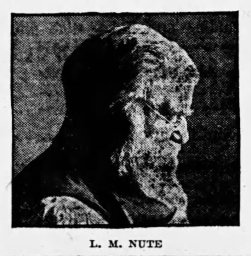 LEANDER M. NUTE, 94, DEAD AT PORTLAND. Oldest Dartmouth Graduate and a Violin Maker. PORTLAND, Me., Feb. 9 – Leander M. Nute, 94, oldest Dartmouth graduate, a violin maker, died this morning. Leander M. Nute was born in Milton, N.H., in 1831. After leaving school he taught for a time in the Pittsfield, N.H., Academy. He then entered Dartmouth, getting credit for one year on account of his teaching. He was graduated from the college in 1854 and had been for several years the sole survivor of his class. After leaving college he took a scientific course and thought that he wanted to be a railroad builder. His first job was on a project to run a railroad line from Saratoga to Sacketts Harbor. This was a failure, and the young man went West and worked in Michigan and Iowa. He then returned to the East and went into business as a shoe manufacturer in Berwick, Me., living in Somersworth, N.H. When he retired at the age of 68 he had 250 men on his payroll and his output was 1200 pairs a day. Then Mr. Nute decided to start a new career – one which perhaps had been for years his heart’s desire. He began making violins. Twenty years later he won first honors with one of his violins – his 278th – in the State competition of the Maine Violin Makers’ Association. For more than 20 years before his death Mr. Nute had made his home in Portland, Me. He had a shop there where he made his violins. Specimens of his work went all over the East. Mr. Nute was a Mason. His wife died many years ago (Boston Globe, February 9, 1925).
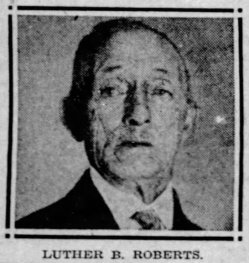 GRANDSON OF BUNKER HILL SOLDIER HERE. Luther B. Roberts, Milton Mills, N.H., Is Nearly 80. Luther B. Roberts of Milton Mills. N.H. nearly 80 who has been visiting relatives near Boston, is a grandson of John Roberts who fought in the Battle of Bunker Hill. His grandfather was born in 1753 at Dover Point. N.H., where the Roberts’ ancestors settled on land they bought from the Indians in 1673. John Roberts came to Boston in 1774 just in time to join the Revolutionary forces at Bunker Hill. He served for two years and was one of the men sent to Montreal by way of Lake Champlain. While on this trip he stopped at a hospital where an older brother, Moses, had died and there he found the man who had attended his brother in his last illness and who had buried him. Moses served in the French and Indian War. John Roberts married in 1778. There were 10 children. Luther’s father, Jere, was next to the youngest. John Roberts lived to be 93. His son, Jere, outlived all the other children and passed his 85th birthday. Mr. Roberts, who has been visiting his niece, wife of Speaker Hull of the Massachusetts House of Representatives, is going home to Milton Mills in a day or two but he will return to witness the celebration of the 150th anniversary of the Battle of Bunker Hill in Charlestown, June 17. He is active, his mind is as keen as ever and he has been mentally lively always, At his age he does look back a bit and reflects about friends. Luther Roberts was born in Waterboro in 1845. He learned his A B C’s in a red schoolhouse. “I’ve come from driving an ox team when I was 16 to see all the great improvements that there are now,” he says. He has been in active mercantile life. In 1878 he was a member of the New Hampshire legislature. In 1915 and 1916 he was in the legislature in Maine, representative from Portland. For four years he was a member of the Supreme Lodge of the order of Knights of Pythias. He and his wife, who was Nellie C. Berry, live now at the Berry homestead. Their one child living is Mrs. Eva Roberts Wood of White Plains, N.Y., who has two children. William R., and Janice. (Boston Globe, April 9, 1925).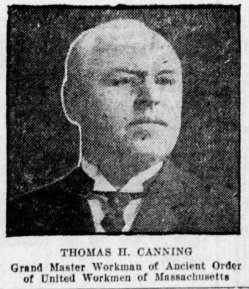

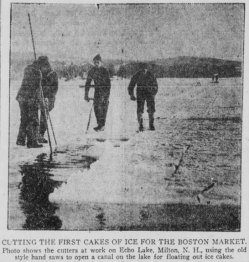 FIRST ICE TAKEN FROM ECHO LAKE. Harvesting Will Continue Five or Six Weeks — Supply Late But Plentiful. MILTON, N.H., Jan. 12. – The first ice cut this winter for the Boston market was taken out of Echo Lake yesterday where the ice is twelve and a half inches thick. Although this is nothing more than the usual thickness, the ice has been declared by experts to be of good quality and a plentiful though late supply is predicted. HARVEST AT HEIGHT. Echo Lake, which is 80 miles from the State House at Boston, is one of the largest contributors to the ice market at Boston, Lynn and Salem. During the next five or six weeks, when the ice harvest will be at its height, the lake is expected to furnish 100,000 tons for the summer supply of those cities. Although this is only a small part of the total supply, it will require the labor of 500 men and horses to harvest it. This year the quality of the ice will more than offset the lateness of the harvest, according to John Alexander Burbine, foreman for the Boston Ice Company, who has been cutting ice on the lake for the past 35 years. “It’s all solid water,” said he with a smile on his weather beaten face as he examined the first cutting today. “The crust of frozen snow is only an inch and a half thick, so that the cakes will be excellent. With good weather we ought to be able to fill the four houses on the lake during the next four weeks.” Every train is bringing seasoned ice handlers into Milton, scrapers, sawyers, groovers, floaters, chainmen, splitters and housemen. Some are old employees of the ice companies sent up from Boston, but the majority hail from neighboring cities and towns. The ice companies are able to employ only a very small portion of those who apply for work, so that hundreds have been turned away. Last year the wages paid were $4 to $4.50 for a 10-hour day. This year the schedule, it is said, will be $3 to $3.50 a day (Boston Post, January 13, 1921).

 For many years she longed for an opportunity to obey “the call” that insistently rang in her ears. But to do the work she longed to do meant great hardship and sacrifice – meant that she must first support and raise her family, for her husband had died and left her penniless.
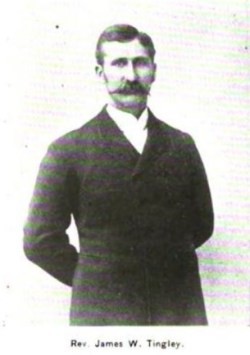 James W. Tingley, a city clergyman, aged sixty-six years (b. Canada), headed a Boston, MA, household at the time of the Fourteenth (1920) Federal Census. His household included his wife Naomi Tingley, aged fifty-seven (b. Canada), and his son, Harold E. Tingley, a general practice dentist, aged twenty-three years (b. Canada). Rev. Tingley had immigrated in 1885, while his wife and child had immigrated in 1887. (The son had “immigrated” by virtue of being born in the US to an alien mother). They were all naturalized when the father was in 1899. They shared a rented two-family dwelling at 62 Hobson Street with the household of George Holbrook, a shoe machinery manager, aged forty-three years (b. MA).




 Milton Observer