Chairman Thibeault and the Beanstalk

By S.D. Plissken | August 26, 2018

It may be that people these days are less familiar than formerly with the tale of Jack and the Beanstalk. Let us set the scene:

Jack is a young, poor boy living with his widowed mother and a dairy cow, on a farm cottage. The cow’s milk was their only source of income. When the cow stops giving milk, Jack’s mother tells him to take her to the market to be sold. On the way, Jack meets a bean dealer who offers magic beans in exchange for the cow, and Jack makes the trade. When he arrives home without any money, his mother becomes angry and disenchanted, throws the beans on the ground, and sends Jack to bed without dinner.

Chairman Thibeault had a bright idea, on which he expounded at last week’s Board of Selectmen’s (BOS) meeting. (Selectman Lucier was absent). Thibeault would like to trade the Town cow for some State magic beans.

Thibeault: Alright. Next on the agenda: A possible State Boat Ramp at the Town Beach. I put this on there [the agenda]. So, this has been talked about a little bit I guess in the past. I reached out to the State a little while ago to get some more information on the State boat ramp. Basically, it’s a 25 to 35-year lease with the State. They require designated trailer spots. It has to be open 24/7 for free – for boaters – to put your boat in and out. It is not intended to be a swimming area. It is not intended to be an area to fish off the dock. The State initially just took a look on Google Earth at the Town Beach. They didn’t say, “yes,” they didn’t say “no.” There were definitely some challenges if we were to try and do a State Boat Ramp there due to competitive parking. The fence would have to be changed a little bit. So, I just wanted to bring it up to the Board of Selectmen, because it’s essentially a Board of Selectmen decision. The State is – would be – willing to talk to us if we want to talk them to get further information. Like I said, it wasn’t a definite “no,” it wasn’t a definite “yes,” because there are challenges with the ball field, with the Town Beach, competing for parking. That was one of their initial concerns, so I wanted to share that with the Board – something to think about. Basically, the State then would be – they would pay for – the boat ramp and maintaining it for those years. So, something we can think about.

Hutchings: Do you want a response?

Thibeault: Yep.

Hutchings: I think it would be a shame to give that to the State. I really do. I think that’s probably kind of the pearl – in the oyster – is that beach area.

Thibeault: You wouldn’t be giving the beach area. Just the spot for the ramps.

Hutchings: You’re going to wind up losing – I mean it’s not a huge area to begin with. We have to give parking up for … for trailers and that. We’re going to lose quite a bit, I think. I asked one of the employees Sunday who was working at the gate to pull up the numbers knowing that this was on the agenda and the amount of money that that brings in up there – I think it would be shame, I mean it’s self-sufficient. I think if we took our money and repaired the boat ramp ourselves, as a town. I think, … I just think it would be a shame to give that away to the State. You’re talking since the middle of May ’til the middle of August, it’s brought in almost $33,000 and that’s not saying the …

Thibeault: $33,000?

Hutchings: $33,000 – $32,726. The boat ramp and the beach. I’m lumping it altogether, because ….

Thibeault: I’ve asked several times how much the boat ramp itself brings in and was told it couldn’t be separated.

Hutchings: Well, I went up and asked Diane on Sunday morning early if she would mind doing this, because when I saw this and she said, how do you want it broke down …

Thibeault: There’s something wrong with those numbers, I think.

Hutchings: Well, I’m saying this is the beach and the boat ramp.

Thibodeau: What were those numbers again?

Hutchings: $32,726, starting from May 8th all the way to August 16th.

Thibodeau: 32 what?

Hutchings: $32,726. The boat ramp – it’s not that the boat ramp brings in the huge amount – the beach brings in the bigger number, but I sat out there, I’ve gone out several times and sat there and watched people who’ve come up, and they bring the whole family, some one of – Uncle Bob we’ll say – brings up the boat, he puts the boat in, and the kids are all out there playing on the beach and then they alternate – they run ’em through. There’s a lot of that that goes on. I think it would be a shame to give that to the State. I really do. So …

Thibeault: I think there’s several options down there and I think we could still charge for the beach and the State ramp would actually bring people into town and promote the town of Milton, which economy is hurting and help the businesses in town because you’d have a State-advertised boat ramp. I do think that we need to be able to separate out how much money just the boat ramp is taking in and my understanding is the way they … they can’t do that right now. The Rec. Commission had actually voted and made a recommendation that that be separated out and I’m not sure where that stands. But, I’m not saying give up the whole Town Beach to the State. That’s not at all what I’m saying if you give up

Hutchings: But I think if you give up …

Thibeault: a small part. I’m open to discussing with the State, to see what they have to offer, because it would be a way to get. like I said, a State boat ramp would get us on the map with the State, and also, I mean, we won’t have to pay the cost of putting in the new ramp.

Hutchings: Which is what – about 30 grand? And we already have $15,000 that the taxpayers in town earmarked for it a year or two ago. Two years ago.

Thibeault: But it’s $30,000 we could use on other areas …

Hutchings: There’s $32,726 we could use to put in a new boat ramp. We could put in a nice pavillion down there, so the kids aren’t having to use the tent. I mean, there’s all kinds of things that we could use …

Thibeault: You’re sure there’s no summer camp money in that?

Hutchings: Positive.

Thibeault: Okay. Alright.

Hutchings: I’m just saying. I just think it would be shame to give that away.

Thibeault: Alright. I just think that we need to think outside the box and the $10 fee that we get at the boat ramp – or whatever it is – we have to account for how we are going to bring people into town. And that free advertisement that the State would give us, I think that would help. I wanted to share that with the Board and I guess right now we don’t really have a decision one way or another. So, we can move on.

Now, Thibeault claims that his scheme would save money, a claim that Hutchings questions. But note his main rationale: this would bring people into town to use the now State ramp, which would help businesses, and the State would do the advertising.

The truth is that “helping” businesses is not a governmental function at all. No taxpayer resources whatsoever should be devoted to that purpose. None, nil, zilch.

Government’s supposed justification has always been the protection of life, property, and liberty. At the town level, it is usually taken to also include maintenance of roads and schools. Business and its concerns – its successes or its failures – have no part in this. The town government does not have to, as Chairman Thibeault has it, “account for how we are bringing people into town.” “Boosting” business is not a concern of government of at all.

Surrendering a part of the Town Beach – as some have said, its “pearl” – to the State based on Chairman Thibeault’s theory – just a theory, mind you – that it would somehow “help” business is misguided. That has the taxpayers subsidizing the businesses. That is not how free markets work. He needs perhaps, as happened to Jack in the story, to be sent to bed without his dinner.

But neither he nor Milton town government will welcome these truths.

Of all the offspring of Time, Error is the most ancient, and is so old and familiar an acquaintance, that Truth, when discovered, comes upon most of us like an intruder, and meets the intruder’s welcome.

References:

Milton Board of Selectmen. (2018, August 20). Milton Board of Selectmen Meeting, August 20, 2018. Retrieved from https://youtu.be/LfPichonEYQ?t=1840

Wikipedia, (2018, August 23). Jack and the Beanstalk. Retrieved from en.wikipedia.org/wiki/Jack_and_the_Beanstalk

Wikipedia. (2018, May 20). Extraordinary Popular Delusions and the Madness of Crowds. Retrieved from en.wikipedia.org/wiki/Extraordinary_Popular_Delusions_and_the_Madness_of_Crowds

Milton and the Knowledge Problem

By S.D. Plissken | August 13, 2018

Milton has a serious knowledge problem: it lacks awareness of the “Local Knowledge Problem.”

A succession of Milton selectmen, town officials, planners, economic developers, as well as much of its population, have been absolutely certain that Milton needs a family restaurant at Exit 17. They have known this, almost as an article of faith, for years. Few question it.

Some might ask how they received this revelation (or why they have persisted in believing it for so very long). Well, they will tell you. The major weight of Milton’s increasingly high property taxes is borne by homeowners. Unaccountably, those taxpayers do not like to bear that burden. So, that tax burden should be shifted onto businesses. Or, at least it could be, if there were only more businesses. Milton needs more businesses.

The business owners’ incentive to line up for this mulcting remains unclear. It might appear that they have none at all. Alternatives, such as reductions in town government or in its budgets (or even just holding the line), easing local regulations, seeking state regulatory relief, etc., are never seriously considered. That would be crazy. Milton just needs more businesses.

There are aesthetic considerations too. Milton deplores just any business venture that might arise through natural market processes. (Witness the China Pond and Mi-Te-Jo expansion melodramas). Milton does need more businesses, but they need to be the “right” sorts of businesses.

Restaurants might be good, but franchise restaurants are obviously less so. They do not strike the right tone; they are a bit déclassé. However, a “family” restaurant could work quite nicely. That would be just the “right” sort of business. Absolutely. Milton needs a family restaurant business at Exit 17. No doubt at all. The town government knows what is best for Milton.

But it does not know. It could never know – that would be impossible – because of the “Local Knowledge Problem.”

Professor F.A. Hayek (1899-1992) of the London School of Economics (and winner of the Nobel Prize in Economics) published “The Use of Knowledge in Society” (often called the “Local Knowledge Problem”) in the American Economic Review in September 1945. His article was rated recently as among the most important 20 papers of the last 100 years. In it, Hayek explained why central planning is all nonsense.

The knowledge required for economic planning is imperfect, transitory, and widely dispersed among many actors. No board, commission, or committee of individuals could ever hope to assemble enough for an optimal solution (and perhaps not even enough for a poor one). It is impossible for them to do so. The necessary knowledge resides temporarily – the situation is ever changing – in the array of all market participants. (Nowadays, it might be said that the necessary knowledge and information is “Crowd Sourced”).

As one proceeds north from Milton along NH Route 16, the results of successful decisions based upon such dispersed local knowledge may be seen readily. There are three gas station convenience stores, two restaurants, a trading post, an auto parts store, a sugar house, a Kung Fu dojo, a garden center, a motel, a farmers’ & crafters’ market, a stove museum, and a fish farm. There are also quite a few home-based businesses. In season, there are several farm stands.

All of these businesses were created without benefit of central planning, through market processes. Their entrepreneurs took a chance, based upon their own intuition and local knowledge. They invested their own capital (available in part due to lower taxes), resources, and effort in those concerns. Bravo! They have satisfied market demand, and done so with no cost, risk, or loss to taxpayers if they fail to thrive.

Milton’s central planners have their thumb on the scale in “knowing” that Milton needs a family restaurant. Without adequate knowledge, which they can never have, it is their own preferences they put forward in defiance of market desires. That can garner only imperfect results at best and likely “it will all end in tears.” (Remember the most recent strong preference failure of this sort: the landfill?).

Why should it not be that an electric car-charging station, farmers’ market, sheep farm, meadery, dojo, cell-tower, billboard, or things not yet imagined arises at Exit 17? Why is a family restaurant necessarily the optimal solution? How can planners know that? (A free market might even prefer that location remains as it is). Obviously, they cannot.

Yes, there is a sort of arrogance to it all. Milton and its taxpayers are not part of some SimCity game.

Of course, there is also the additional hurdle of water and sewer facilities. The proposed Exit 17 location lies beyond the town water network. (Exit 18 is even further beyond the Pale). It has been estimated that it would cost at least $1 million to extend those services out to the desired restaurant site. That is daunting. But, wait. BOS Vice-chairwoman Hutchings revealed recently that the $1 million figure is an underestimate. In fact, it would cost much more than that, vastly more. (And government estimates usually need to be tripled to approach real-world accuracy).

Tax reductions would allow business growth. But that implies an attendant government reduction. Town government sees no benefit in reducing itself: such a proposal lacks appeal. Impossible. Put such notions aside.

The Exit 17 family restaurant must remain an article of faith. Government planners know it.

Meanwhile, the Stop, Drops & Rolls coffee shop closed this week. Its proprietor seeks to sell both the business and the property. “We just can’t generate the customers to continue to stay open.”

References:

Hayek, Friedrich A. (1945, September). The Use of Knowledge in Society. Retrieved from fee.org/articles/the-use-of-knowledge-in-society/

Stop, Drops & Roll. (2018, August 6). It Is a Sad Day Today. Retrieved from www.facebook.com/StopDropsandRoll/

Wikipedia. (2018, August 13). Friedrich Hayek. Retrieved from en.wikipedia.org/wiki/Friedrich_Hayek

Wikipedia. (2017, June 20). Local Knowledge Problem. Retrieved from en.wikipedia.org/wiki/Local_Knowledge_Problem

Wikipedia. (2018, August 3). SimCity. Retrieved from en.wikipedia.org/wiki/SimCity

Electra, Dorian. (2010, December 20). I’m in Love with Friedrich Hayek. Retrieved from www.youtube.com/watch?v=Arbfem4BohA

Milton and the Spaulding Turnpike

By Muriel Bristol | June 5, 2018

The NH State Legislature authorized construction of a northern extension of the Eastern Turnpike in 1953. The Eastern Turnpike would consist of the just completed (1950) Blue Star Turnpike or NH Turnpike (now also Interstate 95), which ran from the Massachusetts border to the Portsmouth traffic circle, as well as a northern extension, which would run from the Portsmouth traffic circle to the Dover-Rochester area.

The first five miles of the Eastern Turnpike’s northern extension, ran from the Portsmouth traffic circle, through Newington, to Exit 6 (US Route 4) at Dover Point. Construction began in May 1954 and opened in September 1956.

Huntley N. Spaulding (1869-1955) and his brother, Rolland H. Spaulding (1873-1942), both of north Rochester, were manufacturers of leatherboard and fiberboard at their family’s mills in New Hampshire, Massachusetts, and New York. They both served as NH Governors: Rolland in 1915-17, and Huntley in 1927-29. Both they and other members of their family were philanthropists. The northern extension of the Eastern Turnpike was renamed to the Spaulding Turnpike by March 1954, presumably in their honor. (Huntley N. Spaulding died in November 1955).

The second seventeen-mile section of the now Spaulding Turnpike ran between Exit 6 (US Route 4) at Dover Point to Exit 12 (US Route 202 | NH Route 11 | NH Route 125) in Gonic, in Rochester. This second section bypassed the Dover Point Road, downtown Dover, and NH Route 108 between Dover and Rochester. It opened in August 1957.

The Portsmouth Herald observed that by “Connecting with the New Hampshire Turnpike, the Spaulding Turnpike will give motorists a superhighway from the Massachusetts line to Rochester and easier access to the mountain region of the state.”

The Spaulding Turnpike and NH Route 16 ran concurrently from Portsmouth Circle towards Rochester, where the Spaulding Turnpike ended at Exit 12. (NH Route 125 ran from the Massachusetts border at Haverhill, MA, through Plaistow towards Rochester). NH Routes 16 and 125 then ran concurrently from there through downtown Rochester, north along Milton Road in Rochester towards Milton, and through Milton along the White Mountain Highway to Union (Wakefield).

Milton enjoyed a tourist boom in the 1960s and 1970s. It had lost its train station by 1960. But it was now the first town (as opposed to Rochester) through which the increased traffic of the Spaulding Turnpike passed after Exit 12. (Some estimates were triple the traffic). Many travelers considered Milton to be a halfway point to the White Mountains. It was a good place to break one’s journey.

Older residents and through-travelers recall that Milton had more mercantile activity, such as general stores, hardware, antiques, garages, etc., during this period. Other venues catered to lunches, ice cream treats, and summer activities. Its public beach had been open since about 1948. Mi-Te-Jo Campground has been here from at least the 1960s. Ray’s Marina replaced the train station in 1962. There were even water-ski jumps in the Depot Pond.

Then the NH Department of Public Works and Highways (now the NH Department of Transportation (NHDOT)) announced plans for a third section of the Spaulding Turnpike in 1973. The NH legislature authorized it in 1977. It would continue twelve miles from Exit 12 in Rochester to the current Exit 18, just short of the Milton-Union (Wakefield) border. This third section opened in 1981 after three years of construction.

Milton had been by-passed and its stretch of the White Mountain Highway is now a by-way, rather than a highway.

The NH Route 16 designation had shifted successively from its original path through Dover Point, downtown Dover, and NH Route 108 as Spaulding Turnpike construction advanced. Somewhat belatedly, that designation shifted away also from downtown Rochester and Milton to the Spaulding Turnpike in the mid-1990s.

NH Route 16 continues north from Exit 18 of the Spaulding Turnpike. Its alternate name of  White Mountain Highway is still used in those stretches of the “old” NH Route 16 that have been bypassed or re-aligned. It is also used in stretches that continue to align with the modern NH Route 16. It is so called in Milton, Sanbornville (Wakefield), West Ossipee, Tamworth, Conway, and North Conway.

References:

Carroll County Independent. (1926, September 3). Record of Public Service Best Campaign Argument. Center Ossipee, NH.

Eastern Roads. (n.d.). Spaulding Turnpike. Retrieved from http://www.bostonroads.com/roads/spaulding/

NH Department of Transportation. (2015). Spaulding Turnpike. Retrieved from https://www.nh.gov/dot/org/operations/turnpikes/system/spaulding.htm

Portsmouth Herald. (30 August 1957). Spaulding Turnpike Now Open to Traffic. Published Portsmouth, NH

Portsmouth Herald. (1977, June 24). News Briefs. Published Portsmouth, NH

Wikipedia. (2018, February 17). New Hampshire Route 16. Retrieved from https://en.wikipedia.org/wiki/New_Hampshire_Route_16

Wikipedia. (2017, September 25). Spaulding Turnpike. Retrieved from https://en.wikipedia.org/wiki/Spaulding_Turnpike

Uber of 1926

By Muriel Bristol (Transcriber) | June 4, 2018


PUBLIC AUTO

COMFORTABLE CAR, RATES REASONABLE

Mrs. Blanche H. Barbour

UNION, N.H.

Tel. Milton Mills 33-21


References:

Carroll County Independent. (1926, September 3). Public Auto. Published Center Ossipee, NH

Milton’s Railroad Line

By Muriel Bristol | May 28, 2018

Railroad - 1860

The railroad line that passes through Milton was built by the Great Falls and Conway Railroad. The railroad was incorporated in 1844, and was then

… authorized and empowered to locate, construct, and finally complete a railroad, beginning at or near the depot of the Boston and Maine Railroad, in Somersworth, and thence running through said Somersworth, Rochester, Milton, Wakefield, Ossipee, Effingham, Freedom, or Tamworth, to any place in Conway (Gregg and Pond, 1851).

The Great Falls and Conway line connected in Somersworth to the Great Falls and Berwick Railroad, which in turn connected to Portsmouth and beyond. The two railroad companies merged under the name Portsmouth, Great Falls & Conway Railroad (PGF&C) in 1848.WW-1851

Construction began at the Somersworth (Great Falls) end and the stretch between there and Rochester opened on February 28, 1849. It had reached “South Milton” by 1850.

An 1851 tourist guide had Gt. Falls & Conway Railroad service terminating in Rochester. Chestnut Hill, Milton, and points beyond were accessible by stage only.

A blasting accident injured three members of a railroad construction crew extending the tracks beyond Milton in December 1852.

Milton was said to be the “terminus” in 1854, but construction had reached Wakefield’s Union village by 1855. There it stalled due to financial difficulties.

A Boston & Maine advertisement of 1861 mentioned that its Portland, ME, train connected with the Great Falls & Conway Railroad at Great Falls, NH, i.e., Somersworth. Wakefield’s Union village is the end of the line; travel beyond there was by stagecoach.

The 8.46 AM Train from Portland connects at Great Falls with the Cars of the Great Falls and Conway Railroad, for Rochester, Milton and Union Village, and Stages for Milton Mills, Wakefield, Ossipee, Conway, etc.; and at Dover, with the Cars of the Cocheco Railroad, for Rochester, Farmington, Alton, and Alton Bay; and with Steamer Dover, in Summer, on Lake Winnipiseogee, for Wolfboro, Center Harbor and Meredith Village, with Stages from Center Harbor for Conway and White Mountains (Willis, 1861).

Railroads have rarely been economically viable. The history of railroads is a history of government subsidies and interventions in favor of railroads. (A notable exception was James J. Hill and his Great Northern Railroad). But the Republican administrations that dominated the post-Civil War era were not overly attached to free market principles. As a general rule, they favored “internal improvements” (now called “infrastructure spending” or government “investment”), including railroad subsidies and other interventions.

The moribund Portsmouth, Great Falls and Conway railroad (PGF&C) construction was revived in July 1865, at least to some degree. But serious progress did not happen until the Eastern Railroad (eastern Massachusetts with branches) leased the PGF&C lines in September 1870 (it guaranteed the PGF&C’s bonds).

NEW HAMPSHIRE. At the meeting of the stockholders of the Eastern Railroad in New Hampshire, and the Portsmouth, Great Falls and Conway Railroad; held in Portsmouth, on Monday, the lease ot the latter road to the former was voted (Vermont Journal (Windsor, VT), September 24, 1870).

Leasing was often a mechanism to eliminate competition; mergers often followed those leases.

The Eastern Railroad extended the PGF&C lines from Union to Wakefield, and then on to West Ossipee, between September 1870 and October 1871.

WHIFFS FROM NEW HAMPSHIRE. Last week at a town meeting, Ossipee voted five per cent. of its valuation to aid in extending the Great Falls and Conway railroad from Union Village to West Ossipee. There has been a wrangle over this railroad for several years, the track has been surveyed three times, each time locating somewhat better (New England Farmer (Boston, MA), September 13, 1870).

NEW HAMPSHIRE. Ossipee, having voted five per cent to have a railroad, is puzzled which of the three routes surveyed to choose, and will have to let the conformation of ground, and scarcity or abundance of rocks settle the question for it (Vermont Journal (Windsor, VT), September 24, 1870).

NEW HAMPSHIRE. The first passenger train over the Portsmouth, Great Falls and Conway extension passed to Wakefield station, six miles beyond Union, on Monday (Vermont Journal (Windsor, VT), [Saturday,] July 1, 1871).

The Great Falls and Conway Railroad is open to West Ossipee, N.H. (New England Farmer (Boston, MA), October 14, 1871).

By the beginning of July 1872, the Eastern Railroad was advertising that

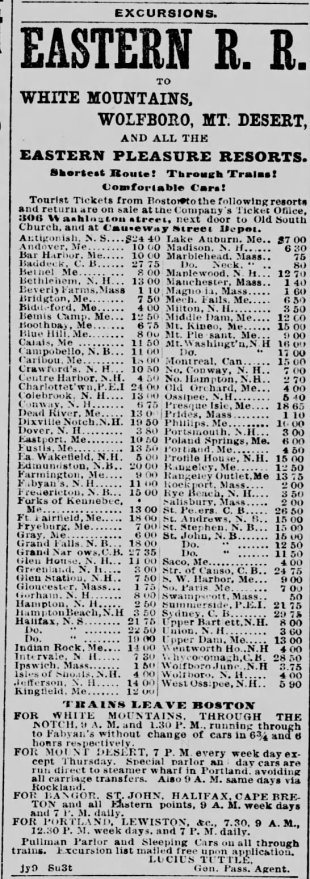
THE PORTSMOUTH, GREAT FALLS AND CONWAY RAILROAD Is completed and running Trains to North Conway, and in connection with the Eastern Railroad forms the Shortest, Quickest and Only Route to North Conway and White Mountains … (Boston Globe, July 1, 1872).

The North Conway station was built in 1874. The PGF&C connected to the Portland and Ogdensburg Railway line at Intervale in 1875.

The Milton station depicted in old postcards and pictures was built in 1873. The original station stood on the “Lebanon side,” i.e., still in Milton, but on the other side of the Salmon Falls River..

Historian Sarah Ricker seemed to think the station and the ice business began together in 1873, although she did not specify whether the chicken or the egg came first. She further reported that “… the area’s ice industry experienced tremendous success in the 1880s. The Milton Ice Company, one of five such businesses in town, shipped up to 100 carloads of ice to Boston every day.” Ice cutting is a seasonal affair, of course. Those ice companies remained active until the late 1920s.BG820722-Excursion

The Eastern Railroad renewed its lease on the PGF&C line for a period of 60 years in 1878, but the whole was taken over by the Boston & Maine Railroad in 1890, which operated it as its Conway Branch line.

Transporting lumber and ice were early mainstays of the railroad. Mills sprang up, especially in places that had both the train and water power. That added raw materials and finished products to the freight. Milton participated in both ice and manufacture, but the mills and trains enabled also an exodus of sorts. An 1882 description of Milton mentioned that “there has been a small [net] decrease in population during the last twenty years, many leaving town for the cities and larger manufacturing towns for the purpose of engaging in other business than farming.”

The White Mountain Art movement predated railroad access to the White Mountains. This landscape painting movement began with stagecoaches in the early nineteenth century and had its heyday in the mid-nineteenth century. But it did enjoy improved railroad access for a time and it encouraged an initial wave of tourists to the White Mountains. Those tourists came by train. By the latter part of the nineteenth century, the White Mountain Art movement was being supplanted by the Hudson River School, Rocky Mountain art, and photography.

According to the Conway Scenic Railroad, North Conway is the “birthplace of American skiing.” Snow trains began running in 1932 to serve those skiers. “Countless skiers rode the snow trains as the sport of skiing grew with the development of ski lifts.” (See also Milton in the News – 1952 for a description of a snow train journey).

By the early 1950s, improved highways and America’s love affair with the automobile led to a decline in passenger service. Passenger service to Boston ended on December 2, 1961, as a single B&M Budliner headed south never to return. Freight customers continued to decline, too, and the last freight train departed on October 30, 1972 (Conway Scenic Railroad, n.d.).

The Portsmouth Herald published a list of fifteen Boston and Maine Railroad stations that would close as of June 1, 1958:

Here is a list of the 15 Boston & Maine Railroad stations in New Hampshire where passenger service will be discontinued June 1. Bath, Sugar Hill, Jefferson, Randolph, Fitzwilliam, Troy, Keene, Walpole, Hayes, Milton, Union, Burleyville, Mountainview, Mount Whittier, and Madison (Portsmouth Herald, May 9, 1958).

Ray’s Marina had supplanted the Milton Train Station by May 1963. The B&M went bankrupt in 1970. The last passenger train between Rollinsford and North Conway ran in 1972.

The railroad line continues in a limited way under the New Hampshire Northcoast Railroad (NHN). Ossipee is now its northern terminus. (Several disconnected stretches north of there are run as tourist attractions). It carries no lumber, ice, mill products, artists, skiers, or tourists now. It services only the sand pits of Ossipee with twice daily runs. They pass right on through and do not stop here.

Ray’s Marina closed in 2012. The train station’s freight depot building still remains, as a part of the Ray’s Marina complex. (Facing the marina buildings and the pond, it is the small building or shed on the left-hand end).


See also Milton’s Railroad Station Agents


References:

American-Rails.com. (2018). Surviving New Hampshire Railroad Stations. Retrieved from https://www.american-rails.com/support-files/new-hampshire-railroad-stations.pdf

Conway Scenic Railroad. (n.d.). A Brief History of Our Station. Retrieved from https://www.conwayscenic.com/history/station-history/

Foster’s Daily Democrat. (2016, May 12). Obituary: Rheaume J. (Ray) Lamoureux. Retrieved from http://www.legacy.com/obituaries/fosters/obituary.aspx?n=rheaume-j-lamoureux-ray

Gregg, W.P. and Pond, Benjamin. (1851). Railroad Laws and Charters of the United States. Boston, MA: Charles Little and James Brown

Historic Wakefield. (n.d.). Heritage Park Railroad Museum. Retrieved from http://www.historicwakefieldnh.com/heritage-park-.html

Hurd, D. Hamilton. (1882). A History of Rockingham and Strafford Counties. Philadelphia, PA: J.W. Lewis & Co. (also retrievable from Archive.org: https://archive.org/stream/historyofrocking00hurd#page/n5/mode/2up)

Jonathan (The Shark (102.1 & 105.3 FM)). (2016, April 1). Restaurants Eyeing The Site Of Ray’s Marina In Milton. Retrieved from http://shark1053.com/restaurants-eyeing-the-site-of-rays-marina-in-milton/

Marvel, William (Conway Daily Sun). (2018, May 2). Then and Now: A Conspicuous Manisfestation of Industry, 1890. Retrieved from https://www.conwaydailysun.com/community/history/then-and-now-a-conspicuous-manifestation-of-industry/article_279bf71c-4969-11e8-b663-b7d076758d9e.html

Poor, Henry V. (1860). History of the Railroads and Canals of the United States of America. Retrieved from books.google.com/books?id=M0YKAAAAIAAJ&pg=PA53

Ricker, Sarah. (1999). Milton and the New Hampshire Farm Museum. Arcadia Publishing: Charleston, SC, Chicago, IL, Portsmouth, NH, and San Francisco, CA

Rochester Courier. (1960, January 7).  Close [Sanbornville] R.R. Station. Rochester Courier: Rochester, NH

Rochester Courier. (1960, January 28). B and M Requests Permission to Drop Passenger Service Entirely on Conway Branch. Rochester Courier: Rochester, NH

Wikipedia. (2018). Portsmouth, Great Falls and Conway Railroad. Retrieved from https://en.wikipedia.org/wiki/Portsmouth,_Great_Falls_and_Conway_Railroad

Wikipedia. (2018, March 10). White Mountain Art. Retrieved from https://en.wikipedia.org/wiki/White_Mountain_art

Williams, W. (1851). The Traveller’s and Tourist’s Guide Through the United States of America, Canada, etc. Retrieved from books.google.com/books?id=OKAoECHHbM4C&pg=PA10

Willis, William. (1861). A Business Directory of the Subscribers to the New Map of Maine. Retrieved from books.google.com/books?id=mKm9lz1RH_0C&pg=PA307

Rochester’s Pink Cadillac Diner Closes

By S.D. Plissken | May 17, 2018

The Pink Cadillac Diner (at 17 Farmington Road (Exit 15)) in Rochester closed Monday, May 14, after 17 years (it opened in December 2001).

The owner posted a farewell to the diner’s Facebook page on the afternoon of May 14:

It is with a heavy heart that we must confirm the closing of the Pink Cadillac Diner.

To our dedicated and exceptional staff that stood by us every day, we cant express enough sorrow or gratitude for every day, every ounce you had, every laugh and every milestone we got to be apart of. Thank you for giving us more than we ever could have asked for. We are here for whatever you may need, please reach out.

To our customers, past, present, near & far, we cannot thank you enough for allowing us the opportunity to serve you over the last 17 years. You have all become friends and family; you have been there for us and we have had the ultimate privilege of being there for you.

We are saddened to have to make this decision but please know, we are dealing with the loss as well. If you care to reach out, we will do our best to accommodate in any way we can.

Again, thank you all for everything. We love you, thank you.

The owner gave no reasons for the closure, which appears to have been rather sudden. He had been advertising for additional help as late as March 22. The closure was announced in the late afternoon. Most (but not all) of the staff were informed by telephone. The diner did not open the following morning.

The Pink Cadillac is the third Rochester restaurant to close recently. Mel Flanagan’s Irish Pub & Café (at 50 North Main Street) closed back in January, and Gary’s Sports Restaurant & Lounge (at 38 Milton Street (Route 125)) will close on Friday, May 25, both due to their owners’ respective health issues.

It worth noting that, in several respects, the Pink Cadillac Diner at Exit 15 in Rochester was exactly what is always being put forward as a panacea for Exit 17 in Milton.

References:

Pink Cadillac Diner. (2018, May 14). Pink Cadillac Diner Facebook. Retrieved from https://www.facebook.com/pinkcadillac.nh/

Kiley, Karen (WOKQ). (2018, May 16). Popular Rochester Diner Suddenly Closes Leaving Customers Stunned. Retrieved from http://wokq.com/popular-rochester-diner-suddenly-closes-leaving-customers-stunned/

Stucker, Kyle (Foster’s Daily Democrat). (2018, May 15). Rochester’s Pink Cadillac diner abruptly closes. Retrieved from https://www.fosters.com/news/20180515/rochesters-pink-cadillac-diner-abruptly-closes


Burning a Hole in Their Pocket

By S.D. Plissken | May 13, 2018

The Milton Town Administrator calculated during the Joint BOS and Budget Committee meeting of Monday, December 4, 2017, that the mass assessment had caused some $1.4 million to be collected above and beyond that needed to cover the budget. According to the breakdown in the Press Release of November 13, 2017, that would be a $247,660 overage for the county and state school taxes, $403,900 overage for the Town, and $748,440 overage for the local school tax.

The Board of Selectmen (BOS) have never explained in any public setting how this came to be. (It is not apparent that they understand it themselves). Nor have they ever explained how they plan to return the overages to the taxpayers, either as refunds, tax credits, or by some other method.

Like as not, they are incapable of ever retrieving the state and county amounts totaling $247,660 that were over-collected as a result of this “process.”

Instead, they have devoted themselves to parking issues. It seems that there are rental units near the dam that lack the currently mandated two parking spaces per housing unit. The BOS have never explained whether that shortage is the result of a failure to enforce that mandate or whether those units predated the requirement. In any event, those renters without parking at their residence park instead on White Mountain Highway (the state highway), presumably to the detriment of the business owners that front that highway. Except during the winter parking ban, when they park on the state land near the dam.

Meanwhile, the purchasers of the former Ray’s Marina property have found that they too are short of parking requirements. The former owners had access to the parking spaces now occupied by the Milton Crossing strip mall (Dunkin’ Donuts/Dollar General), as well as a triangular patch on the pond side. The new owners had intended to open a restaurant, but one that also had some associated residence units. Their redevelopment process has been stalled for at least a year, reportedly over their parking shortage.

At the most recent BOS Meeting, that of Monday, May 7, 2018, item 10 on their Agenda was the Parking Plan, Design & Purchase. The Town Administrator explained that they had discussed the Parking Plan at the most recent Workshop meeting (not recorded). She reminded them that the DPW Director, Pat Smith, had arranged for them all to visit the property in question. It was 25 to 30 with “metes and bounds” or 15 to 20 without those “metes and bounds.” He “… really wants the Board to make a commitment on buying the land and moving forward with it.”

Chairman Thibeault recalled that the “… number was $400,000 with the assumption that 70% of that was ledge.” Selectwoman Hutchings recalled that it was “closer to $500,000 … not including the purchase price of the land either.”

Selectman Lucier wanted to “table” the issue until the next meeting. The Town Administrator reminded them that the DPW Director sought a commitment. Chairman Thibeault gave his opinion that he “… is all in favor of improving parking downtown, but I think this particular spot needs to be abandoned and we need to look at different options. It’s way too expensive for what we have.”

It would seem that the BOS has decided to spend public money for private purposes, i.e., parking for either private residences or businesses, or both. They drew back from this particular property as being too expensive – price plus $400,00 to $500,000 of site work – but apparently it would all have gone differently had it been cheaper.

It is likely legal for them to solve private parking problems with public money, but is it legitimate, ethical, or even politically-savvy for them to do so?

Back in April, Selectmen Lucier questioned the purchase of a tractor for the beach. He thought rightly that a purchase of that size should go before the voters. (“I don’t think the three of us [Selectmen] should make a $10,000 choice. It should be the voters or taxpayers of Milton. They’re the ones who are paying the bills”).

But that does not matter now. They have $403,900 of taxpayer money and it is burning a hole in their collective pocket.

References:

Milton Board of Selectmen. (2017, December 4). Milton BOS Meeting, December 4, 2017. Retrieved from https://youtu.be/iHs1VF2tO28?t=3269

Milton Board of Selectmen. (2018, April 2). Milton BOS Meeting, April 2, 2018. Retrieved from https://youtu.be/hOJyH7ZPHEI?t=3141

Milton Board of Selectmen. (2018, May 7). Milton BOS Meeting, May 7, 2018. Retrieved from https://youtu.be/6oeKNRKTPSw?t=4010

Milton Town Administrator. (2017, November 13). Press Release. Retrieved from http://www.miltonnh-us.com/uploads/index_683_1719174841.pdf


Local NH Liquor & Wine Outlet Stores Join Business Migration to Route 11

By S.D. Plissken | May 1, 2018

The NH Liquor & Wine Outlet stores at the Lilac Mall in Rochester and on Route 11 in Farmington have closed.

The NH Liquor Commission (NHLC) announced on March 2 that it would “… open a new, 20,000-square-foot New Hampshire Liquor & Wine Outlet on Tuesday in Rochester. The state-of-the-art, freestanding store, which is located within The Ridge Marketplace on Route 11 just off Exit 15 of the Spaulding Turnpike, features an enhanced shopping experience, more than 6,600 sizes and varieties of wines and spirits, and a strategic location providing exposure to more than 36,000 daily motorists. NHLC anticipates this new store generating $9.5 million in sales each year. This new, larger location will replace the existing Lilac Mall store on Route 125 in Rochester and the Route 11 site in Farmington.”

NH Liquor Commission Chairman Joseph Mollica said, “We are constantly evaluating our stores looking for opportunities to optimize our sales success, which last year reached an all-time record of nearly $700 million. This new store will serve our customers in Farmington, Rochester, and neighboring communities in Maine, as well as the traveling public.”

The new Ridge Marketplace location opened as planned on Tuesday, March 6. It is 5 miles from the former Farmington location and 3.4 miles from the former Lilac Mall location.

In related news, the NHLC closed the Dover and Somersworth outlets in favor of a larger new Somersworth outlet. The Portsmouth Circle outlet is being expanded in place.

New Hampshire is one of seventeen states that chose to create state-run monopolies when Prohibition was repealed in 1933. (The other choices being continued state-level prohibition and licensing private vendors).

NH Public Radio (NHPR) ran a short report of the history of NH liquor licensing on its Only In New Hampshire show in December 2017: You Asked, We Answered: Why Do All New Hampshire Bars Have To Sell Food? (11:28).