By Muriel Bristol (Transcriber) | January 23, 2020
In this year, we encounter a pair of Milton snowbirds, a letter to the editor, Milton cottages for rent or sale, a running child, the Minnewawa Council, Little America cottages for sale or rent, a summer job (and coffee cake recipe), a fatal auto accident, two toddlers killed in an auto fire, a hunting death, and Robert E. Jones’ birthday remembered.
Sisters Mrs. Ingeborg V. “Ivy” (Swanson) Townsend, of Milton Mills, widow of Henry Townsend, and Mrs. Ruth H. ((Swanson) Iovine) Dawson, of Milton, visited Orlando, FL, as tourists in February 1951.
I.V. Townsend, a widow, aged seventy-two years (b. NH), headed a Milton (“Milton Mills”) household at the time of the Sixteenth (1940) Federal Census. Her household included her boarder, Harold Dawson, a life insurance salesman, aged twenty-seven years (b. NH). Ingeborg Townsend owned her house on [Milton Mills’] Main Street, which was valued at $2,500.
Tourist Registrations. Mrs. I.V. Townsend. Milton Mills, N.H., Mrs. Seth F. Dawson. Milton, N.H. (Orlando Evening Star, February 14, 1951).
Mrs. Ingeborg Townsend served on the Frisbie Hospital open-house-day committee in September 1951 (Farmington News, September 28, 1951). Mrs. Ruth H. Dawson would embark upon a political career.
Milton Leatherboard manager M. James Guild wrote to the editor of the Boston Globe with his concerns that unbalanced budgets constituted a threat to democracy.
M. James Guild, a leather-board manager, aged fifty-two years (b. Scotland), headed a Rochester, NH, household at the time of the Sixteenth (1940) Federal Census. His household included his wife, Eva [M. (Taylor)] Guild, aged forty-seven years (b. MA), and his children, Josephine C. Guild, aged twenty-two years (b. MA), M. James Guild, Jr., a leather-board laborer, aged eighteen years (b. VA), Frederick W. Guild, aged fourteen years (b. VA), and Kenneth S. Guild, aged ten years (b. NH). M. James Guild owned their house on White Hall Road, which was valued at $8,000. They had resided in the “same house” in 1935.
Meston James Guild of Whitehall Road, Rochester, registered for the WW II military draft in Rochester, NH, April 27, 1942. He was fifty-five years old (b. Wells, Somerset, England, March 7, 1897), and employed by the Milton Leather-board Co. of Milton, NH. His contact was [his wife] Eva Mertis [(Taylor)] Guild of Whitehall Road, Rochester. Their telephone number was Rochester 1162. He was 5′ 9″ tall, weighing 240 pounds, with blue eyes, grey hair, and a ruddy complexion.
What People Talk About. Our Own Stupidity and Ignorance Could Make Democracy Fold Up. To the Editor – John Harriman is right. Democracy is not going to fold before the bluster of Communism. Nobody I know of wants Communism or Socialism. Then what is going to make what we call democracy fold? Our own stupidity and ignorance – they could very easily cause it to fold up. We refer not to money, but the handling of money as the most important thing in the world. If an individual spends beyond his means, he ends at the poor farm. A state would probably be taken over by the Federal Government. If the United States becomes insolvent, with the resulting financial and social chaos, what is the result? The Government would take over control of everything and everybody. This would be a totalitarian state, any way you figure it; call it anything you want. This is the only thing that can destroy free enterprise or democracy. A free democratic government must, by the very nature of it, live within its means or, as we say, balance the budget. If it does not, it is bound to be a failure which means the end of that or any other system. M.J. GUILD, Milton, N.H. (Boston Globe, February 14, 1951).
Guild did not live to see $23 trillion dollar debts, which have been climbing under both parties at over a $1 trillion per year (and whose rate of increase is increasing). Many monetary analysts claim that debts of this size can never be repaid or outgrown; it can end only in a default or hyperinflation.
Summer Cottages and Houses. MILTON, N.H. 4-rm. lakefront cottage for rent, all conv., boating, fishing, swim. Aug. only. $50 wk. Write D 341 Globe. SSu (Boston Globe, May 5, 1951).
Houses for Sale. 120. A COTTAGE on Town House Pond, Milton, N.H., 3 yrs. old, $4,000, 5 rooms and bath, Youngstown kitchen cabinets, combination gas and oil range, tile floor in kitchen and bathroom, Elec. hot water, 2 bedrooms, living room, glassed in porch, full length copper screens on all windows. Completely furnished. Cement cellar under kitchen, 12’x12′. Call Rochester 780. 2t m11 (Portsmouth Herald, May 11, 1951).
REAL ESTATE. NEW HAMPSHIRE Highway Farm, $10,000 – House, 10 rooms, large sheds and barn, 90 acres, long high way frontage. C.T. BALCOM, Realtor; ME 4-2140. or Rte. 16, Milton, N.H. SSuW (Boston Globe, May 26, 1951).
Robert D. Runnells of Milton had a child run into the side of his car in Portsmouth, NH. You have seen perhaps the Crystal Motor Express freight trucks with their safety motto: “Behind a rolling ball comes a running child.”
Police Reports. Police reported that a girl five-year-old girl identified as Dona Jean Powell of 35 Profile avenue ran from behind a parked car into the side of a car operated by Robert D. Runnels, 19, of Milton, yesterday near her home. The girl was taken to Portsmouth hospital. (Portsmouth Herald, May 16, 1951).
The child, Donna Jean Powell, survived to graduate from Portsmouth High School in June 1963.
Milton long had a chapter of the unfortunately-themed Improved Order of Red Men (IORM) fraternal mystic order. Here several candidates are to have a higher degree conferred upon them in Manchester, NH.
Mystic Orders. Red Men. The 30th annual meeting of the Old Deerfield Conference will be held on Friday and Saturday in Manchester, N.H., in Odd Fellows Hall. 83 Hanover st. The Pocahontas Degree will be conferred on several candidates by Minnewawa Council of Milton, N.H., at 8:00 p.m. The annual business meeting of the Conference will be called at 9:00 a.m. Saturday. A reception and ball to Great Chiefs and guests at 8:00 p.m. New England will be represented by Great Chiefs from the several Reservations (Boston Globe, June 3, 1951).
Many of these mystic orders had their nineteenth century origins as mutual insurance benefit societies. The Red Men claimed to have their origins in the Boston Tea Party. Presidents Warren G. Harding, Theodore Roosevelt, and Franklin D. Roosevelt were in their time all members of the IORM.
William P. Boivin advertised a new cottage for sale. (He had previously offered similar “Little America” cottages for rent in 1949).
Summer Cottages and Houses. NEW COTTAGE FOR SALE, IN PINE GROVE on shore of Milton Lake, N.H., finished and furnished like a home, 4 rooms, flush, screened porch, good well, electric pump, will sleep 6 people, price $5200. Write WM. BOIVIN, Box 90, Milton, N.H. SSu (Boston Globe, June 16, 1951).
Summer Cottages and Houses. VACATION IN N.H. LITTLE AMERICA housekeeping cottages by the lake, boating, bathing, fishing, $35 to $45 a week; vacancy second week in July and the month of Aug. Write WM. BOIVIN, Box 40, Milton, N.H. SSu (Boston Globe, June 23, 1951).
Miss Edith J. Hodgdon, proprietor of The Little House (hotel) and Pantry in Northfield, VT, recruited her niece, Joyce Hodgdon of Milton Mills for some summer assistance. She had opened the hotel in 1940, changed its location in or around 1948 and, more recently, there had been a kitchen fire there in May 1951 (Burlington Free Press, May 21, 1951).
Edith J. Hodgdon, a commercial food work dietician, aged thirty-four years (b. VT), headed a Northfield, VT, household at the time of the Sixteenth (1940) Federal Census. Her household included her hotel guest, Rufus C. Jones, a memorial granite salesman, aged forty-two years (b. TX). The hotel was situated at 9 North Main Street. Edith J. Hodgdon had resided in Boston, MA, in 1935; her guest had resided in Colfax, WA, in 1935.
Edith J. Hodgdon appeared in the Northfield, VT, directory of 1949 as proprietor of The Little House and Pantry, with her house at 40 So. Main street. The Little House and Pantry appeared as a restaurant and tea room at 40 So. Main street, with Edith J. Hodgdon as its proprietor.
Personal News Items. Miss Joyce Hodgdon of Milton Mills, N.H., a senior in Milton High School, is assisting at The Little House this summer. She is a niece of the owner, Miss Edith Hodgdon (Burlington Free Press, July 11, 1951).
And if Joyce Hodgdon were to have brought home to Milton Mills her Aunt Edith’s Quick Coffee Cake recipe, it would have looked like this:
Favorite Recipes of Famous Taverns. The Little House and Pantry. Next to the post office in the village of Northfield, Vermont, this restaurant, owned by Edith Hodgdon, specializes in real New England dishes. It is open from 7:30 a.m. to 8:00 p.m., every day. Closed December 20 to January 5. Baked goods may be purchased in the Pantry.
LITTLE HOUSE QUICK COFFEE CAKE
½ cup sugar
3 tablespoons shortening
2 eggs
1¼ cups milk
2½ cups flour
4 teaspoons baking powder
1¼ teaspoons salt
Cream sugar and shortening. Add eggs, beat well. Stir in milk and dry ingredients. Spread in oblong 9 x 12 cake pan and sprinkle with sugar, cinnamon and chopped nuts. Bake in moderate oven. Serve warm with butter. Makes 12 portions (Ford Times, December 1956).
Herbert M. Drew of Milton is thought to have suffered a heart attack while driving to Farmington, NH, on the Farmington-Middleton road, i.e., the modern NH Route 153. Drew died and his wife was injured in the ensuing accident.
Five Killed in New England Road Accidents. Five persons were killed and several others were injured yesterday in a series of accidents through New England. In Farmington, N.H., Herbert M. Drew, 53, of Milton, N.H., was killed and his wife was seriously injured when their car careened down a steep embankment on the Farmington-Union road. Mrs. Irma Drew, 43, suffered a fractured right leg, head injuries, and a dislocated knee. She was rushed to Frisbie Memorial Hospital in Rochester. Dr. George McGregor of Durham, medical referee, said the accident may have been caused when Drew had a heart attack. He was treated for a heart condition recently. Drew died from the injuries suffered in the accident. Dr. McGregor said. (Portsmouth Herald, August 7, 1951).
MILTON MAN DEAD, WIFE HOSPITALIZED, AFTER AUTO ACCIDENT ON MIDDLETON ROAD. Herbert M. Drew, aged 53, a resident of Milton and recently employed as a chimney cleaner, lost his life, and his wife was hospitalized when the car he was driving plunged off the Farmington-Middleton highway last Monday morning between 9 and 10 o’clock. The accident occurred as Mr. and Mrs. Drew were on their way to work in Farmington and it is believed that Mr. Drew suffered a heart attack as the car was rounding a sharp curve in the road directly opposite the home of Mr. and Mrs. Chris Tibbets. The vehicle went out of control, plunged down over a steep embankment and turned over on its side. The front end of the vehicle crashed into a large pine tree, causing considerable damage. Mrs. Drew the only other passenger in the oar was taken to the Frisbie Memorial hospital in Rochester and was later removed to the Huggins hospital in Wolfeboro where she is being treated for head injuries, leg and hip injuries, with possible fracture of both and severe bruises. Dr. George MacGregor of Durham, the attending medical referee, pronounced the man dead upon arrival at the scene and the body was removed to the Norman L. Otis funeral parlor. Mrs. Drew is a well known beauty parlor operator in Farmington and her husband had been employed variously as a woodsman, chimney cleaner, and at other occupations. They lived a short distance from the accident scene. Rural mail carrier Harry Nute narrowly escaped being involved in the accident. At the time of the crash he was scheduled to stop at mail boxes only a scant few feet from where the Drew car left the road, however due to extra heavy mail he was a few minutes late and thereby escaped possible injuries to himself and damage to his car. Mr. Drew was born in Concord and survivors include his wife, Mrs. Irma Drew; a son Frederick Drew of Laconia; two sisters, Mrs. Arthur Foote and Mrs. Leonard, both of Concord; and three brothers, Harry of Bow, Chester of Meredith, and Andrew of Concord. Funeral services were held on Wednesday afternoon at the Norman L. Otis funeral parlor. Remains were taken to Bow (Farmington News, August 10, 1951).
Late in the evening of the same day as the accident, and less than a mile away on the same road, a drunken Milton Mills driver crossed over into oncoming traffic, causing a head-on collision in which seven people were injured, one of them hospitalized (Farmington News, August 10, 1951). (There was a serious roll-over accident on this road in December 1949).
CARD OF THANKS. I am deeply grateful for the cards, flowers, and many kindnesses and expressions of sympathy in my recent great misfortune. Mrs. Irma Drew (Farmington News, August 17, 1951).
Mrs. Irma Drew may have suffered after-effects from the accident in which her husband died. She published the following notice a year after she sustained her injuries.
NOTICE! MRS. IRMA DREW wishes to notify her friends and customers that she will be at Wolfeboro Hospital for a few days. Her shoppe will be open for telephone calls and future appointments, under the care of her apprentice, Miss Phyllis Masse (Farmington News, August 22, 1952).
Two young children burned to death in a horrible fire on Jug Hill Road in Milton Mills. Their family had only recently moved here from Gorham, NH.
Cornelius R. Murphy, a paper mill laborer, aged twenty-seven years (b. NH), headed a Gorham, NH, household at the time of the Sixteenth (1940) Federal Census. His household included his wife (of one year), Leah B. [(Cousens)] Murphy, aged twenty-two years (b. ME), his child, Mary E. Murphy, aged one month (b. NH), and his step-child, Bobby A. Poutin, aged three years (b. ME). Cornelius R. Murphy rented their house on Lancaster Road, for $10 per month, He had resided in the “same place,” i.e., Gorham, NH, in 1935, while his wife had resided in Portland, ME.
Cornelius R. Murphy (with wife Leah B. Murphy) appeared in the Gorham, NH, directory of 1948 as an employee of the BCo, i.e., the Brown Company, with a house on Upper Main street.
Sisters, 3 and 2, Burned to Death in Parked Auto. MILTON MILLS, N.H., Oct. 11. – Two little sisters burned to death in a fire which destroyed an automobile parked outside their parents’ farmhouse on Jug Hill road at noon today. The victims were Lynn Murphy, 3, and Donna, 2, daughters of Mr. and Mrs. Cornelius Murphy. The family moved here from Gorham only a month ago. Medical Referee George McGregor of Durham said he believed the children set the car afire while playing with matches. However, State Police were called in to investigate. The parents had missed the little girls, but had no idea they were in the automobile until firemen extinguished the flames. Lynn and Donna had been playing in the yard with their kitten when last seen alive. There are three other children, Adrian, 10; Cornelius Jr., 6, and Mary, 11 (Boston Globe, October 11, 1951).
Alphonse P. Plante of Dover, NH, son of Joseph E. and Marie E. (Lavertue) Plante, lost his life in a Milton hunting accident.
18 PERSONS DEAD IN NEW ENGLAND. Fires, Drownings, Highway Crashes Take Big Week-End Toll. HUNTER WOUNDED FATALLY IN N.H. Alphonse E. Plante. 21, of Dover, N.H., who had enlisted in the Marine Corps only a week ago, was killed when his shotgun banged against a stump and discharged into his abdomen while he was hunting in Milton, N.H. (Brattleboro Reformer, December 3, 1951).
Famous Milton-native Robert E. Jones’ birthday was remembered in syndicated newspaper birthday columns around the nation.
Today’s Birthdays. Robert E. Jones of New York, noted stage designer, born Milton, N.H., 64 years ago (Shreveport Times, December 12, 1951).
By Muriel Bristol (Transcriber) | January 19, 2020
In this year, we encounter a retired headmaster’s lecture, chicken dinners at the Hotel Braemore, real estate, a Goodwin Road fire, highway construction, escaped Strafford County prisoners, and a West Milton camp for sale.
Dr. George E. Carmichael, a retired headmaster, was apparently an early “snowbird.” He gave a lecture to other retirees in Florida on the last survivor of Bunker Hill, i.e., Ralph Farnham of Milton Mills. (Ralph Farnham’s swan song appeared in various news articles of 1860).
Retired Teacher Will Give Talk. “The Last Survivor of Bunker Hill” will be the lecture topic of Dr. George E. Carmichael, Milton Mills, N.H., at 2 p. m. today at the Tourist Center Lounge. His talk is sponsored by the International Retired Teachers Association. Dr. Carmichael is retired headmaster of the Milton Mills Preparatory School. Dr. Arnold D. Collier, president of the teachers organization, has extended an invitation to members of the Friday Night Club and the New Hampshire Society to attend the Monday meeting (Tampa Bay Times (St. Petersburg, FL), January 16, 1950).
Dr. George E. Carmichael is principally remembered as the founder of the Brunswick Preparatory school of Greenwich, CT, which he founded in 1902, and of which he was headmaster until 1933.
His obvious Milton Mills connection was his wife, who was a daughter of Everett F. and Carrie B. (Ricker) Fox of Milton Mills. George E. Carmichael, a teacher, aged thirty-seven years, married in Milton, December 25, 1912, Helen G. Fox, aged thirty-one years, he of Greenwich, CT, and she of Milton. Rev. Myron P. Dickey, then of Kennebunk, ME, performed the ceremony.
Al Braman turned over the proprietorship of the Hotel Braemore to his wife, Madeleine (Van Reybroeck) Braman. She advertised reasonable rates, hotel dining room hours, and special chicken dinners.
HOTEL BRAEMORE. Milton, N.H. Special Chicken Dinners $1.00. Open 7 a.m. to 12 p.m. Transient rooms, $1.50 single, $3.00 double. Some furnished 2-room Apts. Reasonable weekly rates. Madeleine Braman, prop. (Farmington News, February 3, 1950).
Madeleine (Van Reybroeck) Braman was born in Moerkerke, West Vlaanderen, Belgium, July 6, 1896. She died in Inglewood, Los Angeles, CA, January 28, 1977.
Henry H. Pillman had still his Mountain View camp for sale, as he had in the previous year.
Summer Cottages and Houses. MILTON. N.H. Shore front camp, $3300 ; also lots. Call LY 5-4311 (Boston Globe, April 9. 1950).
FARM, VILLAGE HOMES. 6-RM. house, 5 acres, oil furnace; near school, stores and church; $2300. Brook H. Jedrey, Milton Mills, N.H. (Boston Globe, April 16, 1950).
Realtor Chester T. Balcom of Melrose, MA, offered several Milton properties for sale. He would seem to have had a local agent or representative with a Milton telephone number.
REAL ESTATE. NEW HAMPSHIRE. Route 16, 8 single and double cabins, furnished, running water, flush toilets, sinks, stoves, electric lights, septic tanks, excellent fishing, swimming; prominent location. C.T. BALCOM. MElrose 4-2140 and Milton, N.H. W AMS AM Su (Boston Globe, April 19, 1950).
REAL ESTATE. MILTON, N.H. – Colonial, 8 rooms, steam heat, barn, 25 acres, in field and woodland, $5700. C.T. BALCOM. Realtor. MElrose 4-2140; Route 16, Milton, N.H.; tel. Milton 41-32. SSu (Boston Globe, May 6, 1950).
Leslie W. and Hazel A. (Perkins) Anderson had a two-alarm fire that damaged the second story of their two-story Goodwin Road house.
Leslie W. Anderson, a shoe shop wood heeler, aged forty-four years (b. MA), headed a Milton household at the time of the Sixteenth (1940) Federal Census. His household included his wife, Hazel A. Anderson, aged forty-two years (b. NH), his children, Ellaine A. Anderson, aged sixteen years (b. NH), and Lena E. Anderson, aged fifteen years (b. NH), and his boarder, Jacob M. Swinerton, a shoe shop treer, aged thirty-seven years (b. NH). Leslie W. Anderson owned their house, which was valued at $1,200. They had resided in Farmington, NH, in 1935.
Leslie Walter Anderson, of Goodwin Road, Milton, registered for the WW II military draft in Rochester, NH, April 27, 1942. His mailing address was P.O. Box 71, Farmington, NH. He was aged forty-six years (b. Stoneham, MA, June 21, 1895), and worked at the Rondeau Shoe Co. in Farmington, NH. Hazel A. Anderson, of Goodwin Road, Milton (or P.O. Box 71, Farmington, NH), was given as his contact. Leslie W. Anderson was 5′ 10″ tall, weight 163 pounds, and had brown hair, brown eyes, and a light complexion.
FIRE DAMAGES HOME OF LESLIE ANDERSON IN MILTON. Fire of unknown origin cause considerable damage to the home of Mr. and Mrs. Leslie Anderson on the Goodwin road in Milton last Monday night. The blaze, which originated in an upstairs room of the two-story house, was discovered by the Anderson family who were occupying the first-floor rooms at the time. They immediately called the Milton fire department and firemen were quickly dispatched to the scene. Upon arrival, the Milton fire chief called for assistance from the Farmington fire department and Chief Gibbs sent Farmington’s new tank truck unit. The two departments worked together as a team, and the superb performance of the tank truck, soon had the fire under control, but only after one room of the house was gutted and other portions of the upstairs considerably damaged. Damage is unofficially estimated at close to $1,000 (Farmington News, April 21, 1950).
In the Milton taxpayer inventory, i.e., property assessment, of April 1949 (for the year 1950), Leslie Anderson’s property included the 90-acre Hersey farm ($200) and its woodland ($200), the 45-acre Daniel Goodwin farm ($150) and its woodland ($150), the 45-acre George Goodwin farm ($250) and its woodland ($100), and the 5-acre Canney farm ($1,000). His residence, and the property damaged by fire, would seem to have been the 5-acre Canney farm.
Highway construction in Milton was being “figured,” presumably by the NH State Department of Transportation, for May 11.
New England Building Projects. According to Gainey’s Construction Newsletter the following is a partial list of projects now being figured. Silver Lake Elem Schl, Athol, Extn., May 11; Sanders St. Elem. School (Addn & Alts), Athol, Extn., May 11; New Church & Parish Hse. (Alts), Quincy, May 11; Elementary School, Dover, N.H., Ext., May 11; Bridge, Conway, N.H., May 11; Highway, Milton, N.H., May 11; Theatre & Stores, Littleton, N.H., May 12; Parochial School, Salem, May 12; Concr. & Stone Msnry. Bridge & Approaches, Grafton County, N.H., May 16; Install Fire Detection System, Chelsea, May 17; Day Sq. Station, E. Boston, May 18; Alt. to Four Schools, Lexington, May 18; Elem. School Addn., Hadley, May 22; Hospital (Alts. & Addn.), Brattleboro, Vt., May 23; Pierce Elem. School, W. Newton, May 23; Hospital, Fort Kent, Me., May 26; Hospital (Addn. & Alts.), So. Braintree, May 31; Housing Project 200-2, Worcester, June 2; Motor Vehicle Storage Bldg., North Scituate, RI, Abt. June 16 (Boston Globe, May 7, 1950).
Bernard G. Sprague of Acton, ME, pled “not guilty” to charges of setting fire to the Milton Mills Knights of Pythias hall. He was held until bail could be determined.
Bernard Sprague, a lumber (firewood) chopper, aged twenty years (b. Waterboro, ME), headed an Acton, ME, household at the time of the Sixteenth (1940) Federal Census. His household included his wife, Virginia [M. (Smith)] Sprague, aged twenty years (b. VA), and his child, Irving Sprague, aged one month (b. ME). Bernard Sprague rented their house on the Milton Mills Road, for $3 per month.
Bernard Sprague enlisted in the U.S. Army in Portland, ME, May 25, 1943. He had a grammar school education (as did most people). In civilian life he had held what the army classed as semi-skilled jobs: “chauffeurs and drivers, bus, taxi, truck, and tractor.” He was born in Maine in 1920, and stood 68″ (5′ 8″) tall.
Maine Man Held for N.H. Grand Jury on Charge of Arson. ROCHESTER. N.H., April 28 – Following a hearing in Municipal Court today, Judge Justin A. Emery found probable cause to hold Bernard Sprague, 30, of Acton, Me., for September grand jury action on a charge of arson. The state alleged that Sprague set fire to the wooden three-story Knights of Pythias building, owned by the town of Milton, at Milton Mills. N.H., on April 20. The building was nearly destroyed in a blaze fought by firemen of five communities. Sprague, represented by Municipal Judge Errol S. Hall of Farmington, pleaded not guilty. County Solicitor Alfred Catalfo presented eight witnesses, including two women, who were across the street and testified they saw Sprague enter the building a short time before the fire broke out. Defense presented no evidence. As bail was beyond the jurisdiction of the local court, Sheriff Wilfred J. Pare and Deputy Sheriff Hervey Tanner took Sprague, father of several children, to the House of Correction (Boston Globe, April 21, 1950).
On August 6, after three months in jail, Bernard Sprague and another prisoner, Leonard I. Boutin, overpowered Strafford County’s head jailer, took his keys, and escaped. Boutin, who had a prior drunk-driving conviction in his native Vermont, was “working off” his time on a Strafford County drunk-driving charge.
Prisoners Who Fled N.H. Jail Sought. DOVER. N.H. Aug. 7 (AP) – Police searched today for two prisoners who escaped from the Strafford County Jail near here. Bernard Sprague, 30, of Milton Mills, and Leonard Boutin, 37, of Vermont, overpowered and injured the head jailer, Daniel Cronin of Dover, late yesterday afternoon. A jail official said the two escapees hid in a dark corner near the main door of the jail and rushed the head jailer as he was releasing another prisoner to help with evening chores. Cronin’s hip was injured as the two fleeing men pushed him to the floor. A cordon, consisting of local and state police end deputy sheriffs, surrounded the area, but no trace of the convicts was found (Boston Globe, August 7, 1950).
Posse Searches For Two Escaped Prisoners in Dover. Two prisoners, who fled the Strafford county jail in Dover late yesterday, are still on the loose today. Sheriff Wilfred Pare said all-night search for the men was unsuccessful, although a posse made up of deputies, state and local police combed the wooded areas near the jail. Pare said the men are Bernard Sprague, 30, of Acton, Me., who faces the Superior court in September on a arson charge, and Leonard Boutin, 37, of Bennington, Vt. Boutin is working out a $199 fine assessed by the Somersworth municipal court on a drunken driving charge (Portsmouth Herald, August 7, 1950).
ONE OF TWO ESCAPED PRISONERS IS CAPTURED. MILTON MILLS, N.H., Aug. 8 (AP). – One of two prisoners who broke out of Strafford county jail in Dover after slugging a guard Sunday was captured in woods today. Leonard Boutin, 37, surrendered without a struggle to a posse headed by Sheriff Wilfred J. Page (Rutland Daily Herald (Rutland, VT), August 9, 1950).
Two Strafford County Jail Fugitives Back. STATE AP NEWS. Dover, Aug. 9. – Two prisoners who slugged a guard and broke out of Stratford county jail last Sunday were back in custody today. BERNARD SPRAGUE, 30, returned to the jail last night with his wife, Virginia, 23 [30], and six children ranging in age from one to seven. Mrs. Sprague said: “I told the sheriff if I could find him I was going to make him give himself up.” She didn’t give any details, SPRAGUE arrived at the jail as a posse was searching for him in a wooded area in Milton where Leonard Boutin, 37, was captured without a struggle several hours earlier. Sprague and Boutin escaped by overpowering Guard Daniel Cronin and seizing his keys. Sprague was awaiting a hearing on an arson charge. Boutin serving an eight months sentence (Nashua Telegraph, August 9, 1950).
The Town Warrant for Tuesday, March 13, 1951 included Article 32: “To see if the Town will vote to retain the Knights of Pythias lot in Milton Mills Village for use as a park in future years, allowing the Selectmen to sell a narrow piece adjoining the property of Mr. Lombard.”
Nothing has come to hand regarding the disposition of Sprague’s case. He died January 3, 1959, aged thirty-eight years.
Harlan Feyler of Farmington, NH, offered to swap a nearly completed four-room West Milton house for a car of equal value.
FOR SALE. CAMP 12 FT. by 20 ft. with addition of 15 ft. by 20 ft. most completed for four-room house, on lot of land 125 ft. by 75 ft., with spring of water on lot. Located in West Milton, three miles from Farmington, excellent hunting. Will sell or swap for car of same value. Harlan Feyler, Charles St., Farmington (Farmington News, December 8, 1950).
“The essence of the [voluntary] exchange is that both people make it because they expect that it will benefit them; otherwise they would not have agreed to the exchange. A necessary condition for an exchange to take place is that the two goods have reverse valuations on the respective value scales of the two parties to the exchange” (Rothbard, 1970).
By Muriel Bristol (Transcriber) | January 16, 2020
In this year, we encounter a mountain-top farm for sale, a favorite poem consoles, Boston hooligans, the twelfth winter carnival, Nute Ridge as an underground railroad station, a drowning tragedy, more real estate offerings, and a miraculous escape.
The F.C. Tanner of this farm advertisement was likely a misprint for S.C. Tanner, the Milton store proprietor, former state representative, and, of late, realtor for Country Properties realty.
REAL ESTATE. FARM, VILLAGE HOMES. N. Hamp. Summer Home, $3000. 40 ACRES on mountain top, view fields and woodland; blueberries, hunting, fishing. and skiing; near lake and village; 7-rm. house & barn; electricity, telephone. R.F.D. Write or call F.C. TANNER, Milton, N.H. (Boston Globe, January 9, 1949).
As usual, one finds oneself astonished to learn how little housing costs were as a proportion of one’s income before government interventions in the real estate market. The $3,000 asking price for a house, barn, and forty acres of land would be equivalent to only $32,640 in modern inflation-adjusted currency.
The Boston Globe editors ran a regular column in which its readers might request reprints of their favorite poems or song lyrics. Lois J. Colby had a favorite poem about traveling a stony path.
SONGS and POEMS of LONG AGO.
If there is a favorite song or poem which you would like and are unable to find, write to the editor of Everybody’s Column. Our readers are pleased to send in old favorites requested. Editor.
Reward
O what a stony path I trod To find my way to you – and God. So many turns I took were wrong I blundered endlessly along Yet, as I stumbled, so I grew, And found at last, my God – and you.
Lois J. Colby, Milton Mills, N.H. (Boston Globe, January 9, 1949).
Lois Jeanette Keddie was born in Newton, MA, circa 1912-13, daughter of Arthur W. and Clara M. (Wentworth) Keddie.
Arthur W. Keddie, a woolen mill finisher, aged twenty-seven years (b. MA), headed a Milton household at the time of the Fourteenth (1920) Federal Census. His household included his wife, Clara Keddie, aged thirty-one years (b. NH), and his children, Lenora F. Keddie, aged eight years (b. NH), and Lois J. Keddie, aged seven years (b. MA). Arthur W. Keddie owned their house on Church Street, free-and-clear, without any mortgage.
Lois J. Keddie married (1st), in Belmont, NH, September 7, 1930, William I. Colby, from whom she was divorced October 13, 1933. She married (2nd) in Milton Mills, 1935, Alfred H. Shea. One might like very much to learn that – as in the poem – she found at last what she sought. However, she and Alfred H. Shea were living apart in 1940.
Lois J. Colby, a blanket mill weaver, aged twenty-seven years (b. NH), headed a Milton household at the time of the Sixteenth (1940) Federal Census. Her household included her daughter, Barbara Colby, aged nine years (b. NH). (Lois J. Colby was said to be divorced). She rented their house in Milton Mills Center, for $8 per month.
Perhaps it was her daughter that fulfilled for Lois the reward of the poem.
Milton visitors to Boston fell afoul of city slickers several times in the past. Here six Nute high school lads were accosted by rowdies.
What People Talk About. More Boston Rowdyism. To the Editor – About 7:20 p.m., Wednesday, Dec. 29, one group of six of our Nute High School lads suffered a short surprise attack in Boston from a “mob” of not fewer than 22 others. This occurred within sight of the North Station and a traffic officer. The assailants were undoubtedly boys of that locale. Said premeditated, cowardly assault caused some pain to our group and financial loss to at least one parent. These attacks are nothing new but are now too frequent, even for Boston. The Garden, or any other part of town, may not be on our itinerary in the future. If they are we may come prepared to do battle on more even terms the next time. I suggest a few pilgrimages by the good citizens of Boston to parts of their own city, to see some of the sights. S.H. PERKINS, Milton, N.H. (Boston Globe, January 21, 1949).
Herbert S. Perkins, a shoe shop stitching finisher, aged forty-three years (b. NH), headed a Milton household at the time of the Sixteenth (1940) Federal Census. His household included his wife, Rosemond Perkins, aged forty-six years (b. NH), and his children, Herbert S. Perkins, Jr., aged twenty-three years (b. NH), Constance J. Perkins, aged sixteen years (b. NH), and Robert E. Perkins, aged six years (b. NH).
By 1949, Robert E. Perkins would have been fifteen years of age, i.e., Nute high school age. He might have been one of the victims, or at least in a position to have heard about it (and tell his father).
Notice was here given of the Teneriffe Sports club’s twelfth annual winter carnival. It featured downhill and slalom ski races by age classes and the coronation of a carnival queen.
TENERIFFE SPORTS CLUB’S WINTER CARNIVAL, MILTON, N.H. The Teneriffe Sports club’s twelfth annual carnival is scheduled for Saturday, February 19. At 9 a.m., the junior boys’ races will be run. The slalom races will begin at 10 o’clock. The classes are to be divided so that youngsters in the fourth, fifth, and sixth grades will be competing against one another, and an additional group will include those in the seventh and eighth grades. The prizes will be given to the winners of the combined events. On Saturday afternoon, at one o’clock, the downhill race for those in high school will be held. The slalom race will start at 2.30 p.m. The prizes will go to the winners of the combined events. On Sunday afternoon at one, men’s and women’s races will be [take] place, with the downhill run as the lead-off attraction. The slalom will follow at 2.30 o’clock. The men’s and women’s races will be run in together, although separate trophies will be awarded. The trophies this year will be a little more special, and will go to the winner of the combined events, because it is the opinion of the committee that this method is fairer to the all-round performer. An especially fine award will go also to the team who has the best combined time. The meet is invitational and letters have been mailed to the Abenakis of Wolfeboro, Bauneg Bog club of Sanford, Me., Concord Ski club, Panda Outing club of Biddeford, Rochester, and Garrison Outing club of Dover. Entries on the carnival queen must be in not later than February 12, and are limited to girls from the ages 14 to 25. The queen will be named and coronated at the carnival ball to be held on Saturday night at the Strand building (Farmington News, February 1, 1949).
Extracted here from a lengthier letter to the editor regarding the census is the story of a Nute Ridge farmer whose farm served as a station on the underground railroad. The author was Farmington storeowner Ned L. Parker, whose son, H. Franklin Parker, had served briefly as one of Nute Chapel’s ministers.
An amusing story is told of a “station,” located on Nute Ridge in the neighboring town of Milton. A sympathetic farmer, who had on occasion aided these unfortunate people, on repairing to his barn one morning to feed his cattle, was confronted by a huge black man who rose up from the haymow and whose entire raiment consisted of a “swallowtail” coat. This slave had escaped from Virginia and was on his way “up through,” as the trail to Canada was called. The good farmer provided a hearty breakfast and suitable clothing and permitted the fugitive to remain concealed in his barn until nightfall. Then this member of the underground conveyed his black brother to a “station” in Alton from which point he eventually made his way to Canada and freedom (Farmington News, March 25, 1949).
Perhaps one would not call this situation “amusing,” but it remains instructive. For those who remain confused as to the difference between what is right and what is legal, i.e., some politicians’ or court justice’s scribbles, what the sympathetic West Milton farmer did was illegal and what the pursuing sheriffs and slave-catchers did was perfectly legal.
Mrs. Phoebe C. (Whitten) Willey lost sight of her toddler in the yard, who then drowned in nearby Hart brook.
WEST MILTON CHILD DROWNED IN BROOK. A tragic note was struck in the hearts of Mr. and Mrs. Charles A. Willey of West Milton, when their son, Everett C. Willey, aged three years and eight months, was accidentally drowned in the Hart brook, a short distance from their home, last Saturday afternoon. The child, who had been playing in the yard, wandered off and was missed by Mrs. Willey, who sought the aid of neighbors. After a search of the locality, Robert Badger and Charles Ellis discovered the child’s body in a deep part of the brook. Investigation of the accident was made by Dr. Forrest L. Keay of Rochester, medical referee of Rochester, who announced that death was due to accidental drowning. Survivors include his parents, two sisters, Florence and Gwendolyn, and three brothers, Murray, Milton, and Norman. Funeral services were held Monday at the Norman L. Otis funeral parlor, with Rev. Charles Shelley of the Nute Ridge chapel officiating. Remains were taken to Somersworth for burial (Farmington News, April 1, 1949).
Charles A. Willey was born in Auburn, NH, March 22, 1896; son of George and Melvina (Kelley) Willey.
He married (1st) in Candia, NH, November 7, 1914, Gertrude M. Tuttle. Their children included Norman, Murray, Milton, and Gwendolyn. She died in Rochester, NH, March 20, 1936. He married (2nd) in Chichester, NH, April 17, 1945, Phoebe C. Whitten.
Henry H. Pillman had still his Mountain View camp either for sale or for rent, as he had in the previous year.
Summer Cottages and Houses. MILTON, N.H.; for rent, large camp on lake, sleeps 8, conveniences. LY 5-6927 SSu (Boston Globe, June 18, 1949).
Summer Cottages and Houses. MILTON, N.H. Large shore front camp, flush toilet, running water; $38 wk.; open July 30 on. LY 5-6927 (Boston Globe, July 17, 1949).
Bill Boivin (formerly of Rochester, NH) had eight new Little America cottages for rent on Route 16. (These cottages appeared still on Milton tax rolls of the late 1970s (and possibly beyond)).
Summer Cottages and Houses. VACATION AT N.H. LITTLE America cottages by the lake at Milton, N.H., Route 16, 8 new cottages, 3 and 4 rooms. screened porches, boats. bathing and fishing. $35.00 and $43.00 weekly. For reservation write BILL BOIVIN, Box 138, Milton, N.H. (Boston Globe, July 31, 1949).
William P. Boivin, a garage salesman, aged forty-six years (b. NH), headed a Rochester, NH, household at the time of the Sixteenth (1940) Federal Census. His household included his wife, Louise Boivin, a shoe shop packer, aged thirty-two years (b. NH). William P. Boivin owned their house at 30 Hancock Street, which was valued at $1,800.
Assuming it is extant, it should not be too hard to identify a 1790 Cape Cod-style house on the main [White Mountain] highway.
REAL ESTATE. NEW HAMPSHIRE. PARTLY furnished 1790 Cape Cod, 7 rooms, bath, lav., oil heat, 2 long living rooms, on main highway; also small guest house in rear on river connecting with large lakes: excellent location for year-round antique shop, guest house, etc. C.T. BALCOM, Realtor; MElrose (Mass.) 4-2140, or Route 16, Milton, N.H. SSu (Boston Globe, August 7, 1949).
Note the ease with which establishing a year-round antique shop or summer hotel is proposed.
Robert P. Laskey of Milton Mills had a miraculous escape from death when his convertible rolled over on the Farmington-Middleton highway. (Said highway sounding like the modern NH Route 153).
MILTON MILLS MAN UNINJURED IN AUTO ACCIDENT SUNDAY NIGHT.Robert Laskey of Milton Mills escaped injury in an auto accident which occurred last Sunday evening on the Farmington-Middleton highway near the home of Alden Emery. Mr. Laskey was driving his convertible towards Farmington and failed to make a curve in the highway. The vehicle turned completely over and was badly demolished, however, Mr. Laskey was extricated from the wreck and taken to the office of a local physician, where he was found to be uninjured, but suffered shock as a result of a severe shaking up. Chief of Police Elmer F. Clough investigated the accident (Farmington News, December 9, 1939).
Twenty-eight-year-old Robert P. Laskey rolled over in a convertible automobile with no roll-bar and no seatbelts. He was a very lucky man. Well, he was unlucky in having the accident in the first place, but lucky in everything else.
Alden C. Emery, whose house was near the scene of the accident, resided at Charles Street North in Farmington, NH, close to its intersection with the West Milton Road.
The Nute Chapel was often described as a “union” church, which is to say it functioned as a non-denominational church or, as our sources more charmingly put it, as an “undenominational” church. In this period, it was frequently termed a “Community church.”
The Nute Chapel ministers of this 1922-53 period included Mrs. Abbie V. (Hartland) Bennett (continuing on from the death of her husband, Rev. George A. Bennett), Rev. H. Franklin Parker, Rev. Theodore J. Poelman, Rev. E. Lincoln and Mrs. Marion S. (Turner) Bigelow, Rev. Charles E. Shelley, and Rev. F. David Spruance.
Mrs. Abbie Victoria (Hartland) Bennett – 1922-26, 1927-28
Abbie V. Hartland was born in Sandwich, MA, September 20, 1863, daughter of Charles and Hannah Hartland. She married in Brockton, MA, September 20, 1884, George A. Bennett, both of Brockton. He was a confectionary dealer, aged thirty-one years; she was at home, aged twenty years.
Rev. George A. Bennett, pastor of the Nute Chapel in 1920-21, died in Milton, NH, October 12, 1921, aged sixty-eight years and one day. His widow, Mrs. Abbie V. (Hartland) Bennett, ran the Nute Chapel for several years after his death.
WEST MILTON. Mrs. Abbie Bennett, who has been at the home of her son in Florida since the death of her husband, has come back to Nute parsonage and is to occupy and preside as pastor of Nute chapel through the coming months. She is fully able to attend the duties pertaining to church work and we are glad she is to be with us again (Farmington News, April 21, 1922).
WEST MILTON. Owing to the bad traveling, the attendance at town meeting from West Milton was very slim, and would have been slimmer, had not Abbie Bennett, pastor at Nute chapel, and Elvah Kelley announced they were going if they went on snowshoes, which instilled courage in some of the men. Town clerk, Harry L. Avery, and treasurer, Everett F. Fox, were elected without opposition. Fred M. Chamberlain was elected a member of the board of selectmen for three years. Fifty dollars was appropriated to make the spring on Silver street suitable and sanitary for public use. One hundred dollars was appropriated to beautify the grounds near the railroad station at Milton, the work to be done under the direction of the Womans’ club (Farmington News, March 16, 1923).
WEST MILTON. The sleighing except on the drifted cross roads is rather thin and hardly worth the name of sleighing. The doctors are using their autos. Mrs. Hayes and Mrs. Kelley attended the service at Nute chapel last Sunday. Mrs. Abbie Bennett called on Mrs. Thurston one day last week and also on other families in this vicinity (Farmington News, February 20, 1925).
WEST MILTON. The snow is still going and our roads are getting very muddy. Not many can remember such a mild and pleasant February. Mrs. Abbie Bennett visited the people on the West Milton road on Thursday of last week and found it pretty hard traveling part of the way (Farmington News, February 27, 1925).
WEST MILTON. There is plenty of mud in our roads just at present and it grows deeper. The attendance at Nute chapel increases every Sunday as the weather grows warmer. Let us hope as the ground settles there will be still more. Mrs. Bennett, who has been suffering from neuritis severely all winter, had the misfortune to fall on the ice recently and of course, fell on her lame arm, but without much injury (Farmington News, March 20, 1925).
WEST MILTON. Mrs. Abbie Bennett is to go South after Christmas to spend the winter (Farmington News, November 27, 1925).
Abbie V. (Hartland) Bennett moved South again to Miami, FL, in October 1926 to spend the winter with her son, Charles A. Bennett. The language of that time did not suggest that she would be back (See Farmington Boy Will Be Pastor at Nute Chapel below), but she returned for a final year in June 1927.
WEST MILTON. Mrs. Abbie Bennett, who has returned home from a much needed rest with her son in Florida, resumed her duties as pastor of Nute chapel and preached to a good congregation who extended her a warm welcome. Many friends are pleased to note her improvement in health. H. Franklin Parker, who has given such universal satisfaction as her supply during the winter, was present at the service and received many hearty compliments from members of the parish. Next Sunday he will begin his duties as the summer pastor of the church at North Barnstead (Farmington News, June 17, 1927).
FURNITURE SALE. The following and other pieces of household furniture will be offered at private sale this SATURDAY AFTERNOON, Sept. 1st. One divan, 1 chamber set extension dining table, with chairs, office desk, organ, etc. NUTE CHAPEL PARSONAGE (Farmington News, August 31, 1928).
Charles A. Bennett, a widowed Florida employee, aged thirty-seven years (b. VT), headed a Miami, FL, household at the time of the 1935 Florida state census. His household included [his mother,] Abbie V. Bennett, a housekeeper, aged seventy-one years (b. MA). Charles A. Bennett had graduated from college, and Abbie V. Bennett had graduated from high school. They resided at 3139 S.W. 25th Street.
Charles A. Bennett, a U.S. Govt. employee, aged forty-eight years (b. VT), headed a Miami, FL, household at the time of the 1945 Florida state census. His household included [his second wife,] Johanne C. [(Cowart)] Bennett, a deputy clerk, aged forty-four years (b. FL), and [his mother,] Abbie V. Bennett, a widow, aged eighty-one years (b. MA). Charles A. Bennett had graduated from college, Johanne C. Bennett had graduated from high school, and Abbie V. Bennett had graduated from grammar school. They resided at 1825 N.W. 21st Street.
Mrs. Abbie V. (Hartland) Bennett died in Miami, FL, February 27, 1950.
GREATER MIAMI DEATHS.Mrs. Abbie Bennett, 86, Dies at Home of Son. Mrs. Abbie Victoria Bennett, 86, died early today at the home of her son, Charles A. Bennett, 1825 NW 21st st. A native of Sandwich, Mass., she came to Dade county 21 years ago. Surviving, besides the son, are two daughters, Mrs. A.F. Weeks, Somersworth, N.H., and Mrs. Jane Hill, East Pepperell, Mass., 10 grandchildren and 11 great-grandchildren. Services will be conducted by Dr. Nevin H. Schaaf, pastor of the First Presbyterian church in Coral Gables, at 7:30 p.m. Thursday in the Glass funeral chapel. Burial will be in Lee, N.H. (Miami News, February 27, 1950).
Rev. Harry Franklin Parker – 1926-27*
Harry Franklin Parker was born in Rochester, NH, May 12, 1904, son of Ned L. and Mary A. (Hussey) Parker.
James F. Hussey, own income, aged seventy-seven years (b. NH), headed a Farmington, NH, household at the time of the Thirteenth (1910) Federal Census. His household included his wife (of fifty years), Sarah A. Hussey, aged seventy-five years (b. NH), his daughter, Mary A. Parker, aged forty-one years (b. NH), his son-in-law, Ned L. Parker, a dry goods retail merchant, aged forty years (b. NH), and his grandson, Harry F. Parker, aged five years (b. NH). James F. Hussey owned their house at 27 Tappan Street, free-and-clear. Sarah A. Hussey was the mother of three children, of whom one was still living. Mary A. Parker was the mother of one child, who was still living.
James F. Hussey, own income, aged eighty-seven years (b. NH), headed a Farmington, NH, household at the time of the Fourteenth (1920) Federal Census. His household included his daughter, Mary A. Parker, aged fifty years (b. NH), his son-in-law, Ned L. Parker, a proprietor of a dry goods store, aged forty-nine years (b. NH), and his grandson, Harry F. Parker, aged fifteen years (b. NH). James F. Hussey owned their house at 27 Tappan Street, free-and-clear.
FARMINGTON BOY WILL BE PASTOR AT NUTE CHAPEL. Beginning Sunday, October third, H. Franklin Parker will become pastor at Nute Chapel in West Milton and will occupy the pulpit of that edifice for the first time on that date. In this office Mr. Parker succeeds Mrs. Abbie Bennett, whose pastorate in that community has covered a period of several faithful years. Her resignation was prompted by a desire to join her son in the South and to retire from continuous service in the ministry, where she has given a fine account of her ability and conscientious consecration. While sincere regret is expressed on all sides by Mrs. Bennett’s resolution to go out from the community, Mr. Parker’s advent is heartily welcomed because of the universal friendship that he enjoys from his early and often renewed associations here. He is the only son of Mr. and Mrs. Ned L. Parker, lifetime residents and influential citizens of Farmington. He received his elementary education in the public schools and was graduated from Farmington high school in the class of 1923. He has given an excellent account of himself with a year of training at the Bangor Theological Seminary, Bangor, Me., and last year was a student at the Gordon Bible college, Boston, where he retains registration and hopes eventually to complete his studies for the ministry. Mr. Parker’s idea of interrupting his school course with a period of preaching, and parish work has been reached in deference to his health and further concluded by the unprecedented success which he has enjoyed in the upbuilding of the church in North Barnstead, where he has preached during the past summer. He concluded his services there last Sunday and received substantial tokens from the parish. Not only was Mr. Parker able to draw out and interest large congregations, but throughout the parish he made his influence manifest with a spirit of organization and a material increase in the spiritual and financial assets of the church. This same zeal and energy he will carry to his new field of endeavor and it is assured that he will receive the hearty cooperation of the people, who are numbered as his friends. For a time Mr. Parker will hold only Sunday morning service and Sunday school (Farmington News, October 1, 1926).
NUTE CHAPEL. Next Sunday service at the chapel will be made more impressive with the observance of Palm Sunday and in accord with the sentiment of the day, H. Franklin Parker will speak on the subject “The Triumphal Entry into Jerusalem.” Mr. Parker has given this theme especial preparation and a large congregation is hoped for (Farmington News, April 8, 1927).
LOCAL. H. Franklin Parker, who has enjoyed remarkable success as the temporary pastor of the Nute chapel at West Milton, during the absence of Mrs. Bennett in Florida, will continue his duties there for the present at least, with a farewell sermon next Sunday, and very soon will resume his summer pastorate at North Barnstead. In parish and pulpit Mr. Parker has qualified as a clergyman of exceptional ability and proven that he is capable of attracting interest and supervising the work and prosperity of a church in almost any community. He has securely entrenched himself in the hearts of his parishioners and sincere regret at his leaving is mingled with a spirit of hearty welcome at the return of the regular pastor of Nute chapel, Mrs. Bennett, who is improved in health after a much needed rest (Farmington News, June 10, 1927).
PERSONAL. H. Franklin Parker was at home from his studies at Gordon College in Boston and spent the week-end with his parents, Mr. and Mrs. Ned L. Parker (Farmington News, February 17, 1928).
PERSONAL. H. Franklin Parker is having a few days’ vacation from his theological studies in Boston and is at home (Farmington News, March 16, 1928).
H. FRANKLIN PARKER TO BECOME PASTOR AT CHICHESTER, N.H. Franklin Parker, one of the most promising young ministers of this locality, and son of Mr. and Mrs. Ned L. Parker of this village, has accept a call to become the settled pastor of the First Congregational church at Chichester, where he is no stranger and a popular favorite, having supplied that pulpit for several weeks. The call to that church is a decided compliment to Mr. Parker’s ability, as formerly the parish has been presided over by clergymen of long established reputations. While Mr. Parker is still a theological student, he has had considerable preaching experience and has given a good account of himself. He has trained two years at the Gordon Bible college in Boston, has preached a successful year at the Nute chapel, West Milton, and has been the summer pastor at the North Barnstead church for three seasons. Especially in the last named pulpit he has pleased not only a discriminating summer parish but has been a substantial influence in the upbuilding of the church. Wherever Mr. Parker has been associated with the people in his work or social connections he has gained a good will and fellowship that will accompany him in his new undertaking. As a theologian Mr. Parker combines a serious-minded purpose with sensible thinking and a faculty of expression that teaches without commanding. Those that know him best have no misgivings about his success as his profession was not chosen at random but rather was born of a mature sense of responsibility and a desire for service in the spiritual cause. Mr. Parker will preach his first sermon as the settled pastor at North Chichester next Sunday and will be glad to see familiar faces in his congregation at any time (Farmington News, November 9, 1928).
“The Reverend H. Franklin Parker was called to the [Chichester] church in 1928 and preached here for forty-one years – longer than any other pastor to serve in our pulpit!” (Hope in Christ, n.d).
H. Franklin Parker married in Chichester, NH, October 7, 1929, Alice D. Marston, he of Farmington and she of Chichester. He was a clergyman, aged twenty-five years; she was a stenographer, aged twenty years. She was born in Chichester, circa 1909, daughter of Nathan J. and Alice (Parsons) Marston.
H. Franklin Parker, Congregational ministry, aged twenty-five years (b. NH), headed a Chichester, NH, household at the time of the Fifteenth (1930) Federal Census. His household included his wife, Alice Parker, aged twenty years (b. NH). H. Franklin Parker rented their house on the Valley Road, for $5 per month.
Harry Franklin Parker, a church clergyman, aged thirty-five years (b. NH). headed a Chichester, NH, household at the time of the Sixteenth (1940) Federal Census. His household included his wife, Alice M. Parker, aged thirty years (b. NH), and his son, David F. Parker, aged three years (b. NH). Harry Franklin Parker rented their house on the Pittsfield Road, for an unspecified amount.
MATING GAME. After 62 years, he’s an institution of marriage Preacher has heard vows of 1,200. By Bob Hohler, Globe Staff. CHICHESTER – Rev. H. Franklin Parker had just donned a railroad conductor’s cap – to remind him that he likes “to get people on the right track and keep them going” – when Michael Valenti pulled into Parker’s driveway with a marriage license. Valenti and his fiancee. Susan Leighton, wanted a holiday wedding – a small ceremony at Leighton’s family home in Barnstead. And they wanted Parker, known by some in these parts as “Marryin’ Sam,” to officiate. “Why not?” Leighton said later in a telephone interview. “He’s married just about everybody else around here.” Parker, soon to celebrate his 86th Christmas, is one of New Hampshire’s last old-time country preachers. Worn Bible in hand, he has spent much of his life crisscrossing a short stretch of the Suncook Valley east of Concord, marrying more than 1,200 residents, three generations of the Brown family of Epsom among them. Parker has gone to mountaintops and hospital wards to pronounce couples husband and wife. He has accommodated couples seeking hasty weddings, marrying them next to the old pedal-powered organ in his study or under the solitary cherry tree in his front yard, just up the road from the 140-year-old Chichester Country Store. And two years ago, in exchange for a cord of wood, Parker stood in the chill of an 18th-century gristmill in Loudon to marry a 47-year-old dairy farmer and a 42-year-old Concord secretary who had arrived on the farmer’s doorstep for a blind date on Valentine’s Day and never left. Both had been married twice before. “One reason so many people come to him may be that he doesn’t judge them that way,” said Ruth Hammen of Chichester, who was baptized and later married by Parker. “He doesn’t feel it’s his place to judge.” Last week. Parker wanted Valenti to answer only one question – had he and Leighton known each other long enough to give their marriage a strong foundation? – before he would agree to marry them. Is it any wonder Parker’s favorite television show is “The Dating Game”? “Everything else is pretty boring,” he said. For 62 years, Parker has entered hundreds of families’ living rooms – and welcomed hundreds more couples to his own – to begin marriages. He has kept the ceremonies short because he says people like it that way. And he has etched each wedding date, among other events great and small, in a diary that traces the lives of a popular country preacher and his flock. It is a story of mutual affection, beginning with Parker’s arrival in Chichester – soon after electricity – in 1926. Before he “retired” in 1969 after 41 years as pastor of the Chichester Congregational Church, Parker often doubled as a circuit rider, delivering five sermons a Sunday at churches in Chichester, Epsom, Barnstead and Gilmanton Center. His congregation grew so wide, according to Carole Brown of Epsom, that she “didn’t even know what church he was affiliated with” when Parker performed her wedding ceremony 10 years ago. “All I knew,” Brown said, “was that he. married everybody,” including Brown’s husband’s parents and grandparents. Later, Parker tracked many of the couples he married. He sometimes delivered a single red rose to women who had given birth. He baptized the children, knitted them mittens for Christmas and wrote them stories when they were sick. And he saw many of them again in his jobs as town librarian, historian, ballot clerk and chaplain for the Chichester Grange. “Rev. Parker’s a landmark, like one of those old country doctors,” said Robert Feeny of Pittsfield, whose wedding Parker conducted 37 years ago. Parker often scanned local papers to learn which area residents had been admitted to hospitals and nursing homes, and once visited more then 1,000 patients in a year. He told many of them his philosophy of life – a Latin phrase [Per aspera ad astra] that he translated as “through adversity to the stars.” “If we get to the stars,” he told the patients, “some of us will get there only through adversity.” And when congregants died, Parker conducted their funerals, sending many of them off with a poem by John Greenleaf Whittier that ends: “I know not why His islands lift their fronded palms in the air, I only know I cannot drift beyond His love and care.” Through the years, Parker has seen the coffins of dozens of men and women he once baptized lowered to their graves. But he has no philosophy of death. “It’s just one of those elements you have to reckon with,” he said. “I take it as it comes.” Recently, Parker has gotten out less and less. He still cuts firewood, gardens and walks to the store, waving his cane to passersby. He visits the local nursing home and hospital about once a week. When someone asks him to conduct a funeral service, he does. And he still performs small weddings. But big weddings worry him. “My memory doesn’t serve me as it ought to anymore.” he said, rocking slowly in his chair as a grandfather clock ticked behind him. “If I slipped up, it would be embarrassing to everyone.” So he stays at home more, sometimes sitting before his 12-inch television to watch Rev. Robert Schuller broadcast from the Crystal Cathedral. Other times, he writes poetry. Or sits by the woodstove, reading aloud to his wife, Alice, before entering the book title in his diary on the day he completes it. And when he has the energy, Parker pumps the pedals on his church organ – adorned with his childhood teddy bear – and plays spiritual tunes, among them his own composition, the “Chichester Hymn.” He regrets that his falling eyesight prevents him from driving 10 miles to Concord to see a performance of Handel’s “Messiah.” But he yearns for little else. “I’ve had a simple, uneventful life,” Parker said. “Others have drifted along, but I’ve gone at my own pace and gotten a lot of enjoyment out of it.” Now the “Happy Holidays” welcome mat lies at Parker’s front door, and much of his flock is returning. Many couples, renewing an annual tradition, are stopping by with good wishes. Some are bringing gifts. Others are sending cards. And most are saying thank you. Among them will be Feeny, who credits Parker with “tying a good tight knot” for him and his wife of 37 years. Parker is “a minister you can look up to,” Feeny said. “He’s an honest, upright man who is always there when you need him, night or day.” Hammen, too, will pay a visit soon, giving Parker a date book to help him chart another year of his life. Hammen remembers when Parker stood by her family eight years ago after their house was destroyed by fire. “It was no great big thing,’ Hammen said. “But that’s not Rev. Parker’s style. In his own way, he has showed a lot of us around here that sometimes the simplest gifts make the greatest impressions” (Boston Globe, December 18, 1988).
Rev. H. Franklin Parker died in Epsom, NH, December 14, 1997.
Rev. Theodore John Poelman – 1928-30
Theodore J. Poelman was born in Groningen, Holland, in 1883, son of Miender G. and Lammchiem (Rozee) Poelman.
THE PUTNEY COLUMN. Theodore J. Poelman to be Ordained. The ordination of Theodore J. Poelman, pastor of the Congregational church, will take place Wednesday afternoon and evening, Oct. 11. The council will meet in the afternoon and the ordination will take place in the evening (Vermont Phoenix, October 6, 1916).
THEO. J. POELMAN OF PUTNEY ORDAINED. Ecclesiastical Council and Ordination Program Yesterday – E.C. Crosby of Brattleboro Moderator. (Special to The Reformer.) PUTNEY, Oct. 12. Theodore J. Poelman, who came here recently to be pastor of the Congregational church, was ordained to the gospel ministry as a Congregational minister last evening in the church here, following an ecclesiastical council in the afternoon. At the council Edward C. Crosby, delegate from the Centre church in Brattleboro, was elected moderator and Rev. A.V. Woodworth of West Brattleboro scribe. After the examination of the candidate it was voted to ordain him, and in the evening the following ordination program was carried out: Solo, Hollis Cobb; invocation, Rev. A.V. Woodworth; scripture, Rev. C.W. Mock of Newfane ; Sermon, Rev. Richard H. Clapp of Brattleboro, whose text was John 1:6, “There was a man sent from God”; solo, Mrs. H.L. Bailey; prayer of ordination, Rev. W.S. Gooch of Westmoreland, N.H.; charge to pastor, Rev. W.R. Curtis of Westminster West; right hand of fellowship, Rev. C.W. Mock; charge to people, Rev. A.V. Woodworth; benediction by the pastor. Rev. Mr. Poelman attended Hope college in Michigan and the Gordon training school in Boston. Before coming here he had a pastorate one year in East Lebanon, Me. He is an earnest worker and the church looks forward to larger things under his leadership (Brattleboro Reformer, October 12, 1916).
Rev. T.J. Poelman Resigns. At the Sunday morning service Rev. T.J. Poelman, pastor of the Congregational church, tendered his resignation to take effect Sept. 1, much to the surprise and regret of the congregation. Rev. Mr. Poelman has been with the church a year and has labored zealously for the up-building of the church. A meeting will be called to act upon his resignation (Vermont Phoenix, August 3, 1917).
PUTNEY. The committee of the Congregational church has been instructed to interview Rev. T.J. Poelman to see if he will reconsider his resignation (Brattleboro Reformer, August 18, 1917).
WESTMINSTER WEST. Rev. Walter Curtis exchanged pulpits with Rev. T.J. Poelman of Putney Sunday morning (Brattleboro Reformer, August 23, 1917).
PUTNEY MINISTER IN AUTO ACCIDENT. Rev. T.J. Poelman Was Accompanying Boy Scouts on Outing when Car Overturned – Not Badly Hurt. (Special to The Reformer.) PUTNEY, Sept. 4. Rev. Theodore J. Poelman, pastor of the Congregational church here, was cut and bruised in an automobile accident which happened soon after 11 o’clock yesterday, but he was not seriously hurt. The Boy Scouts raised a flag in the village in the forenoon, and Rev. M.W. Russell made an address and there was singing of patriotic hymns, after which the boys left for Spofford lake for an outing. About the last to leave were Rev. Mr. Poelman and Allen Wood, son of Henry Wood of West hill, who started in Dr. L.H. Bugbee’s Ford automobile, the pastor being at the wheel. Near the Divoll place south of the village they turned out for another car and their machine tipped bottom upwards with the occupants under it. The young man was not hurt, but Rev. Mr. Poelman was cut and bruised, and on account of his wounds bleeding he returned to the village and gave up the trip. The automobile was badly damaged (Brattleboro Reformer, September 4, 1917).
PUTNEY. Rev. T.J. Poelman Engaged. The engagement is announced of Miss Helen F. Guptill, a prominent school teacher of Berwick, Me., daughter of Frank S. Guptill, to Rev. Theodore J. Poelman of Putney, pastor of the Congregational church. Miss Guptill is at present teaching in Rollinsford, N.H. (Brattleboro Reformer, April 23, 1918).
Rev. Mr. Poelman to Leave. Much to the surprise of the people it is announced that last Sunday was the last in the pastorate of Rev. T.J. Poelman, pastor of the Congregational church the last two years. Mr. Poelman’s plans are not completed, but the past few weeks he has been suffering with throat trouble, and a rest is needed from pastoral work (Brattleboro Reformer, August 9, 1918).
Theodore J. Poelman married in Berwick, ME, September 5, 1918, Helen F. Guptill, he of Putney, VT, and she of Berwick, ME. He was a clergyman, aged thirty-five years (b. Holland), and she a teacher, aged twenty-five years (b. Berwick, ME). She was born in Berwick, ME, daughter of Frank S. and Helen M. (Pinkham) Guptill.
Theodore J. Poelman, Jr., was born in Wakefield, NH, July 15, 1919, son of Theodore J. Poelman (a clergyman, aged thirty-five years (b. Netherlands)), and Helen F. Guptill (aged twenty-five years (b. Berwick, ME)).
Rev. T.J. Poelman, of Wakefield, NH, received and accepted a call to the Federated church, of Chepachet, [Glocester,] RI (Congregationalist, June 1921). He served on the Chepachet Old Home Days committee in August 1921. Rev. T.J. Poelman, formerly of Chepachet, RI, now of Lansing, MI, accepted a call to Johannesburg [MI] (Congregationalist, December 11, 1922).
WEST MILTON. Rev. and Mrs. Poelman attended a monthly supper at Wakefield, a former pastorate, and visited friends recently (Farmington News, November 16, 1928).
Theodore J. Poelman, clergyman, and his wife, Helen F. Poelman, appeared in the Milton directory of 1930, as resident in Farmington, R.D. [Rural Delivery].
WEST MILTON. Rev. Theodore Poelman, who has officiated as pastor at Nute chapel for nearly two years has resigned and preached his farewell sermon on Sunday, February 23. All those who know Mr. Poelman believe he has given his best and most conscientious efforts as pastor of the church and a citizen of the community, and his resignation is the source of sincere regrets in many quarters. He will remain for a time, with his family, at the parsonage, and later expects to move to Berwick, Me. The pulpit will be filled by a supply until a regular appointment is made by the trustees (Farmington News, March 14, 1930).
WEST MILTON. Rev. T.J. Poelman and family have moved to Farmington (Farmington News, March 28, 1930).
Theodore J. Poelman, a Congregational clergyman, aged forty-six years (b. Holland), headed a Farmington, NH, household at the time of the Fifteenth (1930) Federal Census. His household included his wife (of eleven years), Helen F. Poelman, aged thirty-six years (b. ME), and his children, Theodore J. Poelman, Jr., aged ten years (b. NH), Grace H. Poelman, aged nine years (b. ME), John H. Poelman, aged four years (b. MI), and Miriam F. Poelman, aged one year (b. ME). Theodore J. Poelman rented their Farmington house, for $15 per month.
Rev. Theodore J. Poelman and his wife, Helen F. Poelman, appeared in the Rochester directories of 1931 and 1939 as having a home at 71 Winter street.
PUTNEY, Rev. T.J. Poelman of South Wolfboro, N.H., a pastor here several years ago, visited friends in town over the week end (Brattleboro Reformer, November 16, 1944).
The American Bible Society published and provided scriptural material for use in public schools. The National Education Association supported a National Bible Reading program that included those Bible materials in school curricula in 1944-45 and published an article about it.
We quote from three of the many letters prompted by this article: Mrs. Helen F. Poelman of South School, Wolfeboro, New Hampshire: It seemed such a splendid thing for our NEA publication to send this “upward reach” through the medium of its public-school teachers. I hope many schools did what we did – read them (NEA, 1945).
Rev. Theodore J. Poelman died in Wolfeboro, NH, February 17, 1956. Helen F. (Guptill) Poelman died August 14, 1958.
HELEN FAITH POELMAN, widow of the Rev. Theodore J. Poelman, who died in 1956 after retiring as minister of Union Congregational Church, South Wolfeboro, N.H., died August 14 at the age of 65. Her survivors include two sons, four daughters, thirteen grandchildren, two brothers and two sisters (United Church Herald, 1958).
Rev. Edgar Lincoln Bigelow & Rev. Marion S. (Turner) Bigelow – 1930-44
Edgar Lincoln Bigelow was born in Northampton, MA, May 25, 1888, son of William H. and Julia K. (Rood) Bigelow.
Edgar L. Bigelow, a widowed chocolate mill painter, aged thirty-one years (b. MA), headed a Malden, MA, household at the time of the Fourteenth (1920) Federal Census. His household included his son, John L. Bigelow, aged one month (b. MA), and his mother Julia K. Bigelow, a widow, aged fifty-seven years (b. MA). They shared a two-family residence with the household of Albert Schindler, a farm laborer, aged forty years (b. MA).
Edgar L. Bigelow married [(2nd)] in Northampton, MA, in or after 1920, Marion S. Turner. She was born in Cambridge, MA, March 5, 1899, daughter of William and Carrie L. (Varney) Turner.
FOR SALE. FOR SALE. One spring sleigh, one surry. Phone Morgan 29-15. Rev. E. Lincoln Bigelow, Holland. 31-33 (Express and Standard (Newport, VT), August 4, 1922).
NORTH HOLLAND. Rev. E. Lincoln Bigelow is driving a new Ford. Rev. and Mrs. E.L. Bigelow motored to Swanton last Thursday (Express and Standard (Newport, VT), August 18, 1922).
New Enterprises. On a cold Sunday night in February, a fire of unknown origin, carried by a strong north wind, swept the buildings on the business corner in Holland, including the Methodist church. Men gathered to the scene and led by the pastor of the church, fought heroically, but all efforts failed and in a very short time all that was left of the little white church was a pile of twisted steel and charred timbers. The energetic pastor, Rev. E. Lincoln Bigelow, who knows no defeat and in whose vocabulary the word “can’t” is not known, led his people to the town hall for worship; and almost before the ashes of the old meeting house had grown cold he had inspired his people to build another house of worship, and secured pledges for $1500 towards this enterprise. A neat chapel will, probably be built this summer to house this congregation (Express and Standard (Newport, VT), April 27, 1923).
EAST ORANGE. Rev. E. Lincoln Bigelow is again occupying the pulpit at the Union church here after being confined to his home some time with whooping cough (Groton Times (Woodsville, NH), January 25, 1924).
WEST MILTON. Mr. Bigelow of Milton occupied the pulpit at Nute chapel Sunday, March 2. There was a good attendance (Farmington News, March 7, 1930).
E. Lincoln Bigelow, a Community church minister, aged forty-one years (b. MA), headed a Milton household at the time of the Fifteenth (1930) Federal Census. His household included his wife (of ten years), Marion S. Bigelow, aged thirty-one years (b. MA), and his children, John L. Bigelow, aged ten years (b. MA), William E. Bigelow, aged eight years (b. VT), Florence H. Bigelow, aged six years (b. VT), Elise M. Bigelow, aged five years (b. VT), and Gerald E. Bigelow, aged two years (b. ME). He rented their house on the Nute Ridge Road, for $10 per month. They did not have a radio set.
BAKERSFIELD. The Rev. and Mrs. E.L. Bigelow and family of Milton, N.H., visited friends in town last week. Mr. Bigelow occupied the Methodist pulpit for a short time ten years ago (Burlington Free Press, August 13, 1931).
NUTE CHAPEL PARSONAGE RECEIVES SURPRISE VISIT. Honoring Mrs. Bigelow’s Birthday. Rev. and Mrs. Bigelow Commence Sixth Year in this Pastorate. Thirty-five friends and parishioners assembled at the parsonage Monday evening on the occasion of the birthday of Mrs. E. Lincoln Bigelow. The party was arranged as a surprise by Mrs. George Lloyd. A most enjoyable evening was spent with music, games and social repartee, all of which was spiced with delicious refreshments, which included two birthday cakes, the gifts of parishioners. Mrs. Bigelow also found it necessary to acknowledge several other gifts and the hearty felicitations from the company. The party broke up at a reasonable hour, with many expressions that are characteristic of the fine spirit that exists in this community, and compliments to the pastor and his wife for the fine work they have done during their five years in this parish. Rev. and Mrs. Bigelow will enter their sixth year of local service next Sunday. It is significant to record that the average Sunday morning worship attendance for the year just closed was 41 people. Several have been converted under the leadership of Mr. and Mrs. Bigelow. Sunday school attendance has increased materially. Nute chapel weekly cottage prayer meetings enjoy the reputation of being the largest in this vicinity. A choir has been started and is progressing well. The Thursday evening church programs have come into special prominence and are attracting large numbers. In 1934 Mrs. Bigelow was the author of two Christmas pageants, bot of which were staged and presented publicly by her in other quarters. The social functions connected with the chapel and parish are always attended with spirited interest and usually by much appreciated interest from outside localities. The prayer meeting group which was started three years ago at the home of Mr. and Mrs. Charles Perry now has an active membership of 72 and further good work is being contemplated for the welfare of church and community, with plans for an enlarged and more interesting summer church program which will include outside speakers and special music (Farmington News, [Friday,] March 8, 1935).
A volunteer crew cleared away fallen limbs and trees from the Hurricane of ’38 at the Nute chapel parsonage’s woodlot in January 1939.
“‘I thee wed …’ Bigelow [center] has performed hundreds of wedding ceremonies, many of them in the parsonage parlor. The home of a country minister is always open to his parishioners – but seldom on happier occasions than the wedding of a local couple” (Together, April 1958).
E. Lincoln Bigelow, no occupation listed, aged fifty-two years (b. MA), headed a Milton household at the time of the Sixteenth (1940) Federal Census. His household included his wife, Marian Bigelow, aged forty-one years (b. MA), and his children, John Bigelow, a news worker, aged twenty years (b. VT), William Bigelow, aged eighteen years (b. VT), Florence Bigelow, aged sixteen years (b. VT), Elsie Bigelow, aged fifteen years (b. VT), and Gerald Bigelow, aged twelve years (b. ME). E. Lincoln Bigelow rented their house on the Nute Ridge road, which was valued at $1,500.
WEST MILTON. Pastor Bigelow of Nute chapel has made contributions to the food situation by having slaughtered, this past week, two hogs which netted over three hundred pounds of pork. If each of us could do as much the coming year, what a help it would be, locally at least (Farmington News, March 19, 1943).
Now 402 Sales and ANOTHER YANKEE AUCTION! Thursday, Aug. 17, 10:30 A.M. – All Day at Nute Chapel Parsonage, NUTE RIDGE, WEST MILTON, N.H., For the pastor and his family to vacate for removal to new pastorate. Good Merchandise, accumulated from many years of housekeeping, two generations, some choice antiques. Complete assortment of household furnishings, tip-top table, Salen rocker, ladderback and Windsor chairs, kitchen cabinet, chiffonier, chest of drawers, bureaus, electric washing machine, cabinet, circulating heater (coal, wood, oil), beds, springs, mattresses, kitchen ware, silverware, china, 5 in. pewter plate, cameras, clocks, lamps, room and scatter rugs, and other articles too numerous to mention, Ford V-8 chassis, engines, bodies, and miscellaneous parts, 1935 Hudson sedan (no wheels). No jacking, no bid in – All sales final – Sale date positive – Refreshments. Rev. E. Lincoln Bigelow, Sub., Carl B. Canney, Auctioneer (Farmington News, August 11, 1944).
Rev. and Mrs. Bigelow went next to a parish in Danville, VT. (Her parents remained in Farmington, NH).
Edgar Lincoln Bigelow died in Berlin, VT, August 17, 1970. Marian S. (Turner) Bigelow died in Walden, VT, November 15, 1972.
Rev. Charles Edward Shelley – c1945-51
Charles E. Shelley was born in Boston, MA, February 6, 1910, son of George W. and Wilhelmina P. (Gould) Shelley.
George W. Shelley, a sign painter for R.H. White Co., aged fifty-seven years (b. MA), headed a Boston, MA, household at the time of the Fifteenth (1930) Federal Census. His household included his wife (of twenty-three years), Wilhelmina Shelley, aged fifty-seven years (b. MA), his children, Eleanor A. Shelley, and insurance file clerk, aged twenty-four years (b. MA), Ernest D. Shelley, a pub. acct. clerk, aged twenty-one years (b. MA), Charles E. Shelley, metal plant blueprints, aged twenty years (b. MA), and Harold K. Shelley, aged eighteen years (b. MA), and his sister-in-law, Myra B. Gould, aged sixty-nine years (b. RI). George W. Shelley owned their house at 1 Richfield Park, which was valued at $8,500. They had a radio set.
Wilhelmina Shelley, a widow, aged sixty-seven years (b. MA), headed a Boston, MA, household at the time of the Sixteenth (1940) Federal Census. Her household included her son, Charles Shelley, a wholesale clothing co. shipper, aged thirty years (b. MA), and her sister, Myra B. Gould, aged seventy-nine years (b. RI). Wilhelmina Shelley owned their house at 1 Richfield Park, which was valued at $4,000. (It was now rated as half of a two-family, the other half being valued at $4,000). Wilhelmina Shelley supplied the census information.
Charles E. Shelley married in North Reading, MA, August 7, 1943, Mildred I. Downs. She was born in Lawrence, MA, April 14, 1919, daughter of Walter S. and Agnes L. (Seavey) Downs.
CHARLES E. SHELLEY TO BE ORDAINED TO MINISTRY AT NUTE CHAPEL MONDAY NIGHT, AUGUST 21. The ordination of Charles Edward Shelley to the gospel ministry will be held at Nute Chapel at Nute Ridge, Milton, next Monday evening, August 21, beginning at 7:30 o’clock. Mr. Shelley is popularly known to many people in Farmington, and a number of the local residents are expected to be in attendance. The service of ordination will be presided over by Rev. Buell W. Maxwell, pastor of the Milton Mills Baptist Church, and Jeanette MacCorkle will serve as organist. Among the expected guests will be Rev. Maxfield, Mrs. MacCorkle, and Rev. Leslie D. McInnes, pastor of the Blaney Memorial Baptist church of Dorchester, Mass. Rev. Paul Scruton, pastor of the Contoocook Baptist church, Rev. John Godfrey, pastor of the West Lebanon Baptist church, Me., Rev. Robert S. Stansfield, pastor of the Second Baptist church, Auburn, N.Y., Rev. George Schilling, pastor of the True Memorial Baptist church of Rochester, Rev. Douglas B. MacCorkle, pastor of Immanuel Baptist church of Newton, Mass., Rev. Thomas Hawxwell, pastor of Farmington Baptist church, Rev. Ralph Townsend, pastor of East Rochester Baptist church. Following the services an informal reception will be held in the vestry (Farmington News, August 18, 1950).
PASTOR RESIGNS. Rev. Charles E. Shelley has resigned the pastorate at Nute chapel having been called to a new field of service. His last Sunday will be November 4 at the chapel and he and his family will move soon thereafter to Glen. This will terminate six years of service at West Milton (Farmington News, October 19, 1951).
Rev. Charles E. Shelley held subsequently parishes in Glen, NH, West Townsend, MA, and Merrimac, MA.
WEST TOWNSEND. Charles E Shelley of Glen, N.H., with Mrs. Shelley, the former Mildred Downs, and their two daughters, Barbara and Ruth, will move into the Baptist parsonage tomorrow, and next Sunday, Rev. Mr. Shelley will give his first sermon as pastor of the First Baptist church. He preached his farewell sermon Sunday in the Glen church where he has been pastor for two years. He was ordained in 1951 [SIC] at the Nute Chapel at Milton. N.H.. where he held a pastorate for six years. He is a graduate of Gordon college. Boston (Lowell Sun, October 12, 1953).
Charles E. Shelley died in Amesbury, MA, September 18, 2000. She died in Merrimac, MA, December 21, 2004.
Rev. Frederick David “David” Spruance – c1952-53
Frederick D. Spruance, Jr., was born in San Francisco, CA, December 30, 1927, son of Frederick D. and Gladys Cope (Wilson) Spruance.
Gladys Cope, a Citgo co. stenographer, aged thirty-nine years (b. PA), headed a San Francisco, CA, household at the time of the Sixteenth (1940) Federal Census. Her household included her son, David Spruance, aged twelve years (b. CA), and her lodger, Richard Jones, an assistant insurance actuary (life insurance co.), aged fifty years (b. VA). Gladys Cope rented their house at 1295 Thirty-Ninth Avenue, for $32 per month.
He graduated from Wheaton College, in Wheaton, IL, in 1948. Frederick Spruance married in Preston, CT, July 7, 1949, Jean Dawley. She was born in Preston, CT. circa 1927.
FIRST BAPTIST CHURCH [Farmington, NH]. Thanksgiving Service. Thursday at 10 A.M. In observance of this national day of giving thanks to God for all his blessings, a special service will be held in this church, to which all are invited. There will be musical selections including a solo by Mrs. Jean Spruance, and a brief message by the pastor. Everyone is invited to bring in a scripture verse of praise and other ministers will be participating in the program (Farmington News, November 28, 1952).
Rev. David Spruance received his Master of Divinity degree from Gordon College in 1953. He and Jean (Dawley) Spruance left Nute chapel in late 1953 to take up missionary work in Tucuman, Argentina.
FIRST BAPTIST CHURCH [Farmington, NH]. Rev. and Mrs. Spruance of Nute chapel have recently been appointed as missionaries to South America and they will be with us to tell of the work they are planning to do there (Farmington News, October 9, 1953).
MIDDLETON GOSPEL CHAPEL. At a business meeting Thursday it was voted to contribute $100 for the year 1954 to Rev. David Spruance and his wife, Jean, to help support them in their Missionary work in Argentina (Farmington News, December 18, 1953).
Rev. F. David Spruance died in Dresher, PA, June 11, 2015.
Rev. F. David Spruance, D. Min., December 30, 1927 – June 11, 2015. Rev. F. David Spruance, D. Min., of Dresher, Pennsylvania died Thursday, June 11, 2015 at his residence. He was 87 years old. Dave was born December 30, 1927 in San Francisco, California, son of the late Frederick David Spruance, Sr., and the late Gladys Cope (nee – Wilson). He is the beloved husband of Jean Spruance (nee – Dawley); father of John Spruance and his wife Carolina, Deborah McPeek and her husband Kevin, David M. Spruance and his former wife Patricia, Mark Spruance and his late wife Joanne, and Alicia Copa and her husband David; grandfather of Joshua, Aaron and his wife Grace, Micah, Jeffrey and Joel Spruance and his wife Julia, Christopher and his wife Kristine and Jack McPeek and his wife Saskia, Natasha Yeoman and her husband Joshua, Camille Kinder and her husband Nathan, and Dorliza, Dorcas, and Daniel Copa. He is also survived by his 9 great grandchildren.
Dave was born and raised in San Francisco, California. He attended Wheaton College in Wheaton, Illinois, where he met his future wife, Jean Dawley. The two were married July 7, 1949 on her family’s farm in Preston, CT. He graduated from Wheaton with a Bachelor of Arts degree in 1948. Dave received a Master of Divinity degree from Gordon-Conwell Theological Seminary in South Hamilton, Massachusetts in 1953, a Master of Sacred Theology degree from Dallas Theological Seminary in Dallas, Texas in 1977, and a Doctorate in Ministry degree from Denver Seminary in Littleton, Colorado in 1982. He served as a missionary for WorldVenture, formerly CBFMS, in the city of Tucuman in Argentina from 1956 until 1983, where he established a seminary. Dave also served in a campus crusade in Manila in the Philippines before returning to the United States where he served in an interim capacity for a number of church congregations. He finished his active ministry with the Chelten Baptist Church in Dresher, Pennsylvania and with the Seminary of the East, where he was both a professor and Dean of the school. He retired in 1992 at the age of 65.
Relatives and friends were invited to his memorial service on Sunday, July 19, 2015 at 2:30 P.M. at Chelten a Church of Hope, 1601 Limekiln Pike, Dresher, PA 19025 [URL omitted] where donations may be made, in lieu of flowers, in his memory (Wetzel, 2020).
Banks, Marjorie G.H. (1985). Through the Open Doors of the First Congregational Church, Wakefield, New Hampshire. Retrieved from books.google.com/books?id=Qw_nAAAAMAAJ
In this year, we encounter a new ski tow, an outboard motor dealer, a serious barn fire, Mountain View cabins for sale and for rent, Ice Box cabins for rent, a Milton larceny, a country colonial house for sale, and a plane crash.
Al Braman of the Hotel Braemore announced a new ski tow at Teneriffe Mountain, to be opened for business on Saturday, January 10.
SKIERS.Brand New Ski Tow Opens Saturday at Milton, N.H., Halfway to North Conway. SKI ALL DAY FOR $1.00. Rooms and Meals at HOTEL BRAEMORE. Next to R.R. Station. AL BRAMAN, Mgr. Rates $2 per day. Meals Extra. NO RESERVATIONS NEEDED. TEL. MILTON 26-3 (Boston Globe, January 9, 1948).
Next to this Hotel Braemore advertisement was another for Boston & Maine Railroad “Sunday Snow Trains.” It offered round-trip tickets from Boston to North Conway or Intervale, NH, for $3.25 “plus tax.”
Glidden’s of Milton appeared in a list of New England Scott-Atwater outboard motor dealers.
America’s Sportsmen Agree With These Dealers On Scott-Atwater. None But the Best Carry Scott-Atwater – Visit Your Dealer. [Excerpted from lengthy list:] GLIDDEN’S, Milton, N.H., Tel. 23-3 (Boston Globe, February 1, 1948).
Dr. Arthur D. Katwick lost his Bonny Acres dairy farm barn, cattle, horses, and farm equipment in a disastrous West Milton fire.
Arthur Katwick, an osteopathic physician (at home), aged thirty-seven years (b. MA), headed a Stoughton, MA, household at the time of the Sixteenth (1940) Federal Census. His household included his wife, Alice S. Katwick, a nurse, aged thirty-one years (b. Canada (Eng.)), and his daughter, Alice A. Katwick, aged two months (b. MA). Arthur Katwick owned their house at 70 Park Street, which was valued at $3,250.
Stoughton Doctor’s Barn in N.H. Razed by Fire; Loss $50,000. WEST MILTON, N.H., Feb. 11. – Thirty-six head of registered Guernsey and Holstein cattle and four horses perished and valuable farm equipment was destroyed early to day when fire of undetermined origin levelled the large barn at Bonny Acres dairy farm here, owned by Dr. Arthur D. Katwick of Stoughton, Mass.. with a loss estimated at close to $50,000. The barn was part of the ancestral property of Lewis W. Nute, a Milton native and Massachusetts shoe manufacturer, whose money made possible the Nute High School, the public library, and the chapel at Nute’s Ridge (Boston Globe, February 12, 1948).
N.H. Fire Loss $50,000. MILTON, N.H., Feb. 12. – Fire Chief Herbert Downs estimated a $50,000 loss by fire yesterday that destroyed a Nute Ridge barn and 40 head of livestock owned by Dr. Arthur D. Katwick of Mass. The chief said he believed the blaze started from an overheated electric water pump. Included the loss were 36 purebred cattle, four horses, a tractor and beach wagon. Firemen saved the house, located across the street (Fitchburg Sentinel, February 12, 1948).
Herbert A. Downs, a leather-board mill machine tender, aged twenty-five years (b. NH), headed a Milton household at the time of the Sixteenth (1940) Federal Census. His household included his wife, Wilma F. [(Warnecke)] Downs, aged twenty-two years (b. NH), and his children, Arthur W. Downs, aged three years (b. NH), and Sharon E. Downs, aged one month (b. NH). Herbert A. Downs owned their house on the Farmington Road, which was valued at $1,000. Guy L. Hayes, the antique corset collector of July 1945, lived next door.
The Lynn telephone number has changed, but this is one of several properties that Henry H. Pillman, Jr., sought to sell in the previous year. Pillman ran the Mountain View rental cottages
REAL ESTATE. MILTON, N.H. 1300 FT. shore frontage, 6 A., house, barn, bungalow, 2 camps; $8500. Call LY 5-6927 (Boston Globe, February 15, 1948).
This property was advertised still in April. By May, the advertiser was willing to sell the component parts separately.
Summer Cottages and Houses. MILTON, N.H. – Lake shore camp, $930; bungalow, $2500: camp lots, from $300 to $500. Call LYnn 5-6927 (Boston Globe, May 9, 1948).
Henry R. Sweeney advertised again his Milton “Ice Box” cabins with its home-cooked meals. (Chicken dinners might have been on offer, as they would be advertised in future years).
NEW HAMPSHIRE. Plan your summer vacation Now. THE ICE BOX. Route 16; Tel. 26-4, Milton, N.H. Cabins in pine grove and on lake shore. Modern plumbing & elect. Steam heat. Bathing, boating, fishing. Children welcome. Rates $38.50 per week per person, includes three home-cooked meals daily. SPECIAL JUNE RATES. H.R. SWEENEY, Mgr. (Boston Globe, May 23, 1948).
Note that Mr. Sweeney’s per-person prices have increased 10% from the $35.00 of 1947 to $38.50 in 1948.
Mr. Pillman here sought to rent the vacation properties that he had advertised for sale in the spring (see above).
Summer Cottages and Houses. FOR RENT – On Lake Shore at Milton, N.H., bungalow, $32; 2 duplex units, $28 each; boating, bathing, fishing. LY 5-6927 (Boston Globe, June 13, 1948).
The rather astounding trail of mainly Durham, NH, events recounted here – and criminal charges preferred – involved Milton only as the scene of a breaking, entering, and larceny charge.
Durham Divorcee Held In Ax-Assault, Larceny. Guilty pleas to individual charges of aggravated assault with the end of an ax on a 66-year-old Massachusetts man, and breaking, entering and larceny in the daytime were entered in Durham municipal court today by Mrs. Ellen Madelyn Walton, 40-year-old divorcee. Stockingless and garbed in a khaki army shirt over a plain print dress, the Durham Point camp resident appeared in cool reserve as Judge Bradford W. Mclntire held her in $1,000 bail on each charge. The assault took place Tuesday at the middle-aged mother’s Middle road camp when, she told police, she became involved in an argument with Robert Livesey, 66, of 11 Charter street, Newburyport. Appearing in court in a blood-caked shirt with his unbandaged face showing evidence of a recent, brutal beating, Livesey was not called upon to testify. The charges were brought by Strafford County Solicitor Frank W. Peyser who said Mrs. Walton committed the break and larceny at the Milton, N.H., home of Catherine Boyd a short while after the altercation with the Massachusetts man. Occasionally shifting the position of her tattered sneakers, the Durham Point woman showed no other evidence of possible concern over the arraignment as Judge Mclntire ordered Livesey held in $100 as a material witness to appear before the September term of the Stratford county grand jury. Police reported this morning Livesey was discovered about 7 o’clock Tuesday with deep gashes in his skull by State Trooper Clifton Hildreth, Durham Police Chief Bourgoin and Sheriff Stephen W. Scruton. Arriving at the Durham Point camp on a routine call, the three Police officers then rushed Livesey to the Durham Center office of Dr. George McGregor for emergency treatment. At the close of the trial, Mrs. Walton declared she could procure the bail money from her 22-year-old son whom police have been unable. to locate (Portsmouth Herald, July 7, 1948).
Mr. Pillman continued to advertise a portion at least of the vacation properties that he had advertised earlier in the year (see above).
Summer Cottages and Houses. FOR SALE. Camp at Milton, N.H., 3 rooms, completely furnished, sleeps 5, screened porch, good well, beach, 1 block from main highway. get kiddies in the pines; price $2500. Write P.O. Box 424, Rochester, N.H. 3t Jy27 (Boston Globe, July 27, 1948).
FARM, VILLAGE HOMES. MILTON, N.H. WHITE MT. Hwy. No. 16, old country colonial, 25 acres, 9 rooms, furnished inside and out, near lakes and mountains, high altitude, modem conveniences, Excellent summer or permanent farm home. Price $9000. GEORGE O. MACAULEY, owner, Plummers Ridge, Box 177, Milton, N.H. (Boston Globe, August 22, 1948).
George O. MacAuley, a saw and steel miller, aged thirty-two years (b. MA), headed a Groton, MA, household at the time of the Sixteenth (1940) Federal Census. His household included his wife, Louise K. [(Cunningham)] MacAuley, aged thirty-two years (b. MA), and his daughter, Betty L. MacAuley, aged eleven years (b. MA). George O. MacAuley owned their house on Elm Street, which was valued at $1,400.
A Canadian pilot traveling from Boston, MA, to Bangor, ME, made an unscheduled landing in a Milton field.
FLYERS ESCAPE INJURY AS PLANE HITS STONE WALL. MILTON, N.H., Sept. 8 (AP). Two men flying from Boston to Bangor, Me., had to continue their journey by bus tonight when their light plane struck a stone wall and crimpled under the impact. Joseph Digiacinto, 24, of Frederickton, N.B., and an unidentified companion, had landed on a large field here after they had lost their bearings (Rutland Daily Herald, September 9, 1948).
In this year, we encounter a poultry farm for sale, Ice Box cabin rentals, a car thief captured, Mountain View cottage rentals, Robert Jones at Tanglewood, a navy veteran’s recollections, the Braemore Hotel, and Henry H. Pillman, Jr., offering shorefront properties for sale.
Stanley C. Tanner, of Country Property realtors, offered for sale a Milton poultry farm and its appurtenances.
BUSINESS CHANCES. N.H. Poultry and Grain Business. $50,000 BUSINESS yearly, on state highway, near village, 25 acres, house for 1400 layers, brooder house for 2000 chicks, range shelters for 1700, 2-story granary, garage and office bldg., walk-in refrigerator, tool house, storage sheds, running water to all bldgs. and range, platform scales, all in first class condition; $9000 stock in trade and truck at market price. S.C. TANNER, Country Property, Milton, N.H.; tel. 53 (Boston Globe, February 16, 1947).
Henry R. Sweeney of Newton, MA, is here identified as the manager of the Milton Ice Box cabins and grille.
Henry R. Sweeney (and his wife, Claire E. Sweeney) appeared in the Newton directory of 1945 as supt. of the Holtzer Cabot Elec. Co. (Roxbury), with a house at 131 Sargent street, Newton.
NEW HAMPSHIRE. Plan your summer vacation Now. THE ICE BOX. Route 16; Tel. 26-4, Milton, N.H. Cabins in pine grove and on lake shore. Modern plumbing & elect. Steam heat. Bathing, boating, fishing. Children welcome. Rates, $35.00 per week per person, include three home-cooked meals daily. SPECIAL JUNE RATES. H.R. SWEENEY, Mgr. (Boston Globe, April 20, 1947).
Mr. Sweeney seems to have expanded his meal amenity from three meals per week to three meals per day. Other sources describe the motel cabins as each sleeping four persons. (The Ice Box cabins and grille appeared also in the years 1939, 1941, 1945, and 1946).
Another oft-paroled career criminal passed through Milton on a three-state crime spree. He burgled an electrical appliance store in East Wakefield, NH, and stole an automobile in Milton Mills.
Samuel J. Latray, cell block clerk, aged thirty-one years (b. Canada (French)), was an inmate at the Clinton Prison, at Dannemora, NY, at the time of the Fifteenth (1930) Federal Census.
Samuel J. Latray, No. 45694, aged forty-one years (b. Canada (French)), was an inmate at the Auburn State Prison, at Cayahoga, NY, at the time of the Sixteenth (1940) Federal Census.
Vermont Official Questions Letray. PORTLAND, Me, April 22 (AP). Samuel J. Letray, 48, who New York, Vermont and New Hampshire officials and Federal agents questioned here in connection with breaks and car thefts in three states, waived extradition to New York and two charges of being a fugitive from justice were nol prossed in municipal court. – The fugitive warrants allege Letray fled from New York after committing 20 counts of burglary in Columbia County, N.Y., and that he violated his parole from Clinton Prison, N.Y. Letray was questioned the past several days by Sgt, James W. Russell and Cpl. James J. Buckley of the New York State Police. Alfred Franzoni, detective chief for the Vermont attorney general; Sheriff John M. Leighton, Carroll County, N.H., Sheriff Stephen Schutton, Strafford County, N.II., , and Police Chiefs Thomas Redden and John Melak of Rochester and Conway, N.H., respectively. Leighton and Letray admitted a break in [at] an electrical appliance store at East Wakefield, N.II., and the theft of a car at Milton Mills, N.H. Letray and the New York officers left tor New York immediately after the court proceedings. Cpl. Buckley said that when he was paroled from prison I.etray had been serving 15 years to life imprisonment and that he faced the possibility of life imprisonment as an alleged fourth offender. Franzoni said he came here to question Letray about “at least 10 breaks” in Vermont. Fred Wyman, 19, of Old Orchard beach, an alleged accomplice of I.etray, was scheduled to appear before U.S. Commissioner Richard K. Gould tomorrow on a charge of interstate transportation of a stolen car (Bennington Evening Banner, April 22, 1947).
Mountain View cottages were available for rent. Its rates were competitive with those of the Ice Box cabins (in April above). The Mountain View cabins were somewhat less expensive, but offered no home-cooked meals.
Summer Cottages and Houses. Mountain View Cottages. ON the lake shore at Milton, N.H., 9 miles from Rochester on route 16, running water, flush toilet, screened porches, sandy beach, boating. bathing, fishing. $26 and $32 per week a cottage. For reservations call Lynn 2-8402 Sunday alter 8 p.m. or any weekday (Boston Globe, June 15, 1947).
Harry H. Pillman, Jr., of Lynn, MA, used the same Lynn telephone number in selling Milton shore front property (in September below).
Milton native and famous theatrical designer Robert E. Jones interrupted his Milton vacation to consult with the director of the Boston Symphony Orchestra at Tanglewood in Lenox, MA.
Designer Visits Conductor. Robert Edmond Jones, famous theatrical designer, has spent the past two days in Lenox, consulting with Serge Koussevitzky, music director of the Boston Symphony Orchestra, and the management plans for staging the “music for all” field day July 29. Mr. Jones interrupted his vacation in Milton, N.H., to come to Tanglewood (Berkshire Eagle, July 10, 1947).
Mr. Courtemanche’s letter is here included because it is so distinctly dated “Milton, N.H.,” but there is some reason to believe that the common Milford-Milton-Wilton confusion may have taken hold of the Boston Globe editor.
VETERANS’ FORUM By HAROLD PUTNAM. Your “laugh dept.” mentioned “Fink” and “Bull.” If that is C.E. Bull, our old skipper of the U.S.S. Gilligan (DE 508), he sure is a good authenticator – as the Japs found out at Okinawa. I was with him 64 days and nights, and he was a fighting captain. Incidentally, our exec’s name was “Wolf.” – Nelson A. Courtemanche, Milton, N.H. Answer – The same, sir! (Boston Globe, August 1, 1947).
Alfred E. “Al” Braman kept the Braemore Hotel at Teneriffe Mountain in Milton at this time. (It appears to have been a neighbor (or possibly a successor) of the Teneriffe Sports Club).
Alfred E. Braman, 1943 (Photo: S. Gosselin)
Braman was born in Hampton, New Brunswick, Canada, November 12, 1891. He, his Belgian-native second wife (of five years), Madeleine (Van Reybroeck) Braman, and his daughter, Dorothy Braman (b. Boston, 1921), immigrated to Boston in 1937.
Alfred Ernest Braman registered for the WW II military draft in Boston, MA, April 27, 1942. He was fifty years of age (b. Hampton, New Brunswick, November 12, 1891). He was 5’7″ tall, weighing 186 pounds, with hazel eyes, black hair, and a dark complexion. He wore glasses “for working purposes.” He was employed at the Irvington Rooms hotel, at 8 Irvington Street, Boston, MA, and resided at 845 Boylston Street, Boston, MA. Dorothy Leon [his daughter] of 19½ Jackson Place, Jamaica Plain, was listed as his contact.
NEW HAMPSHIRE. BRAEMORE HOTEL, MILTON, N.H., AT TENERIFF MOUNTAIN. Boating, Bathing, Fishing. Boston busses pass door. Near R.R. station. Rates reasonable. A great place to spend a week-end. AL BRAMAN, MGR. (Boston Globe, August 10, 1947).
Harry H. Pillman, Jr., of Lynn, MA, offered several Milton shore front properties for sale. Note that the telephone number is the same as that for the Mountain View rental cottages of June (above).
FARM, VILLAGE HOMES. MILTON. N.H. – 1300 ft. shore front on lake. Large house, barn, 3-rm. bungalow and 2 cottages. Price, $8200. Call LY 2-8402 (Boston Globe, September 21, 1947).
FARM, VILLAGE HOMES. MILTON, N.H. – CAMP LOTS. SHORE front lots, $350; back lots, $200. Ly 2-8402 or write HARRY H. PILLMAN, JR., 49 Haviland av., Lynn (Boston Globe, October 5, 1947).
Harry H. Pillman, hurricane clearance labor, aged forty-three years (b. MA), headed a Malden, MA, household at the time of the Sixteen (1940) Federal Census. His household included his wife, Constance Pillman, aged forty-seven years (b. Canada (Eng.)), his children, Harry P. Pillman, a typewriter repairman, aged twenty-two years (b. MA), Pearl Pillman, a retail grocery clerk, aged twenty years (b. MA), Ruth Pillman, aged nineteen years (b. MA), and Stanley Pillman, aged seventeen years (b. MA). Harry H. Pillman owned their house at 1 Andrew Court, which was valued at $4,000.
(Mr. Pillman was employed still in clearing damage from the Hurricane of ’38, well over a year after that powerful storm).
In this year, we encounter the death of a Navy Yard fireman, a farm for sale, two carbon monoxide deaths, a missing war bride, the death of Mrs. Hart, sheep wanted, and rental cabins available at the Ice Box.
Fred J. Savoie of Milton died in the hospital of the Portsmouth Naval Shipyard, of smoke inhalation he suffered while fighting a submarine fire.
Fred J. Savoie, a leatherboard mill finisher, aged forty-two years (b. NH), headed a Milton household at the time of the Sixteenth (1940) Federal Census. His household included his wife, Ruby [(Ellis)] Savoie, aged thirty-four years (b. NH), and his children, Jacqueline P. Savoie, aged fifteen years (b. NH), Maurice M. Savoie, aged thirteen years (b. NH), and Arnie N. Savoie, aged twelve years (b. NH). Fred J. Savoie owned their house on Main Street, Milton Community, which was valued at $1,500. They lived quite close – only a house apart – to Dr. and Mrs. Hart (see below).
Portsmouth Fireman Dies In Portsmouth Naval Hospital. Fred J. Savoie of Milton died yesterday at the U.S. naval hospital at the Portsmouth naval base where he had been a patient for eight days suffering from smoke inhalation reportedly received while fighting a blaze aboard a submarine at the base a week ago. A member of the fire department at the base, Mr. Savoie was born in Dover, the son of Joseph W. and Delia Burns Savoie. He had been a resident of Milton for the past 20 years. He was 49 years old. He served in World War I and was a member of the Oscar Morehouse post, American Legion, of Milton, the Milton fire department and Rindge lodge, Knights of Pythias, East Rochester. Survivors include his wife. Mrs. Ruby Savoie: two daughters, Jacqueline and Elaine Savoie: a son, Maurice, all of Milton, and a sister, Mrs. Jennie Wentworth of Farmington (Portsmouth Herald, January 24, 1946).
Fire Victim’s Funeral. MILTON, N.H., Jan. 24. Funeral services will be held in the Community church here Saturday for Fred J. Savoie, 49, Portsmouth navy yard fireman who died at Portsmouth naval hospital yesterday as the result of smoke inhalation. A member of the family said Savoie was overcome by smoke a week ago when he was helping to extinguish a blaze in a submarine (Fitchburg Sentinel, January 24, 1946).
Here is offered for sale a six-room farmhouse on thirteen acres of land along Route 16 (1,000 foot frontage).
REAL ESTATE. FOR SALE – MILTON, N.H. 6-RM. HOUSE in exc. cond., bath, h. and c. water, steam heat, hardwood firs throughout, 13 A. land, 2 in till., bal. in pine, birch and maple, 1000 ft. frontage on highway, located on Route 16, main route to White Mountains, beautiful location, price $7200. photos on request. BENWAY AGENCY, 12 Central St., Farmington, N.H.; tel. 3153 (February 10, 1946).
We may note again the extent to which Federal housing guarantees, subsidies, and interventions are artificially affecting the housing market. The $7,200 asking price would be equivalent to “only” $93,672 in inflated modern dollars. (Itself a problem). To an assessor’s eye, such a property would be worth multiples of even the inflation-adjusted price.
Two Milton teenagers appeared in a list of fourteen New England weekend fatalities. They died of carbon monoxide poisoning in nearby Barnstead, NH.
14 Weekend Deaths Caused by Mishaps. Boston, March 11 (AP). At least 14 persons were’ dead In New England today as the result of accidents over the week-end. The chief causes were fire, train-auto collisions, carbon monoxide poisoning and falls. Arthur Marchildon, about 60, died of suffocation and burns in a fire that swept the upper floors of a four-story lodging house In the downtown area of Lowell. Several score persons were driven to the street just before dawn and two other men suffered injuries. One death was indirectly the result of an accident. In Newton, Mass., Miss Mary H. Merrill, nurse’s aide at Wellesley hospital, suffered a fatal heart attack rushing to help four persons who suffered only minor injuries when their car hit a pole near her home after a tire puncture. In Eaton, Me., Earl P. Carlow, 27, and Donald R. Theriault, 18, both of Robbinston, Me., were killed when their car crashed into a halted Maine Central Railroad train at a crossing. Two sailors, Lorimer L.L. Herrmann, 23, and Charles L. Savage, 23, of the New London submarine base, were fatally injured at Branford. Conn., when their car crashed into a tree. Another double fatality was at Barnstead, N.H., where the bodies of Erving W. Williams, 19, and John W. Pennell, 17, both of Milton, N.H., were found in an automobile. Medical Examiner Lester R. Brown said monoxide poisoning killed both. Coal gas fumes cost the life of Mrs. Birdena Washburn, 48, housekeeper in a Skowhegan, Me., home. In Lowell. Mass., five-year-old Richard Bellerose was killed under the wheel of a truck. Eleven-year-old Robert Argrayes died similarly at North Lincoln, Me., and In -.Monson, Mass., Hugh Toner, 74, was fatally injured by an automobile while crossing a street (North Adams Transcript, March 11, 1946).
Leland H. Jenness, a machinist, aged twenty years (b. Strafford County, NH), enlisted in Manchester, NH, January 6, 1942, for service in the U.S. Army. He was sixty-seven inches tall and weight 153 pounds.
Bridegrooms Left Waiting at the Depot for 2 War Wives. Not a single unwclcomed bride waited last night at South Station to be claimed by a tardy husband. Instead two nervous bridegrooms paced the train platform and pleaded with the M.P.’s assigned as bride escorts, to find two missing brides who didn’t arrive, as scheduled, on the last night train from the west coast. One of them, James E. York Jr., had flown from Houston, Tex., where he is stationed, when his sister wired him that the Red Cross was sending his Australian bride to their Melrose home, 229 Main street. He got to Melrose in time to meet the train but did not meet his bride. At a late hour, no word had arrived for either bridegroom to tell why he’d been left waiting at the station door. Afraid She’s Changed. The other disappointed bridegroom, Leland Jenness of Milton Mills. N.H., was in Boston early yesterday afternoon when he hoped his wife from Australia would arrive. As the last train pulled in, his worried expression brightened. “I’m pretty nervous,” he said, “even if I was married for eight months before I left for home. But that was 11 months ago, and maybe she’s changed.” He didn’t have a chance to find out last night, for a check of the passengers disclosed only one bride – an American girl, claimed by a young Navy lieutenant, who grinned a little complacently as he took in the situation and remarked something about the advantage of marrying “closer to home” (Boston Globe, March 12, 1946).
Details are scant, but Leland H. Jenness, then of Milton Mills, and his missing Australian war bride, Mrs. Iris Mona (Coles) Jenness, were reunited.
They had moved to California by 1961. (We may note that California is closer to Australia).
Mrs. Estelle K. (Draper) Hart, wife of Dr. M.A.H. Hart, died while on a lengthy visit to Bedford, MA.
Malcolm A.H. Hart, a medical doctor, aged seventy-eight years (b. NH), headed a Milton household at the time of the Sixteenth (1940). His household included his wife, Estelle L. [(Draper)] Hart, aged seventy-six years (b. VT). Malcolm A.H. Hart owned their house on Main Street, Milton Community, which was valued at $2,500. They lived quite close – only a house apart – to Fred J. and Ruby Savoie (see above).
Deaths and Funerals. Mrs. Estelle L. Hart. BEDFORD, June 22. Funeral services for Mrs. Estelle L. (Draper) Hart, 82, wife of Dr. M.A.H. Hart of Milton, N. H., will be held tomorrow afternoon at 2:30 in the Community Church at Milton. She died here Thursday. Mrs. Hart came to Bedford from Milton last November. She was a member of the Woman’s Relief Corps, Woman’s Club, Daughters of the American Revolution and Community Church in Milton. Besides her husband, she leaves two sons, M. Wentworth Hart of Bedford and Ezra D. Hart of Andover; a brother, George U. Draper of Fairhaven, Vt., and a sister, Mrs. Charles A. Bullock of Bristol, Conn (Boston Globe, June 23, 1946).
Mrs. Hart was likely visiting with her son, M. Wentworth Hart, at the time of her death. Marion Wentworth Hart, a meat store clerk, aged forty-nine years (b. NH), headed a New Bedford, MA, household at the time of the Sixteenth (1940) Federal Census. His household included his wife, Elise [(Nicholas)] Hart, a dry goods store clerk, aged forty-seven years (b. MI), his daughter, Marion Hart, a Consolidated Gas co. file clerk, aged twenty-three years (b. CT), and his mother-in-law, Eliza [(Webster)] Nicholas, aged seventy-one years (b. Nova Scotia). Marion Wentworth Hart rented their house at 38 Great Road, for $20 per month.
(The Harts had suffered a comprehensive property fire in March 1921, from which they had rebuilt. Mrs Hart’s letter to her Fairhaven sister-in-law featured in the news of that event).
L.H. Baldwin advertised for sheep with which to stock his Milton farm.
The Ice Box cabins and its attendant grille continued in business into the post-war period.
NEW HAMPSHIRE. THE ICE BOX. Route 16, Milton, N.H. Cabins in pine grove on lake, boating, bathing, fishing. Rates include free home-cooked meals with steam-heated cabins, $35 a week per person. Golf 7 miles. Train and bus service. Box 219, Milton, N.H. (Boston Globe, August 4, 1946).
The rental cabins were advertised also in 1945. Three home-cooked meals from the grille were included with a week’s rental. Presumably, those renters, and a walk-in trade, might purchase extra meals there. Ice Box grille workers were mentioned in 1941 and 1939.
By Muriel Bristol (Transcriber) | December 29, 2019
In this year, we encounter a POW, a heavy snowstorm, real estate for sale, Mrs. Willey on a visit, advertising by the Ice Box cabins (and grille), antique corsets, and a family of ministers.
This was the year in which World War II concluded. Units of the United States and the Union of Soviet Socialist Republics met at Torgau, Germany, on April 25. The U.S.S.R. captured Berlin by May 2. The Japanese surrendered in September after having been twice atom-bombed in August.
Estimates of World War II deaths run between 70 to 85 million people (of which “only” 20 to 25 million were military deaths).
Lester E. Marsh, an Acton-native, and former Milton Mills resident, was reported to be a prisoner in Germany.
Recent War Casualties. Reported by Families on Receipt of Official Government Notice. ARLINGTON. Pvt. Lester Marsh, USA, 34, of 1067 Massachusetts av., formerly of Milton Mills, N.H., is a prisoner in Germany. He went overseas in September. He is son of Mr. and Mrs. George Marsh, Milton Mills, N.H., is married and has two children, George, 3, and Lester Jr., 12 (Boston Globe, January 13, 1945).
George W. Marsh, proprietor of a blacksmith shop, aged sixty-one years (b. ME), headed an Acton, ME, household at the time of the Sixteen (1940) Federal Census. His household included his wife, Eva M. [(Burrows)] Marsh, aged forty-nine years (b. NH), and his grandson, Lester Marsh, Jr., aged seven years (b. ME). George W. Marsh owned their house “near Milton Mills, New Hampshire,” which was valued at $1,000.
A particularly strong January blizzard hit Massachusetts, New Hampshire and Maine. Neighboring Acton, ME, was hard hit. Drifts there ran to fifteen feet in height and had to be twice cleared due to high winds.
Snow Blocks N.E. Roads. One Maine Town Is Isolated, Farm-to-Market Roads Cut Off in Vermont, Bay State. BY THE ASSOCIATED PRESS. Wind driven snow drifts, frozen solid in some New England communities by added crusts, of sleet and hail tonight gave highway crews rugged battles in their efforts to contact one Maine town and to break passages through some farm to market roads in rural western Massachusetts and southern Vermont. At least one death was caused, that of Hugh S. Newell, 64, a Bath, Me, shipyard worker, who attempted to walk six miles to his home in North Newcastle after his car bogged in the snow. He slogged three miles and fell dead of exhaustion. Acton, Me, population 400, cut off since Monday, still was isolated tonight as crews bucked drifts which in some places measured 15 feet. High wind increased the depth of many drifts in this and other parts of Maine. Gov. Maurice J. Tobin ordered two heavy snow plows of the Massachusetts department of public works and a sno-go machine to western Massachusetts to break paths through some snow-clogged farm to market roads in the towns of Worthington, Cheshire, Chesterfield, Peru and Plainfield in the Berkshires. Similar reports of plugged secondary roads, used in transportation of milk and milk products .to market, came from southeastern Vermont. In the isolated town of Acton, Me. none of the residents was reported suffering from lack of fuel or food. Mail was brought in by Everett Wiggins, RFD carrier, who came over the snow four miles from Sanbornville, N.H, on snowshoes. One highway, from Milton, N.H. to Acton, cleared yesterday became clogged again today when high wind drifted the snow again. Town officials ordered dynamite used to break away through 10 foot snow packs six miles north of Dover-Foxcroft. State crews working from Shapleigh toward Acton managed to force, their way one-eighth of a mile in six hours, so heavily was the snow stacked. These efforts from, the outside were being matched, in effort at least, by Acton men and boys, trying to shovel their way out of the town. Two thousand bushels of apples stored in South Acton were in danger of freezing because employes were unable to reach the plant to tend fires. The storm in Maine was the fifth of the month and the second heaviest. It raised the snow depth in Greenville and Presque Isle to 36 inches. The heaviest fall yesterday was 13 inches at Caribou. Meanwhile, conflicting reports of coal supplies were prevalent in Boston. Edward Larkin, president of the Retail Fuel Institute, foresaw adequate incoming shipments of coal, while Solid Fuel Administrator Harold L. Ickes refused an appeal from Acting Mayor John E. Kerrigan, for a special allocation of 20 cars of nut coal above Boston’s quota. There is no danger of a coal famine and new arrivals will replenish our supply before we run out, Larkin asserted. Acting Mayor Kerrigan requested all coal dealers to scrape their coal pockets for all possible anthracite and to turn it over to the bagging plant at the Boston Ice company which would make the coal available in 100 pound bags for emergency cases (Rutland Daily Herald, January 31, 1945).
Harry F. Wiggin, a farmer, aged fifty-five years (b. NH), headed a Wakefield (South Wakefield (Sanbornville)), NH, household at the time of the Sixteenth (1940) Federal Census. His household included his wife, Myra [(Witham)] Wiggin, aged fifty-seven years (b. NH), his son, Everett F. Wiggin, a farmer, aged thirty years (b. NH), and his nephew, Delmore E. Witham, aged twenty-six years (b. NH). Harry F. Wiggin owned their farm in South Wakefield, near Route 16, which was valued $3,000.
Stanley C. Tanner here advertises several real estate properties for the Country Property realty office.
REAL ESTATE. BOYS’ OR GIRLS’ CAMP SITE. TRI ECHO LAKE, Milton, N.H., 7 acres, 1300 ft. of shore frontage, good bathing, ¼ mile from village, trains and buses; 1 7-room cottage with heat, bath, fireplace, garage and stable; 1 3-room cottage and garage; 1 two-story building with living room 19×30, kitchen 14×20, room 16×16, screened porch 8×40, 6 rooms up and large sheathed attic; barn 30×60, good lake view. tel. and electricity, price $8500. S.C. TANNER, Country Property, Milton, N.H. (Boston Globe, March 18, 1945).
REAL ESTATE. FARM, VILLAGE HOMES. N.H. SUMMER HOME. HIGH elevation, quiet mountain home, 40 acres of field and woodland, fruit and berries, old Cod house of 6 rooms and modern bath, furnace, gravity water, fireplaces, all its old features, household furnishings, barn 30×40 with farming machinery, good hunting and fishing, 2 miles to trunk line and lake; price $3000. S.C. TANNER, Country Property, Milton, N.H. (Boston Globe, April 15, 1945).
Stanley C. Tanner, a real estate broker, aged forty-six years (b. NH), headed a Milton household at the time of the Sixteen (1940) Federal Census. His household included his wife, Cordelia D. Tanner, aged forty-four years (b. Canada (Eng.)). Stanley C. Tanner owned their house in the “Milton Community,” which was valued at $1,900.
We encountered in the previous year Mrs. Grace C. (Fletcher) Willey, president of the NH Federation of Women’s Clubs. Here she was the overnight guest of Mrs. Taft of Greenville, MA. Mrs. Mary Taft was president of the Greenville Women’s Club.
GREENVILLE. Mrs. J. Herbert Willey of Milton, N.H., president of the New Hampshire Federation of Woman’s Clubs, was an overnight guest of Mrs. Taft Thursday (Fitchburg Sentinel (Fitchburg, MA), April 14, 1945).
The Ice Box cabins and grille are here advertised. They were mentioned previously in 1941 and 1939.
“THE ICE BOX” ROUTE 16, MILTON. N.H. CABINS in pine grove on lake, bathing, fishing, boating, good safe sandy beach, rates include 3 home-cooked meals with cabin, $35 wk. Per person, golf 7 miles, train & bus service. R.F.D. Union, N.H., Su4t Je17 (Boston Globe, June 17, 1945).
Collectors have their little fancies, and finding a better or older pair of ladies corsets appears to have been that of Mr. Hayes.
OWNS ANCIENT CORSETS. MILTON, N.H, July 18 (INS). A pair of ladies corsets made in 1770 is in the possession of Guy L. Hayes. He has been trying to duplicate them or discover an older pair (Journal News (White Plains, NY), July 16, 1945).
Guy L. Hayes, a building carpenter, aged sixty-two years (b. NH), headed a Milton household at the time of the Sixteenth (1940) Federal Census. His household included his wife, Nellie D. Hayes, aged sixty-three years (b. NH), and his son, Phillip G. Hayes, a building carpenter, aged thirty years (b. NH). Guy L. Hayes owned their house on the Farmington Road, which was valued at $200.
Joseph B. Bubar is here identified as pastor of the Milton Mills Baptist church, as his father and siblings were associated also with the Baptist ministry.
Five Sons Follow Dad Into Ministry. By United Press. ALLAGASH, Me. The Burbar family has a virtual monopoly on the Baptist ministry in this big woods section of northern Maine. All five sons of the Rev. Benjamin C. Bubar are following in their father’s footsteps as Baptist ministers. Rev. Bubar, who has preached in nearly every Baptist Church in Maine, entered the ministry 45 years ago. Benjamin, 28, is pastor of the North Vassalboro, Smithfield, and East Winslow Churches. Joseph, 26, is pastor of a church at Milton Mills, N.H. John, 19, is attending the Providence, R.I. Bible Institute and spends his summers doing pastoral work. David, 17, is pastor of the Baptist Church at Blaine. The youngest son, Paul, is a freshman at Milton, N.H., High School and also plans to enter the ministry. A daughter, Rachel, 23, assists the oldest brother (Munster Times (Munster, IN), October 16, 1945).
Jos. B. (Ruth H.) Bubar appeared in the Gloucester, MA, directory of 1948 as minister of the Pigeon Cove Federated Church, resident at 138 Granite Street, Pigeon Cove [Rockport, MA].
By Muriel Bristol (Transcriber) | December 26, 2019
In this year, we encounter wasted lumber, book drive suggestions, hiring at Spaulding Fibre Company, a clubwomen’s convention, a camp for sale, the Silver Slipper dance hall, bean advice, a camp counselor, a fire at the Lebanon Academy, West Milton activities, and clubwomen at Fort Devens.
This was also the year in which the tide of war turned against the Axis powers. The Union of Soviet Socialist Republics (U.S.S.R.) relieved the 872-day siege of Leningrad (in which a million people starved to death). The Allies invaded France (June), while at the same time (June) the U.S.S.R. destroyed its nemesis, the National Socialist (Nazi) German Army Group Centre. The US invaded the Japanese-held Marianas and Palau (June-November), Saipan (June), Peleliu (September), and the Philippines (October). The year closed with a Nazi German counterattack on the western Allies at the Battle of the Bulge (December).
West Milton farmer Horatio Butters wrote a letter to the editor of the Boston Globe opposing the use of spruce trees rather than balsam trees for Christmas trees.
What People Talk About. Letters from the Editor’s Mail. Wasted Lumber for 1000 Homes. To the Editor – I visited Boston’s market district two days before Christmas and found, to my surprise, massive piles of evergreen trees brought in for the Christmas trade promiscuously thrown into the street just as though no one cared. But the greatest shock came when, upon closer inspection, it developed that a great preponderance of those trees were baby spruce. For many years the balsam fir has been the standard Christmas tree. Why are these young spruce trees being slaughtered? When there is such a demand from our government for more and more timber, why not preserve these baby spruces and let them grow into sawable timber? It is safe to say that the greater part of these trees came from our own New England states, and that the farmer received the prodigious sum of 10 or 15 cents each. Wrapped up in those spruce trees were a potential million feet of timber enough to keep a large woodworking mill busy for three months or enough finished lumber to build approximately 1000 pretty homes. It is a well-known fact that while a few of the early speculators in Christmas trees gouged plenty out of defenseless citizens, many of them lost heavily. Let’s not have our forests denuded by speculators. May I suggest that the six New England Commissioners of Agriculture, especially Commissioners Webster of my own Massachusetts and Felker of New Hampshire, where my farming operations are carried on, contact their Legislatures and have laws enacted to prohibit the cutting of spruce trees until they are ready for the saw. HORATIO BUTTERS. Watertown and Milton, N.H. (Boston Globe, January 17, 1944).
Horatio Butters, a farmer, aged seventy-one years (b. ME), headed a Milton household at the time of the Sixteenth (1940) Federal Census. He owned his farm on the Nute Ridge road, which was valued at $2,900.
Mrs. Myrtle McLellan of Milton Mills had some suggestions to improve book drives for service men.
What People Talk About. Books for Service Men. To the Editor – I have been reading of the discouraging results of the drive to get books for our boys. It seems to me it is too impersonal, this asking for books and the donor knowing not where they are going or who will read them. Why not ask each parent, wife, relative or friend of a service man to give him a book. They know or should know the type of book he likes to read. In the books they select they may write the name and address of the man it is for, and all books will then be left at stated places, as in the past book drive. Books can then be forwarded to the proper addresses. If a man’s name is on the flyleaf I doubt if many “Alice in Wonderlands” are found among the gifts. The books would become the property of the camps to which they are sent, not of the individual. After the war they could be turned over to service hospitals. Why not a campaign to buy books for this purpose? And I feel sure a personal book drive would be a success. To do for one we love sends us out on winged feet. MRS. J.T. McLELLAN, Milton Mills, N.H. (Boston Globe, February 2, 1944).
Myrtle McLellan, aged forty-three years (b. ME), headed a Wrentham, MA, household at the time of the Sixteenth (1940) Federal Census. Her household included her husband, John T. McLellan, a restaurant manager, aged forty-five years (b. MA), and her son, John T. McLellan, Jr., aged fourteen years (b. MA). Myrtle McLellan rented their house at 243 East Street, for $25 per month. (They had resided in Belmont, MA, in 1935).
John Theodore McLellan of Milton Mills registered for the WW II military draft, August 4, 1943. He was aged eighteen years (born in Belmont, MA, August 4, 1925), and was employed by the South Portland Shipbuilding Company. He was 6′ tall, weighed 170 pounds, with a light complexion, blonde hair, and blue eyes.
Spaulding Fibre Company sought to hire workers not engaged in essential or locally needed activities at their highest war useful skill level. It expected to continue its activities after the “present emergency.”
EMPLOYEES NEEDED. MEN AND WOMEN. We need additional employees to maintain our production of War and Essential Civilian Products. We have been in business for many years and expect to continue operating after the present emergency is over. SPAULDING FIBRE CO., INC., NORTH ROCHESTER, N.H. Apply at our plants at North Rochester or Milton. (Workers now engaged in essential or locally needed activities at their highest war useful skill will NOT be considered) (Farmington News, March 31, 1944).
Mrs. Grace C. (Fletcher) Willey, president of the NH Federation of Women’s Clubs, represented New Hampshire at the triennial national convention of the Federation of Women’s Clubs.
N.E. Clubwomen Leave for Parley. A group of New England clubwomen, delegates to the national convention of the Federation of Women’s Clubs, holding its triennial conclave this week at St. Louis, left here yesterday. The transportation chairman, Mrs. William R. Walsh, of Bridgewater, was in charge. Mrs. Herbert F. French of Braintree, president of the Massachusetts State Federation, and General Federation director for Massachusetts, was accompanied by Mrs. Edwin Troland of Malden, dean of directors, and vice president; Mrs. Lewis C. Stevens, of Worcester, vice president; Mrs. Ralph G. Swain, of Brockton, secretary: Miss Vera F. Gould, of Swampscott, director, and Mrs. William A. Robb of Wollaston, senior sponsor; Mrs. J. Herbert Willey, of Milton, N.H., president of the New Hampshire Federation, and a group of delegates and alternates from all sections of the New England area. Miss Marjorie A. Burns of Roslindale. chairman of junior membership, and her staff were on hand to bid bon voyage to Elizabeth Powers of Stoughton and Marion Fillmore of Arlington, winners in the junior scholarship travel contest, who are to be guests at St. Louis (Boston Globe, April 24, 1944).
James H. Willey, a drug store druggist, aged sixty-five years (b. NH), headed a Milton household at the time of the Sixteenth (1940) Federal Census. His household included his wife, Grace F. [(Fletcher)] Willey, aged forty-four years (b. ME), and his children, Herbert F. Willey, aged nineteen years (b. NH), and Frances Willey, aged fourteen years (b. NH). James H. Willey owned their house in the “Milton Community,” which was valued at $2,000. They had all resided in the “same house” in 1935.
REAL ESTATE FOR SALE. Houses for Sale. 120. FOR SALE – Camp at Milton, N.H., location on the waterfront. Phone 815. 3t a25 (Portsmouth Herald, April 25, 1944).
Red’s Music Makers had reopened the Silver Slipper dance hall in Milton in November 1943. Their tenure would seem to have been brief, as Jack Howard is here reported to have opened it for the 1944 season.
JACK HOWARD OPENING SILVER SLIPPER AT MILTON. The dance fans of this vicinity will follow Jack Howard to Milton this Friday night, May 5, when he will open the Silver Slipper ballroom for weekly dances. His famous All Ace band will be the musical feature and it is expected that the hall will be packed. The well known Silver Slipper always has been a popular amusement resort and Jack Howard has the biggest dance following of any amusement promoter over a wide area. These attractions without question will overflow the house on every open date (Farming News, May 5, 1944).
Jack Howard of Farmington, NH, had been a proprietor of the Frolic Haven dance pavilion in its later years, as well as a restaurateur and dance promoter in Farmington, NH, and other locales.
Horatio Butters here offered his advice on the relative merits of pole beans versus bush beans.
Pole Vs. Bush Beans. To the Editor – A Globe reader inquires about the comparative production of pole and bush beans. As an experienced farmer I submit the following calculation. To acquire the highest production of quality beans, poles for same should be set four feet apart each way., to admit sun and air, thus requiring 16 square feet for each hill of four beans. With plenty to eat and thorough cultivation that hill will produce one quart of dry beans. In the same space you would have 1 1-3 rows three feet long with eight stalks of bush beans, which’ under good treatment will produce one pint of dry beans. In a nutshell, on 16 square feet of land planted to pole beans one would expect one quart of dry beans, but on the same area the bush beans will return one pint of dry beans. On a small lot this difference seems trivial but on a larger space the difference is astounding. For instance, on one acre there would be 2722 hills of pole beans, consequently that number of extra pints, which amounts to 45 bushels of dry beans. The current price of 13 cents per pound shows a gain of $403 of pole beans over the bush variety. The great drawback in planting pole beans is the high price of the poles, which are hard to procure, and the labor required to set them in the ground. HORATIO BUTTERS. Milton, N.H. (Boston Globe, June 17, 1944).
Miss Werna Ross of New York, NY, took a summer job as a counselor at Camp Colonies in Milton.
CAMP INSTRUCTOR. WARRENSBURG. Miss Werna Ross, who has been spending two weeks with her mother, Mrs. Nina Ross, has left for Camp Colonies, Milton, N.H., where she will be a councillor. Miss Ross has completed her second year in the Brooklyn College. At Camp Colonies she will act as tutor and give swimming instruction (Post Star (Glen Falls, NY), June 30, 1944).
Anne Kirwin, a telephone operator, aged thirty-seven years (b. NY), headed a New York, NY, household at the time of the Sixteenth (1940) Federal Census. Her household included her children, Clinton Kirwin, aged thirteen years (b. NY), and Anne Kirwin, aged ten years (b. NY). It also included her lodgers, apparently in a separate unit. They were lodger Nina Ross, aged forty-seven years (b. NY), and her lodger’s children, Lionel E. Ross, a NYA student, aged twenty-four years (b. NY), Ryburn Ross, aged nineteen years (b. NY), and Werna Ross, aged eighteen years (b. NY). Anne Kirwin rented their house at 552 Dean Street, for $45 per month.
The Sanford, ME, Rochester, and Milton, NH, fire departments helped put out a fire near the Lebanon Academy in West Lebanon, ME.
WATER CARRIED TO FIRE. 900 Gallons Trucked 14 Miles to Fight Blaze In Maine. WEST LEBANON, Me. (AP) Nine hundred gallons of water were rushed 14 miles over the road yesterday to help battle a blaze which damaged historic Lebanon Academy. West Lebanon has no fire protection and the water had to be brought from Sanford, Me. Booster pumps came from Rochester and Milton, N.H., as townsfolk fought the fire with water in washtubs and boilers. The amount of the damage was not determined Immediately (Brattleboro Reformer, July 15, 1944).
Here we find war news of several West Milton residents and the activities of the Nute Ridge Grange.
WEST MILTON. Fred McGregor. Sgt. George Bigelow, U.S.M.C., who is having a furlough after two years service in the various battle areas of the Pacific, has been visiting his uncle, Rev. E.L. Bigelow. Norma Nute, daughter of Mr. and Mrs. Ray Nute, will soon qualify as a cadet nurse. Horace Wentworth has been on the sick list and in care of a physician. Norris Anderson was recently inducted into the U.S. Army and assigned to Camp Devens. At the regular meeting of Nute Ridge Grange, Friday, July 28, plans were announced for an open meeting in the near future to be in the form of a “Community Servicemen’s Night.” The highlights of the literary program consisted of an essay, “Agriculture,” by Mrs. Florence Gerrish, and as a thought stimulant for our boys in Normandy, singing of the National Anthem of France (Farmington News, August 4, 1944).
Mrs. Grace C. (Fletcher) Willey of Milton, and other clubwomen, lived as WACs (Women’s Army Corps) for a day at Fort Devens, in Ayer, MA.
New England Clubwomen Have Day as WACs at Ft. Devens. By RUTH LYONS. Special Dispatch to the Globe. FORT DEVENS. Sept. 9 – They were the adopted children of a WAC detachment at Fort Devens for a day of military life . . . the first group of women from the New England Council of the Federation of Women’s Clubs to be guests of the Army. They stood reveille at 5:30 in the morning, learned how to make a GI bed, ate in the mess hall, inspected barracks, slept in Army bunks, rode in jeeps, changed tires, learned how and when to salute ranking officers . . . all the things that make a good WAC. The group making the tour, in the interests of WAC recruiting, comprised: Mrs. James C. Calmark, Providence, R.I., president of the New England Council; Mrs. Edward Troland of Malden, president of the Massachusetts Federation of Women’s Clubs; Mrs. Wilfred Bodine, Bellows Falls, Vt,; Mrs. J. Herbert Willey, Milton, N.H.; Mrs. Leroy Folsom, Augusta, Me.; Mrs. Charles F. Towne, Providence, R.I., and Mrs. Raymond Andrews, Hamden, Conn. WAC officers accompanied the group, with the Boston Globe reporter, to the fort, where they were greeted by Maj. Anne Cowan, chief of WAC recruiting for the 1st Service Command, and Maj. Elizabeth W. Stearns, WAC director of New England. We were taken to the barracks, assigned to our bunks, given toilet articles and an extra blanket. At the officers’ day room, we were greeted by Col. Howard M. Estes, commanding officer of Fort Devens, who sketched the program of activity. WAC enlisted officers took us to the mess hall for our first meal. At the post chapel, Maj. James Kenealy, a Catholic chaplain, explained the religious activities of the men and women. At the post exchange we enjoyed soft drinks and went to the motor pool where the Army cars are kept. Then followed a tour of the reception center where the overseas boys are processed and back to the mess hall for supper. In the evening we were taken to a movie and to the service club where a variety show was in progress. Eleven o’clock found us in our bunks after a strenuous day as skirted soldiers of the Army. Reveille sounded at 5:30, but no one heard it so five minutes later we were awakened by a WAC sergeant. We were a sad-looking bunch of women that half-slid down the stairs and outdoors for roll call. After breakfast we were taken to Lovell General Hospital and spent the entire morning walking through corridors, through the laboratory, the clinics, X-ray department and then into the wards where Mrs. Troland talked with several Boston boys. Pfc. Orland L. Giannatonio of 56 Dean st., Everett told us about the birthday party that the hospital staff gave him Friday. Then there was Pvt. Murray Ward of 113 Lanark road, Boston, who wore several decorations including the Purple Heart. He was being discharged later in the day. They were all cheerful, glad to be home and alive. Speaking for the visiting club women, Mrs. Calmark remarked that “now we have been WACs for a day . . . and are convinced that there is a great need for more young women in the medical detachment. These boys need our help, and so every possible aid must be given in obtaining WAC recruits to help in this great work.” (Boston Globe, September 10, 1944).
By Muriel Bristol (Transcriber) | December 23, 2019
In this year, we encounter Rev. Maxfield on the road, Red Cross fundraising, a South Milton fire, a camp for sale, camps for rent, a cottage for sale, Rev. Patterson on the road, and the reopening of the Silver Slipper dance hall.
It was in this year that the tide began to turn against National Socialist (Nazi) Germany and the Japanese empire. The Union of Soviet Socialist Republics (U.S.S.R) held and then defeated German forces at the Battle of Kursk (July-August). The western allies defeated Axis forces in North Africa (May), began their strategic bombing of Germany (June), and invaded the Italian Social Republic, first at Sicily (July) and then the Italian mainland (September). In the Pacific, the allies began their assault on Japanese forces in the Gilbert and Marshall islands (November).
Rev. Leland L. Maxfield was the guest pastor at the Baptist church in Glenville, NY, in March.
GUEST CLERIC FOR BAPTISTS. The Rev. Leland L. Maxfield of Milton, N.H., will supply the Baptist pulpit Sunday at the 11 A.M. worship service. The Rev. Maxfield, who has served five years as pastor of the Baptist Church in Milton, holds a degree of Bachelor of Divinity from Gordon College of Theology and Missions in addition to the regular bachelor’s degree. Sunday school will be conducted at 10 A.M. Sunday with E.E. Griffith, superintendent, in charge. The union service at 7:30 will be in the Methodist Church. Union mid-week prayer service will be conducted at 7:30 P.M. Wednesday in the church. Classes in religious education will be conducted Wednesday afternoon and high school classes Friday afternoon (Post Star (Glenville, NY), March 6, 1943).
Kennett R. Kendall of Rochester, NH, reported that the local Red Cross chapter, which included Milton, had achieved its fund-raising quota.
Rochester Tops Red Cross Quota. The Rochester Chapter of the American Red Cross, which includes the towns of Strafford, Farmington, New Durham, Middleton, Milton Mills, Milton, N.H., and Lebanon, Me., has met its quota of $18,500 for the 1943 Red Cross War Fund drive, it was announced last night by Kennett R. Kendall, chairman of the drive (Portsmouth Herald, April 1, 1943).
Kennett R. Kendall, an insurance agent, aged thirty years (b. NH), headed a Rochester, NH, household at the time of the Sixteenth (1940) Federal Census. His household included his wife, Mary N. Kendall, aged twenty-seven years (b. ME), his son, Kennett Kendall, Jr., aged two years (b. NH), and his housekeeper, Sara Berry, a private family housekeeper, aged twenty-one years (b. NH). Kennett R. Kendall owned their house at 82 Charles Street, which was valued ay $4,000.
Laura M. McKeagney lost her Milton house to a fire. Her son, George A. McKeagney, a garage proprietor, had become Milton police chief in 1939 (in the aftermath of Milton and the Horne Murder – 1939). He appears to have become a NH State Trooper in the intervening years.
SOUTH MILTON, N.H. (AP). The home of Mrs. Laure McKeagney, mother of State Trooper George A. McKeagney, was destroyed by fire yesterday with damage estimated at $5,000 (Brattleboro Reformer, May 18, 1943).
Laura M. [(Gibson)] McKeagney, a fibreboard mill office clerk, aged fifty years (b. MA), headed a Milton household at the time of the Sixteenth (1940) Federal Census. Her household included her children, George A. McKeagney, a garage proprietor, aged thirty-one years (b. MA), Robert B. McKeagney, an N.Y.A. project foreman, aged nineteen years (b. MA), and her brother, Edwin J. Gibson, a she shop shoe repairer, aged sixty-one years (b. MA). Laura M. McKeagney owned their house on the Old Road, which was valued at $4,500.
REAL ESTATE FOR SALE. Houses for Sale 120. THREE APARTMENT HOUSE, two apartments furnished. Near yard, $4,200. Small camp, all furnished, at Milton, N.H., $1,000. Also 1941 Chevrolet Sedan, $700. Must be sold at once. Apply 26 Otis Ave., Kittery, Maine. Tel. 3657-R, between 6:30 to 7 pm. 3t m20 (Portsmouth Herald, May 20, 1943).
REAL ESTATE FOR RENT. Vacation Places. 113. STEVENS COTTAGES. Northeast pond, Milton. N.H., $14-$21. 12t j1 (Portsmouth Herald, July 8, 1943).
THE REAL ESTATE MARKET. MILTON, N.H. For sale, 7 rm. single cottage house, town water, electricity, near schools, churches, stores, depot and buses: sold on account of sickness, rents for $180 a year: pays 10% on the investment. Call Par. 1205. John S. Genter (Boston Globe, August 22, 1943).
George S. Genter, a restaurant manager, aged sixty-seven years (b. MA), headed a Boston, MA, household at the time of the Sixteenth (1940) Federal Census. His household included his wife, Mary E. Genter, aged sixty-five years (b. MA), and his brother, John S. Genter, aged sixty-nine years (b. MA). George S. Genter rented their house at 30 Penfield street, for $40 per month. (John S. Genter was a retired real estate salesman; he died in 1949).
Rev. Leroy Patterson of the Milton Mills Baptist church is here remembered in his hometown paper as a former high school football and track star.
Sunday Church Services. Undenominational. East Altoona Undenominational, services to be held Sunday, August 22, through Sunday, August 29, at 7:30 p.m. Rev. Leroy Patterson, speaker. Rev. Patterson is a former High school football and track star, later star fullback for Wheaton college. He is pastor of Milton Mills, N.H., Baptist church. The subjects for the week are: Sunday, “Beauty for Ashes.” Monday, “is One Religion as Good as Another ” Tuesday, “The Preacher Who Tried to Run Away From God.” Wednesday, “And After That … The Spokesman in This Age.” Friday, “What Wilt Thou Do at the Swelling of the Jordan?” Sunday, “It’s Later Than You Think.’ (Altoona Tribune (Altoona, PA), August 21, 1943).
The Silver Slipper dance pavilion reopened in Milton under new management after having been closed for several years.
RED’S MUSIC MAKERS OPEN SILVER SLIPPER AT MILTON. On Thanksgiving night, this Thursday, November 25, Red’s Music Makers will hold a grand opening dance at the Silver Slipper in Milton and will feature their sax team which composes one of the best dance bands in New England. This dance will be followed by a series of Saturday night dates at this well known dance hall. The Silver Slipper formerly was one of the most popular recreation centers in this vicinity and the dance fans will hail with enthusiasm its reopening under the management of Red’s Music Makers. Remember that every Saturday night you have a date at the Silver Slipper (Farmington News, November 26, 1943).

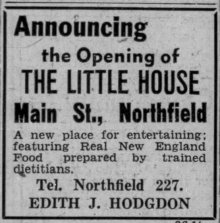 Miss Edith J. Hodgdon, proprietor of The Little House (hotel) and Pantry in Northfield, VT, recruited her niece, Joyce Hodgdon of Milton Mills for some summer assistance. She had opened the hotel in 1940, changed its location in or around 1948 and, more recently, there had been a kitchen fire there in May 1951 (Burlington Free Press, May 21, 1951).
 CARD OF THANKS. I am deeply grateful for the cards, flowers, and many kindnesses and expressions of sympathy in my recent great misfortune. Mrs. Irma Drew (Farmington News, August 17, 1951).
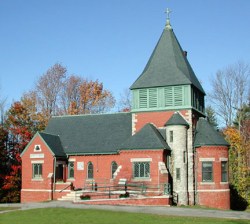 The
The 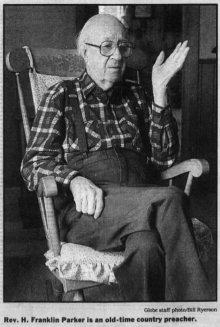 MATING GAME. After 62 years, he’s an institution of marriage Preacher has heard vows of 1,200. By Bob Hohler, Globe Staff. CHICHESTER – Rev. H. Franklin Parker had just donned a railroad conductor’s cap – to remind him that he likes “to get people on the right track and keep them going” – when Michael Valenti pulled into Parker’s driveway with a marriage license. Valenti and his fiancee. Susan Leighton, wanted a holiday wedding – a small ceremony at Leighton’s family home in Barnstead. And they wanted Parker, known by some in these parts as “Marryin’ Sam,” to officiate. “Why not?” Leighton said later in a telephone interview. “He’s married just about everybody else around here.” Parker, soon to celebrate his 86th Christmas, is one of New Hampshire’s last old-time country preachers. Worn Bible in hand, he has spent much of his life crisscrossing a short stretch of the Suncook Valley east of Concord, marrying more than 1,200 residents, three generations of the Brown family of Epsom among them. Parker has gone to mountaintops and hospital wards to pronounce couples husband and wife. He has accommodated couples seeking hasty weddings, marrying them next to the old pedal-powered organ in his study or under the solitary cherry tree in his front yard, just up the road from the 140-year-old Chichester Country Store. And two years ago, in exchange for a cord of wood, Parker stood in the chill of an 18th-century gristmill in Loudon to marry a 47-year-old dairy farmer and a 42-year-old Concord secretary who had arrived on the farmer’s doorstep for a blind date on Valentine’s Day and never left. Both had been married twice before. “One reason so many people come to him may be that he doesn’t judge them that way,” said Ruth Hammen of Chichester, who was baptized and later married by Parker. “He doesn’t feel it’s his place to judge.” Last week. Parker wanted Valenti to answer only one question – had he and Leighton known each other long enough to give their marriage a strong foundation? – before he would agree to marry them. Is it any wonder Parker’s favorite television show is “The Dating Game”? “Everything else is pretty boring,” he said. For 62 years, Parker has entered hundreds of families’ living rooms – and welcomed hundreds more couples to his own – to begin marriages. He has kept the ceremonies short because he says people like it that way. And he has etched each wedding date, among other events great and small, in a diary that traces the lives of a popular country preacher and his flock. It is a story of mutual affection, beginning with Parker’s arrival in Chichester – soon after electricity – in 1926. Before he “retired” in 1969 after 41 years as pastor of the Chichester Congregational Church, Parker often doubled as a circuit rider, delivering five sermons a Sunday at churches in Chichester, Epsom, Barnstead and Gilmanton Center. His congregation grew so wide, according to Carole Brown of Epsom, that she “didn’t even know what church he was affiliated with” when Parker performed her wedding ceremony 10 years ago. “All I knew,” Brown said, “was that he. married everybody,” including Brown’s husband’s parents and grandparents. Later, Parker tracked many of the couples he married. He sometimes delivered a single red rose to women who had given birth. He baptized the children, knitted them mittens for Christmas and wrote them stories when they were sick. And he saw many of them again in his jobs as town librarian, historian, ballot clerk and chaplain for the Chichester Grange. “Rev. Parker’s a landmark, like one of those old country doctors,” said Robert Feeny of Pittsfield, whose wedding Parker conducted 37 years ago. Parker often scanned local papers to learn which area residents had been admitted to hospitals and nursing homes, and once visited more then 1,000 patients in a year. He told many of them his philosophy of life – a Latin phrase [Per aspera ad astra] that he translated as “through adversity to the stars.” “If we get to the stars,” he told the patients, “some of us will get there only through adversity.” And when congregants died, Parker conducted their funerals, sending many of them off with a poem by John Greenleaf Whittier that ends: “I know not why His islands lift their fronded palms in the air, I only know I cannot drift beyond His love and care.” Through the years, Parker has seen the coffins of dozens of men and women he once baptized lowered to their graves. But he has no philosophy of death. “It’s just one of those elements you have to reckon with,” he said. “I take it as it comes.” Recently, Parker has gotten out less and less. He still cuts firewood, gardens and walks to the store, waving his cane to passersby. He visits the local nursing home and hospital about once a week. When someone asks him to conduct a funeral service, he does. And he still performs small weddings. But big weddings worry him. “My memory doesn’t serve me as it ought to anymore.” he said, rocking slowly in his chair as a grandfather clock ticked behind him. “If I slipped up, it would be embarrassing to everyone.” So he stays at home more, sometimes sitting before his 12-inch television to watch Rev. Robert Schuller broadcast from the Crystal Cathedral. Other times, he writes poetry. Or sits by the woodstove, reading aloud to his wife, Alice, before entering the book title in his diary on the day he completes it. And when he has the energy, Parker pumps the pedals on his church organ – adorned with his childhood teddy bear – and plays spiritual tunes, among them his own composition, the “Chichester Hymn.” He regrets that his falling eyesight prevents him from driving 10 miles to Concord to see a performance of Handel’s “Messiah.” But he yearns for little else. “I’ve had a simple, uneventful life,” Parker said. “Others have drifted along, but I’ve gone at my own pace and gotten a lot of enjoyment out of it.” Now the “Happy Holidays” welcome mat lies at Parker’s front door, and much of his flock is returning. Many couples, renewing an annual tradition, are stopping by with good wishes. Some are bringing gifts. Others are sending cards. And most are saying thank you. Among them will be Feeny, who credits Parker with “tying a good tight knot” for him and his wife of 37 years. Parker is “a minister you can look up to,” Feeny said. “He’s an honest, upright man who is always there when you need him, night or day.” Hammen, too, will pay a visit soon, giving Parker a date book to help him chart another year of his life. Hammen remembers when Parker stood by her family eight years ago after their house was destroyed by fire. “It was no great big thing,’ Hammen said. “But that’s not Rev. Parker’s style. In his own way, he has showed a lot of us around here that sometimes the simplest gifts make the greatest impressions” (Boston Globe, December 18, 1988).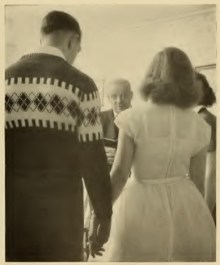
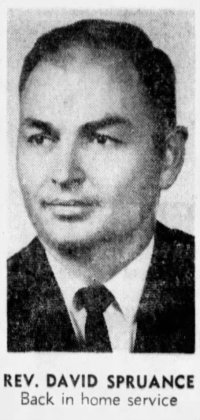 Gladys Cope, a Citgo co. stenographer, aged thirty-nine years (b. PA), headed a San Francisco, CA, household at the time of the Sixteenth (1940) Federal Census. Her household included her son, David Spruance, aged twelve years (b. CA), and her lodger, Richard Jones, an assistant insurance actuary (life insurance co.), aged fifty years (b. VA). Gladys Cope rented their house at 1295 Thirty-Ninth Avenue, for $32 per month.
 New England Clubwomen Have Day as WACs at Ft. Devens. By RUTH LYONS. Special Dispatch to the Globe. FORT DEVENS. Sept. 9 – They were the adopted children of a WAC detachment at Fort Devens for a day of military life . . . the first group of women from the New England Council of the Federation of Women’s Clubs to be guests of the Army. They stood reveille at 5:30 in the morning, learned how to make a GI bed, ate in the mess hall, inspected barracks, slept in Army bunks, rode in jeeps, changed tires, learned how and when to salute ranking officers . . . all the things that make a good WAC. The group making the tour, in the interests of WAC recruiting, comprised: Mrs. James C. Calmark, Providence, R.I., president of the New England Council; Mrs. Edward Troland of Malden, president of the Massachusetts Federation of Women’s Clubs; Mrs. Wilfred Bodine, Bellows Falls, Vt,; Mrs. J. Herbert Willey, Milton, N.H.; Mrs. Leroy Folsom, Augusta, Me.; Mrs. Charles F. Towne, Providence, R.I., and Mrs. Raymond Andrews, Hamden, Conn. WAC officers accompanied the group, with the Boston Globe reporter, to the fort, where they were greeted by Maj. Anne Cowan, chief of WAC recruiting for the 1st Service Command, and Maj. Elizabeth W. Stearns, WAC director of New England. We were taken to the barracks, assigned to our bunks, given toilet articles and an extra blanket. At the officers’ day room, we were greeted by Col. Howard M. Estes, commanding officer of Fort Devens, who sketched the program of activity. WAC enlisted officers took us to the mess hall for our first meal. At the post chapel, Maj. James Kenealy, a Catholic chaplain, explained the religious activities of the men and women. At the post exchange we enjoyed soft drinks and went to the motor pool where the Army cars are kept. Then followed a tour of the reception center where the overseas boys are processed and back to the mess hall for supper. In the evening we were taken to a movie and to the service club where a variety show was in progress. Eleven o’clock found us in our bunks after a strenuous day as skirted soldiers of the Army. Reveille sounded at 5:30, but no one heard it so five minutes later we were awakened by a WAC sergeant. We were a sad-looking bunch of women that half-slid down the stairs and outdoors for roll call. After breakfast we were taken to Lovell General Hospital and spent the entire morning walking through corridors, through the laboratory, the clinics, X-ray department and then into the wards where Mrs. Troland talked with several Boston boys. Pfc. Orland L. Giannatonio of 56 Dean st., Everett told us about the birthday party that the hospital staff gave him Friday. Then there was Pvt. Murray Ward of 113 Lanark road, Boston, who wore several decorations including the Purple Heart. He was being discharged later in the day. They were all cheerful, glad to be home and alive. Speaking for the visiting club women, Mrs. Calmark remarked that “now we have been WACs for a day . . . and are convinced that there is a great need for more young women in the medical detachment. These boys need our help, and so every possible aid must be given in obtaining WAC recruits to help in this great work.” (Boston Globe, September 10, 1944).
