Here follows a transcription (with annotations) of the last will and testament of Milton Mills woolen manufacturer John Townsend.
John Townsend was born in Wilton, Wiltshire, England, October 22, 1807, son of Joseph and Sarah “Sally” (Palmer) Townsend, and was baptized there January 8, 1808. He died in Brookline, MA, May 21, 1891, and this last will, which was dated November 1, 1890, was proved in Norfolk County Probate Court, in Dedham, MA, May 27, 1891 (Norfolk County Probate, 167:54).
Townsend was twice married. He married (1st) in Dorchester (Boston), MA, January 14, 1834, Jane Matilda Townsend, both of Dorchester, MA. She was born in Wilton, Wiltshire, England, September 18, 1815, daughter of Thomas B. and Jane (Randall) Townsend. Their children were Jane Randall “Jennie” Townsend (1835-1869), Caroline Frances Townsend (1840-1897), and Henry Herbert Townsend (1842-1904). Jane M. (Townsend) Townsend died in Dorchester, MA, December 24, 1843.
He married (2nd) in Boston, MA, April 22, 1844, Eliza Ann Townsend. She was born in Milton, MA, April 8, 1823, daughter of Thomas B. and Jane (Randall) Townsend, i.e., she was a younger sister of his deceased first wife. Their children were Emma M. Townsend (1848-1875), William B. Townsend [II] (1850-1878), Frank Albert Townsend (1855-1913), and Flora G. Townsend (b. 1863). Eliza A. (Townsend) Townsend survived him and died in Needham, MA, September 19, 1896.
Townsend started his Milton Mills woolen mill in or around 1846. He and his second wife, Eliza, and the children of both marriages resided in Milton Mills from then until the early to mid 1860s. (His eldest son, Henry H. Townsend, would run the rebuilt mill there in later years).
GREAT FALLS, N.H., Saturday, Oct. 19. The flannel factory of JOHN TOWNSEND, at Milton Mills, N.H., was burnt this evening. Loss about $30,000, which is partially insured. The factory was running on a Government contract (NY Times, October 20, 1861).
John Townsend, a merchant, aged fifty-five years (birthplace omitted), headed a Brookline, MA, household at the time of the Second (1865) MA Census. His household included his wife, Eliza Townsend, aged forty-two years (b. Milton, ME [SIC], Jane R. Townsend, aged twenty-nine years (b. Dorchester), Caroline F. Townsend, aged twenty-five years (b. Dorchester), Henry H. Townsend, a clerk, aged twenty-two years (b. Dorchester), Emma M. Townsend, aged nineteen years (b. Milton, NH), William B. Townsend, aged fourteen years (b. Milton, NH), Frank A. Townsend, aged ten years (b. Milton, NH), Flora G. Townsend, aged two years (b. Milton, NH), and Mary Welsh, aged twenty years (b. Ireland). John Townsend and Henry H. Townsend were ratable polls and legal voters.
Will of the Late John Townsend Filed. DEDHAM, May 27. This afternoon the will of John Townsend, late of Brookline, the deceased woollen manufacturer, was filed for probate in the Norfolk registry at Dedham. He left about $400,000, of which amount all but $700 is bequeathed to his family and other relatives. The instrument was drawn November 1, 1890, and his sons, Henry H. and Frank A. Townsend, are named as his executors and trustees (Boston Globe, May 27, 1891).
Note that $400,000 in 1891 would be worth about $36,000,000 today. (Each $20 might be taken as a one-ounce gold “double eagle” coin, and that one ounce of gold is worth about $1,800 in Federal Reserve notes at their present value).
John Townsend – Will – Proved May 27, 1891
I, John Townsend of the Town of Brookline, County of Norfolk and Commonwealth of Massachusetts, Woolen Manufacturer, make this my last will and testament hereby revoking all other wills.
Item 1st. I give and bequeath to my beloved wife Eliza Ann Townsend sixty thousand dollars to be held in trust and five thousand dollars in cash and all the furniture and horse or horses, harnesses, carriages, and sleighs at her disposal to sell or otherwise as she may think best, and for her benefit the income or interest on her bequest of sixty thousand dollars may be paid at any time she may desire provided the trustee or trustees have cash on hand received by them for or on account of income or interest on their investments.
Eliza A. (Townsend) Townsend died in Needham, MA, September 19, 1896. (Her son, Frank A. Townsend, lived then in Needham).
Item 2nd. I give and bequeath to my son Frank Albert Townsend one hundred thousand dollars in cash, and all my office furniture excepting the small desk, and I trust he will make good use of the above as his father has done before him. I also give him five thousand dollars in cash extra to be paid him for his services rendered me.
Frank Albert Townsend was born in Milton Mills, NH, July 5, 1855, son of John and Eliza A. (Townsend) Townsend. He died at his home at 371 Walnut Street, Brookline, MA, July 29, 1913, aged fifty-eight years, twenty-four days. (He was buried in Forest Hills Cemetery, in Jamaica Plain, Boston, MA).
Frank A. Townsend, own income, aged fifty-eight [fifty-five] years (b. MA), headed a Needham, MA, household at the time of the Thirteenth (1910) Federal Census. His household included his wife (of six years), Anna L. Townsend, aged sixty years (b. NH), and his servants, Rose G. Lufkin, a private family waitress, aged thirty-four years (b. MA), and Bessie G. McGlone, a private family cook, aged thirty-five years (b. Ireland (English)).
Item 3rd. I give and bequeath to my son Henry Herbert Townsend one hundred thousand dollars in cash, also my small desk in the counting room, if the said Henry Herbert Townsend owes my Estate either by note or on account it is to be deducted from his cash amount.
Henry Herbert Townsend was born in Dorchester, MA, August 12, 1842, son of John and Jane M. “Matilda” (Townsend) Townsend. He died in Milton Mills, June 25, 1904, aged sixty-one years, ten months, and thirteen days.
Henry H. Townsend married in Milton, June 7, 1870, Agnes J. Brierley, he of Boston and she of Milton, NH. She was born in Lowell, MA, May 17, 1844, daughter of Edward and Margaret M. (Thompson) Brierley. (See also Milton Mills’ Brierley Mill – c1864-18). He was a merchant, aged twenty-seven years; she was aged twenty-six years. Rev. N.D. Adams of Union, NH, performed the ceremony. (This record appeared also in Boston vital records).
Item 4th. I give and bequeath to my beloved daughter Caroline Frances Townsend forty five thousand dollars to be held in trust, the interest or income to be paid to her semiannually. I also give and bequeath to the aforementioned Caroline Frances Townsend in cash one thousand dollars, and at her decease the amount held by the trustee or trustees shall be paid one half to Henry Herbert Townsend and the other half to Frank Albert Townsend of their heirs.
Caroline Frances Townsend was born in Dorchester, MA, May 2, 1840, daughter of John Townsend and his first wife, Jane Matilda (Townsend) Townsend.
Caroline F. Townsend of Milton Mills appeared in a list of first and second year women taking the English course of studies at the New Hampton Literary & Biblical Institution, in New Hampton, NH, during the 1856-57, when she was called “Carrie F.,” 1857-58, 1858-59 academic years. She majored in Modern Languages. Her elder sister, Jennie R. Townsend, was a student there also during the 1856-57 academic year.
Caroline F. Townsend boarded for many years with another legatee, Mary W. Robinson of Dorchester.
Caroline F. Townsend married in the Bromfield Street Methodist Church in Boston, MA, June 27, 1894, John W. Wellman, she of Dorchester, MA, and he of Wakefield, MA. He was a cotton broker, aged seventy-four years (b. Farmington, ME), and she was at home, aged fifty-four years (b. Boston); it was his third marriage and her first.
Caroline F. (Townsend) Wellman died in Wakefield, MA, December 26, 1897, aged fifty-seven years, seven months, and twenty-four days. Her husband died in Wakefield, MA, January 30, 1900, aged eighty-one years.
Item 5th. I give and bequeath to my grandchild John Townsend son of Henry Herbert and Agnes Townsend five thousand dollars to be held in trust and Gracy Townsend daughter of Henry Herbert and Agnes Townsend two thousand dollars to be held in trust until they arrive at the age of twenty-one years when there shall be paid to them the forenamed legacies and accrued income thereon.
John E. Townsend was born in Milton Mills, September 9, 1872, son of Henry H. and Agnes J. (Brierley) Townsend. He died in Milton Mills, September 8, 1914, aged forty-two years, eleven months, and thirty days. He married in Milton, January 28, 1896, Eda B. Lowd.
His sister, Grace Maud “Gracie” Townsend, was born in Milton Mills, November 14, 1873. She died September 7, 1953. She married in Milton Mills, June 19, 1896, John C. Townsend, she of Milton, and he of Saugus, MA. He was a clerk, aged twenty-four years, and she was aged twenty-two years. He was born in East Wilton, ME, September 17, 1871, son of Joseph and Ruth P. (Wentworth) Townsend. He died in Milton Mills, February 14, 1916.
Item 6th. I give and bequeath to my brother James Townsend two thousand dollars to be held in trust, also to my sister Eliza, also Charles Townsend son of my brother Thomas, one thousand dollars each, also to Ruth widow of Joseph Townsend two thousand dollars, all of the above mentioned to be held in trust.
James Townsend was born in Wilton, Wiltshire, England, June 2, 1802, son of Joseph and Sarah “Sally” (Palmer) Townsend. He married in Dorchester, MA, June 12, 1826, Sarah Kilham. He died in Marlborough, NH, August 6, 1892, aged ninety years, one month, and twenty-eight days.
Charles T. Townsend (1810-1881)
Eliza J. Townsend was born in Wilton, Wiltshire, England, February 2, 1814, daughter of Joseph and Sarah “Sally” (Palmer) Townsend. She died in Saugus, MA, January 22, 1894, aged seventy-nine years, eleven months, and twenty days.
Charles Thomas “Thomas” Townsend was born in Wilton, Wiltshire, England, January 17, 1810, son of Joseph and Sarah “Sally” (Palmer) Townsend. Charles Thomas Townsend was “now residing at Milton Mills,” NH, when he made his will on May 20, 1879. Charles T. Townsend of Peterborough, NH, died on Walnut Street in Brookline, MA, January 27, 1881, aged seventy-two years, one month. (John Townsend had his home at 371 Walnut Street in Brookline).
He married in Gilsum, NH, in 1837, Elsea M. Bingham. They had children Ellen A. Townsend (1838-1908), Elsea R. Townsend (1839-1932), the legatee Charles Horace Townsend (1842-1899), Edward P. Townsend (1846-1879), Adelaide M. Townsend (1848-1935), and Alfred B. Townsend (1853-1879).
Joseph Townsend was born in England, in 1823. He died in 1887. He married in Milton, January 6, 1850, Ruth Paul Wentworth, he of Milton and she of Acton, ME. She was born in 1826. She died in 1901.
Item 7th. I give and bequeath to Martha Townsend widow of William B. Townsend two thousand dollars to be held in trust and in case of the decease of the parties named in Items 6 + 7 or either of them then their proportions shall be equally distributed between the families of John and Matilda and John and Eliza Ann Townsend.
William B. Townsend was born in Wilton, Wiltshire, England, October 21, 1803, son of Joseph and Sarah “Sally” (Palmer) Townsend. He died in Milton Mills village, November 23, 1847, aged forty-four years.
William B. Townsend married in Canton, MA, December 13, 1832, Martha W. (Holden) Townsend, both of Canton. She was born in Boston, MA, circa 1808, daughter of Stephen and Martha (Niles) Holden. They had children Mary E. Townsend (1833-1906), Anna A. Townsend (1836-1861), Harriet Townsend (1840-), and William E. Townsend (1844-). Martha W. (Holden) Townsend died in Worcester, MA, February 5, 1896, aged eighty-eight years, five months, and nineteen days.
Item 8th. I give and bequeath to Agnes wife of Henry H. Townsend three thousand dollars to be held in trust the income or interest to be paid to her semiannually and at her decease the amount held by the trustee shall be paid to her husband Henry H, the trust ceasing at her death.
Agnes J. (Brierley) Townsend did not long survive the testator. She died December 26, 1891, aged forty-seven years.
Item 9th. I give and bequeath to my brother-in-law Joseph Whitehead one thousand dollars in cash.
Joseph Whitehead was born in Yorkshire, England, May 20, 1823. He died in the Masonic Home in Charlton, MA, November 17, 1912, aged eighty-nine years, five months, and twenty-seven years.
Joseph Whitehead married in Saugus, MA, November 18, 1849, Sarah M. Townsend, both of Saugus. (He was of Milton, NH, in the marriage intentions). He was a spinner, aged twenty-four years (b. England), and she was aged twenty-five years. She was born in England, circa 1821, daughter of Joseph and Sarah “Sally” (Palmer) Whitehead. She died of consumption in Saugus, MA, February 28, 1869, aged forty-eight years, six months.
Joseph Whitehead, a trader, aged thirty-seven years (b. England), headed a Saugus, MA, household at the time of the Eighth (1860) Federal Census. His household included Sarah Whitehead, aged thirty-nine years (b. England), Ralph S. Whitehead, aged three years (b. MA), Ann Townsend, aged forty-eight years (b. England), Eliza Townsend, aged forty-six years (b. England), and Elizabeth Townsend, aged forty-four years (b. England). Joseph Whitehead had real estate valued at $2,200 and personal estate valued at $1,800.
Item 10th. I give and bequeath to my friend Aaron S. McIntosh five hundred dollars in cash.
Aaron S. McIntosh was born in Needham, MA, August 22, 1819, son of Samuel and Priscilla (Smith) McIntosh. He died in Boston, MA, November 4, 1895, aged seventy-six years.
Aaron S. McIntosh appeared in the Boston directory of 1885, as a bookkeeper at 25 Tremont Temple, with his house at 2859 Washington street.
Item 11th. I give and bequeath to my faithful employee John Young two hundred dollars in cash provided he is in my employ at my decease.
John W. Young was born in Barrington, NH, April 8, 1851, son of John B. and Mary J. (Buzzell) Young. He died in Brookline, MA, January 21, 1901, aged fifty-one years.
John W. Young appeared in the Brookline directory of 1891, as a coachman for John Townsend, at Walnut street, with his house on Sewall street, corner of Chestnut street.
Item 12th. I give + bequeath to my kind friend Miss Mary W. Robinson of Dorchester in consideration of her great kindness to my daughter Caroline Frances the sum of five hundred dollars in cash.
Mary Withington Robinson was born in Dorchester, MA, April 30, 1819, daughter of Stephen and Hannah (Withington) Robinson. She died in her home at 33 Brent Street, Boston, MA, September 16, 1905, aged eighty-six years, four months, and sixteen days.
Mary W. Robinson, keeping house, aged sixty-one years (b. MA), headed a Boston, MA, household at the time of the Tenth (1880) Federal Census. Her household included her boarder, Caroline F. Townsend, aged forty years (b. MA). They resided on Washington Street.
Miss Mary W. Robinson of Dorchester, MA, was a vice-president of the New England Wheaton Seminary Club in May 1891 (Boston Globe, May 10, 1891).
Mary W. Robinson appeared in the Boston directory of 1893 as having her house at 33 Brent street. Caroline F. Townsend appeared as boarding with her. The property was described when sold by Robinson’s estate as being a frame house, with 5,186 square feet of land, situated between Talbot avenue and Washington street in Dorchester (Boston Globe, April 17, 1908).
I also direct that after all my just debts and expenses and all the hereinbefore mentioned legacies have been fully paid the remainder of my estate if any shall be equally divided between the families of John and Matilda and John and Eliza Ann Townsend.
I appoint as my Executors and Trustees of this my last will and testament my sons Henry Herbert and Frank Albert Townsend without giving surety or sureties on their official bonds as Executors or Trustees.
In witness whereof I have signed + sealed this instrument and published and declared the same as + for my last will and testament at Boston in the Commonwealth of Massachusetts this first day of November in the year A.D. one thousand eight hundred and ninety.
John Townsend (Seal)
The said John Townsend at Boston, on the first day of November signed and sealed this instrument and published and declared the same as and for his last will and testament and we at his request and in his presence and in the presence of each other have written our names as subscribing witnesses. John G. Wetherell. Chas L. Lane. W.W. Martin.
A $5 Note of the Atlas Bank of Boston (Redeemable in Gold Coin)
Witness John G. Wetherell (1822-1897) was president and a director of the Atlas National Bank of Boston. Charles L. Lane (1828-1891) was an Atlas National Bank cashier. (He did not long survive the testator). William W. Martin (1854-1908) was an Atlas National Bank clerk and messenger.
As the annual holiday most associated with the idea of liberty, it would not be an understatement to say that limited government took a massive hit this year. The virus was one thing, but the disastrous effects of the lockdowns will be felt for years to come. Worse still is what appears to be approval from most folks that the lockdowns were the correct course of action for state and local governments to take. While one can’t trust the mainstream media to put anything in perspective, I do believe a poll I read a few months back that 81% of the respondents did NOT want the lockdowns to end and were concerned about opening up too soon.
Incredibly, even here in the Live Free or Die state, it appears that most people have succumbed to the idea that “this time it’s different.” Really? If you check even the CDC records, in the 2017-2018 flu season, there were anywhere from 46,000 to 95,000 deaths in the US. For those with longer memories, you might recall the 1968-1969 Hong Kong flu season when an estimated 100,000 people perished in the US. Benjamin Franklin’s eternal words, “Those who would give up essential liberty to purchase a little temporary safety, deserve neither liberty nor safety” come to mind. Should our state motto be changed to read “Live Free AND Die”?
I moved to this state specifically because it had a reputation for being liberty-oriented. What a major disappointment when our governor issued Emergency Order #17 and required all “non-essential” Granite Staters to stay at home. Of course, many people were already cutting back on their social contacts as news of the virus was everywhere, but not everyone was, so the heavy hand of government stepped in to “protect” us. The initial emergency order was only 4 pages long, but Exhibit A describing “essential” jobs was 11 pages long. My own industry was not originally listed as “essential,” but my professional trade association raised Cain, and voilà suddenly we were added to the list and became “essential.” So much for there being any doubt about the arbitrariness of it all.
On the other hand, I have great respect for how the pandemic was handled in South Dakota. The governor’s executive order was only 2 pages long, and there was no lockdown. As the governor stated, it’s the residents of South Dakota who are primarily responsible for their own safety. These days, what a radical thought to proclaim publicly—and as a government official too—that people have to take care of themselves and not expect the government to take care of them. They have the freedom to be treated like adults but also the responsibility to face the consequences of their choices. The governor noted that she was trusting them to act like responsible adults during the pandemic, so there was no need for authoritarian behavior like in other states.
Of course, the government control freaks weren’t keen on letting some folks keep their liberties intact, so when there was an outbreak of the virus at a meat plant in South Dakota, the governor took a lot of heat for not locking down the state. Unlike other governors who caved in to mounting pressure, she once again reiterated her non-authoritarian stance and also pointed out that meat plants were deemed essential by the president, so they would have been open anyway during a lockdown.
So, does liberty really work or are we destined for gloom and doom if our leaders don’t treat us like children? Obviously the original “models” were pathetic in how far they were off base, but let’s look at some actual data a few months into the pandemic. New Hampshire is not very different from South Dakota as it’s mostly rural. With a population of 1.36 million, it’s the 10th least populated state, while South Dakota is the 5th least populated state with a population of around 882,000. As of this week, New Hampshire had 373 corona-related deaths, while South Dakota had 93. Dividing the number of deaths by the total population, the virus death rate is .027% per capita for New Hampshire and .013% for South Dakota. If lockdowns save lives, then why is the rate lower for South Dakota, which had no lockdown? As for unemployment as of 06/19/20, the rate for New Hampshire was 14.5% and 9.4% for South Dakota. So apparently authoritarianism isn’t good for your livelihood—or even your health.
To be completely fair to our governor, one of our state reps told me that when some of them complained to the governor that state troopers were pulling drivers over during the initial phase of the lockdown to check why they were out driving, he vowed to put a stop to that nonsense. From what I’ve read, he kept his word, and there were none of the really outrageous civil liberty violations here like arresting surfers, citing people sitting in their cars watching the sunset, taking down the license numbers of cars in church parking lots during Easter Sunday, and the disgusting “Karens” who turned in their neighbors to local police departments and “good citizen” government hotlines.
As today’s holiday approached, there’s been a mainstream media feeding frenzy about the president visiting South Dakota and Mount Rushmore for a celebration and fireworks. The governor said, “We’ve told people to focus on personal responsibility. Every one of them has the opportunity to make a decision that they’re comfortable with. So, we will be having celebrations of American independence. We told those folks that have concerns that they can stay home. But those who want to come and join us, we’ll be giving out free face masks, if they choose to wear one. But we won’t be social distancing.” Needless to say, those who celebrate the god of government control are fit to be tied. Ignoring CDC guidelines is akin to or perhaps worse than heresy.
If I were a bit more cynical, I would say the governor’s critics are hoping for lots of new infections and, better still, deaths resulting from today’s celebration in South Dakota. But I prefer to focus on being happy that there’s actually an elected official who is actively promoting self-ownership, personal responsibility, and self-reliance. Perhaps the meaning behind today’s holiday hasn’t been lost after all.
The Milton Board of Selectmen (BOS) have posted their agenda for a BOS meeting to be held Monday, July 6.
The BOS meeting is scheduled to begin with a Non-Public session beginning at 6:00 PM. That agenda has one Non-Public item classed as 91-A3 II (a).
(a) The dismissal, promotion, or compensation of any public employee or the disciplining of such employee, or the investigation of any charges against him or her, unless the employee affected (1) has a right to a meeting and (2) requests that the meeting be open, in which case the request shall be granted.
This likely has to do with compensation, rather than the other possibilities. (The Town government has posted four positions).
Due to their concerns regarding Covid-19, there will be no public in attendance and, therefore, no public comment. The session may be watched remotely through the usual YouTube means or by teleconference. The links for both are in their original agenda, for which there is a link in the References below.
The quasi-Public portion of the agenda has New Business, Old Business, Other Business, and some housekeeping items.
Under New Business are scheduled four agenda items: 1) Update Regarding Covid-19 (Novel Coronavirus) Operational Activities / Plans, 2) Ira Miller’s General Store – Tax Abatement Agreement in lieu of RSA 79-E application, 3) Jones Brook Discussion, 4) Vote to Authorize Tax Exempt Drawdown Basis Tax Anticipation Note for Fiscal Year 2020.
Update Regarding Covid-19 (Novel Coronavirus) Operational Activities/Plans. One supposes, by the very terms of the meeting announcement, that the Covid-19 is still among us. We will evidently hear an update on those things with which the BOS has been active.
There will be a fifth ReopenNH rally at the State House in Concord, NH, July 4, from noon until 2 PM. This one will include a prayer, a reading of the Declaration of Independence, children’s activities, and a parade.
Ira Miller’s General Store – Tax Abatement Agreement in lieu of RSA 79-E application. Under the Community Revitalization Tax Relief Incentive (RSA 79-E), a redevelopment project resulting in a substantial rehabilitation (at least $75,000 or 15% of the total existing assessed value), any new taxable value directly generated by the renovation can be freed from the levying of property taxes for five years (for a substantial renovation), with an additional four years possible for a property listed or eligible to list on the National Register of Historic places.
Jones Brook Discussion. A bit cryptic. Either the watershed, conservation area, or partnership of that name is to be discussed.
Vote to Authorize Tax Exempt Drawdown Basis Tax Anticipation Note for Fiscal Year 2020. In which Milton’s Town government plumbs the depths: borrowing in order to spend. Taxpayers will henceforth pay not only their taxes, but interest on those taxes. Do you want to pay more in taxes than need be in order to pay interest on borrowed money? I know I don’t.
Aah, but is bond interest in the default budget? Probably not.
Tax Anticipation Note (TAN): “A municipal bond, usually with a maturity of less than one year, issued on the assumption that the debt will be paid back on future tax revenue. Municipalities issue tax anticipation notes to provide cash for immediate or time sensitive needs.”
Tax Exempt: “Federal tax laws require an analysis of a governmental unit’s cash flow needs if the borrowing is to be done on a tax-exempt basis. The need is demonstrated by preparing month-by-month cash flow estimates for the funds for which the borrowing will be made. … The statutes under which notes and warrants are authorized are likely to include a formula or dollar amount limiting the amount of notes or warrants that may be lawfully issued. They are typically payable solely from the taxes or revenues being anticipated.”
Major Hogan: What do you do when you’re short of cash? Lt. Sharpe: Do without, sir. Hogan: You borrow, Richard, from a bank.
Under Old Business are scheduled three items: 5) Request for a One-year Extension for Completion of Project on Tax Deed Auction Property Located at 1121 White Mountain Highway (Issuance of Certificate of Occupancy), 6) Status of following tax deeded structures: 20 Dawson, 79 Charles and 565 White Mountain Highway, and 7) Possible Conservation Commission Appointment.
Request for a One-year Extension for Completion of Project on Tax Deed Auction Property Located at 1121 White Mountain Highway (Issuance of Certificate of Occupancy). The owner of the so-called Blue House, which sold at auction last year, with covenants for repair within the year, has requested an extension.
Status of following tax deeded structures: 20 Dawson, 79 Charles and 565 White Mountain Highway. Properties not disposed of when the prior one sold at auction.
Possible Conservation Commission Appointment. Another “selection” (see next agenda item).
Under Other Business That May Come Before the Board is scheduled one item: 8) Open submissions for Select Board Vacancies and Announcement of Applicant Names.
Open submissions for Select Board Vacancies and Announcement of Applicant Names. Herein lies a tale, no doubt, likely one we will not hear. It would seem that one or more of the selectmen (“vacancies” being the plural form) is to be replaced, per statute, by a special “selection” rather than a special election. Those doing the selecting were themselves elected by a plurality of a minority of the electorate, but they did at least face an election.
The only statute alternative is to have a judge make the “selection” rather than the remaining selectmen. Hmm.
There will be the approval of prior minutes (from the quasi-Public session of June 15, 2020, the quasi-Public session of June 30, 2020, the non-Public session of June 30, 2020, an expenditure report, administrator comments, and BOS comments.
The administrator comments will address the first meeting report of the Local Government Efficiency Task Force™; the receipt of the GOFERR grant reimbursement; and “other.”
The Milton recipients of $288,319.13 in grants from the Governor’s Office for Emergency Relief and Recovery (GOFERR) were Eastern Boats, Inc. ($190,067.26), Shortridge Academy, LLC ($78,393.22), Aerial NDT Inspection Inc. ($11,150.72), Milton Associates, LLC ($4,534.26), and Mary V`S Unique Creations ($4,173.67).
We have seen that our newly-established Local Government Efficiency Task Force has begun its work with questions of how to find other revenue sources. That is to say, the Board of Selectmen (BOS) do not seem to feel that Milton has budget and spending problems, as such, but an income shortage instead.
They are wrong of course, as is their wont. A correspondent directed our attention to a recent article in the Concord Monitor regarding average Police budgets in New Hampshire.
According to this article, NH cities and towns spent in a range between $100 and $554 per capita for their Police services in 2019, with the average community spending $194 per capita. Milton, at $201 per capita, spent more than the average community.
Our neighboring city of Rochester reportedly spent $222 per capita, which was relatively low for a city, while our neighboring towns of Farmington, Middleton, and Wakefield spent $209, $188, and $161 respectively.
Milton taxpayers might well ask themselves whether our Police requirements and, therefore, our per capita Police expenses, align more closely with those of Rochester or those of Middleton and Wakefield. (Keeping in mind that our other neighbors in Lebanon, ME, have no police at all, relying instead on their County Sheriff).
Taxpayers might well ask these questions, as it would seem that our BOS have little interest in asking on our behalf.
Bend low again, night of summer stars.
So near you are, sky of summer stars.
So near, a long arm man can pick off stars,
Pick off what he wants in the sky bowl,
So near you are, summer stars,
So near, strumming, strumming,
So lazy hum-strumming.
July 1. An open star cluster from Serpens (IC4756) may be viewable near midnight but may require binoculars.
July 3. Asteroid Herculina in Sagittarius may be viewable most of the night.
July 4. The Earth will be at its farthest point from the sun.
July 5. There will be an eclipse of the full Moon this evening between 23:08 and 1:53 am. The Moon will also be at its farthest point from the sun. The Moon will be closely passed by Jupiter.
July 6. The Moon and Saturn will rise and be close to each other.
July 8. Venus will be as bright as it ever gets in the sky this evening.
July 10. Venus will be at its farthest point from the sun.
July 11. The Moon and Mars will both rise and closely approach one another.
July 12. This date will bring the last quarter of the moon which will also appear smaller than normal.
July 14. Jupiter, in Sagittarius will be viewable most of the night.
July 15. Asteroid 2 Pallas from Sagitta will be viewable much of the night. 134430 Pluto, in Sagittarius will be viewable much of the night.
July 17. The Moon and Venus will rise and closely approach one another.
July 20. There will be a new Moon today which will pass close to the Sun. Saturn, in Sagittarius will be viewable much of the night.
July 22. Mercury will be at its farthest point from the Sun.
July 25. The Moon will be at its closest proximity to the Earth and will appear larger than usual.
July 26. Mercury will be at its highest point in the sky.
July 27. The Moon will be at first quarter.
July 28. The Piscis Austrinid meteor shower can be best viewed at 3:00 am.
July 29. The Southern Aquariid meteor shower will be best for viewing at 5:00 am … yes, just before dawn. The Capricornid meteor shower will be viewable most of the night.
References:
In-the-Sky.org. (2020, June 29). Guides to the Night Sky. Retrieved from in-the-sky.org
The Local Government Efficiency Task Force announced that its inaugural quasi-public meeting will be held today at 6:00 PM.
Its published agenda prefixed its title with the adjective “Remote,” which is meant apparently to signify a “public” meeting under the Governor’s Covid-19 workaround of closed meetings, without any public comment at all, that are “public” only in the sense that they are broadcast to the public or that the public may listen by telephone. Presumably, it is not intended to signify a remote local meeting, which would be to pile on another oxymoron. (The original one having been “government efficiency” or “local government efficiency”).
This new “task force” was initially identified also as an “independent” committee, which it would not be, – even in government speak – if constituted as discussed previously. An actual independent committee would be one composed mostly – if not entirely – of members who are not Town officials or apparatchiks.
A “Joint” committee would be one whose members are drawn from several different bodies or authorities, such as from the Board of Selectmen and School Board. A “Select” or “Special” committee is one appointed for a defined and limited time period for a particular purpose only. This might be termed alternatively an “Ad Hoc” (Latin for “to this” or “for this” purpose) committee.
The time period put forward for this Local Government Efficiency Task Force to fulfill its purpose has been estimated at twelve to eighteen months, or even longer, i.e., well after the current budget process, well after the next election, and perhaps even after the next budgeting process. It is truly amazing how these things “work.”
It would seem that those seeking tax reductions as precipitate as the tax increases have been might have to look elsewhere.
The Task Force’s agenda has six main topics: [1)] Introductions and Statements of Individual Goals, 2) Discussion of Ideas and Approaches, 3) Revenue / Tax Base Growth and Diversification, [4)] Operational Efficiencies, [5)] Organization, and [6)] Other Business.
Introductions and Statements of Individual Goals. In which we meet the members.
Discussion of Ideas and Approaches. In which we might hear of their general approach and their initial thoughts. I had once a boss that explained that consultants mostly return and support what management asked them to find at the outset. And that lies in the questions being asked below.
Revenue / Tax Base Growth and Diversification.a) What grows the tax base? b) What kinds of impacts do different types of growth have on the community? c) What opportunities do we have to create revenue brainstorming session (additional Solar Panel Farm, leasing of town facilities, advertising revenue possibilities), d. Other Ideas and Suggestions.
The questions all suggest that the Town government hopes still to continue merrily along at current or even larger levels, but that someone else might be found to foot the ever-increasing bill.
The questions do suggest some dim awareness that regulatory restrictions have hampered growth and, consequently, tax revenues. In this, the task force seems to have identified already the well-known Kindergarten principle: don’t hit people and don’t take their stuff. Regrettably, they seem to have taken away the wrong lesson. They hope to find and take more stuff.
They do not seem to consider “growth” to be a concern of property owners, as such, but a “communal” one. One supposes that they might next to be speaking of taxes as an “investment.”
Operational Efficiencies.a) What ideas do you have that might increase efficiencies? [E.g.,] Energy Conservation, Cooperative purchasing with school, regionally, Are there opportunities to combine departments / functions?, Are there other opportunities to regionalize?
It is better late than never to eliminate duplication, but it has been inexplicable that it has taken so long. There is an organizational efficiency that taxpayers should consider. Why would one ever establish, depend, or expand upon an organization that spends first and considers organizational efficiencies last?
Organization. a) Election of Chair, Vice Chair, Secretary; b) Review of and proposed amendments to Task Force By-laws (you are a subcommittee of the Board of Selectmen, so these are samples – any by-laws ultimately would need approval by the Select Board); c) Do you want to put together subcommittees for the areas Identified Above?
Strictly speaking, a subcommittee of the BOS would be composed entirely of members of the parent committee, i.e. the Board of Selectmen.
Well, we shall see, will we not?
We always carry out by committee anything in which any one of us alone would be too reasonable to persist. – Frank Moore Colby
A southern newspaper, published just days before the second Battle of Bull Run (Manassas), took notice of an accident involving a Federal troop transport. Among the victims were the wives of several officers of the Sixth NH Regiment.
LATER FROM THE NORTH. Northern papers of the 16th instant have been received in Richmond. On the night of the 13th inst. the steamer West Point, with 197 convalescent troops from Newport News, for Burnside’s army, was run into at Aqula Creek by the steamer George Peabody. Capt. Travers. and sunk in a few minutes. Seventy-three lives were lost, including the wives of Major Dort, Lieut. Col. Scott, and Capt. Cummings, of the 6th N.H. regiment (Weekly Raleigh Register (Raleigh, NC), August 27, 1862).
I had occasion recently to visit a friend at her home in the Jamaica Plain district of Boston, MA. Among the several interesting things that we did was take a walk through Forest Hills Cemetery.
The cemetery was consecrated in 1848, and consists of 248 acres of cemetery paths and lanes. It has also a beautiful pond inhabited by turtles, geese, and other wildlife. Visitors may obtain maps at its main entrance that show the locations of at least some of the more famous people who are buried there.
It was certainly a pleasant walk and there is much to see in the way of monumental and funerary sculpture.
Joseph Warren (1741-1775)
Joseph Warren was a physician and patriot leader. He was a founding member of the Sons of Liberty, and president of the Massachusetts Provincial Congress. He was killed leading militiamen at the Battle of Bunker Hill.
William Dawes, Jr. (1745-1799)
William Dawes was one of three dispatch riders that set out to warn that the British were marching on Lexington and Concord in April 1775. The other two riders were Paul Revere and Samuel Prescott.
William Lloyd Garrison (1805-1879)
William Lloyd Garrison was an early and fervent abolitionist. He is best known as publisher of the radical anti-slavery newspaper The Liberator, which was published between 1831 and 1865, and as a founder of the American Anti-Slavery Society.
That which is not just is not law. – William Lloyd Garrison
Lysander Spooner (1808-1887)
Lysander Spooner was also an abolitionist, as well as a lawyer and entrepreneur, but is best known as a legal theorist, scholar, and writer.
Those who are capable of tyranny are capable of perjury to sustain it. – Lysander Spooner
Edward Everett Hale (1822-1909)
Edward Everett Hale was the son of a Boston editor, as well as being nephew and namesake of famous orator Edward Everett. (Who spoke at length at Gettysburg before Abraham Lincoln delivered his short address). He was himself a teacher, minister, abolitionist, and writer. He was a founder of the Unitarian Church, chaplain of the U.S. Senate, and he wrote the famous patriotic short story Man Without a Country. (There is a statue of him in Boston’s Public Garden).
I am only one, but I am one. I cannot do everything, but I can do something. And because I cannot do everything, I will not refuse to do the something that I can do. – Edward Everett Hale
Jacob Wirth (1840-1892)
Jacob Wirth was a German immigrant who founded in 1878 the Boston restaurant – one of its oldest – that bore his name. It closed its doors in 2018.
Grace S. Allen (1876-1880)
Grace Sherwood “Gracie” Allen was nearly five when she died. Her grave is marked with a portrait statue of her by sculptor Sidney Morse, who was a poet, editor, and friend of Walt Whitman. It is a soft white marble, which tends to fare poorly over time, but this one is encased in glass and is very well preserved. It is certainly worth a look.
Eugene O’Neill (1888-1953)
Eugene Gladstone O’Neill was a famous playwright. He was several times winner of the Pulitzer Prize. His play Long Day’s Journey into Night is considered one of the finest American plays of the twentieth century.
His last words: “I knew it. I knew it. Born in a hotel room and died in a hotel room.”
E.E. Cummings (1894-1962)
Edward Estlin Cummings was an innovative and famous poet.
His grave was not easy to find. Admirers leave things there. I have heard they leave coins, stones, and scraps of poetry. On my visit there several pens had been placed beside the marker.
I wouldn’t give an inch of New Hampshire for all the rest of New England. – e.e. cummings
Thanks to Ms. Bristol, who helped me with my research. She observes also that Lewis W. Nute‘s first Boston employer, the ship chandler Thomas Simmons, is buried in Forest Hills, as is the White Mountain School artist, Frank H. Shapleigh, who painted pictures of Nute’s West Milton farmstead.
While “Staying at Home” recently, I decided to get my taxes out of the way once and for all. I was unpleasantly surprised to discover that I owed a larger-than-expected amount on my state income tax. I know they say we have no state income tax here in New Hampshire, but that’s baloney. If you have received more than $2,400 in income in interest, dividends, or annuities in one year, you will pay the State of New Hampshire a 5% tax on the total. Of course, they do have some of the usual exemptions for age and blindness (and why not deafness too – isn’t that discrimination?), but if that isn’t a tax on income, then I don’t know what is. They say it’s a tax on passive income, not earned income, but a tax is a tax, no matter what you call it.
However, what I did discover is New Hampshire has a great option available to take a credit against this income tax by making a donation to a school scholarship program. This 85% credit, not deduction, is part of the New Hampshire Education Tax Credit Program. It serves two worthwhile purposes: it helps children from families with less financial means attend non-government schools, and it gives state bureaucrats less money to waste. The latest data shows there were 413 students in the state benefiting from this program at 58 participating schools. This is a lowly participation rate of less than 1% of the 47,584 students who are income-eligible statewide. Still, to the families of those 413 students, even a mere scholarship of 15% of government school per-student spending means a lot.
So, how does the program work? As with all government programs, they come with their share of rules, conditions, and requirements. That said, the requirements don’t appear to be particularly onerous. To be eligible, the family members must be New Hampshire residents, the child must be between the ages of 5 and 20 (and not graduated from high school) or must be entering kindergarten for the first time or entering 2nd-12th grades and coming from a government school. The family’s income cannot exceed 300% of the federal poverty level, which in lay terms means $51,720 for a family of 2, $65,160 for a family of 3, and exponentially an additional $13,440 for each additional family member. There are only two government-approved scholarship organizations that qualify for the education tax credit program – the Children’s Scholarship Fund and the Giving and Going Alliance. I checked out both organizations before I gave my donation, and both seemed just fine to me. The Children’s scholarship Fund is for nonsectarian schools, and the Giving and Going Alliance is for the more faith-based crowd. Most important, the scholarships are awarded to students struggling in their current government schools to allow them to attend any school—private, religious, out-of-district government school, even home schooled—that the parents deem best for their child.
The tax credit program was established in 2012 by SB372 and launched in 2013. It only applied to business organizations, which could utilize the 85% credit against the Business Profits Tax (BPT) and/or Business Enterprise Tax (BET) or Interest & Dividends Tax (I&D). However, HB1686 extended the same credit to individuals to use against any I&D tax owing. The program has an annual cap of $6 million, and while contributions from donors have increased over the years from $20,000 in fiscal year 2014 to $381,000 in fiscal year 2018, it still has never gotten anywhere close to the cap.
For years, those who purport to help the poor have been on the offensive to kill the program or chop it down as much as possible. One of their favorite arguments is the program is for the benefit of “the rich.” The data does not support their claim. In the 2018-2019 school year, 61.4% of the students in the Children’s Scholarship Fund and 44.9% of the students in the Giving and Going Alliance qualified for free or reduced-price lunches.
Their next favorite argument is that the program “carves out” $6 million that would otherwise go to government schools. More bunk. Firstly, the maximum tax credit is 85% of the $6 million, which is $5.1 million. Secondly, up through March 8, 2019, the total tax credits claimed since the program started are only $2,218,254. That’s only 7.25% of what could have been claimed over a 6-year period.
Another favorite rant against the program is that it drives up property tax rates. Considering how small the program is, this is completely laughable. The funds that would have been paid to the state if the tax credits had not been claimed go to the general fund (a big black hole), and since only 24% of state funding goes to education, there’s a 76% chance the funds would have gone to other priorities than education. If you count every dollar given out on a per-student basis since the program began, it would only come to $12.66 per student. However, per the Department of Education’s Office of Student Finance, the total annual cost at government schools is an average of $18,991/student. Looking at it another way, even if you included all the educational tax credits claimed from 2014-2019 (6 years) and compared that to what the state spent in just the last fiscal year ($1.4 billion), that’s .16 of just 1%. Any way you slice it, the program is a drop in the ocean of what is spent at government schools.
If they were really so concerned about property tax increases, maybe they should look at the Veterans Tax Credit Program. Its numbers are huge compared to the peanut Education Tax Credit Program. In 2016, 54,790 veterans claimed $26.76 million in property tax credits through the veterans’ program as compared to a few hundred students. As an example, looking at Manchester, New Hampshire’s largest school district, in 2016, 2,797 veterans claimed the credit for a loss in tax revenue of $1.2 million. Contrast that with 27 students who received scholarships at a total loss in tax revenue of $133,534, which includes the additional grant for the federal lunch program. That’s roughly 11% of the veterans’ credit, so why go after peanuts if your real concern is high property taxes?
Of course, the real elephant in the room is the increase in state spending on education despite the steady drop in student populations. From 2009-2018, the statewide average decline in enrollment was 10.1%. However, spending and adding staff have gone in the opposite direction. From 1992-2015, New Hampshire government schools’ student-staff ratio declined from 8.6 to 5.8 (national average was 8.0 in 2015). It is the dramatic increase in non-teaching staff that is driving the wild spending. In 1992 the schools had an average of 19.6 students for every non-teaching staff member; by 2015, the number was down to 10.8 students for every non-teaching staff member. If schools are for teaching, why are so many non-teachers needed?
Despite all these extra resources at government schools, clearly one-size-fits-all doesn’t work for every child. Why begrudge children who do better in non-government schools (and for the most part are not from the upper echelons of society)? Such a large pool of students who are eligible for the federal school lunch program suggests that students who use the scholarship program tend to do worse in government schools and need extra attention and resources. So, by leaving government schools, that should not only reduce the burden there, it should reduce it even more since those who leave require more services. If the money truly followed the child, then this miniscule number of students should actually get more resources, not less. However, under the education tax credit program, the average scholarship for 2018-2019 was $2,301, and the rest of the tuition costs was shouldered by the families. Not to mention transportation costs, which parents have to arrange themselves. And yet these families manage to get their kids into better schools at great expense to themselves and are grateful for the program due to better outcomes for their children.
This is a win-win for everyone. Certainly, the parents and children are happier with the expanded choices afforded by the program. In surveys required by the program, 93.8% of the parents in the Children’s Scholarship Fund and 96.9% of the parents in the Giving and Going Alliance indicated that they were satisfied with the program. Government schools get to lose a few “customers” who are better served elsewhere anyway, and the foregone revenue has a negligible effect on their budgets. Perhaps the only losers are the power control freaks who cannot stand it when anyone opts out of their centralized control plans.
Lewis Worster Nute was born in Milton, February 17, 1820, son of Ezekiel and Dorcas (Worster) Nute. (The Worcester surname is sometimes rendered as Worster or Wooster).
Mr. Nute was born in Milton Feb. 17, 1820. He was son of Ezekiel and Dorcas (Worster) Nute, natives of Milton, and grandson of Samuel Nute, a native of Back River, Dover, who settled in what is now Milton, soon after the close of the Revolution. His ancestors were among the early settlers in Dover. Ezekiel Nute was a good farmer and for many years a deacon in the Congregational Church at Milton. His wife was one of the best of women. They had four sons, the second of whom was named Lewis Worster (Scales, 1914).
Lewis Worster Nute was a namesake for his maternal uncle, Lewis Worster, who was born in Milton, NH, April 4, 1815, but died there as an infant, December 18, 1815. Another maternal uncle, Isaac Worster, Jr., was an early and ardent Milton abolitionist. His maternal grandfather, Isaac Worster, was a proprietor of the Milton Social Library.
He attended the Nute school in West Milton, i.e., the Nute Ridge school. One of his teachers was John Brewster (1813-1886), for whom Wolfeboro’s Brewster Academy is named. Brewster was hired, just before he turned sixteen years of age, to teach the 1828-29 academic year at the Nute Ridge school. He ultimately became Wolfeboro’s benefactor to a similar extent as Nute became that of Milton (Parker, 1901).
He worked on the farm with his father until he was nineteen years old. When he was a small boy he went to school summer and winter, six weeks each; when he was a big boy he went to the winter school only; all big boys attended winter school. Those who think the “six weeks” schools were not of account are greatly mistaken. The best of them like that in Mr. Nute’s district were kept by college boys and the work done was first class and thorough. The boys went to these schools until they were eighteen or twenty years old. Mr Nute made good use of the time and easily mastered all the textbooks then available for school use. When he was nineteen years old he commenced teaching winter schools in the back districts and the committee said he did good work (Scales, 1914).
It was said of him also that he was “… not highly favored as regards educational privileges, being permitted to attend school only about six weeks each winter. He was so studious, however, and made such use of the limited opportunities offered that at the age of nineteen he engaged in teaching, continuing that occupation during two terms” (Hurd, 1882).
When he was twenty years old he left the farm and went to work in Boston as clerk in Mr. Simmons’ ship-chandler store (Scales, 1914).
Thomas Simmons (1791-1866) appeared in the Boston directories of 1839, 1840 and 1842, as a ship chandler at 7 India street. Simmons resided on Highland street in Roxbury, MA.
When he was twenty-one he commenced work in the boot and shoe business with Elmer Townsend (Scales, 1914).
Elmer Townsend (1807-1871) appeared in the Boston directories of 1840 and 1842, as a leather dealer at 4 Blackstone street, with his house at 17 Louisburgh square (on Beacon Hill).
There was also Elmer Townsend, whose connection with the trade began early in the ’40s, and who was as largely instrumental as any one man could be in laying a firm foundation for our present enormous business. He it was who, seeking new methods to extend the trade, introduced leather sewing machines and other improvements. William W. Wickersham, the inventor, in company with Messrs. Butterfield and Stevens, came to Mr. Townsend with the first model of a wax-thread sewing machine, and so pleased him with the possibilities of its usefulness that the firm of Townsend & Mallard became owners of the patent and set to work manufacturing and introducing the machines. Mr. Townsend eventually became the sole proprietor of the interest. It was an enterprise that required both pluck and perseverance, for the machine was comparatively rude when Mr. Townsend bought it, and as it stood when perfected it was covered by 100 or more patents for improvements, each one of which Mr. Townsend valued at $1000. The royalty paid to Elias Howe for a very simple attachment was disheartening in its burden, but it had a compensation in a corresponding royalty gained from McKay for his infringement. Mr. Townsend was also interested in many other improvements (Boston Globe, June 15, 1885).
AUCTION SALES (Boston Post, June 24, 1842)
A large dealer in babies’ shoes. – On Wednesday, a young stupid-looking fellow, named George Dewing, went into the store of Mr. Elmer Townsend, in Blackstone street, and lifted a package containing 26 pairs of children’s shoes, and was caught going out with them. Constable Hunt was sent for, and, after his arrest, Dewing confessed that he had stolen another package before, and told where they could be found. This lot contained 27 pairs of small shoes, and one pair of men’s. The first lot were valued at five dollars, which gave the court final jurisdiction, and Dewing was sentenced to two months in the House of Correction for stealing. The second lift was valued at eight dollars, which made the theft beyond the jurisdiction of the court, and the case was sent up to the Municipal Court. In the meantime he will reside in comfortable quarters at South Boston, subject to further orders. A third complaint has been preferred against him, for stealing shoes from another person, but the court did not think it necessary to go through another examination, as he was securely held upon the two first cases. The complainant was directed to lay his case before the grand jury, with the other two cases, and if he does, Dewing must be indicted and convicted of being a common and notorious thief. He tried to cry, but he couldn’t make it go – his lachrymal ducts refused to discount a single tear, and it was a dead dry cry that he made of it (Boston Post, May 22, 1840).
Lewis W. Nute married in Cohasset, MA, August 3, 1845, Priscilla N. Farrar [or Farrow], he of Boston, MA, and she of Cohasset. She was born in Cohasset, MA, December 6, 1819, daughter of Thomas and Priscilla A. (Nichols) Farrar. Both were aged twenty-five years.
His wife, to whom he was married Aug. 1 [SIC], 1845, was Priscilla Farrow of Cohasset, Mass. They had no children (Scales, 1914).
Quaker brothers T.P. & O. Rich formed a partnership in December 1841 (Boston Post, December 7, 1841). Lewis W. Nute began to work for them at about that time.
Later he worked with the firm of T.P. and O. Reit [Rich] & Company, remaining with them until 1848 (Scales, 1914).
Younger brother Otis Rich (1806-1876) had been active in the Boston leather trade from the 1830s.
LOST. – On Saturday, 28th Sept. was dropped from a truck coming from schooner Reeside, at Mercantile wharf to Otis Rich’s store, No. 38 Broad street, four sides red Leather, marked O. The finder will he suitably rewarded by leaving them at said store. oct8 3t (Boston Post, October 11, 1833).
The partnership of T.P. and O. Rich appeared in the Boston directory of 1846, as wholesale boot, shoe & leather dealers, at 38 Broad street. Otis Rich retired from the partnership about 1848, in order to engage in the California shipping trade (Boston Post, June 27, 1876).
Elder brother Thomas P. Rich (1803-1875) appeared in the Boston directories of 1848 and 1849, as a wholesale boot, shoe and leather dealer, and auctioneer, at 45-47 Pearl street. His passport described him as being 5′ 9″ tall, with brown hair, blue eyes, and a “blonde” complexion. He had also a high forehead, full chin, and a “prominent” nose. He became a Democrat state representative from Boston in November 1858. He and his wife died in their residence at the Parker House hotel, in Boston, some few months apart, in 1875.
AUCTION SALES (Boston Post, June 24, 1842)
The business portion of Pearl street in 1848 was of very limited extent. The shoe trade at first took the southern side of the street. The largest business house here was undoubtedly that of T.P. & O. Rich, which was merged into those of T.P. Rich, Warren Mallard; Townsend & Mallard; Townsend, Mallard & Cowing; Rich, Cowing & Hatch and Cowing & Hatch. It is now extinct, but at one period of its existence this house led the trade in the amount of sales (Boston Globe, June 15, 1885).
Lewis W. Nute went to work next for Allen, Harris & Potter in 1848. Allen, Harris & Potter appeared in the Boston directory of 1846 as boot, shoe, and leather dealers at 57-59 Pearl street.
… then with Allen, Harris & Potter, with whom he remained until May 1, 1853, when he purchased an interest in the business, and the new firm became Potter, Elder & Nute (Scales, 1914).
Its partners were Freeman Allen (1800-1861), whose house was at 29 Pemberton square, Nathaniel Harris (1812-1880), whose house was at Brookline, MA, and John Cheney Potter (1812-1870), whose house was at Newton, MA. Franklin B. White (1830-1885) was an employee there from 1847. Silas Potter (1820-1891) joined as a silent partner in 1848 (he was no relation to the other Potter). He boarded at 3 Bowdoin street.
It looks like a contradiction, but it is the fact that while the amount of business done was very small compared with its present proportions, the Pearl street of the early days was very much the busiest, noisiest and most crowded place. It was choked with frequent blocks of vehicles, and wore altogether an air of enterprise and activity that would astonish many of the sedate denizens of the street of today. It was customary to extend business hours into the evening, and many a big sale was made “after supper” (Boston Globe, June 15, 1885).
Lewis Nute, a trader, aged thirty years (b. NH), headed a Boston, MA, household at the time of the Seventh (1850) Federal Census. His household included Pris. Nute, aged twenty-seven years (b. MA). They shared a two-family dwelling in Ward Six with the separate household of William Spurden, a trader, aged thirty years (b. England).
Allen, Harris & Potter paid $800 in Boston taxes on its $125,000 in personal estate, i.e., their stock in trade, in 1852 (Boston Assessing Department, 1853).
P.A. Ames (1826-1909) proposed Lewis W. Nute for membership in Boston’s Columbian Lodge of Masons, to which he was initiated February 5, 1852. He was passed there, March 4, 1852, and raised there, April 9, 1852. (The Columbian Lodge, A.F. & A.M., was instituted by Paul Revere in 1795).
BAH! – The facility with which a class of Americans make themselves ridiculous, is just now receiving an illustration. A company of gentlemen from Massachusetts, calling themselves Knights Templars, are now paying a visit to Richmond and Virginia, and it is formally announced that the officers accompanying them are “Sir William Parkman, Sir John S. Tyler, Sir P. Adams Ames, Sir John A. Cumming, Sir Benjamin Dean,” etc. Yes, Sir-ee, Bob! (Berkshire County Eagle, May 27, 1859).
Preston A. Ames, a merchant, aged twenty-six years (b. MA), was a tenant in Isaac Little’s [Union House] hotel, in Hingham, MA, at the time of the Seventh (1850) Federal Census.
In an alternate telling of this period in his life, we learn that Lewis W. Nute was taken ill about this time and nearly died. Upon recovering, he was taken into a partnership with “Potter & Co.”
When a young man Mr. Nute went to Boston to work for the leather firm of Potter & Co. He worked there for several years, when he was taken sick and nearly died. When he recovered he found that all his bills were paid and he was a silent partner in the firm. He was considered the best judge of leather in Boston (Boston Globe, September 6, 1888).
Allen, Harris & Potter appeared in the Boston, MA, directory of 1853, as dealers in boots, shoes & leather, at 57 Pearl street. Silas Potter, William H. Elder, and Lewis W. Nute formed a new partnership, May 1, 1853. Potter, Elder & Nute paid $608 in Boston taxes on its $80,000 in personal estate, i.e., their stock in trade, in 1853 (Boston Assessing Department, 1854).
Potter, Elder & Nute appeared in the Boston, MA, directory of 1854, as dealers in boots, shoes & leather, at 57 Pearl street. Potter, Elder & Nute paid $828 in Boston taxes on its $90,000 in personal estate, i.e., their stock in trade, in 1854 (Boston Assessing Department, 1855).
Potter, Elder & Nute had a letter awaiting pickup at the Charleston, SC, post-office in February 1854 (Charleston Daily Courier, February 17, 1854). The firm had perhaps a “drummer,” i.e., a traveling salesman, active in the area.
In those days before they had the present financial arrangement for exchanges, buyers used to bring their money here [to Pearl Street], buy their goods and pay for them if they were able to do so, and if not to take them on eight months’ time with the privilege of renewing for eight months more if they wanted to. Very few of the dealers in town had any concern in the manufacture of goods. It was not the custom of buyers from abroad to visit the factories as at present, nor was the convenient drummer then to be found. In order to meet the demand, the traders were forced to carry larger and more varied stocks than now. Then stocks had consigned goods but smally represented, and these were gathered by a system of barter then in vogue which necessitated the carrying of a stock of leather as well as of shoes. For this stock of leather the goods of Southern and Western merchants were often hypothecated in payment, and frequent purchases of leather were made upon the arrangement of turning over goods in payment for it before a shoe had been sold. The manufacturers made weekly visits to the towns, usually on Saturday preceding their stocks of shoes, which came from the railways and baggage wagons later. Small manufacturers sometimes came in with their one or two cases upon their shoulders. The goods were examined and a price set upon them, after which an adjournment was made to the cellar, where other prices were made for the leather stock, and the trade was then consummated by settlement, generally on the basis of two-thirds stock to one-third cash. It was not an uncommon thing to exact a round profit on the stock and then sell the shoes at another good profit above their normal cost; but this was thought to be fair, for the manufacturer was never at a loss to regain the cost of his productions, and the dealer had to run the risk of a Southern or Western repudiation. which was the curse of the times (Boston Globe, June 15, 1885).
Charles Brewster (1813-1893) kept a dry goods store in Ft. Madison, IA, and made periodic buying trips “in the east,” where he filled some of his inventory at Potter, Elder & Nute. In this transaction, and in several lawsuits against others that “repudiated” their debts, i.e., defaulted on them, the shoe dealers’ methods may be glimpsed.
In that [1854] year, he started his purchasing in Boston on February 28 with an order for shoes, boots, and leather trunks from Potter, Elder & Nute, totaling $760.38. Four days later, he completed purchases totaling $1339.85 in yard goods and men’s’ clothing from two other Boston houses (Pilcher, 1979).
Potter, Elder & Nute appeared in the Boston, MA, directory of 1855, as dealers in boots, shoes & leather, at 57 Pearl street, with partners Silas Potter, who had his house at 103 Harrison avenue, William H. Elder, who had his house at 1 Bulfinch street, and Lewis W. Nute, who had his house at 33 Myrtle street.
Lewis W. Nute, a boot and shoe dealer, aged thirty-five years (b. NH), headed a Newton, MA, household at the time of the 1855 MA State Census. His household included Priscilla Nute, aged thirty-five years (b. MA).
Potter, Elder & Nute donated $100 to the Seaman’s Friend Society in April 1855. They were one of the larger Boston donors. (Allen, Harris & Potter donated also $100) (Wilmington Daily Herald (Wilmington, NC), April 25, 1855)).
Goods were sent to St. Louis by water from here [Pearl Street] by the way of New Orleans. St. Louis was then the extreme Western market. There were other distributing points, like Louisville, Memphis, New Orleans and other points on the Mississippi. Chicago was not then known as a point of distribution. and competition was all in a southern direction. It took in those days two or three months to get goods from Boston to St. Louis. When gold was discovered in California [in 1848] a large market was opened there for boots and shoes, and they were taken around the horn, requiring six months for the delivery. To this day, notwithstanding the fact that goods are now so largely manufactured in California, a considerable trade remains with the Pacific slope, and not a few buyers from San Francisco, Oregon and other extreme Western points are seen during a year in Boston (Boston Globe, June 15, 1885).
Potter, Elder & Nute sued Richard Ritter in Sangamon County (IL) Circuit Court, in November 1855, to recover a debt. Ritter had given Potter, Elder, and Nute a promissory note but then failed to pay. Ritter retained the Illinois law firm of Lincoln & Herndon to represent him. Yes, Abraham Lincoln’s law firm, although this case was handled by his partner, William H. Herndon. Ritter agreed to a judgment against himself for $353.37. The court sold 280 acres of land that belonged to him to satisfy the judgment (Papers of Abraham Lincoln, 2006).
The firm of Potter, Nute, White & Bayley paid $800 in Boston taxes on its $100,000 in personal estate, i.e., their stock in trade, in 1856 (Boston Assessing Department, 1857). Potter, Nute, White & Bayley appeared in the Boston, MA, directory of 1856, as dealers in boots, shoes & leather, at 57 Pearl street, with partners John C. Potter, Jr., who boarded at Newton corner, Lewis W. Nute, who had his house at Newton corner, Franklin B. White (1830-1885), who had his house at Milton, MA, and James C. Bayley (1832-1883), who had his house at 14 Avon place.
POTTER, WHITE & BAYLEY, Manufacturers of Boots, Shoes and Brogans, Nos. 128 and 130 Summer Street; Factories Cochituate, Farmington, and North Abington. – One of the oldest-established and leading firms of boot and shoe manufacturers in New England is that of Messrs. Potter, White & Bayley, whose salesrooms and warehouse are so centrally located at Nos. 128 and 130 Summer Street. The business was established in 1839 by Mr. Amassa Walker, succeeded in 1848 by the firm of Emerson, Harris & Potter, in 1847 it became that of Allen, Harris & Potter, succeeded by Potter, Elder & Nute in 1853, and, then, again in 1856 by the firm of Potter, Nute, White & Bayley. In 1862 Mr. Nute retired and Mr. John C. Potter, Mr. Franklin B. White, and Mr. James C. Bayley organized the well-known firm of Potter, White & Bayley and who did so to advance their quality of product, and introduce fine hand-made and machine-sewed goods that are fully the equal of custom work. The decease of Mr. Bayley occurred in 1873 [1883], and of Mr. White in 1885, since which date Mr. Potter has actively conducted this immense in co-partnership with his son, Mr. F.C. Potter, a young man of great executive ability and sterling integrity, and Mr. H.M. Stephens, a popular salesman. The honored old name and style, a veritable trade mark, has been permanently retained and the house maintains its lead in the van of progress, with perfected and ample resources at command. Their factories are three in number, and situated respectively at Cochituate, Farmington, and North Abington. They are unusually extensive, substantial structures, fitted up with the latest improved machinery and appliances, and afford employment to upwards of fifteen hundred hands, engaged in the manufacture of the finest and medium grades of men’s and youth’s boots, shoes and brogans. The proprietors exercise closest personal supervision over their large concern, and are recognized authorities in their line, exercising the soundest judgment and the utmost care in the selection of leather and findings and noted for the elegance of cut and perfection of finish, as well as the essentials of strength and durability. These are the handsomest and most popular lines of men’s fine and medium wear on the market today, and the firm’s trade therein has attained proportions of great magnitude. They have three floors at Nos. 128 and 130 Summer Street, devoted to salesroom and carrying of a heavy stock. The importance of this to buyers is evident. These are not special sample lines, but the goods as will be shipped, every box subject to inspection, while, as regards price and quality the firm challenge competition. Their goods are in growing demand throughout the entire United States, and the interests developed are of appreciated value in maintaining Boston’s supremacy in this important branch of trade (American Publishing, 1889).
Potter, Nute, White & Bayley appeared in the Boston, MA, directory of 1857, as dealers in boots, shoes & leather, at 57 Pearl street.
L.W. Nute of the firm of Potter, Nute, White & Bayley, shoe & leather dealers, of 57 Pearl Street, appeared in a lengthy list of members of the Boston Board of Trade, in 1858 (Boston Board of Trade, 1858).
Lewis Nute, a shoe merchant, aged forty years (b. NH), headed a Newton (West Newton P.O.), MA, household at the time of the Eighth (1860) Federal Census. His household included Priscilla Nute, aged forty years (b. MA), and Eliza Morgan, a servant, aged thirty-five years (b. Nova Scotia). He had personal estate valued at $1,000.
Potter, Nute, White & Bayley appeared in the Boston, MA, directory of 1861, as dealers in boots, shoes & leather, at 57 Pearl street, with partners John C. Potter, Jr., who had his house at Roxbury, Lewis W. Nute, who had his house at Newton Corner, Franklin B. White, who had his house at Milton, MA, and James C. Bayley, who had his house at 15 Union Park.
The Sheriff of Boone County, IL, held a sale of real estate seized from Henry L. Crosby of Belvidere, IL, August 28, 1861. The seizure and sale sought to satisfy an older court judgment against Crosby in favor of Nute’s prior firm of Potter, Elder and Nute. This would seem to be another case, similar to the Ritter case of 1855, in which footwear had been supplied to a merchant on credit, and that merchant then defaulting or “repudiating.”
SHERIFF’S SALE.BY VIRTUE of an alias Execution and Fee Bill, issued out of the Clerk’s office of the Circuit Court of Boone County and State of Illinois, and to me directed, whereby I am commanded to make the amount of a certain Judgment recently obtained against Henry L. Crosby, in favor of Silas Potter, William H. Elder, and Lewis W. Nute, out of the lands, tenements, goods and chattels of the said Henry L. Crosby, I have levied on the following property, to wit: Lots No. two and three, in Block No. forty in the Original Town of Belvidere, Boone County, Illinois, and the tenements thereon. Therefore, according to said command, I shall expose for sale, at public auction, all the right, title and interest of the above named Henry L. Crosby in and to the above described property, on Wednesday, the 28th day of August, 1861, at one o’clock, P.M., at the Court House, in Belvidere, Boone County, Illinois. Dated at Belvidere, this 6th day of August, 1861. HENRY F. JENNISON, late Sheriff of Boone County, Illinois (Belvidere Standard, August 20, 1861).
H.L. Crosby, a merchant, aged forty years (b. NY), headed a Belvidere, IL, household at the time of the Eighth (1860) Federal Census. He had real estate valued at $1,500 and personal estate valued at $500.
American Civil War Brogan Shoes (Battlefield Trust)
Lewis W. Nute’s particular market niche was inexpensive Brogan and plow shoes. The term Brogan derives from the Irish Gaelic word bróg, meaning simply “shoe,” and its diminutive brógán, meaning “little shoe.” They were “little” in the sense that they rose only to or above the ankle, but not so high as boots. Brogans were an Army shoe style, from as early as the English Civil War, and were widespread in both armies of the American Civil War. (Thomas Jefferson wore Brogans to his 1801 inauguration). Generally, civilian Brogan and plow shoes were cheaper grades of work shoes popular especially in the south and west. Some Brogan-style shoes featured waxed uppers, presumably to make them water-resistant. Kip Brogans were made from calfskin.
Potter, Nute, White & Bayley sold 1,236 pairs of Army shoes to the Massachusetts Commissary General, for $1,335.60, in 1861. The Commissary General purchased at this time 45,113 pairs in all, from 17 different vendors, for a total of $73,986.60 (MA Adjutant General, 1862).
BOSTON BOOT AND SHOE MARKET. Saturday, October 12, 1861. No change in the general features of the market. The aggregate of sales has been fair for the season, but they are principally confined to one specialty, that of army goods; for these, rates of both stock and work are advancing, and while leather adapted for this purpose is eagerly sought for and sold readily for cash, there is no less inquiry for workmen, to whom good wages and constant employment are being given. The manufacture of sewed army shoes is now firmly established in Norfolk, Plymouth and a portion of Middlesex counties, but in other parts of the State it has not been so generally introduced and is not so flourishing. Government has recently been paying considerable sums to parties here holding contracts, and the effect is already visible in the trade. The shipments for the week compare favorably with those of the corresponding week of last year. New York has taken 5551 and Cincinnati 2262 cases, a considerable portion of which are army goods. – Shoe and Leather Reporter (New England Farmer, October 19, 1861).
The Town of Newton, MA, charged William Thomas $21.12 in property taxes for his house valued at $3,200 in 1862. (A “mil” rate of $6.60 per thousand [!]). Thomas owned three houses; this was the one “occ. by L.W. Nute” (Newton Auditing Department, 1863).
The shoe dealers of Pearl street had a visit from well-known and controversial Methodist minister and Whig newspaper editor, William G. Brownlow, of Knoxville, TN, in June 1862. He mounted a counter in the store of Nute’s former partners and delivered a speech.
Parson Brownlow was recently called upon to address a large assemblage of the shoe dealers in Pearl street, Boston. He entered the store of Messrs. Allen, Harris, & Potter, and, the fact becoming known a large number of his admirers rushed in en masse and filled the principal room. The Parson thereupon mounted the counter and delivered a characteristic address, which was listened to throughout with the most earnest attention and elicited deafening applause (Louisville Courier Journal, June 4, 1862).
Parson Brownlow’s daughter was famous also for having refused a demand by Confederate soldiers to remove a U.S. flag hanging at their Knoxville home. She held them off with a pistol. The family was expelled from Tennessee in April 1862. Brownlow would eventually be post-war Governor of Tennessee and a U.S. Senator from there.
Thomas Officer & W.H.M. Pusey, bankers, tax-paying & collecting agents, of Council Bluffs, IA, included Potter, Nute, White & Bayley, of Boston, Mass., among their references in a newspaper advertisement of November 1862 (Council Bluffs Nonpareil, November 29, 1862).
Lewis W. Nute continued with Potter, Nute, White & Bayley until, as one source had it, he “retired,” i.e., he left the partnership, in 1862, or, as in the following, he “took the entire business,” i.e., he bought out the others, in 1863.
In 1857 the firm changed to Potter, Nute, White & Bayley. In 1863 Mr. Nute took the entire business and held it as long as he lived. His specialty for a long time was the manufacture of brogans and plow-shoes. For a long time his wholesale store was at 27 High street, Boston. He had an extensive manufactory at Natick, Mass. His career was a remarkable one; strict in his business methods, honest in his dealings with his employees, and a large-minded citizen who loved and did not forget his old home in Milton (Scales, 1914).
Potter, Nute, Elder and Bayley were among the Boston contributors that collectively donated $35,000 to a fund for the benefit of the Western Sanitary Commission, in January 1863. Silas Potter gave individually (Forman, J.G, 1864). The Western Sanitary Commission funded medical supplies and nurses for Union soldiers in the western theater, as well as assistance to freedmen. (Nute’s nephew, George A. Nute (1842-1891), served in Company C of the Thirteenth NH Volunteer Infantry, from September 19, 1862, until June 21, 1865).
L.W. Nute signed a remonstrance addressed to the Massachusetts General Court (House and Senate) in April 1863. It opposed the establishment of a proposed Metropolitan Police force under the direction of the Massachusetts Governor.
To the Honorable the Senate and the House of Representatives of the Commonwealth of Massachusetts in General Court: The undersigned, citizens of Boston, or doing business therein, respectfully remonstrate against the passage of the Bill now pending in the General Court, providing for the establishment of a Metropolitan Police. George W. Messinger, Thomas H. Russell, Eben. Jackson, Wm. J. Hubbard, Patrick Donahoe, John Lee Watson, Herman Lincoln, Jas. O. Watson, James Paul, Wm. T. Eustis, E.L. Cunningham, Paul Adams, Jr., George E. Brown, John T. Clark, Jas. H. Beal, Theo. A. Gore, J.W. Tyler, Jas. G. Smith, Jno. S. Blatchford, Geo. K. Stevens, E.R. Seccomb, Nathan Crowell, Jonas Fitch, Fred. Howe, Hallet, Davis & Co., Wm. P. Ellison, Jos. T. Brown, I.C. Howes, L.B. Harrington, Otis Everett, Frank’n B. White, W.C. Crane, L.W. Nute, Sam’l C. Nottage, James C. Bayley, N.K. Skinner, John C. Potter, Jr., Henry E. Cobb, S.B. Smith, C.C. Batchelder, Benjamin Callender, Horace G. Tucker, Geo. E. Learnard, J. Edwin Hunt (MA Senate, 1863).
A “remonstrance” differs somewhat, if only in tone, from a petition, in that it seeks to correct officials who are engaged in making an error. Hundreds of prominent citizens, as well as the Boston aldermen, submitted remonstrances opposing this proposed police establishment. On this one signed by Nute, we may readily recognize the names of Thomas H. Russell, then a senior partner in the law firm that would craft Nute’s will (but later to be a senior Massachusetts judge); John C. Potter, Jr., Franklin B. White, and James C. Bayley, who were Nute’s partners in the firm of Potter, Nute, White & Bayley; and Henry E. Cobb, a prominent banker, who would be named later as a Nute executor.
L.W. Nute of Newton, MA, registered for the Civil War Class II military draft in Middlesex County, MA, June 20, 1863. He was a mechanic, aged forty-three years (b. NH), with no military experience.
Lewis W. Nute appeared in the Boston directory of 1867, as a wholesale dealer in boots, shoes and leather at 53 Pearl street.
Lewis W. Nute appeared in the Boston directories of 1869 and 1870, as dealing in boots, shoes and leather, at 55 Pearl street, with his house at 92 Worcester street.
L.W. Nute appeared frequently in newspaper financial columns that featured lists of Receipts of Leather and Hide deliveries. L.W. Nute was reported, on August 3, 1872, as having received 3 rolls of leather; and 10 rolls via the Boston & Providence Railroad in November 1872 (Boston Globe, August 3, 1872; November 7, 1872).
The Pearl Street “Colony” of boot, shoe and leather dealers, including Lewis W. Nute & Co.’s Pearl Street premises, was completely destroyed in the Great Boston Fire of 1872. Only some safes were saved. The 55-59 Pearl Street building was listed among those destroyed. Its owners were the Freeman Allen heirs and its assessed value was $25,000. The named tenants were Hofmes, Harlowe & Co, boots; Potter, White & Bailey, boots; and B.B. Blanchard & Co., boots. This fire of November 9-10, 1872 was Boston’s largest fire ever and remains one of the largest in U.S. history.
The Sixty-Acre Burnt District (in Red)
DEVASTATION! Pearl Street. All the magnificent stone buildings on Pearl street, throughout its entire length from Milk to Broad streets, are now but unsightly, misshapen heaps of ruins (Boston Globe, November 11, 1872).
Effects of Fire on Granite Walls – Pearl Street
Condition of Safes. A number of safes were taken out of the building on the left hand side of Milk street below the new Post-office, yesterday. These safes were of iron, lined, enclosed by a thick brick wall and protected by boiler iron. The contents were found intact. Johnson, Rust & Co., Nos. 85 and 87 Pearl street; L.W. Nute & Co. and Samuel W. French & Co., in the same building, preserved their books and papers. The contents of the safe belonging to Dunbar, Hobart & Whidden, Pearl street, were also found all right yesterday forenoon. Other parties were less fortunate. A safe belonging to J.M. Beebe & Co., Winthrop square, which was opened yesterday morning, contained nothing but a few charred books and papers. Another safe was taken from the site of Smith’s express office, corner of Water and Kilby streets, and on being opened the contents were found to be in a very bad condition. Messrs. Horswell, Kinsley & French, Winthrop square, recovered from their safe a small portion of gold coin which had been melted like lead, and a set of diamonds bedded in a shapeless mass in what had been the gold of an elegant brooch. Two vaults belonging to J.R. Bigelow, No. 43 and 45 Federal street, preserved their contents in fine condition (Boston Globe, November 16, 1872).
One of the ironies of this serious fire lies in its being fueled partly by taxation or, at least, by the desire to avoid taxation. It seems that materials and products stored in the attics and eaves of buildings were not subject to taxation, which occasioned those tax-free spaces being stuffed “to the rafters,” so to speak, with flammable materials.
L.W. Nute was elected to the Transportation committee of the New England Shoe and Leather Association, at its annual meeting held at 91 State Street in Boston, MA, January 15, 1873. He served with A.L. Coolidge, C. Coon, C.W. Hersey, and C.F. Parker (Boston Globe, January 16, 1873).
Yellow Fever raged in Memphis, TN, in October 1873, and donations were collected for its victims in Boston, MA, and throughout the country. (Milton’s Ice Industry sent five train cars full of ice (about six hundred tons) for a similar outbreak in September 1878).
LOCAL INTELLIGENCE. THE CITY. The following additional contributions have been received for the Memphis sufferers by Geo. J. Dockray. agent of the Great Western Despatch Company, No. 25 Water street; L.W. Nute, $25; Moore, Smith & Co., $20. Previously reported, $1285. Total $1330 (Boston Globe, October 13, 1873).
Lewis W. Nute had some sort of business arrangement or relationship with the J.O. Wilson & Co. shoe factory of Natick, MA, by which he served apparently as its exclusive sales agent. Its partners were John O. Wilson (1821-1906) and his son, Edward H. Wilson (1845-1882), until the son’s death, and thereafter, Henry G. Wood (1853-1895). Nute might have been some sort of silent partner, investor, or contracting customer. (Some accounts go even so far as to imply that Wilson worked for him).
J.O. Wilson & Co., Manufacturers of Men’s, Boys’ and Youths’ Brogans and Plow Shoes. – The well and favorably known establishment of J.O. Wilson & Co., manufacturers of men’s, boys’ and youths’ brogans and plow shoes, is in all respects the leading, largest and best equipped firm in this branch of industrial activity hereabouts, and which since the inception of enterprise thirty-two years ago has maintained record of steady progress. This flourishing business was established in 1855 by the present senior member, the style changing ten years to J.O. Wilson & Son, who conducted it up 1881, when the firm name changed to J.O. Wilson & Co., and as such it has since been continued with uninterrupted success. The factory is a huge four-story structure 30×200 feet in superficial dimension, with two wings, each 30×60 feet in area, supplied with full steam power and equipped with the most improved machinery, devices and appurtenances, including a one hundred-horse power boiler and a sixty-horse power engine, forty stitching-machines, etc. (over two hundred machines of all kinds being in service), while employment is afforded to from three hundred and fifty to four hundred and twenty-five hands. The average daily output runs from five thousand to six thousand pairs, however, the shop having a capacity to turn out as high as seven thousand pairs a day when required, and a heavy and excellent stock is constantly carried. The trade extends all over the United States, the products being strong, coarse wear, entirely, and altogether an enormous business is done. The ownership consists of Messrs. J.O. Wilson and H.G. Wood, natives of Massachusetts and New Hampshire respectively, the founder of the business being now a gentleman of sixty-seven but active and vigorous, while Mr. Wood is a young man of push and enterprise. Mr. Wilson is the popular and respected president of the Five Cents Savings Bank, and is also a director of the Natick Gas Company and the Horse R.R. Company and a trustee of the Public Library, and deacon of the Orthodox Church. Lewis Nute & Co., No. 27 High street, are the firm to whom all orders for the above goods should be sent (International Publishing, 1887).
The young and enterprising Mr. Wood died suddenly in 1895, and Nute’s surviving partner, Charles H. Moulton, was a pallbearer at his funeral (Boston Globe, October 21, 1895).
J.O. WILSON & SON appeared in the Natick directory of 1873, as shoe manufacturers, on North Avenue, at its corner with Walnut street. His house was at Walnut street, corner of Grove street. J.O. Wilson received 11 rolls of leather from the Merritt & Company’s Express, and L.W. Nute received 4 rolls, in December 1873 (Boston Globe, December 10, 1873).
Mrs. L.W. Nute appeared in a list of subscribers to “Our Dumb Animals,” a publication of the Massachusetts Society for the Prevention of Cruelty to Animals (MSPCA), in May 1873 and May 1874 (MSPCA, 1874). Lewis W. Nute appeared in a list of subscribers to “Our Dumb Animals,” in May 1876 (MSPCA, 1876).
The following Boston Globe article cites L.W. Nute (and his contract manufacturer, J.O. Wilson & Son of Natick, MA) as being an exception to the general run of closures and business failures of the prevalent financial Panic of 1873. This worldwide economic recession was at its worst between 1873 and 1877. (The Globe article included also some snide allusions to Reconstruction-era southern black legislators, as being men of small understanding and oversized feet, for which they ordered from Nute the shinier variety of cheap work shoes).
NATICK. Shoe Business. The shoe business in Natick remains quite dull. Some factories are doing nothing. and others are making a half or a quarter their usual amount of goods. The only exception to this stagnant condition of things is the factory of J.O. Wilson & Son, who manufacture for L.W. Nute of Boston. Mr. Nute has kept his business going on as usual, and since November 1, 1873, Wilson & Son have manufactured for him 2457 cases of “brogans” and “plough shoes,” and are still at work filling orders at the rate of 130 cases a week. Their pay roll ranges from $8000 to $10,000 per month. which is punctually paid. Last year, they manufactured 4627 cases. This firm has just manufactured three pairs of “wax brogans,” No. 16, for a couple of colored Representatives-elect to the Mississippi Legislature. It speaks well for the future of Mississippi that she elects to her high places of trust men of large “understanding,” and if these are representative men of that ilk, whenever Mississippi “puts her foot down,” it behooves the people of adjoining States to look out for their corns (Boston Globe, March 23, 1874).
American House (per BPL)
L.W. Nute was elected to the Transportation committee of the New England Shoe and Leather Association, at its annual meeting held at 91 State Street in Boston, MA, January 30, 1874. He served with C. Coon, E. Hutchinson, H.H. MacWhinney, and C.F. Parker (Boston Globe, January 31, 1874).
The Mayor of New Orleans, LA, appealed to the Mayor of Boston, MA, April 18, 1874, for help in dealing with Mississippi River flooding. Over ten thousand acres were inundated. “Many thousands of families are ruined in their fortunes, and threatened with starvation.” Lewis W. Nute subscribed $50 for the “Louisiana sufferers” in April 1874. Over $30,000 was raised (Boston Globe, April 27, 1874).
L.W. Nute, and H.A. Turrel, both of Boston, were guests at the Maxwell House hotel in Nashville, TN (The Tennessean (Nashville, TN), November 29, 1874). Lewis W. Nute appeared in the Boston directory of 1875 as a wholesale boot and shoe dealer, on High street, at its corner with Federal street. H.A. Tirrill also appeared as such also, but at 45 Hanover street. (These were their post-fire addresses, both had been at 55 Pearl street in 1871).
Lewis W. Nute appeared in the Boston directory of 1878, as dealing in boots, shoes and leather, at 27 High street, and boarding at the American House.
Fires and Recessions Reduce Prices (Boston Globe, June 4, 1875)
Lewis W. Nute is here identified – either correctly or not – as owner of the Natick factory, which was being run by J.O. Wilson & Son. There seems to have been operating a rather complicated arrangement by which some employees had their own separate sub-employees or sub-contractors, who were paid out of the contracting employee’s check. Mr. Nute seems to have become involved in some dispute between two employees and, if the Boston Globe’s follow-on correction was more correct than their original article, he would seem to have judged incorrectly.
NATICK. Caught in the Act. C.O. Wilson, looked upon as being an honorable man of this place, was caught in the act of stealing from his employer yesterday, pay-day. It is not his first theft, but heretofore be has been successful. Wilson was foreman of the stitching-room in the factory of Lewis W. Nute, run by J.O. Wilson & son, and was hired by the month. John Moran is hired by the day in the same department, taking the place of his brother Andrew, who had the riveting by the case and paid two boys out of his pay. Since Andrew has left, Wilson has clipped the coupons and, at the end of the month, sent them into the office, representing the work being done as piecework. He would let Moran go to the office and collect the money, and turn the same over to him, he then paying Moran by the day and the boys by the week, putting the remainder in his pocket. Last month it amounted to $7.50, this month $22, and Moran would not give it up as was demanded. Mr. Moran saw Mr. Nute and told him the story, when he was told to keep the money and he should see Wilson in the morning. He did so, and [Wilson] told him to take his departure forever more (Boston Globe, August 7, 1879).
NATICK. A Correction Cheerfully Made. The Globe of yesterday contained an article which represented that Charles O. Wilson of Natick had been detected in stealing. The Globe reporter had the report of the theft, as he supposed at the time, from responsible parties, but an investigation of the case shows that be was seriously misled. The substantive facts are as follows: Mr. C.O. Wilson, the party charged with wrong-doing, is a middle-aged man who has from childhood resided in Natick and bears an unblemished reputation. Mr. Wilson worked in the factory of J.O. Wilson & Son and was foreman of the stitching room. One Andrew Moran had a job in the same room and employed a number of hands to rivet and eyelet shoes. Moran went to the office monthly with coupons on which he drew his pay by the case and paid his hands by the day, making a profit on his help. Moran was under Mr. Wilson, the foreman, and his habits became so bad that Mr. Wilson virtually discharged him. Mr. C.O. Wilson then proposed to J.O. Wilson & Son to add to his previous duties of foreman the duties of Moran, provided he could hire the help by the day and set the margin of profit Moran had previously received. This proposition was accepted, and C.O. Wilson then hired Moran’s brother John, who performed most of the duties formerly performed by his brother. Mr. L.W. Nute, the real proprietor of the factory, made the price for work, and of course Mr. Wilson did not steal from Mr. Nute. Wilson agreed to pay Moran $1.75 per day for his labor. and Moran informed The Globe reporter that Wilson paid him as per agreement. Moran said to the reporter that he found he had a chance to go for Wilson, and put up the job out of pure revenge. By repeated representations to Mr. L.W. Nute that things were going wrong, Moran secured his end in the discharge of Wilson by Nute. People who knew all the parties and the facts do not question the integrity of Wilson (Boston Globe, August 9, 1879).
Lewis W. Nute, aged sixty years (b. NH), and Priscilla Nute, aged sixty years (b. MA), were lodgers at the American Hotel on Hanover Street in Boston, MA, at the time of the Tenth (1880) Federal Census. Henry Rice, aged thirty-five years (b. MA), was its proprietor. There were twenty-one lodgers, and one hundred thirteen resident servants of various types. (The census enumerator complained of the difficulty of gathering accurate information regarding the American Hotel’s resident staff).
Lewis W. Nute commissioned artist Frank Henry Shapleigh (1842-1906) to paint a picture of his Nute Ridge farmstead, which is dated 1880, and of the view from that farmstead. Shapleigh was an artist of the White Mountain School.
THE FINE ARTS. Frank Shapleigh has divided his time between the White Mountains, his old stamping grounds in Maine, and Cohasset. From these localities he has brought home a crowded portfolio – memories of “the green and pleasant places” of interior New England and of the rough and wind-beaten coast of the Old Commonwealth. Mr. Shapleigh seems to have found an inexhaustible source of artistic inspiration in and about the places of his Summer’s sojourn. He shows us shady nooks in the fields and forests of Maine and New Hampshire, long stretches of sunny landscapes, glimpses of old-fashioned country farm-houses and grass-bordered country roads; and, turning from these, we have the scraggy cedars that cling to the rocks and bluffs of the South Shore, the sands and rocks and the long line of ocean with its burden of white sails. Mr. Shapleigh has worked earnestly and industriously, tbe past season, and has something to show for it worth the showing (Boston Globe, October 20, 1874).
One wonders how they met. Shapleigh’s paintings certainly appeared in exhibitions and galleries in Boston. The article above demonstrates some familiarity at least with Cohasset, MA, from which Mrs. Nute came. Shapleigh was a Boston native – and resident – but he and his parents had also life-long connections with Lebanon, ME.
Lewis W. Nute took Charles H. Moulton (1847-1915) as his partner in 1880, under the name Lewis W. Nute & Company. Moulton was born in Dover, NH, September 2, 1846, son of Josiah and Harriet (Allen) Moulton. Moulton had worked as paymaster for the Cocheco Manufacturing Company in Dover, NH, before he “came to Boston in 1871 and entered the employ of L.W. Nute, shoe manufacturer” (Chilton Company, 1915).
CHARLES H. MOULTON, Manufacturer of Boots and Shoes, No. 27 High Street. – Boston has long been noted as being the centre of the wholesale boot and shoe trade of the United States, and the command of large capital, coupled with the well-known energy and enterprise of the representative members of the trade, has permanently retained this supremacy. Prominent among the reliable and progressive houses extensively engaged in this important trade is that of Mr. Charles H. Moulton, whose office and salesroom are located at No. 27 High Street. Mr. Moulton owns and operates two spacious and well-equipped factories, one being at Dover, N.H., and the other at Natick, Mass. These factories furnish constant employment to 600 skilled operatives who turn out daily 1000 pairs of plow shoes and brogans. This extensive business was established twenty years ago, by Mr. L.W. Nute. In 1880 Mr. Charles H. Moulton became a partner the firm being known by the style and title of “L.W. Nute & Co.” On October 1888 Mr. Nute died after a successful career, when the business became the property of Mr. Moulton, who has since associated with him Mr. Charles E. Bigelow of New York, as special partner. Mr. Bigelow is president of the Bay State Shoe Company, and is a resident of New York City. The brogans, plow shoes, etc., manufactured by Mr. Moulton are general favorites with the trade and public, and are unrivalled for quality, durability, strength, and workmanship. All orders are carefully and promptly filled at the lowest possible prices, and the trade of the house now extends throughout all sections of the United States and Canada. Mr. Moulton was born in New Hampshire, and is a resident of Waltham, where he filled the office of alderman for several years. He is an enterprising and honorable business man, liberal and just in all transactions, and is achieving a substantial and well-merited success (American Publishing, 1889).
L.W. Nute & wf. [wife], of N.H., were arrivals at the American House hotel in Boston, MA, in November 1881 (Boston Post, November 2, 1881). Mr. & Mrs. Lewis W. Nute appeared in the Clark’s Blue-Book editions of 1882 and 1884, as residents of the American House hotel, in Boston’s West End.
An Unexceptional Table? (Boston Post, May 24, 1881)
Lewis W. Nute was a “special” partner in the Boston firm of Hersey, Whittier & Wyman, to the tune of $100,000, when it failed in August 1883. Hersey, Whittier & Wyman appeared in the Boston directory of 1882, as hide and leather dealers, at 276-78 Purchase street. Its partners were Charles W. Hersey (1837-1885), whose house was at 69 Newbury street, Justin Whittier (1848-1897), whose house was at Newton, MA, and Walter Forestus Wyman (1854-1919), whose house was at Chelsea, MA.
Hersey, Whittier & Wyman. – BOSTON, MASS., August 4. – The announcement will be made in the morning that the large shoe and leather firm of Hersey, Whittier & Wyman, doing business on Federal street. has failed with liabilities of half a million. The suspension, it is stated, is not brought about by the recent heavy failures in that line of trade, but is due entirely to other causes. The firm were sole-leather tanners and dealers in upper leather, 278 Purchase street,-and made an assignment of their property, for the benefit of creditors, to Wm. F. Mullin, of the firm of Mullin & Brown. The failure became known to but very few persons Saturday, and the announcement will be a surprise not only to the general public, but to the greater part of the shoe and leather trade. The firm have as branches Hersey & Co., tanners, of Moose River, N.Y., and George M. Botchford, tanner, of Glensdale, N.Y., and all three concerns go down together. Moose River branch consists of Mr. Hersey and Mr. Wyman, and the Glensdale branch of Botchford & Hersey. The firm have done a large business both in sole leather and in wax and kip, and combined liabilities of the main and branch houses aggregate $500,000. Indebtedness almost entirely to banks, very few notes having been given for merchandise. The assets are large, and the failure, the firm state, is due to the refusal of the banks, on account of the feeling of distrust which at present prevails in reference the shoe and leather trade, to take the firm’s paper as liberally as they have been accustomed to do. The firm is not involved at all in the affairs of F. Shaw & Bros., or any concern which has failed within the last few days. Lewis W. Nute, Natick, boot and shoe manufacturer, is a special partner for $100,000 until February 28, 1885. The firm has been considered worth $200,000 or $300,000, and its failure will tend to check the restoration of confidence which had begun to take place of distrust induced by the Shaw failure and those growing out of it (St. Louis Globe-Democrat, August 5, 1883).
Another Despatch. The suspension of Hersey, Whittier & Wyman naturally causes considerable uneasiness, as on the surface it seemed to indicate a general tendency to demoralization in the shoe and leather trade of the city. A careful analysis of the situation, however, leaves no cause for a panic or general alarm. It is possible that the firm will pay all their liabilities in full, and that Lewis W. Nute, of Natick, the special partner to the amount of $100,000, will be able to save a portion of his capital (Bangor Daily Whig & Courier (Bangor, ME), August 6, 1883).
BUSINESS REVERSES. Hides and Leather. Hersey, Whittier & Wyman, Boston, Mass., commission and tanners, failed; debts $493,747; assets $307,322 (Countin Room Company, 1883).
Nute might have preserved in this loss as much as $62,000 to $70,000 of his original $100,000 investment (Daily City News, September 7, 1883).
But as Shakespeare had it, “When sorrows come, they come not single spies, but in battalions.” The shoe market was experiencing generally a serious downturn, due to which Nute sought a wage reduction in Natick, MA. The J.O. Wilson & Co. workers went out on strike. In response, Nute sought to relocate a part of his manufacturing at least to Dover, NH.
Gleanings in New England. The McKay lasting machine operators in the shoe factory of L.W. Nute, 14 in number, at Natick, Mass., have left work, refusing to instruct green hands who have been employed to fill the places of former “linkers,” who left because of a reduction in prices (St. Johnsbury Index (St. Johnsbury, VT), November 22, 1883).
NATICK. There seems to be no change as yet in the condition of affairs at the shoe factory of J.O. Wilson & Co. Neither have there been the least signs or anything ungentlemanly on the part of the strikers. It is yet maintained that Mr. Nute will take his business to Dover, N.H., to the E.C. Keenear factory, which, it is said, he will have in operation a week from Monday (Farmington News, December 3, 1883).
The Dover City Council sought to “encourage” Nute’s proposed relocation from Natick, MA, to Dover, NH, by exempting him from taxation for a period of ten years. It passed the following resolution to that effect, December 6, 1883:
Resolved, &c. That the firm of Lewis W. Nute & Co., are hereby exempted from taxation for the term of ten years from date – providing they do a business amounting to $100,000 per year in the manufacture of boots and shoes in Dover, meaning hereby to exempt all machinery, stock, and all new buildings which shall be built and used by Messrs. L.W. Nute & Co. for the manufacture of boots and shoes in this city. Passed December 6 (City of Dover, 1883).
Lewis W. Nute & Co. took up some factory space at 10 Grove street in Dover, NH, which had been vacated or partially vacated by John H. Hurd & Co. (It passed to Bradley & Sayward after Nute’s death. Nute’s operation continued under the name of his surviving partner, Charles H. Moulton, in a new factory built by the Dover Improvement Association in 1892).
Bradley & Sayward; factory owned by the Kenney estate; built in 1861; dimensions, 60 x 40; built of wood; four stories; steam power; cost, $4,000; kind of goods manufactured, mens’ and boys; heavy brogans and plow shoes; number of hands employed, forty; yearly pay roll, $10,000. This factory was successively occupied by Goodwin & Kenney, Ira W. Nute, J.H. Hurd & Son, Lewis Nute & Co., Bradley & Sayward (NH Bureau of Labor, 1896).
Lewis W. Nute (Nute & Co.) appeared in the Dover, NH, directories of 1884, 1886, and 1888, as boot and shoe manufacturers, at [10] Grove street, corner of Third street. HORACE T. BABB, husband of Nute’s niece, Carrie A. (Nute) Babb, appeared as the agent for L.W. Nute & Co, boarding at Mrs. Hannah [(Nute)] Hatch’s, at 11 Sixth street, in 1884-88. Babb was a mill foreman and manager of long experience.
TELLING ANOTHER STORY. A Statement of the Natick Troubles from the Manufacturers’ Point of View. (Special Despatch to The Boston Globe). NATICK, April 14. A representative of the McKay & Copeland Machine Company gave today the following statement in regard to the trouble between the firm of J.O. Wilson & Co. and the Lasters’ Union: “The trouble,” said he, “began last fall When L.W. Nute tried to bring about a reduction of the cost of his machine lasting. He had fourteen machines in the shop. It took two men and a boy about 18 years old to operate each machine. That there might be no injustice to his men he discharged the fourteen young men who had outgrown their occupation, proposing to employ fourteen lads who would be willing to work for its wages. By this move be ensured his operators an advance of two cents and his fitters the same price as before. He hired one or two new nickers. but they were run out of the factory by the disaffected operatives. His machine operators and fitters joined issue with the discharged nickers, and refused to enter his employ again. The machine operators incited the hand lasters, between whom and the firm there was no issue at all, to join them and form a lasters union. The union was formed and the hand lasters left the shop. ‘This caused the shutting up of the factory for some five or six weeks. The unaffected operators began to be anxious to resume work. They gave the hand lasters to understand that unless they pulled out from the machine lasters and went to work again they should obtain friends of theirs to do Mr. Nute’s lasting. and should protect them. “The result of this was that the hand lasters came back to work. The machine lasters were also anxious to come back if they could come at the old price. But the result was a cut-down, because the firm proposed to pay nothing extra for extra sizes or plow shoes; hut it is probable that the two cents advance offered the machine operators would have nearly compensated for the loss. Mr. Nute refused to allow the machine operators to come back at the old price, but did furnish employment to some of them at hand lasting. “The situation remained the same until the close of the present season. The firm in the meantime moved three of its lasting machines to Dover, N.H. Two of the remaining machines were run more or less by boys. At the close of the present season Mr. Nute discharged all his lasters and shut down his factory. “I want it distinctly understood that the boot and shoe trade do not recognize a man’s right to consider himself an employe after he has been paid off at the end of the season. The lasters claim that they are still employes. But we say that they are not. “The firm then procured some twenty new men from other places. Of this number. the Lasters’ Union was successful in gaining over only two or three. Last Thursday night there were five machines running and the new operators were doing good work. The Lasters’ Union used all means to buy off, drive off and intimidate the new men. They left the next day. The town authorities thus far have shown no disposition to afford the new men any protection. There is only one simple issue in this matter and it is this: Has Mr. Nute the right to employ twenty-two men and eleven lads at day wages to fill the place of his discharged help? Must he shut up his factory or employ his old discharged help? The firm employs a large number of men altogether, and the present policy which tends to drive them out of town is not exactly propitious for the business interests of Natick.” (Boston Globe, April 15, 1884).
WHAT THE LASTERS SAY. Statement of the Employes’ Side of the Story in the Natick Difficulty. (Special Despatch to The Boston Globe). Natick, April 17. – A member of the Lasters’ Union voiced the sentiment of his fellows today by making the following statement of the past difficulty at J.O. Wilson & Co.’s: “At the beginning of last fall’s sale, Mr. Wood of the firm called the ‘nickers’ to his office, and told them the firm was going to pay thirty cents per case for ‘nicking.’ They considered it boys’ work, and unless the men were willing to work at that price they would obtain boys. The men refused to accept, because it was a reduction from forty-five cents for regular sizes, fifty-five cents for extra ones, and sixty cents for ‘plows.’ “After discharging the ‘nickers’ Mr. Wood offered to let out to the operators by contract the lasting of the shoes for $1.40 per case, each operator to employ his own ‘fitter and nicker’ and to be responsible for the work. He suggested to them that they could have sixty cents by paying thirty cents to ‘nickers’ and fifty cents to ‘fitters.’ They informed Mr. Wood they would not accept of the contract under any’ conditions. He then told them the firm would hire ‘nickers,’ whereupon three men were put on. The operators were at their posts ready to work. One ‘nicker’ left of his own free will, on account of not being able to do the work, while the other two knew nothing of how to begin, and left in disgust. This obliged all operators to be idle, and they asked for work at handlasting and were refused. “The handlasters were interested in the actions between the firm and machine men. They saw that if the firm was successful in reducing the machine men, it was only a question of time when a similar state of affairs would follow for them. and they induced the men to join the Lasters’ Union for protection. The advisory board of the union sent a committee to the firm to make some adjustment. Not being successful they reported to the board a statement of J.O. Wilson to the effect that if the machine men would return to work he would give 55 cents per case to operators, 50 cents to fitters and 40 cents to nickers for all orders, which left a reduction of eight cents per case. The advisory board deemed it inexpedient to accept the compromise and ordered the lasters out, when the factory was closed for three weeks. At the end of this time the firm sent for the advisory board, to which they said in writing: ‘We will put all the lasters to hand lasting, machine men or not, at the price paid at last sale.’ This was accepted by the board and the men were ordered to resume work, and all machine men were soon at work except those who had obtained work elsewhere. The factory has since run till about the first of April, when they closed to take an account of stock, paying off their help as usual. “All was supposed to be harmonious until about ten days ago, when a new complication was the employment of out-of-town men to run the machines at a reduction, as these men told the Lasters’ Union. they were told by members of the union of the circumstances existing, when the new men stated that they were misinformed as to the condition of affairs and as they now understood the matter, were willing to leave town. The Thursday eight affair was condemned by the union, as they used their every effort to suppress the crowd. “Now, as to a few statements in Tuesday’s GLOBE from the firm’s point of view. The unaffected operatives in the factory had little, if any, stock taken in what they said. They were not recognized by the union in any way. The representative states that Mr. Nute discharged all his lasters and shut down his factory. His statement can be refuted by the language of J.O. Wilson, senior member of the firm, who, so long as any man has left his kit in his factory, does not consider him discharged any more than he does his uppers or sole leather ‘clicks’; but when he discharges a man tells him to remove his kit. It is acknowledged that the firm has a right to employ new help, but the Union claims a right to induce employes, in a legitimate way, to leave the shop when they are working tor a reduction. “He further slates that the officials show no disposition to protect the hew men. This statement is refuted by the Board of Selectmen. who claim orders were given for an extra force if needed, but as the chief of police did not see the necessity of it, he did not call for any help. “While the union men do not care to have any controversy with the McKay & Copeland Machine Company, they purpose to tell things just as they are, not to surprise the citizens with such statements as have appeared from the company. They were in substance contradicted the day before by J.O. Wilson in the local press.” (Boston Globe, April 18, 1884).
Full details have not come to hand as yet, but Nute’s newly-established Dover, NH, operation seems to have had a fire on May 1884 that damaged the factory and destroyed some of his materials.
New England Notes. The damage to L.W. Nute & Co. of Dover is considerably larger than at first supposed. Fifty cases of fitted uppers and 150 sides of whole stock were totally destroyed and the building slightly damaged. In all the amount will be near $7000, covered by insurance. Work will not be resumed till next week (Boston Globe, May 20, 1884).
New England Notes. Lewis W. Nute & Co.’s shoe factory at Dover, N.H., started up on full time yesterday forenoon (Boston Globe, May 12, 1885).
Franklin B. White, who had been one of Lewis W. Nute’s partners in Potter, Nute, White & Bayley, died in Milton, MA, June 10, 1885.
Death of Franklin B. White. Mr. Franklin B. White, of the firm of Potter, White & Bayley, died at his residence in Milton at 8 o’clock this morning after a brief illness of peritonitis. He was born in Quiney in 1831. Coming to Boston In 1847, he entered the boot and shoe house of Allen, Harris & Potter as a boy, and remained in the trade up to time of his death. The firm of Potter, Elder & Nute succeeded the house of Allen, Harris & Potter, and was in turn succeeded by the firm of Potter, Nute, White & Bayley. The present firm of Potter, White & Bayley was organized in the spring of 1865. James C. Bayley died about a year and a half ago. Mr. White was a director of the Bank of North America, and a director of the Boot and Shoe Exchange. He was also one of the most popular members of the Commercial Club. He has left a widow and one son (Boston Globe, June 10, 1885).
Lewis W. Nute & Co.’s new Dover, N.H., shop was highlighted as doing well by the beginning of 1886.
Dover, N.H. The shoe shops are now doing a good business. L.W. Nute & Co. have 125 employes, whose weekly pay averages $1500. They turn out 180 cases of brogans and plough shoes per week, valued at about $50 per case (Boston Globe, January 1, 1886).
L.W. Nute & Co.’s shoes were still popular and well regarded in its key southern and western markets. Goodbar, Love & Co. of Memphis, TN, but with a branch office at 24 High street, Boston, MA, advertised its shoes for sale.
Also, L.W. Nute & Co.’s Kip Brogans and Plow Shoes – the best Brogans made in the United States – heretofore handled by Goodbar & Co. (Memphis Appeal, February 5, 1886).
Priscilla N. (Farrow) Nute died at the American House hotel in Boston, MA, April 2, 1886 aged sixty-six years.
Another Factory Shut Down. Dover, N.H., May 1 – L.W. Nute & Co.’s shoe factory which resumed work last Monday after four weeks’ shut down has been closed indefinitely. This action resulted from the presentation by the Lasters’ Protective Union to the shoe factories here of a price list demanding an average increase of twenty-five per cent over old wages (Chattanooga Commercial, May 1, 1886).
FRIDAY MORNING, MAY 14, 1886. The Nute shoe factory, in Dover, started up Monday forenoon after a brief shut down. The Hurd shoe factory, which was expected to start up also, did not but will some day this week (Farmington News, May 14, 1886).
The Boston City Council voted, in January 1887, to seek the elimination of the tolls paid on harbor ferries running between East Boston and the main Boston peninsula. Many “modern” arguments were deployed in favor of this. Mr. Foss said it was a matter of “justice”; Mr. Morrison (Ward 1) thought East Boston’s residents were “entitled” to this service; Mr. McEnaney did not think that East Boston residents should be “compelled” to pay; and Mr. Whittemore thought it an opportunity for the legislature to decide. There being no such thing as a “free lunch” or, in this case, a “free ferry,” these councilors were proposing that the costs be paid instead by others that did not use the ferries (Boston Globe, January 21, 1887).
Mr. Frost thought it would set a bad precedent; Mr. Morrison (Ward 9) did not think the city should have to establish “free” ferries; and Mr. Webster observed rightly that if the tolls were removed, then East Boston housing rents would rise as an inevitable consequence. This misguided “free ferry” motion passed by forty votes (62.5%) in favor to twenty-four votes (37.5%) opposed (Boston Globe, January 21, 1887). Boot and Shoe Reporter, in its March 3, 1887 issue, included L.W. Nute & Co. among the sixty Boston boot and shoe companies that “… signed a remonstrance against any legislation giving the City Council authority to abolish the tolls on the East Boston ferries.” His former firm of Potter, White & Bayley signed too.
Lewis W. Nute was suffering by June 1888 – if he had not been before – from Bright’s Disease, i.e., an acute or chronic nephritis (kidney disease), with heart complications. He made out his last will and testament in Boston, MA, June 15, 1888. Shortly thereafter he returned to his Nute Ridge farmstead in West Milton. He experienced there what newspaper obituaries usually characterize as “a lengthy illness.”
LOCALS. Lewis Nute, the well-known shoe manufacturer, lies dangerously ill at his farm in Milton. His is a complicated case, being Bright’s disease, a valvular trouble of the heart, together with congestive symptoms. His recovery is improbable (Farmington News, August 10, 1888).
LOCALS. There is no improvement in Lewis Nute’s condition, and it seems that it must be only a question of a few days when he passes away (Farmington News, August 17, 1888).
LOCALS. There seems to be no change in Lewis Nute’s condition. Deacon Hussey is reported about the same as last week (Farmington News, August 24, 1888).
The Boston Globe and other papers reported falsely that Lewis W. Nute died on Wednesday, September 5, 1888. He was not a well man but, as with Mark Twain, the reports of his death were greatly exaggerated. (However, their erroneous report did provide an interesting anecdote of his early career).
LEWIS W. NUTE DEAD. Boston’s Big Leather Dealer Expires at His Home. Dover, N.H., Sept. 5. Lewis W. Nute died this morning at the homestead at Milton. When a young man Mr. Nute went to Boston to work for the leather firm of Potter & Co. He worked there several years, when be was taken sick and nearly died. When he recovered he found all his bills paid and he was a silent partner in the firm. He was considered the best judge of leather in Boston. Shortly afterwards the name of the firm was changed to Nute, Potter, White, & Bailey. He stayed with them some years then sold out and went into business for himself with an office in Boston and manufactory in Natick, and five years ago he started the shop in Dover (Boston Globe, [Wednesday,] September 5, 1888).
LEWIS W. NUTE NOT DEAD. The report current, Wednesday, of the death of Lewis Nute proves to be unfounded, as he is still living. This is the second time that the press has had Mr. Nute dead, and we would advise our daily brethren down the river to be a little more cautious how they kill us off up here. We are all human, and all expect to die eventually, but let us do so of our own accord, please (Farmington News, September 7, 1888).
LOCALS. Mr. Geo. Nute of Massachusetts, with other relatives, came Thursday noon under the supposition that his uncle, Lewis Nute, was dead, having seen the account of his death in the daily press (Farmington News, September 7, 1888).
Lewis W. Nute actually died six weeks later in the Nute farmstead on what is now the Nute Ridge Road, in West Milton, NH, October 20, 1888, aged sixty-eight years, nine months, and three days.
LOCALS. Lewis W. Nute died at his residence at Nute’s ridge, Milton, Saturday morning, Oct 20. The remains will be buried in the Mount Auburn cemetery to-day, Thursday (Farmington News, October 26, 1888).
LOCALS. Lewis W. Nute left an estate of over a $1,000,000 (Farmington News, November 2, 1888).
TELEGRAPHIC SUMMARY, ETC. The late Lewis Nute, of Milton, N.H., left $25,000 for building a schoolhouse at that place, and $100,000 as a permanent fund for maintaining the school, in addition to numerous other public bequests (Baltimore Sun, November 6, 1888).
Boston Assessing Department. (1853). List of Persons, Co-Partnerships, and Corporations Who Were Taxed on Six Thousand Dollars and Upwards, in the City of Boston, in the Year 1852. Retrieved from https://books.google.com/books?id=Xf9JAAAAMAAJ&pg=RA1-PA05
Boston Assessing Department. (1854). List of Persons, Co-Partnerships, and Corporations Who Were Taxed on Six Thousand Dollars and Upwards, in the City of Boston, in the Year 1853. Retrieved from books.google.com/books?id=Xf9JAAAAMAAJ&pg=RA2-PA100
Boston Assessing Department. (1855). List of Persons, Co-Partnerships, and Corporations Who Were Taxed on Six Thousand Dollars and Upwards, in the City of Boston, in the Year 1854. Retrieved from books.google.com/books?id=Xf9JAAAAMAAJ&pg=RA3-PA105
Boston Assessing Department. (1857). List of Persons, Co-Partnerships, and Corporations Who Were Taxed on Twenty Thousand Dollars and Upwards, in the City of Boston, in the Year 1856. Retrieved from books.google.com/books?id=3SVNm1xEuVQC&pg=PT543



 Thomas Simmons (1791-1866) appeared in the Boston directories of 1839, 1840 and 1842, as a ship chandler at 7 India street. Simmons resided on Highland street in Roxbury, MA.

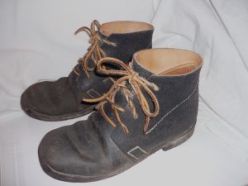
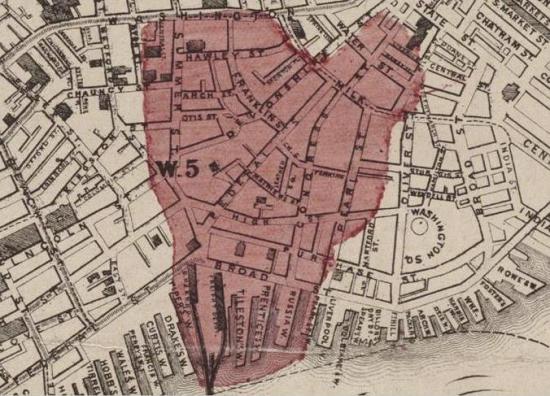


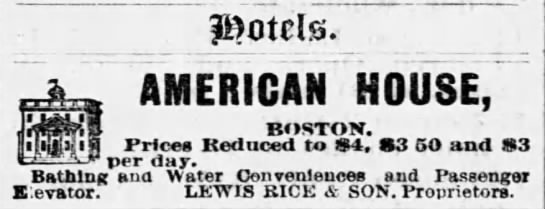
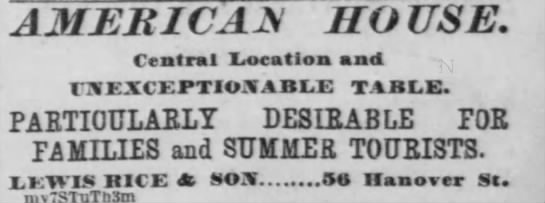
 Milton Observer