I am given to understand that representatives of the Milton Taxpayers’ Association (MTA) will be out collecting signatures in the next month so that a Tax Cap warrant article may appear on the March ballot.
You may share their concern that in recent years that Town officials seem to be either unable or unwilling to restrain themselves in creating Town budgets. They thereby create tax burdens that increase at rates much greater than inflation. This could be your opportunity to “assist” the Town in finding some upper limits.
Last year the Board of Selectmen (BOS) voted unanimously to use your fund balance – the money they took “in error” due to their preposterous 2016 valuation – to cover their rather incontinent budget. Their budget was rejected by the voters, but many of its features were funded anyway by an excessive “fudge factor” included in their process.
This year the BOS voted unanimously to “guide” their Town department heads in drafting budgets that included 2% raises and 1.7% COLA increases. Selectman Rawson said immediately, i.e., without any apparent consideration at all, that he was “just fine” with that; the other selectmen all agreed with him.
In a public BOS meeting this past year Town Planning Board member Laurence D. “Larry” Brown spoke rather unguardedly about his “vision” for Milton’s future. (He had requested a secret meeting, but went ahead anyway in a public session). You might find that you are not present in the future he plans.
Mr. Brown expressed publicly his utter contempt for manufactured homes. They do not serve as “attractions.” (Quote: “No one travels to see the double-wides of New Jersey”). Yes, that old saw again, as if creating “attractions” was ever a legitimate concern of government. He said forthrightly that there are “far too many” manufactured homes in town (13% of Milton’s households). That is to say, for those of you that live in them, there are far too many of you in town.
Mr. Brown expressed his glowing approval for “gentrification” – a process by which wealthier incomers displace those with less wherewithal. Can’t keep up with our increasing government and the increasing taxes needed to pay for it? You can be replaced by better, wealthier taxpayers.
Mr. Brown congratulated himself on having personally prevented the establishment of many businesses over the years, both as an officeholder and an individual. As if that were an accomplishment. (He bragged that he had even spent his own money on lawsuits to do so).
These are the people that are Planning our future, creating and approving the Town budgets, and setting the tax rates. One might almost embrace a slogan from the national scene, and claim that these persons are “Not My Planning Board” and “Not My Board of Selectmen.”
There might be some few among you who think that these trends and these people have not been a burden and a problem for Milton. You should sign the Tax Cap petition anyway, if only to support the principles of democracy. You would be ensuring that there are more ballot options from which voters might choose, rather than fewer options. And there would be no danger that a fully satisfied electorate would pass such a measure, right?
If an MTA volunteer finds their way to your house, you should smile upon their efforts. If you do not encounter one, you may find an MTA volunteer seated in the Dunkin’ Donuts, for the next few Saturday mornings, between 8:00 AM and 10:00 AM.
By Muriel Bristol (Transcriber) | December 12, 2019
In this year, we encounter the death of a former Nute High principal, a housekeeper situation wanted, the Teneriffe Sports Club’s winter carnival, the Wolfeboro winter carnival, the death of the Milton station agent, the collapse of the Pineland Park pavilion, the Spinney Farm for sale, an Eliot versus Nute baseball game, vacationing principals, Miss Carmichael goes to the World’s Fair, President Roosevelt signed a Federal conscription act, a Mrs. DeMerritt visits Kittery, and a stolen grocery truck.
This was also the year in which National Socialist (Nazi) Germany invaded and occupied Denmark and Norway, invaded and occupied the Netherlands and Belgium, and defeated and partially occupied France, but failed to gain air superiority in the Battle of Britain. The Union of Soviet Socialist Republics (U.S.S.R) occupied Latvia, Lithuania, and Estonia.
At the beginning of the year, we bid farewell to Arthur Thaddeus Smith, who collapsed suddenly in Boston’s South Station and died en route to Boston City hospital.
Lawyer Expires in Railway Terminal. Winchester, Mass., Jan. 2 (AP). Services for Arthur T. Smith, 64, Boston lawyer and corporation official, who collapsed and died last night, will be at his (235 Mystic Valley Parkway) home Thursday afternoon. Smith, Dartmouth honor graduate and former principal of the Nute High school, Milton, N.H., died in Boston’s south terminal a few minutes after seeing his daughter, Jeanette, off for New York (Boston Globe, January 4, 1940).
Smith had been the Nute High School’s second principal before taking up a law practice in Boston.
IN MEMORIAM. Arthur Thad Smith. While bidding goodbye to his daughter on New Year’s morning, Arthur Thad Smith, prominent Massachusetts barrister, collapsed at the South Station and expired before reaching Boston City hospital. This death reaches deeply the communities of Farmington and Milton and rekindles enduring affections that are shared universally in these quarters where he began an illustrious career before the ink was hardly dry on his college diploma. Mr. Smith was born at Silver City, Idaho, May 1, 1875, the son of Dr. Arthur Noel and Mary Hattie (McCann) Smith. As a lad he came to Dover, where his father engaged in a medical practice for a number of years. The deceased graduated from Dover high school and from Dartmouth college with a degree of A.B. and highest honors in 1896. The same year he was elected principal of Nute high school in Milton, and served that post for five years. He resigned his post as teacher in 1901, having entered Harvard Law school and was graduated in 1904 with a bachelor of laws degree. He was admitted to the Massachusetts bar the same year and immediately joined the law firm of Bartlett & Anderson. Soon after he married one of his former high school pupils, Miss Ora S. Dickie. Of this union two children were born, a son, Arthur T. Smith, Jr., who was associated with him in a Boston law practice, and a daughter, Miss Ora Jeanette Smith, now a student in New York City. It was while he was located at Milton that he formed deep attachments with the late Elmer F. Thayer, prominent New Hampshire shoe manufacturer and financier, who later settled both manufacturing and residential interests in Farmington. Mr. Smith became treasurer and director of the Thayer-Osborne Shoe Cp., continuing this capacity and extending his connections to the Farmington National bank. Mr. Smith renewed associations with this locality not infrequently and always with the warm-hearted fellowship which his affections embraced (Farmington News, January 5, 1940).
Mrs. Margaret O. (Newell) Corbett sought again a housekeeper position as she had in 1934.
Charles O. Stillings, a fibreboard mill oiler, aged sixty-seven years (b. NH), headed a Milton household at the time of the Sixteenth (1940) Federal Census. His household included his wife, Susie [(Newell)] Stillings, aged sixty-four years (b. Nova Scotia), his children, Harold A. Stillings, a fiberboard mill sample clerk, aged twenty-seven years (b. NH), and Elmer E. Stillings, a machine tender, aged twenty-seven years (b. NH), and his sister-in-law, Margaret O. Corbett, a private home house maid, aged fifty-seven years (b. Canada). Charles O. Stillings rented their house, for $13 per month.
Milton’s Teneriffe Sports Club held a winter carnival in late January 1940. (Likely they sponsored also the winter carnival of the prior year).
Wilbur Lover Is Ski Star at Milton, N.H., Carnival. MILTON, N.H., Jan. 28. Wilbur Lover, with victories in the downhill and slalom races, was the individual star in the final day’s events of the annual Winter carnival of the Teneriffe Sports Club today. Miss Myrtle Durkee was elected Queen of the carnival last night and presided over all festivities today. The summary: Downhill Ski Race Won by Wilbur Lover, Teneriffe Sports Club; second, Ed Senechal, Pow-Wow Club, Amesbury, Mass. Time. 59.6s. Slalom Race Won by Lover; second, Elmer Skillings, Teneriffe Club; third, William Warneke, Teneriffe Club. Time, 1m. 4s. Ski Jump Won by Guy Smith; second, Everett MacIntyre; third, Wilbur Lover. Distance. 68ft. 9in. (Boston Globe, January 29, 1940).
Peter J. Lover, a leather-board mill machine tender, aged fifty-two years (b. NH), headed a Milton household at the time of the Sixteenth (1940) Federal Census. His household included his wife, Alice M. [(Downs)] Lover, aged fifty-one years (b. NH), his son, Wilbur C. Lover, a leather-board mill finisher, aged twenty-five years (b. NH), and his boarder, Marion Atwood, a public school teacher, aged thirty years (b. NH). Peter J. Lover owned their house on Church Street, which was valued at $1,150.
Porter J. Durkee, a grocery store storekeeper, aged thirty-nine years (b. MA), headed a Milton household at the time of the Sixteenth (1940) Federal Census. His household included his wife Estella [(Swinerton)] Durkee, a grocery store clerk, aged thirty-four years (b. NH), and his children, Myrtle T. Durkee, aged sixteen years (b. MA), and Edward A. Durkee, aged eleven years (b. NH). Porter J. Durkee rented their house in the Milton “Community,” i.e., Milton Three Ponds, for $15 per month.
Milton schoolboy skiers Leeman and Leavitt placed first and second in the Wolfeboro Winter Carnival slalom race. Leavitt came second in the downhill race. (Their first names were not given).
Rochester, N.H., Ski Club Takes Wolfeboro Team Prize. WOLFEBCRO, N.H., Feb. 4. – Handicapped by adverse snow conditions. the Wolfeboro Winter Carnival skiing events were held today, with a large group of spectators in attendance. In the hockey game last night, the Sacred Hearts of Concord administered a crushing defeat to the Abernaki Indians of Wolfeboro, winning by a 17-to-6 score. The summary: Team prize won by Greenwich State Outing Club (Rochester), combined time 11m. 29 2-10s.; second, Abernaki Outing Club (Wolfeboro). 11m. 40 4-10s. Downhill Race Won by Pouliot (Greenwich). 1m. 15s.; second, L. Couture (Greenwich), 1m. 17s. Slalom Race Won by R. Marden (Abernaki), 43s.; second, L. McHugh, 46 2-10s. Open Downhill Won by N. Davis (Abernaki). 23 6-10s.; second, L. McHugh. 25s. Junior races, children under high school age, slalom for boys, won by Leeman (Milton, N.H.), 1m. 6 5-10s; second, Leavitt (Milton, N.H.) lm. 19 3-10s. Downhill Won by B. McHugh (Wolfeboro), 33 1-10s,; second, Leavitt (Milton, N.H.). 33 3-10s (February 5, 1940).
It would seem, by a process of elimination, that the Milton junior race champions were George H. Leeman, aged fifteen years, and Roland R. Leavitt, aged fourteen years.
Edgar J. Wyatt, no occupation listed, aged sixty-seven years (b. NH), headed a Milton household at the time of the Sixteenth (1940) Federal Census. His household included his wife, Hattie E. [((Hayes) Dewolfe)] Wyatt, aged seventy-one years (b. NH), his son, Luther A. Wyatt, a sample room clerk at a leather-board mill, aged twenty-nine years (b. NH), his step-daughter, Helen M. [(DeWolfe)] Leeman, aged forty-nine years (b. NH), and his grandson, George H. Leeman, aged fifteen years (b. NH). Edgar J. Wyatt owned their house on Old Road, which was valued at $1,500.
Roy P. Leavitt, a leather-board mill operator, aged forty-eight years (b. NH), headed a Milton household at the time of the Sixteenth (1940) Federal Census. His household included his wife, Bertha E. [(Baker)] Leavitt, aged forty-seven years (b. NH), his children Pauline B.W. Leavitt, a shoe shop operator, aged twenty-six years (b. NH), and Roland R. Leavitt, aged fourteen years (b. NH), his grandchild, Daniel H. Whitehouse, aged two years (b. NH), and his lodger, Raymond Cleveland, a repair shop welder, aged nineteen years (b. NH). Roy P. Leavitt owned their house on Remick Street (near its intersection with Church Street), which was valued at $1,000.
Here we bid farewell to Milton’s long-term B&M railroad station agent Hugh A. Beaton. He dropped dead while working at the Milton train station.
H.A. Beaton appeared in the Milton directory of 1905 as Milton’s American Express Co. agent.
IN MEMORAM. Hugh A. Beaton. Announcement of the sudden death of Station Agent Hugh A. Beaton at Milton on February 12 brings sorrow to many friends and acquaintances in this locality. Mr. Beaton dropped dead while he was about his duties in the B&M railroad yard at Milton, Monday afternoon. The deceased was 67 years of age and had been in the employ of the B&M for about 45 years. For nearly 40 years he had held the position of station agent, freight agent and telegraph agent, and was widely known among his townsmen and to the traveling public. He is survived by his wife, two daughters, a brother Charles Beaton, also a railroad man of Portsmouth, and one sister, for all of whom much sympathy is expressed. Funeral was held Wednesday morning at the Baptist church in Milton, with services in charge of Fraternal Chapter, No. 71, A.F.&A.M., of which he was a member (Farmington News, February 16, 1940).
Milton had a popular dance pavilion at Pineland Park, at Milton Three Ponds, which was active from about 1924 through at least 1937. (See Milton and Frolic Haven – 1925-37).
Here we learn that the pavilion’s structure was damaged by the heavy gale winds of Saturday and Sunday, April 6-7. The pavilion collapsed on Sunday afternoon, April 7, 1940.
LOCAL. While no local reports of damage to property have come in since the gales of Saturday and Sunday, there was a total collapse of Pineland Park Pavilion at Milton Three Ponds on Sunday afternoon. For a number of years this has been among the chief summer amusement resorts of this region and its destruction inflicts a heavy property loss on its owner, Albert Green of East Rochester (Farmington News, [Friday,] April 12, 1940).
Grace L. Mills, a widow, aged sixty-four years (b. NH), headed a Rochester, NH, household at the time of the Sixteenth (1940) Federal Census. Her household included her lodgers, Albert L. Green, second hand in the weaving room of a woolen mill, aged fifty-four years (b. MA) and [his second wife,] Lena M. [(Companion)] Green, a weaver at a woolen mill, aged forty-six years (b. NH). Grace L. Mills owned their house at 2 Green Street, which was valued at $2,000.
The Spinney Farm on Milton Mills road, i.e., Applebee Road, in Milton Mills, went on the market.
Summer Cottages & Houses. FOR RENT FOR SEASON – Furnished 8-rm, old colonial, beautiful setting, modern, bathing, fishing, near White Mountains. Spinney farm, Milton Mills rd., Milton Mills, N.H. May be seen the week-end or call Bel. 3569, Thursday. 2t my 30 (Boston Globe, May 30, 1940).
Eliot (ME) High school won a baseball game against Milton’s Nute High school in the last two innings of the game.
Eliot High Pins Defeat On Nute At Milton, 3-0. Milton, N.H., June 5 – Eliot, Me., high tallied three runs in the last two innings here yesterday to win over Nute High 3 to 0. The locals were held to two hits by Lapointe in the seven-inning affair.
Eliot 0 0 0 0 0 1 2 – 3; Nute 0 0 0 0 0 0 0 – 0
Runs – Bourgiois, Spencer, Lapointe. Errors – Bourgiois, Richardson, Lord, Davis, Craig. Two-base hits – Bourgiois. Three-base hits – Morin. Stolen bases — Bourgiois, Morin, Spencer. Sacrifices – Dyer, Lapointe. Double plays — Bourgiois, to Spencer to Sylvester. Left on bases – Eliot 4, Nute 3. Base on balls – off Warneke. Struck out, by Warneke 9. Lapointe 13. Hit by pitcher – by Warneke, (Spencer). Umpire – O’Brien. Time of game -1:45 (Portsmouth Herald, June 5, 1940).
The Nute High School team would appear to have been third baseman James L. Ramsey (aged 16 years), shortstop Kenneth R. Stowe (aged seventeen years), pitcher Donald S. Warneke (aged sixteen years), left-fielder Phillip E. Lord (aged seventeen years), center-fielder Frederick W. Comfort (aged fifteen years), right-fielder Fred E. Clough (aged fifteen years), catcher Charles H. Logan (aged seventeen), and second baseman Charles F. Husser (aged eighteen years). First baseman Craig remains somewhat elusive; he might have been an out-of-town tuition student.
Two Cambridge, MA, grammar school principals, daughters of Patrick and Julia (Coleman) O’Keefe, were vacationing at their Milton summer home.
CAMBRIDGE. The Misses Ellen and Elizabeth O’Keefe, Rindge av., North Cambridge, principals of the Wyman and Abraham Lincoln Grammar Schools, respectively, are vacationing at their Summer home at Milton, N.H. (Boston Globe, June 29, 1940).
Mary O’Keefe. a public school matron, aged sixty-four years (b. MA), headed a Cambridge, MA, household at the time of the Sixteenth (1940) Federal Census. Her household included her sisters, Elizabeth J. O’Keefe, a public school principal, aged sixty-three years (b. MA), and Ellen T. O’Keefe, a public school acting principal, aged sixty years (b. MA). Mary E. O’Keefe owned their house at 184 Rindge Avenue, which was valued at $4,500. They had all resided in the “same house” in April 1935.
Principal Elizabeth J. O’Keefe had attended four years of college, while her sister, acting principal Ellen T. O’Keefe, had attended two years of college, and her other sister, matron Mary E. O’Keefe, had attended two years of high school.
Margaret Carmichael of Foxcroft, Milton Mills, accompanied Mary E. Clapp of Brattleboro, VT, to the 1939 New York World’s Fair.
Just prior to taking up residence at Foxcroft, Margaret Carmichael, a private nursing school teacher, aged twenty-six years (b. ME), had shared an apartment with Martha Martin, a public school school nurse, aged twenty-eight years (b. VT), in Wolfeboro, NH, at the time of the Sixteenth (1940) Federal Census. Their apartment on Waumbeck Street cost them $25 per month.
Personal. Miss Mary Elizabeth Clapp and guest, Miss Margaret Carmichael of Foxcroft, Milton Mills, N.H., have gone to New York on business. They also will attend the World’s Fair (Brattleboro Reformer (Brattleboro, VT), July 18, 1940).
President Franklin D. Roosevelt signed the first-ever peacetime conscription act, September 16, 1940. All men aged 21 to 45 years of age were required to register for the draft. Draft boards established themselves in October and some registrants were being called up as early as November 1940.
Mrs. Carrie S. (Tobey) DeMerritt, wife of Delphin G. DeMerritt, and her children here visited with her sister-in-law in Kittery, ME.
Kittery Point. Mrs. Delwin DeMerritt and children of Milton, N.H., are visiting her sister, Mrs. Schyler Tobey of Haley road (Portsmouth Herald, September 30, 1940).
She was a daughter-in-law to Mrs. Musetta A. (Dorr) DeMerritt, who one may remember and admire for her gift to ailing patients in 1918,
Jack Howard of Farmington, NH, who formerly managed Frolic Haven at the Pineland Park pavilion, in Milton Three Ponds, as late as 1937, commenced a winter dance series at Central Hall in Milton Mills.
DANCE AT MILTON MILLS. Jack Howard will have a grand opening dance at Central hall, Milton Mills, on Saturday evening, October 1. Music will be furnished by the Four Aces. For those who love to sway to romantic tunes or jump to jitterbug music, this should be as ideal way to spend the holiday evening. Columbus would have liked it no doubt (Farmington News, October 4, 1940).
Some culprit stole a delivery truck from the Furber & Sons grocery store in Farmington, NH. The grocery store partners were Leon F. Furber and his two sons, Otto J. Furber and Myron F. Furber.
Leon F. Furber, a grocery store owner, aged fifty-five years (b. NH), headed a Farmington, NH, household at the time of the Sixteenth (1940) Federal Census. His household included his wife, Flora [A. (Jones)] Furber, a packer, aged fifty-three years (b. NH), and his boarder, Clyde Nutter, a public school student, aged twelve years (b. NH). Leon F. Furber owned their house on Mechanic Street, which was valued at $2,000.
The truck thief jammed it between two trees on the West Milton road, i.e., on Milton Road in Farmington, or its continuation as Park Place in Milton.
DELIVERY TRUCK STOLEN. A delivery truck used in the business of Furber and Sons was stolen last Saturday night and was found wedged between two trees on the West Milton road. As yet, it has not been determined who is directly responsible for the theft but it is still being investigated and it is hoped that the culprit or culprits will soon be brought to justice, for the business has been somewhat handicapped this week by the loss (Farmington News, November 15, 1940).
By Muriel Bristol (Transcriber) | December 8, 2019
In this year, we encounter volunteer woodsmen, a police investigation, a winter carnival, a cottage for rent, an auto stalled on the tracks, a possible ice cream venue, mice in the radiator, a two-family house for sale, a fatal fire, a coed colonel, a Milton Mills lodge for ski travelers, and Christmas bonuses.
This was the year of the Horne murder, in which John H. Howland murdered Milton-native Maude F. Horne, on Friday, February 3, 1939.
This was also the year in which the Second World War began, when National Socialist (Nazi) Germany invaded Poland, on September 1, 1939. (Let us not forget the Union of Soviet Socialist Republics (U.S.S.R.), which invaded Poland from the other side, and murdered 22,000 Polish officer prisoners and civilians in or near the Katyn forest).
Eighteen men and four horses gathered at the Nute Chapel woodlot in West Milton to clear away wind-blown timber. It might have been freshly damaged timber, but more likely it had been brought down in September by the Hurricane of ’38.
ODD ITEMS from EVERYWHERE. Eighteen men recently gathered at the parsonage woodlot of Nute Chapel, West Milton, N.H., and worked with four horses to salvage the blown-down timber, while the women of the community did their part in the kitchen, preparing winner for the toilers (Boston Globe, January 11, 1939).
HERE and THERE. Eighteen men gathered a short time ago at the parsonage woodlot of Nute Chapel at West Milton and worked with four horses to salvage the blown-down timber, while the women of the community did their part in the kitchen, preparing a dinner for the workers (Portsmouth Herald, January 11, 1939).
One wonders what the dinner might have been. Something both wholesome and toothsome, no doubt.
Here follows some additional details regarding John H. Howland’s February murder of Miss Maude F. Horne (beyond those set out already in Milton and the Horne Murder – 1939).
Milton’s then Police Chief Downs had appointed the felon Howland as a special or reserve police officer during the Hurricane of ’38. The Chief had supplied him at that time with a coat and a heavy flashlight. The same flashlight is discussed here as possibly having been the murder weapon. George McKeagney replaced Chief Downs at the March election.
Seek to Question Pal. MILTON, N.H., Feb. 6. After questioning scores of townspeople in the new Nute High School at Milton, N.H., during the day, Strafford County Solicitor John F. Beamis announced tonight that an appeal would be broadcast for information on Edwin (Buddy) Howard, pal of John N. Howland, missing suspect in the case, who assisted the suspect in writing several pieces of music. Beamis appealed to Howard to come forward and submit voluntarily to questioning. The solicitor said that the state officials were seeking additional information about Howland. Beamis also said that the state officers now have corroborative testimony that Howland and his 15-year-old girl friend were seen near the home of the murdered woman, at about the time the murder occurred. Last Saturday, a neighbor, Mrs. Charlotte Garyait, placed the young man and girl in Miss Horne’s home at the approximate time of the crime. The latest evidence, Beamis said, places the pair on the Farmington road [now Elm Street], a few hundred feet away from the Horne residence. He would not reveal the identity of his informants.
Kept Little Cash in House. To assure full cooperation from the 1200 farmers and mill workers who live in Milton, Atty. Gen. Thomas P. Cheney issued a circular today which was distributed to every home, calling upon anybody with information to get in touch with investigating officials. The townspeople were also asked if they had any recent conversations with any of the three. That the murderer obtained less than $35 from Miss Horne’s purses was ventured by Beamis. He said that the murdered woman was not in the habit of having much money in the house despite the fact that her uncle, who died four months ago, left her $3322 in cash as part of his estate. The uncle’s estate was valued at more than $10,000. Mrs. Ina Shaw of West Lebanon, Me., a former resident of East Rochester, told the authorities that she called on Miss Horne Friday and she was in good spirits. She said she showed her around the house and even went to the garage where the car, which is now missing, was located. The mother of Howland, Mrs. Rose Abrams of Reading, Mass., who has been residing in a one-story house on Main st., went to Boston last Wednesday, Beamis stated. She did not know where her son was while in the city. She returned here after the crime. Howland is a parolee from an Ohio prison to which he had been sentenced from one to 20 years for the larceny of an automobile. He served as a special police officer in Milton, during the weeks immediately after the hurricane last September, Chief Downs asserted. At that time he borrowed one of the Chief’s police coats and also five-call flashlight, neither of which were ever returned. The medical examiner has been asked to report whether or not a heavy flashlight could have caused the wound to the murdered woman’s head (Boston Globe, February 7, 1939).
John W. Shaw, a private shop barber, aged seventy-three years (b. England), headed a Lebanon, ME, household at the time o the Sixteenth (1940) Federal Census. His household included his wife, Ina M. [(Blaisdell)] Shaw, aged sixty-three years (b. ME). John M. Shaw rented their West Lebanon house, for $5 per month. (They had lived in Rochester, NH, as late as April 1, 1935).
Milton held a winter carnival Friday and Saturday, February 11-12.
Week-End Events. SATURDAY AND SUNDAY. Milton, N.H. – Carnival (Boston Globe, [Friday,] February 10, 1939).
The Portsmouth owner of a Milton beach-front cottage offered it for rent. It had several attractive amenities.
FOR RENT. FOR RENT – Furnished cottage Milton, N.H. Fireplace, sleeping porch, conveniences. Sandy beach with boat. Tel. Ports. 2732-14. 3t J5 (Portsmouth Herald, June 6, 1939).
An automobile driven by Mrs. Elizabeth (Bronson) Maxfield, wife (since July 1938) of Rev. Leland Maxfield, stalled on the railroad tracks, at Porter’s crossing in Milton. She and one of her two passengers were seriously injured when the automobile was struck by a northbound train.
Two Women Hurt as Train Hits Car at Milton, N.H. MILTON, N.H., July 8 (A. P.) – Two women were injured critically and a man escaped with cuts and bruises today when a Boston to North Conway railroad train struck an automobile stalled across the tracks a mile beyond Milton. The injured were listed as Mrs. Elizabeth Maxfield of Milton, driving a car owned by the Milton Red Cross Chapter, and two passengers, Mr. and Mrs. Harry Large of Lebanon, N.H. Names of the two women were placed on the danger list at Rochester Hospital. Doctors said Mrs. Maxfield had several broken ribs and internal injuries and Mrs. Large suffered a fractured leg and probable internal injuries (Boston Globe, July 8, 1939).
Mrs. Large never fully recovered from her injuries. She died three years later in July 1942.
Harry D. Large, no occupation given, aged sixty-six years (b. NH), headed a Lebanon, ME, household at the time of the Sixteenth (1940) Federal Census. His household included his wife [of thirty-six years], Alberta G. [(Shorey)] Large, aged sixty-four years (b. NH). Harry D. Large owned their house, which was valued at $1,500. They were said to have lived in the “same house” in 1935. (They had resided in Malden, MA, in 1930).
Miss Meredith E. Corkins, aged about twenty-six years, put aside her apron at her brother’s Green Shutters ice cream parlor in Wilmington, VT, in order to put on another at The Ice Box in Milton, NH.
Wilmington. Miss Meredith Corkins, who has been assisting at the Green Shutters for several weeks, has left for Milton, N.H., where she will be employed for two or three weeks at The Ice Box (Brattleboro Reformer, September 9, 1939).
When it opened in May 1935, the Green Shutters was described in the Bennington, VT, newspaper. The paper provided few details of the parlor’s menu, but its description of the color scheme was quite complete.
WILMINGTON. The “Green Shutters” opened last Saturday under the management of Mr. and Mrs. Ray Corkins. The outside has been newly painted white with green shutters. The interior is attractive in red and cream. A modern soda fountain has been installed with novel lighting effects. The booths are finished in mahogany. The waitresses, Louise Ray and Lilla Shultz, are dressed in green and white (Bennington Banner, May 10, 1935).
Milton’s “The Ice Box” ice cream parlor has proven somewhat elusive, assuming it existed in Milton at all. Editors, reporters and typesetters sometimes mistook Milton for Wilton. In looking for it, one finds that the newspapers were overflowing with offers to take one’s old ice box in partial trade for a new electric one, and overflowing too with many, many recipes for ice box cakes and cookies. Both of which made searching for “Ice Box” like looking for a needle in a haystack.
One remembers Charles L. Morrison, the Boston & Maine Railroad gate tender mentioned in 1929 as having a large appetite for ice cream.
Mice fled the radiator of a wood-sawing machine when it was filled with water. It might have been their mousey descendants that built a nest in the air duct of my automobile.
Probably it was the same instinct which causes rats to leave a sinking ship that made mice leave the radiator of a wood-sawing machine at Milton, N.H., when the owner began to pour in water preparatory to starting operations. The mice had built a nest inside the radiator and it blocked passages in the cooling system so that nearly a full day was required to make repairs on the system. That’s something for Ripley to work on (Burlington Free Press, October 6, 1939).
Here we find advertised an offer of a seller-financed mortgage. The owner wanted 25% down, and would apparently negotiate payment terms for the other 75%. (Other sellers on the same page offered to finance fifteen or twenty-year mortgages).
THE REAL ESTATE MARKET. BARGAIN! – $1500 buys my Milton, N.H., 2-family; fully rented, $26 monthly; cost $6000. OWNER, P 414. Globe (Boston Globe, October 25, 1939).
The $6,000 price would have today the spending power of $109,757. Few would consider that to be much spending power when buying current two-family houses.
One might almost suppose that government guarantees of mortgages, like its guarantees of student loans, and guarantees of other things, actually causes a greater rate of inflation in those “guaranteed” markets.
David Knight Pinkham, also known as David Knight, died when the “one-room board camp” in which he was sleeping “burned to the ground.”
NEW HAMPSHIRE MAN DIES IN FIRE AT CAMP. MILTON, N.H., Nov. 20 (AP). David Knight, 52, perished in a fire which during the night destroyed a woods camp on Jones river, five miles from Milton. Medical Referee Forrest L. Keay reported death was accidental. Knight formerly lived at South Berwick, Me., and at Dover and had served in the navy (Rutland Herald, November 21, 1939).
His Milton death record explained that “His charred remains [were] found in camp of Bard B. Plummer near Jones River at northeastern part of Teneriffe Mt., Milton, N.H.” The camp was described also as a “wood chopper’s camp.” The unfortunate Mr. Knight was buried on the Milton Town Farm.
Identify Victim of Milton Fire. Milton, Nov. 24 – The body of a man tentatively identified as that of David “Knight,” aged about 53, discovered as the victim of death by burning Sunday evening, Nov. 19, at a lumberman’s camp on the northeast side of Teneriffe Mountain in this town, has been identified as that of David Pinkham, Both names belong to the same man. From investigation by Deputy Sheriff Lyman Plummer, whose father owns the land on which camp is located, it was learned that the name “Knight” was that of man’s step-father, Fred Knight. He has a daughter by the name Beatrice J. Pinkham, born May 1922, in Dover, but her whereabouts is unknown. Unable to locate any relatives, Deputy Plummer and Chief of Police George McKeagney of Milton buried the remains in the town cemetery here (Portsmouth Herald, November 24, 1939).
Ruth Phyllis “Phyllis” Iovine of Milton, a Boston University student in the Class of 1940, was a leading candidate for coed colonel of the annual B.U. military ball.
B.U. Co-Ed Colonel Candidates. Phyllis Iovine, Milton, N.H., at left, and Georgianna Harris, Carlisle, Penn., are leading candidates for coed colonel at the annual Boston University Military Ball, Friday night, in the main ballroom of the Hotel Statler. The affair is sponsored by the university chapter of Scabbard and Blade (Boston Globe, December 14, 1939).
Ruth Phyllis Iovine, of Milton, NH, a schoolteacher, married in St. Thomas (Episcopal) Church in Dover, NH, October 27, 1946, Robert Samuel Boak, Jr., of Portsmouth, NH, a radio announcer.
Boston doctor and pharmacist Fred M. Drake opened a vacation lodge at Milton Mills.
Fred M. Drake appeared in Boston directory of 1939, as running a retail drug store at 54 Fairmount av. in the Hyde Park district of Boston, MA. He and his wife, Marjorie F. [(Folger)] Drake, resided in the Squantum district of Quincy, MA.
WINTER SPORTS. Dr. Fred M. Drake, formerly of Hyde Park, has opened a vacation lodge at Milton Mills, N.H., and is recommending it as a stop-over for snow parties en route further north. It’s 100 miles from Boston, north of Rochester off Route 16 (Boston Globe, December 15, 1939).
Dr. and Mrs. Drake do not appear in the Boston directory of 1940, nor in the Sixteenth (1940) Federal Census. One supposes they were in Milton Mills. However, Fred M. Drake appeared in the Boston directory of 1941, as an osteopathic physician, at 15 Fairmount av. in the Hyde Park district of Boston, MA. He and his wife, Marjorie F. Drake, resided at 475 Washington street in Dedham, MA.
The Spaulding Fibre company, having considered its financial situation, chose to give out Christmas bonuses to its employees ten days before Christmas.
The $2.50 rate it gifted to someone having worked in any month would have today the spending power of about $45.75. (The six-month bonus would have the modern spending value of $274.50, and the full-year bonus would be worth $549.00). Ho, ho, ho.
Rochester, N.H., Dec. 15 (AP) Employes of the five mills of the Spaulding Fibre company, owned and operated by the former New Hampshire governors, Huntley N. and Rolland H. Spaulding, received Christmas bonuses today. All employes of record last December, who worked part of each month in 1939, received $30; those who worked in six months received $15, and others received $2.50 for each month. The mills are in Townsend Harbor, Mass., Rochester, North Rochester and Milton, N.H. (Bennington Evening Banner (Bennington, VT), December 15, 1939).
Rolland Spaulding, a fibre manufacturer, aged sixty-seven years (b. MA), headed a Rochester, NH, household at the time of the Sixteenth (1940) Federal Census. His household included his wife, Vera G. [(Going)] Spaulding, aged fifty-seven years (b. MA), his children, Virginia Spaulding, aged nineteen years (b. MA), and Betty Spaulding, aged seventeen years (b. MA), and his servants, Alice Beckingham, a private family maid, aged thirty-one years (b. NH), and Eleanor Higgins, a private family cook, aged thirty-eight years (b. NH). Rolland Spaulding owned their house at 76 Wakefield Street, which was valued at $45,000.
Huntley Spaulding, a fibre manufacturer, aged seventy years (b. MA), headed a Rochester, NH, household at the time of the Sixteenth (1940) Federal Census. His household included his wife, Harriet [(Mason)] Spaulding, aged sixty-three years (b. MA), his servants, Ina [(Brown)] Wood, a private family cook, aged thirty-eight years (b. NH), and Wendell Wood, a private family chauffeur, aged forty-five years (b. MA). Rolland Spaulding owned their house at 78 Wakefield Street, which was valued at $35,000. (Joshua Studley, a greenhouse proprietor, aged forty-two years (b. MA), resided at 82 Wakefield Street).
Those interested in orthography may note that the news article used still the original French spelling of employé or employe, with a single trailing “e.” Also that the company name features the British spelling “Fibre,” rather than the more American “Fiber.”
Due to holidays and snowstorms, we join the celestial show already in progress.
December 2. The Pheonicid meteor shower will originate from the Constellation Phoenix.
December 4. The first quarter phase of the Moon should shine brightly in the evening sky. The Moon is at its apogee (its greatest distance from the Earth), which will result in it appearing smaller than usual.
December 6. The Cassiopeia meteor shower from Andromeda should be visible.
December 7. The Puppid-Velid meteor shower from Veda will appear in the night sky.
December 9. The Monocerotid meteor shower from Monoceros should be visible.
December 10. The Moon will be at its farthest distance from the Sun. This is commonly referred to as the Moon at aphelion. Also this evening, Saturn and Venus will both rise at a right ascension,
December 11. Saturn and Venus will be passing one another.
December 12. The Moon will be full on this date. This Moon is the third full autumn Moon of 2019, known as the Oak Moon (in-the-sky.org, 2019). The Hydrid meteor shower from the Constellation Hydra presents itself. An object in space orbiting the Milky Way, known as the Large Magellanic Cloud or LMC will present itself today (Wikipedia, 2019).
December 13. Venus and Pluto will be rising otherwise known as conjunction.
December 14. The Geminid meteor shower from the Constellation Gemini is upon us this date.
December 15. From the Constellation Cancer, the Beehive Cluster will be making a close approach to the Moon. An open cluster from Orion will be visible, also known as NGC 1981.
December 16. From the Constellation Leo comes the Comae Berenicid meteor shower.
December 18. The Moon will be at perigee meaning at its closest point to the Earth. This Moon should appear larger than usual. This date also brings us to the last quarter of the Moon.
December 20. December Leonid Minorid meteor shower from the Constellation Leo Minor.
December 21. December Solstice and shortest day of the year.
December 22. Both the Moon and Mars will ascend a.k.a be in conjunction. As well, they both will be moving close together.
December 23. Ursid meteor shower from the Constellation Ursa Minor.
December 26. There will be a new Moon. The Moon will also be closest to the Sun.
December 27. The Moon and Saturn will ascend. Jupiter will move very close to the Sun.
December 28. From the Constellation Monoceros comes an open star cluster generally referred to as NGC 2232. The Moon and Venus will rise and will be approaching one another.
December 29. Once again coming from the Constellation Monoceros comes an open star cluster commonly referred to as NGC 2244.
December 30. Mercury will be located at its greatest distance from the Sun, otherwise referred to as aphelion.
We wish you a very Happy New Year! My resolution will be to issue this report in a more punctual manner. But you know how it is with New Year’s resolutions.
By Muriel Bristol (Transcriber) | December 5, 2019
Milton barber John H. Howland brutally murdered Miss Maude F. Horne in her Farmington Road (now Elm Street) home on Friday night, February 3, 1939, after 8:00 P.M.
Howland escaped in his victim’s black 1935 Plymouth automobile, accompanied by his teenage cousin.
The Victim
Maude Francis Horne was born in Milton, July 9, 1877, daughter of John R. and Olive R. (Corson) Horne. Her mother died in Milton, May 22, 1879 (before Maude’s second birthday).
Miss Horne attended Nute High School with one of its first classes (probably during the tenure of Principal Norton). She taught in Milton schools for several years after graduation. Thereafter, she worked in Milton’s shoe industry as a shoe stitcher, shoe repairer, shoe operative, etc.
Susan F. Horne, aged fifty-six years (b. NH), headed a Milton household at the time of the Twelfth (1900) Federal Census. Her household included her brother, John R. Horne, a widowed farm laborer, aged forty-seven years (b. NH), her sister, Martha A. Horne, aged forty-five years (b. NH), and her niece, Maude F. Horne, a school teacher, aged twenty-three years (b. NH).
John R. Horne, a general farm farmer, aged fifty-four years (b. NH), headed a Milton household at the time of the Thirteenth (1910) Federal Census. His household included his sister, Mattie A. Horne, aged fifty-five years (b. NH), and his daughter, Maude F. Horne, a shoe factory stitcher, aged thirty-two years (b. NH). John R. Horne owned their farm on the Plummer’s Ridge Road.
John R. Horne, a farmer, aged sixty-six years (b. NH), headed a Milton household at the time of the Fourteenth (1920) Federal Census. His household included his sister, Mattie A. Horne, aged sixty-four years (b. NH), and his daughter, Maude F. Horne, a shoe shop shoe repairer, aged forty-two years (b. NH). John R. Horne owned their farm on the Plummer’s Ridge Road.
John R. Horne, a widower, aged seventy-six years (b. NH), headed a Milton household at the time of the Fourteenth (1930) Federal Census. His household included his sister, Mattie A. Horne, aged seventy-five years (b. NH), and his daughter, Maude F. Horne, a shoe factory operator, aged fifty-two years (b. NH). John R. Horne rented their house on Silver Street, for $10 per month. They did not have a radio set.
Maude’s father, John R. Horne, died in Milton, April 11, 1938. Her uncle, Charles A. Horne, a retired Milton meat merchant, died in Milton, October 10, 1938. Her aunt, Martha A. “Mattie” Horne, died at Plummer’s Ridge in Milton October 22, 1938. Maude supplied the personal information for all their death records.
Miss Horne moved from her rented place on Silver Street to her late Uncle Charles’ house on the Farmington Road (now Elm Street). She was said to have felt uneasy there, which she attributed to living alone for the first time in her life.
The Murderer
John Henry “Henry” Howland was born in Stoneham, MA, April 23, 1913, son of Norman and Anna Rose (Burbine) Howland. (He sometimes used the alias John Norman Howland).
His criminal record commenced when he was about thirteen years of age. Police arrested him in Charleston, WV, on suspicion of burglary, June 26, 1927. He posted a $1,000 bond and was released pending trial. A jury convicted him of an auto theft in Monroe, WA, May 16, 1929, for which he received a three-to-five-year sentence.
John H. Howland, an inmate, aged twenty years (b. MA), was imprisoned in the WA State Reformatory in Park Place, Snohomish, WA, at the time of the Fifteenth (1930) Federal Census. Prison authorities assigned him to the building labor detail there; he was said also to have been married when he was sixteen years of age, which they took to be circa 1925-26. (In point of fact, he would have been only about sixteen years of age as of this census enumeration, and not the twenty years that he claimed).
A Bexar County, TX, jury convicted him of an auto theft in Austin, TX, January 26, 1931, for which he received a five-year sentence.
John Howland of Middletown, OH, pled guilty to stealing an automobile from Middletown auto dealer R. Shetter, July 10, 1935, and he received an indeterminate (one-to-twenty years) sentence in September 1935 (Journal News (Hamilton, OH), September 13, 1935). He received a parole from the Ohio State Farm on August 1, 1938, just six months before he murdered Miss Horne.
Several accounts describe Howland as an ex-Navy man, sailor or “gob.” One imagines his service, if any there actually was, to have been brief. He did have a tattoo of a girl’s head and the legend “San Juan,” which might suggest time spent in Puerto Rico. Of course, there are San Juans in Mexico too, and he had spent “time” in neighboring Texas. Howland claimed to have been in the Navy just before getting hired at the Salem Shoe company in Milton, whereas he had actually been just before a prisoner at the Ohio State Farm.
John H. Howland came to Milton due to the presence here of his mother, Mrs. Anna R. “Rose” ((Burbine) Howland) Abrams. She was employed in nursing Maude F. Horne’s uncle, Charles A. Horne, during his final illness. (Her sister and her sister’s family lived also in town).
Howland was in town for less than six months. He took initially a job at the Salem Shoe company factory, and resided with his mother in the ailing Horne’s Farmington Road (now Elm Street) house. Uncle Charles died in Milton, October 10, 1938.
At some point, Howland’s mother left for Reading, MA. Howland remained behind in Milton. He was working in Hervey C. Tanner’s Milton barber shop at the time of the murder.
Maude F. Horne accused him of having stolen $100 worth of household items from her late uncle’s house after his death.
The Cousin
Aida Elizabeth Butler was born in Milton, February 3, 1924, daughter of Edward T. and Margaret J. (Burbine) Butler. Her mother and Howland’s mother were sisters, which made her a first cousin to Howland.
Edward T. Butler, a leather-board mill engineer, aged forty years (b. MA), headed a Milton household at the time of the Fifteenth (1930) Federal Census. His household included his wife, Margaret J. [(Burbine)] Butler, aged thirty-four years (b. MA), and his children, Charles E. Butler, aged fifteen years (b. MA), Benjamin F. Butler, aged thirteen years (b. MA), Margaret E. Butler, aged twelve years (b. NH), John P. Butler, aged eleven years (b. NH), Walter F. Butler, aged nine years (b. NH), Patrick Butler, aged seven years (b. NH), Aida E. Butler, aged six years (b. NH), Thomas U. Butler, aged three years (b. NH), Grace A. Butler, aged one year (b. NH), and George F. Butler, aged three months (b. NH). Edward T. Butler owned their house on North Main Street, which was valued at $1,000. They had a radio set. Fred Chamberlain, a State Road commissioner, aged seventy years (b. NH), was their neighbor.
Aida E. Butler was a student at Nute High School at the time of the murder. Police did not consider her to be an active participant, although she was present at the scene and fled with the murderer on his cross-country getaway. Police arrested her with him on a sort of “holding” charge of flight to avoid testifying. She was slated to be a witness against him, but was never called, as he pled guilty at his trial.
Hunt Young Barber, Girl In Brutal Horne Murder. N.H. Warrant Charges John N. Howland With Slaying Spinster – Seen in House. Special Dispatch to the Globe. MILTON, N.H., Feb. 5. – A warrant charging John N. Howland, 25-year-old barber, with the murder of Miss Maude F. Horne, 61, was issued tonight by Sheriff Clyde R. Cotton. Police throughout New Hampshire and other New England states were immediately asked to aid in the search for the youth, who disappeared from his home here late Friday night. In the same interstate teletype broadcast, state officials asked that a 15-year-old girl who disappeared from her home here at the same time be taken into custody for questioning. Both Howland and the high school girl were placed in Miss Horne’s home here early Friday evening by a neighbor. State Police said that they believe that the girl was a witness to the murder. Three men’s handkerchiefs, used as a gag to shut off the cries of the elderly spinster-victim, were being held by Sheriff Cotton as one of the most Important bits of evidence in the case. The handkerchiefs, Cotton said, bear the initial “H.” Additional evidence was found, the sheriff reported, that the slayer washed his hands and possibly the murder weapon in the kitchen sink in the murdered woman’s home. Bits of human hair found in the sink will be examined tomorrow to determine if it is that of Miss Horne. The murder warrant was issued by Cotton soon after he received the report on an autopsy performed by Dr. Ralph Miller, state pathologist, of Hanover, and Dr. Forest L. Keay, medical referee of Stafford County, stating that Miss Horne “died an agonizing death.” Atty. Gen. Thomas P. Cheney stated that Drs. Miller and Keay said “without qualification” that Miss Horne died in the room where the body was found, from a combination of fractures of the skull and suffocation.
Neighbor’s Tale. “Three handkerchiefs were packed in her mouth,” the doctors’ report read, “displacing her tongue to the extent that it entirely cut off all supply of air. The victim bled profusely. Either the head injuries or suffocation might have caused death.” Sought with Howland is a high school girl who was last reported seen Friday night with the murder suspect in Miss Horne’s home. Earlier on the same night she had told her mother that she was going to a basket-ball game at Somersworth, but nobody has been found who saw her at the game. Mrs. Charlotte Garyait, a neighbor of the murder victim, told state officers today that she visited Miss Horne on Friday night, arriving at the Horne residence at 7:15 and leaving at 7:45. At 7:30, she said, Howland and the 15-year-old girl arrived to visit with Miss Horne. They were still there when she left, Mrs. Garyait said.
Arthur P. Garyait, a fibreboard mill moulder, aged thirty-six years (b. ME), headed a Milton household at the time of the Sixteenth (1940) Federal Census. His household included his wife, Charlotte E. [(Wiggin)] Garyait, aged thirty-one years (b. NH), and his children, Richard Garyait, aged ten years (b. NH), and Barbara Garyait, aged seven years (b. NH). Arthur P. Garyait owned their house on the Farmington Road (now Elm Street), which was valued at $700.
Familiar With House. Police said that Howland, a former sailor, was thoroughly familiar with the house in which the murder occurred. Last Fall when his mother, Mrs. Rose Abrams, now of Reading, Mass., was nursing Charles A. Horne, an uncle of Miss Horne, he stayed at the house nights to assist her. Miss Horne, a resident of this town all her life, went to live in the murder house only last October after the death of her uncle. It was believed that she inherited a sizable fortune at that time. Investigators also learned today from neighbors of the murdered spinster that for two weeks before her sudden death she lived in fear for her life. On several occasions she told friends that she feared to go to bed at night, and had slept in an armchair on the first floor of the small house. She was never alone before, she said, and she couldn’t get used to it. The missing Howland had told townspeople for a week before his disappearance that he was planning to go South. Three or four days before the murder he told the postmaster that he wished his mail held for him because he would be out of town for several weeks. Howland is described in the teletype messages sent out by the New Hampshire State Police as being six feet tall and weighing 190 pounds. He is fond of music, the message stated, and plays several musical instruments. A girl’s head is tattooed on his upper right arm and shoulder over a date and the words, “San Juan.” The 15-year-old girl, believed to be with the youth, is described as being five feet, two inches tall and weighing 118 pounds. When last seen she was wearing a brown ski suit, plaid jacket and brown overshoes. She wore no hat.
Put Suitcase in Auto. After leaving the Navy, Howland worked for a time at the Salem Shoe factory here and most recently as a barber. Fellow employees at the factory knew him little, declare that he seemed to prefer the company of women to that of men. Hervey Tanner, owner of the barber shop in which the youth worked most recently said today that Howland a few days ago offered to sell him a “Tommy-gun” for $40. Tanner was unable to tell officials whether Howland had any ammunition for the machine gun. Miss Evelyn Paey, 27, was minding Tanner’s children on Friday night, she told police when she looked out the window of the Tanner home and saw Howland packing a suitcase into the rear of an automobile. She was unable to describe the auto, which police believe may have been that of Miss Horne which has not been seen since the time of the murder. The murder weapon has not been found. Because of the type of wounds on the victim’s head, police think that the weapon may have been a heavy flashlight. The death of Miss Horne was the fourth in her family within a period of 10 months. Her father. John, died last April, and her uncle, Charles, and aunt, Mattie Horne, died last October (Boston Globe, February 6, 1939).
One wonders if Howland had ever actually had a Thompson submachine gun (“Tommy gun”) or whether that was just some sort of scam. (His $40 asking price would have the current value of about $732). Howland was a felon many times over. An actual submachine gun would have been illegal to possess under the National Firearms Act of 1934. So, it would have been impossible for him to have acquired one, right?
George W. Paey, foreman of a shoe shop finishing room, aged sixty-eight years (b. MA), headed a Milton household at the time of the Sixteenth (1940) Federal Census. His household included his wife, Josie M. [(Downs)] Paey, aged sixty-two years (b. NH), his sister-in-law, Hattie E. [(Downs)] Hartford, a widow [of Fred S. Downs], aged sixty-nine years (b. NH), and his daughter, Evelyn Paey, a private home houseworker, aged thirty years (b. NH). George W. Paey owned their house on Silver Street, which was valued at $800.
Miss Paey lived on Silver Street, but she saw Howland putting his suitcase in Miss Horne’s car from a window at Hervey C. Tanner’s house on Mill street. One might infer that Howland lived also on Mill street.
Hervey C. Tanner, a barber shop barber, aged thirty-five years (b. NH), headed a Milton household at the time of the Sixteenth (1940) Federal Census. His household included his wife, Yvonne E. [(Lessard)] Tanner, a shoe shop stitcher, aged twenty-nine years (b. NH), and his children, Hervey C. Tanner, Jr., aged four years (b. NH), and Patrick Tanner, aged two years (b. NH). Hervey C. Tanner owned their house in the “Milton Community” (Mill street) which was valued at $1,500.
Arrest Asked of Howland in N.H. Murder. ROCHESTER. N. H., Feb. 8 – Maj. Ralph W. Caswell, deputy superintendent of the New Hampshire State Police, today sent to large cities throughout the country circulars asking for the arrest of John Henry Howland on a warrant charging murder. Howland, police say, is on parole from the Ohio State Prison. He is wanted, says the circular, for the murder last Friday of Miss Maude Horne, 61, of Milton, N.H. Howland has been sought for four days, ever since Miss Horne’s battered body was discovered. Also missing is Aida Butler, 15-year-old cousin of Howland, who is believed to have gone with him. The circular says that Howland, who is 25 years old, has a record at “Charleston, W. Va.; Monroe, Wash.; Austin, Tex.; Texas State Penitentiary, and was paroled Aug. 1, 1938, from London, O., state farm.” In Ohio, Howland was serving a one to twenty-year sentence for larceny. Investigators hoped today that need of money would send Howland to acquaintances, many of whom are known (Boston Globe, February 8, 1939).
BLOODY PRINT SPURS SEARCH FOR HOWLAND. Special Dispatch to the Globe MILTON, N.H., Feb. 7. The imprint of a bloody hand on a door jamb in the little white house where elderly Miss Maude Horne was slain last Friday night definitely connects John Henry Howland, missing prison parolee and amateur song writer, with the crime, state officers said tonight. Since Saturday morning, state fingerprint expert Ivan Hayes has been working in the murder-house. The gruesome mark on the doorway leading from the living room to the kitchen and prints of a couple of fingers found on a water dipper are the best of those which he believes are connected with the crime. Classifications of Howland’s finger prints arrived here today from the Ohio State Prison where the suspect was imprisoned a couple of years ago on an automobile theft charge. Other prints are expected within the next day from Washington.
Nation-Wide Hunt On. After County Solicitor John F. Beamis and state and local police officials had an opportunity to check the prints received from Ohio with photographs of those found in the Horne home, the technical classification of the wanted man’s finger prints were sent to every state in the country. Deputy Supt. of State Police Maj. Ralph W. Caswell announced the finding of the prints on the door jamb and their importance in the search for Howland. Agents of the Federal Bureau of Investigation searched Howland’s home here today and seized several of his personal articles, including a bundle of letters. Maj. Caswell denied tonight rumors that any of the bundle of letters taken by police from the Howland home contained “love-letters” from admirers of the missing man.
Sought by Police: Aida Butler, 15
Believe Girl Innocent. There is a feeling here that Howland, who so far as anybody knows had little or no money last weekend, may seek out some one of his old friends for assistance. Authorities said today that although they believe that Howland’s cousin, 15-year-old Aida Butler, was present at the. time of the murder, evidence points to the fact that she took no active part in the crime and may have been forced to accompany Howland when he quit town. The girl’s mother, Mrs. Edward Butler, sister of Mrs. Rose Howland Abrams, Howland’s mother, has repeatedly said that she was sure that Aida did not leave town of her own volition. Mrs. Butler pointed out that when her daughter left home Friday night, ostensibly to go to a basket-ball game with Howland, she wore no hat and only everyday sports clothes.
Services for Victim. Funeral services were held this afternoon in a heavy snowstorm for Miss Horne at the Edgerly Funeral Home. Only a few relatives and friends were present. Rev. Leland Maxfield of the Baptist Church officiated. After the services, the body was removed to the Rochester Cemetery. Awaited by police is the complete report of Dr. Ralph Miller, state pathologist, who performed an autopsy last Saturday and has since had the vital organs of the murdered woman and also bits of hair found in the sink of the Horne home in his laboratory at Hanover. The hair, police said, was apparently washed off the murder weapon in the kitchen sink by the murderer before he quit the house. There is a chance, the authorities declare, that there may be further proof of the identity of the murderer in the pathologist’s final report.
Leland Maxfield, a minister, aged thirty years (b. NH), headed a Milton household at the time of the Sixteenth (1940) Federal Census. His household included his wife, Elizabeth [(Bronson)] Maxfield, aged twenty-seven years (b. NY), and his boarders, Mary E. Willard, aged twenty-nine years (b. MA), and Mary E. Sherborne, aged twenty-three years (b. ME). Leland Maxfield rented their house on Church Street, for $10 per month.
Slaying Motive Advanced. The theory that Miss Horne’s death may have been connected in some way with a series of petty thefts from the home of her late uncle, Charles Horne, who died last October, was put forward tonight by one of the state officers investigating the crime. Rumors have been circulating in this tiny town since the murder that it was because the elderly woman learned of the thefts which totaled less than $100 and threatened to expose the thief, that she was slain. When Miss Horne inherited the property of her uncle, she also inherited an inventory of all the physical goods in the estate. It was after checking the furnishings in her uncle’s house against this list, that she allegedly confronted the thief with her evidence (Boston Globe, February 8, 1939).
Five-State Hunt for Howland in N.H. Murder. MILTON, N.H., Feb. 9 – Police authorities in five states were co-operating today with county investigators in their search for John Henry Howland, chief suspect in the slaying last Friday of Miss Maude Horne, and for his 15-year-old cousin and supposed companion, Aida Butler. Acting on reports that the wanted couple were seen last Sunday afternoon in Ossipee, 36 miles from here, New Hampshire State Police this morning resumed their search of all empty camps and buildings in Ossipee seeking to uncover some clew as to their whereabouts. Meanwhile Massachusetts, Connecticut, Rhode Island and New York authorities were endeavoring to check the report of a Boston bus driver that a man and woman resembling Howland and his young cousin had boarded a New York-bound bus with another, couple in Providence last Sunday night and left at Southport, Conn., when their money ran out.
Bus driver Edward S. White’s information was inaccurate. Howland and Butler never boarded his bus, nor were they accompanied by another couple. They had Miss Horne’s automobile.
Driver Roxbury Man. The driver, Edward S. White, 30, of Roxbury, who supplied the information last night at Boston Police Headquarters, said the two couples left the bus Monday morning at 4:10 and asked him how far it was to New York. White was uncertain about the identification of Howland and said he was “positive” in his identification of the Butler girl’s picture. Although sought for questioning by investigators here, the girl, who disappeared Friday night after leaving her home to attend a basket-ball game, is believed by authorities to be innocent of all connection with the murder. White told Boston police that one of the two men wore a navy uniform and the other, dressed in civilian clothes, carried a Gladstone bag. The other girl was tall, dark and about 27 years old, the driver said. His attention was attracted to the couples at the Providence terminal, White stated, when he was told by the ticket agent that when the men purchased tickets they asked him how far the four could travel for $2.50 each. The agent told them that Southport, Conn., was the limit for that sum and the men bought tickets to that point (Boston Globe, February 9, 1939).
SLAYER OF MILTON WOMAN STILL AT LARGE. Near a week has elapsed since the body of Miss Maude Horne, a well-known Milton woman and murder victim, was found in her home on the Farmington road early last Saturday evening. John H. Howland and a 15 years old girl, a cousin of the accused, are at large and the objects of a countrywide search, as Howland is suspected of the slaying of Miss Horne. The story of this brutal assault and the death of Miss Horne, has featured [in] daily newspapers since the finding of the body. Town, state, county and Federal officers have been working on the case. Every effort is being made to trace them together, separately, or in connection with a black 1935 Plymouth coach, the property of the murdered woman, which bore registration plates N.H. 51839, and in which it is alleged Howland and his companion made their getaway. The identification of the missing pair sought in connection with the death of Miss Horne, has definitively established Howland as an ex-Navy man and he has a long criminal record from which finger prints have been compared with those found at the scene of the crime. His companion is a high school girl, known to everybody in her home town and never before has been charged with reprehensible conduct. Miss Horne was a native and lifelong resident of Milton and one of its most esteemed women. She was 61 years old, the daughter of the late John and Olive (Corson) Horne. She was a member of one of the first classes to graduate from Nute high school in her native town, and subsequently for several years was a successful school teacher. She had never married and had always lived a quiet, yet influential, life through her affiliations with church, fraternal and young people’s work. Among the surviving relatives is a cousin, Herbert F. Horne of Farmington. Funeral services were held in Rochester on Tuesday afternoon (Farmington News, February 10, 1939).
Herbert Horne, a retired salesman, aged sixty-four years (b. NH), headed a Farmington, NH, household at the time of the Sixteenth (1940) Federal Census. HIs household included his wife, Maude D. [(Barker)] Horne, a houseworker, aged sixty-three years, and [her] sister, Ethel Barker, a houseworker, aged sixty-two years (b. NH). Herbert Horne owned their house on Lone Star Avenue, which was valued at $4,700.
Man Wanted For Murder Slips Through Officers Of McAllen. McALLEN – John Howland, alias John Allen King, was fingerprinted by the McAllen police department night of February 17 when he asked for a place to sleep, chief of police Noah Cannon said Saturday. Cannon said Howland, wanted in New Hampshire on a charge of murder and theft of a car, approached on a Main street corner bout 7:30 p.m. February 17, and explained that he had come down to McAllen from San Antonio looking for a job. The man, six feet tall and brown-headed, told Cannon he expected to get a job with a neon sign company the next day. Howland said he wanted a place for he and his “wife” to sleep. The woman with him was not questioned by local police, but Chief Cannon said he assumed she was the Aida Butler, 15, mentioned in the dispatch from New Hampshire. Cannon sent the man to the Salvation Army, where Howland was told they could provide a place for the woman but not for him. The woman said she disliked to be away from her companion, but finally decided to sleep at a place provided by the charity organization, and Howland went to the jail to sleep. The night was cold and misty. The man was fingerprinted as a routine matter by Henry Mallau, the city’s fingerprint expert. The next day, Howland went to the sign company, asked about the job, and when told the man in charge was out, he left and he and his woman companion left town, Chief Cannon said. Howland’s prints were sent to the Texas department of public safety at Austin and the Federal Bureau of Investigation at Washington, D.C. The police chief received a telegram from Joe S. Fletcher, chief of the bureau of identification and records at Austin on February 20, notifying Cannon that’ Howland was wanted in New Hampshire for murder. By that time, Cannon said the McAllen department did not know of the man’s whereabouts. Cannon said the man did not act suspicious, apparently was seeking the job in good faith, and there was no reason to hold him for further investigation. An agent from the federal bureau of investigation was in McAllen Friday seeking information on Howland, Cannon said. The G-men entered the case apparently through the Mann act which prevents a man from taking a girl across a state line, and from the act which prohibits transportation of a stolen automobile across a state line. Records sent McAllen police department by the Texas department of public safety show that Howland was arrested June 26, 1937 at Charleston, W. Va., on suspicion of burglary and entering. He made a $1.000 bond, but disposition of the case was not noted. May 16, 1929, he was arrested at Monroe, Wash., charged with taking a motor vehicle without the owner’s knowledge and sentenced to from three to five years. He turned up at Austin, Texas, January 26, 1931, arrested by state police on a charge of a car theft. He was sentenced to five years from Bexar County on the charge. On July 10, 1935, Howland again was in trouble with the law. He was arrested at Middletown, Ohio, on a charge of auto theft in Columbus, Ohio, and sentenced to from one to 20 years. He was paroled August 1, 1938. On February 10. 1939. the Concord, N.H., police department sought him for the murder of a Mrs. [Miss] Horne, 62. The last notation on the record is: “February 17, 1939. McAllen police department, fingerprinted, investigation” (Valley Morning Star (Harlingen, TX), February 26, 1939).
HOWLAND AND GIRL ARRIVE HERE TODAY. John Henry Howland, 25-year-old writer of love songs, will arrive in Boston this afternoon, nearing the end of a 2200-mile cross-country trip to face trial for the murder of Miss Maude Horne, elderly Milton, N.H., spinster. With Howland on the night of the murder was his cousin, Aida Elizabeth Butler, 15, who left the little New Hampshire mill town with him on his flight. Taken into custody with him, she will be returned on the same train from Corpus Christi, under police guard. Sometime late this afternoon Howland and his cousin will be taken across the city from the South to the North Station and start on the last leg of their return trip to Dover, N.H. (Boston Globe, March 29, 1939).
Indictments formerly employed a legal boilerplate phrase: “not having the fear of God before his eyes, but being moved and seduced by the instigation of the devil and his own wicked heart …” Was Howland insane or wicked when he bludgeoned and suffocated Miss Horne?
HOWLAND TO HAVE MIND EXAMINATION. Pleads Innocent to N.H. Murder; Goes to Hospital. CONCORD, N.H., March 31. (AP). John Henry Howland, 25-year-old ex-sailor who pleaded innocent yesterday to two indictments charging him with the murder of Miss Maude Horne, 61, Milton, N.H., spinster, entered the state hospital today for mental observation. Former County Solicitor Thomas H. McGreal, appointed by Superior Court Judge A.J. Connor as counsel for the accused man, said he would ask that Howland be kept at the hospital for a month. Mental examination is required in capital cases in New Hampshire. Staring at the floor and speaking in a barely audible voice, Howland entered pleas of innocence to both indictments in Dover yesterday. One charge said that Miss Horne died of strangulation Feb. 3, the other said a blow on the head was the cause. The whereabouts of Miss Aida Butler, his 15-year-old cousin, remained undisclosed. The girl, arrested with Howland in Corpus Christi, Tex., after a nation-wide search, will be the “principal witness” against the former sailor, Prosecutor John Beamis said. Attorney General Thomas Cheney told the court Howland had “talked freely about most phases of the case and readily admitted that he had killed Maude Horne” (Brattleboro Reformer, March 31, 1939).
Thomas McGreal, a private practicing attorney, aged forty-three years (b. NH), headed a Somersworth, NH, household at the time of the Sixteenth (1940) Federal Census. His household included his wife, Annie McGreal, aged forty-one years (b. MA). He rented their house at 29 Linden Street, for $20 per month. (He died in Boston, MA, November 4, 1940, of post-operative complications).
HOWLAND GOES TO PRISON FOR LIFE. Changes Plea to Guilty to Murder of N.H. Woman. DOVER, N.H., May 1. (AP). John Henry Howland, 25-year-old self-styled jack of all trades, pleaded guilty in Strafford county court today to the blackjack slaying of Miss Maude Horne, 61, at Milton Feb. 3 and was sentenced to life imprisonment by Judge A.J. Conner. The trial lasted only 12 minutes (Brattleboro Reformer, May 1, 1939).
John Howland, an inmate, aged twenty-seven years (b. MA), resided in the NH State Prison in Concord, NH, at the time of the Sixteenth (1940) Federal Census.
By Muriel Bristol (Transcriber) | November 28, 2019
In this year, we encounter a former Milton teacher’s appointment as a college trustee, an earthquake, a Milton Mills farm for sale, a fatal auto accident, the death of a visiting native, completion of NH Route 75, Rev. Leland Maxfield’s wedding, the Great New England Hurricane of ’38, and a Milton Mills fire.
This was also the year in which National Socialist (Nazi) Germany annexed the Austrian Republic, on March 12, 1938, and the Czechoslovakian Sudetenland region, on October 1, 1938.
Katherine L. Gardner graduated from Mt. Holyoke College in South Hadley, MA, in 1914, and taught for “a few years” thereafter at Milton, prior to taking a position as a stenographer at Amherst College in Amherst, MA. (She was there as early as 1920, and married her husband there in 1925).
Years later, we find Massachusetts Governor Hurley appointing her as a trustee at the State College in Amherst, MA, i.e., the University of Massachusetts at Amherst. There were apparently some ruffled political feathers associated with her appointment, not associated with her, but with the protocol and the nature of the hierarchy.
HURLEY DENIES SLIGHTING BAKER. Declares Mrs. Canavan Qualified for Trustee. Gov. Hurley emphatically denied yesterday that he intended any slight to Pres. Hugh B. Baker of the State College when he appointed as a college trustee Mrs. Katherine G. Canavan, whose husband is superintendent of the college’s dairying department and a subordinate of Pres. Baker. “Mrs. Canavan is exceptionally well qualified for the position,” commented the Governor, “and the fact that her husband happens to be an employee of the college should not be held against her.” There have been repeated but unconfirmed rumors that the Governor has been at odds with Pres. Baker. The basis for these rumors was the fact that Howard Bidwell, recently discharged superintendent of the power plant, has been given the opportunity by the Governor to call and question college officials at a public hearing. When confirmed Mrs. Canavan will become one of the 14 trustees of the college and achieve distinction at an institution where she worked about 15 years ago as a stenographer. It was while she was working at the college that she met and married her husband. Upon her marriage she gave up her position at the college and went to live at a home in the town. Her husband, Frank Canavan, continued his employment at the college and rose to be head of his department. The couple have five youngsters, some of whom plan to attend classes at the college. In addition to his work at the college Mr. Canavan has been chairman of the Democratic Town Committee and, in the last election, was a staunch supporter of Gov. Hurley. Mrs. Canavan is well known and well liked at Amherst. She is the daughter of the late Prof. George E. Gardner of Boston University and is a sister of Prof. George K. Gardner of Harvard Law School. She is a graduate of Mt. Holyoke College and for a few years was a teacher at Milton, N.H., and later at Rawlins, Wyo. (Boston Globe, April 1, 1938).
Milton felt briefly the tremors of an earthquake on April Fools’ Day, April 1, 1938. (Eighty years later, Farmington, NH, experienced a 2.1 magnitude earthquake on December 3, 2018, which was felt also in Milton).
HOUSES ARE SHAKEN IN N.H. AND MAINE. Slight Tremor Reported Lasting 11 Seconds. Special Dispatch to the Globe. ROCHESTER, N.H., April 1. Rattling dishes and shaking pictures from the wall, an earthquake tremor alarmed residents of several towns within a 10-mile radius of Rochester early tonight. Floors swayed and glasses tinkled on mantelpieces in East Rochester and Milton, N.H., and South and West Lebanon, across the river in Maine, as telephone calls flooded police and telephone stations here between 9:15 and 9:30. Mrs. Helen Piper, telephone operator at Milton, said the telephone exchange building shook. She heard a rumbling noise, she declared, and a moment later telephone subscribers for miles around flooded the exchange with inquiries asking where the explosion was. Rev. Leland Maxfield, pastor of the Community Church at Milton, said it felt as though “some large object had rolled downhill and struck the house.” Another Milton resident, Ira W. Jones, said he believed a meteor had exploded. Pictures shook on the mantel of her room, one West Lebanon, Me., woman reported, while another said floors swayed and cellars seemed to rumble (Boston Globe, April 2, 1938).
Charles E. Piper, a public utility agent, aged fifty years (b. NH), headed a Milton household at the time of the Sixteenth (1940) Federal Census. HIs household included his wife, Helen [(Pray)] Piper, a telephone co. agent, aged fifty-two years (b. NH). Charles E. Piper owned their house on Main Street, Milton Community, which was valued at $1,200.
Leland Maxfield, a minister, aged thirty years (b. NH), headed a Milton household at the time of the Sixteenth (1940) Federal Census. His household included his wife, Elizabeth [(Bronson)] Maxfield, aged twenty-seven years (b. NY), and his boarders, Mary E. Willard, aged twenty-nine years (b. MA), and Mary E. Sherborne, aged twenty-three years (b. ME). Leland Maxfield rented their house on Church Street, for $10 per month.
Ira W. Jones, no occupation listed (presumably retired), aged eighty-five years (b. NH), headed a Lebanon, ME, household at the time of the Sixteenth (1940) Federal Census. His household included his wife, Lucie C. [(Wentworth)] Jones, aged seventy-two years (b. NH), and his daughter, Mary C. Jones, aged forty-five years (b. NH). Ira W. Jones owned their house, which was valued at $4,500.
Here was offered for sale a nine-room house (ten rooms when counting the bathroom), on a 140-acre property on the right-hand side of the Milton Mills road that was off the main highway, i.e., off the White Mountain Highway.
THE REAL ESTATE MARKET. MILTON, N.H. FOR SALE – Country estate of 140 acres, 9-room house, bath and barn on Milton Mills road. Belmont 3659 or see owner on property June 18 and 19; first house on right side of Milton Mills road, off main highway. 3t je16 (Boston Globe, June 16, 1938).
Real Estate. HOUSE FOR SALE. 10-ROOM colonial house in beautiful setting, ideal for Summer or year-round: modern in every respect, including 4 fireplaces, barn and workshop; good bathing and fishing: easy driving distance to White Mountains. Call Bel. 3569, or will be on property Saturday and Sunday. Milton Mills road, Milton, N.H. Milton Mills 31, ring 2 (Boston Globe, June 25, 1938).
Real Estate. MILTON, N.H. 10-ROOM colonial house in beautiful setting, ideal for Summer or year-round: modem in every respect, including 4 fireplaces, barn and workshop; good bathing and fishing; easy driving distance to White Mountains. Call Bel. 3559, or will be on property Saturday, Sunday. Milton Mills road. Milton, N.H.; Milton Mills 31, ring 2. dSu3t jy1 (Boston Globe, July 1, 1938).
Milton Mills road, off the main highway, sounds like what is now known as Applebee Road.
A Melrose rusticator died when his automobile went off the White Mountain Highway in Milton, three miles short of Milton Three Ponds village.
Charles G. Bodley, a manufacturer’s agent for a wholesale plumbing supplier, aged forty-four years (b. MA), headed a Melrose, MA, household at the time of the Fifteenth (1930) Federal Census. His household included his wife (of eight years), Katherine H. Bodley, aged thirty years (b. NV), and his children, Charles H. Bodley, aged seven years (b. MA), Joyce Bodley, aged three years (b. MA), and Katherine A. Bodley, aged one year (b. MA). Charles G. Bodley owned their house at 74 Harold Street, which was valued at $8,000. They had a radio set.
CRASH KILLS MELROSE MAN. Car Goes Over Wall, Hits Tree in Milton, N.H. MILTON, N.H., July 8. Charles G. Bodley, 52, of 74 Harold st., Melrose, Mass., was instantly killed shortly after midnight this morning when his automobile left a road three miles outside of town and hurtled over a stone wall, striking two trees. The wreck of his car was discovered by George E. Jordan of this town. State Motor Vehicles Inspector Harold M. Foss, state trooper Frank D. Manning and patrolman Wilfred Grenier went to the scene and reported that Bodley’s car had traveled more than 100 feet along a deep ditch at the roadside before hitting the wall. Medical Referee Dr. Forrest L. Keay of Rochester said that the man died instantly. He was alone in his car. According to papers found in Bodley’s pockets he was a member of the Melrose Legion Post and the Grand Lodge of the Rosicrucian Brotherhood. The Bodley family is spending vacation in a camp at Horn Pond, Milton Mills, N.H. Mr. Bodley was formerly employed as a manufacturer’s agent (Boston Globe, July 8, 1938).
George E. Jordan maintained a Milton filling station, presumably near to the crash site.
Milton death records state that Charles G. Bodley died of a “fracture of skull when his automobile ran off the road into a stone wall and trees. No other auto involved and he rode alone.” The death, and therefore the accident, occurred at about 10:45 PM on the night of July 7. Louise P. Avery (daughter of the Milton Town Clerk who had died in 1936) recorded the death. Frank F. Spencer (whose Milton Mills house, barn and funeral parlor would burn down in October) served as funeral director.
A visiting Milton native, Alta Durgin (Chipman) Cleaves, died while vacationing in Milton. She was born in Milton, September 18, 1895, daughter of Edwin and Bertha (Drew) Chipman, and married in Milton, September 3, 1916, Frank H. Cleaves.
MRS. ALTA CLEAVES. MILTON, N.H., July 7. Stricken with a cerebral hemorrhage while vacationing here, Mrs. Alta Cleaves, proprietor of a Boston employment bureau, died here tonight. Mrs. Cleaves, who resides at 115 Gallivan boulevard, Dorchester, was taken ill early this evening at the home of her mother. Mrs. Bertha Chipman, in this town. Besides her mother, Mrs. Cleaves leaves two sisters, Mrs. Clara Kimball of Milton, N.H., and Mrs. Lois Fogg of Sanbornville, N.H. Services will be held at her mother’s residence, Sunday afternoon (Boston Globe, July 8, 1938).
It would seem to have been Ralph J. Chesley of Farmington, NH, who “built the roads” between Farmington, NH, and Milton.
He supervised construction of the state highway, i.e., NH Route 75, a 5.5 mile stretch of road between Farmington, NH (at NH Route 11), and Milton (at NH Route 125), over a period of three seasons. His crew is projected here to complete the final quarter mile by the end of July 1938. Their work would have consisted largely of reworking existing roads.
Ralph J. Chesley appeared in the Dover directory of 1936, as a farmer, housed on the Ten Rod Road (RD 2) in Farmington, NH.
FARMINGTON TO COMPLETE STATE ROAD TO CONNECT WITH MILTON. Work was commenced on Tuesday this week toward the completion of the final 1286 feet of unfinished highway construction required to connect the towns of Farmington and Milton with a permanent stretch of state highway which has been in process of construction the past two seasons. The work was resumed in charge of former Road Agent Ralph J. Chesley, under whose supervision the former work was done. With good weather favoring the project, it is expected the connecting link will be finished by the end of July (Farmington News, July 8, 1938).
Ralph J. Chesley, a portable sawmill loader, aged forty-five years (b. NH), headed a Farmington, NH, household at the time of the Sixteenth (1940) Federal Census. His household included his wife, Ethel Chesley, aged forty-two years (b. NH), and his children, Lois Chesley, aged seventeen years (b. NH), and Pauline Chesley, aged thirteen years (b. NH). Ralph J. Chesley owned their farm on the Ten Rod Road, which was valued at $1,600.
Rev. Leland Maxfield of the Milton Community Church married Miss Elizabeth Bronson of Boston, July 21, 1938.
BOSTON NURSE WEDS MILTON, N.H., PASTOR. Miss Bronson Is Bride of Rev. Leland Maxfield. Special to the Globe. MILTON, N.H, July 21. Rev. Leland Maxfield, pastor of the Community Church, and Miss Elizabeth Z. Bronson of Boston were married this evening at 6 o’clock at the church by Rev. J. Westfield Bronson of Brookline, brother of the bride. Miss Ruth Butler of Whitman, Mass., was maid of honor and the best man was Rev. James Marshall of Medford, Mass. The ushers were Rev. Ernest D. Sillers, pastor of the Baptist Church, East Rochester; Rev. Leslie Beinstadt of Beverly, Mass., field secretary of the Christian Endeavor Societies of Massachusetts, and Rev. James Currie, pastor of the Baptist Church at Milton Mills, N.H. Mr. Maxfield is the son of Mr. and Mrs. Lewis Maxfield of Rochester. He graduated from Gordon College of Theology and Missions in Boston in 1935. Mrs. Maxfield is a graduate of the Memorial Hospital Training School for Nurses, Albany, N.Y., and Gordon College, Boston, and has been employed as a supervisor in the Deaconess Hospital, Boston (Boston Globe, July 22, 1938).
The Hurricane of 1938 made landfall first at Long Island, NY, and then Connecticut on September 21, proceeded through western Massachusetts and along the New Hampshire-Vermont border, during the night of September 21-22, then through Vermont, on September 22, finally dissipating in Ontario, Canada, September 23.
It was the deadliest and most destructive hurricane to strike New England probably ever, and certainly the worst since the Great Colonial Hurricane of 1635. Milton was fortunate in not having been directly in its path and would have experienced mostly severe wind damage, with attendant loss of trees, power and telephone lines.
Recovery Problems Face New England As Waters Recede. Death List Has Climbed To More Than 400; Plans For Rehabilitation Are Now Under Way. Boston, Sept. 24. Receding flood waters along the wide Connecticut and Merrimack rivers today left battered Massachusetts, New Hampshire, Vermont and Connecticut with a staggering recovery problem. With a hurricane death toll in Rhode Island around 240; the-known dead for all six states had climbed well above 400. As rescue-workers cut their way through to isolated communities, the chance grew the dead eventually might number 500. More than a hundred perished as a tidal wave engulfed the Westerly, R.I., area. The Connecticut river subsiding at Hartford, Conn., after reaching its second highest level in 300 years, still menaced a densely populated tenement district protected by sand bags. Three thousand persons were flood refugees. Sand bag dykes also protected the Massachusetts industrial cities of Lowell, Lawrence and Haverhill as the crest of the Merrimack river headed seaward. In Boston, Mass., Gov. Charles F. Hurley announced the situation in the Bay State was “under control.” He called his executive council into emergency session again. Massachusetts reconstruction centered along flooded Cape Cod and in western Mass. In the summer resort towns of Falmouth, Mass., alone, on the southern shore of the Cape, town officials estimated damage at $1,000,000. New Hampshire’s tall pines and slim branches were snapped and leveled by the thousands, airplane observers reported. They said the damage would take months to estimate. Peterboro, N.H., ravaged by fire, flood and hurricane, set its loss at more than $1,000,000 in a radio message from the still isolated community. Meanwhile communication was being restored slowly in the Granite State. The Boston and Main railroad announced resumption of service to many New Hampshire and Vermont stations. An estimated 200,00 telephones were out of service. The New England Telephone and Telegraph Co. said 250,000 miles of wire would have to be replaced. White River Junction, Vt., long out of contact with the rest of New England said that 50 families were flooded from their homes. Four batteries of artillery were ordered out later today by Mass. authorities – ordered to shoot to kill to prevent looting in guarding the territory in the vicinity of Wareham on Cape Cod. Two units were mobilized in Boston and when added to those already on duty will raise the total to 500 patrolling Cape Cod streets. Gov. Francis P. Murphy of New Hampshire called a meeting of the executive council to discuss measures of re-habilitation. Authorities believed damage thoughout the state might reach $20,000,000. President Roosevelt has been asked for federal assistance. One of the hardest hit communities was the little town of East Weare. A toy factory, creamery and other buildings were wiped out with a loss of $250,000, The Summit House observatory and radio-tower on Mt. Washington escaped serious damage; The maximum velocity of wind during the height of the storm was reported as 200 miles an hour (Portsmouth Herald, September 24, 1938).
$75,000 DAMAGE TO COG RAILWAY, MT. WASHINGTON. Mt. Washington, Sept. 24. Damage to the Mt. Washington Cog railway was estimated at $75,000 by Col. Henry Teague as a result of Wednesday night’s gale, the results of which became known yesterday. With the wind blowing at an average velocity of 165 miles per hour, but reaching more than 200 miles per hour in gusts, the railway trestle known as Jacob’ s Ladder was torn from its moorings and carried more than 150 feet. Windows on the east side of the Summit house were torn out with their frames, and the runway between the old Tip-Top house and the Summit house was destroyed, but the short-wave radio station withstood the blasts, according to people coming down the mountain yesterday. A 135-foot long ice house near the base station was leveled. Col. Teague, proprietor of the cog railway, announced service would be given Sunday from the base station to the Half-Way house. It will be impossible to repair the remainder of the line this year, he said, but reconstruction will be carried out for the 1939 season (Portsmouth Herald, September 24, 1938).
TO OUR CUSTOMERS. In most communities served by us, repairs to electrical lines have reached the point where we can concentrate our attention on individual homes and factories that are without electrical service. If you are one of these, please so inform our nearest district office. At present it is impossible for us to run new service entrances. If the service pipe attached to the outside of your home or factory is damaged in any way, we cannot restore your service, until the service pipe has been repaired by your electrical contractor. Our line crews are working to the limit of endurance. We are hiring all the experienced linemen we can get. , but it is almost impossible to find properly equipped line crews. It will be a great help to the progress of electrical repairs if trees, branches and debris are removed so that line crews can concentrate on line work when they reach the neighborhood. WARNING! Please continue to regard ALL FALLEN WIRES As ALIVE And DANGEROUS At All Times. DO NOT TOUCH THEM Under Any Circumstances. New Hampshire Division of Twin State Gas & Electric (Farmington News, September 30, 1938).
MAPLE SUGAR CROP HARD HIT. A shortage in New Hampshire’s maple sugar crop for years to come has been forecast as farmers have reported on losses in the recent hurricane. The farm bureau federation and agricultural department officials reported that about 75 percent of sugar maple trees fell during the storm. It takes from 35 to 40 years to produce a maple sugar tree of bearing age, officials said. The well-known Paulson orchard in this [Farmington] town suffered a loss of about fifty of its best sugar maples (Farmington News, October 14, 1938).
Frank F. Spencer’s Milton Mills two-family house, barn, and funeral parlor burned in a fire of undetermined origin on October 9. (The headline should have had 6 N.H. persons escaping the fire, rather than 4).
Frank F. Spencer, and his [first] wife, Ramona W. [(Weston)] Spencer, appeared in the Milton directory of 1936-37, with he as an undertaker, and civil engineer, housed at Milton Mills. In point of fact, Frank F, and Ramona Spencer parted company at about that time. He married (2nd) in Rochester, NH, February 10, 1938, Lela A. (Bessey) Coleman. It would have been Lela Spencer that escaped from the fire with he and the two children.
4 N.H. PERSONS FLEE FIRE IN SLEEPING CLOTHES. MILTON MILLS, N.H., Oct 9 (AP). Frank Spencer, his wife and two children barely escaped in their sleeping clothes early today as fire of undetermined origin destroyed their home, barn and fully-equipped funeral parlor. Mr. and Mrs. Arthur Flye, occupants of the second half of the duplex house, also escaped (Rutland Daily Herald (Rutland, VT), October 10, 1938).
Arthur M. Flye, aged seventy years (b. ME), headed a Milton (“Milton Mills”) household at the time of the Sixteenth (1940) Federal Census. His household included his wife Delia M. [(Douglass)] Flye, aged seventy-one years (b. ME). Arthur M. Flye rented their house on Main Street, for $10 per month.
Frank F. Spencer, a funeral director undertaker, aged forty-seven years (b. ME). headed a Rochester, NH, household at the time of the Sixteenth (1940) Federal Census. His household included his wife, Lela Spencer, aged thirty-four years (b. NH), and his children, Fred Spencer, aged eighteen years (b. NH), Charles Spencer, aged ten years (b. NH), Ann Spencer, aged nine years (b. NH), and David Spencer, aged eight years (b. NH). Frank F. Spencer owned their house at 182 So. Main Street, which was valued at $10,000.

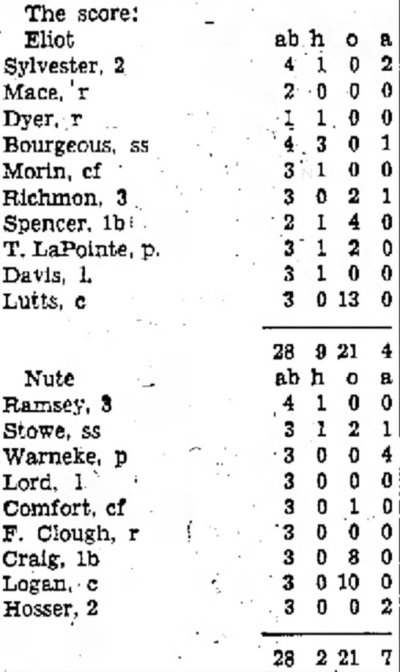 Eliot 0 0 0 0 0 1 2 – 3; Nute 0 0 0 0 0 0 0 – 0
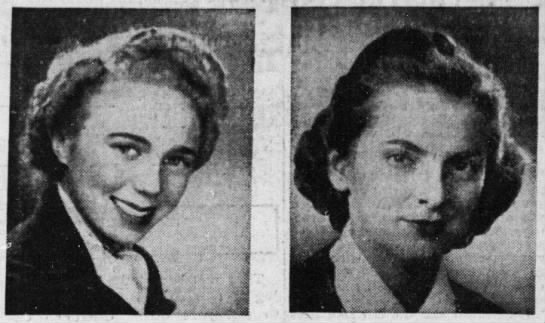 B.U. Co-Ed Colonel Candidates. Phyllis Iovine, Milton, N.H., at left, and Georgianna Harris, Carlisle, Penn., are leading candidates for coed colonel at the annual Boston University Military Ball, Friday night, in the main ballroom of the Hotel Statler. The affair is sponsored by the university chapter of Scabbard and Blade (Boston Globe, December 14, 1939).
 Hunt Young Barber, Girl In Brutal Horne Murder. N.H. Warrant Charges John N. Howland With Slaying Spinster – Seen in House. Special Dispatch to the Globe. MILTON, N.H., Feb. 5. – A warrant charging John N. Howland, 25-year-old barber, with the murder of Miss Maude F. Horne, 61, was issued tonight by Sheriff Clyde R. Cotton. Police throughout New Hampshire and other New England states were immediately asked to aid in the search for the youth, who disappeared from his home here late Friday night. In the same interstate teletype broadcast, state officials asked that a 15-year-old girl who disappeared from her home here at the same time be taken into custody for questioning. Both Howland and the high school girl were placed in Miss Horne’s home here early Friday evening by a neighbor. State Police said that they believe that the girl was a witness to the murder. Three men’s handkerchiefs, used as a gag to shut off the cries of the elderly spinster-victim, were being held by Sheriff Cotton as one of the most Important bits of evidence in the case. The handkerchiefs, Cotton said, bear the initial “H.” Additional evidence was found, the sheriff reported, that the slayer washed his hands and possibly the murder weapon in the kitchen sink in the murdered woman’s home. Bits of human hair found in the sink will be examined tomorrow to determine if it is that of Miss Horne. The murder warrant was issued by Cotton soon after he received the report on an autopsy performed by Dr. Ralph Miller, state pathologist, of Hanover, and Dr. Forest L. Keay, medical referee of Stafford County, stating that Miss Horne “died an agonizing death.” Atty. Gen. Thomas P. Cheney stated that Drs. Miller and Keay said “without qualification” that Miss Horne died in the room where the body was found, from a combination of fractures of the skull and suffocation.
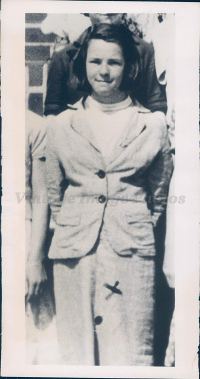
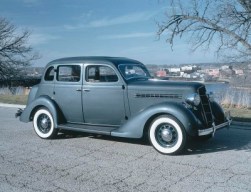 SLAYER OF MILTON WOMAN STILL AT LARGE. Near a week has elapsed since the body of Miss Maude Horne, a well-known Milton woman and murder victim, was found in her home on the Farmington road early last Saturday evening. John H. Howland and a 15 years old girl, a cousin of the accused, are at large and the objects of a countrywide search, as Howland is suspected of the slaying of Miss Horne. The story of this brutal assault and the death of Miss Horne, has featured [in] daily newspapers since the finding of the body. Town, state, county and Federal officers have been working on the case. Every effort is being made to trace them together, separately, or in connection with a black 1935 Plymouth coach, the property of the murdered woman, which bore registration plates N.H. 51839, and in which it is alleged Howland and his companion made their getaway. The identification of the missing pair sought in connection with the death of Miss Horne, has definitively established Howland as an ex-Navy man and he has a long criminal record from which finger prints have been compared with those found at the scene of the crime. His companion is a high school girl, known to everybody in her home town and never before has been charged with reprehensible conduct. Miss Horne was a native and lifelong resident of Milton and one of its most esteemed women. She was 61 years old, the daughter of the late John and Olive (Corson) Horne. She was a member of one of the first classes to graduate from
 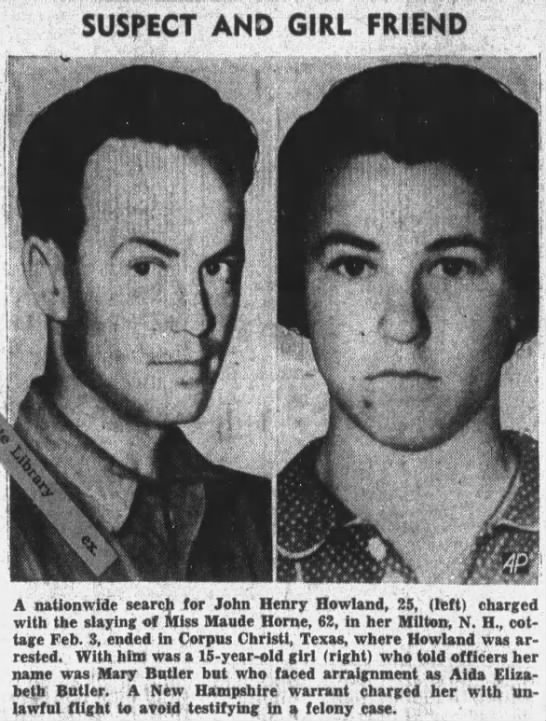 HOWLAND AND GIRL ARRIVE HERE TODAY. John Henry Howland, 25-year-old writer of love songs, will arrive in Boston this afternoon, nearing the end of a 2200-mile cross-country trip to face trial for the murder of Miss Maude Horne, elderly Milton, N.H., spinster. With Howland on the night of the murder was his cousin, Aida Elizabeth Butler, 15, who left the little New Hampshire mill town with him on his flight. Taken into custody with him, she will be returned on the same train from Corpus Christi, under police guard. Sometime late this afternoon Howland and his cousin will be taken across the city from the South to the North Station and start on the last leg of their return trip to Dover, N.H. (Boston Globe, March 29, 1939).
 FARMINGTON TO COMPLETE STATE ROAD TO CONNECT WITH MILTON. Work was commenced on Tuesday this week toward the completion of the final 1286 feet of unfinished highway construction required to connect the towns of Farmington and Milton with a permanent stretch of state highway which has been in process of construction the past two seasons. The work was resumed in charge of former Road Agent Ralph J. Chesley, under whose supervision the former work was done. With good weather favoring the project, it is expected the connecting link will be finished by the end of July (Farmington News, July 8, 1938).
 Milton Observer