
By Heather Durham | January 31, 2023
Hi everyone! How are you doing these odd Wintry days. Here I am, writing for February when there’s been no chance for me to snowshoe! … not yet anyway. I’ve been studying phone photography. In the process, I found this amateur photography guide I thought I would share with you along with the date of each New or Black Moon. This means that the skies would be really dark, and dark it needs to be for Astrophotography.
I hope you enjoy the new moon and photography additions. Happy reading and sky watching. Until we meet again next month. …
February 5. Today will have the full Snow Moon.
February 13. The Moon will be at final quarter today.
February 22. Tonight’s sky should be delightful for the Moon along with Venus and Jupiter will all ascend close together towards the right.
February 27. The Moon and Mars will travel together and ascend towards the right.
“At the end of February the zodiacal light (reflection produced by the scattering of sunlight due to particles moving along the entire solar system) also begins to be visible. In the Northern Hemisphere at this time of year, it’s visible to the west, at the end of the astronomical twilight, after Sunset, in the direction of the Sunset. On the contrary, in the Southern Hemisphere it’s visible to the east, before the astronomical twilight begins, before dawn, in the direction of the Sunrise.” PhotoPills.com
(https://www.photopills.com/articles/astronomical-events-photography-guide#step3)
“February 20: New Moon.
The Moon is between the Earth and the Sun, so the bright side of the Moon is facing away from the Earth. The Moon phase is 0% at 07:07 UTC.
The days around the New Moon are great for photographing the night sky.
If you’re in the Southern Hemisphere, you can start hunting the Galactic Center of the Milky Way with your camera! And don’t forget the Magellanic Clouds heading south.
Depending on your latitude, you can see the Galactic Center closest to the horizon (perfect for panoramas). And as you go to latitudes further south, you can photograph it more and more vertical. For example, in New Zealand you can almost capture it completely vertical.
In February, you can also capture the Galactic Center in the Northern Hemisphere: you see it low, near the horizon… although the conditions are not as good as in the Southern Hemisphere. And if you don’t get it, you can always wait until March to start enjoying it.
In the Northern Hemisphere you can also photograph the Orion constellation and the Winter Triangle.
And also during the New Moon, you can capture Star Trails, whose pattern depends on your latitude and the direction to which you point your camera at.” PhotoPills.com
(https://www.photopills.com/articles/astronomical-events-photography-guide#step3).
References:
Unknown (n.d.) Astronomical Events 2023: The Definitive Photography Guide. Retrieved from https://www.photopills.com/articles/astronomical-events-photography-guide
Ford, D.F. (n.d.). December 2022. Retrieved from in-the-sky.org
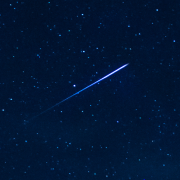
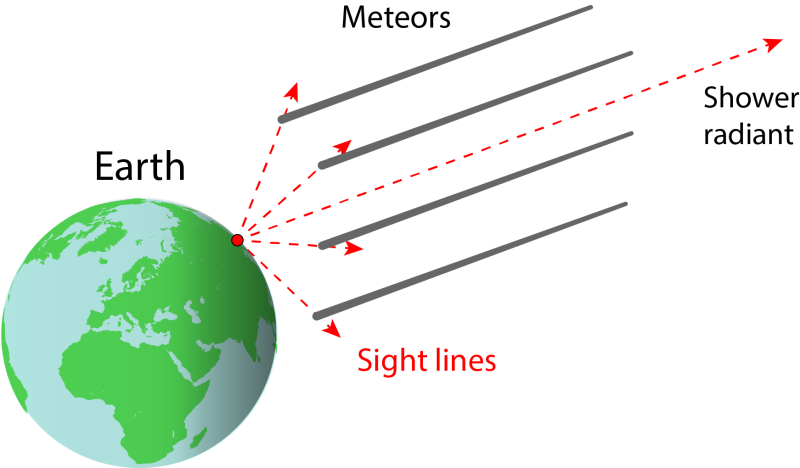 I have included several very interesting and informative YouTube videos for you to see, including one specifically for the Perseid Shower. The others tend to go into more depth than I usually do that are just as intriguing as anything I could have written. I do hope that they add to your monthly view of astronomical events. As well, I have added some photos of the shower. (Photos by D.F. Ford).
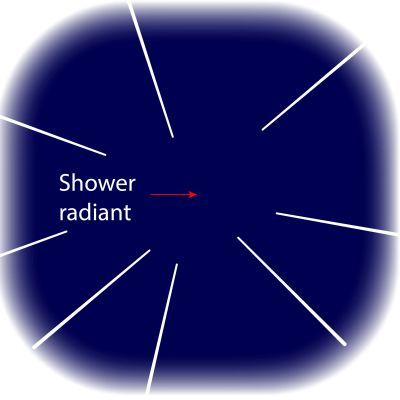 August 13. This month’s major event is the Perseid meteor shower will perform at its peak today, but may be visible before and after this date. The meteors might be colorful. Coming from the Constellation Perseus, the display will happen all through the night.
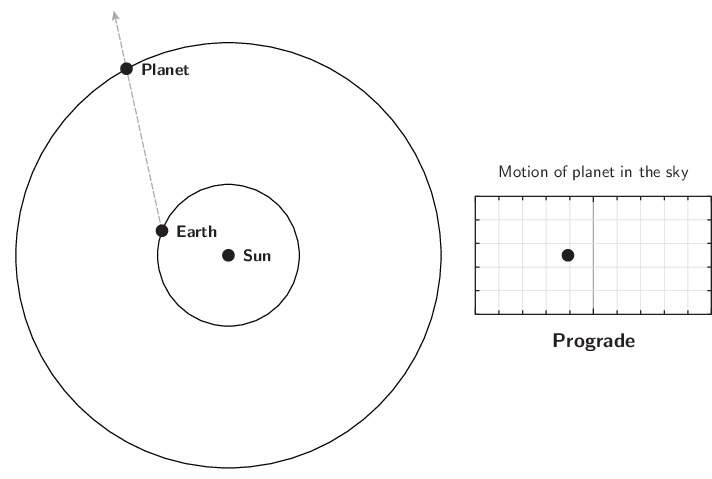 June 4. Saturn appears as though it’s going backwards because of the rotation of the Earth around the Sun.
 Milton Observer