By Muriel Bristol | September 29, 2024
Barnabas Palmer is said to have been born in Dublin, Ireland, May 29, 1725. (Various accounts have said he was born in 1725, which would have him being about twenty years of age in 1745, but at his death in 1816, his age was given as ninety-six years, which would have him being born circa 1720-21).
This Palmer family is descended from Barnabas Palmer, who was born in Dublin, Ireland, in 1725, of English parentage. When 14 years of age, he and his younger brother, Daniel, were enticed aboard a ship in Dublin harbor, by the Captain, named Tunner, and brought to New England where the boys were sold to pay their passage from Dublin. Barnabas was taken into the home of a Mr. Rankin, of Portsmouth, N.H., where he was raised as a son and companion to Mr. Rankin’s only son, William. He enlisted as a soldier under Sir William Pepperell in the siege of Louisburg, in 1745, and there lost his right arm but gained the rank of Major due to his bravery under fire (Miller & Stanton, 1937).
(A Daniel Palmer appeared in “A List of the men under the Comand of Capt Job Clements, a Gard [Guard] for Rochester and Barrenton [Barrington]. April 7th 1748″).
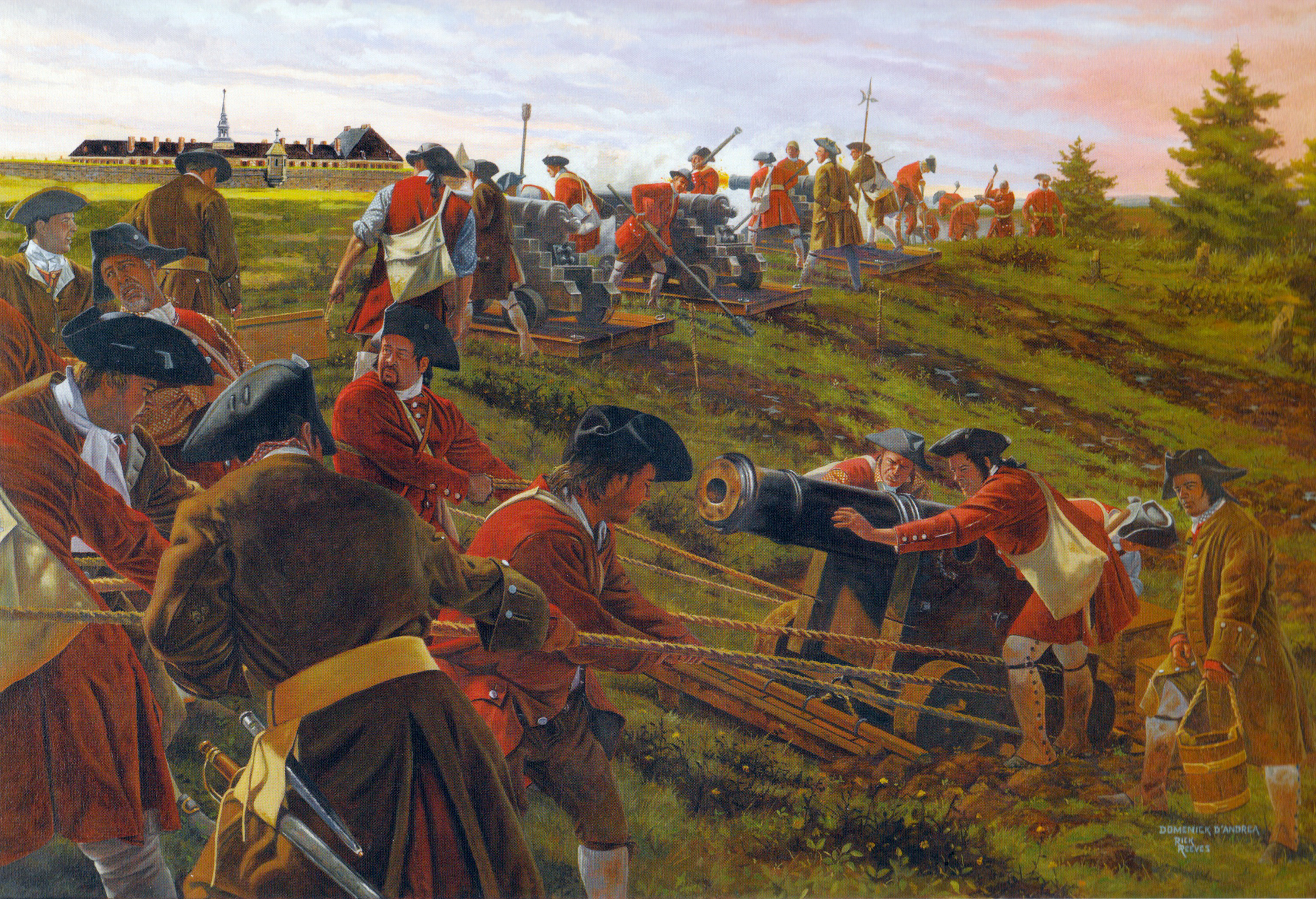 Barnabas Palmer appeared as a Private in a list of soldiers serving under Capt. Peter Hunt (1692-1770), October 16, 1745. Capt. Hunt commanded the Eighth Company in Brig. Gen. Joseph Dwight’s Ninth Massachusetts Volunteer Regiment during the Louisburg Expedition (MA Historical Society, 1899). Private Palmer’s rank of “Major” was most likely acquired later in life, due to continued service in the militia, rather than as a result of his undoubted bravery and wounding at the six-week siege of the Fortress Louisburg, at Cape Breton, in 1745.
 Barnabas Palmer married, reportedly at Louisburg, Cape Breton, circa 1746, Elizabeth Robinson. She was born in Exeter, NH, August 18, 1729, daughter of Christopher and Elizabeth (Hilton) Robinson. (Her father, Orderly Sergeant Christopher Robinson, died at Cape Breton, i.e., during the occupation of Louisburg, in 1746).
While in Louisburg he married Elizabeth, daughter of Christopher Robinson, the Orderly Sergeant of the British troops. (Christopher was a son of John; son of John; son of Isaac; son of Rev. John of Mayflower fame). Her mother was Elizabeth Hilton, a descendant of Hon. Kinsley Hall, of Exeter, N.H., and her grandmother was Ann Dudley, daughter of Samuel (son of Gov. Thomas) and Mary, daughter of Gov. John Winthrop (Miller & Stanton, 1937).
(The known children of Barnabas and Elizabeth (Robinson) Palmer were: Mary Palmer (1748-1810), Margaret Palmer (1749-1839), Jonathan Palmer (1751-1841), Samuel Palmer (1755-1816), William Palmer (1757-1815), Elizabeth Palmer (1759-1828), Barnabas Palmer, Jr. (I) (1761-1762), John Palmer (1763-1848), Barnabas Palmer, Jr. (II) (1765-1822), Benjamin Palmer (1766-1806), Joseph Palmer (1769-1829), Mercy Palmer (1770-1770), and Dudley Palmer (1775-1855)).
Elizabeth (Robinson) Palmer was said to be “skilled in the use of roots and herbs” (Merrill, 1889).
Daughter Mary “Molly” Palmer was born in Rochester, NH, June 2, 1748. Daughter Margaret “Peggy” Palmer was born in Rochester, NH, August 29, 1749.
[1751.] May 26. Baptized & Received Into full Comunion with ys Chh [this Church] Elisabeth ye Wife of Barnaby Palmer … (NHGS, 1908).
[1751.] June 16. Baptized Molley & Margaret Palmer, Children of Barnaby Palmer (NHGS, 1908).
(The English alphabet formerly had another letter Þ, which was called the “Thorn.” It was represented latterly with a sort of letter y, but with a crossbar, and had a “th” sound. So, ys, would be an abbreviation for yis, and pronounced as “this,” yt would be an abbreviation for yat, and pronounced as “that,” ye would be pronounced as “the,” and so on).
Son Jonathan Palmer was born in Rochester, NH, July 12, 1751.
[1751.] Dec. 8. Baptized John Chamberlain & Jonathan Palmer (NHGS, 1908).
Son Samuel Palmer was born in Rochester, NH, October 18, 1755. He was baptized in Rochester, NH, November 30, 1755, by Rev. Amos Main.
1755.] Novr 30. Baptized Samuel Palmer & Elizabeth McNeal (NHGS, 1908).
Son William Palmer was born in Rochester, NH, October 19, 1757. Daughter Elizabeth Palmer was born in Rochester, NH, December 28, 1759.
Son Barnabas Palmer, Jr. (I), was born in Rochester, NH, December 29, 1761. He died in Rochester, NH, March 13, 1762, aged two [three] months, and fourteen days.
 Barnabas Palmer was among the Rochester, NH, inhabitants that petitioned His Excellency Benning Wentworth, Captain General, Governor, and Commander-in-Chief of His Majesty’s Province of New Hampshire, February 8, 1762, seeking representation for Rochester, NH, in the NH Provincial Assembly. (See Rochester Representation Petition – 1762).
Son John Palmer was born in Rochester, NH, January 6, 1763. Son Barnabas Palmer, Jr. (II), was born in Rochester, NH, February 18, 1765.
Barnabas Palmer’s former regimental commander at Louisburg, Brig. Gen. Joseph Dwight, died in Great Barrington, MA, June 9, 1765, aged sixty-two years.
Tho great in council and in arms, Tho pious, good and just, Yet death its cruel debt demands, Dwight slumbers in the dust.
Son Benjamin Palmer was born in Rochester, NH, August 5, 1766. He was baptized in Rochester, NH, November 13, 1766, by Rev. Avery Hall (successor to Rev. Amos Main).
Daughter Mary Palmer married, circa 1769, Josiah Main. He was born in Rochester, NH, December 27, 1735, son of Rev. Amos and Elizabeth (White) Main. (His father was the “Parson” Main whose statue stands on Main Street in Rochester, NH).
 Son Joseph Palmer was born in Rochester, NH, January 16, 1769. He was baptized in Rochester, NH, August 6, 1769, by Rev. Avery Hall.
[1769.] Aug. 6. Joseph, Son of Barnabas Palmer & his Wife.
Daughter Margaret Palmer married in Rochester, NH, in August, 1769, David Copp. Col. John Gage, J.P., of Dover, NH, performed the ceremony. Copp was born in Rochester, NH, December 11, 1738, son of Jonathan and Esther (Dow) Copp. He was a veteran of the French & Indian War.
Captain David Copp was for many years a conspicuous figure. He was born in Rochester, December 11, 1738, the son of Jonathan and Esther Copp, prominent members of the Congregational church, on whose record stands his name as having received infant baptism, February 12, 1739 (Merrill, 1889).
Barnabas Palmer’s former company commander at Louisburg, Capt. Peter Hunt, died in Tewksbury, MA, April 3, 1770, aged seventy-seven years.
You are now so once was we, As we are now so you may be.
Daughter Mercy Palmer was born in Rochester, NH, August 20, 1770. She was baptized in Rochester, NH, November 18, 1770, by Rev. Avery Hall. She died in Rochester, NH, December 28, 1770.
[1770.] Nov. 18. Mercy, Daughter of Barnabas Palmer & his Wife.
Son-in-law Josiah Main was the Rochester, NH, Town Clerk between 1771 and 1802.
Son Jonathan Palmer married (1st), in 1771, Mary Elizabeth Carr.
 The first saw-mill was built by Samuel Palmer at the Three Ponds village, and near where the present dam is located. This was very early, probably about 1775 to 1780. Mr. Palmer subsequently built another saw-mill and grist-mill farther down stream, where the Varney mill was afterwards located. This part of the town was known for many years as “Palmer’s Mills” (Scales, 1914).
Barnabas Palmer was a Rochester, NH, town assessor between 1773 and 1776. He was elected a Rochester, NH, selectman in 1775, in place of John McDuffee, who left office to join the army, and Palmer was re-elected in 1776, 1777, and 1780.
Son-in-law Capt. David Copp, Capt. James Garvin, and John Gage were elected at David Copp’s house in East-Town (later Wakefield), NH, June 28, 1774, as a proprietors’ committee to seek incorporation of East-Town, NH.
Extract from Proprietors Records. At a Proprietors meeting Leagely warned and held at the house of Capt. David Copp in East-Town so called by the proprietors of said East-Town, the 28th day of June, Anno Domini, 1774; And the proprietors at said meeting, Voted, That this Tract or Township of Land comonly called East-Town, be Incorperated, and the said proprietors at said meeting, Voted, That Capt. David Copp, Capt. James Garvin, and John Gage be a Commitee or agents to wait on the Governor & Counsel to gite the said Township Incorporated. A true Coppy. Attest John Gage Pro. Clark (Merrill, 1889).
Petition for Incorporation – Province of New Hampshire. To his Excellency John Wentworth Esqr Capt General, Governor and Commander in Chief of said Province and the Honourable his Majesty’s Council: Humbly shews, David Copp, James Garvin, and John Gage that at a Proprietors Meeting held at East-Town so called on the 28th day of June last your Petitioners were Voted a Committee to Petition your Excellency and Honors for an Incorporation of said Tract or Township: Your Petitioners therefore humbly pray that the said Township beginning at the North East corner of the Township of Rochester at Newichwanick River, and from said River running westerly by the head line of Rochester five miles, and from that extent upon a strait Line parallel with the General Course of the said River as a strait line may be run at the said River & continuing the breadth of five miles adjoining said River & bounds of the Province so far northwardly as to make equal to six Miles square in such form as that the head or northerly Boundary shall be a Line parallel with the head line of Rochester, and the westerly side Line to be strait from Rochester Line to the head Line of said Tract of Land may be incorporated and invested with such powers & Privileges as other Towns in this his Majesty’s Province usually have & enjoy; and your Petitioners as in duty bound shall ever pray. Portsmouth 29th August, 1774. David Copp, James Garvin.
(N.B., The Newichwanick (“river with many falls”) used in the Wakefield boundary description above would be the Abenaki name for the Salmon Falls River).
Son Jonathan Palmer moved from Rochester, NH, to the newly established Wakefield, NH, in or around 1775.
The next year [1775] he [Robert Hardy] helped Jonathan Palmer on his barn, who had come from Rochester, the son of Barnabas, who was just “of age” in 1772, and who became the possessor of a very large farm, and was of considerable repute, but died in poverty (Merrill, 1889).
Son Dudley Palmer was born in Rochester, NH, April 14, 1775. He was baptized in Rochester, NH, October 1, 1775, by Rev. Jeremy Belknap. He was a namesake for his maternal grandfather, Dudley Hilton.
Hon. Joshua G. Hall says this of Captain Copp: “Coming to Wakefield early from Rochester, he seems for many years to have been the central figure in the management of public affairs. In wealth, social standing, and in influence, he was the first man in the town. There was no office in the gift of the people he did not enjoy, and there was no call of his country that he was not among the foremost to obey” (Merrill, 1889).
(Various histories say that Captain David Copp led a militia company at the June 1775 Battle of Bunker Hill. That would seem to be unlikely. His wife remembered that he raised a company of Strafford County militiamen after receiving news of the Battle of Bunker Hill).
Son Samuel Palmer enlisted in Captain Jonathan Wentworth’s Company, May 30, 1775, and was to be paid for two months, seven days service at 40s per month. His pay amount had £1 16s deducted for the coat and blanket he had been issued. Samuel Palmer of Rochester, NH, husbandman, aged twenty years, appeared in a list of NH militiamen in Captain Jonathan Wentworth’s Company, June 13, 1775.
Son-in-law David Copp raised a company of Strafford County militiamen and marched to Portsmouth, NH, in late July or early August 1775, where they secured a number of cannon. He was commissioned a Captain in Col. Enoch Poor’s Second NH Regiment. From there they marched to Winter Hill in Cambridge, MA, where they took part in the Siege of Boston. Their cannon were used, as were those brought by General Knox from Fort Ticonderoga, to force the British to evacuate Boston, MA.
Among General John Sullivan’s troops stationed at Winter Hill near Boston (1775-76) the twenty-fifth company was from Wakefield, officered by Captain David Copp, Lieutenant Andrew Gilman, Second Lieutenant Samuel Wallingford, and was composed of sixty-three men (Merrill, 1889).
 Son Samuel Palmer appeared as a Private in a pay roll of Captain Jonathan Wentworth’s Company, in Col. Enoch Poor’s Second NH Regiment, dated August 1775.
Son Samuel Palmer appeared in a list of men in Captain Jonathan Wentworth’s Company, in Col. Enoch Poor’s Second NH Regiment, that received $4 each for Regimental coats, October 12, 1775.
Captain Copp is said to have befriended General George Washington during the siege. The British evacuated Boston, MA, March 17, 1776, and sailed away to New York, NY. Captain Copp returned home to Wakefield in about May 1776. (See Wakefield Widow’s Rev. War Pension Application – 1837).
Son Jonathan Palmer married (2nd), circa 1776, Mary Roberts. She was born in Somersworth, NH, in 1756, daughter of Francis and Mary (Carr) Roberts.
Barnabas Palmer was among the one hundred ninety-eight men who signed the revolutionary Association Test in Rochester, NH, June 1, 1776. (Son-in-law Josiah Main signed also).
WE, the Subscribers, do hereby solemnly engage, and promise, that we will, to the utmost of our Power, at the Risque of our Lives and Fortunes, with ARMS, oppose the Hostile Proceedings of the British Fleets, and Armies, against the United American COLONIES (Batchellor, 1910).
Twenty-two Rochester men “refused” to sign. Another twenty-two Rochester Friends, i.e., “Quakers,” did not “choose” to sign, i.e., they were conscientious objectors.
Son-in-law David Copp and his father, Jonathan Copp, would sign the revolutionary Association Test of 1776 in Wakefield, NH. (Capt. David Copp would seem to have already fulfilled his pledge at the siege of Boston).
Col. Steven Evans, acting for the NH Committee of Safety, sought in 1776 to commandeer a four-pounder cannon that had been held by Rochester, NH, for thirty years. Barnabas Palmer was one of the three Selectmen who refused his claim.
To the Honorable Meshach Weare Esq., President of the General Assembly now sitting. Sir: We received an order from the Committee of Safety for the Colony of New Hampshire, in which we were desired to deliver to Col. Stephen Evans a four pound cannon which is in this town to be returned to Piscataqua Harbor, & c. Col. Evans applied for said cannon in April last, but without an order. We told the colonel we looked upon the cannon to be the town’s property, and that it might be of service in alarming the country, & c., but still we told him we were willing it should be carried where your Honors should think it would answer the best end, in case he would give a receipt and promise the value thereof equal to what hath been given for other cannon bought for the use of the colony, on which the Col. told us he was in no capacity to receive it on that condition, and so left it. On Saturday, 29th June last, Col. Evans sent again for said cannon and likewise sent the above order. But as the same difficulty subsisted that there was at first (there being no person to give a receipt or rather security,) the cannon was not delivered. The Selectmen acquainted the Committee of Safety for said Town with their proceedings relative to the cannon. They justify our proceedings, yet thought the cannon ought to be carried where it would answer the best end, but yet thought our request for the value thereof not unreasonable. We would herewith testify our readiness to obey all such orders as we shall receive from the Honorable House from time to time, as also our willingness with lives and fortunes to bear our proportional part in defending and securing to us the rights, liberties and privileges we are now contending for, & c. We are, Sir, Yours, and the Honorable House’s most Humble and Obedient servants. JABEZ DAME, BARNABAS PALMER, WILLIAM ALLEN } Selectmen of Rochester. Rochester, July 3, 1776 (McDuffee, 1892).
(Rochester, NH, would retain its “Queen Anne” cannon, until it exploded when fired many years later, July 4, 1845).
Pursuant to a Vote of Congress. We herewith Exhibit an account of the Number of Soldiers who were in the Continental Armey in the Year 1775 & Engaged again in 1776. Number 13 @ 2s 4¾d Each which makes £1.11.1¾. Attest William Allin, Barnabas Palmer, Jabez Dame } Selectmen Rochester. To the Honeble Nicholas Gilman Esqr, Treasurer of the State New Hampshire, March 31, 1777.
Drafting Soldiers. An interesting tradition handed down relative to the method used for filling the quota of the men appointed to this [Wakefield] town for service in the Revolutionary war. It has been told that all of the men in town liable for military duty assembled at the house of Col. Jonathan Palmer, which then stood on the east side of the highway, south of the Parson Piper house and at the northeast corner where Milton Mills road, going over Copp hill, branches off. The house of the square type, with the chimney in the middle. Slips of paper equal to the number of men present were prepared, with the word “go” written on a number of slips equal to the quota. All of the slips were put into someone’s tall hat and mixed up. The hat was then put on the mantle, or some other convenient place, and the “men marched around the chimney” and each man put one hand into the hat and took out a slip of paper. Each man drawing a marked slip of paper was obliged to go to war unless he could induce someone to take his place. Years after that time the old house caught on fire and was burned down but the foundations may be seen at the present time (Springfield Daily Republican (Springfield, MA), April 27, 1930).
Son William Palmer, aged nineteen years, enlisted as a private in Capt. Frederick M. Bell’s 4th Company, 2nd NH Regiment, May 22, 1777. He received a £20 enlistment bounty up front, and £16 8s in pay over the remainder of that year.
Son Samuel Palmer was one of the NH militiamen that acknowledged receipt of £4 10s lawful money from Col. Stephen Evans, September 11, 1777, that amount being a month’s advance wages, as well as a 3d per mile travel allowance “from our Abodes to Bennington,” VT. They had enlisted, after the Battle of Bennington, “for the Relief of the Brigade under the Command of General Stark.” (An elderly Gen. John Stark authored later his famous phrase or motto in 1809: “Live free or die: death is not the worst of evils”).
Son Samuel Palmer served three months, eight days, in Captain James Libby’s Company, in Col. Stephen Evans’ Regiment, for which he earned £12 16s 8d. Col. Evans’ Regiment “march’d and join’d the Northern Continental Army at Saratoga,” in 1777. Captain James Libbey’s NH militiamen were paid a travel allowance for the 316 miles from New Windsor, NY, where the Continental Army had a major depot, back to Dover, NH. (They had enlisted to November 1777, if not released sooner). Private Samuel Palmer was discharged December 15, 1777.
Barnabas Palmer, as a Rochester, NH, Selectman, paid the £60 enlistment bounties, in September 1779, for four Rochester, NH, men enlisted in the Continental Army.
State of New Hampshire to the Selectmen of Rochester Dr [Debtor].
1779 Sept. { To Paid 4 Soldiers inlisted in the Continental Army for one year. Joseph Rocker, Peter Cook, Ichabod Horn, John Rogers } Bounty £60 Each Pr Recets – £240
Errors excepted, in behalf of the Selectmen of Rochester. Barnabas Palmer.
Son Jonathan Palmer was chosen as militia second lieutenant in the Tenth Militia Regiment in 1779.
In this year [1779] the militia officers chosen were John Haven, Esq., captain, Mr. Joseph Maleham, first lieutenant, Mr. Jonathan Palmer, second lieutenant, Mr. Daniel Hall, ensign. Before the war the organization was not kept up in places according to the requirement of the old militia law, “that every inhabitant from sixteen to sixty should be provided with a musket and bayonet, knapsack, cartridge box, one pound of powder, twenty bullets, and twelve flints.” This militia was organized into companies and regiments subject to frequent drills. The muster day and review was a great occasion. Every town was obliged to keep in readiness one barrel of powder, two hundred pounds of lead, and three hundred flints for every sixty men (Merrill, 1779).
1780, February. Committee appointed to procure our quota of beef cattle for the army: Captain David Copp, Esq., and Jonathan Palmer and Samuel Hall (Merrill, 1889).
New Hampshire divided its Tenth militia Regiment, November 3, 1780, into its Tenth Militia Regiment and a newly created Fourteenth Militia Regiment. Son-in-law David Copp was commissioned as Lt. Colonel of the new regiment.
The Tenth regiment of militia was divided November 3, 1780, and the Fourteenth regiment organized from the towns of Wakefield, Middleton, Wolfeborough, Effingham, Ossipee Gore, Eaton, Conway, Tuftonborough, Moultonborough, Sandwich, and Tamworth by the General Assembly, which chose as field officers Major Bradbury Richardson, colonel, Captain David Copp, lieutenant-colonel, Captain David Page, first major, Mr. David Folsom, second major (Merrill, 1889).
Wakefield, NH, sent son-in-law David Copp to the NH General Court as its NH State Representative in 1781, 1782, 1783, and 1784.
Five months later, in March 1781, son Jonathan Palmer was commissioned as Major in the Fourteenth Militia Regiment.
March 31, 1781, “David Page, Esq., of Conway,” was appointed lieutenant-colonel of this regiment, and Mr. Jonathan Palmer of Wakefield, first major. The civil titles given in the last appointment indicate that the feeling was prevalent that the militia would not be as a body called into active military operations (Merrill, 1889).
Son John Palmer of Rochester, NH, served as a Private in Capt. Joshua Woodman’s Company, in Lt. Col. Daniel Reynolds’ NH Militia Regiment. He was engaged October 1, 1781, and they marched on October 9, 1781. He received £4 3s 4d in pay on October 28, 1781. His name appears on a muster roll dated Charlestown [Township #4], NH, November 24, 1781. This territory was in dispute between Vermont and New Hampshire and, coincidentally, the Vermont Assembly was arriving to meet there.
… some of the principal members waited on Colonel Reynolds, to advise him, that, if he had been sent to Charlestown, with any hostile intent, for the sake of humanity, it would be best, that he should remain quiet. They moreover, informed him, that his force was insufficient to avail, in case of any demonstration on his part. No demonstration was made. If he had received any private instructions, therefore, from New Hampshire, relative to the Vermont Legislature, he kept them to himself. But, we have no good reason to believe that he had received any; for his force, without any reference to Charlestown, was enlisted under a requisition of General Washington for reinforcing the continental army; and it was only the circumstances of the situation which led the people to entertain the supposition that the regiment was ordered to Charlestown, for a different purpose (Saunderson, 1876).
Daughter Elizabeth Palmer married in Rochester, NH, February 28, 1782, John Myrick. He was born in Hallowell, ME, January 22, 1762, son of John and Rebecca (Vaughan) Myrick.
Son William Palmer married (1st), in 1783, Susanna Twombly. She was born in 1764.
Son Jonathan Palmer of Wakefield, NH, was Colonel of the Nineteenth NH Militia Regiment in 1784. Nathaniel Hoit of Moultonboro, NH, was his Lt. Colonel, Jacob Smith of Sandwich, NH, was his Major, and Joshua Heath of Conway. NH, was his Second Major (Batchellor, 1891).
Lieutenant, later Colonel, Jonathan Palmer was younger than these, but became quite a prominent Federalist in the [Wakefield] town and state. He was the son of Barnabas and Elizabeth Palmer, of Rochester, and brother to David Copp’s wife (Merrill, 1889).
The NH General Court passed an act, June 11, 1784, to raise £2,500 from the several towns by March 1, 1785. Wakefield, NH, was assessed for £91 1s 6d and £7 14s, making a total of £104 15s 6d. Son Colo Jonathan Palmer was named as being responsible for the Wakefield town total. (Rochester, NH, of which Milton was then a part, was assessed for £396 12s 8d).
Wakefield, NH, appointed son Maj. Jonathan Palmer to a seven-man church committee intended to treat with Rev. Asa Piper, in November 1784, regarding settling him as the local minister. The committee was composed of S. Dearborn, N. Balch, A. Hall, Lt. Jonathan Gilman, Capt. J. Gilman, Maj. Jonathan Palmer, and Ensign Mayhew Clark (Merrill, 1889). The church would be organized and Rev. Piper ordained in September 1785. (Rev. Asa Piper would be active also in Rochester’s Northeast Parish (that would become Milton in 1802)).
Son Jonathan Palmer of Wakefield, NH, petitioned the NH General Court, November 1, 1784, seeking to testify regarding a debt. It regarded settlement of a debt owed to Col. Stephen Evens of Dover, NH, through a payment in kind of milled lumber. Although Col. Evens had been present and accepted the lumber, he had failed to discharge the debt. The NH General Court granted Palmer a hearing on the matter.
Barnabas Palmer of Rochester, NH, was deposed in a legal case between the Selectman of Rochester, NH, and George Place, November 3, 1784.
The Deposition of Mr. Barnabas Palmer of Lawful Age of Rochester testified and Saith that since Augst 1783 or sometime in the Insuing Fall Mr. George Place came to me to borrow some state notes which I understood was to pay the Town Tax and I Lent Said Place Two Notes which he returned to me again[.] the Deponent further saith not. Novr 3d 1784. Barna[bas] Palmer.
 Barnabas Palmer and his sons, Samuel Palmer, William Palmer, Barnibus Palmer [Junr], and John Palmer, were among the three hundred ten Rochester inhabitants that petitioned the NH legislature, August 30, 1785, seeking repeal of an act requiring milled boards to be square-edged and an inch thick (and other lumber in proportion). Those inhabitants described themselves then as being “largely Concerned in Lumber.” They sought also repeal of an act forbidding transport of lumber to the British West Indies, and seeking the issuance of a new paper money (Hammond, 1884). (See Rochester Lumber Remonstrance – August 1785).
 Son Jonathan Palmer and son-in-law David Copp were among the fifty-two Wakefield, NH, inhabitants that petitioned the NH legislature, in August 1785, seeking repeal of an act requiring milled boards to be square-edged and an inch thick (and other lumber in proportion). Those inhabitants described themselves then as being “largely Concerned in Lumber.” They sought also repeal of an act forbidding transport of lumber to the British West Indies, and seeking the issuance of a new paper money.
 A Rochester, NH, town meeting appointed a committee, November 20, 1785, composed of Capt William Allen, Barnabas Palmer, Capt William Chamberlin, Ens. Richard Furber, Joseph Pearl, John Plumer, Esqr, and Deacn James Knowles, to treat with Revd Joseph Haven, regarding settling him as the local minister. Rev. Haven’s ordination took place in Rochester, January 10, 1786 (McDuffee, 1892).
Son Benjamin Palmer married in Rochester, NH, October 16, 1785, Martha W. “Patty” Hartford, both of Rochester, NH (NHGS, 1908). She was born in Milton, September 18, 1763, daughter of Nicholas and Abigail (Brackett) Hartford.
 Son Samuel Palmer married (2nd), January 22, 1786, Anna (Garland) Hubbard. She was born in Milton, in 1752, daughter of Daniel and Sarah (Roberts) Garland. (She was the widow of Joseph Hubbard).
The Strafford County towns of Dover, Rochester, Somersworth, Madbury, Barrington, Lee, Wakefield, Middleton, New Durham, Wolfeborough, and Effingham, NH, sent delegates to a convention, which met in Dover, NH. Son-in-law David Copp represented Wakefield, NH. Convention committee members petitioned the NH General Court, September 4, 1786, advocating for a reinflation of the expiring inflationary wartime State paper money, through taking on State debt.
They are almost unanimously of Opinion that a Paper Currency, made & issued on a Loan for double the Value Mortgag’d, would be very beneficial to the good People of the State & the Most likely to keep it from Depreciation …
Two weeks later, September 20, 1786, over two hundred armed men besieged the NH General Court, then in session at Exeter, NH, in what would be known as the “Exeter Riot” or the “Paper Money Riot.” Son William Palmer’s former regimental commander, Col. George Reid of Londonderry, NH, was by now a Brigadier General in the NH militia. NH President John Sullivan called him out to suppress the Exeter protesters or rioters. (The “President” of NH would now be termed its Governor).
Son John Palmer married (1st) in Rochester, NH, November 23, 1786, Dorothy Perkins, both of Rochester, NH. Rev. Joseph Haven performed the ceremony.
On Oct. 15, 1787, Rochester “voted to lay out a road from the Branch bridge to Palmer’s mill.” This was the first public road laid out in Milton, and was from some bridge in the present town of Rochester, and not from what is now known as the Branch bridge in Milton, for at a meeting held the 31st day of the following March, they “voted to lay out a road from Palmer’s mill to Wakefield line, if the owners will give the land.” This road extended over Plumer’s ridge, the Branch river, and what has since been known as the Branch hill, thus establishing a thoroughfare through the entire town from Rochester to Wakefield (Scales, 1914).
Rochester, NH, sent Barnabas Palmer as a delegate to the convention that voted on the US Constitution in 1788. (See Milton and the U.S. Constitution).
Rochester, NH, sent Barnabas Palmer to the NH General Court as its NH State Representative in 1788, 1789, 1790, and 1791.
The Wakefield, NH, Selectmen of 1788 were Col. Jonathan Palmer, Lt. Reuben G. Dearborn, and John Wingate. The Wakefield, NH, Selectmen of 1789 were Jonathan Palmer, David Copp, and John Gilman. The Wakefield, NH, Selectmen of 1790 were Col. Jonathan Palmer, David Copp, and John Gilman.
Robinson Palmer, Brackett Palmer, and Barnabas Palmer, sons of Benjamin Palmer, were baptized October 25, 1789. Patty Palmer, wife of Benjamin Palmer, was also baptized “upon making a confession of faith in Christ” (McDuffee, 1892).
Barnabas Palmer headed a Rochester, NH, household at the time of the First (1790) Federal Census. His household included three males aged 16-plus years [himself], one male aged under-16 years, and two females [Elizabeth (Robinson) Palmer]. Their household appeared in the enumeration between those of Caleb Jackson and Joseph Knight.
Josiah Main headed a Rochester, NH, household at the time of the First (1790) Federal Census. His household included three males aged 16-plus years [himself, Jacob Main, and Josiah Main], two males aged under-16 years [William Palmer Main and John Main], and four females [Mary (Palmer) Main]. Their household appeared in the enumeration between those of Wentworth Hayes and Joseph Haven.
David Copp headed a Wakefield, NH, household at the time of the First (1790) Federal Census. His household included three males aged 16-plus years [himself], five males aged under-16 years, and five females [Margaret (Palmer) Copp]. Their household was enumerated between those of Moses Pike and Elipl Philbrook.
Jona Palmer headed a Wakefield, NH, household at the time of the First (1790) Federal Census. His household included one male aged 16-plus years [himself], four males aged under-16 years, and five females. Their household was enumerated between those of Isaac Wiggen and Thomas Lindsay.
Samll Palmer headed a Rochester, NH, household at the time of the First (1790) Federal Census. His household included one male aged 16-plus years [himself], and two females. Their household was enumerated between those of Ebenzr Jones and Jona Pinkham.
Willm Palmer headed a Rochester, NH, household at the time of the First (1790) Federal Census. His household included one male aged 16-plus years [himself], three females [Susanna (Twombly) Palmer, Elizabeth Palmer, and Nancy Palmer], and one male aged under-16 years [Daniel Palmer]. Their household was enumerated between those of Joseph Hait and John Palmer. (See Northeast Parish in the First (1790) Federal Census).
John Palmer headed a Rochester, NH, household at the time of the First (1790) Federal Census. His household included one male aged 16-plus years [himself], and two females. Their household was enumerated between those of Willm Palmer and Ephm Twombly. (See Northeast Parish in the First (1790) Federal Census).
Benja Palmer headed a Rochester, NH, household at the time of the First (1790) Federal Census. His household included one male aged 16-plus years [himself], two males aged under-16 years, and five females [Martha (Hartford) Palmer]. Their household was enumerated between those of Nicholas Wentworth and Nicolas Hartford.
Daughter-in-law Susanna (Twombly) Palmer was baptized by Rev. Joseph Haven “upon a Dying bed,” i.e., her deathbed, in Rochester, NH, January 19, 1790 (NHGS, 1908).
Son William Palmer was elected a Rochester, NH, selectman in 1790 through 1795 (McDuffee, 1892).
Son Barnabas Palmer, Jr. (II), married in Rochester, NH, July 21, 1791, Mary Place, both of Rochester, NH. Rev. Joseph Haven performed the ceremony. She was born in Rochester, NH, May 22, 1763, daughter of Col. David and Susannah (Thompson) Place.
Son William Palmer married (2nd), August 30, 1791, Deborah Ham. She was born in Dover, NH, February 5, 1766, daughter of Dodavah and Lydia (Plummer) Ham.
Barnabas Palmer was a subscriber of the Rochester Social Library in 1792, as were his sons, Col. Jonathan Palmer, Samuel Palmer, and Lt. William Palmer. Levi Jones, Jotham Nute, Beard Plumer, and Joseph Walker subscribed also (McDuffee, 1892). (The military titles of his sons would have been their post-war militia ranks).
The Wakefield, NH, Selectmen of 1794 were John Gilman, Walter Neal, and Jonathan Palmer. The Wakefield, NH, Selectmen of 1795 were Jonathan Palmer, John Gilman, and Walter Neal. The Wakefield, NH, Selectmen of 1796 were Jonathan Palmer, Isaac Fellows, and John Gilman.
In a [1844] court case, ownership of the Fernald lot in Milton would be in question. A recitation of its neighboring Denbow lot owners in 1795 included son Samuel Palmer, Beard Plumer and his brother, Joseph Plumer.
In relation to the “Fernald lot,” it appeared that in 1795 Samuel Palmer, Beard Plumer and Joseph Plumer, senior, owned and occupied the Denbow lot, as tenants in common; Palmer owning one half and the Plumers each one quarter (NH Supreme Court, 1851).
Wakefield, NH, and Brookfield, NH, sent son-in-law David Copp to the NH General Court as its NH State Representative in 1795. They sent son Col. Jonathan Palmer to the NH General Court as their NH State Representative in 1796. The two men tended to “see-saw” or alternate in the NH legislature. It would be said later that Jonathan Palmer was a Federalist-Republican adherent, while David Copp was a Democrat-Republican.
Son Dudley Palmer married (1st) in Rochester, NH, February 26, 1797, Abigail Pickering, both of Rochester, NH.
The Wakefield, NH, Selectmen of 1797 were Isaac Fellows, Col. Jonathan Palmer, and Col. John Gilman.
Wakefield, NH, and Brookfield, NH, sent son Col. Jonathan Palmer to the NH General Court as their NH State Representative in 1797. Son-in-law David Copp petitioned that same NH General Court, June 5, 1797, seeking incorporation of the Wakefield & Brookfield Union Library.
To the Honorable Senate and house of Representatives of the State of New Hampshire to be convened at Concord on the first Wednesday of June, A.D. 1797.
This petition of the Subscribers, in behalf of the proprietors of Wakefield and Brookfield Union Library, being Impowered by a vote of the proprietors for the purpose aforesd, humbly pray that Timothy Johnson, Avery Hall, Jonathan Palmer, David Copp, William Chamberlin be Incorporated into a body politic with all the power and privileges that the Legislature, in their Wisdom, may see proper for the benefit and continuance of the said Institution, and your petitioner for and in behalf of said proprietors in duty bound will ever pray & c. David Copp. Wakefield June 5th 1797.
The NH General Court incorporated the Wakefield & Brookfield Union Library, June 20, 1797. The original incorporators were Timothy Johnson, Avery Hall, [son,] Jonathan Palmer, [son-in-law,] David Copp, William Chamberlin, and their associates. David Copp was authorized to call the first meeting (NH Secretary of State, 1917). (See Rochester Social Library – 1792 and Milton Social Library – 1822).
The Wakefield, NH, Selectmen of 1798 were Col. Jonathan Palmer, Col. John Gilman, and Lt. James Young. Wakefield, NH, and Brookfield, NH, sent son Col. Jonathan Palmer to the NH General Court as their NH State Representative in 1798.
 Sons Benjamin and Dudley Palmer were among the thirty-four inhabitants of Rochester, NH, that petitioned the NH Governor and his Executive Council, November 30, 1798, seeking appointment of Abraham Hull of Rochester, NH, as a packer and inspector of beef.
 Wakefield, NH, and Brookfield, NH, sent son-in-law David Copp to the NH General Court as its NH State Representative in 1799-1801.
Son John Palmer married (2nd) in Rochester, NH, June 6, 1799, Elizabeth “Betsy” Ellis, both of Rochester, NH. Rev. Joseph Haven performed the ceremony.
The Kennebec Company had granted a strip of land to Sir Thomas Temple, consisting of several thousand acres, reaching through a part of Fairfield, Canaan, Norridgewock, and Starks. This land struck the Kennebec river on the north side, and was about a mile in width from the river. This, with other land,, was bought by John Nelson, of the Island of Granada, and was surveyed by John McKechnie, who drew a plan dated November 7, 1769. In this lot, the Company, with a view to the settlement of the country, and the elevation of the price of neighboring lands, reserved 1780 acres, which were given away to actual settlers. At the death of Nelson the land was sold by his administrator, and the purchaser was Jonathan Palmer, of Wakefield, New Hampshire. The entire strip was about a mile in width, passing in a north-westerly direction through the plantations, striking the river at the great bow on which is located the village of South Norridgewock, excluding that and most of the soil on the river in Norridgewock and Canaan, which, as was stated above, was reserved to be given to actual settlers (Hanson, 1849).
Josiah Main headed a Rochester, NH, household at the time of the Second (1800) Federal Census. His household included one male aged 45-plus years [himself], two females aged 45-plus years [Mary (Palmer) Main], and one male aged 16-25 years [John Main].
David Copp headed a Dover, NH, household at the time of the Second (1800) Federal Census. His household included one male aged 45-plus years [himself], one female aged 26-44 years, one male aged 26-44 years, one female aged 16-25 years, one male aged 10-15 years, two males aged under-10 years, and two females aged under-10 years.
Saml Palmer headed a Northeast Parish, Rochester, NH, household at the time of the Second (1800) Federal Census. His household included one male aged 45-plus years [himself], one female aged 26-44 years, one female aged 16-25 years, and one female aged 10-15 years. (See Northeast Parish in the Second (1800) Federal Census).
Wm Palmer, Esqr, headed a Northeast Parish, Rochester, NH, household at the time of the Second (1800) Federal Census. His household included one male aged 26-44 years, two females aged 26-44 years, one male aged 10-15, one female aged 10-15, two males aged under-10 years, two females aged under-10 years. (See Northeast Parish in the Second (1800) Federal Census).
John Mirrick headed a 25-Mile Pond Plantation [now Unity], ME, household at the time of the Second (1800) Federal Census. His household included one male aged 45-plus years [himself], one female aged 45-plus years [Elizabeth (Palmer) Mirrick], one female aged 26-44 years, one male aged 16-25 years [Barnabas Mirrick], one female aged 10-15 years, one male aged under-10 years, and one female aged under-10 years.
John Palmer headed a Rochester, NH, household at the time of the Second (1800) Federal Census. His household included one male aged 26-44 years [himself], and one female aged 26-44 years.
Barnabas Palmer [Jr. (II)] headed a Waterboro, ME, household at the time of the Second (1800) Federal Census. His household included one male aged 26-44 years [himself], one female aged 26-44 years [Mary (Place) Palmer], three males aged under-10 years (Barnabas Palmer, David P. Palmer, and Stephen Palmer], and two females aged under-10 years [Elizabeth Palmer and Mehitable Palmer]. Their household appeared in the enumeration between those of Jonathan Hanson and Michel Bodoine.
Benjn Palmer headed a Rochester, NH, household at the time of the Second (1800) Federal Census. His household included one male aged 26-44 years [himself], one female aged 26-44 years [Martha (Hartford) Palmer], and two males aged 10-15 years.
Dudley Palmer headed a Rochester, NH, household at the time of the Second (1800) Federal Census. His household included one male aged 26-44 years [himself], one female aged 26-44 years [Abigail (Pickering) Palmer], one male aged 16-25 years, one female aged 16-25 years, one female aged under-10 years [Elizabeth Palmer], two males aged under-10 years [James S. Palmer and Dudley S. Palmer], one male aged 45-plus years, and one female aged 45-plus years.
Son-in-law David Copp received his initial five-year appointment as a Wakefield, NH, justice-of-the-peace, June 14, 1800.
The Selectmen of Rochester, NH, laid out the town’s cemetery in August 1800, which abutted land of Maj. Solomon Perkins and son Benjamin Palmer.
Return of Burying ground. Agreeable to a vote of the Town of Rochester passed, we have laid out of the Town’s land for a burying place as follows, beginning near the clay pits on a line extended from the lower side line of the lot sold Hatevil Knight North 82° east four rods from said Knights corner and run on said line about eleven rods to some land sold to Maj Solomon Perkins & Benjamin Palmer then by said Perkins & Palmer land twenty rods – then Towns land South 48° east nineteen rods to a stake then by land left for a four rods road south 50° east eleven rods to the first bounds containing about one acre & fifty five square rods – also we have agreed with Jabez Dame Esq and with Joseph Hanson to move theer lots lower down 2 rods to open a pass to & from said Burying yard between said Jabez Dames lot & land of Widow place laid out this 25th day of August 1800. Richd Dame, Beard Plummer, Joshua Allen } Selectmen (McDuffee, 1892).
Wakefield, NH, sent son Col. Jonathan Palmer to the NH General Court as their NH State Representative in 1802.
Son Samuel Palmer conveyed to Ivory Hovey his half interest in the Denbow lot in Milton, in 1802 (NH Supreme Court, 1851).
Son Joseph Palmer married in Rochester, NH, April 25, 1802, Mary Hanson, he of Rochester, NH, and she of Dover, NH.
 Sons Samuel Palmer, William Palmer, John Palmer, and Dudley Palmer, all signed the Rochester Division Petition of May 1802. (Son-in-law Josiah Main did not sign. Sons Jonathan Palmer, Barnabas Palmer, and Joseph Palmer, as well as sons-in-law David Copp and John Merrick, all resided elsewhere).
Son Jonathan Palmer received his initial appointment as a Wakefield, NH, justice-of-the-peace, February 10, 1803.
Wakefield, NH, sent son Col. Jonathan Palmer to the NH General Court as their NH State Representative in 1803.
Son Samuel Palmer was active with John Fish and others in creating and using a diving bell to retrieve sunken cargoes.
Samuel Palmer and John Fish engaged in several diving bell adventures endeavoring to raise the cargoes of sunken vessels, one at Portsmouth and one upon a western lake but were unsuccessful in both (McDuffee, 1892).
Wakefield, NH, sent son Col. Jonathan Palmer to the NH General Court as their NH State Representative in 1804.
Son-in-law David Copp subscribed to a social library established for Wolfeboro, NH, and vicinity, January 10, 1804.
Son-in-law Josiah Main signed a remonstrance petition of forty-eight inhabitants of Rochester, Farmington, Milton, and Middleton, NH, to the NH General Court, June 6, 1804, which opposed incorporating a proposed turnpike road running from Dover, NH, through the Norway Plains [in Rochester, NH,] to Sandwich, NH. They objected to the waste and destruction that would be imposed on farms by cutting through those farms in an injurious manner, without equitable compensation.
We therefore most humbly pray that our property and privileges, purchased by industry and frugality, may be secured to us and our heirs without the Control of any individuals or any body of men that the Legislature whom We have intrusted with our Liberties may View the deposit as Sacred and Consider Whether General Laws for making and improving public Roads will Not more Conduce to the Good of the Community than impowering any Class of men to wrest our property from us without our Consent and we as in duty bound will ever pray.
Elizabeth (Robinson) Palmer died in 1804. (Some sources have a widowed Barnabas Palmer, living thereafter with their son, William Palmer, on Plummer’s Ridge in Milton for the remainder of his life. However, his own Milton household, consisting of himself alone, was enumerated separately in the Third (1810) Federal Census).
Son-in-law David Copp “declined a renewal” of his original five-year appointment as a Wakefield, NH, justice-of-the-peace, when it expired June 14, 1805.
Son Benjamin Palmer died in Augusta, ME, January 25, 1806.
Son Jonathan Palmer received a renewal appointment as a Wakefield, NH, justice-of-the-peace, June 7, 1808. The roster had a marginal notation to the effect that he had been “omitted.”
Daughter Mary (Palmer) Main died in Rochester, NH, January 18, 1810.
Son Wm Palmer and son-in-law David Copp were among the fifty Strafford County inhabitants who recommended that Colo James Carr be reappointed as Strafford County sheriff, January 22, 1810. John Fish, John Plumer, Junr, Jonas C. March, and Joseph Plumer signed also. (See Strafford County Sheriff Petition – 1810).
Barnabas Palmer headed a Milton household at the time of the Third (1810) Federal Census. His household included one male aged 45-plus years [himself]. His household was enumerated between those of Gilbert Perkin and John Palmer.
Josiah Main headed a Rochester, NH. household at the time of the Third (1810) Federal Census. His household included one male aged 45-plus years [himself], one female aged 45-plus years [Mary (Palmer) Main], one male aged 26-44 years, one female aged 26-44 years, one male aged 16-25 years, one female aged 16-25 years, one male aged 10-15 years, two females aged 10-15 years, two males aged under-10 years, and one females aged under-10 years. His household was enumerated between those of Paul Libbe and Winthrop Harford.
David Copp Esqr headed a Wakefield, NH, household at the time of the Third (1810) Federal Census. His household included one male aged 45-plus years [himself], one female aged 45-plus years [Margaret (Palmer) Copp], one male aged 16-25 years, one female aged 16-25 years one male aged 10-15 years, one female aged 10-15 years, and one male aged under-10 years.
Colo John [Jonathan] Palmer headed a Wakefield, NH, household at the time of the Third (1810) Federal Census. His household included one male aged 45-plus years [himself], one female aged 45-plus years, one female aged 16-25 years and one female aged 10-15 years.
Saml Palmer headed a Milton household at the time of the Third (1810) Federal Census. His household included one male aged 45-plus years [himself], one female aged 26-44 years, and one female aged 10-15 years. His household was enumerated between those of Wd Elizabeth Gerrish and Jno Fisk.
Wm Palmer headed a Milton household at the time of the Third (1810) Federal Census. His household included one male aged 45-plus years, one female aged 26-44 years, one male aged 16-25 years, one female aged 16-25 years, one male aged 10-15 years, one female aged 10-15 years, one male aged under-10 years, three females aged under-10 years. His household was enumerated between those of Peter Gerrish and Benair Colby.
John Myrick headed a 25-Mile Pond Plantation [now Unity], ME, household at the time of the Third (1810) Federal Census. His household included one male aged 45-plus years [himself], one female aged 45-plus years [Elizabeth (Palmer) Myrick], two males aged 26-44 years, and one female aged 16-25 years.
John Palmer headed a Milton household at the time of the Third (1810) Federal Census. His household included one male aged 45-plus years, one female aged 45-plus years, and one male aged 10-15 years. His household was enumerated between those of Barnabas Palmer and Daniel Palmer.
Barnabas Palmer [Jr. (II)] headed an Athens, ME, household at the time of the Third (1810) Federal Census. His household included one male aged 45-plus years [himself], one female aged 45-plus years [Mary (Place) Palmer], two males aged 16-25 years [Barnabas Palmer and David P. Palmer], one female aged 16-25 years [Elizabeth Palmer], two males aged 10-15 years [Stephen Palmer and Samuel Palmer], one female aged 10-15 years [Mehitable Palmer], two females aged under-10 years [Lucy Palmer and Roxanna Palmer], and one male aged under-10 years [Jonathan Palmer]. Their household appeared in the enumeration between those of Lemuel Coston and Jabez P. Bradley.
Joseph Palmmer headed a Wakefield, NH, household at the time of the Third (1810) Federal Census. His household included one male aged 26-44 years [himself], one female aged 26-44 years, one female aged 16-25 years, two males aged 10-15 years, two females aged 10-15 years, and one male aged under-10 years.
Dudley Palmer headed a Million Acres, North of Solon & Athens, ME, household at the time of the Third (1810) Federal Census. His household included one male aged 26-44 years [himself], one female aged 26-44 years [Abigail (Pickering) Palmer], one female aged 10-15 years [Elizabeth Palmer], one male aged 10-15 years [Dudley S. Palmer], two males aged under-10 years [Barnabas Palmer and Benjamin Palmer], and two females aged under-10 years [Abigail Palmer and Maria Palmer]. Their household appeared in the enumeration between those of Lazarus Jones and Jonathan Quimby.
Son William Palmer, and son-in-law, David Copp, were among the fifty Strafford County inhabitants that petitioned NH Governor Jeremiah Gilman, January 22, 1810, seeking a renewal appointment for Strafford County Sheriff James Carr. (See Strafford County Sheriff Petition – 1810).
As regards town, state and national politics, son Jonathan Palmer favored the Federalist-Republicans, or “Federalists,” while son-in-law David Copp favored the Democratic-Republicans, i.e., “Republicans,” or “Democrats.”
In its civil capacity the [Wakefield, NH] town met at the meeting-house for fifty years or more in its early days, usually adjourning to Captain David Copp’s for a half-hour, sometimes only a quarter or twenty minutes, for refreshments and to “complete the slate.” In 1811 it took but five hours to transact all the town business, and, adds the relieved town clerk, “the like of which was never known in this town before.” Now that would be a long time. Politics sometimes ran high, and party lines were sharply drawn. Each of the two policies of the parties found warm advocates, to say the least. The fires were kept hot, and the air was filled with the resounding blows upon the iron. Tradition’s voice has told us of the methods of warfare, but they need not be revealed. The Republicans, under lead of Captain Copp, admired Jefferson. The Federalists, or followers of Hamilton, were led by Jonathan Palmer, later by Joshua G. Hall and Luther Dearborn (Merrill, 1889).
Democratic-Republican Thomas Jefferson was elected U.S. President in 1801-09, while Federalist-Republican James Madison was elected U.S. President in 1809-17. (Federalist Luther Dearborn would advocate for a division of both Milton and Wakefield, NH, in 1820 (See Milton Militia Dispute – 1820)).
Son-in-law David Copp, Esq., of Wakefield, NH, made his last will, July 16, 1812. He devised one-third of his estate, both real and personal, to his wife, Margret Copp, during her natural life. He devised Lot #91 and Lot #100, as purchased from Francis Yeaton and John Chase, to his daughter, Betty Dearborn. He devised a Second Division Lot, originally the right of Solomon Hanson, deceased, to his daughter, Esther Whitton. She was also to receive one middling cow and calf. He devised $100 to his son, David Copp, “if now living,” upon his return to the State. He devised $5 to his son, Jonathan Copp, as well as confirming him in the deed already given on the Hall farm in Wakefield, NH. He devised one-half of Lot #74 in the First Division, part of the original right of John Marden, deceased, to his son, George W. Copp. He devised Lot #117 in Athens, ME, to his daughter, Sally Copp. She was also to have forty acres in the adjoining Lot #124, the two adding to two hundred acres. She was to have also $200. He devised Lots #18 and #20, as well as all that owned on the adjoining Lot #27, all in Athens, ME, to his son, Amasa Copp.
He devised “all that remains of my homestead farm,” together with the livestock, farming utensils, and household furniture, to his two sons, William Copp and John Copp. They were also to receive all the lands in Wakefield, Brookfield, Milton, and Ossipee, NH, that may remain unsold. They were to receive also any lands as yet unsold in Athens, Canaan, Norridgewock, Clinton, and Fairfield, in the District of Maine. He appointed his two sons, William Copp and John Copp as joint executors. Luther Dearborn, Noah Robinson, and Nelson Nutter signed as witnesses (Strafford County Probate, 22:8)
Son Samuel Palmer was a part owner of the 70-ton sloop Flora, of Newport, RI, July 7, 1813. It had one deck, a single mast, and a female figurehead. Its master was John Aldershaw [of Philadelphia, PA]. Its owners were Asa Brooks of Newport, RI, mariner; Samuel Palmer of Milton, NH, laborer; Ambrose Barnby of Freetown, MA, yeoman; and Joseph Robinson of Somerset, MA, mariner (National Archives Project, 1941).
Barnabas Palmer, and his sons, William Palmer, John Palmer, and Joseph Palmer, were among those that petitioned the NH General Court, in or around June 1814, seeking incorporation of the Milton Congregational Society. (A Daniel Palmer signed also). (See Milton Congregational Society Petition – 1814).
Son Samuel Palmer was a part owner of the 22-ton schooner Amazon, of Newport, RI, July 20, 1814. It had one deck, and two masts, but no figurehead. Its master was Stephen D. Oxnard [of Portland, ME]. Its owners were John Cole of North Kingstown, RI, mariner; Samuel Palmer of Milton, MA [NH], mariner; and John How of Portland, ME, merchant (National Archives Project, 1941).
Daughter-in-law Abigail (Pickering) Palmer died in Brighton, ME, April 14, 1814.
Son Dudley Palmer married (2nd), in January 1815, Hannah Mudgett.
Son William Palmer died in Milton, April 23, 1815, aged fifty-seven years, six months, and nine days. His last will was proved in a Strafford County Probate court held at Dover, NH, April 26, 1815 (Strafford County Probate, 14:127).
Barnabas Palmer and his granddaughter, Achsah Palmer, were two of the nine founding members when the newly incorporated Milton Congregational Society organized itself, September 8, 1815. (See Milton’s Congregational Ministers of 1815-26).
Barnabas Palmer died in Milton, October 26, 1816, aged ninety-six [?] years. (See Milton in the News – 1816).
DEATHS. At Milton, N.H., Mr. Barnabas Palmer, 96 – born in Cork, Ireland. He left his native country when about sixteen years old, and came to this, where he settled and became the father of a numerous family of sons and daughters – he lost an arm (right) in the battle of Louisburg, at that time a major in the British service – he was many years a member of the legislature of New Hampshire before and after the Revolution, a warm and zealous advocate for American Independence, and whilst his voice was heard in our councils with wonder, he inspired and armed his sons for the field, whom he had the satisfaction to see return victorious (Salem Gazette (Salem, MA), November 8, 1816).
DEATHS. Barnabas Palmer, member of the New Hampshire legislature, died in Milton, aged 96 (Columbian Centinel, November 9, 1816).
Son Samuel Palmer died in Bermuda, November 27, 1816.
Daughter-in-law Hannah (Mudgett) Palmer died in Athens, ME, in February 1817, aged thirty-one years.
Son-in-law David Copp died in Wakefield, NH, March 13, 1817, aged seventy-eight years. His last will was proved in a Strafford County Probate Court, August 29, 1817 (Strafford County Probate, 8:11).
Son Dudley Palmer married (3rd) in Somerset, ME, in 1818, Mary Jewell. She was born in Sandwich, NH, April 3, 1792, daughter of Sargent and Miriam (Page) Jewell.
Son John Palmer received a pension of $8 per month, beginning April 23, 1818, for his Revolutionary War service as a Private.
Son Barnabas Palmer, Jr. (II), Esq., replaced Hon. Stephen Thatcher as Postmaster at Kennebunk, ME.
Barnabas Palmer, Esq., is appointed Post Master at Kennebunk, vice Hon. Stephen Thatcher, appointed Collector at Eastport (Portland Gazette (Portland, ME), April 28, 1818).
Sons John Palmer and Wm Palmer signed the Milton Anti-Division Remonstrance of June 1820. Son Joseph Palmer signed the Wakefield Anti-Division Remonstrance of June 1820. Son John Palmer signed also a Milton Militia Division Petition of November 1820. (See Milton Militia Dispute – 1820).
 John Myrick headed a Moscow, ME, household at the time of the Fourth (1820) Federal Census. His household included one male aged 45-plus years [himself], one female aged 45-plus years [Elizabeth (Palmer) Merrick], one male aged 16-25 years, and one female aged 16-25 years. Two members of his household were engaged in Agriculture.
Barnabas Palmer [Jr. (II)] headed an Athens, ME, household at the time of the Fourth (1820) Federal Census. His household included one male aged 45-plus years [himself], one female aged 26-44 years [Mary (Place) Palmer], two females aged 16-25 years [Mehitable Palmer and Lucy Palmer], one female aged 10-15 years [Roxanna Palmer], and one male aged 10-15 years [Jonathan Palmer]. One member of his household was engaged in Agriculture. Their household appeared in the enumeration between those of Stephen Palmer and Sarah Philbrick.
Dudley Palmer headed an Athens, ME, household at the time of the Fourth (1820) Federal Census. His household included one male aged 45-plus years [himself], one female aged 26-44 years [Mary (Jewell) Palmer], two males aged under-10 years, and two females aged under-10 years [Ezra Palmer and Jesse Palmer]. One member of hos household was engaged in Agriculture. Their household appeared in the enumeration between those of Jonathan Parling and Eliphalet Quimby.
Son Barnabas Palmer, Jr. (II), died in Kennebunk, ME, December 1, 1822, aged fifty-seven years.
Son-in-law Josiah Main died in Rochester, NH, November 21, 1823, aged eighty-nine years.
AN ACT to change the names of sundry persons. Be it enacted by the Senate and House of Representatives in Legislature assembled, … that John Myrick, Barnabas Palmer Myrick [1785-1868], David Copp Myrick, and John Palmer Myrick, of Warsaw, in the county of Somerset, together with their children, shall he allowed to take the surname of Merrick; … (Portland Gazette (Portland, ME), April 20, 1824).
Daughter Elizabeth (Palmer) Merrick died in Pittsfield, ME, in 1828. Son Joseph Palmer died in Wakefield, NH, in 1829.
Jonathan Palmer headed a Rome, ME, household at the time of the Fifth (1830) Federal Census. His household included one male aged 50-59 years [himself], one female aged 50-59 years, one female aged 20-29 years, one female aged 15-19 years, and one male aged 10-14 years.
John Merrick headed a Pittsfield, ME, household at the time of the Fifth (1830) Federal Census. His household included one male aged 60-69 years [himself], one female aged 20-29 years, and one female aged under-5 years.
Dudley Palmer headed a Brighton, ME, household at the time of the Fifth (1830) Federal Census. His household included one male aged 50-59 years [himself], one female aged 30-39 years [Mary (Jewell) Palmer], one male aged 10-14 years, one male aged under-5 years, and one female aged under-5 years. Their household appeared in the enumeration between those of James Palmer and George Kennard.
Daughter Margaret [(Palmer)] Copp, widow of Capt. David Copp, received a Revolutionary War widow’s half-pension of $30 per half-year, between September 1831 and September 1838, for the Revolutionary War service of [her husband,] Capt. David Copp. He was credited with having served six months in Col. Enoch Poor’s [Second NH] Regiment. Her pension had begun in March, 1817, and payments were made care of her son, Amasa Copp, Esq., of Wakefield, NH. She received a final installment of $10 for March 1839. (See Wakefield Widow’s Rev. War Pension Application – 1837).
Son-in-law John Merrick of Somerset County, ME, aged seventy-three years, appeared in the ME Revolutionary War Pension roll of 1835. He had served as a private and corporal in the MA Continental forces. He had been entered in the roll, March 4, 1831, at the rate of $91.10, and had received a total of $225, by May 28, 1834.
Daughter-in-law Mary (Roberts) Palmer died in Augusta, ME, June 6, 1834, aged seventy-five years.
Son-in-law John Merrick died in Pittsfield, ME, June 15, 1835. A Somerset County, ME, County Probate Court appointed attorney George M. Mason of Canaan, ME, as administrator of John Merrick, late of Pittsfield, ME, November 3, 1835 (Somerset County Probate, 8:61).
Daughter-in-law Martha W. (Hartford) Palmer died in Berwick, ME, March 10, 1836.
Daughter Margaret (Palmer) Copp died in Wakefield, NH, August 15, 1839, aged ninety years.
DEATHS. Mrs. Margaret Copp, relict of the late David Copp, died at Wakefield, aged 90 (Columbian Centinel, August 31, 1839).
Dudley Palmer headed a Brighton, ME, household at the time of the Sixth (1840) Federal Census. His household included one male aged 70-79 years [himself], one female aged 40-49 years (Mary (Jewell) Palmer, two females aged 4-9 years, and one male aged under-5 years. Three members of his household were scholars. Their household appeared in the enumeration between those of Robt Jordan and Daniel Ward.
Son Dudley Palmer was described by his son, James Palmer (1798-1896), to be “a gentle man of Rochester, NH. He wore a ruffled shirt hanging from his bosom and never did any work to speak of” (Palmer, 2006).
Son Col. Jonathan Palmer died in Wakefield, NH, January 15, 1841, aged eighty-nine years.
DEATHS. In Wakefield, Jan. 15, Col. Jonathan Palmer, in his 90th year. He was a native of Rochester, and moved up to W. [Wakefield] when two or three families constituted the entire population, and when there was scarcely a dwelling between his own and the Canadas. (Portsmouth Journal (Portsmouth, NH), January 30, 1841).
Daughter-in-law Mary (Place) Palmer died in Athens, ME, in 1844.
Son John Palmer died in Milton, January 20, 1848.
Dudley Palmer, none, aged seventy-six years (b. NH), headed a Brighton, ME, household at the time of the Seventh (1850) Federal Census. His household included Mary [(Jewell)] Palmer, aged fifty-eight years (b. NH), John Palmer, none, aged twenty-one years (b. ME), and David Palmer, aged fourteen years (b. ME). Their household appeared in the enumeration between those of Wm Palmer, a farmer, aged twenty-nine years (b. ME), and Jesse palmer, a farmer, aged thirty-nine years (b. ME).
Son Dudley Palmer died in Brighton, ME, October 24, 1855, aged eighty years.
References:
Batchellor, Albert S. (1891). Early State Papers of New Hampshire. Retrieved from books.google.com/books?id=ewEw-S0CAtAC&pg=PA261
Find a Grave. (2013, March 27). Capt. Job Clements III. Retrieved from www.findagrave.com/memorial/107394020/job-clements
Find a Grave. (2012, June 14). Margaret “Peggy” Palmer Copp. Retrieved from www.findagrave.com/memorial/91925387/margaret-copp
Find a Grave. (2010, February 22). BG Joseph Dwight. Retrieved from www.findagrave.com/memorial/48549250/joseph-dwight
Find a Grave. (2006, July 10). Capt. Peter Hunt. Retrieved from www.findagrave.com/memorial/14884716/peter-hunt
Find a Grave. (2010, February 20). Mary Palmer Main. Retrieved from www.findagrave.com/memorial/48404183/mary-main
Find a Grave. (2012, June 16). Maj. Barnabas Palmer. Retrieved from www.findagrave.com/memorial/92000601/barnabas-palmer
Find a Grave. (2011, August 24). Barnabas Palmer [Jr. (II)]. Retrieved from www.findagrave.com/memorial/75406384/barnabas-palmer
Find a Grave. (2013, August 4). Daniel Palmer. Retrieved from www.findagrave.com/memorial/114736884/daniel-palmer
Find a Grave. (2011, June 23). Dudley Palmer. Retrieved from www.findagrave.com/memorial/71868759/dudley-palmer
Find a Grave. (2012, June 16). Col. Jonathan Palmer. Retrieved from www.findagrave.com/memorial/91997245/jonathan-palmer
Find a Grave. (2007, November 25). Mary Place Palmer. Retrieved from www.findagrave.com/memorial/23100568/mary_palmer
Find a Grave. (2015, October 17). Sgt. William Palmer. Retrieved from www.findagrave.com/memorial/153850898/william-palmer
Hanson, John W. (1849). History of the Old Towns, Norridgewock and Canaan. Retrieved from books.google.com/books?id=pUddoq8vHsQC&pg=PA119
MA Historical Society. (1899). Collections of the Massachusetts Historical Society. Retrieved from books.google.com/books?id=vJHwYxwsN4YC&pg=PA532
Merrill, Georgia Drew. (1889). History of Carroll County. Retrieved from books.google.com/books?id=xmMKyZxlU5MC&pg=PA472
Miller, Clara Gardner, and Stanton, John Milton. (1937). Gardiner-Gardner Genealogy, Including the English Ancestry of George Gardiner and Many of His Descendants. Rutland, VT: Tuttle Publishing Company, Inc. Page 115.
NH Secretary of State. (1917). Laws of New Hampshire: Second Constitutional Period, 1792-1801. Retrieved from books.google.com/books?id=ypP8XBvtgsoC&pg=PA405
National Archives Project. (1941). Ship Registers and Enrollment of Newport, Rhode Island, 1790-1939. Retrieved from books.google.com/books?id=749JAQAAMAAJ&pg=PA218
NHGS. (1908). The New Hampshire Genealogical Record: An Illustrated Quarterly. Retrieved from books.google.com/books?id=8cwUAAAAYAAJ&pg=RA3-PA113
Palmer, Kathy M. (2006, September 11). Barnabas Palmer and Allied Families of Maine & NH. Retrieved from www.genealogy.com/ftm/p/a/l/Kathy-M-Palmer/index.html
Ricker, Sarah. (1999). Milton and the New Hampshire Farm Museum. Arcadia Publishing: Charleston, SC.
Saunderson, Henry H. (1876). History of Charlestown, New-Hampshire, the Old No. 4. Retrieved from books.google.com/books?id=IVNKAAAAYAAJ&pg=PA165
Tibbetts, C.W. (1909). NH Genealogical Record. Retrieved from books.google.com/books?id=0wxFAQAAMAAJ&pg=PP5
Wikipedia. (2023, May 1). 2nd New Hampshire Regiment. Retrieved from en.wikipedia.org/wiki/2nd_New_Hampshire_Regiment
Wikipedia. (2024, July 9). Siege of Boston. Retrieved from en.wikipedia.org/wiki/Siege_of_Boston
Wikipedia. (2024, July 8). Siege of Louisburg (1745). Retrieved from en.wikipedia.org/wiki/Siege_of_Louisbourg_(1745)
Wikipedia. (2024, August 26). Thorn (Letter). Retrieved from en.wikipedia.org/wiki/Thorn_(letter)

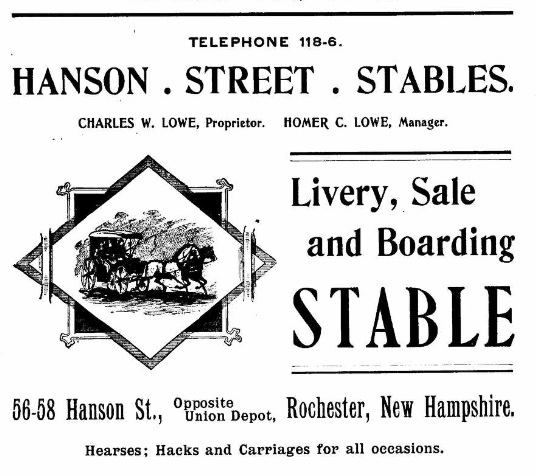 Son Homer C. Lowe married in Rochester, NH, March 20, 1905, Eva M. Webber, both of Rochester, NH. He was a liveryman, aged nineteen years, and she was at home, aged seventeen years. Rev. Leslie R. Danforth performed the ceremony. She was born in Rochester, NH, May 5, 1888, daughter of Wilbur H. and Cora (Corson) Webber.
 Homer C. Lowe of Rochester, NH, had a 28.8 h.p. Mitchell automobile registered (#1871) in Rochester, NH, in 1912 (NH Secretary of State, 1913).
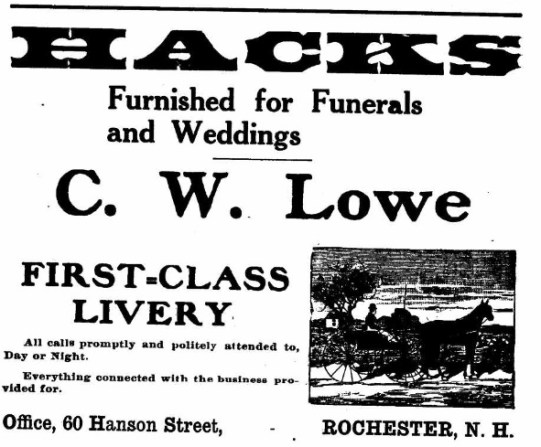 Charles W. Lowe & Son appeared in the Rochester, NH, directory of 1917, as proprietor of an auto for hire, livery and boarding stable, at 56-58 Hanson street. His son, Homer C. Lowe, appeared as an undertaker at Derry, NH.
 The National Grange (or the National Grange of the Order of Patrons of Husbandry) “is a social organization in the United States that encourages families to band together to promote the economic and political well-being of the community and agriculture” (Wikipedia, 2024).
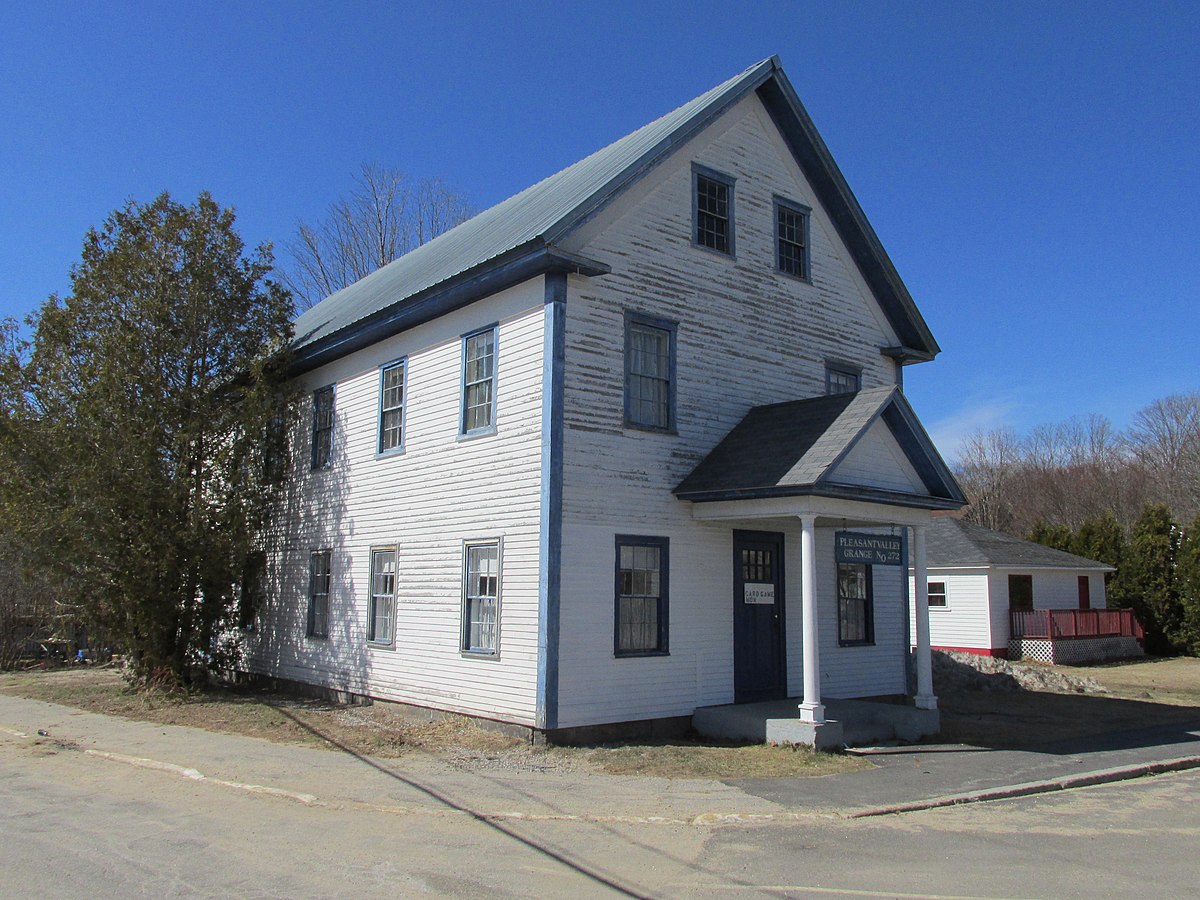 MILTON MILLS. Installation of officers of Pleasant Valley Grange Wednesday evening. Albion G. Weeks of Rochester is the installing officer. The officers for the ensuing year are as follows: Master, Mrs. Florence N. Hanson; Overseer, Mrs. Sarah D.L. Jewett; Lecturer, Mrs. Carrie B. Walsh; Steward, Joseph Jenness; Chaplain, Mrs. Helen Jewett; A. Steward, George A. Buzzell; Secretary, Mrs. Lucia P. Fox; Treasurer, Wilbur G. Miller;. Gate Keeper,
 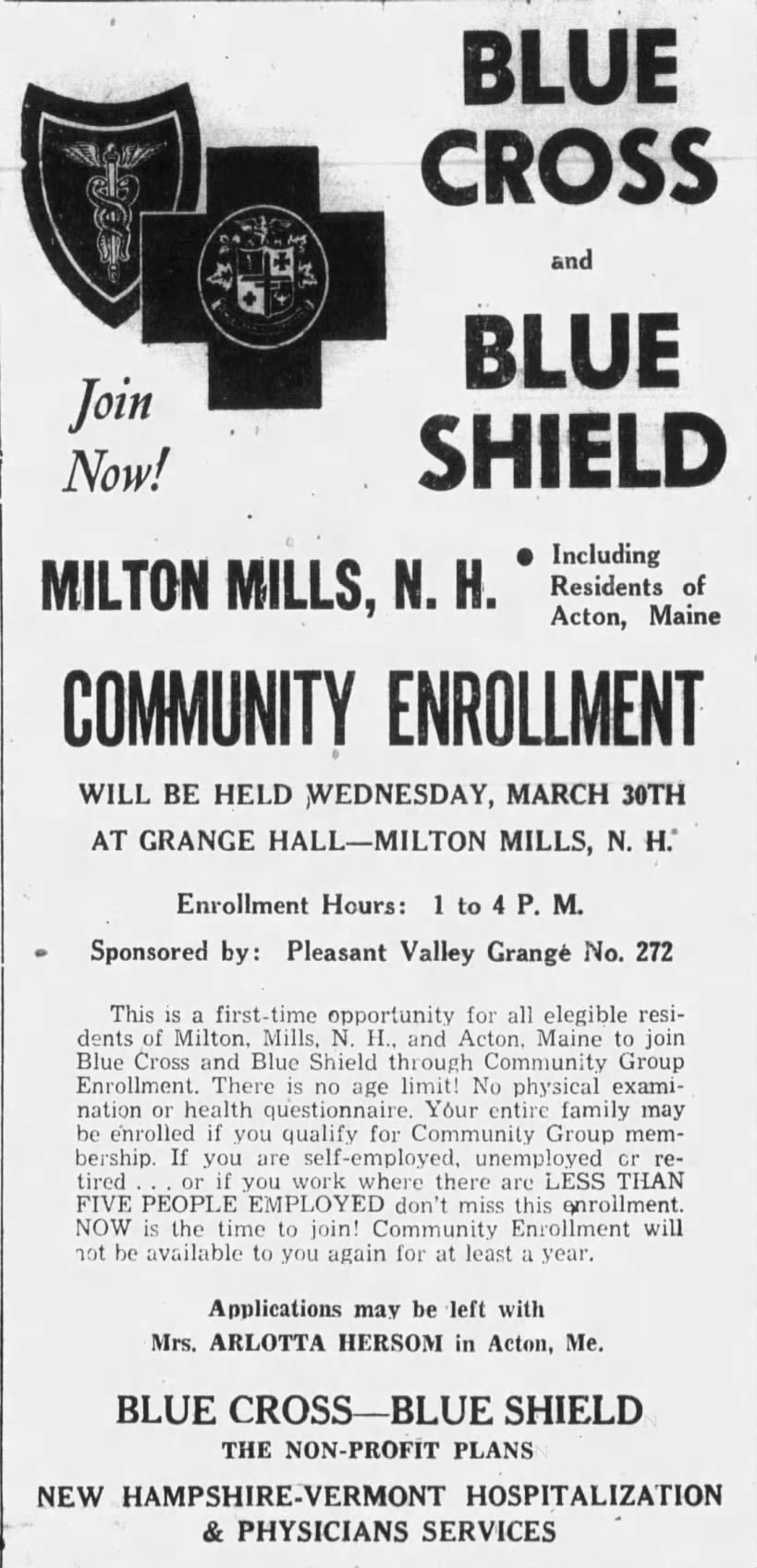 MEETING OF EASTERN N.H. POMONA GRANGE. Eastern N.H. Pomona Grange, No. 2, will meet at Milton Mills on Thursday, March 20, with members of Pleasant Valley Grange as hosts. Supper will be served at 5.30 o’clock. A closed session will be called promptly at 7 p.m. by Master Gideon Marcoux. A very fine program will be presented by the lecturer, Alice Brock, at 8.30 (Farmington News, March 14, 1947).
 Then the town voted to build a meeting-house on that site, 52×42 feet, with a porch at each end eleven feet square and a portico in front.
  Milton Observer