Milton in the News – 1907

By Muriel Bristol (Transcriber) | July 11, 2019

In this year, we encounter a temporary worker, more Arctic weather, a Milton invalid, a dancing rabbit novelty, a Milton minister in Portsmouth, Mrs. Demeritt still seeking her au pair, and some hydraulic consulting.

This was also the year of Milton’s murderous lover.


Victor W. “Vic” Stewart was born in Hardwick, VT, February 16, 1874, son of William H.H. and Emma J. (Wakefield) Stewart. He married in Hardwick, November 25, 1896, Lulu L. Meader. She was born in Walden, VT, January 8, 1874, daughter of Stephen and Priscilla Meader.

Victor W. Stuart, a granite cutter, aged twenty-six years (b. VT), and his wife (of three years), Lulu L. Stuart, a dressmaker, aged twenty-six years (b. VT), lodged at the time of the Twelfth (1900) Federal Census in the Hardwick, VT, household of William Taylor, an attorney, aged thirty-six years (b. VT).

HARDWICK. Vic Stewart, who has been working in Milton, N.H., has returned home (St. Johnsbury Republican, January 8, 1907).

Mr. Stewart worked probably on one of Milton’s ice-harvesting crews, although he might conceivably have been employed temporarily in a shoe or leather-board factory. (He made it home to Hardwick just in time for his wife’s birthday).

Victor W. Stuart, a granite shed lumper, aged thirty-six years (b. VT), headed a Hardwick, VT, household at the time of the Thirteenth (1910) Federal Census. His household included his wife (of thirteen years, Lulu L. Stuart, aged thirty-six years (b. VT), and his niece, Priscilla E. McGinnis, aged three years (b. NH). Lulu was not a mother. They owned their home on North Main Street (with a mortgage).

Victor Wakefield Stewart, of Hardwick, VT, aged forty-four years, registered for the WW I military draft in St. Johnsbury, VT, September 12, 1918. He worked for George B. Shepman, of Hardwick, VT, as a teamster and sawmill hand. His nearest relative was his wife, Lulu M. Stewart, of Hardwick, VT. He was described as a tall man, with a medium build, blue eyes, and brown hair.

Lulu L. (Meader) Stewart died in Hardwick, VT, March 5, 1945. Victor W. Stewart died in Hardwick, VT, August 13, 1955.


Milton Mills experienced some Arctic weather, even colder than that of 1904.

DOWN TO 50 BELOW. That is the Report From West Ossipee, N.H. – Many Towns Report 40 Below. PORTSMOUTH, N.H., Jan 24 – Reports from points along the Conway division of the Boston & Maine railroad show that this morning was the coldest for years. At Conway Junction it was 40 below, Milton Mills 42, Union 40, Wolfboro 32, Tuftonboro 40, Pine River 46, Madison 42, West Ossipee 50, Conway Center 47, Jackson 36, Conway 40, Great Works 42. All existing records for low temperature in this city were broken when at 7 a.m. in several places about the West End, the thermometer registered 28 below zero and at the street railroad car barn it was 32 below. The extreme low temperature threw train schedules on the B&M RR away out of the regular time, the freight trains being several hours late, while passenger trains were considerably off. From north of here reports have been received that it was the coldest for half a century. Greenland was 20 below and Newcastle, on the harbor front was 10 below, the coldest for 50 years (Boston Globe, January 24, 1907).


A Milton invalid corresponded with others through the Each and All Society pages published in newspapers.

OBJECTS AND AIMS OF EACH AND ALL. PERHAPS some of you, seeing this page for the first time, wonder just what the Each and All Society really is; what there is about its aims and objects to create so widespread an interest among “young girls of all ages.” The society was founded in February, 1905, with Christine Terhune Herrick for its president and with an almost instant membership of girls from nearly every State in the Union and in Canada. Its object is to help girls help themselves by developing their talents into something the world wants; to solve difficult problems – the sort a girl wants a calm, unbiased, out-of-the family opinion upon and to promote the exchange of general help. Any girl may belong. There is no red tape about it. The sending of your name for membership gives you the range of every opportunity the society boasts. And Mrs. Herrick stands ready to welcome, to advise and to help.

From a Shut-In. I hasten to answer your call for letters from shut-ins. I have been confined to my bed for fifteen months with spinal trouble the result of an injury. I enjoy the Each and All page so much, and I have been meaning to send a message to my sister shut-ins for some time, as I cannot take up a great number of correspondents. It costs too much of the strength I am so carefully trying to win back, to say nothing of expense, so I have thought of sending a wee message of hope through you.

You ask what I most long for. Well, just now it is for a return to health so that I can take my proper place in the home. A family in which there are a number of growing boys and girls needs a mother that can be “up and doing,” especially when the income is so limited as ours. I covet strength, also, that I may work and earn money to help lift the heavy burden of debt left by my illness, and that of two of the children, who had a long run of typhoid last winter. I wish I had means to have a specialist come to see me.

Some day I shall need a wheel chair, I am sure; and I like pretty, dainty things. I love to read, and should be glad of some of the reading matter offered, and this is enough of my longings. If it is best for me to have any of them gratified, the way will be opened. I am sure. Now for what helps:

First and foremost, “God is our refuge and strength.” I don’t want to preach to the sisters, but there is a Heavenly Father and a Friend who never forgets even the least of His helpless, suffering children. Next, I count a strong determination to get better, D.V. [Deo Volente: God Willing]. By will power and work I have regained the use of my right hand. At Christmas time it was paralyzed – only a little power left in the thumb. My doctor told me the other day that I might feel proud of that hand, as it was only my own persistent efforts that had brought it back as supple as ever, only still a little weak. I worked, darning stockings, trying to scribble – I had enough strength left in my thumb to hold a pencil or needle against the contracted, helpless fingers. I opened out the hand and slept on it. As power began to come in, I played imaginary “five-finger” exercises on the bed quilt and wiggled my fingers in all possible shapes; so that now I can sew, knit, crochet, and write fairly well. Work is a blessing. I find and I do not feel quite such a burden as long as I can mend all the stockings, sew on buttons, do a little light sewing, etc. Just now I am knitting a sweater for one of the girls. I want to take up my writing again, but have not felt equal to a very great effort as yet. 

I love music so well and hear little. I used to play the piano, and wish I could get a guitar now. I think I could play it as I can a banjo. Once I had a great pleasure. A very fine violinist came and played for me all one evening. Another time a neighbor brought in his graphophone. There’s a hint for you girls – so many pianos lie silent in homes when elderly or sick people would love to have you play for them, an hour or two; or you could take your guitars, graphophones or other instruments. If you have a musicale, go out in the “highways and bring In the halt and maimed,” who are doubtless too proud to even hint how music will do to make them forget their miserable condition. A.L.P. (Milton, N.H.) (Los Angeles Times, February 3, 1907).

A Mrs. F.J.N., of Milton, N.H. was also an Each and All Society correspondent (Los Angeles Times, February 10, 1907; April 28, 1907).


A Milton Mills entrepreneur set themselves up as a mail-order distributor of novelties and toys. In this case, the novelty advertised appears to have been a wind-up dancing rabbit.

WANTED – AGENTS. AGENTS WANTED – Dancing rabbit, latest and cutest thing out; ever changeable; always amusing; price 25c. MILTON NOVELTY CO., Milton Mills, N.H. (Indianapolis News, February 9, 1907).

A nearly identical advertisement included the additional information that the dancing rabbit was made of rubber.

AGENTS WANTED. DANCING RABBIT. Made entirely of rubber; latest and cutest thing out; ever changeable, always amusing. 25¢. Illustrated catalogue free. McNeil & Co.. Kenosha, Wis. 171 (Des Moines Register, December 1, 1907).

Various department and other stores around the country included dancing rabbits among their Easter toys and novelty advertising.

Easter Novelties Shown in Basement in Great Numbers. Easter rabbits, 5¢ to $1.25; Dancing rabbits, 49¢ to $1.00, Jumping rabbits, each 25¢; Walking chickens, each 25¢; Fox chasing chickens, 25¢; Easter baskets, 5¢ to 75¢; Downy little ducks, 5¢ to $1.00; Color for eggs, 6 shades, 5¢ (Carlisle Evening Herald (Carlisle, PA), March 22, 1907).

It might be said that the dancing rabbit toy “had legs.” In 1946, the Habob Company of 41 West 19th Street, New York, NY, included them among its offerings: novelty pencil boxes, fire chief hats, bulk bubble pipes, plastic aeroplanes, nose catchers, dancing rabbits, pistol clappers, Old Maid card games, bead dolls, and tattoo transfers (Chain Store Publishing Company, 1946).


Rev. Charles D. Osborne of Milton, NH, was the guest preacher at Portsmouth’s Pearl Street Free Baptist Church on Sunday, June 2, 1907.

Pearl Street Free Baptist Church. Preaching at 10.30 by Rev. Charles D. Osborne of Milton, N.H. Subject, “A Great Secret.” Evening service at 7.30, conducted by Rev. Mr. Osborne. Subject, “The Prince of Healers and How to be Healed.” Everybody welcome (Portsmouth Herald, June 1, 1907).


Mrs. Demeritt sought still for her au pair, as she had in the previous year. This time, she wrote to the Each and All Society mentioned above.

A Chance for Some One. l would like to ask if all the women and girls of today have become “office help,” or if there is none between the ages of 30 and 60 who would be willing to “keep house” in a quiet place, with a good home and good wages and with her rights fully considered? Mr. M.A.D. (Milton, N. H.).

Here is an opportunity for some woman. I hope the right one may get it. She would, of course, be glad to exchange references (Los Angeles Times, June 23, 1907).


Ira W. Jones, Milton’s home-town hydraulic engineer was off consulting in Montpelier, VT.

ENGINEER’S REPORT. Hydraulic Expert Again Visits Kinney’s Mills. I.W. Jones, hydraulic engineer, of Milton, N.H., went back to his home last night after making another inspection of the water privileges owned by Messrs. Corry, Deavitt and Frost at Kinney’s mills. A contour map has been prepared showing the various sources of water supply and the lowest points in that neighborhood where it would be possible to erect power plants. Mr. Jones has reported to the syndicate his observations on the various dam sites, the possibilities of each and the probable cost of construction. It is reported that Mr. Jones is very favorably impressed .with the water privileges owned by the syndicate. The Montpelier men have not yet decided how large a plant they will put in. They can do two things, the first, build a plant that will supply their street railroad with possibly a small amount of juice for sale, or build a large plant with plenty of juice for sale. Such a development will involve the investment of a large amount’ of money (Montpelier Evening Argus, August 28, 1907).


Previous in sequence: Milton in the News – 1906; next in sequence: Milton in the News – 1908


References:

Find a Grave. (2012, July 8). Arthur J. Marcoux. Retrieved from www.findagrave.com/memorial/93325461

Wikipedia. (2019, July 7). Christine Terhune Herrick. Retrieved from en.wikipedia.org/wiki/Christine_Terhune_Herrick


Not the Fourth of July

By Ian Aikens | July 8, 2019

Isn’t it strange how even the name of the holiday being celebrated last week with parades, barbeques, flag-waving, and fireworks has morphed from “Independence Day” to the “Fourth of July”?  It almost seems like an intentional purpose to make people forget what the Declaration of Independence was all about and why it came into being.

Though the general population’s knowledge of civics and the most basics of American history is severely lacking these days — close to 40% of the American public cannot name even one of the freedoms listed in the First Amendment — at least most folks know there was a war when the 13 colonies broke away from England sometime in the late 1700’s, the Founding Fathers conjured up some historical documents like the Declaration of Independence and the Constitution, and our country was formed.  Most folks will recall there was some type of uproar over taxes or some such grievance, but that’s about it.  Shamefully, despite the massive amounts of taxpayer money spent on education these days — in most states, close to 50% of taxes collected go to schools — much collective memory has been lost.  When I was in junior high school, studying the Constitution was one of the major hurdles of getting through the eighth grade.  When I ask young folks these days about it, they all say that it’s not even taught at all — at least not in government schools.

How convenient to forget the past.  In fact, the Declaration of Independence was a radical proclamation by rebel British subjects that the purpose of government is to protect and uphold individual rights.  After 250 years, we take that as a given, but at the time, that was truly a remarkable revelation.  Government was created to serve the people, not the other way around.  In fact, the rebel colonists were so distrustful of government from their experience with the British government that the Articles of Confederation created such a weak federal government that it didn’t even have the power to tax.  (In retrospect, perhaps a good thing?)  The Founding Fathers were on to something new and profound, and it’s no accident that Americans experienced an incredible growth in prosperity after the signing of the Declaration of Independence (which was approved by Congress on July 4, 1776 but wasn’t actually signed until August 2, 1776) to be followed by the Constitution and Bill of Rights in 1787 and 1789 respectively.  A lot of thought went into designing a government that would be limited in scope and concentration of authority to prevent the abuse of power.  They very purposely came up with a government based on the rule of law, rather than the rule of man.

Sadly, if the Founding Fathers were here today to see what the limited government they created has become, they would faint.  Endless wars and Congress completely abdicating its responsibility and allowing the president to commit US troops abroad without congressional approval goes completely against the intent of the Founding Fathers.  And this is nothing new:  the last time Congress authorized and declared war was World War II.  The Founding Fathers specifically did not want a standing army because they knew it would lead to military adventures overseas — which is has — and felt a navy would be sufficient for defensive purposes.  They would be appalled at American presidents with the power to assassinate “our enemies” with drones without due process of law.  The surveillance state and rampant abuses by the NSA, CIA, FBI, IRS, FDA, and TSA would be another whopper for the Founding Fathers to grasp.  The utter lack of economic freedom, where every branch of government has passed a myriad of laws governing every aspect of running any business these days, would also have the Founding Fathers aghast.  If you ever take a look at bills that push for more controls with licensing and fee extractions, they often literally say “for the privilege (my emphasis) of operating a business in …”  The signers of the Declaration of Independence knew from experience that government itself is the greatest threat to liberty and designed a system to prevent such tyranny.  The welfare state and calls for more government guaranteed jobs, housing, education, healthcare, and just about every other need would be completely incomprehensible to the Founding Fathers as they intended the “pursuit of happiness” to be critical for human beings to thrive, not the “guarantee of happiness.”

In my travels to Concord earlier this year to give testimony in committee public hearings, it was disheartening to listen to person after person from vested special interest groups urge our elected representatives for more control over our lives with more laws, regulations, and taxes.  Of course, as long as they received the largesse for their particular group, that’s all they really cared about.  The fact that they were basically begging for alms from the spoils of mandatory charity didn’t seem to bother anyone, which shows just how far our society has evolved away from the ideals created in the Declaration of Independence.  It has become a largely overlooked and definitely unappreciated gift from those who understood the true meaning of liberty.


See also Milton and the U.S. Constitution


References:

Harrison Elizabeth (History.com). (2012, July 4). 9 Things You May Not Know About the Declaration of Independence. Retrieved from https://www.history.com/news/9-things-you-may-not-know-about-the-declaration-of-independence

Washington Times. (2017, September 13). 37 Percent of Americans Can’t Name Any of the Rights Guaranteed by the First Amendment: Survey. Retrieved from https://www.washingtontimes.com/news/2017/sep/13/37-percent-of-americans-cant-name-any-of-the-right/

Wikipedia. (2019, June 6). Declaration of War by the United States. Retrieved from https://en.wikipedia.org/wiki/Declaration_of_war_by_the_United_States


Milton’s Murderous Lover – 1907

By Muriel Bristol (Transcriber) | July 7, 2019

A crazed Milton shoe-worker tried to murder his “sweetheart” when she refused his proposal. Fortunately, she survived, although it was a very close thing.


Boston Post, June 17, 1907
“Pretty Milton, N.H., young woman and how she was attacked by a sharp knife and left for dead by a man in the woods outside the village” (Boston Post).

MURDEROUS LOVER FORGIVEN BY GIRL. Arthur Marcoux, Who Cut Sweetheart’s Throat, Weeps in Jail. MILTON, N.H., June 16. “I bear no malice against Arthur for what he did; I think just as much of him and I know he loves me. They shall never make me testify against him.”

Lying wan and pale on a bed in the Milton Hotel Miss Annie Drapeau received a Post reporter and in these words proved her devoted love for the youth who assaulted and nearly killed her in the lonely woods of the old Flume and who will be arraigned in Rochester in the morning, charged with the attempted murder of his 19-year-old sweetheart. Tonight Arthur Marcoux, himself barely 20, is guarded in the Strafford county jail at Dover without bail.

Moans and Weeps

When brought over from Milton this afternoon by High Sheriff Frank I. Smith and Deputies Bert Wentworth and Charles Roscoe Allen he collapsed completely, and when Rochester was reached a stop had to be made while the moaning, weeping boy was attended by Dr. Edson M. Abbott. He was in a pitiable condition when taken to a cell in the Dover [revolving] jail, but will in any case be taken to Rochester on the 8.30 electric to be arraigned before Judge McGill. Dr. M.A.H. Hart of Milton is attending Marcoux’s victim, and also looked after the youth this morning. He alone has heard the true story of this mysterious affair from the lips of the lovers and consented to tell the story of the tragedy for the readers of the Post.

M.A.H. [Malcolm Allen Hayes] Hart, a general practice physician, aged forty-eight years (b. NH), headed a Milton (“Milton 3 Ponds”) household at the time of the Thirteenth (1910) Federal Census. His household included his wife (of twenty years), Estelle [(Draper)] Hart, aged forty-six years (b. VT), and his children, Wentworth Hart, aged nineteen years (b. NH), and Ezra Hart, aged sixteen years (b. NH).

By Doctor M.A.H. Hart

“The stories that are being told around of this affair are far from the truth. Both Marcoux and the girl have told me the truth, and while there are some things I may not tell, I shall be glad to tell what I can. Annie Drapeau is 19 and, while not pretty, she is rather a pleasant companion. Arthur Marcoux is a handsome young chap of 20, and has admired Annie for some time, but she did not pay him much attention. She was not feeling well lately and left her employment at Thayer’s shoe shop to go under the care of a Rochester physician. Saturday noon she came from a trip to Rochester from her home in Sanbornville and stopped off at Milton to keep an appointment with Marcoux. They went to his home to dinner, and about 2.30 they started on a walk to the old Flume, a famous trysting place for lovers a mile down Main street in South Milton. Here it is densely wooded, and they walked down towards the Salmon Falls River.

Old Slum Picnic Grounds.jpg
The scene of the crime

She Refused to Wed

“The boy asked the girl to marry him and she refused. From here on the memory of both is hazy. He had his razor with him by pure accident. He had just gotten it from Arthur Marchand, the [Rochester] barber who had honed it. Well, he got the girl down, so they say, and slashed her across the throat. Then he ran across lots straight home. Apparently the girl was dazed, but not unconscious, for although the blood was pouring from a great gash in her throat, she started for home. She was so confused that she went the wrong direction, falling, crawling, staggering along through the woods and underbrush till she reached the brook.

“This she waded and finally staggered into the old leatherboard mill. Some Greeks there were terrified by her appearance, disheveled, her clothing blood-soaked, and that terrible gash across her throat. They called to their boss, William S. Drew, and he telephoned to me. I hastily got some necessary things together and drove there. I found the cut had not severed the jugular, although it was six inches long and exposed the epiglottis. The girl seemed rational and as much as she could told me what had happened. “Arthur didn’t mean to hurt me,” she said again and again.

“She kept asking us to take her to her home in Sanbornville. When I saw what a serious affair it was I sent for Selectman Hazen Plummer and Chief of Police Fred Howard. We got the girl to the Milton Hotel on an improvised stretcher, and then Marcoux was arrested. He tried to conceal nothing, and later told me the whole story. He said from the time the girl refused his mind is blank. Annie says the same. Marcoux is a fine boy and the last fellow I would pick to do such a thing. He is now a complete nervous wreck.”

When the Post reporter arrived in Milton he was admitted to Miss Drapeau’s room at the Milton Hotel and presented to her.

Girl May Live

While very weak she is able to talk a little and Dr. Hart believes she will ultimately recover unless blood poisoning develops. She is being nursed by Mrs. Charles [Lydia (Marcoux)] Welch, a married sister of the youth who assaulted her, and when the Post writer called he found a brother of Marcoux with the wounded girl. To the reporter Miss Drapeau whispered the amazing message that she now loved Arthur more than ever and wanted him to know it. She is not a pretty girl, but yet is rather attractive. She is very tall, while Marcoux is undersized. This morning Arthur Marcoux was taken from the town lockup and willing took the officers to where he attempted his crime. Here he found the razor and Sheriff Smith now has it. It is a cheap razor with a black rubber handle. The blade is stained with blood and rusted. On one side a large clot of blood can be seen. In this connection Marcoux’s clothes were blood-stained. Before starting for the jail he asked to see his mother, and an affecting scene took place. He has five brothers and the same number of sisters.

Later his mother drove to Rochester, where she retained Attorney Walter Scott to defend her son. Attorney Scott went to Dover jail this evening to have a talk with the prisoner, but could do nothing because of Marcoux’s condition. Sheriff Smith sent out summons for Dr. Hart, Chief of Police Fred Howard and Selectman Plummer to testify at the preliminary hearing in the morning.

Marcoux’s father, Joseph Marcoux, a laborer, had his house on Charles street in Milton, near its intersection with Tappan court, in 1905 (Dover Directory, 1905). Marcoux’s mother, Theotiste Adelaide “Addie” (Cyr) Marcoux, would have set out for Rochester from there. They moved to Farmington after these terrible events (Dover Directory, 1908).

Feeling Against Youth

The feeling against the boy would-be murderer is very intense, and it is said that even if his victim refuses to testify against him and he will not confess on the stand, he will be prosecuted to the full extent of the law by County Solicitor Dwight Hall. The maximum penalty is 20 years at hard labor. The members of Marcoux’s family are heartbroken.

“I know Arthur did not mean it,” said his sister, who is nursing Miss Drapeau. “He loved the girl and we all liked her. He wanted to marry her and she wouldn’t say yes. She said she loved Arthur but they were too young. If Annie dies they will never have a chance to punish Arthur, for it will kill him.”

Annie Drapeau had been employed as a shoe stitcher in Thayer’s shoe factory and went back and forth from her home in Sanbornville every day. Her mother is very ill, but her father came to her today (Boston Post, June 17, 1907).

Eusebe Drapeau, a farmer (working out [i.e., working off his farmstead]), aged forty-eight years (b. Canada), headed a Wakefield (“Sanbornville Village”) household at the time of the Thirteenth (1910) Federal Census. His household included his wife (of twenty-five years), Aurelia [(Carrier)] Drapeau, aged forty-nine years (b. Canada), and his children, Eusebe G. Drapeau, odd jobs, aged sixteen years (b. NH), Leda Drapeau, aged fourteen years (b. NH), Heliodore Drapeau, aged twelve years (b. NH), Valore Drapeau, aged ten years (b. NH), Euclide Drapeau, aged eight years (b. NH), and Eliana Drapeu, aged three years (b. NH).


LEFT FOR DEAD, GIRL CRAWLS FAR WITH THROAT CUT. Attacked by Lover Who Confesses Crime to Police. Jugular Vein Missed by Thinness of Tissue Paper. MILTON, N.H., June 18. With a gash five and one-half inches long in her throat inflicted, she said, by her sweetheart, Annie Crapau crawled half a mile before she found assistance. Arthur Marcoux, the man accused by the girl, has been arrested, and he will be arraigned in court in Rochester.

“I don’t know why I did it,” he said. After he had been taken to the police station, he confessed, the police say, and told substantially the same story of the crime that had been related previously by the wounded girl. 

Slashed on Throat. “We left our homes and started out together in the woods to hunt for wildflowers,” the girl said after her wound had been dressed. “When we arrived at the Old Flume we sat down beside the brook to rest. We had been there several minutes when Arthur, without a word of warning or explanation, pulled a long knife from his pocket. He attempted to stab me with it. I noticed that his eyes were wild, and so I jumped up and ran away. I screamed as I went, but no one heard me. Arthur pursued me. He could run faster than I and he soon overtook me. Then he caught me by the hair, drew my head back, and slashed me across the throat with the knife. I must have fainted from fright, because I do not remember anything more. When I came to I was lying in a clump of bushes near the brook. I guess he threw me there. I called for help, but nobody came. Then I began crawling.”

Fainting Saves Life. Almost dead, she reached Spaulding’s mill. Several men there rushed to her assistance and carried her into the mill. She accused Marcoux of the crime, and action was taken at once to effect his arrest. The chief of police rushed off to Marcoux’s home. He found the man in the yard unconcernedly drawing a pail of water. The chief accused him flatly of having cut the girls throat and he admitted it, but would give no motive for the crime.

Dr. Hart reached the mill a few minutes after he had been summoned. He examined the wound and expressed the opinion that unless blood poisoning should result the girl would survive.

“Both the jugular vein and the windpipe were missed by the thinness of a sheet of tissue paper,” he said.

The girl was brought to her home here. It is believed her life was saved by the fact that she fainted when the knife ripped her throat open, and that Marcoux, when he left her, believed she was dead (Washington Times, June 18, 1907).

Marcoux, Arthur


Milton. Another trouble is the assault at the Flume in Milton, Arthur J. Marcoux having drawn a razor upon Miss Annie Drapeau, whom he had proposed to marry. He had cut her throat in a way that barely avoided the jugular vein, after which he left his victim supposedly to die. But she recovered consciousness sufficiently to drag herself to the road, where she was discovered by persons driving, who carried her to the office of Dr. Hart, and gave the alarm which was followed by the arrest of Marcoux. The assailant was taken to Rochester in care of Sheriff F.I. Smith and one of his deputies, and it was ordered by Judge McGill that he be held without bail at Dover jail, for appearance at the September term of the superior court. Miss Drapeau expresses opinion that the man is not right in his head. She had objected to immediate marriage as she thought they were both too young. There may be other opinions as to this assault, but this seems to be as nearly correct a report as can be made at this time. Such an event confirms the assertion of many that a good chaperon never is out of place, when young men and women are together. (Farmington News, June 21, 1907).


PARENTS REFUSED CONSENT. Young Man Could Not Marry Girl and Cut Her Throat In Revenge. Milton, N.H., June 17. Mamie Trebeau of Sanbornvllle, aged 19, is suffering from knife wounds in the throat alleged to have been inflicted by her sweetheart, Arthur Marcoux of this village. Although there is a cut in her neck nearly six inches long, she is thought to have a chance of recovery, as the wound is not of great depth. Marcoux, who was arrested after the wounded girl had been found in a lonely spot near a picnic ground, was taken to Dover jail to await the outcome of her injuries. Marcoux is said to have told the officers that he was infatuated with the girl, but that her parents refused to allow her to marry him. Marcoux accompanied the officers to the scene of the attack and assisted in finding the knife which he used upon the girl’s throat. Marcoux is a shoe factory employe, 21 years old (North Adams Transcript, June 23, 1907).

Arthur J. Marcoux was committed to the New Hampshire State Hospital early in February of the following year. Annie Drapeau married someone else in May of that year.

BOTH SENT TO ASYLUM. Morgan Charged With Killing Lowell Man in Dover, Marcoux With Attempt to Kill Woman. DOVER, N.H., Feb. 27. Two defendants before the superior court, one charged with murder and the other with assault with intent to kill, were committed to the state asylum at Concord today after entering pleas of not guilty by reason of insanity. The murder case was that in which Patrick Morgan was accused of having killed Dennis Doherty of Lowell in a quarrel in this city last February. The assault case was that of Arthur J. Marcoux of Milton against Miss Annie Drapeau of the same place. Both men had been under examination at the Concord institution since last August, and Dr. Charles E. Bancroft, the superintendent, informed the court that both undoubtedly were insane (Boston Globe, February 27, 1908).

Arthur Marcoux, an inmate, aged twenty-two years (b. NH), resided in the New Hampshire State Hospital in Concord, NH, at the time of the Thirteenth (1910) Federal Census.

Arthur Joseph Xavier Marcoux registered for the WW I military draft in Strafford County, October 21, 1918. He was an unemployed shoemaker, aged thirty years. He gave his address as PO Box 776, in Farmington, NH. His physical appearance was given as a medium height, a medium build, with brown eyes and black hair. His nearest relative was his brother, Fredk. Jos. Marcoux, at the same Farmington PO Box.

Arthur J. Marcoux’s obituary says that he lived and worked in Boston for many years, returning later in life to work in Rochester. He never married. When he fell ill, he lived his last six months in a rotation through his sisters’ houses in Farmington.

Arthur J. Marcoux died in Farmington, NH, October 28, 1935, aged forty-nine years. (His birthday). Annie died in Sanford, ME, July 12, 1941.


References:

Find a Grave. (2012, July 8). Arthur J. Marcoux. Retrieved from www.findagrave.com/memorial/93325461

Milton in the News – 1906

By Muriel Bristol (Transcriber) | July 4, 2019

In this year, we encounter a Massachusetts ice scarcity, a ministerial anecdote, an au pair wanted, a train connection missed, two apparent arson fires, Nute High school bullies, a new ice season, and pullers-over wanted at Milton Mills.

This was also the first year (beginning September 1) in which New Hampshire motorists were required to have automobile registrations and driver’s licenses.


Massachusetts had significant warm stretches during the winter of 1905-06, which interfered with its ice harvest.

Ice Scarce in Lynn. [Lynn Item] The Lynn ice men are not cutting much ice just now in any form. The Lynn Ice Co., M.S. Coolidge, and Z.J. Chase & Sons, who are working at Milton, N.H., have been bothered there by weather, warm spells coming along to interfere with the piling up of ice in the houses there. The Lynn Ice Co. has not cut a pound in Lynn this winter, though the engines have been ready to strike at any minute. Dealers who have cut on Sluice, Floating Bridge, Cedar and Spring ponds have a few tiers in. but not enough to more than carry along the daily trade. All the ice dealers have been buying ice where they have been able to find it outside of Lynn, and some of the New Hampshire men who have small ponds and are near railways have been selling briskly. Far up in New Hampshire there is a plenty, but the cost of getting it to the cities is high, and the cost of lumber is also so high and the lumber so scarce that it is almost impossible to get it on the spot quickly enough to cover the stacks of ice made, and that means melting pretty fast where the sun strikes the cakes.

At Milton, N.H., Tuesday night, there was a big blow. Report came to Lynn today that some of the local firms had lost ice houses, but later the information reached Lynn that the houses that were put out of business for a while are those of the Boston Ice Co., which was building 13 new houses there. The uprights were erected and boarding in had begun, but a high wind during the night blew the standing timbers down and the work will have to be gone over again The Boston Ice Co. people say that where they need 450,000 tons they have but 100,000. and they don’t know what to do any more than the Lynn dealers. Providence, R.I., and New Bedford and Fall River are without ice, or will be after April 1, if some cannot be found to fill the houses.

“I have been m the ice business 25 years,” said a Lynn man today, “and the situation is the worst I ever knew. A man who has been in the trade 19 years told me the other day that he never saw anything like it. We don’t know what to do and that’s a fact. We can just plug along cutting what we can in Milton and trusting that something will happen to fill our houses. We are in a fix and wondering. Yes, ice will be high for next summer. I don’t see how it can be helped. It is costing high to get what little we can find as it is, and if we have to go farther north then the cost will jump to bigger figures and that means that the retail trade must go up.” (Fitchburg Sentinel, March 2, 1906).

ICE SHORTAGE, Hallstram Says It Is Here Already. Avers Dealers Will Have Hard Time Till New Crops. Fourteen Icemen Indicted in Philadelphia. Charles W. Hallstram, secretary of the Massachusetts ice dealers’ association, treasurer of the Union ice company, and prominent among the Ice dealers recently summoned before the grand jury, says it will be a tight squeak for Boston to get through warm weather without a shortage of ice. “Our company,” said Mr. Hallstram, “last week used up the entire supply of one of our houses, where it would ordinarily last two weeks at least. There were 2500 tons of ice in that house, but it was all used up in a week. “People who do not understand the situation may talk as they will, but the fact is there is a shortage of ice, and many of the dealers will find it pretty hard work to drag along until the new crop comes. “Our company has only four houses left with ice up at Milton, N.H. At Wilmington, Mass, we have six small houses full since last year. We supply the fish trade mostly, and I know that we will have a pretty hard time to pull through with what supply we have.” Mr. Hallstram said his company put their price up only 50 cents a ton this year, and that the price now is $3 a ton (Boston Globe, August 8, 1906).

See also Milton’s Ice Harvest of 1906 and Milton’s Ice Industry.


Elder Daniel B. Goodwin seems to have been the last of Milton’s Christian Church Elders – 1846-1888. He had died in Milton, October 10, 1888, and was here remembered nearly twenty years later for his large hands.

Mr. Goodwin’s Hands. A story comes from Milton, N.H., of an old clergyman named Goodwin. He was a tall, broad-shouldered man and was said to have the largest hands of any man for miles around. One noon a young man named Allen was taking dinner at the elder’s house. It was the elder’s custom to ask a blessing at the table, and Allen had not been used to this sort of thing, for instead of waiting he began to eat. The elder raised his hand with restraining gesture and said: “Pause, young man.” “Paws,” was the reply, “I should think they was paws.” – Chicago Inter Ocean (Funk & Wagners, 1906).


Berthold Isaac Demeritt married in Milton, July 9, 1892, Musetta Ardella Dorr. He was born in Newfield, ME, November 30, 1874, son of David and Hannah A. (Nason) DeMeritt; she was born in Milton, NH, in July 1875, [adopted?] daughter of Simon C. and Hannah W. (Hill) Dorr.

Bert DeMeritt, a packer of boots and shoes, aged twenty-five years (b. ME), headed a Boston, MA, household at the time of the Twelfth (1900) Federal Census. His household included his wife (of eight years), Musetta A. DeMeritt, aged twenty-four years (b. ME [SIC]), and his daughters, Merribel DeMeritt, aged six years (b. NH), and Bonneville DeMeritt, aged five years (b. NH). They resided in a rented two-family house at 48 Fairview Street, which they shared with the household of John Hunter, a gas collector, aged thirty-eight years (b. Scotland). Musetta was the mother of four children, of whom two were still living.

Exchange of Ideas in Members’ Letters. Who Needs This Work? I would like very much to have a lady, from 40 to 60, help with care of three children, mostly. She could do whatever she wished of the other work, with the price accordingly. I would rather help care for them, but I must have help, and some one well recommended, whom I could trust, who would be willing to stay with them so I could go out of doors. I would try to make it a pleasant home in every way – the help are one with the family here In the country. We are near churches, postoffice and healthy mountains, woods and water. It is an ideal place for one who cares more for country quiet than city streets. I would like to hear from any one answering these requirements, with good references. I will try to have a fair understanding, as regards price and privileges, and will return answers to all with any information asked for. House very convenient and roomy. Children made to mind and respect elders. One girl, two boys, 1 years to 2 months. Mrs. M.A. De M. (Milton, N.H.). An excellent chance for some one. (Los Angeles Times, April 29, 1906).

Berthold I. DeMeritt, a shoe factory foreman, aged thirty-five years (b. ME), headed a Milton household at the time of the Thirteenth (1910) Federal Census. His household included his wife (of seventeen years), Musetta DeMeritt, aged thirty-four years (b. NH), and his children, Bonneville I. DeMeritt, aged fifteen years (b. NH), Bruce R. DeMeritt, aged seven years (b. NH), Roscoe E. DeMeritt, aged four years, Delphine H. DeMeritt, aged two years, and Hannah D. DeMeritt, aged four months (b. NH). Musetta was the mother of eight children, of whom five were still living.

Mrs. M.A. Demeritt donated flowers to the New England Hospital for Women and Children, in Boston, MA, in 1918-19 (See Mrs. DeMerritt’s Arbutus).

Berthold I. DeMeritt died in Milton Mills, January 11, 1940. Musetta A. (Dorr) DeMeritt died in Rochester, NH, April 12, 1946.


Edgar M. Churchill, a clergyman, aged forty-one years (b. ME), headed an Acton, ME, household at the time of the Twelfth (1900) Federal Census. His household included his wife (of eight years), Amy M. Churchill, aged thirty-one years (b. ME), and his daughter, Dorothy M. Churchill, aged three years (b. ME). (Their household appeared on the same page as that of Eugene H. Ayer (see below).

CHURCH NOTES. There were no services in the Free Baptist church Sunday owing to the detainment in North Conway, N.H., of the Rev. A.W. Churchill of Milton, N.H., who was to have supplied there. Mr. Church understood that the summer train service was in effect and so missed connections. He will have charge of the services at the church next Sunday (St. Johnsbury Republican, May 9, 1906).


Jacob F. Staples married in Milton, March 9, 1863, Amaney J. Pike. Rev. James Doldt performed the ceremony.

Jacob F. Staples appeared on Page 5 of Milton in the Veterans Schedule of 1890. He and his family seem to have been missed in the Twelfth (1900) Federal Census. The Milton section of the Dover Directory of 1900 listed him as a farmer, boarding at H.W. Staples. Harry W. Staples appeared as a farmer, on the U.V. [Union Village] road, 2 m. west of M.M. [Milton Mills].

FAMILY BURNED OUT TWICE. Town of Milton, N.H. Stirred Up Over Two Fires Which Officials Believe to Have Been of incendiary Origin. MILTON, N.H., Aug 7. This town is considerably stirred up over what is believed to have been two incendiary fires. On the morning of June 2, between the hours of 2 and 3, the home of Jacob F. Staples, about one mile out of the village on the road to Union, was burned, together with the barn which contained five horses, other live stock and farming implements. When the family, which consisted of Mr. Staples and his wife, his son Harry and the latter’s child, awakened, the house was one mass of flames and the occupants had barely time to get out without saving any of their effects. They moved to a small house owned by the son, and their neighbors assisted them in furnishing their new home. Early Sunday July 29 this house, together with the barn, three horses and wagons were completely destroyed by fire. As in the case of the previous fire, the family barely escaped with their lives. Owing to the circumstances connected with both fires the selectmen of the town have placed the matter in the hands of county solicitor Dwight Hall, and a systematic investigation will be made in hope of clearing up the mystery (Boston Globe, August 7, 1906).

Jacob F. Staples made out his last will in Milton, October 4, 1906. He devised his farm tools of every description to his son, Harry W. Staples; $1 to his daughter, Susie A. Hatch, wife of Frank Hatch of Kennebunk, ME; and all the rest and residue to his wife, Amancy J. Staples, who was also named as executrix. The will was proved November 7, 1906, i.e., Jacob F. Staples had by then died.


Eugene H. Ayer, a carriage painter, aged forty-five years (b. ME), headed an Acton, ME, household at the time of the Twelfth (1900) Federal Census. His household included his wife (of seventeen years), Charlotte Ayer, aged thirty-six years (b. NY), and his children, William Ayer, at school, aged ten years (b. [Parsonfield,] ME), Francese Ayer, aged seven years (b. ME), and Gladys H. Ayer, aged three years (b. ME). (Their household appeared on the same page as that of Rev. Edgar M. Churchill (see above)).

VICTIM OF HAZING. William Ayer Suffering from Blood Poisoning Said to Have Been Caused by Milton, N.H., High Schoolmates. MILTON MILLS, N.H., Sept. 19. William Ayer, 15, son of Eugene Ayer of this place, is suffering from blood poisoning it is caused, it is alleged, by being hazed by the sophomores of the Nute high school at Milton, which young Ayer entered this fall (Boston Globe, September 19, 1906).

Mr. Clarence E. Kelley was Nute High school principal at the time, and Misses Anna F. Berry and Theresa A. Gerould were the teachers. Despite this Nute High school experience, William R. Ayer went on to become a teacher too. He attended three years of college. He was a teacher, resident on Church Street in Milton Mills, in 1917; and a grammar school teacher, resident in Milton Mills, in 1920. He was a farmer, resident on Church Street in Milton Mills, in 1930 and 1940.

William R. Ayer died in 1954.


Here we find two of Milton’s ice merchants attempting to put the ice shortages of the winter of 1905-06 behind them. Hopefully, the winter of 1906-07 would be more successful.

MALE HELP WANTED. WANTED – 2 or 3 laborers to go to Milton, N.H. Apply to J.R. DOWNING CO, 128 Kenrick st., Brighton, at office or by phone, 2t* n13 (Boston Globe, November 13, 1906).

FOR SALE. ICE. NEW ICE, f.o.b. Milton, N.H., $1 per ton, railroad weight. Address JOHN O. PORTER, Milton, N.H. (Boston Globe, December 9, 1906).

Porter states his terms as being F.O.B.. i.e., the “sale” took place when the ice was loaded at Milton. Ownership, loss in transit, and any liability, all shifted at that time to the buyer.


McKay Leather Stitching Machine.jpg
McKay Leather Stitching Machine

The Boynton Shoe Company had been active in various locations since at least 1898. Its founder, William H. Boynton, died in Marblehead, MA, in December 1901. It had a Candia, NH, operation from around 1903. It first advertised for a stock-fitter for women’s and misses’ shoes at a Milton Mills branch in October 1904. (Boynton was the successor there of the Gale Shoe Company).

MALE HELP WANTED. PULLERS-OVER and operator, McKay sewer, steady work, good chance for family to move where they can all have work. BOYNTON SHOE CO. Milton Mills, N.H., or ANDREWS CO., Everett. SuW d23 (Boston Globe, December 26, 1906).

(Details of a Puller-Over’s task may be found in Milton in the News – 1901). The Boynton Shoe Company produced shoes at Milton Mills through at least 1908.


Previous in sequence: Milton in the News – 1905; next in sequence: Milton in the News – 1907


References:

Beehive (MA Historical Society). (2014, February 7). The McKay Stitcher: The Machine That Revolutionized Footwear Production. Retrieved from www.masshist.org/beehiveblog/2014/02/the-mckay-stitcher-the-machine-that-revolutionized-footwear-production/

Find a Grave. (2013, August 12). William R. Ayer. Retrieved from www.findagrave.com/memorial/115348574

Sampson & Murdock Company. (1908). New England Business Directory and Gazetteer for 1908. Retrieved from books.google.com/books?id=11ZEAQAAMAAJ&pg=PA460

Wikipedia. (2019, June 23). FOB (Shipping). Retrieved from en.wikipedia.org/wiki/FOB_(shipping)

Wikipedia. (2018, August 27). Gordon McKay. Retrieved from en.wikipedia.org/wiki/Gordon_McKay


Concord Beat – Early July 2019

By Ian Aikens | July 1, 2019

As promised in my last article, this time I examined Jeb Bradley’s recent legislative record. I culled my impression not only from his voting record but also from the bills he either sponsored or co-sponsored. While Bradley has a tendency to allow individuals and their employers to negotiate voluntarily between themselves on important issues like pay and benefits, sadly, in other areas, he shows no reluctance to give government bureaucrats the power to mandate all sorts of things.

First a little background on Bradley himself. He has been active in New Hampshire politics since 1986, when he was first elected to the Wolfeboro Planning Board. He was elected to the New Hampshire House in 1990 and re-elected five times. He was elected to Congress in 2002, but in an upset he lost his seat to Carol Shea-Porter, an anti-war activist, in 2006. He was elected to the New Hampshire Senate in 2010 and served as the Majority Leader from 2010-2018. He currently serves as District 3 Senator, representing 19 towns in Carroll County, Waterville Valley in Grafton County, and Middleton and Milton in Strafford County. Outside of the political sphere, he ran an organic bakery, a painting business, a real estate office, and even worked as a street magician in Switzerland at one time.

Now down to business:

HB1319 – Prohibiting discrimination based on gender identity in housing, employment, and public accommodations. Bradley co-sponsored the bill and it was signed by the governor. While it is proper to prohibit all discrimination on government property and for all government services, since “the commons” are owned by all taxpayers, is it really the proper role of government to dictate to private (voluntarily-run) businesses who they must serve? In the olden days, the argument that a traveler had few, if any, choices when traveling, so it would have been uncivil to allow a private business to deny lodging to a traveler may have been plausible, but in this day and age with most businesses scrambling for more customers, it makes little sense to mandate fairness. Besides, the biggest obstacles to more choices for consumers these days are government regulations and occupational licensing.

SB1 – Granite Caregiving Act of 2019. This bill was vetoed by the governor, and Bradley had the good sense to vote NO on it. This would have actually been a tax on earned income—which in any other state is called an income tax—but politicians produce flowery-named titles for bills that might not otherwise be well-received when they are trying to pull the wool over voters’ eyes. This TAX would have been deducted out of all employees’ wages at the rate of .5%. While it would have been a nice fringe benefit for employees, and there is broad-based support for “Family Leave,” once you inform folks that they have to pay for it themselves, support for the program drops dramatically. This would have a mandate too—and the only opt-out would have been for companies that already offer the benefit.

SB10 – Minimum wage up to $12.00 per hour. Bradley voted NO on this one. Another mandate forcing businesses to pay employees more than their skills are worth on the open market. There’s been plenty written about minimum wages and their consequences over the years, so it should come as no surprise that those on the bottom of the economic ladder are hurt the most by these mandates. Those with the lowest skills just starting out lose out on the opportunities to advance their skills. It should also come as no surprise that minimum wage laws were originally pushed by union workers to keep non-Caucasians from competing for their jobs. The racism continues today, but they call it a “Living Wage.”

SB148 – Notification to public employees of right to join or not join a union. Bradley was a co-sponsor on this bill. While one part of this bill that requires new employees’ personal information to be released to unions is alarming, overall this was a net good bill because of the requirement that new employees be informed that they have a choice of joining a union or not. No mandatory forced extortion to join the union or lose your job.

SB255 – Dementia training for direct care staff in residential facilities and community-based services. Co-sponsored by Bradley, this bill demonstrates that he believes that those who choose a residential home for their loved ones don’t have sense enough to choose a facility where the health care workers have adequate training for the jobs they perform. It also assumes the residential facilities have no business interest in maintaining properly trained employees and need to be nudged by a mandate. What business can survive if its reputation is marred by poor care of its customers?

SB270 – Establish tax credit against business profits tax for donations to career and technical schools. Another bill co-sponsored by Bradley, this one would serve to help finance apprenticeships and training programs at technical schools that teach their students actual job skills for the real world, rather than traditional schools supported by tax dollars that do little to prepare students for the working world. An added plus is the tax credit serves to deprive government bureaucrats of more money to waste.

SB272 – Enforce the Paul Wellstone and Pete Domenici Mental Health Parity and Addiction Equity Act of 2008. Bradley co-sponsored this bill, which would force health insurers to treat mental illness as seriously as physical illnesses. Of course, we all want extra goodies we don’t have to pay for, but all these extra services increasingly mandated by politicians and bureaucrats—that’s why the cost of medical insurance and services continue to increase dramatically. Besides, I’m not so sure all this obsession with mental health is so healthy. With the ever-increasing number of new laws, bans, and mandates—that’s enough to increase mental illness in itself.

SB274 – Mothers with newborns on Medicaid entitled to “free” home visits. Another bill co-sponsored by Bradley, this is a new, small entitlement program. I have nothing against mothers—either with newborns or older children—but who will pay for these special home visits? After all, they’re not free. If Bradley and the other co-sponsors were to personally pay for these home visits themselves, that would be highly commendable, but forcing everyone else to pay—that’s forced giving.

SB279 – Requires health insurers to cover fertility treatment on all policies. Another bill co-sponsored by Bradley. Not everyone is interested in having every sort of medical option (that they will have to pay for), so forcing all insurers to cover more and more expenses drives up the costs for most people (and employers who could otherwise pay their employees more). Health insurance—like all other services that folks (and their employers) pay for—should have as much variety as possible to suit individual needs of consumers, but mandating more and more services results in less choices for all.

SB282 – Requires school districts and chartered government schools to provide suicide prevention training. Bradley was the primary sponsor on this one. Suicide, especially by a young person, is always a tragic event, but is mandating all teachers to attend two hours of suicide training annually going to actually save lives? I doubt it. More likely, it will be yet another administrative burden for teachers to fulfill in an ever-increasing list of required non-teaching duties. If politicians were really serious about suicide prevention among youth, perhaps they should consider making school attendance non-compulsory. First, there would be the obvious savings to taxpayers of not chasing down kids who hate being in school and often cause the most disruption. More important, forcing all kids to attend government schools—and face it, unless the family is well-off, the option of a private (voluntary) school is very limited—which are often dangerous (bullying, gangs, drugs) may actually increase suicides. One-size-fits-all doesn’t work for everyone.

SB290 – Changes to New Hampshire Granite Advantage Health Care Program. This bill has several parts to it, but the main thrust is to reduce work requirements for those who qualify for what is essentially totally free health care—no deductibles, premiums, or co-pays. We’re talking about able-bodied adults here, not the disabled or pregnant women. Encouraging people away from self-sufficiency leads to dependence on others and ill will from tax-weary taxpayers. Fortunately, Bradley voted against the bill.

All in all, Bradley at best has a spotty record in Concord. His view of what government should be doing borders on paternalism at best and authoritarianism at worst.

[Editor’s note: see also NH SB 154 Amended and SB 154 on the House Floor].


Previous in sequence: Concord Beat – May 2019


References:

LegiScan. (2019). NH Legislation | 2018 | Regular Session. Retrieved from  legiscan.com/NH/bill/HB1319/2018

LegiScan. (2019). NH Legislation | 2019 | Regular Session. Retrieved from legiscan.com/NH/bill/SB1/2019

LegiScan. (2019). NH Legislation | 2019 | Regular Session. Retrieved from legiscan.com/NH/bill/SB10/2019

LegiScan. (2019). NH Legislation | 2019 | Regular Session. Retrieved from legiscan.com/NH/bill/SB148/2019

LegiScan. (2019). NH Legislation | 2019 | Regular Session. Retrieved from legiscan.com/NH/bill/SB255/2019

LegiScan. (2019). NH Legislation | 2019 | Regular Session. Retrieved from legiscan.com/NH/bill/SB270/2019

LegiScan. (2019). NH Legislation | 2019 | Regular Session. Retrieved from legiscan.com/NH/bill/SB272/2019

LegiScan. (2019). NH Legislation | 2019 | Regular Session. Retrieved from legiscan.com/NH/bill/SB274/2019

LegiScan. (2019). NH Legislation | 2019 | Regular Session. Retrieved from legiscan.com/NH/bill/SB279/2019

LegiScan. (2019). NH Legislation | 2019 | Regular Session. Retrieved from legiscan.com/NH/bill/SB282/2019

LegiScan. (2019). NH Legislation | 2019 | Regular Session. Retrieved from legiscan.com/NH/bill/SB290/2019

Wikipedia. (2019, April 15). Jeb Bradley. Retrieved from en.wikipedia.org/wiki/Jeb_Bradley

Milton Automobiles in 1906-07

By Muriel Bristol | June 30, 2019

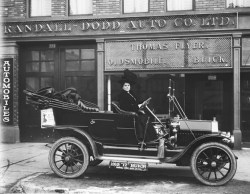
Automobiles would have been available since the 1890s, for those Milton “automobilists” that could afford them.

In 1905, the New Hampshire legislature enacted “An Act Relative to Motor Vehicles and the Operation Thereof.” It established for the first time, among other things, registration of motor vehicles, license plates, licensing of drivers, fees for those things, and speed limits. (Massachusetts had enacted its version in 1903).

AUTO LAW IN EFFECT. Concord, N.H., May 2. New Hampshire’s first law for the regulation of automobiles has gone into effect. It requires the registration and numbering of all automobiles and motor cycles, the registration of manufacturers and dealers, and the licensing of operators. The speed limits are 20 miles an hour without and eight miles an hour within business districts (Fitchburg Sentinel, May 2, 1905).

Speed limits were set at 8 miles-per-hour (mph) in business districts (simply defined as a quarter-mile stretch of buildings set 100 feet apart or less) and at 20 mph everywhere else.

There were no Stop signs or any other signage at all. Motorists were required to slow down when proceeding through intersections situated on curved stretches of road, when proceeding down steep hills, or when crossing bridges. They were to honk their horns when proceeding through the intersections situated on curves, as well as slowing down.

Persons who daily cross streets where speedy automobiles ply should feel at liberty to vote themselves Carnegie medals any day without waiting for the official award (Portsmouth Herald, February 5, 1906).

Automobile owners were to pay $3 to register their motor vehicles. Registrations, as well as operator licenses, were obtained by mail from the NH Secretary of State. (There was no inspection for the automobile nor any driving test for its driver). License plates were simply a number followed by the state designation “NH.” Two plates were required, front and back, for which the motorist was charged $1 apiece.

By way of comparison, we have seen that the first-class cook at the Hotel Milton received payment of $1 per day for her services. Had she a motor vehicle, which seems unlikely, it would have cost her most of a week’s pay to register it and outfit it with license plates.

Pierce-Racine 1906Automobile prices ran between $1,650 and $1,750 dollars in advertisements of 1906. Their 4-cylinder motors generated, depending upon the brand and model, between 20 and 28 horsepower. One (The Model 14 Rambler) had a 3-speed sliding gear transmission that delivered its horsepower by direct drive to the rear axle. Another (the Apperson) advertised “Every Car a Special Car, Built for the Owner.”

So, automobiles were expensive. They were the “horseless” substitute for a horse and carriage, which were also expensive. Most people walked, hired a horse and carriage, took a trolley (in cities), or traveled longer distances by train.

(We might recall that Henry Ford’s market success would come through price reductions based upon the use of standardized parts and assembly-line factory processes).

Those traveling in motorcars were much exposed to wind and weather. Clothing merchants advertised a range of Men’s Driving and Automobile Coats. At the lower price points were Manchurian Sheep-Lined Auto Coats ($18.50). From there, one might move upscale through China Dog-Lined Coats, the same but with Otter collars, Best Quality Dog-Lined Coats, Galloway Coats, and, at the top of the line, Natural Raccoon-Lined Coats ($75.00). And, of course, a hat, gloves, and goggles.

Drivers of this period obtained their driver’s license by mail. Many, if not most, of these early automobiles would not have been operated in the wintertime. Drivers mentioned a process of disassembly, maintenance, and storage of cars over the winter. For those that continued to drive throughout the year, many models had no windshield wipers. (Some had no windshield). One winter driver told of keeping a bucket of glycerin in the front seat of his delivery truck during a snowstorm, and stopping periodically to sponge some of it on the windshield.

According to the New Hampshire Secretary of State’s Report for 1908, Milton had between 12 and 16 registered automobiles, and 2 registered motorcycles, at any one time during the year ending August 31, 1907.

Those registrations marked with an asterisk had cancelled their registration at some point during the 1906-07 year. Most of those had also another registration. One supposes they had cancelled the registration for one car when they obtained another (which would affect the total number of cars registered at any one time).

Milton had 12 licensed drivers, 3 licensed livery drivers, and no traffic violations in its first year (1906-07).

Motor Vehicle Statistics.

REGISTRATIONS, LICENSES, AND VIOLATIONS FOR THE YEAR ENDING AUGUST 31, 1907.

Strafford County. Milton.

Automobiles – Leslie C. Brock, 838; Everett B. Cooley, 1821; Frank E. Fernald, 609; Arthur M. Flye, 1017; Asa A. Fox, 473*, 1464; Harry C. Grover, 1638*, 1783; Forrest L. Marsh, 1025; Robert S. Pike, 1177; Hazen Plummer, 902; Alfred T. Rudd, 616; John E. Townsend, 204*, 1055; John C. Townsend, 1497*, 1662. 

Motor Cycles – Isaac H. Atherton, C89; Joseph E. Willey, C181.

Private Operators – Isaac H. Atherton, Everett B. Cooley, Frank E. Fernald, Arthur M. Flye, Asa A. Fox, Charles D. Fox, Harry G. Grover, Forrest L. Marsh, Robert S. Pike, Hazen Plummer, John C. Townsend, Joseph E. Willey.

Professional Chauffeurs – Isaac H. Atherton, Frank D. Stevens, Carl B. Tarbell.

*Registration cancelled during the year.

By way of comparison, Rochester had between 43 and 49 registered automobiles and 4 registered motorcycles. Farmington had between 11 and 13 registered automobiles and 2 registered motorcycles. Middleton had but 1 registered automobile. Wakefield had 5 registered automobiles and 1 registered motorcycle.

Registration fees for automobiles rose to $10 in 1909, while those for motorcycles dropped to $2. Speed limits increased to 10 mph in business districts and 25 mph everywhere else.

(We may note that it did not cost any more for a clerk to register an automobile in the Secretary of State’s book than it did to register a motorcycle. Automobiles were already being seen as a state revenue “cash cow”).


For a rather brief description of the main route through Milton in this period (1917-18), see also Milton, Straight Thru (North), in 1918.


… Autos and trucks require less than one-fourth the barn and yard space needed for animal transportation. This alone effects a large saving. One of the chief objections I have heard urged against autos and trucks is that they scare horses and cannot go over muddy and sandy roads. The remark that was once applied to whisky is applicable to motors. All are good, but some are better than others (Boston Globe, February 25, 1912).

Continued in Milton Automobiles in 1909-10


References:

NH General Court. (1908). Secretary of State’s Report. Retrieved from books.google.com/books?id=ok0bAQAAIAAJ&pg=RA2-PA127

NH Secretary of State. (1909). Laws of the State of New Hampshire. Retrieved from books.google.com/books?id=VZ1GAQAAIAAJ&pg=PA528

Milton in the News – 1905

By Muriel Bristol (Transcriber) | June 27, 2019

In this year, we encounter a grisly accidental death in South Milton, the candidacy of a former Milton resident, the alleged Jones poisoning murderer imprisoned still – for debt, vampers wanted, a Milton school teacher hired in Quincy, the Strafford Savings Bank embezzler being released, a stolen horse and carriage, and a frigid football game.


Here we find a horrible accidental death in what must surely be a contender for worst job interview ever.

Head Battered by Fly Wheel. Rochester, N.H. – Jan. 25. Lawrence Chauvette, 35 years old, fell against the fly wheel of the engine in Drew’s sawmill at South Milton and was instantly killed. His head was crushed to a pulp. Chauvette is said to have been drinking, but he visited the mill in search of work (North Adams Transcript, January 25, 1905).

Milton vital records put the Canadian native’s age at “about” forty years. Dr. M.A.H. Hart, of Milton, certified the accidental death in a saw mill of this teamster. Dr. Hart gave intoxication as the contributing cause. Chauvette was buried in the Milton Town Farm cemetery, January 24, 1905, by A.A. Fox, undertaker, of Milton Mills.

“The use of alcohol and drugs may adversely affect the ability of a person to work in a safe manner.”


Charles R. Morse, one of seven candidates for three vacant seats on the Winthrop, MA, Board of Selectmen, had resided in Milton as a child, between circa 1857 and 1865.

Darwin Morse, a farmer, aged forty-seven years (b. NH), headed a Milton household at the time of the Eighth (1860) Federal Census. His household included Phoebe A. [(Huntress)] Morse, aged thirty-three years (b. NH), Charles R. Morse, aged nine years (b. NH), William Huntress, a gentleman, aged eighty-one years (b. NH), and Dorcas [(Dore)] Huntress, aged sixty-six years (b. NH). Darwin Morse had real estate valued at $10,000 and personal estate valued at $30,000.

(The Federal government assessed Phoebe A. Morse’s brother (and Charles R. Morse’s maternal uncle), William H. Huntress, for his hotel, livery stable, horse and carriage, and liquor license in Milton’s US Excise Tax of May 1864).

Charles R. Morse is a lawyer and is prominent in town affairs. Born in Natick In 1851, where the first six years of his life was spent, moving with his parents to Milton, N.H., where farm work occupied his attention during his boyhood, attending school during the winter time at Wolfboro academy. In 1865 he returned to Natick. and in 1871 entered the law office of F.F. Hurd, brother-in-law to Gen. B.F. Butler, and in whose office a portion of the next seven years were spent in the study of law. Mr. Morse located permanently in Boston in 1877, and has been a resident of Winthrop since 1890 (Boston Globe, March 23, 1905).

Charles Ruel Morse died in Dorchester, Boston, MA, October 8, 1925.


Here we find Milton’s alleged poisoning murderer of 1897 still confined in the Strafford County jail for debt.

HE PREFERS JAIL, A.W. Jones Won’t Take Debtor’s Oath. Milton, N.H, Man Petitioned Court, Then Refused to Appear. DOVER, N.H., May 16. – Alfred W. Jones of Milton, who petitioned the superior court from the Strafford county jail where he has been confined six years for debt, for release from imprisonment, refused at almost the last moment to appear before the commissioners appointed by the court to hear his petition, and so will continue to live behind jail bars. The hearing on the Jones petition was set for today at the county courthouse before Hon. William P. Nason and Robert Doe as commissioners. Jones sent word last evening to his counsel. James McCabe, that he had changed his mind and did not wish to press his application for release. The hearing accordingly did not take place (Boston Globe, May 27, 1905).

The “debtor’s oath” or “poor debtor’s oath” was a sort of bankruptcy. Taking the oath was an admission of insolvency and would permit liquidation of the debtor’s assets to at least partially satisfy his creditors. After which the debtor would be freed to start over.

Refusing to take the oath might preserve the debtor’s assets, but would also ensure his continued residence in jail.


N.B. Thayer & Company sought two female vampers for its Milton shoe factory.

Podiatry Today
Parts of a Shoe, including the Vamp (Diagram: Podiatry Today)

A vamp is the part of a shoe that covers the forepart of the foot, possibly including the toe and instep (depending upon the style of shoe). The vampers sought here were female workers that made vamps. Similar advertisements mention vampers as operating two-needle Singer sewing machines.

FEMALE HELP WANTED. VAMPERS – Wanted, 2 first-class cylinder vampers on boys’ shoes. N.B. THAYER & Co., Milton, N.H. dSu7t Je20 (Boston Globe, June 23, 1905).

We see again the typographer’s code at the conclusion. This advertisement was to run both daily and Sunday, for seven times, from June 20.


Here another Milton school teacher (and principal) is identified. Walter Harold Bentley was born in Brookline, MA, May 24, 1878, son of David B. and Esther A. (Boyden) Bentley.

David B. Bentley, a school teacher, aged sixty-eight years (b. Canada (Eng.)), headed a Bridgewater, MA, household at the time of the Twelfth (1900) Federal Census. His household included his wife (of thirty-eight years), Esther A. Bentley, aged fifty-nine years (b. MA), his son, Walter H. Bentley, a day laborer, aged twenty-two years (b. MA), and his boarders, Rachel Parker, a servant, aged twenty-three years (b. Canada (Eng.)), Howard H. Stiles, a shoe shop rounder, aged twenty-one years (b. NY), Frank C. Weeks, water works superintendent, aged seventy-four years (b. VT), Ethel E. Thomas, a school teacher, aged twenty-five years (b. ME), Nancy J. Westgate, a school teacher, aged twenty-four years (b. MA), Edna L. White, a school teacher, aged twenty-six years (b. MA), and Archie C. Osborne, a druggist, aged thirty-two years (b. NH).

Mr. Bentley’s tenure as a Milton school teacher would have been brief, only a year or two, likely beginning around the 1900-01 academic year. (His obituaries say he was a principal in Milton, probably at the Grammar School). He taught next in Dover, NH, and was principal of the Walnut-sq. grammar school in Haverhill, MA, by the 1903-04 academic year (Boston Globe, June 16, 1904).

A number of [Quincy, MA] grammar schools will have new teachers. Walter H. Bentley is principal of the Coddington school, vice Miss Mary A. Dearborn, who resigned after a service of over 30 years. Mr. Bentley is a graduate of the Bridgewater normal school, class of 1900, and has taught at Milton. N.H., Dover, N.H. (Boston Globe, September 11, 1905).

[The “vice” above is Latin for “in place of.” Coddington’s Principal Dearborn was replaced by Principal Bentley].

Walter H. Bentley, a public school teacher, aged thirty-one years (b. MA), headed a Quincy, MA, household at the time of the Thirteenth (1910) Federal Census. His household included his wife, Harriet A. Bentley, aged twenty-three years (b. MA), and his father, David Bentley, a widower, aged seventy-seven years (b. Canada (Eng.)). They resided in a mortgaged house at 104 Underwood Avenue.

Walter H. Bentley resigned his principalship at Quincy’s Coddington school at the close of the 1910-11 academic year (Boston Globe, April 26, 1911). He was subsequently proprietor / teacher of a boys’ camp, resident in Winchester, MA, in 1920; a camp director, resident in Winchester, MA, in 1930; and a camp director, resident in Winchester, MA, in 1940.

Some 25 years ago [circa 1941-42], Walter H. Bentley of Winchester, who taught at Gov. Dummer Academy and other schools and started a boys camp at Wolfeboro, N.H., in 1909, wrote a letter on this subject. It was printed in a pamphlet to parents, and the letter is quoted in the last publication of the camp, now conducted by his son, Bradford M. Bentley, also of Winchester. Said the founder in part: “Wyanoke is like a big family. It is made up of boys – little fellows of 8 or 9 who need constant and sympathetic care and understanding; sturdy, active youngsters of 12 or 13, who need plenty to do and steady, wise direction; big, growing youths of 15 and 16, who are beginning to think of what life means, and who need inspiration and the daily comradeship of mature men who understand them. All of these boys benefit greatly from the community life of the camp. Many campers come from small families. At camp they learn that everything, even fun, is to be shared, and that the duties well done and consideration for others bring satisfaction and friends. Boys like and need to ‘run with the pack’ and a Summer home cannot fill this need as a camp does” (Boston Globe, April 30, 1967).

Walter H. Bentley died in Winchester, MA, January 30, 1945.

Deaths and Funerals. Walter H. Bentley. WINCHESTER, Jan. 30. Walter H. Bentley, 66, of 24 Central St., founder of several Summer camps for boys and girls, died today at his home. A graduate of Bridgewater Normal School, he was principal of schools in Milton and Dover, N.H., Haverhill and Quincy, and was associated for a time with Governor Dummer Academy. In 1904 he helped found the Medomak Camp for Boys and in 1909 he opened Camp Wyanoke, Wolfeboro, N.H., now directed by his son, Bradford M. Bentley. He also founded Camp Winnemont for Girls, West Ossipee, N.H. Besides his son he leaves a wife. Funeral services will be held in the Ripley Memorial Chapel of the First Congregational Church Thursday at 2:30. Burial will be in Wolfeboro, N.H. (Boston Globe, January 31, 1945).

Camps Founder Dies in Massachusetts. Boston, Feb. 1 (AP) – Walter H. Bentley, 66, a pioneer in the founding of children’s summer camps, died Tuesday. A resident of Winchester, Bentley was principal of schools in Milton, Dover, N.H., Haverhill and Quincy during his early years as an educator. He operated his own camps, Wyanoke for boys at Wolfeboro, N.H., and Winnemont for girls at West Ossipee, N.H. Burial will be in Wolfeboro, N.H. (Portsmouth Herald, February 1, 1945).


The Dover bank embezzler of 1903 served out two years of his two-to-three-year sentence and was released.

MATHES IS RELEASED. Ex-Treasurer of Stafford Savings Bank of Dover, N.H., Returns to That City. CONCORD, N.H., Oct. 21. – Albert O. Mathes of Dover, one time treasurer of the Strafford savings bank in that city, was released from the state prison in this city today, having completed the minimum term of an indeterminate sentence imposed upon him two years ago for the embezzlement of the funds of his institution. Gov. McLane and his council gave Mathes a pardon at their last meeting, the effect of which was to annul the parole feature of his sentence and to restore him at once to the full privileges of citizenship. Mathes went from this city to Dover, where old friends are said to have secured a position for him (Boston Globe, October 21, 1905).

Albert O. Mathes died in Dover, NH, July 20, 1907.


Rev. E.W. Churchill of Milton Mills gave an address before a Freewill Baptist quarterly meeting held in West Lebanon, ME.

FREE BAPTISTS IN SESSION. New Durham Quarterly Meeting on at West Lebanon, Me. WEST LEBANON, Me, Oct 25. – The New Durham, N.H. quarterly meeting of Free Baptists is in session at the Free Baptist church here. Today’s program began at 9:30, with a testimony and prayer meeting, led by Rev G.L. Lowell of Northwood, N.H. The conference sermon was preached at 11 by Rev. Hibbert Lockhart of Rochester, N.H. This afternoon the woman’s missionary society met, Mrs. Flora L. Hill presiding. The reports showed the society to be in a flourishing condition. Rev E.W. Churchill of Milton Mills, N.H. gave an address. There was a solo by Mrs. Lura J. Bagley of East Rochester. An evangelistic service was held this evening by Rev. Walter J. Malvern of Gonic. Tomorrow amendments to the constitution will be discussed, among them being a change of name of the association, and a change of the time of the annual meeting (Boston Globe, October 26, 1905).


At Milton. N.H., last Wednesday, a dark bay horse of 1100 pounds and one white hind foot, attached to a Kimball open buggy and wearing an open bridle, was stolen. Any information will be gladly received by the local police (Fitchburg Sentinel, [Monday,] November 27, 1905).

No indication of owner or whether the horse and buggy were recovered.


How cold was it?

EDITORIAL POINTS. It was so cold Thanksgiving day that a football game at Milton, N.H., was cancelled, and the brutal feature of the game which forces delicate women to sit for hours slowly freezing to death was thus abolished (Boston Globe, December 4, 1905).


Previous in sequence: Milton in the News – 1904; next in sequence: Milton in the News – 1906


References:

Find a Grave. (2017, August 31). Walter Harold Bentley. Retrieved from www.findagrave.com/memorial/182880263

The More Things Change …

By S.D. Plissken | June 26, 2019

Last week’s Board of Selectmen (BOS) meeting had some few points of interest.

Chief Krauss added some new expense requests. An upgraded police phone system was added to his nautical items already on the agenda. His combined police-pursuit / boat-hauling vehicle was described as having been approved already at a prior meeting. He sought only permission to include the prior unnecessary boat-hauling vehicle in a trade-in deal for the new unnecessary police-pursuit / boat-hauling vehicle.

The Town (or Town Police) boat dock “Concern” was the damaged Town boat dock that had damaged also the Town Police boat. Or vice versa. It seems that the dock is inadequate at its current length, as more dock length is needed when the pond water level goes down. No one could have predicted that (as it goes down every year). Thus the damage to the dock, and to the boat.

There was some discussion of whether some beach funds might be redirected to cover some or all of this. We know that is unlikely, at least to any significant degree, as the Milton Town Beach Has Its Own Government. But the BOS chose to pretend that such a thing might happen, for purposes of discussion.

Note well that the other side of the ponds has no corresponding Lebanon Police navy. In fact, our larger neighbor (population 6,031 in 2010), has had no police department at all since 1991. An effort to create one was defeated at the ballot in 2009 (498 (60.8%) to 321 (39.2%)). (They rely on state and county police).

One looks in vain for the nightly light of a burning Lebanon reflected in the ponds, or for its daily riots, or its pond pirates, or for its warlords fighting over territories within it.

Thank God the bridge is down and that we have a Police navy.


Under Old Business, the Town Administrator put forward a suggested September Saturday meeting, in which a combined BOS and Budget Committee would hear the departmental budget presentations. The board was in favor of this. The administrator would next seek similar approval from the Budget Committee.

Chairman Thibeault asked Town Administrator Ernest Creveling about the current budget.

Town Administrator Creveling: We’ve already started working on [Budget] things. One of the things we’re working on is we’ve put together a spreadsheet and gave it to all the department heads. Because we’re on a Default Budget and I wanted people to go through it and analyze their budgets and take a look at exactly what it is and exactly what it is they think they absolutely need to spend, these are all absolute necessities, things that are dealing with public safety, employee safety, contracts – the police phone system may become one of those things – it is important to be able to reach the police department and leave messages if you have to, so they are are things in the process of going through that exercise.

The Town Administrator has here suggested to the department heads a sort of “party line”: express all your desired budget increases in terms of either public or personnel safety. Yes, that should do the trick.

Creveling: Hopefully, that will give us an amount that we can sort of pool together out of each line item, for a total, so that we know, if other things pop up, we’re able to pull from there, and once we get through that, I’ll make sure that you all get a copy and are you’re fully aware of what we’ve done.

Selectman Rawson: It seems a good idea.

From there, they moved on to the payroll aspect of next year’s budget. Note that they begin with the assumption that the baseline is correct and that there will be an increase above that. It is then just a question of how large that increase will be.

Chairman Thibeault: Alright. Did you also want to discuss the guidance on the employee wages for 2020, or is that just …

Creveling: Well, on … Oh, yes, we can do that as well. As far as putting budgets together, people are starting to do that now. So, as far … in the recent past, you’ve gone 2% for merit and 1.7% for Cost of Living. People just wanted to know if that is what they should move forward with in the budget development, at this point.

Now, as we have mentioned previously, very few in the real world might expect to receive any Cost-of-Living Adjustment (COLA) increase at all. (We have heard that Social Security recipients recently got some pittance, after a gap of some years without any). But, based upon this discussion, 2% raises and additional annual COLA would seem to be de rigueur in Milton Town budget thinking.

Which might go some ways at least towards explaining why Town budgets increase always faster than – usually double – the rate of inflation.

What might “our” representatives have to say? Doubtless something innovative, something bold.

Selectman Rawson: Yeah, I’m fine with that. It’s always been that way, since my tenure of being in town.

Creveling: If you look at the New England region, its been that for the last couple of years.

The Argumentum ad Populum fallacy. Your mother has an answer for that: If all the other Towns were jumping off a bridge, would you jump off too?

Thibeault: I’m alright with that. Erin, do you want …

Vice-Chairwoman Hutchings: That’s … that’s … I mean you’re just pulling it together to look at it, so …

It seems fairly obvious that once you tell the department heads to assume 3.7% raises, they are going to budget 3.7% raises and that will be what you will “look at” later. Then will come the unanimous approval of what they will have before them.

So, you see, they just lost the budget increase battle right there. Not much of a struggle to represent the taxpayers’ interests, was it?

Creveling: Right, right. By no means is it a final budget. It would just give people guidance on what to use.

One hears around town several variations of the old saw: If one does again what one always has done before, one might reasonably expect to get again what one has always gotten before. In our case, that would be budgets and taxes that rise at twice the rate of inflation.

Chairman Thibeault is fond of talking about “out of the box” solutions. One commenter suggested that we might replace the BOS with a simple computer “app” to be always just “fine with that.”

Magic BOS-Ball
Magic BOS-Ball

I thought perhaps a Magic 8-Ball, which would at least give a negative answer one-quarter of the time. Each board member would give it a shake and read off their answer.


Plus ça change, plus c’est la même chose [The more things change, the more they remain the same] – Jean-Baptiste Alphonse Karr


References:

Foster’s Daily Democrat. (2017, December 18). Does Lebanon Need Its Own Police Force? Retrieved from www.fosters.com/news/20171218/does-lebanon-need-its-own-police-force

Town of Milton. (2019, June 17). BOS Meeting, June 17, 2019. Retrieved from https://youtu.be/4RLXxlP8rFA?t=1386

Wikipedia. (2019, June 20). Argumentum ad Populum. Retrieved from en.wikipedia.org/wiki/Argumentum_ad_populum

Wikipedia. (2019, March 11). Jean-Baptiste Alphonse Karr. en.wikipedia.org/wiki/Jean-Baptiste_Alphonse_Karr

Wikipedia. (2019, June 7). Magic 8-Ball. Retrieved from en.wikipedia.org/wiki/Magic_8-Ball

Milton in the News – 1904

By Muriel Bristol (Transcriber) | June 23, 2019

In this year, we encounter some cutters wanted at a shoe factory, another masked ball at the A.O.U.W. hall, some Arctic weather, the Milton & Lebanon Building Association founded, another table girl wanted, a wife wanted, a fireside quilt completed, puppies for sale, a suspicious death, and a smoke-filled room.


The N.B. Thayer & Company’s shoe factory was hiring.

MALE HELP WANTED. TAP CUTTER – Wanted, first-class tap cutter, Walker dies. N.B. THAYER & CO., Milton, N.H. SSu (Boston Globe, [Saturday,] January 3, 1904).

MALE HELP WANTED. CUTTERS – Wanted, 2 first-class outside cutters for box calf and vici. N.B. THAYER & CO., Milton, N.H. (Boston Globe, [Sunday,] January 3, 1904).

One may note again the typesetter’s notation or code to themselves [SSu] concluding the first advertisement: this advertisement was to be printed in both the Saturday and Sunday editions. Remember too that the typesetters would be reading their own notation, as well as everything else, in reverse.


Here we have another masked ball at the A.O.U.W. [Ancient Order of United Workmen] hall in Milton, this one sponsored by the Milton dramatic club.

ANNUAL MASQUE BALL. Entertainment Given at Milton, N.H., by Dramatic Club of That Place. MILTON, N.H., Jan. 8. – The Milton dramatic club gave its second annual masked ball at A.O.U.W. hall tonight. There were 92 couples in the march, which was led by Mr. and Mrs. Fred S. Hartford. The ball officers were Fred S. Hartford, chief marshal; Samuel E. Drew, Frank S. Norton, aids; George A. Gilmore, George V. Paey, Samuel Swett, assistants. Among those present were:

Mr. John Hartigan, Mr. Charles Parker, Mr. Herbert Finnegan, Mr. W. Wentworth, Mr. & Mrs. E. Looney, Mr. Herbert Willey, Mr. Harry Page, Mr. William Elliott, Mr. Frank Burke, Mr. Fred Downs, Miss Alice Brock, Miss Annie Marcoux, Miss Annie Young, Miss Clara Hurd, Miss M. O’Loughlin, Miss Florence Dore, Mr. Frank Cassidy, Mr. Ernest Leighton, Miss Mary Varney, Miss Grace Pike, Miss Grace Stone,

Mrs. Piercy, Mr. & Mrs. C. Wingate, Mr. & Mrs. J. O’Loughlin, Mr. Frank Jones, Mr. Philip Irish, Mr. Walter Randall, Mr. James Howard, Mr. William Dore, Mr. & Mrs. Leslie Hayes, Mr. Scott Randall, Miss Effie Howard, Mr.  & Mrs. J. Marcoux, Miss Blanche Tufts, Mr. Charles Drew, Mr. & Mrs. Charles Page, Mr. Herbert Dow, Mr. Fred Emery, Mrs. John Daniels, Mr. & Mrs. Fred Horne, Miss Lizzie Stead, Miss Blanch Dore (Boston Globe, January 9, 1904).

This event may be compared with that held in the same hall by the Milton social club in 1899.


Milton may be considered to be in the northern part of the south, for weather reports affecting the seacoast, but also in the southern part of the north, for weather reports affecting the White Mountains.

ARCTIC N.H, SECTIONS. From 14 to 18 Below in Portsmouth – Conway Has It 46, West Ossipee 41 and Wolfboro 30. PORTSMOUTH. N.H., Jan 19. Today is the coldest of the present season in this city, the mercury this morning ranging from 14 to 18 degrees below zero, and all outdoor work is practically suspended. Reports from points along the northern division of the Boston & Maine railroad are as follows: Conway 46 degrees below, West Ossipee 41 degrees below, Union 35 degrees below, Wolfboro 30 degrees below, Milton 19 degrees below, Conway Junction 20 degrees below (Boston Globe, January 19, 1904).

In this case, Milton seems to have been comparatively lucky in experiencing weather more akin to the northern part of the south, while Arctic weather affected the White Mountains to its north so severely.


A number of prominent men founded the Milton & Lebanon Building Association.

Maine Corporations. AUGUSTA, Feb. 28 – The following companies filed articles of incorporation last week.

Milton & Lebanon Building Association, Lebanon. Capital – $10,000. Promoters, F.H. Thayer, Boston; Joseph H. Avery, B.B. Plummer, J. Gardner Alden, Milton; Ira W. Jones, Lebanon (Boston Globe, February 28, 1904).


The table girl sought here either replaces or supplements the one hired by the Milton Hotel in December of the previous year.

FEMALE HELP WANTED. WANTED – Experienced table girl, permanent position and good wages. Milton Hotel, Milton. N.H. (Boston Globe, March 13, 1904).


If one has a farm, but is not a farmer, one might want to hire a farm couple to run the place.

MALE HELP WANTED. WANTED – Couple on farm, to do general farm work, 3 miles from village; state wages wanted. Address E.L.S., Milton, N.H., Box 229 (Boston Globe, March 18, 1904).

There were no “state wages,” as minimum wages were still many years in the future and even then usually exempted farm labor. The advertiser E.L.S. meant simply that they would like applicants to declare or state what wages they would consider to take the job.


MATRIMONIAL. WIFE WANTED – A strictly temperate man of 85 wants a kind and loving wife. Address H.P. CURTIS, Box 69, Milton, N.H. (Boston Globe, August 20, 1904).

“There may be snow on the rooftop, but there is fire in the furnace.”


Cyrus Frink Hart was born in Milton, June 3, 1821, son of John and Elizabeth (Nutter) Hart. He married in Milton, September 12, 1845, Mary Lydia “Lydia” Witham. She was born October 25, 1823.

Cyrus F. and Lydia M. (Witham) Hart had a farm at Milton Mills.

Cyrus F. Hart, a farmer, aged seventy-eight years (b. NH), headed a Milton (Milton Mills Village”) household at the time of the Twelfth (1900) Federal Census. His household included his wife (of sixty-four years), Lydia Hart, aged seventy-six years (b. NH). She was the mother of six children, of whom only one was still living. They owned their farm free-and-clear, without any mortgage. Their household appeared in the enumeration between those of Hiram Young, a farmer, aged forty-six years (b. ME), and Hiram Wentworth, a carpenter, aged fifty-six years (b. NH).

Cyrus F. Hart died in Milton Mills, July 27, 1902. Here we find his widow, Mrs. Lydia (Witham) Hart, having completed her fireside quilt, just in time for the winter of 1904-05.

Odd Items from Everywhere. Mrs. Lydia Hart, of Milton Mills, N.H., aged 82 years, has just completed what she calls a “Fireside quilt,” which she has pieced entirely with her own hands (Boston Globe, October 19, 1904).

Lydia (Witham) Hart died in Milton Mills, February 1, 1907.


Fred M. Chamberlain, proprietor of the Phoenix House hotel (next to depot), advertised a litter of puppies for sale.

DOGS, CATS, ETC. FOR SALE – 1 extra good rabbit dog, $25; others, not so good, for sale. Write F.M. CHAMBERLAIN, Phœnix house, Milton, N.H. (Boston Globe, October 30, 1904).


Shove Shannon Symonds was born in Salem, MA, September 19, 1848, son of Jonathan S. and Elizabeth G. (Nichols) Symonds.

Shove S. Symonds, a painter, aged fifty-two years (b. MA), headed a Salem, MA, household at the time of the Twelfth (1900) Federal Census. His household included his wife, M. Estelle Symonds, aged thirty-seven years (b. MA). He owned the two-family dwelling at 113 North Street, which they shared with the household of George Spence, a machinist, aged fifty years (b. ME).

S.S. Symonds appeared at the Milton A.O.U.W. “smoke talk” as a visiting speaker from the A.O.U.W. Massachusetts Grand Lodge’s Committee on Laws.

ANCIENT ORDER OF UNITED WORKMEN. Strafford lodge of Milton, N.H. will have a smoke talk Tuesday evening. S.S. Symonds of the law committee will be the speaker (Boston Globe, November 27, 1904).

Shove S. Symonds was still a member of A.O.U.W. Committee on Laws in 1920. He died in Salem, MA, in 1928.


Here we learn of the suspicious death in Rochester, NH, of Herman C. Dyer of Milton.

Charles Dyer, a farmer, aged fifty-seven years (b. ME), headed a Milton household at the time of the Twelfth (1900) Federal Census. His household included his wife (of thirty-two years), Martha A. [(Drew)] Dyer, aged fifty-six years (b. NH), and his children, Herman C. Dyer, a paper mill operative, aged thirty-one years (b. NH), Annie M. [(Dyer)] Bailey, a shoe shop vamper, aged twenty-nine years, Benjamin Dyer, a farm laborer, aged twenty-six years (b. NH), Hattie M. Dyer, a button-hole finisher, aged twenty-four years (b. NH), and [her twin], Nettie M. Dyer, runs button-hole machine, aged twenty-four years (b. NH). Their farm appeared in the enumeration between the households of Charles A. Ricker, a farmer, aged forty-five years (b. NH), and Kimball S. Goodall, a farmer, aged sixty-eight years (b. NH).

THINK MAN, NOT TRAIN, KILLED HIM. Richard Farrell Arrested on Suspicion of Concern in Dyer’s Death. ROCHESTER. N.H., Dec. 4. – As the result of an investigation of the death of Herman C. Dyer, whose body was found shortly after 6 last night – between the rails of the northern division of the Boston & Maine about halfway between the Portland-st and Winter-st crossings. Richard Farrell is under arrest on suspicion of being concerned in Dyer’s death.

Tracks Between Portland and Winter
Halfway Between the Portland-st. and Winter-st. Crossings

The investigation is being conducted by the medical referee, Dr. John H. Neal, who today made an autopsy on the body with Drs. M.B. Sullivan and Harry O. Cbesley of Dover. It was thought at first that Dyer was struck and killed by either the 5:55 train or the 6:08 train, both southbound, but after the body had been examined, indications of possible violence were discovered.

The body had been found in the track by Harry Hoyt, who stumbled over it in the darkness. A careful examination of the spot where the body lay, which was about 300 yards from the station, showed that the body had been dragged to the middle of the track from outside the rail. A pool of blood partly inside and partly outside the rail was found about 20 feet away. The body rested face up on ties at a switch, which are higher than those near it. The fact that the injury was on the back of the head, instead of the face, is considered a suspicious circumstance. The place is a dark one, some distance from the electric lights.

There were two Harry Hoyts in Rochester: one aged nineteen years and the other aged seventeen years.

Later in the night the police were notified by R.M. Perkins, who lives nearest the place where the body lay, that he heard a pistol shot a little after 6 in the direction of the railroad.

Ironically, R.M. Perkins was a manufacturer and dealer of marble monuments and headstones. His shop stood opposite the G.F. & C.R.R. [Great Falls & Conway Railroad] station in Rochester. His house was at 15 Heaton street.

Meantime it had been learned that Dyer had been in company during the day with Farrell, that they had visited several saloons together and had also driven in a livery team to a roadhouse on the Farmington road. It was reported that Dyer had a considerable sum of money with him. When his clothing was searched only 46 cents was found.

Farrell was arrested in Central sq., about 12:30 by Asst. City Marshal Albert F. Wilkinson and locked up. He was told that he was suspected of murdering Dyer, but he denied all knowledge of the alleged crime. He admitted having been with Dyer during the day. The charge against Farrell will depend upon the nature of the report Medical Referee Neal will make tomorrow forenoon to County Solicitor Scott of Dover.

Dr. Neal declined to make a statement tonight as to the result of the autopsy, as Solicitor Scott had requested that the details be withheld until tomorrow. Dr. Neal would neither confirm nor deny the report that a bullet had been extracted from Dyer’s head nor say whether the discolorations found on the side of the head last night, and supposed to be coal dust or sand, were powder marks. The absence of a large portion of Dyer’s skull, extending from the base of the brain to near the top of the head, is expected to bear out the theory that he was shot at close range or was clubbed to death.

The officials are now confident that Dyer could not have been hit by any train. It is learned that he was seen in the vicinity walking along the track after the 6:08 train had gone, and his body was found and removed before the 6:34 north-bound train arrived from Somersworth.

Mrs. Charles Dyer, the dead man’s mother, was seen at her home in Milton today. She said that Charles Chesley, a Milton man, informed her today that he went to Rochester last night, arriving there on the 6:08 train, and that he saw her son near the Portland-st crossing and spoke to him. She did not learn from Chesley whether another man was with Dyer. Mrs. Dyer said that her son left Milton for Rochester Saturday morning at 8:30. She asked him when he would return.

Charles Chesley, a farm laborer, aged twenty-eight years (b. NH), had resided in the Milton household of his uncle, Laraila [?] Chesley, a farmer, aged eighty years (b. NH), at the time of the Twelfth (1900) Federal Census.

“You’ll see me when I come back,” he said, an answer he was wont to give, his mother stated. As to the amount of money Dyer had when he left, Mrs. Dyer said that before going he paid her the board money he owed her, and that he had more than $19 beside. She thought he must have had about that sum on leaving town.

Dyer had been employed at the Milton leather-board mill 19 years. He was accustomed to take liquor occasionally, but has borne a good reputation. He was 35 years old. He is survived by his parents and three sisters, Mrs. Nettie Ellis and Mrs. Jacob Legro of Milton, and Mrs. Annie Bailey or Boston. The family is grief-stricken over the tragedy.

The Milton Leather-board company established itself in Milton around 1885. Dyer would have been one of its earlier employees. (He was an “operator,” i.e., he operated a machine). Its mill in Milton had burned down in January 1902, but had been rebuilt rather quickly.

Farrell is 30 years old. He came to this city from Lowell five years ago. He has no regular occupation, except that he is often employed as a piano player at road houses. Farrell was taken to the office of City Solicitor Felker today and closely questioned by Solicitor Felker and City Marshall Allen. Later he was questioned by County Solicitor Scott, who was present also at the autopsy (Boston Globe, December 5, 1904).

Farrell’s arrest for “a suspicion of a concern” seems rather slim in terms of “probable cause.” He has not left much in the way of a documentary record in either Lowell, MA, or Rochester, NH. Perhaps that is part and parcel of being a piano player in a succession of roadhouses.

FOUL PLAY SUSPECTED. Rochester, N.H., Dec. 5. Because the body of Herman C. Dyer of Milton, N.H., which was found on the tracks of the Boston and Maine railroad Saturday evening, showed little of the usual mutilation attending a railroad fatality, the police arrested Richard Farrell of Lowell, Mass, by occupation a musician, on suspicion of being concerned in Dyer’s death. An autopsy was held, the result of which the authorities would not disclose (Fitchburg Sentinel (Fitchburg, MA), December 5, 1904).

KILLED BY FALL. Belief Now Held in the Dyer Case at Rochester – Charges Against Farrell Likely to be Dropped. DOVER, N.H., Dec. 7. – County Solicitor Scott was asked today what effect the story of Mrs. Guptill and Miss Ellis of Somersworth, concerning the man whom they saw board the down train from Rochester, last Saturday evening, and jump off after it had got well under way, and who is thought to have been Herman C. Dyer, would have upon the murder charge against Richard Farrell. Mr. Scott replied: “That will probably be the end of it. A hearing will be held at 2 o’clock this afternoon at Rochester, when the state’s charge against Farrell will probably be dropped. There is now practically no doubt that Dyer was killed by falling off the train” (Boston Globe, December 7, 1904).

The Rochester Town Clerk, H.L. Worcester, recorded Dyer’s December 3rd death in Rochester, NH, somewhat belatedly, on December 31, 1904, as informed by [Dr.] John H. Neal, medical referee. The cause of death given was “Accident on Rail Road.” For the duration of the illness, usually more relevant for some ailment or disease, Neal laconically answered “Short.”


“They afterwards took me to a dancing saloon [in Leadville, CO,] where I saw the only rational method of art criticism I have ever come across. Over the piano was printed a notice: PLEASE DO NOT SHOOT THE PIANIST. HE IS DOING HIS BEST. The mortality among pianists in that place is marvelous.” – Oscar Wilde, Impressions of America


Previous in sequence: Milton in the News – 1903; next in sequence: Milton in the News – 1905


References:

Find a Grave. (2011, February 28). Herman C. Dyer. Retrieved from www.findagrave.com/memorial/66265131

Find a Grave. (2013, July 29). Lydia Witham Hart. Retrieved from www.findagrave.com/memorial/114593902

Wikipedia. (2019, June 9). Don’t Shoot Me, I’m Only the Piano Player. Retrieved from en.wikipedia.org/wiki/Don%27t_Shoot_Me_I%27m_Only_the_Piano_Player

Milton in the News – 1903

By Muriel Bristol (Transcriber) | June 20, 2019

In this year, we encounter a bank embezzler, an escape artist, and a table girl wanted at the Milton Hotel.


Albert Orlando Mathes was born in Milton, in July 1842, son of Robert and Mary S. (Moulton) Mathes. He married in Woburn, MA, December 15, 1880, Mary J. Drew, he of Dover, NH, and she of Woburn. He was a bank teller.

Albert O. Mathes, a bank clerk, aged fifty-seven years (b. NH), headed a Dover, NH, household at the time of the Twelfth (1900) Federal Census. His household included his wife (of nineteen years), Mary J. Mathes, aged fifty-two years (b. MA), and his daughter Lura J. Mathes, at school, aged fifteen years (b. NH). They resided at 56 Silver Street in Dover. His mother-in-law, Mary Y. Drew, a widow, aged seventy-six years (b. NH), and her daughter [his sister-in-law], Harriet W. Drew, also a bank clerk, aged forty-six years (b. MA), resided next door at 58 Silver Street.

Albert O. Mathes, of Dover, NH, featured in Milton’s Centennial, August 30, 1902, in presenting a memorial clock (for the steeple of the Congregational church), as well as arranging for a display of historical artifacts.

Mathes, Albert OCASHIER MATHES INJURED. Dover Banker Fell Between the Cars at Milton. Albert O. Mathes, cashier of the Strafford Savings bank of Dover and will known in this city, fell between the cars at Milton, while getting off the train, at noon on Thursday. One of his legs was so badly crushed it is believed it will be necessary to amputate the member below the knee. Mr. Mathes has been ill for the last week and is subject to dizzy spells. It is thought that he had one of these spells and lost his balance while alighting from the moving train (Portsmouth Herald, May 1, 1903).

ADMITS WRONG-DOING. Treasurer of Strafford Savings Bank a Defaulter. FIRST TOOK CASH IN 1890. Became Involved In Speculation and Had Never Been Successful – Used Money of Personal Friends and Covered Up Shortage For Years. Dover, N.H., June 1. The bank commissioners of New Hampshire announced that Albert O. Mathes, for 35 years treasurer of the Strafford Five Cents Savings bank of this city, is a defaulter to the amount of $15,452.43. The officials of the bank have placed the facts in the hands of Attorney General Eastman. Mathes has an accident insurance policy for $7500 which he has turned over to the bank, and has real estate valued at $8000 in this city, which will also be placed at the bank’s disposal. In addition he was under $50,000 bonds furnished by a Baltimore guaranty company. Mathes, who had been in ill health, went to Milton, N.H., on April 29, where his mother resided, and met with an accident, having his leg cut off by falling under a train. President Brown of the bank first had his attention called to the irregularities when complaints began to come in from depositors that they had more money on deposit in the bank than their passbooks gave them credit for. Mr. Brown went to Milton and asked the treasurer about these discrepancies, and the latter admitted to him that he had taken in all $15,400, which was just the amount that was revealed by a more thorough examination of the depositors’ passbooks. Mathes said he first began to take the money in 1890. About that time a friend gave him $1000 with which to speculate, the profits to be shared jointly. He speculated with it and lost, and in order to make good his losses he took money from the deposits of personal friends who had deposited money in the bank and had left their passbooks with him for safe keeping. For two years, he said, he had continued to speculate, and he had never been successful in his ventures. For the past eight years, however, he said be had not speculated at all, but had simply tried to keep his shortage covered up. Notices were sent out to depositors on April 1 to bring in their books for verification and the officials made their examination on April 28, the day before Mathes started for Milton. The Strafford Savings bank is the fifth in Dover in which a defalcation has occurred within a dozen years, the Dover National and the Dover Five Cents Savings bank having failed about 11 years ago through the peculations of Isaac Abbott, the cashier and treasurer. Abbott burned his books and committed suicide on his wife’s grave. By the defalcation of Harry Hough of the Cocheco National and Cocheco Savings banks, who is now in prison, those institutions were wrecked four years ago (North Adams Transcript, June 1, 1903).

OPEN AS USUAL. The Strafford Savings bank of Dover opened its doors as usual on Monday morning at nine o’clock, for all the world as if its treasurer, Albert O. Mathes, were not charged with defalcation of the institution’s funds to the amount of over $15,000. Every official was at his post, and business was transacted without the slightest hitch. There has been no run on the bank by the depositors, nor any indication that they or the public in general have lost confidence in the least in the institution (Portsmouth Herald, June 2, 1903).

HELD IN $6000 BAIL. – Albert O. Mathes Charged with Embezzling $10,000 from Savings Bank at Dover, N.H. DOVER, N.H., July 20. – Albert O. Mathes, ex-treasurer of the Stafford savings bank, came down from Milton this morning and was placed under arrest at the police station on the charge of embezzlement of $10,000 of the funds of the bank. Immediately after voluntarily giving himself up he was arraigned before Judge Frost in the police court. Last Wednesday the alleged defaulting treasurer wrote to County Solicitor Scott that he was ready to be arrested, and asked when it would be convenient to have the arraignment. He desired to come to Dover and have the papers served on him here. Col. Scott designated Monday morning at 9 as the most convenient time, and requested him to come then. Mr. Mathes accordingly came from Milton today on the first train. He was met by his counsel, Hon. John Kivel, and they proceeded to the police station, where Sheriff George W. Parker served the warrant. The ex-treasurer appeared much emaciated, but his strength has been steadily increasing since the accident at Milton last spring, which cost him his leg. He now gets about readily on crutches. At the arraignment counsel Kivel waived the reading of the warrant, but did not enter a plea in the case, as his client desired to do that. Mr. Mathes, upon the advice of his counsel, decided to plead not guilty, in order that the respondent might derive the advantage of such a plea in case any defect should be found in the expected indictment. The court held Mathes for appearance before the September term of the superior court, and fixed his bail at $6000, which was immediately furnished. The bondsmen are John T.W. Ham of this city and Amos M. Roberts of Milton. Solicitor Scott stated after the arraignment that he believed it to be Mathes’ intention to plead guilty before the superior court, when the case comes up for final disposal. He based his opinion on Mathes’ declaration before the police court that he desired to plead guilty. Mr. Mathes returned on the 10:40 train to Milton, where he is staying at his mother’s home. Mathes’ expressed intention to plead guilty is not surprising, in view of the fact that he made a clean breast of his wrong-doings before Pres. Brown and other officers of the bank. Although Mathes had never been placed under arrest formally, it has been known for some time that a warrant for his detention on the charge or embezzlement was in the possession or the county solicitor. The paper was issued by the court shortly after the examination of the books of the Strafford bank disclosed a large defalcation. Suspicion was at once attached to Mathes, and soon afterward the severance of the relations of Mathes as treasurer of the bank was announced. The reason the government did not arrest the bank treasurer was that he met with an accident at Milton. as a result of which he had been confined indoors until today, when the doctor permitted him to come to Dover for the court proceedings (Boston Globe, July 20, 1903).

Mathes’ Shortage Made Good. DOVER. N.H., Aug. 4 – The Strafford savings bank of this city has received payment in full from the fidelity concern which furnished bonds for Albert O. Mathes, the former cashier, now under arrest. The shortage was about $12,000 (Boston Globe, August 4, 1903).

GOES TO PRISON. Albert O. Mathes Pleads Guilty in Dover. Embezzled $10,000 From the Strafford Savings Bank. Sentenced to Two or Three Years at Hard Labor and Costs. DOVER, N.H., Oct. 22. – The arraignment of Albert O. Mathes. ex-treasurer of the Strafford savings bank of this city, indicted at the September term of the superior court for the alleged embezzlement of $10,000 of the bank’s funds, May 1, 1903, took place at 9:30 this morning in the superior court. The ex-official came down from his mother’s home at Milton on the 8:30 train, and walked on crutches to the courthouse. where he was met by hits counsel, Hon. J.S.H. Frink of Portsmouth, and Hon. John Kivel of this city. Half an hour later he walked into the courtroom, appearing remarkably cool and well prepared for the ordeal, although somewhat pale and emaciated. Before the arraignment a 20-minute conference was held in the judge’s private room between Judge Stone, Atty. Gen. Eastman, County Solicitor Scott and Mathes’ counsel. Attorney Frink waived the reading of the indictment. Mathes’ plea was then called for by the clerk. Rising from his seat, Mathes replied. “I am guilty.” Mr. Frink then addressed the court at length in an argument for a mild sentence on the ground of extenuating circumstances. Atty. Gen. Eastman said that while his sympathies were touched by the appeal of the respondent’s counsel, he, as a representative of the people, must do his duty toward securing the ends of justice, and should ask for a reasonably long sentence. Judge Stone then sentenced Mathes to not more than three years nor less than two at hard labor in the state prison and to pay the costs of prosecution. Mathes received the sentence with emotion. The maximum penalty in this state for a crime of this nature is five years. A mittimus was immediately prepared and the ex-treasurer was taken to Concord by Sheriff Parker on the 19:40 train. This was done in order that Mathes might begin serving his sentence today. No member of Mathes family was present at the arraignment. The farewells were said at his mother’s home at Milton this morning (Boston Globe, October 23, 1903).

Mrs. Albert O. Mathes had her house at 58 Silver Street in the Dover directory of 1905. Lura Mathes, an employee at C.M. Co. [Cocheco Manufacturing Company], boarded there with her.

Albert O. Mathes was released from the state prison in Concord, NH, October 21, 1905. (He served two years). He died in Dover, NH, July 20, 1907.


John Ray married in Sanford, ME, May 17, 1902, Cassendania B. “Cassie” McDaniels, both of Sanford. He was born in Liverpool, England, circa 1878-79, son of John and Mabel (Pickett) Ray, and she in East Wakefield, NH, March 27, 1882, daughter of Samuel L. and Mary E. (Sanborn) McDaniels. Ray was a sailor.

John Ray Goes to Jail. SANFORD, Me., July 28 – John Ray, known as “Sailor Jack,” who escaped from officer Tibbetts last Thursday after having been sentenced in the municipal court to pay $3 and costs or serve 30 days in jail for intoxication, was recaptured by Tibbetts at Milton Mills last night. Ray was committed to jail this morning to serve the sentence for intoxication (Boston Globe, July 29, 1903).

One might not be too terribly surprised to find that Cassie divorced Sailor Jack. She married (2nd) in Boston, MA, July 21, 1906, Hubert E. Reish, she a mill operative, of Portsmouth, NH, aged twenty-four years, and he a blacksmith, of Indianapolis, IN, aged twenty-two years.

Mary E. McDaniels, a shoe shop trimmer, aged forty-four years (b. ME), headed an Acton, ME, household at the time of the Thirteenth (1910) Federal Census. Her household included her children, Cassendania Reish, aged twenty-eight years (b. NH), Sewall McDaniels, a farmer (working out), aged nineteen years (b. ME), Curtis H. McDaniels, a worsted mill laborer, aged seventeen years (b. ME), and Luella McDaniels, a shoe shop cementer, aged thirteen years (b. ME).

Cassie B. Reish died in Wolfeboro, NH, September 16, 1915, aged thirty-three years. She had resided there for one year, having previously resided in Boston.


FEMALE HELP WANTED. TABLE GIRL. Wanted, experienced table girl – permanent position and good wages, Milton hotel. Milton, N.H. (Boston Globe, December 27, 1903).

Whoever this table girl might have been, she would have served, among many others, May Bogan and her daughter Louise, the future poet laureate.


Previous in sequence: Milton in the News – 1902; next in sequence: Milton in the News – 1904


References: