By Muriel Bristol (Transcriber) | September 22, 2019
Here we encounter the story of Rev. Mrs. Elizabeth S. “Lizzie” (Morton) Barker, and her lifelong path to the Methodist Church pulpit of Peterborough, NH.
One of the stations through which she passed was superintendent of the stitching room of a Milton shoe factory (in the late 1880s and much of the 1890s). She said that it was in Milton that “the Lord called her a second time.”
Elizabeth Storer “Lizzie” Morton was born in New Vineyard, ME, April 4, 1842, daughter of George W. and Catherine (Storer) Morton.
George W. Morton, a farmer, aged thirty-seven years (b. ME), headed a New Vineyard, ME, household at the time of the Seventh (1850) Federal Census. Hs household included Catherine Morton, aged thirty-six years (b. ME), Betsy S. Morton, aged eight years (b. ME), Norris Morton, aged six years (b. ME), and Mary Norton, aged four years (b. ME). George W. Morton had real estate valued at $600.
Woman Struggles 80 Years from Shoe Factory to Pulpit. At 80 years of age, a New England woman has just become the proud possessor of a license to preach in the Methodist church.
For many years she longed for an opportunity to obey “the call” that insistently rang in her ears. But to do the work she longed to do meant great hardship and sacrifice – meant that she must first support and raise her family, for her husband had died and left her penniless.
She worked for years in a shoe factory, and when her children were grown, she gave them both to the Lord, and now at last she is free to occupy a pulpit and live in a parsonage.
Like a mother hen among her chicks the white-spired Methodist Church of Peterboro broods over the little white houses nestling all around.
Close beside it is the parsonage, old as the church itself – a century old; the two of them a refuge for the heavy laden of four generations and a shelter for many a minister till the missionary urge sent him on to conquer other souls in this world or the next.
They are part of the history of Peterboro’s earliest days; summer visitors and winter sport lovers, year after year, pause on Concord street to admire their simplicity of line and their fresh defiance, equally picturesque, peering through the green or wrapped in snow as white as the hair of the aged.
Yet church and parsonage were very young when Mrs. Elizabeth Barker, their present incumbent, was born.
Perhaps that is why she fits so well there. Hardy and straight as a New England pine, ruddy with an unquenchable youth, fearless of being called “radical,” Mrs. Barker sends forth from her pulpit the clarion call of the gospel in all its pristine simplicity.
It was not in her pulpit that I found her, however. When I knocked for admittance in the latticed porch of the parsonage, a faithful follower with snowy hair led me at once into the study.
There was nothing of the modern “den” about this study. “Waste not. want not,” spoke sternly from plain furniture. The two small lamps stared with unshaded eyes into the naughty world.
There was a sort of unfettered power in the unbending back of the woman who sat writing at an old-fashioned desk, and in the deliberate manner in which she turned to face a stranger. The sum total of long and hard life experience tempered with an unshaken faith and love had put an almost martial strength in every feature up to the soft gray hair. She was like a female George Washington.
She wore – what you would have expected her to wear – a plain black dress with a bit of old lace at the neck fastened with a cameo brooch.
“I’m sure I don’t know why a newspaper should want to tell about me.” You might have guessed she would say that.
“Because New England people would like very much to hear about you,” I came back. She chuckled. Her voice was as vigorous. clear, and deep-toned as a mountain brook’s song. “I have never done anything sensational. The Lord called me, and I obeyed – that’s all.”
Wanted to Be Missionary. That’s all – and that is why in Peterboro they all call her “Mother Barker,” known her helping hand and unselfish devotion.
George W. Morton, a farmer, aged forty-seven years (b. ME), headed a New Vineyard, ME, household at the time of the Eighth (1860) Federal Census. His household included Catherine Morton, aged forty-six years (b. ME), Elizabeth Morton, aged eighteen years (b. ME), Norris Morton, aged seventeen years (b. ME), Edith E. [Mary C.] Morton, aged fifteen years (b. ME), and Mary C. [Edith E.] Morton, aged seven years (b. ME). George W. Morton had real estate valued at $600 and personal estate valued at $500.
“The call came twice.” she told me. “The first time when I was converted at 17 years of age. I wanted to obey it then and be a foreign missionary; but I was only a country girl down in Maine, and apart from the unusualness of a woman of those days going off alone to a foreign land, I felt I did not have sufficient education for the work.” Her thoughts were far from the geraniums on the stand in the window upon which her eyes rested. “I am not today what you would call a well educated woman. I have never been to college. My religious training was received at Northfield and by taking Dr. Scofield’s Comprehensive Bible Course, but I found,” her voice rang with conviction, “you don’t have to be educated up to God, for ‘out of the mouths of babes and sucklings he has ordained praise.’”
Elizabeth S. Morton married in Boston, MA, July 7, 1870, Timothy B. Barker, she of Wilton, ME, and he of Boston. He was a painter, aged twenty-five years (b. Boston, son of Rensselaer and Harriet S. Barker); she was aged twenty-eight years (b. New Vineyard, ME, daughter of George W. and Catherine Morton). Rev. D.B. Cheney of Boston, MA, performed the ceremony.
Timothy B. Barker died in Stoneham, MA, March 25, 1876, aged thirty years, two months, and twenty-two days. He was a married man and a painter. Middlesex County Probate Judge George M. Brooks appointed Mrs. Lizzie S. Barker of Stoneham as administratrix of his estate, April 4, 1876.
Apart from what she then considered her lack of education, there were other much greater difficulties in the way to her coveted goal. She married a veteran of the Civil war, and shortly before her second child was born her husband died, leaving her to support herself and little family. There was nothing to do, of course, but set to work to make an immediate living. She could not wait then to study for the ministry – there were two little hungry mouths to feed, two small bodies to clothe, two infant intellects to educate, to say nothing of her own needs, but she never thinks of those.
Elizabeth S. Barker, working in shoe factory, aged thirty-eight years (b. ME), headed a Stoneham, MA, household at the time of the Tenth (1880) Federal Census. Her household included her children, Robert S. Barker, aged six years (b. MA), and Mabel E. Barker, aged three years (b. MA), her mother-in-law, Harriet S. Barker, keeping house, aged sixty-one years (b. MA), and her brother-in-law, Benjamin G. Barker, a commercial traveler, aged thirty-seven years (b. MA).
And so she spent the day working and half the night baking bread and beans for her hungry family, and washing and mending their clothes, and many a time as the bread sang in the oven Mrs. Barker would be sitting at her table studying the Sunday school lesson or reading the Bible.
Worked in Shoe Factory. It was when she was working as superintendent of the stitch room of a shoe factory in Milton, N.H., that the Lord called her a second time, as she expresses it.
Elizabeth S. Barker, widow of Timothy B. Barker, applied for a Civil War widow’s pension in New Hampshire, July 14, 1890. (She does not appear in Milton in the Veterans Schedule of 1890). Her mother, Catherine Morton, died in Milton, January 5, 1894, aged seventy-eight years, one month, and fourteen days. M.A.H. Hart, M.D., Milton, N.H., reported the death.
Her son, Robert S. Barker, married in Rochester, NH, November 29, 1897, Alice B. Thompson, both of Milton, NH. He was a shoe cutter, aged twenty-four years; she was a shoe stitcher, aged twenty-one years. His mother, Elizabeth S. Barker, an evangelist, aged fifty-five years, resided in Milton. Her parents, Frank H. Thompson, a laborer, aged forty-five years, and Kate [(Simpson)] Thompson, a housekeeper, aged forty-four years, resided in Milton.
“My children were grown up then and could take care of themselves. It was a source of rejoicing to me that both of them chose to serve the Lord. My boy became a minister and now holds the pulpit at West Rindge and my girl doing Institutional work in Boston. Would you like to see them?”
There was pride In her eye as she reached for two of the long row of photographs of young folk and grown folk hat adorned the back of her desk. To her this man and woman of mature years would always be her “boy” and “girl,” even though her grandchildren were also fully grown. It is an interesting fact that when Mrs. Barker began her church work in earnest she became the assistant to her own son in church at Haverhill and elsewhere. Her first preaching experience, began at Twin Mountain, New Hampshire.
But she still dreamed dreams of the foreign mission field. Having made such a good start as a preacher, she felt the Lord must open the way for her to obey his call to the fullest.
Worked Among Mountaineers. When an opportunity came to serve in the wilderness districts of South Carolina her heart responded readily. This was surely equivalent to “foreign” experience.
Ask some of the lowly mountain people in the wilds of South Carolina today what it was that endeared Mrs. Barker to their hearts and they will tell you her unfailing sympathy with them; ability to meet them on their own ground – to journey cheerfully through dangerous places to reach their cabins, and then to eat their hoe-cake with them and sleep in their plank and straw beds in one-roomed huts where whole families slept.
Robert S. Barker, a shoe factory cutter, aged thirty-six years (b. MA), headed a Stoneham, MA, household at the time of the Thirteenth (1910) Federal Census. His household included his wife (of twelve years), Alice B. Barker, a shoe factory vamper, aged thirty-four years (b. MA); his children, Robert T. Barker, aged eleven years (b. NH), Ruth M. Barker, aged nine years (b. NH), Catherine E. Barker, aged seven years (b. MA), and Franklin I. Barker, aged three years (b. MA); his mother, Lizzie S. Barker, a traveling evangelist, aged sixty-eight years (b. ME); his father-in-law, Frank H. Thompson, a laboratory caretaker, aged fifty-eight years (b. NH), and his mother-in-law, Catherine E. Thompson, aged fifty-seven years (b. MA). They resided in a rented house at 12 Pine Street.
At this time she was a licensed preacher in the Free Baptist Church to which her husband had belonged. But she had been raised a Methodist and the old call came back to her once more. So she went to work for the Methodists. But here again she came up against an obstacle hat looked insurmountable.
“There was no provision in the Methodist Church for granting a license to a woman to preach,” she explained to me. But that didn’t daunt her spirit at all. “So I went to the authorities and said, ‘Look here, I can get a license any time in the Free Baptist Church. If I can’t get a license in the Methodist Church I may have to go back to the Baptists; I’ve got to preach.’”
She got the license, due to a special ruling of the Methodist conference which lately convened at Des Moines, la., which provided for the licensing of women preachers. About a week ago Mrs. Barker received her license. So eager, however, were the people of Peterboro to have her occupy their pulpit that they called her to preach to them over a year ago (Boston Globe, February 27, 1921).
Elizabeth S. Barker, Methodist Church clergy, aged seventy-seven years (b. ME), headed a Peterborough, NH, household at the time of the Fourteenth (1920) Federal Census. Her household included her lodger, Dorothy Putnam, aged fourteen years (b. NH). Elizabeth S. Barker rented her house at 43 Concord Street.
METHODISTS ADMIT WOMAN TO SESSION. N.H. Conference Is in Session at Nashua. NASHUA, N.H., April 7 – The New Hampshire Methodist Episcopal conference today admitted as the second woman member, Rev. Mrs. Elizabeth S. Barker, who, when she was licensed to preach last Summer, was the first in the State to obtain the authority. Mrs. Baker [Barker], who is 79 years of age, was applauded as she took her seat at the conference session. A proposal that the laymen be given equal representation in the conference sessions was defeated today, and a suggestion was made that it be amended and brought up again next year. The laymen’s organization voted 38 to 24 for a redistricting of the State into halves, instead of the three-district arrangement now existing. The conference yesterday voted against such a change. C.C. Smith of Lebanon was elected president of the laymen (Boston Globe, April 8, 1921).
Mrs. Elizabeth S. Barker appeared in the Exeter, NH, directory of 1927, as boarding in the Dearborn avenue house of R.S. Barker. Robert S. Barker appeared as pastor of the Methodist Church, with a house on Dearborn avenue. His wife, Alice B. Barker, and Miss Ruth M. Barker, a NJ teacher, resided there too.
Rev. Mrs. Elizabeth S. (Morton) Barker died in Bristol, NH, February 23, 1929, aged eighty-six years, ten months, and eight days.
And did the Countenance Divine, Shine forth upon our clouded hills? And was Jerusalem builded here, Among these dark Satanic Mills? – Blake.
By Muriel Bristol (Transcriber) | September 19, 2019
In this year, we encounter two boarding-house thieves, a postal complaint, a father’s lesson in sharp trading, a poultry farm for sale, the Rev. Goodheart on a visit, a village home for sale, a boarding-house for sale, the death of the Rev. Tingley, a fatal auto accident, and Mrs. Demerritt gaining a daughter-in-law.
This was also the year in which the Nineteenth Amendment, which extended the franchise to women, passed (August 18, 1920).
Two departing ice workers decided to steal some luggage from a fellow lodger on their way out of town in February. The victim, Scott E. Howe, was likely an ice worker too.
Scott E. Howe, registered for the WW I military draft in Medford, MA, June 5, 1917. He was then a married grounds-worker at Tufts College, in Somerville, MA, aged twenty-seven years (b. Laconia, NH, June 25, 1889), and resided at 170 Main street, in Medford, MA. He was of medium height, and medium build, with blue eyes and brown hair.
Just a couple of weeks before the theft, he had been enumerated in his sister’s Portsmouth, NH, household. Etta B. [((Howe) Weeks)] Heath, a Navy Yard bookkeeper, aged thirty-two years (b. NH), headed a Portsmouth, NH, household at the time of the Fourteenth (1920) Federal Census. Her household included her children, Winifred M. Weeks, aged fifteen years (b. NH), and Willis J. Weeks, aged fourteen years, and her brother, Scott E. Howe, a Navy Yard helper, aged twenty-nine years (b. NH). Etta B. Heath had a rented house at 6 Chauncy Street.
ARRESTED ON THE WAY TO BOSTON. Boston Men Charged with Larceny at Milton, N.H. The local police received a telephone message from the chief of police at Milton, N.H. this morning to watch out for William Brown and Herman Esquedilis [?], both of Boston, whom the Milton police want for larceny. Both men had been working for the Boston Ice Company and this morning they left the town, and a hand bag from a lodging house, belonging to Scott Howe, disappeared at the same time. Patrolmen Philbrick and Ellingswood boarded the 10.20 train from the north and found both men. When questioned they denied owning the bag found in the seat beside them. The officers then searched the bag and found clothing and other property that matched the description, valued at $75. The men were placed under arrest and taken from the train to headquarters. An officer from Milton will take them in charge on Friday (Portsmouth Herald, February 5, 1920).
Scott E. Howe married (2nd), circa 1920, Hazel Gertrude Reed. They resided in Union village, Wakefield, NH, from circa 1921 through 1925, and Scott E. Howe, a timber chopper, aged forty years (b. NH), headed a Wakefield household in 1930.
The U.S. Postal Department delivered an ordinary package to Milton more quickly than a much more expensive Special Delivery one.
EDITORIAL POINTS. Those who may have thought that calling special delivery stamps “special delay” stamps was rather rough may be interested to know that a parcel-post package with an S.D. stamp mailed in Everett Wednesday morning was delivered in Milton, N.H., Saturday noon. Another parcel-post package mailed in Cambridge without a special delivery stamp Thursday evening was delivered in Milton. N.H., Friday evening (Boston Globe, May 6, 1920).
The standard boilerplate disclaimer “results may vary” comes to mind.
A Milton mill owner allowed his son to learn something about free enterprise.
Odd Items From Everywhere. A boy at Milton, N.H., conceived the idea of gathering old newspapers around town and selling them to his father, who has a mill, at 50 cents a hundred pounds, and did this for a long time until he learned that at another mill they were paying 65 cents a hundred pounds. Without saying anything, he began selling his papers to the other mill. After a while his father asked if he had given up the business, and the boy explained that the other mill was paying him 65 cents a hundred for his papers now. “Huh!” said his father, “we’ve been paying everybody else 65 cents, but I wasn’t going to give it to you if you hadn’t enterprise enough to ask for it” (Boston Globe, May 14, 1920).
James Lewis appeared in the Milton directory of 1912 as being employed in Michigan, with a house on School street, 2nd west of Union street, in Milton Mills. A John Lewis appeared as being deceased.
James Lewis appeared also in the Milton directory of 1917 as a poultry raiser, eggs, etc., house School street, 2nd west of Union road, Milton Mills.
James Lewis – 1917
POULTRY, PIGEONS. FOR SALE – On account of death, will sell my homestead in Milton Mills, N.H., fourteen miles from Rochester, on State road, close to school and Postoffice, easy auto ride to good fishing; consisting of up-to-date poultry farm, seven rooms furnished, and barn in best of repair; an ideal Summer home; five acres of good, productive land; twenty bearing apple trees; brooder house for one thousand chicks, with brooder stoves; one open-front laying house, 104×16, been used one season; large yards, tools; all equipped, ready for business, price $3500. JAMES LEWIS, Milton Mills, N.H. (Boston Globe, June 6, 1920).
Rev. Simon F. Goodheart left Milton for Shirley, MA, in 1918, but returned for a visit in 1919, and now, in 1920.
Shirley Locals. Rev. S.F. Goodheart returned last Saturday from a visit of four days to his former parish in Milton, N.H., where he delivered an address at the annual ladies’ night of the Brotherhood (Hollis Times, June 11, 1920).
THE REAL ESTATE MARKET. VILLAGE HOME, on State road to White Mountains, Milton, N.H.; fine 8-room house, hot-water heat, large stable, henhouse, about 2 acres land, orchard 80 trees, well water, pump in kitchen; year-round or Summer home; $3200, terms. N 303, Globe office (Boston Globe, July 11, 1920).
This particular opportunity to run a company boarding house was at N.B. Thayer’s East Rochester, NH, plant, but it is of a type with similar establishments in Milton
BUSINESS CHANCES. BOARDING HOUSE. – Opportunity for man and wife to continue a well-established house with 50 table boarder. For particulars apply to N.B. THAYER & CO., East Rochester, N.H. (Boston Globe, July 19, 1920).
REAL ESTATE. ONLY $600 DOWN. SACRIFICED FOR $1200. 20-ACRE VILLAGE FARM, ¼ mile from village and blanket mills; plenty of work at mill if desired; 1½ miles to beautiful lake; 50 nice fruit trees; 20 acres; wood for home use; abundance blueberries; 6-room cottage with one unfinished chamber; painted and blinded; and barn 32×32; beautiful high location. overlooking Milton Mills, N.H„ and shown by W.S. Shorey, E. Rochester, N.H. CHAMBERLAIN & BURNHAM, Inc., 204 Washington st. (Boston Globe, June 20, 1920).
Rev. James W. Tingley, a Boston Baptist minister, died in Milton while assisting at a Union church service at the Baptist church.
James W. Tingley, a city clergyman, aged sixty-six years (b. Canada), headed a Boston, MA, household at the time of the Fourteenth (1920) Federal Census. His household included his wife Naomi Tingley, aged fifty-seven (b. Canada), and his son, Harold E. Tingley, a general practice dentist, aged twenty-three years (b. Canada). Rev. Tingley had immigrated in 1885, while his wife and child had immigrated in 1887. (The son had “immigrated” by virtue of being born in the US to an alien mother). They were all naturalized when the father was in 1899. They shared a rented two-family dwelling at 62 Hobson Street with the household of George Holbrook, a shoe machinery manager, aged forty-three years (b. MA).
DEATHS. TINGLEY – In Milton, N.H., the Rev. James W. Tingley, suddenly. Funeral from the home of Dr. L.M. Crosby, 31 Avon st., Wakefield, Mass. Notice of time of funeral later (Boston Globe, July 13, 1920).
GREENVILLE. Rev. .lames W. Tingley. a former pastor of-the Baptist church here, died while assisting at a union service last Sunday evening at the First Baptist church at Milton. N.H. The body is taken to Brighton, Mass. for burial. Mr. Tingley made and held fast many friends while here, both within his church and without, and all were grieved to hear of his death. He leaves a wife, son and daughter (Fitchburg Sentinel, July 15, 1920).
Two salesmen were killed when their automobile was struck by a train at Porter’s Crossing.
TWO KILLED WHEN TRAIN HITS AUTO. Hurled Over 100 Feet in Milton, N.H., Crash. Providence and New York Men Were Victims at Porters Crossing. Special to the Globe MILTON, N.H., Aug. 6 – Albert W. Cox, 37, of 11 Angell st., Providence, R.I., and Charles B. Brewster, 34, of 385 Fort Washington av., New York city, were instantly killed today by the southbound Mountain express at Porters Crossing, over which they were riding in an automobile on their way home from the White Mountains. At this crossing several years ago Joseph O’Brien and Miss Nora Collins of Rochester suffered a similar fate. The crossing is on the Conway branch of the Boston & Maine Railroad, is protected by bells, but is considered a blind one. The train was running about 45 miles an hour and was in charge of conductor Boynton and engineer Powers. Mr. Cox was driving the car, which was nearly over the crossing when the locomotive struck one of the rear wheels. He was thrown 120 feet, landing in a field. Mr. Brewster’s body was found 150 feet from the crossing. The automobile was progressing at about 15 miles an hour and men employed at the icehouses warned the occupants of the car to be on the lookout for the train. The crossing bells worked well and the engineer sounded his whistle. Medical Referee Forrest L. Keay of Rochester viewed the bodies and ordered their removal to a Rochester undertaker’s establishment (Boston Globe, August 7, 1920).
Albert Cox, an automobile company salesman, aged thirty-seven years (b. PA), and his mother, Anne Cox, a widow, aged sixty years (b. PA), boarded with Mrs. Stella M. Wilcox, a private estate secretary, aged sixty-four years (b. RI) at the time of the Fourteenth (1920) Federal Census. Mrs. Wilcox headed the household, with six servants (a cook, two waitresses, and three chambermaids), and twenty-seven boarders. It was a rented establishment at 181 Angell Street.
According to Milton death records, Albert W. Cox, an auto salesman, aged thirty-seven years (b. Philadelphia, PA, September 3, 1882, son of Albert W. and Anna (Holson) Cox), died of a skull fracture, when the “automobile in which he was riding was hit by locomotive.” His passenger, Charles B. Brewster, a salesman, aged thirty-four years (b. Rynland, NY, son of [Rev.] Charles A. and Gertrude (Taylor) Brewster) died of the same cause. Forrest L. Keay, M.D., medical referee, noted somewhat laconically that the duration of their illnesses was “short.”
TRAIN KILLS TWO IN AUTO. Struck on Crossing at Milton, N.H. MILTON. N.H.. Aug. 6. Charles B. Brewster of New York and Albert W. Cox of 181 Angell street. Providence, were killed when their automobile was struck by an express train on the Boston & Maine railroad here, late today. The two men had been visiting the White Mountains and were on their way to their homes. The crossing where their car was struck is protected by a bell signal, and the engineer of the train said that he blew his whistle when he saw the car. Cox was driving the automobile (Boston Post, August 7, 1920).
TWO KILLED. MILTON, N.H., Aug. 6. – Charles B. Brewster of Newark and Albert W. Cox of Providence were killed when their automobile was struck by an express train on the Boston & Maine railroad here late today (Bridgeport Telegram (Bridgeport, CT), August 7, 1920).
Bruce R. Demerritt married in Milton, September 6, 1920, Mary E. Hunter, he of Milton and she of Roslindale, MA. Rev. Owen E. Hardy of Milton performed the ceremony.
West Roxbury District. Mr. and Mrs. John Hunter of 43 Ashfield st., Roslindale, have just announced the marriage of their second daughter, Mary E. Hunter, to Bruce R. DeMerritt at the latter’s home at Milton, N.H., on Sept. 6. Mr. and Mrs. DeMerritt will be at home at Milton, N.H., on Oct. 1 (Boston Globe, September 21, 1920).
Berthold I. Demerritt, a shoe shop foreman, aged forty-five years (b. ME), headed a Milton household at the time of the Fourteenth (1920) Federal Census. His household included his wife, Musetta Demerritt, aged forty-four years (b. NH), and his children, Bruce R. Demerritt, a shoe shop laborer, aged sixteen years (b. NH), Rossbert E. Demerritt, aged fourteen years (b. NH), Delphin C. Demerritt, aged twelve years (b. NH), Hannah E. Demerritt, aged ten years (b. NH), and V. Dorethea Demerritt, aged eight years (b. NH).
By Muriel Bristol (Transcriber) | September 15, 2019
In this year, we encounter returning Great War soldiers (mixed throughout), the death of a Milton Mills native inventor, ice for sale, a Milton Mills nonagenarian’s advice on longevity (and other matters), a visit from Rev. S.F. Goodheart, camp sites for rent, a farm for sale, West Milton squash pie, Mrs. Lessard’s restaurant auction, a barber wanted, and a maple syrup mail mishap misreported.
The Great War having concluded in November of the previous year, relatives of soldiers sought information from newspaper columns as to where their soldiers might be and when they would be coming home.
This was also the year in which the Eighteenth Amendment, which prohibited the manufacture or sale of alcohol, was passed (January 16, 1919). It took effect on January 17, 1920.
“Many Thanks” of Milton made an inquiry about the status of the 314th Ambulance Company. He or she presumably had a friend or relative in that unit. Vacheronville was near Verdun, France, scene of several sanguinary battles.
WHAT PEOPLE TALK ABOUT. Anonymous communications will receive no attention, nor will any notice be paid those of undue length. Denominational or sectarian questions will not be acceptable. Location of Divisions.
Many Thanks, Milton, N.H. The 314th Ambulance Company is attached to the 79tb Division. Was at Vacheranville Nov. 28 (Boston Globe, January 23, 1919).
N. Nelson of Milton made an inquiry about the status of Battery F, 106th Field Artillery. He or she presumably had a friend or relative in that unit. Montford was in Normandy, France.
About Soldiers Overseas. N. Nelson, Milton, N.H. – Battery F, 106th Field Artillery, was at Montford Jan. 2 (Boston Globe, January 28, 1919).
Charles E. Wootton of Milton Mills, who appeared in the news as a Canadian casualty (illness), had a varied and unusual backstory.
Charles E. Wootton was baptized in Southwark, London, September 4, 1892, son of Osborne C. and Alice [(Huggett)] Wooton.
Charles Ernest Wootton, a hawker, b. Westminster, London, January 18, 1891, enlisted as a “boy sailor” in the Royal Navy, at the age of sixteen years, June 6, 1907. He served in a short time on a variety of ships, including several state-of-the-art British battle cruisers: HMS Ganges, HMS Cochrane, HMS Sutlej, HMS Vivid, HMS Isis, where his “character” was rated “V.G.” (very good), and where he was promoted to Ordinary Seaman, and HMS Defence. There he was separated from his ship for twenty-eight days (the reason is difficult to read). He was transferred to HMS Argyll, August 14, 1909. His character was rated “fair” on HMS Argyll, right up until he “run” or “ran,” i.e., “jumped ship,” when the ship was anchored near Grant’s Tomb at New York, NY, October 2, 1909. (He missed thereby Wilbur Wright’s ground-breaking flyover of the city, Statue of Liberty, and HMS Argyll four days later. Yes, that Wilbur Wright, one of the Wright Brothers).
He married in Milton, NH, December 27, 1910, Jennie S. Wentworth, both of Milton. He was a [shoe] vamper, aged twenty years (b. London), and she was a shoe stitcher, aged twenty-three years (b. Milton). O.J. Faunce performed the ceremony. She divorced him in Carroll County, NH, November 28, 1913.
Charles Ernest Wootton of Acton, ME, registered for the WW I military draft in Acton, ME, June 5, 1917. He was an alien, having been born in London, England, January 18, 1891. He was single and self-employed as a farmer. He was of medium height, with a medium build, blue eyes and brown hair.
But Wootton did not wait around to be drafted, nor did he enlist in any U.S. force. Charles Ernest Wootton of Acton, ME, enlisted in the Canadian Over-Seas Expeditionary Force (CEF) at Frederickton, New Brunswick, June 15, 1917. He was assigned to the 236th O.S. Battalion, also known as the “Sir Sam’s Own” New Brunswick Kilties. His attestation papers include a separate undated marginal note identifying a wife, Mrs. Violet [(Lapsley) Bell)] Wooton, with an address 42 C[raig]foot Terrace, Bo’ness, Scotland. The medium height of his U.S. draft registration was given here as 5′ 8″; his complexion was fair, eyes blue, and hair brown. He had a “Tattoo of a girl’s head or snowshoe and a sailor and girl embracing, bird with letter, and hands clasped on right arm. Snake and eagle in fight on left.” Presumably, his “tats” were souvenirs of his time in the Royal Navy.
The 236th Battalion (CEF) was absorbed into the 20th Battalion (CEF) in France in March 1918. The 20th Battalion (CEF) participated in the Battle of Amiens, in August 1918, which was the opening phase of the Last Hundred Days offensive.
CANADIAN CASUALTIES. OTTAWA, Feb. 10 – C.E. Wootton of Milton Mills, N.H., and W.F. Bevan of Wallingford. Conn, are ill, according to today’s casualty list (Boston Globe, February 10, 1919).
Having recovered from his illness – likely the Spanish flu – he received his discharge, May 2, 1919. He appeared in a US immigration pre-clearance record, taken in St. John, New Brunswick, as intending to travel from Halifax, Nova Scotia, to the United States on board the Regina, May 30, 1919. He was then a telephone lineman, aged twenty-eight years. The Canadian military paid his fare.
Charles E. Wootton, a blanket mill weaver, aged twenty-eight years (b. England), headed an Acton, ME, household at the time of the Fourteenth (1920) Federal Census. His household included his wife, Violet [((Lapsley) Bell)] Wootton, aged twenty-seven years (b. Scotland), and his step-children, Violet B. Bell, aged seven years (b. Scotland), Margaret C. Bell, aged five years (b. Scotland), and Hugh Bell, aged four years and nine months (b. Scotland). They were all classed as Aliens. He had immigrated to the US in 1909, as we have seen, while his second wife and her children all came over from Scotland in 1919. That is to say, they all joined him when he returned from his Canadian service. Charles E. Wootton owned their farm, free-and-clear. It was on the Horn’s Mills Road, in Acton Corner.
Wooton’s parents appeared also in Acton, ME, just doors away from their son. They had immigrated in 1912. Osborne C. Wootton, a blanket mill napper, aged fifty-seven years (b. England), headed an Acton, ME, household in 1920. His household included his wife, Alice Wootton, aged fifty-two years (b. England), and his grandson, James O.N. Mucci, aged two years and one months (b. NH (parents born Italy and England)). Osborne C. Wootton owned their farm, free-and-clear.
Charles E. Wootton, a painter, aged thirty-nine years (b. England), was in Wolfeboro, NH, in 1930, after which he eludes us. His wife was there still in 1940, while his parents were in Buxton, ME, in 1930 and 1940.
A Milton “Mother” made an inquiry about the status of Co. N, 21st Engineers. She presumably had a son in that unit.
Soldiers Overseas. Mother, Milton, N.H. – Co. N, 21st Engineers, is not in the Army of Occupation. Has not been ordered home (Boston Globe, February 11, 1919).
Albert L. Simes of Milton Mills made an inquiry about the status of Co. D, 401st, Tel. Br. He presumably had a friend or relative in that unit.
Soldiers Overseas. A.L. Simes, Milton Mills, N.H. – It is not announced when Co. D, 401st, Tel. Br., will sail (Boston Globe, February 18, 1919).
David F. Hartford, a Milton-native shoe machinery inventor and manufacturer died in the Dorchester district of Boston, MA.
His father, David P. Hartford, a wood farmer, aged thirty-three years (b. NH), headed a Rochester, NH, household at the time of the Seventh (1850) Federal Census. His household included Mary [((Hurd) Thurston)] Hartford, aged forty-one years (b. NH), John G.C. Thurston, a wood turner, aged seventeen years (b. NH), Mary C. Thurston, aged fourteen years (b. NH), Sarah F. Hartford, aged eight years (b. [Milton,] NH), David F. Hartford, aged six years (b. [Milton,] NH), and Thomas F. Hartford, aged four years (b. [Milton,] NH). David P. Hartford had real estate valued at $800.
D.F. HARTFORD. RETIRED INVENTOR, DIES, AGED 75. David F. Hartford of Alban st., Dorchester, a retired machine inventor, died yesterday at his home, in his 76th year, following a long illness. He lived in Boston 50 years, during which period with his brother Thomas he conducted a business house under the name of Hartford Brothers on South st. He was a shoe machine inventor. Mr. Hartford retired from active business 12 years ago. He was born in Milton Mills, N.H., in August, 1843. He made his home in Dorchester for 20 years. He is survived by a daughter, Mrs. Augustus Bickerson of Milton, and a stepson, Edmund Tarbell. The funeral will be held Monday afternoon at 2 o’clock from the residence (Boston Globe, February 23, 1919).
David F. Hartford, a shoe machinery manufacturer, aged sixty-six years (b. NH), headed a Boston, MA, household at the time of the Thirteenth (1910) Federal Census. His household included his housekeeper, Nellie Kelley, a private family housekeeper, aged twenty-eight years (b. Ireland (Eng.)). David F. Hartford owned his house at 52 Albans Street, free-and-clear.
FOR SALE. ICE. PURE New Hampshire Ice, direct from water, ready to ship now. Full Information at PORTER MILTON ICE CO., Reading, Mass.; phone Reading, Mass., 144, or Milton, N.H., 25. Sud3t* f23 (Boston Globe, February 23, 1919).
Note that the Porter Milton Ice Co. had shifted its base from Marblehead, MA, to Reading, MA. The founder, John Oliver Porter, of Marblehead, MA, retired at about this time. The company continued, but with other hands at the helm.
A Milton “Sister” made an inquiry about the status of 18th Company, Transportation Corps. She presumably had a brother in that unit. The newspaper had little with which to alleviate her concerns.
Soldiers Overseas. Sister, Milton, N.H. – The location of the 18th Company, Transportation Corps, is not announced. Not ordered home. (Boston Globe, March 15, 1919).
Asa Merrill is here said to have been a school teacher in Lebanon, Sanford, and Berwick, ME, and Milton Mills, NH. This can only have been the late 1840s and early 1850s. He was already in Massachusetts by the mid to late 1850s.
Asa’s father, Nathan Merrill, a farmer, aged sixty-one years (b. ME), headed an Acton, ME, household at the time of the Seventh (1850) Federal Census. His household included Sally [(Brackett)] Merrill, aged fifty-nine years (b. ME), George W. Merrill, a farmer, aged twenty-three years (b. ME), John Merrill, a schoolteacher, aged twenty-one years (b. ME), Asa Merrill, aged nineteen years (b. ME), and Nathan Merrill, Jr., aged twelve years (b. ME). Nathan Merrill had real estate was valued at $2,500.
Asa Merrill
SAW WOOD AND LIVE TO BE AS OLD AS METHUSALEH. That Is Advice of Asa Merrill of Milton Mills, N.H., Who at Age of 90 Tackles Brockton Woodpile. Special Dispatch to the Globe BROCKTON, March 6 – There’s nothing like a little exercise for keeping young. That’s why I saw wood every day. If more men, as they advanced, would do a little something, instead of “sitting in a chair all day, they would feel better and live still longer,” said Asa Merrill, who has just arrived at the 90th milestone. He was a guest of honor at a dinner party in the home of Mr. and Mrs. John Lawton, 24 Tilton av., In recognition of the anniversary. He was a veteran teacher in the Boston schools. Mr Merrill lives in Milton Mills, N.H. His wife enjoys just as remarkable health. Mr. Merrill, besides being remarkably active, is a student of current events. His eyes are unimpaired after his 90 years of long activity and he reads without glasses. Some of his pithy sayings are: “If a man keeps active and exercises both mind and body, ordinarily he will live to a ripe old age. “Keep smiling. There’s nothing like health with all the worries banished, particularly in these times when the world pace is maddening. “I’d wished most of all to see the war end, and now I’m at rest. But I hope they give the Kaiser his just reckoning. But may all our boys be home soon. “Teddy Roosevelt was a great man. I was deeply grieved when he died. “This country owes a great deal to Wilson. He is a wonderful man in the right place. Nothing we could ever do would pay our debt to him. “I don’t know but what prohibition is a good thing after all. Liquor is a curse to millions and a trial without it won’t do any harm.” “Yes, I believe in woman’s suffrage. There are hundreds of thousands of women just as intelligent as men.” Up in Milton Mills, where Mr. and Mrs. Merrill live, there is a small backyard garden each year, rows straight, no weeds and well cultivated, the pride of the local nonagenarian and his thrifty wife. Mrs. Merrill does her own housework. Mr. Merrill was born In Acton, Me. in 1829. He was graduated from Parsonfield Academy, Parsonfield, Me. after which he taught school in Lebanon. N.H. [ME?], Berwick and Sanford, Me, and Milton Mills, N.H. He later went to Boston, where he also taught school, making a specialty of bookkeeping. Later he accepted a position as a bookkeeper in a mercantile house in Boston. About 30 years ago he bought a farm in Union, N.H, living there for a while until his age made it impossible for him to work the farm longer. He then removed to Milton Mills, N.H. Winters Mr. and Mrs. Merrill pass with Mr. and Mrs. Lawton here. After hanging about the house for several days Mr. Merrill dispatched Mr. Lawton to purchase a pair of overhauls for him. Mr. Lawton did. A day later Mrs. Lawton heard the swish of the saw in the cellar and started to rush down. “Leave him alone!” Mrs. Merrill warned. “He’s got to have his exercise” (Boston Globe, March 17, 1919).
Asa Merrill married (1st), circa 1855, Susan C. Mudgett. She was born in Acton, ME, January 26, 1832, daughter of Samuel and Nancy (Cram) Mudgett. The Boston phase of their life was shorter than it might appear in his telling. He was a trimmer in the Roxbury district of Boston in 1860, but was a tailor in Ossipee, NH, by 1870. They were in Wakefield, NH, i.e., Union, by 1880, where he was again a tailor, and a farmer there in 1900.
Susan C. (Mudgett) Merrill died in Union village, Wakefield, NH, October 20, 1903. Asa Merrill married (2nd) in Milton Mills, October 25, 1904, Susan F. (Randall) Titcomb, both of Wakefield. Rev. E.W. Churchill of Milton Mills performed the ceremony. She was born in Great Falls, i.e., Somersworth, NH, circa 1837-38, daughter of Benjamin and Melinda (Stillings) Randall. They were retired in Milton Mills by 1910.
Asa Merrill and his second wife were recorded twice in the Fourteenth (1920) Federal Census. John W. Lawton, a lumber dealer, aged fifty-nine years (b. MA), headed a Brockton, MA, household on January 3, 1920. His household included his wife, Emma F. [(Randall)] Lawton, aged sixty-four years (b. ME), his daughter, Florence R. Lawton, a City of Boston clerical worker, aged twenty-seven years (b. MA), his brother-in-law, Asa Merrill, aged ninety years (b. NH), his sister-in-law, Susan Merrill, aged eighty-one years (b. NH), and his hired man, Anthony Arzekawski, a jobbing teamster, aged fifty-four years (b. Poland (Lithuania)). Lawton owned their house at 40 Tilton Avenue, but with a mortgage. Arzekawski resided in a shed in the rear [!].
Asa Merrill, aged eighty-nine years (b. ME), headed a Milton household on January 21, 1920. His household included his wife, Susan Merrill, aged eighty years (b. NH). They appeared in the enumeration between the households of Robert S. Pike, a retail butcher, aged sixty years (b. NH), and William Cronin, a Town laborer, aged fifty-four years (b. NH). (Merrill appeared in the Milton directory of 1917 at “9 Highland, Milton Mills.” Pike appeared at “18 Highland, on hill, Milton Mills).
Lloyd Francis Ellis of Milton registered for the WW I military draft in Milton, June 5, 1917. He was an ice man for the Boston Ice Company, aged twenty-one years (b. Milton, April 17, 1896). He was a single man, of medium height, with a medium build, with blue eyes and brown hair.
NEW ENGLANDERS OF 26TH ON THE AMERICA. Completion of Names of Soldiers Who Arrived Saturday. Following are additional names of New England soldiers arriving in Boston Saturday in the troopship America. The units not given in Sunday morning’s Globe are printed this morning.
CO. E, 103D INFANTRY. LLOYD F. ELLIS, Milton, N.H. (Boston Globe, April 17, 1919).
George E. Ellis, a Boston ice company seam straightener, aged fifty years (b. NH), headed a Milton household at the time of the Fourteenth (1920 Federal Census. His household included his wife, Gertrude I. Ellis, aged thirty-nine years (b. NH), and his children, Lloyd F. Ellis, an Met. ice company ice puller, aged twenty-three years (b. NH), Ethel M. Remick, a leather-board skiver, aged nineteen years (b. NH), Nellie B. Ellis, a leather-board skiver, aged sixteen years (b. NH), Ruby Ellis, aged fourteen years (b. NH), Myrtle M. Ellis, aged twelve years (b. NH), Rosalie A. Ellis, aged six years (b. NH), and Edward G. Ellis, aged four years and eight months (b. NH). They resided in a rented house on Lower Main Street in Milton Village.
Corporal George Wentworth Drew, of Company A, 125th Infantry [Regiment], 32nd Infantry Division, son of Ina [(Wentworth)] Drew, home address Milton, NH, appeared in a list of 125th Regiment soldiers aboard a transport ship in Hoboken, NJ, February 18, 1918. It was a typewritten list, composed mostly of Michigan men. They were bound for France.
ONLY ONE DEATH IN 55 CASUALTIES. Most of New England War Losses Slightly Wounded. The casualty list released for publication this morning contains 311 names, classified as follows: Killed in action, 5; died from wounds, 4; died from accident and other causes, 4; died of disease, 14; wounded severely, 11; wounded (degree undetermined), 36: wounded slightly, 233; missing in action, 4. New England casualties number 55, of whom one died of wounds, one is wounded severely, 10 wounded (degree undetermined), and 43 slightly wounded. There are seven corrections. Following are the named of New England men in the official casualty lists, with some sent in by relatives in advance of the official announcement.
WOUNDED SLIGHTLY. DREW, George Wentworth, Milton, N.H. (Boston Globe, April 17, 1919).
The 32nd Infantry Division fought in the Second Battle of the Marne (July-August 1918), the Battle of Oise offensive (as part of the French 10th Army), and the Meuse-Argonne offensive (September-November 1918).
George W. Drew married in Detroit, MI, September 20, 1919, Izetta Olysworth, both of Detroit. He was a salesman, aged twenty-six years (b. NH, son of Samuel and Ina (Wentworth) Drew); she was a clerk, aged twenty-two years (b. MI, daughter of Robert and Elizabeth (Forbes) Olysworth). Their marriage record had, as did many on the same page, am interlineated notation: “In war against Germany.”
Mark L. Thompson appeared in the Milton directory of 1917 as a painter and Spaulding employee, with his house off South Main street, near Spaulding’s mills. His mother, Lizzie S. Thompson, widow of Otto S. Thompson, resided on South Main street, near Spaulding’s. (His father, Otis S. Thompson, who died in 1911, appeared in the Veterans Schedule of 1890).
LIST OF NEW ENGLAND TROOPS ON THE PATRICIA. Following is a list of New England boys returning on the Patricia.
HEADQUARTERS AND SUPPLY DETACHMENT, 101ST FIELD SIGNAL BATTALION. Corp. Mark L. Thompson, Milton, N.H. (Boston Globe, April 18, 1919).
Mark L. Thompson, a building foreman, aged thirty-nine years (b. ME), headed a Beverly, MA, household at the time of the Fourteenth (1920) Federal Census. His household included his wife, Mary I. Thompson, aged twenty-four years (b. MA), and his child, George M. Thompson, aged one year and nine months (b. MA). They resided in a three-family dwelling at 26 Cabot Street.
Rev. Simon F. Goodheart, who had transferred to a parish in Shirley, MA, in the previous year, returned to speak at a Brotherhood meeting in April.
Shirley Locals. Rev. S.F. Goodheart, Mrs. Edwin H. Conant, Mr. and Mrs. John G. Conant, Mrs. W.H. Coddington, Mrs. Herbert E. Lawrence and Mrs. Nellie W. Holbrook attended the meeting of the Middlesex Association of Congregational Churches at Dunstable Wednesday, Mr. Goodheart giving one of the addresses of the day. Mr. Goodheart left yesterday for Milton, N.H., where he was to speak before the Brotherhood, which he organized there in 1916 (Hollis Times, April 25, 1919).
George Lawrence Tanner of Milton registered for the WW I military draft in Milton, June 5, 1917. He was a laborer in the shoe counter factory of J. Spaulding & Sons of North Rochester, NH, aged twenty-eight years (b. Farmington, NH, September 18, 1889). He was a single man, of medium height, with a medium build, and blue eyes and brown hair. He had served previously for three months in the NH Guard.
NEW ENGLAND MEN WHO CAME TO BOSTON ON SANTA ROSA. Following is a partial list of New England passengers who arrived yesterday on the U.S.S. Santa Rosa, some of the named not being obtainable from the ship’s papers last evening.
BATTERY B, 302D FIELD ARTILLERY. George L. Tanner, Milton, N.H. (Boston Globe, April 27, 1919).
Mary A. [(O’Hara)] Tanner, aged fifty-four years (b. Ireland), headed a Milton household at the time of the Fourteenth (1920) Federal Census. Her household included her children, Eva M. Tanner, a shoe shop stitcher, aged thirty-one years (b. NH), George L. Tanner, an ice company laborer, aged thirty years (b. NH), Marion L. Tanner, a shoe shop stitcher, aged twenty-eight years (b. NH), Stanley C. Tanner, an ice company fireman, aged twenty-seven years (b. NH), Charles Edwin Tanner, a leather-board laborer, aged twenty-five years (b. NH), Consuelo Tanner, aged twenty-two years (b. NH), Patrick J. Tanner, a tire repair shop owner, aged twenty-one years (b. NH), Eleanor T. Tanner, aged eighteen years (b. NH), Audrey Y. Tanner, aged sixteen years (b. NH), and Herbey C. Tanner, aged fifteen years (b. NH); her daughter-in-law, Vila L. [(Kimball)] Turner, aged nineteen years (b. NH), and her grandson, Lloyd C. Turner, aged eight months (b. NH). Mary A. Turner was a naturalized citizen, having immigrated in 1892. They resided on Charles Street in Milton Village.
Box 42 in Milton had some tent sites and good fishing on the Lebanon side of North-east Pond to rent to rusticators.
SUMMER RESORTS. TO LEASE – Camp sites on shore of North-east Pond, Lebanon, Me., fine boating and fishing, home of the black bass and pickerel, scenery unsurpassed, beautiful spring of mineral water; land to rent tor tenting. Box 42, Milton, N.H. Su2t* my4 (Boston Globe, May 4, 1919).
Mrs. Fred W. Badger of Milton made an inquiry about the status of the 318th Engineers. Her husband was with that unit.
Alwida Clara McFarland married in Windsor, VT, April 17, 1915, Fred Wells Badger, she of Milton Mills, NH, and he of Windsor, VT. She was born in Newark, VT, circa 1896-97, daughter of Aldea B. and Jessie M. (Foster) McFarland.
Fred Wells Badger of Windsor, VT, registered for the WW I military draft in Cornish, VT, June 5, 1917. He was a chauffeur for Charles A. Platt of Cornish, VT, aged twenty-five years (b. Barre, VT, October 20, 1891). He was a married man, of medium height, with a medium build, and brown eyes and black hair.
Private Fred W. Badger, of the 318th Engineers (Sappers), sailed from Hoboken, NH, May 8, 1918, bound for France on board the troop transport America. His next of kin was his wife, Mrs. Alwoda Badger, of Milton Mills, NH.
Requests and Answers. Mrs. Fred W. Badger, Milton, N.H. – The 318th Engineers were not sent home with the 26th Division. It has not been announced when it will be ordered home (Boston Globe, May 15, 1919).
Sup. Sgt. Eng. Fred W. Badger, of the 318th Engineer Train, sailed from Brest, France, June 5, 1919, bound for Hoboken, NJ, on the USS Leviathan. His next of kin was his wife, Mrs. Alwoda Badger, of Milton Mills, NH. They arrived on June 12, 1919, and the men were sent to Camp Mills.
Fred W. Badger, a State highway civil engineer, aged twenty-eight years (b. VT), headed a Montpelier, VT, household at the time of the Fourteenth (1920) Federal Census. His household included his wife, Alwida C. Badger, aged twenty-three years (b. VT), and his child, Fred W. Badger, Jr., aged two years and five months (b. VT). They shared a rented two-family dwelling at 107 State Street with the household of Edwin C. Gitchell, a general contractor, aged forty-eight years (b. NH). Three other residents on their census page were also State highway civil engineers, one was a State highway stenographer, and several others held other State positions.
Carl Howard Keene (temporarily) of 824½ W. Second Avenue, Spokane, WA, registered for the WW I military draft in Spokane, WA, November 7, 1917. He was single, a farmer, employed by Harry Bester of McLeod, Alberta, Canada, aged thirty years (b. Boston, MA, August 15, 1887). He was of medium height, with a slender build, blue eyes, and brown hair.
Carl H. Keene enlisted in the US Army, June 28, 1918. He began with Co. G of the 158th Infantry Regiment, 40th Division, with whom he left New York, NY, August 10, 1918, on board the troop transport Olympic (sister ship to the Titanic). He transferred to Co. L of the 308th Infantry Regiment, 77th Division, September 20, 1918.
The 308th Infantry Regiment was part of the famous “Lost Battalion” unit surrounded for five days in early October during the Meuse-Argonne offensive. Carl H. Keene left St. Nazaire, France, with Convalescent Detachment 68 (Sick and Wounded), February 25, 1919, on board the troop transport Nansemond (arriving March 11, 1919). He was still a member of 308th Infantry Regiment. He received his discharge April 4, 1919.
21 MORE CASUALTIES FROM NEW ENGLAND. Army Reports 95, Marines 19 in Checking Up of List. The official casualty list released for publication today contains 95 names from the Army and 19 from the Marine Corps, classified as follows: From the Army – Killed in action. 3; died from wounds, 6: died of accident or other causes. 12; died of disease. 3; wounded slightly. 64; missing in action, 7. From the Marine Corps – Killed in action, 6; died of wounds, 5; died of disease, 2; missing in action. 7. Of the 114 names reported for the whole country 21 are from New England, 20 being Army casualties and one Marine, with the following classification:
Corrections. WOUNDED, DEGREE UNDETERMINED. KEENE, Carl H. Milton, N.H. (previously reported missing in action.) (Boston Globe, May 22, 1919).
Hervey W. Dorr, a farmer, aged forty-five years (b. NH), headed a Milton household at the time of the Fourteenth (1920) Federal Census. His household included his wife, Catherine M. ((McKenzie) Keene) Door, aged fifty years (b. England), his step-son, Carl H. Keene, a Milton Ice Co. laborer, aged twenty-three years (b. MA), and his boarders, Dan H. Craig, a Standard Sand Co. laborer, aged twenty-three years (b. VA), and Marion E. Craig, aged nineteen years (b. MA). Hervey W. Dorr owned the farm, which was situated on the Plummer’s Ridge road, free-and-clear.
A local couple must have been devoted fans of former Milton minister Rev. S.F. Goodheart, as they traveled all the way to his new parish in Shirley, MA, to be married by him.
Jeanettie A. [(Rhines)] Page, widow [of George W. Page], appeared at 6 Remick street, off Silver street, in the Milton directory of 1917. Two of her children, Bernis L. Page, a shoe operative, and Mavis L. Page, resided with her.
Samuel Mayrand of North Rochester, NH, USA, enlisted in the Canadian Over-Seas Expeditionary Force in Montreal, Canada, August 7, 1918. He was an unmarried shoemaker, aged thirty-four year, eleven months (born in Canada, September 25, 1883, son of Eleazar Maynard (residing in 1918 at 22 Rabbit Street, Woonsocket, RI, USA)). He was 5′ 9½” tall, with medium blue eyes and brown hair. He was assigned to the 2nd Depot Battalion, of the 2nd Quebec Regiment.
Shirley Locals. Miss Mavis L. Page of Milton, N.H., and Samuel E. Mayrand of North Rochester, N.H., were married Tuesday by Rev. S.F. Goodheart at the Congregational parsonage. The bride is a former parishioner of Mr. Goodheart, and the groom has recently been discharged from the Canadian army (Hollis Times, August 1, 1919).
Another West Milton farm went on the market It was equidistant from both Hayes [South Milton] and Milton stations and two miles from Farmington village.
THE REAL ESTATE MARKET. HOUSE AND BARN, with about 25 acres, 10 tillable, balance pasture and wood; blueberries and wild berries galore: house furnished, seven rooms, with toilet, refrigerator and sink rooms additional; altitude 800; scenery unsurpassed; water and air unexcelled, the coolest place in Summer; porch screened in, 16×12, view for 30 miles; suitable for all year around, particularly for Summer boarders; no trouble to fill house, it has always been used privately; location, West Milton, N.H., two miles from Farmington, three from Hayes and Milton, N.H., stations; price on application; telephone connection. W. H. LOSEE, J. MILLER, R.F.D. 1, Farmington, N.H. (Boston Globe, August 10, 1919).
The advertisement mentions its possibilities for Summer rusticators, having the features that attract them: high altitude, scenery, cool air, screened porch, wild berries, proximity to train stations, a telephone connection, and even an indoor toilet.
In late September, a Mrs. Field sought some squash pie advice from the readers of the Boston Globe’s Household Department column.
Household Department
Requests. Will the sisters tell me how I can make a squash pie like you see in a bakery? I would like it thick, and brown on top, but the ones I made no one could eat. They were about a quarter of an inch thick when I took them from the oven. My husband just looked at them. He would not eat them. Will some one please help me to make a good pie? Field (Boston Globe, October 2, 1919).
Annie Louise was first to reply to Field’s request.
Squash Pie. For Field – One and one-third cups sifted squash. 1 even tablespoon flour, 1 egg, good half cup sugar, ½ teaspoon cinnamon, salt. Beat together, add 1 1/3 or 1½ cups milk. It depends on the dryness of the squash. If possible use part cream, if not add a little melted butter before you put the milk in. I build my crust up like a custard pie, binding it around with a strip of cloth, then there is no danger of it falling down. After the pie is ready for the oven add two tablespoons of cream or top milk. Do not stir, but with the back of spoon spread over the top. This will give it the nice wrinkly brown look. Bake quickly at first until crust and top begin to brown, then let finish baking more slowly or it will boil and that spoils it. Will be pleased to hear what success you have if you try my way. Annie Louise (Boston Globe, October 6, 1919).
A West Milton, N.H., woman offered her own “tried and true” recipe on the following day.
Squash Pie. Requested by Field. – One cup stewed and sifted squash, 1 pint milk, scalded, 3 crackers rolled fine and sifted. Mix together, then add 2/3 cup sugar, ½ teaspoon ginger (less if strong), ½ teaspoon cinnamon, ½ teaspoon salt. Bake in a moderate oven. Squash and pumpkin pies do not sour so soon when milk is scalded. I always line a deep plate with paste, build up an edge which I keep from falling by wrapping with a narrow strip of wet cloth, pasting the ends together with a bit of dough. Remove the cloth before serving pie. This recipe is tried and true. West Milton, N.H. (Boston Globe, October 7, 1919).
Field thanked Annie Louise, and all the other sisters who had replied to her request, including the one from West Milton, NH.
Acknowledgements. I wish to thank Annie Louise for her squash pie recipe. I tried it and it came out just as I wanted. You don’t know how grateful I am to you, Annie Louise, and wish I could only help you in return. I also wish to thank “Robbin’s Grandma,” West Milton, N.H., “Almost Forty-One,” “A Little Mother” and “Conn Ema” for their kindness in sending squash pie recipes. Field (Boston Globe, November 10, 1919).
One sister questioned whether Field’s pie plate had been perhaps too large. Another suggested sprinkling cinnamon on top of the pie before baking.
A wood-fired “moderate oven” translates to 350° to 375° in a modern oven. Naturally, no times were given: anybody worth their salt just knew that. Some modern recipes suggest covering the pie’s edges with tin-foil, rather than wet cloth. They suggest baking at 350° for fifteen minutes, removing the tin-foil, and then continuing to bake for a further 35-40 minutes, or until a knife inserted in the middle comes out clean.
This sister is still wondering how one goes about sifting squash. Perhaps I should write to the Boston Globe?
[Ed. note: your meat grinder, clamped to a countertop, and with the proper screen insert, would sieve your squash. Now, perhaps, you might use an electric blender].
A Mrs. Lassard (or Lessard) of Milton, NH, had something to do with an apparently short-lived (1918-19) Portsmouth, NH, restaurant. (There were several Mrs, Lessards in Milton in this period, none of whom identified themselves as restauranteurs).
Little’s Restaurant. 502 Islington Street, Opposite Gale Shoe Co. Regular Board by Week. Also Meal Tickets. Lunches put up to take out. All Home Cooking. A Little Out of the Way, but It Pays to Walk (Portsmouth Herald, February 16, 1918).
The Little’s Restaurant advertisement employs several turns of phrase that, while still used, are now separated from their original context. Here we find the “regular board” of “room and board,” meaning meals. Also, the concept of a “meal ticket,” literally a ticket of pre-purchased meals, which was to be “punched” as one ate them. Missing is the “Blue Plate Special.”
Little’s Restaurant had “location, location, location” as regards the lunchtime crowd from Gale Shoe, but needed other customers to walk a bit out of their way. But it would be worth it, i.e., it would “pay to walk” there.
At Public Auction. Instructions from Mrs. Lassard of Milton, N.H. On Wednesday Next, Oct. 8, 1919. Contents of the Restaurant at Islington St., Opposite the Gale Shoe Company. Comprising large ice refrigerator, National Cash Register, gas stoves, tables, chairs, bar and stools, clock and such articles as are used in restaurants. Sale at 1015 A.M. For Further Particulars apply to S.D. Eastham, 86 Congress St., Tel. 86 (Portsmouth Herald, October 4, 1919).
Mr. J.O. Porter would be glad that Little’s was using a large ice refrigerator, i.e., an ice box. The National Cash Register (NCR) company had been founded in 1884. (IBM’s founder, Thomas J. Watson, Sr., worked for NCR at this time). A gas stove. The bar and stools suggests a lunch counter.
The Federal Reserve banking system was imposed back in 1913, while several Milton barber shops were competing for barbers. The market rate for a barber in a country town was then $13 per week, but competitive offers of $14, a half-day off, and even commissions, began to appear in that year and the next.
MALE HELP WANTED. BARBER at once; good workman, steady job, ½ day and evening off; $21 per week. Address C.L. BURKE, Milton, N.H.; Lock Box 3. Sud3t* o19 (Boston Globe, October 19, 1919).
The effects of the Federal Reserve’s monetary inflation – and, to some extent, wartime shortages – may be seen here already in its early days: proffered wages for Milton barbers in 1919 have reached 150% of their 1913 wage rates. The asking prices for farms and other advertised items have also risen greatly over this period. It was not that services and commodities had suddenly become more valuable, but rather that the dollars used to purchase them had become less valuable through expansion of the money supply. The U.S. dollar has lost about 95% of its value since the Federal Reserve gained control of the money supply in 1913.
A Boston Globe editor or typesetter confused his units and measures in their article about a Milton postal mishap.
Odd Items From Everywhere. There was trouble at Milton, N.H., when the postmaster, opening a sack of his having a hundred bushels of maple syrup, sent by parcel post, had exploded in the bag (Boston Globe, October 16, 1919).
They noticed their error, and printed this corrected version on the following day, with a gallon of maple syrup substituted for the original hundred bushels.
Odd Items From Everywhere. There was trouble at Milton, N.H., when the postmaster, opening a sack of mail, found that a gallon of maple syrup, sent by parcel post, had exploded in the bag (Boston Globe, October 17, 1919).
The Waterville Sentinel, of Waterville, ME, had noticed it too, as presumably had thousands of readers, and teased her sister newspaper a little bit.
It Was Printed All Right Next Day. Says the Boston Globe: There was trouble at Milton, N.H., when the Postmaster opened a sack of his having a hundred bushels of maple syrup, sent by parcel post, had exploded in the bag. If this is a true account of what actually happened, we should say it might have been called trouble. Waterville Sentinel (Boston Globe, October 21, 1919).
By Muriel Bristol (Transcriber) | September 12, 2019
In this year, we encounter a hotel sale, an ice horse auction, two farms for sale, an officer’s commission, draftsmen wanted, a minister receives a call, dogs for sale, the Spanish flu, and some wartime recipes.
The “only hotel” left in Milton went on the auction block in February 1918. (The Milton directory of 1917 had listed two others, as well as Central House in Milton Mills). To judge by its stated location – near the depot – The Sampson might have been a continuation under new management of Fred M. Chamberlain’s Phoenix House.
Sampson Advertisement – 1912
The Milton directory of 1917 had two entries for The Sampson. It was on Main street, “next to depot,” as opposed to “opposite B.&M. R.R. station,” but it was also on Main street, “near the depot (closed).”
AUCTION SALE OF “THE SAMPSON HOTEL,” IN MILTON, N.H. TUESDAY and WEDNESDAY, Feb. 5th and 6th. 20-room house, all furnished; stable and carriage shed, electric lights, bath, opposite B. & M. R. R. station; furniture in O.K. condition; the only hotel in town, 88 miles from Boston, State Boulevard to White Mountains. A good investment for a live hotel man in a live town. S.E. DREW, Auctioneer, Milton, N.H. Tel. 13-5 (Boston Globe, February 3, 1918).
The Sampson’s proprietor, John F. Quinlan, was born in Dover, NH, August 20, 1855, son of David and Katherine “Kate” (O’Connor) Quinlan.
He married (2nd) in Rochester, NH, October 7, 1903, Olive P. Sampson, both of Rochester. He was a widowed hotel proprietor, aged forty-eight years, and she was a milliner, aged twenty-eight years. She was born in Rochester, NH, circa 1874-75, daughter of Luther and Philinda C. (Garrette) Sampson.
John F. Quinlan ran the Hotel Wrisley in Dover, NH, when its wine room was breached in 1904.
BURGLAR ALARM WORKED. Frank H. Hurd Caught In Act of Robbing the Wineroom of the Hotel Wrisley In Dover. DOVER, N.H., Aug. 13 – Frank Herbert Hurd, a well-known local character, who is on the city dry list was caught by the police in the act of robbing the wineroom of hotel Wrisley, at 2 this morning, and was locked up. For the past six months proprietor John F. Quinlan has known that liquors were being stolen at frequent intervals from his wineroom but suspicion centered on no one. Recently be learned that the thefts occurred late at night. He accordingly had a burglar alarm connected with the room. At 2 this morning the alarm sounded and the police were telephoned to. Hurd was handily nabbed while filling a valise with bottles of whisky and other liquors. He had a small lantern and a key to the cellar door at the rear of the hotel. He admitted that he had been robbing the hotel for some time. Hurd is aged 50 and was formerly employed by the Boston & Maine railroad. but was discharged because of his drinking habits. He has worked around the local hotels a good deal and was thoroughly familiar with the Wrisley. He has a family. He was arraigned in the police court this morning. charged with entering and larceny. and was held for the September term of the Superior court in $1000 bonds (Boston Globe, August 14, 1904).
John Quinlan, a hotel landlord, aged fifty-five years (b. NH), headed a Milton household at the time of the Thirteenth (1910) Federal Census. His household included his wife (of six years), Olive Quinlan, aged thirty-three years (b. NH), his clerk, Laurence O’Brien, hotel clerk, aged twenty-eight years (b. Canada (Eng.)), and his servants, Thomas O’Brien, hotel servant, aged twenty-two years (b. Canada (Eng.)), Blanch O’Brien, hotel table girl, aged twenty years (b. Canada (Eng.)), Thomas Kelley, hotel servant, aged forty years (b. MA), Mary McMahon [?], hotel cook, aged forty years (b. Canada (Eng.), and Margaret Davis, hotel servant, aged thirty years (b. ME). Quinlan owned the house free-and-clear.
The residents of The Sampson were enumerated between the households of Hugh Beaton, B&M railroad station agent, aged thirty-six years (b. OH), Charles Houston, B&M railroad freight agent, aged twenty-eight years (b. NH), and Charles E. Piper, railroad station helper, aged twenty years (b. NH), on the one side; and Robert E. Noland, state highway foreman, aged thirty-five years (b. MA), on the other side. (Robert E. Nolan would advertise for a State Road foreman in August 1913).
The enumerator made a sequence error in numbering the households. It might just be that Nolan and his boarders resided in the hotel, rather than next to it. (Nolan’s boarders were his twelve Italian immigrant highway laborers).
John F. Quinlan died in Rochester, NH, January 2, 1934. Olive P. (Sampson) Quinlan died in Rochester, NH, in 1962.
Having cut all their ice for the season, the Porter Ice Company put twelve horses on the auction block in Boston at 2:15 PM on April 2.
McKINNEY BROS, 197 FRIEND STREET. 56 – HEAD OF INDIANA – 56 DRAFT HORSES. Just arrived: some of the best matched pairs and single horses you can find in Boston, from 1200 to 1900 lbs. 50 – HEAD – 50 Of the beat acclimated horses that have ever been offered for sale; in matched pairs and singles; will arrive at our stable Tuesday. April 2d; call and see the goods. REGULAR AUCTION SALE. WEDNESDAY, APRIL 3, AT 1 P. M. 78 Head of second class horses have already been consigned for this sale; some as good as grows; also plenty of cheap ones; express wagons, caravans, buggies and harness. AT 1:30 P. M. Smooth, a bay combination gelding, weight 1200 lbs., age six, perfectly sound with veterinary certificate; absolutely clever in harness and under the saddle a perfect beauty. Owner’s statement: “Smooth is a perfect horse. I have used him on the road and through the woods. He has a grand disposition.” Slick, chestnut combination gelding, weight 1100 lbs., 18 hands, age six years, perfectly sound with veterinary certificate, absolutely clever in harness and under the saddle: lady has ridden him on the road and in the woods. Owner’s statement: “Slick is a grand individual in every respect, with a grand disposition.” These horses can be seen and tried at 197 Friend St., Boston, Tuesday, Apr. 2d. AT 1:45 P.M. One black mare, 8 years old. 1100 lbs. perfect in every way, stands anywhere you leave her; one 6-post top wagon. 1 custom made harness, one top wagon, rubber tires; all these goods are in No. 1 shape; have been used by Gove & Mollens, 156 Federal st.. Boston. AT 2:15 P.M. 12 Head of horses from Porter Ice Co., Milton, N.H.; been used in the work of cutting ice: as they are wholesalers they cut all of their ice and have no further use for horses: absolute sale: horses range in weight from 1200 to 1500 lbs. in pairs and singles and all good workers. I.L. McKINNEY. L.L. HALL, Auctioneers (Boston Globe, March 31, 1918).
Farmington attorney Samuel S. Parker offered two more Milton farms for sale in April. (He had made a similar offer in the prior year for a farm that sounded very much like the first one in this advertisement).
THE REAL ESTATE MARKET. FARMS FOR SALE. A 40-acre farm in Milton, N.H., 1½-story house of nine rooms, stable connected, high land, with pasture, field and woodland; also a 50-acre farm in Milton N.H., l½-story house, with stable, 25 acres of woodland and rest field and pasture, two small ponds on place. Inquire of S.S. PARKER, Farmington, N.H. Su2t* ap21 (Boston Globe, April 21, 1918).
Harry E. Anderson became a 1st Lieutenant in the Medical Reserve in July 1918.
In the Milton directory of 1912, he had been a physician on Main street in Milton Mills, at its corner with Church street.
Harry E. Anderson Advertisement – 1912
Harry Edward Anderson of Acton, ME, aged thirty years, registered for the WW I military draft in Acton, ME, June 5, 1917. He had been born in Limington, ME, April 1, 1887. He was married. He was employed as a physician and a York County deputy sheriff. He claimed an exemption for his position as a deputy sheriff. He was tall, with a stout build, grey eyes, and brown hair.
Special Dispatch to the Globe. WASHINGTON, July 31 – The following appointments were announced today by the War Department: First Lieutenant, Ordnance Reserve Spurgeon W. Howatt, 762 Broadway, Everett. First Lieutenant. Medical Reserve Harry E. Anderson, Milton Mills, N.H.; Frank G. Wheatley, 174 Adams st. North Abington. [Remainder of lengthy list omitted] (August 1, 1918).
Harry E. Anderson reported to Fort Oglethorpe, GA, August 22, 1918, where he was a 1st Lieutenant in the Medical Department. He was discharged December 21, 1918, “for the conv. [convenience?] of Government.”
Lock Box 11 advertised for two neat draftsman. Likely this originated in I.W. Jones’ engineering office.
MALE HELP WANTED. WANTED – Two neat draftsmen at once. Address lock Box 11, Milton, N.H. 3t au8 (Boston Globe, August 9, 1918).
The Congregational Church of Shirley, MA, made an offer to Rev. Francis S. Goodheart of Milton.
SHIRLEY. Church Calls New Pastor. At a business meeting of the Congregational church held Monday evening at 7.30 it was voted to extend a call to Rev. Francis S. Goodheart of Milton, N.H., to become pastor of the church, his salary to be $1200 per year and the use of the parsonage. Following the meeting of the church, a special meeting of the parish was held at which it was, voted to concur with the vote of the church. The salary voted to the new pastor is an increase of $300 over that paid Rev. J. Edwin Woodman, the last resident pastor, whose compensation was $900 and the parsonage, while Rev. Douglas H. Corley received $850 per year. Mr. Goodheart was notified by letter of the action of the church, and an announcement of his decision in the matter is expected within a few days (Hollis Times, August 16, 1918).
SHIRLEY. Rev. Francis Goodheart of Milton. N.H., recently called to the pastorate of the Shirley Congregational church, has informed the local committee that he will be unable to give his decision until after Sept. 1, when he can put the matter formally before his church in Milton (Fitchburg Sentinel, August 23, 1918).
Simon Francis Goodheart of Milton, aged forty-five years, registered for the WW I military draft in Milton, September 12, 1918. He was born September 28, 1872, and was married to Sarah Lester Goodheart of Milton, who was identified as his nearest relative. He was employed as a clergyman by the [Milton] Congregational Society. He was of medium height, medium build, with brown eyes and brown hair.
Simon F. Goodheart, a Cong. Church clergyman, aged forty-seven years (b. Russia), headed a Shirley, MA, household at the time of the Fourteenth (1920) Federal Census.His household included his wife, Sarah L. Goodheart, aged forty-eight years (b. England), and his [step-] daughter, Esther J. Goodheart, aged ten years (b. VT). Simon F. Goodheart had immigrated in 1898, and Sarah L. Goodheart in 1916; both were naturalized. They resided in a rented house at 7 Front Street.
James J. Ham offered for sale two American Beagle rabbit hounds. He worked for the Milton Leather-Board Company and resided at 52 Charles street, near Toppan street, in 1917.
James Joseph Ham of Milton, aged twenty-nine years, registered for the WW I military draft in Milton, June 5, 1917. He had been born in Dover, NH, September 28, 1887; and was a mill hand at Milton Leather-Board Company. He had a wife and four children. Unusually, he had three years’ prior experience as a private in the “State” infantry, i.e., the national guard. He was a tall man, with a slender build, with gray eyes and brown hair.
DOGS, CATS, PETS, ETC. FOR SALE. TWO American beagle rabbit hounds, male and female; beauties. JAMES HAM, Milton, N.H. (Boston Globe, August 18, 1918).
His youngest daughter Mildred J. Ham, who no doubt had delighted in the little puppies, and would only two months later be one Milton’s influenza victims of 1918 (see below).
James J. Ham, a leather-board laborer, aged thirty-one years (b. NH), headed a Milton household at the time of the Fourteenth (1920) Federal Census. His household included his wife Blanch C. [(Drew)] Ham, aged twenty-seven years (b. NH), his children, Francis H, Ham, aged ten years (b. NH), Catherine B. Ham, aged eight years (b. NH), James J. Ham, aged five years (b. NH), Bernard W. Ham, aged two years and three months (b. NH), his nephew, William A. Miller, aged eight years (b. NH), his brother, Francis W. Ham, an ice company laborer, aged thirty years (b. NH), and his sister-in-law, Mary L. [(Corcoran)] Ham, aged thirty-one years (b. MA). James J. Ham owned his home, with a mortgage, on Charles Street.
Spanish Flu Victim Alma M. (Oliver) Witham (Photo: Henry H. Miller)
No Milton-specific news articles have come to hand to illustrate the arrival of the so-called “Spanish” Influenza in Milton. Despite its name, the Spanish Flu (a subtype of the avian H1N1 virus) did not originate in Spain. It is just that Spain, not being a WW I belligerent, did not censor its news of the flu, which made it appear to be more prominent there.
The disease affected most heavily people aged between 20 and 40 years of age. This was partly because it over-stimulated the afflicted people’s own immune systems, which would be more fully developed and, therefore, more subject to over-stimulation, in that age range.
The deadly second wave of the Spanish Flu pandemic of 1918-19 arrived in Portsmouth, NH, by mid-September. The Portsmouth Naval Shipyard, crowded with departing Great War soldiers and sailors, was a disease locus.
THE HERALD HEARS. That the Spanish influenza appears to have hit this city in some places (Portsmouth Herald, September 14, 1918).
The flu reached Milton within a week of its arrival in Portsmouth (based upon the illness durations given in Milton death records). The 1918 death records of the following ten Milton people mention influenza among the causes of their deaths. There may have been still more flu deaths, both in this year and the next, where pneumonia alone, or some other cause, was given as the cause of their death. (And there were likely other cases in “Acton side” and “Lebanon side” too).
Spanish Flu Victim Elizabeth L. (Cunningham) Chamberlain (Photo: Eugenia B. Ruff)
Elizabeth L. (Cunningham) Chamberlain died of pneumonia / influenza (duration eight days) in Milton, October 4, 1918, aged thirty-three years, ten months, and 9 days.
Edith M. (Nute) Brawn died of influenzal pneumonia (duration eleven days) in Milton, October 5, 1918, aged forty-three years, five months, and twenty-four days.
Winfield B. Sinnott died of broncho-pneumonia / influenza (duration seven days) in Milton, October 7, 1918, aged thirty-five years and twenty-five days.
Mildred J. Ham died of lobular pneumonia / influenza in Milton, October 8, 1918, aged five years, eight months, and nine days.
Charles E. Thompson died of lobular pneumonia / influenza in Milton, October 13, 1918, aged twelve years, one month, and four days.
Edith A. (Ackerman) Dawson died of lobular pneumonia / influenza in Milton, October 14, 1918, aged thirty-two years, and three months.
Willard C. Burrows died of influenza (duration one day) in Milton, October 15, 1918, aged one year, one month, and twenty eight days.
Olwen Tanner died of acute nephritis / influenza in Milton, October 23, 1918, aged two years, nine months, and fourteen days.
Flora P. Elliott died of influenza (duration four days) in Milton, December 31, 1918, aged sixteen years, seven months, and eighteen days.
Alma M. (Oliver) Witham died of broncho-pneumonia / influenza in Milton, December 31, 1918, aged thirty-two years, five months, and thirteen days.
In the same December 5 post-war issue of the Portsmouth Herald that announced the end of wartime censorship, civilian influenza death estimates were finally published as of that date. The death toll continued to climb from there through the winter and into the spring of 1919.
INLUENZA’S DREADFUL TOLL OF DEATHS. Nearly 350,000 Civilians Died Since September 15, of Disease. (By Associated Press). Washington, Dec. 4 – Between 300,000 and 350,000 deaths from influenza and pneumonia occurred among the civilian population of the United States since September 15, according to estimates of the U.S. Public Health Department (Portsmouth Herald, September 15, 1918).
About 28% of the U.S. population contracted the Spanish Flu, and between 500,000 to 650,00 died of it. Worldwide, somewhere between 50 million and 100 million people died in the Spanish Flu pandemic.
In the final days of the Great War. Mrs. P.W. Merrill, of Milton, NH, shared two “war time” recipes in the Boston Globe. An armistice was declared for the eleventh hour of the eleventh day of 1918. The Great War ended on Monday, November 11, 1918, at 4:00 PM Milton time.
WAR TIME RECIPES of New England Housewives. SQUASH PIE. Bake squash in an earthen dish, well covered, until soft; then put through a coarse sieve. Measure out 1 cup to each pie; beat 2 eggs with 2-3 cup sugar, pinch of salt, cinnamon, clove, ginger and a little nutmeg; add 1 pint of milk. Bake in a rather slow oven, as too hot an oven causes it to boil, and then it becomes watery, MRS. P.W. MERRILL, Box 63, Milton, N.H. (Boston Globe, November 9, 1918).
A wood-fired “rather slow oven” translates to 325° to 350° in a modern oven. (A West Milton squash pie recipe, with some additional suggestions for a better edge crust and oven times, will appear in Milton in the News – 1919).
WAR TIME RECIPES of New England Housewives. WALNUT CAKE. One-half cup butter, 1 cup sugar, 1 3-4 cups flour, 2 1-2 teaspoons baking powder, whites 2 eggs. 3-4 cup walnut meats. Cream butter, add sugar and then egg yolks well beaten; add milk slowly and flour sifted with baking powder. Carefully fold in whites beaten until stiff; then add nut meats. Bake 45 minutes in moderate oven; cover with boiled frosting, to which has been added 1-4 pound marshmallows, melted over hot water, with 2 tablespoons boiling water. Put nuts on top. MRS. P.W. MERRILL, Box 63, Milton. N.H.(Boston Globe, November 11, 1918).
A wood-fired “moderate oven” translates to 350° to 375° in a modern oven.
The United States suffered the loss of 116,708 military deaths and 757 merchant marine deaths, for a total of 117,465 deaths in the Great War. It paid monetary costs of $32 billion, which was 52% of its gross national product.
The Milton Board of Selectmen (BOS) have this morning posted belatedly their agenda for a BOS meeting to be held tonight, Monday, September 9.
A correspondent points out that the scheduling of this meeting, at such short notice, violates RSA 91:A, to wit:
Except in an emergency or when there is a meeting of a legislative committee, a notice of the time and place of each such meeting, including a nonpublic session, shall be posted in 2 appropriate places one of which may be the public body’s Internet website, if such exists, or shall be printed in a newspaper of general circulation in the city or town at least 24 hours, excluding Sundays and legal holidays, prior to such meetings.
That is to say, notifications of Monday evening meetings should be posted no later than Saturday. The prior agenda did state that there might be a BOS meeting on this date (*Next Meeting Scheduled For: September 9th, 2019 (Pending Board of Selectmen Approval)), which hardly satisfies the notification requirement.
Our correspondent might have overlooked the escape clause: except in an emergency. But who decides if this is an emergency? Likely the selectmen themselves. (There are public entities that declare emergencies as a matter of routine, to circumvent union rules).
This might still be a legal meeting, provided the selectmen go so far as to declare an “emergency,” which might be interesting, and telling, in and of itself. How cynical are they, exactly?
The BOS meeting is scheduled to begin with a Non-Public session beginning at 5:45 PM. That agenda has one Non-Public item classed as 91-A3 II (c).
91-A:3 II (c) Matters which, if discussed in public, would likely affect adversely the reputation of any person, other than a member of the public body itself, unless such person requests an open meeting. This exemption shall extend to any application for assistance or tax abatement or waiver of a fee, fine, or other levy, if based on inability to pay or poverty of the applicant.
The BOS intend to adjourn their Non-Public BOS session at approximately (*) 6:00 PM, when they intend to return to Public session.
The Public portion of the agenda has New Business, Old Business, Other Business, and some housekeeping items.
Under New Business are scheduled four agenda items: 1) Economic Development Committee Member Appointment, 2) Wakefield Pantry Outside Services Presentation (Howie Knight), 3) Employee Appreciation Luncheon, and 4) Library Construction Update (Betsy Baker), 5) Preliminary Update with Avitar Regarding 2019 Reevaluation Update; 6) Police Chief R. Krauss: 6A) Emergency Service Zone Acceptance, 6B) Highway Safety Grant Acceptance, 6C) Computer Replacement, 6D) Accept Rx Dropoff Box Donation, and 6E) Dog Warrant Update; 7) School Board Building Permit for Sign Waiver Request, and 8) Town Building Rental Agreement Preliminary Discussion.
Economic Development Committee Member Appointment. “Selections” are not to be preferred to elections. If there is insufficient citizen support or interest for running for election to Town committees, it might be time to start reducing the number of Town committees.
Wakefield Pantry Outside Services Presentation (Howie Knight). Welcome, Mr. Knight. Let’s hear about it.
Employee Appreciation Luncheon. Because the proposed greater-than-inflation raises and COLA just do not express enough appreciation.
Library Construction Update (Betsy Baker). Hopefully, we will hear that this is on time and under budget.
Preliminary Update with Avitar Regarding 2019 Reevaluation Update. Various commenters have mentioned a very large increase in the land component of their valuation. Some have said theirs have nearly doubled since the 2016 Corcoran fiasco. A near doubling would be ridiculous on its face.
These valuations are grossly inflated and the housing bubble on which they are based is expected to burst quite soon. Will there be one of these magical town-wide button-push revaluations when the bubble bursts?
Police Chief R. Krauss: 6A) Emergency Service Zone Acceptance, 6B) Highway Safety Grant Acceptance, 6C) Computer Replacement, 6D) Accept Rx Dropoff Box Donation, and 6E) Dog Warrant Update. What strings might be attached to those grants? The grantor often wants to redirect Town resources to their own ends. Cheap for them, we still pay the employee benefits for employees redirected to someone else’s end.
School Board Building Permit for Sign Waiver Request. Town entities do not have to go through their own convoluted procedures? If they are not important, how about waiving them for all of us?
Town Building Rental Agreement Preliminary Discussion. Let’s hear it.
Under Old Business is scheduled one item: 9) Milton Mills Flag Pole Discussion Follow-Up.
Milton Mills Flag Pole Discussion Follow-Up (Robert Graham). At the last meeting Mr. Graham sought to tap the Durgin Fund to replace Milton Mills’ flagpole. His estimates varied considerably, but would drain the funds’ disposable interest monies (roughly $13,000) – intended for the benefit of all of Milton’s citizens – by a third to a half. Well might those citizens question the universal benefit of such an expenditure.
Other Business That May Come Before the Board has no scheduled items.
Finally, there will be the approval of prior minutes (from the BOS meeting of August 19, 2019), the expenditure report, Public Comments “Pertaining to Topics Discussed,” Town Administrator comments, and BOS comments.
By Muriel Bristol (Transcriber) | September 8, 2019
In this year, we encounter used cars in an estate sale, a civil rights violation, an automobile fatality, puppies for sale, an automobile accident, a soldier’s marriage, a good mouser, and three mothers out for a walk.
This was also the year in which the German empire resumed unrestricted submarine warfare, sent the Zimmerman Telegram (proposing an alliance with Mexico), and the year in which the United States entered the Great War on the side of the Triple Alliance.
Buick Model 17 (1910)
Two used automobiles were to be sold to settle a Milton estate. The name of the original owner is not specified. (However, that of blanket manufacturer John E. Townsend, who had died in 1914, does come to mind).
AUTOMOBILES. CHEAP FOR CASH to settle estate, two Buick cars, one Model 17, one Model 10, both convertible to trucks, good mechanically, but need overhauling by standing through Winter. For further particulars write to Box 83, Milton, N.H. (Boston Globe, May 13, 1917).
Note the recommendation that the cars should “stand,” i.e., stand idle, while they are overhauled over the Winter. We have had anecdotal evidence of this practice before (see Milton Automobiles in 1906-07).
President Woodrow Wilson asked Congress for a declaration of war against the German empire on April 2, 1917. The U.S. Senate complied on April 4, and the House on April 6, 1917. A military draft was voted in early May and draft registration for Class I – men between 21 and 30 – began June 5, 1917.
A young man with some apparent connection to Milton Mills got sent to jail in Boston, MA, for accosting two women on Columbus avenue, on or before June 8. (His Milton Mills connection remains elusive). He was at the time wearing an American flag pin on his lapel.
The U.S. had been seized in April by a sort of war hysteria. Articles, editorials, and letters strove mightily to outpace each other in condemning “slackers” – those who might not have volunteered immediately for military service. Anyone not in uniform might be subject to rather aggressive public abuse.
In Britain, this had taken earlier the form of women – for some reason usually suffragettes – accosting young men in public in order to present them with white feathers: a symbolic accusation of cowardice. Famously, they once did this to a man in civilian dress who was on his way to receive the Victoria Cross (Britain’s equivalent of the Congressional Medal of Honor) for his heroism.
Suggests White Feather. Dear Sir – I take the liberty of writing this note to let you know that I am heartily in favor of your method of making some of the Hub’s men enlist. I know several men, and all they want to talk about is baseball, dancing, the latest shows, etc. I for one am disappointed in some of Boston’s and Greater Boston’s young men. I would rejoice to see every ‘slacker’ be made to wear a white feather – for their lack of real manhood. in order to make them do their duty some of them will certainly need to be taken by the scruff of their necks (Boston Globe, April 29, 1917).
This authoritarian hysteria reached the point where U.S. military authorities found it necessary to issue special certificates (and placards for window display) to men who had volunteered but had been rejected for medical reasons. These documents were intended to “protect” them from harassment, or worse. For example, this Marine Corps “Not Yellow” card, proposed even before the actual declaration of war.
MARINES PLAN HONOR CARDS. Certificate That Rejected Applicant Is No Slacker. To protect the patriotic citizen who offers to enlist, and who fails to pass, from being dubbed a “slacker” by others, the Marine Corps yesterday asked authority from headquarters at Washington to print so-called “Not Yellow” cards, to be issued to rejected applicants. These cards will, if approved, be issued to every young man who is examined and who is rejected because of physical disability. They will be issued only to men who have permanent disability and who show an honest desire to serve their country. They will read; “This is to certify that ________ has this day applied for enlistment in the U.S. Marine Corps and has been rejected because of permanent physical disability.’’ The signature of the officer in charge will be appended to each card (Boston Globe, April 4, 1917).
In the following account, it might well have been the two women that accosted Frank E. Hall, rather than the other way around. Note too the affronted “special” city employees who moved Heaven and Earth to make sure that Hall was imprisoned for the longest possible time. They were the “witnesses” against him.
WW I Flag Pin
CONVICTED OF INSULTING THE FLAG. Frank E. Hall Given Month in Jail Was Already in Charles-St. Jail on Another Sentence. Frank E. Hall, who claims both Barnstable, Mass. and Milton Mills, N.H., as his home, who has been in Charles st. Jail since June 8, when he appealed from a two months’ sentence at Deer Island, after being convicted of accosting and insulting two women on Columbus av., and carrying a dirk knife, was brought up from jail this morning on a capias, placed under arrest again by policeman Eaton of Station 5, and tried on a charge of insulting the American flag, was found guilty and given another month in jail. The complainant in the case was John P. Flynn, a special officer and city employe, who was assigned to guard duty at the Columbus-av. Bridge. The reason Hall was not charged with the offense when first arrested was because the statute was looked up and Flynn told that because of the wording of the complaint Hall would not be convicted, that it might be enough to press only two charges, carrying the dirk knife and accosting the two girls and speaking improperly to them. But special officer Flynn, a good American citizen, was unwilling to let the case drop. He visited the Federal Building with Corp. St. Lawrence of Co. F 6th Regiment, Marlboro, and two soldiers witnesses, with the result United States Marshal John J. Mitchell told Flynn to proceed against Hall, and directed him to see Capt. Driscoll of the East Dedham-st. Station, which he did, policeman Eaton securing the warrant. Hall appeared before Judge Parmenter in the first session of the Municipal court at 10:30, and when the complaint was read which charged him with insulting the United States flag, he seemed bewildered, for it appeared to be a new one on him. Special officer Flynn testified to the arrest and conviction of Hall before another justice on June 8 on charges of accosting and carrying a dirk knife. “Your Honor,” said Flynn, “this man in the dock insulted the American flag and the country. He used vile, vulgar and indecent remarks that could not be mentioned in court. There were several witnesses who heard him insult the flag and I saw him take a small American flag from the lapel of his coat and make a remark and throw the flag on the ground.” Corp. St. Lawrence testified that he heard Hall curse the flag and take it from his coat saying what the h— is the good of the d— old flag, throwing it away as he was making the remarks. “I asked him why he was wearing the flag, if he was a German as he said he was, and he said to me the flag was no good anyway.” Special officer Flynn at the time of Hall getting his first sentence June 8, told the judge that Hall told him that he was a German, and if he had a gun he would shoot him, at the same time drawing the dirk knife. There was evidence that Hall had been drinking at the time, but witnesses said he was not drunk and knew what he was saying (Boston Globe, June 19, 1916).
GETS MONTH IN JAIL FOR INSULTING FLAG. Frank E. Hall, claiming Barnstable, Mass, and Milton Mills, N.H., as his home, was yesterday sentenced to one month in jail for insulting the flag. Hall has been in jail since June 8, on a charge of insulting two women on Columbus av. and carrying a dirk knife. He appealed from a sentence of two months on Deer Island. At the time of his arrest, the flag charge was not brought against him. Special officer Flynn and Corp. St. Lawrence testified to the throwing of a flag on the ground and making insulting remarks (Boston Globe, June 20, 1917).
The U.S. Supreme Court ruled in 1989, in the case of Texas vs. Johnson, that insults to the actual U.S. flag, up to and including its actual destruction by burning, are constitutionally protected acts. Free speech supersedes flag idolatry. In a sacrilegious attempt to thwart and override that First Amendment ruling, Congress passed immediately the 1989 Flag Protection Act, which was struck down promptly by the U.S. Supreme Court in the 1990 case of U.S. vs. Eichman.
An affianced Rochester, NH, couple’s car was struck by a train at Porter’s crossing in Milton on the day of their wedding.
COUPLE IN AUTO KILLED BY TRAIN IN MILTON, N.H. MILTON, N.H., June 27 – A passenger train struck an automobile at Porters crossing late today, causing the instant deaths of Joseph O’Brien of Rochester, a hotel manager, and Miss Norah Collins, a school teacher of that city, who were occupants of the automobile. It was said they were to have been married tonight. The train, bound from North Conway for Boston over the Boston & Maine Railroad, carried the wreck of the machine 300 yards, ripping up the track as it went. As a result, traffic in both directions was suspended. The crossing at which the accident occurred is protected only by a bell (Boston Globe, June 28, 1917).
Nora Katherine Collins was born in Rochester, NH, December 29, 1889, daughter of John J. and Mary A. “Minnie” (Murray) Collins. In the Rochester directory of 1917, she was a teacher at the Allen school, who resided in her father’s house at 8 Osborne street. She had two older sisters who were teachers too, one of them a principal.
Joseph O’Brien was born in Lynn, MA, June 17, 1874, son of James and Mary (Kilcarney) O’Brien. In the Rochester directory of 1917, Joseph O’Brien was a clerk at the Hotel Rochester, who resided in the hotel, at 64 Hanson street.
Their Milton death records gave as cause of death: “Traumatic shock, struck by R.R. train on grade crossing in automobile.” He was a hotel manager, aged forty-three years and ten days. She was a school teacher, aged twenty-six years and seven months.
Guy H. Chamberlain had foxhound puppies for sale. He was born in Wakefield, NH, July 22, 1887, son of Fred M. Chamberlain, and grew up in the Phoenix Hotel in Milton.
DOGS, CATS, PETS, ETC. FOR SALE – Foxhound pups, six weeks old from my trained female foxhound, sired by “Highland”; beauties; $5 males, $3 females; black, white and tan. G.H. CHAMBERLAIN, Box 54, Milton, N.H. (Boston Globe, September 9, 1917).
Guy Chamberlain’s father had offered similarly a litter of rabbit dogs for sale from his Phoenix hotel in October 1904.
Phoenix Hotel Advertisement – 1905
Fred M. Chamberlain kept a livery stable in 1892. He appeared as proprietor of the Phoenix hotel (or Phenix hotel) in the Milton business directories of 1894, 1898, 1901, 1904, and 1905-06. It was situated near the B&M railroad depot. He and his second wife aided the victim of the 1908 Hennessey Kidnapping at their hotel. He kept also for a time a separate summer hotel (“The Sands”) at Meeting House pond. He was proprietor of Chamberlain House in 1909.
Chamberlain divorced his first wife, Grace M. (Dicey) Chamberlain, October 2, 1902. (She died at the NH State Hospital in Concord, NH, June 15, 1908). He married (2nd) in Milton, February 8, 1907, Caroline E. (Armstrong) Reed, he of Milton and she of Houlton, ME. (It would have been she that aided the Hennessey kidnapping victim).
[Ed. note: it might seem that the Phoenix / Chamberlain House hotel fell also victim to the Town no-license vote of this time, as had the ill-fated Hotel Milton].
Fred M. Chamberlain, an odd jobs teamster, aged fifty-one years (b. NH), headed a Milton (“Milton 3-Ponds”) household at the time of the Thirteenth (1910) Federal Census. His household included his [second] wife (of three years), Caroline Chamberlain, aged thirty-five years (b. Canada), his [step] children, Myrtle Chamberlain [Armstrong], a dressmaker, aged fourteen years (b. ME), and Elmer Chamberlain [Armstrong], aged thirteen years (b. ME), and his hired man, Mike Sullivan, a stable laborer, aged thirty-five years (b. MA).
In 1912, the erstwhile hotelier was engaged in “teaming,” i.e., working as a teamster, and now resident at 107 North Main street, rather than in his hotel near the depot. (His second wife divorced him also, October 15, 1915). By 1917, he was employed by the Boston Ice Company, and still resident at 107 North Main street.
Fred M. Chamberlain, ice cutter laborer, aged fifty-nine years (b. NH), headed a Milton household at the time of the Fourteenth (1920) Federal Census. His household included his son, Guy H. Chamberlain, an ice cutter laborer, aged thirty-two years (b. NH), and his grandchildren, Marion G. Chamberlain, aged eleven years (b. MA), Gardner M. Chamberlain, aged ten years (b NH), Madeline L. Chamberlain, aged eight years (b. MA), Howard R. Chamberlain, aged six years (b. MA), Pearl E. Chamberlain, aged four years (b. MA), and Muriel Chamberlain, aged two years (b. NH).
Frederick M. Chamberlain died in Milton, May 30, 1935.
This South Milton accident happened when an automobile skidded and “turned turtle.”
SOUTH WEYMOUTH AUTO PARTY IN N.H. WRECK. MILTON, N.H., Oct 20 – An automobile owned and driven by J.T. Price, also containing Mrs. Price and Mr. and Mrs. Barraud, all of South Weymouth, Mass., skidded and turned over late this afternoon at South Milton, pinning Mr. Price under the machine. He was badly injured and Mrs. Price’s right wrist was broken. Mr. and Mrs. Barraud escaped with a severe shaking. The machine was wrecked The automobilists were taken to the office of Dr. J.J. Buckley for treatment. They will return home tomorrow (Boston Globe, October 21, 1917).
In the 1916 Weymouth directory, Ernest S. Barraud was a [drug] salesman, whose house was at 27 Walnut av. His wife (of thirteen years) was Ida C. (Ratcliffe) Barraud. John F. Price was a foreman at River Works [shipyard], whose house was at 701 Front in Weymouth. His wife (of fifteen years) was Blanche L. (Childs) Price.
A Milton soldier was among those marrying before going “Over There” to the Great War in Europe.
Oscar Ernest Gagnon, of Milton, registered for the WW I military draft in Milton, June 5, 1917. He had been born in Wakefield, NH, November 25, 1896, and was an ice man for J.R. Downing Co., at Milton, NH. He was of medium height, with a medium build, with brown eyes, and light brown hair.
FOUR SOLDIERS AT CAMP BARTLETT TO BE MARRIED. WESTFIELD, Oct. 31 – Four of the soldiers at Camp Bartlett have filed marriage intentions, two of the prospective brides being Westfield girls. The couples are Sergt. Joseph Torrish of Eagle Pass, Tex., and Stefania C. Gorska of this town, Harold Fuller of Northfield, Vt., and Mary Liptak Humason of 71½ Elm st, this town; William H. Prestley of Everett and Gretchen De Resce of Boston, Oscar Gagnon of Milton, N.H, and Jennie Harmon of Ossipee, N.H. (Boston Globe, November 1, 1917).
Corporal Oscar E. Gagnon, of the 91st Co., Transport Corps, left Marseilles, France, July 16, 1919, on board the troop ship Sophia, bound for Brooklyn, NY. He was a resident of Sanbornville, NH, and son of Ernest Gagnon.
Oscar Gagnon was enumerated twice in the Fourteenth (1920) Census. He appeared in the Wakefield, NH, household of his parents, Ernest and Georgianna Gagnon, where he was a railroad brakeman, aged twenty-three years (b. NH). He appeared also as a lodger in the Seaver Street, Boston, MA, household of George W. and Mary L. Shinney, where he was a railroad man, aged twenty-four years (b. NH). Jennie was not present in either household.
Oscar E. Gagnon, of Wakefield, NH, divorced Jennie M. Gagnon, of Rochester, NH, in Carroll County, June 28, 1923. He alleged abandonment.
John S. Haynes’ large house cat was more than just a good “mouser.” It was a force to be reckoned with.
Odd Items from Everywhere. John Haynes of Milton, N.H,. owns a large house cat which is a good hunter. The other day he brought a full-grown mink home which he had killed (Boston Globe, December 6, 1917).
John S. Haynes, a general farm farmer, aged sixty-three years (b. NH), headed a Milton household at the time of the Thirteenth (1910) Census. His household included his [second] wife (of sixteen years), Ellen E. [(Varney)] Haynes, aged fifty-seven years (b. NH), and his aunt, Elizabeth [(Place)] Banfield, a widow [of Enoch Banfield], aged eighty-seven years (b. NH). And, presumably, their large house cat.
John S. Haynes was a farmer, on Middleton road in West Milton, near the pond, in the Milton directory of 1917.
John S. Haynes died in Milton, in 1922. Ellen E. (Varney) Haynes died in 1944.
I have seen mink in Milton, not so very often, but I have seen them. As for the cat that could take one down …
This maternal assemblage would not seem to have been so very odd, especially with the larger families of the time, but the Boston Globe evidently found it so.
Odd Items from Everywhere. Three women, two quite young and the other middle-aged, were walking along the road at Milton Village, N.H. Each young woman pushed a baby carriage and each had two toddlers besides, while with the older woman were four children. The last mentioned was mother to the four, mother-in-law to the two young women and grandmother to the six tiny ones (Boston Globe, December 17, 1917).
“Every individual citizen who in peace times had no function to perform by which he could imagine himself an expression or living fragment of the State becomes an active amateur agent … in reporting spies and disloyalists, in raising Government funds, or in propagating such measures as are considered necessary by officialdom.” – Randolph Bourne
Did you see the article in the news about Faro Italian Grille, a popular eating spot in Laconia, closing early this summer for lack of workers? (See References below).
While the current low unemployment rate (if you can believe the government’s figures) is good news for those in need of a job, the other side of the coin is the current economic situation is creating havoc with businesses trying to survive. What caused this dilemma and what could be done to alleviate it?
The most obvious factor is the lack of foreign workers due to the ever-increasing crackdown and curtailment of immigrants into this country. Regardless of how one feels about legal and illegal immigration, the unavoidable fact is that American businesses need foreign labor to survive. The US economy has 7.6 million jobs open but only 6.5 million people looking for work. (The subject of work force participation and the growing number of folks dependent on government programs is a whole other subject that I may delve into at some point in the future).
Since the Department of Labor began tracking job turnover 20 years ago, this is the first time the pendulum has swung this way—and the gap is growing each month. Interestingly, while it’s common knowledge that employers have been short on workers in the science and technology field for years, the labor shortage has now crept down to blue-collar jobs like healthcare aides, restaurant workers, and hotel staff. Rather than the oft-heard proclamation that immigrants are “taking jobs away from Americans,” the reality is there simply aren’t enough native-born Americans to (willingly) do those jobs to keep the economy moving along smoothly. In the various hearings I attended in Concord this year, an oft-repeated complaint I heard was healthcare facilities in dire need of workers. “Who will take care of our old folks?” was a common theme.
Speaking of old folks, a huge part of the problem is the changing demographics of American society. Baby boomers, those who were born from 1946-1964 and about 80 million strong in the US, are retiring en masse these days. According to the AARP, 10,000 baby boomers are turning 65 every single day (that’s nearly 7 every single minute), and some sparsely populated states have a very high concentration of them. Maine has the most at 36.8%, and New Hampshire is a close second. While 65% of baby boomers plan to work past age 65, it turns out that 60% of retired workers had to stop working earlier than planned due to layoffs and health issues. In addition to the growing number of folks on the older end, families are having less kids these days, which means fewer young people in the future to do the work.
Another factor that comes into play here is students staying in school longer these days and entering the workforce later. According to the National Center for Education Statistics, the number of “kids” enrolled in post-secondary degree-granting institutions increased by more than 52% between 1990 and 2014. When you look at college dropout statistics, this is a terrible trend: one-third of college students drop out entirely, and more than half enrolled take more than 6 years to graduate. Furthermore, 28% of students drop out before they even become a sophomore. At community colleges, it’s even worse with 43% of students dropping out with no degree. This is often due to the majority of students taking remedial classes for what they were supposed to learn in high school. This trend of staying in school longer and longer and extending childhood doesn’t bode well. No wonder one hears so much these days about college students turning into snowflakes and “triggered” simply by viewpoints different than their own.
Back in California, I rented out a room to a graduate student who at age 30 had never worked at a regular job for even one day in her entire life—and she was still going to school. (I often remarked to others that by the time she’s done with all her studies and is ready to get a job, it will be time to retire already.) A friend of mine who hails from Europe once told me that it’s not unusual in Europe for “kids” to study until their mid-20’s and then go to work. With more and more calls lately for “free college” to beckon young people to stay in school longer when staggering numbers of them—those who actually finish college—end up taking menial jobs not even in their fields of study, this makes no sense. Especially when there are already plenty of jobs that need to be filled. Granted, they may not be glamourous jobs, but there’s still something valuable about independence, practical work experience, being out of the ivory tower, and growing up, even in 2019.
So, back to the original problem for businesses like Faro’s, where do we go from here? While “open borders” are hardly feasible in the current political environment, how about something like the Bracero Program, which was established by President Roosevelt by executive order (unlike his infamous Executive Order 9066 which directed the internment of 120,000 Japanese-Americans) in 1942 and lasted through 1964? It allowed nearly 5 million Mexican citizens to enter the US legally and temporarily work on farms and railroads, and in factories, while many young Americans were overseas in the military in WWII. Like any government program, it had its share of bureaucratic problems, but it did serve the useful function of bringing in workers that were desperately needed—and giving people living south of the border an opportunity to earn a better living here. (Some call this exploitation, but you have to compare the working opportunities in Mexico versus what they faced in the US—if it was that much worse here facing “exploitation” and discrimination, why did they choose voluntarily to come north?)
Hilariously, while researching this article, I ran into another government program that definitely did not pan out. It was established in 1965 shortly after the Bracero Program ended, when American farmers complained to the government that the Mexican workers had performed jobs that Americans refused to do and their crops would rot in the fields without them. Leave it to a government bureaucrat to come up with a real zinger: called the A-TEAM, which stood for Athletes in Temporary Employment as Agricultural Manpower, its grand plan was to recruit 20,000 American high school male athletes to work on farms in California and Texas during summer harvest seasons. The end result: fewer than 3,500 of the A-TEAM signed up for work, and many of them soon quit or went on strike complaining of the back-breaking work, oppressive heat, low pay, and poor working conditions. Needless to say, the zinger was zapped after the first summer. Moral of the story: US businesses need foreign workers to do a lot of the lesser jobs that native-born Americans simply will not do.
As to the more recent trend of extending childhood well into what used to be adulthood, that’s a trend worth reversing. Of course, if students themselves, their families, their donors, and their banks are willing to pay the costs, no problem, but not at the public trough. The only real benefactors of sticking it to the taxpayers are the institutions that charge more with the additional “free” tuition money floating around, and of course all the bureaucrats who feed on the largesse. One good suggestion I ran into was for employers in the real world (voluntary economy) to reduce educational requirements and increase internal on-the-job training. If they can’t get more foreign workers in here to help out, that’s just what they might be forced to do anyway.
More foreign workers, fewer useless degrees, more real-world working experience—that might help businesses like Faro’s in the future, but too late for this season.
By Muriel Bristol (Transcriber) | September 5, 2019
In this year, we encounter the marriage of a minister, a winter warm spell, the Milton Shoe Company auction sale, an iceman hit by a train, a housekeeper wanted, a Milton Mills bakery for sale, a suicide by train engine, a farm for sale, an opportunity for a horse, an East Rochester shoe strike, summer cottages for sale, a barber wanted, a Milton woman in a fatal auto accident, another farm for sale, a fishing prodigy, Milton farmers impersonated, yet another farm sale, Mr. Brady out on a “toot,” and a loom fixer wanted.
This was also the year of the Battle of Verdun (359,000 dead), the Irish Easter Rising, and the First Battle of the Somme (1,052,757 dead) in the Great War. And the year in which President Wilson campaigned successfully for re-election on the strength of his having “kept us out of war.”
WINDSOR. Mr. and Mrs. Charles D. Penniman announce the engagement of their daughter, Jennie Chandler, to Rev. S. Francis Goodheart of Milton, N.H. (Vermont Journal (Windsor, VT), January 7, 1916).
And then, it would appear, the wedding was off.
PASTOR TO TAKE BRIDE. The Rev. S. Francis Goodheart, of Milton, N.H., will be married Thursday to Mrs. Sarah Lester Gane, recently of London, England. They will be at home after September 3 at the Congregational parsonage in Milton. Before going to Milton a few years ago, Mr. Goodheart was pastor of the Congregational church at St. Johnsbury Center (St. Johnsbury Republican, August 23, 1916).
Simon Francis Goodheart married in Rochester, NH, August 24, 1916, Sarah Lester (Jones) Gane, both of Milton.
A three-day warm spell postponed Milton ice cutting for a time.
STOP CUTTING THE ICE CROP. Warm Spell Causes Hold-Up at Sanbornville and Milton. The mild weather of the past three days has interfered with the ice crop at Milton, Sanbornville and other places where the big ice companies are at work. In fear of accidents from the softening of the ice, the companies have suspended operations until colder weather. There is no fear of any shortage of ice on account of the warm spell (Portsmouth Herald, January 28, 1916).
The Milton Shoe Company had gone into receivership in November 1915 and its plant was sold at public auction, February 3, 1916.
The Milton Shoe Company had incorporated originally in 1901. It appeared in Milton business directories of 1901, and it advertised for workers as late as August 1902, but then it seems to have suspended its activities for a number of years.
The Milton Shoe Company resumed operations in August 1909 after nearly seven years, likely under new management. The industry directory Shoe and Leather Annual of 1912 identified that management and the factory’s product:
Milton Shoe Co. (Inc. $25,000). F.J. Currier, pres’t and treas., and M.I. Currier, vice pres’t; Fred Carter, clerk. Women’s, misses’ and children’s fine and medium welts. F.J. Currier, buyer. D. (Shoe and Leather Reporting Company, 1912).
In 1910, the Milton Shoe Co.’s president, Frank J. Currier, its factory superintendent, Ezra D. Colby, and the superintendent’s wife, were all boarding in Mrs. Miller’s Milton boarding house, which was close to the factory. (Note that the Superintendent’s wife worked in the factory as a shoe stitcher).
Sarah M. [(Hodgdon)] Miller, a widow, aged seventy-three years (b. ME), kept a boarding house in Milton at the time of the Thirteenth (1910) Federal Census. Her boarders were Ezra Dolby, a shoe factory superintendent, aged forty years (b. NH), his wife (of fifteen years), Edith [C. (Moody)] Dolby, a shoe stitcher, aged thirty-eight years (b. NH), and Frank Currier, a shoe manufacturer, aged forty years (b. MA). The census enumerator recorded her household between those of Joseph D. Willey, a general store merchant, aged fifty-six years (b. NH), and Joseph Walker, a Cong. Church clergyman, aged fifty-eight years (b. England).
The Milton Shoe Company’s president was enumerated also at his principal residence in Lynn, MA. (Vice-president M.I. Currier was his wife).
Frank J. Currier, a shoe manufacturer, aged thirty-seven years (b. MA), headed a Lynn, MA, household at the time of the Thirteenth (1910) Federal Census. His household included his wife, Marie I. [(Newhall)] Currier, aged twenty-seven years (b. MA), his brother-in-law, Alfred S. Newhall, a bank teller, aged twenty-five years (b. MA), and his servant, Margaret Doyle, a private family servant, aged twenty five years (b. Ireland). They shared a rented two-family dwelling at 16 Greystone Park with the household of Belle H. Marotta, own income, aged forty-six years (b. MA).
The Milton business directory of 1912 listed “Milton Shoe Co., Frank J. Currier, pres. and treas., Leb. side, Milton at Cocheco dam.” As we have seen, Lynn-based President Currier boarded, when he was in town, with Mrs. Miller at 9 South Main street. Frank Currier, employed in Milton, N.H., had his house at 16 Greystone park in the Lynn directory of 1913.
The Milton Shoe Company advertised for workers in 1910, 1911, 1912, 1913, 1914, and 1915, but not thereafter. That was because it went into receivership, i.e., bankruptcy, in November 1915.
MILTON, N.H. Charles F. Cotter of Lynn and William J. Barry of Boston have been appointed receivers of the Milton Shoe Co., Inc. The bonds were fixed at $10,000. The Ayer Tanning Co., a creditor with a claim of $3,331, instituted the proceeding. The liabilities are about $40,000, and the assets exceed that amount, but are not readily convertible into cash (McLeish, 1915).
Now its factory building, machinery, furniture, stock, and appointments went on the auction block in February 1916.
AUCTION SALES. Receivers’ Sale at Public Auction, Feb. 3rd, 1916, at 12 [P]M, on Premises of the Milton Shoe Co., Inc., Milton, N.H. (Take 8:35 A.M. train from No. Station, Boston). The plant of the said Company. consisting of the factory, shown on left of picture, about 40×150, run by steam and water power, with electrical plant, belting, pulleys, shafting. stitching room machinery, making and finishing room machinery, cutting boards, lasts, pattern, dice, office furniture, safes, typewriter, fixtures, merchandise consisting of upper stock, linings, heeling, threads, inner soles, counters, nails, tacks, heels, toplifts, uppers partially completed, finished shoes, upper leather and other merchandise and articles as usually go with a factory making women’s, misses’ and children’s welt and McKay shoes, contained on said premises and in office of said Company, 135 Lincoln St. Boston, under decree of the U.S. District Court for the District of Massachusetts dated Jan. 19, 1916, terms: each bidder to deposit with the Receivers 10% of the amount of his bid and not less than $500 at the time of sale and balance to be paid in cash upon confirmation of sale by the Court, the right being reserved to reject any and all bids: the factory on the right of the picture is vacant and is not the property of the Milton Shoe Co. The factory to be sold is in Lebanon. Me., on the B.&M. R.R.. Milton. N.H. Sta., and has a spur track and is on the banks of the Salmon Falls River and connected with the vacant factory on the New Hampshire side of the river by a foot bridge. The above property is open for inspection. For further description see the Receiver. WILLIAM J. BARRY, 212 Barristers Hall. Boston. Hay. 376. CHARLES F. COTTER, 244 Broad St., Lynn; Lynn 2660. ja20 23 30 (Boston Globe, January 20, 1916).
The company had sought a secretary for “steady work” in the prior year. She needed to understand typewriting and stenography. One may note her typewriter listed in the auction inventory.
Superintendent Dolby might have been an interesting companion at Mrs. Miller’s boarding-house. He played checkers competitively, and became even president of the Lynn Checkers Club.
Although he came here from Lynn, MA, he had local origins, having been born in New Durham, NH, September 23, 1876, son of Henry I. and Ellen A. (Pinkham) Dolby. He married in Lynn, MA, March 2, 1905, Edythe C. Moody, both of 112 Broad Street.
Dolby and his wife returned to Lynn, MA, after the Milton Shoe Company failure. He sold his Indian motorcycle there in July 1916 (Boston Globe, July 1, 1916).
Ezra Drown Dolby, aged forty-one years, registered for the WW I military draft at the American Consulate in Montreal Canada, September 12, 1918. Those records gave his home address as 82 Colonial Avenue, Lynn, MA, but also that he was employed as a foreman by the Kingsbury Footwear Company, La Salle Street, Maisoneuve, Montreal. He was described as a short man, with a medium build, brown eyes, and dark brown hair. He gave as his nearest relation his mother, Ellen A. Wright, of Farmington, NH.
He later manufactured airplanes. He worked in Manchester, NH, from the mid 1920s through at least the early 1930s, but he was back in Lynn, MA, for the 1940 census. He died in Saugus, MA, January 7, 1978. (Yes, a centenarian).
Porter Ice Company foreman John M. Brown was struck and killed by a southbound B&M railroad train on February 20.
John M. Brown married in Boston, MA, July 19, 1884, Margaret Fay, both of Boston. He was then a teamster. John M. Brown, of Peaceable Street, Boston, MA, laborer, petitioned for naturalization, October 15, 1886. In that document, he claimed to have arrived in the United States at Boston, MA, January 15, 1870.
Prior to his fatal accident, John Brown, an ice business ice handler, aged fifty-seven years (b. [Nova Scotia] Canada), headed a Boston, MA, household at the time of the Thirteenth (1910) Federal Census. His household included his wife (of twenty-five years), Margaret [(Fay)] Brown, aged forty-five years (b. MA), and his children, Ambrose [Minot] Brown, an ice business ice handler, aged twenty-four years (b. MA), and Charlie Brown, aged fifteen years (b. MA). They resided at 124 Kenrick Street.
Kenrick Street in Brighton (a district of Boston, MA) was headquarters of the J.R. Downing Ice Company, whose proprietor had died in 1911. Everyone on John Brown’s Kenrick Street census page was employed in some capacity in the J.R. Downing Co.’s “ice business”: bookkeeper, blacksmith, collector, general man, helpers, ice handlers, and teamsters. (That business would have included retail ice sales in the Boston area, including business, store, or home deliveries by horse-drawn wagons). The company had even its own boarding house on Kenrick Street.
Five years after Downing’s death, one finds John M. Brown working for former Downing competitor, J.O. Porter’s Marblehead Ice Company. Porter seemed to have acquired in stages Downing assets and employees over this intervening period. He would eventually buy up any remaining shares of the J.R. Downing Company in 1920.
KILLED BY LOCOMOTIVE. John Brown of Brighton, in Charge of Ice-Cutting Crew, the Victim in Milton, N.H. MILTON, N.H, Feb. 20. John Brown of Brighton, Mass., an employe of the Porter Ice Company of Boston, was instantly killed at noon today by being struck by a locomotive on the way from Sanbornville to the repair shop at Portsmouth. Mr. Brown, who had charge of a crew of ice cutters at Milton Three Ponds, was crossing the track on his way to his boarding house and did not notice the locomotive. The engineer did not see Mr. Brown in time to save his life, but made every effort to do so. The victim was thrown 30 feet. Drs. M.A.H. Hart and J.H. Buckley were called, but life was extinct. Medical Referee Walter J. Roberts of Rochester viewed the body. Minot Brown, a son, employed by his father, was one of the first on the scene after the accident. Mr. Brown had been in the ice business 41 years, most of which time he had been employed by Porter Bros. He was 63 years old and is survived by his wife and two sons (Boston Globe, February 21, 1916).
DEATHS. BROWN – In Milton, N.H., Feb. 20, by accident, John M. Brown. Funeral from his late residence, 124 Kenrlck St., Brighton, Wednesday, Feb. 23, at 2 p.m. Relatives and friends invited (Boston Globe, February 22, 1916).
Milton Town Clerk Harry L. Avery recorded the death of John M. Brown, March 1, 1916. His information had been supplied by W.J. Roberts, M.D., Medical Referee for Strafford County. Ice handler John M. Brown of 124 Kenrick Street, Brighton, MA, had died in Milton, February 20, 1916, aged sixty-three years and seventeen days, when he was “Struck by B&M Railroad Engine while crossing the tracks.” He had been born in Port George, Nova Scotia, Canada, February 3, 1853 [1852], son of Ambrose and Catherine (Winer) Brown.
Spaulding Shoe Superintendent Dickson’s new “take charge” housekeeper of August 1915 evidently needed to take a couple of months off, or longer.
FEMALE HELP WANTED. HOUSEKEEPER wanted for 6 or 8 weeks or longer, four in family, wages $5 per week. Address W.A. DICKSON. Milton, N.H.; tel. 16-3 (Boston Globe, March 13, 1916).
Milton Mills had for a time a bakery: Tacey’s Bakery. It had a “good center location” in Milton Mills, but also offered horse-drawn wagon deliveries in surrounding areas.
BUSINESS CHANCES. BAKERY for sale, good center location, team driving for Milton, Union and Sanbornville, no competition; doing good business, good chance to make money; reason for selling, has other business; unreasonably cheap. TACY’S BAKERY, Milton Mills, N.H. (Boston Globe, April 28, 1916).
And, of course, its owner had a good reason to sell: the demands of their other business. At present, few details regarding this apparently short-lived bakery enterprise have come to light.
The second Milton train death within months was intentional, rather than accidental. Mrs. Kate (Andrews) Perkins threw or placed herself in front of a moving train. (She may have been influenced in the manner of her suicide by the accidental death of iceman John M. Brown in February (see above).
Kate Perkins was born in Kingman, ME, May 7, 1893, daughter of Joseph and Esther (Frazier) Andrews.
Joseph Andrews, an odd jobs laborer, aged fifty-one years (b. OH), headed a Lebanon, ME, household at the time of the Thirteenth (1910) Federal Census. His household included his children, Kate Andrews, a fiber factory tube maker, aged seventeen years (b. ME), and James Andrews, aged fifteen years (b. ME). They were said to be of Indian, i.e., Native American, ancestry and resided in a rented house.
THROWS HERSELF IN FRONT OF TRAIN. Woman’s Body Is Found Near Milton, N.H. Mrs. Kate Perkins Had Been in Poor Health for Some Time. MILTON, N.H., June 7. – Mrs. Kate Perkins, who lived across the river in Lebanon, Me., committed suicide early this morning by throwing herself in front of a northbound freight train near the Boston Ice Company houses on the Boston & Maine Railroad. Her mangled body was found about two hours later by employes of the ice company while on their way to work. George J. Jordon, chairman of the Board of Selectmen, was notified and later Medical Referee Dr. Walter J. Roberts of Rochester viewed the remains and turned them over to her father, John Andrews. Neither the engineer nor the fireman of the train saw the young woman and knew nothing about the accident until they were notified on their arrival at Mountain View [Mountain View Station, Ossipee]. Mrs. Perkins lived in a small house with her father. Mr. Perkins has been away from home for about two years. Mrs. Perkins has not been well and acted strangely of late. About three months ago she attempted to take her life by shooting herself in the shoulder, after which she notified men who were nearby. After recovering she informed some friends that she did not wish to live, and would take her life in some way. She talked a good deal about the officials being after her for setting the fire which destroyed the hotel of this village about three [seven] months ago. Mrs. Perkins left the house this morning without her father hearing her, taking all her belongings. Her shoes were found about quarter of a mile below her body and were beside the track as if placed there by her. Mrs. Perkins was about 23 years old, coming here from her native town of Farmington. For several years she had been employed in the shoe factory. Since the closing of the factory she had been unable to secure work and had hard work to make a living (Boston Globe, June 7, 1916).
NEWS IN BRIEF. The mangled body of Mrs. Kate Perkins, 23, was found on the railroad tracks at Milton, N.H. It is believed she took her own life by jumping beneath a train (Fitchburg Sentinel, June 8, 1916).
Whether Mrs. Perkins did or did not set the barn fire that spread to the disused Hotel Milton (and other buildings) in November 1915, as well as whether officials were or were not actually “after her” for it, is difficult to say at this point. She would seem to have been what is sometimes termed “distracted.”
Her Milton death certificate gave her birthplace as Kingman, ME, rather than Farmington, NH. It classed her death as “Suicide by R.R. Engine.” It had also the horrifying detail that she had “Sat down on rail in front of engine,” rather than throwing herself in front of it. The “Deceased was wife of Harry Perkins.”
She removed her shoes and then sat down on the railroad tracks. Terrible to contemplate.
S.S. Parker of Farmington, NH, advertised a 40-acre Milton farm for sale. It was one mile off the State’s new White Mountain Highway. He likely served as agent or attorney for someone else.
THE REAL ESTATE MARKET. SUMMER HOME FOR SALE. 40-ACRE farm with wood, lumber, tillage and hay land: 9-room house, stable connected; also poultry house; all in good repair; 3 wells of good water and many fruit trees; location one mile from State highway in Milton, N.H.; price $850. Inquire of S.S. PARKER, Farmington, N.H. Su2t* (Boston Globe, July 2, 1916).
Samuel S. Parker, a general practice lawyer, aged fifty-four years (b. NH), headed a Farmington, NH, household at the time of the Thirteenth (1910) Federal Census. His household included his wife (of thirty years), Mary E. Parker, aged fifty-four years (b. NH), and his father, Harry S. Parker, an odd jobs laborer, aged eighty-eight years (b. NH). He owned their house at 7 Harcourt Street, free-and-clear.
Here we find again an offer to accept a horse for its keep (as seen already in June 1914). This one will in retirement become a driver, i.e., it will pull a small carriage.
HORSES, CARRIAGES, ETC. WANTED – A good driver for its keep, with good reliable parties in the country, a good home for a good horse. Address all letters to G.J. LEAVITT, Milton Mills, N.H. (Boston Globe, July 9, 1916).
One might question, if only as a matter of tactics, the timing of this East Rochester strike against the N.B. Thayer Company, with so many recently laid-off Milton Shoe Company workers living so close by.
SHOE CUTTERS AT ROCHESTER ON STRIKE. ROCHESTER. N.H.. Aug. 3. – Cutters in the employ of the N.B. Thayer Company, shoe manufacturers at East Rochester, went on strike tonight as the result, according to their statement, of the refusal of the company to accede to their request for a minimum wage of $18 a week. The plant, which employs more than 500 shoe workers, may be forced into idleness, it is said, if the cutters remain out (Boston Post, August 4, 1916).
Lock Box 47 owned summer cottages – plural – and sought rusticators to lease them.
SUMMER COTTAGES. TO LET – Summer cottages, fully equipped, good fishing, boating and bathing. For terms address Lock Box 47, Milton, N.H. dSu7t* au11 (Boston Globe, August 17, 1916).
We have seen previous mention, in August 1915, of a summer “colony” of fifty such cottages.
It would seem that one of the barbers hired in 1913 or 1914 needed to be away for a month or so.
MALE HELP WANTED. BARBER at once for 4 weeks or longer; day off; good pay. Address Lock Box 3. Milton, N.H. Sud4t* s3 (Boston Globe, September 6, 1916).
Mrs. Nettie E. (Pike) Plummer was killed instantly when the automobile in which she was riding overturned in two-car collision on Main Street in Acton, ME.
Nettie E. Pike was born in Middleton, NH, August 26, 1863, daughter of John S. “Smith” and Mary (Cloutman) Pike. She married in Milton, March 14, 1891, Hazen Plummer, both of Milton. He was a farmer, aged twenty-four years, and she a shoe stitcher, aged twenty-seven years. He was born in Milton, May 27, 1866, son of Daniel and Sarah E. (Clements) Plummer.
Hazen Plummer, a Un. Shoe Mch. Co. machinist, aged forty-three years (b. NH), headed a Milton (“Milton 3-Ponds”) household at the time of the Thirteenth (1910) Federal Census. His household included his wife (of twenty years), Nettie E. Plummer, aged forty-six years (b. NH), and his son, Ray Plummer, aged fourteen years (b. NH). He owned their house free-and-clear, without any mortgage. Nettie E. Plummer was the mother of three children, of whom one was still living. Their household appeared in the enumeration between the households of Ernest Dickens, a leather-board mill machinist, aged thirty years (b. MA), and George M. Corson, an odd jobs laborer, aged sixty-nine years (b. ME)).
Hazen Plummer appeared as a machine inspector for the United Shoe Machinery Co., and a coal dealer, in the Milton directory of 1912. His house was at 28 Silver street. The United Shoe Machinery Company had a “system”: they did not sell their shoe machinery, but rather leased it. Hazen Plummer was their local representative for machine installations, issues, and problems at any of the Milton shoe factories that leased their machines.
WOMAN KILLED IN AUTO CRASH. Machines in Collision Near Fair Grounds. ACTON, Me., Sept. 14. – Mrs. Nettie Plummer of Milton, N.H., was instantly killed today when an automobile in which she was riding with her husband and a party of friends collided with a machine owned by John Wood of Springvale near the Acton fair grounds and overturned. The other occupants of the cars escaped with slight injuries (Boston Globe, September 15, 1916).
According to her Acton, ME, death record, Nettie E. Plummer died in Acton, ME, September 14, 1916, aged fifty-three years and nineteen days. She was killed instantly; the base of her skull was fractured when her “automobile turned turtle.” The deceased was the wife of Hazen Plummer.
Hazen Plummer married (2nd) in Dover, NH, March 17, 1919, Grace F.C. (Card) Fogg, he of Milton and she of Dover. She was born in Dover, NH, August 2, 1886, daughter of Edsel P. and Helen A. (Whittier) Card.
Former Milton farmer Louis W. Fountain, now of Farmington, NH, and now a widower, sought to sell his Teneriffe Mountain farm.
Lewis Fountain, a farmer, aged sixty years (b. MA), headed a Milton household at the time of the Thirteenth (1910) Federal Census. His household included his wife (of forty years), Lotty Fountain, aged fifty-four years (b. NY), his daughter, Elnora Baxter, aged twenty-eight years (b. MA), her husband (of ten years), John Baxter, an odd jobs laborer, aged thirty-eight years (b. NH), and his boarders, Fred McDonald, aged seven years (b. ME), and John Manulan [?], aged ninety years (b. Canada (Eng.)).
Lewis W. Fountain appeared in the Milton directory of 1912 as being a farmer, who took in summer boarders. His farm was at Teneriffe Mt. in Milton. The directory also took note of the death of [his wife] Mrs. Lottie W. Fountain, March 7, 1911, aged fifty-six years.
THE REAL ESTATE MARKET. $800 TAKES 40-a. farm in Milton, N.H;. 9-r. h., 30×40 b., hen h., shed conn.; write owner for particulars. LOUIS W. FOUNTAIN, Farmington, N.H.. SuM* (Boston Globe, September 18, 1916).
Hazel M. White, daughter of Harry A. “Abbott” and Gertrude C. (Peek) White, of Rye, NH, enjoyed a good night of Milton fishing.
Odd Items from Everywhere. Hazel White, aged 8, while visiting her aunt, Mrs. Nellie Trefethen, at a camp in Milton, N.H., caught nine fish one night (Boston Globe, September 28, 1916).
She was visiting her paternal aunt, Nellie M. (White) Trefethen. (Nellie was the wife of George L. Trefethen, also of Rye, NH).
Boston police officers featured often as Milton rusticators. Back in Boston, these Summer visitors performed their “impressions” of Milton and Sanbornville country folk – as being poorly dressed, unshaven, and looking for a drink – in their liquor “stings” in Boston’s West End.
DRESSED UP AS FARMER. Patrolman Benson Invades West End and Arrests Three Persons Charged With Liquor Selling. Policeman Benson, needing a shave badly and dressed up as a farmer who carried his old dress suit case, got into two houses in the West End last night and, it is alleged, secured liquor illegally, with the result that three persons were arrested. At 6 Minot st. Benson said he just arrived from Milton Mills, N.H., and he was unable to find any place around where he could get a glass of cider. He wanted to hire a room, and did, and he says that he also bought and paid for half a dozen bottles of beer. He had the beer in court today as evidence. As a result of this visit of Benson, Marv Balinsky and Harry Balinsky were before Judge Creed in the Municipal Court on a charge of keeping and exposing liquors in violation of the law. They were held in $500 until Wednesday for trial, after entering a plea of not guilty. Officer Benson also had in court Hyman Flaxman of North Russell st., who was charged with making an illegal sale of liquor. He told Flaxman that he had just come from Sanbornville, N.H., and was very tired and dry. He claims that he got liquor at the house. He also pleaded not guilty, and his case went over until Wednesday for trial, the bail being set at $500. Sergt. Patrick Flaherty had charge of the cases. There was also in court six men who were charged with gaming on the Lord’s day in a house on Minot st. Sergt. Flaherty told Judge Creed that so far as he knew it was the first time the men had ever been arrested, and a fine of $10 was imposed on each (Boston Globe, October 2, 1916).
Their activities might sound like entrapment to you. Boston’s historic West End neighborhood, including Scollay Square, was destroyed in government redevelopment schemes of the 1960s and 1970s. Government Center, including Boston’s City Hall and its plaza, and the JFK Federal Building, are among the architecturally unimpressive replacement buildings.
Here we find yet another farm property sold in what might seem to have been a sort of exodus of Milton farmers.
George W. Hall has sold for Louis and Philanda Anger their stock farm on the Middleton road, Milton, N.H. There are 100 acres of land, an 8-room house with modern improvements, large stock barn and several outbuildings. The price included personal property. Ruth B. Mornay of Somerville buys for a home (Boston Post, November 12, 1916).
Louis Anger, a shoe factory laster, aged forty-six years (b. MN), headed a Farmington, NH, household at the time of the Thirteenth (1910) Federal Census. His household included his wife, Phillinda Anger, an “at home” laundress, aged forty-six years (b. NH). They resided in a rented three-family house on Court Street, which they shared with the households of Fred W. Flaherty, a shoe factory shoe finisher, aged thirty-seven years (b. NY), and Daniel C. Dore, a shoe factory shoe laster, aged sixty-eight years (b. NH).
A bar-hopping Michael C. Brady tried to trade on his supposed relationships to get another drink when he had been “shut off,” so to speak. From this distance, his antics might seem even somewhat amusing – up to and including the policeman’s brass buttons – but his destruction of the glass door was indeed a step too far.
HAD TOO MANY IN HIS FAMILY. Mike Relied on Relationship in Vain. It came to pass that Michael C. Brady, late of Milton Mills, N.H., came home to vote, in Boston. His vote failed to swing the State, but Mr. Brady “saw friends” and has managed to get himself elected to four months at Deer Island. Friday afternoon, while the campaign was still on, so far as Brady could see, they began refusing him drinks around Washington and Castle streets. His claim to family relationship with the licensing board and threat to revoke their selling permit had no softening effect upon the barkeep. So Brady grabbed and swallowed another customer’s beer and was ejected. On the ground that he was an untrammeled American citizen who could vote or take a drink as often as any man, M. Brady went back. Three times more he was thrust farther and farther toward the centre of the car track. Persistently, he returned to take up the broken thread of his interrupted discourse. Then he kicked in the glass door, and, being arrested, threatened to strip the brass buttons off Patrolman Tim Kelliher under claim of blood connection with Superintendent Crowley, Commissioner O’Meara and President Wilson. It was the $35 pane of glass that got him into Central Court yesterday. Admitting that his foot went through the door, Brady offered to take oath, before Justice Burke, that he slipped on a banana peel and the foot got away from him. The court was incredulous (Boston Post, November 12, 1916).
The banana peel under sworn oath was a nice touch. His next destination, Deer Island, was and is a jail in Boston harbor.
Mr. Brady left little imprint in Milton Mills’ record. His stay there, like his claimed relationships with prominent Boston and Massachusetts officials, might have been a slight and passing one.
MALE HELP WANTED. WANTED – Loom fixer on Crompton & Knowles looms, good pay and steady work. Address MR. F.H. SIMES, Supt., Milton Mills, N.H. (Boston Globe, December 24, 1916).
F.H. Simes, a woolen mill weaver, aged forty-two years (b. NH), headed an Acton, ME, household at the time of the Thirteenth (1910) Federal Census. His household included his wife (of twenty-three years), Mary A. Simes, aged forty-one years (b. NH), and his boarder, Ethel Birch, a woolen mill weaver, aged twenty years (b. ME). He owned their home free-and-clear. Mary A. Simes was the mother of one child of whom one was still living.
Fred H. Simes was “boss weaver” at the T. Mills, i.e., the Townsend Mills, in Milton Mills, in the Milton directory of 1917. (He had held that position since at least 1900). He resided at 9 French street, Acton Side, Milton Mills.
By Muriel Bristol (Transcriber) | September 2, 2019
In this year, we encounter below zero places, the death of a Porter ice man, microscopic writing by a minister’s wife, two life estates, a lightning strike on an ice house, and the death of a former ice magnate.
Milton appeared again in a list of places whose railroad station thermometers registered below zero temperatures.
Way Below Zero Places. Ayer, 20 to 25; Georgetown, 15 to 20; Billerica, 15; Concord, Mass., 12; Westboro, 10; Lawrence, 8 to 26; Waltham, 5; Newburyport, 14; Methuen, 25 to 33; North Lancaster, 32; Marlboro, 15; Northboro, 15; Southboro, 11; Gorham, Me., 34; Portland, Me., 7; South Berwick, Me., 24; Westbrook, Me., 22; Cape Elizabeth, Me., 12; Kittery Point, Me, 6; Nashua, N.H., 35; Newington, N.H., 20; Manchester, N.H., 29 to 36; Goffstown, N.H., 38; Salem Depot, N.H., 35; Portsmouth, N.H., 10 to 18; Cotton Valley, N.H., 24; Milton, N.H., 16; Dover. N.H., 14; Rochester, N.H., 20; Ludlow, Vt., 20; Woodstock, Vt., 40; Bridgewater, Vt., 36; Whetlock’s Hen House, 16 (Boston Globe, January 24, 1922).
The accidental death of ice cutter Frank Tebbetts sheds some light on how the ice channel, through which cut ice blocks were pushed towards the ice house’s conveyer belt, was kept open.
Melvin Frank Tibbetts was born in Rochester, NH, circa 1870, son of Luke and S. Abbie ((Ellis) Colby) Tibbetts. He had an elder sister, Phebe L. Tibbetts (m. Charles E. Ham), and younger siblings, Charles A. Tibbets and Alice M. Tibbetts. Their father died in Milton, September 17, 1893.
Frank M. Tibbetts, a laborer, had his house at 72 Main street, opposite the depot, in 1912. His mother, Abbie S. Tibbetts, widow of Luke Tibbetts, and his brother, Charles O. Tibbetts, an iceman, had their house at 64 Main street.
Frank M. Tibbetts, a saw mill sawyer, aged forty-nine years (b. NH), headed a Milton household at the time of the Fourteenth (1920) Federal Census. His household included his servant, Nettie O. Mills, a private family servant, aged fifty-four years (b. NH). He shared a rented two-family dwelling on Upper Main Street with the household of Everett Brown, aged sixty-four years (b. NH).
ICE CUTTER IS DROWNED IN MILTON, N.H., POND. MILTON, N.H., Jan 27 – Frank Tebbetts, employed by the J.O. Porter Ice Company, was drowned at midnight last night on the Milton Pond and his body was recovered by the Selectmen at 5 o’clock this morning. Mr. Tebbetts was keeping the channel open for ice cutting, using a boat, which capsized. He was 52 years old and leaves two sisters and a brother (Boston Globe, January 27, 1922).
According to Milton town records, Frank M. Tibbetts died in Milton (“accidental drowning”), January 27, 1922, aged fifty two years and twenty-one days. He had been born in Rochester, NH, son of Luke and S. Abbie (Ellis) Tibbetts.
Here we may marvel at the patience and dexterity of a Methodist minister’s wife.
Pastor’s Wife Wrote 10,558 Words on One Side of U.S. Post Card; Hancock Record Goes. Special Dispatch to the Globe. MILTON MILLS, N.H., Feb. 13 – In a recent issue of the Globe, in a dispatch from Schenectady, N.Y., it stated that Mrs. Samuel Sweet of Hancock, Mass., wrote 8632 words on a postal card, which, it said, was “a record.” The lady will have to try again. In 1890 Mrs. Lillie E. Taylor, wife of Rev. B.S. Taylor, then residing in Des Moines, Ia., wrote 10,558 words on one side of a common U.S. postal card with a steel pen, without the aid of a magnifying glass. Mrs. Taylor also wrote The Lord’s Prayer six times, and 27 words extra, in a space the size of a nickel (420 words) (Boston Globe, February 14, 1922).
Such things are possible. One may see in the Essex Institute of Salem, MA, a miniature carving of the Last Judgment in which there are dozens of figures – if not more – carved inside half of a walnut shell.
FINNOCHIARO WILL FILED. Special Dispatch to The New York Times. Newport, May 22. – The will of Mrs. Florence Angel Finnochiaro, formerly Mrs. John J. Mahon of New York, was filed here to-day. Francesco Paola Finnochiaro, the husband, said the estate would not exceed $400,000. Bond was fixed at $800,000. The husband receives all of the estate, except a $5,000 bequest to a servant of forty years in the household. He gets the residue of two $25,000 trust funds. The income of one of these funds goes to a brother, Harold G. Angel of Milton Mills, N.H., for life, and the income of the other to George A. Smith of Milton Mills, for life (New York Times, May 23, 1922).
Edward S. Simes, a woolen mill carpenter, aged seventy-seven years (b. NH), headed a Milton household at the time of the Fourteenth (1920) Federal Census. His household included his wife, Mary E. Simes, aged seventy-four years (b. ME), his son-in-law, George A. Smith, aged sixty-four years (b. NH), his daughter, Laura Smith, aged forty-six years (b. NH), and his boarder, Harold G. Angell, aged sixty-one years (b. NY). They resided on School street.
Ice houses were among the largest, if not actually the largest, structures in town. Their height and isolated position (beside an open lake surface) would tend to attract lightning strikes.
BOSTON COMPANY’S ICE HOUSE AT MILTON, N.H., HIT. MILTON, N.H., July 18 – During a heavy showers this afternoon lightning struck the chimney of the engine and boiler room and one of the large ice houses of the Metropolitan Ice Company of Boston. About 10 feet of the chimney was demolished and a side of the ice house damaged (Boston Globe, July 19, 1922).
REPRESENTATIVE CHASE OF LYNN KILLED IN MILTON, N.H. LYNN, Sept. 4 – Representative Mial W. Chase of 15 Euclid st., Lynn, was killed yesterday by a fall from a hayloft in Milton, N.H., in the rear of the home of relatives whom he was visiting. He was found dead by a farmhand. Mr. Chase, a native of Lynn. was serving his second term in the Massachusetts Legislature, being elected from the 13th Essex District. He was the brother of Edward E. Chase, chief of the Lynn Fire Department. For a number of years he was a member of the Lynn School Board. He was an officer of the North Shore Ice Company and was formerly president of the old Chase Ice Company for a number of years. (Boston Globe, September 5, 1922).
Mial W. Chase, an ice delivery co. treasurer, aged fifty years (b. MA), headed a Lynn, MA, household at the time of the Fourteenth (1920) Federal Census. His household included his wife, Maude Chase, aged forty-nine years (b. MA), his in-laws, Alonzo Hollis, aged eighty-four years (b. CT), and Carrie Hollis, aged seventy years (b. ME), and his boarder, Sarah Bush, a widow, aged eighty-six years (b. MA). He owned their home at 15 Euclid avenue free-and-clear.
By Muriel Bristol (Transcriber) | September 1, 2019
The Boston Globe ran a biographical series – Our Business Pioneers – on New England businessmen of note. Here are extracted some 1916 biographies of those whose industrial accomplishment or life story had some Milton component or chapter. (That portion of their story has been bolded).
These biographic sketches identify some short-term Milton residents whose activities and influence might otherwise be overlooked, due to their brief tenure, or the timing of their activities here having fallen between census enumerations, or other reasons.
They include a blacksmith’s apprentice of circa 1828-30, a Milton storekeeper of circa 1835-37, and a Townsend mill machine shop foreman of circa 1851-58. Also included is the Somersworth rail superintendent that pushed the Portsmouth, Great Falls & Conway railroad past South Milton [Hayes Station] on through to North Conway, circa 1853-73.
Cocheco Manufacturing Company executive Zimri S. Wallingford was born in Milton and he “began” to learn the blacksmith’s trade here, circa 1828-30, before departing for other fields of endeavor.
Zimri S. Wallingford
OUR BUSINESS PIONEERS. Men Who Built Up Industrial New England. ZIMRI SCATES WALLINGFORD, ACTIVE AGENT OF THE COCHECO MANUFACTURING COMPANY AT DOVER, N.H. Born at Milton, N.H., Oct 1, 1816. A certain Nicholas Wallington came to Boston in 1638 by the ship Confidence from London. He settled at Newbury, Mass., where he married in 1661, and had eight children. On a sea voyage he was captured and was never returned; his estate was settled In 1684 and at this time the surname was changed to Wallingford. The Wallingford family became a representative one in New Hampshire. Zimri’s father was Samuel Wallingford and when he died, in 1825, he left a widow with four children of whom Zimri, the eldest, was nine years of age. At 12 years he began to learn the trade of blacksmith, but this did not appeal to him as a business, so he entered the machine shops of the Great Falls Manufacturing Company at Great Falls, N.H., and after serving an apprenticeship went to work at Maryland, and Philadelphia. In 1844 he was employed as master machine builder in the Cocheco Manufacturing Company at Dover, N.H, where he remained for five years, and was then made superintendent of the company. In 1860 he was appointed agent of the company. Mr. Wallingford in a few years had raised the standard of the goods manufactured and had opened new and greater markets for selling them. During his many years as agent the company never suffered any depression from a panic or any money troubles. He had all his life deplored the fact that slavery existed in the United States and he was among the first of those who agitated emancipation. He was a warm personal friend of Garrison, Phillips, Parker and Douglas. He became one of the eager workers for emancipation and gave liberally to aid the cause. Mr. Wallingford was beloved by his workmen and took up their cause when a Southern Senator at Washington said in a speech that the Northern mechanic and laborers “stood upon a level with Southern slaves.” A meeting of mechanics was called at Dover and Mr. Wallingford presided. Resolutions were passed expressing the feelings of the meeting against this Southern speech, and when these were published the Senator wrote through a New York paper and asked Mr. Wallingford 10 questions. It was intended to show the disadvantages of our system of free labor, and the reply, also through the press, was a triumphant vindication of the workingmen of the Nation. Mr. Wallingford always refused to accept public. office. He was, however, a director in the Dover & Winnipesaukee Railroad, was president of the Strafford County Savings Bank and a director of the Strafford National Bank (Boston Globe, June 20, 1916).
Zimri S. Wallingford died in Dover, NH, May 28, 1886, aged seventy-nine years.
Sandpaper manufacturer William Shepard Stevens kept a country store at Milton, NH, circa 1835-37, in partnership with James Berry.
William S. Stevens
OUR BUSINESS PIONEERS. Men Who Built Up Industrial New England. WILLIAM SHEPARD STEVENS. A SUCCESSFUL GLUE AND SANDPAPER MAKER. Born at Canterbury, N.H., June 21, 1816. William Shepard Stevens went Concord, N.H., to serve as a clerk In the store of Andrew Capen when he had finished attending the public schools at Canterbury. After a year he went to study at the academies of Gilmanton, Pembroke and Hampton, and while at the latter place was asked to teach at Kingston, N.H. Three teachers had been appointed to the Kingston School, and the disorderly students had driven each one of them away. Mr. Stevens was appointed and he taught the Winter term with satisfactory results. He had decided to enter business, so he went home to Canterbury, formed a partnership with John Bryant, and under the firm name of Bryant & Stevens they began to manufacture platform scales. For seven years the business was carried on, and much of the time Mr. Stevens traveled about the country and took orders for the scales, going all through New England and into the British provinces. He then dissolved partnership with Mr. Bryant, formed another with James Berry, and opened a country store at Milton, N.H, where he remained only two years. Then he went to Ossipee, N.H., and for 10 years kept a country store without a partner.Then in 1848 he went to Dover, N.H., took Asa Jewett as a partner in a country store. At the end of two years he bought out his partner and ran the business alone. Then he became absorbed with the idea of settling in the West, and made a long journey for the purpose of finding a suitable place to locate. His wife’s ill health broke up his Western plan and he returned to Dover. Here he was joined by Benjamin Wiggin and together they manufactured glue. They worked together till Mr. Wiggin died, in 1863, and then the son, Russell B. Wiggin, entered the firm. About this time the firm began to manufacture sandpaper. New works were built for this additional business. Ten years later these works were destroyed by fire and the firm rebuilt at Malden, Mass., making the works up to date. Russell Wiggin died In 1886 and Mr. Stevens and his son bought out the Wiggin Interests. Later they built a new factory for glue at Malden, but continued to manufacture at the old works at Dover. The Malden sandpaper works turned out flint, garnet and emery papers. Both of the glue factories produced material for making sandpaper. The firm had quarries in Maine and Massachusetts where they secured the flint for the paper. The Stevens plant was one of the largest of its kind in the country and the goods were used, not only all over the United States, but also in several foreign countries. He found time to be elected to the New Hampshire Legislature, and served with credit as Mayor of Dover. He was a director of the Strafford Bank, and when it was reorganized as the National Bank he was made president. He was for 40 years a trustee of the Strafford Savings Bank, he was for many years a director of the Boston & Maine Railroad (Boston Globe, November 24, 1916).
William S. Stevens died in Dover, NH, April 15, 1897, aged eighty years.
Newspaper machine inventor Samuel C. Forsaith was “given charge” of the machine repair shop of John Townsend’s Milton Cotton Mill, between 1851 and 1858. (See Milton in 1857 and Milton in 1859).
Samuel C. Forsaith
OUR BUSINESS PIONEERS. Men Who Built Up Industrial New England. SAMUEL CALDWELL FORSAITH, WHO INVENTED A MACHINE FOR FOLDING NEWSPAPERS. Born in Goffstown, N.H., Sept. 29, 1827. Samuel Caldwell Forsaith was the son of a farmer, and during his youth he worked with his father and attended the district school in Goffstown. Even as a young boy he showed that he had strong inventive genius. There was no machinery he saw that he could not understand,. and when he was but 11 years old be built a miniature sawmill on the bank of the river near his home, and put it in perfect running order. The model was complete in all its appointments. When he was 17 years old Manchester was then a town of 5000 inhabitants, the Amoskeag Mill was busy, and young Forsaith entered the machine shop of this mill as an apprentice. He learned rapidly, finished his time and his first place of employment was in the Stark Mill. In 1850 he went to Milton, N.H, where he found a place in the machine repair shop that was connected with the Milton Cotton Mill. He was given charge of the shop and remained there for eight years.Mr. Forsaith had made a good record and the Saco Water Power Machine Company, in Maine, was looking for foreman. For two year he demonstrated to himself and the mill owners that he thoroughly understood his business, and then felt that the time had come for him to establish a business of his own He was able to hire a room in the shop of the Manchester Scale Works, and he began in the simplest way, for he had very little money. In the first year his business became so well established that he hired a larger shop. Watching always for some practical invention to make, Mr. Forsaith noted that a machine had been built for folding newspapers and a patent had been secured, but the machine was of no real service as the owners were unable to work it. Forsaith studied the machine, saw where it could he perfected, and made the machine for sale. The newspapers all over the country adopted it. While he was working on this invention he built circular saw mills, shafting, mill gearings, water wheels and various other useful works. In 1863 his business was so large that he took a lease of the entire scale works. In 1867 he had to build a new shop that became the main building of what was one of the largest manufacturing industries in New Hampshire. In 1884 it was decided to reorganize the business as a stock company. During the years Mr. Forsaith lived at Manchester he had seen the city grow to be one of the financial centers of New England, and he had taken an active part in the affairs of the city (Boston Globe, November 21, 1916).
Samuel C. Forsaith died in Philadelphia, PA, March 23, 1885, aged fifty-seven years.
Railroad executive Albert A. Perkins supervised construction of the Portsmouth, Great Falls & Conway railroad from where it had stalled at South Milton [Hayes Station] through to North Conway, over a twenty-year period beginning in 1853.
Albert A. Perkins
OUR BUSINESS PIONEERS. Men Who Built Up Industrial New England. ALBERT AI.ONZO PERKINS, WHO WAS ACTIVE IN BUILDING THE RAILROAD FROM GREAT FALLS TO CONWAY, N.H. Born at Ossipee, N.H, March 6, 1826. Albert Alonzo Perkins’ father belonged to one of the earliest English families that came to settle at Wells, Me, and later he removed to the New Hampshire village of Ossipee. After attending the Ossipee schools Albert went to the academies of Effingham and Wakefield, and began to consider going West to gain advantages in the rapid development of the new States. Before he had absolutely settled upon this there was a chance to buy a country store in his village. So he gave up his Western ideas, bought this store and settled down as a New England merchant. He did well for five years, but he longed for a wider opportunity to take a more important position in public affairs. He was particularly interested in the railroads of the State and often talked about the Great Falls & Conway Railroad with one of the directors, who lived at Ossipee. One day when this man was at his store he spoke of the great difficulty the road had in finding an efficient treasurer. Mr. Perkins said laughingly: “If you cannot find any one else to take the place, I will take it.” A few days later the director called upon Mr. Perkins to notify him that he had been elected to fill the office. Mr Perkins sold his store and removed to Somersworth, N.H., where the offices of the road were situated. The railroad at that time extended from the village of Great Falls in Somersworth to South Milton, N.H., only 12 miles. The capital stock was $100,000, and $100,000 of mortgage bonds had been issued. Under Mr. Perkins’ management of financial affairs a second $100,000 of bonds were issued, and shortly after $75,000 of third mortgage bonds. There was soon trouble, for the holders of the third mortgage bonds tried to operate the road to the exclusion of the stockholders. While the affairs of the road were in this unsettled condition, in 1853, Mr. Perkins was appointed superintendent. When he saw the old stage coaches start from Great Falls to Concord, Mr. Perkins felt renewed courage and hope that the road would soon be built over the route outlined. He personally looked after the preliminary surveys, settled the land damages, graded the roadbed, laid the rails and worked for 20 years till the road was extended from South Milton to North Conway and from Great Falls to Conway Junction, with a branch line from Wakefield to Wolfboro. When Mr. Perkins resigned in 1873 the road was connected with the Eastern Railroad and with the Portland & Ogdensburg. He had accomplished what he considered the duty of his life, but his work had been too severe and his health failed. Three years were devoted to building up his strength; he spent his Winters in Florida and the Summers in various resorts of the North. He regained his health, and in 1876 was elected treasurer of the Somersworth Savings Bank and also president of the Great Falls National Bank. He served in the General Court of New Hampshire and was active in the municipal affairs of Somersworth (Boston Globe, November 23, 1916).
Albert A. Perkins died in Somersworth, NH, March 5, 1898, aged seventy-two years.

 For many years she longed for an opportunity to obey “the call” that insistently rang in her ears. But to do the work she longed to do meant great hardship and sacrifice – meant that she must first support and raise her family, for her husband had died and left her penniless.
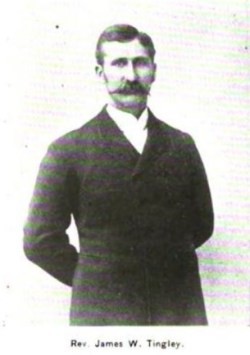 James W. Tingley, a city clergyman, aged sixty-six years (b. Canada), headed a Boston, MA, household at the time of the Fourteenth (1920) Federal Census. His household included his wife Naomi Tingley, aged fifty-seven (b. Canada), and his son, Harold E. Tingley, a general practice dentist, aged twenty-three years (b. Canada). Rev. Tingley had immigrated in 1885, while his wife and child had immigrated in 1887. (The son had “immigrated” by virtue of being born in the US to an alien mother). They were all naturalized when the father was in 1899. They shared a rented two-family dwelling at 62 Hobson Street with the household of George Holbrook, a shoe machinery manager, aged forty-three years (b. MA).

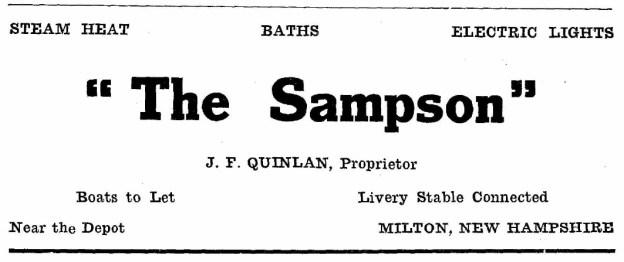



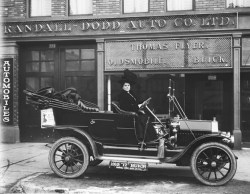
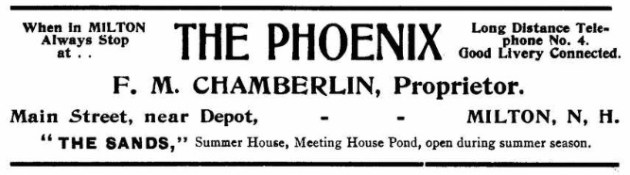
 This was also the year of the Battle of Verdun (359,000 dead), the
  AUCTION SALES. Receivers’ Sale at Public Auction, Feb. 3rd, 1916, at 12 [P]M, on Premises of the Milton Shoe Co., Inc., Milton, N.H. (Take 8:35 A.M. train from No. Station, Boston). The plant of the said Company. consisting of the factory, shown on left of picture, about 40×150, run by steam and water power, with electrical plant, belting, pulleys, shafting. stitching room machinery, making and finishing room machinery, cutting boards, lasts, pattern, dice, office furniture, safes, typewriter, fixtures, merchandise consisting of upper stock, linings, heeling, threads, inner soles, counters, nails, tacks, heels, toplifts, uppers partially completed, finished shoes, upper leather and other merchandise and articles as usually go with a factory making women’s, misses’ and children’s welt and McKay shoes, contained on said premises and in office of said Company, 135 Lincoln St. Boston, under decree of the U.S. District Court for the District of Massachusetts dated Jan. 19, 1916, terms: each bidder to deposit with the Receivers 10% of the amount of his bid and not less than $500 at the time of sale and balance to be paid in cash upon confirmation of sale by the Court, the right being reserved to reject any and all bids: the factory on the right of the picture is vacant and is not the property of the Milton Shoe Co. The factory to be sold is in Lebanon. Me., on the


 Milton Observer