Blackfly Song

By Muriel Bristol | May 20, 2019

The blackflies made their annual reappearance last week. Wednesday (May 15) at my house). That fits pretty well with their traditional schedule of between Mothers’ Day and Fathers’ Day.

Last year, we provided both a general description (Black Flies Return) and a folk remedy for their itching bites (Hot Water for Itchy Bug Bites).

That having been covered already, the following Canadian folk song – Blackfly Song – as sung in 1955 by its author Wade Hemsworth, might give some sense of the joy that is blackfly season.

We are not facing them in the woods of North Ontario, thankfully, but their Milton cousins are fierce enough, thank you.

Blackfly Song

‘Twas early in the spring when I decide to go
For to work up in the woods in North Ontar-i-o;
And the unemployment office said they’d send me through
To the Little Abitibi with the survey crew
And the black flies, the little black flies,
Always the black fly no matter where you go;
I’ll die with the black fly a-pickin’ my bones,
In North Ontar-i-o-i-o, in North Ontar-i-o.

And the man Black Tobey was the captain of the crew
And he said, I’m gonna tell you boys, what we’re gonna do:
They want to build a power dam; we must find a way
For to make the Little Ab flow around the other way
With the black flies, the little black flies,
Always the black fly no matter where you go;
I’ll die with the black fly a-pickin’ my bones,
In North Ontar-i-o-i-o, in North Ontar-i-o.

So we survey to the east, survey to the west,
Couldn’t make our minds up how to do it best;
Little Ab, Little Ab, what shall I do?
I’m all but goin’ crazy with the survey crew
And the black flies, the little black flies,
Always the black fly no matter where you go;
I’ll die with the black fly a-pickin’ my bones,
In North Ontar-i-o-i-o, in North Ontar-i-o.

It was blackfly, blackfly, everywhere,
A-crawlin’ in your whiskers, crawlin’ in your hair;
Swimmin’ in the soup, swimmin’ in the tea,
And the devil take the blackfly, let me be.
Black flies, the little black flies,
Always the black fly no matter where you go;
I’ll die with the black fly a-pickin’ my bones,
In North Ontar-i-o-i-o, in North Ontar-i-o.

Black Tobey fell to swearin’; the work went slow,
The state of our morale was a-gettin’ pretty low;
The flies swarmed heavy; hard to catch your breath,
As you staggered up and down the trail a-talkin’ to yourself
With the black flies, the little black flies,
Always the black fly no matter where you go;
I’ll die with the black fly a-pickin’ my bones,
In North Ontar-i-o-i-o, in North Ontar-i-o.

Well now, the bull cook’s name was Blind River Joe,
If it hadn’t been for him we’d ‘ve never pulled through;
‘Cause he bound up our bruises and he kidded us for fun,
And he lathered us with bacon grease and balsam gum.
And the black flies, the little black flies,
Always the black fly no matter where you go;
I’ll die with the black fly a-pickin’ my bones,
In North Ontar-i-o-i-o, in North Ontar-i-o.

And at last the job was over; Black Tobey said we’re through
With the Little Abitibi and the survey crew!
‘Twas a wonderful experience and this I know:
I’ll never go again to North Ontar-i-o
With the black flies, the little black flies,
Always the black fly no matter where you go;
I’ll die with the black fly a-pickin’ my bones,
In North Ontar-i-o-i-o, in North Ontar-i-o.

And the black flies, the little black flies,
Always the black fly no matter where you go;
I’ll die with the black fly a-pickin’ my bones,
In North Ontar-i-o-i-o, in North Ontar-i-o.

References:

Wikipedia. (2018, December 14). Little Abitibi River. Retrieved from en.wikipedia.org/wiki/Little_Abitibi_River

YouTube. (2015, May 20). Blackfly Song. Retrieved from www.youtube.com/watch?v=SIzw1j4onNc

Milton in the News – 1896

By Muriel Bristol (Transcriber) | May 19, 2019

In this year, we encounter an offer of a good home, a flood at the Spaulding homestead, the Lynn death of a Milton native, a troubled Amesbury shoe factory considering a move, a first-class cook wanted, the suspicious death of a traveler, non-union lasters being both wanted and warned away, and a drowning death.

(Milton Mills got a telephone exchange and its first telephones in this year. Milton did not get their first ones until 1898).


Male Help Wanted. WANTED – A boy about 15 or 16 years in want of a good home for the winter for board, chores on a small farm. Apply G.G., Milton Mills, N.H. (Boston Globe, January 6, 1896).

A boy of this age would have completed already his district school education. No pay is mentioned here, but “chores” are not a full-time job. The boy in question would be free to supplement this room-and-board offer with paid work elsewhere.


Townsend, MA, was the ancestral home of the Spaulding family. Here we find the Townsend house of Jonas Spaulding, Jr., suffering some flood damage. Jonas Spaulding, Jr., was the father in the J. Spaulding & Sons leatherboard manufacturing partnership.

TOWNSEND HARBOR. Many of the cellars of this village have been flooded this week, but, aside from this, little damage has been done hereabouts. The pond is as solidly frozen as any time this winter. The Conant House, recently occupied by Mr. Stackpole, was sold at auction Saturday. The property of the father of Spaulding brothers in Milton, N.H., was damaged several hundred dollars by the flood. Harry Wright, late with Frank Knight, is still at his home in Hudson, badly broken up, physically. He is not likely to be [- indistinct -] this season (Fitchburg Sentinel (Fitchburg, MA), March 6, 1896).

Leatherboard is made from a pulp of scrap leather and wood pulp. Spaulding Brother, later J. Spaulding & Sons, had factories in both Massachusetts and New Hampshire, including those in Milton and East Rochester. (Later, their largest factory would be established in Tonawanda, NY).

Two of the three Spaulding sons would go on to become governors of New Hampshire. Rochester’s Spaulding High School and the Spaulding Turnpike are named after them.


War Veteran Dies. LYNN, March 12. William Cook, 61, a war veteran, died today. He was born at Milton, N.H, enlisted for three months at Haverhill in the 8th regiment at the beginning of the war, and when his term had expired reenlisted in the 4th Massachusetts volunteers. He was a member of Washington lodge of Masons of Windsor, Conn., and of Gen. Lander post, 5, G.A.R., Lynn (Boston Globe, March 13, 1896).

William P. Cook was born in Milton, NH, April 26, 1834, son of William W. and Mary M. (Yeaton) Cook.

William W. Cook, a farmer, aged fifty-two years (b. NH), headed a Milton household at the time of the Seventh (1850) Federal Census. His household included Mary Cook, aged forty-eight years (b. NH), George H. Cook, a shoemaker, aged eighteen years (b. NH), William P. Cook, a shoemaker, aged sixteen years, Mary E. Cook, aged thirteen years (b. NH), Mark F. Cook, aged nine years (b. NH), Ira Cook, aged six years (b. NH), and Charles E. Cook, aged four years (b. NH). William W. Cook had real estate valued at $1,000. Their household appeared in the enumeration between those of Elias S. Cook, a farmer, aged thirty-six years (b. NH), and Joseph Pearl, a farmer, aged years. They lived also quite close (same page) to the household of John T.G. Colby, a Christian B. [Baptist] Clergyman, aged fifty-four years (b. NH). Note too the child Mark F. Cook, who was likely a namesake for Elder Mark Fernald.

William P. Cook married (1st) in Lynn, MA, September 5, 1858, Margaret E. Rand, both of Lynn, MA. He was a cordwainer, aged twenty-four years (b. Milton, NH), and she was a shoe-fitter, aged twenty-two years (b. Europe). It was her second marriage. Rev. H.E. Hempstead performed the ceremony.

Wm. E. Cook, a cordwainer, aged thirty years (b. NH), headed a Lynn, MA, household at the time of the Eighth (1860) Federal Census. His household included Margaret Cook, aged twenty-five years (b. MA), and Charles Cook, aged one year (b. MA). His household shared a two-family dwelling with the household of John P. Watts, a cordwainer, aged thirty-six years (b. NH). (Their son, Charles Herbert Cook, died of scarlet fever in Lynn, MA, May 20, 1863, aged four years).

William P. Cook, a shoemaker, married, aged twenty-nine years (b. NH), registered for the Class I military draft in Lynn, MA, in May or June 1863. “Class I comprises all persons subject to do military duty between the ages of twenty and thirty-five years, and all unmarried persons subject to do military duty above the age of thirty-five years and under the age of forty-five.”

William P. Cook, a shoemaker, aged thirty years (b. NH), and Margaret Cook, a shoe-fitter, aged twenty-seven years (b. NY), resided in the Lynn, MA, household of Thomas B. Wilford, an expressman, aged thirty-seven years (b. Marblehead), at the time of the Second (1865) Massachusetts State Census.

He married (2nd), after 1865, but before 1880, Essie J. Latham. She was born circa 1853.

William P. Cook, a shoemaker, aged forty-five years (b. NH), headed a Lynn, MA, household at the time of the Tenth (1880) Federal Census. His household included his wife, Essie J. Cook, keeping house, aged twenty-seven years (b. England), and his boarder, Florence Rand, works in shoe factory, aged twenty years (b. MA). They resided at 8 Bickford Court.

William P. Cook filed for a Federal invalid veteran’s pension, June 24, 1884, based upon his service in the Fourth Massachusetts H.A. [Heavy Artillery] during the civil war.

William P. Cook of Lynn, MA, appeared in the surviving veterans schedule of the Eleventh (1890) Federal Census. According to that schedule, he had enlisted in Co. D of the Fifth Massachusetts Infantry, in April 1861, and had been discharged in July 1861. He had re-enlisted in Co. L of the Fourth Massachusetts H.A. [Heavy Artillery], in June 1864, and had been discharged in July 1865.

William P. Cook died in Lynn, MA, March 12, 1896, aged sixty-three years, ten months, and sixteen days.

The Lynn City Directory for 1897 listed William P. Cook, died March 12, 1896. It had also listed Mrs. William P. Cook, forewoman stitching, 95 State [Charles H. Ingalls & Co.], h. 16 Warren and Essie J. Cook, h. 16 Warren.

Essie J. Cook filed for a Federal widow’s pension, March 20, 1896, based upon her deceased husband’s service in the Fourth Massachusetts H.A. [Heavy Artillery] during the civil war.

Essie J. (Latham) Cook died in Lynn, MA, in November 1928.


The Massachusetts Department of Labor and Industries chronicled Amesbury’s industries of 1895. The Lewis, Adams, & Co. firm, which was engaged in making slippers, became the Lewis, Gross, & Co. firm. The substitution of Gross for Adams might suggest a new partner with new capital, which might have been necessary if the firm were struggling and financially “embarrassed.”

THE WEEK’S NEWS. FRIDAY, MAY 22. The shoe firm of Lewis Gross & Co., of Amesbury, Mass., will move to Milton Mills, N.H. (Newport Mercury (Newport, RI), May 23, 1896).

Lewis Gross and Co. Make Assignment. AMESBURY, June 6. The slipper firm of Lewis Gross & Co. made an assignment this morning to J.T. Choate, a local attorney. An attachment was served yesterday which they could not meet. No statement is made. It is probable that the firm will resume operations and that the difficulty will be but temporary. This is the firm which was announced last week as being about to move to Milton Mills. N.H., where a factory was being built for them. It is understood, however, that one of the firm is favorable to remaining here and Pres. Chipman of the Merchants’ association and others are laboring to secure their remaining in Amesbury (Boston Globe, June 6, 1896).

An “assignment” is a transfer of asset ownership from a debtor to a creditor.

To Continue Business at Amesbury. AMESBURY, July 20. The slipper firm of Lewis, Gross & Co, which failed here two months ago with liabilities of $30,000, are to continue business here. It was announced this morning that arrangements had been perfected whereby the plant will be sold by the assignee to parties who will, in conjunction with Messrs. Lewis, continue the business. It is further stated that Mr. Gross will retire. Before the firm assigned reports were published that they were to move their business to Milton Mills, N.H, and the fact that they will continue here is hailed with satisfaction (Boston Globe, July 20, 1896).

Hailed with satisfaction in Amesbury, MA, no doubt, although Milton Mills must have been somewhat less satisfied.


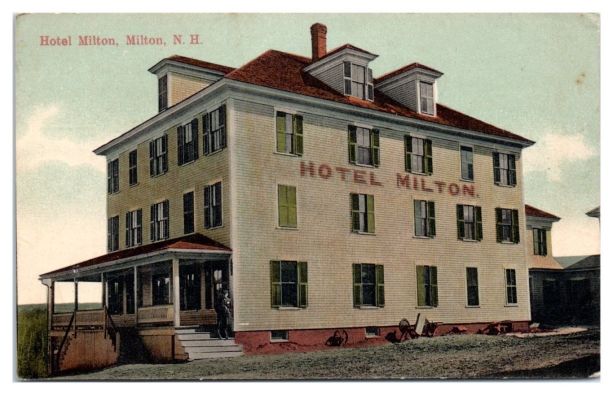
The Milton Hotel (or Hotel Milton) advertised for a first-class cook, a female one.

Female Help Wanted. WANTED – To pay $1 per day for first-class cook, steady job. Milton hotel, Milton, N,H. (Boston Globe, June 29, 1896).

Hotel MiltonThe Milton Hotel appeared, under the management of E.M. Bodwell, in the Milton Business Directories of 1894, 1898, 1901, and 1904.

Charles L. Bodwell, a hotel keeper, aged forty-three years (b. ME), headed a Milton household at the time of the Twelfth (1900) Federal Census. His household included his wife, Etta M. Bodwell, aged forty-two years (b. ME), and his son, Linwood C. Bodwell, at school, aged twelve years (b. NH). It would appear that he rented the building from her, which she owned free-and-clear. (More might be found in its census farm schedule).

Seven servants and six boarders resided in the Milton Hotel on that census day in June 1900. Cecile Fritts, house cook, aged twenty-five years (b. MI) was one of the servants. Due to the inflation of the intervening years, her daily wage of $1.00 would have the purchasing power of $30.46 in 2019. (She probably made about $9,503 per year). Of course, there were no income taxes and she appears to have received room and board also.

The poet Louise Bogan (1897-1970) lived as a child in the Milton Hotel (or Hotel Milton) for a few years from 1901. “The hotel faced both the Caricade [Carricabe] Paper Mill and the old flume, a mile-long stretch of very rapid white water dropping nearly a hundred feet over a rocky series of falls” (Frank, 1986). (See also Milton Water Power in 1901).


One might expect the Milton murder of  a traveling stranger to have received more column inches than this did. The authorities seem to have satisfied themselves as to identity of the victim on rather slight circumstantial evidence and a telegraphed description.

WILLIAM O’NEILL, PERHAPS. CLINTON, July 25. – It is thought that the man found murdered at Milton, N.H., July 14, is William O’Neill of this place. He left the Lancaster mills, where he was a weaver, three weeks ago, for Lewiston, Me. (Boston Globe, July 26, 1896).

LETTER MAY FURNISH CLEW. Body Found by Roadside Thought to be That of William O’Neil of Clinton. CLINTON, July 27. There is a general impression here today, based upon information furnished by the police, that the unknown man found murdered by the roadside at Milton, N.H., July 14, is William O’Neil of this town. When the remains were found a letter was discovered in the clothes. addressed to William O’Neil, Clinton, Mass. A description of the man arrived this morning, and those who knew O’Neil say that it fits him exactly. O’Neil was employed at the Lancaster gingham mills for the past three years, and is popular with his associates. John McGrail, with whom Mr. O’Neil boarded, states that he left here three weeks ago for Lewiston, Me. Since then he has heard nothing from him. Mr. McGrail thinks that the murdered man was O’Neil (Boston Globe, July 27, 1896).

There does not seem to have been any subsequent stories of investigations, suspects, arrests or trials. The O’Neill murder case – if that was who he was – seems to have gone “cold.”

(Ed. Note: Milton Vital Records name and explain him as “Unknown,” a white male, aged thirty-five years, who was “Run Over by Train”).


Here we find mention of a second Milton shoe strike. N.B. Thayer & Co. advertised for sixteen shoe lasters, apparently to replace those out on strike.

MALE HELP WANTED. LASTERS wanted. 6 non-union lasters on boys’ shoes, 10 on misses’ and children’s, must be good workmen and responsible men. Apply to 103 Bedford st., Boston, or Milton, N.H. N.B. THAYER & CO.

In the same edition of the same newspaper the union strike committee advertised its request that all shoe lasters stay away from Milton.

LASTERS are requested to keep away from Milton, N.H. as there is a strike on. Per order committee (Boston Globe, September 2, 1896).


Here we find another accidental death in which the victim was intoxicated. (Following the grisly wagon-dragging death in 1891).

Body Found in Milton Pond. SANFORD, Me, Nov. 11 – The body of John Steves, who disappeared from West Lebanon last week, was found floating in the pond at Milton, N.H., today. He was last seen Friday night, and was then in an intoxicated condition. It is supposed that in attempting to cross the railway bridge on the North Conway branch of the Boston & Maine he fell into the water and perished (Boston Globe, November 12, 1896).

Mr. Steves left little in the way of a documentary record. One supposes that he did his drinking in Milton and was attempting to cross back to the Lebanon, ME, side of the river.


Previous in sequence: Milton in the News – 1895; next in sequence: Milton in the News – 1897


References:

Find a Grave. (2013, July 7). Charles Linwood Bodwell. Retrieved from www.findagrave.com/memorial/113448151

Find a Grave. (2011, January 26). Pvt. William P. Cook. Retrieved from www.findagrave.com/memorial/64713218

Frank, Elizabeth. (1986). Louise Bogan: A Portrait. Retrieved from books.google.com/books?id=SSsaOu2w85UC&pg=PA6

Massachusetts Department of Labor and Statistics. (1896). Annual Report on the Statistics of Manufactures. Retrieved from books.google.com/books?id=zSwaAQAAIAAJ&pg=PA254

Massachusetts Department of Labor and Statistics. (1897). Annual Report on the Statistics of Manufactures. Retrieved from books.google.com/books?id=M6AoAAAAYAAJ&pg=PA197

Wikipedia. (2019, February 25). Louise Bogan. Retrieved from en.wikipedia.org/wiki/Louise_Bogan

Wikipedia. (2018, October 11). Townsend, Massachusetts. Retrieved from en.wikipedia.org/wiki/Townsend,_Massachusetts

YouTube. (2018, June 3). Penny Loafers Hand Lasting. Retrieved from www.youtube.com/watch?v=4O2yjII_WLU

Public BOS Session Scheduled (May 20, 2019)

By Muriel Bristol | May 17, 2019

The Milton Board of Selectmen (BOS) have posted their agenda for a Public BOS meeting to be held Monday, May 20, beginning at 6:00 PM.

There will be also a concluding Non-Public session (regarding a matter whose discussion “would likely affect adversely the reputation” of someone) after the Public portion of the BOS meeting (see below).

Ernest M. Cartier Creveling received his appointment as the new Town Administrator as of Monday, May 15. This would be his first meeting as Milton Town Administrator.


The Public portion of the agenda has New Business, Old Business, Other Business, and some housekeeping items.

Under New Business are scheduled four agenda items: 1) Appoint Board of Selectmen Liaison Townhouse Stewardship Committee, 2) Approval of Public Works Employee Hiring (Pat Smith), 3) Public Hearing – Acquisition and Possible Disposition of Land Parcel; Tax Map 17, Lot 5, and 4) Request to Purchase Tax Map 37 Lot 64 (Jackie Monahan).

Appoint Board of Selectmen Liaison Townhouse Stewardship Committee. At their inaugural meeting, the BOS neglected to appoint one of their members for all of the ex-officio BOS seats. Some lucky selectman will win an ex-officio seat on the Townhouse Stewardship Committee.

Approval of Public Works Employee Hiring (Pat Smith). The BOS began the Default Budget year already “in the hole” from last year’s employee medical insurance increases. This agenda item heralds a fifth new hire since then: two policemen, a town administrator, a land use clerk, and now a DPW employee.

Newton’s third law of default budgets informs us that for every budget expenditure there must be an equal and opposite budget cut (probably to a service).

Public Hearing – Acquisition and Possible Disposition of Land Parcel; Tax Map 17, Lot 5. At the last meeting, we were informed that this property was already acquired in 2015, but without the proper rigmarole, and that two Public Hearings would be necessary to set things straight.

Request to Purchase Tax Map 37 Lot 64 (Jackie Monahan). Ms. Jackie Monahan, of Ford Farm Road, might like to purchase a roughly $200 addition to her annual tax bill, in the form of another 0.4-acre parcel on Ford Farm Road.


Under Old Business is scheduled one item: 5) Approve Economic Development Committee & Recreation Commission Appointments.

Approve Economic Development Committee & Recreation Commission Appointments. Rather than dissolve the various boards, committees, and commissions that lacked candidates at the recent election, evidently due to a lack of interest, the BOS will designate their personal favorites from among such as asked them for post-election appointments.


Other Business That May Come Before the Board has no scheduled items.


Next, there will be the approval of prior minutes (from the Special BOS meeting of May 4 (the tax-titled property auction), and the BOS meeting of May 6, 2019), the expenditure report, Public Comments “Pertaining to Topics Discussed,” Town Administrator comments, and BOS comments.


Non-Public Session: 91-A:3 II (c) – Reputation

Earlier in the week, this Public BOS meeting was to have begun with a Non-Public session at 5:30 PM, for a Non-Public agenda item classed as 91-A3 II (c). The BOS appears to be holding that Non-Public session at the conclusion of their Public BOS meeting instead of at the beginning as they usually do.

91-A:3 II (c). Matters which, if discussed in public, would likely affect adversely the reputation of any person, other than a member of the public body itself, unless such person requests an open meeting. This exemption shall extend to any application for assistance or tax abatement or waiver of a fee, fine, or other levy, if based on inability to pay or poverty of the applicant.

An additional annotation of “Reputation” was added to the usual 91-A justification. Someone thought we should know that this particular Non-Public session would deal specifically with a matter that might affect adversely the reputation of some person, other than a member of the public body. (And that it would not deal with any application for assistance, tax abatement, or waiver).

Peekaboo. Everyone can see who comes and goes from these Non-Public sessions. Only an ostrich or a toddler think that if they cannot see you, you cannot see them.

(Well, maybe it works for truck drivers and their rear-view mirrors. And group photos and the camera).

[Added from the court filings database, October 23, 2019: “New Hampshire Supreme Court, Report on Status of Cases, As of September 30, 2019. Case 2019-0278. Three Ponds Resort, LLC v. Town of Milton. 05/15/2019 – Case Filing. 06/04/2019 – Accepted.”]


Mr. S.D. Plissken contributed to this article.


References:

State of New Hampshire. (2016, June 21). RSA Chapter 91-A. Access to Governmental Records and Meetings. Retrieved from www.gencourt.state.nh.us/rsa/html/VI/91-A/91-A-3.htm

Town of Milton. (2019, May 2). BOS Meeting Agenda, May 4, 2019. Retrieved from www.miltonnh-us.com/sites/miltonnh/files/agendas/5.4.19_bos_agenda-town_property_auction_0.pdf

Town of Milton. (2019, May 2). BOS Meeting Agenda, May 6, 2019. Retrieved from www.miltonnh-us.com/sites/miltonnh/files/agendas/5.6.19_bos_agenda.pdf

Town of Milton. (2019, May 17). BOS Meeting Agenda, May 20, 2019. Retrieved from www.miltonnh-us.com/sites/miltonnh/files/agendas/5.20.19_bos_agenda.pdf

Town of Milton. (2019). Press Release: Milton Names New Town Administrator. Retrieved from www.miltonnh-us.com/sites/miltonnh/files/news/press_release-milton_names_new_town_administrator.pdf

Wikipedia. (2019, April 25). Newton’s Laws of Motion. Retrieved from en.wikipedia.org/wiki/Newton%27s_laws_of_motion

Youtube. (1965). Cone of Silence. Retrieved from www.youtube.com/watch?v=g1eUIK9CihA&feature=youtu.be&t=1

Taxation Is Theft

By S.D. Plissken | May 16, 2019

For well over a month now, some of New Hampshire’s Republican legislators have been working the phrase “Taxation is theft” into their speeches on the House floor in Concord. (See video compilation in the References below).

One might ask what they mean by this. By way of explanation, the classic “How Many Men?” thought experiment took us along a continuum of theft. It comes in many variations, of which we will here provide but two. You are challenged to identify the point at which theft ceases to be theft.

British theologian J. Budziszewski provided the following How Many Men? sequence.

  1. On a dark street, a man draws a knife and demands my money for drugs.
  2. Instead of demanding my money for drugs, he demands it for the Church.
  3. Instead of being alone, he is with a bishop of the Church who acts as bagman.
  4. Instead of drawing a knife, he produces a policeman who says I must do as he says.
  5. Instead of meeting me on the street, he mails me his demand as an official agent of the government.

If the first is theft, it is difficult to see why the other four are not also theft. Expropriation is wrong not because its causes are wrong, but because it is a violation of the Eighth Commandment: Thou shalt not steal.

[Ed. note: the church in this example is an “established” church, i.e., an arm of the British government].

Strictly speaking, the menaces threatened make taxation more of an Extortion, or perhaps a Robbery, but the Taxation is Theft phrase reaches for some degree of alliteration.

American jurist Andrew Napolitano provided a similar How Many Men? sequence from a legal point of view.

  1. Is it theft if one man steals a car?
  2. What if a gang of five men steal the car?
  3. What if a gang of ten men take a vote (allowing the victim to vote as well) on whether to steal the car before stealing it?
  4. What if one hundred men take the car and give the victim back a bicycle?
  5. What if two hundred men not only give the victim back a bicycle but buy a poor person a bicycle, as well?

The experiment challenges an individual to determine how large a group is required before the taking of an individual’s property becomes the “democratic right” of the majority.

For many, there is no point at which it ceases to be a theft. They claim there can never be such a point. Individuals lack the right to perpetrate theft. Aggregate groups of individuals, such as democratically-voting majorities or their democratically-elected representatives, also lack that right, as groups cannot acquire any extra rights above and beyond those of the individuals of which they are composed.

One might hope that this newly-expressed awareness of majority theft spreads like wildfire throughout the Republican caucus. Perhaps it might temper their own actions when they regain the majority.

One might hope also that this awareness is infectious and crosses over the aisle to the current majority Democrat caucus too.

In fact, awareness of the true nature of taxation should permeate through every level of government, right down to Milton selectmen. It might have the happy effect of limiting some of their wilder fancies.

As the WW II posters asked when seeking to save scarce resources, “Is this trip really necessary?”

Meanwhile, those of us in the peanut gallery may watch these interesting floor speeches by these few “woken” representatives. Too funny.

References:

Wikipedia. (2019, May 15). Extortion. Retrieved from en.wikipedia.org/wiki/Extortion

Wikipedia. (2019, May 16). Robbery. Retrieved from en.wikipedia.org/wiki/Robbery

Wikipedia. (2019, May 12). Taxation as Theft. Retrieved from en.wikipedia.org/wiki/Taxation_as_theft

Wikipedia. (2019, May 13). Theft. Retrieved from en.wikipedia.org/wiki/Theft

Yokela, Josh (Concord Monitor). (2019, April 1). My Turn: Taxation is Theft – and Here’s Why. Retrieved from www.concordmonitor.com/Taxation-is-theft-2441211

Youtube. (2019, April 4). NH Representatives Stating That Taxation Is Theft. Retrieved from www.youtube.com/watch?v=cGO7m8O83ZQ

NH Legislative Hearings, May 14 and 15

By S.D. Plissken | May 12, 2019

A Concord correspondent informs us that there will be thirty-one NH legislative hearings in the upcoming week. Because the next bill will create Utopia.

Every proposed bill passing though the New Hampshire legislature gets a hearing. No exceptions. Any citizen may sign up to testify in support or opposition of those bills. Or you can just go to “hear,” and perhaps to buttonhole our legislators. (Rep. Peter T. Hayward (R), Rep. Abigail Rooney (R), and Sen. Jeb Bradley (R)).

Our correspondent felt that three hearings of the thirty-one hearings held particular interest. They concern proposed bills seeking to prohibit government restrictions on free speech, to increase registry-of-deeds fees, and to increase fees for snowmobile registrations.


HB 154 Hearing – Prohibiting Government Settlement Restrictions on Free Speech

House Bill 154 seeks to “prohibit non-disparagement clauses in settlement agreements involving a governmental unit.”

So, you reached a settlement of your lawsuit against some government entity. But that entity demands as a condition of the settlement that you never speak of how completely overbearing and unconstitutional its original overreach was. Government bureaucrats do not want others to know when they have gone too far, and that they can be successfully opposed. They would prefer to muzzle you as a part of their settlement.

This bill would squash that practice. Some rate this free speech-oriented bill as being moderately partisan, in that it was put forward and supported largely by Democrats. It does have some Republican sponsors. It should have 400 sponsors, including our own state representatives Hayward and Rooney.

Its hearing will be held at 10:00 AM on Tuesday, May 14, in Room 100 of the State House. (Yes, at the very same time as the SB 74 hearing (below)).


SB 74 Hearing – Increasing Registry of Deeds Fees

Senate Bill 74 seeks to increase the “… Register of Deeds fees used to support the Land and Community Heritage Investment Program (LCHIP), and establishing a committee to study the economic impact of land conservation.”

A tax by any other name would smell as sour. We have seen Milton officials seeking “grants” from this LCHIP fund. This is another one that should bear Selectman Lucier’s warning label: It comes also from taxation, just taxation exacted at another level of government. It is not “free money.”

Some rated this fee-increasing bill as strongly partisan (from the Democrat side). Do you want to be New Massachusetts, people? This is how you turn into New Massachusetts: constantly increasing fees, fines, and taxes. Always for a “good cause,” of course. Except when they play bait and switch, as they did already with the supposedly ear-marked Keno money.

Its hearing will be held at 10:00 AM on Tuesday, May 14, in Room 202 of the Legislative Office Building. (Yes, at the very same time as the HB 154 hearing (above)).


SB 187 Hearing – Increasing Snowmobile Fees

Senate Bill 187 seeks to increase “OHRV dealer and rental agency registration fees and snowmobile registration fees.”

Again, a tax by any other name would smell as sour. Some rated this as a bipartisan bill. Apparently, increasing snowmobile registration fees is a bipartisan thing. No “good cause” specified; just more for government.

Evergreen Valley Snowmobile Club, the NH Senate is calling your name. They would like to hear your opinion regarding snowmobile registration fee increases at their SB 187 hearing.

The hearing will be held at 10:45 AM on Wednesday, May 15, in Room 202 of the Legislative Office Building. (Yes, the very same place as the SB 74 hearing of the previous day (above)).


“No man’s life, liberty or property are safe while the Legislature is in session” – Gideon J. Tucker


References:

Legiscan. (2019). New Hampshire House Bill 154. Retrieved from legiscan.com/NH/bill/HB154/2019

Legiscan. (2019). New Hampshire Senate Bill 74. Retrieved from legiscan.com/NH/bill/SB74/2019

Legiscan. (2019). New Hampshire Senate Bill 187. Retrieved from legiscan.com/NH/bill/SB187/2019

NH General Court. (2019). Directions to the State House and Legislative Office Building. Retrieved from www.gencourt.state.nh.us/misc/directions/default.html

NH General Court. (2019). Representative Peter T. Hayward. Retrieved from www.gencourt.state.nh.us/house/members/member.aspx?member=408928

NH General Court. (2019). Representative Abigail Rooney. Retrieved from www.gencourt.state.nh.us/house/members/member.aspx?pid=9274

NH General Court. (2019). Roster of the New Hampshire State Senators (including Senator Jeb Bradley). Retrieved from gencourt.state.nh.us/Senate/members/senate_roster.aspx

NH Government. (2019). Concord State Office Locator. Retrieved from www.nh.gov/government/locator-map.htm

Milton in the News – 1895

By Muriel Bristol (Transcriber) |May 12, 2019

In this year, we encounter some hiring by a mill superintendent, the demise of a former mill superintendent, children for adoption, a would-be housekeeper seeking employment, several out-of-town visitors, the departure of an original Nute High School teacher, and Miss Merrill’s “miracle” cure.


Vermont native William T. Rockwell was the Varney & Lane shoe factory superintendent during the Milton Mills Shoe Strike of 1889. During which event he and his wife were allegedly threatened by the strikers.

Here he we find him recruiting factory help for a successor shoe factory (perhaps the W.T. Thayer [N.B. Thayer] company, whose proposed expansion was announced in 1894, or perhaps the Gale Shoe company, who leased the Varney & Lane factory at Milton Mills in this year).

SHOE FACTORY HELP WANTED. In factory just starting at Milton Mills, N.H., operators on all machines in making room, lasters and stitching room help; also first-class bottom finisher, to take job by case; also first-class stock fitter, to take job by case. Address W.T. ROCKWELL (Boston Globe, February 13, 1895).

William T. Rockwell removed to Burlington, VT, by 1899, where he became superintendent of the Lakeside Shoe Company (and thereafter to Pittsfield, MA).

William Rockwell, a shoe manufacturer, aged forty-nine years (b. VT), headed a Burlington, VT, household at the time of the Twelfth (1900) Federal Census. His household included his wife (of twenty-one years), Carrie Rockwell, aged forty-six years (b. VT), and her parents, [Narcise] Nelson Milete, aged seventy-two years (b. Canada), and Louise Milete, aged sixty-two years (b. Canada). They resided in a rented house on Park Avenue. Her parents were resident aliens, who had entered the country in 1870.

William T. Rockwell died of general paralysis (six months duration) at the NH Soldiers’ Home in Tilton, NH, September 28, 1906, aged fifty-five years, ten months, and twenty-six days. He had been resident there for two years; his previous residence was Pittsfield, MA. (He was born in Middleton, VT, November 2, 1850).

TROY. A telegram has been received announcing the death of William T. Rockwell, son of Mr. and Mrs. Anson Rockwell of this place. Mr. Rockwell had been in poor health for several years, and his death occurred at the Soldiers’ Home at Tilton, N.H. At the breaking out of the civil war he was attending school at Westfield and although only fourteen years of age walked to Hyde Park and enlisted. After his return from the war he learned the shoemaker’s trade, becoming very proficient, and had held some excellent positions. Mr. Rockwell leaves a wife, father and mother, and ten brothers and sisters. This is the first break in the family, of which Mr. Rockwell was the oldest child (Orleans County Monitor (Barton, VT), October 8, 1906).

The Pittsfield City Directory of 1906 listed Rockwell, Carrie A., wid. William T., h. 3 Forest pl. (She had removed to California by 1910).

Caroline A. (Milete) Rockwell died in Lakeport Village, Laconia, NH, May 21, 1935, aged eighty-one years, one month, and nineteen days.


The following obituary of Joseph Robinson tells his rags-to-riches life story. John Townsend employed him as his mill superintendent at the Milton Mills Manufacturing Company in the early 1850s.

Joseph Robinson was born in Hunslet, Yorkshire, England, May 9. 1812, son of James and Mary S. (Aspin) Robinson.

He married in Leeds, March 26, 1833, Frances Ann Lewis. She was born in Yorkshire, November 16, 1814, daughter of Thomas and Isabella (Theakston) Lewis.

Joseph Robinson, a dyer, aged twenty-five years, headed a Leeds, Yorkshire, England household at the time of the UK Census of 1841. His household included Frances Robinson, aged twenty years, Mary Robinson, aged seven years, Frances Robinson, aged three years, and Thomas Robinson, aged one year. (The UK Census of 1841 used five-year age ranges for adults: Joseph and his wife were aged 25-29 and 20-24 respectively). They resided on York Street, near its intersection with Morton Row.

TWO CENTS TO WEALTH. Joseph Robinson Started on a Small Capital. Lived to Enjoy Prosperity, the Oldest Maine Manufacturer. Was Father of 15 Children All of Whom Were Brought Up in Mill. OXFORD, Me., March 6. Joseph Robinson, Maine’s oldest woolen manufacturer, died at 7 this morning; after an illness of several weeks. Mr. Robinson was born In Leeds, Eng. in 1810, and at the early age of 9 years was apprenticed to the woolen manufacturing business, beginning as a bobbin boy, piecing and plugging bobbins behind a spinning jack. After serving his apprenticeship he went to Hamburg, thence to Reichtenburg, finally returning to Hamburg. He spent six years in these cities, working in woolen factories. Before leaving England he fell in love with a pretty English lass, Frances Lewis, and during his sojourn in Germany and in Austria their courtship was carried on by letters. When 27, with his young wife and infant son, he landed in Boston. His entire worldly possessions at that time consisted of the clothes upon his back and two copper pennies in his pocket. He kept those big old fashioned English pennies during his life-time, and was very fond of showing them to visitors and of relating how he began life in Boston upon a capital of two cents. He obtained work enough to earn the money to take him to Ballardvale, in which place there was then a small woolen factory. As he thoroughly understood the manufacture of woolens he readily obtained employment. Soon after John Townsend engaged the young Englishman to act as superintendent and dyer of his woolen factory at Milton Mills. N.H. A few years later the Norway Plains woolen mills at Rochester, N.H. advertised for a superintendent, and Robinson saw the situation. He lived in Rochester for a number of years and was able to save a little money. This he invested in a small woolen factory at Mill Village, Wolfboro, N.H. He soon had an opportunity to sell his interest in this factory; and moved to Oxford, Me, 36 years ago, and purchased the old Craige woolen mill of John Halt. The old Craige woolen mills are among the oldest, if not the oldest, in New England. After a long series of experiments Mr. Robinson succeeded in producing a more beautiful and permanent shade of blue than any other dyer had attained. With a roll of his peerless blue cloth under his arm. he went to Boston and called upon the largest wholesale house in that city. He was offered $2.50 a yard for all of the same kind of cloth that he could manufacture for three years. But the manufacturer was not satisfied with this offer, and went on to New York, calling upon, among others, A.T. Stewart. That far-seeing merchant at once closed a bargain with Robinson. “Jim” Fisk, then a peddler, came very near buying out Joseph Robinson at this time, and was only prevented from doing so by the fact that he could not raise sufficient money to close with Robinson’s offer. Some idea of the way Joseph Robinson drove his business at that time may be gathered from the fact that common spinners were able to earn $130 a month in this factory before the war, probably the highest wages ever paid tor this class of work. Early In 1862 the Robinson manufacturing company was incorporated, consisting of H.L. Libby, a Portland millionaire, and Mr. Robinson. The latter retained 60 percent of the stock. The working capital was increased to $300,000, and during war times the factory was driven to its utmost capacity. Most of the soldiers who went from New Hampshire were arrayed in the “fadeless Oxford blue.” The most remarkable fact connected with Joseph Robinson’s life is that during the many years in which he was engaged in making woolen cloth, he never had a single labor trouble of any kind. As he once said, since he had a factory of his own he moved among his hands more like a father among his children than a superintendent. Most of his employes have worked for him the larger portion of. their lives, some of them for 35 years. When the agitation favoring a 10-hour law began Joseph Robinson was the first large manufacturer in Maine to place his signature on a petition in favor of such a movement, though he claimed the law ought to be a national one. In personal appearance he was light complexioned, with the very red cheeks peculiar to Englishmen He was about 6 feet in height, with shoulders perfectly erect, in spite of his size, and with a thick-set, massive figure indicative of health and unusual strength. He was the father of 15 children, and he outlived all except six of them. His children were all brought up to earn their daily bread by daily labor, and the most of them have at some period of their lives worked as day laborers in their father’s factory. (Boston Globe, March 7, 1895).

Gilman Jewett, a postmaster, aged seventy-three years (b. NH), headed a Milton household at the time of the Seventh (1850) Federal Census. His household included Ann Jewett, aged fifty-nine years (b. NH), Joseph Sharp, a manufacturer, aged forty years (b. England), Hannah Sharp, aged twenty-five years (b. England), Benjamin Sharp, a manufacturer, aged twenty-five years (b. England), Susan A. Hubbard, aged sixteen years (b. ME), Susan S. Nutter, aged forty years (b. NH), John McDonald, a tailor, aged thirty-five years (b. Scotland), and Joseph Robinson, a manufacturer, aged thirty-six years (b. England). They lived in close proximity to the households of John Townsend, agent of the Milton Mills Manuf’g Co., aged forty-three years (b. England), and Benjamin Hubbard, a Baptist clergyman, aged thirty years (b. ME).

John Bailey Robinson, son of Joseph and Frances A. (Lewis) Robinson, was born in Milton, NH, August 16, 1852.

Joseph Robinson, a manufacturer, aged forty-eight years (b. England), headed an Oxford, ME, household at the time of the Eighth (1860) Federal Census. His household included Frances M. Robinson, a housekeeper, aged forty-six years (b. England), Frances A. Robinson, works in factory, aged twenty-one years (b. England), Emily Robinson, works in factory, aged sixteen years (b. England), Louisa Robinson, aged twelve years (b. MA), Lucretia Robinson, aged ten years (b. MA), John Robinson, aged seven years (b. NH), Celina Robinson, aged five years (B. NH), Henrietta Robinson, aged three years (b. NH), and Albert Robinson, aged one month (b. ME). His real estate was valued at $6,000 and his personal estate was valued at $200.

Joseph Robinson, a woolen manufacturer, aged fifty-eight years (b. England), headed an Oxford, ME, household at the time of the Ninth (1870) Federal Census. His household included Frances A. Robinson, keeps house, aged fifty-six years, Emily Robinson, at home, aged twenty-six years (b. England), Louisa Robinson, works in wool mill, aged twenty-one years (b. MA), Lucretia Robinson, works in wool mill, aged nineteen years (b. MA), John Robinson, works in wool mill, aged sixteen years (b. NH), Salina Robinson, at home, aged fourteen years (b. NH), Henrietta Robinson, at school, aged twelve years (b. NH), Albert Robinson, at school, aged eight years (b. NH [SIC]), and Mary Fry, works in house, aged twenty-two years (b. NH). His real estate was valued at $25,000 and her personal estate was valued at $2,500.

Frances A. (Lewis) Robinson died in Oxford, ME, November 9, 1890. Joseph Robinson died in Oxford, ME, May 8, 1895.

The Robinson Manufacturing Company mill, in Oxford, ME, remained open (and in the family) until 2004.


For Adoption. FOR ADOPTION. – Two pretty American female children, respectable parentage, one 1 years, one 16 months. For further particulars address box 23, Milton, N.H. 2t* ap25 (Boston Globe, April 26, 1895).


Miss Bartlett sought a housekeeping position. Note that she did not wish to be alone in the house with the widower (and his children). Presumably for propriety’s sake. Without more information, it is difficult to say much more about the competent Miss Bartlett. (She does not appear as such in the Twelfth (1900) Federal Census).

Situations Wanted. SITUATION wanted as housekeeper in widower’s family where other help is kept, by a competent lady of 23 years. Address Miss BARTLETT. box 30. Milton. N.H. (Boston Globe, May 31, 1895).

This advertisement might be compared with that of the husband and wife team that sought work on a farmstead in 1894, or the former teacher that sought either bank, office work, or to act as a ladies companion in 1893.


Elmer I. Hapgood was born in Hudson, MA, June 24, 1871, son of Wilbur and Maria E. (Mills) Hapgood.

Wilbur Hapgood, a farmer, aged forty-two years (b. MA), headed a Milton household at the time of the Tenth (1880) Federal Census. His household included his wife, Maria E. Hapgood, keeping house, aged thirty-nine years (b. MA), his children, Willie G. Hapgood, at home, aged sixteen years (b. MA), Elmer I. Hapgood, aged nine years (b. MA), [his mother,] Sally [(Wetherbee)] Hapgood, keeping house, aged seventy-two years (b. MA), and her grandchild, Leslie Felton, at home, aged thirteen years (b. MA).

Elmer Hapgood married in South Royalton, VT, August 16, 1891, Mary L. “May” Woodward. He was a shoe laster (possibly displaced by the Milton Mills Shoe Strike of 1889). She was born in South Royalton, VT, August 15, 1875, daughter of John W. and Melissa M. (Ellsworth) Woodward.

South Royalton Notes. Elmer Hapgood and wife are visiting friends at Milton Mills, N.H., during his vacation (Herald and Courier (Randolph, VT), August 8, 1895).

South Royalton. Mr. and Mrs. Elmer Hapgood returned from Milton Mills, N.H., last Saturday after spending two weeks at his father’s (Landmark (White River Junction, VT), August 23, 1895).

John W. Woodard, a house painter, aged sixty-one years (b. VT), headed a Royalton, VT, household at the time of the Twelfth (1900) Federal Census. His household included his wife, Melissa M. Hapgood, aged fifty-three years (b. VT), and his boarders, Charles W. Marston, a general store merchant, aged forty years (b. NH), and Thomas Arnold, a general store clerk, aged twenty-two years (b. VT). Woodard owned their farmstead free-and-clear, without any mortgage. He shared his two-family dwelling with the household of Elmer Hapgood, a shoe factory McKay stitcher, aged twenty-eight years (b. MA), and his wife, Mary L. Hapgood, aged twenty-four years (b. VT). They were renters.

Elmer I. Hapgood’s sister, Carrie M. Hapgood, died in Milton, NH, June 22, 1902, and his father died here, November 6, 1908.


Summer visitor Alma Giduz was born in Germany, in February 1878, daughter of Bernard and Laura (Russack) Giduz. Her family emigrated to the United States in 1882.

Local Lines. Miss Elma Giduz will spend a few weeks in Milton Mills, N.H. (Boston Globe, August 18, 1895).

Bernard Giduz, a grocer, aged fifty-one years (b. Russia), headed a Boston, MA, household at the time of the Twelfth (1900) Federal Census. His household included his wife (of twenty-five years), Laura Giduz, a bookkeeper, aged forty-six years (b. Germany), his children, Hedwig, a houseworker, aged twenty-four years (b. Germany), Alma, a piano teacher, aged twenty-two years (b. Germany), and Hugo Giduz, at school, aged seventeen years (b. Germany), and his brother, Adolph Giduz, a cigar maker, aged forty-six years (b. Russia). They shared a two-family dwelling at 105S Lamertine Street with the household of Martin Gatley, a wagon driver, aged thirty-eight years (b. Ireland).

We hear of Miss Giduz next in Butte, MT, where she advertised as a teacher of pianoforte from about 1910. Her brother, Hugo Giduz, accompanied her, both to Montana and on the violin.

SOCIETY. BUTTE WELCOMES A MUSICIAN. Butte musicians are fortunate in being able to introduce Miss Alma Giduz, a recent arrival from Boston, Mass., where she was prominent in musical circles for a number of years and has had great success as a teacher of the piano. Miss Giduz has had splendid opportunities and a thorough musical education. She studied at the New England Conservatory of Music under professors Charles Dennee; and Rudolph Carpe. Mr. Dennee is especially remarkable for his beautiful compositions. Miss Giduz also studied at Radcliffe, where she took theoretical work with Professor Spaulding of Harvard University. At college Miss Giduz took an active part in musical organizations. She is a graduate of the American Institute of Normal Methods, Boston, Mass. Apparently there is always room in Butte for musicians and Miss Giduz has received a warm welcome from many friends here who knew her previously and will be glad to see her remain here and make Butte her home (Butte Daily Post (Butte, MT), January 8, 1911).

Miss Giduz went on to teach piano for another fifty years.

Alma Giduz, Piano Teacher, Dies in Brookline. Alma Giduz, a piano teacher in Boston for many years died at her home on Babcock st., Brookline. A graduate of the New England Conservatory of Music, Miss Giduz had taught music previously in Simsbury, Ct., and Butte, Mont. During World War I, she served as a Y.M.C.A. entertainer at army bases. She leaves a niece, Bernice G. Schubert, of Maryland, and a nephew, Roland Giduz of North Carolina. Funeral services will be private (Boston Globe, [Monday,] July 24, 1961).


Here we hear a glowing report of Miss Sarah L. Benson’s literary lecture in North Conway, NH, and her departure for the Framingham Normal School. She was one of the original teachers at Milton’s Nute High School. She taught there for four years, between the 1891 and 1895.

BRATTLEBORO. The following highly complimentary mention of Miss Sarah Benson of Brattleboro is from the North Conway correspondence of a New Hampshire paper: “The fine lecture on Whittier, given Friday evening at the residence of Rev. W.B. Allis by Miss Benson of the Nute High school, Milton, was a rare treat and most thoroughly enjoyed by those who were brave enough to disregard the horrible traveling and attend the meeting of the Young People’s Literary club, before which it was given. Miss Benson is an easy speaker and her vivid and sympathetic pictures of the Quaker poet were charming. The lecture was interspersed with numerous selections and short quotations from Whittier’s works” (Vermont Phoenix (Brattleboro, VT), April 19, 1895).

PERSONAL. Miss Sarah Benson, who has been a teacher in the Nute High school at Milton, N.H., for several years, has gone to Framingham, Mass., where she will take a special one year’s course in the normal school (Vermont Phoenix (Brattleboro, VT), September 13, 1895).

(See Milton Teacher of 1891-95 for a sketch of her life).


Sarah M. “Sadie” Merrill was born in Acton, ME, July 20, 1861, daughter of George W. and Rebecca S. (Downs) Merrill.

She lost her voice around Thanksgiving 1894. Here we find her featured in an advertisement for Boston physician Dr. J. Cresap McCoy’s “Almyr System” that she claimed restored it.

TEN MONTHS DUMB. Miss Merrill Had Not Spoken Since Last Thanksgiving Now She Testifies With Joy to the Restoration of Her Voice.

Merrill, Sadie M.jpgHearing restored can seem to the deaf no more like a miracle than the voice restored seems to one who has been for a long time without the power of speech. At least so says and so thinks Miss Sadie M. Merrill, who came to the Almyr offices yesterday with a face beaming with joy. She said: “I can talk and tell you all about it if I don’t break down with either laughing or crying. You have given me back my voice. I just came from Mrs. Farnham’s and I left that lady laughing and crying by turns. I have just written to my father and the family at our home at Milton Mills, N.H., and I don’t know whether they will laugh or cry when they get my letter.

“For ten months, until this morning, I had not uttered a sound.

“You may publish my story, of course you may, and perhaps the newspapers containing it will reach my relatives and friends before my letters will reach them. I live at Milton Mills, N.H. For many years I had suffered from severe catarrhal trouble, and last Thanksgiving day it culminated in the entire loss of my voice. From that time on, during the ten months past, I could not speak at any time above a whisper. I determined to come to Boston and be treated by you, and on the 26th of August I went to you. I arranged to stay while in the city with Mrs. H.A. Farnham, a relative, at 73 Dale St., who was also under your care and loud in your praises. I was treated by you steadily since the 26th of August. Today my voice is restored and I am an overjoyed, happy woman, and I want all the world to know it, but especially I want all my friends and all my relatives in New England to know about it.”

This is the statement of Miss Sadie M. Merrill of Milton Mills. N.H. She will remain some time at 73 Dale St., before going back to her home, and she says:

“Tell every one who is interested that they can come and see me, and that I will not have to write out my answers to their questions, as I might have had to a few days ago, but that I can tell them in a good. clear voice all about the wonderful skill which has wrought this change” (Boston Globe, September 20, 1895).

Despite Miss Merrill’s endorsement, Dr. J. Cresap McCoy, and his cures, were likely not efficacious. His practice tended to move from city to city: Harrisburg, 1883; Delaware, 1884; St. Louis, 1885; Kansas City, 1886; St. Paul, 1887; Philadelphia, 1889; Minneapolis, 1892; Baltimore, 1893; Boston, 1895; Washington, DC, 1897, etc. The Illinois Board of Health revoked his medical certification in 1885. It characterized him then as a “professional mountebank and fraud.”

Sadie M. Merrill married in Acton, ME, November 25, 1903, Charles L. Stevens. He was born in 1857.

Charles L. Stevens died in 1923. Sarah M. (Merrill) Stevens died in Milton, NH, October 8, 1942.


Previous in sequence: Milton in the News – 1894; next in sequence: Milton in the News – 1896


References:

Find a Grave. (2015, November 9). Dr. John C. McCoy. Retrieved from www.findagrave.com/memorial/154803040

Find a Grave. (2012, August 30). Elmer Irving Hapgood. Retrieved from www.findagrave.com/memorial/96280565

Find a Grave. (2012, January 17). Florence Blanchard Amadon. Retrieved from www.findagrave.com/memorial/83613742/florence-amadon

Find a Grave. (2015, September 12). Joseph Robinson. Retrieved from www.findagrave.com/memorial/152233733

Find a Grave. (2013, August 13). Sadie M. Merrill Stevens. Retrieved from www.findagrave.com/memorial/115512799

Find a Grave. (2013, August 14). Wilbur Hapgood. Retrieved from www.findagrave.com/memorial/115416013/wilbur-hapgood

Illinois State Board of Health. (1885). Annual Report of the State Board of Health of Illinois. Retrieved from books.google.com/books?id=d5BMAQAAMAAJ&pg=PR36

Wikipedia. (2019, February 13). Catarrh. Retrieved from en.wikipedia.org/wiki/Catarrh

Wikipedia. (2019, February 7). John Greenleaf Whittier. Retrieved from en.wikipedia.org/wiki/John_Greenleaf_Whittier

YouTube. (2016, August 5). Why Aye Man. Retrieved from www.youtube.com/watch?v=tmYQwdAiCXk

YouTube. (2015, January 9). Hartland Shoe Repair: Using McKay Stitcher. Retrieved from www.youtube.com/watch?v=d4FaOdULB6o

 

Milton in the News – 1894

By Muriel Bristol (Transcriber) | May 10, 2019

In this year, we encounter another bumper ice crop, Post-Panic work resuming at the Shipley Company, a farm situation being wanted, an Odd Fellows traveler, Post-Panic work resuming at the Townsend factory, the Milton station agent seeing something, the Joanna Farnham story is reprised, burglars “blew” the safe at the Milton Mills post-office, a concert review excerpt from the Milton Journal, a Milton Mills druggist attends a veterans’ reunion, and a factory expands.


ICEMEN HELP UNEMPLOYED. WAKEFIELD, Jan. 14. – The ice on Lake Quannapowitt is eleven inches thick and as soon as it becomes fourteen the Boston Ice Company will put a large gang of men at work. If the cold weather continues the company expect to commence in a week, and about two hundred men will be put to work and about 75,000 tons housed. The Boston Ice Company commenced cutting ice at Milton. N.H., yesterday and have excellent ice fourteen inches thick. They commenced cutting ice at North Chelmsford today, where the ice is twelve Inches thick, about one hundred men and fifty horses being at work. Local dealers In Wakefield and Melrose will commence cutting and filling their ice houses this week. This ice is about eleven Inches thick and good quality (Boston Post, January 15, 1894).

PLENTY OF ICE TO CUT. Crop All Over New England Will be Ready to Harvest Soon. There need be no concern among the consumers of ice about the crop for next season. To be sure, the ice cut so far this season has not been up to the standard of last year, but it is of fairly good quality, and the supply will be sufficient for the demand. Work of harvesting ice at Milton pond, N.H., was begun yesterday, and the ice is of good quality and more than a foot thick. At North Chelmsford, where a great deal of ice is cut each winter, the crop is not yet quite thick enough for cutting, but another cold snap will set the scrapers and groovers in motion. The ice on Jamaica pond is about 10 inches thick, but about one-fifth of this is snow, so that there must be another season of cold weather before work can begin there. Usually about 50,000 tons are gathered at this pond, but this year it is not likely that more than 25,000 or 30,000 tons will be taken, as the company has now but one house there. The Drivers Union company does practically all its cutting at Wolfboro Junction, N.H., and the usual crop is 100,000 tons. No trouble is expected this year in getting that crop, and although it is believed the crop will not be quite as good as last year’s, it probably will be far above the average. Work has already begun at Wolfboro, the men going out upon the lake a day or two ago. Union ice company, as well as the Boston ice company, cuts at Milton. N.H. It has already begun work and thinks that the crop will be good. This company also has ice from Wilmington, Mass, but the pond in that town is not, yet ready for the work. It is expected that this company will cut 40,000 tons this year; about the same amount as last. The Winkley & Maddox ice company of Charlestown began cutting two days ago on a pond at Newton Junction, and expects to be able to continue for three or four weeks if the weather holds good. Fifty thousand tons is about the amount of the season’s cutting, and it is thought that this amount can be obtained all right with another cold snap. The local crop, with the usual full harvest that is expected on the Kennebec, will give Boston and all New England, for that matter, plenty of cooling material for next summer. With the next cold snap the dealers will, in the vernacular of the times, “cut considerable ice” (Boston Globe, January 19, 1894).


The Maine Legislative Manual for 1894 listed the “Shipley Hosiery and Dyeing Co, hosiery and dyeing,” in Acton, ME, i.e., right across from Milton Mills, on the Maine side of the river.

MILL NOTES. The Shipley knitting and hosiery co., at Milton mills, N.H., will resume operations next week (Vermont Record (Fair Haven, VT), February 2, 1894).

But not for long. A textile publication of the following year described the Shipley Hosiery & Dyeing Company, of Acton, ME, as being “out of business.”


SITUATIONS WANTED. EXPERIENCED farmer and gardener wants situation on gent’s farm, good milker, wife good cook and butter maker, best of references. Box 148, Milton Mills, N.H. (Boston Globe, March 9, 1894).


Francis J. “Frank” Busch was born in Lowell, MA, in 1854, son of Francois J. and Roseanne (Farrell) Busch.

Francis J. Busch, Jr., works in woolen mill, aged twenty-six years (b. MA), headed a Milton (“Milton Mills Village”) household at the time of the Tenth (1880) Federal Census. His household included his wife, Ellen N. Busch, aged twenty-five years (b. ME), his father, Francis J. Busch, a woolen goods finisher, aged fifty-nine years (b. France), and his brothers, James T. Busch, works in woolen mill, aged twenty-one years (b. MA), John A. Busch, at school, aged fourteen years (b. NH), Charles W. Busch, at school, aged twelve years (b. NH), and Frederick Busch, at school, aged ten years (b. NH). They resided very close to Asa A. Fox (and his store), appearing between the household of Abram Sanborn, a harness maker, aged fifty-eight years (b. NH), and that of Benjamin G. Adams, superintendent of the woolen mill, aged fifty-seven years (b. NH).

FROM LOCAL FIELDS. Frank J. Busch, of Milton Mills, N.H., visited Harmony lodge last night. Mr. Busch is traveling in the interests of an Odd Fellows chart company and has visited over 4,000 lodges throughout the country (Hamilton Evening Journal (Hamilton, OH), March 14, 1894).


The Milton Mills Manufacturing Company resumed work after the Panic of 1893.

MILL NOTES. At Milton, N.H., the Townsend blanket mill has again started up, giving employment to about 40 hands. New shafting and other machinery has been placed in the mill (North Troy Palladium (North Troy, VT), April 12, 1894).


A burglary suspect was thought to have been seen in Milton.

NEWMARKETS BURGLAR. Excitement Runs High Over Saturdays Affray. One Man Held by the Malden Police Who Answers Description. Another Seen at Milton, N H, Who Will be Arrested Today. NEWMARKET, N.H., April 16 – The excitement is still intense here over the death of Clarence Dame and the assault on Dr. C.A. Morse Saturday night. No one has been arrested as yet, but tonight parties will go to Malden to see if the man arrested there can be identified. C. Griffin left this morning for Hampton, where a chum of the missing man is at work in a sawmill, thinking the wanted man might be there. A jury consisting of W.W. Durell, C.V. Doe and Joseph Pinkham have been summoned by Coroner A.L. Mellows, and the inquest over the death of Dame will take place this noon. The funeral of Clarence Dame will be held at the Baptist church Wednesday morning. The two friends of the missing man who were arrested yesterday are still held in the lockup. The missing man went under the name of William Guarantee. A telegram was received at 11 this morning from the station agent at Milton, N.H., stating that a man answering the description of the man wanted, as given in The Globe, bad just passed the station there on the track. Orders were sent to hold him (Boston Globe, April 16, 1894).


Here we find a revival of the tale of Miss Joanna Farnham’s trunks. The original stories appeared after her death in 1877.

HAD NOTHING TO WEAR, But Owned 89 Costly Frocks, 114 Pair of Silk Stockings, Etc. New York Sun. “What do you think of a woman who was the owner of eighty-nine dresses of the very finest of silk, satin, velvet and other expensive dress goods. 106 skirts of every conceivable texture and fabric, 111 pairs of silk hose, nineteen rich and costly shawls, and undergarments of the finest linen by the trunk full, and yet had never worn a single one of these dresses, skirts, shawls, undergarments or pairs of hose?” said a well-known Boston woman. “It seems Incredible, but those things were some of the articles of wearing apparel that belonged to Miss Joanna Farnham, of Milton, N.H., although no one ever knew it but herself until she died. She wore the cheapest clothing all her life, and her common remark was that she had nothing to wear. “Miss Farnham was eighty years old when she died. Although she went from Milton to Boston when she was a young girl and lived there until her death, she always called Milton her home. She was for years an employe of Boston hotels, and made no intimate acquaintances. When she died it was not known that she had even enough to give her more than a decent burial, but in her old trunk in her room at the hotel were found $5,000 in good securities, a bank book showing that she had nearly $2000 on deposit in a savings bank, and a key wrapped in a piece of paper. On the paper was written ‘This key will unlock a trunk at my cousin Ann’s house in Milton.” The trunk was found there and the key unlocked It. It was packed full of such things as I have mentioned, and contained another key wrapped In a paper, with information on the paper that this key would unlock another trunk at another place. That trunk was found with a like result, with a third key for a third trunk in still another place. This went on until twenty large trunks belonging to the eccentric dead woman had been found. Besides the wearing apparel already spoken of, valuable china ware, jewelry and silverware, large quantities of the very finest table and bed linen, the best English table cutlery, and many pieces of choice bric-a-brac were found In the trunks. This precious storage made a load that it took two yokes of oxen to haul out of Milton. Miss Farnham’s heirs agreed to sell the whole of these valuables by auction in Boston, and they netted more than $10,000, nowhere near their actual value.” (Indianapolis Journal, April 16, 1894).


Thomas Murray, a wool sorter, aged sixty-plus years (b. Ireland), headed a Milton (“Village of Milton Mills”) household at the time of the Tenth (1880) Federal Census. His household included his wife, Sarah A. [(Earnshaw)] Murray, keeping house, aged forty-five-plus years (b. England), and his children, Richard Murray, a tin peddler, aged twenty-five years (b. NH), James W. Murray, a tin peddler, aged twenty-four years (b. NH), Daniel Murray, a tin man, aged twenty-two years, and Mary A. Murray, at home, aged fifteen years (b. NH).

The Murray Brothers appeared as proprietors of a stove and tin-ware store in the Milton (Milton Mills) business directories of 1880, 1881, 1882, 1884, 1887, 1889, 1892, 1894, and 1898.

Burglars dynamited the Milton Mills post office safe in the early hours of Wednesday, May 16, 1894. As was then usual, the post office did not have its own dedicated building. It occupied some space in the Murray Brothers’ stove and tin-ware store. One of the brothers, J.W. Murray, was the postmaster.

Milton Mills Postoffice Robbed. MILTON, N.H. May 16 – Shortly after 3 o’clock this morning the safe in the postoffice at Milton Mills was blown open and rifled of $400 in money and stamps (Boston Globe, May 16, 1894).

NEWS OF THE WEEK. Thursday, May 17. The postoffice at Milton, N.H. was robbed of $400 (Swanton Courier, May 18, 1894).

New Hampshire. A safe in the postoffice in Murray Brothers’ store at Milton Mills was blown open Wednesday morning of last week. Three men were seen leaving the store, but the robbers made good their escape. They secured about $400 in money and stamps. It is thought to be the work of the same gang that has been operating in New Hampshire and Maine for several months past and has blown safes in 12 or 15 postoffices (Bellows Falls Times, May 24, 1894).

Richard and James W. Murray removed to Berwick, ME, before 1900. Richard Murry, a dealer in stoves and groceries, aged forty-five years (b. NH), lodged in the Berwick, ME, household of Alamanda Page, a tailoress, aged fifty-one years (b. NH). He died in Berwick, ME, November 16, 1909, aged fifty-five years and five months.

Nancy Doe, tailoress, aged fifty-two years (b. NH), headed a Berwick, ME, household at the time of the Twelfth (1900) Federal Census. Her household included her sister, Fannie E. Doe, a stitcher in a shoe factory, aged forty-three years (b. ME). They shared a two-family dwelling with the household of J.W. Murray, stoves and hardware, aged forty-four years (b. NH), his household included Nancy Doe’s sister, Mary A. Murry, keeps house, aged thirty-five years (b. NH). [Note that the census enumerator appears to have confused Mary A. Doe and Fannie E. (Doe) Murry].

James W. Murray married in Berwick, August 9, 1900, Frances E. “Fannie” Doe. James W. Murray died in Berwick, ME, November 8, 1922.

Daniel Murray had still the Milton Mills store in 1901 and 1904. He appeared also as a plumber. His wife, Mrs. Helen Murray, kept a fancy goods and toy store.


A Milton Journal review of Boston’s Apollo Quartette is here featured in an advertisement for a concert to be held in Poultney, VT.

A MUSICAL TREAT. A Coming Musical Event – Poultney to be Treated to a Fine Concert – All Will Wish to Attend of Course. The academy has secured for commencement concert, June 20, the Apollo quartette of Boston. Each of the four gentleman who compose this quartette is a solo artist of reputation. The Haverhill Gazette says of Byron F. Noble, first tenor: “Mr. Noble, the tenor, has one of the clearest, sweetest and fullest male voices heard in this city this season. Of Robert Bruce the Rutland Herald says: “Mr. Bruce sings with such melody and finish that it is obvious he has been trained in the best school. Not often is the public privileged to enjoy such faultless renditions of classical selections as he gave.” Of Francis Woodward, the baritone, the Keene Republican says: “Mr. Woodward possesses one of the most manly baritone voices it has been our privilege to listen to in many a day; deep, rich and sympathetic, over which he exercises perfect control.” The Chatauqua Assembly Herald says of the quartette: “The Apollo quartette of Boston have thoroughly established themselves as Chautauqua favorites. Their voices are very evenly balanced and mate sweet harmony in quartette work, while as soloists they are exceptionally fine.” Milton, N.H. Journal says: “The four voices blend in such harmony that many good judges have pronounced them the best they ever heard.” The Providence Journal comparing them with the once most famous Boston quartette says: It was a question in the minds of the large assembly whether or not the Apollo quartette was not better than the late Ruggles Street quartette. Its singing, certainly, seemed faultless and in want of nothing which could improve it. The melody of the four voices was of the sweetest nature, rivaling the tenderest tone that the most delicate instruments could produce.” The company will be supported by a cornet and violin soloists and by the champion elocutionists of the school. This will be the great musical event of the year, and is sure to receive a generous patronage. Tickets will be sold at the very low price of 35 cents. All seats will be reserved. Sale of seats will begin Saturday, June 16. The tickets will be found at M. J. Horton’s store (Poultney Journal (Poultney, VT), June 8, 1894).


Unitarians Meet at Pepperell. LOWELL, June 7. Lowell Unitarians in large numbers attended the convention in Pepperell today. The participants in the exercises were Rev G.S. Shaw of Ashby, Col. Daniel Needham of Groton, Rev T.E. Allen of Grafton, Mrs. H. Bernard Whitman of Boston, Rev F.T. Porter of Littleton, Mrs. George Whiting of Milton, M.F. Patch of Boxboro, Charles F. Coburn of Lowell, Miss Lulu Blanchard of Milton, N.H. The next meeting will be in Groton (Boston Globe, June 8, 1894).


Benjamin Burr Sloan was born in Barre, VT, circa 1870, son of David and Hannah (Willey) Sloan.

B.B. Sloan had been successively a corporal and then a sergeant in Captain O.D. Clark’s Company H (the Montpelier Capitol Guards) of Colonel J.J. Estey’s First Vermont National Guard Regiment in 1889 (Rutland Daily Herald, August 14, 1889; Army and Navy Journal, 1889).

MONTPELIER MERE MENTIONS. Benjamin B. Sloan, the well-liked clerk in the store of Lester H. Green, is to go to Farmington, N.H., January 1, where be has an excellent position in a drug-store. “Ben” would have to count some time to enumerate all the friends he has in Montpelier and vicinity who will wish him enlarged success in his new field Argus and Patriot (Montpelier, VT), December 30, 1891).

He married (1st) in Farmington, NH, September 13, 1892, Adelaide C. Waldron, both of Farmington. She was born in Milton, NH, circa 1871-72, daughter of John and Adelaide C. Waldron. He was a druggist, aged twenty-two years, and she was a lady, aged twenty years. Rev. W.H. Waldron of Farmington performed the ceremony.

B.B. Sloan appeared as proprietor of a Milton Mills drug store in the Milton [Milton Mills] business directory of 1894.

MONTPELIER MERE MENTIONS. B.B. Sloan, of Milton, N.H., was in Montpelier last Saturday and Sunday. He assisted Company H, of which be was formerly a member, at the muster last week (Argus & Patriot (Montpelier, VT), August 22, 1894).

Greene's Syrup of TarHe seemed to be back in Montpelier and working for the Greene’s Syrup of Tar company by early 1895. Per the label on its bottle, Greene’s Syrup of Tar contained alcohol, heroin, and chloroform “compounded in proportions and by processes known only to its proprietors” (Vermont Historical Society, 2015).

MONTPELIER MERE MENTIONS. Benjamin B. Sloan, who has been engaged by the Greene Syrup of Tar company, left last Saturday morning tor Clinton, Mass., where be has a position in a drug establishment (Argus & Patriot (Montpelier, VT), December 4, 1895).

Adelaide C. (Waldron) Sloan divorced her husband in Strafford County in February 1896. He was then named as Benjamin B. Sloan of Montpelier, VT. She alleged “treatment seriously impairing health.” (Before no-fault divorces, one had to allege something). Perhaps he gave her some Greene’s Syrup of Tar.

He married (2nd) in Newton, MA, December 15, 1899, Lillian B. Henderson, he of Littleton, NH, and she of Newton. He was a druggist, aged twenty-nine years, and she was an artist, aged twenty-five years. She was born in West Newton, MA, circa 1874, daughter of Francis G.L. and Fannie (Wheelock) Henderson.

Benjamin B. Sloan, a druggist, aged twenty-nine years (b. VT). and Lillian C. Sloan, aged twenty-five years (b. NH), were boarders in the Littleton, NH, household of Nelson Parker, a soap manufacturer, aged fifty-five years (b. NH), at the time of the Twelfth (1900) Federal Census.


N.B. Thayer’s shoe company took over the factory closed by the Burley & Usher Company after the Panic of 1893.

TO START ANOTHER FACTORY. Shoe Industry Likely to Boom the Town of Milton, N.H. MILTON, N H. Oct 23. – W.H. Thayer & Co. today purchased the shoe factory formerly occupied and operated by Burley & Usher, which has been idle for nearly a year. The new purchasers are at present operating a factory in this town and employ nearly 40 hands, and steps will at once be taken to connect the two factories and largely increase the number of employes (Boston Globe, October 24, 1894).

Note that there was no Federal “stimulus” in the wake of the Panic of 1893. The more viable firms survived, while those that had overextended themselves gave way to better management.


Previous in sequence: Milton in the News – 1893; next in sequence: Milton in the News – 1895


References:

Army and Navy Journal. (1889). The United States Army and Navy Journal and Register of the Regular and Volunteer Forces. Retrieved from books.google.com/books?id=dfs-AQAAMAAJ&pg=PA743

Find a Grave. (2013, July 31). Daniel Murray. Retrieved from www.findagrave.com/memorial/114681970

Find a Grave. (2013, August 15). Thomas Murray. Retrieved from www.findagrave.com/memorial/115520153/thomas-murray

McGraw-Hill. (1895). Textile World. Retrieved from books.google.com/books?id=8ZJAAQAAMAAJ&pg=RA3-PA110

Vermont Historical Society. (2015). “Twill Cure Your Cold”: Vermont-Made Patent Medicines. Retrieved from vermonthistory.org/journal/83/VHS8302_AboutCover.pdf

Skies over Milton, May Edition

By Peter Forrester | May 9, 2019

Greetings, stargazers, wherever you may be! Apologies for the long delay in writing this update – I have been dealing with some personal issues which took up a great deal of my time every day, for about the last month, but that has now been resolved.

So here are your skywatching tips for this “Merry Month of May”!

Past events (included only for completeness, except for the meteor shower which is ongoing):

Thursday, May 2: Moon near Venus, morning sky at 11:00 AM (Eastern Daylight Time)

Friday, May 3: Moon near Mercury, morning sky at 6:00 AM.

Saturday, May 4: New Moon at 6:46 PM.

Monday, May 6: Three events: Moon near Pleiades (open cluster) at 1:00 AM.

Also, the peak of the Eta Aquariid meteor shower occurred at 10:00 am (most visible for a 7-day period around this peak, still visible now just above the horizon before dawn). This meteor shower is formed by debris that separated from Halley’s Comet hundreds of years ago. Easier to see in the Tropics and in the Southern Hemisphere. The shower lasts until Tuesday, the 28th of May.

Third, the Moon was near the bright star Aldebaran at 6 PM.

Tuesday, May 7: The Moon was near Mars at 9:00 PM.

Future events: 

Thursday, May 9: The Moon will be near the bright star Pollux (one of the bright ones in Gemini) at 11:00 PM.

Saturday, May 11: First Quarter Moon at 9:12 PM.

Monday, May 13: Moon will be at perigee (closest to Earth in the current orbital period) at 5:54 PM.

Saturday, May 18: Full Moon at 5:10 PM.

Tuesday, May 21: Mercury will be at superior conjunction (meaning it is directly behind the Sun) with the Sun at 9:00 AM. After this it will pass into the evening sky.

Wednesday, May 22: Moon will be near Saturn at 4:00 PM. People in South Africa will be able to see an “occultation”, meaning that Saturn will be behind the Moon.

Sunday, May 26: Moon at apogee (furthest from the Earth) at 9:00 AM. Also, Last Quarter Moon at 12:33 PM.

Tuesday, May 28: Ceres will be at opposition at 6:00 PM. This means that it is in a straight line with the Earth and Sun, with the Earth in the middle. This is when it is brightest, but at apparent magnitude of 6.7, it is still too dim to see with the naked eye unless you have extremely dark skies.

Ceres is the largest object in the Main Asteroid belt between Mars and Jupiter, and the only “dwarf planet” there. It was the first asteroid to be discovered, way back in 1801. The NASA spacecraft Dawn orbited Ceres from 2015 to 2018, see the reference below for more information on this fascinating space body.

For more skywatching events (including some in the free download PDF that involve the Moon being near various objects which I omitted), or to see the events in Universal Time or ones that are not visible from my location in Milton, New Hampshire, see http://Skymaps.com/skycalendar/.


Previous in series: Skies Over Milton, April Edition


References:

Thalassoudis, Kym. (2000-19). Skymaps. Retrieved May 9, 2019 from skymaps.com.

Wikipedia. (2019, May 8). Ceres (dwarf planet). Retrieved from https://en.wikipedia.org/wiki/Ceres_(dwarf_planet).

Wikipedia. (2019, April 20). Conjunction (astronomy)#Superior and inferior. Retrieved from https://en.wikipedia.org/wiki/Conjunction_(astronomy)#Superior_and_inferior

Wikipedia. (2019, May 4). Eta Aquariids. Retrieved from https://en.wikipedia.org/wiki/Eta_Aquariids.

Wikipedia. (2019, May 8). Opposition (astronomy). Retrieved from https://en.wikipedia.org/wiki/Opposition_(astronomy).

Squaring the Circle

By S.D. Plissken | May 10, 2019

Technically-inclined eccentrics of yore spent lots of time attempting to “square the circle.” Those not engaged in this busied themselves instead in inventing “perpetual motion” machines. Both were known (for different reasons) even then to be impossible pursuits. (The modern equivalent is faster-than-light (FTL) travel).

Last year’s Board of Selectmen (BOS) were chugging along in their usual rut of increasing the Town budget at more than twice the rate of inflation. At the very last minute – which is a problem in itself, both a management and a planning problem – they received the astounding news that employee medical insurance costs would rise.

And that was how they counted up last year’s proposed budget: entirely predictable medical insurance increases added to an already unsustainable budget. (Mr. Brown recently termed this “prudential management”).

Milton’s voters rejected that proposed budget in favor of using the prior year’s budget instead. In this case, the previously-approved budget, which was itself a travesty, is termed the “default” budget.

The Board of Selectmen are not required, when working under a default budget, to spend the default budget money in exactly the same way as they did in the prior year. They can reallocate money from one budget category to another as they see fit. They are limited only in spending no more than the default budget’s smaller amount of money.

It is a sort of “closed” system. If they choose to allocate more money to some budget category, they must necessarily allocate less money to some other budget category or categories.

This BOS is now two months into its year in office. (One-sixth of their time has elapsed). For those of you that have experienced the workaday world in the private sector, you might expect to see certain things happening.

First, management would seek to limit the damage. They would announce immediately a hiring freeze. Hopefully, there might be vacancies, which would have to remain vacant, at least until the situation could be carefully analyzed. It might even be that layoffs would be still necessary. Or that layoffs in one area might be needed in order to hire in another.

Raises, if there were to be any at all, would be severely limited if not entirely out of the question. It might be that some might get them, while others did not. They would certainly be smaller than in other years.

Capital expenses might be deferred. They might be suspended, have their timelines extended, or perhaps be cancelled entirely.

Those are all costs within management’s control. What of costs beyond their control, such as increases in medical insurance rates? Well, frankly, there would be fewer employee medical expenses if there were fewer employees. Thus the hiring and pay-raise freezes. Should those be insufficient, then something else – some equal cost elsewhere in the budget – would have to be cut instead.

And there it is. Under a fixed budget, within which some costs are rising, other costs must fall.

Of course, as when turning a ship or other large vehicle, acting promptly allows for a gentler change.

How is our BOS prudentially managing affairs? They have filled four vacancies in as many meetings. They have increased the mileage reimbursement. (There was no requirement that they do so). They are talking of taking on new membership dues. And so on.

There has been no mention of any corresponding cuts in other budget categories. No workshops devoted to reallocating the default budget monies. No sign that they are not just carried along by events.

Back in the time of Squaring the Circle and Perpetual Motion machines, people believed also in “trick” horses and “learned” pigs. Of course, we know now that those creatures were not actually doing any calculations or making any choices, but simply responding to prompts.

References:

Wikipedia. (2019, February 9). Clever Hans. Retrieved from en.wikipedia.org/wiki/Clever_Hans

Wikipedia. (2017, September 18). Learned Pig. Retrieved from en.wikipedia.org/wiki/Learned_pig

Wikipedia. (2019, March 22). Perpetual Motion. Retrieved from en.wikipedia.org/wiki/Perpetual_motion

Wikipedia. (2019, April 22). Squaring the Circle. Retrieved from en.wikipedia.org/wiki/Squaring_the_circle

Tax-Titled Property Auction Results

By S.D. Plissken | May 6, 2016

The James R. St. Jean auctioneers held an auction at the Emma Ramsey Center in Milton, on Saturday, May 4, 2019. Eight tax-titled (tax seizure) Milton properties were on the block.

The descriptions below appeared in their auction brochure (see References below). One of our correspondents found the sale prices quoted below in a social media posting by an auction attendee.

(Ed. Note: The sale prices of the following properties have been revised through receipt of exact figures: #2 (added), #3 (revised downwards), #4 (revised downwards), and #7 (sale cancelled) (May 7)).

A follow-up discussion of this auction is scheduled as the tenth agenda item on tonight’s Board of Selectmen (BOS) meeting agenda.


The Two Properties Sold with Covenants

The first two properties had some serious problems – health hazards – frequently mentioned in Board of Selectmen (BOS) meetings. The following conditions (or covenants) were attached to those properties.

Auctioneer’s Note for Sales 1 & 2: The Grantee agrees that within 45 days of the date of the execution of the deed, the Grantee will apply to the Town for a building permit for all work necessary to return the property to livable condition. Further, the Grantee agrees that within 1 year from the date of execution of the deed all necessary work will be completed and a certificate of occupancy obtained.

In effect, each of these two properties comes with a rather expensive albatross tied around its neck, even should they become “tear downs.”

(Their problems are not unlike those present on a much larger scale in the Town’s so-called Lockhart Field site).


Sale #1 is the so-called “Blue House” property discussed in so very many BOS meetings.

SALE #1: Tax Map 22, Lot 19, 1121 White Mountain Highway • Cape style home on a 2.64± acre lot includes 3,256± SF GLA, 4BR, 2 BA, & FHW/oil heat • Attached garage & detached shed • Zoned Low Density Residential • Assessed value $168,300. 2018 taxes $4,289. DEPOSIT: $5,000

Sold for $11,000. This would be 6.5% of its previously assessed value.


SALE #2: Tax Map 9, Lot 2, 16 Spruce Lane • Single family home on 0.4± acre lot on a dead end street • Property features 968± SF GLA, 1 BR & 1 BA • Storage Shed, FHA/gas heat, & wood deck • Assessed value $69,000. 2018 taxes $1,759. DEPOSIT: $5,000

Sold for $69,000. This would be exactly its assessed value.


The Six Undeveloped Lots Sold “As Is”

The following six properties are undeveloped lots. Note that in some cases there was a considerable variance between their auction prices – their actual value as determined by the market – and their assessed values. This variance should be a matter of some study by the assessors, who will likely want to make some adjustments in similar properties – for accuracy’s sake.


SALE #3: ABSOLUTE – Tax Map 43, Lot 24-6, Campbell Road • Undeveloped 1.51± acre lot located on a cul-de-sac street in the Briar Ridge development • Lot is wooded and gently rolling in topography • Zoned Low Density Residential • Assessed value $33,600. 2018 taxes $857. DEPOSIT: $2,500

Sold for $24,000. This would be 71.4% of its previously assessed value.


SALE #4: ABSOLUTE – Tax Map 43, Lot 24-8, Campbell Road • Undeveloped 1.58± acre lot located on a cul-de-sac street in the Briar Ridge development • Lot is wooded and gently rolling in topography • Zoned Low Density Residential • Assessed value $33,800. 2018 taxes $862 DEPOSIT: $2,500

Sold for $21,000. This would be 62.1% of its previously assessed value.


SALE #5: ABSOLUTE -Tax Map 5, Lot 7, Willey Road • Undeveloped 11.98± acre lot along a quiet paved road • Lot is wooded and slopes down from the road • Zoned Low Density Residential • Assessed value $45,000. 2018 taxes $1,147. DEPOSIT: $2,500

Sold for $12,000. This would be 26.7% of its previously assessed value.


SALE #6: ABSOLUTE – Tax Map 47, Lot 27-1, White Mountain Highway • Undeveloped 10.83± acre lot along heavily traveled Rte. 125 • Lot is wooded, level to gently rolling and has water frontage along the Salmon Falls River • Zoned Commercial/Residential • Assessed value $50,800. 2018 taxes $1,295. DEPOSIT: $2,500

Sold for $20,000. This would be 39.4% of its previously assessed value.


SALE #7: ABSOLUTE -Tax Map 37, Lot 64, Ford Farm Road • Undeveloped 0.4± acre lot along a paved road in a quiet residential neighborhood • Lot is wooded and gently rolling in topography • Zoned Low Density Residential • Assessed value $8,100. 2018 taxes $207. DEPOSIT: $1,000

This property reportedly sold for between $4,000 and $5,000. That would have been between 49.4% and 61.7% of its previously assessed value However, the winning bidder withdrew, so the property remains available. .

Quiet residential neighborhood would be one way to describe it. This property is situated along one of the proposed “no through trucking” routes mentioned at the BOS meetings of last year.


SALE #8: ABSOLUTE – Tax Map 39, Lot 9, Middleton Road • Undeveloped 4± acre lot along a paved road close to the Farmington Town Line • Lot is rolling in topography and much of the lot is made of wetlands • Zoned Low Density Residential • Assessed value $2,200. 2018 taxes $56. DEPOSIT: $1,000

Sold for $100. This would be 4.5% of its previously assessed value. The auction attendee described this as “the wetlands lot.”

Assessors should take note, with an eye to adjusting their cards, that the market values wetland properties as virtually worthless, at least for small-scale building purposes. Neither Rome nor Washington, DC,  achieved their current values until after they had drained their pestilential swamps. (Their actual swamps, rather than their metaphorical ones).


Overall, the seven properties, with a combined assessed value of $402,700, sold at auction for $157,100. That would be an average of 39.0% of their previously assessed value.

References:

Town of Milton. (2019, April 11). Tax-Titled Property Auction, May 4, 2019. Retrieved from www.miltonnh-us.com/sites/miltonnh/files/news/one_page_brochure.pdf