The Milton Board of Selectmen (BOS) have posted their agenda for a BOS meeting to be held Monday, October 15.
The meeting is scheduled to begin with a Non-Public preliminary session at 5:00 PM. That agenda has a single Non-Public item classed as 91-A:3 II (j).
91-A:3 II (j). Consideration of confidential, commercial, or financial information that is exempt from public disclosure under RSA 91-A:5, IV in an adjudicative proceeding pursuant to RSA 541 [Rehearings and Appeals in Certain Cases] or RSA 541-A [Administrative Procedure Act].
The sole Non-Public item (the “j” item) might still relate to abatements. Of course, it could be anything at all. Maybe the old fire station still. It has been suggested to us before last time that it might have to do with discussing revisions of employee manuals and employee insurance buyouts, issues that have been mentioned in the open sessions.
The BOS intend to adjourn their Non-Public BOS session at approximately (*) 5:30 PM, when they intend to return to Public session.
The Public portion of the agenda has new business, old business, and the approval of minutes.
Under new business is scheduled 1) Additional Public Comment Discussion (Ryan Thibeault), 2) Halloween Street Crossing Safety Request (Jeffrey Azjicek), 3) Acceptance of Highway Safety Grant (Richard Krauss), 4) Unsealing of Nonpublic Meeting Minutes: 7.10.18 and 9.24.18 (Ryan Thibeault), and 5) Retract Parking Ordinance (Ryan Thibeault).
Some residents have pointed out that under the new By-Law format, having Public Comments at the beginning of the meeting prevents any comments having to do with the meeting itself. They would necessarily lag always behind: commenting only about the prior meeting or general issues. This discussion would explore the possibility of having two Public Comment sessions, one at the beginning and another at the end of the meeting.
The Halloween Street Crossing Safety request may relate specifically to the upcoming Trunk-or-Treat event or to general street-crossing safety on and around Halloween.
Chief Krauss wants the BOS to authorize acceptance of a Highway Safety Grant. He last appeared for this sort of thing in seeking authorization for acceptance of a Federal Seatbelt enforcement grant. It is always wise to beware of grants. They come with attached strings. The granting authority gets to redirect your resources to their ends. But, you still get to fund the long-term expenses for those resources.
The BOS will be lifting the veil from several Non-Public matters from their July 10 and September 24 meetings. Their September 24 Non-Public session dealt with two 91A:3 II (c) matters and a 91A:3 II (j) matter (similar to that that will lead off this meeting). There was no July 10 meeting, unless they mean July 10 of 2017. That meeting was a busy one. Among the matters discussed then was the old fire station.
Retracting prior parking ordinances is a bit of housekeeping. White Mountain Highway is a State highway. Milton has little authority over it, if any. A prior BOS got overly excited and passed a parking ordinance for which they lacked any authority at all. It would be like someone setting dinnertime at your house or arranging the cars in your driveway. This BOS has been wrestling with similar signage and other issues on the State’s White Mountain Highway.
Under old business is scheduled a discussion of the departmental budget submissions of September 24, and October 1. Also departmental presentations previously scheduled, but for which time did not allow: Town Clerk/ Tax Collector, Welfare, Town Administration, and Government Buildings.
Under other business is scheduled the third round of departmental budget presentations. Those will include (time permitting) Sewer, Treasurer, Moderator, Supervisor of the Checklist, Trustees of the Trust Fund, Cemetery, Assessing, Police, Recreation, and Insurance/Benefits.
Finally, there will be the approval of prior minutes, expenditure report, Town Administrator comments, and BOS comments.
Milton has “enjoyed” an unprecedented increase in the size and cost of its Town government for over a decade now. That cost increase has been greater than the official rates of inflation over the same period. It has certainly been increasing faster than the disposable incomes of those who are being taxed to cover it.
Some have characterized this increase trend as an unprecedented “engorgement” of Town government. Now, when a snake swallows a goat or a lion eats a gazelle, they seek some safe spot to lay quietly while they digest their meal. We have the same impulse after Thanksgiving dinner. (Sherlock Holmes never eats while he is on a case). Is it not time for the Town government to take a nap? A good, long nap, long enough for everyone else to wash the dishes.
If Town budgets increase at rates greater than taxpayer incomes do, that necessarily represents a redistribution – a net decrease in taxpayer incomes and a corresponding net increase in the proportion taken by Town government.
Obviously, that can not continue for long – it is the very definition of unsustainable. The trendline of what the Town wants and that of what the taxpayer can afford have long since diverged. Its logical end point is the bankruptcy of the taxpayer.
Anybody following local social media will have seen comments, quite a few of them, from people who have left Milton, who are in the process of leaving Milton, or who feel that they will have to leave Milton soon. That is only anecdotal evidence but, logically, it would have to happen at some point. You might consider these poor souls as our canaries in the coal mine. They serve as a warning that the air is getting bad here.
The supposed point of a Capital Improvement Program (CIP) plan is to prevent individual Town budget “spikes,” of larger-than-usual expenses, by spreading them out over a number of years. That is what we have been told, over and over again.
But, in order to be sustainable, Town budgets should not rise at rates that are greater than the rate of inflation. If the CIP plan consistently recommends an unsustainable spending trendline, one that is consistently rising above the rate of inflation – then the plan is itself just one giant combined “spike.”
Chairman Thibeault read some “highlights” from the CIP at the last Board of Selectman’s (BOS) meeting. Near the end of his recitation:
Chairman Thibeault: The [Planning] Board continues to recommend the potential increase of no more than 3% for year-over-year total capital expenses. This current … for 2018-19 stands at approximately 3.8%.
The Federal government’s year-over-year inflation rate for 2017 (the year upon which this year’s Town budget should be based) was 2.1%. The Planning Board recommended an increase of “no more than 3%.” Obviously, that would be far too much. The additional 3.8% figure, where 2018-29 “stands,” would be nearly double the rate of inflation. Cloud-Cuckoo-Land really.
We are now entering the BOS budget season. Let us establish some performance metrics for them. If their overall budget number comes in larger than last year, then the BOS will have failed. A tax increase will follow.
If their overall budget number decreases, then the BOS will have succeeded. They might accomplish that by cutting expenses. They might also accomplish that by extending their timelines: saving for purchases over a greater number of years. (I see, it would be almost as if you devised some sort of plan that took some account of our ability to pay).
(Have you heard of the experiment in which the ability of children to defer gratification is tested? They are told they can have one candy now but, if they can wait for a period of time, they can have two candies later? Most chose the one candy now. Of course they do).
If their overall budget number remains the same, the BOS will at least have held the line. Taxes will not rise further than their current unsustainable level. If they were to hold the line for a number of years, our incomes might begin to catch up to where we might take a breath.
(Watch for the $1.4 million taken in error last year to re-emerge in some fashion from wherever it has been hiding. It was represented then as a calculation error. That is to say, its taking was never authorized by your vote. The then BOS directed you to the abatement process. A tiny fraction of a fraction of those affected found some relief there. For the rest of you, I have bad news: you got snookered. The current BOS still has the money and has given no indication of returning it).
The BOS might either succeed, succeed partially (by holding the line), or fail utterly. Maybe we should start a town pool. Or, maybe it should be some sort of over-under kind of thing. (I am not much of a gambler). Let’s see, that would be $4,508,365 x 1.038 = $4,679,683. Who wants to bet “over”?
References:
Town of Milton. (2018, October 1). BOS Meeting, October 1, 2018. Retrieved from youtu.be/jLkGCxJjXeg?t=640
We encountered the six and a half pages of the US Excise Tax of May 1864 for its Collection District 1 and Division 8. This was put forward as a temporary tax – a war measure – but we all know there is no such thing as a temporary tax. This particular “temporary” war tax continued well into the 1870s. (We will perhaps examine other years separately in the future).
Division 8 comprised the towns of Alton, Alton Bay, East Alton, and West Alton; Barnstead, Center Barnstead, and North Barnstead; Blue Hill; Farmington; Gilmanton, Gilmanton I.M. [Iron Mill], and South Gilmanton; Middleton; Milton, Milton Mills, and South Milton; New Durham; Strafford, Center Strafford, and Strafford Corner.
There was one entry for an itinerant Dover-based 3d-class pedlar.
Only the entries for Milton, South Milton, and Milton Mills have been excerpted below (Their sequence numbers have been omitted).
ALPHABETICAL LIST of Persons in Division No. 8, in Collection District No 1 of the State of New Hampshire, liable to a tax under the Excise laws of the United States, and the amount thereof, as assessed by George A. Titcomb, Assistant Assessor, and by him returned to the Assessor, of said District, for the month of May – Annual, 1864.
Assessors must be particular to fill all the blanks in this form, as far as practicable, and to classify and number all articles and occupations upon which taxes are assessed to correspond with the entry in the Abstract.
[Page 76]
Bennett, James, Milton, Manufacturer, $10 Class B License, $10 Amount of Tax Due
Drew, Stephen, Milton, Physician, $10 Class B License, $10 Amount of Tax Due
[Page 77]
Fox, Asa & Son, Milton Mills, Retail Dealer, $10 Class B License, $10 Amount of Tax Due
Hanson, William H., Milton, Retail Dealer, $10 Class B License, $10 Amount of Tax Due
Hayes, Barstow, & Co., So. Milton, Manufacturers, $10 Class B License, $10 Amount of Tax Due
Hayes, Lyman, & Perkins, So. Milton, Retail Dealers, $10 Class B License, $10 Amount of Tax Due
[Page 78]
Huntress, William H., Milton, Hotel 8th Class, $5 Class B License, $5 Amount of Tax Due
Huntress, William H., Milton, Retail Liquor Dealer, $20 Class B License, $20 Amount of Tax Due
Huntress, William H., Milton, Livery Stable, $10 Class B License, $10 Amount of Tax Due
Huntress, William H., Milton, 1-Horse Carriage, $1 Rate, $90 Value, $10 Class C Enumerated Articles, $36 Amount of Tax Due
Jewett, Asa, Milton Mills, Retail Dealer, $10 Class B License, $10 Amount of Tax Due
Jones, Charles, Milton, 1-Horse Carriage, $1 Rate, $80 Value, $1 Class C Enumerated Articles, $1 Amount of Tax Due
[Page 79]
Milton Mills Co., Milton Mills, Manufacturers, $10 Class B License, $10 Amount of Tax Due
Plummer, Enoch W., Milton, Stallion, $10 Class B License, [blank] Amount of Tax Due
Plummer, Enoch W., Milton, 1-Horse Carriage, $1 Rate, $75 Value, $1 Class C Enumerated Articles, $11 Amount of Tax Due
Plummer, Joseph, Milton, 2-Horse Carriage, $2 Rate, $150 Value, $2 Class C Enumerated Articles, $2 Amount of Tax Due
Pearl, Joseph, Milton, 2-Horse Carriage, $1 Rate, $80 Value, $1 Class C Enumerated Articles, $1 Amount of Tax Due
[Page 80]
Reed, L.D., Milton Mills, Hotel 7th Class, $10 Class B License, [blank] Amount of Tax Due
Reed, L.D., Milton Mills, Retail Liquor Dealer, $20 Class B License, $30 Amount of Tax Due
Simmes, Bray U., Milton Mills, Retail Dealer, $10 Class B License, $10 Amount of Tax Due
Simmes, John U., Milton Mills, Retail Dealer, $10 Class B License, $10 Amount of Tax Due
Twombly, E.H., Milton Mills, Retail Dealer, $10 Class B License, $10 Amount of Tax Due
[Page 81]
Wentworth, H.V., So. Milton, Horse Dealer, $10 Class B License, $10 Amount of Tax Due
These 23 entries provide a snapshot of the major economic activity in South Milton, Milton, and Milton Mills as assessed in May 1864 – the beginning of the fourth and final year of the Civil War. At least, it provides a snapshot of the major taxable activity.
South Milton had manufacturer Hayes, Barstow, & Co., retail dealer Hayes, Lyman, & Perkins, and horse dealer H.V. Wentworth.
Horse dealer Hiram V. Wentworth (1818-1890) had become a shoe manufacturer by the time of the Ninth (1870) Federal Census. (He was also an incorporator of the Milton Classical Institute).
Milton proper had a single manufacturer James Bennett; a retail dealer William H. Hanson; 7th class hotelier, retail liquor dealer, and livery stabler William H. Huntress; and physician Dr. Stephen Drew.
James Bennett (1816-1894) appeared in an 1865 Dover Directory as a partner in Bennett (James) & Hovey (Thos. C.), shoe manuf. Orchard n. Central, house 8 Orchard.
William H. Hanson (1834-1913) had appeared as a Lebanon, ME, shoemaker in the Eighth (1860) Federal Census and would appear as a Dover grocery clerk in Ninth (1870) Federal Census.
William H. Huntress (1823-1873) had appeared as a Milton shoemaker in the Eighth (1860) Federal Census and would appear as a Milton saloon keeper in the Ninth (1870) Federal Census. He must have established or taken up his 7th-class hotel, saloon, and livery stable at some time between June 1860 and May 1864.
William H. Huntress, Charles Jones (1833-1873), E.W. Plummer (1815-1896), Joseph Plummer (1820-1907), and Joseph Pearl (1786-1867) all had their carriages taxed. These one and two-horse carriages might have been their owners’ personal carriages or they might have been possibly for hire. (Charles Jones was also an incorporator of the Milton Classical Institute).
Jones and the Plummer brothers all appeared together on the same page in the Eighth (1860) Federal Census; they were all farmers, whose post-office district was Milton, while Joseph Pearl, who was also a farmer, had a post-office district of West Milton.
Enoch W. Plummer had his stallion assessed too. No other horses, either stallions or mares, appeared in the Milton tax assessments. It seems unlikely that this was the only stallion in town. Might it have been especially valuable for some reason?
The Great Falls & Conway railroad had begun running through Milton some nine years before this assessment. The station building was still nine years in the future.
Milton Mills had a single manufacturer, Milton Mills Co.; five retail dealers: Asa Fox & Sons, Asa Jewett, Bray U. Simmes, John U. Simmes, and E.H. Twombly; and one 7th class hotelier and retail liquor dealer L.D. Reed.
Asa Fox (1809-1887) appeared as a Milton Mills farmer in the Eighth (1860) Federal Census and as retail grocer in the Ninth (1870) Federal Census.
Asa Jewett (1815-1883) appeared as a Milton Mills farmer in both the Eighth (1860) and Ninth (1870) Federal Censuses.
B.U. Sims (1801-1885) and his son, John Sims, appeared together as Milton Mills merchants in the Eighth (1860) Federal Census and Bray U. Simmes and John U. Simmes appeared separately as Milton Mills retail grocers in the Ninth (1870) Federal Census.
E.H. Twombly (1830-1893) appeared in the Eighth (1860) Federal Census as a Milton Mills merchant and Ezra H. Twombly appeared in the Ninth (1870) Federal Census as Milton Mills Post Master.
L.D. Reed appeared in the Eighth (1860) Federal Census as the landlord of the Milton Mills Hotel. His tenants at that time included a physician (Wm. B. Reynolds), four pedlars, a bread pedlar, and an expressman. His hotel appeared between the households of John L. Swinerton, physician, and E. Osgood, blacksmith.
Lewis D. Reed, aged thirty-eight years, hotel keeper, of Milton, registered for the draft in June 1863. He died in Milton in 1870.
This Milton Mills assessment may be compared with Vulpe’s January 1864 letter in the Farmington Weekly Courier. The Milton Mills Co. of the tax assessment corresponds to John Townsend, Esq.’s superlative flannel mill of the other. Vulpes omits the trader E.H. Twombly, as well as L.D. Reed’s hotel and saloon bar, but mentions “three or four” small grocery vendors and a carting company that the tax assessment omits.
Ten prominent Milton citizens incorporated a private secondary school at Three Ponds Village in Milton, NH, in July 1867. The incorporators included NH Governor’s Councilor (and ex-officio NH State Board of Education member) Charles Jones, Strafford Sheriff Luther Hayes, manufacturers William P. Tuttle and Hiram V. Wentworth, Dr. George W. Peavey, and others.
AN ACT TO INCORPORATE THE MILTON CLASSICAL INSTITUTE AT MILTON
Section 1. Corporation name, powers and liabilities. 2. Purposes, location and capital stock. 3. First meeting, how called, etc. Section. 4. Power of Legislature reserved. 5. Repealing clause. 6. Act takes effect on its passage.
Be it enacted by the Senate and House of Representatives in General Court convened:
Sect. 2. Said corporation is hereby authorized to establish and maintain at Three Ponds Village, in the town of Milton, in this State, the Milton Classical Institute, a literary and scientific institution heretofore established in said village, for the purpose of the academical instruction of the young in any or all of the branches of education usually taught in any academy; and for that purpose is made capable in law to have, and to hold, and enjoy, all the property, both real and personal, which has been heretofore and is now held and possessed by the said grantees as trustees of said institute, for said purpose, and which may be so held and possessed at the time of the passage of this act; and for this purpose may purchase, erect, and maintain suitable buildings therefor; and may receive and hold by purchase, gift, devise, or otherwise, real or personal estate to an amount not exceeding thirty thousand dollars.
Sect. 3. Any two of said corporators may call the first meeting of said corporation, at said Three Ponds Village, by giving a written or printed notice thereof to each of said corporators, or causing the same to be left at his last and usual place of abode, five days prior to the time appointed for holding the same; at which, or any subsequent meeting called and holden, said corporation may adopt such constitution and by-laws, not repugnant to the constitution and laws of this State, as they shall judge proper to carry into effect the object of this grant, and may choose such officers and trustees as they may deem expedient.
Sect. 4. The Legislature may at any time alter, amend, or repeal this act, whenever, in their opinion, the public good may require it.
Sect. 5. All acts and parts of acts inconsistent with this act are hereby repealed.
Sect. 6. This act shall take effect from and after its passage. (Approved July 8 1867).
The Milton Classical Institute occupied a repurposed church building on Main street at Milton Three Ponds, just south of the B&M railroad station. The 1888 “Bird’s Eye” map shows it as a reddish multi-story building set back a bit from Main street (with a whitish number “3” on its roof to the left of its four-pointed tower or spire). It was a bit south (left) of the train station and on the opposite side of the street.
Milton, N.H., 1888. 3. Institute Building; and 7. Station, B.&M. R.R,, Northern Div.
(The same map locates the Congregational church thrice as far south, also on Main street, but between Silver and Church streets).
The Milton Classical Institute was a private secondary school sustained by tuition fees. Most of Milton’s graduating district or “common” school students would not have bothered to study further at such an institution. It had classical courses, modern languages, and scientific studies. Most students sought a bit more education, but there were also among them those few wanting to attend college (in order to enter one of the “learned” professions or the ministry). It would not have been limited to Milton residents.
Dr. John Edmund Scruton (1846-1894) of Union “received his early education at the Farmington (N.H.) High School, at the West Lebanon Academy, and at Milton (N.H.) Classical Institute.” As he received his medical degree at Bowdoin College in 1870, he too must have attended the Milton Classical Institute in its earliest days.
A short biography of Milton merchant and NH State Senator Charles H. Looney (1849-1902) says that he “was educated in the [Milton] common schools and at the Classical Institute of Milton N.H.” The course of his life suggests that he must have attended the Milton Classical Institute not long after its 1867 incorporation. He was already running his own Milton store by 1871.
Mary C. (Ricker) Quimby (1847-1934) was first a student and then a teacher at the Milton Classical Institute, probably prior to her marriage in 1878.
Mrs. Mary C. Quimby, who for 46 years has been a school teacher, observed her 79th birthday in her home at Acton, Me., near her birthplace. Mrs. Quimby was educated in West Lebanon, Me., academy and Milton Institute. In the latter she acted as assistant teacher for two years. She taught her first term of school when 15 years of age [c1862]. Mrs. Quimby’s parents were Daniel and Susan (Hern) Ricker. Mr. and Mrs. Quimby will observe their 48th wedding anniversary the 12th of next month, having married October 12th 1878, by Rev. Hiram Manser (Carroll County Independent, September 17, 1926).
Milton’s famous hydraulic engineer, Ira W. Jones (1854-1946), was said to have “attended the district schools in South Milton, and the Milton High school,” that is to say, he attended the Milton Classical Institute (Scales, 1914).
In her genealogy of the family of John Hayes of Dover, NH, Katherine F. Richmond recounted the following story of how the Milton Classical Institute acquired its school bell (apparently after whatever bell the Union church might or might not have had).
There is a record that he [Joseph Hayes (1783-1872)] loaned a thousand dollars to William Trickey of Milton to buy a bell for the [Crown Point Methodist] church for which Mr. Trickey never paid. When the church building was demolished, the bell was sold by Joseph for sixty dollars, and after serving as a factory bell at “Goodwinville,” [in West Milton,] and as a school bell for the Milton Classical Institute, it finally “came to its own” again in the belfry of the present Free Baptist Church of Milton Three Ponds (Richmond, 1936).
The Milton Classical Institute first opened its doors in 1867 (probably September 1867). Its lead teachers or principals were William D. Ewer, Josephine M. Ham, Jesse P. Bickford, C. Augusta Clements, Allen E. Cowell, Frederick A. Chase (or Chace), Elizabeth J. ((Chamberlain) Hussey) Cowell, and Fannie L. Hayes. Most of these principals would have had an assistant teacher also.
William Dyer Ewer – 1867-68
William Dyer Ewer was born in Vassalboro, ME, January 14, 1835, son of Rev. John Alpheus “Alpheus” and Mary J. (Dyer) Ewer.
Alpheus Ewer, a farmer, aged fifty years (b. ME), headed a Vassalboro, ME, household at the time of the Eighth (1860) Federal Census. His household included [his second wife,] Betsey Ewer, aged forty-six years (b. ME), Henry A. Ewer, aged fifteen years (b. ME), Charles E. Ewer, aged twelve years (b. ME), Mary J. Ewer, aged five years (b. ME), William D. Ewer, a student, aged twenty-five years (b. ME), and Rhoda Ewer, aged eighty-six years (b. MA). Alpheus Ewer had real estate valued at $1,000 and personal estate valued at $700.
William Dyer Ewer was a Junior at Waterville College in 1860-61, and presumably graduated from there in June 1862.
William D. Ewer married in Waterville, ME, July 12, 1862, Julia F. Hamlin. She was born in China, ME, 1838, daughter of Calvin and Phebe H. (Jordan) Hamlin
He enlisted in Company B of the Maine Sixteenth Regiment, August 14, 1862, in which he served as a sergeant, until mustered out March 5, 1863.
W.D. Ewer appeared in the NH Business Directory of 1868, as principal of the Milton Classical Institute.
W.D. Ewer, a school teacher, aged thirty-five years (b. ME), headed a Sierra (Sierra-ville P.O.), CA, household at the time of the Ninth (1870) Federal Census. His household included J. Ewer, keeping house, aged thirty years (b. ME). W.D. Ewer had real estate valued at $250 and personal estate valued at $50. E.H. Hamlin, a farmer, aged thirty-five years (b. ME), was his neighbor.
Sixtieth Wedding Anniversary Feted. SAN JOSE, July 17. Celebration of their 60th wedding anniversary was observed here last week by Mr. and Mrs. William D. Ewer, beloved residents of this city for a number of years, when a host of their friends gathered to do them honor at their family residence, 1030 Willow street. The venerable old people greeted more than 50 at the reception and both were firm in their confidence that the future holds numerous more anniversaries for them. Mr. and Mrs. Ewer, both natives of Maine, were married in that state just 60 years ago. A number of years later they crossed the continent to California and here have passed many anniversaries together with their wide circle of friends. Despite her advanced age, Mrs. Ewer made her own white-dress with streamers of gold ribbon, which she wore on the occasion of the anniversary. She is 84 years of age and her husband slightly older (Oakland Tribune (Oakland, CA), July 17, 1922).
William D. Ewar died in Santa Clara, CA, January 21, 1927, aged ninety-two years. Julia F. (Hamlin) Ewer died in San Jose, CA, August 11, 1935, aged ninety-six years.
Josephine Mary Ham – 1871-73
Josephine Mary Ham was born in Rochester, NH, circa 1852, daughter of Joseph W. and Sarah H. (Roberts) Ham.
Jos. W. Ham, a farmer, aged forty-four years (b. NH), headed a Rochester (“Gonic”), NH, household at the time of the Ninth (1870) Federal Census. His household included Sarah H. Ham, keeping house, aged thirty-eight years (b. NH), Josephine M. Ham, a school teacher, aged seventeen years (b. NH), Abbie J. Ham, at home, aged fifteen years (b. NH), Henry W. Ham, at home, aged five years (b. NH), Edgar J. Ham, aged two months (b. NH), James Ham, aged eighty-four years (b. NH), Abbie M. Ham, aged forty years (b. NH), and Edga[r] B. Curry, aged twenty-seven years (b. MA). Jos. W. Ham had real estate valued at $900 and personal estate valued at $500. James Ham had real estate valued at $2,000.
The NH Register listed the Milton Classical Institute as a Literary Institution in 1871. J.N. Ham appeared in the Milton directory of 1873, as principal of the Milton Classical Institute.
CITY AND COUNTY. The Augusta Journal says that “Mr. Ham who has been elected Principal of Augusta High School is a graduate of Bates College, is Principal of the Classical Institute in Milton N.H., married, about 25 years of age, and said to be a fine teacher.” Mr. H. is a son of Nelson Ham, esq., of this city, and Augusta has been fortunate to secure so good a teacher (Lewiston Sun-Journal (Lewiston, ME), April 11, 1872).
M. Josephine Ham married in Rochester, NH, May 7, 1879, George B. Haley, she of Rochester and he of Barrington, NH. He was a station agent, aged thirty-three years; she was a teacher, aged twenty-seven years. He was born in Lee, NH, December 20, 1846, son of John P. and Lydia A. (Giles) Haley.
George B. Haley, a R.R. station agent, aged thirty-three years (b. NH), headed a Barrington, NH, household at the time of the Tenth (1880) Federal Census. His household included his wife, Josephine Haley, keeping house, aged twenty-eight years (b. NH).
George B. Haley died in Barrington, NH, August 11, 1923. Mary J. (Ham) Haley died in Barrington, NH, May 25, 1938 aged eighty-five years, nine months, and thirteen days.
The Maine Journal of Education identified Freedom Hutchinson (1847-1922) as a teacher at the Milton Institute for the fall term of the 1872-73 academic year. (His older brother was Liberty H. Hutchinson). That is to say, he was the assistant teacher to the principal teacher.
EDUCATIONAL INTELLIGENCE. Mr. F. Hutchinson, of Auburn, is to teach the fall term of Milton Institute, at Milton, N.H. (Brown Thurston, 1872; Lewiston Sun-Journal (Lewiston, ME), August 3, 1872).
Bates College conferred an A.B. degree upon Freedom Hutchinson, of Auburn, ME, in June 1873 (Boston Globe, June 27, 1873).
Jesse Piper Bickford – 1874-78
Jesse Piper Bickford was born in Newburgh, ME, March 3, 1844, son of George and Ann (Piper) Bickford.
Jesse Piper Bickford, of Newburgh, ME, attended Governor Dummer Academy in Byfield, MA, in 1868-69.
Jesse P. Bickford, of Newburgh, Maine, attended Bowdoin College; he belonged to Bowdoin’s Athenean Society in his freshman (1870) and sophomore (1871) years. Jesse Piper Bickford resided in room 21 of Bowdoin’s M.H. residence during his junior year (1872). He likely would have graduated from Bowdoin College in the Spring of 1874.
The US Commissioner of Education included the Milton Classical Institute in his annual report of 1874, with the newly-minted Jesse P. Bickford as its Principal. The Institute had been both chartered and opened in 1867. It had then one male (Bickford himself) and one female instructor, and sixty-eight students (38 males and 30 females). Sixty-seven students took a classical course of studies, while one took a scientific course of studies. None took a modern languages course. Only one student intended to go on to take a classical course in college.
The Milton Classical Institute appeared in the Milton directories of 1874 and 1875, but without a named principal.
The US Commissioner of Education included the Milton Classical Institute (Principal J.P. Bickford) in his 1875 report. The Institute had been both chartered and opened in 1867. It had then one male (Bickford himself) and one female instructor, and one hundred-thirteen students (57 males and 56 females). One hundred-ten students took a classical course of studies, while three took a scientific course of studies. None took a modern languages course. Three students were preparing to take a classical course in college.
He married Elizabeth “Lizzie” C. Horne of Milton, July 30, 1876. She was born in Massachusetts, circa 1858, daughter of James R. and Abbie A. Horne.
J.P. Bickford appeared in the Milton directories of 1876 and 1877, as principal of the Milton Classical Institute.
Steiger’s Educational Directory listed the Milton Classical Institute of Milton, N.H., in its 1878 edition.
The US Secretary of the Interior included the Milton Classical Institute (Principal J.P. Bickford, A.B.) in his 1878 report. The Institute had been both chartered and opened in 1867. It had then one male (Bickford himself) and one female instructor, and sixty-five students (25 males and 40 females). Forty-one students took an English course of studies, while four took a scientific course of studies. None took a modern languages course. Three students intended to enter college, while two intended to enter a scientific or technical school or college.
Jesse P. Bickford seems to have left Milton shortly after this time. He appeared next in the Tenth (1880) Federal Census. He may have been called home due to his father’s being ill; in fact, his father died in September 1880. (His wife, Lizzie C. (Horne) Bickford, was not present).
George Bickford, a farmer, aged seventy-eight years (b. ME), headed a Newburgh, ME, household at the time of the Tenth (1880) Federal Census. His household included his wife, Anna Bickford, keeping house, aged seventy-seven years (b. ME), his children, Jesse Bickford, a teacher, aged thirty-six years (b. ME), and Annie E. Bickford, housework at home, aged thirty-two years (b. ME), and his grandchild, Walter H. Bartlett, a clothing & fancy goods storekeeper, aged twenty-five years (b. ME).
J.P. Bickford, of Newburgh, ME, was a guest at the New England House hotel in Boston, MA, in December 1881 (Boston Globe, December 9, 1881).
Jesse P. Bickford died in Bangor, ME, May 26, 1910, aged sixty-six years, two months, and twenty-three days.
C. Augusta Clements – 1878-80
Miss C. Augusta Clements appeared in the Dover, NH, directory of 1865, as the teacher at Dover’s School District #9 schoolhouse. She boarded at 31 Locust street.
Charles E. Hussey taught at the high school, i.e., Classical Institute, in Milton at about this time.
For a year he [Hussey] taught the high school at Milton, N.H. In 1879, he resigned to take the principalship at Rochester (Eaton, 1896).
Miss Clements appeared in the Milton directory of 1880, as principal of the Milton Classical Institute.
The US Commissioner of Education included the Milton Classical Institute (Principal C. Augusta Clements) in his 1880 report. The Milton Classical Institute had been chartered in 1866 [SIC]. It had then no male and two female instructors (including Miss Clements), and forty-eight students (19 males and 29 females). Thirty-six students took an English course of studies, while twelve took a scientific course of studies. None took a modern languages course. None of these students intended to enter college or a scientific or technical school or college.
The US Commissioner of Education reported the Milton Classical Institute, of Milton, NH, as having been “closed.” This information appeared in an addendum to an 1881 List of institutions for secondary instruction, & c. But, as Mark Twain would have it, reports of its demise were exaggerated.
Allen Eustis Cowell – 1881-83
Allen Eustis Cowell was born in Lebanon, ME, July 26, 1862, son Edmond E. and Elizabeth J. (Chamberlain) Cowell of Lebanon, ME. (His mother would be the Mrs. E.E. Cowell of 1887 (below); she was a sister of Samuel G. Chamberlain (1827-1911)).
Edmund E. Cowell, a silver miner, aged fifty-five years (b. ME), headed a Lebanon, ME, household at the time of the Tenth (1880) Federal Census. His household included his wife, E. Jane Cowell, keeping house, aged fifty years (b. NH), his son, Allen E. Cowell, at home, aged eighteen years (b. ME), and his mother, Merry Cowell, at home, aged seventy-nine years (b. ME).
A.E. Cowell appeared in the Milton directories of 1881 and 1882, as principal of the Milton Classical Institute.
MILTON. School began May 2, Prof. Cowell, principal, and Mrs. Oren Varney, asst. Mr. C. has given satisfaction in his own state as a teacher, and we think we have got the right man in the right place (Farmington News, May 13, 1881).
By 1894, A.E. Cowell had become the local agent for the Pearl Square Auger Co., of Rochester, NH. This should be read as Pearl “Square Auger,” rather than “Pearl Square” Auger. That is to say, the Pearl company made a auger that bored a square hole.
LOCALS. Mr. A.E. Cowell, agent for the Pearl Square Auger, who has many friends in town, is convalescing from a severe illness at his home at West Lebanon, Me. (Farmington News, October 23, 1894).
Allen E. Cowell married in Rochester, NH, April 25, 1900, Sarah Inez Hayes, both of Lebanon, ME. He was a farmer, aged thirty-seven years (b. Lebanon, ME); she was a lady, aged thirty-three years (b. Lebanon, ME). Rev. John Manter of Rochester performed the ceremony. She was born in Lebanon, ME, in July 1866, daughter of Cyrus W. and Lydia (Furbush) Hayes.
Cyrus W. Hayes, a widowed farmer, aged seventy-six years (b. ME), headed a Lebanon, ME, household at the time of the Twelfth (1900) Federal Census. His household included his daughter, Inez S. Cowell, aged thirty-three years (b. ME), and his son-in-law, Allen E. Cowell, a farmer, aged thirty-eight years (b. ME). Cyrus W. Hayes owned their farm, free-and-clear.
Allen E. Cowell died in 1929.
Frederick A. Chace – 1883-84
Frederick A. Chace was born in Westport, MA, July 3, 1855, son of Elbridge G. and Susan B. (Macomber) Chace.
Fred A. Chace, a school teacher, aged twenty-six years (b. MA), boarded at the Massachusetts State Reform School for Boys, in Westborough, MA, at the time of the Tenth (1880) Federal Census. Luther H. Sheldon, aged sixty-two years (b. MA) was its superintendent, and his wife, Sarah H. Sheldon, aged fifty-eight years (b. MA) was its matron. There were two assistant matrons, a nurse, a turnkey, a clerk, five teachers (including Chace), an engineer, an assistant engineer, three housekeepers, a seamstress, a laundress, two cooks, two dining-room workers, two gardeners, three farmers, four farm workers, a laborer, and a painter. There were one hundred-eighty prisoners, all working in the chair shop, aged between twelve and eighteen years of age.
WESTPORT. The pupils in the Brownell’s Corner school presented their teacher, Mr. Fred A. Chace, with an autograph album at the close of the school term; the parents also testified their appreciation of his services by raising money sufficient to continue the school for another month (Fall River Daily Evening News (Fall River, MA), March 6, 1883)
Fred A. Chase appeared in the Milton directory of 1884, as principal of the Milton Classical Institute.
Frederick A. Chace died in Westport, MA, February 7, 1885, aged thirty years, seven months, and four days.
Mrs. Eliza Jane ((Chamberlain) Hussey)) Cowell – 1886-87
Elizabeth Jane “Eliza” Chamberlain was born in Milton, November 24, 1829, daughter of Samuel N. and Mary (Moody) Chamberlain.
Elizabeth J. Chamberlain married (1st) in Milton, August 24, 1851, Alexander T. Hussey, both of Milton. Rev. James Doldt performed the ceremony. He was born in Acton, ME, August 27, 1827. He died of typhoid fever in Milton, November 15, 1851, aged twenty-four years, two months, and twenty-two days.
Eliza Jane (Chamberlain) Hussey married (2nd) in Lebanon, ME, in February 1858, Edmund Eustis Cowell. He was born in Beverly, MA, circa 1825, son of Isaac and Lucy (Cottle) Cowell.
Edmond E. Cowell received appointments as West Lebanon postmaster, July 16, 1859, and April 7, 1864.
E.E. Cowell, a retail grocer, aged forty-five years (b. ME), headed a Lebanon, ME, household at the time of the Ninth (1870) Federal Census. His household included Elizabeth J. Cowell, keeping house, aged forty years (b. NH), Emma J. Cowell, aged eleven years (b. ME), Allen E. Cowell, aged eight years (b. ME), and Lucy N. Cowell, aged four years (b. ME). E.E. Cowell had real estate valued at $3,000 and personal estate valued at $1,000.
Edmond E. Cowell received appointment as West Lebanon postmaster, December 22, 1885.
Mrs. M.K. Cowell was said to have run the Milton Classical Institute in 1886, while Mrs. E.E. Cowell (mother of A.E. Cowell) ran it in 1887. There really was no Mrs. Moses K. Cowell, as he never married. He was at this time a physician in Milton Mills; He died single in Acton, ME, July 8, 1905, aged eighty-two years, four months, and sixteen days. The Mrs. M.K. Cowell of 1886 was likely also Mrs. E.E. Cowell.
LOCALS. An entertainment, consisting of solos, duets and choruses by the Amphion Male Quartette, assisted by Mrs. H.B. White, soprano and accompanist, and a lecture by S.S. Parker upon “Pictures from Books of Stone,” illustrated with the stereopticon, was given at Institute hall, Milton, last week. It was pronounced first-class in every particular (Farmington News, November 30, 1888).
Edmond E. Cowell died in Lebanon, ME, August 3, 1898, aged seventy-three years, nine months, and ten days.
Elizabeth J. Cowell, a widowed farmer, aged sixty-nine years (b. NH), headed a Lebanon, ME, household at the time of the Twelfth (1900) Federal Census. Her household included her sister, Elinor M. Ricker, a widow, aged eighty-seven years (b NH). Elizabeth J. Cowell was the mother of three children, of whom two were still living; Elinor M. Ricker was the mother of no children. Elizabeth J. Cowell owned their farm, free-and-clear.
Mrs. Elizabeth J. ((Chamberlain) Hussey) Cowell died at Plummer’s Ridge in Milton (twenty years’ residence), May 18, 1923, aged ninety-three years, five months, and twenty-four days.
Fannie Lawrence Hayes – 1889
Fannie Lawrence Hayes was born in Milton, November 7, 1865, daughter of Luther and Sarah D. (Cochran) Hayes. (Her father had been one of the Institute’s original incorporators).
Luther Hayes, a farmer, aged sixty years (b. ME), headed a Milton household at the time of the Tenth (1880) Federal Census. His household included his wife, Nellie R. Hayes, aged thirty-nine years (b. NH), his children, Lyman S. Hayes, at home, aged seventeen years (b. NH), Fannie L. Hayes, at home, aged fourteen years (b. NH), Hattie E. Hayes, aged twelve years (b. NH), Luther C. Hayes, aged ten years (b. NH), and Clarence Hayes, aged two years (b. NH), and his mother-in-law, Rachel F. Morrill, aged seventy-four years (b. NH).
Miss Fannie L. Hayes appeared in the Milton directory of 1889, as principal of the Milton Classical Institute. She would seem to have been its last principal.
MILTON. Miss Fannie L. Hayes, who is teaching school at Haverhill, Mass., will spend her holiday vacation at her home in South Milton (Farmington News, December 30, 1892).
The Boston Globe ran a best or favorite teacher promotion at this time. Students and others might vote for their candidate by clipping ballots from the newspaper which, of course, had the potential of increasing purchases of its newspaper. Miss Fannie L. Hayes of Milton, but then teaching in Haverhill, MA, was a serious contender, at least on the state level. The winner would receive an all-expenses-paid trip to the Columbian World Exposition, in Chicago, IL.
Miss A. Yietta Kimball of Concord, N.H., who led yesterday in that State with 883 votes, and increased her number to 1020 during the day, is displaced by Miss Fannie L. Hayes of Milton, who has 1021 (Boston Globe, January 31, 1893).
Fanny L. Hayes, a school teacher, aged thirty-four years (b. NH), headed a Haverhill, MA, household at the time of the Twelfth (1900) Federal Census. Her household included her lodger, Ada B. Berry, a school teacher, aged forty-two years (b. MA). Fanny L. Hayes rented their portion of a two-family dwelling at 272 Washington Street, which they shared with the household of William Martin, a hat finisher, aged thirty-two years (b. England).
Miss Fannie L. Hayes appeared in the Milton directories of 1905, 1909, 1912, and 1917, as a teacher in Haverhill, MA, with a summer residence with E.J. Wyatt, in South Milton. (Edgar J. Wyatt appeared as a farmer at L.C. Hayes, South Milton).
Miss Fannie L. Hayes was principal of Haverhill’s Crowell School during the 1912-13 academic year (but likely before as well).
HAVERHILL. Miss Fannie L. Hayes, principal of the Crowell School, has gone to Milton, N.H., for the Summer vacation. Stanley D. Gray, principal of the Winter-st School, is at Bucksport, Me., where he will remain until September (Boston Globe, June 23, 1913).
Fannie Lawrence Hayes married in Milton, December 25, 1919, Frank Nathaniel Rand, she of Milton and he of Haverhill, MA. He was born in Morrisville, VT, circa 1862-63, son of Alvinza and Fidelia R. (Goodell) Rand. She was a teacher, aged fifty-four years; he was a real estate contractor, aged fifty-six years.
Frank N. Rand, proprietor of a real estate construction company, aged fifty-six years (b. VT), headed a Haverhill, MA, household at the time of the Fourteenth (1920) Federal Census. His household included his wife, Fannie L. Rand, a public school teacher, aged fifty-four years (b. NH). Frank N. Rand rented their house on Sandler Place.
Frank N. Rand died in 1939. Fannie L. (Hayes) Rand died in 1953.
Dissolution of the Milton Classical Institute – c1890-91
The Milton Classical Institute did not appear in the Milton directory of 1890. Its hall continued to be used for other purposes. Here NH State Senator David A. Taggart of Manchester, NH, campaigned for a seat in the U.S. House of Representatives, and Rev. Frank K. Chase of Dover, NH, campaigned for prohibition.
MILTON. Wednesday evening Hon. David A. Taggart spoke at Institute hall. Friday evening Rev. F.K. Chase, of Dover, speaks at the same place in the interests of prohibition (Farmington News, October 24, 1890).
The journal of the NH House of Representatives for the afternoon of Thursday, January 22, 1891, includes the following:
On motion of Mr. Pulsifer of Gilford, the following petitions were recalled from the Committee on Education and referred to the Committee on the Judiciary:
Petition of the trustees of the Milton Classical Institute for authority to sell and convey the property of said institute and dispose of the proceeds thereof.
Petition of Ira W. Duntley and 36 others of Milton, praying that authority be granted the trustees of the Milton Classical Institute to sell and convey the property of said institute and dispose of the proceeds thereof.
At which point, it was all over but the conveyancing. Its successor, the Nute High School, opened its doors for the first time on Tuesday, September 8, 1891, with William K. Norton as its principal.
MILTON. Milton Institute, which was once a prominent educational building in this town, is now a thing of the past. The building has been used for school purposes for over thirty-five [twenty-five] years, and on Saturday it was sold at public auction to J.D. Willey for $710. That amount, by vote of the trustees, is to be evenly divided between the two churches. The building, previous to being used as an institute, was the Congregational church, and has stood on its present site for about seventy-five years. It will now be made into a tenement house (Farmington News, September 4, 1891).
Joseph D. Willey kept a general store (and a summer boarding house) at Milton Three Ponds in 1892.
MILTON. J.D. Willey is preparing to move the old institute nearer the road and to change it into a tenement house (Farmington News, September 15, 1893).
There was this sort of eulogy, which was published in a local 1907-08 town directory, as a lead-in to a discussion of the 1891 Nute High School and Library.
The first attempt at the establishment of a high school in Milton was made by the Rev. Ezra S. Anderson, in 1832. The most successful of the earlier institutions, however, was the Classical Institute, classes being held in the old Union meeting-house, remodeled in 1866, for that purpose. Many men of prominence in the community and State, today [1908], point with pride and satisfaction to the early training they received there.
Biographical Review Publishing Company. (1897). Biographical Review: Containing Life Sketches of Leading Citizens of Stafford and Belknap Countries, New Hampshire. Retrieved from books.google.com/books?id=C2sjAQAAMAAJ&pg=PA102
Eaton, Chester W. and Warren E. (1896). Proceedings of the 250th Anniversary of the Ancient Town of Redding, Once Including the Territory Now Comprising the Towns of Reading, Wakefield, and North Reading. Retrieved from books.google.com/books?id=Ke44AQAAMAAJ&pg=PA78
By Muriel Bristol (Transcriber) | October 11, 2018
This description of Milton’s water power has been extracted from a Federal government report of 1901.
The first paragraph of this extract begins by describing how actions at Milton Three Ponds affect East Rochester dams downstream. From there, the descriptions move sequentially upstream towards Milton [Dams Nos. 11-15] and, finally, Milton Mills [Dams Nos. 16-22]. Other portions of the report describe water power on other waterways.
At East Rochester, a village of 700 or more inhabitants, the Cocheco Woolen Manufacturing Company has two dams. The lower dam is of wood, founded on rock, and gives a fall of 12 feet at mill No. 3, which is close by, and where 75 horsepower is employed. A canal 20 feet wide and 700 feet long leads water to mills Nos. 1 and 2, where 17 feet of fall and 240 horsepower of turbines are in use. These can be run at full capacity, except sometimes on Saturday, when the supply from Milton Three Ponds is shut off [at Dam No. 15], in which case steam is used for mill No. 3. A 100-horsepower engine is also kept in reserve for mills Nos. 1 and 2. Ordinarily, however, water wastes over the dam day and night. The Cocheco Company operates 18 sets of cards in the manufacture of all kinds of woolen wear. A quarter of a mile above this dam is the upper dam, also of wood, forming a pond 2 miles and giving a head of 8 feet. The power here has been used in a box shop, and when the place was visited an electric power station was being built at one end of the dam, where the Cocheco Company proposed to install about 160 horsepower of turbines to furnish light, and perhaps power, to its mills.
The next dam, the tenth above tide water, is about midway between East Rochester and Milton. It is only a rude barrier of bowlders [SIC], serving to divert part of the stream’s volume into a canal, which extends about three-fourths of a mile along the river, finally giving a head of 6 feet at a small mill where 30 or 40 horsepower is used in grinding grists, making shingles, spinning yarn, and in other light work. The property is owned by Mrs. E.J. Cottle of West Lebanon, Me.
Upstream there is no fall of consequence between this and the next dam [Dam No. 11], which is within 1½ miles of Milton. Here a fall of 16 feet is obtained, which might be increased 2 feet by excavating in the rapids below the dam, the power being used in Spaulding’s leather-board mill, which has a capacity of 3 tons a day. From 250 to 275 horsepower of turbines is employed, and steam power is not required.
Between the top of the dam last described and the top of the reservoir dam at Milton Three Ponds [Dam No. 15], a distance of from 2 to 3 miles, there is a developed fall of 63 feet, covering four water privileges, which closely succeed one another through the village of Milton. In addition to this there is probably from 50 to 75 feet of available undeveloped fall a short distance below the village. All of this water power is owned by the Great Falls Manufacturing Company, which leases it to the present users and has additional power to lease to acceptable persons. The undeveloped fall is scattered along a stretch of a half or three-fourths of a mile, from which the railroad is nowhere more than a half mile distant. The bed of the river is of granite, and granite ledges form its banks, which rise abruptly from 5 to 15 feet above the stream on each side, and are succeeded by more gradual slopes farther back. In the lower part of this stretch are two abrupt pitches, a few hundred feet apart, at each of which there is a descent of from 10 to 15 feet in a distance of about 200 feet. Farther upstream there is a fall of about 25 feet in a distance of 200 or 300 feet and elsewhere there is a succession of low pitches and rough water.
Of the four developed privileges the first in order [Dam No. 12] is occupied by the Strafford Paper Company, manufacturing 10 or 12 tons of manila paper and newspaper stock a day. Turbines aggregating 280-horsepower are operated under a head of 17 feet, and a 75-horsepower steam engine is also in constant use. The dam is of logs, running in two sections of 50 or 75 feet each from the banks to a ledge in midstream. Next in order comes a stone dam [Dam No. 13], giving a head of 25 feet, under which from 200 to 300 horsepower is obtained by the Milton Leather Board Company. The third dam [Dam No. 14] is a timber structure about 60 feet long, at each end of which N.B. Thayer & Co. has a shoe factory, the combined output of which is 7,000 60-pair cases a year of a medium grade of boys’ shoes. A 50-horsepower turbine under 8 feet head is used on each side of the river, with steam in reserve. Although the water power here is regarded as relatively constant, it is subject to occasional shortage, due to the closing of gates at Three Ponds and to some interruption during extreme freshets, when the stream becomes choked in a gorge below, and backwater nearly destroys the fall at this privilege. The uppermost dam in the village of Milton, the fifteenth in order from the mouth of the river, is at the outlet of the so called Three Ponds. With flashboards on the dam and with full pond, the fall is about 13 feet, but when visited in September, 1898, the pond had been drawn down about 8 feet, reducing the fall correspondingly. A small power is used for a sawmill and a gristmill. The dam is a low dry-stone structure with high flashboards. It creates a reservoir which is very useful to the Great Falls Company, being about midway between Great East Pond, at the headwaters, and the company’s mills at Somersworth, and here the principal regulation of the supply to the lower river is effected. Although the three ponds are somewhat distinct from one another, they connect freely, stand at a common level, and form a continuous sheet of water of about 840 acres extent. Commanding a drainage area of 124 square miles, they fill rapidly in spring but during the summer and fall they are gradually drawn down,, though fluctuating more or less with rains and according to the management of the upper reservoirs. During the period of drought the gates at the dam are kept closed from Saturday night to Sunday night, no water passing downstream in the interval, except what leaks through the dam.
From this dam it is 6 or 7 miles, by river, to Milton Mills, the next settlement upstream. Backwater from Three Ponds covers the lower half of this distance, and for the remainder the stream has a flat slope.
Milton Mills is a small village on the New Hampshire side of the river, 3 miles distant from the railroad. In the village and its immediate vicinity there are five dams, covering an aggregate fall of 63 feet, at three of which power is used, while two have served for storage purposes only. This portion of the stream is above the mouth of Branch River, has a drainage area of less than 30 square miles, and is entirely dependent upon the Great East and connecting ponds. Ordinarily drought upon these begins in the latter part of July and continues until winter, and although a rather constant flow is thus assured, its absolute value is not great and the resulting water power above Milton is but moderate. Some details of the utilized power will be found in the following table. Between Hooper and Roe dams is undeveloped fall, variously stated at 18 and 36 feet, and there is additional fall the amount of which could not be learned, between Wiggin’s mill and Horns Pond.
Water powers on Salmon Falls River above Milton, N.H.
Dam, Location, Fall (Feet), Turbines (Horsepower)
No. 22*, Outlet of Horn’s Pond, 10, 40,
[——], Between Horn’s mill and Wiggin’s mill, 8, None
No. 21, About 1 mile below Horn’s Pond, 8½, 45
No. 20, Roe dam above Milton Mills, 10, None
[——], Jewett privilege, *(?), None
No. 19, Hooper dam Milton Mills, 13, None
No. 18, Milton Mills, 14, 56
No. 17, do., 15, 90
No. 16, do., 11, 80
*Above tide water.
The water power at dam No. 22 is owned by the Great Falls Manufacturing Company, which controls the pond for storage purposes. The fall is 9 or 10 feet when the pond is full, but it is subject to, say, 5 feet reduction when the water in the pond is drawn down. The power is utilized at James Horn’s sawmill.
The water power between Horn’s mill and Wiggin’s mill is unimproved. The fall is 8 feet. It is said to have formerly been used.
Dam No. 21 is a dry stone structure. The pond is small and the power is used at L.P. Wiggin’s sawmill.
At dam No. 20 (the Roe dam) the reservoir is used simply for storage. It forms part of the Waumbeck Woolen Company’s property. It is a narrow pond, extending about 2 miles upstream, nearly to the next dam. The dam is of dry stone, planked on top, and with full pond gives a fall of about 10 feet.
The power at Jewett’s privilege is unimproved. The fall is variously stated at 18 and 36 feet.
Dam No. 19 is a dry-stone structure with plank top. It formerly served to form a reservoir for the Waumbeck Woolen Company, but within a year or two of the time it was visited a section at the right end had been carried away and the pond was empty, the river running through.
At dam No. 18 half of the power is owned by the Great Falls Manufacturing Company and half by the Gale Shoe Manufacturing Company. The latter company employs more than 100 persons and has an output of 15 or 16 cases of shoes a day.
At dam No. 17 the power is used by the Waumbeck Woolen Company in the manufacture of cheap dress goods. The mills have 10 sets of cards and 54 looms. A 60-horsepower steam engine is held in reserve.
At dam No. 16 the power is used in H.H. Townsend’s blanket mills, which have 3 sets of cards and 18 looms. There are two buildings in use here, one opposite the dam, at which the fall is 84 feet, and another 200 or 300 feet lower down, to which water is led in a timber penstock, giving a fall of 11 feet. During ordinary low water a 45-horsepower wheel can be run at only half gate, and a steam engine is used for auxiliary power.
References:
US Geological Survey. (1901). The Twenty-Second Annual Report of the US. Geological Survey to the Secretary of the Interior, 1900-1901. Retrieved from books.google.com/books?id=YgmrSmldbl4C&pg=PA68
Societies – E.H. Wentworth Post, G.A.R. [Grand Army of the Republic]; Woman’s Relief Corps [G.A.R. Auxiliary]; Strafford Lodge, A.O.U.W. [Ancient Order of United Workmen]; Lewis W. Nute Grange; Teneriffe Conncil, O.U.A.M. [Order of United American Mechanics]; Madokawando Tribe, I.O.R.M. [Improved Order of Red Men]; Minnewawa Council, D. of P. [Daughters of Pythias]; Lakeside Lodge, I.O.G.T. [International Order of Good Templars].
Artisans – Tonsorial artists, W.F. Hargraves, H. Bassett; painters and paper hangers, J.F. Edgerly, J.Q.A. Toppan, Lee & Ço., J. Smith; dressmakers, Miss Daisy Corkery, Mrs. C.A. Edgerly.
Merchants – J.D. Willey, Amos M. Roberts, H.S. Mason, C.D. Jones, Joseph Cayo, J.A. Howland; boots and shoes, N.G. Pinkham; groceries, W.T. Wallace, W.C. Hall; gents. furnishing and sporting goods, cigars, and tobacco, C.D. Jones; drugs, J.H. Willey; ice, Boston Ice Co., Lynn Ice Co., Marblehead Ice Co., J.R. Downing, Union Ice Co.; jewelry, J.A. Howland; millinery and fancy goods, Miss Cora Larrabee, Mrs. J.C. Penney; provisions, G.E. Wentworth, C.A. Horne; fish, Charles Rhodes; confectionery and cigars, E.G. Knight; hay, G.E. Wentworth, J.D. Willey; coal, H.W. Downs, J.D. Pinkham; variety store, E.G. Knight.
Literary Institution – Milton Free Public Library, John U. Simes, librarian, 600 vols.
Societies – Morning Star Lodge, K. of P. [Knights of Pythias]; Miltonia Lodge, I.O.О.F [Independent Order of Odd Fellows]; Eastern Star Lodge; D. of R. [Daughters of Rebekah]; Minnehaha Lodge, I.O.G.T. [International Order of Good Templars]; Pleasant Valley Grange, P. of H. [Patrons of Husbandry].
Manufacturers, Mechanics & Artisans – Blacksmiths, J.E. Wentworth, H.J. Burrows; builders, A.B. Shaw, J.F. Titcomb, E.S. Simes, Hiram Wentworth, G.E. Sims; doors, sash and blinds, C.R. Edgecomb; boot and shoe heels, E.P. Buck; harnesses, F.M. Sanborn; soap, S.G. Chamberlain; woolen goods, H.H. Townsend[Dam No. 16]; barber, Robert Page; boots and shoes, Gale Shoe Mfg. Co. [Dam No. 18]; shoemakers, J.W. Hanson, G.W. Merrill; carriages, M.G. Chamberlin, A.O. Prescott; painters and paper hangers, W.F. Mills, T. Connolly, W.G. Miller; dressmaker, Sadie M. Merrill; photographers, J.E. Townsend, J.S. Elkins; undertaker, A.A. Fox; nurse, Abbie Hayes; plumber, D. Murray; carriage painter, H.E. Ayer; landscape painter, A.H. Wentworth; shingles, clapboards, and lumber, C.R. Edgecomb.
Merchants – Asa Fox & Son, F.H. Lowd & Co, E.J. Brierley & Son; confectionery, E.T. Libbey; dry goods, G.S. Lovering; fish, E.F. Hamilton; furniture, Asa Fox & Son; jewelry, Asa Fox & Son, E.T. Libbey; merchant tailor, Harry Wentworth; millinery and fancy goods, Mrs. J.W. Merrow; provisions, R.S. Pike; stoves and tinware, Daniel Murray; soda fountain and periodicals, E.T. Libbey, E. Dearden; fruit, Frank Broggi; grain, J.F. Dore, J.U. Simes; shingles and clapboards, I. Miller; fancy goods, toys, etc., Mrs. Helen Murray, F.H. Lowd; coal, E.A. Wentworth; Clothing and furnishing goods, J. Everett Horne.
Sanford, ME, to Rochester, NH, via Springvale, ME, Milton Mills and Milton, NH, was one of two routes proposed for a trolley line in 1901.
PROPOSED NEW ROAD TO ROCHESTER. Rochester, Dec. 26. – There is a movement on foot to build a trolley line from Sanford to this city in the early spring. Civil engineers have already been engaged to survey for the road as much as possible during the winter months. There are two routes under consideration, one to run from Springvale to Milton Mills and Milton, and then to Rochester. The other route is through Lebanon and East Rochester (Boston Globe, December 26, 1901).
You are trapped in a room with two doors. One leads to certain death and the other leads to freedom. You don’t know which is which.
There are two robots guarding the doors. They will let you choose one door but upon doing so you must go through it.
You can, however, ask one robot one question. The problem is one robot always tells the truth, the other always lies and you don’t know which is which.
What is the question you ask?
[Answer to Puzzle #7 to follow in the next Puzzle]
You know that the box labeled “Oranges and Apples” is labeled incorrectly. Therefore, it must contain either only apples or only oranges. Pick from that box.
Path One: If you pick an apple, relabel that box “Apples.” The box mislabeled “Oranges” must actually contain the apples and oranges. Relabel it “Oranges and Apples.” Finally, by process of elimination, the remaining box that is mislabeled “Apples” must actually contain oranges. Relabel it “Oranges.”
Path Two: If you pick an orange, relabel that box “Oranges.” The box mislabeled “Apples” must actually contain the apples and oranges. Relabel it “Oranges and Apples.” Finally, by process of elimination, the remaining box that is mislabeled “Oranges” must actually contain apples. Relabel it “Apples.”
Apple Computer used this question in interviews for the position of Software Quality Assurance Engineer.
Congratulations to Mike Sylvia for solving this first, with a Path One solution. He gets the glory, such as it is. Those who followed after him are entitled also to a measure of thanks for their effort and satisfaction in their results.
Massachusetts experienced unusually warm weather during the winter of 1906. High temperature records were set that would not be broken for over a century. (There were February days with temperatures ranging as high as 64 degrees). As a result, ice harvests at Massachusetts lakes and ponds fell short of the usual supply.
Some ice dealers looked north to Milton to augment their stacks.
By January 25, the Lynn ice men had given up hopes of securing a crop in the vicinity of that city and began preparations for obtaining their next season’s supplies from New Hampshire. The Lynn Ice Company has houses at Free Pond [Three Ponds?], in Milton, N.H., which will store 20,000 tons. The company has been transporting ice from there to supply its Lynn customers. Z.J. Chase and M.S. Coolidge own land at Milton on which they will build stacks for the ice they may cut there (Cold Storage, February 1906).
John O. Porter, of the Beverly Ice Company, of Beverly, and Silas Boyes, of the Beverly & Salem Ice Company, went to Milton N.H., last week to arrange for cutting ice. Both of these companies usually get their stocks from Wenham Lake, but the ice at the latter place has not been thick enough for storage. Mr. Boyes’ men have cut some ice 7 inches thick from Wenham Lake, which has been used for present supply. The ice men about Wenham Lake recall the fact that several years ago, when little ice had been obtained there up to the middle of February, a full crop was harvested before the first of April. Mr. Porter is planning to cut from 40,000 to 50,000 tons at Milton, N.H., and will employ 150 men there. He has sent an engine, tools and horses there (Cold Storage, February 1906).
The Beverly Co-operative Ice Company cut some ice nine inches thick last week. The company has been obliged to get ice for present use from Milton N.H. (Cold Storage, March 1906).
The Lynn Ice Company of Z.J. Chase & Son and M.S. Coolidge & Co of Lynn, who cut ice at Milton, N.H., built 11 houses there and had two stacks. No ice was cut by them on ponds near Lynn. They secured 36,000 tons. Their stocks last year aggregated 54,000 tons (Natural Ice, April 1906).
John O. Porter, of Marblehead, Mass. has filled his ice houses and stacked considerable ice for present use at his ice houses at Milton, N.H. (Cold Storage, April 1906)
Allowing for shrinkage, their stocks will be short about 22,000 tons. Mial W. Chase, of Z.J. Chase & Son, estimates that the ice will cost nearly double what it did last year. The Lynn dealers’ expenses were greatly increased by minor accidents and the high cost of lumber for their houses at Milton. Their work was also much hindered by snow storms. The ice harvested was 16 to 19 inches thick (Natural Ice, June 1906).
George Stackpole, an ice dealer of the Glenmere District of Lynn, fell through a hole in the run at one of the Milton, N.H. ice houses, July 19, and injured his foot so badly that he was obliged to walk with a cane for several days (Cold Storage, August 1906).
The stocks of ice in Lynn are very low. On October 20, M.S. Coolidge disposed of the last of his supply, while the Lynn Ice Company reported bare houses two days before that and the Independent Ice Company gave up selling some days previously. The dealers had been getting ice from Milton, N.H., but the last of that supply was shipped on October 20. Z.J. Chase & Son and G.F. Day & Son were still in evidence at the last report (Cold Storage, November 1906).
The Union Ice Company, of Concord, N.H. is making extensive additions to its plant at Milton, N.H. Over $10,000 are to be expended in the improvements (Cold Storage, November 1906).
Milton once had a substantial ice industry, of which these accounts represent just an unusual spurt. The John O. Porter mentioned above had a gang of ice cutters working there in 1904 too, with their horse-drawn ice-cutting equipment. Railroad trains, with cars numbering as many as a hundred, shipped ice out of Milton.
Selectman Lucier recalled picking up nails left from where the ice houses, or some of them at least, had once stood at the Town Beach.
Portsmouth newspapers reported the American defeat at the Battle of Bladensburg (Maryland) and the British capture of Washington, D.C. in late August 1814. In the following week, they published further reports of the British capture of Castine and Belfast, Maine, and actions in upstate New York and the American “Northwest.” British naval vessels were cruising off the coast.
Needless to say, Portsmouth’s government and citizens were “Alarmed.” (Portsmouth was also the NH state capitol).
On Saturday, September 3, the Portsmouth town meeting appointed a Committee of Public Safety, as well as adopting a number of other defensive measures. Fortifications on both the Kittery and Portsmouth sides of the harbor were to be put in a state of readiness and additional fortifications constructed by citizen volunteers.
A requisition, for militia, has been made by Gen. [Henry] Dearborn on the Governor of this state, and, we understand, a competent body of the hardy sons of Newhampshire are to be detached, without delay for our defence. A very few days, we trust, will put us into a posture that shall enable us to give a good account of the enemy, should this place receive a visit from him.
His Excellency Gov. Gilman arrived in town yesterday (NH Gazette, September 6, 1814).
NH Governor John Taylor Gilman (1753-1828) put out an urgent call (or “Alarm”) for militia and Milton responded by sending a company of militiamen under Captain William Courson. Captain Courson’s company became a part of the Fourth Regiment, NH Detached Militia, which was commanded by Lt. Colonel Isaac Waldron of Barrington, NH. (Also known as Waldron’s Command).
The muster roll of that company shows the following names, under date Sept. 11, 1814: Capt. William Courson, [2nd] Lieut. Jeremy Nute, Sergt. John Museron [John Meserve], Sergt. Jacob Nute, Sergt. David M. Courson, Corp. Thomas Wentworth; Musician Benjamin Dare [Benaiah Dore], Musician Lewis Hayes. Private soldiers: Ephraim Wentworth, Thomas Baker, Samuel Nute, Daniel Wentworth, John C. Varney, Ichabod Dodge, James Bragdon, Ezekiel Nute, George Dow, Daniel Hayes, Jr., James Twombly, Henry Miller, James Goodwin, William Downs, John Foss, Hapley Varney, Thomas Chapman, Amos Gerrish, Webster Miller, James Varney, Jr., Ebenezer Adams, John L. Varney, William Gerrish, William Foss, William Burroughs, John Remick, Norton Scates, James Hayes, Dowar Dow, Richard Plumer, Ambrose Tuttle, Nathaniel Pinkham, Isaac Hayes, Aaron Twombly, John Mills, William Drew, James Merrow, Jr., Phineas Wentworth, Beard Plumer, Andrew Dow, Dodivah Plumer, John Boise, Sergt. Patrick Hanscomb [Pelatiah Hanscomb], Corp. Joshua Jones, Charles Recker, and Lieut. Hanson Hayes (Scales, 1914).
(The underlined names had appeared also several years earlier as heads of household in the Third (1810) Federal Census of Milton. There would be a tendency for the younger men, the “tick” marks of that census, rather than the older named heads of household to be sent on this adventure).
Major John Anderson (1780-1834) had issued a nationwide notification in late July, regarding the daily rations to be issued in the various military districts. The ration “at any place or place where troops may be stationed, marched, or recruited within the district of Maine or state of Newhampshire and their northern vicinities” was defined:
A ration to consist of one pound and a quarter of beef, eighteen ounces of bread or flour, one gill of rum, whiskey or brandy; and at the rate two quarts of salt, four quarts of vinegar, four pounds of soap, and one pound and a half of candles to every hundred rations (NH Gazette, September 6, 1814).
The rations of salt, vinegar, soap, and candles to be issued to groups of a hundred men were additional company-level rations. A large body of militiamen seems to have encamped outside the town proper at the Portsmouth Plains. Others were detailed to man various fortifications.
DEFENCE. The means of defence have been prosecuted in this [Portsmouth] town and neighborhood for the last fortnight with great assiduity. An attack is expected, and a determination to prepare for it and repel it, universally prevails. Several corps of Militia, Infantry and Artillery, have already arrived from the interior, and others are on their march. The Concord Artillery came in last evening. We are happy to learn that it is the intention of the Commander in Chief to command in person. Volunteers, from this and neighboring towns have offered in great numbers, to labor on the forts; and the works there continue to be daily and rapidly strengthening and improving. Sundry companies of volunteers, composed of those who are exempted from military duty by law [Editor’s note: men aged 45 or over], have already been organized, for the purpose of joining in the defence of the town and harbor (NH Gazette, September 13, 1814).
FEMALE PATRIOTISM. – With pleasure we observe, among other instances of patriotism, and much to the honor of the fair sex, that since the existing alarm a number of LADIES have been voluntarily employed at the State-House in this town, in making cannon and musket cartridges for the use of the militia (NH Gazette, September 13, 1814).
By September 20, the Portsmouth newspapers were reporting a British attack on Baltimore, Maryland, and the capture of the fort at Machais, Maine. They announced also that the troops defending Portsmouth were to be paid $10 per month for their service.
On Saturday last [September 24] the Portsmouth Regiment of Militia were under arms. They marched to the Plains, and in the afternoon were joined by the volunteers and detached militia now at this place. The whole presented a martial scene never before witnessed by our citizens; and their correct manoeuvring drew upon them the praise of numerous spectators (NH Gazette, September 27, 1814).
The expected British attack on Portsmouth never materialized and the militia troops called out to face it were discharged to return home at various times between September 24, 2014 and September 29, 1814.
Captain Courson’s Milton militiamen departed with the others, while he himself remained in the service until November 20, 1814.
Peace negotiations had been going on since August and both parties signed the Treaty of Ghent on December 24, 1814.
Captain William Courson (1782-1863)
William Courson was born in NH in 1782. He died in Fort Plain, NY, January 3. 1863. (He is buried in Fort Plain, NY).
William Courson headed a Milton household at the time of the Third (1810) Federal Census. His household included one male aged 26-44 years, one female aged 26-44 years, one female aged 16-25 years, one male aged under-10 years, and three females aged under-10 years. The census taker recorded his household between those of Paul Jewett and Jona. Young on the one side, and those of Daniel Grant and Peter Grant on the other. Benaiah Dore resided nearby.
Courson’s first wife – his Milton wife – appears to have died sometime between 1820 and 1824. He married (2nd) in Yonkers, NY, September 24, 1824, Elizabeth “Eliza” Kniffen. She was born in Westchester County, NY, in 1800. She died in 1884. (She is buried in Fort Plain, NY).
They were residing in Minden, NY, at the time of the Seventh (1850) Federal Census and the NY State Census of 1855. The two sons and a daughter of his second marriage were living with them. (Other family members appear to have remained in Milton).
Mrs. Eliza Courson, widow of William Courson, filed for a bounty land warrant in 1878, after his death in Fort Plain, NY, January 3, 1863. Her claim was based upon his service as a Captain in the NH Militia between September 11, 1814 and November 20, 1814. She herself died “prior to” January 28, 1885.
National Archives and Records Administration. (n.d.). Index to the Compiled Military Service Records for the Volunteer Soldiers Who Served During the War of 1812. Washington, D.C.: National Archives and Records Administration. M602, 234 rolls.
NH Gazette. (1814, September 6). Defence of the Town. Portsmouth, NH: NH Gazette.
NH Gazette. (1814, September 6). Notice Is Hereby Given. Portsmouth, NH: NH Gazette.
NH Gazette. (1814, September 13). Defence. Portsmouth, NH: NH Gazette.
At last Monday’s meeting of the Board of Selectmen (BOS), Chairman Thibeault made a slip of the tongue regarding the legal force of the Capital Improvement Program (CIP) plan.
Chairman Thibeault: Alright. Next on the Agenda, 2019-2024 CIP Discussion. I put this on here. So, the Planning Board has been working on this, along with the department heads, for basically all year and it was approved at the public hearing on September 18. We’ve all received copies of that. Hopefully, we all have had a chance to review it. So, I guess I’ll open it up to any discussion or comments from the board.
Vice-chairwoman Hutchings: Are we voting on it now?
Thibeault: I would recommend that we accept it, but I wasn’t sure if we want to discuss it first. If you want me to go through and highlight some things, I will. Yes, no?
Selectman Lucier: Yep.
Thibeault: Alright. So, the Capital Improvement Program is an annual recommendation report for the Board of Selectmen and the Budget Committee. It is mandated under New Hampshire RSA 674:5 [through 674:]8.
Screech. Stop right there. That is … less than accurate. The BOS is not so mandated. RSA 674:5 states clearly that the BOS may authorize the creation of such a CIP recommendation, which may encompass this or that content. RSAs 674:6 through 674:8 state clearly that, when requested, the Planning Board or CIP committee shall create one in a certain manner and that, having prepared such a recommendation, they shall submit it to those that requested it.
The difference between “may” – things the BOS might do, but only if they like – and “shall” – things the BOS must do, even if they would rather not – is a mile wide.
The BOS may choose to request such a CIP plan or they may choose not to request such a plan. The Planning Board shall submit one to the BOS upon their request. The Planning Board has no choice. At which point, the BOS may choose to use it, in whole or in part. They may equally choose to throw it away, draw pretty pictures on it, or wear its pages as dunce caps. They are not mandated to do any particular thing with it.
Chairman Thibeault likely wants to amend his characterization of a CIP mandate, for accuracy’s sake. The BOS faces no such mandate to either create or implement one – no irresistible force, no unmovable object. The RSAs will not “make” the BOS do whatever it is that he contemplates, they do not escape responsibility for their actions.
Quite the contrary. If that CIP plan proposes yet more tax increases, the BOS has a positive obligation to those it represents to disregard those aspects of it. That would go double if, say, it included things already rejected at the ballot. Otherwise, why have such things on the ballot at all? That would be just silly. (Vice-chairwoman Hutchings sensed this in some inchoate way).
Unless the BOS does not represent the interests of the voters, but some other interest instead. But what could that be?
Aah, the Town government. The interests of the voters and the Town government have diverged. Well, that can happen. One group wants to reverse the trend of many years of increasing taxes and the other wants those increases to continue. It is insatiable, really.
(Chairman Thibeault goes on to say that CIP plan recommends continuing the usual above-inflation-rate tax increase of 3.0% while, elsewhere, in the very same document, the plan recommends also an even-greater-than-usual tax increase of 3.8%).
So, our paths diverge in a wood and the voter’s interests took the one less traveled. And that will make all the difference. (Apologies to Robert Frost).
One hopes we take that less-traveled path. We need a break, a very long break, from above-inflation-rate tax increases. You can not tax your way to prosperity. And the BOS represents us, as opposed to the Town apparatus. Surely, they would never work against our interests? That is why the BOS exists, after all – to represent our interests.
Well, that is the nub of it, isn’t it? I guess, we shall have to wait and see. We have no other choice.

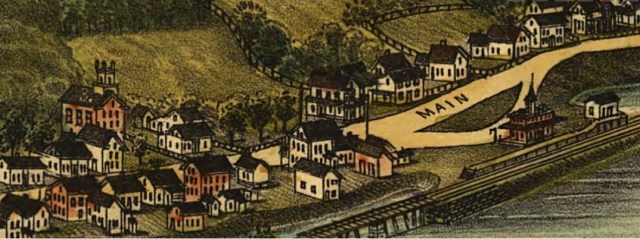
 Milton Observer