Milton and the Income Tax – 1911

By Muriel Bristol | August 15, 2019

The United States was created during its revolution as a loose confederacy of independent states, which then were drawn closer together under the constitution of 1789.

The federal government could not tax citizens of states directly. It could impose tariffs on foreign goods and it could vote “direct taxes.” Direct taxes were apportioned to the states by the relative sizes of their populations. Each sovereign state would then determine in what manner it would raise its apportioned share within its own borders.

With the exception of a Federal income tax imposed briefly as a Civil War emergency measure (see Milton’s US Excise Tax of May 1864), high tariffs and direct taxes were how the Federal government financed itself for the 120 years between 1789 to 1909.

Enter the Progressives, both Democrat and Republican.

DEMOCRATS’ TARIFF VIEWS. Want the Income Tax and Reduction on the Necessaries of Life. Washington, April 15. – For more than four hours the Democratic members of the senate conferred in an effort to agree upon a policy toward tariff legislation. At the end of that time it was announced that they had decided to support an income tax amendment and would present a solid front against any Republican opposition to an income tax for raising revenue. The conference also went on record favoring a general reduction on tariff schedules, particularly those relating to the necessaries of life (Portsmouth Herald, April 15, 1909).

Income Tax Amendments. Washington, May 22. – The coalition of Democratic senators and “progressive Republicans” has been broken so far as the income tax question is concerned, and amendments on that subject will be presented by Senators Bailey and Cummins (Portsmouth Herald, May 22, 1909).

But these advocates of a more “positive,” i.e., a more active, more powerful, and more intrusive, federal government managed to smooth over any differences. More positivity required more money, a lot more money, than tariffs and direct taxation could hope to provide.

Passed by Congress – July 12, 1909

The U.S. Congress passed a resolution on July 12, 1909, sending the proposed Sixteenth Amendment to the U.S. Constitution out to the States for ratification.

Sixteenth Amendment: The Congress shall have power to lay and collect taxes on incomes, from whatever source derived, without apportionment among the several States, and without regard to any census or enumeration.

Twenty-five States ratified the amendment between August 10, 1909, and March 2, 1911.

New Hampshire Rejects the Sixteenth Amendment – March 2, 1911

New Hampshire’s Progressive Republican Governor, Robert P. Bass of Peterborough, NH, pushed hard for passage of the measure. In so doing, he set aside New Hampshire’s own sovereignty in favor of some vague Progressive formulations about the needs of the federal government and the supposed dangers it faced. He asserted also the income tax’s “equity,” using a variant of the socialist dictum “from each according to his ability, to each according to his need.”

Depression-era bank robber Sutton would use that same reasoning some years later. When asked why he robbed banks, he supposedly answered, “Because that’s where the money was.” That is to say that banks, as repositories of money, were the ones best able to satisfy his “needs.”

URGES INCOME TAX. Gov. Bass Sends Special Message to New Hampshire Legislature Favoring Federal Support. CONCORD, N.H., Jan. 19. – Gov. Robert P. Bass today sent a special message to the New Hampshire legislature favoring the ratification by New Hampshire of the income tax amendment to the national constitution. “Loyalty to our country,” said Gov. Bass, “demands that we give to the national government every power necessary to protect and maintain itself under all circumstances and all dangers. An income tax is the most equitable form of taxation, because it draws upon the citizens directly in proportion to their ability to bear the burden.” The matter was made a special order in the house of representatives for next Wednesday. The special committee appointed to investigate the subject of railroad rates in New Hampshire organized today, and voted to employ as counsel Edmund B. Cook of Concord and Sherman E. Burroughs of Manchester (Boston Globe, [Friday,] January 20, 1911).

The New Hampshire House responded to the Governor’s Special request promptly. After 3 o’clock, on Wednesday afternoon, January 25, 1911, Rep. Ahern of Concord moved for a vote on House Joint Resolution No. 1, i.e., ratification of the Sixteenth Amendment.

On a viva voce vote the joint resolution passed and was sent to the Senate for concurrence (NH General Court, 1911).

A viva voce vote was a voice vote. So, no records of any particular yeas and nays would be kept, which was likely very much the point. (Therefore, there would appear to be no way to determine how Milton’s representative voted).

THE PUBLIC DRINKING CUP. New Hampshire Puts Ban on This Germ Distributor. Concord, N.H., Jan. 25. The knell of the public drinking cup in New Hampshire was sounded today when the lower branch of the Legislature, concurring with the Senate, passed a bill to give the state board of health authority to restrict the use of common drinking cups in public places. The bill is along the line of the one passed in Massachusetts a year ago. The House today also passed a bill providing for the registration of all cases of tuberculosis. This bill must go to the Senate before becoming a law. A resolution, ratifying the proposed income tax amendment to the federal constitution was passed by the House by viva voce vote and was sent to the Senate (Rutland (VT) Daily Herald, January 26, 1911).

[Tuberculosis was a health scourge at this time: a highly communicable, incurable, fatal disease. Withdrawing public drinking vessels made perfect sense. Authorizing at the same time an economically cancerous Federal income tax made much less sense].

THE INCOME TAX AMENDMENT. ONE of the results of the political overturn of last fall is the impetus that has been given to the ratification of the federal income tax amendment. This week the senate of North Carolina ratified the amendment by a vote of 42 to 1, and its passage, as far as that state is concerned, is assured. Ohio, which last year under republican auspices rejected the amendment, this year with democrats in control ratified it by an almost unanimous vote. During the year it is not improbable that 24 more states, the required number, will ratify and make the amendment effective. The roll of states that have adopted the amendment includes Alabama, Georgia, Kentucky, Illinois, Maryland, Mississippi, Ohio, Oklahoma, South Carolina and Texas, with North Carolina practically assured. Gov. Bass of New Hampshire has urged ratification and the situation in that state is favorable. Vermont, however, has turned down the amendment. In Maine favorable action is expected. In Massachusetts the house is regarded as favorable to it, and the governor is favorable, but the senate is in doubt. The final adoption of the amendment does not put any income tax law in operation. Congress must pass such a law before there will be an income tax. The legislation might not be passed readily. A graduated tax has been proposed, one that would bear lightly on small fortunes, but draw off a little of the swelling in. swollen fortunes (Boston Globe, January 27, 1911).

INCOME TAX IS APPROVED BY 13. Opposed by Virginia and Rhode Island. Senator Brown Sure States Will Adopt the Amendment. Thirty-Five Must Favor Measure to Do It. WASHINGTON, Jan. 31. – Before the adjournment of several state legislatures now in session the number of states that have ratified the amendment to the federal constitution providing for an Income tax will probably be considerably increased. Already 13 states have approved the Income tax proposition. Idaho being the latest to get onto the bandwagon. Others which have previously put their “OK” on the legislation are Illinois, Mississippi, Oklahoma, Georgia, Kentucky, Maryland, Alabama, South Carolina, Texas, Missouri, Kansas and Ohio. One house of the New Hampshire legislature has passed the ratification resolution and it is now before the other house. Virginia and Rhode Island are the only states that have so far refused approval. The majority, of the Virginia legislature thought that the adoption of the amendment would give the federal government and its officials too much authority to pry into the affairs of private individuals and state corporations. To make the amendment effective the ratification of 35 or 36 states – depending on how soon Arizona and New Mexico are admitted to the union – is required. The approval of 35 of the 46 states now in the union would be a three-fourths vote, enough to adopt the amendment. If the number do not ratify before the two territories now in the process of being made into states are formally admitted into the union, the ratification of one additional state will be necessary – three-fourths of 48 being 36. It has taken a year and a half for 13 states to give their approval. Senator Brown of Nebraska formally presented the income tax amendment to the senate June 17, 1909, during the tariff session of congress. Today Senator Brown expressed the belief that not a single state will ultimately withhold its approval. “I am confident,” he said, “that there will be unanimous verdict in favor of the Income tax amendment among the states. I have written to the proper officer of every state, calling their attention to the proposed amendment and pointing out the reasons for its adoption promptly. I have heard from every one of them, and upon their replies I base my expectations that no one will withhold ratification” (Boston Globe, February 1, 1911).

On Thursday, March 2, 1911, NH State Senator Hosford of Monroe moved that the whole Senate vote on accepting the Senate Judiciary committee’s recommendation on House Joint Resolution No. 1. (The Senate Judiciary committee was composed of Senators Charles H. Hosford of Monroe (R) (2nd District), Robert J. Merrill of Claremont (R) (7th), Alvin B. Cross of Concord (R) (10th), Alvin J. Lucier of Nashua (D) (20th), and John Pender of Portsmouth (R) (24th)). The Judiciary committee majority had voted (3-2) to recommend approval of the Sixteenth Amendment.

Nine NH state senators (39.1%) voted to accept that majority report of the Judiciary committee (i.e., indicating that they favored the Sixteenth Amendment): James O. Gerry of Madison (D) (5th District), Robert J. Merrill of Claremont (R) (7th), John W. Prentiss of Walpole (D) (8th), Arthur J. Boutwell of Hopkinton (R) (9th), Windsor H. Goodnow of Keene (R) (13th), Charles L. Rich of Jaffrey (R) (14th), Daniel W. Hayden of Hollis (R) (15th), Alvin J. Lucier of Nashua (D) (20th), and John Pender of Portsmouth (R) (24th).

Fourteen NH state senators (60.9%) voted instead to accept the minority report of the Judiciary committee (i.e., indicating that they opposed the Sixteenth Amendment): John Cross of Colebrook (R) (1st District), Charles H. Hosford of Monroe (R) (2nd), George S. Rogers of Lebanon (R) (3rd), Jonathan M. Cheney of Ashland (R) (4th), Charles H. Bean of Franklin (R) (6th), Alvin B. Cross of Concord (R) (10th), George H. Guptill of Raymond (D) (11th), Haven Doe of Somersworth (D) (12th), Charles E. Chapman of Manchester (R) (16th), Robert Leggett of Manchester (R) (17th), Michael E. Ahern of Manchester (D) (18th), Reginald C. Stevenson of Exeter (R) (21st), John W. Jewell of Dover (D) (22nd), and Clarence H. Paul of Portsmouth (D) (23rd).

NH Senate President William D. Swart of Nashua (R) (19th District) did not vote.

Milton’s state senator was among those that opposed authorizing a national income tax through ratification of the Sixteenth Amendment.

The viva voce vote on the amendment itself broke along the same lines as the votes on the Judiciary committee’s recommendation. The Senate clerk advised the House that the joint resolution had failed.

MESSAGE FROM THE SENATE. A message from the Honorable Senate by its clerk announced that the Senate refused to concur with the House of Representatives in the passage of the following joint resolution sent up from the House of Representatives: House Joint Resolution No. 1, joint resolution ratifying the Sixteenth Amendment to the Constitution of the United States of America (NH General Court, 1911).

The Sixteenth Amendment, having failed in the NH Senate, did not “progress” to Governor Bass for his signature.

Income Tax Killed. Concord, N.H., March 3. – The New Hampshire state senate, by a vote of 14 to 9, killed the resolution passed by the house some weeks since ratifying the income tax amendment to the national constitution (Portsmouth Herald, March 3, 1911).

Delaware Gets the “Final Honor” – February 3, 1913

Meanwhile, another ten states approved the amendment between March 16, 1911, and January 31, 1913, for a total of thirty-five of the necessary thirty-six states. At the end there was a bit of a “photo finish” for the “honor” of imposing a national income tax. Progressive President-elect Woodrow Wilson (D) wanted his home state of New Jersey to tip the balance, but New Mexico was also a contender. Unexpectedly, Delaware got in before either of them.

INCOME TAX IS NOW CERTAINTY. Amendment of Constitution Is Voted by States. Delaware Gets Final Honor. Washington, Feb. 4. The action of the legislature of Delaware in ratifying the income tax amendment to the constitution makes it part of the federal organic law. There was a lively race for the honor of being the pivotal state in the ratification of the amendment. To make it effective, the approval of three-quarters of the states was required. Up to yesterday morning thirty-five states had acted favorably and it was expected New Mexico would have the honor of “clinching’ the amendment, as its legislature was expected to take affirmative action yesterday. New Jersey was a close rival, and President-elect Wilson was very desirous that his state should swing first into line, but the fact that the New Jersey legislature did not reassemble until last evening put it at a disadvantage. In the meantime Delaware, which had not been in the limelight, got busy and ratified the amendment, heating out both New Mexico and New Jersey. Shortly after the news of Delaware’s ratification was received a Cheyenne dispatch announced that the Wyoming legislature had also ratified the amendment. The income tax issue was submitted to the states by unanimous vote of the senate and a 317 to 14 majority of the house on July 31, 1909. The amendment submitted was as follows: “That congress shall have power to levy and collect taxes on incomes, from whatever source derived, without apportionment among the several states and without regard to any census or enumeration.” Alabama led off the procession or ratifying states on Aug. 19, 1909, and by the end of 1910 the amendment had been approved by eight states. In 1911 the number was increased to thirty. In 1913, Arizona, Arkansas, Louisiana and Minnesota fell into line, making the total thirty-four, ratification by two more states being necessary to adopt the amendment. The states that have rejected the amendment are Connecticut, New Hampshire, Rhode Island and Utah. Florida, Massachusetts, New Jersey, New Mexico, Pennsylvania, Vermont and Virginia have taken no action on the amendment. Congress will enact a law to levy the tax, probably during the extra-ordinary session to be called by President-elect Wilson in March. The tax itself, its provisions and its limitations, are all left to congress. The new law probably would supersede the corporation tax and provide for a tax on all incomes above $5000, although there has been some sentiment in favor of making the limit as low as $4000. Congressional leaders who have been preparing for the final ratification by the states estimate an income tax would bring in about $100,000,000 a year to the government. Now that the tax is provided by the constitution, the proposed excise tax, framed by Democratic leaders in 1912 to meet the supreme court’s decision, which held a former income tax un-constitutional will be dropped, and some of its provisions may be included In the new law (Fitchburg Sentinel, February 4, 1911).

New Hampshire Gets Onto the Bandwagon – February-March 1913

For some reason, Vermont, Massachusetts, and New Hampshire felt some need to vote superfluous affirmations after Delaware had already tipped the scale. The bandwagon effect, one supposes.

A newly-elected (November 1912) New Hampshire House passed another viva voce, or voice vote, in favor of passage, on February 18, 1913; and a newly-elected New Hampshire Senate voted –  this time giving its approval – 20 in favor, to 2 opposed, on February 19, 1913.

Samuel D. Felker of Rochester (D) was the new governor. He had failed to win election outright and had instead been selected by the legislature. (He was the newly-selected Governor). His signature completed New Hampshire’s after-the-fact ratification process on March 7, 1913.

Enabling Legislation – March 1913

Three states had rejected the amendment outright: Connecticut, Rhode Island, and Utah. In Florida, it passed in just one branch of its legislature. Pennsylvania and Virginia took no action at all.

The Federal congress, being now authorized to impose national income taxes, set forth to do so immediately. In arguing for ratification of the Sixteenth Amendment, its Progressive proponents had claimed originally that it would not affect anyone making less than $10,000 per year. The goal posts moved to $5,000 per year by 1911. After passage, that figure reached down to include those making $3,500 per year.

INCOME TAX DOWN TO $3500. With indications that the proposed Income tax “bill would levy tribute upon all incomes above $3500, Representative Hull has begun the task of forming that measure. There has been a tentative understanding among members of the Ways and Mean Committee that the income tax bill would apply to all incomes above $5000. As the estimates of the revenues under the new tariff law are being made, however, it is suggested that the $5000 exemption will be too high and that an income tax upon incomes to the excess of $3500 will be necessary to supply the deficiency. The new income tax law will absorb the existing corporation tax law which now produces nearly $30,000,000 annually in revenues. In the absence of definite figures by experts of the Ways and Means Committee as to the inroads upon the treasury will be inevitable under the Underwood tariff bill, it is now estimated that the income tax must produce between $125,000,000 and $150,000,000 annually. Originally, Mr. Hull, who is the income tax expert of the House, favored a one per cent tax on all incomes above $5000 designated as earned incomes. On unearned incomes Mr. Hull suggested a 1 1-2 per cent tax, and graduated higher rate (Portsmouth Herald, March 22, 1913).

Those Progressives pushing the Sixteenth Amendment promised a better world for which only the rich would pay. (Aren’t we being told that even now?) In 1913, the somehow villainous ultra-rich were being defined as those making above $3,500 per year ($90,000 in 2018 dollars).

Frédéric Bastiat warned against governmental systems “by which everyone seeks to live at the expense of everyone else.” Margaret Thatcher warned that “eventually, you run out of other people’s money.”

But the Progressives were right, weren’t they? Only the rich have been taxed and Heaven was established here on earth. Well, no, it was Bastiat and Thatcher that were proved right. Income taxation’s definition of the rich “progressed” downwards to include nearly everyone and Heaven still awaits us.

Current Federal income tax schedules – after recent “tax cuts” – reach down to “touch” those making as little as $13,000. (That would have been those who were making as little as $507 per year in 1913).


The second of the ten planks in Karl Marx’s 1848 Communist Manifesto demanded “A heavy progressive or graduated income tax.” 


Mr. S.D. Plissken contributed to this article.


References:

Buenker, John D. (1981, May). The Ratification of the Federal Income Tax Amendment. Retrieved from object.cato.org/sites/cato.org/files/serials/files/cato-journal/1981/5/cj1n1-10.pdf

Find a Grave. (2009, September 9). Robert Perkins Bass. Retrieved from www.findagrave.com/memorial/41750126

NH General Court. (1911). Journals of the Honorable Senate and the House of Representatives of the State of New Hampshire, January Session, 1911. Retrieved from books.google.com/books?id=n3BNAAAAYAAJ

Rothbard, Murray N. (2017). The Progressive Era. Retrieved from mises-media.s3.amazonaws.com/The%20Progressive%20Era_0.pdf

Wikipedia. (2019, July 22). Progressive Era. Retrieved from en.wikipedia.org/wiki/Progressive_Era

Wikipedia. (2019, June 18). Robert P. Bass. Retrieved from en.wikipedia.org/wiki/Robert_P._Bass

Wikipedia. (2018, September 24). Samuel D. Felker. Retrieved from en.wikipedia.org/wiki/Samuel_D._Felker

Wikipedia. (2019, August 5). Voice Vote. Retrieved from en.wikipedia.org/wiki/Voice_vote

Milton in the News – 1911

By Muriel Bristol (Transcriber) | August 11, 2019

In this year, we encounter a new meat market, patent leather repairers wanted, a former business owner seeking employment, the Boston funeral of a Milton-native female physician, a forest fire, ice for sale, a Boston pickpocket, J.R. Downing’s passing, a new team captain, and shoe operatives wanted.

This was also the year of Milton and the Income Tax and Milton and the Gypsy Moth in 1911.


Fred Howard, a shoe factory finisher, aged forty-three years (b. NH), headed a Milton household at the time of the Thirteenth (1910) Federal Census. His household included his wife (of twenty-four years), Costilla [(Scruton)] Howard, aged forty years (b. NH). They owned their house free-and-clear, without any mortgage. Costilla Howard was the mother of one child [Effie], of whom one was still living. They were enumerated between the households of Hannah Wentworth, a widow, aged sixty-nine years (b. NH), and Sarah P. Haley, a widow, aged forty-eight years (b. NH).

A. Howard has opened a meat market at Milton, N.H. (National Provisioner, 1911).

Fred Howard kept a meat market on Main street in 1912. His house was at 9 School street. He was also a policeman.


Frank J. Currier, president of the Milton Shoe Company, sought patent leather repairers. Applications to be directed either to the factory in Milton or to his home in Lynn, MA.

MALE HELP WANTED. WANTED – Pat. leather repairers; good pay, steady work. Apply to MILTON SHOE CO., Milton, N.H., or F.J. CURRIER, 16 Greystone Park, Lynn, Sunday. dSu3t d30 (Boston Globe, January 1, 1911).


Some Milton business owner having sold his own business sought a good position in someone else’s enterprise instead.

SITUATIONS WANTED – MALE. WANTED, a good position – having sold my business for the best of reasons, I would like any good position where honesty and push are of value; am an American, 48 yrs. old, of good appearance and the best of habits; would prefer to qualify with a reliable wholesale house or manufactory as a traveling salesman, having had some experience, or any position of trust. P.O. Box 153, Milton, N.H. dSu10t d28 (Boston Globe, January 5, 1911).

Seeking business owners of a similar age in the census of the prior year, we find only Harry L. Avery, a fancy goods salesman, aged forty-six years; George W. Ellis, a laundryman, aged forty-eight years; and James H. Fletcher, a blacksmith, aged forty-seven years. Or someone not self-identified in the census as being a business owner.


Milton native Dr. Ann Sophia (Kenney) (Patch) Lindquist died in Boston, MA in March 1911.

She was born in Milton, circa 1863-64, daughter of Edwin and Mary A. (Wentworth) Kenney. She married (1st) in Farmington, NH, May 7 1884, Fredrick S. Patch, from whom she was divorced (after 1900). She married (2nd) in Boston, MA, April 28, 1905, Dr. Carl A. Lindquist; they were both physicians.

Carl A. Lindquist, a general practice physician, aged thirty-five years (b. Sweden), headed a Boston, MA, household at the time of the Thirteen (1910) Federal Census. His household included his wife (of five years), Ann S. Lindquist, a general practice physician, aged forty-two years (b. NH), and his niece [in-law], Eunice Kenney, aged twelve years (b. NH). They owned their residence in a four-family dwelling at 195 Huntington Avenue.

FUNERAL OF DR. LINDQUIST. Wife of Dr. Carl Lindquist Had Practice in Boston. Private funeral services took place yesterday afternoon for Dr. Ann S.K., wife of Dr. Carl A. Lindquist at the family home, 196 Huntington av. Rev Thomas Van Ness of the Second church, Copley sq. The body was taken to Forest Hills cemetery for interment. Dr. Lindquist died Saturday morning. She was born in Milton, N.H., and received her degree at Tufts medical in 1896. She engaged in practice in this city. Besides her husband she is survived by her father, a brother, and one son (Boston Globe, March 21, 1911).


Sanford and Springvale, ME, as well as Milton Mills, NH, experienced drought and forest fires in the Spring.

LOSS IN SANFORD. ME. Timberland Damaged Fully $10,000 – Fire in Night Reported at Milton Mills, N.H. SANFORD. Me., May 8 – Three fires, which were burning on as many sides of Sanford and Springvale last night, were well in hand today, but it was uncertain how soon further damages would be done when the wind freshened, as the ground was extremely dry and the wells are drying up, so there is little water with which to fight the flames. No buildings were burned, but the timberland damage was estimated at fully $10,000. Timber valued at half this amount was burned on Shaws Ridge in the eastern section of Sanford. A large amount of timber was burned at Milton Mills. N.H., north of Sanford, in the night. No buildings were reported burned (Boston Globe, May 8, 1911).


J.R. Downing & Company offered Milton ice by the train car-load. We know from other sources that each train car would take about thirty tons of ice.

ICE FOR SALE. Ice, in car-load lots, finest quality, situated in Milton, N.H. Apply to J.R. DOWNING & CO., Brighton, Mass. (Portsmouth Herald, August 18, 1911).


An East Milton man – more accurately “Acton Side,” Milton Mills – encountered a Boston city slicker who snatched his wallet.

GETS HIS MONEY BACK. Milton, N.H., Man Makes Friends With Stranger Who Steals His Pocket Book – Latter Goes to Jail. Edward H. Libby, 40, who is known to the police as a wire for the sharpers, who has been in state prison twice for picking pockets, was arrested again last night by policeman William Walsh at the North station, charged with the larceny of $76 from George H. Brackett of East Milton, N.H. Brackett arrived from New Hampshire last night, and Libby met him almost at the gate of the track upon which the train arrived. “I know you; you’re from New Hampshire. I am well acquainted with some of your folks,” spoke up Libby. Then there was handshaking, and Brackett said among other things that he came to Boston to attend the wedding of his brother in Waltham, whom he had not seem for 10 years. Over to a liquor store Libby and Brackett went, where a few drinks were bought. Libby suggested a visit to a moving picture show. But it was not taken. When walking up Canal st., Brackett produced his pocketbook, and while abstracting several bills to be put to immediate use, Libby snatched the wallet and ran. Brackett shouted stop thief, and a man stopped further outcry by saying he was a special officer and he would chase and catch the thief. This “special officer” was acting the part of the wire last night. In court today Libby was sentenced to six months in the house of correction, and Brackett received his money back (Boston Globe, August 18, 1911).

Mary E. Lowd, a widow, aged sixty years (b. MA), headed an Acton, ME, household at the time of the Thirteenth (1910) Federal Census. Her household included her daughter, Sarah D. Jewett, aged thirty-five  (b. ME), her son-in-law, Richard I. Jewett, a home farmer, aged forty years (b. NH), and her servant, George A. Brackett a general farmer, aged forty-one years (b. ME).


Here we bid farewell to Jeremiah Roberts Downing, one of the principal dealers in Milton’s ice industry, who died in Milton in October.

BRIGHTON DISTRICT. The body of James R. [Jeremiah R.] Downing, the well-known ice dealer of this district, who died of pneumonia at Milton, N.H., Tuesday, will be brought home for the funeral services which will be held at the home, 128 Kendrick st. tomorrow afternoon at 2 o’clock. Rev. Dr. William Allen Knight of the Brighton Congregational Church will officiate. The body will be sent to Kennebunkport, Me., Mr. Downing’s native home, for interment. Mr. Downing was on a business trip in Milton and Milbury when stricken. He left Brighton last Thursday. He was in the ice business in Brighton about 35 years. As a very young man he left Kennebunkport and went to New York, where he was employed by the Knickerbocker Ice Company. Later he came to Brighton and bought out a small ice business. At first he supplied the Abbatoyr [abattoir], but a natural business ability led him to increase his trade, until he finally had the entire district. Years ago he cut ice on Chandlers Pond near Lake st., old Frog Pond on Chestnut Hill av., Woolshop Pond on North Beacon st. and on a pond in the Faneuil district. Mr. Downing recently built a barn near his home on Kenrick st., which cost him $30,000. He was 66 years old and stood over six feet in height. His friends say of him that he was as big in heart as he was in body. He is survived by his wife and one son, Jeremiah. The family has a Summer home at Beechwood, Me. (Boston Globe, October 11, 1911).

Jeremiah R. Downing, an ice dealer, aged sixty-five years (b. ME), headed a Boston, MA, household at the time of the Thirteenth (1910) Federal Census. His household included his wife (of thirty-eight years), Elvina P. [(Ross)] Downing, aged sixty-four years (b. MA). She was the mother of two children, of whom one was still living. They owned their home at 128 Kenrick Street, free-and-clear, without any mortgage.


The New Hampshire College football team elected Philip Cowell Jones of Milton as its team captain for 1912. (Gov. Fred H. Downs had the college’s name changed to University of New Hampshire (UNH) in 1923).

JONES CAPTAIN FOR 1912. New Hampshire College Football Leader a General Athlete of Mark in the Institution. DURHAM, N.H., Nov. 16 – Philip C. Jones of Milton, N.H., was elected captain today of the New Hampshire College football team for next year. Jones is a star football player and one of the best all-round athletes in the junior class. Jones prepared for college at the Irving School of Tarrytown, N.Y., where he played on the baseball, football and basket-ball teams. Since entering New Hampshire he has played on the football eleven three years, the baseball team two years and the basket-ball team a year. Mr. Jones is also managing editor of The New Hampshire, secretary of the Christian Association and of the Athletic Association. He is a member of Kappa Sigma and the Casque and Casket (Boston Globe, November 17, 1911). 

Fred P. Jones, a general farmer, aged fifty years (b. NH), headed a Milton household at the time of the Thirteenth (1910) Federal Census. His household included his wife (of twenty-eight years), Emma C. Jones, aged fifty years (b. ME), his children, Robert E. Jones, aged twenty-two years (b. NH), Philip C. Jones, aged eighteen years (b. NH),  Elizabeth J. Jones, aged fifteen years (b. NH), and Alice V. Jones, aged thirteen years (b. NH); and his servant, Henry M. Bowens, a farm laborer, aged fifty-five years (b. Canada).

Philip C. Jones became a Presbyterian minister. Rev. Dr. Philip Cowell Jones died in Branford, CT, October 15, 1977.


The Milton Shoe Company sought still for sober, industrious machine operatives with various skills.

TAKE NOTICE. WE WANT pullers-over on Goodyear Welts, outside cutters, stitching-room help; to sober, industrious operatives we will guarantee 300 days’ work in a year at good pay; very cheap rents; best schools in New England. MILTON SHOE COMPANY, Milton, N H. Sud7t n26 (Boston Globe, November 27, 1911). 

Milton Shoe Co.’s offer of 330 days works out to fifty six-day weeks in a year. Their claim of Milton having then very cheap rents and the best schools in New England might have been mere advertising puffery, but they apparently made it without fear of contradiction.


Previous in sequence: Milton in the News – 1910; next in sequence: Milton in the News – 1912


References:

Find a Grave. (2013, November 7). George A. Brackett. Retrieved from www.findagrave.com/memorial/119931546

Find a Grave. (2010, April 15). Rev. Philip Cowell Jones. Retrieved from www.findagrave.com/memorial/51167425

National Provisioner. (1911 March 18). National Provisioner. Retrieved from books.google.com/books?id=9_XmAAAAMAAJ&pg=RA10-PA41

Wikipedia. (2019, August 1). University of New Hampshire. Retrieved from en.wikipedia.org/wiki/University_of_New_Hampshire

Milton in the News – 1910

By Muriel Bristol (Transcriber) | August 8, 2019

In this year, we encounter a fur coat thief, a persistent fire, new mill construction, a beer conviction, cold weather, a blacksmith wanted, ice for sale, a misidentification, shoe workers wanted, and more cold weather.

This was also the year of Milton and the Immigrants and Milton and the Progressive Pie.


A Boston man was arrested for the theft of a fur-lined coat from John E. Townsend of Milton Mills. (Townsend was the heir of the H.H. Townsend blanket factory).

ARRESTED IN BOSTON. Fur Coat Thief Captured by the Police of That City. Sheriff Myron Johnson of Union, N.H., was here today on his way to Boston where the police of that city will turn over to him a prisoner arrested on Friday for larceny of a fur coat at Milton Mills (Portsmouth Herald, February 5, 1910).

Houston Case Nol Prossed. DOVER. N.H, Feb 8. The complaint against Jesse G. Houston of Boston of breaking and entering the stable office of John E. Townsend of Milton, N.H., and stealing a fur lined coat valued al $75, was nol prossed today on motion of County Solicitor Dwight Hall. Houston was discharged (Boston Globe, February 9, 2010).

We have seen formerly that a substantial coat was a necessity for motorists driving the relatively open cars of the day. That would be especially the case in February. The “nol prossed” verb derives from the Latin legal term nol prosequi, i.e., despite an indictment, the prosecuter decided not to prosecute the defendant.

John E. Townsend, a woolen blanket manufacturer, aged thirty-nine years (b. NH), headed a Milton [“Milton Mills”] household at the time of the Thirteenth (1910) Federal Census. His household included his wife (of fourteen years), Eda B. [(Lowd)] Townsend, aged thirty-nine years (b. ME), and his children, Henry A. Townsend, aged twelve years (b. NH), and Agnes M. Townsend, aged ten years (b. NH).

Jesse B. Houston, a clubhouse steward, aged forty-six years (b. VA), headed a Boston, MA, household at the time of the Thirteenth (1910) Federal Census. His household included his wife (of twenty-two years), Lucy J. Houston, aged forty-three years (b. Canada), and his son, Jesse G. Houston, a private family chauffeur, aged nineteen years (b. MA). They rented their residence in a three-family dwelling at 60 Ruggles Street.

John E. Townsend would die in Milton Mills, September 8, 1914, aged forty-one years, eleven months, and thirty days.

As for the further adventures of the alleged coat thief:

Larceny and Forgery Charged. Jesse G. Houston, arrested late yesterday by special officer Lyons of the Back Bay Police Station, on a larceny charge, had an additional charge of forgery placed against him by Inspector Conboy, when he was arraigned before Judge Murray in the Municipal Court this morning. He was held in $500 on each charge for the Grand Jury. Special officer Lyons arrested Houston on a charge of the larceny of auto supplies worth $67 from a Massachusetts av. auto supply concern on April 12. When he was brought down town it was found that there was a warrant two years old against him on the charge of forging a check for $55 (Boston Globe, May 4, 1915).

The grand jury of 1915 returned “true bills,” i.e., felony indictments, against Jesse G. Houston for larceny, uttering, and forgery (Boston Globe, June 12, 1915). Passing bad checks was usually termed “uttering,” because the one “kiting” or passing the check was considered to be falsely vouching – or speaking – for its validity. Of course, as we have seen earlier, indictments are not convictions.


Coal-seam fires may burn for extended periods of times. There is one in Australia that has burned for at least 6,000 years. The coal bin of the defunct Salmon River Paper company was not a natural coal seam, but had enough fuel to be still burning eight months after ignited.

BIRDEYE VIEWS. Since the paper mill at Milton, N.H., was destroyed by fire last June the fire in the coal bin has never gone out, and on some days the smoke from it may be seen many miles away (Portsmouth Herald, February 10, 1910).

In the aftermath of the Salmon River Paper company’s fire, it was predicted that Spaulding Brothers would build a new mill. They acquired leases for the water privileges formerly enjoyed by burnt Salmon River Paper mill, and others.

BUILDING A NEW MILL. Rochester, Feb. 18. Already a large amount of building material has arrived at Milton for the building of the new mill by the Spaulding Brothers at what is known as the new flume, which place they purchased last fall and have since built a dam. The building will be commenced in the spring when a very large mill, over 300 feet in length three stories high and will be used in making gramophone barns, baskets and boxes which are now being manufactured at the old woolen mill in this city. The mill to be built at the Old Flume will be up-to-date in every way and when running full blast will give about 900 hands work (Portsmouth Herald, February 18, 1910).


Here we have the continuation of the South Milton beer arrest of an Italian immigrant millworker in the prior year. He was arrested as O.D. Berton, indicted as Odberton, and tried as either Attorio or Attonio Di Berto.

DOVER DOINGS. Dover, Feb. 18. The jury in the case of Michael Stanton of Somersworth, charged with liquor for sale, came in with verdict of not guilty. They were out about five hours. The case on trial Thursday was that of Attorio Di Berto of Milton, who was indicted under the name of Odberton, and whose name was later said to be O.D. Berton (Portsmouth Herald, February 18, 1910).

DOVER DOINGS. Dover, Feb. 19. – The trial of Attonio Di Berto, of Milton, who. was charged with keeping liquor for sale, resulted in a verdict of guilty, and the jury returned after being out about three hours. Out of three liquor cases being tried at this term of court two have resulted in convictions. Di Berto was fined $50 and costs on the charge brought against him. Court adjourned until Monday afternoon (Portsmouth Herald, February 19, 1910).

There is every reason to believe that Di Berto was not an accurate rendering of his name either. Had they not locked him up and extracted a substantial amount of money from him, for his victimless crime, it might almost be funny. (See also Milton and the Immigrants – 1910).


A February cold snap was compared to conditions in the Klondike region of the Canadian Yukon. The Klondike, and its severe weather, were well known from its gold rush of 1896-99.

IT WAS COLD ALL RIGHT. Well, it was certainly Klondike weather this morning and again demonstrates that the groundhog knew his game. At Milton the glass registered thirty degrees below zero while at Rochester it was twenty and twenty-eight (Portsmouth Herald, February 25, 1910).

It would seem that the groundhog had predicted six more weeks of winter (at the beginning of the month). These would be ideal conditions for Milton’s ice industry.


MALE HELP WANTED. BLACKSMITH, good shoer and jobber, steady job and good pay. CHARLES E. SMITH, Milton, N.H. dSu8t* mh18 (Boston Globe, March 18, 1910).


Mr. J.O. Porter’s Marblehead Ice Company ice was selling for 70¢ per ton Freight on Board (F.O.B.) in August 1910.

FOR SALE. ICE. FOR SALE, best quality, F.O.B. Milton, N.H.; freight to Boston 70c per ton; R.R. weights; price right. JOHN O. PORTER, Marblehead, Mass. (Boston Globe, August 20, 1910).


A Milton Italian immigrant “fit the description” of a Somersworth Greek immigrant who was wanted for murder.

SUSPECT NOT CAPSALIS. Man Resembling Alleged Slayer of Mrs. Capsalitsa Caught in Milton, N.H., But Released. SOMERSWORTH, N.H., Aug. 26. Acting City Marshal Thomas Joyal received word from Milton officials last that they had arrested on suspicion, a man whom they thought to be the Somersworth Greek, Nicholas Capsalis, alias Capsalakos, the alleged murderer of Maritsa Capsalitsa, his aunt. The suspect answered the description of Capsalis and looked like the latter’s published portrait. Marshal Joyal sent three officers to Milton in an automobile to identify and bring the prisoner here, should he prove to be Capsalis. They found, however, that the suspect was not Capsalis but was an Italian who bore a very strong resemblance to him. The suspect was released and the Somersworth officers returned after midnight. The story spread rapidly all over this section this morning that Capsalis had been captured and the police were besieged all the morning with telephonic inquiries and a stream of callers at headquarters (Boston Globe, August 26, 1910).


The Milton Shoe company had renewed its operations and hiring in the prior year. It would remain active through at least 1912. (It went into receivership in 1915).

SITUATIONS WANTED – MALE. WANTED – Closers, stayers, lining makers; good wages; steady work. Apply to MILTON SHOE CO., Milton, N.H. (Boston Globe, December 3, 1910).


The Salmon River Paper company of Milton burned down in June 1909. (As seen above, its coal bin was still smoldering). Its proprietor, William S. Lowe, decided not to rebuild. He removed instead to Kansas City, MO. Here he was sued by Harry A. Waldron.

Harry A. Waldron Recovers $3553. PORTSMOUTH, N.H., Dec. 8 – In the superior court this morning the jury in the action of Harry A. Waldron of Boston against W.S. Lowe of Kansas City, formerly manager of the Salmon River paper company, at Milton, returned a verdict of $3553 for the plaintiff, Waldron sued to recover $2900 which he alleged was owed him by Lowe (Boston Globe, December 8, 1910).

Harry A. Waldron, a paper mill supplies broker, aged thirty-nine years (b. MO), headed a Boston, MA, household at the time of the Thirteenth (1910) Federal Census. His household included his wife (of one year), Elinor M. Waldron, aged thirty-four years (b. Canada (Eng.), and his boarder, Mary C. Richards, a school teacher, aged thirty-eight years (b. MA). They resided in a rented house at 20 March Avenue.


The official thermometers of the Conway branch of the B&M railroad recorded another cold snap.

NEW HAMPSHIRE FRIGID. Mercury Ranges at Different Points from 4 Below at Portsmouth to 20 Below at North Conway. PORTSMOUTH, N.H., Dec. 31. This morning was the coldest of the present season, the glass being 4 below In the city and near-by towns. Reports from points along the Conway branch of the B & M R.R. are as follows: North Conway 20 below. Madison 21, Conway 18. Whittier 16, Sanbornville 12, Jewett 6, Union 18, Milton Mills 18, Ossipee 16 (Boston Globe, December 31, 1910).


Previous in sequence: Milton in the News – 1909; next in sequence: Milton in the News – 1911


References:

Find a Grave. (2013, August 12). John E. Townsend. Retrieved from www.findagrave.com/memorial/115352496

Wikipedia. (2019, May 12). Coal-Seam Fire. Retrieved from en.wikipedia.org/wiki/Coal-seam_fire

Wikipedia. (2019, July 19). Klondike Gold Rush. Retrieved from en.wikipedia.org/wiki/Klondike_Gold_Rush


Milton and the Progressive Pie – 1910

By Muriel Bristol (Transcriber) | August 4, 2019

Here we find an amusing tale of a surfeit of pumpkin pie received during a Thanksgiving journey from Portland, ME, to Cambridge, MA. This early automobile trip included a stop in Milton, NH.

Milton having just in the prior year become the southern terminus of the White Mountain Highway stretch of the state’s new Eastern Route.

[Ed. note: Progressive Pie was a party game originating in the 1890s. It was sort of a musical chairs with servings of pie.]


PROGRESSIVE PIE. Why Two Standard Delicacies Were Put on the List of Things Untouched by a Thanksgiving Guest.

The hostess looked chagrined as her guest left his generous section of pumpkin pie untouched.

She had only known him a short time, but her husband had insisted on bringing him out for Thanksgiving dinner.

“His folks are all away,” he explained, “and it would be tough if he had to dine at the club.”

Now she was awfully proud of that pie and to think that it was left begging hurt her dreadfully. And he hadn’t even taken a sip of the cider, the cider that uncle Ben sent all the way from Maine. The two crowning touches of her dinner were completely ignored.

True, he had eaten heartily of the turkey and fixin’s, but he might at least have made a bluff at eating her pie. It wasn’t courteous, but she couldn’t take her eyes off of that slice of golden goodness, and finally she said in a plaintive voice, “You don’t care for pie?”

“Madam, I don’t, came the prompt response.- That is, I don’t care for pumpkin pie. Any kind of pie but pumpkin pie. Apple, peach, plum, cranberry pie, lunch counter pie of any description but pumpkin. Pumpkin is my pet aversion, my bete noir.

“I know this is good pie and I should like to honor you by eating it, but never again will a morsel of pumpkin pie pass these lips without the use of an anesthetic.

“And I also include cider with the pie. The very sight of the combination makes gooseflesh on my spine, gives me palpitation of the medulla oblongata, produces chills followed by rapidly rising temperature.

“Madam, listen to my sad, sad story. You and your husband have been good enough to entertain me on this festal day and I know that you will not betray my confidence.

“When I was a small boy I adored pie. Pumpkin pie would make me forsake tops, marbles, three old cat or any of childhoods pleasures. And cider – why, madam, cider seemed to talk to me through stone walls. I would play hookey and hide in the storeroom with a straw and suck the liquid sweetness from the bung. My love for pumpkin pie and cider amounted to an obsession.

“Pardon these tears, but I find it hard to control my feelings as I recall the great change that came over me. It was just a year ago this morning that I was in Portland. I had just finished a business deal and was anxious to come to Cambridge and dine with a dear old aunt whose cooking would cause our worthy President to class her with Aunt Delia.

“As I was starting to the depot I met Tom Potts in his touring-car. He was just about to make the run to Boston and enticed me away from the certainties of railroad travel. In a moment of thoughtlessness I fell. We started at 8 o’clock after I had wired my aunt that I would be in Cambridge in time for dinner.

“I had indulged in a lunch counter breakfast and the sharp tang of the fall air whetted my appetite before we got well under way. We were about 15 miles out of Portland when a rusty nail reached up and bit a slice out of one of the tires.

“Tom may be able to drive a car, but he can’t qualify as an expert mechanician. It took him a couple of hours to get a new tire on and we had a nice audience before we were through.

“An old farmer with worsted whiskers watched us and offered suggestions. The only reason that I didn’t slay him was that just before we got under weigh he went to the house and returned with a bundle of hot pumpkin pie and a pitcher of cider. Now that was right where I lived and Tom and I made short work of it.

BG101124-1“Nearing Milton, N.H., the engine got hot and we had to make another stop. It was dinner time all along the line, and a hospitable farmer appeared at the roadside with a Thanksgiving offering of hot pumpkin pie and a pitcher of cider. And said offering was sacrificed on the altars of our appetites.
“At Portsmouth we were way behind time and I wired the aunt that I would be late getting in, but to save dinner. And two miles out of Portsmouth we picked up the little brother to the puncture we had met earlier in the day. Before we had that tire mended we were presented with hot pumpkin pie and cider by a dear old lady who just couldn’t think of anybody missing out on such delicacies on Thanksgiving.

“I was beginning to crave turkey and onion dressing and celery and bread when we ran into a culvert near Powwow river. We sprained something and while Tom was rubbing liniment on the running gear the afternoon wore well along and we had a caller. He was a nice old chap and said that he was sorry that we didn’t break down earlier so he could have asked us in -to dinner. He assured us that the girls were redding things up, but he insisted that we have some of his cider and pumpkin pie. Now for once in my life I had had enough pumpkin pie, likewise cider, but 1 didn’t have the moral courage to refuse.

“The next stop happened about 30 miles from Boston. We ran out of gasoline, and Tom trudged off to get some. He left me to guard the machine, and told me that if I got hungry before he returned that I would find some lunch under the back seat. I got hungry all right, and a little later I opened up the hamper and found a nice pumpkin pie, and one of those keep-it-hot or cold bottles, filled with – cider.

“It’s really too sad to speak about, and when Tom came back to the car he found me with my head bowed in grief and my salt tears splashing on the varnished tonneau.

“We made 10 miles on the next spurt, and then sat in the mist where the roads crossed, and were about to toss a coin to see which road should take when we heard somebody coming. He was a nice old codger and gave us the cheering information that we were off of the right track. Said if we’d wait a minute he’d get us a map.

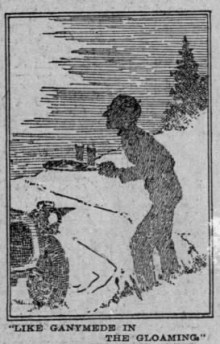
BG101124-2a“And then he reappeared out of mist, like Ganymede [cup-bearer of the Olympic gods], bearing cider and pumpkin pie. He had forgotten the map. We forgave him when he sent his son with us to the proper turn and we finally came in sight of Cambridge.

“My spirits began to rise, and while I didn’t expect to find the sizzling turkey intact on my aunt’s table, I knew that I could do justice to anything in the line of solid food, even if I had to eat it off the ice chest. I wasn’t as ravenous as I have been, but while a steady diet of pie and cider may be filling it is not always satisfying.

“Tom’s little machine was working beautifully now and he ran right up on the lawn by the side door. I looked through the window and saw aunty bobbing about and I was blessing her for the dear good cook that she was.

“Tom spilled a couple of honks out of the horn and saw aunty scurry to the door. She stood against the light and called out a welcome to us. We readily assured her that we were there and ready for dinner.

BG101124-2b“And now, madam, comes the saddest part of this sad, sad tale. ‘Bob,’ said aunty, ‘I kept dinner waiting three mortal hours and then uncle and the boys got so hungry that they couldn’t wait a minute longer, and when they sat down to the table they just cleaned that turkey to the last bone. But never you mind. I’ve saved some pumpkin pie and cider for you.’

“And when they brought me to I found myself unable to look at pumpkin or an apple without tremors.

“Madam, If you will pardon me, I will pass the pumpkin pie and cider but I would take another little slice of that dark meat and some stuffing” (Boston Globe, November 24, 1910).


See also Milton Automobiles in 1906-07Milton and the Eastern Route – 1909, and Milton, Straight Thru (North), in 1918


Milton Businesses in 1905-06

By Muriel Bristol (Transcriber) | August 1, 2019

Here is extracted the Milton business listing section from the Dover Directory of 1905-06. This Milton business listing is more comprehensive than many that have been available to us in prior years.

The bolded upper-case entries (with page numbers) were those that had purchased supplementary advertisements. We may deal with those advertisements in a separate article.

The abbreviations used were defined elsewhere in the directory as A.S.M.M. (or A.S., M.M.) for Acton [ME] Side; Far. for Farmington, NH; Leb. for Lebanon, ME, as in Lebanon, Lebanon Bridge, and Lebanon Side (Leb. s.); M. for Milton; M.M. for Milton Mills; p o for Post Office (or n p o for near Post Office); and prop. for proprietor.


MILTON

BUSINESS DIRECTORY

EMBRACING

A Classified List of all Trades, Professions and Pursuits in Milton, for the years 1905-06, arranged Alphabetically for each Trade, thus exhibiting, at a glance, the full address and Special Business of its Citizens.


Twenty miles northwest of Dover. R.R. stations at Milton, Union and Hayes, on B.&M. R.R., northern division. Milton Mills four miles from Union, stage twice daily. It was originally a part of Rochester. Incorporated June 11, 1802. Farming and manufacturing are the principal employments. Area, 25,000 acres. Population, 1,625.

Selectmen – Haven R. Jewett, Jos. H. Avery, Chas. A. Jones. Town Clerk – Harry L. Avery. Treasurer – Everett F. Fox. School Board – Forest L. Marsh, M.A.H. Hart, Frank G. Horne. Treasurer School Board – Forest L. Marsh. Board of Health – Dr. M.A.H. Hart, E.W. Fox, Harry D. Coles. Postmasters – Joseph H. Avery, Milton; E.T. Libby, Milton Mills. Deputy Sheriff, Charles D. Fox, Milton Mills. Constables, Hazen W. Downs, Charles E. Remick.


Agricultural Implements.

Apothecary.

Architect and Designer.

(Water Power Plants.)

Bakery.

  • Horne, H.F. (dealer), Main

Barrel Headings.

  • Mayo, L.S. & Sons Co., Leb. side, M.

Bicycle Repairer.

  • Knight, W.C., Toppan

Blacksmiths.

  • DUNTLEY, I.W., See p 791
  • RUDD, ALFRED A., 20 Main, M.M. – See p 796
  • WENTWORTH, J.E., 71 Main, M.M. – See p. 798
  • YOUNG, JAMES C., Leb. s. M. – See p 795

Blanket Mfr.

Boarding Houses.

  • BLAISDELL, S.G. MRS., Charles on hill
  • Hall, W.C. Mrs., Charles
  • Hodgdon, E.A. Mrs., 9 Church
  • Lindsey, M.E. Mrs., River, A.S.M.M.
  • PRESCOTT, C.H., Main – See p 795
  • Ramsdell, E.E. Mrs., A.S. at bridge, M.M.
  • Rowe, E.I. Mrs., 10 So. Main, M.M.

Boats to Let.

  • Brown, Everett E., B.&M. depot

Boot and Shoe Dealers.

  • Flye, A.M., 41 Main, M.M.
  • FOX, ASA & SON, Milton Mills – See p 797
  • Mason, H.S., Main
  • PINKHAM, N.G., Main – See p 793
  • WILLEY, J.D., Main – See p 793

Boot and Shoe Maker and Repairer.

  • Page, Joseph, Main opp depot

Boot and Shoe Machinery and Repairer.

  • PLUMMER, H., 28 Silver – See p 794

Boot and Shoe Mfrs.

Building Material.

Butchers.

  • HORNE, C.A., Main – See p 795
  • Pike, R.S., Milton Mills

Carpenters and Builders.

  • AVERY, JONES & ROBERTS – See page 791
  • Rines, Mark, Milton Mills
  • SHAW, A.B., Milton Mills – See page 797
  • Simes, Edward S., Milton Mills
  • SIMES, GEO. E., Milton Mills – See page 797
  • Webber, Everett S., South Main
  • WEBBER, ROYAL K., South Main – See page 791
  • WENTWORTH, HIRAM, 31-35 Church, Milton Mills – See p 796

Carriage Repairers.

  • Ayers, H.E. (painter), Milton Mills
  • DUNTLEY, IRA W., Main – See page 791
  • PRESCOTT, A.O., 11 Leb rd, A.S., M.M. – see page 798
  • YOUNG, J.C., Leb s., Milton – See page 795

Churches and Clergymen.

Cigars and Tobacco.

  • LIBBY, E.T., 15 Main, Milton Mills – See page 797
  • MUCCI, N., 44 Main, Milton Mills – See page 798
  • PAGE, ROBERT, 23 Main, Milton Mills – See page 798
  • WILLEY, J.H., 2 Main, Milton – See page 795

Civil and Hydraulic Engineer.

Clothing.

  • Horne, J.E., Milton Mills
  • LOVERING, J.S., 27 Church, Milton Mills -See page 798
  • Mason, H.S., Main

Coal and Wood.

  • Downs, H.W., 7 Silver
  • Pinkham, J.D., 8 Silver

Coffins and Caskets.

  • FOX, ASA A., 10 School, Milton Mills – See page 797

Confectionary and Fruit.

  • Horne, H.F., Main
  • Knight, E.G., Main
  • LIBBY, E.T., Milton Mills – See page 797
  • MUCCI, N., 44 Main, Milton Mills – See page 798
  • WILLEY, J.H., 2 Main – See p 795

Conveyancer, Claim and Collection Agents.

Crockery and Glassware.

  • FOX, ASA & SON, Milton Mills – See page 797
  • WHITEHOUSE BROS., Main – See page 792
  • WILLEY, J.D., Main, Milton – See page 793

Dentist.

Deputy Sheriff.

  • Fox, C.D., 10 School, M.M.

Designer of Water Power Plants.

  • JONES, I.W., Main, opp Leb. bridge, Milton – See page 794

Dressmakers.

  • Corkery, D.G. Miss
  • Rowe, E.I. Mrs., 10 So. Main

Dry and Fancy Goods.

  • FOX, ASA & SON, Milton Mills – See page 797
  • HART, LENA M., Main n p o – See page 781
  • Jones, C.D., Main
  • LOVERING, G.S., 27 Church, Milton Mills – See page 798

Embalmer.

  • FOX, ASA A., 10 School, Milton Mills – See page 797

Engineer (Civil.)

  • JONES, I.W., Main, opp Leb. bridge, Milton – See page 794

Express Company.

  • American Express Co., H.A. Beaton, agent, Milton; C.H. Fox, Milton Mills

Farm Products.

  • AVERY, B.H., 21 South Main – See page 792
  • HAYES, C.L., South Milton – See page 795

Fish and Oyster Dealer.

  • WENTWORTH, E.L., 14 Mill n Charles – See page 792

Flour and Grain.

  • WHITEHOUSE BROS., Main – See page 792
  • WILLEY, J.D., Main – See page 793

Furniture.

  • FOX, ASA & SON, Milton Mills – See page 797
  • MILLER, W.S., 46 Main, M.M. – See page 798

General Stores.

  • Flye, Arthur M., 41 Main, M.M.
  • FOX, ASA & SON, Milton Mills – See page 797
  • Lowd, F.H., 7 Main, M.M.
  • WILLEY, J.D., Main – See p 793

Gents’ Furnishings.

  • FOX, ASA & SON, Milton Mills – See page 797
  • Horne, J.E., 25 Main
  • LOVERING, G.S., 27 Church, M.M. – See page 798
  • Mason, H.S., Main, Milton

Grain and Feed.

  • EDGECOMB, C.R., 41 Leb rd, A.S., M.M. – See p 796

Grist Mill.

  • EDGECOMB, C.R., 41 Leb rd, A.S., M.M. – See p 796

Grocers.

  • BLAISDELL, S.G., Main, opp Leb bridge – See page 793
  • Flye, A.M., 41 Main, M.M.
  • FOX, ASA & SON, Milton Mills – See page 797
  • HALL, W.C. & CO., Charles – See page 793
  • Knight, E.G., Milton
  • Lowd, F.H., 7 Main, M.M.
  • MUCCI, N. (fancy), 44 Main, M.M. – See page 798
  • WHITEHOUSE BROS., Main – See page 792
  • WILLEY, J.D., – See p 793

Hairdressers.

  • Hargraves, William F., Milton
  • PAGE, ROBERT, Milton Mills – See page 797
  • Stackpole, C.A., Main, Milton

Hardware.

  • FOX, ASA & SON, Milton Mills – See page 797
  • MURRAY, DANIEL, Milton M. – See p 797
  • WILLEY, J.D., – See p 793

Harness Makers and Repairers.

  • Page, Joseph, Main, opp depot
  • Sanborn, Frank M., Milton Mills

Hats, Caps, etc.

  • FOX, ASA & SON, Milton Mills – See page 797
  • Horne, J.E., Milton Mills
  • Mason, H.S., Main

Hay Dealers.

  • WILLEY, J.D., – See p 793

Horseshoer.

  • RUDD, ALFRED A., 20 Main, M.M. – See p 796
  • DUNTLEY, IRA W., Main – See page 791
  • WENTWORTH, J.E., 71 Main – See page 798
  • YOUNG, J.C., Milton Mills – See page 795

Hotels.

  • CENTRAL HOUSE, J.H. Lord, Milton Mills – See page 796
  • MILTON HOTEL, C.L. Bodwell – See page 791
  • MILTONIA HOUSE, C.H. Prescott – See page 795
  • PHOENIX HOUSE, F.M. Chamberlin prop – See page 792
  • “THE SANDS” (summer), Milton pond, F.M. Chamberlin – See page 792

House Decorators.

  • GILMORE BROS., Milton – See page 791
  • MILLS, W.F., Milton Mills – See page 796

Ice Cream and Soda.

  • LIBBY, E.T., Milton Mills – See page 797

Ice Dealer (Retail).

  • CLEMENT, JOHN B., Plummer’s Ridge, M. – See page 795

Ice Dealers (Wholesale).

  • Downing, J.R.
  • Marblehead Ice Co.
  • Union Ice Co.

Insurance Agents.

  • Gage, J.M., Main, opp drug store.
  • MARSH, FORREST M., Milton Mills – See front cover

Jewelry and Watches.

  • LIBBY, E.T., Main, Milton Mills – See page 797

Justices of the Peace.

  • AVERY, B.H., 21 So. Main – See page 792
  • AVERY, H.L., Main – See page 791
  • FOX, E.F., Milton Mills – See page 797
  • FOX, E.W., Milton Mills – See page 797
  • Goodwin, G.H., W. Milton
  • JONES, CHARLES H., So. Main, 1 mile out – See page 793
  • MARSH, F.L., Milton Mills – See front cover
  • PLUMMER, B.B., Plummer’s Ridge – See page 795
  • Wentworth, L.H., W. Milton

Ladder Mfr. (Steel).

  • Cantelo Mfg. Co., Avery bldg, Lebanon side, M.

Ladies Furnishings.

  • HART, LENA M., Main n p o – See page 791

Laundry Agents.

  • Hargraves, W.F., Main
  • Knights, E.G., Main
  • LIBBY, E.T., Milton Mills – See page 797
  • PAGE, ROBERT, 22 Main, M.M. – See page 797
  • WILLEY, J.H., Main cor Silver – See page 795

Lawyers.

Leather Board Mfrs.

Libraries.

  • Milton Free Public Library, John U. Simes, librarian (600 volumes), Milton Mills
  • Nute Library, Mrs. F. Haley, librarian, Milton

Lumbermen.

  • AVERY, JONES & ROBERTS – See page 791
  • EDGECOMB, C.R. (dealer and sawyer), M. Mills – See page 796
  • Plummer, G.L. (p o Union)

Machinist.

  • PLUMMER, HAZEN, 28 Silver – See page 794

Manufacturing Companies.

  • BOYNTON SHOE CO. (shoes), Milton Mills – See page 794
  • United Box Board and Paper Co. (paper and card board)
  • SPAULDING, J. & SONS CO. (leather board and counters) – See page 794
  • TOWNSEND, H.H. (Estate), (blankets), Milton Mills – See page 794

Market Gardener.

  • FALL, G.G., So. Main – See page 792

Masons and Plasterers.

  • Rines, T.G., Remick av., Milton

Milkmen.

  • AVERY, B.F., 21 So. Main – See page 792
  • Buck, Herman L., Springvale rd, A.S., M.M.
  • Hapgood, W., Milton Mills
  • HAYES, L.C., So. Milton – See page 795
  • NUTE, GEORGE E., Nute Ridge, Milton, See page 792

Millinery.

  • Betts, E.E. Miss, Milton Mills
  • Corkery, Daisy G., Main
  • Horne, Olive A. Mrs., M.M.

Mill Supplies.

  • Mayo, L.S. & Sons Co., picker sticks, levers, arms, etc., Leb. side, M. – See page 348

Music Teachers.

  • DICKEY, M.S. (piano), 13 So. Main – See page 795
  • Jones, F.P. (piano), Plummer’s Ridge, M.
  • Kimball, Annie M. (piano), 10 Maple
  • Wentworth, Mary A. (piano), 35 Church, M.M.

Newspapers and Periodicals.

  • LIBBY, E.T., at p o M.M. – See page 797
  • PINKHAM, N.G., Main, Milton – See page 793

Notaries Public.

  • FOX, E.F., Milton Mills – See page 797
  • FOX, E.W., Milton Mills – See page 797
  • Looney, Walter E., 54 So. Main, Milton
  • MARSH, FORREST L., Milton Mills – See front cover
  • Wentworth, G.C.S., Main, M.

Oysters, Clams, Etc.

  • HORNE, C.A., Main, opp Leb. bridge – See page 795
  • WENTWORTH, E.L., 14 Mill, Milton – See page 792

Painters (Sign).

  • SHULMAIER, H.R., 15 Allens, Berwick, Me. – See Somersworth page 323

Painters and Paperhangers.

  • Connolly, T., Milton Mills
  • MILLS, WILLIAM F., Milton Mills – See page 796
  • Pinkham, Thomas H., 9 Maple
  • GILMORE BROS., 15 Silver and 14 So. Main – See page 791
  • Toppan, J.Q.A., M. Hotel, Toppan

Paints and Oils.

  • FOX, ASA & SON, Milton Mills – See page 797
  • WHITEHOUSE BROS., Main, M. – See page 792
  • WILLEY, J.D. – See page 793

Paper Mfrs.

  • United Box Board and Paper Co., off So. Main, Milton

Physicians.

Plumber.

  • MURRAY, D., Milton Mills – See page 797

Pool Rooms.

  • Hargraves, William F., Main

Provisions.

  • BLAISDELL, S.G., Main – See page 793
  • HORNE, C.A., Main, off Leb. bridge – See page 795
  • Pike, R.S., Milton Mills
  • Wentworth, George E., Main

Railroad.

  • BOSTON & MAINE R.R. – See page 34

Saw Mills.

  • AVERY, JONES & ROBERTS – See page 791
  • EDGECOMB, C.R., Leb. rd, A.S., M.M. – See page 796
  • Plumer, G.L., p o Union

School.

  • Milton Grammar School, R.M. Looney, 8 Church, Milton
  • Nute Free High School, C.E. Kelley, principal, 15 Far. rd, Milton

Soap Mfrs.

Stables.

  • CHAMBERLIN, F.M. – See page 792
  • LORD, J.H., Milton Mills – See page 792
  • MILTON HOTEL STABLES, Charles – See page 791

Stoves and Tinware.

  • MURRAY, D., Milton Mills – See page 797

Teamsters and Truckmen.

  • CLEMENT, JOHN B., Milton – See page 795
  • Pinkham, J.D., 8 Silver, Milton

Telephone Company.

  • N.E. TELEPHONE & TELEGRAPH CO. – See page 35

Toilet Articles.

Undertaker.

Wheelwrights.

  • DUNTLEY, IRA B., Main – See page 791
  • PRESCOTT, A.O., A.S., M.M – See page 798
  • RUDD, A.T., (iron work), 20 Main, M.M. – See page 796
  • WENTWORTH, J.E., 71 Main, M.M. – See page 798

Wood Dealers.

  • AVERY, B.F., 21 So. Main – See page 792
  • AVERY, JONES & ROBERTS, Main, Milton – See page 791
  • BODWELL, C.S., Milton Hotel, Toppan – See page 791
  • CLEMENTS, JOHN B., Milton – See page 795
  • Downs, H.W., 7 Silver, Milton
  • HAYES, L.C., So. Milton – See page 795
  • JONES, C.A., So. Main – See page 793
  • Jones, F.P., Plummer’s ridge
  • Pinkham, J.D., 8 Silver, M.

Woolen Goods Mfr.


Previous in sequence: Milton Businesses in 1904; next in sequence: Milton Businesses in 1909


References:

Bass and Company. (1905). Dover, Somersworth, Rochester, and Strafford County, N.H., Directory, 1905. Dover, NH: Bass and Company, 466 Central Avenue.

Milton and the Immigrants – 1910

By Muriel Bristol | July 28, 2019

In perusing the Thirteenth (1910) Federal Census schedules for Milton, as I am wont to do, I came across a rather unusual enumeration from a leather-board factory in South Milton.

The census enumerator, Bard B. Plummer, visited the site on April 23, 1910. He passed from the household of “Henery” B. Hayes, a farmer (home farm), aged fifty-six years (b. NH), to that of the mill superintendent. (Recorded on Page 3 of 32 Milton pages).

William A. Dickson, a leather-board mill superintendent, aged thirty-five years (b. MA), headed a Milton [“Milton-Town”] household at the time of the Thirteenth (1910) Federal Census. His household included his wife (of sixteen years), Hattie Dickson, aged thirty-four years (b. MA); his children, Marion I. Dickson, aged fourteen years (b. MA), Hazel M. Dickson, aged five years (b. NH), and Carolyn P. Dickson, aged two years (b. NH); and his in-laws William V. Newell, aged sixty-six years (b. MA), and Lucy H. Newell, aged sixty-six years (b. MA). The Newells had been married forty-six years, during which time she had been the mother of five children, of whom four were still living.

So far so good. Mr. Plummer passed next to a sort of worker’s hotel, dormitory, or barracks. Some forty leather-board mill laborers “boarded” there. They were all recorded as Alien immigrants, i.e., they were not yet Naturalized citizens. None of them spoke English. He gave their non-Yankee names a serious mangling.

[Ed. note: Recording the citizenship status of alien immigrants in the census was neither new nor unusual].

Plummer enumerated first the head of household, Thomas Peatri, aged thirty-four years (b. Greece). He had been longest in the U.S., having arrived in 1900. Under the CITIZENSHIP column, he was classed still as an Alien, i.e., not yet Naturalized. One supposes he had acquired in ten years some English and knew our little ways, and that was why he was taken to be “Head.” The others were all “Boarders.”

Next came nine other Greeks, also Aliens who had arrived between 1906 and 1909. Their names were mangled as Alec Porpas, aged twenty years (b. Greece), Uperslatey Kenaser, aged thirty years (b. Greece), John Punplato, aged thirty-eight years (b. Greece), Alcano Yunjar, aged nineteen years (b. Greece), George Stocklin, aged thirty-seven years (b. Greece), Spenta Chacton, aged eighteen years (b. Greece), John Delussule, aged forty years (b. Greece), Apostola Dumas, aged twenty-four years (b. Greece), and James Prapleton, aged twenty-six years (b. Greece).

Plummer hit a brick wall when he recorded the next twenty-six leather-board mill workers. Where he should have continued with the “NAME of each person whose place of abode on April 15, 1910, was in this family,” he instead wrote down their distinguishing numbers, #1 through #26, as issued them by the mill, and the explanation:

Impossible to get any thing from them more [-illegible-] for their names or any thing else.

They were all recorded as Aliens, who had immigrated between 1908 and 1910. A different and presumably later hand, perhaps that of Plummer’s census supervisor, noted that

These Greeks could not be enumerated better as they are only known as numbers in the factory and are going and coming every few days.

Finally Plummer enumerated four Italian workers who had names, although he recorded mangled versions of them: Antonio Dumnrio, aged twenty-five years (b. Italy), Giuseppe Palmapo, aged twenty-one years (b. Italy), Sauda Oamfans, aged eight years (b. Italy), and Aemelio De Bartolemo, aged twenty-two years (b. Italy). They too were all recorded as Aliens, who had immigrated between 1906 and 1908.

Previously, we have seen these Greek mill laborers – or some others using their numbers – when they aided the victim of Milton’s Murderous Lover – 1907. (The newspapers gave different versions of her French Canadian name in nearly every article).

We should note in closing that one of New Hampshire’s early settlers was “John Ammisoone the Greek,” who was at Great Island [now New Castle], NH, as early as 1659. God only knows his true name. His many descendants go by the name Amazeen.


My mother Thetis tells me that there are two ways in which I may meet my end. If I stay here and fight, I will not return alive but my name will live forever: whereas if I go home my name will die, but it will be long ere death shall take me. – Homer, the Illiad


References:

Noyes, Sybil, Libby, Charles T., and Davis, Walter G. (1991). Genealogical Dictionary of Maine and New Hampshire. Baltimore, MD: Genealogical Publishing Company

Milton in the News – 1909

By Muriel Bristol (Transcriber) | July 25, 2019

In this rather full year, we encounter an offer of Porter ice fresh from the pond, a Federal income tax proposed, a poverty ball, a fire at the Salmon River Paper mill, Ralph Farnham freshly remembered, a shoe magnate’s will proved, a power-boat injury, the Milton Shoe company resuming work, lady sales agents wanted, a realtor’s advertisement, a Boston Ice company conflagration, shoe stitchers wanted, a Women’s Relief Corps inspection, a backstabbing on a state highway road-gang, penstock boilermakers wanted, and a beer arrest (with that name confusion again).

This was also the year of Milton and the Eastern Route – 1909.


Milton ice merchant John O. Porter offered a discount price for ice taken directly from the pond.

ICE. BEST QUALITY, now loading from water; price right; large or small contracts. JOHN O. PORTER, Milton, N.H. (Boston Globe, February 22, 1909).

This option would save him the storage costs, which his client would then take upon himself, thus allowing Porter to sell his ice with the “price right.”


At the national level, Democrat U.S. Senators decided in this year to put forward a constitutional amendment that would authorize Federal income taxation.

DEMOCRATS’ TARIFF VIEWS. Want the Income Tax and Reduction on the Necessaries of Life. Washington, April 15. – For more than four hours the Democratic members of the senate conferred in an effort to agree upon a policy toward tariff legislation. At the end of that time it was announced that they had decided to support an income tax amendment and would present a solid front against any Republican opposition to an income tax for raising revenue. The conference also went on record favoring a general reduction on tariff schedules, particularly those relating to the necessaries of life (Portsmouth Herald, April 15, 1909).

Ironically,  their announcement came on April 15. It was proposed originally to “touch” only a handful of millionaires. We all know how that has “progressed” over time.


A Poverty Ball was a low-cost social event to which attendees were expected to wear their old clothes. Such costume balls were common from the 1890s through the 1930s. (“Terpsichorean” means dancing).

Odd Items from Everywhere. At a poverty ball given by the Terpsichorean club of Milton, N.H., the dancers were obliged to copy the order on plain baggage tags from a poster on the wall. All the refreshments the tired couples got during the intermission was cold water and ice cream. The ice cream was served on paper plates, and there was but one plate to a couple (Boston Globe, June 5, 1909).

The most ragged couple at a poverty ball might win a prize. People dressed too well might be fined. In this case, other frills have been omitted too. There were no dance cards: attendees are using baggage tags. (Might it have been held at the train station?) Refreshments were minimal and served on paper plates.

THE COUNTRY DANCE. The dance held at country homes, or the small summer or winter resort begins at an earlier hour than the dance in the city, and is more informal. In summer men often wear flannels and girls simple little evening dresses. The whole affair, including supper, is laid along simple lines, although, of course, in the matter of invitations, as well as the principles of etiquette, a dance in one place is the same as a dance in another. Special features, and, consequently, greater fun, are more possible at the country dance than at the formal city affair. The barn dance, the masquerade, a “Poverty Ball” where even the family dog questions ragged but picturesque costumes, the Mother Goose party, Calico Ball – all these are possible to the country hostess and may be entirely impromptu. Refreshments should be correspondingly simple (Lutes, 1923).


William S. Lowe was born in Missouri, circa 1855. He married in St. Luke’s Church in Denison, TX, August 6, 1878, Margaret E. “Maggie” Hughes. They lived in Texas, as late as 1880, Missouri, circa 1882-83, Ohio, circa 1884-85, and Lima, Missouri, in 1900.

William S. Lowe was president of the Salmon River Paper Company, in Milton, NH, from about 1905. He took up a paper mill described (in 1909) as having been established “about thirty years” before. (The Milton Manufacturing Co. appeared as a paper manufacturer in the Milton business directories of 1887, 1889, 1892, 1894; the Strafford Paper Co. so appeared in 1898; C.D. Brown & Co. in 1901; and the United Box Board and Paper Co. in 1904 (where our sequence currently ends)).

SALMON RIVER PAPER CO. (W.S. Lowe, Pres. and Treas.; M.H. Lowe, Vice Pres.; C.L. Lowe, Sec.) S.P., at mill. Two 800-lb., two 1200-lb., and one 2800-lb. Beating and three Jordan engines; one Four Cylinder and forty-seven Dryers. Water and Steam. Widest trimmed sheet, 75 inches. 48,000 lbs., 24 hours. High Grade Patent Whites and Colors, Single and Double Lined Manilas for Lithographic Work and Clay Coating; also Paraffined, Waxed and Waterproof Boards (Vance, 1908).

Note that the Salmon River Paper Company’s Vice President was Lowe’s wife, Maggie Hughes Lowe, and its Secretary was his middle daughter, Clara Louise Hughes.

W.S. Lowe was one of many manufacturers that lobbied a Congressional committee for a removal or reduction of wood tariffs in November 1908.

MILTON, N.H., November 16, 1908.

COMMITTEE on WOOD PULP IMPORTERS, New York.

GENTLEMEN: Regarding the tariff on mechanical and chemical wood pulp, this company is very much opposed to any increase of the duty; it would work an unnecessary hardship on consumers. We are paying now $42 for unbleached sulphite, the highest price I can remember. The duty on mechanical pulp should be taken off entirely. The price of this commodity is not regulated by duty but entirely by the water supply, and the ability of the grinders to operate. A drought creates high prices; plenty of water power, low prices. It is a low-priced product normally and the high freight rates from Canada and elsewhere makes a sufficiently high natural duty to always give domestic pulp an advantage of from $2 to $4 per ton. Yours truly, W.S. LOWE, Treasurer (U.S. House, 1908).

Fire destroyed the Salmon River Paper company on the night of Friday, June 10, 1910.

PAPER MILLS BURN. Salmon River Plant Loss Will Be $100,000. Fire at Milton, N.H., Due to Boiler Room Chimney. ROCHESTER, N.H., June 10 – One hundred employes were thrown out of employment and a property loss of $100,000 was caused by the destruction by fire of the Salmon River paper mills in the town of Milton, eight miles from this place, tonight. The blaze is supposed to have started about the chimney in the boiler room of the factory, which was a two-story wooden building. A heavy rain had wet the roofs of adjoining buildings and saved them from catching. W.S. Lowe of Portsmouth was the proprietor of the plant. The business was the manufacture of paper novelties. Mr. Lowe had partial insurance on the property (Boston Globe, June 11, 1909).

Fire Destroys Paper Mills. Milton, N.H., June 11. – One hundred hands were thrown out of employment and a property loss of $100,000 was caused by the destruction by fire of the Salmon River paper mills The blaze is supposed to have started in the boiler room {Portsmouth Herald, June 11, 1909).

MIGHT BUILD IN PORTSMOUTH. If the Water Power Supply Was Right for His Needs. W.S. Lowe, proprietor of the Salmon River Paper company’s plant at Milton, stated to a Herald reporter this morning that [it] is doubtful if he rebuilt his plant there. Said he: “I wish Portsmouth had water power near at hand. I should like to build my mill here as I would have a good labor market which is a question at Milton.” The fire started in the oil and waste house. The plant which was burned at Milton on Thursday night, was built about thirty years ago, and had been several times repaired. The equipment, however, was up to date, the paper machine having been installed six years ago at a cost of over $40,000. There were six beater engines and jordans in the mill. The power was mostly water, but there were two engines, one about 200-horse power, the other of half the size. The large one ran the paper machine, the small one helped in times of low water. About forty men were employed in two shifts, fifteen on the night shift, the others by day, with a pay roll of 500 to $800 per week (Portsmouth Herald, June 12, 1909).

W.S. Lowe did not rebuild. He returned instead to Missouri before year’s end. William S. Lowe, a paper manufacturer, aged fifty-five years (b. MO), headed a Kansas City, MO, household at the time of the Thirteenth (1910) Federal Census. His household included his wife (of thirty-two years), Margaret Lowe, aged fifty-one years (b. Canada (Eng.)), his children, Clara Louisa Lowe, aged twenty-eight years (b. MO), and Edna Lowe, aged twenty-six years (b. OH). Margaret Lowe was the mother of three children, of whom three were still living. They resided in a rented house at 2615 Forest Street.

MEANS A NEW MILL. Clash is Averted Between Two Big Companies. Great Falls and Spauldings Settle Water Privileges. MILTON. N.H., Aug. 9. – The threatened legal clash between the Great Falls manufacturing company of Somersworth and the J. Spaulding & Sons Co. of North Rochester, over the water privilege at the old flume, just below where the mill of the Salmon river paper company was burned last May [June], has been averted by the leasing of the water privilege by the Spauldings from their upper mill to the site of the burned mill. As a result the Great Falls company this morning called off its crew that was set at work last month to build a dam for a proposed electric power station. On this site the Spauldings will erect a leather board mill that will employ 500 hands. They are also negotiating for the water privileges held by the United boxboard and paper company under a lease from the Great Falls manufacturing company that runs until 1923. These rights include the site of the burned paper mill. As the paper company has no further use for the privilege it is understood that it will shortly sublet it to the Spaulding company. This will mean another mill for Milton. The Great Falls company owns the entire water privileges of the river from its mills at Somersworth to the Milton ponds (Boston Globe, August 10, 1909).


A Milton revolutionary soldier, Ralph Farnum – who had been the last living veteran of the Battle of Bunker Hill – was freshly remembered in a queries column of the Boston Globe, as he had been in articles printed during his final Boston visit in 1860, in which he had an audience with the King of England.

Last Survivor of Bunker Hill. To the Editor of the People’s Column – In answer to your request in the Globe of June 22, the last survivor of the battle of Bunker Hill was Ralph Varnum. A number of people of Milton, N.H., saw him take the team at that time, and one of them was named Samuel T.W. Duntlly. Ralph Varnum is buried in Acton, Me., and Eli Wentworth post 80 [89], G.A.R. places a flag on his grave every year. Milton, N.H. George I. Jordan (Boston Globe, June 29, 1909).

Farnum “took the team” in the sense that he served in the revolutionaries’ baggage train.


Then shall our names, Familiar in [their] mouths as household words, … Be in their flowing cups freshly remember’d. – Shakespeare, Henry V, Act IV, Scene III


Publication of probate information, even that of ordinary decedents, was a commonplace in newspapers of the past. In this case, the legatee in question was N.B. Thayer, founder of the N.B. Thayer & Co. shoe firm, which had a factory at Milton.

Noah Blanchard Thayer was born in Weymouth, MA, January 6, 1830 son of Nicholas and Thais (Shaw) Thayer. He married Lucy M. Newcomb. She was born in Randolph, MA, August 2, 1833, daughter of Samuel and Lucy L. (Blanchard) Newcomb. She died in 1895.

N.B. Thayer & Co. shoe manufacturers appeared in the Milton business directories of 1892, 1894, 1898, and 1904 (where our sequence currently ends).

Noah B. Thayer was one of six men who stood as sureties for the Weymouth tax collector’s $30,000 bond in March 1893. That tax collector paid off his mortgage, put all his property in his wife’s name, and skipped town with the remaining tax money. A “Bad Check Was Left Behind as Souvenir” (Boston Globe, December 5, 1894).

Noah B. Thayer, a shoe mfr., aged seventy years (b. MA), headed a Weymouth, MA, household at the time of the Twelfth (1900) Federal Census. His household included his daughter, Carrie McBride, a widow, aged thirty years (b. MA), his grandchildren, Edwin T. McBride, at school, aged six years (b. MA), and Margarie McBride, aged four years (b. MA), and his servant, Julia Keefe, a servant, aged twenty-four years (b. MA).

N.B. Thayer & Co., Inc., had “big” shoe factories at East Rochester and Milton, N.H., which were said to be “among the busiest in the country” in 1908 (Boot & Shoe Recorder, 1908). He died in Weymouth, MA, June 29, 1909.

WILL OF NOAH B. THAYER. Weymouth Man Leaves Bequests of $3000 for Son and Daughter. DEDHAM. July 10 – The will of the late Noah B. Thayer of Weymouth has been filed with the Norfolk registry of probate. The will was drawn April 27, 1906, and an accompanying codicil was drawn Sept 6, 1906. By the will $3000 is left to one son, Frank H. Thayer. To one daughter, Carrie M. McBride, is left $3000, and all the household goods and furniture. The remainder of the property is left to the children, Frank H. and Elmer F. Thayer and Carrie M. McBrlde. Frank H. Thayer is suggested for executor (Boston Globe, July 10, 1909).


Power-boats would have been a relatively recent development on the Three Ponds. It would seem that the injury was received inside the boat.

Boy Hurt in Power Boat. MILTON, N.H., Aug. 9 – While going from Northeast pond to Milton station early this morning Chester Batchelder, aged 12, of Lynn, caught his leg under the propeller shaft of the power boat and had the flesh badly torn and the bones broken. He was taken to the Lynn hospital (Boston Globe, August 10, 1909).

Ralph C. Bachelor, a shoe shop foreman, aged forty-two years (b. MA), headed a Lynn, MA, household at the time of the Thirteenth (1910) Federal Census. His household included his (second) wife (of eleven years), Bertha J. Bachelor, aged thirty-nine years (b. MA), and his children, Chester F. Bachelor, aged sixteen years (b. MA), and Everett B. Bachelor, aged fourteen years (b. MA). They resided at 20 Rand Street, which home they owned free-and-clear.


The Milton Shoe Co. appeared in Milton business directories of 1901, but not in that of 1904 (where our sequence currently ends). Here they are resuming production after a long hiatus.

HAD LONG BEEN IDLE. Factory of the Milton, N.H., Shoe Company Resumes Operations. MILTON, N.H., Aug. 13 – The large factory of the Milton shoe company, which has long been idle, has resumed operations. About 400 persons are employed (Boston Globe, August 13, 1909).

MALE HELP WANTED. WANTED – Two first-class vampers; steady work and extra good pay. Apply to MILTON SHOE CO., Milton, N.H. (Boston Globe, September 13, 1909).

Charles C. Keene may have been superintendent at the factory at this time. (He resigned from that position in August 1912 (Boot & Shoe Recorder, 1912)). The Milton Shoe Company, of Milton, N.H., manufacturers of children’s shoes, reportedly went into receivership in 1915.


The Warranty Shoe Manufacturing Company, at Milton Mills, sought lady shoe sales agents. These advertisements appeared in newspapers published in Norwich, CT, Boston, MA, and Barre, Burlington, Montpelier, and Rutland, VT.

WANTED. LADY AGENTS wanted. Hustlers earn $15 to $18 per week. Write us. Warranty Shoe Mfg. Co., Milton Mills, N.H. (Burlington Free Press, August 18, 1909).


A Milton realtor sought to sell property of all sorts, including even livestock, anywhere in New Hampshire. Apparently, it was to be done by mail.

THE REAL ESTATE MARKET. If you have a Store, Farm, Timber Lot or Live Stock anywhere in N.H., for sale, address Box 75, Milton, N.H. (Boston Globe, October 3, 1909).


Sparks from a passing B&M railroad locomotive caused a serious fire at the Boston Ice Company during the evening of Saturday, October 9.

Here we learn that the Boston Ice Company had also tenements for its employees, as did other firms in town. The ice company’s ice houses, stables, and tenements were situated at modern Utah Way.

NEW ENGLAND BRIEFS. The plant of the Boston ice company at Milton, N.H., with 13 houses, a stable and four loaded railroad cars was destroyed by fire last night. Treas. F.J. Bartlett in Boston last night estimated the loss to be about $75,000. Employes in nearby tenements had hard work to save their homes (Boston Globe, October 10, 1909).

One hopes that the horses (if any there were) got out of the stable. Rebuilding began soon after the fire.


The Andrews-Wasgatt Company, of Everret, MA, shoe manufacturers, who had advertised in the prior year for vampers, were seeking stitchers.

FEMALE HELP WANTED. STITCHERS on all parts of misses’ shoes. ANDREWS, WASGATT CO, Milton Mills, N.H. (Boston Globe, October 28, 1909).


Mrs. Emily E. “Emma” (Miller) Looney, acting in her capacity as Department President of the [Women’s] Relief Corps, was to inspect the State Relief Corps. The Women’s Relief Corps was the women’s auxiliary of the Grand Army of the Republic (G.A.R) Civil War veterans’ organization. (Her husband, the Hon. Charles H. Looney, had died in Milton Mills, April 23, 1902).

Personals. Department President Mrs. Emma E. Looney of Milton, N.H., will inspect the State Relief Corps on Friday afternoon, at G.A.R. hall (Portsmouth Herald, October 29, 1909).

Emma E. Looney, a widow, aged fifty-six years (b. NH), headed a Milton [“Milton 3-Ponds”] household at the time of the Thirteenth (1910) Federal Census. He household included her children, Walter Looney, a clerk at Central House, aged thirty-two years (b. NH), Robert M. Looney, a grammar school teacher [principal of the Milton Grammar school in 1905], aged thirty years (b. NH), Harry N. Looney, a shoe factory cutter, aged twenty-seven years, and John H. Looney, aged twenty-four years (b. NH). She owned their house free-and-clear, without any mortgage. [They resided at 54 South Main street in 1905].


A state road-gang laborer on the new Eastern route state highway perpetrated a serious assault upon another laborer.

STABBED IN THE BACK. Man Known Only as Philip, from Boston, Victim of Row at Milton, N.H. – Police Seek Joseph Crapna. MILTON, N.H., Nov 23. As the result of a row among laborers employed on the new state highway, a man who is known only by his first name, Philip, is suffering from a stab in the back, inflicted, it is alleged, by Joseph Crapna, aged 30, who escaped after the encounter, and who is being sought by Chief of Police James Rines. The affray occurred late Sunday night at lodgings in the Hart building. It is said that liquor flowed freely, and that the principals became excited over some old trouble. Philip had only recently joined the men, coming here from Boston. During the altercation Crapna suddenly pulled a stiletto, it is said, and stabbed Philip in the upper portion of the back, making an ugly gash near the shoulder blade. Crapna quickly disappeared. The victim bled profusely, but it is reported he will recover (Boston Globe, November 23, 1909).

There do not seem to have been any follow-up articles, so it might be that Joseph Crapna was never apprehended.


Penstock work would be work upon the sluice gate or water intake structures of a dam, of which Milton had several.

MALE HELP WANTED. TWO BOILERMAKERS wanted at once for penstock work at Milton, N.H. L. DOUGHTON, Milton, N.H. (Boston Globe, December 16, 1909).

Mr. L. Doughton has proven somewhat difficult to pin down. He may have been a mill superintendent or possibly an out-of-town dam contractor of some sort.


As we have seen, several factories in Milton had their own tenements, or residences, on their grounds for worker housing. A number of Italian and Greek immigrant workers were so domiciled in South Milton. (We encountered them previously helping the victim of Milton’s Murderous Lover in 1907).

On this occasion, we encounter an Italian immigrant factory worker running afoul of New Hampshire’s restrictive liquor licensing. We may recall that their factory housing was situated two miles out from Three-Ponds village. He had some bottles of beer, which he either vended or gave away to some of the other workers with whom he resided. For that he was arrested for “keeping liquor for sale,” which violated several aspects of the liquor law.

(If one were working a ten to twelve-hour workday, six days a week, and marooned in a workers’ tenement in the woods of South Milton, one might consider it a beneficial service, rather than otherwise, to have access to a bottle of beer after a hard day’s work).

Beer Seized at Milton, N.H. ROCHESTER, N.H., Dec. 23. Deputy Sheriff Frank I. Smith and Deputy Sheriff Elmer Clark of Dover and Deputy Sheriff William Hartford and policeman Harrison Rhines of Milton raided the boarding house of Demarta Odberton at Milton Tuesday night and seized a quantity of beer. Yesterday, before Judge Lawrence V. McGill, he was charged with keeping malt liquor for sale and was held in $200 bonds for the superior court (Boston Globe, [Thursday,] December 23, 1909).

Apart from the absurdities attendant to the liquor laws, we may again experience the hilarity arising from the various officials’ utter inability to comprehend the accused’s Italian name. The accused’s name was definitely not Demarta Odberton, nor anything like that.

We shall encounter the unfortunate Mr. Odberton, under yet other names, as he passes through the various court proceedings of the following year.


Previous in sequence: Milton in the News – 1908; next in sequence: Milton in the News – 1910


References:

Chilton Company. (1908). Boot & Shoe Recorder. Retrieved from books.google.com/books?id=CPAxAQAAMAAJ&pg=PA58

Chilton Company. (1912). Boot & Shoe Recorder. Retrieved from books.google.com/books?id=vto-AQAAMAAJ&pg=RA4-PA21

Find a Grave. (2008, October 5). Noah Blanchard Thayer. Retrieved from www.findagrave.com/memorial/30324570

Lutes, Della T. (1923). The Gracious Hostess: A Book of Etiquette. Retrieved from books.google.com/books?id=W6YvAAAAYAAJ&pg=PA212

U.S. House of Representatives. (1908). Pulp and Paper Investigation Hearings, April 25, 1908. Retrieved from books.google.com/books?id=Q91CAQAAMAAJ&pg=PA3193

Vance Publishing Corp. (1908). Lockwood’s Directory of the Paper and Stationary Trade. Retrieved from books.google.com/books?id=6A8AAAAAMAAJ&pg=PA94

Wikipedia. (2019, January 24). Henry B. Quinby. Retrieved from en.wikipedia.org/wiki/Henry_B._Quinby

Wikipedia. (2019, July 12). Penstock. Retrieved from en.wikipedia.org/wiki/Penstock


Milton and the Eastern Route – 1909

By Muriel Bristol (Transcriber) | July 21, 2019

In 1909, New Hampshire’s governor and his council chose the routes through which proposed (and legislatively-authorized) western, middle, and eastern state highways would run.

The news articles quoted here identify forthrightly the motivations of those making the choices. Their objects were more political than strictly economic or geographic ones: providing road access for less-developed low-population northern areas of the state, at the expense of taxpayers in the remainder of the state.

That the final selections addressed primarily political purposes, rather than purely engineering ones, was evidenced by the large attendance of the “prominent men” of the affected areas, and the “considerable pressure” that they brought to bear. The opinions of accomplished engineers were not mentioned as being relevant at all.

The prominent men of the northern logging industry and the Boston & Maine railroad would have had their “say” also. (The Conway branch of the B&M railroad aligned more closely with the route ultimately chosen). A cynic might suppose that it was their say that was dispositive.

The various possible Eastern route alternatives, which must have concerned Milton most nearly, ran largely over existing roads, at least so far as the mountain “notches.” As such, the choices were mostly a question of State officials “claiming” or “designating” particular existing roads as being henceforth “their” own state highway.

The routes passed over at this time would become state highways eventually. The chosen Eastern route took on the name “White Mountain Highway” at the Rochester-Milton town line.


In late July 1909, the governor and his council had not yet decided whether or not the Eastern route would run from Rochester through Milton, Wakefield, Ossipee, Tamworth, and Albany to Conway, as it does now. It might have run instead from Rochester through Farmington, New Durham, to Alton (as NH Route 11 runs now), then to Wolfeboro, Tamworth, Albany, and Madison to Conway.

GOVERNOR AND COUNSEL LISTEN TO ARGUMENTS FOR ROAD LOCATION. Governor Henry B. Quinby and the members of his council were in Concord Wednesday and gave up most of their time to a hearing of all parties interested in lay-out of the boulevard on the east side of the state authorized by the highway bill passed the last session of the legislature. There are to be three of these trunk lines, the east side, the central and the west side, and to date the route of the former seems to be the most seriously in dispute. From the coast the location of the road to Rochester is agreed upon. On leaving Rochester, however, the question is how shall it reach the mountains, the objective point of all the highways. There are two routes suggested, one through Milton Mills, Wakefield and Ossipee, and the other through Farmington, New Durham, Alton and Wolfboro, and then via Tamworth and Albany to Conway, or via Ossipee and Chocorua to Conway; or through Ossipee and Madison to Conway. The great interest in the proposition was shown by the large attendance of prominent men representing the towns through which it is desired the road should pass, which compelled the use of the supreme court room in the state library building. The hearing opened at 11:00 o’clock with the governor and the advisers occupying the bench and working under the notice that ten minutes would be given to the claims of each town interested. It took until nearly two o’clock before the final word had been said and an adjournment taken (Portsmouth Herald, July 22, 1909).

By mid-September 1909, the governor and his council made up their minds to continue the Eastern route from Rochester through Milton, rather than through Farmington. Milton was not specifically mentioned in the article, although it is what lies between the mentioned locations of Rochester and Wakefield.

ROUTES FOR THE STATE HIGHWAYS. The Big Undertaking of the State of New Hampshire. CONCORD, Sept. 18. – The governor and council at their meeting on Friday took up the location of the West Side road and, after considerable discussion, established the route, thereby completing the designation of the three trunk lines, as provided by act of the last legislature, and for the construction of which $1,000,000 was appropriated.

The road, as determined by them begins at the state line between Northfield, Mass., and Hinsdale, N.H., passes through Hinsdale, Winchester and West Swanzey to Keene; thence through Gilsum, Lempster and Goshen to Newport; thence through Croyden and Grantham to Hanover; thence following the Connecticut river, passes through the villages of Lyme and Orford, Piermont, Haverhill to Woodsville; thence through Bath and Lisbon villages lo Littleton; thence from Littleton over the hill by the Glessner estate to Bethlehem street; from Bethlehem street to the Twin Mountain House; thence from the Twin Mountain House to Whitefield, continuing through Lancaster, Northumberland, Groveton, Stratford and Columbia to the northerly terminus of the line at Colebrook.

There has been much pressure brought to bear upon the governor and council for other routes as well as for the route selected by them, and particularly from the vicinity of Rindge and Fitzwilliam, as well from Claremont and Newport. The route from Keene to Newport is through many small towns and over a country that has no means of transportation except over the highway. Besides furnishing better transportation facilities for the towns, this road it is believed, will open for development the territory that has previously been little known. There are no forbidding grades on the route, and there is plenty of material along the entire route for construction.

The middle road, previously selected, will enter the state at Nashua and have its northern terminal in a junction with the west side road at Twin Mountain, its route taking it through Manchester, Concord, Franklin, Laconia, Plymouth, Woodstock and other towns.

The East side road, also previously selected, will follow the ocean boulevard to Portsmouth, thence via Dover, the edge of Somersworth, Rochester, Wakefield, Conway, Pinkham Notch, Berlin, Errol and Dixville Notch, to Colebrook, which will be the terminal of both the Eastern and the Western roads.

The Crawford Notch road between Glen and Twin Mountain will afford a route through the heart of the mountains from the East road to the junction of the middle and West roads (Portsmouth Herald, September 9, 1909).

All of this was mirrored at the Town level. Historically, most New England roads have been privately built, for their owners’ purposes, and then, at some point, “accepted” by their respective Towns as being Town roads.


If we didn’t have state coercion, the argument runs, there would be no roads. There’d be a Sears store over there, and your house over here, and everyone involved would be standing there scratching their heads. – Thomas Woods


See also Milton, Straight Thru (North), in 1918, Milton and the Spaulding Turnpike, and Trip to Wildcat Shortened


References:

Wikipedia. (2019, January 24). Henry B. Quinby. Retrieved from en.wikipedia.org/wiki/Henry_B._Quinby

Wikipedia. (2019, July 14). Logrolling. Retrieved from en.wikipedia.org/wiki/Logrolling

Wikipedia. (2019, June 25). New Hampshire Route 16. Retrieved from en.wikipedia.org/wiki/New_Hampshire_Route_16


Milton in the News – 1908

By Muriel Bristol (Transcriber) | July 18, 2019

In this year, we encounter another Massachusetts ice shortage, a farm worker wanted, a Nute High school field trip, Rev. Dickey’s correspondence, and vampers wanted at Milton Mills.

This was also the year of the Hennessey kidnapping.


Massachusetts’ own ice harvest was again marginal, with Milton’s ice harvest again cited as one of its alternate sources.

ICE FAMINE THREATENING. Massachusetts So Far Has Very Little. Cutting in Progress to North With Fair Thickness. Cape and Rhode Island Districts Worst Off. Three weeks will probably settle the fate of the ice crop in New England for 1908. Ice dealers to the north of Boston are fairly confident of securing an ordinary supply, but to the south conditions are far from satisfactory. Last year at this time the ice houses were full and the companies were putting ln extra supplies. A considerable quantity of this surplus is still on hand and an attempt will be made to carry It over, notably about 250,000 tons on the Penobscot belonging to the American Ice company. There is also considerable last year’s ice in other parts of New England, but the small dealers are nearly cleaned out and are becoming anxious about the crop. The average thickness of the ice north of the Massachusetts line and 20 miles inland is about 10 inches. In some sections it runs to 12 or 13 Inches, and a little has been harvested. In the Berkshire hills and the Green mountains there is of course no danger of a famine, and dealers in other parts of Vermont see no cause for alarm, although lake Champlain is not yet closed in. Cutting has begun at Agawam, Mass., near Springfield with nine inches; at Milton, N.H., with 12 Inches; at Montpelier, Vt., with 12 inches; and at Holden, near Worcester, with 11 inches. It Is along the coast from Portsmouth, N.H., south that the famine threatens, especially at Plymouth, along cape Cod, and in Rhode Island. The average thickness of the ice on the ponds about Middleboro is not more than a few inches and some of the larger ponds are not frozen except along the edges. There is no ice at all on cape Cod. Dealers in those sections say that if the ponds and lakes do not show 8 or 10 inches by Feb 10 the local crop will again be a failure and that New Hampshire and Maine will have to furnish the supply for the summer. In former years the ice companies along the Penobscot harvested two or three million tons and the work gave employment to thousands of men. The capacity of the houses of the American ice company on the Kennebec at the present time is less than 500,000 tons, as many of the plants have been burned or gone into decay. The same is partly true of those on the Penobscot (Boston Globe, January 20, 1908).


MALE HELP WANTED. MAN wanted to do general work on farm. Address E.L.S., Milton, N.H; Box 229 (Boston Globe, February 20, 1908).


Here we find Nute High School Principal Clarence E. Kelley and Mrs. Mary B. (Plummer) Wallingford escorting fourteen students on a week’s trip to Washington, DC.

FOR WASHINGTON TRIP. Seventy-One Tourists Leave Boston Tonight for National Capital. Fifteen students and an instructor from the Milton, N.H., high school, 71 tourists from various parts of this state, 9 from Rhode Island, 7 from other parts of New Hampshire than Milton, and 2 from New York will start this evening on an excursion to Washington organized by George E. Marsters of 298 Washington st. The party will be conducted by Frank W. Lund. and the stayawav sightseeing will continue for one week. Here are the names of the fortunate ones: Miss Eliza L. Baker, Miss Josie M. [Calkins] Clakins, Miss Inez M. Colbath, Miss Elva M. Gowan, Miss S.B. Hutchins, Miss Rosamond E. Piper, Miss Marlon Tuttle, Miss Frances G. Wadleigh, Mr. Paul G. Baker, Mr. L.S. Drew, Mr. C.F. Hayes, Mr. C.P. Moulton, Mr. C.E. Piper, Mr. Dana C. Tuttle, Mr. Clarence E. Kelley, Mrs. Mary B. Wallingford, Milton, N.H. high school; Mr. and Mrs. C.W. Jenness, Farmington. N.H.; Mr. Horace J. Batchelder. Haverhill; Mr. Frank J. Batchelder, Haverhill; Mrs. E.B. Parsons, Springfield; Miss Josephine F. Ellis, Winthrop Beach; Miss Florence J. Weddleton, Chelsea; Mrs. S.J. Hatch, Boston; Mrs. L.A. Coombs, Shelburne: Mrs. W.H. Wright, Roxbury; Miss Maude R. Wright, Roxbury: Mrs. G.H. Hayes, Winthrop; Miss A.H. Hayes, Winthrop: Miss E. McWane. Newtonville; Mrs. Robert B. Edes, Newton; Miss Grace Montgomery, Newton; Mrs. J.H. Jones, Dorchester; Mrs. A.W. Hole, Dorchester; Mrs. Walter White, Malden; Mr. Wm. Murphy, Roxbury; Mr. Wm. D. Murphy. Roxbury; Mr. Thomas J. Murphy, Roxbury; Mr. and Mrs. H.N. Tucker, Boston; Mrs. F.B. Pratt, Boston; Mrs. G.O. North, Boston; Mrs. Geo. Lane, Winthrop; Mr. E.W. Marshall, Portsmouth, N.H.; Mrs. E.W. Marshall, Portsmouth, N.H.; Mrs. Geo. E. Miller, Suncook, N.H; Master J.G. Seaver, Woburn; Mrs. C.B. Holmes, Boston; Mrs. J.H. Robinson, Boston; Mr. Henry McCarty, Boston; Mrs. Henry McCarty, Boston; Mrs. M.B. Green, Boston: Miss Rebecca Bent, Somerville; Miss Emma B. Willcomb, Maynard; Mrs. L. Anderson, Boston; Mrs. A.B. Shepard, Andover; Miss Georgia Shepard, Andover; Miss Floretta Vining, Hull; Mrs. Edward Clark, Hull; Mrs. George Bates, Boston; Mrs. Adelia Page, Dorchester; Mrs. J.L. Gibbs, Waltham; Miss Grace T. Richards, Dorchester; Mrs. R.E. Page, Arlington; Miss Cora Watts, East Boston; Mrs. A.M. Gove. Dorchester; Mrs. Charles T. Crane. Braintree; Mrs. Belle Austrup, Worcester; Mrs. George Beane, Worcester; Miss Flora M. Scott, Worcester: Mrs. J.L. Scott, Worcester; Mr. and Mrs. George F. Morgan, Cambridge; Mr. and Mrs. S.C. Colbath. Alton, N.H.; Miss Mary Hallissey, Dorchester; Miss Alice R. Capen, Boston; Mrs. J.W. Ryan, Dorchester; Miss R.B. Ryan, Dorchester; Miss G.L. Ryan, Dorchester; Mr. and Mrs. A.S. Harriman, Haverhill; Mr. and Mrs. C.C. Dexter, Lowell; Mrs. A.F. Dearborn, South Acton; Mr. L. Coffin, Newton; Mr. I.A. McManus, Newton; Mr. and Mrs. J.H. Bates, Leominster; Mrs. C. Hemenway, Worcester; Mrs. Rufus Dixon, Worcester; Mr. and Mrs. W.L. Kirschner, New York; Mr. L.S. Whalen, Dorchester; Miss Susie Manchester, Newport, R.I.; Miss Lillie Manchester, Newport, R.I.: Miss Louise Goffe, Newport, R.I.: Miss Kate Stratford, Newport, R.I., Mr. Walter Sherman. Newport, R.I.; Mr. Harry Alger, Newport, R.I.; Mr. J. Paul Cozzens, Newport, R.I.; Mr. William Weaver, Newport, R.I.; Mr. Robert Shepley, Newport, R.I.; Messrs. Leland and Lawton, Boston; Mr. A.E. Clary, Boston; Miss Catherine Paulint (Boston Globe, April 17, 1908).

George E. Marsters ran a Boston tourist agency. His advertisements mentioned his representing foreign and American steamship lines, railways, hotels and resorts. He was willing to arrange tours under escort, private cars, foreign money, exchange, drafts, and letters of credit. He would have arranged for the escort, Frank W. Lund, who was himself a ticket, tourist, or travel agent, resident in Nashua, NH, as early as 1902.

Mrs. Wallingford was likely along as chaperone. She was the widow of Samuel W. Wallingford, who had died in 1899. She appeared as a farmer, aged fifty-five years (b. NH), in the Twelfth (1900) Federal Census. Her household included her sister, Frances W. Twombly, aged forty-nine years (b. NH), and her brother-in-law, John Twombly, a retired physician, aged fifty-one years (b. NH). Neither sister had any children.

Jessie Calkins, aged thirteen years (b. ME); Elva Gowan, aged nine years (b. NH); Rosamond E. Piper, aged eleven years (b. NH), and her brother Charles E. Piper, aged ten years (b. NH); Charles T. Hayes, aged nine years (b. NH), were all Milton students, although not yet attending the high school, at the time of the Twelfth (1900) Federal Census. They would have been aged between seventeen and twenty-one years at the time of the Washington trip.

Not all of Nute High school’s students necessarily lived in Milton. Nute High school also admitted “tuition students” from elsewhere. Iniz M. Colbath, aged ten years (b. NH); Lyle S. Drew, aged nine years (b. NH); Blanche S. Hutchins, aged ten years (b. NH); Dana C. Tuttle, aged eleven years (b. NH), and his sister, Marion Tuttle, aged nine years (b. NH), and Fanny G. Wadleigh, aged nine years (b. MA), all resided in Wakefield, NH, in 1900.  They would have been aged between seventeen and nineteen years at the time of the Washington trip.

Carroll P. Moulton, aged ten years (b. NH), resided in Ossipee, NH in 1900. Eliza L. Baker, aged twelve years (b. VT) and her brother, Paul G. Baker, aged ten years (b. VT), resided in Vergennes, VT, in 1900. They would have been aged between eighteen and twenty years at the time of the Washington trip.


Rev. Francis, former pastor of Ludlow, MA’s First Congregational church read out some letters from another former pastor, Rev. Myron P. Dickey of Milton.

GIVES LUDLOW $10,000. Old-Home Sunday Cheered by C.D. Rood. Many People Attend First Congregational Church. LUDLOW CENTER, Aug. 9. Just 275 persons attended “Old-home Sunday” at the First congregational church today and of those 21 men and 18 women were more than 60 years of age. An important matter was the receipt of a letter from Charles D. Rood stating that he had forwarded $10,000 for the benefit of Ludlow. The anthem “Invitation,” sung by a large chorus in the back gallery, began the service, and as they used to do, the congregation turned and faced them. Rev. Mr. Francis, pastor from 1895 to 1905, presided. He read letters from Rev. M.P. Dickey of Milton, N.H. a former pastor, and Mrs. Julius P. Bodfish of Washington, D.C. Rev. Mr. Rice of Agawam spoke. The congregation took their dinner under the trees (Boston Globe, August 10, 1908).


The Andrews-Wasgatt shoe company of Everett, MA, set up a branch factory in Milton Mills in this year. (They had experienced a strike at their Everett plant in 1907).

FEMALE HELP WANTED. VAMPERS on flat bed machines. ANDREWS-WASGATT CO, Milton Mills, N.H. (Boston Globe, December 27, 1908).

One of its partners, Herbert P. Wasgatt took his seat as alderman-at-large and chairman of the board of aldermen in Everett in January 1909 (Boston Globe, January 5, 1909).

The Andrews-Wasgatt company appears to have been active at Milton Mills through at least 1913 (Shoe & Leather, 1914; Boston Globe, January 7, 1924). Timson and Company, of West Epping, NH, purchased Andrews-Wasgatt’s Milton Mills factory in 1915 and moved their operation there.


Previous in sequence: Milton in the News – 1907; next in sequence: Milton in the News – 1909


References:

Shoe and Leather Reporter Company. (1914). Shoe and Leather Reporter Annual. Retrieved from books.google.com/books?id=st0-AQAAMAAJ&pg=PA284


Public BOS Session Scheduled (July 15, 2019)

By Muriel Bristol | July 14, 2019

The Milton Board of Selectmen (BOS) have posted their agenda for a Public BOS meeting to be held Monday, July 15, beginning at 6:00 PM.


The Public portion of the agenda has New Business, Old Business, Other Business, and some housekeeping items.

Under New Business are scheduled four agenda items or, rather, three Town officials, two of them with two or more sub-items: 1) Fee Schedule Adjustment (Bruce Woodruff); Townhouse Stewardship Committee (John Katwick), and Cemetery Capital Reserve Fund Request (John Katwick); and 4) Police Chief R. Krauss, a) Milton Mills Parking, b) Ordinance Workshop Request, and c) Town-Seized Tax-Deeded Properties.

1) Fee Schedule Adjustment (Bruce Woodruff). Mr. Woodruff is on the agenda to discuss reducing fees. Just kidding. In which direction would you suppose any Town fees would actually be “adjusted”? But will the BOS vote unanimously to do so?

2) Townhouse Stewardship Committee CIP Request (John Katwick). Mr. Katwick will request that something be put on the Capital Reduction Program™ conveyor belt. Perhaps he refers to the heating system discussed previously.

3) Cemetery Capital Reserve Fund Request (John Katwick). Moving funds around. This usually takes the form of spending money from somewhere and then replenishing that somewhere from the relevant fund.

4) Police Chief R. Krauss is himself an agenda item – again – with several more bones to pick.

  • Milton Mills Parking. One supposes that the Chief might like to reduce parking restrictions in Milton Mills. Just kidding. It seems more likely that he will be seeking more parking restrictions.
  • Ordinance Workshop Request. One supposes that the Chief hopes to reduce the number of Town ordinances. Again, just kidding. It seems more likely that he will be seeking more Town ordinances.
  • Town-Seized Tax-Deeded Properties. This agenda title seems a bit redundant. “Tax-Deeded” is the Town’s euphemism for a forcible tax seizure. So, we have here Town-Seized Town-Seized Properties. One imagines that one or more of the properties seized previously, and then described as being hazardous, and for which boundary fencing was discussed as essential some months ago, may have progressed to the point where the Chief thinks it should go beyond loose talk.

Under Old Business are scheduled two items: 5) Town Auction Property Status; and 6) 2020 Budget Status.

5) Town Auction Property Status. Time to sell the rest of it. And quick. Do you suppose the BOS can live on a Default budget? And there are the Chief’s safety concerns too.

6) 2020 Budget Status. Larger, the budget will be considerably larger. As will the tax burden. Be in no doubt. The BOS gave that “guidance” unanimously at their last meeting. (Selectman Rawson led the descent: “Yeah, I’m fine with that. It’s always been that way, since my tenure of being in town”).


Other Business That May Come Before the Board has no scheduled items.


Next, there will be the approval of prior minutes (from the BOS meeting of June 17, 2019, and the BOS Workshop meeting of July 1, 2019), the expenditure report, Public Comments “Pertaining to Topics Discussed,” Town Administrator comments, and BOS comments.


Mr. S.D. Plissken contributed to this article.


References:

Town of Milton. (2019, July 12). BOS Meeting Agenda, July 15, 2019. Retrieved from www.miltonnh-us.com/sites/miltonnh/files/agendas/07-15-2019_bosagenda.pdf