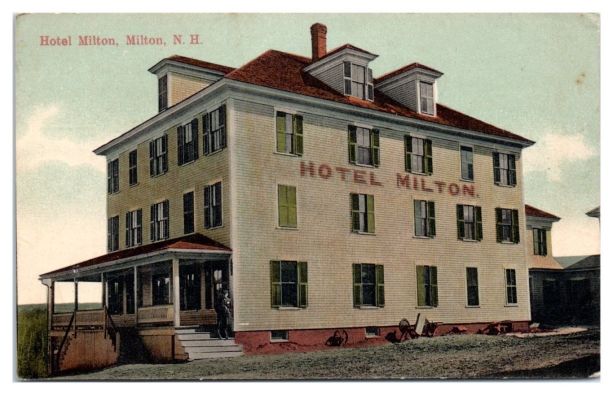
Milton in the News – 1895

By Muriel Bristol (Transcriber) |May 12, 2019

In this year, we encounter some hiring by a mill superintendent, the demise of a former mill superintendent, children for adoption, a would-be housekeeper seeking employment, several out-of-town visitors, the departure of an original Nute High School teacher, and Miss Merrill’s “miracle” cure.


Vermont native William T. Rockwell was the Varney & Lane shoe factory superintendent during the Milton Mills Shoe Strike of 1889. During which event he and his wife were allegedly threatened by the strikers.

Here he we find him recruiting factory help for a successor shoe factory (perhaps the W.T. Thayer [N.B. Thayer] company, whose proposed expansion was announced in 1894, or perhaps the Gale Shoe company, who leased the Varney & Lane factory at Milton Mills in this year).

SHOE FACTORY HELP WANTED. In factory just starting at Milton Mills, N.H., operators on all machines in making room, lasters and stitching room help; also first-class bottom finisher, to take job by case; also first-class stock fitter, to take job by case. Address W.T. ROCKWELL (Boston Globe, February 13, 1895).

William T. Rockwell removed to Burlington, VT, by 1899, where he became superintendent of the Lakeside Shoe Company (and thereafter to Pittsfield, MA).

William Rockwell, a shoe manufacturer, aged forty-nine years (b. VT), headed a Burlington, VT, household at the time of the Twelfth (1900) Federal Census. His household included his wife (of twenty-one years), Carrie Rockwell, aged forty-six years (b. VT), and her parents, [Narcise] Nelson Milete, aged seventy-two years (b. Canada), and Louise Milete, aged sixty-two years (b. Canada). They resided in a rented house on Park Avenue. Her parents were resident aliens, who had entered the country in 1870.

William T. Rockwell died of general paralysis (six months duration) at the NH Soldiers’ Home in Tilton, NH, September 28, 1906, aged fifty-five years, ten months, and twenty-six days. He had been resident there for two years; his previous residence was Pittsfield, MA. (He was born in Middleton, VT, November 2, 1850).

TROY. A telegram has been received announcing the death of William T. Rockwell, son of Mr. and Mrs. Anson Rockwell of this place. Mr. Rockwell had been in poor health for several years, and his death occurred at the Soldiers’ Home at Tilton, N.H. At the breaking out of the civil war he was attending school at Westfield and although only fourteen years of age walked to Hyde Park and enlisted. After his return from the war he learned the shoemaker’s trade, becoming very proficient, and had held some excellent positions. Mr. Rockwell leaves a wife, father and mother, and ten brothers and sisters. This is the first break in the family, of which Mr. Rockwell was the oldest child (Orleans County Monitor (Barton, VT), October 8, 1906).

The Pittsfield City Directory of 1906 listed Rockwell, Carrie A., wid. William T., h. 3 Forest pl. (She had removed to California by 1910).

Caroline A. (Milete) Rockwell died in Lakeport Village, Laconia, NH, May 21, 1935, aged eighty-one years, one month, and nineteen days.


The following obituary of Joseph Robinson tells his rags-to-riches life story. John Townsend employed him as his mill superintendent at the Milton Mills Manufacturing Company in the early 1850s.

Joseph Robinson was born in Hunslet, Yorkshire, England, May 9. 1812, son of James and Mary S. (Aspin) Robinson.

He married in Leeds, March 26, 1833, Frances Ann Lewis. She was born in Yorkshire, November 16, 1814, daughter of Thomas and Isabella (Theakston) Lewis.

Joseph Robinson, a dyer, aged twenty-five years, headed a Leeds, Yorkshire, England household at the time of the UK Census of 1841. His household included Frances Robinson, aged twenty years, Mary Robinson, aged seven years, Frances Robinson, aged three years, and Thomas Robinson, aged one year. (The UK Census of 1841 used five-year age ranges for adults: Joseph and his wife were aged 25-29 and 20-24 respectively). They resided on York Street, near its intersection with Morton Row.

TWO CENTS TO WEALTH. Joseph Robinson Started on a Small Capital. Lived to Enjoy Prosperity, the Oldest Maine Manufacturer. Was Father of 15 Children All of Whom Were Brought Up in Mill. OXFORD, Me., March 6. Joseph Robinson, Maine’s oldest woolen manufacturer, died at 7 this morning; after an illness of several weeks. Mr. Robinson was born In Leeds, Eng. in 1810, and at the early age of 9 years was apprenticed to the woolen manufacturing business, beginning as a bobbin boy, piecing and plugging bobbins behind a spinning jack. After serving his apprenticeship he went to Hamburg, thence to Reichtenburg, finally returning to Hamburg. He spent six years in these cities, working in woolen factories. Before leaving England he fell in love with a pretty English lass, Frances Lewis, and during his sojourn in Germany and in Austria their courtship was carried on by letters. When 27, with his young wife and infant son, he landed in Boston. His entire worldly possessions at that time consisted of the clothes upon his back and two copper pennies in his pocket. He kept those big old fashioned English pennies during his life-time, and was very fond of showing them to visitors and of relating how he began life in Boston upon a capital of two cents. He obtained work enough to earn the money to take him to Ballardvale, in which place there was then a small woolen factory. As he thoroughly understood the manufacture of woolens he readily obtained employment. Soon after John Townsend engaged the young Englishman to act as superintendent and dyer of his woolen factory at Milton Mills. N.H. A few years later the Norway Plains woolen mills at Rochester, N.H. advertised for a superintendent, and Robinson saw the situation. He lived in Rochester for a number of years and was able to save a little money. This he invested in a small woolen factory at Mill Village, Wolfboro, N.H. He soon had an opportunity to sell his interest in this factory; and moved to Oxford, Me, 36 years ago, and purchased the old Craige woolen mill of John Halt. The old Craige woolen mills are among the oldest, if not the oldest, in New England. After a long series of experiments Mr. Robinson succeeded in producing a more beautiful and permanent shade of blue than any other dyer had attained. With a roll of his peerless blue cloth under his arm. he went to Boston and called upon the largest wholesale house in that city. He was offered $2.50 a yard for all of the same kind of cloth that he could manufacture for three years. But the manufacturer was not satisfied with this offer, and went on to New York, calling upon, among others, A.T. Stewart. That far-seeing merchant at once closed a bargain with Robinson. “Jim” Fisk, then a peddler, came very near buying out Joseph Robinson at this time, and was only prevented from doing so by the fact that he could not raise sufficient money to close with Robinson’s offer. Some idea of the way Joseph Robinson drove his business at that time may be gathered from the fact that common spinners were able to earn $130 a month in this factory before the war, probably the highest wages ever paid tor this class of work. Early In 1862 the Robinson manufacturing company was incorporated, consisting of H.L. Libby, a Portland millionaire, and Mr. Robinson. The latter retained 60 percent of the stock. The working capital was increased to $300,000, and during war times the factory was driven to its utmost capacity. Most of the soldiers who went from New Hampshire were arrayed in the “fadeless Oxford blue.” The most remarkable fact connected with Joseph Robinson’s life is that during the many years in which he was engaged in making woolen cloth, he never had a single labor trouble of any kind. As he once said, since he had a factory of his own he moved among his hands more like a father among his children than a superintendent. Most of his employes have worked for him the larger portion of. their lives, some of them for 35 years. When the agitation favoring a 10-hour law began Joseph Robinson was the first large manufacturer in Maine to place his signature on a petition in favor of such a movement, though he claimed the law ought to be a national one. In personal appearance he was light complexioned, with the very red cheeks peculiar to Englishmen He was about 6 feet in height, with shoulders perfectly erect, in spite of his size, and with a thick-set, massive figure indicative of health and unusual strength. He was the father of 15 children, and he outlived all except six of them. His children were all brought up to earn their daily bread by daily labor, and the most of them have at some period of their lives worked as day laborers in their father’s factory. (Boston Globe, March 7, 1895).

Gilman Jewett, a postmaster, aged seventy-three years (b. NH), headed a Milton household at the time of the Seventh (1850) Federal Census. His household included Ann Jewett, aged fifty-nine years (b. NH), Joseph Sharp, a manufacturer, aged forty years (b. England), Hannah Sharp, aged twenty-five years (b. England), Benjamin Sharp, a manufacturer, aged twenty-five years (b. England), Susan A. Hubbard, aged sixteen years (b. ME), Susan S. Nutter, aged forty years (b. NH), John McDonald, a tailor, aged thirty-five years (b. Scotland), and Joseph Robinson, a manufacturer, aged thirty-six years (b. England). They lived in close proximity to the households of John Townsend, agent of the Milton Mills Manuf’g Co., aged forty-three years (b. England), and Benjamin Hubbard, a Baptist clergyman, aged thirty years (b. ME).

John Bailey Robinson, son of Joseph and Frances A. (Lewis) Robinson, was born in Milton, NH, August 16, 1852.

Joseph Robinson, a manufacturer, aged forty-eight years (b. England), headed an Oxford, ME, household at the time of the Eighth (1860) Federal Census. His household included Frances M. Robinson, a housekeeper, aged forty-six years (b. England), Frances A. Robinson, works in factory, aged twenty-one years (b. England), Emily Robinson, works in factory, aged sixteen years (b. England), Louisa Robinson, aged twelve years (b. MA), Lucretia Robinson, aged ten years (b. MA), John Robinson, aged seven years (b. NH), Celina Robinson, aged five years (B. NH), Henrietta Robinson, aged three years (b. NH), and Albert Robinson, aged one month (b. ME). His real estate was valued at $6,000 and his personal estate was valued at $200.

Joseph Robinson, a woolen manufacturer, aged fifty-eight years (b. England), headed an Oxford, ME, household at the time of the Ninth (1870) Federal Census. His household included Frances A. Robinson, keeps house, aged fifty-six years, Emily Robinson, at home, aged twenty-six years (b. England), Louisa Robinson, works in wool mill, aged twenty-one years (b. MA), Lucretia Robinson, works in wool mill, aged nineteen years (b. MA), John Robinson, works in wool mill, aged sixteen years (b. NH), Salina Robinson, at home, aged fourteen years (b. NH), Henrietta Robinson, at school, aged twelve years (b. NH), Albert Robinson, at school, aged eight years (b. NH [SIC]), and Mary Fry, works in house, aged twenty-two years (b. NH). His real estate was valued at $25,000 and her personal estate was valued at $2,500.

Frances A. (Lewis) Robinson died in Oxford, ME, November 9, 1890. Joseph Robinson died in Oxford, ME, May 8, 1895.

The Robinson Manufacturing Company mill, in Oxford, ME, remained open (and in the family) until 2004.


For Adoption. FOR ADOPTION. – Two pretty American female children, respectable parentage, one 1 years, one 16 months. For further particulars address box 23, Milton, N.H. 2t* ap25 (Boston Globe, April 26, 1895).


Miss Bartlett sought a housekeeping position. Note that she did not wish to be alone in the house with the widower (and his children). Presumably for propriety’s sake. Without more information, it is difficult to say much more about the competent Miss Bartlett. (She does not appear as such in the Twelfth (1900) Federal Census).

Situations Wanted. SITUATION wanted as housekeeper in widower’s family where other help is kept, by a competent lady of 23 years. Address Miss BARTLETT. box 30. Milton. N.H. (Boston Globe, May 31, 1895).

This advertisement might be compared with that of the husband and wife team that sought work on a farmstead in 1894, or the former teacher that sought either bank, office work, or to act as a ladies companion in 1893.


Elmer I. Hapgood was born in Hudson, MA, June 24, 1871, son of Wilbur and Maria E. (Mills) Hapgood.

Wilbur Hapgood, a farmer, aged forty-two years (b. MA), headed a Milton household at the time of the Tenth (1880) Federal Census. His household included his wife, Maria E. Hapgood, keeping house, aged thirty-nine years (b. MA), his children, Willie G. Hapgood, at home, aged sixteen years (b. MA), Elmer I. Hapgood, aged nine years (b. MA), [his mother,] Sally [(Wetherbee)] Hapgood, keeping house, aged seventy-two years (b. MA), and her grandchild, Leslie Felton, at home, aged thirteen years (b. MA).

Elmer Hapgood married in South Royalton, VT, August 16, 1891, Mary L. “May” Woodward. He was a shoe laster (possibly displaced by the Milton Mills Shoe Strike of 1889). She was born in South Royalton, VT, August 15, 1875, daughter of John W. and Melissa M. (Ellsworth) Woodward.

South Royalton Notes. Elmer Hapgood and wife are visiting friends at Milton Mills, N.H., during his vacation (Herald and Courier (Randolph, VT), August 8, 1895).

South Royalton. Mr. and Mrs. Elmer Hapgood returned from Milton Mills, N.H., last Saturday after spending two weeks at his father’s (Landmark (White River Junction, VT), August 23, 1895).

John W. Woodard, a house painter, aged sixty-one years (b. VT), headed a Royalton, VT, household at the time of the Twelfth (1900) Federal Census. His household included his wife, Melissa M. Hapgood, aged fifty-three years (b. VT), and his boarders, Charles W. Marston, a general store merchant, aged forty years (b. NH), and Thomas Arnold, a general store clerk, aged twenty-two years (b. VT). Woodard owned their farmstead free-and-clear, without any mortgage. He shared his two-family dwelling with the household of Elmer Hapgood, a shoe factory McKay stitcher, aged twenty-eight years (b. MA), and his wife, Mary L. Hapgood, aged twenty-four years (b. VT). They were renters.

Elmer I. Hapgood’s sister, Carrie M. Hapgood, died in Milton, NH, June 22, 1902, and his father died here, November 6, 1908.


Summer visitor Alma Giduz was born in Germany, in February 1878, daughter of Bernard and Laura (Russack) Giduz. Her family emigrated to the United States in 1882.

Local Lines. Miss Elma Giduz will spend a few weeks in Milton Mills, N.H. (Boston Globe, August 18, 1895).

Bernard Giduz, a grocer, aged fifty-one years (b. Russia), headed a Boston, MA, household at the time of the Twelfth (1900) Federal Census. His household included his wife (of twenty-five years), Laura Giduz, a bookkeeper, aged forty-six years (b. Germany), his children, Hedwig, a houseworker, aged twenty-four years (b. Germany), Alma, a piano teacher, aged twenty-two years (b. Germany), and Hugo Giduz, at school, aged seventeen years (b. Germany), and his brother, Adolph Giduz, a cigar maker, aged forty-six years (b. Russia). They shared a two-family dwelling at 105S Lamertine Street with the household of Martin Gatley, a wagon driver, aged thirty-eight years (b. Ireland).

We hear of Miss Giduz next in Butte, MT, where she advertised as a teacher of pianoforte from about 1910. Her brother, Hugo Giduz, accompanied her, both to Montana and on the violin.

SOCIETY. BUTTE WELCOMES A MUSICIAN. Butte musicians are fortunate in being able to introduce Miss Alma Giduz, a recent arrival from Boston, Mass., where she was prominent in musical circles for a number of years and has had great success as a teacher of the piano. Miss Giduz has had splendid opportunities and a thorough musical education. She studied at the New England Conservatory of Music under professors Charles Dennee; and Rudolph Carpe. Mr. Dennee is especially remarkable for his beautiful compositions. Miss Giduz also studied at Radcliffe, where she took theoretical work with Professor Spaulding of Harvard University. At college Miss Giduz took an active part in musical organizations. She is a graduate of the American Institute of Normal Methods, Boston, Mass. Apparently there is always room in Butte for musicians and Miss Giduz has received a warm welcome from many friends here who knew her previously and will be glad to see her remain here and make Butte her home (Butte Daily Post (Butte, MT), January 8, 1911).

Miss Giduz went on to teach piano for another fifty years.

Alma Giduz, Piano Teacher, Dies in Brookline. Alma Giduz, a piano teacher in Boston for many years died at her home on Babcock st., Brookline. A graduate of the New England Conservatory of Music, Miss Giduz had taught music previously in Simsbury, Ct., and Butte, Mont. During World War I, she served as a Y.M.C.A. entertainer at army bases. She leaves a niece, Bernice G. Schubert, of Maryland, and a nephew, Roland Giduz of North Carolina. Funeral services will be private (Boston Globe, [Monday,] July 24, 1961).


Here we hear a glowing report of Miss Sarah L. Benson’s literary lecture in North Conway, NH, and her departure for the Framingham Normal School. She was one of the original teachers at Milton’s Nute High School. She taught there for four years, between the 1891 and 1895.

BRATTLEBORO. The following highly complimentary mention of Miss Sarah Benson of Brattleboro is from the North Conway correspondence of a New Hampshire paper: “The fine lecture on Whittier, given Friday evening at the residence of Rev. W.B. Allis by Miss Benson of the Nute High school, Milton, was a rare treat and most thoroughly enjoyed by those who were brave enough to disregard the horrible traveling and attend the meeting of the Young People’s Literary club, before which it was given. Miss Benson is an easy speaker and her vivid and sympathetic pictures of the Quaker poet were charming. The lecture was interspersed with numerous selections and short quotations from Whittier’s works” (Vermont Phoenix (Brattleboro, VT), April 19, 1895).

PERSONAL. Miss Sarah Benson, who has been a teacher in the Nute High school at Milton, N.H., for several years, has gone to Framingham, Mass., where she will take a special one year’s course in the normal school (Vermont Phoenix (Brattleboro, VT), September 13, 1895).

(See Milton Teacher of 1891-95 for a sketch of her life).


Sarah M. “Sadie” Merrill was born in Acton, ME, July 20, 1861, daughter of George W. and Rebecca S. (Downs) Merrill.

She lost her voice around Thanksgiving 1894. Here we find her featured in an advertisement for Boston physician Dr. J. Cresap McCoy’s “Almyr System” that she claimed restored it.

TEN MONTHS DUMB. Miss Merrill Had Not Spoken Since Last Thanksgiving Now She Testifies With Joy to the Restoration of Her Voice.

Merrill, Sadie M.jpgHearing restored can seem to the deaf no more like a miracle than the voice restored seems to one who has been for a long time without the power of speech. At least so says and so thinks Miss Sadie M. Merrill, who came to the Almyr offices yesterday with a face beaming with joy. She said: “I can talk and tell you all about it if I don’t break down with either laughing or crying. You have given me back my voice. I just came from Mrs. Farnham’s and I left that lady laughing and crying by turns. I have just written to my father and the family at our home at Milton Mills, N.H., and I don’t know whether they will laugh or cry when they get my letter.

“For ten months, until this morning, I had not uttered a sound.

“You may publish my story, of course you may, and perhaps the newspapers containing it will reach my relatives and friends before my letters will reach them. I live at Milton Mills, N.H. For many years I had suffered from severe catarrhal trouble, and last Thanksgiving day it culminated in the entire loss of my voice. From that time on, during the ten months past, I could not speak at any time above a whisper. I determined to come to Boston and be treated by you, and on the 26th of August I went to you. I arranged to stay while in the city with Mrs. H.A. Farnham, a relative, at 73 Dale St., who was also under your care and loud in your praises. I was treated by you steadily since the 26th of August. Today my voice is restored and I am an overjoyed, happy woman, and I want all the world to know it, but especially I want all my friends and all my relatives in New England to know about it.”

This is the statement of Miss Sadie M. Merrill of Milton Mills. N.H. She will remain some time at 73 Dale St., before going back to her home, and she says:

“Tell every one who is interested that they can come and see me, and that I will not have to write out my answers to their questions, as I might have had to a few days ago, but that I can tell them in a good. clear voice all about the wonderful skill which has wrought this change” (Boston Globe, September 20, 1895).

Despite Miss Merrill’s endorsement, Dr. J. Cresap McCoy, and his cures, were likely not efficacious. His practice tended to move from city to city: Harrisburg, 1883; Delaware, 1884; St. Louis, 1885; Kansas City, 1886; St. Paul, 1887; Philadelphia, 1889; Minneapolis, 1892; Baltimore, 1893; Boston, 1895; Washington, DC, 1897, etc. The Illinois Board of Health revoked his medical certification in 1885. It characterized him then as a “professional mountebank and fraud.”

Sadie M. Merrill married in Acton, ME, November 25, 1903, Charles L. Stevens. He was born in 1857.

Charles L. Stevens died in 1923. Sarah M. (Merrill) Stevens died in Milton, NH, October 8, 1942.


Previous in sequence: Milton in the News – 1894; next in sequence: Milton in the News – 1896


References:

Find a Grave. (2015, November 9). Dr. John C. McCoy. Retrieved from www.findagrave.com/memorial/154803040

Find a Grave. (2012, August 30). Elmer Irving Hapgood. Retrieved from www.findagrave.com/memorial/96280565

Find a Grave. (2012, January 17). Florence Blanchard Amadon. Retrieved from www.findagrave.com/memorial/83613742/florence-amadon

Find a Grave. (2015, September 12). Joseph Robinson. Retrieved from www.findagrave.com/memorial/152233733

Find a Grave. (2013, August 13). Sadie M. Merrill Stevens. Retrieved from www.findagrave.com/memorial/115512799

Find a Grave. (2013, August 14). Wilbur Hapgood. Retrieved from www.findagrave.com/memorial/115416013/wilbur-hapgood

Illinois State Board of Health. (1885). Annual Report of the State Board of Health of Illinois. Retrieved from books.google.com/books?id=d5BMAQAAMAAJ&pg=PR36

Wikipedia. (2019, February 13). Catarrh. Retrieved from en.wikipedia.org/wiki/Catarrh

Wikipedia. (2019, February 7). John Greenleaf Whittier. Retrieved from en.wikipedia.org/wiki/John_Greenleaf_Whittier

YouTube. (2016, August 5). Why Aye Man. Retrieved from www.youtube.com/watch?v=tmYQwdAiCXk

YouTube. (2015, January 9). Hartland Shoe Repair: Using McKay Stitcher. Retrieved from www.youtube.com/watch?v=d4FaOdULB6o


Milton in the News – 1894

By Muriel Bristol (Transcriber) | May 10, 2019

In this year, we encounter another bumper ice crop, Post-Panic work resuming at the Shipley Company, a farm situation being wanted, an Odd Fellows traveler, Post-Panic work resuming at the Townsend factory, the Milton station agent seeing something, the Joanna Farnham story is reprised, burglars “blew” the safe at the Milton Mills post-office, a concert review excerpt from the Milton Journal, a Milton Mills druggist attends a veterans’ reunion, and a factory expands.


ICEMEN HELP UNEMPLOYED. WAKEFIELD, Jan. 14. – The ice on Lake Quannapowitt is eleven inches thick and as soon as it becomes fourteen the Boston Ice Company will put a large gang of men at work. If the cold weather continues the company expect to commence in a week, and about two hundred men will be put to work and about 75,000 tons housed. The Boston Ice Company commenced cutting ice at Milton. N.H., yesterday and have excellent ice fourteen inches thick. They commenced cutting ice at North Chelmsford today, where the ice is twelve Inches thick, about one hundred men and fifty horses being at work. Local dealers In Wakefield and Melrose will commence cutting and filling their ice houses this week. This ice is about eleven Inches thick and good quality (Boston Post, January 15, 1894).

PLENTY OF ICE TO CUT. Crop All Over New England Will be Ready to Harvest Soon. There need be no concern among the consumers of ice about the crop for next season. To be sure, the ice cut so far this season has not been up to the standard of last year, but it is of fairly good quality, and the supply will be sufficient for the demand. Work of harvesting ice at Milton pond, N.H., was begun yesterday, and the ice is of good quality and more than a foot thick. At North Chelmsford, where a great deal of ice is cut each winter, the crop is not yet quite thick enough for cutting, but another cold snap will set the scrapers and groovers in motion. The ice on Jamaica pond is about 10 inches thick, but about one-fifth of this is snow, so that there must be another season of cold weather before work can begin there. Usually about 50,000 tons are gathered at this pond, but this year it is not likely that more than 25,000 or 30,000 tons will be taken, as the company has now but one house there. The Drivers Union company does practically all its cutting at Wolfboro Junction, N.H., and the usual crop is 100,000 tons. No trouble is expected this year in getting that crop, and although it is believed the crop will not be quite as good as last year’s, it probably will be far above the average. Work has already begun at Wolfboro, the men going out upon the lake a day or two ago. Union ice company, as well as the Boston ice company, cuts at Milton. N.H. It has already begun work and thinks that the crop will be good. This company also has ice from Wilmington, Mass, but the pond in that town is not, yet ready for the work. It is expected that this company will cut 40,000 tons this year; about the same amount as last. The Winkley & Maddox ice company of Charlestown began cutting two days ago on a pond at Newton Junction, and expects to be able to continue for three or four weeks if the weather holds good. Fifty thousand tons is about the amount of the season’s cutting, and it is thought that this amount can be obtained all right with another cold snap. The local crop, with the usual full harvest that is expected on the Kennebec, will give Boston and all New England, for that matter, plenty of cooling material for next summer. With the next cold snap the dealers will, in the vernacular of the times, “cut considerable ice” (Boston Globe, January 19, 1894).


The Maine Legislative Manual for 1894 listed the “Shipley Hosiery and Dyeing Co, hosiery and dyeing,” in Acton, ME, i.e., right across from Milton Mills, on the Maine side of the river.

MILL NOTES. The Shipley knitting and hosiery co., at Milton mills, N.H., will resume operations next week (Vermont Record (Fair Haven, VT), February 2, 1894).

But not for long. A textile publication of the following year described the Shipley Hosiery & Dyeing Company, of Acton, ME, as being “out of business.”


SITUATIONS WANTED. EXPERIENCED farmer and gardener wants situation on gent’s farm, good milker, wife good cook and butter maker, best of references. Box 148, Milton Mills, N.H. (Boston Globe, March 9, 1894).


Francis J. “Frank” Busch was born in Lowell, MA, in 1854, son of Francois J. and Roseanne (Farrell) Busch.

Francis J. Busch, Jr., works in woolen mill, aged twenty-six years (b. MA), headed a Milton (“Milton Mills Village”) household at the time of the Tenth (1880) Federal Census. His household included his wife, Ellen N. Busch, aged twenty-five years (b. ME), his father, Francis J. Busch, a woolen goods finisher, aged fifty-nine years (b. France), and his brothers, James T. Busch, works in woolen mill, aged twenty-one years (b. MA), John A. Busch, at school, aged fourteen years (b. NH), Charles W. Busch, at school, aged twelve years (b. NH), and Frederick Busch, at school, aged ten years (b. NH). They resided very close to Asa A. Fox (and his store), appearing between the household of Abram Sanborn, a harness maker, aged fifty-eight years (b. NH), and that of Benjamin G. Adams, superintendent of the woolen mill, aged fifty-seven years (b. NH).

FROM LOCAL FIELDS. Frank J. Busch, of Milton Mills, N.H., visited Harmony lodge last night. Mr. Busch is traveling in the interests of an Odd Fellows chart company and has visited over 4,000 lodges throughout the country (Hamilton Evening Journal (Hamilton, OH), March 14, 1894).


The Milton Mills Manufacturing Company resumed work after the Panic of 1893.

MILL NOTES. At Milton, N.H., the Townsend blanket mill has again started up, giving employment to about 40 hands. New shafting and other machinery has been placed in the mill (North Troy Palladium (North Troy, VT), April 12, 1894).


A burglary suspect was thought to have been seen in Milton.

NEWMARKETS BURGLAR. Excitement Runs High Over Saturdays Affray. One Man Held by the Malden Police Who Answers Description. Another Seen at Milton, N H, Who Will be Arrested Today. NEWMARKET, N.H., April 16 – The excitement is still intense here over the death of Clarence Dame and the assault on Dr. C.A. Morse Saturday night. No one has been arrested as yet, but tonight parties will go to Malden to see if the man arrested there can be identified. C. Griffin left this morning for Hampton, where a chum of the missing man is at work in a sawmill, thinking the wanted man might be there. A jury consisting of W.W. Durell, C.V. Doe and Joseph Pinkham have been summoned by Coroner A.L. Mellows, and the inquest over the death of Dame will take place this noon. The funeral of Clarence Dame will be held at the Baptist church Wednesday morning. The two friends of the missing man who were arrested yesterday are still held in the lockup. The missing man went under the name of William Guarantee. A telegram was received at 11 this morning from the station agent at Milton, N.H., stating that a man answering the description of the man wanted, as given in The Globe, bad just passed the station there on the track. Orders were sent to hold him (Boston Globe, April 16, 1894).


Here we find a revival of the tale of Miss Joanna Farnham’s trunks. The original stories appeared after her death in 1877.

HAD NOTHING TO WEAR, But Owned 89 Costly Frocks, 114 Pair of Silk Stockings, Etc. New York Sun. “What do you think of a woman who was the owner of eighty-nine dresses of the very finest of silk, satin, velvet and other expensive dress goods. 106 skirts of every conceivable texture and fabric, 111 pairs of silk hose, nineteen rich and costly shawls, and undergarments of the finest linen by the trunk full, and yet had never worn a single one of these dresses, skirts, shawls, undergarments or pairs of hose?” said a well-known Boston woman. “It seems Incredible, but those things were some of the articles of wearing apparel that belonged to Miss Joanna Farnham, of Milton, N.H., although no one ever knew it but herself until she died. She wore the cheapest clothing all her life, and her common remark was that she had nothing to wear. “Miss Farnham was eighty years old when she died. Although she went from Milton to Boston when she was a young girl and lived there until her death, she always called Milton her home. She was for years an employe of Boston hotels, and made no intimate acquaintances. When she died it was not known that she had even enough to give her more than a decent burial, but in her old trunk in her room at the hotel were found $5,000 in good securities, a bank book showing that she had nearly $2000 on deposit in a savings bank, and a key wrapped in a piece of paper. On the paper was written ‘This key will unlock a trunk at my cousin Ann’s house in Milton.” The trunk was found there and the key unlocked It. It was packed full of such things as I have mentioned, and contained another key wrapped In a paper, with information on the paper that this key would unlock another trunk at another place. That trunk was found with a like result, with a third key for a third trunk in still another place. This went on until twenty large trunks belonging to the eccentric dead woman had been found. Besides the wearing apparel already spoken of, valuable china ware, jewelry and silverware, large quantities of the very finest table and bed linen, the best English table cutlery, and many pieces of choice bric-a-brac were found In the trunks. This precious storage made a load that it took two yokes of oxen to haul out of Milton. Miss Farnham’s heirs agreed to sell the whole of these valuables by auction in Boston, and they netted more than $10,000, nowhere near their actual value.” (Indianapolis Journal, April 16, 1894).


Thomas Murray, a wool sorter, aged sixty-plus years (b. Ireland), headed a Milton (“Village of Milton Mills”) household at the time of the Tenth (1880) Federal Census. His household included his wife, Sarah A. [(Earnshaw)] Murray, keeping house, aged forty-five-plus years (b. England), and his children, Richard Murray, a tin peddler, aged twenty-five years (b. NH), James W. Murray, a tin peddler, aged twenty-four years (b. NH), Daniel Murray, a tin man, aged twenty-two years, and Mary A. Murray, at home, aged fifteen years (b. NH).

The Murray Brothers appeared as proprietors of a stove and tin-ware store in the Milton (Milton Mills) business directories of 1880, 1881, 1882, 1884, 1887, 1889, 1892, 1894, and 1898.

Burglars dynamited the Milton Mills post office safe in the early hours of Wednesday, May 16, 1894. As was then usual, the post office did not have its own dedicated building. It occupied some space in the Murray Brothers’ stove and tin-ware store. One of the brothers, J.W. Murray, was the postmaster.

Milton Mills Postoffice Robbed. MILTON, N.H. May 16 – Shortly after 3 o’clock this morning the safe in the postoffice at Milton Mills was blown open and rifled of $400 in money and stamps (Boston Globe, May 16, 1894).

NEWS OF THE WEEK. Thursday, May 17. The postoffice at Milton, N.H. was robbed of $400 (Swanton Courier, May 18, 1894).

New Hampshire. A safe in the postoffice in Murray Brothers’ store at Milton Mills was blown open Wednesday morning of last week. Three men were seen leaving the store, but the robbers made good their escape. They secured about $400 in money and stamps. It is thought to be the work of the same gang that has been operating in New Hampshire and Maine for several months past and has blown safes in 12 or 15 postoffices (Bellows Falls Times, May 24, 1894).

Richard and James W. Murray removed to Berwick, ME, before 1900. Richard Murry, a dealer in stoves and groceries, aged forty-five years (b. NH), lodged in the Berwick, ME, household of Alamanda Page, a tailoress, aged fifty-one years (b. NH). He died in Berwick, ME, November 16, 1909, aged fifty-five years and five months.

Nancy Doe, tailoress, aged fifty-two years (b. NH), headed a Berwick, ME, household at the time of the Twelfth (1900) Federal Census. Her household included her sister, Fannie E. Doe, a stitcher in a shoe factory, aged forty-three years (b. ME). They shared a two-family dwelling with the household of J.W. Murray, stoves and hardware, aged forty-four years (b. NH), his household included Nancy Doe’s sister, Mary A. Murry, keeps house, aged thirty-five years (b. NH). [Note that the census enumerator appears to have confused Mary A. Doe and Fannie E. (Doe) Murry].

James W. Murray married in Berwick, August 9, 1900, Frances E. “Fannie” Doe. James W. Murray died in Berwick, ME, November 8, 1922.

Daniel Murray had still the Milton Mills store in 1901 and 1904. He appeared also as a plumber. His wife, Mrs. Helen Murray, kept a fancy goods and toy store.


A Milton Journal review of Boston’s Apollo Quartette is here featured in an advertisement for a concert to be held in Poultney, VT.

A MUSICAL TREAT. A Coming Musical Event – Poultney to be Treated to a Fine Concert – All Will Wish to Attend of Course. The academy has secured for commencement concert, June 20, the Apollo quartette of Boston. Each of the four gentleman who compose this quartette is a solo artist of reputation. The Haverhill Gazette says of Byron F. Noble, first tenor: “Mr. Noble, the tenor, has one of the clearest, sweetest and fullest male voices heard in this city this season. Of Robert Bruce the Rutland Herald says: “Mr. Bruce sings with such melody and finish that it is obvious he has been trained in the best school. Not often is the public privileged to enjoy such faultless renditions of classical selections as he gave.” Of Francis Woodward, the baritone, the Keene Republican says: “Mr. Woodward possesses one of the most manly baritone voices it has been our privilege to listen to in many a day; deep, rich and sympathetic, over which he exercises perfect control.” The Chatauqua Assembly Herald says of the quartette: “The Apollo quartette of Boston have thoroughly established themselves as Chautauqua favorites. Their voices are very evenly balanced and mate sweet harmony in quartette work, while as soloists they are exceptionally fine.” Milton, N.H. Journal says: “The four voices blend in such harmony that many good judges have pronounced them the best they ever heard.” The Providence Journal comparing them with the once most famous Boston quartette says: It was a question in the minds of the large assembly whether or not the Apollo quartette was not better than the late Ruggles Street quartette. Its singing, certainly, seemed faultless and in want of nothing which could improve it. The melody of the four voices was of the sweetest nature, rivaling the tenderest tone that the most delicate instruments could produce.” The company will be supported by a cornet and violin soloists and by the champion elocutionists of the school. This will be the great musical event of the year, and is sure to receive a generous patronage. Tickets will be sold at the very low price of 35 cents. All seats will be reserved. Sale of seats will begin Saturday, June 16. The tickets will be found at M. J. Horton’s store (Poultney Journal (Poultney, VT), June 8, 1894).


Unitarians Meet at Pepperell. LOWELL, June 7. Lowell Unitarians in large numbers attended the convention in Pepperell today. The participants in the exercises were Rev G.S. Shaw of Ashby, Col. Daniel Needham of Groton, Rev T.E. Allen of Grafton, Mrs. H. Bernard Whitman of Boston, Rev F.T. Porter of Littleton, Mrs. George Whiting of Milton, M.F. Patch of Boxboro, Charles F. Coburn of Lowell, Miss Lulu Blanchard of Milton, N.H. The next meeting will be in Groton (Boston Globe, June 8, 1894).


Benjamin Burr Sloan was born in Barre, VT, circa 1870, son of David and Hannah (Willey) Sloan.

B.B. Sloan had been successively a corporal and then a sergeant in Captain O.D. Clark’s Company H (the Montpelier Capitol Guards) of Colonel J.J. Estey’s First Vermont National Guard Regiment in 1889 (Rutland Daily Herald, August 14, 1889; Army and Navy Journal, 1889).

MONTPELIER MERE MENTIONS. Benjamin B. Sloan, the well-liked clerk in the store of Lester H. Green, is to go to Farmington, N.H., January 1, where be has an excellent position in a drug-store. “Ben” would have to count some time to enumerate all the friends he has in Montpelier and vicinity who will wish him enlarged success in his new field Argus and Patriot (Montpelier, VT), December 30, 1891).

He married (1st) in Farmington, NH, September 13, 1892, Adelaide C. Waldron, both of Farmington. She was born in Milton, NH, circa 1871-72, daughter of John and Adelaide C. Waldron. He was a druggist, aged twenty-two years, and she was a lady, aged twenty years. Rev. W.H. Waldron of Farmington performed the ceremony.

B.B. Sloan appeared as proprietor of a Milton Mills drug store in the Milton [Milton Mills] business directory of 1894.

MONTPELIER MERE MENTIONS. B.B. Sloan, of Milton, N.H., was in Montpelier last Saturday and Sunday. He assisted Company H, of which be was formerly a member, at the muster last week (Argus & Patriot (Montpelier, VT), August 22, 1894).

Greene's Syrup of TarHe seemed to be back in Montpelier and working for the Greene’s Syrup of Tar company by early 1895. Per the label on its bottle, Greene’s Syrup of Tar contained alcohol, heroin, and chloroform “compounded in proportions and by processes known only to its proprietors” (Vermont Historical Society, 2015).

MONTPELIER MERE MENTIONS. Benjamin B. Sloan, who has been engaged by the Greene Syrup of Tar company, left last Saturday morning tor Clinton, Mass., where be has a position in a drug establishment (Argus & Patriot (Montpelier, VT), December 4, 1895).

Adelaide C. (Waldron) Sloan divorced her husband in Strafford County in February 1896. He was then named as Benjamin B. Sloan of Montpelier, VT. She alleged “treatment seriously impairing health.” (Before no-fault divorces, one had to allege something). Perhaps he gave her some Greene’s Syrup of Tar.

He married (2nd) in Newton, MA, December 15, 1899, Lillian B. Henderson, he of Littleton, NH, and she of Newton. He was a druggist, aged twenty-nine years, and she was an artist, aged twenty-five years. She was born in West Newton, MA, circa 1874, daughter of Francis G.L. and Fannie (Wheelock) Henderson.

Benjamin B. Sloan, a druggist, aged twenty-nine years (b. VT). and Lillian C. Sloan, aged twenty-five years (b. NH), were boarders in the Littleton, NH, household of Nelson Parker, a soap manufacturer, aged fifty-five years (b. NH), at the time of the Twelfth (1900) Federal Census.


N.B. Thayer’s shoe company took over the factory closed by the Burley & Usher Company after the Panic of 1893.

TO START ANOTHER FACTORY. Shoe Industry Likely to Boom the Town of Milton, N.H. MILTON, N H. Oct 23. – W.H. Thayer & Co. today purchased the shoe factory formerly occupied and operated by Burley & Usher, which has been idle for nearly a year. The new purchasers are at present operating a factory in this town and employ nearly 40 hands, and steps will at once be taken to connect the two factories and largely increase the number of employes (Boston Globe, October 24, 1894).

Note that there was no Federal “stimulus” in the wake of the Panic of 1893. The more viable firms survived, while those that had overextended themselves gave way to better management.


Previous in sequence: Milton in the News – 1893; next in sequence: Milton in the News – 1895


References:

Army and Navy Journal. (1889). The United States Army and Navy Journal and Register of the Regular and Volunteer Forces. Retrieved from books.google.com/books?id=dfs-AQAAMAAJ&pg=PA743

Find a Grave. (2013, July 31). Daniel Murray. Retrieved from www.findagrave.com/memorial/114681970

Find a Grave. (2013, August 15). Thomas Murray. Retrieved from www.findagrave.com/memorial/115520153/thomas-murray

McGraw-Hill. (1895). Textile World. Retrieved from books.google.com/books?id=8ZJAAQAAMAAJ&pg=RA3-PA110

Vermont Historical Society. (2015). “Twill Cure Your Cold”: Vermont-Made Patent Medicines. Retrieved from vermonthistory.org/journal/83/VHS8302_AboutCover.pdf

Milton in the News – 1893

By Muriel Bristol (Transcriber) | May 6, 2019

In this year, we encounter a disastrous institutional fire, Mr. Carricabe’s runaway son, an ex-teacher seeking office work, the illness of a minister’s wife, a veteran’s suicide, a Nute teacher beginning her summer vacation, suspension of work at the Carricabe paper mill, the death of Samuel F. Nute, the double-headed snake reprised, hiring at the shoe factory, and layoffs at the Waumbeck mill.

The Panic of 1893 began in February 1893, with the bankruptcy of the Philadelphia & Reading Railroad and a series of bank failures. The various Milton mill closures in the latter half of the year were due to the Panic of 1893.


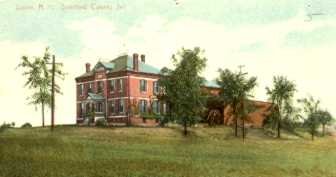
The Strafford County Insane Asylum, situated on what is now County Farm Road in Dover, NH, burnt down during a blinding snowstorm on Friday night, February 9, 1894. One of the unfortunate victims was Mary Twindall, from Milton Mills.

INSANE ASYLUM FIRE. Horrible Holocaust at Dover, New Hampshire. FORTY-FOUR LIVES WERE LOST. Of the Forty-Eight Inmates Only Four Escaped – A Blinding Snowstorm Raging at the Time, and Those That Escaped Suffered Extreme Hardships – Names of the Victims. Dover, N.H., Feb. 10. The county insane asylum, four miles from here, was burned last night and forty-four lives were lost. When Watchman William Chevey made his 10 o’clock trip into the insane asylum he found the fire coming out of the cell occupied by A. Lafamitain, a woman, and gave the alarm. William Driscoll, the keeper, with his family, lived in the building, and he at once broke the locks off the fifty-four cells and tried to get the inmates out, then he got his wife and two children, neither of whom were dressed. Of the forty-eight inmates, only four escaped. They are William Twombly, Rose Sanderson, William Davey and Frank Donshon. The latter walked two miles in a blinding snowstorm, with only his shirt on, to William Home’s house, where he was taken care of. Those who were burned were: Robert Dione, of Salem Falls, N.H.; Mary Foutain, of Great Falls; Frank Nutter, of Rochester; William Chesley, of Durham; Mrs. Roberts, of Great Falls, and an eight-year-old child; Lester Jones, of Farmington; William Twombly, of Barrington; Owen Malley, of Great Falls: Michael Case, of Dover; Frank Rowe, of Great Falls; Charles Libby, of Great Falls; Frang Page, of Rochester; W. Filles, of Great Falls; Frank Spriggins, of Dover; Harry Kimball, of Dover; Julia Keil, of Dover; Mrs. Mary Lavin, of Salmon Falls; Mrs. Mary McClintock, of Dover; Maggie White, of Great Falls; Ann Carr, of Rollinsford; Mary Nutter, of Rochester; Mary Maloney, of Dover; Lenia Ellis, of Lee; Mary Twindall, of Milton Mills; Caroline Rait, of Dover; Mrs. Ann Rothwell, of Dover; Lizzie Ellis, of Great Falls; Catherine Haley, of Dover; Elizabeth Pickering, of Gonic; Mary Cogley, of Dover; Sarah Sweet, of Rochester; Sarah Hutchings, of Dover; Kate Duffee, of Dover; Sarah McClintock, of Great Falls; Fannie Slattery, of Great Falls; Ann McDermott, of Dover; Addie Otis, of Great Falls, and six others whose names could not be remembered by the keeper and his books were burned in the building. The building was of wood, 135 by 84 feet, two stories high, with a big yard on each side. It was built fifty years ago and had fifty cells. One woman escaped to the yard, but was burned to death there. The building cost $150,000. The main building, in which was over one hundred of the county poor, caught fire, but was saved by the heroic efforts of the inmates, who carried pails of water and extinguished the flames, although many were burned in so doing. – The Dover fire department was summoned, but owing to the distance, the blinding snowstorm and the icy roads, it took ninety-five minutes for the department to get there, too late to be of any service. The smoking ruins show the charred bodies still laying on their beds. How the building caught fire is a mystery (Republic (Columbus, IN), February 11, 1893).


Paper mill owner John M. Carricabe’s wandering boy would have been John A. Carricabe.

BOY LOST AND FOUND. Chief of Police Miller received word Saturday morning from John M. Carrecabe of Boston that he had good reason to believe that his 18-year-old son was here, having run away from home a few weeks before. Mr. Miller found the boy clerking for W.B. Atwood under the name of Frank Roberts. He immediately wired his father, who came here on the 3 o’clock train Saturday night. Accompanied by Mr. Miller, they went to Bina Hastings’ house where the boy was boarding. The boy was taken completely by surprise and promised to go home with his father. Both left for Boston on the midnight train. No motive was discovered for the boy’s running away. His father is a twine merchant in comfortable circumstances and the boy had received. a good education and been cashier in his father’s factory at Milton, N.H. He first went to Manchester, N.H., and was under police surveillance there when his father arrived to bring him home, but escaped as soon as he caught sight of his father in the Manchester depot. Mr. Carrecabe was very grateful to Chief Miller for his prompt detention of the boy (St. Johnsbury Caledonian, March 9, 1893).

John A. Carrecabe, shoe stock manufr, 277 Derby, h. 12 Dearborn, appeared in the Salem, MA, city directory of 1897.


WANTED – By a lady (formerly a teacher), acquainted with typewriting, a position in an office, bank or library, or as a cashier, companion or teacher; best of references. Address box 64, Milton, N.H. (Boston Globe, April 4, 1893).


Orlan N. Wardwell married in Keene, NH, October 1868, Augusta M. Wilson. They had two daughters and a son; only the son and one daughter, Hattie B. (Wardwell) Coller, were still living in 1893.

That daughter was the wife of Edwin S. Coller, the Milton Mills Methodist minister.

JAMAICA. Mrs. O.N. Wardwell who has been at Milton Mills, N.H., for some time past taking care of her sick daughter, has returned here to her home (Londonderry Sifter (South Londonderry, VT), April 7, 1893).

Edwin S. Caller, a clergyman (Meth.), aged forty-one years (b. MA), headed a Goffstown, NH, household at the time of the Twelfth (1900) Federal Census. His household included his wife, Hattie B. Caller, aged twenty-nine years (b. NH), and his daughter, Ethel C. Caller, at school, aged eleven years (b. NH).


Alvah G. Burrows was born in Lebanon, ME, in 1841, son of Jonathan and Abigail (Goodwin) Burrows.

Alvah G. Burrows, a currier, aged twenty-three years (b. ME), registered for the Class I military draft in South Danvers, MA, in June 1863. He entered military service with the Salem Cadets Massachusetts Infantry, under the nom-de-guerre Charles Andrews. He served also with Battery E of the First Pennsylvania Light Artillery.

He married in Farmington, NH, November 26, 1866, Lizzie B. Ricker. Rev. S.L. Tufts performed the ceremony. She was born in Milton, NH, circa 1849, daughter of Hiram and Caroline (Meserve) Ricker.

Albah G. Burroughs, a farmer, aged thirty-nine years (b. ME), headed a Milton household at the time of the Tenth (1880) Federal Census. His household included his wife, Lizzie B.S. Burroughs, keeping house, aged twenty-nine years (b. NH), and his children Minnie E. Burroughs, at school, aged twelve years (b. NH), and Willie S. Burroughs, at school, aged ten years (b. NH). They shared a two-family dwelling with the household of [her father] Hiram W. Ricker, a farmer, aged sixty years (b. NH), and [her mother] Caroline Ricker, at home, aged fifty-nine years (b. NH); she was disabled by rheumatism. Their two-family dwelling appeared between those of Robert W.L. Pike, a farm worker, aged fifty-six years (b. NH), and Paul Reynolds, a farmer, aged eighty years (b. NH). Theodore Lyman and Luther Hayes lived in close proximity, i.e., they all lived in [South] West Milton.

Alvah G. Burrows applied for a veteran’s invalid pension, July 16, 1887. He appeared on Page 5 of the Veterans Schedule of the Eleventh (1890) Federal Census.

CONDENSED NEWS OF THE DAY. New England. Alvah Burrows, a veteran and an estimable citizen of South Milton. N.H., committed suicide by cutting his throat with a razor. Despondency resulting from ill health was the cause (Burlington Independent, April 15, 1893).

Lizzie B. Burrows applied for a widow’s pension, May 25, 1893. She married (2nd), before 1903, Addison W. McCorrison.


Miss Benson finished her second year at Milton’s Nute High School and returned to her home town of Brattleboro, VT on vacation.

PERSONAL. Miss Sarah Benson has returned from Milton, N.H., where she is a teacher in the Nute High school (Vermont Phoenix (Brattleboro, VT), June 23, 1893).

See also Milton Teacher of 1891-95 for a more complete biographical sketch of her life.


The Waumbeck Company at Milton Mills closed for six months due to the deflated prices of the Panic of 1893.

MANY NEW ENGLAND MILLS TO CLOSE. New York Merchants Believe the Serious Effect of the Move Overestimated. MILTON MILLS, N.H., July 20. The agent of the Waumbeck company has issued orders for closing the mills here for six months as soon as the goods now in process of manufacture are finished. The reason assigned for this action is a lack of orders except at ruinous prices. This is the first time m the history of this company that work has been ordered to cease on account of the condition of markets, and the result of the present action will be a serious blow to many employés (Chicago Tribune, July 21, 1893).

FLASHES FROM THE WIRES. The agent of the Waumbeck Company has issued orders for closing the mills at Milton, N.H., for six months. The reason assigned in the lack of orders except at ruinous prices. This is the first time in the history of the company that work has been ordered to cease (Los Angeles Times, July 21, 1893).


Lewis W. Nute’s brother, Samuel F. Nute, died in Peabody, MA, on Monday, August 28, 1893. His share of the Lewis W. Nute estate thereby passed to the town of Milton.

By the death of Samuel F. Nute in Peabody, Mass., on Monday the town of Milton, N.H., comes into possession of $50,000 in accordance with the conditions of the will of L.W. Nute. The money is to be used for the benefit of the worthy poor of the town. Mr. Nute had evidently come to the conclusion that the building of libraries and museums is progressing at a sufficiently rapid pace to meet the thirst for knowledge of letters and art. Just about this time it is safe to say that a great many persons will regard the provisions of Mr. Nute’s will as quite as philanthropic in their way as the comparatively common million-dollar bequest for education (Princeton Union (Princeton, MN), August 31, 1893).


Milton’s double-headed snake had attracted a great deal of attention in 1891. This later reprint had been overtaken by events.

CABINET OF LITTLE CURIOS. Professor Rogers, of Boston, is the owner of an alcoholic specimen in the shape of a doubleheaded snake of the brown adder species. It was killed at Milton, N.H., in 1891 (Orleans County Monitor (Barton, VT), September 4, 1893).

The unfortunate Professor Rogers had died in a ballooning accident in July 1892. (See Milton in the News – 1891 for further details).


The N.B. Thayer shoe company was actually hiring during the Panic of 1893.

FEMALE HELP WANTED. GIRL wanted in packing room to dress and button shoes, misses’ and children’s work. N.B. THAYER CO., Milton, N.H. (Boston Globe, September 28, 1893).


The Milton Leatherboard Company also felt the deflationary affects of the Panic of 1893, but somewhat later than the Waumbeck Company, which had suspended production some months earlier.

NEW ENGLAND MILL NOTES. The Milton Leatherboard Co., of Milton, N.H., has made a reduction in the number of its employes (Essex County Herald (Island Pond, VT), November 25, 1893).

Economically, all this suggests that the N.B. Thayer shoe company had the stronger foundation. They were most capable of weathering a serious market downturn. The Milton Leatherboard Company was less secure, but stronger than the Waumbeck Company.


Previous in sequence: Milton in the News – 1892; next in sequence: Milton in the News – 1894


References:

Find a Grave. (2014, September 17). Pvt. Alvah G. Burrows. Retrieved from www.findagrave.com/memorial/136013410

Find a Grave. (2012, October 23). Hattie B. Wardwell Coller. Retrieved from www.findagrave.com/memorial/99448378

Wikipedia. (2019, April 1). Panic of 1893. Retrieved from en.wikipedia.org/wiki/Panic_of_1893

Public BOS Session Scheduled (May 6, 2019)

By Muriel Bristol | May 4, 2019

The Milton Board of Selectmen (BOS) have posted their agenda for a Public BOS meeting to be held Monday, May 6, beginning at 6:00 PM.


This BOS meeting would have begun with a Non-Public session, for a Non-Public agenda item classed as 91-A3 II (a), except that the BOS held that preliminary Non-Public session ahead of time on April 25.

91-A:3 II (a) The dismissal, promotion, or compensation of any public employee or the disciplining of such employee, or the investigation of any charges against him or her, unless the employee affected (1) has a right to a meeting and (2) requests that the meeting be open, in which case the request shall be granted.

This will be the fourth meeting of the Town year to be preceded by a secret meeting about hiring or raises. The new BOS has already hired people at amounts that approach the difference between the proposed budget, which was rejected, and the default budget, with which they are supposedly working.

If this Town were floundering financially, which it is, and sought out professional advice, which likely it will not, it would be advised first to just stop spending.


The Public portion of the agenda has New Business, Old Business, Other Business, and some housekeeping items.

Under New Business are scheduled eight agenda items: 1) Introduction of Town Administrator (*6:15PM*), 2) Public Hearing: Acquisition and Possible Disposition of Land Parcel; Tax Map 17, Lot 5, 3) Hiring of Assistant Town Clerk / Tax Collector, 4) Hiring of Land Use Clerk, 5) Exit #17 Economic Revitalization Zone Update (Bruce Woodruff), 6) Bolan Road Paving Discussion (Robert Graham), 7) Municipal Clerks Week Proclamation, and 8) New Beginnings Food Pantry.

Introduction of [New] Town Administrator. Here we find the reason for the Non-Public BOS meeting of April 25. Will there be also a vote of thanks and a fond farewell for the interim Town Administrator?

Public Hearing: Acquisition and Possible Disposition of Land Parcel; Tax Map 17, Lot 5. We have seen already that “public hearings” are RSA-required rituals where the BOS may pretend to listen. If we read the Avitar database correctly, it would seem that the Town acquired this property already a few years ago (2015). But perhaps they did not perform the required ritual at that time and now seek to remedy that failing.

Hiring of Assistant Town Clerk / Tax Collector and the next item, Hiring of Land Use Clerk. One or both of these were a part of last year’s proposed budget. You know, the one that got rejected in favor of the default budget. The BOS can spend within that default budget as it likes, but it necessarily demands they make equivalent cuts somewhere else. Or overspend. Overspending is the safe bet.

Exit #17 Economic Revitalization Zone Update (Bruce Woodruff). Past discussions have been about trying to retain Index Packaging by arranging for its expansion to take place at Exit 17. And there is the gas station convenience market currently under construction.

Bolan Road Paving Discussion (Robert Graham). The town’s major roads are maintained by the State. Some few others are paved and maintained by the Town. The DPW Director told us in his election statement that he has every year sufficient money to repair the existing paved roads, but never enough to expand the net of paved roads.

The DPW Director got more road money. And one of our former state representatives rises to seek some (or all) of it for the road on which he resides. Good for him.

The taxpayers on the remaining unpaved roads should get instead a substantial tax discount to reflect the difference in service levels. There is no reason for them to subsidize forever the paved sections.

Municipal Clerks Week Proclamation. Municipal Clerks Week runs May 5-11. (Check out the suggested sample proclamation on the IIMC site in the References below).

New Beginnings Food Pantry. There are food pantries in Farmington, New Durham, Rochester, and Sanbornville (Wakefield). Something new for Milton perhaps?


Under Old Business are scheduled four items: 9) Town Vehicle & Equipment Surplus Bid Follow-Up, 10) Follow-Up Discussion on Auction Results, 11) Follow-Up Discussion & Potential Decision of Board / Committee Vacancies, 12) Follow-Up Discussion Re.: Lockhart Field Status Letter to DES.

Town Vehicle & Equipment Surplus Bid Follow-Up. When last discussed, some DPW and police vehicles were to be sold at auction. Except for one police vehicle that would be decommissioned for general Town use. (Supposedly thus removing the need for the increased mileage reimbursement recently approved (unnecessarily)). It was mentioned also that there would be some additional expense of removing the “police package” from the vehicle retained, as there had been an additional expense to add it when it was new.

Follow-Up Discussion on Auction Results. So many questions. Do you suppose the properties sold for anything like their assessed values? Some, at least, of these properties had fallen into a distressed condition. So, probably not those ones.

But were their assessed values ever valid? Will these auction sale prices be included in the sampling used for valuation purposes? If, not, why not? These sales are more accurate than previous guesses.

Will this sale money be returned to its rightful owners, in the form of reduced taxation (in their second tax bill), or will it just disappear as increased Town spending? (“Free” money!!!)

Follow-Up Discussion & Potential Decision of Board/Committee Vacancies. Filling vacancies on Milton’s many Boards and Committees is a perennial problem. This has been become ever more of a problem as the number of Boards and Committees has proliferated over time.

For instance, the Planning Board and Zoning Board (ZBA) were not so very long ago a single board. In splitting them apart, each might be check upon the other, but that advantage vanishes in a puff of smoke, when the same few people rotate through both boards. Or even less effectively, when the same few people sit on both boards simultaneously. The intended check is gone, all that remains is the additional bureaucracy.

Appointment by the BOS, who are themselves majority-of-a-minority office-holders, from a small clique of self-selecting former officials and specially-interested parties is hardly a shining manifestation of democracy. William F. Buckley once expressed his preference for governance by a random sampling from the telephone directory over an appointed group of “experts.”

It would seem that Milton simply cannot sustain as many Boards and Committees as it has. There is a fix for that. The artisans of the Bauhaus school proposed that “less is more.”

Follow-Up Discussion Re.: Lockhart Field Status Letter to DES. This is the sort of thing that the Town Selectmen and Planning Boards should have been planning all these years, instead of playing SimCity. Their current plan? Pray that the Feds continue to ignore the problem, or else pray that those same Feds pick up the presumably world-ending cost.


Other Business That May Come Before the Board has no scheduled items.


Finally, there will be the approval of prior minutes (from the Special BOS meeting of April 15, the regular meeting of April 15, and the Workshop meeting of April 23, 2019), the expenditure report, Public Comments “Pertaining to Topics Discussed,” Town Administrator comments, and BOS comments.


Mr. S.D. Plissken contributed to this article.


References:

International Institute of Municipal Clerks. (2019). 50th Anniversary of Municipal Clerks Week. Retrieved from www.iimc.com/index.aspx?nid=156

State of New Hampshire. (2016, June 21). RSA Chapter 91-A. Access to Governmental Records and Meetings. Retrieved from www.gencourt.state.nh.us/rsa/html/VI/91-A/91-A-3.htm

Town of Milton. (2019, April 23). BOS Meeting Agenda, April 25, 2019. Retrieved from www.miltonnh-us.com/sites/miltonnh/files/agendas/4.25.19_bos_nonpublic_session.pdf

Town of Milton. (2019, April 19). BOS Meeting Agenda, April 27, 2019. Retrieved from www.miltonnh-us.com/sites/miltonnh/files/agendas/4.27.19_bos_special_meeting.pdf

Town of Milton. (2019, May 2). BOS Meeting Agenda, May 4, 2019. Retrieved from www.miltonnh-us.com/sites/miltonnh/files/agendas/5.4.19_bos_agenda-town_property_auction_0.pdf

Town of Milton. (2019, May 2). BOS Meeting Agenda, May 6, 2019. Retrieved from www.miltonnh-us.com/sites/miltonnh/files/agendas/5.6.19_bos_agenda.pdf

Youtube. (1965). Cone of Silence. Retrieved from www.youtube.com/watch?v=g1eUIK9CihA&feature=youtu.be&t=1

Wikipedia. (2019, April 23). Bauhaus. Retrieved from en.wikipedia.org/wiki/Bauhaus

Milton in the News – 1892

By Muriel Bristol (Transcriber) | May 2, 2019

In this year, we encounter an objection to school busing (via wagon), and a Nute High school teacher on her vacations.


Alfred W. Jones was born in Randolph, MA, October 30, 1848, son of William and Sally W. (Ellis) Jones. He married in East Rochester, NH, May 3, 1870, Ella S. Kimball. She was born in North Berwick, ME, circa 1850, daughter of John B. and Sabrina Kimball.

Alfred Jones, a farmer, aged thirty years (b. NH), headed a Milton household at the time of the Tenth (1880) Federal Census. His household included his wife, Ella Jones, keeping house, aged twenty-eight years (b. NH). He appeared in the enumeration between the household of Henry Downs, a farmer, aged sixty years (b. Canada), and that of Benjamin W. Foss, a farmer, aged fifty-nine years (b. NH).

Costly Economy. Mr. Alfred W. Jones of Milton, N.H., complains of the new school law in that state. By the provisions of the law, school boards are authorized to convey children in sparsely settled districts to the village schools. Mr. Jones complains that in carrying out this law some school boards practice an improper economy in furnishing poor teams and incompetent drivers. In some cases the drivers are worse than incompetent, being men of low class, given to drink, vulgarity and profanity. He says “I would rather go back to the old law than to have our children receive more schooling and be ruined.” (New England Farmer (Boston, MA), February 20, 1892).

We shall encounter Mr. Jones again in a few years, when vulgar school-wagon drivers would be the least of his concerns.


The Nute High School had opened its doors for the first time in September 1891, with Miss Sarah L. Benson as one of its original teachers.

Here we find her returning to Milton from her Christmas break and, later, visiting Brattleboro, VT, and Heath, MA, on her summer vacation. She maintained always a permanent address at her step-mother’s Brattleboro home (while her step-mother lived).

PERSONAL. Miss Sarah L. Benson returned this week to Milton, N.H., where she is a teacher in the Nute High school (Vermont Phoenix (Brattleboro, VT), January 1, 1892).

PERSONAL. Miss Sarah L. Benson, a teacher in the Nute High school at Milton, N.H., has returned to Brattleboro for the summer vacation (Vermont Phoenix (Brattleboro, VT), July 1, 1892).

NORTH HEATH. Miss Sarah S. Benson from Brattleboro, who is employed at school keeping at Milton N.H., is taking her vacation of a few weeks with her many friends in this vicinity (Deerfield Valley Times (Wilmington, VT), August 19, 1892).

See also Milton Teacher of 1891-95 for a more complete biographical sketch of her life.


Previous in sequence: Milton in the News – 1891; next in sequence: Milton in the News – 1893


References:

Wikipedia. (2019, April 25). Brattleboro, Vermont. Retrieved from en.wikipedia.org/wiki/Brattleboro,_Vermont

Wikipedia. (2018, September 22). Heath, Massachusetts. Retrieved from en.wikipedia.org/wiki/Heath,_Massachusetts


Milton in the News – 1891

By Muriel Bristol (Transcriber) | April 29, 2019

In this year, we encounter a boiler explosion, a new hardware store, a bumper ice crop (except at Milton), a grisly drunk-driving death, a two-headed snake, and a stamp collector.

This was also the year in which the Nute High School and Library opened its doors, on Tuesday, September 8, 1891. (See also Nute High School Principals, 1891-21 and Milton Teacher of 1891-95).


Water for water-powered mills would have been more plentiful in certain seasons than in others, and even in season the activities of other upstream mills may have interrupted supplies temporarily. The various water-powered mills along Milton’s Salmon Falls River usually had also backup steam-powered engines.

NEWS OF THE DAY. The boiler in Carricade’s pulp mill at Milton, N.H., exploded, wrecking a portion of the mill. The amount of damage is not known (Plain Speaker (Hazelton, PA), February 3, 1891).

John M. Carricabe’s mill appeared also in news items of 1888 and 1889.


It Is Reported – That Mr Burbank has opened a Hardware store at Milton N.H. (Iron Age, February 19, 1891).

Perhaps, but we have not yet found any sign that he actually did so. Harry L. Burbank of Parsonfield, ME, came here a decade later.


According to this account, this was generally a good ice year. However, the Union Ice Company did not find it profitable to continue cutting in Milton, where the ice happened to have a large snow content.

ICE A-PLENTY THIS YEAR. Hundred of Thousands of Tons Left Over – A New Ice Plane. BOSTON, March 12. – For once the Icemen themselves admit that the crop has been a good one. They are ready to go on record in the matter, and so cannot consistently raise the price next summer. The Boston and South Boston ice companies think the prices will be the same as in 1888. This does not mean that the market is overstocked, but only that the “war rates of 1889 and 1890 will not rule this season.” Of last year’s crop there are some 200,000 tons remaining in New Hampshire and Maine. This will never see the market. This circumstance shows that the scarcity of last season did not really justify the exorbitant prices that speculators tried to require the public to pay. The consumption diminished about one-half last season owing to the high prices The Penobscot and Kennebec supplies are good, much better than the New York supply The fish trade Is amply provided for. The Union Company, which does wholesale business with the fishermen, report all their houses filled to repletion. Their ice is cut almost wholly at Wilmington. They started to cut at Milton, N.H., but the quality was so affected by the quantity of snow ice that the attempt was abandoned as unprofitable. The inland cuttings In Maine, so much used last year, were also abandoned. Inland ice is of poor quality this year. Many firms planed both sides of each cake in order to get ice of first quality. They used a new appliance for this purpose invented in New York last year. Instead of doing the planing on the ice field each block as it is hauled to the storehouse passes under a machine that does the work ((NY) Sun, March 13, 1891).


The unfortunate Frank Leighton died a horrible death while driving his wagon under the influence. (You might want to skip over this one).

HIS LUNGS PROTRUDED. Frank Leighton, Caught in the Gear of His Wagon, is Dragged Six Miles, and His Body is Horribly Mutilated. DOVER, N.H., March 31. Frank Leighton of Milton drove to Rochester yesterday in a skeleton wagon. He got intoxicated, and at one of the saloons he was placed in his wagon, and started for home. About two miles out of the village he fell out. and his legs getting caught in the gearing and was dragged, face down, to the outskirts of Milton. a distance of six miles. where he was found dead. The flesh was all stripped from his face and hands, his clothes torn off, and the flesh torn off his chest. so that the lungs protruded. He was about 35 years old (Boston Globe, March 31, 1891).

TELEGRAPHIC BREVITIES. Frank Leighton of Milton, N.H., while drunk, fell from his carriage yesterday and was dragged six miles over a rocky road. He is dead (NY Times, April 1, 1891).


The Milton boy that killed a two-headed snake is not here identified. The intrepid aeronautical Professor George A. Rogers, who came into possession of the snake, was somewhat easier.

SNAKE WITH TWO HEADS. Not an Imaginary One But a Real Adder from New Hampshire. Prof. G.A. Rogers, the great American aeronaut, dropped into THE GLOBE office yesterday afternoon having in his possession a very rare species of a brown adder. It was 11½ inches long, and with two distinct heads, 1¼ inches from the point of contact [and] had the appearance of two snakes artistically rolled into one. This peculiar freak of nature was killed a few days ago by a 7-year-old Milton, N.H., boy, who performed the feat with a short stick as the youthful adder was coming out of a small pile of rocks (Boston Globe, April 10, 1891).

Prior to the Wright Brothers, Professor Rogers’ aeronautic feats would have taken place in a balloon. (I see, the Professor “dropped” into the Boston Globe offices).

George A. Rogers was born in Wolfeboro, NH, in 1830, son of Henry and Nancy (Richardson) Rogers. (His father was born in Alton and his mother in Farmington). He occasionally used the name Augustus, which may have been his middle name.

He was a painter in Boston in 1855; a trader in Boston in 1860; involved somehow with billiards in 1863; a tinsmith in Boston in 1878; a store clerk in Malden in 1880; and an aeronaut in Malden in 1882. His academic affiliation is not clear; he may have been a “professor” in the same sense as Professor Marvel in the Wizard of Oz.

Rogers, Prof. George A.Dangers of Ballooning. The Independence Day celebration at Boston closed with a tragedy in the upper air. Prof. G.A. Rogers, the well-known aeronaut, who had made one hundred and eighteen balloon ascensions, together with Thomas Fenton and De Los Goldsmith, a reporter, made a balloon ascension from Boston Common as the final feature of the observance of the day. The balloon, when released, shot up perpendicularly, and after reaching the height of about a mile was blown seaward at a rapid rate; then it began to descend. It was supposed by observers that Prof. Rogers had opened the safety valve with the intention of descending before the balloon was out at sea. While the crowd watched, the balloon suddenly collapsed and fell into the bay; the car sank and the folds of the balloon settled over the occupants. Two of these were seen to emerge from beneath the balloon, one being Prof. Rogers, the other Reporter Goldsmith. Fenton did not come to the surface. Goldsmith swam easily and was rescued, but Prof. Rogers seemed to have sustained some injury, and just before assistance reached him he threw up his hands and sank. The body of Prof. Rogers has not been recovered; Fenton’s body was brought into view as the rigging of the balloon was drawn up by the rescuing party. Fenton’s neck had been caught in one of the meshes of the net. His body was warm when taken from the water, but all efforts to resuscitate him failed (Scientific American, July 16, 1892).

Boston’s vital records include the accidental drowning in Dorchester bay, on July 4, 1892, of George A. Rogers, of Malden, MA, aeronaut, aged sixty-one years and eleven months.

We shall encounter the Professor’s two-headed snake again in the future.


Harry Horace Clement was born in Danville, VT, May 19, 1884, son of William and Helen L. (Bean) Clement.

We encounter him here at the age of seven years, trying to exchange his foreign stamps for US stamps.

EXCHANGE COLUMN. I will give 160 varieties fine foreign stamps for every 800 U.S. adhesives, postage, or revenue stamps sent me. HARRY H. CLEMENTS, Milton, N.H. (Spy Glass (Arkansas City, KS), October 1, 1891).

Helen Clement, a widow, aged sixty-one years (b. VT), headed a Manchester, NH, household at the time of the Twelfth (1900) Federal Census. Her household included her daughter, Emma Darling, a compositor, aged thirty-seven years (b. VT), her son, Harry Clement, at school, aged sixteen years (b. VT), and her lodgers, Vilae Carter, needle work, aged twenty-two years (b. VT), Abby M. Coffin, aged sixty-one years (b. ME), Sadie Coffin, an artist painter, aged forty-six years (b. ME), and Helen Prescott, a bookkeeper, aged twenty-five years (b. NH). Helen Clement’s household shared a two-family dwelling with the household of Frank Dickey, a brick mason, aged forty-one years (b. NH).

Harry H. Clement married in Manchester, NH, August 1, 1908, Genevieve W. McPherson. She was born in Manchester, NH, August 11, 1883, daughter of Frederick O. and Della J. (Holbrook) McPherson.

Harry H. Clement died in Los Angeles, CA, September 23, 1943. Genevieve W. (McPherson) Clement died in Burbank, Los Angeles, CA, March 29, 1972.


Previous in sequence: Milton in the News – 1890; next in sequence: Milton in the News – 1892


References:

Ignasher, Jim. (2015, April 3). Boston, MA – July 4, 1892. Retrieved from www.newenglandaviationhistory.com/tag/george-a-rogers-aeronaut/


Nute High School Principals, 1891-21

By Muriel Bristol | April 27, 2019

Nute High School’s Early Days

Nute High School at its inception was not, strictly speaking, a public school at all. As late as 1917, its principal and teachers were employed (and paid) by the Trustees of the Nute High School and Library, rather than by the Town of Milton. For this reason, it was sometimes called the Nute-Endowed High School.

Nute High School 2
Note the separate Library door on the building’s left side, as distinct from the School doors on both left and right of the Nute building’s front face

Prior to the establishment of the endowed Nute High School and Library complex, its purposes had been fulfilled on a smaller scale by several earlier private institutions. Its library functions had been available (from 1822) at the Milton Social Library, and its post-district school college preparation available (from 1867) at the Milton Classical Institute. They were funded by subscriptions and fees and  were eclipsed by the larger (and better endowed) Nute facility.

Lewis W. Nute’s endowment was intended to pay all of its expenses, with no tax component at all. Several of Milton’s principals and teachers taught later at similarly endowed institutions. For instance, one taught later at a school endowed for Quincy-born girls only. Non-Milton students also attended Nute, even in large numbers, but by payment of a tuition fee that, by the terms of the Nute endowment, would not have been charged to Milton students.

Nute would have been intended primarily for college preparation. Many Milton district school students did not go on to study at Nute or anywhere else. There certainly was no legal requirement that they do so. And attending college was itself useful mostly if one intended to enter one of the professions. (The “learned professions” as the 1840 census had it). If one did not intend to enter into one of the professions, there would have been little point in attending either college or the Nute High School.

Admission to Nute would not have been automatic, even for Milton students. Most schools of this type required passage of an entrance examination.

Nute’s curriculum, where it has been mentioned, included languages, mathematics, sciences, and, later, some business subjects, such as commercial law and bookkeeping.

The languages offered, both classical and modern, were Greek, Latin, English, French, and German. English has since replaced French as the common Lingua Franca (literally, “French Language”), but at this time many fundamental texts were sometimes available only in their original classical or French language versions. Many technical and scientific texts would have been available only in German. The same would apply to many professional journals and periodicals. To study such texts one would need to have some acquaintance with the languages in which they were written.

(We have seen an example of a Nute High School teacher who, in her own earlier college preparation, went so far as to take up residence for a time within an immigrant German household so as to immerse herself in the German language).

Nute High covered also post-district school mathematics, such as Algebra and Geometry, and Science, including Chemistry. (Its fourth principal became later a professor of Astronomy at Harvard College).

Nute High School’s Early Principals

As mentioned in a prior article on early teachers, Nute’s principals were principal in the sense of being the principal teacher. They would have carried a full class load. In some similar institutions, the teachers were called masters and the principal called the headmaster. (The assistant principal, if any, might be called the sub-master or sub-headmaster).

The principals of Milton’s Nute High School during its first thirty years (or so) were: William K. Norton, 1891-96; Arthur T. Smith, 1896-; Arthur D. Wiggin, 1901-03; Clarence E. Kelley, 1903-14; Franklin H. Manter, 1914-16; William F. Carlson, 1916-18; and Edwin S. Huse, 1919-.


William K. Norton – 1891-96
Norton, William K. - Detail
William K. Norton and his children, Marion and Harvard Norton

William Kimball Norton was born in Boston, MA, November 19, 1865, son of William and Maria R. (Burrows) Norton.

William K. Norton graduated from Harvard College with the class of 1888 (Harvard, 1902).

He married in Boston, MA, June 28, 1888, Eliza Maria “Lilla” Marion. She was born in Burlington, MA, February 16, 1866, daughter of Abner P. and Sarah E. (Covell) Marion.

William K. Norton was Nute High School’s first principal. He would have been there when its doors opened for its first sixty students on Tuesday, September 8, 1891. (Building construction continued into 1892). He would have been accompanied by one of its first teachers (he would have two), Miss Sarah L. Benson.

Meanwhile, his wife was seven months pregnant. Harvard Norton was born in Milton, NH, December 24, 1891, son of William K. (teacher, born Boston, MA, aged twenty-seven years) and Eliza M. Norton (born Burlington, MA, aged twenty-six years).

The officers of Milton’s Lewis W. Nute Grange, No. 193, in 1894 were: Bard B. Plummer, Master; William K. Norton, Lecturer; and Charles A. Jones, Secretary (NH Department of Agriculture, 1895).

WILLIAM KIMBALL NORTON. In June 1891, I terminated a two years’ connection with the Lawrence (Mass.) High School as sub-master. This I did to accept a better position as principal of the Nute High School of Milton, N.H. This school was established by a fund left by a deceased townsman. It is the only school of its grade on the Northern Division of the Boston and Maine Railroad, between Rochester and the White Mountains. The school numbers about sixty-five pupils at present, but is growing. I had the pleasure of opening and inaugurating the school. I have two assistant teachers. We fit for any college. My daughter, Marion Norton, the class cradle baby, is a particularly plump and healthy girl of nearly four and a half years. She is now getting old enough to hear some of the tales of Fair Harvard and to understand what is meant by the carved inscription on her cradle ‘Class of 88.’ In another sense, too, she hears much of Harvard, for she has a promising young brother who came to us as a Christmas gift, two years ago. His name is Harvard Norton, and I am proud of it. He is named not only for his father’s alma mater, but his name must mean for him particularly the illustrious class of ’88. I wish to take this opportunity to extend a very earnest invitation to all my friends, classmates of ’88, to visit me in my New Hampshire home, that they may taste the pleasures of this beautiful healthful resort (Harvard Class Secretary, 1894).

Principal Norton left Milton at the close of the 1895-96 academic year to become sub-master (assistant principal) in New Bedford, MA.

A New Bedford, MA, school report of 1897 listed the teachers (and their addresses and their salaries) at the New Bedford High School. Wilson R. Butler, of 75 William Street ($2,750), was principal. William K. Norton, of 351 County Street ($1,800), was his sub-master and math’l teacher. There were three other teachers ($1,500 to $1,700), nine assistant teachers ($800-$1,000), a military instructor ($300), a clerk ($600), and a janitor ($1,000). The subjects were mathematics, science, classics, and commerce (New Bedford, 1897).

WILLIAM KIMBALL NORTON Writes: “After graduation my first year’s work was at the Watertown, Mass., High School. Then two years were spent at Lawrence, where I was sub-master in the High School. A call to the principalship of the endowed Nute High School, about to be opened at Milton, N.H., was accepted in ’91. I had two assistants and about sixty pupils. The work was interesting, but not telling; it was certainly dispiriting to live five years in a community so remote from a city that there was no possibility for contact with scholarly, ambitious, and progressive minds.

“My Harvard, who was born while we were at Milton is a lithe, athletic little fellow, of almost seven, not much in figure, like his big sister who got such a remarkable start in her class cradle that she tips the scales at ninety-five pounds.

“Two years last September I came here to New Bedford as the head of the Mathematics Department in the High School. There is much more real satisfying life here. We have about four hundred pupils, and we fit quite a number of boys for Harvard and for other colleges. It is a pleasure to know that one can be instrumental in pointing out the advantages of our grand Alma Mater, and help the promising youth of the upgrowing generation to strive ambitiously for the rewards which the great university bestows. I have just been elected sub-master in our school here, and I look forward amid these congenial surroundings for prolonged opportunity to work zealously, and I trust profitably, for the best good of our rising youth (Harvard Class Secretary, 1898).

William K. Norton, a high school sub-master, aged thirty-five years (b. MA), headed a New Bedford, MA, household at the time of the Twelfth (1900) Federal Census. His household included his wife, Lillian M. Norton, aged thirty-four years (b. MA), and his children, Marion Norton, at school, aged ten years (b. MA), and Harvard Norton, at school, aged eight years (b. [Milton,] NH).

THE HIGH SCHOOL. Three teachers resigned from this school during the summer vacation to accept positions elsewhere, Mr. William K. Norton, sub-master, Mr. Ernest V. Page, commercial teacher, and Miss Emma H. Parker, in science. Mr. Norton and Mr. Page went to Boston, and Miss Parker to Newton. They were all excellent teachers in their respective departments and were liked and respected both by their associates and their pupils. They had been connected with the school long enough to become thoroughly familiar with its operation and it will feel their loss for some time to come (New Bedford, 1900).

William K. Norton, a public school teacher, aged forty-five years (b. MA), headed a Boston, MA, household at the time of the Thirteenth (1910) Federal Census. His household included his wife (of twenty-one years), Lillia M. Norton, aged forty-four years (b. MA), Marion Norton, a public school teacher, aged twenty years (b. MA), and Harvard Norton, aged eighteen years (b. NH). They resided at 26 Meredith Street, which they owned (with a mortgage).

William K. Norton, a Latin school teacher, aged fifty-five years (b. MA), headed a Boston, MA, household at the time of the Fourteenth (1920) Federal Census. His household included his wife, Eliza M. Norton, aged Fifty-three years (b. MA), his daughter, Marion N. Pond, aged thirty years (b. MA), his granddaughter, Lilla M. Pond, aged thirteen months (b. NH), and his guest, Lina H. Sawyer, a widow, aged sixty-five years (b. ME).

William K. Norton, a Boy’s Latin school master, aged sixty-five years (b. MA), headed a Boston, MA, household at the time of the Fifteenth (1930) Federal Census. His household included his wife, Lilla M. Norton, aged sixty-four years (b. MA). The resided on Meredith Street, where they owned their house (valued at $10,000). They did have a radio set.

Norton, William K. -1935HEADMASTER NORTON GUEST OF SENIORS. Boston Latin School Class Makes Presentation. William Kimball Norton, who retires this year as headmaster of the Boston Latin School, was the guest of honor at a banquet, given by the members of the senior class, at Durgin & Park’s restaurant. The class will be graduated in the tercentenary of the Boston Latin School. Last evening the members made their retiring master an honorary member of the class. Lee Dunn introduced Supt. Patrick T. Campbell of the Boston schools, a former headmaster of the Latin School. Mr. Campbell gave personal impressions of the school and many of the boys and teachers. He also gave sketches of the type of men who taught in the school from the first day to the present. Supt Campbell asked the boys to enter into the spirit of the coming celebration in April of the 300th birthday of the Latin School. Other speakers were William Pride Henderson, professor in the French department; Edwin F.A. Benson, head of the English department; William H. Marnell, coach of the debating team, and John Collins. William Nolan, president, expressed the appreciation and love of all the members for their retiring master, and presented him a gold watch charm, suitably inscribed. Headmaster Norton assured the boys that he would be available to all at any time to aid them in problems. He was graduated from Boston Latin School in 1884 and from Harvard University in 1888. He returned to the school as a teacher in 1900 and became its senior master in 1908. To generations of Latin School boys “Uncle Billy,” as those who loved him called him, is well known for his problem and puzzle solving abilities. Guests at the head table included Charles F. Winslow, Fred P.H. Pike, Louis W. Arnold, Archer L. Faxon, William P. Henderson, Edwin F.A. Benson, Elmer R. Bowker, Leon O. Glover, John E. Collins and Robert W. Wales of the faculty. The banquet was attended by 155 seniors (Boston Globe, March 22, 1935).

William K. Norton died in Boston, MA, in 1960. Eliza M. (Marion) Norton died in Boston, MA, in 1968.

William K. Norton. NORWOOD, Feb. 27 – Funeral services for William Kimball Norton, 95, of 80 Lincoln st. and Jackson, N.H., master of mathematics at Boston Latin School for more than 30 years until his retirement in 1935, will be held Monday afternoon at 2:30 at the Forsyth Chapel, Forest Hills Cemetery. Mr. Norton died Friday at his home. He was born in Boston, son of William and Marie (Burrows) Norton. He was graduated from Boston Latin and from Harvard, cum laude, in 1888. He was one of the oldest graduates of Harvard. Mr. Norton taught as sub-master at Lawrence High and New Bedford High, and as principal of the Nute High School, Milton, N.H. prior to joining the faculty of Boston Latin School. A botanist, he also was an excellent bridge player and participated in many tournaments. He leaves a daughter, Mrs. Marion N. Pond, with whom he lived, three grandchildren, and a great-grandchild (Boston Globe, February 27, 1960).


Arthur T. Smith – 1896-01

Arthur Thaddeus Smith was born in Silver City, ID, May 1, 1875, son of Arthur N. and Mary H. (McCann) Smith.

Arthur Thad Smith graduated from Dartmouth College with the class of 1896. He became principal at Nute High School beginning with the 1896-97 academic year.

Arthur Thaddeus Smith joined the Moses Paul Lodge (Lodge #96) of Masons, of Dover, NH, in 1897. He was a lawyer, born in Silver City, ID, May 1, 1875. He was initiated there, March 25, 1897; passed there, April 29, 1897; and raised June 11, 1897. In later years, when he resided in Winchester, MA, he affiliated himself with the William Parkman Lodge, of Woburn, MA, May 12, 1914, and was dismissed, presumably to that Woburn lodge, December 16, 1915.

PERSONALS. Arthur Smith, principal of the Nute high school at Milton, paid a visit to in this city Monday (Portsmouth Herald, July 26, 1898).

Arthur Thad Smith taught Latin, Greek, and Chemistry at the Nute High School in 1900.

Arthur T. Smith left Milton by the close of its 1900-01 academic year in order to go to law school. Harvard Law School conferred an L.L.B. degree (bachelor of laws) upon Arthur Thad Smith at the conclusion of its 1903-04 academic year.

Arthur T. Smith married in Milton, NH, November 15, 1906, Orinda Sophia Dickey. She was born in Ludlow, MA, June 22, 1883, daughter of Myron P. and Louisa R. (Shumway) Dickey.

Smith, Mr and Mrs ATSMITH-DICKEY. Father Performs Ceremony, When Milton, N.H., Girl Weds Boston Attorney. MILTON, Nov. 15 – At the Congregational parsonage, the home of the bride at 2 this afternoon, Miss Ora S. Dickey, daughter of Rev. and Mrs. Myron P. Dickey, was married to Arthur Thad Smith, a young Boston attorney. The ceremony, which was very simple, was performed by the bride’s father, in the presence of the immediate families and few intimate friends. The bride and groom were unattended. The bride is a graduate of Wheaton seminary, and one of the most talented and popular young women of this section. The groom was several years ago principal of the Nute high school of this town. The romance which culminated in today’s event, began at that time, Miss Dickey then being a pupil in the institution. Mr. Smith is a graduate of Dartmouth college and the Harvard law school, the son of Dr. A. Noel Smith, a prominent physician of Dover. After a short wedding trip, Mr. and Mrs. Smith will reside in Boston, making their home at 40 Lindsey st., Dorchester. Among those present were: Rev. and Mrs. Myron P. Dickey, Milton; Dr. and Mrs. A. Noel Smith, Dover; Mark S. Dickey. Milton; Maurice W. Dickey, Springfield, Mass; Miss Laura H. Smith, New Britain, Conn; Miss Ina E. Smith, Verona, N.J.; Mrs. S.O. Amidon, Mr. and Mrs. F.A. Amidon, Worcester, Mass; Miss Marion Mellus, Springfield, Mass; Mrs. H.E. Paul, Cambridge, Mass; Miss Helen G. Fox, Milton Mills; Miss Elsie M. Wallace, Rochester; Miss Ethel Shepard, Boston; Mr. and Mrs. J.H. Avery. Mr. and Mrs. Ralph M. Kimball, Mrs. Emily E. Looney, Mrs. J.B. Hart, Milton (Boston Globe, November 16, 1906).

DOVER DOINGS. Arthur T. Smith and family of Boston are visiting Mr. Smith’s father, Dr. A. Noel Smith of this city. Mr. Smith is now in one of the leading law offices of Boston. He was formerly principal of the Nute high school of Milton (Portsmouth Herald, July 29, 1909).

Arthur T. Smith, a general practice lawyer, aged thirty-six years (b. ID), headed a Boston, MA, household at the time of the Thirteenth (1910) Federal Census. His household included his wife, Orinda D. Smith, aged twenty-six years (b. MA), his children, Ora J. Smith, aged two years (b. MA), and Arthur T. Smith, aged six months (b. MA), and his servant, Hilda Herlin, a private family servant, aged twenty years (b. Sweden). They resided at 40 Lindsey Street.

Arthur Thad Smith, of 50 Myrtle Terrace, Winchester, MA, aged forty-three years (b. May 1, 1875), registered for the WW I military draft in Arlington, MA, September 12, 1918. He was a self-employed lawyer at 45 Milk Street in Boston, MA. His nearest relative was Orinda D. Smith, of 50 Myrtle Street, Winchester, MA. He was described as being of medium height, with a medium build, and having brown eyes, light hair (s[lightly] bald), and no physical disabilities.

Mr. and Mrs. Arthur Thad Smith attended the annual alumni dinner of the Nute Club of Boston in at least the years 1917, 1918, and 1920. Mrs. Smith was its vice president in 1918 and president in 1920. Arthur T. Smith was toastmaster in 1920.

NUTE HIGH SCHOOL CLUB OF BOSTON MEETS AND DINES. The annual reunion and banquet of the Nute High School Club of Boston, composed of graduates and pupils of the Nute High School at Milton, N.H., took place last night at the Thorndike. Among the 40 guests was Miss Sarah L. Benson of the faculty. Arthur T. Smith was toastmaster. The officers elected are: Mrs. Ora D. Smith of Winchester, president; Lawrence Hayes, Milton, N.H., vice president; Arthur D. Brackett, treasurer, and Miss Susan P. Haley of Rochester, N H, secretary (Boston Globe, February 21, 1920).

Arthur T. Smith, a lawyer, aged forty-four years (b. ID), headed a Winchester, MA, household at the time of the Fourteenth (1920) Federal Census. His household included his wife, Ora D. Smith, aged thirty-six years (b. MA), Ora G. Smith, aged twelve years (b. MA), and Arthur T. Smith, Jr., aged ten years (b. NH). They resided in a rented home at 50 Myrtle Street.

Arthur T. Smith, a general practice lawyer, aged fifty-four years (b. ID), headed a Winchester, MA, household at the time of the Fifteenth (1930) Federal Census. His household included his wife, Ora D. Smith, aged forty-six years (b. MA), Ora G. Smith, an investment banking financial assistant, aged twenty-two years (b. MA), and Arthur T. Smith, Jr., aged twenty years (b. NH). He owned their home at 235 Middlesex Valley Parkway, which was valued at $20,000. They had a radio set.

Arthur T. Smith died at South Station in Boston, MA, January 1, 1940.

Deaths and Funerals. Arthur Thad Smith, Noted Lawyer, Dies. Arthur Thad Smith, 64, prominent Winchester lawyer, died yesterday after collapsing at the South Station while saying goodbye to his daughter who was leaving for New York after the New Year holidays. Smith’s son, Arthur T. Smith Jr, associated with his father in the law at 10 Postoffice sq., called police but his father was dead on arrival at Boston City Hospital. Since 1937 Smith had been treated for a heart ailment by Dr. Richard Clarke of Winchester. The lawyer and former educator was born in Silver City. Idaho, May 1, 1875, the son of Arthur Noel and Mary Hattie (McCann) Smith. He was graduated with highest honors from Dartmouth College in 1896 with the degree of A.B. Attaining some repute as an authority on electrolysis. Smith served for five years as principal of the Nute High School in Milton, N.H., and later married one of his former pupils, Miss Ora S. Dickey, daughter of the pastor of the local Congregational Church. Before his marriage Smith left his position as headmaster of the high school to attend Harvard Law School where he received his bachelor of laws degree in 1904 and was admitted to the Massachusetts bar in the same year. He then joined the firm of Bartlett and Anderson, headed by the late Gen Charles W. Bartlett of Boston and after his marriage moved to Dorchester to five He was admitted to practice of law before the Federal courts in 1906 and before the United States Supreme Court in 1932. Since 1904 he practiced law in Boston. Besides memberships in the American Bar Association, Massachusetts Bar Association and Boston Bar Association, Mr. Smith was treasurer and director of the Thayer-Osborne Shoe Company. He was a member of the Phi Beta Kappa, Delta Kappa Epsilon, Casque and Gauntlet. Affiliated politically with the Republican party, Smith was a Mason and an Odd Fellow. He also held membership in the Winchester Country Club He made his home at 265 Mystic Valley Parkway, Winchester. Besides his widow Mr. Smith leaves his son and a daughter, Miss Ora Jeanette South (Boston Globe, January 2, 1940).

Orinda S. (Dickey) Smith died in Greenwich, CT, August 15, 1952.


Arthur D. Wiggin – 1901-03

Arthur Dean Wiggin was born in Barton, VT, January 1, 1874, son of William T. and Jane M. (Batchelder) Wiggin.

Arthur D. Wiggin graduated from Dartmouth College with the class of 1899. He became a teacher in North Troy, VT.

William T. Wiggin, a farmer, aged fifty-nine years (b. VT), headed a Barton, VT, household at the time of the Twelfth (1900) Federal Census (June 8, 1900). His household included his wife, Jane M. Wiggin, aged fifty-three years (b. Canada (Eng.)), and his children, Arthur D. Wiggin, a teacher, aged twenty-six years (b. VT), Anna R. Wiggin, aged nineteen years (b. VT), and Ada W. Wiggin, aged fourteen years (b. VT), and his hired man, Robert G. Card, a farm laborer, aged thirty-four years (b. Canada (Eng.)).

Arthur D. Wiggin married (1st) in Troy, VT, June 13, 1900, Edith M. Buggy. She was born in North Troy, VT, April 24, 1877, daughter of William and Eliza (Green) Buggy.

Arthur D. Wiggin left North Troy, VT, for Milton in 1901. Note the unanimous election, i.e., a unanimous election by the Nute trustees.

LOCAL NEWS. Barton. Arthur D. Wiggin, who has for two years taught the North Troy high school, has been unanimously elected to the principalship of the Nute high school at Milton, N.H. This is an institution endowed with one hundred and twenty-five thousand dollars. Mr. Wiggin’s salary will be 1200.00 per year (Orleans County Monitor, July 1, 1901).

LOCAL NEWS. Barton. A.D. Wiggins, son of William Wiggins, will be home this week for a vacation. Mr. Wiggins is principal of the Nute High School at Milton, N.H. He is another Vermonter who has made a success (Orleans County Monitor, July 7, 1902).

Principal Wiggin left Milton to become principal of the high school of Topsfield, MA, at the close of the 1902-03 academic year.

TOPSFIELD, MASS. Mr. Arthur D. Wiggin of North Troy, Vt., has been elected principal of the high school. He is a graduate of Dartmouth, class of 1897, and for the past two years has been principal of the Nute high school, Milton, N.H. (School Journal, 1903).

News of Woodstock. Examinations for admission to the Woodstock High school will be held at the school building Friday, September 1 at 9 a.m. Arthur D. Wiggin, Prin. (Spirit of the Age (Woodstock, VT), August 26, 1905).

PRINCIPAL OF HIGH SCHOOL. Arthur D. Wiggin of Vermont Appointed for Ensuing Year – Professor Eastman to Come Back. At the regular meeting of the school board last evening, the committee on teachers and salaries made the following partial report: We recommend the appointment of Arthur D. Wiggin of Woodstock, Vermont, as principal of the High school for the ensuing year at a salary of $1,800 per annum. We recommend that Clarence Eastman be employed as head of the science department, at a salary of $1,400 for the ensuing year. We recommend that a graduate from the High school who has served for three years as a substitute teacher, be required to take at least one year in a normal school before being further employed in the schools of this city; and that a graduate from the High school who has also graduated from a normal school, and who has not had any experience in teaching, be employed as a substitute at a salary of $600 for the first year. The report was adopted by the board, and the appointments recommended will be made. Mr. Eastman, who will be head of the science department, is well known in Great Falls, having been connected with the High school before (Great Falls Tribune, May 7, 1909).

Arthur D. Wiggin, a high school principal teacher, aged thirty-six years (b. VT), headed a Great Falls, MT, household at the time of the Thirteenth (1910) Federal Census. His household included his wife (of nine years), Edith Wiggin, aged thirty-three years (b. Canada (Eng.)), his children, Ruth M. Wiggin, aged nine years (b. VT), Harold A. Wiggin, aged seven years (b. NH), and Doratha Wiggin, aged three years (b. ND), his mother-in-law, Eliza Buggy, aged fifty-eight years (b. Canada (Eng.)), and his roomers, Bryan Cascaden, a high school teacher, aged twenty years (b. ND), Northa Porter, a primary teacher, aged twenty-three years (b. IA), and Minnie Patterson, a graded teacher, aged twenty-two years (b. IA).

Wiggin, Arthur DARTHUR WIGGIN, EDUCATOR. JUST as the Easterners became the pioneers who blazed the trails through the new Western country, so the college men of New England have done much of the pioneering in the educational field of the West, and Montana has been one of the magnets for the college men of the best institutions of the Eastern part of the country. Great Falls, Mont. boasts one of the remarkably successful New England college men who are engaged in work there. A remarkably successful one is Arthur D. Wiggin, son of Mr. and Mrs. W.T. Wiggin of Orleans. Vt. He Is a graduate of Dartmouth College, class of ’99. He was born in Barton, Vt., and he was educated at Barton Academy and Lyndon Institute. He was a pupil at Lyndon when W.E. Ranger, now Commissioner of Education in Rhode Island, was principal. At Dartmouth he was a member of his class football team and was active in the social hfe of the college. Being graduated in 1899 he was appointed principal of the North Troy, Vt. High School. He was there two years when he took the Nute High School at Milton, N.H., and the High at Topsfield, Mass. He was two years in each position and subsequently was four years principal and superintendent of a school at Woodstock. Vt. whence he came to be principal of the Great Falls, Mont. High School three years ago. He has given excellent service and has sustained the school at a high standard of efficiency. Its diplomas admit graduates to such institutions as the University of Michigan. Chicago, Wisconsin and Minnesota. Mr. Wiggin quickly took a leading place among the educational people of Montana. He was made president of the Department of Higher Education in the State association and is a member of the committee on rules and regulations of the State Athletic Association. He is recognized as one of the most capable educators of Montana. Mr. Wiggin married Edith Baggy, daughter of Mrs. Eliza Buggy of North Troy. They have two daughters and a son. Hs service as an educator in Montana has been highly creditable to his alma mater and his preparatory schools (Boston Globe, September 22, 1912).

ORLEANS LOCAL MENTION. Prof. Arthur D. Wiggin is called here from Raynesford, Mont., by the critical illness of his father, W.T. Wiggin (Orleans County Monitor (Barton, VT), March 28, 1917).

NORTH TROY. Arthur D. Wiggin, formerly of this place and at one time principal of the high school, was in town Friday, called here by the sickness and death of his father, a resident of Orleans. Mr. Wiggin is now engaged in teaching in Montana, and was obliged to return at once to his work. Mrs. Wiggin before her marriage was Miss Edith Buggy, of this village (St. Albans Daily Messenger, April 7, 1917).

Arthur Dean Wiggin, of Brandon, VT, aged forty-four years (b. January 1, 1874), registered for the WW I military draft in Londonderry, VT, September 11, 1918. He was a district school superintendent for Londonderry and six other towns, employed by the state of Vermont. His nearest relative was his wife, Edith M. Wiggin, of Brandon, VT. He was described as being of medium height, with a medium build, and having blue eyes, dark brown hair, and no physical disabilities.

Arthur D. Wiggin, a school superintendent, aged forty-six years (b. VT), headed a Brandon, VT, household at the time of the Fourteenth (1920) Federal Census. His household included his wife, Edith M. Wiggin, aged forty-three years (b. VT), and his children, Rachel M. Wiggin, Harold A. Wiggin, aged sixteen years (b. NH), and Dorothy G. Wiggin, aged twelve years. They resided on Pearl Street.

Edith M. (Buggy) Wiggin died in Danville, VT, February 2, 1923. Arthur D. Wiggin married (2nd), in Whitefield, NH, August 9, 1928, Glenna D. Eaton, he of Rye, NH, and she of Whitefield. They were both teachers. She was born in Manchester, NH, in 1905, daughter of Eldred F. and Ida B. (Dow) Eaton.

Arthur D. Wiggin, a public school teacher, aged fifty years (b. VT), headed a Rye, NH, household at the time of the Fifteenth (1930) Federal Census. His household included his wife, Glenna Wiggin, a public school teacher, aged twenty-five years (b. NH), and his daughter, Dorothy Wiggin, a public school teacher, aged twenty-two years (b. VT). They resided in a rented house, for which they paid $25 per month. They had a radio set.

Arthur D. Wiggin, a wooden hut manufacturer, aged sixty-six years (b. VT), headed an Exeter, NH, household at the time of the Sixteenth (1940) Federal Census, His household included  his wife, Glenna E. Wiggin, aged thirty-three years (b. NH), and his children, Jane E. Wiggin, aged nine years (b. NH), and Arthur W. Wiggin, aged less than a year (b. NH). They resided in a rented residence at 67 Park Street, for which they paid $25 per month. (It was mistakenly reported that they had lived in the same house ten years previously).

Glenna D. (Eaton) Wiggin died in 1957. Arthur D. Wiggin died in Exeter, NH, February 10, 1959.

Deaths and Funerals. Arthur D. Wiggin. EXETER – Arthur D. Wiggin, 85, of 39 Court St.. died last night at Exeter Hospital following a brief illness. Born in Barton, Vt., Jan. 1, 1874, he was the son of the late William and Jane (Batchelder) Wiggin. A graduate of Dartmouth College, Mr. Wiggin was a 50-year member of the Woodstock Lodge, F. and A.M., of Woodstock. He was a retired school superintendent and teacher and had resided in Exeter for the past 20 years. Survivors include three daughters: Mrs. Donovan Chase, Port Jervis. N.Y., Mrs. Earl M. Hay and Mrs. Lyle Robillard, both of Exeter; one son, Arthur W. Wiggin of Exeter, two sisters,; Mrs. Leo Wilson and Mrs. Elmer Wylie, both of Great Barrington, Mass.; 11 grandchildren and 17 great-grandchildren (Portsmouth Herald, February 11, 1959).


Clarence E. Kelley – 1903-14

Clarence Erskine Kelley was born in Merrimac, MA, July 31, 1849, son of Giles M. and Abbie G. (Chase) Kelley.

Clarence E. Kelley graduated from Harvard College with the class of 1873.

He married in Haverhill, MA, August 24 1876, Caroline W. Moore, both of Haverhill. She was born in Mobile, AL, April 15, 1851, daughter of Joseph and Caroline W. Moore. They were both teachers.

Clarence E. Kelly, a school teacher, aged thirty-one years (b. MA), headed a Haverhill, MA, household at the time of the Tenth (1880) Federal Census. His household included his wife, Caroline M. Kelly, keeping house, aged twenty-nine years (b. AL), his children, Lucy J. Kelly, aged two years (b. MA), and Wingate Kelly, aged ten months (b. MA), and his servant, Georgianna W. Cowley, a housekeeper, aged forty-five years (b. MA).

Principal Kelley much admired the work of poet (and abolitionist) John Greenleaf Whittier (1807-1892), who was a native of Haverhill. (One of Whittier’s more famous poems was Snow-Bound). Kelley served later as a trustee of the Whittier homestead site, but here we find him presenting a commissioned portrait of Whittier to the Haverhill Public Library. Whittier was himself present.

WHITTIER’S PORTRAIT, Unveiled With Appropriate Exercises at the Haverhill Publie Library. HAVERHILL, December 17. – At the reunion of the classmates of the poet Whittier, in the old Haverhill Academy, which was held at the rectory of St. John’s Church, Mr. Whittier kindly consented to sit for his portrait, to be given by his classmates to the public library of his native town. Mr. Harrison Plummer, one of the poet’s schoolmates. was selected as the artist, and at 2.30 o’clock this afternoon, today being the 78th anniversary of the poet’s birth, the portrait was unveiled with appropriate ceremonies before a large gathering of the aristocracy and culture of Haverhill. The picture was presented to the library trustees by Clarence E. Kelley, principal of the high school, and was received with appropriate remarks by Mayor Sheldon. Remarks were made by Hon. J.D.B. Cogswell. Dr. John Crowell, Judge Charles Bradley of Providence, R.I., and letters were read from Professor Charles Short of Columbia College, Professor G.B. Thayer of Harvard Law School and Senator J.J. Ingalls of Kansas, all three having been Haverhill boys. The committee on obtaining the portrait were Thomas Garland of Dover, N.H., and Hon. James H. Carleton of Haverhill. The frame. which is of the very finest workmanship and material. costing about $150. was presented by Mrs. E.J.M. Hale. Mr. Whittier himself is much pleased with the likeness (Boston Globe, December 18, 1885).

Those traveling north from the Massachusetts border towards Portsmouth, NH, on US Route I-95, pass over the Merrimac River at Amesbury, MA, on the John Greenleaf Whittier Bridge. (Whittier lived also at Amesbury).

Kelley, Clarence and Wingate
Clarence E. and Wingate Kelley, and their telescope, in Haverhill, MA, in the mid to late 1880s (Haverhill Public Library). (Gauge the date by the age of the boy, who was born in 1880)

Principal Kelley’s renewal as Haverhill High School principal for the 1894-95 academic year encountered some opposition in June 1894.

HAVERHILL’S PRINCIPAL. Attempt to Reinstate Clarence E. Kelley Fails for Time Being. HAVERHILL, Mass, June 29. Tonight for the third time the school board attempted to reinstate Clarence E. Kelley as principal of the high school. All the members were present except Dr. Bradley and Rev. George Benedict. On motion of Dr. L.S. Smith the board went into executive session. Dr. L.S. Smith declared that he had been misrepresented and misquoted. He asserted that principal Kelley was not in touch with the scholars. He had no personal grievances against the man. C.F. How asserted that Mr. Kelley was lacking in executive ability. W.W. Spaulding defended Mr. Kelley and declared that he did not believe it was true that he was not respected by the scholars. J.W. Tilton asked what Mr. How meant by principal Kelley lacking in executive ability. Mr. How said he was only speaking in general terms. Mr. Tilton moved to ballot for a principal of the high school. With 11 votes necessary for a choice, Mr. Kelley secured nine out of 16. A second ballot was taken with the same result. Then Mr. Tilton moved that the rules be amended so that a majority, instead of two-thirds of the votes cast, should elect. As it was necessary to leave the matter on the table for a month, the board adjourned without being able to secure Mr. Kelley’s reinstatement (Boston Globe, June 30, 1894).

Principal Kelley would be renewed and would remain in Haverhill until he went to Milton (after the 1902-03 academic year).

Clarence E. Kelley, a high school principal, aged fifty years (b. MA), headed a Haverhill, MA, household at the time of the Twelfth (1900) Federal Census. His household included his wife, Caroline M. Kelley, aged forty-nine years (b. AL), and his children, Lucy J. Kelley, aged twenty-two years (b. MA), and Wingate Kelley, a sole laborer, aged twenty years (b. MA), Henry E. Kelley, at school, aged nineteen years (b. MA), Clarence M. Kelley, at school, aged fifteen years (b. MA), and his mother, Abigail G. Kelley, aged seventy-six years (b. MA). They resided at 17 Grant Street.

Clarence E. Kelley left his position in Haverhill and became principal of the Nute High School at the beginning of the 1903-04 academic year. One wonders if he brought his telescope with him.

Principal Clarence E. Kelley of Milton’s Nute High School spoke at a regional teachers’ conference held in Exeter, NH, May 18, 1906. His topic was “The Place of Examinations in Public School Work” (Portsmouth Herald, May 8, 1906).

OFF FOR EXETER. Portsmouth Teachers Will Leave Tomorrow. TO ATTEND AN INSTITUTE TO BE HELD IN EXETER. A teachers’ institute will be held at the Robinson Female Seminary at Exeter tomorrow, under the direction of the state department of public instruction, and with the cooperation of the County Teachers’ association. Massachusetts has been drawn on for the speakers, who include Supt. George I. Aldrich of Brookline, Miss Mabel Hill of the Lowell normal school and Charles L. Hanson of the Mechanic Arts high school at Boston. The single speaker from this state is Principal Clarence E. Kelley of the Milton High School. Teachers of the public schools in this city will be present (Portsmouth Herald, May 17, 1906).

Principal Clarence E. Kelley left Nute High School at the conclusion of the 1913-14 academic year. He received an appointment as professor of Astronomy at Harvard College in June 1917 (Boston Globe, June 14, 1917).

Professor Clarence E. Kelley of Harvard University, formerly of Nute High School, attended the annual alumni dinner of the Nute Club of Boston in February 1918 (Boston Globe, February 23, 1918).

Clarence E. Kelley, a college teacher, aged seventy years (b. MA), headed a Cambridge, MA, household at the time of the Fourteenth (1920) Federal Census. His household included his wife, Caroline N. Kelley, aged sixty-eight years (b. AL). They rented their home at 23 Irving Street, which was a two-family dwelling that they shared with the household of William C. Howlett, a piano factory repairer, aged sixty-six years (b. MA)..

Clarence E. Kelley died in Cambridge, MA, in March 1923.

FUNERAL THURSDAY OF CLARENCE E. KELLEY. Funeral services for Clarence Erskine Kelley, for 19 years principal of the Haverhill High School and more recently an instructor in astronomy at Harvard University, will be held Thursday afternoon at 3 o’clock in Christ Church, Cambridge. Rev George L. Paine, assistant rector of the church, and another clergyman, will officiate. Mr. Kelley died Sunday at his home, 23 Irving st., Cambridge. He was born in West Amesbury, now Merrimac, July 31. 1849. Mr Kelley taught for three years at St Paul’s School, Concord, N.H., and in 1881 became principal of the Haverhill High School, holding the position until 1900. He was principal of the Nute High School in Milton, N.H., from 1903 to 1914. He was a trustee of the John G. Whittier homestead in Haverhill and a lay reader in the Episcopal Church. He was a member of the National Education Association, the New England Association of Colleges and Preparatory Schools, the New Hampshire Historical Society and the Phi Beta Kappa of Harvard. Mr. Kelley was married In 1876 to Caroline Moore of Haverhill. They had four children: Mrs. Lucy Jeanette Tuck; Wingate Kelley, Rev. Henry Erskine Kelley and Dr. Clarence Moore Kelley (Boston Globe, March 20, 1923).

Mrs. Kelly was killed by a reckless driver in Cambridge, MA, August 10, 1924, while boarding a streetcar.

DORCHESTER MAN HELD ON MANSLAUGHTER CHARGE. Wendell Cotter, 40, of 1 Carson st., Dorchester, appeared before the Third District Court, East Cambridge, this morning on a charge of manslaughter and was held in $1000 for the Grand Jury. Last night Cotter’s car ran down Mrs. Caroline M. Kelley, wife of Prof. Clarence E. Kelley, formerly of Harvard College, as she was about to get on a car at Massachusetts av. and Everett st, Cambridge. Cotter was also charged with driving so as to endanger the lives and safety of the public (Boston Globe, August 11, 1924).


Franklin H. “Frank” Manter – 1914-16

Franklin Henley Manter was born in Milton, NH, June 4, 1892, son of John S. and Julia (Henley) Manter. (His father was Milton’s Free-Will Baptist minister in 1890-96).

Bates College. Class of 1913. Franklin Henley Manter. b. 4 June 1892, Milton, N.H. Son of John and Julia (Henley) Manter. Teacher, Burr & Burton Sem., Manchester, Vt., 1913-14; Prin., Nute High Sch., Milton, N.H., 1914- (Bates College, 1914).

Franklin H. Manter, of Koshkonong, MO, aged twenty-five years, registered for the WW I military draft in Oregon County, MO, June 5, 1917. He had been born in Milton, NH, June 4, 1892. He was engaged in the educational field (for Scott Foresman), but was currently on vacation. He was tall, with a medium build, blue eyes, dark brown hair (not balding), and had no missing limbs or appendages. He claimed an exemption for “broken arches in feet.”

For the National Army. Thirteen boys will go to the army camp about the 26th, from Oregon County, and they are to be selected from the following list furnished us by the board at Alton: Albert C. Simpson, Martin T. Clark, Wm. H. Risner, Wm. H. Sherry, Roscoe Mitchell, Henry Buckner, Joseph A. Henshaw, Oscar Harmon, Wm. H. Roy, Percy W. Braswell, Charley Hankins, Edward E. Wadley, Grover C. Carson, Kenneth O. Powell, Andrew J. Kellams, Franklin H. Manter (Thayer News (Thayer, MO), April 19, 1918).

Franklin H. Manter enlisted in the US Army, May 3, 1918. 2nd Lt. Franklin H. Manter, of the 2nd Company, 6th Ordnance Battalion embarked on the transport Dunvegan Castle at New York, NY, bound for Southampton, England, August 31, 1918; 2nd Lt. Franklin H. Manter, of the 2nd Company, 6th Ordnance Battalion embarked on the transport Antrim at Southampton, England, bound for Le Havre, France, September 24, 1918. 1st Lt. Franklin Manter, assigned to Ordnance, left Brest, France, on board the troop transport Agamemnon, June 10, 1919. He was discharged June 21, 1919.

John Manter, a pastor, aged fifty-nine years (b. ME), headed an Ashland, NH, household at the time of the Fourteenth (1920) Federal Census. His household included his wife, Julia Manter, aged fifty-eight years (b. ME). and his children, Marion E. Manter, a clinical doctor M.D., aged twenty-nine years (b. ME), and Franklin H. Manter, a manufacturing manager, aged twenty-seven years (b. NH).

MILTON, N.H., SCHOOL ALUMNI AT BANQUET. The annual dinner of the Alumni Association of the Nute High School. Milton, N.H., was held last evening at the Vendome with 50 members present. Robert M. Looney presided. Among the honor[ed] guests and speakers were William F. Carlson of the Brookline High School; Miss Theodora A. Gerould of Medford, Frank H. Manter, former teachers in the school, and Arthur T. Smith, a former principal (Boston Globe, February 26, 1921).

He married, circa 1924, Dorothea Carter. She was born in Wilmington, MA, July 2, 1898, daughter of Fred M. and Barbara E. (Cole) Carter.

Franklin Manter, an executive, aged thirty-two years (b. US), headed a Bronx, NY, household at the time of the New York State Census of 1925. His household included his wife, Dorothy Manter, housework, aged twenty-six years (b. US).

Franklin H. Manter, advertising manufacturing, aged thirty-six years (b. NH), headed a Bronx, NY, household at the time of the Fifteenth (1930) Federal Census. His household included his wife, Dorothy C. Manter, aged thirty-one years (b. MA), and his son, John R. Manter, aged two years (b. NY). They resided in a multi-family apartment building at 2523 University Avenue. They paid $55 [per month] in rent and did have a radio set.

Franklin Manter, of 2 Deshon Avenue, Bronxville, NY, sailed on the SS Siboney, from Havana, Cuba, May 14, 1935, bound for New York, NY. He was married, aged 42 years, having been born in Milton, NH, June 4, 1892.

Franklin Henley Manter, of 5 Waldron Street, Marblehead, MA, aged forty-nine years, registered for the World War II military draft in Swampscott, MA, April 21, 1942. He had been born in Milton, NH, June 4, 1892. His telephone number was MAr 1365-W. He named Dorothy C. Manter, of 5 Waldron Street, Marblehead, MA, as the person who would always know his address. He was self-employed at 10 High Street, Boston, MA. He stood 5′ 10″ tall and weighed 155 pounds. He had blue eyes, brown hair, and a light brown complexion.

Players Cast, Directors Named. Directors and cast for Susquehanna Players’ next production, “The Night of January Sixteenth,” have been announced. The play will be presented April 20 and 21 at Vestal’s Clayton Avenue School. Curtain time will be 8:30 p.m. Benjamin Gilinsky will be director and Joseph Iskra, assistant director. The three-act play, written by Ayn Rand, is about a murder trial. An unusual feature of the production is the recruiting of 12 persons from the audience to serve as jurors. Members of the cast will be: Miss Ruth Poulos, Miss Barbara Hastings and Miss Jane Lounsberry. all as secretaries; Frank De Angelis as court clerk; Robert McFalls as Homer Van Fleet; Mrs. Helen Fairservice as Roberta Van Rensselaer, showgirl; Also, Mrs. Anne Hackling as Magda Svenson; Frank H. Manter as Dr. Kirkland; Mrs. Shirley Hoskins as Mrs. Hutchins; William Vickers as Judge Heath; Miss Edith Cutting as Jane Chandler; Richard Valent as Sweeney, and Mr. Iskra as a bailiff (Press and Sun-Bulletin (Binghampton, NY), April 13, 1956).

Franklin H. Manter died in Binghampton, NY, December 27, 1972. Dorothy (Carter) Manter died in Glastonbury, CT, November 13, 1986.


William F. Carlson – 1916-18

William Fritz Carlson was born in Bornholm, Denmark, November 22, 1892, son of Fred and Joanna F. (Stone) Carlson.

William Fritz Carlton graduated from Harvard College with the class of 1915.

He married in Easton, MA, August 30, 1915, Olga Elvira Abrahamson, both of Easton. She was born in North Easton, MA, March 19, 1888, daughter of Edward and Anna F. (Lundgren) Abrahamson.

William F. Carlson  was principal of the Nute High School for three years, 1916-17, 1917-18, and 1918-19.

Alumni Notes. ’16 – William F. Carlson is principal of the Nute High School at Milton, N.H. (Harvard University, 1916).

Mrs. William F. Carlson  (Olga Carlson) attended the annual alumni dinner of the Nute Club of Boston in at least the year 1917.

REUNION OF NUTE HIGH SCHOOL BOSTON CLUB. Merriment marked the banquet and reunion of the Nute High School Boston Club at the Thorndike last night. Roland E. Chesley of Utica, N.Y., presided. Among those present were Pres. and Mrs. Harry W. Nutter, Vice Pres. Mrs. Harry S. Coles, Treas. Gertrude M. Getchell. Sec. Arthur D. Brackett, Mr. and Mrs. Arthur T. Smith, Miss Theodora Gerould, Mrs. William F. Carlson, Walter E. Looney, Mr. and Mrs. B.B. Plummer, Jr, Miss Maud Storey, Miss Annie Meickel, Charles O. Parmenter. Mr. and Mrs. Chauncey Brown, Mr. and Mrs. H. Wilson Ross, Mr. and Mrs. Charles W. Hodgdon. Miss Mary C. Jones, Ezra D. Hart, Miss Anna Alden, Reginald Leeman, George Leeman, Mrs. George Freeman, Marc S. Dickey, Lawrence C. Hayes, Miss Hazel Farnham, Walter W. Hayes, Miss Louise Avery, Mr. and Mrs. Elmer A. Lamper, Mr. and Mrs. Louis Starkey. Miss Orinda Plummer, Chester Fox, Eugene Cox and Miss Susan P. Haley (Boston Globe, February 24, 1917).

William Fritz Carlson, of 19 Mechanic [street], No. Easton, MA, aged twenty-four years (b. Bornholm, Denmark, November 22, 1892), registered for the WW I military draft, June 2, 1917. He registered with the Strafford County clerk, but for his residence in North Easton, MA. He was a citizen and registered voter, having become a naturalized citizen when his father did so. He was employed as a teacher in Milton, NH, by the Trustees of the Nute High School. He claimed an exemption due to being a married man with a dependent wife and one-year-old child. He was tall, with a slender build, blue eyes, light brown hair, and no disabilities.

William F. Carlson, a high school teacher, aged twenty-seven years (b. Denmark), headed a Boston, MA, household at the time of the Fourteenth (1920) Federal Census. His household included his wife, Olga E. Carlson, aged thirty-one years (b. MA), his children, Paul E. Carlson, aged three years (and six months) (b. VT), F. Roy Carlson, aged two years (and two months) (b. MA), and Edward W. Carlson aged one year (and two months) (b. MA), and a State-ward, Ida M. Perry, a maid, aged eighteen years (b. Canada). They shared a rented two-family dwelling at 260 Corey Street with the household of Elizabeth Buckman, aged fifty=five years (b. MA).

Carlson, WFNEW PRINCIPAL FOR WOODWARD INSTITUTE. QUINCY, June 30 -The Board of Trustees of the Woodward Institute for Girls, an endowed institute of learning for Quincy-born girls, announced today that W.F. Carlson of Brookline had been appointed principal of the institute. The board adopted resolutions eulogizing the efficient and faithful work of Horace W. Rice, for 13 years principal of the school, who retired because of ill health. Mr. Carlson was born in North Easton 31 years ago. After leaving the grammar schools of that town he entered the Oliver Ames High School and later went to Harvard, where he was graduated with a degree of A.B. in 1915. From 1916 to 1918 he was headmaster of the Nute High School of Milton, N.H.; from 1918 to 1919, acting headmaster of the Brookline High School, and from 1919 to 1923 had charge of the history department of the Brookline High School. For three years he was principal of the Brookline Evening School (Boston Globe, July 1, 1923).

William Carlson, a private school principal, aged thirty-seven years (b. MA [SIC]), headed the Ossining School for Girls, in Ossining, NY, at the time of the Fifteenth (1930) Federal Census. His “household” include his wife, Olga Carlson, aged forty-one years (b. MA), fifteen teachers, three housemothers, a secretary, a bookkeeper, a nurse, and a hostess. (Ossining is famous too, for its prison institution, “Sing-Sing”).

Olga E. (Abrahamson) Carlson died October 10, 1965. William F. Carlson died September 18, 1969.

Dr. Carlson North Easton Services Set. Services will be Monday for Dr. William F. Carlson, 76, of 2640 South Garden dr., Lake Worth, Fla., formerly of Mount Ida Junior College, Newton, who died at St. Mary’s Hospital, Palm Beach, Fla., on Thursday evening. He was born in Denmark and had resided in North Easton, Mass. He was a graduate of Oliver Ames High School in North Easton, and Harvard College, class of 1915, where he was a solo violinist of the concert orchestra. Dr. Carlson did graduate work at Harvard and received a Ph.D. from Loubaine University of Belgium. In 1939 Dr. Carlson reestablished the Mt. Ida Junior College at its present site in Newton Center. In 1959 he retired as president of the college and moved to Palm Beach, Fla., and founded Flager College for Women in St. Augustine, Fla. He was a member of Covenant Congregational Church of North Easton, the Harvard Club of Palm Beach, and the School Masters Club, and a 25-year member of Rotary International. Dr. Carlson leaves his wife, Helen (Dickey); three sons, Paul E. of Needham, and Dr. F. Roy Carlson and E.W. Carlson, both of Newton, and two brothers, Capt. F.G. Carlson of Plymouth and Dr. A.G. Carlson of Palm Beach, Fla. Funeral services will be held at 1 p.m. Monday in Covenant Congregational Church, North Easton (Boston Globe, September 20, 1969).


Edwin S. Huse – 1919-23

Edwin Sweetser Huse was born in Woburn, MA, August 22, 1878, son of John S. and Mary S. (Paine) Huse.

Edwin Sweetser Huse joined the Hope Lodge of Masons, of Woburn, MA, in 1904. He was a teacher, born in Woburn, MA, August 22, 1878. He was initiated there, November 22, 1904; passed there, December 20, 1904; and raised January 17, 1905. In later years, he was dismissed from the Hope Lodge, November 16, 1915, and affiliated himself with the Palestine Lodge, of Melrose, MA, December 8, 1915. (He died May 2, 1955).

He married in Everett, MA, May 25, 1910, Gladys J. Newhall. She was born in Everett, MA, December 6, 1889, daughter of John and Catherine (McDonald) Newhall.

Edwin S. Huse  was principal of the Nute High School beginning with the 1919-20 academic year. It was he that wrote the school song, Beloved, Hail to Thee. His lyrics mention the school colors – purple and gold – which may have been established as such in his time too.

Edwin S. Huse, a high school teacher, aged forty years (b. MA), headed a Milton (Milton Village) household at the time of the Fourteenth (1920) Federal Census. His household included his wife, Gladys N. Huse, aged twenty-nine years (b. MA), and his children, Ralph N. Huse, aged eight years (b. MA), and Barbara E. Huse, aged seven years (b. MA). They occupied a rented house on Farmington Road and appeared in the enumeration between the household of Sarah P. Haley, a widow, aged seventy-one years (b. NH), and that of Guy L. Hayes, a house carpenter, aged forty-one years (b. NH).

Edwin S. Huse appeared in a March 1923 list of Kappa Sigma fraternity members who were employed as teachers. The fraternity listed him as Edwin S. Huse, B-K, headmaster, Nute High School, Milton, N.H. (Kappa Sigma, 1923).

Edwin S. Huse, a junior high school headmaster, aged forty-nine years (b. MA), headed a Keene, NH, household at the time of the Fifteenth (1930) Federal Census. His household included his wife, Gladys M. Huse, aged thirty-nine years (b. MA), and his children, Ralph N. Huse, aged eighteen years (b. MA), and Barbara E. Huse, aged seventeen years (b. MA). They rented their residence at 43 Franklin Street, for which they paid $35 per month. They had a radio set.

Edwin S. Huse, of Keene, NH, did not win New England Coke’s $1,000 first prize in its $5,000 Prize Contest of November 1931. Neither did he win the $200 second prize, a $100 third prize, a $50 prize, nor a $10 prize. He was one of 640 $5 prize winners (Boston Globe, November 12, 1931). (That would be coal coke, for heating purposes, rather than Coca Cola “Coke”).

Milton Burton, son of Mrs. Blanche Burton, has been appointed principal of Central junior high school at Keene, which is a training school for Keene teachers college. Mr. Burton has been supervising instructor in general science for the past two years. Mr. Burton succeeds Edwin Huse who was in charge of the building for 26 years (Fitchburg Sentinel, September 24, 1948).

Arthur Robinson, Jr., of Main street is visiting her parents, Mr. and Mrs. Edwin Huse of Keene (Portsmouth Herald, February 16, 1950).

Edwin S. Huse died in Durham, NH, May 2, 1955.

Prof. Edwin S. Huse. DURHAM – Prof. Edwin S. Huse, 72, retired faculty member of Keene Teachers’ College, died Monday night at the home of his daughter, Mrs. Arthur W. Robinson of 5 Madbury Rd., with whom had resided. Prof. Huse retired from the college staff in 1950 as head of the of secondary school training after having served on the faculty for 27 years. Born in Woburn, Mass., Aug. 22, 1882, the son of the late John S. and Mary (Paine) Huse, he obtained a bachelor’s degree from Wesleyan College in 1901. He was a former president of the Keene YMCA and a member of the Keene Rotary Club, the Durham Community Church, a 50-year member of Palestine Lodge, F & AM, of Everett, Mass., and a member of St. Andrew’s Chapter. RAM: John’s Council, R & SM; Boston Commandery, Knights Templar, and Aleppo Temple, Mystic Shrine, all of Boston, Mass. Prof. Huse had resided here about three years, previously living in Dover for two years after his retirement. Besides his daughter and wife, Mrs. Gladys (Newhall) Huse, survivors include a sister, Mrs. Alice H. Mason of Boston, and one granddaughter (Portsmouth Herald, May 4, 1955).


Continued in Nute High School Principals, 1923-57


References:

Find a Grave. (2014, July 4). Arthur Dean Wiggin. Retrieved from www.findagrave.com/memorial/132308280

Find a Grave. (2016, September 4). Edwin Sweetser Huse. Retrieved from www.findagrave.com/memorial/169359886/edwin-sweetser-huse

Find a Grave. (2011, September 12). Lieut. Franklin H. Manter. Retrieved from www.findagrave.com/memorial/76377004

Find a Grave. (2011, July 21). William Fritz Carlson. Retrieved from www.findagrave.com/memorial/73712046

Harvard Class Secretary. (1894). Secretary’s Report, Class of 1888. Retrieved from books.google.com/books?id=Y7cnAAAAYAAJ&pg=PA50

Harvard Class Secretary. (1898). Secretary’s Report, Class of 1888. Retrieved from books.google.com/books?id=nrcnAAAAYAAJ&pg=RA1-PA54

Harvard University. (1902). Names and Addresses of Living Bachelors and Masters of Arts, and of the Holders of Honorary Degrees of Harvard University, 1902. Retrieved from books.google.com/books?id=qeUTAAAAIAAJ&pg=RA1-PA83

Harvard University. (1916). Harvard Alumni Bulletin. Retrieved from books.google.com/books?id=uibPAAAAMAAJ&pg=PA244

Haverhill Public Library. (2019). Clarence Kelley and son, telescope at Wingate Estate, Broadway, Haverhill. Retrieved from haverhill.pastperfectonline.com/photo/DA00F34D-2ADB-4944-8F5E-437180832490

Kappa Sigma Fraternity. (1923, March). Caduceus. Retrieved from books.google.com/books?id=-khOAAAAMAAJ&pg=PA382

New Bedford. (1897). Report of the Board of the School Committee for the City of New Bedford [Various Years]. Retrieved from books.google.com/books?id=8xtRAQAAMAAJ&pg=RA4-PA57

New Bedford. (1900). Annual report of the School Committee. Retrieved from books.google.com/books?id=kdocAQAAIAAJ&pg=RA4-PA94

NH Department of Agriculture. (1895). Twenty-Third Annual Report of the Board of Agriculture, November 1, 1893, to November 1, 1894. Retrieved from books.google.com/books?id=WWxNAAAAYAAJ&pg=PA382

Whittier Birthplace. (2019). Whittier Birthplace. Retrieved from www.johngreenleafwhittier.com/

Wikipedia. (2019, April 16). John Greenleaf Whittier. Retrieved from en.wikipedia.org/wiki/John_Greenleaf_Whittier

Wikipedia. (2019, April 11). Scott Foresman. Retrieved from en.wikipedia.org/wiki/Scott_Foresman

Miss McClary’s Candies and Such

By Muriel Bristol | April 25, 2019

Miss M. Emilie McClary taught French, mathematics, and science at Milton’s Nute High School in 1899-1902. She was one of Miss Benson’s successors. (She worked with Nute principals Arthur T. Smith and Arthur D. Wiggin). After her time here, she returned to her hometown of Malone, NY.

Her mother, Mrs. Martin E. McClary (Patience (Ford) McClary), belonged to the Women’s Aid Society of the First Congregational Church of Malone, NY. The Women’s Aid Society published The Malone Cookbook in 1908, likely as a fundraiser. Mrs. McClary was one of its editors.

The cookbook included five recipes submitted by her daughter, Emilie McClary, Milton’s quondam teacher. (Then teaching Latin at Wellesley College).


Cucumber Boats. Pare medium-sized cucumbers and cut through the center lengthwise and scoop out the seeds; place in a pan ice water until ready to serve. Prepare a salad of tomatoes and cucumbers, cut in small cubes, with cream dressing No. 1 and fill boats with the salad just before serving and garnish with nasturtiums –  Emilie McClary

Dressing is very much a matter of taste. The Cream Dressing No. 1 mentioned may be found  on Page 99 of the Malone Cookbook (in the References below). Nasturtium flowers are edible. They might be used as an edible garnish, as Miss McClary suggests here, or even appear in the salad itself.


Panned Oysters. Place oysters in the dish with a tablespoon of butter and a little salt. Cover closely and light the lamp. Stir occasionally and when the oysters are plump and the gills curled they are ready to serve. One-half cup of thick sweet cream may be poured over them if desired before taking up. – Emilie McClary

The “dish” of which she spoke was a chafing dish and the lamp its heat source. (This may be compared with the Milton Mills Oyster Fritters Recipe of 1895).


Peppermint Drops. One cup of sugar, a very little water, boil until it hairs. Remove from the stove, add a pinch of cream [of] tartar and three drops of oil of peppermint, stir until the mixture begins to whiten. Drop with a spoon on buttered paper. Wintergreen oil may be used instead of the peppermint, and cochineal may be used to color them pink. – Emilie McClary

In the absence of a candy thermometer, the temperature might be tested by dropping a bit in cold water. At 235° F, it should form a soft ball; at 260° F, it should form a hard ball; at 300° F, it should form a brittle strand or “hair.” Therefore, it might be said that the mixture “hairs” at 300° F.

(Similar period recipes sometimes go on to dip the resulting drops in melted chocolate The results would be not unlike commercially available Junior Mint peppermint patties).


Miss McClary’s own alma mater was Wellesley College, from which she received her B.A. with the class of 1899. (She also taught there).

College Candy. Two cups of maple or brown sugar, one-third of a cup of sweet cream, one half pound of English walnuts. Boil the sugar and cream until it forms a ball when dropped in water, stirring constantly. Remove from the stove and add the walnuts chopped fine; stir until the mixture begins to whiten, turn into pans and when cold cut into squares. – Emilie McClary

As seen in the Peppermint Drops recipe just above, a soft ball temperature would be about 235° F (and a hard ball might be expected at about 260° F).


Salted Almonds. Shell the nuts and pour boiling water over them; let them stand in the water a minute or two, then throw them into cold water, and rub between the hands. To every cupful add one even tablespoon of melted butter and let stand a while. Sprinkle with a level teaspoon of salt. Place in a moderately hot oven and bake until brown, stirring occasionally, then place on brown paper. Peanuts may be salted in the same way. – Emilie McClary

Other spices or flavorings might be added (or substituted for some of the salt), in the same manner that baked pumpkin seeds are flavored. For example, Sriracha is popular these days.


These are not Milton recipes, as such, but they are recipes of one of Milton’s early high school teachers. For the most part, the Nute principals and teachers all lived within walking distance of the Nute High School, either on School Street or on “the Farmington road” (now Elm Street). It might be that she served some of these dishes at social gatherings there.

Just imagine if we had also some recipes of Miss Terrill, who taught home economics at the University of Chicago and the University of Vermont.


References:

Wikipedia. (2019, April 20). Tropaeolum [Nasturtium]. Retrieved from en.wikipedia.org/wiki/Tropaeolum

Women’s Aid Society. (1908). The Malone Cookbook. Retrieved from books.google.com/books?id=dTI2AQAAMAAJ

Poblacht Na h-Eireann

By Muriel Bristol | April 24, 2019

The Irish Easter Rising began on Easter Monday, April 24, 1916 (one hundred and three years ago).

Padraig H. Pearse, President of the Provisional Government thus proclaimed, read the Proclamation from the steps of the General Post Office (GPO) in Dublin on that Easter Monday morning.

The Irish rebels held strong points in Dublin for five days, against bombardments and infantry assaults by the British Royal Army, before surrendering. The British government executed all seven signatories of the Proclamation by firing squad. (James Connolly, who had been wounded, was shot while tied to a chair). Others as well.

Raidió Teilifís Éireann (RTÉ) produced a reading of the proclamation for the April 2016 Centenary (or Centennial). It features various Irish people living all over the world each reading a line or two. (Similar to the annual reading of the American Declaration of Independence by NPR correspondents). You may recognize London, Boston, Sydney, Washington, China, Canada, Moscow, Hollywood, Paris, New York, India, the Netherlands, and other locations among the featured locations. (The background music is Róisín Dubh (or Little Black Rose)).

While the Easter Rising did not succeed in itself, it set the scene for events that did produce the modern Irish Republic.


POBLACHT NA h-EIREANN [Irish Gaelic for People of Ireland]

THE PROVISIONAL GOVERNMENT OF THE IRISH REPUBLIC TO THE PEOPLE OF IRELAND

IRISHMAN AND IRISHWOMEN: In the name of God and of the dead generations from which she receives her old tradition of nationhood, Ireland, through us, summons her children to her flag and strikes for her freedom.

Having organized and trained her manhood through her secret revolutionary organization, the Irish Republican Brotherhood, and through her open military organizations, the Irish Volunteers and the Irish Citizen Army, having patiently perfected her discipline, having resolutely waited for the right moment to reveal itself, she now seizes that moment, and, supported by her exiled children in America and by gallant allies in Europe, but relying in the first on her own strength, she strikes in full confidence of victory.

We declare the right of the people of Ireland to the ownership of Ireland, and to the unfettered control of Irish destinies, to be sovereign and indefeasible. The long usurpation of that right by a foreign people and government has not extinguished the right, nor can it ever be extinguished except by the destruction of the Irish people. In every generation the Irish people have asserted their right to national freedom and sovereignty; six times during the past three hundred years they have asserted it in arms. Standing on that fundamental right and again asserting it in arms in the face of the world, we hereby proclaim the Irish Republic as a Sovereign Independent State. And we pledge our lives and the lives of our comrades-in-arms to the cause of its freedom, of its welfare, and of its exaltation among the nations.

The Irish Republic is entitled to, and hereby claims, the allegiance of every Irishman and Irish woman. The Republic guarantees religious and civil liberty, equal rights and equal opportunities of all its citizens, and declares its resolve to pursue the happiness and prosperity of the whole nation and of all its parts, cherishing all the children of the nation equally, and oblivious of the differences carefully fostered by an alien government, which have divided a minority in the past.

Until our arms have brought the opportune moment for the establishment of a permanent National Government, representative of the whole people of Ireland and elected by the suffrages of all her men and women, the Provisional Government, hereby constituted, will administer the civil and military affairs of the Republic in trust for the people.

We place the cause of the Irish Republic under the protection of the Most High God, Whose blessing we invoke upon our arms, and we pray that no one who serves that cause will dishonour it by cowardice, inhumanity, or rapine. In this supreme hour the Irish nation must, by its valour and discipline and by the readiness of its children to sacrifice themselves for the common good, prove itself worthy of the august destiny to which it is called.

Signed on behalf of the Provisional Government,

THOMAS J. CLARKE
SEAN MAC DIERMADA | THOMAS MACDONAGH
P.H.PEARSE | EAMONN CEANNT
JAMES CONNOLLY | JOSEPH PLUNKETT


References:

Wikipedia. (2019, March 16). Easter Rising. Retrieved from en.wikipedia.org/wiki/Easter_Rising

Wikipedia. (2019). Róisín Dubh (Song). Retrieved from en.wikipedia.org/wiki/Róisín_Dubh_(song)

YouTube. (2016). Centenary: The Proclamation. Retrieved from www.youtube.com/watch?v=ERCVSDileo0

YouTube. (2016). Declaration of Independence (1997 National Public Radio Version). Retrieved from www.youtube.com/watch?v=OWoxGez0AfU

YouTube. (2014, November 7). The Black Rose (Roisin Dubh), Performed by Joannie Madden. Retrieved from www.youtube.com/watch?v=Kg4pAeT_MbU


Miss Benson’s Successors, 1895-14

By Muriel Bristol (Transcriber) | April 22, 2019

Some immediate associates and successors of Miss Sarah L. Benson, a Milton Teacher of 1891-95, were Misses Bertha M. Terrill, Lillian A. McAllister, Anna F. Berry, M. Emilie McClary, and Theodora A. Gerould. This would take us up through the close of the 1913-14 year.

Nute Faculty, 1900
Nute High School Faculty, 1900

Some Nute High School principals in this same period were William K. Norton, Arthur D. Wiggin, Arthur T. Smith, Clarence E. Kelley, and Frank H. Manter. (Subject to additions or revisions). The principal would not have been solely an administrator. They would have been “principal” in its original sense: principal teacher, i.e., the head teacher, who was also administrator.

The various teachers covered here were sometimes called assistant teachers, i.e., assistants to the principal teacher. The Nute High School staff would not have been large initially, likely just the principal and an assistant teacher or two. Separately, there was the library, although it shared the same building, and its librarian (initially, Rev. Frank Haley). And the building had also a janitor.

(Milton Mills had its own high school as late as 1905. William McCue was one of its teachers).


Miss Bertha M. Terrill – 1895-96

Bertha Mary Terrill was born in Morristown, VT, December 11, 1870, daughter of Newton A. and Mary S. (Cheney) Stevens.

Newton Terrill, a farmer, aged fifty-seven years (b. VT), headed a Morristown, VT, household at the time of the Tenth (1880) Federal Census. His household included his wife Mary S. Terrill, keeping house, aged fifty-seven years (b. VT), his children, Flora M. Terrill, teaching school, aged twenty-four years (b. VT), Herbert M. Terrill, at school, aged twenty-one years, Charles D. Terrill, works on farm, aged eighteen years (b. VT), George H. Terrill, works on farm, aged sixteen years, Bertha M. Terrill, aged nine years, and Z. Weld Terrill, aged six years, and his servant, Clara O. Bromwich, a houseworker, aged twenty-two years (b. VT).

CADY’S FALLS FANCIES. Miss Bertha Terrill is attending school at Morrisville (Argus and Patriot (Montpelier, VT), September 9, 1885).

UNDERHILL CENTRE. Miss Bertha Terrill goes to work this week at the White Mountains (Cambridge Transcript (Cambridge, VT), July 20, 1887).

UNDERHILL UTTERINGS. Bertha Terrill is home from the White Mountains (Argus and Patriot (Montpelier, VT) October 5, 1887).

LOCAL TOWN ITEMS. Underhill Center. Miss Rosa Gilbert of Burlington visited her friend, Bertha Terrill, last week (Cambridge Transcript (Cambridge, VT), May 15, 1889).

Miss Terrill attended the St. Johnsbury Academy prior to going to Mount Holyoke College.

LOCAL NEWS. Morrisville. Bertha Terrill is at home from St. Johnsbury academy during Christmas vacation (Morrisville News and Record, December 25, 1890).

CADY’S FALLS FANCIES. Miss Bertha Terrill is home on her vacation from St. Johnsbury Academy (Argus and Patriot (Montpelier, VT), July 1, 1891).

CADY’S FALLS. Misses Flora and Bertha Terrill are in a German family at Derry, N.H., to study that language (Morrisville News and Citizen, August 3, 1893).

Miss Terrill would have been somewhat the worse for wear when she first arrived for Nute High School’s 1895-96 academic year:

Morrisville. G.H. Terrill’s horse was frightened by some pigs near J. Merriam’s last Sunday afternoon and kicked the front end of the buggy to pieces, injuring Mr. Terrill slightly, and seriously injuring his sister, Miss Bertha Terrill and a little son of Chas. Terrill of Massachusetts, who is visiting them, and cutting the horse quite badly about the legs (Cambridge Transcript, [Friday,] September 5, 1895).

Miss Terrill taught for a single year at Nute High School before moving on to teach Greek at the Abbot Academy in Andover, MA.

St. Johnsbury Local News. Miss Bertha Terrill, Academy ’91, now teacher of Greek in Abbot Academy, spent several days in town last week, the guest of Miss Caroline Ely and Mrs. Jonas Brooks (St. Johnsbury Republican, December 21, 1898).

St. Johnsbury Local News. Miss Bertha Terrill, St. J.A. ’91, now a teacher in Abbot Academy, Andover, Mass., passed through here Wednesday on the way to her home in Morrisville (St. Johnsbury, Republican (St. Johnsbury, VT), June 28, 1899).

Bertha M. Terrill, a teacher, aged twenty-nine years (b. VT), resided at the Abbot Academy, on School Street in Andover, MA, at the time of the Twelfth (1900) Federal Census. Principal Emily A. Means, aged forty-nine years (b. MA), headed the enumeration. There were two matrons, a librarian, eight teachers (including Miss Terrill), a laundress, two assistant laundresses, a cook, four waitresses, an assistant janitor, and one hundred twenty-five boarding students residing at the academy. (Only the assistant janitor was not female).

VALUE OF FOOD PRODUCTS. Miss Terrlll’s Interesting Paper Before Motherhood Club. Miss Bertha M. Terrill of the department of home economics in the Hartford School of’ Religious Pedagogy read a paper on “The Value of Food Products,” before the Motherhood Club in Grand Army Hall yesterday afternoon. Mrs. Harry E. Peabody, the president, presided, and there was a large attendance. Miss Terrill told how to acquire knowledge of the constituent parts of various foods and said that food might be divided into two parts or kinds, that which is useful for building up the tissues of the body and that which is necessary to supply the body’s demand. There are four constituent parts in all food, proteins, fats, carbohydrates and mineral salts. Miss Terrill told of Professor Atwater’s experiments in food, and said that the maxim that the best is the cheapest does not always apply to food. She urged that housekeepers used an intelligent guidance so that they may be able to select the most economical food and said that education in values is sadly needed by all classes of people. When opportunity was given for questions, one member of the club told of a doctor and her husband who had no kitchen but lived on fruits and nuts. Miss Terrill, on the meat question, said that she felt inclined to agree with Mrs. Richards that Americans are “meat drunk” (Hartford Courant, December 8, 1903).

Miss Terrill wrote a paper, thesis, or book on Household Management in or around 1901, which was published as a Lesson Paper by the American School of Household Economics in Chicago, IL, in 1905. It credited her as being a professor of Home Economics in the Hartford School of Religious Pedagogy, and author of US Government Bulletins.

She appeared under the heading “Fellows Appointed for the Year 1907-08” in the University of Chicago’s Annual Register.

Terrill, Bertha M.
Bertha M. Terrill (in 1909)

BERTHA MARY TERRILL, A.B., Household Administration. Student, Mount Holyoke College, 1891-5; Teacher, Nute High School, Milton, N.H., 1895-6; Teacher of Greek, Abbot Academy, Andover, Mass., 1896-1900; Student, Harvard Summer School, 1900; Fellow, School of Housekeeping, 1900-1; Teacher, Home Economics, School of Religious Pedagogy, Hartford, Conn., 1901; Fellow in Household Administration, University of Chicago, 1907-8 (University of Chicago, 1907).

Sarah A. Boynton, a widow, living on her own income, aged seventy-three years (b. MA), headed a Chittenden, VT, household at the time of the Thirteenth (1910) Federal Census. Her household included her daughter, May A. Boynton, aged forty-three years (b. NH), and her lodgers, Helen B. Shattuck, a university librarian, aged thirty-two years (b. NH), and Bertha M. Terrill, a university teacher, aged thirty-nine years (b. VT). They resided on North Prospect Street.

Bertha M. Terrill, a university instructor, aged forty-nine years (b. VT), headed a Chittenden, VT, household at the time of the Fourteenth (1920) Federal Census. Her household included her lodger, Alice Blundell, a university assistant instructor, aged twenty-nine years (b. IA). They resided on Pearl Street.

Bertha M. Terrill died in Burlington, VT, December 22, 1968 aged ninety-eight years.

Dr. Bertha Terrill Of UVM Faculty Dies. BURLINGTON (UPI) – Services will be held Thursday for Dr. Bertha M. Terrill, 98, first woman faculty member of the University of Vermont. Miss Terrill, a native of Morristown, died Monday following a short illness. She retired in 1940 after teaching home economics at the university for 31 years. In  1910, one year following her appointment to the College of Arts and Sciences, Miss Terrill became the first adviser of women, an office which preceded the office of dean of women. She received her college education at Mt. Holyoke in Massachusetts and a doctor’s degree at the University of Chicago (Bennington Banner, December 24, 1968).

The Delta Kappa Gamma sorority established the Bertha Terrill Scholarship in her memory. The University of Vermont has a building – The Bertha M. Terrill Home Economics Building – named after her.


Miss Lillian A. McAllister – 1896-99

Lillian Angela McAllister was born in Moriah, NY, October 28, 1874, daughter of Rev. Dr. William C. and Angela M. (Bronson) McAllister.

NEWBURY CENTER. Miss Lillian McAllister, daughter of Rev. N.C. McAllister of Manchester, N.H., was highly complimented a short time ago by being tendered a position at Columbia University. Miss McAllister was a graduate from Vassar college last June, and is now instructor in French and mathematics in the Nute Endowed High School in Milton, Mass. She has recently been invited to become an assistant in the astronomical observatory of Columbia University, New York City. Naturally Miss McAllister feels highly complimented as the invitation came entirely unsought through the recommendation of the Faculty at Vassar. Her record as a student was such that she was selected out of quite a number. She has just become adjusted to her present surroundings and finds them very agreeable and feeling a moral obligation to the school where she is now employed, Miss McAllister has decided to remain m Milton (United Opinion (Bradford, VT), February 23, 1897).

THE TATTLER. Miss Lillian McAllister has declined an invitation to become an assistant in the observatory of Columbia university. Miss McAllister graduated in June from Vassar and is now teaching French and mathematics in the Nute Endowed High school in Milton, N.H. (Springfield Recorder (Springfield, VT). April 16, 1897).

Lillian Angela McAllester’s biography in a Vassar College catalog had her teaching in Milton, NH, 1896-99, and Gloucester, MA, from 1899.

Teachers … To fill these vacancies the [Gloucester School] Board, after much time and expense, has secured the services of Miss Lillian McAllester, of the Nute High School, Milton, N.H., Vassar ’95, for the French department; Miss Ida C. Gleason, principal of the Tewksbury, Mass., High School, for the commercial work; and Mr. Walter G. Whitman, of Goddard Seminary, Barre, Vt., Tufts ’98, for the line of science (Gloucester School Report, 1900).

According to the Gloucester City Directory of 1900, Lillian McAllister taught French, Algebra, and English at the Gloucester High School. The High School curriculum included English, German, Greek, Latin; Civics, History; Literature; Astronomy, Botany, Chemistry, Geology, Physics; Algebra, Arithmetic, Geometry, Mathematics; Bookkeeping; Commercial Law; Stenography, Typewriting; Drawing, Music; Gymnastics, and Physical Education.

William C. McAllester, a [Baptist] clergyman, aged fifty-one years (b. NY), headed a Randolph, MA, household at the time of the Twelfth (1900) Federal Census. His household included his wife (of twenty-six years), Angela M. McAllester, aged forty-nine years (b. NY), and his children, Lillian McAllester, a school teacher, aged twenty-five years (b. NY), Ralph W. McAllester, a student, aged twenty-two years (b, NY), and Grace E. McAllester, at school, aged fourteen years (b. NY).

Fitz E. Riggs, living on his own income, aged sixty years (b. MA), headed a Gloucester, MA, household at the time of the Thirteenth (1910) Federal Census. His household included his wife, Annie E. Riggs, aged fifty-six years (b. Canada), and his lodgers, Lillian A. McAllester, a high school teacher, aged thirty-five years (b. NY), and Maud Burroughs, a high school teacher, aged thirty-one years (b. MA).

Lillian A. McAllester applied for a US Passport in Gloucester, MA, April 5, 1910. She stated that she had been born in Moriah, NY, October 28, 1874, and was aged thirty-five years. She resided (at 53 Summer Street) in Gloucester, MA, where she followed the occupation of teacher. She was 5′ 4″ tall. She had light hair, an oblong face with a high forehead, a regular chin, and a light complexion. She had blue eyes, a medium nose, and a regular, medium mouth.

Miss Lillian McAllister was a teacher in Gloucester, MA, in May 1919 (Fitchburg Sentinel, May 19, 1919).

George H. Newell, a private practice dentist, aged sixty-one years (b. NH), headed a Gloucester, MA, household at the time of the Fourteenth (1920) Federal Census. His household included his wife, Carrie A. Newell, aged sixty-one years (b. MA), his daughter, Katherine Newell, a violin teacher, aged twenty-seven years (b. MA), and his lodgers, Lillian A, McAllester, a high school teacher, aged forty-five years (b. NY), and Marion Bailey, a high school teacher, aged twenty-three years (b. MA). They resided on Hovey Street.

Lillian A. McAllester, of 53 Summer Street, Gloucester, MA, aged fifty-three years (b. Moriah, NY), steamed from Cherbourg, France, August 17, 1928, on board the S.S. Dresden, arriving in New York, NY, August 27, 1928.

Lillian McAllister, a public school teacher, aged fifty-five years (b. NY), headed a Gloucester, MA, household at the time of the Fifteenth (1930) Federal Census. She shared a two-family dwelling (at 53 Summer Street) with the household of her landlord, Kilby W. Shute, a bank cashier, aged sixty-one years (b. MA). The property was valued at $5,000; McAllister paid $25 per month in rent. She had no radio set.

Lillian McAllister, of 53 Summer Street, Gloucester, MA, aged fifty-eight years (b. Moriah, NY), steamed from Liverpool, England, August 25, 1932, on board the S.S. Georgic, arriving in New York, NY, September 2, 1932.

Lillian McAllister, a high school teacher, aged sixty-five years (b. NY), headed a Gloucester, MA, household at the time of the Sixteenth (1940) Federal Census. She had resided in the same house in 1930.

Lillian A. McAllester died in 1959.


Miss Anna F. Berry – 1899-12

Anna Florentine Berry was born in Candia, NH, March 22, 1878, daughter of Edward S. and Florentina (Elkins) Berry.

Anna Florentine Berry took a more difficult four-year Classical course at Concord High School. She graduated with the class of 1891. (She would have been thirteen years of age). Anna Florentine Berry (of Concord, NH) received her B.A. degree from Radcliffe College, in Cambridge, MA, in June 1896. She was one of thirty-nine students to do so.

Radcliffe, Class of 1896 - Detail
Anna F. Berry (Detail from Radcliffe Class Photo of 1896)

Anna F. Berry, of the Radcliffe class of 1896, taught in the Orleans, MA, high school in 1896.

The Milton section of the Dover Directory of 1901 listed Miss Anna F. Berry, a teacher, Nute High School, as having a house on School street.

The Milton section of the Dover Directory of 1905 listed Mrs. Florantine Berry, widow, as having a house at 5 School street. Miss Anna F. Berry, a teacher, Nute High School, also had the same address.

Florentine Berry, no occupation given, aged fifty-five years (b. NH), headed a Milton household at the time of the Thirteen (1910) Census. Her household included her daughter Anna F. Berry, a [Hampton] high school teacher, aged thirty-three years (b. NH). They appeared in the enumeration next to the household of A. Annette Gerould, whose daughter was also a high school teacher.

Anna F. Berry was an assistant teacher at the Manchester High School, in Manchester, NH, in the 1912-13, 1913-14, and 1914-15 academic years. She had a salary of $950 (Manchester Town Report). Anna F. Berry, a teacher at the Manchester High School (515 Beech street), resided at 443 Amherst street in Manchester, NH, in 1916 (Manchester Directory, 1916).

Anna’s mother, Florentine (Elkins) Berry, died in Concord, NH, in 1918.

Arthur Cunningham, a shoe machine operative, aged sixty years (b. MA), headed a Weymouth, MA, household at the time of the Fourteenth (1920) Census. His household included his wife, Alice A. Cunningham, aged fifty-eight years (b. MA), and his boarder, Anna F. Smith, a public school teacher, aged twenty-five years (b. NH). [Aged forty-two years]. The resided at 70 Middle Street.

Anna F. Berry, of Weymouth, MA, sold land in Hampton, NH, to Pauline F. Pierce, of Malden, MA, for $1 (Portsmouth Herald, August 11, 1923). Anna F. Berry, of 70 Middle Street, East Weymouth, MA, Tel. WEV, 285-W, taught French at the Weymouth High School in 1920.

Berry, Anna F.
Anna F. Berry (in 1924)

Anna Florentine Berry applied for a US Passport in Norfolk County, MA, April 30, 1924. She stated that she had been born in Candia, NH, March 22, 1878, and was aged forty-six years. She resided (at 70 Middle Street) in East Weymouth, MA, where she followed the occupation of teacher. She was 5′ 3″ tall. She had brown hair, an oval face with a medium forehead, a round chin, and a dark complexion. She had brown eyes, a roman nose, and a medium mouth.

Anna F. Berry, of 70 Middle Street, East Weymouth, MA, aged forty-six years (b. Candia, NH), steamed from Cherbourg, France, August 23, 1924, on board the S.S. George Washington, arriving in New York, NY, August 31, 1928.

Wesley P. Beckford, an electrician, aged forty years (b. MA), headed a Weymouth, MA, household at the time of the Fifteenth (1930) Federal Census. His household included his wife, Ada M. Beckford, aged thirty-six years (b. MA), Elizabeth L. Beckford, aged nine years (b. MA), and John W. Beckford, aged four years (b. MA), his father, Edwin S. Beckford, aged eighty-six years (b. NH), and his lodger, Anna F. Berry, aged forty four years (b. NH). [Aged fifty-two years]. They resided on Commercial Street. They had no radio set.

WEYMOUTH. Miss Anna Berry of East Weymouth, a teacher in the High School, will spend the remainder of the Summer visiting in Maine and New Hampshire (Boston Globe, July 14, 1932).

IN MEMORIUM. ANNA FLORENTINE BERRY. Since the last issue of the PURPLE AND GOLD, we have learned of the death on April, 1940, of Anna Florentine Berry. She was a graduate of Radcliffe and came to Nute where she served for several years. A refined and educated woman, her life was centered in her work and the care of her mother. As Freshmen, we rather in awe of her, but as Seniors we both loved and respected her. – Contributed by a Former Pupil (Nute High School Yearbook, 1941).


Miss M. Emilie McClary – 1899-1902

Maude Emilie McClary was born in Malone, NY, June 15, 1877, daughter of Martin E. and Patience (Ford) McClary.

Maude Emilie McClary, b. June 15, 1877. Attended public schools in Malone, graduated 1894; private school, New York City, 1894-95; graduated Wellesley College, 1899. Teacher in Milton, Vt. [N.H.], 1899-1902; in Malone, N.Y., 1902-05; in Columbia University, 1905-06; taught Latin in Wellesley College, 3 years, and one year at the Putnam School at Poughkeepsie, N.Y. She m. Aug. 2, 1910, Willard Dana Woodbury, of Allston, Mass. Children: 1. Jean McClary, b. June 15, 1911. 2. Willard Dana, b. July 5, 1913.

Maude Emilie McClary, class of 1899, was a managing editor of the Wellesley Magazine (Wellesley Magazine, December 10, 1898). Wellesley College conferred a B.A. degree upon Maude Emilie McClary, of Malone, NY, in 1899.

M. Emilie McClary taught at Nute High School 1899-1902. After leaving Milton, she returned for a time to her hometown of Malone, NY. (And, apparently, back to being Maude E., rather than M. Emilie).

Martin E. McClary, a lawyer, aged fifty-one years, headed a Malone, NY, household at the time of the New York State Census of 1905. His household included his wife, Patience F. McClary, housework, aged forty-eight years, his children, Maude E. McClary, a teacher, aged twenty-seven years, Nelson F. McClary, a civil engineer, aged twenty-five years, and Arthur E. McClary, at school (9½), aged twenty-one years, his mother-in-law, Amanda P. Ford, aged seventy-nine years, and his servant, Alice E. Redmond, a servant, aged twenty-six years.

Several of Miss McClary’s recipes were published in the Malone Cookbook of 1908.

NORTHERN NEW YORK. A Home Wedding and Church Marriage in Malone on Tuesday. Malone, N.Y., Aug. 8. On Tuesday at one o’clock, at the home of the bride’s parents, Mr. and Mrs. M.E. McClary, on Terrace avenue, occurred the marriage of their daughter, Maud E., to Willard D. Woodbury, the Rev. J.A. Macintosh, pastor of the Congregational Church, officiating. The wedding was a very pretty one, the arrangements being exquisite in detail. A reception and an elaborate luncheon followed the wedding ceremony. Mr. and Mrs. Woodbury left at 8:30 o’clock for Montreal, bound for the city of Quebec, and a trip up the Saguenay river. Mrs. Woodbury is the daughter of M.E. McClary. senior member of the law firm of McClary, Allen & McClary of Malone. The wedding gifts to the bride were many and beautiful. Among those from out of town who were present were Mr. and Mrs. J.F. Woodbury, R.L. Woodbury, Miss Helen H. Woodbury and Mrs. H.B. Stratton of Boston, Mrs. H.C. McClary, Miss Ella McClary and Mrs. N.A. McClary of Chicago, Ill., W.C. Tudbury of Utica, Mrs. Alice Stevens of Washington, D.C, Miss Mary J. Way of Brooklyn and Dr. and Mrs. John W. Kissane of Norwood. The bride is a graduate of Franklin Academy and of Wellesley College and has been a teacher for several years (Burlington Free Press, August 4, 1910).

Willard Woodbury, a building contractor, aged thirty-five years (b. MA), headed a Boston, MA, household at the time of the Fourteenth (1920) Federal Census. His household included his wife, Emily Woodbury, aged forty-two years (b. VT [SIC]), and his children, Jane Woodbury, aged four [actually, eight] years (b. MA), and Willard Woodbury, Jr., aged six years (b. MA). They shared a rented two-family dwelling at 74 Ashland Street, with the household of Joseph Keefe, a blower and furnace estimator, aged forty-nine years (b. MA).

Emily M. (McClary) Woodbury died in Boston, MA, December 21, 1960.

WOODBURY. In Jamaica Plain, Dec. 21, Emily M., wife of Willard D. of 22 Woodbourne rd., mother of Jean M. Johnstone of Ontario, Canada, and W. Dana Woodbury of Stockton, Calif. Funeral from St. John’s Episcopal Church, Jamaica Plain. Tuesday. Dec. 27, at 2 p.m. (Boston Globe, December 24, 1960).


Miss Theodora A. Gerould – 1903-14

Theodora Annette “Nettie” Gerould was born in Watertown, MA, April 16, 1879, daughter of Lyman P. and Augusta A. (Darling) Gerould. Her father was superintendent of the gas works there. He died in 1899.

A. Annette Gerould, no occupation, aged seventy-eight years (b. MA), headed a Northampton, MA, household at the time of the Twelfth (1900) Federal Census. Her household included her daughters, Ella H. Gerould, a trained nurse, aged forty-one years (b. MA), and Theodora A. Gerould, at school, aged forty-one years (b. MA). [Theodora was actually aged twenty-one years]. They lived on Franklin Street. Northampton is known as the Five College Town. Theodora was attending Smith College [Class of 1903].

Theodora A. Gerould has accepted the position as teacher of history and English in the Nute High School of Milton, New Hampshire. Her address is P.O. Box 145, Milton, Stafford County, New Hampshire (Smith College, 1903).

The Milton section of the Dover Directory of 1905 listed A. Annette Gerould, widow of L.P.G, as having a house at 18 Farm. [Farmington] rd. Theodora A. Gerould, a teacher, Nute High School, boarded there.

A. Annette Gerould, no occupation, aged seventy-eight years (b. MA), headed a Milton household at the time of the Thirteenth (1910) Federal Census. Her household included her daughter, Theodora A. Gerould, a high school teacher, aged thirty-one years (b. MA), and her servant, Bessie M. Laskey, a private family servant, aged nineteen years (b. NH). They appeared in the enumeration next to the household of Florence Berry, whose daughter was also a high school teacher.

The Smith College Catalog for 1910 listed Theodora Annette Gerould, B.A., Class of 1903, as an asst. teacher at the Milton, N.H., high school. Her address was Box 180, Milton, N.H. (Smith College, 1911).

The Milton section of the Dover Directory of 1912 listed A. Annette Gerould, widow of Lyman P., as having a house at 2 Kimball, corner of So. Main. Ella H. Gerould, a trained nurse, resided in the home of Mrs. A.A.G., 2 Kimball, and Theodora A. Gerould, a teacher, Nute High School, boarded there.

The Smith College Catalog for 1915 listed Theodora Annette Gerould, B.A., Class of 1903, as having been an asst. teacher at the Milton, N.H., high school, 1903-14, and a teacher in Swampscott, Mass, from 1914. Her address was 281 Lynn Shore Drive, Lynn. (Smith College, 1916).

The Lynn Directory of 1915 listed Mrs. A. Annette Gerould as having a house at 281 Lynn Shore drive, suite 2. Ella H. Gerould boarded there, as did Theodora A. Gerould, a teacher (Swampscott).

Theodora Gerould attended the annual alumni dinner of the Nute Club of Boston in at least the years 1917 and 1918.

Theatre owner A. Paul Keith died in 1918. His will devised legacies to a wide circle of relatives and friend. Among the legatees were Ella Gerould, Theodora Gerould, and Harriet Gerould of Lynn, in the amount of $5,000 (Boston Globe, November 2, 1918).

The Lynn Directory of 1919 listed Mrs. A. Annette Gerould as having died Jan. 12, 1918. Ella H. Gerould boarded at 281 Lynn Shore drive, suite 2, as did Theodora A. Gerould.

Theodora Gerould who has been busy repairing and restoring the quaint old farmhouse on her poultry farm writes that she is ready to qualify as master painter and paper hanger. Fanny Clement must look to her laurels (Smith College, 1920).

Ella H. Gerould, no occupation given, aged seventy-one years (b. MA), headed a Bedford, MA, household at the time of the Fifteenth (1930) Federal Census. Her household included her sister, Theodora A. Gerould, aged fifty-one years (b. MA). Ella H. Gerould owned the house, which was valued at $7,000. They did not have a radio set.

Theodora Gerould, no occupation given, aged sixty years (b. MA), headed a Bedford, MA, household at the time of the Sixteenth (1940) Federal Census. Her household included her partner [sister], Ella H. Gerould, aged eighty years (b. MA). The house was valued at $5,000. They resided at 32 North Road, which was the same house that they had occupied ten years earlier. Ella Harriet Gerould died in Bedford, MA, in 1941.

Theodora A. Gerould, of Westmore, NH, died in Bellows Falls, VT, April 6, 1964, aged eighty-four years


See also Nute High School Principals, 1891-21 and Milton Teacher of 1891-95


References:

Find a Grave. (2014, November 7). Bertha M. Terrill. Retrieved from www.findagrave.com/memorial/138427823/bertha-m_-terrill

Find a Grave. (2015, September 9). Lillian A. McAllester. Retrieved from www.findagrave.com/memorial/152112142/lillian-a_-mcallester

Find a Grave. (2011, October 11). Theodora Annette Gerould. Retrieved from www.findagrave.com/memorial/79261017

Terrill, Bertha M. (1916). Household Management. Retrieved from books.google.com/books?id=-EAuAAAAYAAJ

Smith College. (1903). Smith College Monthly. Retrieved from books.google.com/books?id=J7IAAAAAYAAJ&pg=PA122

Smith College. (1911). Catalog of the Officers, Graduates and Non-Graduates of Smith College, Northampton, Mass., 1875-1910. Published by Smith College Alumnae Association: Northhampton, MA

Smith College. (1916). Smith College Bulletin, 1875-1915. Published by Smith College Alumnae Association: Northhampton, MA

Smith College. (1920). Smith Alumnae Quarterly. Retrieved from books.google.com/books?id=sMPOAAAAMAAJ&pg=RA1-PA300

University of Chicago. (1907). Annual Register. Retrieved from books.google.com/books?id=1CwXAAAAYAAJ&pg=PA36

University of Vermont. (2019). Bertha M. Terrill Building Restoration. Retrieved from www.uvm.edu/arch/bertha-m-terrill-building-renovation