
The Preacher and the Druggist – 1897

By Muriel Bristol | May 23, 2019

Have you heard the one about the preacher and the druggist?

A Milton (N.H.) druggist who considered that he was being persecuted by a minister who alleged that he sold whiskey illegitimately, paid the minister $30 for suppressing criminal prosecution of the druggist. Then the latter had the minister indicted on a charge of blackmail, on which charge he was found guilty (Allison, 1897).


New Hampshire’s Prohibitory Law

In imitation of the so-called Maine Law or Maine Liquor Law of 1850, New Hampshire passed its own state-level alcohol prohibition law in 1855.

New Hampshire’s prohibitory law had some interesting features. It did not prohibit the manufacture of alcohol. (New Hampshire was New England’s largest producer of beer). It did not prohibit either the possession or consumption of alcohol. It only prohibited the sale of alcohol.

Sales of alcohol – for industrial, medicinal, or scientific purposes only – were limited to state-licensed agents, who were usually druggists.

As we have seen in various period news items and documents, this law did not prevent drinking in hotels (1864), or public drunkenness (1875) or drunken deaths by misadventure (1891, 1896, etc.).

It took only a sympathetic physician’s prescription to buy liquor legally from a druggist. (Which sounds a lot like the approach many states have taken in recent years regarding medical marijuana).

Prohibitory laws are themselves noxious in providing a nexus for government intervention, bureaucracy, political favoritism, fanaticism, and corruption, as well as being a drag on the economy and a general nuisance.

The Druggist

Eli Fernald, a whitesmith [i.e., a tinsmith], aged thirty-three years (b. ME), headed a Milton household at the time of the Eighth (1860) Federal Census. His household included Eliza A. [(Felch)] Fernald, aged thirty-six years (b. NH), M.E. Fernald, aged twelve years (b. NH), and Fred Fernald, aged seven months. Sadly, both of these enumerated children, as well as several others before, appear to have died young.

Eli Fernald served as quartermaster sergeant of the First New Hampshire Heavy Artillery Regiment (1864-65) during the civil war. He paid a $1 tax for his watch in the US Excise Tax of 1866.

Frank E. Fernald was born in Boston, MA, in 1866, presumably under a different name (if he had one at all). Eli and Eliza A. Fernald adopted him and brought him home to Milton. Unfortunately, Eli Fernald died of consumption in Milton, September 27, 1869, when Frank would have been only three years of age.

Eliza A. Fernald, keeping house, aged forty-eight years (b. NH), headed a Milton household at the time of the Ninth (1870) Federal Census. Her household included Frank E. Fernald, aged four years (b. NH [SIC]), Joseph H. Duntley, a blacksmith, aged twenty-two years (b. NH), and Betsy J. Whitehouse, aged fourteen years (b. NH).

Frank grew up in Milton. He would have attended his local Milton district school. His entry in the Sixteenth (1940) Federal Census indicates that he completed the eight years that constituted a district school education. (Twenty (62.5%) of the thirty-two adults on his 1940 Milton census page had that much or less. This was standard. A generally younger cohort of nine adults (28.1%) had also an additional one to three years of high school, and three (9.4%) had two to three years of college).

Eliza A. Fernald, keeps house, aged fifty-seven years (b. NH), headed a Milton (“Milton 3-Ponds”) household at the time of the Tenth (1880) Federal Census. Her household included her “adopted son,” Frank E. Fernald, at home, aged fourteen years (b. MA). The census taker enumerated them between the households of George W. Tasker, works in shoe manufactory, aged fifty years (b. NH), and Charles H. Looney, Milton postmaster, aged fifty years (b. NH).

Frank E. Fernald married (1st) in Manchester, NH, March 12, 1890, Sarah Lucy “Lucy” Watson. He was a Milton shoemaker and she a Manchester shoe-stitcher. Rev. Frank Haley of Milton performed the ceremony. She was born in Sandwich, NH, circa 1866-67, daughter of Jeremiah and Harriet E. (Duntley) Watson.

Elisa Fernald appeared in the veterans schedule of the Eleventh (1890) Federal Census, as the widow of veteran Eli Fernald, who had served in the First NH Artillery. She died in Milton, August 22, 1892.

Druggist Benjamin B. Sloan left Milton to sell a patent nostrum after late 1894. Frank E. Fernald and Charles W. Hicks opened their Milton drug store in or around December 1896. (Hicks’ own Wolfeboro drug store had failed a year earlier, in December 1895, leaving liabilities of $8,000 (Haynes, 1895)).

NEW HAMPSHIRE. Milton will have a new drug store conducted under the style of Hicks & Fernald (Engelhard, 1896).

Town Clerk Charles D. Jones kept another Milton drug store. (Milton Mills appears to have had none at that time).

The Preacher

Enter Rev. Fred E. Carver of Milton’s Free-Will Baptist Church. From an early period, ministers of all denominations detested both slavery and alcohol. Slavery had been resolved by the civil war. That left alcohol on which to focus.

Rev. Carver seems to have been absolutely convinced – we cannot now know the truth – that Hicks and Fernald were selling liquor illicitly from their drug store. Carver had several times had the premises searched by the authorities, presumably on a complaint to one or more of Milton’s many justices of the peace.

On the twenty-ninth day of March, eighteen hundred and ninety-seven, [Fernald] not being an agent of any town for the purpose of selling spirit, sold to one whose name he would not reveal, one quart of spirituous liquor, contrary to the form of the statutes in such cases made and provided, unlawfully and for the sake of wicked gain, and without the order and consent of the attorney-general of said state (Knowlton, 1902).

At this point, Hicks may have developed “cold feet.” He sold his interest in the Hicks & Fernald drug store to Fernald and decamped.

NEW ENGLAND. Frank Fernald has purchased Mr. Hicks’ interest in the firm of Hicks & Fernald at Milton, N.H., and will continue the business. Mr. Hicks has returned to his home in Wolfeboro (Allison, August 1897). 

This might have presented a serious problem for Fernald, if it were Hicks that held the druggist license or registration. Here we find him attempting apparently to supply his license deficiency by advertising for a registered druggist to work in his Milton drug store.

Male Help Wanted. DRUG CLERK wanted, reg. in New Hampshire, must be temperate and reliable, steady job for the right man. Apply, with references, to FRANK E. FERNALD, Milton, N H. (Boston Globe, July 8, 1897).

The Composition

It is largely forgotten now that every private citizen has the authority to arrest and even prosecute malefactors (a “citizen’s arrest”). The official police and district attorneys have no more inherent authority than anyone else. What they do have is “qualified immunity,” by which the court system protects them from what Rev. Carver encountered next: a counter prosecution for having exceeded his legitimate authority, i.e., for acting falsely under “color of law.”

It appeared from the evidence for the state that on August 31, 1897, the defendant [Rev. Carver] went to Fernald and informed him that he had a case against him for the illegal sale of liquor; that the defendant read the law to Fernald and told him if he would settle it would save him a good many dollars; that for thirty dollars he would destroy the evidence, which was a bottle of liquor; that he would prosecute unless thirty dollars was paid, and the fine would be fifty dollars and the costs twenty-five dollars; that subsequently Fernald paid him thirty dollars as demanded, and that thereupon the defendant turned the liquor into the sink, gave Fernald the bottle, and wrote and delivered to him a paper a follows: “Milton, N.H., Sept. 2, 1897. This is to certify that I promise to withdraw all further action against Frank E. Fernald for illegal sale of liquor [on] March 29, 1897. F.E. Carver” (Knowlton, 1902).

The Tables Turn

PASTOR ARRESTED. Blackmail Alleged by a Milton Druggist. Latter Said to Have Witnesses to Money Payment. Rev. F.E. Carver Prosecuted Frank Fernald. Latter Swore He Would Get Even for This. Arranged Interview, Overheard by Three Friends.
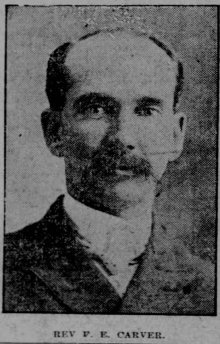
Carver, FEMILTON, Sept 5. The recent action of Rev. F.E. Carver, pastor of the Free Baptist church of this village, in an effort to prosecute under the liquor law Frank Fernald, a local druggist, has taken an unexpected turn, which has created the profoundest sensation in town. and particularly in social and church circles.

On Saturday a warrant was served on Rev. Mr. Carver, charging him with blackmailing Frank Fernald, the complainant, by promising to desist from prosecuting the latter on a liquor charge on payment of $30, which, it is alleged, was paid to him by Fernald and a receipt given.

The clergyman has had Fernald’s places searched several times in the past, it is stated, but the present case resulted from the seizure, a few days ago, of a half pint of whisky on a search warrant sworn out by Rev. Mr. Carver.

Fernald claimed that the liquor was kept for medicinal purposes, but the clergyman threatened to prosecute him and make him pay the statutory fine of $50 for keeping spirituous liquors for sale.

The matter was not immediately pressed to an issue, and Fernald, it is stated, made advances toward the clergyman in reference to dropping the matter, offering to pay him whatever might be satisfactory. Mr. Carver consulted an attorney, so if is said, as to the matter of dropping the case in the way proposed. The consultation resulted in his deciding to accept the proposition.

An appointment was accordingly made with Fernald to meet him at a hotel in the village and fix the matte up. They met on Friday at the appointed time. Fernald had taken precautions to have witnesses to the transaction, and had three of his friends concealed in the next room where they could see all without being seen by the clergyman.

It is alleged that the hush money, $30 in bank notes, were then paid to Mr. Carver by Fernald and a receipt for the money given. The minister then tore up the liquor warrant.

Fernald had succeeded in accomplishing his purpose of scoring even with Mr. Carver, as he has, it is said, from time to time, boasted he would, and without informing the latter what he intended doing, proceeded at once to Rochester, consulted counsel and swore out a warrant for Carver’s arrest for alleged blackmail. The warrant was served Saturday afternoon and Mr. Carver was notified to appear before the police court at Milton Mills Monday morning.

The clergyman’s friends are greatly exercised over the affair, and seem ready to swear vengeance against the druggist. While they question the propriety of his accepting money for keeping the matter quiet, they say he was innocently entrapped.

Mr. Fernald. on the other hand, says he believes the minister engaged in the work of prosecuting him for what money there was in it, and shows his receipt for $30 as evidence that such was probably the case (Boston Globe, September 6, 1897).

Rev. Carver gave no defense. His attorney admitted the facts, but claimed that Carver lacked any ill intent. Nevertheless, Carver was convicted on a charge of “composition,” i.e., a type of conspiracy. Legal tomes point out that in forgoing prosecution in favor of blackmailing Fernald, Carver had deprived the body politic of its opportunity to exercise its public justice and to collect its fines. That is, he had prevented the government from getting its “pound of flesh” from Fernald. (Assuming Fernald would have been convicted, that is).

The Aftermath

F.E. Fernald appeared as proprietor of a Milton drug store in the Milton Business Directory of 1898 (but not in that of 1901). He left Milton before June 1900 to work in Boston as a foreman for the N.B. Thayer shoe company. (He appears to have retained his deceased parents’ Milton homestead, perhaps as a summer residence).

Frank E. Fernald, a shoe factory foreman, aged thirty-four years (b. MA), headed a Boston, MA, household at the time of the Twelfth (1900) Federal Census. His household included his wife (of nine years), Lucy F. Fernald, aged thirty-four years (b. NH), and his wife’s mother, Harriet E. Watson, a widow, aged seventy-two years (b. NH). They resided at 119 Dale Street.

Rev. Carver left Milton too not long after, i.e., 1900-01. He removed to Fort Fairfield, ME.

New Hampshire repealed its state-level prohibition law in 1903. Its legislature replaced it with a New Hampshire Liquor License Law. Instead of forbidding but with few exceptions, they went over to permitting but with many restrictions.

For example, the following bizarre provision forbid serving mixed drinks, having female servers or store clerks, or felon clerks or servers, or having bars that were not fishbowls.

It shall not be lawful to have adulterated liquors, to have any girl or woman clerk, or anyone who has committed a felony serve liquor, and the bars must be visible from the outside (Portsmouth Herald, March 4, 1903).

So, for purposes of selling or serving liquor, being a woman was functionally equivalent to having been convicted of a felony. It would be impossible to make this up. And so things stood until national prohibition was imposed in 1920.

Fernald in Subsequent Years

Frank E. Fernald was one of only twelve Milton residents to have a private [automobile] operator’s license in 1907 (there were also three chauffeur’s licenses); his automobile was one of the only thirteen to sixteen automobiles (and two motorcycles) registered in town.

Receives Silver Loving Cup. EAST ROCHESTER, N.H, Sept 17. Charles C. Taft, manager of the N.B. Thayer & Co. shoe factory since the company started here, was surprised yesterday by the other officials by the presentation of a silver loving cup. The speech was made by Supt. Frank E. Fernald. Mr. Taft recently resigned as manager to accept a similar position with the Nettleton shoe company of Syracuse, N.Y. Mr. Taft formerly lived in Boston (Boston Globe, September 17, 1907).

NB Thayer Letterhead (S-l1600) - Detail
N.B. Thayer & Company Letterhead, 1909

Frank E. Fernald, a shoe factory superintendent, aged forty-three years (b. MA), headed a Boston, MA, household at the time of the Thirteenth (1910) Federal Census. His household included his wife (of twenty years), Lucy Fernald, aged forty-two years (b. NH), and his mother-in-law, Harriet E. Watson, a widow, aged eighty-two years (b. NH). They resided in a six-unit apartment building at 312 Warren Street.

The Boston Directory of 1911 listed Fernald, Frank E., supt., h. 312 Warren, Rox. [i.e., Roxbury, a district of Boston].

Frank E. Fernald, of Milton, NH, and Sarah Lucy Fernald, of Roxbury, MA, divorced in Strafford County Superior Court, November 1, 1910. He accused her of so treating him as to seriously impair his health. (One had to allege something).

The Boston City Directory of 1912 listed Frank E. Fernald, as having rem. to E. Rochester, N.H. It did list his wife, S. Lucy Fernald, milliner, at 313A Warren, i.e., she remained behind in Roxbury, MA, at least for a while.

Frank E. Fernald married (2nd) in Rochester, NH, April 17, 1912, Lulu A. Tuttle, he of Milton and she of Farmington. He was a divorced shoe factory superintendent, aged forty-six years (b. Boston), and she a houseworker, aged thirty-four years (b. Farmington). Frank H. Libby, of Rochester, clergyman, performed the ceremony. She was born in Farmington, NH, September 16, 1875, daughter of Charles E. and Justina (Ham) Tuttle.

Frank E. Fernald received a patent (Number 1,094,546), April 28, 1914, for an “Apparatus for Use in the Manufacture of Boots and Shoes.” He assigned it to the United Shoe Manufacturing Company (Haag, 1914).

CHANGES IN SUPERINTENDENTS AND FOREMEN. Mr. McMurray, superintendent of N.B. Thayer, E. Rochester, has given up his position and has accepted a similar one with Tapley & Marston, Danvers, Mass. He will be succeeded by J.B. Hill of Brockton. Mr. Frank Fernald, the former superintendent, is at the factory for a short time, having fully recovered from his sickness. Mr. McMurray was formerly superintendent for W.H. McElwain in their Newport factory (McLeish, 1916). 

CHANGES IN SUPERINTENDENTS AND FOREMEN. Frank Fernald, the well-known superintendent of N.B. Thayer Co., East Rochester, who retired some time ago on account of poor health, is back with this firm as general manager. Mr. Hill is superintendent at present. Mr. Fernald’s many friends are pleased to learn of his permanent recovery from his illness (McLeish, 1917).

Frank E. Fernald and Harry Y. Nute, of Milton, applied for a patent on an innersole design on March 18, 1918.

1,324,390. INNERSOLE. FRANK E. FERNALD, HARRY Y. NUTE, Milton, N.H. Filed Mar. 18, 1918. Serial No. 223,224. 1 Claim. (Cl. 36-22). An inner sole comprising a base layer, a marginal fabric rib stitched longitudinally medially thereof to the base to provide free edge portions at opposite sides of the stitch and having one face thereof adhesively coated to permit the connection of the opposite edge portions thereof together when folded, the edge portions of the rib when folded being connected by a single row of stitching extending longitudinally thereabout through said edge portions, and a reinforcing stiff fabric on said base and having its edge and lower adjacent marginal portions adhesively connected with the inner edge portion of the rib and the base layer (US Patent Office, 1920).

Harry Yeaton Nute was born in Milton Mills, March 28, 1875, son of John S. and Emma (Morse) Nute.

Frank E. Fernald, a farmer (small farm), aged fifty-three years (b. MA), headed a Wells, ME, household at the time of the Fourteenth (1920) Federal Census. His household included his wife, Lulu A. Fernald, aged forty-four years (b. NH), and his boarder, George Ham, aged forty-two years (b. NH). They resided on Kennebunk Road.

Frank E. Fernald, a shoe factory superintendent, aged sixty-four years (b. MA), headed a Rochester, NH, household at the time of the Fifteenth (1930) Federal Census. His household included his wife, Lulu A. Fernald, aged fifty-four years (b. NH), and his brother-in-law, George Ham, aged fifty-one years (b. NH). They resided at 28 Main Street and did have a radio set.

East Rochester Notes. Mr. and Mrs. Frank Fernald of Milton, N.H., called on friends in town yesterday. Mr. Fernald is a retired shoe executive and for many years was connected with the N.B. Thayer Shoe company here (Portsmouth Herald, December 6, 1941).

Frank E. Fernald, retired, aged seventy-four years (b. MA), headed a Milton, NH, household at the time of the Sixteenth (1940) Federal Census. His household included his wife, Lulu A.J. Fernald, aged sixty-three years (b. NH), and his brother-in-law, George Ham, aged sixty-two years (b. NH). They owned their home on Main Street (“Milton Community”), which was valued at $2,500.

Frank E. Fernald died in Milton, NH, December 14, 1944. Rev. Fred E. Carver died in Portland, ME, August 29, 1948.


Prohibition would be all right if it prohibited anything except the sale of good liquor – Portsmouth Herald, February 8, 1903


Mr. S.D. Plissken contributed to this article.


References:

Allison, William O. (1897, August). Druggists Circular and Chemical Gazette. Retrieved from books.google.com/books?id=Dk0xAQAAMAAJ&pg=PR83

Allison, William O. (1897, October). Druggists Circular and Chemical Gazette. Retrieved from books.google.com/books?id=Dk0xAQAAMAAJ&pg=PR107

Find a Grave. (2016, April 17). Charles W. Hicks. Retrieved from www.findagrave.com/memorial/161206405

Find a Grave. (2015, August 8). Frank E. Fernald. Retrieved from www.findagrave.com/memorial/150356638

Find a Grave. (2013, November 9). Fred E. Carver. Retrieved from www.findagrave.com/memorial/120061681

Haag, Haag, and Haag. (1914, June). Shoe and Leather Facts. Retrieved from books.google.com/books?id=gNM-AQAAMAAJ&pg=RA4-PA37

Haynes, D.O. and Company. (1895). Pharmaceutical Era. Retrieved from books.google.com/books?id=WrzmAAAAMAAJ&pg=PA761

Knowlton, Jerome C. (1902). Cases on Criminal Law. Retrieved from books.google.com/books?id=KBw0AQAAMAAJ&pg=PA309&lpg=PA309

McLeish Communications. (1916, November 4). American Shoemaking. Retrieved from books.google.com/books?id=m-scAQAAMAAJ&pg=RA4-PA25

McLeish Communications. (1917). American Shoemaking. Retrieved from books.google.com/books?id=RuscAQAAMAAJ&pg=RA10-PA25

Sanborn, Josiah B. (1900). The New Hampshire Reports (State vs. Carver). Retrieved from books.google.com/books?id=njdQAQAAMAAJ&pg=PA2

US Patent Office. (1920). Official Gazette of the US Patent Office. Retrieved from books.google.com/books?id=_stRAQAAMAAJ&pg=PA265

Engelhard, G.F., and Company. (1896, December). Western Druggist. Retrieved from books.google.com/books?id=C9DnAAAAMAAJ&pg=PA578

Wikipedia. (2019, May 19). Maine Law. Retrieved from en.wikipedia.org/wiki/Maine_law

Wikipedia. (2019, May 12). Neal Dow. Retrieved from en.wikipedia.org/wiki/Neal_Dow

Wikipedia. (2019, May 19). Prohibition in the United States. Retrieved from en.wikipedia.org/wiki/Prohibition_in_the_United_States
Blackfly Song

By Muriel Bristol | May 20, 2019

The blackflies made their annual reappearance last week. Wednesday (May 15) at my house). That fits pretty well with their traditional schedule of between Mothers’ Day and Fathers’ Day.

Last year, we provided both a general description (Black Flies Return) and a folk remedy for their itching bites (Hot Water for Itchy Bug Bites).

That having been covered already, the following Canadian folk song – Blackfly Song – as sung in 1955 by its author Wade Hemsworth, might give some sense of the joy that is blackfly season.

We are not facing them in the woods of North Ontario, thankfully, but their Milton cousins are fierce enough, thank you.

Blackfly Song

‘Twas early in the spring when I decide to go
For to work up in the woods in North Ontar-i-o;
And the unemployment office said they’d send me through
To the Little Abitibi with the survey crew
And the black flies, the little black flies,
Always the black fly no matter where you go;
I’ll die with the black fly a-pickin’ my bones,
In North Ontar-i-o-i-o, in North Ontar-i-o.

And the man Black Tobey was the captain of the crew
And he said, I’m gonna tell you boys, what we’re gonna do:
They want to build a power dam; we must find a way
For to make the Little Ab flow around the other way
With the black flies, the little black flies,
Always the black fly no matter where you go;
I’ll die with the black fly a-pickin’ my bones,
In North Ontar-i-o-i-o, in North Ontar-i-o.

So we survey to the east, survey to the west,
Couldn’t make our minds up how to do it best;
Little Ab, Little Ab, what shall I do?
I’m all but goin’ crazy with the survey crew
And the black flies, the little black flies,
Always the black fly no matter where you go;
I’ll die with the black fly a-pickin’ my bones,
In North Ontar-i-o-i-o, in North Ontar-i-o.

It was blackfly, blackfly, everywhere,
A-crawlin’ in your whiskers, crawlin’ in your hair;
Swimmin’ in the soup, swimmin’ in the tea,
And the devil take the blackfly, let me be.
Black flies, the little black flies,
Always the black fly no matter where you go;
I’ll die with the black fly a-pickin’ my bones,
In North Ontar-i-o-i-o, in North Ontar-i-o.

Black Tobey fell to swearin’; the work went slow,
The state of our morale was a-gettin’ pretty low;
The flies swarmed heavy; hard to catch your breath,
As you staggered up and down the trail a-talkin’ to yourself
With the black flies, the little black flies,
Always the black fly no matter where you go;
I’ll die with the black fly a-pickin’ my bones,
In North Ontar-i-o-i-o, in North Ontar-i-o.

Well now, the bull cook’s name was Blind River Joe,
If it hadn’t been for him we’d ‘ve never pulled through;
‘Cause he bound up our bruises and he kidded us for fun,
And he lathered us with bacon grease and balsam gum.
And the black flies, the little black flies,
Always the black fly no matter where you go;
I’ll die with the black fly a-pickin’ my bones,
In North Ontar-i-o-i-o, in North Ontar-i-o.

And at last the job was over; Black Tobey said we’re through
With the Little Abitibi and the survey crew!
‘Twas a wonderful experience and this I know:
I’ll never go again to North Ontar-i-o
With the black flies, the little black flies,
Always the black fly no matter where you go;
I’ll die with the black fly a-pickin’ my bones,
In North Ontar-i-o-i-o, in North Ontar-i-o.

And the black flies, the little black flies,
Always the black fly no matter where you go;
I’ll die with the black fly a-pickin’ my bones,
In North Ontar-i-o-i-o, in North Ontar-i-o.

References:

Wikipedia. (2018, December 14). Little Abitibi River. Retrieved from en.wikipedia.org/wiki/Little_Abitibi_River

YouTube. (2015, May 20). Blackfly Song. Retrieved from www.youtube.com/watch?v=SIzw1j4onNc

Milton in the News – 1896

By Muriel Bristol (Transcriber) | May 19, 2019

In this year, we encounter an offer of a good home, a flood at the Spaulding homestead, the Lynn death of a Milton native, a troubled Amesbury shoe factory considering a move, a first-class cook wanted, the suspicious death of a traveler, non-union lasters being both wanted and warned away, and a drowning death.

(Milton Mills got a telephone exchange and its first telephones in this year. Milton did not get their first ones until 1898).


Male Help Wanted. WANTED – A boy about 15 or 16 years in want of a good home for the winter for board, chores on a small farm. Apply G.G., Milton Mills, N.H. (Boston Globe, January 6, 1896).

A boy of this age would have completed already his district school education. No pay is mentioned here, but “chores” are not a full-time job. The boy in question would be free to supplement this room-and-board offer with paid work elsewhere.


Townsend, MA, was the ancestral home of the Spaulding family. Here we find the Townsend house of Jonas Spaulding, Jr., suffering some flood damage. Jonas Spaulding, Jr., was the father in the J. Spaulding & Sons leatherboard manufacturing partnership.

TOWNSEND HARBOR. Many of the cellars of this village have been flooded this week, but, aside from this, little damage has been done hereabouts. The pond is as solidly frozen as any time this winter. The Conant House, recently occupied by Mr. Stackpole, was sold at auction Saturday. The property of the father of Spaulding brothers in Milton, N.H., was damaged several hundred dollars by the flood. Harry Wright, late with Frank Knight, is still at his home in Hudson, badly broken up, physically. He is not likely to be [- indistinct -] this season (Fitchburg Sentinel (Fitchburg, MA), March 6, 1896).

Leatherboard is made from a pulp of scrap leather and wood pulp. Spaulding Brother, later J. Spaulding & Sons, had factories in both Massachusetts and New Hampshire, including those in Milton and East Rochester. (Later, their largest factory would be established in Tonawanda, NY).

Two of the three Spaulding sons would go on to become governors of New Hampshire. Rochester’s Spaulding High School and the Spaulding Turnpike are named after them.


War Veteran Dies. LYNN, March 12. William Cook, 61, a war veteran, died today. He was born at Milton, N.H, enlisted for three months at Haverhill in the 8th regiment at the beginning of the war, and when his term had expired reenlisted in the 4th Massachusetts volunteers. He was a member of Washington lodge of Masons of Windsor, Conn., and of Gen. Lander post, 5, G.A.R., Lynn (Boston Globe, March 13, 1896).

William P. Cook was born in Milton, NH, April 26, 1834, son of William W. and Mary M. (Yeaton) Cook.

William W. Cook, a farmer, aged fifty-two years (b. NH), headed a Milton household at the time of the Seventh (1850) Federal Census. His household included Mary Cook, aged forty-eight years (b. NH), George H. Cook, a shoemaker, aged eighteen years (b. NH), William P. Cook, a shoemaker, aged sixteen years, Mary E. Cook, aged thirteen years (b. NH), Mark F. Cook, aged nine years (b. NH), Ira Cook, aged six years (b. NH), and Charles E. Cook, aged four years (b. NH). William W. Cook had real estate valued at $1,000. Their household appeared in the enumeration between those of Elias S. Cook, a farmer, aged thirty-six years (b. NH), and Joseph Pearl, a farmer, aged years. They lived also quite close (same page) to the household of John T.G. Colby, a Christian B. [Baptist] Clergyman, aged fifty-four years (b. NH). Note too the child Mark F. Cook, who was likely a namesake for Elder Mark Fernald.

William P. Cook married (1st) in Lynn, MA, September 5, 1858, Margaret E. Rand, both of Lynn, MA. He was a cordwainer, aged twenty-four years (b. Milton, NH), and she was a shoe-fitter, aged twenty-two years (b. Europe). It was her second marriage. Rev. H.E. Hempstead performed the ceremony.

Wm. E. Cook, a cordwainer, aged thirty years (b. NH), headed a Lynn, MA, household at the time of the Eighth (1860) Federal Census. His household included Margaret Cook, aged twenty-five years (b. MA), and Charles Cook, aged one year (b. MA). His household shared a two-family dwelling with the household of John P. Watts, a cordwainer, aged thirty-six years (b. NH). (Their son, Charles Herbert Cook, died of scarlet fever in Lynn, MA, May 20, 1863, aged four years).

William P. Cook, a shoemaker, married, aged twenty-nine years (b. NH), registered for the Class I military draft in Lynn, MA, in May or June 1863. “Class I comprises all persons subject to do military duty between the ages of twenty and thirty-five years, and all unmarried persons subject to do military duty above the age of thirty-five years and under the age of forty-five.”

William P. Cook, a shoemaker, aged thirty years (b. NH), and Margaret Cook, a shoe-fitter, aged twenty-seven years (b. NY), resided in the Lynn, MA, household of Thomas B. Wilford, an expressman, aged thirty-seven years (b. Marblehead), at the time of the Second (1865) Massachusetts State Census.

He married (2nd), after 1865, but before 1880, Essie J. Latham. She was born circa 1853.

William P. Cook, a shoemaker, aged forty-five years (b. NH), headed a Lynn, MA, household at the time of the Tenth (1880) Federal Census. His household included his wife, Essie J. Cook, keeping house, aged twenty-seven years (b. England), and his boarder, Florence Rand, works in shoe factory, aged twenty years (b. MA). They resided at 8 Bickford Court.

William P. Cook filed for a Federal invalid veteran’s pension, June 24, 1884, based upon his service in the Fourth Massachusetts H.A. [Heavy Artillery] during the civil war.

William P. Cook of Lynn, MA, appeared in the surviving veterans schedule of the Eleventh (1890) Federal Census. According to that schedule, he had enlisted in Co. D of the Fifth Massachusetts Infantry, in April 1861, and had been discharged in July 1861. He had re-enlisted in Co. L of the Fourth Massachusetts H.A. [Heavy Artillery], in June 1864, and had been discharged in July 1865.

William P. Cook died in Lynn, MA, March 12, 1896, aged sixty-three years, ten months, and sixteen days.

The Lynn City Directory for 1897 listed William P. Cook, died March 12, 1896. It had also listed Mrs. William P. Cook, forewoman stitching, 95 State [Charles H. Ingalls & Co.], h. 16 Warren and Essie J. Cook, h. 16 Warren.

Essie J. Cook filed for a Federal widow’s pension, March 20, 1896, based upon her deceased husband’s service in the Fourth Massachusetts H.A. [Heavy Artillery] during the civil war.

Essie J. (Latham) Cook died in Lynn, MA, in November 1928.


The Massachusetts Department of Labor and Industries chronicled Amesbury’s industries of 1895. The Lewis, Adams, & Co. firm, which was engaged in making slippers, became the Lewis, Gross, & Co. firm. The substitution of Gross for Adams might suggest a new partner with new capital, which might have been necessary if the firm were struggling and financially “embarrassed.”

THE WEEK’S NEWS. FRIDAY, MAY 22. The shoe firm of Lewis Gross & Co., of Amesbury, Mass., will move to Milton Mills, N.H. (Newport Mercury (Newport, RI), May 23, 1896).

Lewis Gross and Co. Make Assignment. AMESBURY, June 6. The slipper firm of Lewis Gross & Co. made an assignment this morning to J.T. Choate, a local attorney. An attachment was served yesterday which they could not meet. No statement is made. It is probable that the firm will resume operations and that the difficulty will be but temporary. This is the firm which was announced last week as being about to move to Milton Mills. N.H., where a factory was being built for them. It is understood, however, that one of the firm is favorable to remaining here and Pres. Chipman of the Merchants’ association and others are laboring to secure their remaining in Amesbury (Boston Globe, June 6, 1896).

An “assignment” is a transfer of asset ownership from a debtor to a creditor.

To Continue Business at Amesbury. AMESBURY, July 20. The slipper firm of Lewis, Gross & Co, which failed here two months ago with liabilities of $30,000, are to continue business here. It was announced this morning that arrangements had been perfected whereby the plant will be sold by the assignee to parties who will, in conjunction with Messrs. Lewis, continue the business. It is further stated that Mr. Gross will retire. Before the firm assigned reports were published that they were to move their business to Milton Mills, N.H, and the fact that they will continue here is hailed with satisfaction (Boston Globe, July 20, 1896).

Hailed with satisfaction in Amesbury, MA, no doubt, although Milton Mills must have been somewhat less satisfied.


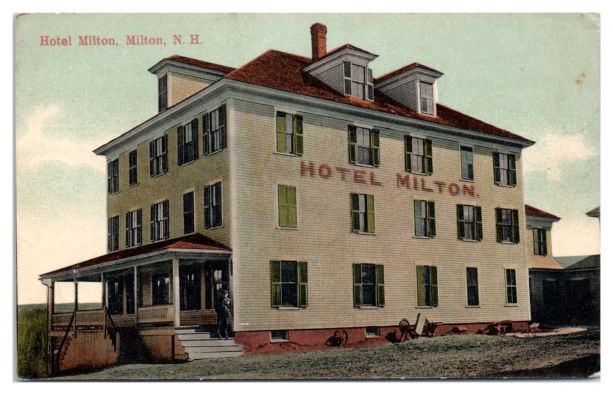
The Milton Hotel (or Hotel Milton) advertised for a first-class cook, a female one.

Female Help Wanted. WANTED – To pay $1 per day for first-class cook, steady job. Milton hotel, Milton, N,H. (Boston Globe, June 29, 1896).

Hotel MiltonThe Milton Hotel appeared, under the management of E.M. Bodwell, in the Milton Business Directories of 1894, 1898, 1901, and 1904.

Charles L. Bodwell, a hotel keeper, aged forty-three years (b. ME), headed a Milton household at the time of the Twelfth (1900) Federal Census. His household included his wife, Etta M. Bodwell, aged forty-two years (b. ME), and his son, Linwood C. Bodwell, at school, aged twelve years (b. NH). It would appear that he rented the building from her, which she owned free-and-clear. (More might be found in its census farm schedule).

Seven servants and six boarders resided in the Milton Hotel on that census day in June 1900. Cecile Fritts, house cook, aged twenty-five years (b. MI) was one of the servants. Due to the inflation of the intervening years, her daily wage of $1.00 would have the purchasing power of $30.46 in 2019. (She probably made about $9,503 per year). Of course, there were no income taxes and she appears to have received room and board also.

The poet Louise Bogan (1897-1970) lived as a child in the Milton Hotel (or Hotel Milton) for a few years from 1901. “The hotel faced both the Caricade [Carricabe] Paper Mill and the old flume, a mile-long stretch of very rapid white water dropping nearly a hundred feet over a rocky series of falls” (Frank, 1986). (See also Milton Water Power in 1901).


One might expect the Milton murder of  a traveling stranger to have received more column inches than this did. The authorities seem to have satisfied themselves as to identity of the victim on rather slight circumstantial evidence and a telegraphed description.

WILLIAM O’NEILL, PERHAPS. CLINTON, July 25. – It is thought that the man found murdered at Milton, N.H., July 14, is William O’Neill of this place. He left the Lancaster mills, where he was a weaver, three weeks ago, for Lewiston, Me. (Boston Globe, July 26, 1896).

LETTER MAY FURNISH CLEW. Body Found by Roadside Thought to be That of William O’Neil of Clinton. CLINTON, July 27. There is a general impression here today, based upon information furnished by the police, that the unknown man found murdered by the roadside at Milton, N.H., July 14, is William O’Neil of this town. When the remains were found a letter was discovered in the clothes. addressed to William O’Neil, Clinton, Mass. A description of the man arrived this morning, and those who knew O’Neil say that it fits him exactly. O’Neil was employed at the Lancaster gingham mills for the past three years, and is popular with his associates. John McGrail, with whom Mr. O’Neil boarded, states that he left here three weeks ago for Lewiston, Me. Since then he has heard nothing from him. Mr. McGrail thinks that the murdered man was O’Neil (Boston Globe, July 27, 1896).

There does not seem to have been any subsequent stories of investigations, suspects, arrests or trials. The O’Neill murder case – if that was who he was – seems to have gone “cold.”

(Ed. Note: Milton Vital Records name and explain him as “Unknown,” a white male, aged thirty-five years, who was “Run Over by Train”).


Here we find mention of a second Milton shoe strike. N.B. Thayer & Co. advertised for sixteen shoe lasters, apparently to replace those out on strike.

MALE HELP WANTED. LASTERS wanted. 6 non-union lasters on boys’ shoes, 10 on misses’ and children’s, must be good workmen and responsible men. Apply to 103 Bedford st., Boston, or Milton, N.H. N.B. THAYER & CO.

In the same edition of the same newspaper the union strike committee advertised its request that all shoe lasters stay away from Milton.

LASTERS are requested to keep away from Milton, N.H. as there is a strike on. Per order committee (Boston Globe, September 2, 1896).


Here we find another accidental death in which the victim was intoxicated. (Following the grisly wagon-dragging death in 1891).

Body Found in Milton Pond. SANFORD, Me, Nov. 11 – The body of John Steves, who disappeared from West Lebanon last week, was found floating in the pond at Milton, N.H., today. He was last seen Friday night, and was then in an intoxicated condition. It is supposed that in attempting to cross the railway bridge on the North Conway branch of the Boston & Maine he fell into the water and perished (Boston Globe, November 12, 1896).

Mr. Steves left little in the way of a documentary record. One supposes that he did his drinking in Milton and was attempting to cross back to the Lebanon, ME, side of the river.


Previous in sequence: Milton in the News – 1895; next in sequence: Milton in the News – 1897


References:

Find a Grave. (2013, July 7). Charles Linwood Bodwell. Retrieved from www.findagrave.com/memorial/113448151

Find a Grave. (2011, January 26). Pvt. William P. Cook. Retrieved from www.findagrave.com/memorial/64713218

Frank, Elizabeth. (1986). Louise Bogan: A Portrait. Retrieved from books.google.com/books?id=SSsaOu2w85UC&pg=PA6

Massachusetts Department of Labor and Statistics. (1896). Annual Report on the Statistics of Manufactures. Retrieved from books.google.com/books?id=zSwaAQAAIAAJ&pg=PA254

Massachusetts Department of Labor and Statistics. (1897). Annual Report on the Statistics of Manufactures. Retrieved from books.google.com/books?id=M6AoAAAAYAAJ&pg=PA197

Wikipedia. (2019, February 25). Louise Bogan. Retrieved from en.wikipedia.org/wiki/Louise_Bogan

Wikipedia. (2018, October 11). Townsend, Massachusetts. Retrieved from en.wikipedia.org/wiki/Townsend,_Massachusetts

YouTube. (2018, June 3). Penny Loafers Hand Lasting. Retrieved from www.youtube.com/watch?v=4O2yjII_WLU

Public BOS Session Scheduled (May 20, 2019)

By Muriel Bristol | May 17, 2019

The Milton Board of Selectmen (BOS) have posted their agenda for a Public BOS meeting to be held Monday, May 20, beginning at 6:00 PM.

There will be also a concluding Non-Public session (regarding a matter whose discussion “would likely affect adversely the reputation” of someone) after the Public portion of the BOS meeting (see below).

Ernest M. Cartier Creveling received his appointment as the new Town Administrator as of Monday, May 15. This would be his first meeting as Milton Town Administrator.


The Public portion of the agenda has New Business, Old Business, Other Business, and some housekeeping items.

Under New Business are scheduled four agenda items: 1) Appoint Board of Selectmen Liaison Townhouse Stewardship Committee, 2) Approval of Public Works Employee Hiring (Pat Smith), 3) Public Hearing – Acquisition and Possible Disposition of Land Parcel; Tax Map 17, Lot 5, and 4) Request to Purchase Tax Map 37 Lot 64 (Jackie Monahan).

Appoint Board of Selectmen Liaison Townhouse Stewardship Committee. At their inaugural meeting, the BOS neglected to appoint one of their members for all of the ex-officio BOS seats. Some lucky selectman will win an ex-officio seat on the Townhouse Stewardship Committee.

Approval of Public Works Employee Hiring (Pat Smith). The BOS began the Default Budget year already “in the hole” from last year’s employee medical insurance increases. This agenda item heralds a fifth new hire since then: two policemen, a town administrator, a land use clerk, and now a DPW employee.

Newton’s third law of default budgets informs us that for every budget expenditure there must be an equal and opposite budget cut (probably to a service).

Public Hearing – Acquisition and Possible Disposition of Land Parcel; Tax Map 17, Lot 5. At the last meeting, we were informed that this property was already acquired in 2015, but without the proper rigmarole, and that two Public Hearings would be necessary to set things straight.

Request to Purchase Tax Map 37 Lot 64 (Jackie Monahan). Ms. Jackie Monahan, of Ford Farm Road, might like to purchase a roughly $200 addition to her annual tax bill, in the form of another 0.4-acre parcel on Ford Farm Road.


Under Old Business is scheduled one item: 5) Approve Economic Development Committee & Recreation Commission Appointments.

Approve Economic Development Committee & Recreation Commission Appointments. Rather than dissolve the various boards, committees, and commissions that lacked candidates at the recent election, evidently due to a lack of interest, the BOS will designate their personal favorites from among such as asked them for post-election appointments.


Other Business That May Come Before the Board has no scheduled items.


Next, there will be the approval of prior minutes (from the Special BOS meeting of May 4 (the tax-titled property auction), and the BOS meeting of May 6, 2019), the expenditure report, Public Comments “Pertaining to Topics Discussed,” Town Administrator comments, and BOS comments.


Non-Public Session: 91-A:3 II (c) – Reputation

Earlier in the week, this Public BOS meeting was to have begun with a Non-Public session at 5:30 PM, for a Non-Public agenda item classed as 91-A3 II (c). The BOS appears to be holding that Non-Public session at the conclusion of their Public BOS meeting instead of at the beginning as they usually do.

91-A:3 II (c). Matters which, if discussed in public, would likely affect adversely the reputation of any person, other than a member of the public body itself, unless such person requests an open meeting. This exemption shall extend to any application for assistance or tax abatement or waiver of a fee, fine, or other levy, if based on inability to pay or poverty of the applicant.

An additional annotation of “Reputation” was added to the usual 91-A justification. Someone thought we should know that this particular Non-Public session would deal specifically with a matter that might affect adversely the reputation of some person, other than a member of the public body. (And that it would not deal with any application for assistance, tax abatement, or waiver).

Peekaboo. Everyone can see who comes and goes from these Non-Public sessions. Only an ostrich or a toddler think that if they cannot see you, you cannot see them.

(Well, maybe it works for truck drivers and their rear-view mirrors. And group photos and the camera).

[Added from the court filings database, October 23, 2019: “New Hampshire Supreme Court, Report on Status of Cases, As of September 30, 2019. Case 2019-0278. Three Ponds Resort, LLC v. Town of Milton. 05/15/2019 – Case Filing. 06/04/2019 – Accepted.”]


Mr. S.D. Plissken contributed to this article.


References:

State of New Hampshire. (2016, June 21). RSA Chapter 91-A. Access to Governmental Records and Meetings. Retrieved from www.gencourt.state.nh.us/rsa/html/VI/91-A/91-A-3.htm

Town of Milton. (2019, May 2). BOS Meeting Agenda, May 4, 2019. Retrieved from www.miltonnh-us.com/sites/miltonnh/files/agendas/5.4.19_bos_agenda-town_property_auction_0.pdf

Town of Milton. (2019, May 2). BOS Meeting Agenda, May 6, 2019. Retrieved from www.miltonnh-us.com/sites/miltonnh/files/agendas/5.6.19_bos_agenda.pdf

Town of Milton. (2019, May 17). BOS Meeting Agenda, May 20, 2019. Retrieved from www.miltonnh-us.com/sites/miltonnh/files/agendas/5.20.19_bos_agenda.pdf

Town of Milton. (2019). Press Release: Milton Names New Town Administrator. Retrieved from www.miltonnh-us.com/sites/miltonnh/files/news/press_release-milton_names_new_town_administrator.pdf

Wikipedia. (2019, April 25). Newton’s Laws of Motion. Retrieved from en.wikipedia.org/wiki/Newton%27s_laws_of_motion

Youtube. (1965). Cone of Silence. Retrieved from www.youtube.com/watch?v=g1eUIK9CihA&feature=youtu.be&t=1

Milton in the News – 1895

By Muriel Bristol (Transcriber) |May 12, 2019

In this year, we encounter some hiring by a mill superintendent, the demise of a former mill superintendent, children for adoption, a would-be housekeeper seeking employment, several out-of-town visitors, the departure of an original Nute High School teacher, and Miss Merrill’s “miracle” cure.


Vermont native William T. Rockwell was the Varney & Lane shoe factory superintendent during the Milton Mills Shoe Strike of 1889. During which event he and his wife were allegedly threatened by the strikers.

Here he we find him recruiting factory help for a successor shoe factory (perhaps the W.T. Thayer [N.B. Thayer] company, whose proposed expansion was announced in 1894, or perhaps the Gale Shoe company, who leased the Varney & Lane factory at Milton Mills in this year).

SHOE FACTORY HELP WANTED. In factory just starting at Milton Mills, N.H., operators on all machines in making room, lasters and stitching room help; also first-class bottom finisher, to take job by case; also first-class stock fitter, to take job by case. Address W.T. ROCKWELL (Boston Globe, February 13, 1895).

William T. Rockwell removed to Burlington, VT, by 1899, where he became superintendent of the Lakeside Shoe Company (and thereafter to Pittsfield, MA).

William Rockwell, a shoe manufacturer, aged forty-nine years (b. VT), headed a Burlington, VT, household at the time of the Twelfth (1900) Federal Census. His household included his wife (of twenty-one years), Carrie Rockwell, aged forty-six years (b. VT), and her parents, [Narcise] Nelson Milete, aged seventy-two years (b. Canada), and Louise Milete, aged sixty-two years (b. Canada). They resided in a rented house on Park Avenue. Her parents were resident aliens, who had entered the country in 1870.

William T. Rockwell died of general paralysis (six months duration) at the NH Soldiers’ Home in Tilton, NH, September 28, 1906, aged fifty-five years, ten months, and twenty-six days. He had been resident there for two years; his previous residence was Pittsfield, MA. (He was born in Middleton, VT, November 2, 1850).

TROY. A telegram has been received announcing the death of William T. Rockwell, son of Mr. and Mrs. Anson Rockwell of this place. Mr. Rockwell had been in poor health for several years, and his death occurred at the Soldiers’ Home at Tilton, N.H. At the breaking out of the civil war he was attending school at Westfield and although only fourteen years of age walked to Hyde Park and enlisted. After his return from the war he learned the shoemaker’s trade, becoming very proficient, and had held some excellent positions. Mr. Rockwell leaves a wife, father and mother, and ten brothers and sisters. This is the first break in the family, of which Mr. Rockwell was the oldest child (Orleans County Monitor (Barton, VT), October 8, 1906).

The Pittsfield City Directory of 1906 listed Rockwell, Carrie A., wid. William T., h. 3 Forest pl. (She had removed to California by 1910).

Caroline A. (Milete) Rockwell died in Lakeport Village, Laconia, NH, May 21, 1935, aged eighty-one years, one month, and nineteen days.


The following obituary of Joseph Robinson tells his rags-to-riches life story. John Townsend employed him as his mill superintendent at the Milton Mills Manufacturing Company in the early 1850s.

Joseph Robinson was born in Hunslet, Yorkshire, England, May 9. 1812, son of James and Mary S. (Aspin) Robinson.

He married in Leeds, March 26, 1833, Frances Ann Lewis. She was born in Yorkshire, November 16, 1814, daughter of Thomas and Isabella (Theakston) Lewis.

Joseph Robinson, a dyer, aged twenty-five years, headed a Leeds, Yorkshire, England household at the time of the UK Census of 1841. His household included Frances Robinson, aged twenty years, Mary Robinson, aged seven years, Frances Robinson, aged three years, and Thomas Robinson, aged one year. (The UK Census of 1841 used five-year age ranges for adults: Joseph and his wife were aged 25-29 and 20-24 respectively). They resided on York Street, near its intersection with Morton Row.

TWO CENTS TO WEALTH. Joseph Robinson Started on a Small Capital. Lived to Enjoy Prosperity, the Oldest Maine Manufacturer. Was Father of 15 Children All of Whom Were Brought Up in Mill. OXFORD, Me., March 6. Joseph Robinson, Maine’s oldest woolen manufacturer, died at 7 this morning; after an illness of several weeks. Mr. Robinson was born In Leeds, Eng. in 1810, and at the early age of 9 years was apprenticed to the woolen manufacturing business, beginning as a bobbin boy, piecing and plugging bobbins behind a spinning jack. After serving his apprenticeship he went to Hamburg, thence to Reichtenburg, finally returning to Hamburg. He spent six years in these cities, working in woolen factories. Before leaving England he fell in love with a pretty English lass, Frances Lewis, and during his sojourn in Germany and in Austria their courtship was carried on by letters. When 27, with his young wife and infant son, he landed in Boston. His entire worldly possessions at that time consisted of the clothes upon his back and two copper pennies in his pocket. He kept those big old fashioned English pennies during his life-time, and was very fond of showing them to visitors and of relating how he began life in Boston upon a capital of two cents. He obtained work enough to earn the money to take him to Ballardvale, in which place there was then a small woolen factory. As he thoroughly understood the manufacture of woolens he readily obtained employment. Soon after John Townsend engaged the young Englishman to act as superintendent and dyer of his woolen factory at Milton Mills. N.H. A few years later the Norway Plains woolen mills at Rochester, N.H. advertised for a superintendent, and Robinson saw the situation. He lived in Rochester for a number of years and was able to save a little money. This he invested in a small woolen factory at Mill Village, Wolfboro, N.H. He soon had an opportunity to sell his interest in this factory; and moved to Oxford, Me, 36 years ago, and purchased the old Craige woolen mill of John Halt. The old Craige woolen mills are among the oldest, if not the oldest, in New England. After a long series of experiments Mr. Robinson succeeded in producing a more beautiful and permanent shade of blue than any other dyer had attained. With a roll of his peerless blue cloth under his arm. he went to Boston and called upon the largest wholesale house in that city. He was offered $2.50 a yard for all of the same kind of cloth that he could manufacture for three years. But the manufacturer was not satisfied with this offer, and went on to New York, calling upon, among others, A.T. Stewart. That far-seeing merchant at once closed a bargain with Robinson. “Jim” Fisk, then a peddler, came very near buying out Joseph Robinson at this time, and was only prevented from doing so by the fact that he could not raise sufficient money to close with Robinson’s offer. Some idea of the way Joseph Robinson drove his business at that time may be gathered from the fact that common spinners were able to earn $130 a month in this factory before the war, probably the highest wages ever paid tor this class of work. Early In 1862 the Robinson manufacturing company was incorporated, consisting of H.L. Libby, a Portland millionaire, and Mr. Robinson. The latter retained 60 percent of the stock. The working capital was increased to $300,000, and during war times the factory was driven to its utmost capacity. Most of the soldiers who went from New Hampshire were arrayed in the “fadeless Oxford blue.” The most remarkable fact connected with Joseph Robinson’s life is that during the many years in which he was engaged in making woolen cloth, he never had a single labor trouble of any kind. As he once said, since he had a factory of his own he moved among his hands more like a father among his children than a superintendent. Most of his employes have worked for him the larger portion of. their lives, some of them for 35 years. When the agitation favoring a 10-hour law began Joseph Robinson was the first large manufacturer in Maine to place his signature on a petition in favor of such a movement, though he claimed the law ought to be a national one. In personal appearance he was light complexioned, with the very red cheeks peculiar to Englishmen He was about 6 feet in height, with shoulders perfectly erect, in spite of his size, and with a thick-set, massive figure indicative of health and unusual strength. He was the father of 15 children, and he outlived all except six of them. His children were all brought up to earn their daily bread by daily labor, and the most of them have at some period of their lives worked as day laborers in their father’s factory. (Boston Globe, March 7, 1895).

Gilman Jewett, a postmaster, aged seventy-three years (b. NH), headed a Milton household at the time of the Seventh (1850) Federal Census. His household included Ann Jewett, aged fifty-nine years (b. NH), Joseph Sharp, a manufacturer, aged forty years (b. England), Hannah Sharp, aged twenty-five years (b. England), Benjamin Sharp, a manufacturer, aged twenty-five years (b. England), Susan A. Hubbard, aged sixteen years (b. ME), Susan S. Nutter, aged forty years (b. NH), John McDonald, a tailor, aged thirty-five years (b. Scotland), and Joseph Robinson, a manufacturer, aged thirty-six years (b. England). They lived in close proximity to the households of John Townsend, agent of the Milton Mills Manuf’g Co., aged forty-three years (b. England), and Benjamin Hubbard, a Baptist clergyman, aged thirty years (b. ME).

John Bailey Robinson, son of Joseph and Frances A. (Lewis) Robinson, was born in Milton, NH, August 16, 1852.

Joseph Robinson, a manufacturer, aged forty-eight years (b. England), headed an Oxford, ME, household at the time of the Eighth (1860) Federal Census. His household included Frances M. Robinson, a housekeeper, aged forty-six years (b. England), Frances A. Robinson, works in factory, aged twenty-one years (b. England), Emily Robinson, works in factory, aged sixteen years (b. England), Louisa Robinson, aged twelve years (b. MA), Lucretia Robinson, aged ten years (b. MA), John Robinson, aged seven years (b. NH), Celina Robinson, aged five years (B. NH), Henrietta Robinson, aged three years (b. NH), and Albert Robinson, aged one month (b. ME). His real estate was valued at $6,000 and his personal estate was valued at $200.

Joseph Robinson, a woolen manufacturer, aged fifty-eight years (b. England), headed an Oxford, ME, household at the time of the Ninth (1870) Federal Census. His household included Frances A. Robinson, keeps house, aged fifty-six years, Emily Robinson, at home, aged twenty-six years (b. England), Louisa Robinson, works in wool mill, aged twenty-one years (b. MA), Lucretia Robinson, works in wool mill, aged nineteen years (b. MA), John Robinson, works in wool mill, aged sixteen years (b. NH), Salina Robinson, at home, aged fourteen years (b. NH), Henrietta Robinson, at school, aged twelve years (b. NH), Albert Robinson, at school, aged eight years (b. NH [SIC]), and Mary Fry, works in house, aged twenty-two years (b. NH). His real estate was valued at $25,000 and her personal estate was valued at $2,500.

Frances A. (Lewis) Robinson died in Oxford, ME, November 9, 1890. Joseph Robinson died in Oxford, ME, May 8, 1895.

The Robinson Manufacturing Company mill, in Oxford, ME, remained open (and in the family) until 2004.


For Adoption. FOR ADOPTION. – Two pretty American female children, respectable parentage, one 1 years, one 16 months. For further particulars address box 23, Milton, N.H. 2t* ap25 (Boston Globe, April 26, 1895).


Miss Bartlett sought a housekeeping position. Note that she did not wish to be alone in the house with the widower (and his children). Presumably for propriety’s sake. Without more information, it is difficult to say much more about the competent Miss Bartlett. (She does not appear as such in the Twelfth (1900) Federal Census).

Situations Wanted. SITUATION wanted as housekeeper in widower’s family where other help is kept, by a competent lady of 23 years. Address Miss BARTLETT. box 30. Milton. N.H. (Boston Globe, May 31, 1895).

This advertisement might be compared with that of the husband and wife team that sought work on a farmstead in 1894, or the former teacher that sought either bank, office work, or to act as a ladies companion in 1893.


Elmer I. Hapgood was born in Hudson, MA, June 24, 1871, son of Wilbur and Maria E. (Mills) Hapgood.

Wilbur Hapgood, a farmer, aged forty-two years (b. MA), headed a Milton household at the time of the Tenth (1880) Federal Census. His household included his wife, Maria E. Hapgood, keeping house, aged thirty-nine years (b. MA), his children, Willie G. Hapgood, at home, aged sixteen years (b. MA), Elmer I. Hapgood, aged nine years (b. MA), [his mother,] Sally [(Wetherbee)] Hapgood, keeping house, aged seventy-two years (b. MA), and her grandchild, Leslie Felton, at home, aged thirteen years (b. MA).

Elmer Hapgood married in South Royalton, VT, August 16, 1891, Mary L. “May” Woodward. He was a shoe laster (possibly displaced by the Milton Mills Shoe Strike of 1889). She was born in South Royalton, VT, August 15, 1875, daughter of John W. and Melissa M. (Ellsworth) Woodward.

South Royalton Notes. Elmer Hapgood and wife are visiting friends at Milton Mills, N.H., during his vacation (Herald and Courier (Randolph, VT), August 8, 1895).

South Royalton. Mr. and Mrs. Elmer Hapgood returned from Milton Mills, N.H., last Saturday after spending two weeks at his father’s (Landmark (White River Junction, VT), August 23, 1895).

John W. Woodard, a house painter, aged sixty-one years (b. VT), headed a Royalton, VT, household at the time of the Twelfth (1900) Federal Census. His household included his wife, Melissa M. Hapgood, aged fifty-three years (b. VT), and his boarders, Charles W. Marston, a general store merchant, aged forty years (b. NH), and Thomas Arnold, a general store clerk, aged twenty-two years (b. VT). Woodard owned their farmstead free-and-clear, without any mortgage. He shared his two-family dwelling with the household of Elmer Hapgood, a shoe factory McKay stitcher, aged twenty-eight years (b. MA), and his wife, Mary L. Hapgood, aged twenty-four years (b. VT). They were renters.

Elmer I. Hapgood’s sister, Carrie M. Hapgood, died in Milton, NH, June 22, 1902, and his father died here, November 6, 1908.


Summer visitor Alma Giduz was born in Germany, in February 1878, daughter of Bernard and Laura (Russack) Giduz. Her family emigrated to the United States in 1882.

Local Lines. Miss Elma Giduz will spend a few weeks in Milton Mills, N.H. (Boston Globe, August 18, 1895).

Bernard Giduz, a grocer, aged fifty-one years (b. Russia), headed a Boston, MA, household at the time of the Twelfth (1900) Federal Census. His household included his wife (of twenty-five years), Laura Giduz, a bookkeeper, aged forty-six years (b. Germany), his children, Hedwig, a houseworker, aged twenty-four years (b. Germany), Alma, a piano teacher, aged twenty-two years (b. Germany), and Hugo Giduz, at school, aged seventeen years (b. Germany), and his brother, Adolph Giduz, a cigar maker, aged forty-six years (b. Russia). They shared a two-family dwelling at 105S Lamertine Street with the household of Martin Gatley, a wagon driver, aged thirty-eight years (b. Ireland).

We hear of Miss Giduz next in Butte, MT, where she advertised as a teacher of pianoforte from about 1910. Her brother, Hugo Giduz, accompanied her, both to Montana and on the violin.

SOCIETY. BUTTE WELCOMES A MUSICIAN. Butte musicians are fortunate in being able to introduce Miss Alma Giduz, a recent arrival from Boston, Mass., where she was prominent in musical circles for a number of years and has had great success as a teacher of the piano. Miss Giduz has had splendid opportunities and a thorough musical education. She studied at the New England Conservatory of Music under professors Charles Dennee; and Rudolph Carpe. Mr. Dennee is especially remarkable for his beautiful compositions. Miss Giduz also studied at Radcliffe, where she took theoretical work with Professor Spaulding of Harvard University. At college Miss Giduz took an active part in musical organizations. She is a graduate of the American Institute of Normal Methods, Boston, Mass. Apparently there is always room in Butte for musicians and Miss Giduz has received a warm welcome from many friends here who knew her previously and will be glad to see her remain here and make Butte her home (Butte Daily Post (Butte, MT), January 8, 1911).

Miss Giduz went on to teach piano for another fifty years.

Alma Giduz, Piano Teacher, Dies in Brookline. Alma Giduz, a piano teacher in Boston for many years died at her home on Babcock st., Brookline. A graduate of the New England Conservatory of Music, Miss Giduz had taught music previously in Simsbury, Ct., and Butte, Mont. During World War I, she served as a Y.M.C.A. entertainer at army bases. She leaves a niece, Bernice G. Schubert, of Maryland, and a nephew, Roland Giduz of North Carolina. Funeral services will be private (Boston Globe, [Monday,] July 24, 1961).


Here we hear a glowing report of Miss Sarah L. Benson’s literary lecture in North Conway, NH, and her departure for the Framingham Normal School. She was one of the original teachers at Milton’s Nute High School. She taught there for four years, between the 1891 and 1895.

BRATTLEBORO. The following highly complimentary mention of Miss Sarah Benson of Brattleboro is from the North Conway correspondence of a New Hampshire paper: “The fine lecture on Whittier, given Friday evening at the residence of Rev. W.B. Allis by Miss Benson of the Nute High school, Milton, was a rare treat and most thoroughly enjoyed by those who were brave enough to disregard the horrible traveling and attend the meeting of the Young People’s Literary club, before which it was given. Miss Benson is an easy speaker and her vivid and sympathetic pictures of the Quaker poet were charming. The lecture was interspersed with numerous selections and short quotations from Whittier’s works” (Vermont Phoenix (Brattleboro, VT), April 19, 1895).

PERSONAL. Miss Sarah Benson, who has been a teacher in the Nute High school at Milton, N.H., for several years, has gone to Framingham, Mass., where she will take a special one year’s course in the normal school (Vermont Phoenix (Brattleboro, VT), September 13, 1895).

(See Milton Teacher of 1891-95 for a sketch of her life).


Sarah M. “Sadie” Merrill was born in Acton, ME, July 20, 1861, daughter of George W. and Rebecca S. (Downs) Merrill.

She lost her voice around Thanksgiving 1894. Here we find her featured in an advertisement for Boston physician Dr. J. Cresap McCoy’s “Almyr System” that she claimed restored it.

TEN MONTHS DUMB. Miss Merrill Had Not Spoken Since Last Thanksgiving Now She Testifies With Joy to the Restoration of Her Voice.

Merrill, Sadie M.jpgHearing restored can seem to the deaf no more like a miracle than the voice restored seems to one who has been for a long time without the power of speech. At least so says and so thinks Miss Sadie M. Merrill, who came to the Almyr offices yesterday with a face beaming with joy. She said: “I can talk and tell you all about it if I don’t break down with either laughing or crying. You have given me back my voice. I just came from Mrs. Farnham’s and I left that lady laughing and crying by turns. I have just written to my father and the family at our home at Milton Mills, N.H., and I don’t know whether they will laugh or cry when they get my letter.

“For ten months, until this morning, I had not uttered a sound.

“You may publish my story, of course you may, and perhaps the newspapers containing it will reach my relatives and friends before my letters will reach them. I live at Milton Mills, N.H. For many years I had suffered from severe catarrhal trouble, and last Thanksgiving day it culminated in the entire loss of my voice. From that time on, during the ten months past, I could not speak at any time above a whisper. I determined to come to Boston and be treated by you, and on the 26th of August I went to you. I arranged to stay while in the city with Mrs. H.A. Farnham, a relative, at 73 Dale St., who was also under your care and loud in your praises. I was treated by you steadily since the 26th of August. Today my voice is restored and I am an overjoyed, happy woman, and I want all the world to know it, but especially I want all my friends and all my relatives in New England to know about it.”

This is the statement of Miss Sadie M. Merrill of Milton Mills. N.H. She will remain some time at 73 Dale St., before going back to her home, and she says:

“Tell every one who is interested that they can come and see me, and that I will not have to write out my answers to their questions, as I might have had to a few days ago, but that I can tell them in a good. clear voice all about the wonderful skill which has wrought this change” (Boston Globe, September 20, 1895).

Despite Miss Merrill’s endorsement, Dr. J. Cresap McCoy, and his cures, were likely not efficacious. His practice tended to move from city to city: Harrisburg, 1883; Delaware, 1884; St. Louis, 1885; Kansas City, 1886; St. Paul, 1887; Philadelphia, 1889; Minneapolis, 1892; Baltimore, 1893; Boston, 1895; Washington, DC, 1897, etc. The Illinois Board of Health revoked his medical certification in 1885. It characterized him then as a “professional mountebank and fraud.”

Sadie M. Merrill married in Acton, ME, November 25, 1903, Charles L. Stevens. He was born in 1857.

Charles L. Stevens died in 1923. Sarah M. (Merrill) Stevens died in Milton, NH, October 8, 1942.


Previous in sequence: Milton in the News – 1894; next in sequence: Milton in the News – 1896


References:

Find a Grave. (2015, November 9). Dr. John C. McCoy. Retrieved from www.findagrave.com/memorial/154803040

Find a Grave. (2012, August 30). Elmer Irving Hapgood. Retrieved from www.findagrave.com/memorial/96280565

Find a Grave. (2012, January 17). Florence Blanchard Amadon. Retrieved from www.findagrave.com/memorial/83613742/florence-amadon

Find a Grave. (2015, September 12). Joseph Robinson. Retrieved from www.findagrave.com/memorial/152233733

Find a Grave. (2013, August 13). Sadie M. Merrill Stevens. Retrieved from www.findagrave.com/memorial/115512799

Find a Grave. (2013, August 14). Wilbur Hapgood. Retrieved from www.findagrave.com/memorial/115416013/wilbur-hapgood

Illinois State Board of Health. (1885). Annual Report of the State Board of Health of Illinois. Retrieved from books.google.com/books?id=d5BMAQAAMAAJ&pg=PR36

Wikipedia. (2019, February 13). Catarrh. Retrieved from en.wikipedia.org/wiki/Catarrh

Wikipedia. (2019, February 7). John Greenleaf Whittier. Retrieved from en.wikipedia.org/wiki/John_Greenleaf_Whittier

YouTube. (2016, August 5). Why Aye Man. Retrieved from www.youtube.com/watch?v=tmYQwdAiCXk

YouTube. (2015, January 9). Hartland Shoe Repair: Using McKay Stitcher. Retrieved from www.youtube.com/watch?v=d4FaOdULB6o


Milton in the News – 1894

By Muriel Bristol (Transcriber) | May 10, 2019

In this year, we encounter another bumper ice crop, Post-Panic work resuming at the Shipley Company, a farm situation being wanted, an Odd Fellows traveler, Post-Panic work resuming at the Townsend factory, the Milton station agent seeing something, the Joanna Farnham story is reprised, burglars “blew” the safe at the Milton Mills post-office, a concert review excerpt from the Milton Journal, a Milton Mills druggist attends a veterans’ reunion, and a factory expands.


ICEMEN HELP UNEMPLOYED. WAKEFIELD, Jan. 14. – The ice on Lake Quannapowitt is eleven inches thick and as soon as it becomes fourteen the Boston Ice Company will put a large gang of men at work. If the cold weather continues the company expect to commence in a week, and about two hundred men will be put to work and about 75,000 tons housed. The Boston Ice Company commenced cutting ice at Milton. N.H., yesterday and have excellent ice fourteen inches thick. They commenced cutting ice at North Chelmsford today, where the ice is twelve Inches thick, about one hundred men and fifty horses being at work. Local dealers In Wakefield and Melrose will commence cutting and filling their ice houses this week. This ice is about eleven Inches thick and good quality (Boston Post, January 15, 1894).

PLENTY OF ICE TO CUT. Crop All Over New England Will be Ready to Harvest Soon. There need be no concern among the consumers of ice about the crop for next season. To be sure, the ice cut so far this season has not been up to the standard of last year, but it is of fairly good quality, and the supply will be sufficient for the demand. Work of harvesting ice at Milton pond, N.H., was begun yesterday, and the ice is of good quality and more than a foot thick. At North Chelmsford, where a great deal of ice is cut each winter, the crop is not yet quite thick enough for cutting, but another cold snap will set the scrapers and groovers in motion. The ice on Jamaica pond is about 10 inches thick, but about one-fifth of this is snow, so that there must be another season of cold weather before work can begin there. Usually about 50,000 tons are gathered at this pond, but this year it is not likely that more than 25,000 or 30,000 tons will be taken, as the company has now but one house there. The Drivers Union company does practically all its cutting at Wolfboro Junction, N.H., and the usual crop is 100,000 tons. No trouble is expected this year in getting that crop, and although it is believed the crop will not be quite as good as last year’s, it probably will be far above the average. Work has already begun at Wolfboro, the men going out upon the lake a day or two ago. Union ice company, as well as the Boston ice company, cuts at Milton. N.H. It has already begun work and thinks that the crop will be good. This company also has ice from Wilmington, Mass, but the pond in that town is not, yet ready for the work. It is expected that this company will cut 40,000 tons this year; about the same amount as last. The Winkley & Maddox ice company of Charlestown began cutting two days ago on a pond at Newton Junction, and expects to be able to continue for three or four weeks if the weather holds good. Fifty thousand tons is about the amount of the season’s cutting, and it is thought that this amount can be obtained all right with another cold snap. The local crop, with the usual full harvest that is expected on the Kennebec, will give Boston and all New England, for that matter, plenty of cooling material for next summer. With the next cold snap the dealers will, in the vernacular of the times, “cut considerable ice” (Boston Globe, January 19, 1894).


The Maine Legislative Manual for 1894 listed the “Shipley Hosiery and Dyeing Co, hosiery and dyeing,” in Acton, ME, i.e., right across from Milton Mills, on the Maine side of the river.

MILL NOTES. The Shipley knitting and hosiery co., at Milton mills, N.H., will resume operations next week (Vermont Record (Fair Haven, VT), February 2, 1894).

But not for long. A textile publication of the following year described the Shipley Hosiery & Dyeing Company, of Acton, ME, as being “out of business.”


SITUATIONS WANTED. EXPERIENCED farmer and gardener wants situation on gent’s farm, good milker, wife good cook and butter maker, best of references. Box 148, Milton Mills, N.H. (Boston Globe, March 9, 1894).


Francis J. “Frank” Busch was born in Lowell, MA, in 1854, son of Francois J. and Roseanne (Farrell) Busch.

Francis J. Busch, Jr., works in woolen mill, aged twenty-six years (b. MA), headed a Milton (“Milton Mills Village”) household at the time of the Tenth (1880) Federal Census. His household included his wife, Ellen N. Busch, aged twenty-five years (b. ME), his father, Francis J. Busch, a woolen goods finisher, aged fifty-nine years (b. France), and his brothers, James T. Busch, works in woolen mill, aged twenty-one years (b. MA), John A. Busch, at school, aged fourteen years (b. NH), Charles W. Busch, at school, aged twelve years (b. NH), and Frederick Busch, at school, aged ten years (b. NH). They resided very close to Asa A. Fox (and his store), appearing between the household of Abram Sanborn, a harness maker, aged fifty-eight years (b. NH), and that of Benjamin G. Adams, superintendent of the woolen mill, aged fifty-seven years (b. NH).

FROM LOCAL FIELDS. Frank J. Busch, of Milton Mills, N.H., visited Harmony lodge last night. Mr. Busch is traveling in the interests of an Odd Fellows chart company and has visited over 4,000 lodges throughout the country (Hamilton Evening Journal (Hamilton, OH), March 14, 1894).


The Milton Mills Manufacturing Company resumed work after the Panic of 1893.

MILL NOTES. At Milton, N.H., the Townsend blanket mill has again started up, giving employment to about 40 hands. New shafting and other machinery has been placed in the mill (North Troy Palladium (North Troy, VT), April 12, 1894).


A burglary suspect was thought to have been seen in Milton.

NEWMARKETS BURGLAR. Excitement Runs High Over Saturdays Affray. One Man Held by the Malden Police Who Answers Description. Another Seen at Milton, N H, Who Will be Arrested Today. NEWMARKET, N.H., April 16 – The excitement is still intense here over the death of Clarence Dame and the assault on Dr. C.A. Morse Saturday night. No one has been arrested as yet, but tonight parties will go to Malden to see if the man arrested there can be identified. C. Griffin left this morning for Hampton, where a chum of the missing man is at work in a sawmill, thinking the wanted man might be there. A jury consisting of W.W. Durell, C.V. Doe and Joseph Pinkham have been summoned by Coroner A.L. Mellows, and the inquest over the death of Dame will take place this noon. The funeral of Clarence Dame will be held at the Baptist church Wednesday morning. The two friends of the missing man who were arrested yesterday are still held in the lockup. The missing man went under the name of William Guarantee. A telegram was received at 11 this morning from the station agent at Milton, N.H., stating that a man answering the description of the man wanted, as given in The Globe, bad just passed the station there on the track. Orders were sent to hold him (Boston Globe, April 16, 1894).


Here we find a revival of the tale of Miss Joanna Farnham’s trunks. The original stories appeared after her death in 1877.

HAD NOTHING TO WEAR, But Owned 89 Costly Frocks, 114 Pair of Silk Stockings, Etc. New York Sun. “What do you think of a woman who was the owner of eighty-nine dresses of the very finest of silk, satin, velvet and other expensive dress goods. 106 skirts of every conceivable texture and fabric, 111 pairs of silk hose, nineteen rich and costly shawls, and undergarments of the finest linen by the trunk full, and yet had never worn a single one of these dresses, skirts, shawls, undergarments or pairs of hose?” said a well-known Boston woman. “It seems Incredible, but those things were some of the articles of wearing apparel that belonged to Miss Joanna Farnham, of Milton, N.H., although no one ever knew it but herself until she died. She wore the cheapest clothing all her life, and her common remark was that she had nothing to wear. “Miss Farnham was eighty years old when she died. Although she went from Milton to Boston when she was a young girl and lived there until her death, she always called Milton her home. She was for years an employe of Boston hotels, and made no intimate acquaintances. When she died it was not known that she had even enough to give her more than a decent burial, but in her old trunk in her room at the hotel were found $5,000 in good securities, a bank book showing that she had nearly $2000 on deposit in a savings bank, and a key wrapped in a piece of paper. On the paper was written ‘This key will unlock a trunk at my cousin Ann’s house in Milton.” The trunk was found there and the key unlocked It. It was packed full of such things as I have mentioned, and contained another key wrapped In a paper, with information on the paper that this key would unlock another trunk at another place. That trunk was found with a like result, with a third key for a third trunk in still another place. This went on until twenty large trunks belonging to the eccentric dead woman had been found. Besides the wearing apparel already spoken of, valuable china ware, jewelry and silverware, large quantities of the very finest table and bed linen, the best English table cutlery, and many pieces of choice bric-a-brac were found In the trunks. This precious storage made a load that it took two yokes of oxen to haul out of Milton. Miss Farnham’s heirs agreed to sell the whole of these valuables by auction in Boston, and they netted more than $10,000, nowhere near their actual value.” (Indianapolis Journal, April 16, 1894).


Thomas Murray, a wool sorter, aged sixty-plus years (b. Ireland), headed a Milton (“Village of Milton Mills”) household at the time of the Tenth (1880) Federal Census. His household included his wife, Sarah A. [(Earnshaw)] Murray, keeping house, aged forty-five-plus years (b. England), and his children, Richard Murray, a tin peddler, aged twenty-five years (b. NH), James W. Murray, a tin peddler, aged twenty-four years (b. NH), Daniel Murray, a tin man, aged twenty-two years, and Mary A. Murray, at home, aged fifteen years (b. NH).

The Murray Brothers appeared as proprietors of a stove and tin-ware store in the Milton (Milton Mills) business directories of 1880, 1881, 1882, 1884, 1887, 1889, 1892, 1894, and 1898.

Burglars dynamited the Milton Mills post office safe in the early hours of Wednesday, May 16, 1894. As was then usual, the post office did not have its own dedicated building. It occupied some space in the Murray Brothers’ stove and tin-ware store. One of the brothers, J.W. Murray, was the postmaster.

Milton Mills Postoffice Robbed. MILTON, N.H. May 16 – Shortly after 3 o’clock this morning the safe in the postoffice at Milton Mills was blown open and rifled of $400 in money and stamps (Boston Globe, May 16, 1894).

NEWS OF THE WEEK. Thursday, May 17. The postoffice at Milton, N.H. was robbed of $400 (Swanton Courier, May 18, 1894).

New Hampshire. A safe in the postoffice in Murray Brothers’ store at Milton Mills was blown open Wednesday morning of last week. Three men were seen leaving the store, but the robbers made good their escape. They secured about $400 in money and stamps. It is thought to be the work of the same gang that has been operating in New Hampshire and Maine for several months past and has blown safes in 12 or 15 postoffices (Bellows Falls Times, May 24, 1894).

Richard and James W. Murray removed to Berwick, ME, before 1900. Richard Murry, a dealer in stoves and groceries, aged forty-five years (b. NH), lodged in the Berwick, ME, household of Alamanda Page, a tailoress, aged fifty-one years (b. NH). He died in Berwick, ME, November 16, 1909, aged fifty-five years and five months.

Nancy Doe, tailoress, aged fifty-two years (b. NH), headed a Berwick, ME, household at the time of the Twelfth (1900) Federal Census. Her household included her sister, Fannie E. Doe, a stitcher in a shoe factory, aged forty-three years (b. ME). They shared a two-family dwelling with the household of J.W. Murray, stoves and hardware, aged forty-four years (b. NH), his household included Nancy Doe’s sister, Mary A. Murry, keeps house, aged thirty-five years (b. NH). [Note that the census enumerator appears to have confused Mary A. Doe and Fannie E. (Doe) Murry].

James W. Murray married in Berwick, August 9, 1900, Frances E. “Fannie” Doe. James W. Murray died in Berwick, ME, November 8, 1922.

Daniel Murray had still the Milton Mills store in 1901 and 1904. He appeared also as a plumber. His wife, Mrs. Helen Murray, kept a fancy goods and toy store.


A Milton Journal review of Boston’s Apollo Quartette is here featured in an advertisement for a concert to be held in Poultney, VT.

A MUSICAL TREAT. A Coming Musical Event – Poultney to be Treated to a Fine Concert – All Will Wish to Attend of Course. The academy has secured for commencement concert, June 20, the Apollo quartette of Boston. Each of the four gentleman who compose this quartette is a solo artist of reputation. The Haverhill Gazette says of Byron F. Noble, first tenor: “Mr. Noble, the tenor, has one of the clearest, sweetest and fullest male voices heard in this city this season. Of Robert Bruce the Rutland Herald says: “Mr. Bruce sings with such melody and finish that it is obvious he has been trained in the best school. Not often is the public privileged to enjoy such faultless renditions of classical selections as he gave.” Of Francis Woodward, the baritone, the Keene Republican says: “Mr. Woodward possesses one of the most manly baritone voices it has been our privilege to listen to in many a day; deep, rich and sympathetic, over which he exercises perfect control.” The Chatauqua Assembly Herald says of the quartette: “The Apollo quartette of Boston have thoroughly established themselves as Chautauqua favorites. Their voices are very evenly balanced and mate sweet harmony in quartette work, while as soloists they are exceptionally fine.” Milton, N.H. Journal says: “The four voices blend in such harmony that many good judges have pronounced them the best they ever heard.” The Providence Journal comparing them with the once most famous Boston quartette says: It was a question in the minds of the large assembly whether or not the Apollo quartette was not better than the late Ruggles Street quartette. Its singing, certainly, seemed faultless and in want of nothing which could improve it. The melody of the four voices was of the sweetest nature, rivaling the tenderest tone that the most delicate instruments could produce.” The company will be supported by a cornet and violin soloists and by the champion elocutionists of the school. This will be the great musical event of the year, and is sure to receive a generous patronage. Tickets will be sold at the very low price of 35 cents. All seats will be reserved. Sale of seats will begin Saturday, June 16. The tickets will be found at M. J. Horton’s store (Poultney Journal (Poultney, VT), June 8, 1894).


Unitarians Meet at Pepperell. LOWELL, June 7. Lowell Unitarians in large numbers attended the convention in Pepperell today. The participants in the exercises were Rev G.S. Shaw of Ashby, Col. Daniel Needham of Groton, Rev T.E. Allen of Grafton, Mrs. H. Bernard Whitman of Boston, Rev F.T. Porter of Littleton, Mrs. George Whiting of Milton, M.F. Patch of Boxboro, Charles F. Coburn of Lowell, Miss Lulu Blanchard of Milton, N.H. The next meeting will be in Groton (Boston Globe, June 8, 1894).


Benjamin Burr Sloan was born in Barre, VT, circa 1870, son of David and Hannah (Willey) Sloan.

B.B. Sloan had been successively a corporal and then a sergeant in Captain O.D. Clark’s Company H (the Montpelier Capitol Guards) of Colonel J.J. Estey’s First Vermont National Guard Regiment in 1889 (Rutland Daily Herald, August 14, 1889; Army and Navy Journal, 1889).

MONTPELIER MERE MENTIONS. Benjamin B. Sloan, the well-liked clerk in the store of Lester H. Green, is to go to Farmington, N.H., January 1, where be has an excellent position in a drug-store. “Ben” would have to count some time to enumerate all the friends he has in Montpelier and vicinity who will wish him enlarged success in his new field Argus and Patriot (Montpelier, VT), December 30, 1891).

He married (1st) in Farmington, NH, September 13, 1892, Adelaide C. Waldron, both of Farmington. She was born in Milton, NH, circa 1871-72, daughter of John and Adelaide C. Waldron. He was a druggist, aged twenty-two years, and she was a lady, aged twenty years. Rev. W.H. Waldron of Farmington performed the ceremony.

B.B. Sloan appeared as proprietor of a Milton Mills drug store in the Milton [Milton Mills] business directory of 1894.

MONTPELIER MERE MENTIONS. B.B. Sloan, of Milton, N.H., was in Montpelier last Saturday and Sunday. He assisted Company H, of which be was formerly a member, at the muster last week (Argus & Patriot (Montpelier, VT), August 22, 1894).

Greene's Syrup of TarHe seemed to be back in Montpelier and working for the Greene’s Syrup of Tar company by early 1895. Per the label on its bottle, Greene’s Syrup of Tar contained alcohol, heroin, and chloroform “compounded in proportions and by processes known only to its proprietors” (Vermont Historical Society, 2015).

MONTPELIER MERE MENTIONS. Benjamin B. Sloan, who has been engaged by the Greene Syrup of Tar company, left last Saturday morning tor Clinton, Mass., where be has a position in a drug establishment (Argus & Patriot (Montpelier, VT), December 4, 1895).

Adelaide C. (Waldron) Sloan divorced her husband in Strafford County in February 1896. He was then named as Benjamin B. Sloan of Montpelier, VT. She alleged “treatment seriously impairing health.” (Before no-fault divorces, one had to allege something). Perhaps he gave her some Greene’s Syrup of Tar.

He married (2nd) in Newton, MA, December 15, 1899, Lillian B. Henderson, he of Littleton, NH, and she of Newton. He was a druggist, aged twenty-nine years, and she was an artist, aged twenty-five years. She was born in West Newton, MA, circa 1874, daughter of Francis G.L. and Fannie (Wheelock) Henderson.

Benjamin B. Sloan, a druggist, aged twenty-nine years (b. VT). and Lillian C. Sloan, aged twenty-five years (b. NH), were boarders in the Littleton, NH, household of Nelson Parker, a soap manufacturer, aged fifty-five years (b. NH), at the time of the Twelfth (1900) Federal Census.


N.B. Thayer’s shoe company took over the factory closed by the Burley & Usher Company after the Panic of 1893.

TO START ANOTHER FACTORY. Shoe Industry Likely to Boom the Town of Milton, N.H. MILTON, N H. Oct 23. – W.H. Thayer & Co. today purchased the shoe factory formerly occupied and operated by Burley & Usher, which has been idle for nearly a year. The new purchasers are at present operating a factory in this town and employ nearly 40 hands, and steps will at once be taken to connect the two factories and largely increase the number of employes (Boston Globe, October 24, 1894).

Note that there was no Federal “stimulus” in the wake of the Panic of 1893. The more viable firms survived, while those that had overextended themselves gave way to better management.


Previous in sequence: Milton in the News – 1893; next in sequence: Milton in the News – 1895


References:

Army and Navy Journal. (1889). The United States Army and Navy Journal and Register of the Regular and Volunteer Forces. Retrieved from books.google.com/books?id=dfs-AQAAMAAJ&pg=PA743

Find a Grave. (2013, July 31). Daniel Murray. Retrieved from www.findagrave.com/memorial/114681970

Find a Grave. (2013, August 15). Thomas Murray. Retrieved from www.findagrave.com/memorial/115520153/thomas-murray

McGraw-Hill. (1895). Textile World. Retrieved from books.google.com/books?id=8ZJAAQAAMAAJ&pg=RA3-PA110

Vermont Historical Society. (2015). “Twill Cure Your Cold”: Vermont-Made Patent Medicines. Retrieved from vermonthistory.org/journal/83/VHS8302_AboutCover.pdf

Milton in the News – 1893

By Muriel Bristol (Transcriber) | May 6, 2019

In this year, we encounter a disastrous institutional fire, Mr. Carricabe’s runaway son, an ex-teacher seeking office work, the illness of a minister’s wife, a veteran’s suicide, a Nute teacher beginning her summer vacation, suspension of work at the Carricabe paper mill, the death of Samuel F. Nute, the double-headed snake reprised, hiring at the shoe factory, and layoffs at the Waumbeck mill.

The Panic of 1893 began in February 1893, with the bankruptcy of the Philadelphia & Reading Railroad and a series of bank failures. The various Milton mill closures in the latter half of the year were due to the Panic of 1893.


The Strafford County Insane Asylum, situated on what is now County Farm Road in Dover, NH, burnt down during a blinding snowstorm on Friday night, February 9, 1894. One of the unfortunate victims was Mary Twindall, from Milton Mills.

INSANE ASYLUM FIRE. Horrible Holocaust at Dover, New Hampshire. FORTY-FOUR LIVES WERE LOST. Of the Forty-Eight Inmates Only Four Escaped – A Blinding Snowstorm Raging at the Time, and Those That Escaped Suffered Extreme Hardships – Names of the Victims. Dover, N.H., Feb. 10. The county insane asylum, four miles from here, was burned last night and forty-four lives were lost. When Watchman William Chevey made his 10 o’clock trip into the insane asylum he found the fire coming out of the cell occupied by A. Lafamitain, a woman, and gave the alarm. William Driscoll, the keeper, with his family, lived in the building, and he at once broke the locks off the fifty-four cells and tried to get the inmates out, then he got his wife and two children, neither of whom were dressed. Of the forty-eight inmates, only four escaped. They are William Twombly, Rose Sanderson, William Davey and Frank Donshon. The latter walked two miles in a blinding snowstorm, with only his shirt on, to William Home’s house, where he was taken care of. Those who were burned were: Robert Dione, of Salem Falls, N.H.; Mary Foutain, of Great Falls; Frank Nutter, of Rochester; William Chesley, of Durham; Mrs. Roberts, of Great Falls, and an eight-year-old child; Lester Jones, of Farmington; William Twombly, of Barrington; Owen Malley, of Great Falls: Michael Case, of Dover; Frank Rowe, of Great Falls; Charles Libby, of Great Falls; Frang Page, of Rochester; W. Filles, of Great Falls; Frank Spriggins, of Dover; Harry Kimball, of Dover; Julia Keil, of Dover; Mrs. Mary Lavin, of Salmon Falls; Mrs. Mary McClintock, of Dover; Maggie White, of Great Falls; Ann Carr, of Rollinsford; Mary Nutter, of Rochester; Mary Maloney, of Dover; Lenia Ellis, of Lee; Mary Twindall, of Milton Mills; Caroline Rait, of Dover; Mrs. Ann Rothwell, of Dover; Lizzie Ellis, of Great Falls; Catherine Haley, of Dover; Elizabeth Pickering, of Gonic; Mary Cogley, of Dover; Sarah Sweet, of Rochester; Sarah Hutchings, of Dover; Kate Duffee, of Dover; Sarah McClintock, of Great Falls; Fannie Slattery, of Great Falls; Ann McDermott, of Dover; Addie Otis, of Great Falls, and six others whose names could not be remembered by the keeper and his books were burned in the building. The building was of wood, 135 by 84 feet, two stories high, with a big yard on each side. It was built fifty years ago and had fifty cells. One woman escaped to the yard, but was burned to death there. The building cost $150,000. The main building, in which was over one hundred of the county poor, caught fire, but was saved by the heroic efforts of the inmates, who carried pails of water and extinguished the flames, although many were burned in so doing. – The Dover fire department was summoned, but owing to the distance, the blinding snowstorm and the icy roads, it took ninety-five minutes for the department to get there, too late to be of any service. The smoking ruins show the charred bodies still laying on their beds. How the building caught fire is a mystery (Republic (Columbus, IN), February 11, 1893).


Paper mill owner John M. Carricabe’s wandering boy would have been John A. Carricabe.

BOY LOST AND FOUND. Chief of Police Miller received word Saturday morning from John M. Carrecabe of Boston that he had good reason to believe that his 18-year-old son was here, having run away from home a few weeks before. Mr. Miller found the boy clerking for W.B. Atwood under the name of Frank Roberts. He immediately wired his father, who came here on the 3 o’clock train Saturday night. Accompanied by Mr. Miller, they went to Bina Hastings’ house where the boy was boarding. The boy was taken completely by surprise and promised to go home with his father. Both left for Boston on the midnight train. No motive was discovered for the boy’s running away. His father is a twine merchant in comfortable circumstances and the boy had received. a good education and been cashier in his father’s factory at Milton, N.H. He first went to Manchester, N.H., and was under police surveillance there when his father arrived to bring him home, but escaped as soon as he caught sight of his father in the Manchester depot. Mr. Carrecabe was very grateful to Chief Miller for his prompt detention of the boy (St. Johnsbury Caledonian, March 9, 1893).

John A. Carrecabe, shoe stock manufr, 277 Derby, h. 12 Dearborn, appeared in the Salem, MA, city directory of 1897.


WANTED – By a lady (formerly a teacher), acquainted with typewriting, a position in an office, bank or library, or as a cashier, companion or teacher; best of references. Address box 64, Milton, N.H. (Boston Globe, April 4, 1893).


Orlan N. Wardwell married in Keene, NH, October 1868, Augusta M. Wilson. They had two daughters and a son; only the son and one daughter, Hattie B. (Wardwell) Coller, were still living in 1893.

That daughter was the wife of Edwin S. Coller, the Milton Mills Methodist minister.

JAMAICA. Mrs. O.N. Wardwell who has been at Milton Mills, N.H., for some time past taking care of her sick daughter, has returned here to her home (Londonderry Sifter (South Londonderry, VT), April 7, 1893).

Edwin S. Caller, a clergyman (Meth.), aged forty-one years (b. MA), headed a Goffstown, NH, household at the time of the Twelfth (1900) Federal Census. His household included his wife, Hattie B. Caller, aged twenty-nine years (b. NH), and his daughter, Ethel C. Caller, at school, aged eleven years (b. NH).


Alvah G. Burrows was born in Lebanon, ME, in 1841, son of Jonathan and Abigail (Goodwin) Burrows.

Alvah G. Burrows, a currier, aged twenty-three years (b. ME), registered for the Class I military draft in South Danvers, MA, in June 1863. He entered military service with the Salem Cadets Massachusetts Infantry, under the nom-de-guerre Charles Andrews. He served also with Battery E of the First Pennsylvania Light Artillery.

He married in Farmington, NH, November 26, 1866, Lizzie B. Ricker. Rev. S.L. Tufts performed the ceremony. She was born in Milton, NH, circa 1849, daughter of Hiram and Caroline (Meserve) Ricker.

Albah G. Burroughs, a farmer, aged thirty-nine years (b. ME), headed a Milton household at the time of the Tenth (1880) Federal Census. His household included his wife, Lizzie B.S. Burroughs, keeping house, aged twenty-nine years (b. NH), and his children Minnie E. Burroughs, at school, aged twelve years (b. NH), and Willie S. Burroughs, at school, aged ten years (b. NH). They shared a two-family dwelling with the household of [her father] Hiram W. Ricker, a farmer, aged sixty years (b. NH), and [her mother] Caroline Ricker, at home, aged fifty-nine years (b. NH); she was disabled by rheumatism. Their two-family dwelling appeared between those of Robert W.L. Pike, a farm worker, aged fifty-six years (b. NH), and Paul Reynolds, a farmer, aged eighty years (b. NH). Theodore Lyman and Luther Hayes lived in close proximity, i.e., they all lived in [South] West Milton.

Alvah G. Burrows applied for a veteran’s invalid pension, July 16, 1887. He appeared on Page 5 of the Veterans Schedule of the Eleventh (1890) Federal Census.

CONDENSED NEWS OF THE DAY. New England. Alvah Burrows, a veteran and an estimable citizen of South Milton. N.H., committed suicide by cutting his throat with a razor. Despondency resulting from ill health was the cause (Burlington Independent, April 15, 1893).

Lizzie B. Burrows applied for a widow’s pension, May 25, 1893. She married (2nd), before 1903, Addison W. McCorrison.


Miss Benson finished her second year at Milton’s Nute High School and returned to her home town of Brattleboro, VT on vacation.

PERSONAL. Miss Sarah Benson has returned from Milton, N.H., where she is a teacher in the Nute High school (Vermont Phoenix (Brattleboro, VT), June 23, 1893).

See also Milton Teacher of 1891-95 for a more complete biographical sketch of her life.


The Waumbeck Company at Milton Mills closed for six months due to the deflated prices of the Panic of 1893.

MANY NEW ENGLAND MILLS TO CLOSE. New York Merchants Believe the Serious Effect of the Move Overestimated. MILTON MILLS, N.H., July 20. The agent of the Waumbeck company has issued orders for closing the mills here for six months as soon as the goods now in process of manufacture are finished. The reason assigned for this action is a lack of orders except at ruinous prices. This is the first time m the history of this company that work has been ordered to cease on account of the condition of markets, and the result of the present action will be a serious blow to many employés (Chicago Tribune, July 21, 1893).

FLASHES FROM THE WIRES. The agent of the Waumbeck Company has issued orders for closing the mills at Milton, N.H., for six months. The reason assigned in the lack of orders except at ruinous prices. This is the first time in the history of the company that work has been ordered to cease (Los Angeles Times, July 21, 1893).


Lewis W. Nute’s brother, Samuel F. Nute, died in Peabody, MA, on Monday, August 28, 1893. His share of the Lewis W. Nute estate thereby passed to the town of Milton.

By the death of Samuel F. Nute in Peabody, Mass., on Monday the town of Milton, N.H., comes into possession of $50,000 in accordance with the conditions of the will of L.W. Nute. The money is to be used for the benefit of the worthy poor of the town. Mr. Nute had evidently come to the conclusion that the building of libraries and museums is progressing at a sufficiently rapid pace to meet the thirst for knowledge of letters and art. Just about this time it is safe to say that a great many persons will regard the provisions of Mr. Nute’s will as quite as philanthropic in their way as the comparatively common million-dollar bequest for education (Princeton Union (Princeton, MN), August 31, 1893).


Milton’s double-headed snake had attracted a great deal of attention in 1891. This later reprint had been overtaken by events.

CABINET OF LITTLE CURIOS. Professor Rogers, of Boston, is the owner of an alcoholic specimen in the shape of a doubleheaded snake of the brown adder species. It was killed at Milton, N.H., in 1891 (Orleans County Monitor (Barton, VT), September 4, 1893).

The unfortunate Professor Rogers had died in a ballooning accident in July 1892. (See Milton in the News – 1891 for further details).


The N.B. Thayer shoe company was actually hiring during the Panic of 1893.

FEMALE HELP WANTED. GIRL wanted in packing room to dress and button shoes, misses’ and children’s work. N.B. THAYER CO., Milton, N.H. (Boston Globe, September 28, 1893).


The Milton Leatherboard Company also felt the deflationary affects of the Panic of 1893, but somewhat later than the Waumbeck Company, which had suspended production some months earlier.

NEW ENGLAND MILL NOTES. The Milton Leatherboard Co., of Milton, N.H., has made a reduction in the number of its employes (Essex County Herald (Island Pond, VT), November 25, 1893).

Economically, all this suggests that the N.B. Thayer shoe company had the stronger foundation. They were most capable of weathering a serious market downturn. The Milton Leatherboard Company was less secure, but stronger than the Waumbeck Company.


Previous in sequence: Milton in the News – 1892; next in sequence: Milton in the News – 1894


References:

Find a Grave. (2014, September 17). Pvt. Alvah G. Burrows. Retrieved from www.findagrave.com/memorial/136013410

Find a Grave. (2012, October 23). Hattie B. Wardwell Coller. Retrieved from www.findagrave.com/memorial/99448378

Wikipedia. (2019, April 1). Panic of 1893. Retrieved from en.wikipedia.org/wiki/Panic_of_1893

Public BOS Session Scheduled (May 6, 2019)

By Muriel Bristol | May 4, 2019

The Milton Board of Selectmen (BOS) have posted their agenda for a Public BOS meeting to be held Monday, May 6, beginning at 6:00 PM.


This BOS meeting would have begun with a Non-Public session, for a Non-Public agenda item classed as 91-A3 II (a), except that the BOS held that preliminary Non-Public session ahead of time on April 25.

91-A:3 II (a) The dismissal, promotion, or compensation of any public employee or the disciplining of such employee, or the investigation of any charges against him or her, unless the employee affected (1) has a right to a meeting and (2) requests that the meeting be open, in which case the request shall be granted.

This will be the fourth meeting of the Town year to be preceded by a secret meeting about hiring or raises. The new BOS has already hired people at amounts that approach the difference between the proposed budget, which was rejected, and the default budget, with which they are supposedly working.

If this Town were floundering financially, which it is, and sought out professional advice, which likely it will not, it would be advised first to just stop spending.


The Public portion of the agenda has New Business, Old Business, Other Business, and some housekeeping items.

Under New Business are scheduled eight agenda items: 1) Introduction of Town Administrator (*6:15PM*), 2) Public Hearing: Acquisition and Possible Disposition of Land Parcel; Tax Map 17, Lot 5, 3) Hiring of Assistant Town Clerk / Tax Collector, 4) Hiring of Land Use Clerk, 5) Exit #17 Economic Revitalization Zone Update (Bruce Woodruff), 6) Bolan Road Paving Discussion (Robert Graham), 7) Municipal Clerks Week Proclamation, and 8) New Beginnings Food Pantry.

Introduction of [New] Town Administrator. Here we find the reason for the Non-Public BOS meeting of April 25. Will there be also a vote of thanks and a fond farewell for the interim Town Administrator?

Public Hearing: Acquisition and Possible Disposition of Land Parcel; Tax Map 17, Lot 5. We have seen already that “public hearings” are RSA-required rituals where the BOS may pretend to listen. If we read the Avitar database correctly, it would seem that the Town acquired this property already a few years ago (2015). But perhaps they did not perform the required ritual at that time and now seek to remedy that failing.

Hiring of Assistant Town Clerk / Tax Collector and the next item, Hiring of Land Use Clerk. One or both of these were a part of last year’s proposed budget. You know, the one that got rejected in favor of the default budget. The BOS can spend within that default budget as it likes, but it necessarily demands they make equivalent cuts somewhere else. Or overspend. Overspending is the safe bet.

Exit #17 Economic Revitalization Zone Update (Bruce Woodruff). Past discussions have been about trying to retain Index Packaging by arranging for its expansion to take place at Exit 17. And there is the gas station convenience market currently under construction.

Bolan Road Paving Discussion (Robert Graham). The town’s major roads are maintained by the State. Some few others are paved and maintained by the Town. The DPW Director told us in his election statement that he has every year sufficient money to repair the existing paved roads, but never enough to expand the net of paved roads.

The DPW Director got more road money. And one of our former state representatives rises to seek some (or all) of it for the road on which he resides. Good for him.

The taxpayers on the remaining unpaved roads should get instead a substantial tax discount to reflect the difference in service levels. There is no reason for them to subsidize forever the paved sections.

Municipal Clerks Week Proclamation. Municipal Clerks Week runs May 5-11. (Check out the suggested sample proclamation on the IIMC site in the References below).

New Beginnings Food Pantry. There are food pantries in Farmington, New Durham, Rochester, and Sanbornville (Wakefield). Something new for Milton perhaps?


Under Old Business are scheduled four items: 9) Town Vehicle & Equipment Surplus Bid Follow-Up, 10) Follow-Up Discussion on Auction Results, 11) Follow-Up Discussion & Potential Decision of Board / Committee Vacancies, 12) Follow-Up Discussion Re.: Lockhart Field Status Letter to DES.

Town Vehicle & Equipment Surplus Bid Follow-Up. When last discussed, some DPW and police vehicles were to be sold at auction. Except for one police vehicle that would be decommissioned for general Town use. (Supposedly thus removing the need for the increased mileage reimbursement recently approved (unnecessarily)). It was mentioned also that there would be some additional expense of removing the “police package” from the vehicle retained, as there had been an additional expense to add it when it was new.

Follow-Up Discussion on Auction Results. So many questions. Do you suppose the properties sold for anything like their assessed values? Some, at least, of these properties had fallen into a distressed condition. So, probably not those ones.

But were their assessed values ever valid? Will these auction sale prices be included in the sampling used for valuation purposes? If, not, why not? These sales are more accurate than previous guesses.

Will this sale money be returned to its rightful owners, in the form of reduced taxation (in their second tax bill), or will it just disappear as increased Town spending? (“Free” money!!!)

Follow-Up Discussion & Potential Decision of Board/Committee Vacancies. Filling vacancies on Milton’s many Boards and Committees is a perennial problem. This has been become ever more of a problem as the number of Boards and Committees has proliferated over time.

For instance, the Planning Board and Zoning Board (ZBA) were not so very long ago a single board. In splitting them apart, each might be check upon the other, but that advantage vanishes in a puff of smoke, when the same few people rotate through both boards. Or even less effectively, when the same few people sit on both boards simultaneously. The intended check is gone, all that remains is the additional bureaucracy.

Appointment by the BOS, who are themselves majority-of-a-minority office-holders, from a small clique of self-selecting former officials and specially-interested parties is hardly a shining manifestation of democracy. William F. Buckley once expressed his preference for governance by a random sampling from the telephone directory over an appointed group of “experts.”

It would seem that Milton simply cannot sustain as many Boards and Committees as it has. There is a fix for that. The artisans of the Bauhaus school proposed that “less is more.”

Follow-Up Discussion Re.: Lockhart Field Status Letter to DES. This is the sort of thing that the Town Selectmen and Planning Boards should have been planning all these years, instead of playing SimCity. Their current plan? Pray that the Feds continue to ignore the problem, or else pray that those same Feds pick up the presumably world-ending cost.


Other Business That May Come Before the Board has no scheduled items.


Finally, there will be the approval of prior minutes (from the Special BOS meeting of April 15, the regular meeting of April 15, and the Workshop meeting of April 23, 2019), the expenditure report, Public Comments “Pertaining to Topics Discussed,” Town Administrator comments, and BOS comments.


Mr. S.D. Plissken contributed to this article.


References:

International Institute of Municipal Clerks. (2019). 50th Anniversary of Municipal Clerks Week. Retrieved from www.iimc.com/index.aspx?nid=156

State of New Hampshire. (2016, June 21). RSA Chapter 91-A. Access to Governmental Records and Meetings. Retrieved from www.gencourt.state.nh.us/rsa/html/VI/91-A/91-A-3.htm

Town of Milton. (2019, April 23). BOS Meeting Agenda, April 25, 2019. Retrieved from www.miltonnh-us.com/sites/miltonnh/files/agendas/4.25.19_bos_nonpublic_session.pdf

Town of Milton. (2019, April 19). BOS Meeting Agenda, April 27, 2019. Retrieved from www.miltonnh-us.com/sites/miltonnh/files/agendas/4.27.19_bos_special_meeting.pdf

Town of Milton. (2019, May 2). BOS Meeting Agenda, May 4, 2019. Retrieved from www.miltonnh-us.com/sites/miltonnh/files/agendas/5.4.19_bos_agenda-town_property_auction_0.pdf

Town of Milton. (2019, May 2). BOS Meeting Agenda, May 6, 2019. Retrieved from www.miltonnh-us.com/sites/miltonnh/files/agendas/5.6.19_bos_agenda.pdf

Youtube. (1965). Cone of Silence. Retrieved from www.youtube.com/watch?v=g1eUIK9CihA&feature=youtu.be&t=1

Wikipedia. (2019, April 23). Bauhaus. Retrieved from en.wikipedia.org/wiki/Bauhaus

Milton in the News – 1892

By Muriel Bristol (Transcriber) | May 2, 2019

In this year, we encounter an objection to school busing (via wagon), and a Nute High school teacher on her vacations.


Alfred W. Jones was born in Randolph, MA, October 30, 1848, son of William and Sally W. (Ellis) Jones. He married in East Rochester, NH, May 3, 1870, Ella S. Kimball. She was born in North Berwick, ME, circa 1850, daughter of John B. and Sabrina Kimball.

Alfred Jones, a farmer, aged thirty years (b. NH), headed a Milton household at the time of the Tenth (1880) Federal Census. His household included his wife, Ella Jones, keeping house, aged twenty-eight years (b. NH). He appeared in the enumeration between the household of Henry Downs, a farmer, aged sixty years (b. Canada), and that of Benjamin W. Foss, a farmer, aged fifty-nine years (b. NH).

Costly Economy. Mr. Alfred W. Jones of Milton, N.H., complains of the new school law in that state. By the provisions of the law, school boards are authorized to convey children in sparsely settled districts to the village schools. Mr. Jones complains that in carrying out this law some school boards practice an improper economy in furnishing poor teams and incompetent drivers. In some cases the drivers are worse than incompetent, being men of low class, given to drink, vulgarity and profanity. He says “I would rather go back to the old law than to have our children receive more schooling and be ruined.” (New England Farmer (Boston, MA), February 20, 1892).

We shall encounter Mr. Jones again in a few years, when vulgar school-wagon drivers would be the least of his concerns.


The Nute High School had opened its doors for the first time in September 1891, with Miss Sarah L. Benson as one of its original teachers.

Here we find her returning to Milton from her Christmas break and, later, visiting Brattleboro, VT, and Heath, MA, on her summer vacation. She maintained always a permanent address at her step-mother’s Brattleboro home (while her step-mother lived).

PERSONAL. Miss Sarah L. Benson returned this week to Milton, N.H., where she is a teacher in the Nute High school (Vermont Phoenix (Brattleboro, VT), January 1, 1892).

PERSONAL. Miss Sarah L. Benson, a teacher in the Nute High school at Milton, N.H., has returned to Brattleboro for the summer vacation (Vermont Phoenix (Brattleboro, VT), July 1, 1892).

NORTH HEATH. Miss Sarah S. Benson from Brattleboro, who is employed at school keeping at Milton N.H., is taking her vacation of a few weeks with her many friends in this vicinity (Deerfield Valley Times (Wilmington, VT), August 19, 1892).

See also Milton Teacher of 1891-95 for a more complete biographical sketch of her life.


Previous in sequence: Milton in the News – 1891; next in sequence: Milton in the News – 1893


References:

Wikipedia. (2019, April 25). Brattleboro, Vermont. Retrieved from en.wikipedia.org/wiki/Brattleboro,_Vermont

Wikipedia. (2018, September 22). Heath, Massachusetts. Retrieved from en.wikipedia.org/wiki/Heath,_Massachusetts


Milton in the News – 1891

By Muriel Bristol (Transcriber) | April 29, 2019

In this year, we encounter a boiler explosion, a new hardware store, a bumper ice crop (except at Milton), a grisly drunk-driving death, a two-headed snake, and a stamp collector.

This was also the year in which the Nute High School and Library opened its doors, on Tuesday, September 8, 1891. (See also Nute High School Principals, 1891-21 and Milton Teacher of 1891-95).


Water for water-powered mills would have been more plentiful in certain seasons than in others, and even in season the activities of other upstream mills may have interrupted supplies temporarily. The various water-powered mills along Milton’s Salmon Falls River usually had also backup steam-powered engines.

NEWS OF THE DAY. The boiler in Carricade’s pulp mill at Milton, N.H., exploded, wrecking a portion of the mill. The amount of damage is not known (Plain Speaker (Hazelton, PA), February 3, 1891).

John M. Carricabe’s mill appeared also in news items of 1888 and 1889.


It Is Reported – That Mr Burbank has opened a Hardware store at Milton N.H. (Iron Age, February 19, 1891).

Perhaps, but we have not yet found any sign that he actually did so. Harry L. Burbank of Parsonfield, ME, came here a decade later.


According to this account, this was generally a good ice year. However, the Union Ice Company did not find it profitable to continue cutting in Milton, where the ice happened to have a large snow content.

ICE A-PLENTY THIS YEAR. Hundred of Thousands of Tons Left Over – A New Ice Plane. BOSTON, March 12. – For once the Icemen themselves admit that the crop has been a good one. They are ready to go on record in the matter, and so cannot consistently raise the price next summer. The Boston and South Boston ice companies think the prices will be the same as in 1888. This does not mean that the market is overstocked, but only that the “war rates of 1889 and 1890 will not rule this season.” Of last year’s crop there are some 200,000 tons remaining in New Hampshire and Maine. This will never see the market. This circumstance shows that the scarcity of last season did not really justify the exorbitant prices that speculators tried to require the public to pay. The consumption diminished about one-half last season owing to the high prices The Penobscot and Kennebec supplies are good, much better than the New York supply The fish trade Is amply provided for. The Union Company, which does wholesale business with the fishermen, report all their houses filled to repletion. Their ice is cut almost wholly at Wilmington. They started to cut at Milton, N.H., but the quality was so affected by the quantity of snow ice that the attempt was abandoned as unprofitable. The inland cuttings In Maine, so much used last year, were also abandoned. Inland ice is of poor quality this year. Many firms planed both sides of each cake in order to get ice of first quality. They used a new appliance for this purpose invented in New York last year. Instead of doing the planing on the ice field each block as it is hauled to the storehouse passes under a machine that does the work ((NY) Sun, March 13, 1891).


The unfortunate Frank Leighton died a horrible death while driving his wagon under the influence. (You might want to skip over this one).

HIS LUNGS PROTRUDED. Frank Leighton, Caught in the Gear of His Wagon, is Dragged Six Miles, and His Body is Horribly Mutilated. DOVER, N.H., March 31. Frank Leighton of Milton drove to Rochester yesterday in a skeleton wagon. He got intoxicated, and at one of the saloons he was placed in his wagon, and started for home. About two miles out of the village he fell out. and his legs getting caught in the gearing and was dragged, face down, to the outskirts of Milton. a distance of six miles. where he was found dead. The flesh was all stripped from his face and hands, his clothes torn off, and the flesh torn off his chest. so that the lungs protruded. He was about 35 years old (Boston Globe, March 31, 1891).

TELEGRAPHIC BREVITIES. Frank Leighton of Milton, N.H., while drunk, fell from his carriage yesterday and was dragged six miles over a rocky road. He is dead (NY Times, April 1, 1891).


The Milton boy that killed a two-headed snake is not here identified. The intrepid aeronautical Professor George A. Rogers, who came into possession of the snake, was somewhat easier.

SNAKE WITH TWO HEADS. Not an Imaginary One But a Real Adder from New Hampshire. Prof. G.A. Rogers, the great American aeronaut, dropped into THE GLOBE office yesterday afternoon having in his possession a very rare species of a brown adder. It was 11½ inches long, and with two distinct heads, 1¼ inches from the point of contact [and] had the appearance of two snakes artistically rolled into one. This peculiar freak of nature was killed a few days ago by a 7-year-old Milton, N.H., boy, who performed the feat with a short stick as the youthful adder was coming out of a small pile of rocks (Boston Globe, April 10, 1891).

Prior to the Wright Brothers, Professor Rogers’ aeronautic feats would have taken place in a balloon. (I see, the Professor “dropped” into the Boston Globe offices).

George A. Rogers was born in Wolfeboro, NH, in 1830, son of Henry and Nancy (Richardson) Rogers. (His father was born in Alton and his mother in Farmington). He occasionally used the name Augustus, which may have been his middle name.

He was a painter in Boston in 1855; a trader in Boston in 1860; involved somehow with billiards in 1863; a tinsmith in Boston in 1878; a store clerk in Malden in 1880; and an aeronaut in Malden in 1882. His academic affiliation is not clear; he may have been a “professor” in the same sense as Professor Marvel in the Wizard of Oz.

Rogers, Prof. George A.Dangers of Ballooning. The Independence Day celebration at Boston closed with a tragedy in the upper air. Prof. G.A. Rogers, the well-known aeronaut, who had made one hundred and eighteen balloon ascensions, together with Thomas Fenton and De Los Goldsmith, a reporter, made a balloon ascension from Boston Common as the final feature of the observance of the day. The balloon, when released, shot up perpendicularly, and after reaching the height of about a mile was blown seaward at a rapid rate; then it began to descend. It was supposed by observers that Prof. Rogers had opened the safety valve with the intention of descending before the balloon was out at sea. While the crowd watched, the balloon suddenly collapsed and fell into the bay; the car sank and the folds of the balloon settled over the occupants. Two of these were seen to emerge from beneath the balloon, one being Prof. Rogers, the other Reporter Goldsmith. Fenton did not come to the surface. Goldsmith swam easily and was rescued, but Prof. Rogers seemed to have sustained some injury, and just before assistance reached him he threw up his hands and sank. The body of Prof. Rogers has not been recovered; Fenton’s body was brought into view as the rigging of the balloon was drawn up by the rescuing party. Fenton’s neck had been caught in one of the meshes of the net. His body was warm when taken from the water, but all efforts to resuscitate him failed (Scientific American, July 16, 1892).

Boston’s vital records include the accidental drowning in Dorchester bay, on July 4, 1892, of George A. Rogers, of Malden, MA, aeronaut, aged sixty-one years and eleven months.

We shall encounter the Professor’s two-headed snake again in the future.


Harry Horace Clement was born in Danville, VT, May 19, 1884, son of William and Helen L. (Bean) Clement.

We encounter him here at the age of seven years, trying to exchange his foreign stamps for US stamps.

EXCHANGE COLUMN. I will give 160 varieties fine foreign stamps for every 800 U.S. adhesives, postage, or revenue stamps sent me. HARRY H. CLEMENTS, Milton, N.H. (Spy Glass (Arkansas City, KS), October 1, 1891).

Helen Clement, a widow, aged sixty-one years (b. VT), headed a Manchester, NH, household at the time of the Twelfth (1900) Federal Census. Her household included her daughter, Emma Darling, a compositor, aged thirty-seven years (b. VT), her son, Harry Clement, at school, aged sixteen years (b. VT), and her lodgers, Vilae Carter, needle work, aged twenty-two years (b. VT), Abby M. Coffin, aged sixty-one years (b. ME), Sadie Coffin, an artist painter, aged forty-six years (b. ME), and Helen Prescott, a bookkeeper, aged twenty-five years (b. NH). Helen Clement’s household shared a two-family dwelling with the household of Frank Dickey, a brick mason, aged forty-one years (b. NH).

Harry H. Clement married in Manchester, NH, August 1, 1908, Genevieve W. McPherson. She was born in Manchester, NH, August 11, 1883, daughter of Frederick O. and Della J. (Holbrook) McPherson.

Harry H. Clement died in Los Angeles, CA, September 23, 1943. Genevieve W. (McPherson) Clement died in Burbank, Los Angeles, CA, March 29, 1972.


Previous in sequence: Milton in the News – 1890; next in sequence: Milton in the News – 1892


References:

Ignasher, Jim. (2015, April 3). Boston, MA – July 4, 1892. Retrieved from www.newenglandaviationhistory.com/tag/george-a-rogers-aeronaut/