By Muriel Bristol (Transcriber) | January 30, 2019
In this year, we encounter an apparently conscience-stricken dog and the departure from Milton of the Rev. James Doldt. (This was also the year in which the Milton Mills Methodist Church congregation organized itself).
MISCELLANEOUS NEWS ITEMS. A little girl at Milton, N.H., named Galnagh, a short time ago had two pets, a chicken and a small dog, and the three were almost constantly together. The little girl was one day feeding her pets, when the dog bit the chicken so badly that it soon died, whereupon the dog refused all food that was placed before him. He actually died of starvation (Brooklyn Daily Eagle, March 20, 1869).
James Galnah, a farm laborer, aged sixty-one years (born Ireland), headed a Milton (Milton Mills P.O.) household at the time of the Ninth (1870) Federal Census. His household included Eliza Galnah, aged fifty-two years (born Maine), and Mary A. Galnah, aged twelve years (born NH). They lived in close proximity to the household of Henderson Willey, a farmer, aged fifty-five years, who had real estate valued at $3,000 and personal estate valued at $1,400.
It would seem that Mary A. Galnagh, daughter of James and Eliza (Trask) Galnagh, was the “little girl named Galnagh.”
Milton’s Congregational minister of over twenty years transferred away near the end of this year.
NEW HAMPSHIRE. Rev. James Doldt of Milton, is to supply the church in Canterbury one year and will soon commence his labors there (Vermont Journal (Windsor, VT), December 11, 1869).
The early career of the Rev. James Doldt, then of North Wolfeboro, was described in 1846:
WOLFBORO’, NORTH. Rev. James Doldt was the son of Frederick Doldt of Groton, Ms. [MA]. He was licensed by the Hollis Association, and, on leaving the Seminary at Gilmanton, supplied one year at Ossipee and Effingham. He married Eliza, daughter of Edmund Stevens of Canterbury” (Prescott, 1846).
The Rev. Doldt transferred from North Wolfeboro to Milton in (or around) 1846. He appeared in the Milton business directories of 1867-68 and 1869-70. After his 1869 departure from Milton, he “supplied” the pulpit in his wife’s home town of Canterbury until 1886 (when he resigned for health reasons and died shortly thereafter).
The Christians, or Christ-ians, or Christian Baptists, were a variety of Baptists distinct from the original Calvinistic Baptists and from that other off-shoot, the Free-Will Baptists.
Of BAPTIST CHURCHES. The Regular or Calvinistic Baptists became established in New-Hampshire in 1755, since which time the Free-Will Baptists and Christians have arisen; but between these and the Calvinistic Baptists there is considerable difference of sentiment, excepting on the subjects and mode of Baptism, in which they agree (Claremont, 1830).
This Christian congregation did not have its own church building – the Union Chapel – until 1841. Early circuit preachers, such as Elder Mark Fernald, met with small groups in private homes or barns, and, in season, held larger “general meetings” in the open. There are sizable gaps in the sequence of resident elders. The congregations must have been much on their own between visits by one Christian circuit preacher or another.
Whether they were allowed to use the Milton town meeting-house at any time prior to 1841 is not clear in the records seen to date.
Elder Mark Fernald
Elder Mark Fernald (1784-1851) was born in the Sir William Pepperell mansion house in Kittery, ME, March 9, 1784, son of Joshua and Elizabeth (White) Fernald.
Elder Mark Fernald
He became pastor, or elder, of the Christian Church at Kittery Point, ME, in 1815, a position he held for the remainder of his life. He has been described as “an energetic itinerant and church organizer.” He is famous too for his diary of his activities, which he published as an autobiography (see References below).
Elder Fernald traveled on a two-month winter circuit that included Milton, which he regarded as a part of the “hill country.” This trip took place in January 1818, some nine years prior to the establishment of a Christian, or Christian Baptist, church in Milton.
Remained at home a few days preaching in Kittery, York, and Portsmouth, and then started again for the hill country. Stopped at Elliot, South Berwick, and Milton, by the way, and reached Wolfborough on the 31st (Fernald, 1852).
Elder Fernald’s chilly route included stops at Eliot and South Berwick, ME; Milton and Wolfeborough, NH; Newfield, Standish, Gray Corner, Gray, New Gloucester, Portland, Scarborough, Windham, and Newfield, ME; Ossipee, Wolfeborough, Tuftonborough, and Brookfield, NH, Berwick, Eliot, and back to Kittery, ME. He traveled by sleigh and mentioned several times having been blocked by deep snow.
Elder Mark Fernald would visit Milton, and the surrounding towns, many times over the ensuing years. He considered them as the “hill country” part of his circuit. He died in Kittery, ME, December 29, 1851. Former Milton Elder Simeon Swett was present at his death.
Christian Church Organized in Milton
Elder Fernald visited again the “hill country” in June 1826. He mentioned specifically stops in Farmington and Wolfeborough.
Milton’s Congregational minister, Rev. James Walker, died on September 4, 1826. Elder Mark Fernald preached at Milton on October 9, 1826, just a month after Walker’s death and five months before the Milton Christian congregation organized themselves.
According to Scales’ History of Strafford County:
The “First Christian Church” [in Milton] was organized March 3, 1827, with ten members as follows, viz., Hapley Meserve, Joseph Goodwin, Anna Goodwin, Joanna Meserve, Eliza Rines, Abigail Burnham, Ruth Burnham, Mary Burnham, Dorcas Ricker, Mary Howe.
The first deacons were Hapley Meserve and Samuel Ricker, and the first clerk was Hapley Meserve.
The pastors have been Simeon Swett, John Davis, John T.G. Colby, Samuel S. White, Jotham S. Johnson, and A.G. Comings. The deacons have been H. Meserve, Samuel Ricker, Joseph Goodwin, Jonathan Howe, Joseph H. Nutt, James H. Twombly, and John C. Varney; and the clerks Hapley Meserve, Daniel B. Goodwin, and Martin V.B. Cook.
Two hundred and one members have been added to this church, and sixty-eight have died. Their house of worship, known as “Union Chapel,” was dedicated Sept. 22, 1841 (Scales, 1914).
Of the pastors mentioned, only Simeon Swett and John T.G. Colby seem to have actually resided in Milton for any length of time. The others appear to have been pastors in the same sense as Elder Mark Fernald: visiting occasionally as a stop on their circuit.
Elder Fernald made another trip in June 1827, on which occasion a two-day general meeting (as opposed to a household meeting) was held.
Saw some of the glory of God displayed in the awakening of sinners, in Kittery and York. On the 19th, I went to Lebanon and on the 20th, and 21st, attended a general meeting at Milton, N.H. We had a good season; the word had good effect, and two were baptized. I visited Brookfield, Tuftonborough, and Wolfborough, and preached several times, not always with my usual freedom; but some of my meetings were very profitable, I think. On the 24th, after preaching twice, I baptized two sisters, and at sunset baptized again. I returned home on the 29th (Fernald, 1852).
Elder Simeon Swett
Simeon Swett was born in Gorham, ME, October 23, 1797, son of Joshua and Mary (Bailey) Swett.
Elder Mark Fernald (1784-1851) of Kittery, ME, attended a general meeting at New Chester, NH (now Hill, NH), October 1-2, 1823.
On the 2d, in the morning, we met in conference, and received two young speakers, viz. Simeon Young and Simeon Swett (Fernald, 1852).
Elder Simeon Swett and two other elders met with the brethren and sisters of Middleton – and vicinity – on March 3, 1827, for the purpose of associating themselves as a church. Since the meeting took place in Milton, and on the very same day as the Milton Christian Church is said to have been founded, it seems likely that the Milton Christian Church and Middleton Free Baptist Church were established at the same meeting.
Religious services were held at Middleton many years previous to the organization of 1827, at which time by the request of a number of brethren and sisters living in the vicinity wishing to associate themselves together as a church of Christ. Elders John H. Nutter, Simeon Swett, and Joseph Banfield met with them March 3, 1827, at the home of Jonathan Howes in Milton, for the purpose of acknowledging them as such (Mitchell-Cony, 1908).
Elder Simeon Swett gave a discourse, August 6, 1827, on the second day of a two-day general meeting, which was held at the east Meeting-house in Wolfeborough, NH:
Thursday, A.M. a discourse was delivered by Elder Simeon Swett, upon Isaiah lxii. 10. “Go though, go through the gates: prepare the way of the people, cast up, cast up the highway; gather out the stones; lift up a standard for the people.” P.M. a discourse was delivered by Brother Jacob Davis, from Isa. iii. 11. “Say ye to the righteous, that it shall be well with him; for they shall eat the fruit of their doings. Woe unto the wicked it shall be ill with him; for the reward of his hands shall be given” (Gospel Banner (Woodstock, VT), November 3, 1827).
Middleton’s first settled Freewill Baptist minister was Rev. Nehemiah Ordway and the second was Rev. John Buzzell. A succession list of later ministers begins with Rev. William Buzzell, Elder Butler, Simeon Swett, J.H. Nutter, etc.
Simeon Swett and John T.G. Colby assisted Elder Mark Fernald at Kittery and York in October 1827.
October 7th [1827]. Brother Colby and myself preached at York, and baptized, and on the 13th, baptized two at Kittery. There was some revival spirit in Kittery and York, where I held many meetings, and had the assistance of brothers Colby and S. Swett. Difficulties existed in some measure as they had for months, among us, the particulars of which I have recorded and left among my papers to be preserved (Fernald, 1852).
Elder Fernald spoke at general meetings held in Strafford and Durham, NH, in October 1829. Simeon Swett and John Davis spoke there too.
October 2d, I preached particularly to the Sabbath school children and their parents. 17th and 18th, attended a general meeting at Crown Point, so called, Strafford, N.H. I spoke on the subject of grace; also J. Davis and S. Swett spoke. Good appeared among us. 28th and 29th, met in general meeting at Durham, New Hampshire. N. Piper, E. Shaw, W. Demerritt, E. Philbrick, J. Winkley, J. Goodwin, S. Swett, G. Pierce, and myself, attended; also N. Wilson and Andrew Rollins of the Free-will Baptists. The Lord helped us, and the meetings were of interest. For several months my health was remarkably good, and I preached more than once every day. Brother J. Flanders was with me a part of the time,, and labored to good acceptance (Fernald, 1852).
Simeon Swett does not appear in the Fourth (1830) Federal Census of Milton. Nor does he appear in that of Middleton. He was then a bachelor and may have resided in someone else’s household.
The New Hampshire Register and Farmer’s Almanacs for 1830 listed ministers for twenty-three NH “Christ-ian” churches. Simeon Swett appeared for Milton. (J.T.G. Colby appeared for Ossipee). It listed William Buzzell as minister in the Freewill Baptist category for Middleton. Swett and Colby occupied the same positions in the 1831, 1832, and 1833 almanacs.
Elder Mark Fernald visited Milton again in August 1831, “where a general meeting was held, near the Three Ponds.” J.C. Blodgett and J. Osborne preached there and Brother Robert Mathews was ordained. Simeon Swett preached with Elders Mark Fernald and S. Nutt in Newmarket in September 1831. Elder Fernald returned to Milton in November 1831.
In November, I preached in Kittery, York, and New Castle, until the 15th, when I went to Brookfield to visit a sick woman. The distance was great, and the traveling bad; but life was desirable. 16th, and 17th, at Wolfborough. 18th, and 19th, at Tuftonborough, where I preached and baptized. 20th, and 21st, attended meetings again in Wolfborough. A help was chosen in the church according to 1 Corinthians xii: 28. 23d, at Middleton, and [November] 24th, at Milton and Great Falls. 30th, a three days meeting commenced at New Castle. I attended the meetings a part of the time (Fernald, 1852).
Elder Simeon Swett married in Haverhill, MA, January 10, 1832, Caroline P. Tyler, he of Milton, NH, and she of Haverhill (Haverhill VRs). She was born in Canaan, NH, November 20, 1808, daughter of Job Tyler.
In May 1833, Elder Fernald attended a New Hampshire Christian conference, which was held in the Milton home of Brother Pinkham. (James Pinkham and James G. Pinkham were the only male Pinkham household heads in 1830).
On the 30th, I went to Milton, where the New Hampshire conference met on the 31st, at brother Pinkham’s. One old brother wished to leave us, because God’s sentence on Adam, as named in Genesis, did not prove to him future punishment; it proved to him there would be none. I informed him that Adam was not taught there was a heaven, hell, resurrection, immortality, or eternal life, and silence on future punishment no more proved it untrue, than silence on all I had named proved them untrue. They were hid in God, and brought to light by Christ in the gospel (Fernald, 1852).
Simeon Swett moved on to Exeter, NH, sometime before 1837. The Swett’s fourth through tenth children were born there between 1837 and 1849, “where he was settled for a number of years” (Brigham, 1912). Simeon Swett headed an Exeter household in 1840.
Swett took over the Exeter church after it had suffered a loss of members in the period leading up to 1842-43. Many left to join the Millerites.
Elder Simeon Swett was remembered partly in Exeter, NH, “as the compounder of several medical preparations which acquired popularity” (Bell, 1888). Elder Mark Fernald suffered a violent bilious attack on the road in Stratham, NH, May 1, 1849. He reached Exeter, where he “put up,” i.e., stayed at the home, of Dr. S. Swett, who administered medicine to him (Fernald, 1852).
Simeon Swett headed a Lawrence, MA, household in 1850, a Portsmouth, NH, household in 1860, and a Beverly, MA, household in 1870.
Elder S. Swett gave the concluding prayer at Elder Mark Fernald’s funeral service, which was held in the Kittery Christian meeting-house, January 2, 1852.
Simeon Swett, a physician, died in Beverly, MA, August 21, 1880, aged eighty-two years and ten months. Catherine B. Swett died in Beverly, MA, September 19, 1883.
Interegnum
Elder Fernald stopped at Milton on May 15, 1839, on his way to Wolfeborugh. Elder [John T.G.] Colby accompanied him from Wolfeborough to Tuftonborough. Fernald came again to Milton on September 29, 1840.
After preaching several times and in different parts of Wolfborough and attending the dedication of a Free will Baptist meeting house the exercises of which were solemn and good. I left for Milton where I reached on the evening of the 29th. On the evening of the 29th I preached at a rum village. The evening was rainy but several assembled and heard a plain and pointed testimony against sin. A Universalist preacher was present and offered some very appropriate remarks. He appeared to know what was right whether he practised it or not. I returned home on the 30th and escaped a severe storm (Fernald, 1852).
It would seem that Elder Fernald considered some portion of Milton to have been a “rum village.”
The Milton Christian Church’s Union Chapel was dedicated on September 22, 1841.
Some Christian Church members were drawn to Millerism. William Miller (1782-1849) was a Baptist lay preacher who predicted that the Second Coming would take place in 1842-43. When that did not happen, the Millerites experienced the “Great Disappointment.”
Elder Fernald visited Milton on May 22, 1845, on his way to Wolfeborough and Tuftonborough. (His diary did not mention Milton’s new Union Chapel). Wolfeborough and Tuftonborough were loci of Millerite friction and disappointments and he spent much time in that area.
Elder John Davis
John Davis was born in Plaistow, NH, September 1, 1802, son of Benjamin Jr. and Susanna (Giles) Davis.
“Rev. John Davis, born Sept. 1, 1802, died Nov. 10, 1885, saw his mother die on his seventh birthday, and that day he promised her he would be a Christian. At age eighteen, he held meetings in Benton, Warren and elsewhere with success. About this time he was baptized and united with the Christian church at S. Piermont, where his parents belonged. Soon after he received license, and continued to hold meetings in schoolhouses, kitchens and in the newly settled country with good results (Burgess, 1889).
In 1820, Elder John Davis lived in #6 district, East Haverhill, [and] preached in Haverhill and surrounding towns (Brigham, 1979).
At age 24 he married and obtained a helper in gospel work. He afterward moved to South Benton where he preached two years. Here he met Free Baptists and identified himself with them. He joined the Lisbon church at North Benton, was licensed by the Sandwich Q.M., and ordained soon after at Bethlehem, where he moved in Jan. 1830. Rev. Jonathan Woodman was on the council (Burgess, 1889).
John Davis married in Haverhill, NH, November 13, 1826, Abigail Carr Jeffers (Haverhill TRs). In March 1831 [SIC], while Elder Davis was away on a visit, his “only son was born” (excerpt from a letter) (Brigham, 1979).
Bittinger’s History of Haverhill, N.H., tells of its Freewill Baptist church having been organized in a barn in 1831 and of a succession of its ministers.
But previous to 1831 there was occasional Free Will Baptist preaching by itinerants, the earliest being Elder John Colby, a noted Evangelist, and in 1820 Elder John Davis of East Haverhill preached there and in adjoining towns (Bittinger, 1888).
John Davis headed a Bethlehem, NH, household at the time of the Fifth (1830) Federal Census. His household included one male aged 20-29 years, one female aged 20-29 years, and one male aged under-five years.
During his pastorate of eight years at Bethlehem, the church was more than doubled. He preached at several more places until he located at East Tilton with his son-in-law, where he worked with his hands and preached occasionally till the death of his wife in 1880. He then lived with another son-in-law at West Campton a few years, and finally at South Boston, where he died. He was buried at East Tilton” (Burgess, 1889).
John Davis headed a Wheelock, VT, household at the time of the Sixth (1840) Federal Census. His household included one male aged 30-39 years, one female aged 40-49 years, and one female aged 5-9 years. His household had one member employed in the Learned Professions or Engineering.
John Davis, a farmer, aged forty-seven years (b. NH), headed a Haverhill, NH, household at the time of the Seventh (1850) Federal Census. His household included Abigail C. Davis, aged forty-four years (b. MA), and Melissa A. Davis, aged ten years (b. VT).
Rev. John Davis performed the marriage ceremony for Mr. David Kezar and Mrs. Rachel P. Witham in Haverhill, NH, February 10, 1859 (Vermont Journal, March 5, 1859).
John Davis, a F.W.B. clergyman, aged fifty-seven years (b. NH), headed a Haverhill (Haverhill Center P.O.), NH, household at the time of the Eighth (1860) Federal Census. His household included Abigail C. Davis, aged fifty-three years (b. MA), and Melissa A. Davis, aged twenty years (b. VT). He had real-estate valued at $600 and personal estate valued at $350.
In Coventry, NH, during the 1860s
Elder John Davis came out from Centre Haverhill, and Elder Lorenzo D. Jeffers from East Haverhill, and ministered to the people, sometimes for a few Sundays and sometimes for months (Whitcher, 1905).
John Davis, a farmer, aged sixty-seven years (b, NH), headed a Chelsea, VT, household at the time of the Ninth (1870) Federal Census. His household included Abigail C. Davis, keeping house, aged sixty-three years (b. MA). He had real estate valued at $2,000 and personal estate valued at $750. He shared a two-family house with the household of Frank A. Smith, a farmer, aged thirty-one years (b. NH). Smith’s household included Melissa A. Smith, keeping house, aged twenty-nine years (b. VT), Lillian E. Smith, at school, aged seven years (b. VT), and Harry Smith, aged twenty-five days (b. VT). Smith had personal estate valued at $235.
Stephen Smith, a farmer, aged seventy-three years (b. NH), headed a Campton, NH, household at the time of the Tenth (1880) Federal Census. His household included his wife, Hannah W. Smith, keeping house, aged seventy-five years (b. NH), his son, Frank A. Smith, a farmer, aged forty-one years (b. NH), his son’s wife, Melissa Smith, keeping house, aged thirty-nine years (b. VT), his granddaughter, Lillian Smith, works in family, aged seventeen years (b. VT), his grandson, Harry Smith, aged ten years (b. VT), and his son’s wife’s father, John Davis, a retired clergyman, aged seventy-seven years(b. NH). John Davis was a widower.
John Davis, a clergyman, died in Boston, MA, November 10, 1885, aged eighty-three years, two months, and ten days. He had been born in Plaistow, NH, son of Benjamin and Susanna. His gravestone inscription states: “I have fought a good fight, I have kept faith.”
Brigham, Theda Page. (1979). Appendix to Descendants of John Page (1614-1687) of Hingham and Haverhill, Massachusetts. Haverhill, MA: Haverhill Historical Society
Brigham, William Irving Tyler. (1912). The Tyler Genealogy: The Descendants of Job Tyler, of Andover, Massachusetts, 1619-1700. Retrieved from books.google.com/books?id=9Zs-AAAAYAAJ&pg=PA267
Campbell, Alexander, and Loos, Charles Louis. (1845). Millennial Harbinger; A Monthly Publication Devoted to Primitive Christianity. Retrieved from books.google.com/books?id=5Z8oAAAAYAAJ&pg=PA420
By Muriel Bristol (Transcriber) | January 28, 2019
Despite what was published in the Vermont Record, the deserving young Albert M. Johnson never got anywhere near Milton, NH. It would seem he never got to Wilton, NH, either.
WILMINGTON. Mr. A.W. Johnson of Wilmington will not go to Shelburne Falls, as was stated a week or two since in the Record, but to Milton, N.H., to engage in business as a dentist. Mr. Johnson is a deserving young man and we trust will meet with prosperity (Vermont Record (Brandon, VT), March 23, 1867).
WILMINGTON. In the Record of last week, read, A.M. Johnson will go to Wilton, N.H, instead of A.W. Johnson to Milton, N.H.; for Mrs. Abby “Hitt,” read, Mrs. Abby Witt. The bull sold by H. & C.T. Alvord to Dr. Rockwell as appeared under Brattleboro Items, was not ten years old but two (Vermont Record (Brandon, VT), March 30, 1867).
Albert Johnson, a farmer, aged twenty-one years, registered for the Civil War draft in Wilmington, VT, in June 1863. This would seem to have been a pointless bureaucratic exercise, as he had already enlisted as a private soldier in Company F of the Sixteenth Vermont Infantry regiment September 11, 1862. He received his discharge in August 1863 (Eleventh (1890) Federal Census (Veterans Schedule)).
Albt. Johnson, a dentist, aged twenty-seven years, headed a Manchester, VT, household at the time of the Ninth (1870) Census. His household included Mary Johnson, keeping house, aged twenty-four years, and Walter Johnson, aged two years. Thereafter, the Johnson family resided in Wilmington, VT, again.
Fortunately, the Milton Observer has been more accurate (to date) than the Vermont Record‘s ham-fisted type-setter of March 1867. 🙂
I skipped over the Sun and the Moon when I wrote about the planet Venus. They are the only two natural objects in the sky brighter than Venus. I will deal with the Sun when we are getting close to a solar eclipse, as that is the only time it is safe to look at it (unless you saved eclipse glasses from the last one, and make sure there are no holes in them. Do not try to use any other type of glasses).
The Moon is our nearest neighbor in space (about 238,000 miles from Earth, on average), and it is the only place outside of Earth orbit where humans have visited (only during six U.S. Apollo missions between 1969 and 1972). It is also the only object, other than the Sun, which is close enough to appear as more than a point of light when seen by the unaided or naked eye. This makes it possibly the most interesting object for observation.
The Moon is very bright, with an apparent magnitude of -12.74 (this is all light from the Sun reflecting off its surface – keep that in mind for later). It is also a relatively large satellite compared to its planet, the Earth. It is the fifth largest natural satellite in the Solar System (the other big ones all orbit gas giants). The diameter of the Moon is more than one quarter the size of the Earth’s.
Put this together, and you get that the Moon is easy to see, but that only half of it is lit at a time. One more piece to add in.
The Moon is “tidally locked” with respect to the Earth. This means that we always see the same side of the Moon from the surface of the Earth (technically, it wags from side to side slightly, a process known as “libration”, and so about 59% can be seen at different times in its orbit). The tidal locking is because the Moon’s rotation about its axis and its revolution around the Earth both take about the same amount of time, 29.5 days.
It is accurate to refer to the near side or far side of the Moon – but not astronomically correct to speak of a “light side” or “dark side”, unless you are strictly speaking from the perspective of someone on the Moon. The phases of the Moon occur as the lighted area of the Moon, that which faces the Sun, moves across the near side. We see the entire lighted portion during a Full Moon, and none during the New Moon.
The Moon’s orbit is tilted about 5 degrees from Earth’s orbit around the Sun. It is only when the orbits line up precisely that eclipses occur: a lunar eclipse during a Full Moon, and a solar eclipse during the New Moon. The solar eclipse is possible only because the apparent size of the Sun and Moon are about the same, about one half degree. Space probes have observed eclipses where this was not the case..
During a lunar eclipse, the Moon passes through the shadow of the Earth, and during the period of totality, the only sunlight falling on the Moon is that which is passing through the Earth’s atmosphere. The same bending of light rays that produces the reds of sunrises and sunsets also causes this light to turn red, as we just saw a few days ago on the eclipse on January 20th (if you were lucky enough to be able to see it, as I was not).
The entire phase cycle of the Moon takes 29 1/2 days. About 7 days after each New Moon there will be a First Quarter, followed by a Full Moon a week later. During this period it is said to be “waxing” or the lighted portion as seen from Earth is getting bigger. After the Full Moon it is “waning” or getting smaller until the next New Moon. When the phase is between a Quarter and Full Moon its shape is called “gibbous”. When it is between Quarter and New Moon, we call the shape a crescent.
One more detail about the appearance during phases, and this is dependent on which hemisphere you’re in. Here in Milton, in the Northern Hemisphere, the light moves from right to left. At first, we will see the dark portion of the phase on the left (the East) when the Moon is waxing. Later when it is waning, the right side will be dark. (This direction is opposite south of the equator, where the Moon and stars appear 180 degrees inverted or rotated).
I will cover more detailed observation of the Moon in a subsequent article, with topics such as the craters and seas of the Near side, and the names they are called by.
The Milton Board of Selectmen (BOS) have posted their agenda for a BOS meeting to be held Monday, January 28.
The BOS held an flurry of Non-Public meetings since their last full meeting on January 7. Such meetings took place on Tuesday, January 15, to deal with 91-A:3 II (b) and 91-A:3 II (c) issues, Thursday, January 17 (rescheduled from the previous day), to deal with a 91-A:3 II (b) issue, and Thursday, January 24, , to deal with a 91-A:3 II (c) issue. (Ed. note: Has this been the least transparent administration in Milton history?)
This meeting is scheduled to begin with a Non-Public session beginning at 5:30 PM. That agenda has two Non-Public items classed as 91-A:3 II (a) and 91-A:3 II (b).
91-A:3 II (a) The dismissal, promotion, or compensation of any public employee or the disciplining of such employee, or the investigation of any charges against him or her, unless the employee affected (1) has a right to a meeting and (2) requests that the meeting be open, in which case the request shall be granted.
The whole increased hours issue for the Town Clerk’s office was to be resolved by the department heads, rather than the BOS, “by the end of January.” The solutions posited were increasing the available hours for the Town Clerk’s office or removing the tasks added last summer.
91-A:3 II (b) The hiring of any person as a public employee.
The Town Administrator is leaving after the Deliberative Session. Evidently, the BOS intends to fill the position, as opposed to reducing the budget through attrition.
The BOS intend to adjourn their Non-Public BOS session at approximately (*) 6:00 PM, when they intend to return to Public session.
The Public portion of the agenda has New Business, Old Business, a smörgåsbord of Outstanding Items, and some housekeeping items.
Under New Business are scheduled four agenda items: 1) 1992 Resolution Re.: Code of Ethics for Town of Milton (Larry Brown), 2) Public Involvement in Board of Selectmen Meetings (Humphry Williams), 3) Procedures Re. Committee/Board Postings to Town Website (Heather Thibodeau), and 4) Town Report Discussion (Heather Thibodeau).
1992 Resolution Re: Code of Ethics for the Town of Milton. One imagines Mr. Brown favors ethics. He will apparently refer on this occasion to an ethical code from 1992, which predates the arrival in town of two of the three selectmen.
Mr. Brown has in the past argued publicly that the BOS is entitled to retain and spend taxes collected in error, and that the BOS alone determines what is ethical. One must always be wary of confusing legalities with ethics. Otherwise, slavery and internments, which were all perfectly legal, might be supposed to have been ethical also.
Public Involvement in BOS Meetings. One imagines that Mr. Williams will speak in favor of more public involvement.
Procedures Regarding Committee/Board Postings. One supposes that this BOS will want to restrict public statements to themselves.
A Town Report Discussion will no doubt have to do with the procedural mechanics and timelines of producing Town Reports that include property valuations that duplicate online information. Also Selectman Lucier’s oft-stated intention of “shaming” tax delinquents.
Under Old Business is scheduled a single item: 5) Deliberative Session Speaking Assignments (Heather Thibodeau).
Deliberative Session Speaking Assignments. Planning of this year’s Washington Monument presentation is to be discussed in public.
There is also the boxed item list at the margins entitled Outstanding Items, as held over from prior BOS sessions. It features much from Selectman Lucier’s Bucket List. They include this time: Town-Owned Property, Recreation Revenue and Office Discussion, Website Update, Property Maintenance Code, Town Report (see above), Atlantic Broadband Contract, NH Listens, Junkyard, and Town Deposit Location Policy (see above). In no particular order.
Finally, there will be the approval of prior minutes (from the BOS Workshop Meeting of December 17, BOS Meeting of January 7, and the Non-Public BOS Meetings of January 15 and January 17) (but not those from the Non-Public Meeting of January 24)), the expenditure report, Public Comments “Pertaining to Topics Discussed,” Town Administrator comments, and BOS comments.
Ms. McDougall has called a sixth meeting of her Milton Advocates group. It will take place again in the Nute Library’s Community Room, on Saturday, February 2 (Groundhog Day)), at 10:00 AM to 11:30 AM. All town residents are invited. Bring your best manners. (Not her words).
Scales’ History of Strafford County stated that Milton’s First (Congregational) Church had no settled minister from the death of Rev. James Walker in September 1826 until the Rev. Benjamin G. Willey was appointed in December 1832.
Rev. Clement Parker, E.S. Anderson, and others, whose names do not appear upon church records “supplied the pulpit” during this time.
“This church worshiped in the old meeting-house until 1835” (Scales, 1914).
Rev. Clement Parker
Clement Parker was born in Coventry, CT, January 14, 1782, son of Lemuel and Hannah (Hawkins) Parker. He married in Cabot, VT, in 1808, Rachel Taylor. She was born in Windsor, VT, March 9, 1785, daughter of Jonas and Hannah Taylor.
In the fall of 1816 the Rev. Clement Parker, then of Cabot, Vt., or vicinity, was procured, and was ordained [in Chester, NH], Feb. 19, 1817 (Chase, 1869).
Not long after Rev. Parker’s arrival in Chester, he preached a memorable sermon against drinking after the local militia company became intoxicated at a muster.
At the June session of the Governor and Council in 1817, Samuel D Wason, who had commanded the militia company at the Long Meadows, was promoted to the office of major. He called out the company to fill the vacancy and treated the company and spectators to as much punch as they would drink. Among the spectators were some of the most respectable men of the parish, including church members and deacons. They did not keep the pledge of the Moral Reform Society, but many of them were a good deal intoxicated. The next Sunday the Rev Clement Parker delivered a discourse advocating total abstinence instead of moderate drinking, maintaining that ardent spirit was entirely useless; that a man could do more work without it than with it. This is the first discourse, so far as I know or believe, ever delivered taking so high a ground. It caused a great deal of talk. One old man asked for its publication, saying that he wished the world to know how great a fool Mr. Parker was. Young men said that it was the greatest folly to suppose that a man could work at haying and harvesting without rum and that so long as they were able to purchase a gallon of rum they would have it. It is possible that Mr. Parker’s practice was not always as good as his preaching, but the writer was a convert, and has never tasted ardent spirit since. There were two other young men who soon after abandoned its use, David Currier and Pike Chase, and there is one man in town over seventy years of age (Amherst Coult) who never drank any (Chase, 1869).
He took up a collection for a wood stove to heat Chester’s West Parish meeting-house:
In 1822, the Rev. Clement Parker went round at the Long Meadows and procured a subscription, and when people plead poverty he offered to advance the money and take his pay in wood. The stove was procured and put into the house in the broad aisle in front of the pulpit, the funnel going up nearly to the ceiling, and then out at the front window. The first time a fire was kindled the stove cracked, when the conservatives said, “I told you so” (Chase, 1869).
The American Tract Society listed Rev. Clement Parker of the West Parish of Chester, NH, as a life member in 1824, and 1828, although he took his leave from Chester in 1825. Life membership came “by the contribution of twenty dollars and upwards.”
In this list the Clergymen were made Life Members by the Ladies or other members of their respective parishes, and the Laymen and Ladies by themselves, unless it is otherwise specified (American Tract Society, 1828).
Rev. Parker supplied the pulpit in Farmington, and presumably Milton also, in the years 1827-28 and parts of 1829 (Scales, 1914). The New Hampshire Missionary Society appointed him to a twelve-week mission in Farmington and Milton in 1829, for which they paid him $84. The society carried him on their $2 membership roll as Rev. Clement Parker, of Milton.
Rev. Clement Parker supplied next the pulpit at the First (Congregational) Church of Acton, ME, having been installed there, January 28, 1829. This church began as the First (Congregational) Church of Shapleigh, ME, but had changed its name when Acton split off from Shapleigh. He held the Acton pastorate until November 9, 1831, during which time 13 members were added (Emerson, 1876).
The American Tract Society listed Rev. Clement Parker of Acton, ME, as a life member in 1832.
The Acton pulpit had a gap of several years until another minister, Rev. Martyn Cushman took Rev. Parker’s place. Rev. Cushman remained in Acton until October 9, 1836.
At which point, Rev. Clement Parker returned to Acton, January 22, 1838 and remained there until May 12, 1847. In September 1840, Rev. Parker, acting as “scribe,” reported to the Maine General Conference that “during preceding years the church had been so small and uneventful no records have been kept.” During his second tenure, 48 members joined the church by profession and 5 by letter (Emerson, 1876).
Rev. Parker was absent from Acton for a year prior to his 1847 dismissal, He then acted as an agent for the Bible Society.
In June 1847, however, several members residing in the lower part of the [Sanford, ME] parish, under the leadership of Rev. Clement Parker, then residing at Springvale, assumed to be the “South Church of Sanford,” chose a clerk and a deacon and requested the “North Church” to concur with them in their opinion. As a result, a council was called, at which the aggrieved parties were advised to ask for dismission, and organize a church regularly, and the church was further advised to encourage such organization. Following this advice, fourteen members asked to be dismissed from the church, and on November 9, with others, were organized as the South Congregational Church, Sanford (Emery, 1901).
Rev. Parker’s Acton replacement, Rev. Stephen Merrill, left in a dispute over the parsonage – there was none – in November 1850. In the gap that followed, Rev. Parker was one of several ministers that supplied the Acton pulpit for short periods (Emerson, 1876).
Rev. Clement Parker’s South Sanford ministry “continued until 1859, with an intermission of one year which the pastor spent in Acton, and during which Rev Isaac Weston was stated supply for a limited time. In 1858, feeling the infirmities of age, Rev. Mr. Parker resigned” (Emery, 1901).
Clement Parker, a Cong. clergyman, aged seventy-eight years (b. CT), headed a Sanford, ME household at the time of the Eighth (1860) Federal Census. His household included Rachel Parker, aged seventy-five years (b. VT). His real estate was valued at $500 and his personal estate was valued at $150.
Rachel (Taylor) Parker died in Farmington, NH, May 5, 1864. Rev. Clement Parker died in Farmington, NH, February 25, 1867.
Rev. E.S. Anderson
Rev. E.S. Anderson, and “others,” remain elusive for the present. (Watch this space).
Rev. Benjamin G. Willey
Benjamin Glazier Willey was born in Conway, NH, February 11, 1796, son of Captain Samuel J. and Elizabeth “Betsy” (Glazier) Willey.
Benjamin G. Willey attended Bowdoin College, where he was a member of the Peucinian Society. He graduated with the class of 1822. He married, June 3, 1825, Sarah M. Mitchell. She was born in North Yarmouth, ME, December 5, 1798, daughter of Jacob and Sarah (Buxton) Mitchell.
His brother Samuel J. Willey Jr.’s family was destroyed at Crawford Notch in the Willey House avalanche of August 28, 1826. He participated in the search for survivors shortly thereafter.
Rev. Benjamin G. Willey
BENJAMIN GLAZIER WILLEY was born in 1796 in Conway, NH. His father, Samuel Willey, a man of great strength and endurance, was among the first who penetrated and laid open those wild glens and passes of the mountains which are now the favorite haunts of so many summer visitors. Samuel Willey, who perished with all his family beneath the great avalanche of August 1826, was his brother. Benjamin G. Willey was one of those who came from Hanover to Brunswick at the downfall of the university. Rev. Asa Cummings was his theological instructor. He preached for eight years in his native town. Then followed a successful ministry of fourteen years at Milton, N.H. Farmington, an adjoining town, had his services for three years. Then he lived in Gilmanton and in Pembroke, and sent his children to school. For eight years past East Sumner in Maine has been his home, and there too his efforts have been crowned with success. In 1824 he was married to Rachel, daughter of Deacon Jacob Mitchell of North Yarmouth. They have had two sons and a daughter. The youngest son alone survives. The eldest S. Ten Broeck Willey had entered on medical studies when he died at the age of twenty-five. Mr. Willey’s book, “Incidents in White Mountain History,” was prepared at the suggestion and with the assistance of this son. To this book, well known to the summer residents of Conway and to White Mountain tourists, I refer those who would know more of Mr. Willey and his family (Cleaveland, 1882).
Reverend Benjamin G. Willey headed a Conway household at the time of the Fifth (1830) Federal Census. His household included one male aged 50-59 years, two males aged 40-49 years, one female aged 30-39 years, one female aged 20-29 years, one male aged under-5 years, and one female aged under-five years.
The New Hampshire Missionary Society took note of Rev. Benjamin G. Willey’s 1832 arrival in Milton in their 1833 Annual Report.
Milton. Rev. Benjamin G. Willey commenced his mission in this place in October [1832], and has witnessed more or less of the reviving influence of the Holy Spirit ever since. It is thought as many as twenty have embraced the truth in the love of it. Five Sabbath Schools are in successful operation, and all furnished with libraries most of them purchased the present year. The benevolence of one or more individuals in a neighboring town has greatly assisted this cause. The state of the church and people is now promising; they are ready to exert themselves in favor of truth and righteousness. We trust the Lord has put forth his hand to restore this branch of Zion, and the angels of heaven have tuned their harps anew. Aid $50.
“This church worshiped in the old meeting-house until 1835, when the house was built at Three Ponds, which has since been transformed into the “Classical Institute.” After this time for several years the meetings were held alternately at the Three Ponds and Milton Mills” (Scales, 1914).
The 1838 Treasurer’s Account of the New Hampshire Missionary Society reported a $100 disbursement for The Support of the Ministry in Milton in 1837, as well as the receipt of $40 from Milton. Of that $40, $35 originated with the Congregational society, and $5 from Rev. Benjamin G. Willey, “for his son,” Jacob M. Willey (1833-1898).
Elsewhere a table of 1837 data included in the same 1838 report, Milton, under missionary Rev. Benjamin G. Willey, had received $100 in aid. It had 75 Club members, i.e., congregants, including 11 additions, no conversions, and 300 Sunday School students. Under remarks was stated: “Some revival. Church rising.”
Benjamin G. Willey headed a Milton household at the time of the Sixth (1840) Federal Census. His household included one male aged 40-49 years, one female aged 30-39 years, and one male aged 5-9 years. His household appeared in the enumeration between those of Robert Mathes and James M. Twombly. One member of his household was employed in the Learned Professions or Engineering.
Rev. Benjamin G. Willey gave up his Milton pulpit in 1846. He went next to Gilmanton and Pembroke, NH.
Benjamin G. Willey, a clergyman, aged fifty-four years (b. NH), headed a Pembroke, NH, household at the time of the Seventh (1850) Federal Census. His household included Rachel Willey, aged fifty-two years (b. ME), Stuyvesant T.B. Willey, a student, aged twenty years (b. NH), Jacob M. Willey, a student, aged seventeen years (b. NH), Mary F. Underhill, aged seventeen years (b. NH), Lewis Bell, aged fourteen years (b. NH), and A.K.H. French, aged sixteen years (b. NH). Benjamin G. Willey had real estate valued at $2,000.
Rev. Benjamin G. Willey penned the Forward to his book in East Sumner, ME, in 1855. He died in Sumner, ME, April 17, 1867. Rachel M. (Mitchell) Willey died in Dover, NH, February 17, 1890.
New Hampshire Missionary Society. (1829). Twenty-Eighth Annual Report of the Trustees of the New Hampshire Missionary Society. Retrieved from books.google.com/books?id=6rAOAAAAIAAJ&pg=PA5
By Muriel Bristol (Transcriber) | January 25, 2019
Milton appeared several times in the newspapers of the first post-Civil War year. The first item concerned the sad suicide of a visiting teenager. After this there appeared accounts of Milton’s boy veteran pensioner, a mill pond drowning death, advice on fruit tree varieties, and a religious revival at Milton Mills.
SUICIDE BY A BOY. Monday morning last, Frank Bachelor, in his sixteenth year, hung himself in a barn at Acton. He lived with Mr. Wm. F. Cutts at Milton Mills, N.H., and was a son of the Rev. O.R. Bachelor, a Freewill Baptist Foreign Missionary in India. There is no apparent reason for his committing such a deed (Bangor Daily Whig and Courier, [Friday,] March 19, 1866).
Frank Bachelor was born in Orisa, India, circa 1849-59, son of Rev. Otis R. and Sarah P. (Merrill) Bachelor. His parents were there as Freewill Baptist missionaries. The family returned to the US in 1852. They resided in New Hampton, NH, in 1860, but it would seem that Frank was left with Mr. Cutts in Milton Mills when his parents returned once more to India.
William F. Cutts, a farmer, aged thirty-nine years, headed a Milton Mills household at the time of the Ninth (1870) Federal Census. His household included Mary A. [(Sanborn)] Cutts, keeping house, aged thirty-five years, Ora E. Cutts, at school, aged ten years, Charles W. Cutts, at school, aged seven years, Fred H. Cutts, at school, aged five years, and Julia A. Cutts, aged forty years. William F. Cutts had real estate valued at $5,500 and personal estate valued at $435, and his sister, Julia Cutts, had personal estate valued at $3,300.
William F. Cutts‘ farm was said to be “2 miles south of Milton Mills.” W.F. Cutts and Luther Hayes were elected as Milton’s two NH State Representatives in March 1877. They were both Republicans (Boston Globe, March 14, 1877).
The following story of Milton’s fourteen-year-old Civil War veteran pensioner was very widely copied across the United States. (This was the nineteenth century equivalent of a story going “viral”).
NEWS SUMMARY. Chas. A. Cook, of Milton, N.H., entered the army as a volunteer, and of course passed muster, before he was twelve years of age. He served about one year, was wounded four times, and now at fourteen years he draws a pension of ninety-six dollars a year. So says the Rochester Courier (Courier-Journal (Louisville, KY), May 22, 1866).
It is difficult to expand upon this without more details. He may have enlisted and served under an alias. Such a young soldier was not impossible, or even unlikely, as one in five Civil War soldiers were under eighteen years of age. The youngest soldiers were generally auxiliaries of some sort, such as musicians, messengers, etc. One famous instance is that of Drummer John Clem. He shot a Confederate officer at the Battle of Chickamauga and was promoted to Sergeant. He was then eleven years old.
Local and General News. At Milton, N.H., on the 25th ult., Mr. James Barry was drowned while bathing in a mill-pond. His body was recovered after considerable exertion (Orleans Independent Standard (Irasburgh, VT), July 6, 1866).
This was carried twice on the same page as having happened on both the 25th inst., i.e., July 25, and the 25th ult., i.e., June 25. Further details do not seem to be available.
John Copp, of Wakefield, NH (Milton Mills P.O.), contributed occasionally to the New England Farmer newspaper. Here he identifies fruit tree varieties he thought suitable for our climate and offers some for sale.
CLAPP’S FAVORITE PEAR. I HAVE young trees of this celebrated variety, which will be sold at reasonable rates – a few fine ones, two years old from the scion, grafted on strong stocks. Also, Dana’s Hovey, Flemish Beauty, Urbaniste – the hardiest pear in this climate I have ever found – Howell, Buffum, and several other varieties. have also a good stock of Apple trees, fine, thrifty, and healthy, selected with special reference for Northern culture, and grown without extra manuring. J. COPP, Wakefield, N.H. P.O. address, Milton Mills, N.H. (New England Farmer (Boston, MA), October 6, 1866).
John Copp was born in Wakefield, NH, February 4, 1809, son of George W. and Sarah (Palmer) Copp. He died in Rowley, MA, September 4, 1898, aged eighty-seven years and seven months (Rowley VRs). He is buried in the Lovell Lake Cemetery, Sanbornville, Wakefield, NH.
In the Fall, the Rev. Caleb F. Page took up the position of minister of the Milton Mills Congregational church.
VARIOUS ITEMS. The Christian Mirror reports an interesting revival at Milton Mills, a village on the line between Maine and New Hampshire. The church edifice is in Milton, N.H., and the parsonage across the river, in Acton. Rev. Mr. Parsons has supplied the pulpit for a few Sabbaths and preached every evening for two weeks, but with the aid of the New Hampshire Missionary Society, Rev. C.F. Page has now been scoured as a stated supply. The congregation is composed of open communion Baptists, Congregationalists, and a few Methodists and Presbyterians. Dr. Buck has given a parsonage worth $1,000 (Vermont Chronicle (Bellows Falls, VT), October 20, 1866).
NEW HAMPSHIRE. Rev. Caleb F. Page has removed from Colebrook, to Milton Mills (Vermont Chronicle (Bellows Falls, VT), December 22, 1866).
Caleb F. Page graduated from Bowdoin College in 1820. He supplied the pulpit at the Limington, ME, Congregational Church between 1823 and 1833. He was at Bridgton, ME, between 1833 and 1850.
Rev. Caleb F. Page, of Bridgton, ME, married in Wakefield, NH, August 13, 1844, Mrs. Mary R. (Dow) Coddington, of Wakefield, NH.
Rev. Caleb F. Page, “formerly of Bridgton,” ME, was “installed over” the First Congregational Church in Granby, CT, October 16, 1850 (Hartford Courant, October 26, 1850). He resigned from Granby in April 1854. There seems to have been some sort of dispute.
Rev. Caleb F. Page was the “stated supply” at Granville, MA, 1855-57, and served at Tolland, MA, 1858-62.
Caleb F. Page, Con. clergyman, aged sixty-two years, headed a Tolland, MA, household at the time of the Eighth (1860) Federal Census. His household included Mary B. Page, aged fifty-one years, Sarah L. Page, aged twenty-two years, and Albert F. Page, aged ten years. Caleb F. Page had personal estate valued at $300.
Rev. Caleb F. Page supplied the pulpit in Colebrook, NH, in 1863-66, from whence he transferred to Milton Mills. He appeared in Milton business directories of 1867-68, 1869-70, 1871, and 1873, and 1874 (and, somewhat inaccurately, in 1876).
Caleb F. Page, a clergyman, aged seventy years (born ME), headed an Acton, ME, household at the time of the Ninth (1870) Federal Census. His household included Mary R. Page, keeping house, aged sixty-two years (born MA), and Sarah L. Page, at home, aged thirty-two years (born ME). Caleb F. Page had personal estate valued at $350.
Rev. Caleb F. Page died in Milton Mills, NH, December 6, 1873.
Scales’ History of Strafford County stated that Milton’s First (Congregational) Church was organized on September 8, 1815, by nine original members. They were Barnabas Palmer (1720-1816), Hatevil Nutter (1748-1831), Benjamin Scates (1747-1833), Abigail [(Folsom)] Scates, Deborah Wentworth, Mary Chamberlain, Achsah Palmer, Mrs. [Susanna (Shackford)] Nutter (1756-1848), and Elizabeth Roberts. (Rev. Curtis Coe signed also).
(Major Barnabas Palmer emigrated from Ireland, at the age of 16 years, i.e., circa 1736-37. He lost his right arm at the Siege of Louisburg in 1745. Note Mr. Nutter’s traditional Puritan name Hatevil: Hate-evil).
Scales goes on to say that Benjamin Scates was its first deacon and clerk, while Rev. Curtis Coe was its first pastor. The church remained under Rev. Coe’s care, and that of Rev. Dyer Burge, until Rev. James Walker took charge in 1819.
“This church worshiped in the old meeting-house until 1835” (Scales, 1914).
Rev. Curtis Coe
Rev. Curtis Coe (1750-1829) had been the long-settled minister at Durham, NH, from 1780 until 1806. His departure from there was a notable occurrence.
The first amendment to the US Constitution barred Congress from making any law respecting an establishment of religion, or prohibiting the free exercise thereof. However, the states were not so enjoined, except perhaps in their own state constitutions.
In New England, the Congregational church had been the established church since its very beginning, and was funded by tax money. Other denominations, such as Baptists, Methodists, Quakers, etc., were paying twice: compulsory taxes for an established Congregational church and then voluntary contributions for their own church.
In the early Federal period, New England dissenters, as the British would have termed them, began to object to this coercive arrangement. Some towns continued to collect the church tax, but attempted to distribute it in the proportions of the various denominations. But, for that, the town government needed to compile lists of who believed what, which was disturbing in itself. (Errors causing interventions, which cause further errors).
Rev. Coe took a dim view of disestablishment. He favored continuing a single tax-funded established church. His final “valedictory” sermon in Durham was a real pot-boiler. He blamed the “unfriendly conduct of some,” i.e., dissenters, for having disturbed the general harmony, having encouraged dissipation, and having made it impossible for him to continue. He resigned his Durham ministry over this issue, effective May 1, 1806.
Rev. Coe next purchased a farm in South Newmarket (now Newfields, NH) and declined offers from other parishes.
He entered the missionary field in the employ of the New Hampshire and Massachusetts Missionary Societies, laboring in the remote parts of New Hampshire and Maine from 1807 as long as he was able to preach (Fitts, 1912).
He is known to have preached occasionally at Stratham, South Newmarket, and various other places, including his fostering of a new Congregational church in Milton, in and after 1815. Given that he resided in South Newmarket, and kept a farm there, his preaching in Milton can have been only occasional and within season. He died in South Newmarket, NH, June 7, 1829.
Rev. Dyer Burge [later Burgess]
From the following, it would seem that Rev. Coe’s associate, or successor, Rev. Dyer Burge (1784-1872), was in Colebrook, NH, as late as May 1815, and had gone off to Ohio sometime in 1817. If so, then the “year or more” that he spent in Milton must have been 1816, bracketed perhaps by the end of 1815 and beginning of 1817. He had been gone for over a year, when the Rev. James Walker arrived as a Congregational missionary in early 1819.
Rev. Dyer Burge
DYER BURGE – Son of Nathaniel and Lucretia (Scott) Burgess, was born in Springfield, Vt., December 27, 1784. He had no collegiate training, but studied theology with Rev. Abijah Wines, of Newport, N.H.; was ordained and installed first pastor of the church in Colebrooke, N.H., in 1810, and dismissed May, 1815. He then preached in Milton, N.H., a year or more, and probably spent some time in medical study, as he took the degree of M.D. from Dartmouth College in 1818. He went to Ohio in 1817, joined the Miami Presbytery, and labored for a time at Troy and Piqua, at the latter of which places he organized a church, and fifty years later participated in its semi-centennial. In 1820 he was installed at West Union, Ohio, where he remained till 1841, then removed to Warren, in the same state, and resided till his death, which took place August 31, 1872, in his eighty-eighth year. He took an honored position among the churches and ministry of Ohio; was a bold anti-slavery and temperance reformer, and a strong patriot. About the time of his leaving Colebrooke, he resumed the original name, Burgess, as did all the family, except Caleb, and his name with portrait, is included in the published Burgess genealogy (Vermont Chronicle (Bellows Falls, VT), June 9, 1877).
Rev. James Walker
Rev. James Walker, Jr. (1778-1826), was born in Concord, NH, July 26, 1778, son of James and Ruth (Abbott) Walker. He married in Bethel, ME, September 4, 1810, Martha Heath “Patty” Ingalls. She was born in Shelburne, NH, August 8, 1786. daughter of Moses and Susan (Heath) Ingalls.
James Walker headed a Bethel, ME household at the time of the Third (1810) Federal Census. His household included one male aged 26-44 years, one female aged 16-25 years, and one male aged under-10 years. The census taker enumerated his household between those of John Walker and Daniel Wight.
He is said to have been a merchant, who then studied for the ministry. He preached in Gilead, ME, as a Congregational missionary, between 1817 and 1818, before coming to Milton.
Rev. Walker preached alternatively at Farmington and Milton for a period of nineteen weeks. He interrupted his mission in March 1819, after an initial period of eight weeks, which suggests that he arrived first in or around January 1819.
The labours of Rev. James Walker, your Missionary at Farmington and Milton appear to have been in some measure successful. He found in Milton a little church, consisting of seven members, two males about seventy years age, and five females, nearly sixty. What a prospect is here! The church about to expire! But, says your Missionary, “The first lecture I preached, two were awakened, who now give evidence of piety. There are others, also, rejoicing in hope, who date their awakening at subsequent meetings. There was an unusual turning out to meeting; a solemn attention; and the minds of many were deeply impressed. Four obtained hopes before I left the place last winter.”
After a Mission of eight weeks, Mr. Walker left the place in March; but returned the first of June; and found that a few in both places had obtained hopes in his absence.
According to his journal, which is brought down to the 18th of August, there is a very general attention in Milton, throughout the town: the house of God, on the Sabbath, is unusually thronged; the people coming in from four or five neighbouring towns. The attentive eye suffused in tears, and the solemn countenance, indicate the presence of God, the Holy Ghost – especially has the administration of the Lord’s Supper been attended with a striking effect on the assembly. There have been seven or eight instances of hopeful conversion; several, of persons quickened, who had entertained hopes, but had not made a public profession; and some instances of special awakening. Six were added to the church, three propounded, and several others expected soon to be.
In Farmington, there was good attention to the word; four instances of hopeful conversion; five of special awakening; professors seemed engaged; and the prospect was, that a church would be organized before the close of his Mission. The people are exceedingly desirous to have a Missionary continued among them. This desire is manifested by the subscription of 100 dollars, in each of these towns, for your treasury (Whiting, 1819).
Rev. Walker remained in Milton for the rest of his life. He died here, September 4, 1826. Boston’s Columbian Centinel newspaper of September 16, 1826 (and September 20, 1826) noted his passing:
Rev. James Walker, Pastor of Congregational Church, died in Milton, N.H.
His widow, Martha H. Walker, died in Great Falls, NH, November 29, 1865, aged eighty-nine years (General Conference, 1867).
Hershock, Martin J. (2012). A New England Prison Diary: Slander, Religion, and Markets in Early America. Retrieved from books.google.com/books?id=fDpFfKfQbkUC
By Muriel Bristol (Transcriber) | January 24, 2019
The Sixth NH Regiment was raised in the Fall of 1861. Its men received a $10 enlistment bounty, and $13 per month pay, with rations. They were to be armed with Springfield rifled muskets with sabre bayonets. They left for Washington, DC, by train on Christmas day and passed through New York City on December 26, 1861. There they were issued Austrian rifles, rather than Springfield rifles.
The Sixth NH Regiment went with General Burnside on his Cape Hatteras expedition in early 1862. They fought at the Battle of South Mills (aka Camden), April 19, 1862. It spent some time at New Berne, N.C., prior to transferring to the Army of Virginia. There it fought in the second Battle of Bull Run, August 29, 1862. Alonzo Downing and Moses Cook were wounded there.
After the battle the army withdrew to the Washington defenses. From there they fought at South Mountain, September 14, the Battle of Sharpsburg (or Antietam), September 17, 1862, and the Battle of Fredericksburg, December 11-15, 1862.
In 1863, the Sixth NH Regiment was sent with General Burnside to Kentucky. From there, it participated in the siege of Vicksburg and the Mississippi campaign. Vicksburg fell on July 4, 1863. Eli Wentworth, for whom Milton’s GAR Post would be named, died at Snyder’s Bluff, MS, July 18, 1863. Timothy Emery died at Milldale, MS, July 20, 1863. The regiment then returned to Knoxville, KY.
Many men re-enlisted in the Fall and received furloughs to New Hampshire. New NH replacements joined also in November and December 1863, and January 1864. Dudley F. Brown, Samuel Chipman, and William Nettles, all of Milton, and Moses W. Cook of Dover, joined in December 1863, and Charles H. French of Rochester joined in January 1864.
In 1864, the Sixth NH Regiment came east again. They participated in General Grant’s overland campaign of 1864, which included the battles of the Wilderness, Spotsylvania, and Cold Harbor.
Then followed the siege warfare at Petersburg, VA. Moses W. Cook was wounded at Petersburg, July 4, 1864. Samuel Chipman was captured at Peebles’ Farm, Poplar Spring Church, on September 30, 1864, when General Grant launched flank attacks. (Chipman died in a Confederate prison camp at Salisbury, NC, the following January).
In 1865, the Sixth NH Regiment fought in the defense of Fort Stedman in March 1865. The Confederate assault on that emplacement was their last attempt to break the siege of Petersburg. General Lee withdrew after towards Appomattox Courthouse. The Sixth NH Regiment formed part of the ring that encircled the Confederate forces and forced their surrender, April 9, 1865.
It marched in the final Grand Review in Washington, DC, May 23, 1865. The men mustered out July 17, 1865, and took a train for home, July 19, 1865. They stopped over in New York City, July 20-21, and arrived back in Concord, NH, July 23, 1865. (Back pay was delayed for the better part of a week. Half the regiment expressed their impatience on July 26).
Milton Men Who Enlisted in the 6th NH Regiment:
BROWN, DUDLEY F.; Co. A; b. Seabrook; 18; res. Milton, Dec. 29, ’63, for 3 yrs.; must. in, Dec. 29, ’63; volunteer; App. Corp; Sergt., July 1, ’65; Must. out, July 17, ’65. P.O. address, Kensington, N.H.
CHIPMAN, SAMUEL; Co. A; b. Boston, Mass.; 18; res. Milton, Dec. 29, ’63, for 3 yrs.; must. in, Dec. 29, ’63; volunteer; Capd., Sept. 30, ’64, Poplar Springs Church, Va. Died dis. and starvation, Jan. 25, ’65, Salisbury, N.C.
EMERY, TIMOTHY; Co. G; b. Milton; 35; res. Milton, June 13, 1862, for 3 yrs.; must. in, August 19, 1862; volunteer; died disease, July 20, ’63, Milldale, Miss.
FOSS, BENJAMIN; Co. G; b. Strafford; 44; res. Milton, Aug. 16, 1862, for 3 yrs.; must. in, August 19, 1862; volunteer; disch. disab., Aug. 3, ’63, Camp Dennison, O. [Ohio]
NETTLES, WILLIAM; Co. F; b. Clark’s Ferry, Pa.; 19; res. Milton, Dec. 19, ’63, for 3 yrs.; must. in, Dec. 19, ’63; volunteer; Tr. from Co. F, 11th N.H.V., June 1, ’65; Must. out, July 17, ’65.
RICKER, HIRAM W.; Co. H; b. Wilton [SIC]; 42; res. Milton, Oct. 31, 1861, for 3 yrs.; must. in, Nov. 28, 1861; volunteer; disch. disab., Feb. 6, ’63, Concord, N.H.
WENTWORTH, ELI; [Company G, Second Lieutenants;] Co. H.; b. Milton; 40; res. Milton, Oct. 18, 1861, for 3 yrs.; must. in, To Date Nov. 28, 1861; volunteer; Appt. 1st Lt., July 4, ’62; Q.M., March 19, ’63. Died dis., July 18, ’63, Snyder’s Bluff, Miss. See Company B.
WENTWORTH, JOHN C.; Co. G; b. Lebanon, Me.; 40; res. Milton, Aug. 17, 1862, for 3 yrs.; must. in, Aug. 19, 1862; volunteer; Disch. disab., Jan. 23, ’63, Falmouth, Va.
Non-Milton Men Who Were Credited to Milton:
DOWNING, ALONZO; Co. G; b. Holderness; 21; res. Farmington, Oct. 3, 1861, for 3 yrs; must. in, Nov. 28, 1861; volunteer; Tr. to Co. D, Dec. 1, ’61; Wd. Aug. 29, ’62, Bull Run, Va.; Re-enl. and must. in from Milton, Jan. 2, ’64; Des. Feb. 29, ’64; Reported May 9, ’65, under President’s Proclamation. Disch. May 9, ’65, Concord, N.H.
DOWNING, STEPHEN; Co. G; b. Holderness; 23; res. Farmington, Oct. 3, 1861, for 3 yrs; must. in, Nov. 28, 1861; volunteer; Tr. to Co. D, Dec. 1, ’61; Re-enl. and must. in from Milton, Jan. 2, ’64; Des. Feb. 29, ’64; Reported May 9, ’65, under President’s Proclamation. Disch. May 9, ’65, Concord, N.H.
Milton Natives, Who Resided and Enlisted Elsewhere:
COOK, MOSES; Co. H; b. Milton; 25; res. Centre Harbor, Dec. 7, 1861, for 3 yrs.; must. in, Dec. 7, 1861; volunteer; Wd. Aug. 29, ’62, Bull Run, Va. Disch. disab., May 15, ’63, Concord, N.H.
COOK, MOSES W.; Co. C; b. Milton; 27; res. Dover, Dec. 10, 1863, for 3 yrs; must. in, Dec. 10, 1863; volunteer; Wd. July 4, ’64, Petersburg, Va.; Must. out, July 17, ’65.
FRENCH, CHARLES H.; Co. B; b. Milton; 15; res. Rochester, Jan. 5, 1864, for 3 yrs.; must. in, Jan. 5, 1864; volunteer; Tr. to Co. E, July 6, ’64; must out, July 17, ’65. P.O. ad. Milton, N.H.
Skinner auctioneers sold two paintings by Frank Henry Shapleigh (1842-1906) on August 13, 2017.
Shapleigh was an artist of the White Mountain School. The White Mountain School pioneered landscape painting in New Hampshire’s White Mountains. They initially traveled there by stagecoach, but did benefit from the extension of the Portsmouth, Great Falls & Conway Railroad into Conway and beyond.
The paintings on the auction block depicted the West Milton farm of Milton native Lewis W. Nute (1820-1888). The first, a view of the Lewis W. Nute farm, is dated 1880. It sold for $15,900.
Lewis W. Nute Farm, Milton, New Hampshire
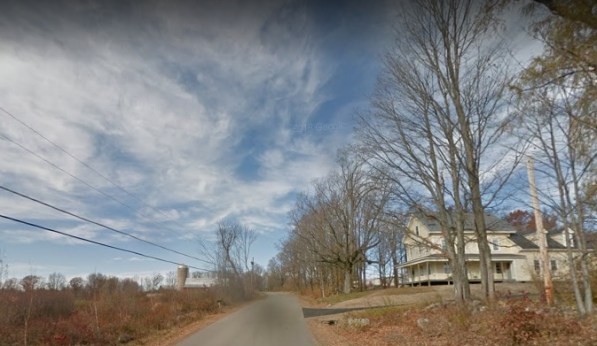
A similar stretch of Nute road, although likely not the same houses and barns, may be seen today. (This view is from Google Maps).
The other Shapleigh painting, a view from the Lewis W. Nute farm looking towards Farmington and the New Durham ridge beyond, is undated, but one might suppose it dates from the same time. One might even suppose that the artist was a guest of Lewis W. Nute.
View from Lewis Nute Farm, Milton, New Hampshire
A similar view may be had from Nute Road today. (This vantage is from Google Maps). The artist would have been closer to the further edge of the field and there were fewer trees between him and Farmington.
Skinner. (2017). Lot 94: Frank Henry Shapleigh (1842-1906) View from Lewis Nute Farm, Milton, New Hampshire. Retrieved from www.skinnerinc.com/auctions/3022M/lots/94





 Milton Observer