Milton Teacher of 1796-1805

By Muriel Bristol (Transcriber) | January 13, 2019

Sophia Cushing was born in Dover, NH, in April 1781, daughter of Thomas Cushing. At the age of thirteen years [1794-95], she began teaching school in the Meaderboro district of Rochester.

She taught next in the “Miltonridge,” i.e., Milton, district of Rochester, at the age of sixteen years [1796-97].

In her first years at “Miltonridge,” she taught at the P. district school and mentions living in the households of early settlers. (She confuses the settlers of a generation before with the town founders of 1802). Prior paragraphs spoke of early settlers Joseph Plumer, Hon. B. Plumer, a state senator, and William Palmer, Esq. All of this – Plummer families, P. district, and Miltonridge – suggests that she began teaching at Plummer’s Ridge.

She, who was there at the founding, seemed to think that Milton was named for the English poet John Milton, author of Paradise Lost. She compared him with Homer (they were both blind poets).

She married (1st), probably in Milton, in 1798, Jonathan Hayes, who died on a trip to San Domingo, West Indies, that very same year. He was a son of Aaron and Deborah (Wingate) Hayes. They had one child.

Next, she taught, and resided in various households, in the Three Ponds district. She left Milton for Gilmanton in 1805.

She married (2nd) in Dover, October 8, 1811, Samuel Wyatt. She became landlady of several notable hotels and, in her later years, wrote an autobiography of her life and experiences. She published it in 1854. She died in Georgetown, MA, December 31, 1857, aged seventy-six years, eight months, and twelve days.

Here is extracted Chapter XII of her 1854 book, Autobiography of a Landlady of the Old School, in which she recounts her time in early Milton. She mentions also her impressions of Milton from several return visits in later years. Her final visit, at the least the last one before her book went to press, was in January 1854.

She begins her tale with some standard Milton information copied from a gazetteer of 1823 (or later).


Milton

Milton is bounded north-west by Middleton and Wakefield, east by Salmon Falls river, separating it from Maine; south-west by Farmington. The Salmon Falls river washes its whole east boundary, a distance of thirteen miles; and a branch of the same river crosses from the south part of Wakefield, and unites near the centre of the east boundary. Teneriffe, a bold and rocky mountain, extends along the eastern part of Milton, near which lies the three ponds, connecting with the Salmon Falls river. This town was formerly a part of Rochester, where Messrs. Joseph Plumer, Bard Plumer, William Palmer, Benjamin Scates, and their associates, went boldly into the forest and commenced cutting down sturdy oaks, in a pleasant place now called Miltonridge, which was detached from Rochester, and incorporated, June 11th, 1802. Those worthy gentlemen, with industry and application, soon made noble farms, early became wealthy and independent. J. Plumer erected a public house, which was known for three score years and upwards, as Plumer’s tavern; one of the best inns ever built and kept in New England in those early days. The Hon. B. Plumer was a statesman, he was chosen senator in district No. 5, Strafford county, in New Hampshire legislature, for several years.

William Palmer, Esq., was a useful man, his mind was well stored with useful knowledge, and was competent to decide any arbitrations that might occur; he was highly respected. Dea. B. Scates lived beloved by all, a worthy exemplary Christian. Those early settlers have left highly respectable descendants.

A number of years since, the writer providentially called at the mansion house of the late senator Plumer, which was owned and occupied by one of his sons, who was laboring in the last stages of consumption; had his family of children gathered around, with the good minister of the parish, Rev. Mr. Walker, for their baptism. I heard him a short time afterward remark, “If my father and my uncle Joseph, and Esq. Palmer, had been religious men, what a good influence they would have exerted over this town.” 

The writer can look back with gratitude to the early patronage she received in Rochester, now Miltonridge. At the age of sixteen years [1797-98] I taught a school in the P. District; boarded in the families of the three first settlers, where kindness and friendship were the leading traits of character. My following terms of teaching were at the three ponds, in the district of Timothy Roberts, Esq., Ensign William Jones, and John Fish, Esq., and other officiating gentlemen of the place. It well might be pronounced a good school; the attention of the scholars was given to their studies, and each one was emulous to excel. At the close of the term, relatives, friends and neighbors, were invited to hear the recitations, and see and hear the dialogues spoken, which was rather a new thing half a century ago, so far up in the woods. The writer has fallen in with individuals in later years, that referred to that school. There are many descendants of those Milton gentlemen who fill eminent places in public life, who were of much enterprise; left their homes at an early day, to seek friends and wealth in other places.

The writer had an opportunity of visiting Milton in January, 1854, where an entire change had taken place. Many of those who made their homes so pleasant, were no more; they return not. But we were soon drawn from tears of sympathy, to be introduced to other scenes. Cheerful, lively, animated faces had taken the places of those that were not; all appeared desirous of doing good. To effect their object, they assembled at the residence of their pastor, the Rev. Mr. Dolt [James Doldt], taking with them a quantity of useful articles, such as any family would find necessary, as well as a surplus of that which we say answers all purposes; and also a luxuriant feast of good things, served up in fine style. Rev. Mr. Dolt is a man of exemplary piety, and unsullied integrity, is much beloved by his people.

But to return to Milton, named in honor of our English Homer.

The town has increased in population and business; and its water power and railroad aid the enterprise of the inhabitants. It has three houses for public worship, two ministers, Rev. James Dolt, Congregational, Rev. L.H. Gordon, Methodist. There are four practicing physicians: Dr. S. Drew early settled at the three ponds, and for thirty years and upwards, had the entire practice of the town. His long and successful practice has endeared him to the people. Dr. D.E. Palmer is a gentleman of much promise, and is fast gaining friends and practice. Dr. Buck is eminent in his profession, and a physician of high respectability. Dr. Swindleton [Dr. J.L. Swinerton] is useful in his profession, and popular. The shoe business of late has become very important. It has one bakery; Charles Sweasey, Esq., proprietor. Mr. Sweasey has long been known as a gentleman of exemplary piety. The manufactory of woolen fabrics is carried on at the westerly village, under the supervision of Mr. Townsend proprietor. It has a good town house, with stores, mills, and public houses, in due proportion.

We noticed at South Milton, a beautiful and substantial family tomb, built by the antiquarian, Theodore C. Lyman, Esq. A Boston gentleman remarked, “It would do Mount Auburn credit.”

But dropping a tear over the graves of those we early loved, we hasten from Milton away (Wyatt, 1854).


South Milton’s Theodore Cushing Lyman (1770-1863) was likely a relative of Sophia (Cushing) Hayes Wyatt.


See also Milton in 1857 and Milton Teacher of 1891-95


References:

Find a Grave. (2013, August 17). Theodore Cushing “T.C.” Lyman. Retrieved from www.findagrave.com/memorial/115612665/theodore-cushing-lyman

Wikipedia. (2019, January 7). John Milton. Retrieved from en.wikipedia.org/wiki/John_Milton

Wikipedia. (2018, November 10). Mount Auburn Cemetery. Retrieved from en.wikipedia.org/wiki/Mount_Auburn_Cemetery

Wyatt, Sophia Hayes. (1854). The Autobiography of a Landlady of the Old School: With Personal Sketches of Eminent Characters, Places, and Miscellaneous Items. Retrieved from books.google.com/books?id=GSbjtNCHpIoC&pg=PA76

Milton in 1817

By Muriel Bristol (Transcriber) | February 2, 2019


MILTON, in Strafford county, was formerly a part of Rochester, and is bounded by N.W. by Middleton, E. by Salmon falls river, which divides it from Shapley (in Maine,) and S.W. by Farmington. Its area is 25,000 acres, and its number of inhabitants 1005. It extends more than 13 miles on Salmon falls river. Branch river crosses the S.W. extremity of the town. Teneriffe mountain lies on its easterly side, near which is Milton pond. The southerly extremity of Milton is 9 miles and 82 rods distant from Wakefield. There are here 3 religious societies, 1 meeting-house, 3 grain-mills, 3 saw-mills, 1 clothing-mill and 3 trading stores.

In a table of comparative statistics, Milton was said to have had 184 polls in 1812; a tax rate of <blank> in 1775; a tax rate of $4.34 per $1,000 in 1812; 122 horses over 4 years old; 250 oxen; 367 cows; 440 cattle between 2 and 4 years old; 18 acres of orchard; and <blank> sheep.

Milton participated in Rochester’s 1775 tax rate of £9 11s 0d per £1000, which would work out to $9.55 per $1,000. Its own 1812 rate was less than half that exacted when a British colony.

Milton’s current tax rate of $25.48 per thousand is 267% of the colonial tax rate of 1775, and 587% of its own 1812 rate.


Next in sequence: Milton in 1823


References:

Merrill, Eliphalet, and Merrill, Phineas. (1817). Gazetteer of the State of New Hampshire. Retrieved from books.google.com/books?id=F38UAAAAYAAJ&pg=162

Non-Public BOS Session Scheduled (January 15, 2019)

By Muriel Bristol | January 13, 2019

The Milton Board of Selectmen (BOS) have posted their agenda for a BOS meeting to be held Tuesday, January 15.

The meeting is scheduled to be an entirely Non-Public session beginning at 4:00 PM. That agenda has two Non-Public items classed as 91-A:3 II (b) and 91-A:3 II (c).

91-A:3 II (b) The hiring of any person as a public employee.

Again, probably having to do with the truck driver posting. But, just possibly, something for the police or fire departments.

91-A:3 II (c). Matters which, if discussed in public, would likely affect adversely the reputation of any person, other than a member of the public body itself, unless such person requests an open meeting. This exemption shall extend to any application for assistance or tax abatement or waiver of a fee, fine, or other levy, if based on inability to pay or poverty of the applicant.

These (c) items are perennial favorites. There is only one of them planned this time.

The BOS have not posted any agenda items for a follow-on Public session on this occasion.


Ms. McDougall has called a fifth meeting of her Milton Advocates group. It will take place again in the Nute Library’s Community Room, on Saturday, January 19), at 10:00 AM to 11:30 AM. All town residents are invited. Bring your best manners. (Not her words).


References:

State of New Hampshire. (2016, June 21). RSA Chapter 91-A. Access to Governmental Records and Meetings. Retrieved from www.gencourt.state.nh.us/rsa/html/VI/91-A/91-A-3.htm

Town of Milton. (2018, January 11). BOS Meeting Agenda, January 15, 2019. Retrieved from www.miltonnh-us.com/uploads/bos_agendas_868_4231712231.pdf

Youtube. (1965). Cone of Silence. Retrieved from www.youtube.com/watch?v=g1eUIK9CihA&feature=youtu.be&t=19

Northeast Parish in the Second (1800) Federal Census

by Muriel Bristol | January 12, 2019

Milton was not yet its own town at the time of the Second Federal Census (1800). It would separate from Rochester in June 1802.

The final seven pages of Rochester’s entry in the Second (1800) Federal Census consisted of those Rochester Northeast Parish households that were shortly to be “set off” as its own town, i.e., shortly to become Milton.

Fortunately, the census enumerator broke this section out separately. It would have been better still had he not alphabetized the list (thus obscuring the geographical relationships within the Northeast Parish).

Note that, despite modern notions regarding constitutional separation of church and state, it was the quality of having “separate ministerial business” that justified creating a separate township. And this separation took place, for that reason, under the US Constitution. Also note that the original meeting-house was both a church and the townhouse. The construction committee financed the building through the sale of church pews, rather than taxation. (And rum, there was also rum).

Rochester’s Northeast Parish, i.e., Milton to be, had 899 residents on Monday, August 4, 1800: 430 males (47.8%) and 459 females (51.2%).

The separate columns are represented here as digits. The first five digits are the number of free white males aged under-10, aged 10-15, aged 16-25, aged 26-44, and 45-and-over. The second five digits are the number of free white females aged under-10, aged 10-15, aged 16-25, aged 26-44, and 45-and-over. The final two digits are the number of all other free persons, and slaves. (New Hampshire had 8 slaves within its borders in 1800; none of them were in the Northeast Parish).

The names of those Rochester residents that petitioned the NH legislature, May 28, 1802, for a separation from Rochester, have been bolded.


The following persons live in a part of Rochester that is proposed to be shortly set of [off] as a separate town, and at present transact their ministerial business separate from this next part of the Town.

  1. Thomas Appleby, 11010-40010-00
  2. William Appleby, 10010-00100-00
  3. Dudley Burnham, 10010-30100-00
  4. James Berry, 00101-01101-00
  5. James Berry Jr, 10010-10100-00
  6. Francis Berry, 20010-20011-00
  7. William Berry, 10110-00010-00
  8. Isaac Brackett, 01010-41010-00
  9. Moses Chamberlain, 01010-01010-00
  10. David Corsen, 01110-10010-00
  11. Benjn Corsen, 31010-00100-00
  12. Joshua Corsen, 10101-31010-00
  13. Ebener Corsen, 31210-21010-00
  14. Saml Chapman, 20001-10010-00
  15. Frederick Cate, 20100-00100-00
  16. Jeremiah Cook, 10010-10100-00
  17. Dodavah Copp, 10010-11010-00
  18. Ephm Drew, 10000-21010-00
  19. John Downs, 10010-30010-00
  20. Moses Downs, 30010-21010-00
  21. Jona Door, 21110-10010-00
  22. Daniel Door, 10010-11110-00
  23. Beniah Door, 11010-21010-00
  24. Nathl Dearborn, 10011-10211-00
  25. Milis Dairs, 10010-10010-00
  26. Winthrop Door, 00100-00010-00
  27. Paul Ellis, 20010-10010-00
  28. John Fish, 01010-30110-00
  29. Thomas Furber, 01001-21010-00
  30. Joseph Dearborn, 10010-10011-00
  31. John Fifield, 00001-10110-00
  32. Benjn Foss, 00110-11011-00
  33. Jeremiah Goodwin, 31001-21101-00
  34. James Goodwin, 01110-31010-00
  35. Daniel Grant, 20010-10010-00
  36. Nathan Grant, 00100-00000-00
  37. Peter Grant, 00001-00001-00
  38. James Hayes, 30010-10110-00
  39. Clement Hayes, 01010-20010-00
  40. Theodore Ham, 11110-10010-00
  41. Nichs Harford [Hartford], 00201-00001-00
  42. John Hanson, 21001-20010-00
  43. Joseph Hight, 22001-20310-00
  44. Jotham Ham, 30010-31010-00
  45. [Richd] H[orn], 11100-00100-00
  46. Isaac Hanson, 10010-20010-00
  47. Daniel Hayes, 12010-12010-00
  48. Ezekiel Hayes, 30010-00100-00
  49. Ichd Hayes, 00010-00000-00
  50. Eleazar Hodgdon, 20010-30010-00
  51. William Hatch, 10010-30010-00
  52. Pelatiah Hanscomb, 00300-10201-00
  53. Shadrach Heard, 10100-00100-00
  54. Robert Hart, 01100-00201-00
  55. Paul Jewett, 01101-01201-00
  56. Gilman Jewett, 00100-10200-00
  57. Stephen Jenkins Jr, 10100-00010-00 
  58. Stephen Jenkins, 00201-01101-00
  59. Ebener Jenkins, 00010-20100-00
  60. Stephen Jennes, 10010-10101-00
  61. Reubin Jones, 01101-00201-00
  62. Ebener Jones, 02101-00301-00
  63. Wm Jones, 01010-10010-00
  64. Elisha Jennes, 11010-10010-00
  65. Levi Jones, 00010-00000-00
  66. Wm W. Lord, 00010-12101-00
  67. James Merrow, 50010-00100-00
  68. Richd Monson, 00201-00100-00
  69. Benjn Miller, 21010-11010-00
  70. Richard Miller, 00020-11100-00
  71. Henry Miller, 00100-10100-00
  72. Robert Mathes, 10010-10010-00
  73. Wm Mathes, 00100-00000-00
  74. Bartholomew Miller, 00100-10100-00
  75. Samuel Nute, 20301-01101-00
  76. Lt Jotham Nute, 33010-10120-00
  77. Francis Nute, 20010-10100-00
  78. Saml Nute Jr, 30100-00100-00
  79. Capn Saml Nute, 11001-01001-00
  80. Josiah Nute, 10010-00100-00
  81. Thomas Nutter, 01010-31010-00
  82. Jona Pottle, 10100-10010-00
  83. Thomas Pinkham, 41010-11010-00
  84. Jona Pinkham, 01010-21010-00
  85. Nathl Pinkham, 20010-30010-00
  86. Joseph Perkins, 00100-00000-00
  87. Beard Plumer, 21201-11210-00
  88. Joseph Plumer, 02101-01201-00
  89. Wm Palmer Esqr, 21010-21020-00
  90. Saml Palmer, 01001-00110-00
  91. John Palmer, 00010-00010-00
  92. Otis Pinkham, 10010-11010-00
  93. Ephm Plumer, 30010-21010-00
  94. Oliver Peavey, 20010-10010-00
  95. Henry Rhines, 10100-10010-00
  96. Shubal Roberts, 00100-00000-00
  97. Lemuel Ricker, 00211-02201-00
  98. Elias Ricker, 00100-00000-00
  99. John Ricker, 10010-20010-00
  100. Ebener Ricker, 21110-3001-00
  101. Timothy Ricker, 21010-20110-00
  102. John Remick, 10101-10101-00
  103. John Remick Jr, 11010-20110-00
  104. Tobias Ricker, 00101-32210-00
  105. Timothy Roberts, 12110-20010-00
  106. Isaac Staunton, 00100-10010-00
  107. Benjn Scates, 12001-01201-00
  108. John Scates, 11110-01100-00
  109. Dadavah Scates, 20001-01010-00
  110. John Smith, 30010-00010-00
  111. Ephm Twombly, 11110-21021-00
  112. John Twombly, 01001-00201-00
  113. Saml Twombly, 00101-31101-00
  114. John Twombly, 10010-10100-00
  115. Ebenr Twombly, 00010-30110-00
  116. Ephm Twombly Jr, 21010-11110-00
  117. Wm Tuttle, 10101-02210-00
  118. Enoch Varney, 00101-40010-00
  119. James Varney, 10010-21010-00
  120. John Varney, 00010-00110-00
  121. Benjn Varney, 01101-00101-00
  122. Lemuel Varney, 10010-10010-00
  123. Aaron Varney, 11010-11010-00
  124. Edmond Varney, 00010-20010-00
  125. Richd Walker, 10111-11111-00
  126. John Wentworth, 20010-02010-00
  127. Saml J. Wentworth, 21010-11010-00
  128. James Wentworth, 10001-10001-00
  129. Stephen Wentworth, 30010-10011-00
  130. Saml J. Wentworth, 31110-20010-00
  131. Gershom Wentworth, 00011-00110-00
  132. Amos Witham, 01011-00001-00
  133. John Witham, 22010-20010-00
  134. Josiah Witham, 01010-40010-00
  135. Caleb Wakeham, 31101-12111-00
  136. Enoch Wingate, 00001-10101-00
  137. David Wallingford, 20010-20020-00
  138. Isaac Worster, 02010-20100-00
  139. Ephm Wentworth, 10010-20010-00
  140. Ichd Wentworth, 21010-30010-00
  141. Enoch Wentworth, 20010-00010-00
  142. Caleb Wingate, 01010-00210-00
  143. Stephen Watson, 11010-50010-00
  144. David Wentworth, 00010-00100-00
  145. Simon Branon, 00100-00100-00
  146. John McDuffie, 10001-10010-00
  147. Wm Griffis, 00001-01001-00
  148. Philip Door, 00001-00001-00
  149. Saml Loe, 00001-00021-00
  150. [blank] Demerett, 10001-20010-00
  151. Widow Smith, 10000-00001-00
  152. Elizabeth [Sp]encer, 00000-20010-00
  153. Aaron Wentworth, 00101-01001-00
  154. John Tanner, 11010-01011-00
  155. Henry Rollins, 11110-10110-00
  156. Moses Dorrs, 10100-10010-00
  157. Lt Elijah Horn, 10010-31010-00
  158. Mark Miller, 20010-00100-00

Rochester’s Northeast Parish had 158 households with an average 5.7 inhabitants per household. Only 2 households (1.3%) were headed by a female, one of them identified as a widow.

336 (37.4%) of the Northeast Parish’s 899 inhabitants were aged under-10 years of age (158 males and 178 females), 124 (13.8%) were aged 10-15 years (67 males and 57 females), 148 (16.5%) were aged 16-25 years of age (65 males and 83 females), 199 (22.1%) were aged 26-44 (97 males and 102 females), and 82 (9.1%) were aged 45-and-over years of age (43 males and 39 females). All of these were “free white” inhabitants.

The constitutional purpose of the census is to apportion US Representatives. For that a simple head count would do. Some of the awkward breaks into uneven age groups are due to another governmental purpose: attempting to determine the size of military age cohorts.

Of primary interest was the size of the males aged 16-25 years cohort. Those are the minutemen. The males aged 26-44 years cohort was of secondary interest. They formed the bulk of the militia. Males aged 45-and-over were exempt from military service. Militia officers Captain Samuel Nute,  Lieutenant Jotham Nute, and Lieutenant Elijah Horn were identified by their militia ranks in this census enumeration.


Note that only 80 (51.3%) of the 156 Northeast Parish’s male householders signed the 1802 separation petition.

24 petitioners were not householders in the Northeast Parish, namely Joseph Berry, Joseph Cook, Wentworth Cook, Ernest Corsen, William Corsen, Abraham Dearborn, Benjamin Dearborn, Gershom Downs, Francis Drew, Nathaniel Gilman, Humphrey Goodwin, Benjamin Higgins, Nathaniel Jewett, Benjamin Jones, John Jones, James McGeoch, Robert McGeoch, Dudley Palmer, Jedediah Ricker, Henry Rollins, Samuel Twombly Jr., Joseph Walker, Josiah Willey, and Obadiah Witham.

Likely, most of these 24 non-householding petitioners resided within the named Northeast Parish households, as column tick marks. If so, the non-householding petitioners and the householder petitioners combined would represent 104 (63.0%) of the approximately 165 Northeast Parish male voters.


palmer, william esqr
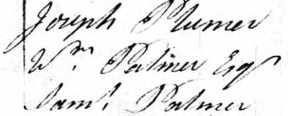
Joseph Plumer, Wm Palmer Esqr, and Saml Palmer

Note also that only one man – William Palmer Esqr – is termed Esqr., or Esquire. It is quite clearly written so. The various printed histories that describe Milton’s first town meetings report William Plumer, Esq., as having called the first town meeting (and a William Plumer as being one of the first selectmen chosen at that meeting). One of these things is not like the other. Either the census enumerator or the history typesetter may have made an error.


Previous in sequence: Northeast Parish in the First (1790) Federal Census; next in sequence: Milton in the Third (1810) Federal Census


References:

State of New Hampshire. (1884). Provincial and State Papers (Volume 13). Retrieved from books.google.com/books?id=hYw7AQAAMAAJ&pg=PA349

Wikipedia. (2018, November). 1800 United States Census. Retrieved from en.wikipedia.org/wiki/1800_United_States_Census

Milton in the News – 1861

By Muriel Bristol (Transcriber) | January 13, 2019

In this first year of the Civil War, Milton suffered a fire that burned three buildings, heard of its Second NH Regiment men departing for the front, held a birthday celebration for another centenarian, heard reports of the first Battle of Bull Run, and saw John Townsend’s Milton Mills Manufacturing Co.’s woolen mill burn down.


Two months after the Civil War began in April 1861, John Colbath and the Goodwin family lost three buildings to a fire in West Milton.

The store of G.W. Goodwin, the shoe manufactory of John Colbath, with their contents, and the dwelling house of C.H. Goodwin, at West Milton, N.H., were destroyed by fire on Sunday morning, Loss about $6500; insured $3000 (Hartford Courant, [Wednesday,] June 19, 1861).

Five Goodwin households appeared sequentially in the Eighth (1860) Census, which suggests they all lived either side-by-side or zig-zagged down the same street in Milton (West Milton P.O.). The enumerator visited them all on June 1, 1860, i.e., only fifteen days before the fire.

Joseph Goodwin, a farmer, aged seventy-seven years, headed the first household in the sequence. His household included Anna [(Hanson)] Goodwin, aged sixty-two years. (Anna might have lied about her age: she was actually seventy-three). He had $2,000 in real estate and $350 in personal estate. The George W. Goodwin (1817-1869), Shepherd K. Goodwin (1823-1891), and Charles H. Goodwin (1825-1904) that follow were sons of this couple and brothers to each other.

Hannah Goodwin, aged sixty-seven years, headed the second household in the sequence. She was Joseph Goodwin’s sister.

Shepherd K. Goodwin, a farmer, aged thirty-seven years, headed the third household in the sequence. His household included Sophrona J. [(Young)] Goodwin, aged thirty-five years, George H. Goodwin, aged fourteen years, Augustine P. Goodwin, aged ten years, and John W. Twombly, a merchant, aged twenty-five years. Stephen H. Goodwin had $1,500 in real estate and $400 in personal estate. John W. Twombly had $150 in personal estate, presumably much of that was his stock in trade. Both children had attended school within the last year. (He would appear also in the US Class II military draft list of 1863).

Geo. W. Goodwin, a merchant, aged forty-two years, headed the fourth household in the sequence. His household included M.C. [Marietta (Chamberlain)] Goodwin, aged thirty-eight years, and Abba A. Moulton, aged eleven years. Geo. W. Goodwin had $3,000 in real estate and $7,000 in personal estate. Abba A. Moulton had attended school within the last year. This house burned.

C.H. [Charles H.] Goodwin, a shoe manufacturer, aged thirty-five years, headed the fifth household in the sequence. His household included Susan E. [(Wentworth)] Goodwin, aged twenty-five years, and Abba A. Goodwin, aged six years. C.H. Goodwin had $1,500 in real estate and $600 in personal estate. Abba A. Goodwin had attended school within the last year. This house burned.

Next in the census sequence below C.H. Goodwin was an “Unoccupied” building. The “shoe manufactory of John Colbath” might have been considered unoccupied in the sense that it had no residents, outside of working hours that is. If this was the shoe manufactory, this building burned.

John Colbath (1828-1915) resided in Charles H. Goodwin’s Milton household in 1850. He married in Milton, NH, November 10, 1853, Adaline Augusta Wentworth (1834-1873). She was born circa 1834, daughter of Joseph C. and Tryphena B. (Roberts) Wentworth

John Colbath, a shoe maker, aged thirty-five years, headed a Somersworth [Great Falls P.O.] household at the time of the Eighth (1860) Federal Census. His household included Augusta Colbath, aged thirty years, and [——] Plummer, a shoe maker, aged twenty-five years.


The Second NH Regiment, in which Milton men had enlisted, passed through Boston, MA, on Thursday, June 20, 1861.

Military Movements. The 2d New Hampshire Regiment, Col. Gilman Marston, passed through this city on Thursday. We are unable to give any particulars this week (New England Farmer (Boston, MA), [Saturday,] June 22, 1861).

Military Movements. The 2d New Hampshire Regiment, which passed through here last week Thursday, is a fine body of men, and won much praise from the spectators as it passed through our streets. They were given a grand collation at Music Hall, which was appropriately decked for the occasion. Short speeches were made by Hon. Marshall P. Wilder, Col. Marston, and others. As the regiment was passing over the Camden and Amboy Railroad, near Westfield, N.J., Friday night, Lieut. Chas. W. Walker, of Co. B, Concord, fell from the train, which passed over one of his legs, and inflicted such injuries that he survived but a few hours. His remains were taken to Concord, and interred with impressive ceremonies, on Wednesday. He was a native of Fryeburg, Me. (New England Farmer (Boston, MA), [Saturday,] June 29, 1861).

Monroe J. Corson, John O. Hayes, Charles E. Jones, Christie L. Jones, Robert Miller, Moses L. Smith, James H. Tibbetts, John S. Varney, Theron F. Varney, and James M. Venner were among those that enlisted in the Second NH Regiment from Milton. (John Brown, Herbert E. Cook, and John Godfrey enlisted in the Second from elsewhere, but were “credited” towards Milton’s total)).

The Second NH Regiment fought in the First Battle of Bull Run (aka Manassas), just a month later, on July 21, 1861.


As mentioned previously, people who lived to an advanced age were of great interest formerly, as they are now.

A Centenary Celebration. The descendants and relatives of the widow of the late Daniel Hayes gathered at the homestead, in Milton, N.H., on which day the old lady was one hundred years of age. There were nearly 300 persons present, including five of the fifth generation (Baltimore Sun, July 20, 1861).

Daniel Hayes headed a Milton household at the time of the Sixth (1840) Federal Census. His household included one male aged 60-69 years and one female aged 70-79 years.

Eunice (Pinkham) Hayes was the “widow of the late Daniel Hayes.” He died in Milton, December 4, 1846, aged eighty-seven years, two months. Eunice lived subsequently in the Milton household of her daughter, Betsy (Hayes) Pearl, and son-in-law, Joseph Pearl.

Joseph Pearl, a farmer, aged sixty-four years, headed a Milton household at the time of the Seventh (1850) Federal Census. His household included Betsy Pearl, aged fifty-eight years, James Rowe, a farmer, aged fifteen years, and Eunice Hayes, aged eighty-nine years. Joseph Pearl had real estate valued at $10,000.

Joseph Pearl, a farmer, aged seventy-three years, headed a Milton (West Milton P.O.)household at the time of the Eighth (1860) Federal Census. His household included Betsy Pearl, aged sixty-eight years, and Eunice Hayes, aged ninety-nine years. Joseph Pearl had real estate valued at $4,000 and personal estate valued at $5,000.

The Federal government assessed Joseph Pearl for his two-horse carriage in the US Excise Tax of May 1864 and the US Excise Tax of May 1866.


The Second NH Regiment, in which some Milton men were serving, was engaged at the first Battle of Bull Run (aka Manassas).

Latest. Our Thursday morning dispatches relate chiefly to the correcting of reports concerning our loss in the late engagement and the preparations being made for the increase of the army at Washington. The following summary embraces everything of importance: The list of the dead and wounded is every day being made more complete. The War Department is still busily employed in organizing the troops. Offers of more troops are coming in, thick and fast, from all parts of the country. 80,000 men have been accepted. The rebels refuse to admit flags of truce for the purpose of taking charge of the wounded, within their lines, but promise that every attention shall be given them. There is no authentic confirmation of the current report that the rebels are evacuating Manassas Junction. The impression, founded upon a dispatch from Capt. Gibson to Capt. Tyler, that some of our troops remain in Centreville, also lacks confirmation. The ordnance department at the Washington Navy Yard is employing extra force in the manufacture of rifled cannon. The blockade of the Virginia shore of the Potomac is still maintained. Two more spies have been arrested at Alexandria.

[Excerpt:]

The Second New Hampshire Regiment went into the action with 856 men, and returned with 800, 52 of whom are wounded; of the others, 12 are dead and 44 missing. Col. Marston is doing well (New England Farmer (Boston, MA), July 27, 1861).


Towards the end of the year, John Townsend’s Milton Mills Company woolen factory burnt in the small hours of Saturday, October, 19, 1861.

Destruction of a Flannel Factory. Great Falls, N.H., Oct. 19. The flannel factory of John Townsend, at Milton Mills, N.H., was burnt this morning. The loss is estimated at $30,000, on which there is a partial insurance. The factory was running on a government contract for army flannels (Baltimore Sun, October 22, 1861).

Miscellaneous Items. The flannel factory belonging to John Townsend. at Milton Mills, N.H., was burnt Saturday morning, at about 2 o’clock. Loss about $30,000; partially insured. The mill was running on a government contract (New England Farmer (Boston, MA), October 26, 1861).

The “flannel factory belonging to John Townsend” was denominated as The Milton Mills in a Milton Gazetteer of 1859.

John Townsend, a woolen manufacturer, aged fifty-two years, headed a Milton (Milton Mills P.O.) household at the time of the Eighth (1860) Federal Census. His household included Eliza A. Townsend, aged thirty-seven years, Jane R. Townsend, aged twenty-four years, Caroline F. Townsend, aged twenty years, Henry H. Townsend, aged seventeen years, Ermina Townsend, aged  fourteen years, Willie B. Townsend, aged ten years, and Frank A. Townsend, aged four years. Caroline F. Henry H., Ermina, and Willie B. Townsend had all attended school within the last year. John Townsend had real estate valued at $2,000 and personal estate valued at $8,000.

John Townsend’s house stood in close proximity to the households of L.D. Reed, landlord of the Milton Mills Hotel, aged thirty-one years; E. Osgood, a blacksmith, aged fifty-four years; Joseph Townsend, a wool manufacturer, aged thirty-seven years, and Joseph P. Swasey, a tailor, aged thirty-five years.

John Townsend rebuilt his Milton Mills Co., or Milton Mills Manufacturing Co., factory larger than the one that burnt. The new mill is mentioned in Vulpes’ letter of 1864 as running “full blast” and it paid the US Excise Tax of May 1864.


The Fifth NH Regiment, in which Milton men had enlisted, arrived in Jersey City, NJ, on its way to Washington, DC, in October 1861.

From Yesterday’s Second Edition. The 5th N.H. regiment, Col. Cross, arrived in the Norwich boat at Jersey City this forenoon and left at seven for Washington. Several friends of Major Cook, formerly of the Boston “Tigers,” as well as sons of New Hampshire, gave them friendly greetings (Buffalo Commercial (Buffalo, NY), October 31, 1861).


The Sixth NH Regiment, in which Milton men had enlisted, passed through New York City in December 1861, bound for Washington, DC.

News by Telegraph. New York, Dec. 26. The 6th N.H. Regiment passed through here to-day tor Washington (Buffalo (NY) Weekly Express, December 31, 1861).


Previous in sequence: Milton in the News – 1860; next in sequence: Milton in the News – 1862


References:

Find a Grave. (2013, January 9). Lieut. Charles W. Walker. Retrieved from www.findagrave.com/memorial/103341372/charles-w-walker


Milton in the Sixth (1840) Federal Census

by Muriel Bristol | January 12, 2019

Milton made its fourth appearance as its own town in the Sixth Federal Census (1840). (It had separated from Rochester in 1802). It had 1,380 residents on Monday, June 1, 1840: 699 males (50.7%) and 681 females (49.3%).

Milton had 250 households with an average 5.5 inhabitants per household. Only 18 households (7.2%) were headed by a female.

Milton had 428 Scholars attending at 17 Academies & Grammar Schools. There were 12 White Persons Over 20 Years of Age Who Cannot Read and Write. There were 2 persons who were Blind, 1 who was Insane or Idiotic at Private Charge, and 2 who were Insane or Idiotic at Public Charge.

The surnames represented as heads of household (all other inhabitants were identified as counts only by age and sex) were: Adams, Applebee, Archibald, Bansfield, Berry, Blaisdell, Brackett, Bragdon, Burleigh, Burnham, Butler, Chamberlain, Clark, Clement, Cook, Courson, Dearborn, Dore, Dow, Downs, Drew, Dunnell, Duntley, Edgerly, Elaskey, Ellis, Emerson, Farnham, Fernald, Foss, Fox, Gerrish, Goodwin, Guptill, Hanson, Hart, Hartford, Hayes, Henderson, Hill, Hodgdon, Horne, How, Huntress, Hussey, Jenkins, Jewett, Jones, Knowles, Leighton, Looney, Lord, Lyman, McMillan, Main, Matthes, Matthews, Merrill, Merrow, Meserve, Miller, Mills, Moulton, Nason, Nute, Nutter, Osgood, Pager, Pinkham, Place, Plumer, Quimby, Remick, Ricker, Rines, Roberts, Robinson, Rundle, Sanborn, Scates, Searles, Shores, Simes, Stevens, Swasey, Swinerton, Tasker, Tibbetts, Tuttle, Twombly, Varney, Wakeham, Walker, Wallingford, Warren, Wentworth, Wiggin, Willey, Witham, Worcester, Worster, and Young.

Thomas Applebee, aged eighty-four years, Amos Bragdon, aged seventy-eight years, David Corsen, aged seventy-nine years, Benaiah Dore, aged seventy-five years, Jonathan Dore, aged eighty-three years, Sarah Nute, aged seventy-seven years (household of David Nute), Elizabeth Roberts, aged eighty years (household of James C. Roberts) were listed in an addendum as Pensioners for Revolutionary or military services.

169 of Milton’s inhabitants were aged under 5 years of age (89 males and 80 females), 172 were aged 5-9 years (89 males and 83 females), 180 were aged 10-14 years of age (92 males and 88 females), 132 were aged 15-19 (79 males and 53 females), 214 were aged 20-29 years of age (115 males and 99 females), 158 were aged 30-39 years of age (71 males and 87 females), 129 were aged 40-49 years of age (62 males and 67 females), 90 were aged 50-59 years of age (41 males and 49 females), 68 were aged 60-69 years of age (34 males and 34 females), 48 were aged 70-79 years of age (18 males and 30 females), 17 were aged 80-89 years of age (8 males and 9 females), and 3 were aged 90-99 years of age (1 males and 2 females). All of these were “free white” inhabitants.

531 of 1,380 Milton’s inhabitants were employed: 425 (80.0%) in Agriculture, 83 (15.6%) in Manufacture and the Trades, 20 (3.8%) in Commerce, and 3 (0.6%) in the Learned Professions and Engineering.

A NH Gazetteer of 1840 reported Milton’s Productions of the Soil as Indian Corn, 292 bushels; Hay, 2,296 tons; Potatoes, 32,622 bushels; Wool, 4,625 pounds, and Maple Sugar, 473 pounds. (Figures difficult to read).

See also Milton in 1839

References:

Wikipedia. (2018, August 23). 1840 United States Census. Retrieved from en.wikipedia.org/wiki/1840_United_States_Census

Milton Hotels in 1860

By Muriel Bristol | January 10, 2019

Milton’s 1860 census enumerator, Elias S. Cook, made marginal notes next to Milton’s two hotel entries. They may or may not have been the actual hotel names, as opposed to a description of their location.

“Milton Hotel”

William Howard “Howard” Huntress (1822-1873) may have run his Milton hotel as early as September 1855 (and up until until his death in January 1873).

William H. Huntress was born in Milton, January 17, 1822, a son of William and Lydia A. (Hatch) Huntress. His mother died in Milton, December 19, 1830; and his father remarried there, July 1, 1832, Dorcas Dore.

William H. Huntress, left town for some years in the 1840s. He was a shoemaker, aged twenty-eight years, residing in the Natick, MA, household of his elder brother, Thomas H. Huntress, also a shoemaker, aged thirty-two years, at the time of the Seventh (1850) Federal Census.

He married, circa 1852-53, Sarah C. Tuttle. She was born in Barrington, NH, August 1, 1832, daughter of John and Esther C. (Moulton) Tuttle. They settled in Milton, where their first two children were born in 1854 and 1859.

William H. Huntress, a shoemaker, aged thirty-seven years, headed a Milton household at the time of the Eighth (1860) Federal Census. His household included Sarah C. Huntress, aged twenty-seven years, Charles A. Huntress, aged six years, and John W. Huntress, aged one year.

Huntress’ household appeared next to that of his brother-in-law, Darwin Morse, a farmer, aged forty-seven years. (His father, stepmother, sister Phebe A. Morse, and nephew resided in the Morse household). They lived near School House No. 12 on what is now Silver Street, approaching its intersection with what is now Winding Road.

Joseph Jenness (1823-1892) lived in the hotel, which he apparently ran on Huntress’s behalf. It stood in the Milton downtown, in close proximity, and likely right next door, to the home of Dr. Stephen Drew (another marginal note: “Practicing Physician in Milton 40 years”).

Joseph Jenness was born in Somersworth, in 1823, son of Joseph and Hannah Jenness. He married November 16, 1845, Reliance C. Witherell. She was born in Monmouth, ME, January 30, 1829, daughter of Rufus and Sarah T. (White) Witherell. They resided in the Somersworth household of his parents in 1850.

Joseph Jenness, a landlord (“Milton Hotel”), aged thirty-six years, headed a Milton household at the time of the Eighth (1860) Federal Census. His household included Reliance C. Jenness, aged thirty-one years. He had no real estate (and Huntress would be taxed for the licenses).

C. Crosby, a hired man, aged twenty-four years, resided there, with Emeline Crosby, aged twenty-one years, Lydia M. Crosby, aged thirty-one years, and Charles G. Crosby, aged seven years.

Nine men were listed as “boarders”: B.F. Rankin, aged twenty-five years, Charles Neal, aged twenty-two years, David Wentworth, aged twenty-three years, Charles Peckham, aged twenty-seven years, Charles Nudd, Esq., aged twenty-seven years, D. Palmer, aged twenty-five years, J.C. Robinson, aged thirty-two years, C.C. Smith, aged forty years, and James Miller, aged twenty-six years.

There were three female guests: Mrs. C. Lane, a teacher of music, aged thirty-one years, [sister-in-law] Pamelia C. Weatherell, aged twenty-nine years, and S.C. Goodrich, a dressmaker, aged twenty-two years.

Also staying in the hotel were three male guests: John R. Palmer, postmaster, aged twenty-four years, Dr. Jackson, a physician, aged forty-two years, and George Hattan, an “Indian Doctor,” aged fifty-five years.

The US Class II military draft list of June 1863 included both William H. Huntress, a hotel keeper, aged thirty-seven years, and Joseph Jenness, a stabler, aged thirty-nine years. Although exempt, due to being a married man of a certain age, Huntress had already enlisted in Company A of the Tenth NH Infantry Regiment, August 20, 1862. He mustered out of the Army at Richmond, VA, June 21, 1865.

The Federal government assessed Huntress for his 8th-class hotel, liquor license, and livery stable in the US Excise Tax of May 1864.

The Federal government again assessed Huntress for his hotel, liquor license, and livery stable in the US Excise Tax of May 1866. He appeared as proprietor of the “Milton” hotel in 1869-70.

William H. Huntress died in Milton, January 16, 1873. His widow died in Dover, NH, July 25, 1880. Landlord Joseph Jenness died in Dover, January 5, 1892. His widow died in Revere, MA, September 2, 1901.

“Milton Mills Hotel”

Lewis D. Reed (c1825-1870) was born in Dover, NH, circa 1825. He married, circa 1843-44, Annette W. Randall. She was born in Lebanon, ME, circa 1827.

Lewis D. Reed, a painter, aged twenty-five years (born ME), headed a Somersworth household at the time of the Seventh (1850) Federal Census. His household included Annette W. Reed, aged twenty-three years (born ME), and Georgiana Reed, aged five years (born NH).

L.D. Reed, a landlord (“Milton Mills Hotel”), aged thirty-one years, headed a Milton (Milton Mills P.O.) household at the time of the Eighth (1860) Federal Census. His household included Annetta Reed, aged thirty-three years, and Georgiana W. Reed, aged fourteen years. The census enumerator wrote “Milton Mills Hotel” in the margin next to the hotel entry. That may or may not have been its actual name, as opposed to a description.

Reed’s seven guests included W.B. Reynolds, a physician, aged thirty-two years, George Moulton, an expressman, aged forty-five years, C. Parker, a pedlar, aged fifty-five years, John Colby, a pedlar, aged thirty years, Ed. D. Colby, a pedlar, aged fifty-one years, H. Livingston, a pedlar, aged forty-three years, and Thomas Christie, a bread pedlar, aged thirty-nine years.

E. Osgood appeared next to L.D. Reed’s hotel in the 1860 enumeration, i.e., they lived in close proximity to each other. (Ebenezer Osgood’s residence appeared on later maps on Main Street, between Water Street and the Post Office).

Hotel guest William Buzzell Reynolds (1828-1877), a physician, aged thirty-three years, enlisted at Milton as a sergeant in the US Army, October 4, 1861. He was in Company F of the 2nd US Sharpshooter Regiment, as of November 26, 1861, promoted to Assistant Surgeon, December 5, 1861, and Surgeon, August 12, 1863. He mustered out January 12, 1865.

The US Class II military draft list of June 1863 included Lewis D. Reed, aged thirty-eight years, hotel keeper, of Milton.

The Federal government would assess L.D. Reed for his 7th-class hotel, liquor license, and livery stable in its US Excise Tax of May 1864. It again assessed Reed for his hotel, liquor license, and livery stable in the US Excise Tax of May 1866.

Lewis D. Reed died in Milton, March 31, 1870.


See also Milton in the News – 1860


Previous in sequence: Milton Hotels of 1850; next in sequence: Milton hotels of 1870


References:

Find a Grave. (2013, July 29). Dr. William B. Reynolds. Retrieved from www.findagrave.com/memorial/114610282

Find a Grave. (2013, July 31).  Ebenezer Osgood. Retrieved from www.findagrave.com/memorial/114682156

Medical Antiques. (2017, October 18). Union Civil War Surgical Manuals and Civilian Medical Books. Retrieved from www.medicalantiques.com/civilwar/Civil_War_medical_book_collection/Civil_War_Surgical_Manuals_page_3-a.htm

Milton in the News – 1860

By Muriel Bristol (Transcriber) | January 8, 2019

In the year 1860, the newspapers discovered the venerable Mr. Ralph Farnham (1756-1860). These articles were copied very widely. Farnham was said to be a native of Milton Mills, NH, who was then living with his son, John Farnham (born 1797), in Acton, ME.

The Last Survivor of Bunker Hill.Farnham, Ralph The statement has frequently been made by the newspapers and endorsed by Mr. Everett in his late Fourth of July oration, that there is no one left of that band of heroes who first withstood the shock of British arms in the open field. Eighty-five years having elapsed since that world renowned struggle, the burden of probabilities would favor that conclusion; yet the statement is not correct. There is one who took part in that memorable battle, and in subsequent events of the revolution, yet living, “full of years,” and venerated for his moral worth as well as for his age and public services. In the town of Acton, Maine, on a beautiful ridge of land, situated about a mile from Milton Mills, N.H., stands a cottage farm house, unpretending in its appearance, and bearing evidence of a very respectable antiquity. The passer-by will often notice a gray-haired man reading attentively by the window or walking about with a single cane perchance engaged in the ordinary labors of the husbandman. The stranger will perceive nothing very remarkable in the thick set, slightly bent figure, and well preserved, swarthy features of this old man of apparently eighty years, but the residents of the adjacent country involuntarily bend with reverence as they pass him. And well they may as he is the last of the Bunker Hill patriots. David Kinnison, who long survived his confederates of the famous Boston tea party, was living in 1831, in Chicago, at the extraordinary age of one hundred and fifteen years. He has since passed away. Ralph Farnham, the last of the Bunker Hill heroes, still lives, although he has nearly attained a span and a half of the space allotted to man. His one hundred and fourth birthday was celebrated at Milton Mills on the 7th. We have already given from the pen of a correspondent, some notice of this interesting affair. Although no pains were taken to extend a notice of the event beyond the immediate vicinity of the veteran’s residence, a very large concourse of people were in attendance. The features of the occasion were an address and one hundred and four greetings from a twelve pounder, and a dinner enlivened with toasts and speeches. Mr. Farnham, we learn, was not in the midst of the battle. Having been enrolled only on the day previous, it was his lot to be detailed among a guard to take charge of artillery and baggage, at some distance from the redoubt. In so close a proximity to the principal scene of strife, the observations he made and distinctly recollects to this day, are highly interesting, and we trust they will be given to the public by some competent pen. When we reflect how few persons living can even remember the event itself as a child of twelve at that time would now be ninety-five years old a living actor in that bloody drama becomes at once an object of interest, respect and veneration. – Boston Journal (St. Johnsbury Caledonian, July 20, 1860).

Massachusetts Governor Nathaniel P. Banks, Boston Mayor Frederic W. Lincoln, Jr., and other luminaries invited Farnham to visit Boston, MA, in October 1860.

HONOR TO A VETERAN. The Boston Journal says, that Gov. Banks, Mayor Lincoln, Edward Everett, Amos A. Lawrence, Judge Shaw, J.A. Andrew, William Appleton and many other citizens, have sent an invitation to Mr. RALPH FARNHAM, of Acton, Me., to visit Boston. Mr. Farnham is 104 years of age and the only survivor of Bunker Hill. It is understood that he has accepted the invitation, and will be here early in October.- The occasion will be one of high enjoyment, as “all the world, with his wife and children,” will desire to see him. This visit of Mr. Farnham will, doubtless, attract thousands from the country to Boston to welcome the old veteran (Vermont Journal (Windsor, VT), October 6, 1860).

While in Boston, Farnham had also an audience with Albert Edward, Prince of Wales (eventually King Edward VII), who was then on a North American tour.

Interview of the Prince with Ralph Farnham. By appointment, Ralph Farnham, the Revolutionary veteran, had an interview with the Prince this morning. The meeting was very cordial. The Duke of Newcastle, who, with most of the suite, was present, asked the veteran if he saw Burgoyne when he surrendered, adding, “You rather had him there.” The old soldier then remarked chuckingly, that hearing so much said in praise of the Prince, he began to fear that the people were turning royalists. This and Mr. Farnham’s manner elicited much laughter, in which the Price joined. The Prince then sent for pen and ink and exchanged autographs with his visitor – one of the men who had stood before British soldiers in 1776 [SIC], in a manner and with a bearing very different from that with which he received the Prince’s courtesies and exchanged glances with the majors, colonels and guardsmen of the suite this morning. Mr. Farnham speaks of the interview with the greatest pleasure, and says he wished to show the boy and his soldiers that he bore no anger for old times. The old man represents the general feeling. Till within the last three months the American public wore not aware that a survivor of one of the bloodiest and most heroic and first struggles of the Revolution is still “a monument of mercy” in our midst. Like most of signers of the Declaration of Independence, Ralph Farnham, who is the only survivor of battle of Bunker Hill now left of band who so nobly resisted the overpowering efforts of the British soldiery in that struggle, has been spared to a good old age, having recently attained his 104th year. Mr. Farnham, who has just been introduced to the Prince of Wales in Boston, was born in Milton Mills, New Hampshire, July 7, 1756. His last birthday was celebrated at that place by the firing of a gun for every year the veteran had attained, by a dinner, speeches, and all the usual honors of patriotic demonstrations of a like description. Since the public were apprised of the existence among them of this time honored veteran be has been flooded with visitors, and letters for the purpose of obtaining autographs, or who wish to enquire of him various matters connected with the Revolution, of which they suppose he has personal cognizance and recollection. He receives all his visitors courteously and kindly, replying to all their questions. He relates anecdotes of Washington and General Putnam, the hero of Bunker Hill, and other leaders of newborn republic. Of Washington he says, with truth, he was “a fine man,” and with sad truth that “there are no such men as Washington living in these days.” He says of Putnam that “he was a rough old fellow, but as brave as a lion, and feared nothing nor anybody.” After Bunker Hill the venerable Ralph served three campaigns, during the years 1775-76, -77, and in 1780 he was settled in the village where he has still resided. He was the first settler the place, which was then an immense “forest wild,” abounding in fierce animals and remote from civilized communities. He resided in this “desolate place” for four years, when he at length brought home a wife to cheer his loneliness. His wife presented him with seven children of whom four still survive, and it is one of them, his second son, John, that the veteran of Bunker Hill now dwells. The old warrior is still vigorous, and does not seem near so old as he really is. He observes regular habits, going to rest at 7 P.M. and rises at 5 A.M. He eats heartily, steps firmly and sleeps soundly, and may yet live many years and survive millions of his contemporaries of the present generation. He has been a member of the Baptist persuasion for eighty years. He spends much of his time reading the Scriptures with a pair of spectacles formerly the property of his maternal ancestor, and now 160 years old. He possesses all his faculties perfectly, except his hearing, which is slightly defective. What must have been the reflections of the Prince during his interview with this venerable man? Let the muses reply. – N.Y. Herald (Dawson’s Fort Wayne Daily Times (Fort Wayne, IN), October 26, 1860).

Farnham attended a concert held in his honor on Monday, October 15, and set out for home again on Friday, October 19, 1860.

The Bunker Hill Veteran. A complimentary concert was given to Ralph Farnham, the Bunker Hill Veteran, at the Music Hall, on Monday evening. A large company was present. He was to leave for home on Friday morning (New England Farmer (Boston, MA), [Saturday,] October 20, 1860).


The Veteran of Bunker Hill – His Journey Home – Acknowledgements – How to Prolong Life.

Acton, Me., Oct. 23, 1860.

Editors of the Boston Traveller: I will give you a brief account of my journey home. When we arrived at Lawrence there was a largo crowd at the depot. They requested me to hold my hat out of the window, which I did, when they showered the “needful” into it, as I never expected to see in my life. Then as the train moved on, we left them amid such cheers as I never shall forget.

At Dover, N.H., I received the like reception, and the Mayor very kindly attended me over to Great Falls, and presented me with a ten dollar bill.

At Great Falls I met with the same kind reception as at Lawrence and Dover, and the ticket master at the Great Falls Branch Railroad invited me to a dinner, which I enjoyed very much.

After leaving Great Falls, I was received with hearty cheers all the way along until I arrived at Acton. I told them when I got home, that “I had seen the elephant,” and I was very glad to get back. I am in good health, and my friends think I am better than when I left homo. I am sure that I am as well. I am very grateful for the honor done me by the invitation to visit Boston, and the many attentions which I received when there. I remember with special pleasure my visit to Bunker Hill, attended by the Charlestown City Authorities, the Military and the Music; also, the addresses delivered on that occasion by the Mayor and Mr. Frothingham. I am also greatly indebted for the liberal sums of money, and the many presents I received. My thanks, which is all have to offer, seem but a poor return for so many favors.

I ought especially to mention Mrs. W. Farnham Lee, and the company of Lancers, and Mayor Dana of Charlestown, and Mr. Gilmore’s Concert Band for their liberal presents.

Though I am in my 105th year, I am not past all usefulness; I split my own kindling wood and build my own fires; I am the first one up in the morning, and the first one in bed at night; I never sleep or lay down in the day time, but rise at 5 and retire at 7, and this I continue summer and winter. I have always been temperate, and for over thirty years past I have not tasted a drop of spirituous liquors or even cider. I was never sick in my life, so as to require the attendance of a physician.

About 25 years ago I broke my thigh, by falling on the ice, and had a surgeon to set it, but this is the only time a doctor ever attended me. I live on plain farmer’s diet, drink tea and coffee, and eat a very light supper, never eating meat at supper, I have no doubt it is owing to these abstemious and regular habits, and the avoidance of medicine at all little ailments, that my life has been so prolonged.

I voted for General Washington for President, and have voted at every Presidential election since, and hope to vote at the next election. This is the duty of every Christian freeman.

This letter, which my grand-son has written at my direction, I have carefully read and approved, and I sign it with my own hand. (Signed) RALPH FARNHAM (Burlington Weekly Free Press, November 1, 1861).


Two months later, Ralph Farnham died of “dropsy” [edema] in Acton, ME, December 26, 1860. (He is buried in the Farnham Cemetery there).

GREAT FALLS, N.H., Dec. 26. Ralph Farnham, the last survivor of the battle of Bunker Hill, died this morning at the residence of his son, in Acton, Me., aged one hundred and four years, five months and nineteen days (Vermont Chronicle (Windsor Falls, VT), January 1, 1861).


See also Milton in the News – 1877 (and Milton in the News – 1894), regarding a daughter, Joanna Farnham; Milton in the News – 1909, for a reprise of Ralph Farnham; and Milton in the News – 1925, regarding a grandson, William P. Farnham.


Previous in sequence: Milton in the News – 1857; next in sequence: Milton in the News – 1861


References:

Find a Grave. (2018). Ralph Farnham. Retrieved from www.findagrave.com/memorial/13754805

Wikipedia. (2018, December 6). Edward VII. Retrieved from en.wikipedia.org/wiki/Edward_VII

Wikipedia. (2018, December 14). Edward Everett. Retrieved from en.wikipedia.org/wiki/Edward_Everett

Milton in the News – 1857

By Muriel Bristol (Transcriber) | January 6, 2019

In this year occurred a tragic accident in which a toddler died when he disturbed a pile of logs.

Miscellaneous Items. A son of Mr. Richard Thompson, of Milton Mills, N.H., aged four years, attempted to climb upon a pile of logs, when the logs gave way and crushed him beneath them, causing instant death (New England Farmer (Boston, MA), October 17, 1857).

Richard Thompson had been born in Scotland, June 11, 1828, son of William and Mary (Dunce) Thompson. He died in Rochester, NH, February 23, 1901.

He married, probably in NH, circa 1850-51, Sarah I. McIlroy. She was born in Glasgow, Scotland, April 15, 1827, daughter of John and Elizabeth (Kennedy) McIlroy. She died in Rochester, NH, July 29, 1907.

Richard Thompson, a spinner, aged thirty-four years (born Scotland), headed an Acton, ME, household at the time of the Eighth (1860) Federal Census. His household included his wife, Sarah I. Thompson, a lady, aged thirty-four years (born Ireland [SIC]), their children,  John W. Thompson, aged eight years (born NH), Elizabeth Thompson, aged five years (born NH), Mary H. Thompson, aged three years (born, NH), and Isabell Thompson, aged one year (born ME), and [her father] John McRoy, a day laborer, aged seventy years (born Ireland). Thompson owned $250 worth of real estate, likely their Acton home, and $100 worth of personal estate.

One may note the sad gap in their listed children between John W. and Elizabeth; also, whether it was related or not, that they moved from the scene of the accident in Milton Mills to nearby Acton after 1857, i.e., after the accident.


Previous in sequence: Milton in the News – 1854; next in sequence: Milton in the News – 1860


References:

Find a Grave. (2018, June 1). Richard Thompson. Retrieved from www.findagrave.com/memorial/190239779/richard-thompson

Wikipedia. (2018, September 6). Panic of 1857. Retrieved from en.wikipedia.org/wiki/Panic_of_1857

Non-Public BOS Session Scheduled (January 7, 2019)

By Muriel Bristol | January 5, 2019

The Milton Board of Selectmen (BOS) have posted their agenda for a BOS meeting to be held Monday, January 7.

The meeting is scheduled to begin with a Non-Public preliminary session at 4:30 PM. That agenda has six Non-Public items classed as 91-A:3 II (c), 91-A:3 II (a), 91-A:3 II (a), 91-A:3 II (d), 91-A:3 II (b), and 91-A:3 II (d).

91-A:3 II (a) The dismissal, promotion, or compensation of any public employee or the disciplining of such employee, or the investigation of any charges against him or her, unless the employee affected (1) has a right to a meeting and (2) requests that the meeting be open, in which case the request shall be granted.

As before, the language of this RSA encompasses dismissals, but that would run very much against trend in the Milton Town government. Likely, this has to do with a promotion, or raise, or both.

91-A:3 II (b) The hiring of any person as a public employee.

Probably having to do with the truck driver posting.

91-A:3 II (c). Matters which, if discussed in public, would likely affect adversely the reputation of any person, other than a member of the public body itself, unless such person requests an open meeting. This exemption shall extend to any application for assistance or tax abatement or waiver of a fee, fine, or other levy, if based on inability to pay or poverty of the applicant.

These (c) items are perennial favorites. There is only one of them this time.

91-A:3 II (d) Consideration of the acquisition, sale, or lease of real or personal property which, if discussed in public, would likely benefit a party or parties whose interests are adverse to those of the general community.

Again, one would certainly hope that nothing additional is being acquired or leased. The Town owns quite a few properties, which have been abandoned or seized by the Town. The Town has RFPs for demolitions out for bid. There is also the proposed $1 sale of historic District No. 1 Schoolhouse.

The BOS intend to adjourn their Non-Public BOS session at approximately (*) 6:00 PM, when they intend to return to Public session.


The Public portion of the agenda has New Business, Old Business, a smörgåsbord of Outstanding Items, and some housekeeping items.

Under New Business are scheduled three agenda items: 1) Discussion on [SIC] the Demolition of Town Owned Properties (Stan Nadeau), 2) Adjust BOS Meeting Dates Due to Town Observed Holidays (Heather Thibodeau), 3) Request BOS Approval to Pay CAI Technologies from the GIS CRF (Dana Crossley).

ZBA Vice-chairman Stan Nadeau wants to speak to the Town’s planned demolition of its condemned properties. This has become a much-discussed issue lately, with some favoring demolition (paid by the Town) and sale, while others would prefer sale and demolition (paid by the new owner). Or some mix of the two approaches. And now we will hear from the ZBA Vice-chairman.

It being much too early to concern ourselves with St. Swithin’s Day, or even Employee Appreciation Day, one assumes that the holidays to be worked around are Martin Luther King Jr. Day (Monday, January 21, 2019) and President’s Day (Monday, February 18, 2019).

Paying CAI Technologies from the GIS Capital Reserve Fund is likely paying for this year’s subscription for the GIS online mapping system. When the BOS approved the GIS online-mapping system, they also set up for perpetual subscription fees.

Under Old Business are scheduled five items: 4) Sign LCHIP Agreement (Betsy Baker), 5) Vote on Warrant Articles (Heather Thibodeau), 6) Town Beach Associated Fees (Andy Lucier), 7) Status of Recreation Commission (Andy Lucier), and 8) 2015 International Property Maintenance Code (Andy Lucier).

Sign LCHIP Agreement. The title leaves little doubt that the BOS will sign the Milton Free Public Library’s (MFPL) Land & Community Heritage Investment Program (LCHIP) grant. LCHIP is “an independent state authority.” Its taxpayer money comes from county registry of deeds fees and Moose license plates. (TANSTAAFL).

Voting on Warrant Articles. Ordinarily, one might expect everyone to get out their inkpads and rubber stamps, but Selectman Lucier had formerly some concerns about the traditional pro forma addendum to warrant articles.

The Town Beach Associated Fees, as well as the Status of Recreation Commission, reach back to the beginnings of this administration. Several meetings have devoted time to seeking an exact breakdown of fees: admission fees, boat ramp, etc. Early meetings questioned too whether the Recreation Commission, which reportedly had gaps both on its board and in its minutes, was even still a valid commission.

2015 International Property Maintenance Code. Selectman Lucier wants to install this Trojan Horse in Milton’s ordinances. He claims its use will never go beyond his personal hobby horse of “cleaning up in this town.”

One need not look very far to find it being misused to require: display of visible addresses on all property, establishment of appropriate size of bedrooms and occupancy requirements in dwelling units, setting water temperature requirements for hot water in dwelling units, insect screen requirements, length of grass, exterior paint standards, etc., etc. Cities implementing this have also “Neighborhood Assessment Teams” to assess violations.


There is also the boxed item list at the margins entitled Outstanding Items, as held over from prior BOS sessions. It features much from Selectman Lucier’s Bucket List. They include this time: Town-Owned Property (see Non-Public Session above), Recreation Revenue and Office Discussion (see Town Beach Associated Fees above), Website Update, Property Maintenance Code (see 2015 International Property Maintenance Code above), Town Report, Atlantic Broadband Contract, NH Listens, and Junkyard. In no particular order.


Finally, there will be the approval of prior minutes (from the BOS Workshop Meeting of December 17, BOS Meeting of December 17, Joint BOS-BC Meeting of December 18, and the BOS Meeting of December 26), the expenditure report, Public Comments “Pertaining to Topics Discussed,” Town Administrator comments, and BOS comments.


Ms. McDougall has called a fifth meeting of her Milton Advocates group. It will take place again in the Nute Library’s Community Room, on Saturday, January 19), at 10:00 AM to 11:30 AM. All town residents are invited. Bring your best manners. (Not her words).


Mr. S.D. Plissken contributed to this article.


References:

International Code Council. (2015). 2015 International Property Maintenance Code. Retrieved from codes.iccsafe.org/content/IPMC2015

LCHIP. (2018). Land & Community Heritage Investment Program. Retrieved from lchip.org/

State of New Hampshire. (2016, June 21). RSA Chapter 91-A. Access to Governmental Records and Meetings. Retrieved from www.gencourt.state.nh.us/rsa/html/VI/91-A/91-A-3.htm

Town of Milton. (2018, January 4). BOS Meeting Agenda, January 7, 2019. Retrieved from www.miltonnh-us.com/uploads/bos_agendas_866_1532474265.pdf

Town of Milton. (2019). 2019 Town-Observed Holidays. Retrieved from miltonnh-us.com/uploads/page_right_491_2175221961.pdf

Youtube. (1965). Cone of Silence. Retrieved from www.youtube.com/watch?v=g1eUIK9CihA&feature=youtu.be&t=19