
By Muriel Bristol | February 24, 2019
The NH Missionary Society sent theological students and a Congregational missionary to preach to a mixed Baptist and Congregational audience in Milton Mills prior to 1871, with mixed results.
Milton Mills. No Congregational church in this place. Remnant of a Baptist church have united, for several years past, with the Congregational element in sustaining Congregational preaching. How long this arrangement will last, or what will be its ultimate results, time must show. Our missionary seems to have aimed faithfully to do his work, but amid many difficulties and embarrassments has not had the success for which he had hoped and prayed (NH Missionary Society, 1870).
In the NH Missionary Society’s accounts for 1871-72, its Treasurer recorded receipts, i.e., donations, of $15 from Rev. Frank Haley [Congregational pastor at Milton Three Ponds], and $13.01 from Milton Mills.
Milton Mills – Union Evangelical Church, $8.01; Dr. Reuben Buck, $5, [Total:] $13.01 (NH Missionary Society, 1870).
Previous to 1871, the Calvin Baptists and Congregationalists of Milton Mills united in maintaining public worship in the old “Union” meetinghouse erected in 1834. Theological students supplied the pulpit here until the Congregational Church was organized Sept. 26, 1871. The church, at its formation, had a membership of about twenty people. Ebenezer Osgood and Benjamin G. Adams were the first deacons; William McGibbon, the first clerk (Mitchell-Cony, 1908).
Union Congregational Church Congregation
According to Scales’ History of Strafford County:
The Union Congregational Church at Milton Mills was organized on the 26th day of September, 1871, with a membership of sixteen, viz., Benjamin G. Adams, Sophia Adams, Dr. Reuben Buck, Mary Buck, Mary E. Brown, Margaret Brierly, Sarah E. Fox, Josiah Gerrish, Wm. McGibbon, Mary McGibbon, Betsey Hubbard, Helen Miller, Ebenezer Osgood, Ellen C. Osgood, Almira B. Osgood, Ann E. Simes (Scales, 1914).
Margaret (Thompson) Brierley of Acton, ME, was the wife of Edward Brierly, a Milton felt manufacturer. Benjamin G. Adams (1823-1905) of Milton was superintendent of the woolen mill, and Sophia (Nutter) Adams (1827-1908) was his wife.
William B. McGibbon of Acton, ME, was a block printer, and Mary (Lang) McGibbon was his wife.
Dr. Reuben Buck of Acton, ME, was a retired physician, and Mary Buck was his daughter. Sarah E. Fox was another daughter. Dr. Buck was involved in organizing this congregation, but did not live to see it. He died (September 17, 1871) in the week before September 26, 1871.
Betsy Hubbard was the widow of Benjamin F. Hubbard, Milton’s Baptist minister of 1850-52. (He died in Dover, NH, September 10, 1870).
Ebenezer Osgood of Milton Mills was a blacksmith. Ellen C. (Burrows) Osgood was his wife, and Almira B. Osgood was their daughter.
Anne E. (Lowe) Simes was the wife of George E. Simes, a Milton carpenter. They were neighbors of Josiah W. Gerrish, a Milton stone mason.
The Union Congregational Church Pastors
Among the first pastors were Revs. Almon T. Clark, D.B. Scott, George Michael, and C.F. Goldsmith (Scales, 1914).
The Mitchell-Cony Town Directory of 1908 omitted the first preacher, if not pastor, Almon T. Clark, from its list, but continued past Charles F. Goldsmith to include also G.S. Butler, H.S. Ives, E.J. Akin, and I.B. Short, i.e., Stuart or Stewart. Several seemed to have overlapping tenures, which suggests they may have been “supply” rather than settled pastors.
The first settled pastor was Rev. Darius B. Scott who came to the church in 1872. After a pastorate of several years’ duration, he was succeeded by Rev. Geo. Michael, who remained two or three years. Rev. Chas. F. Goldsmith came next and remained until May 22, 1881. Rev. G.S. Butler came Aug. 1, 1882, and preached here during a period of four of five years, part of which time he supplied the church at Union. Rev. H.S. Ives came in the fall or winter of 1887 and remained two or three years. Rev. E.J. Akin supplied here for several months during a time when the society had no settled pastor. Rev I.B. Short was the last resident preacher at the church, coming here in 1891, and remaining until about 1894. Since that time the church has depended upon theological students or visiting ministers for preaching and public worship (Mitchell-Cony, 1908).
NARRATIVE OF THE STATE OF RELIGION. We are permitted this year to add one new name to the sisterhood of churches represented by this Association, viz., that of Milton Mills, organized September 26, 1871. It is called the Union Evangelical Church of Milton Mills, and its aim is to include all Christian believers in the town; and what is this but the very genius of Congregationalism? (NH Missionary Society, 1872).
Almon T. Clark – c1871-72
 Almon T. Clark was born in Ticonderoga, NY, February 19, 1840, son of Nahum M. and Phila V. (Eggleston) Clark.
He married in Wadham Mills, NY, October 3, 1866, Marietta Thankful Whitney. She was born in Wadham, NY, February 2, 1842, daughter of John R. and Elmira E. (Fisk) Whitney.
Almon T. Clark can have been at Milton Mills only briefly. The church was organized there in late September 1871, and he was ordained pastor in Tiverton, RI, just about a year later, in early October 1872.
Religious Intelligence. RHODE ISLAND. Mr. Almon T. Clark, a graduate of Andover Seminary in the class of 1871, was ordained pastor of the church in Tiverton, Oct. 9 (Vermont Chronicle, October 26, 1872).
Almon T. Clark, minister of the Gospel, aged thirty-five years (b. NY), headed a Tiverton, RI, household at the time of the RI State Census of 1875. His household included his wife, Marietta T. Clark, a housekeeper, aged thirty-three years (b. NY), and his children, Almon T. Clark, a scholar, aged seven years (b. NY), and Susan E. Clark, aged two years (b. NY).
Almon T. Clark, a clergyman, aged forty years (b. NY), headed a Crown Point, NY, household at the time of the Tenth (1880) Federal Census. His household included his wife, Marietta T. Clark, keeping house, aged thirty-eight years (b. NY), and his children, Almon T. Clark, Jr., at home, aged twelve years (b. NY), Susan E. Clark, aged seven years (b. NY), and Maud E. Clark, aged four years (b. RI).
Rev. A.T. Clark of Sheldon, VT, presented a paper before the 24th annual meeting of the Franklin and Grand Isle Counties Sunday School Union, on its second day, June 24, 1886.
SUNDAY-SCHOOL CONVENTION. SECOND DAY. At 3 p.m., Rev. A.T. Clark of Sheldon read a very interesting paper on “The Bible for the Heart.” This was followed by an able address on the “Bible” by Rev. L.U. Sherburne of Swanton, at the close of which a resolution was introduced thanking the two speakers for their addresses, and adopted by a rising vote (St. Albans Daily Messenger, June 25, 1886).
Almon T. Clark was “called” to be pastor of both the Congregational church at Lake Worth, FL, and that of Tavares, FL, in 1888 (Cong. Publishing, 1888). Thereafter he held various pastorates in Florida.
Almon T. Clark died in West Palm Beach, FL, March 29, 1929. Marietta T. (Whitney) died in West Palm Beach, FL, April 12, 1931.
Darius B. Scott – First Pastorate – 1872-74
Darius Bullock Scott was born in Bloomfield, NY, October 27, 1843, son of Ira and Catherine A. (Johnson) Scott.
Darius Scott, a student, aged twenty years, of Niles, IL, mustered into Company H of 17th IL Cavalry at Chicago, IL, September 30, 1864, for the term of one year. He had dark eyes, dark hair, a fair complexion, and stood 5′ 7¾” tall. He mustered out at St. Louis, MO, May 15, 1865.
Darius B. Scott, a clergyman, aged twenty-seven years, resided in the Alma, KS, household of S.H. Fairfield, at the time of the Ninth (1870) Federal Census. Fairfield was the Wabaunsee County Treasurer. Apart from Fairfield’s family, and a family servant, Lizzie R. Burt, deputy registrar of deeds, Max Bock, a schoolteacher, and Scott lived there also. Scott was there on a school sabbatical, as a missionary to the Native Americans there.
Milton Mills. A union church was organized here, Sept. 26, 1871, with 17 members, on the principle of evangelical doctrines. A call has been extended to Mr. D.B. Scott of the last class of the Seminary, Andover, to become their pastor, with the understanding that he will accept. This is a manufacturing village, containing about 500 people, sixty of whom attend public worship with the new church. Sabbath School, 40; salary, $800; ratable property of the society, $22,000, of which $1,668 belongs to the church. Meeting house recently repaired (NH Missionary Society, 1872).
He graduated from Andover Seminary, with a class of twenty-seven students, in July 1872. He was already designated to be the pastor at “Milton Falls,” i.e., Milton Mills.
Religious News. MASSACHUSETTS. Of the twenty-five young men graduated from Andover Seminary last week in regular course, and two by the special course, the following have accepted calls to enter work in the specified fields: W.H. Cobb, Clintonville; S.H. Dana, Newton Highlands; J.H. Ecob, Augusta, Me., R.C. Flagg, North Andover; O.W. Folsom, Newbury; P.M. Griffin, A.H.M.S., Kansas; T.C. Jerome, Pacific Church, New Bedford; T.M. May, Williamstown, Vt; E.K. Rawson, Chaplain, U.S. Navy; D.B. Scott, Milton Falls, N.H.; A.P. Tinker, Auburn, Me.; A.E. Tracy, Harvard; R.W. Haskins, New York City Missions; S. Ollerenshaw, A.H.M.S.; H. Ketcham, missionary to Eastern Turkey. J.D. Eaton continues his studies in New Haven; and A. Duff and M.S. Phelps in Germany (Vermont Chronicle (Bellows Falls), July 13, 1872).
He married (1st), circa 1872-73, Hepsibah “Hepsie” Folger. She was born in Troy, NY, in 1845, daughter of Seth and Sarah A. (Sheldon) Folger.
The youngest of our New Hampshire churches, at Milton Mills, has been richly blessed during the year. Its pastor, D.B. Scott, was installed Sept. 1, 1872. He writes: “Some discouragements, but no defeats, for the Lord is on our side. We gratefully acknowledge the good things of the past, and hope for still greater things in the future.” Twenty-three have united with the church on profession, and fifteen have been baptized, seven infants, a cheering statement in the too wide-spread neglect of this ordinance. The Sabbath Hymn and Tune Book has been introduced, and a friend has given a rich communion service (Vermont Chronicle (Bellows Falls, VT), September 20, 1873).
D.B. Scott appeared in Milton [Milton Mills] business directories of 1873 and 1874.
Milton Mills. Great success has attended the labors of Mr. Scott with the church and people here, who highly appreciate his wisely directed services. The church, organized in 1871, has enjoyed an almost uninterrupted revival to the present. It now consists of 41 members; 25 of whom were admitted within the year now reported. Baptisms 16, of which seven were infant. Contributions to Christian object, $56.38. A young man, recently converted, declares his purpose to study for the ministry (NH Missionary Society, 1873).
After about two years in Milton Mills, Rev. D.B. Scott left there and took up the pastorship of Lynnfield, MA, for about two years.
After his departure, the NH Missionary Society reported in September 1874:
At Milton Mills the little church is under a cloud. The pastor has left, debt weighs upon it, the house of worship is partly owned by another denomination, and the pulpit is vacant. The plea is for aid to buy the other share of the house and that this little flock may be remembered in our prayers. The former pastor of the church at Milton recently received eleven to that church and several more will soon join it (NH Missionary Society, 1874).
George Michael – c1875-76
George Michael was born in Pennsylvania, in March 1843. He attended Penn College, in Gettysburg, PA, from which he graduated with the class of 1871. After that he studied at the Yale Theological Seminary.
New Hampshire Items. Gorham. On Wednesday evening, May 20th, at the residence of Rev. Geo. F. Tewkbury, occurred the marriage of his daughter, Miss Lizzie, to Rev. George Michael of Pennsylvania, a recent graduate of the Yale Theological Seminary. The ceremony was conducted by the bride’s father, assisted by his son, Rev. George A. Tewksbury, of Plymouth, Mass. Mr. M. is a young man of decided ministerial promise, and is soon to be settled as Pastor of the Congregational church- in Stanton, Mich. He preached on Sabbath last for Mr. Tewksbury in a way both acceptable and edifying to those who heard him (Essex County Herald (Island Pond, VT), May 30, 1874).
George Michael was a theological student from Yale Theological Seminary. He supplied services on alternate weeks at Berlin and Milan, NH, in 1873-74, prior to going for a year to Stanton, MI.
DETAILS AND RESULTS OF MISSIONARY LABOR. Milton Mills. – After being destitute of stated preaching for nearly a year and a half, this church has made a vigorous and successful effort to start anew. The services of the Rev. George Michael have been secured, and he enters upon his work with the hope and prospect that the church will, at no distant day, become self supporting (NH Missionary Society, 1875).
Rev. George Michael went next to Freeport, ME. He served there for about two years, his tenure concluding in a ministerial council. The council declined to rule on his orthodoxy, which had been questioned, but suggested that not continue in Freeport. He went, or returned, to Pennsylvania.
Rev. GEORGE MICHAEL, (Penn College, Gettysburg, 1871; Yale S, 1874,) acting Pastor of Church in Freeport from June, 1876 (General Conference, 1877).
Ministers and Churches. Maine. FREEPORT. The Christian Mirror says: “A ministerial council was held at Freeport on Tuesday of last week at the call .of the church and acting-pastor of that place, Rev. George Michael, to consider and advise, first, on the orthodoxy of the acting-pastor; second, on the expediency of his remaining with the church another year. After hearing the parties at length, the council declined expressing an opinion on the first of these questions, it being one properly coming under the cognizance of a council of the churches, in usual form. On the second question, they advised adversely to a further continuance of Mr. Michael’s ministry in this place” (Vermont Chronicle, July 27, 1878).
Mr. M. subsequently went to Pennsylvania (General Conference, 1877).
George Michael received an appointment as pastor in Moriah, NY, in October 1879 (American Home Missionary, 1880). He was recommissioned as minister for Moriah, NY, and its “outstation” in December 1880 (American Home Missionary, 1881).
George M. Michael, minister of the 1st Congl. Church, aged thirty-seven years (b. PA), headed a Moriah, NY, household at the time of the Tenth (1880) Federal Census. His household included his wife, Sarah E. Michael, aged thirty-eight years (b. ME), keeping house, and his children, Willie C. Michael, aged five years (b. MI), and Annie T. Michael, aged two years (b. ME).
The American Board of Commissioners for Foreign Missions commenced its Seventy-third Annual Meeting in the City Hall, Portland Maine, October 3, 1882, at three o’clock in the afternoon. Rev. George Michael, of Alfred, ME, attended as a Male Honorary Member (American Board, 1882).
George Michael, a Congregational clergyman, aged fifty-seven years (b. PA), headed a Township #142, Cass County. MN, household at the time of the Twelfth (1900) Federal Census. His household included his wife (of twenty-six years), Sarah E. Michael, aged fifty-nine years (b. ME). She was the mother of two children, of whom two were still living.
Minnesota. The Northeastern Corner. Unfortunately for the fellowship of the ecclesiastical children of John Robinson in this region, few churches of the Pilgrim order were founded here. Dulutb Conference numbers seven – two in the city of Duluth and five In adjacent regions. The New England Congregationalist would be astounded at the distances the messengers the churches have to travel to attend the meetings. The church at Walker is 180 miles distant from Duluth. Last year the annual was held at Biwabik, ninety miles north of Dulutb, and Rev. George Michael, pastor at Walker, traveled 270 miles to attend, a distance greater from New York to Boston. Mrs. Michael showed her appreciation of the value of these meetings and her loyally to the work by accompanying her husband. Most faithfully and nobly have these two guided and ministered unto the only church in Walker for over five years (Pilgrim Press, 1905).
George Michael, a Congregational clergyman, aged sixty-seven years (b. PA), headed a Pembina, Mahnomen County. MN, household at the time of the Thirteenth (1910) Federal Census. His household included his wife (of thirty-five years), Sarah E. Michael, aged sixty-eight years (b. ME). She was the mother of two children, of whom two were still living. They resided on Main Street.
George Michael, a farmer, aged seventy-six years (b. PA) headed a Shingobee, Cass County, MN, household at the time of the Fourteenth (1920) Federal Census. His household included his wife, Elisabeth S. Cass, aged seventy-eight years (b. ME), and his daughter, Anna T. Michael, a school teacher, aged forty-one years (b. ME).
George Michael, a retired clergyman, aged eighty-seven years (b. PA), headed a Walker, Cass County, MN, household at the time of the Fifteenth (1930) Federal Census. His household included his wife, Sarah E. Michael, aged eighty-eight years (b. ME), and his daughter, Annie T. Michael, a clerk in an auditor’s office, aged fifty-two years (b. ME). George Michael had real estate valued at $1,500. They did not have a radio set.
George Michael died in Cass County, MN, June 11, 1931. Sarah Elizabeth (Tewksbury) Michael died in Cass County, MN, in 1940.
Darius B. Scott – Second Pastorate – 1877-78
After spending about two years in Lynnfield, MA, Rev. D.B. Scott returned to Milton Mills, for a further two years.
Ministers and Churches. MASSACHUSETTS. Rev. D.B. Scott has resigned from the Lynnfield church. (Vermont Chronicle (Bellows Falls, VT), April 7, 1877).
Ministers and Churches. NEW HAMPSHIRE. Rev. S.F. Lougee is called to the church in Danburv, and Rev. D.B. Scott to the church at Milton Mills (Vermont Chronicle (Bellows Falls, VT), April 28, 1877).
D.B. Scott appeared in Milton [Milton Mills] business directories of 1876 and 1877. (The 1876 entry belonging more properly to Rev. George Michael).
Rev. D.B. Scott of Milton Mills, N.H., gave the ordination prayer at the ordination and installation of Rev. James H. Ross [formerly] of Troy, NY, February 22, 1878. Rev. Ross was installed at the Prospect Street Church in Newburyport, MA (Boston Globe, February 23, 1878).
An Andover Theological Seminary catalog would describe his early career (up to 1880) thus:
Darius Bullock Scott, born 27 Oct. 1843, Bloomfield, N.Y. Wh. C. [attended Wheaton College, IL] – Ord. 12 July 1872. a.p. [Acting Pastor] Milton Mills, N.H., ’72-’74. p. [Pastor] Lynnfield, Ms., ’74’-’76. a.p. Milton Mills, N.H., ’77-’78. p. Hollis, N.H., ’78-.
 Darius B. Scott, a clergyman, aged thirty-seven years (b. NY), headed a Hollis (Hollis Village), NH, household at the time of the Tenth (1880) Federal Census. His household included his wife Hepsie F. Scott, keeping house, aged thirty-six years (b. NY), his daughters, Jennie F. Scott, aged five years (b. NH), and Catherine B. Scott, aged two years (b. NY), and his servant, Catherine L. Pocher, a servant, aged thirty-one years (b. NY).
Hepsibah (Folger) Scott died in Lancaster, MA, July 17, 1906.
Darius B. Scott, a clergyman, aged sixty-four years, married (2nd) in Lancaster, MA, August 8, 1908, Harriet A. Keyes, at home, aged sixty years. She was born in Lancaster, MA, circa 1847-48, daughter of Wright S. and Maria (Cummings) Keyes, both of Lancaster. Rev. William Wells Jordan, of Clinton, MA, performed the ceremony.
Rev. D.B. Scott, pastor of the Congregational church. was overcome by an attack of heart failure in his pulpit Sunday evening and was taken to his rooms in the house of Mrs. Imogen E. Phillips by R, J, Wells and W. II. Sherman. He is much better now and is out of danger (Sioux Falls Argus-Leader, January 19, 1916).
Darius B. Scott married (3rd) at the Seattle YWCA in Seattle, WA, May 9, 1916, Lucy Tappan, both of Seattle, WA.
Rev. Darius B. Scott died in Los Angeles, CA, November 1, 1932.
DEATHS. SCOTT. In Santa Monica, November 1, 1932. Darius Bullock Scott of Pacific Palisades, formerly of Pasadena, beloved husband of Lucy Tappan Scott; brother of Jeannie Scott Maynard and Katharine Bullock Scott. Funeral services Thursday at 2 p.m. from Memory Chapel of Ives & Warren Co., 100 North Hill avenue, Pasadena (Los Angeles Times, November 2, 1932).
Willis A. Hadley – c1879-80
 Willis Augustus Hadley was born in Peterborough, NH, February 19, 1854, son of Joel and Sarah G. (Towns) Hadley. (Joel Hadley died in Peterborough, June 8, 1855).
Sarah Hadley, keeping house, aged fifty-six years (b. NH), headed a Peterborough, NH, household at the time of the Ninth (1870) Federal Census. Her household included Emily M. Hadley, an invalid, aged twenty-five years (b. NH), Charles C. Hadley, works in cotton mill, aged nineteen years (b. NH), Willis A. Hadley, works in cotton mill, aged sixteen years (b. NH), Anthony Whittemore, works on R.R. [railroad], aged twenty-two years (b. NH), and Anna G. Gregg, a school teacher, aged twenty-two years (b. NH). Sarah Hadley had personal estate valued at $100.
EASTERN NEW HAMPSHIRE. The Rev. Willis E. Hadley, of Newington, has accepted a call to the Congregational church at Rye. He will begin his labors on the first Sunday in January (Vermont Journal (Windsor, VT), January 5, 1878).
Ministers and Churches. New Hampshire. MR. WILLIS S. HADLEY, for nine months supplying the church at Newington. accepts a call to supply the Church at Rye for one year, and entered upon his labors January 6th (Vermont Chronicle (Bellows Falls, VT), January 19, 1878).
NEW ENGLAND NEWS. NEW HAMPSHIRE. Willis A. Hadley, a native of Peterboro, was ordained as an evangelist at Rye Beach, Aug. 21 (Boston Post, September 3, 1878).
NEW ENGLAND NEWS. NEW HAMPSHIRE, Rev. Willis E. Hadley, pastor of the Congregational Church at Rye, who had been engaged for another year, has been requested by a Committee representing the church to resign. The cause is said to be a strong sermon which was considered personal in character (Boston Post, December 16, 1878).
NEW ENGLAND NEWS. NEW HAMPSHIRE. Rev. Willis S. Hadley, late of Rye, has received a unanimous call from the Congregational Church at Milton Mills to become its pastor (Boston Post, January 21, 1879).
William A. Hadley, a student, aged twenty-six years (b. NH), was one of eight students boarding in the Tilton, NH, household of Silas E. Quimby, at the time of the Tenth (1880) Federal Census. Quimby, president, aged forty-two years (b. NH), ran the Tilton Seminary. Quimby’s family, including his mother-in-law, a housekeeper, servant, several professors, and a teacher also resided there. Several other professors had separate households in the neighborhood.
He married in New London, CT, June 27, 1883, Stella Elizabeth Beckwith, he of Peterborough, NH, and she of New London. She was born in New London, CT, in 1857, daughter of Charles and Elizabeth Beckwith.
Willis Augustus Hadley, of Peterborough, NH, graduated from the Chicago Theological Seminary in April 1886. At the graduation ceremony, he spoke on “The Problem of the World’s Evangelization” (Chicago Inter-Ocean, April 23, 1886).
New England Briefs. Rev. Willis A. Hadley of Wilmette, Ill., has accepted the call of the Belleville (Newburyport) Congregational to become its active pastor. Rev. Dr. Fiske retaining the position of senior pastor (Boston Globe, November 8, 1887),
Rev. Willis A. Hadley died in Bloomfield, CT, April 15, 1923. Stella (Beckwith) Hadley died in 1931.
NEWINGTON. The old residents of the town were to hear of the death of Rev. Mr. Willis Hadley of Bloomfield, Conn, which occurred at his home the past week. Mr. Hadley was a minister of our church in 1877. It was his first pastorate and the friends he made here at that time have remained true and staunch and many times he has visited us, sometimes passing part of his vacation here (Portsmouth Herald, April 23, 1923).
Charles H. Hickok – c1879-80
C.H. Hickok appeared in the Milton [Milton Mills] business directory of 1880, as pastor of the Congregational church there. It would seem that he could have been in Milton only briefly. He does not appear in the minister lists featured in either Scales’ History of Strafford County or the Mitchell-Cony Town Directory.
Rev. Charles Henry Hickok, second child and eldest son of Myron G. and Mary (Howard) Hickok, was born in Dunham, Province of Quebec, October 21, 1839. He acquired his early education in the public schools of Fairfax, whither his parents removed when he was one and one half years old, and with the object of preparing himself for the Baptist ministry, he entered the New Hampton Institution at Fairfax, Vermont.
The breaking out of the civil war, however, caused him to suspend his studies, as like most of the young men of that day, he was desirous of taking up arms in defense of the Union, and abruptly leaving school September 23, 1861, he proceeded on foot to St. Albans, a distance of eleven miles in order to enroll himself in Company B, First Regiment, Vermont Volunteer Cavalry, for a period of three years. On account of physical disabilities received on many battlefields and long marches he was honorably discharged in November 1862 at Alexandria, Virginia, but he subsequently re-enlisted in Company E, Thirteenth Regiment, United States Veteran Reserve Corps, with which he served until finally mustered out November 10, 1865, after the close of the war. During his army service, Mr. Hickok participated in sixteen regular field engagements, among them Mount Jackson, Virginia, April 16, 1862; Winchester, Virginia, May 25, 1862, in which his horse was shot from under him; second battle of Bull Run, August 28-31, 1862; Ashby’s Gap, September 22, 1862, and many others.
Returning to Fairfax, he resumed his studies, and having pursued an elective course in the sciences at the Boston University, he accepted a call to preach the gospel at Southfield (New Marlborough), Berkshire county, Massachusetts, in 1869, remaining there some two and one-half years (Cutter, 1908).
Charles H. Hickok, a Baptist clergyman, aged thirty years (b. Canada), headed a Marlborough, MA, household at the time of the Ninth (1870) Federal Census. His household included Fannie R. Hickok, keeping house, aged twenty-seven years (b. MA), Fannie E. Hickok, at home, aged one year (b. MA), and Elizabeth C. Hickok, no occupation, aged fifteen years (b. VT).
After preaching in Sterling, Massachusetts, for a year, he entered the Newton Theological Seminary in September 1872, where he pursued the regular course of study and was graduated with honors in the class of 1875. Responding to a call from the Baptist church in Montville, Connecticut, he occupied that pulpit for three years, and he afterward held pastorates at Quincy Point and West Harwich, Massachusetts, and Thompson, Connecticut, receiving while in the latter place a call to Sterling, Connecticut, which he accepted (Cutter, 1908).
Charles H. Hickok, minister, aged thirty-eight years (b. VT [SIC]), headed a Harwich, MA, household at the time of the Tenth (1880) Federal Census, 1-2 June 1880, His household included his wife, Fanny L. Hickok, keeping house, aged thirty-five years (b. MA), and his daughter, Fanny E. Hickok, at home, aged eleven years (b. MA).
State News Items. Mr. and Mrs. Myron G. Hickok observed their golden wedding anniversary at their home in North Fairfax a few days ago. They have seven children, all living, five of whom were present and two were absent, living in the west. Rev. C.H. Hickok, pastor of Central Baptist church, Thompson, Conn., made a brief address (Orleans County Monitor (Barton, VT), August 29, 1887).
After his pastorate in Sterling, MA:
From June, 1895, to the present time [1908], he has resided in Wakefield; having practically retired from the ministry; supplying vacant pulpits as opportunities are given, and he is honored and esteemed by a wide circle of friends and acquaintances.
In politics, Mr. Hickok is a Republican, and although not active in civic matters, he nevertheless takes an earnest interest in the general welfare of the town and its public affairs. He is a comrade of H.M. Varnum Post No. 12, Grand Army of the Republic, which he served as chaplain for ten years, as senior vice commander for two years, and is now commander. He was chosen historian of the First Vermont Regiment of Cavalry, and has already accomplished a considerable portion of the work. He was unanimously elected chaplain of the Department of Massachusetts Grand Army of the Republic in 1901 and 1902.
On February 28, 1867, Mr. Hickok married Miss Fannie Rebecca Clark, born April 10, 1842, daughter of Phineas and Clara (Pattee) Clark, of Bolton Massachusetts. Of this union there are three daughters, and one son – Fannie Ethel, Clara W., Mary Louise, and Charles Edward. The last three deceased. Fannie Ethel, born June I, 1869, became the wife of Walter E. Barber, April 4, 1895, and has one son, Harold H. Barber, whose birth took place May 4, 1896 (Cutter, 1908).
Charles H. Hickok died in Wakefield, MA, November 11, 1914.
 FORMER CHAPLAIN OF STATE G.A.R. Rev. Charles H. Hickok Is Dead in Wakefield. Served in Civil War and Became a Baptist Minister Afterward. WAKEFIELD, Nov. 11. Rev. Charles H. Hickok, a retired Baptist clergyman and former chaplain of the Massachusetts Department, G.A.R., died this evening at his home, 3 Avon st,, aged 75. He had been seriously ill only a few days, but for the past year had suffered from a fall and from liver trouble. Rev. Mr. Hickok was born Oct 21, 1S39 at Dunham, Canada East. At the beginning of the Civil War he was studying at New Hampton Institution, Fairfax, Vt., and he walked 11 miles to St Albans lo enlist as a private in Co. B, 1st Vermont Cavalry, Sept 13, 1861. He participated with his regiment in 15 battles, including those of Pope’s Virginian campaign. At the second battle of Winchester, his horse was shot under him. At the close of the war he entered Boston University Theological School, from which he was graduated in 1867. Two years later he was ordained at New Marlboro and served as pastor of the Baptist Church there two years and at Sterling one year. He then studied at the Newton Theological School, being graduated in 1S75. His subsequent pastorates were at Montville, Conn; Quincy Point, West Harwich, Thompson, Conn, and Sterling. He retired from active service about 30 years ago and came here to live. For two years, 1901-3, he was chaplain of the Massachusetts department. In 1908 he was commander of Wakefield Post, G.A.R., and he had been its chaplain for IS years. He is survived by his wife, two sisters, a brother, Myron H. Hickok f Vermont, and a daughter, Mrs. Walter Barber of Sterling, Conn. Funeral services will be held at 3 Friday afternoon (Boston Globe, November 12, 1914).
Charles F. Goldsmith – 1880-81
Charles Francis Goldsmith was born in Andover, MA, May 22, 1836, son of William and Jane M. (Stickney) Goldsmith.
Charles F. Goldsmith, a cordwainer, aged twenty years filed marriage intentions in Andover, MA, June 19, 1856, with Jessie Murray, aged nineteen years, both of Andover. She was born in Scotland. Rev. Samuel Fuller, Rector of Christ Church, Andover, married them the next day, June 20, 1856.
Charles F. Goldsmith, a shoecutter, married, aged twenty-six years, registered for the military draft in Lynn, MA, in May 1863.
Charles Goldsmith, a shoemaker, aged twenty-nine years (b. Andover, MA), headed a Lynn, MA, household at the time of the Second (1865) Massachusetts State Census. His household included Jesse Goldsmith, aged twenty-three years (b. Edinburgh, Scotland). He was both a ratable poll and a legal voter.
Charles Goldsmith, a shoemaker, aged thirty-eight years (b. MA), headed a Lynn, MA, household at the time of the Ninth (1870) Federal Census. His household included Jessie H. Parker [SIC], aged thirty years. (An error occasioned by the next household being all Parkers). The resided in a multi-family dwelling with the households of George H. Tuttle, a shoemaker, aged thirty-eight years, and John S. Hillus, a shoemaker, aged twenty-six years.
Hinsdale, N.H. The Rev. C.F. Goldsmith of Lynn, Mass., occupied the pulpit in the Universalist church last Sunday morning and evening. A union picnic is now (Tuesday) attracting the consideration of our people. When and where the same will be held remains to be decided (Vermont Phoenix, August 9, 1878).
SECOND CONGREGATIONAL CHURCH [of Wakefield]. For many years there were members of the Congregational church living at Union village, at which Rev. N. Barker preached occasionally, as did Rev. W. Jenness. In 1879 Rev. Charles F. Goldsmith, then preaching at Union, was ordained to the work the ministry as an evangelist by a council called by the First Church. In 1880 Rev. Joseph Fawcett began his ministry of two years (Merrill, 1889)
The lodge of Independent Order of Good Templars, instituted at Union Village, October 9, 1879, now numbers ninety-six members, and has done a vigorous, aggressive, and helpful work. The first chief templar was Rev. C.F. Goldsmith; the last, Fred E. Stevens. C.W. Horne was chief templar for several years, also grand secretary of the Grand Lodge; Mrs. C.W. Horne was secretary for sixteen years. Grand Chief Templar George A. Bailey, who instituted the Union lodge, also instituted the Newichiwannock at Wolfboro Junction, February 1886, but it had a short life (Merrill, 1889).
Charles F. Goldsmith, a clergyman, aged forty-two years (b. MA), headed a Wakefield, NH, household at the time of the Tenth (1880) Federal Census, June 16, 1880. His household included his wife, Jessie Goldsmith, keeping house, aged thirty-one years (b. Canada).
New Hampshire Churches. Milton Mills. The people of the Union congregation held a surprise and pound party at the parsonage (Rev. C.F. Goldsmith, pastor,) on the evening of March 16th. A large number of packages of groceries were presented to the pastor. After partaking of a bountiful collation, for which ample provisions had been made by the ladies, the time was occupied in a thoroughly enjoyable way. The occasion will long be remembered for its expression of good will and feeling (Vermont Chronicle, March 26, 1881).
Strafford Conference. UNION. – Rev. C.F. Goldsmith has resigned as pastor, to take effect next Sunday (Vermont Chronicle, May 21, 1881).
Strafford Conference. MILTON MILLS. – Rev. C.F. Goldsmith has resigned at Milton Mills instead of Union, as was printed last week (Vermont Chronicle, May 29, 1881).
C.F. Goldsmith appeared in the Milton [Milton Mills] business directories of 1881 and 1882, as pastor of the Congregational church there.
Religious Intelligence. NEW HAMPSHIRE. Nelson. An informal meeting of the church, called to take action on hiring Rev. C.F. Goldsmith for another year, voted unanimously against doing so. As the clerk of the society was not present, and refused to be present, no meeting of the society was held. The plea of those in favor of employing Mr. Goldsmith another year, for absenting themselves from the meeting was its illegality. It is expected there will be regular preaching services, notwithstanding this action, and it is to be hoped that all will unite harmoniously on the preacher who may be secured (Vermont Chronicle, October 10, 1890).
Religious Intelligence. NEW HAMPSHIRE. Nelson. Without expressing any opinion as to the necessity of the controversy, we regret to learn that the question of the settlement of the Rev. C.F. Goldsmith is yet agitating this community. The church, at a legal meeting held on the 29th, voted unanimously not to hire Mr. Goldsmith for another year. The clerk of the society has offered his resignation, and another religious organization has been effected with headquarters at Munsonville. As the Nelson church has only forty-nine resident members and has been accustomed to support a minister in connection with that at Harrisville, there would seem to be little room for another religious society (Vermont Chronicle, November 14, 1890).
Religious Intelligence. NEW HAMPSHIRE. Boscawen. Rev. C.F. Goldsmith of Harrisville has accepted a call from the church here to become its acting pastor (Vermont Chronicle, July 31, 1891).
Religious Intelligence. New Hampshire. Boscawen. Rev. C.F. Goldsmith, having closed his labors with the Congregational church of Boscawen, his present address, for temporal supply or permanent engagement, will be Boscawen, N.H. (Vermont Chronicle, September 30, 1892).
JOHNSON. C.F. Goldsmith, of Boscawen, N.H., preached at the Congregational church last Sunday (St. Albans (VT) Daily Messenger, December 6, 1892).
Rev. Charles F. Goldsmith died in Lynn, MA, March 17, 1896. Jessie (Murray) Goldsmith died in Lynn, MA, February 22, 1915.
Gardner S. Butler – 1882-85
Gardner Smith Butler was born in Enosburg, VT, October 1, 1849, on of Sydney D. and Sally B. (Chaffee) Butler.
Rev. Gardener S. Butler was pastor at North Troy, VT, from January 1877 to 1879; Derby, VT, from January 1880 to 1881; and Coventry, VT, from April 1881 to May 1882 (Comstock, 1915).
DERBY [VT]. G.S. Butler of North Troy, has been engaged as pastor of the Congregational church, and has commenced his labors. The services will be held at 11 A.M., instead of 2 P.M., as heretofore (Essex County Herald (Guildhall, VT), January 23, 1880).
Perley Holt, no occupation listed, aged forty-one years (b. VT), headed a Derby, VT, household at the time of the Tenth (1880) Federal Census. His household included his wife, Eunice Holt, aged thirty-eight years (b. Canada), his boarder, G.S. Butler, a minister, aged thirty years (b. VT), and Lucius Parker, a farm laborer, aged twenty-two years (b. VT).
North Troy. Rev. G.S. Butler has received and accepted a call to preach at Milton Mills, N.H. (Express and Standard (Newport, VT), September 12, 1882).
G.S. Butler appeared in the Milton [Milton Mills] business directory of 1884, as pastor of the Congregational church there.
Gardner S. Butler of Milton, NH, married in Wakefield, NH, May 27, 1884, Rosa M. (Hutchins) Applebee of Wakefield, NH. He was a minister, aged thirty-four years, born in Enasburg, VT, son of Sydney D. Butler, a farmer. She was a lady, aged thirty-three years, born in Somersworth, NH, [October 2, 1850,] daughter of William Hutchins, a merchant. She was a widow and this was her second marriage. Walter E. Darling of Farmington, NH, performed the ceremony.
(Rosa M. Applebee, a widow, aged twenty-nine years, resided in 1880 with her parents in Wakefield – right next door to Charles F. and Jessie Goldsmith. That is to say, she lived next door to the Union village parsonage, into which Rev. Gardner S. Butler moved later).
NORTH TROY NEWS. Rev. G.S. Butler, of Milton, N.H , preached at the Congregational house last Sunday, and Rev. C.H. Smith, of Montpelier, is to preach next Sunday. The society is soon to have a preacher from New Hampshire, with a view to engaging his services (Argus and Patriot. December 10, 1884).
NORTH TROY NEWS. Rev. G.S. Butler, of Milton Mills, N.H., Fred Burdick and family, of Springfield, Mass., Post-office inspector Boynton, of Johnson, Seymour Harris and wife, of Morrisville, Mrs. Gilman, of Lawrence, Mrs. A. F Clark, of Meredith, N.H., and Fred. Braley. of Charlestown, Mass., are among recent guests In the village (Argus and Patriot, August 5, 1885).
Upon his return from North Troy, NH, he was called Rev. G.S. Butler, of Union, NH.
New Hampshire. UNION. Rev. G.S. Butler of Union, who has lately been supplying the church at Rochester, has accepted a call from the Ballardville, Mass., Congregational church (Vermont Chronicle, September 7, 1888).
New Hampshire. HILL. Rev. G.S. Butler has resigned, to accept a call from the church at Three Rivers [Palmer], Mass. (Vermont Chronicle, June 10, 1892).
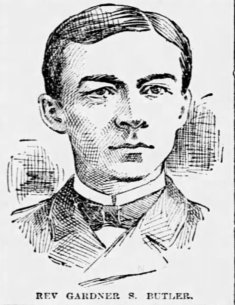 A Palmer, MA, town meeting elected Temperance party leaders Rev. F.E. Jenkins, Rev. Gardner S. Butler, and school superintendent L.H. Gager, as a prosecuting committee in 1896. They raided illegal liquor dealers, prosecuted over 90 cases, and secured 64 convictions, with fines totaling $3,050.
Rev G.S. Butler, pastor of the Union Evangelical church in Three Rivers, came to Palmer in May, 1892. He was born in Vermont. Since coming to Palmer, Mr. Butler has become known as an enthusiastic temperance worker. He has been a firm supporter of no-license, and demonstrated his willingness to do anything possible for the good of the cause he favored (Boston Globe, December 4, 1896).
Gardner S. Butler, a clergyman, aged fifty years (b. VT), headed a Wakefield, NH, household at the time of the Twelfth (1900) Federal Census. His household included his wife, Rose M. Butler, keeping house, aged forty-nine years, his nephew, Lisle Carl Percy, at school, aged eighteen years (b. VT), and his servant, Eliza H. Welch, a servant, aged twenty-three years (b. NH).
NORTH TROY. Rev. G.S. Butler, a former pastor here, and well known in this vicinity, was In town recently, coming with his father’s remains, from Attleboro, Mass. Mr. Butler is located at Atlanta, Ga., as a professor in a theological school (Orleans County Monitor (Barton, VT), March 30, 1903).
Rosa M. Butler died, probably in Charleston, SC, before 1920. Gardner S. Butler died in Demorest, GA, December 28, 1930.
S.H. Atkins – c1886-87
S.H. Atkins appeared in the Milton [Milton Mills] business directory of 1887, as pastor of the Congregational church there.
Springvale. The thirteenth meeting of the York county Baptist association was held here Tuesday, and was well attended. In the evening there was preaching by Rev. S.H. Atkins, of Milton Mills, N.H. (Biddeford Daily Journal, May 6, 1887).
(And a Rev. Charles Atkins gave the prayer before the strike meeting of the Milton Mills Shoe Strike of 1889).
Henry S. Ives – 1888-91
Henry Samuel Ives was born in Canada, May 5, 1864, son of Frederick T. Ives. He emigrated to the United States, in or around 1881.
He married, in 1886, Mary Penny Caruthers. She was born in Glasgow, Scotland, in February 1867, daughter of Richard and Margaret (Thompson) Carruthers.
Durham. The Piscataqua Association will meet at Durham with the Rev. Samuel H. Barnum on Tuesday. October 16th, at ten A.M. Rev. George Lewis of South Berwick, Maine, will deliver the concio and act as moderator, Twenty minutes are to be devoted to the State of Religion and Practical Questions. Rev. G.S. Butler, now of Ballardvale, Mass., will discuss Christian Experience; Rev. H.S. Ives of Milton Mills will present an exegesis of the last clause of I. John i: 7; Rev. A. Ross of Hampton will read an essay on the Scripture meaning of the phrase, The Blood of Christ; Review by Rev. Frank Haley of Milton. Rev. J.H. Fitts, South Newmarket, Scribe (Vermont Chronicle, October 12, 1888).
H.S. Ives appeared in the Milton [Milton Mills] business directory of 1889, as pastor of the Congregational church there.
Henry S. Ives of Francestown, NH, petitioned the NH Supreme Court in Manchester, NH, April 13, 1894. He sought to become a US citizen. He renounced Queen Victoria and took the US citizenship oath in Nashua, NH, 20 October 1896.
Henry S. Ives, a clergyman, aged thirty-six years (b. Eng. Canada), headed a Francestown, NH, household at the time of the Twelfth (1900) Federal Census. His household included his wife, Mary P.C. Ives, aged thirty-three years (b. Scotland), and his children, Florence M. Ives, aged eleven years (b. NH), and Murray R. Ives, aged ten years (b. ME).
Henry S. Ives died in Newbury, VT, April 23, 1934. Mary P. (Carruthers) Ives died in 1963.
Isambert B. Stuart – 1891-93
Isambert Burnell Stuart, b. 25 Nov. 1856, Boothbay, Me, son of Thomas W. and Sarah M. (Barter) Stuart. Pastor, North Yarmouth, Me., 1889-91; Milton Mills, N.H., 1891-93; Alstead, N.H., 1893-01; Hooksett, N.H., 1901-05; Cohasset, Mass., 1905-07; d. 20 Feb. 1907, Boothbay Me. (Bates College, 1915).
Isambert B. Stewart married (1st) in Boothbay, ME, September 22, 1877, Georgia A. Greenleaf, both of Boothbay. She was born in Boothbay, ME, in 1858.
Isambert B. Stuart, a teacher, aged twenty-four years (b. ME), headed a Boothbay, ME, household at the time of the Tenth (1880) Federal Census. His household included his wife, Georgia A. Stuart, keeping house, aged twenty-three years (b. ME), and his daughter, Edith Stuart, aged eleven months (b. ME).
Religious Intelligence. New Hampshire. Milton. Rev. J.B. Stuart is beginning his ministry at Milton Mills very agreeably. His people have given him a reception, and valuable presents (Vermont Chronicle, August 14, 1891).
Religious Intelligence. New Hampshire. Milton Mills. The church here, Rev. Z.B. Stuart pastor, observed Easter by a responsive service in the morning and a Sunday-school concert in the evening. The music at both services was exceptionally fine (Vermont Chronicle, April 29, 1892).
I.E. Stuart appeared in the Milton [Milton Mills] business directory of 1894, as pastor of the Congregational church there.
Georgia A. Stuart died in 1896. Isambert B. Stuart married (2nd) in Boothbay, ME, September 5, 1901, Emma R. Greenburg, both of Boothbay She was born in Boothbay, ME, circa 1859-60, daughter of William and Mary J. (Pinkham) Greenburg.
Isambert B. Stuart died in Boothbay, ME, February 20, 1907.
Hiatus
The pulpit was vacant in the Milton [Milton Mills] business directories of 1898, 1901, and 1904.
Since that time the church has depended upon theological students or visiting ministers for preaching and public worship (Scales, 1914).
References:
American Board of Commissioners. (1882). The Missionary Herald. Retrieved from books.google.com/books?id=wADPAAAAMAAJ&pg=PA414
American Home Missionary Society. (1880). The Home Missionary: For the Year Ending April 1880. Retrieved from books.google.com/books?id=jPTNAAAAMAAJ&pg=RA1-PA204
American Home Missionary Society. (1881). The Home Missionary: For the Year Ending April, 1881. Retrieved from books.google.com/books?id=kOTOAAAAMAAJ&pg=PA250
Andover. (1883). General Catalog of the Theological Seminary, Andover, Mass. Andover, MA: Warren F. Draper.
Bates College. (1915). General Catalogue of Bates College and Cobb Divinity School, 1863-1915. Retrieved from books.google.com/books?id=EetJAAAAMAAJ&pg=PA222
Comstock, John M. (1915). The Congregational Churches of Vermont and Their Ministry, 1762-1914. Retrieved from books.google.com/books?id=obHRAAAAMAAJ&pg=107
Congregational Publishing Society. (1888). Congregational Yearbook, 1888. Retrieved from books.google.com/books?id=0gARAAAAIAAJ&pg=PA128
Cutter, William Richard. (1908). Historic Homes and Places, and Genealogical and Personal Memoirs Relating to the Families of Middlesex County, Massachusetts. Retrieved from books.google.com/books?id=nn1yyHiYJFYC&pg=PA1438
Find a Grave. (2008, January 13). Rev. Almon Taylor Clarke. Retrieved from www.findagrave.com/memorial/23950600
Find a Grave. (2013, February 25). Benjamin Gilman Adams. Retrieved from www.findagrave.com/memorial/105828849/benjamin-gilman-adams
Find a Grave. (2011, August 26). Rev. Charles F. Goldsmith. Retrieved from www.findagrave.com/memorial/75502930
Find a Grave. (2011, September 21). Rev. Charles H. Hickok. Retrieved from www.findagrave.com/memorial/76890117
Find a Grave. (2011, October 19). George Michael. Retrieved from www.findagrave.com/memorial/78717479
Find a Grave. (2013, January 3). Rev. Henry S. Ives. Retrieved from www.findagrave.com/memorial/122663738
Find a Grave. (2012, July 21). Rev. Isambert B. Stuart. Retrieved from www.findagrave.com/memorial/93994283
Find a Grave. (2015, August 5). Rev. Willis Augustus Hadley. Retrieved from www.findagrave.com/memorial/150217793
(General Conference). (1877) General Conference of the Congregational Churches of Maine, Fifty-First Anniversary. Retrieved from books.google.com/books?id=JkX6ebnKU04C&pg=RA1-PA49
McKillop, Dugald MacKenzie. (1902). Annals of Megantic County, Quebec. Retrieved from books.google.com/books?id=JBc1AQAAMAAJ&pg=PA131
Merrill, Georgia Drew. (1889). History of Carroll County, New Hampshire. Retrieved from books.google.com/books?id=xmMKyZxlU5MC&pg=PA513
NH Missionary Society. (1871-75). Minutes. Retrieved from books.google.com/books?id=o_oQAAAAIAAJ&pg=RA9-PA31
Pilgrim Press. (1905). The Congregationalist and Christian World. Retrieved from books.google.com/books?id=8GRMAAAAYAAJ&pg=PA683
Scales, John. (1914). History of Strafford County, New Hampshire, and Representative Citizens. Retrieved from books.google.com/books?id=nGsjAQAAMAAJ&pg=PA518
Stover, Clyde B. (1918). Alumni Directory of Pennsylvania College of Gettysburg, 1832-1918. Retrieved from books.google.com/books?id=qwoTAAAAIAAJ&pg=PA134


 large-scale mill fire took place at Milton Mills in June. The reported loss was over eight times larger (in unadjusted dollar amounts) than that of the A.S. Howard & Co. mill fire of
  following mention of the Milton Mills Congregational church has been extracted from a larger report on the Strafford Congregational Conference. Despite its name, the conference included also Belknap and Carroll counties, as well as Strafford county.
