
By Muriel Bristol | February 2, 2020
Continued from Nute High School Principals, 1891-21 [In which Edwin S. Huse’s tenure should have extended to Spring 1923].
The headmasters of Milton’s Nute High School for its thirty-third through its sixty-sixth years were: R. Harold Gillmore, 1923-26; Ralph G. Reed, 1926-29; Eshburne O. Judkins, 1929-31; Philip R. Burlingame, 1931-36; Austin L. Howard, 1936-39; Robert R. Anderson, 1939-42; John L. Knight, 1943-44; Elliot W. Burbank, 1944-49; and Walter J. Foster, 1949-57.
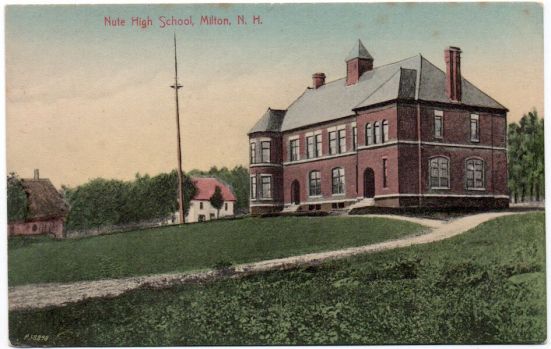
Beginning in 1928 we have readily available for the first time annual Town Reports, with the annual reports of the Nute High School headmasters. An example of each headmaster’s annual reports have been included in the text.
Ralph Harold Gillmore – 1923-26
Ralph Howard Gillmore was born in Lynn, MA, September 8, 1894, son of Edward and Inez M. (Andrews) Gillmore.
Ralph H. Gillmore of Concord, NH, joined the 120 men and 43 women of the Freshman class (“Class of 1916”), which was the largest class to date, at Middlebury College in Middlebury, VT, in September 1912 (Middlebury Register, September 27, 1912).
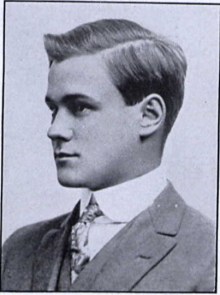
RALPH HAROLD GILLMORE, “ROSIE.” Concord. Concord High. Mechanic Arts. “Rosie” transferred to New Hampshire from Colby in order to be closer to “the ideal of his dreams,” and also to take advantage of the excellent training given by our illustrious “Wood Shop Butcher.” As a social chap, “Rosie” is a leader, and is substantiated by a frequent visitor who hails from the metropolis of Concord. Bits of conversation which have been overheard during these periodic trysts, lead us to believe that Harold is not as quiet as our first impression indicated. However, we heartily welcome our rosy-cheeked Concord lad and we wish him the best of luck in this, his second choice of an Alma Mater. ΑΤΩ; Transferred from Colby (3) (New Hampshire College of Agriculture and Mechanic Arts Yearbook, Durham, NH, 1917).
Ralph Harold Gilmore of Concord, NH, registered for the WW I military draft in Concord, NH, June 5, 1917. He was a self-employed farmer in Pembroke, NH, aged twenty-two years (b. Lynn, MA, September 8, 1895). He was of medium height, with a medium build, brown eyes, and dark brown hair.
He married in Concord, NH, June 30, 1917, Lena May Winslow, he of Concord and she of Chichester, NH. She was born in Chichester, NH, in 1897, daughter of Frank and Mary J. (Lake) Winslow. She was likely “the ideal of his dreams” mentioned in his college yearbook.
R. Harold Gillmore and his wife, Lena Gillmore, appeared in the Concord directory of 1919 as having moved to Chichester, NH, R.F.D. #14.
Ralph H. Gillmore, a high school teacher, aged twenty-five years (b. MA), headed a Casco, ME, household at the time of the Fourteenth (1920) Federal Census. His household included his wife, Lena M. Gillmore, aged twenty-two years (b. NH), and his son, Vernell W. Gillmore, aged one year, eight months (b. NH). Ralph H. Gillmore rented their house in Casco town.
R. Harold Gilmore appeared in the Maine Register for 1920 as principal of the Woodstock High School of Woodstock, Oxford County, ME.
There have been three new teachers on the faculty this year. Mr. Crooker was replaced by Mr. R. Harold Gilmore as principal. Miss Olive Chase was secured as an assistant. At the Christmas recess, she was obliged to undergo an operation on her throat, so she had to leave the faculty. Mr. Byron W. Barker was secured to take her place and serve out the school year. Mrs. Swan expects to terminate her teaching in June, after 14 years of faithful and efficient service as a teacher in Woodstock high school. She had also served two years as superintendent of schools in Woodstock (The Woodstock High School Eureka, Spring 1921).
R. Harold Gilmore appeared in a list of the high school headmasters and principals whose secondary schools had been approved by the NH Board of Education for the 1923-24 academic year. He was listed as the headmaster of the Nute High School, in Milton, which was classed as an A4 school. “Class A includes all schools with complete secondary programs … An attached number shows the number of years in the approved program” (NH State Board of Education, 1924).
R. Harold Gillmore, a high school teacher, aged thirty-five years (b. MA), headed a Hardwick, MA, household at the time of the Fifteenth (1930) Federal Census. His household included his wife (of thirteen years), Lena W. Gillmore, aged thirty-two years (b. NH), and his son, Vernell W. Gillmore, aged eleven years (b. NH). Ralph H. Gillmore rented their house on New Braintree Road, for $25 per month. They had a radio set.
Lena W. Gillmore, aged forty-two years (b. NH), headed a Pembroke, NH, household. She owned her house on the Pembroke Hill Road, which was valued at $4,000. She had resided in Hardwick, MA, in 1935. There appears to have been an enumeration error by which her husband was omitted from their household. Another enumerator recorded him on a supplementary page. R. Harold Gillmore, a public high school principal, aged forty-six years (b. MA), headed a Pembroke, NH, household in this same Sixteenth (1940) Federal Census. He owned his house on Pembroke Street, which was valued at $4,000. He had resided in Pembroke in 1935.
Ralph Harold Gilmore of Pembroke, NH (RFD #4, Concord, NH), registered for the WW II military draft in Concord, NH, April 26, 1942. He was employed by the Town of Hardwick, MA, aged forty-seven years (b. Lynn, MA, September 28, 1894). Lena M. Gillmore, RFD #4, Concord, NH, was his contact. Their telephone number was Concord 698-23. He was 5′ 7″ in height, weighed 175 pounds, with brown eyes, brown hair, and a light complexion.
Ralph H. Gillmore appeared as a farmer in the Concord, NH, directories of 1943 and 1947. He and his wife, Lena W. Gillmore, had their house and farm at Pembroke Hill, R.D. #4.
R. Harold Gillmore appeared in the Concord, NH, directories of 1950, 1951, 1953, 1955, 1957, 1960, and 1962. He and his wife, Lena W. Gillmore, had their house at 64 N. Main street. He was a farmer in 1947 and 1957, and retired in 1960 through 1962.
R. Harold Gillmore died in 1967. Lena M. (Winslow) Gillmore died in 1983.
Ralph Gerry Reed – 1926-29
Ralph G. Reed was born in Bridgton, ME, April 22, 1886, son of Wilbur M. and Carrie W. (Osgood) Reed.
He married in Haverhill, MA, September 18, 1909, Blanche Alma Favor, he of Bridgton, ME, and she of Franklin, NH. He was a teacher, aged twenty-three years, and she at home, aged twenty-three years. She was born in Hill, NH, March 16, 1886, daughter of Llewelyn D. and Alma A. (Caverly) Favor.
ALUMNI. [Class of] 1909 – Ralph G. Reed is principal of the High School at Marlboro, New Hampshire (Bates Student, February 1911).
Ralph Gerry Reed of Sherman Mills, ME, registered for the WW I military draft in Houlton, ME, September 12, 1918. He was employed as a teacher by the Town of Sherman, ME, aged thirty-two years (b. April 22, 1886). He was of tall height, with a slender build, blue eyes, and brown hair. His nearest relative was Blanche F. Reed of Sherman Mills, ME.
Ralph G. Reed, a high school teacher, aged thirty-three years (b. ME), headed a Sherman, ME, household at the time of the Fourteenth (1920) Federal Census. His household included his wife, Blanche A. Reed, aged thirty-three years (b. NH), and his children, Carol L. Reed, aged nine years (b. ME), Glendon Reed, aged six years (b. ME), Cherry Reed, aged one year, nine months (b. ME), and Stanley D. Reed, aged two months (b. ME). Ralph G. Reed rented their house on the Mills Road.
Reed’s daughter, Carol L. Reed, won the Nute High School Thrift Week essay contest in January 1927. The set topic was “Benjamin Franklin’s Contribution to American Independence.” Her winning Nute essay then moved up to be judged in the Strafford County essay contest. At that level, it was John Woodman, a Rochester sophomore, who won the Strafford County Thrift Week essay contest (Farmington News, February 4, 1927).
Ralph G. Reed’s third annual headmaster’s report, for the academic year 1928-29, appeared in the Milton Town Report for 1928, i.e., for the fiscal year ending January 31, 1929.
REPORT OF HEADMASTER OF NUTE HIGH SCHOOL
To the Superintendent of Schools and the Members of the Board of Trustees:
I herein submit for your consideration my third annual report as headmaster of Nute High School.
The school year opened September 4 with an enrollment of eighty pupils, thirty-eight girls and forty-two boys. One boy registered later in the Fall making the total enrollment for the year eighty-one. During the first half year nine pupils have withdrawn from school leaving our enrollment at the present time seventy-two. The number of pupils leaving school has been greater than during the past two years, the reasons being justifiable in many instances. Three removed from town, two were unable to secure transportation, one was due to sickness and the remaining three were either indifferent to high school work or unprepared for it.
Nute High School has received creditable mention from the state department for several years for maintaining a high per cent attendance each year. This year we continued the good record for some weeks by having an average of 98% but epidemics of contagious diseases began to afflict us in December and soon afterward the prevailing epidemic of influenza began to make itself evident among the pupils in ever increasing numbers, on many days from twelve to twenty pupils being absent.
The splendid class which was graduated from the school last June left a gap in the scholastic, literary, musical, and athletic activities which is very difficult to fill and which will take time and effort to replace.
The tuition rate has been increased from sixty dollars per year to seventy-one dollars and eighty-two cents, this amount being the maximum amount allowed by the state to charge, the figures being based upon the annual per capita cost per pupil. There are twenty-eight tuition pupils registered at the present time.
Respectfully submitted,
RALPH G. REED, Milton, N.H., February 5, 1929.
Ralph G. Reed was headmaster at the Amherst, NH, high school beginning with the 1929-30 academic year. He submitted his third annual report, dated Amherst, N.H., February 1, 1932 (Amherst Town Report, 1932).
Ralph G. Reed, a town school teacher, aged forty-three years (b. ME), headed an Amherst, NH, household at the time of the Fifteenth (1930) Federal Census. His household included his wife (of twenty years), Blanche A. Reed, aged forty-four years (b. NH), his children, Carol L. Reed, aged nineteen years (b. NH), Shirley B. Reed, aged twelve years (b. ME), and S. Duane Reed, aged ten years (b. ME), and his nephew, Arthur E. Reed, aged ten years (b. MA). They had a radio set. Ralph G. Reed rented their part of a two-family residence on Depot Street, for $12 per month. Their widowed landlady, Celia A. Fulton, private family housework, aged fifty-eight years (b. MA), occupied the other part. The whole was valued at $1,200.
Ralph G. Reed appeared in a list of the high school headmasters and principals whose secondary schools had been approved by the NH Board of Education for the 1931-32 academic year. He was listed as the headmaster of the Amherst High School, in Amherst, NH, which was classed as an A4 school. “Class A includes all schools with complete secondary programs … An attached number shows the number of years in the approved program.”
Ralph G. Reed died November 17, 1933. Alma A. (Favor) Reed died in Acton, MA, July 24, 1981.
REED – Of Acton, July 24, Blanche (Favor), wife of the late Ralph G. Reed. Mother of Mrs. Carol Coyne of Florida, Stanley D. Reed of Shirley, Mrs. Shirley Goodman of Acton, Mrs. Lorraine Fadden of Norway, Maine and the late Glendon T. Reed. Sister of Vera Favor of Tilton, NH. Also survived by several grandchildren and great grandchildren. A memorial service will be held at a later date at The South Acton Congregational Church. Memorial gifts in her name may be made to The South Acton Congregational Church. Acton, MA 01720. Arrangements by The Acton Funeral Home (Boston Globe, July 26, 1981).
Eshburne Oscar Judkins – 1929-31
Eshburne Oscar Judkins was born in Upton, ME, January 31, 1893, son of Albert W. and Bertha L. (Morse) Judkins.
Eshburn Oscar Judkins of Upton, ME, registered for the WW I military draft in Upton, ME, June 4, 1917. He was a student, aged twenty-four years (b. Upton, ME, January 31, 1893). He was of tall height, with a slender build, blue eyes, and light brown hair.
Eshburn O. Judkins was inducted into the U.S. Army in South Paris, ME, July 25, 1918. He was promoted to Private First Class, September 20, 1918. He was overseas in Europe, between October 3, 1918 and October 21, 1919, where he was attached to various Army Ordnance detachments and departments. He was demobilized on November 4, 1919.
Eshburn O. Judkins appeared as a senior in the University of Maine’s Prism yearbook of 1924-25. He graduated in June 1925 with a degree in mechanical engineering.
ESHBURN O. JUDKINS, “Jud,” Upton. Gould’s Academy. [Major:] Mechanical Engineering. Ex-’16, ex-19, ex-22; Class Track (1), (2); Class Baseball (1), (2); Class Basketball (2); Varsity Basketball (3); Varsity Track (3); Track Club (3); “M” Club (3), (4); President, Dormitory Council (3), (4); Class Nominating Committee (3), (4); Senator, Students’ Council (4); Committee on Student Activities (4) (Prism, 1924).
Eshburn O. Judkins, aged thirty-three years, married (1st) in Oak Bluffs, Martha’s Vineyard, MA, September 14, 1926, Lena Flora Estey, aged twenty-eight years, he of Upton, ME, and she of Oak Bluffs. She was born in Fitchburg, MA, January 12, 1898, daughter of Wallace A. and Flora J. (Ray) Estey.
Lena Flora Estey graduated from the Norton, MA, high school with the Class of 1916 (she was one of only four graduating Seniors), of which she was the valedictorian. Her valedictory address was entitled “Present Day Opportunities.” She also played a piano solo entitled “Scintillements.”
Two of last year’s graduates from the commercial department. Miss Helen Morgan and Miss Bertha Lincoln, entered business offices soon after they were graduated. A third graduate. Miss Lena F. Estey is attending Wheaton College (Norton Town Report, 1917).
Lena F. Estey appeared in the annual Oak Bluffs Town Reports as Librarian of the town’s public library, between April 1922 and December 1925. One might speculate – with no actual evidence – that a vacationing Eshburn O. Judkins met her at her library. Its hours were “Daily, except Sun., 2-5, 6-8” (MA Free Public Library Commission, 1924).
Healdville. Mr. and Mrs. Oscar Judkins of Springfield, Mass., were recent visitors at A.O. Estey’s (Rutland Daily Herald, December 4, 1926).
Oscar E. Judkins (and his wife Lena Judkins) appeared in the Bristol, CT, directory of 1927, as a teacher, with a house at Rear 55 Maple street.
Boy Scout Notes. A full organization of Scoutmaster, two assistant Scoutmasters, five troop committeemen and two patrols of 16 Scouts was effected at West Pawlet last week. The leaders chosen are: Scoutmaster, E.O. Judkins; assistants, James Clark and John Morrow; troop committee, Clarence J. Watters, Arthur H. Morrow, W.O. Williams, Thomas J. Williams, and Ralph Beecher; patrol leaders, Glenn Fitzgerald and Watkin Griffith; scribe, John C. Williams. This makes the 30th troop to be organized in the council area (Rutland Daily Herald, February 27, 1928).
Arlington. County Spelling Contest. The winner of the Bennington county spelling contest, which was held in the Arlington Memorial High school Saturday afternoon, was Miss Mary Shaw of Bennington, with Miss Gertrude Levin of Manchester Center being second. The alternates were James Clarke of Manchester and Albert King of Readsboro. The judges were Capt. Herbert Wheaton Congdon of Arlington, H.C. Matthews, Principal of the Pawlet High school, and E.O. Judkins, principal of the West Pawlet school. Alva Noble of Readsboro acted as chairman of the committee to review the written papers, the contest being conducted by E.L. Bigelow of Manchester Center, superintendent of schools (Rutland Daily Herald (Rutland, VT, May 21, 1928).
West Pawlet. Prof. and Mrs. E.O. Judkins have returned from a summer vacation. He will resume his duties Monday in the West Pawlet high school (Rutland Daily Herald, September 10, 1928).
West Pawlet. The staff teaching in the High school includes: Prof. E.O. Judkins of Maine, Mrs. Kate Richardson of Boston, Miss Myra Ellwell of Bennington, Miss Meredith Clapper of Selkirk, Fourth, fifth and sixth grades are being taught by Miss Fish of Wallingford and first, second and third by Mrs. Mary Jackson Hughes. Miss Hazel Roberts is teaching at Nelsonvllle and Miss Gertrude Tobin at Braintree (Rutland Daily Herald, September 13, 1928).
West Pawlet. Prof. E.O. Judkins went to Warren, N.H., Friday after Mrs. Judkins, who had been spending a month with her parents. They returned Sunday (Rutland Daily Herald (Rutland, VT), April 29, 1929).
Robert Oscar Judkins, second child of Eshburn O. Judkins (headmaster, b. Upton, ME) and Lena Estey (b. Fitchburg, MA), was born in Rochester, NH, October 16, 1929 (Milton Vital Records).
E.O. Judkins’ first annual headmaster’s report, for the academic year 1929-30, appeared in the Milton Town Report for 1929, i.e., for the fiscal year ending January 31, 1930.
REPORT OF HEADMASTER OF NUTE HIGH SCHOOL.
To the Superintendent of Schools and the Members of the Board of Trustees:
The school year opened September 3 with an enrollment of seventy-four, seventeen seniors, fifteen juniors, twenty-two sophomores, and twenty-one freshmen. We now have seventy-five pupils of which number twenty-four are tuition pupils.
Twelve pupils are registered for the college preparatory curriculum and sixty-three for the general business.
The general business curriculum program has been enriched and broadened by the substitution of junior business practice for commercial arithmetic in the freshman year, and the giving of a complete bookkeeping course in the sophomore year. These are to be followed by the introduction of typewriting and correspondence in the junior year and office practice in the senior year. Other commercial courses are commercial history and geography and economics and commercial law.
Extra-curricular activities consisting of base-ball, basket-ball, prize speaking, dramatics, the school publication, orchestra, chorus, and scholarship day round out the program.
To meet the state requirements and replace worn-out books it has been necessary to buy new texts for English, junior business practice, history of civilization, modern European history, and reference books for sociology and economics and law.
The attendance has been high and the school spirit good.
Respectfully submitted,
E.O. JUDKINS.
Milton, N.H., February 7, 1930.
Eshburn O. Judkins, a high school headmaster, aged thirty-seven years (b. ME), headed a Milton household at the time of the Fifteenth (1930) Federal Census. His household included his wife, Lena E. Judkins, aged thirty-two years (b. MA), and his children, Mary Jane Judkins, aged one year (b. VT), and Robert O. Judkins, aged six months (b. NH). They rented their residence on the Farmington Road, for $25 per month. They did not have a radio set. Their household appeared in the enumeration between those of Sarah P. Haley, a widow, aged eighty-two years (b. NH), and her tenant, William S. Lougee, a fibre mill superintendent, aged fifty-five years (b. NH), on the one side, and Huon L. French, a high school janitor, aged seventy-seven years (b. NH), on the other.
Barbara Lena Judkins, third child of Eshburn O. Judkins (headmaster, b. Upton, ME) and Lena Estey (b. Fitchburg, MA), was born in Rochester, NH, January 22, 1931 (Milton Vital Records),
O. Eshburn Judkins, superintendent of schools, aged forty-seven years (b. ME, headed a Reed Plantation, ME, household at the time of the Sixteenth (1940) Federal Census. His household included his wife, E. Lena Judkins, housework, aged forty-two years (b. ME), his children, J. Mary Judkins, aged elevn years (b. ME), O. Robert Judkins, aged ten years (b. ME), L. Barbara Judkins, aged nine years (b. ME), and E. Geraldine Judkins, aged five years (b. ME), and his lodger, T. Stanley Ritchie, a hoop-shaving laborer, aged fifty-one years (b. ME). O. Eshburn Judkins owned their house at 16 Main Street, which was valued at $700. They had resided in the “same house” in 1935.
Lena F. (Estey) Judkins died in Lassen, CA, June 26, 1965. He married (2nd) in Arlington, VA, September 15, 1968, Marjorie Martin.
Eshburne O. Judkins died in Davis, CA, May 14, 1992, aged ninety-nine years. Marjorie (Martin) Judkins died in 2000.
Phillip Russell Burlingame – 1931-36
Philip Russell Burlingame was born in Springfield, MA, November 11, 1892, son of Frederick R. and Josephine I. (Story) Burlingame.
Philip R. Burlingame of R.F.D. #2, Three Rivers, MA, registered for the WW I military draft in Palmer, MA, June 5, 1917. He was employed as a farmer (“jointly with father”), aged twenty-four years (b. Springfield, MA, November 11, 1892). He was of tall height, with a slender build, gray eyes, and brown hair. He claimed an exemption for his “defective eyes” and his employment as a farmer.
He married in Palmer, MA, in 1919, Thelma J. Keith. She was born October 2, 1897. By 1900 (if not before), she was the adopted daughter of Lyman L. and Jennie M. (Burke) Keith.
Philip R. Burlingame, a construction overseer, aged twenty-two years (b. MA), headed a Palmer, MA, household at the time of the Fourteenth (1920) Federal Census. His household included his wife, Thelma K. Burlingame, aged twenty-two years (b. MA, and his boarder, Harry Bradley, a construction laborer, aged twenty-one years (b. MA). His parents lived next door: Frederick Burlingame, a farmer, aged fifty-eight years (b. MA), and Josephine Burlingame, aged fifty-two years (b. RI). Philip R. Burlingame owned his house on Prospect Hill Road, with a mortgage, while his parents rented theirs.
Philip R. Burlingame appeared twice in the Manchester, NH, directory of 1924. He appeared with his wife, Thelma Burlingame, as an instructor, with a house at 47 Sagamore street. He appeared also, in both 1924 and 1925, as a teacher in the West Side High school, with a house at 673 Chestnut street.
Philip R. Burlingame appeared in the 1926 edition of the Meteor, which was the high school yearbook for Berlin, NH. He was a physical training instructor and baseball coach.
Philip R. Burlingame appeared in the Berlin, NH, directories of 1927 and 1930, as a high school coach, with his house at 360 Willard street.
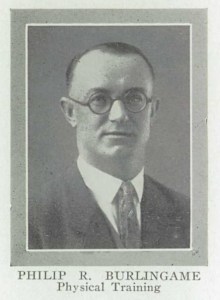 Philip Burlingame, a public school instructor, aged thirty-seven years (b. MA), headed a Berlin, NH, household at the time of the Fifteenth (1930) Federal Census. His household included his wife, Thelma Burlingame, aged thirty-one years (b. MA), and his daughter, Barbara Burlingame, aged nine years (b. MA). They shared a rented two-family dwelling with the household of their landlord, Dubey Telesphore, an industrial agent, aged forty-four years (b. NH). They paid $35 per month in rent. Both households had radio sets. Their dwelling was on Willard Street.
The University of New Hampshire’s College of Liberal Arts conferred a Bachelor of Science degree upon Phillip R. Burlingame of Durham, NH, at its commencement held June 15, 1931 (Boston Globe, June 15, 1931).
SPRINGFIELD MAN HEADS NUTE HIGH IN MILTON, N.H. MILTON, N.H., Sept 1 – Nute High School began the Fall schedule today with a new headmaster, Philip R. Burlingame of Springfield, Mass. Mr. Burlingame was graduated from Springfield College, class of 1922, and from New Hampshire University, 1931. He has been the submaster in the High School at Berlin, N.H. for five years. Last year he was in the teaching staff at New Hampshire University in the department of physical education. A new teacher at Nute High School is Miss Mary Timmens, who will teach history and French. She is a graduate of New Hampshire University and has been teaching in the High School at Durham (Boston Globe, September 2, 1931).
Headmaster Burlingame took an active role in establishing an interscholastic basketball league with other schools in the region.
BASKETBALL LEAGUE FORMED AT DOVER. Philip R. Burlingame was elected secretary of the basketball league formed at Dover, November 7. He recently sent Farmington high school his report of the minutes of the meeting. At a meeting held in the American House hotel in Dover, attended by Headmaster Wright and Coach Riccardi of Newmarket, Headmaster Faunce of Epping, Headmaster Bannister and Coach Pellerin of Farmington, Headmaster Burlingame and Manger Roland Knight of Nute high of Milton, an attempt was made to form a basketball league for boys and also one for girls, consisting of Raymond, Epping, Newmarket, Pittsfield, Farmington, and Nute high schools. [Many other details followed regarding the league’s board, eligibility, trophies, etc., that have not been extracted here] (Farmington News, November 20, 1931).
Philip R. Burlingame’s second annual headmaster’s report, for the academic year 1932-33, appeared in the Milton Town Report for 1932, i.e., for the fiscal year ending January 31, 1933.
REPORT OF HEADMASTER OF NUTE HIGH SCHOOL
To the Superintendent of Schools and the Members of the Board of Trustees:
The forty-second year of this institution opened September 5 with an enrollment of seventy-nine pupils. Transfers to other schools and withdrawals reduced the registration until at present there are 69 pupils divided as follows: Seniors, 12; Juniors, 9; Sophomores, 18; Freshmen, 30. There are eleven tuition pupils as compared with twenty-four last year.
Reports from the State Department of Education show an increased rating by the Commissioner on the scholastic standard of the school over that of previous years.
The Otis Group Intelligence Scale given all members of the school showed an increase of from five to ten points on a like performance given last year, showing a mastering of fundamental processes.
The Woody Arithmetic Scale to determine efficiency in mathematics showed a marked difficulty on the part of all to handle fractions, the result showing the Seniors 87% perfect, Juniors 83%, Sophomores 82% and Freshmen 84%.
There has been a trend towards increase in those registering in the Classical Course this year, eight freshmen electing the Latin or College preparatory course as compared with three last year.
Realizing the value of visual education, field trips have been made by the various classes, the Senior United States Government group going to Concord for a day and attending the Legislature, Federal court, States Prison, Historical society and other places of interest. The Commercial department has visited a modern office and seen up-to-date office equipment being used. Physiography class students visit nearby places to witness effects of water and glacial erosion.
Athletics have been self supporting, and furnished a surplus for purchasing of a ten volume set of Standard History of the World for general reference and research work. It has also furnished money for many needed improvements about school including a new gravel road, a first aid and emergency room for girls which has been furnished with a couch, dressers, table and chairs. As a matter of safety a concrete slab has been poured to cover the unused well back of the school. Shrubbery set out by the graduating class of 1932 has been fertilized and cared for and has made good growth.
Several outstanding booklets, papers and projects of work have been completed. A reproduction of “The House of Seven Gables,” a carpenter job worthy of a master builder, is exhibited by Constandino DiPrizio, sophomore honor pupil from Middleton.
Attendance has been excellent and to date but five tardy marks are charged against the school showing an aptitude for promptness hitherto not exhibited.
The excellent condition of the school property is due in a large measure to the untiring efforts of Caretaker Tetherly, whose personal interest is highly commendable.
Respectfully submitted,
PHILIP R. BURLINGAME,
February 24, 1933. Headmaster.
WEST MILTON. The Church Night program was held last Thursday evening at Nute Chapel. The literary program was under the direction of Charles Hayes. Mrs. Daisy Curtis rendered two piano selections in her usual pleasing manner. Miss Myrtle Durkee rendered a vocal selection which was enjoyed by all. Headmaster Philip R. Burlingame gave a very instructive address on “Education.” Anyone not present surely missed a real treat. Refreshments were served by Mrs. Cora Garland and her assistants (Farmington News, September 22, 1933).
MILTON. Nute high school started basketball practice Tuesday night, with Mr. Burlingame coaching (Farmington News, November 2, 1934).
Philip Burlingame, a public school teacher, aged forty-six years (b. MA), headed a Lancaster, NH, household at the time of the Sixteenth (1940) Federal Census. His household included his wife, Thelma Burlingame, aged thirty-nine years (b. MA), and his children, Barbara Burlingame, a maid (private home), aged nineteen years (b. MA), and Robert Burlingame, aged nine years (b. NH). They owned their house at 37 Prospect Street, which was valued at $2,800. (William Fuller, superintendent of schools, aged fifty-four years, rented a house at 52 Prospect Street). They had resided in Milton, NH, in 1935.
Philip Russell Burlingame of Lancaster, NH, registered for the WW II military draft in Lancaster, NH, April 27, 1942. He was employed by Williams Brothers of Tulsa, OK, aged forty-nine years (b. Springfield, MA, November 11, 1892). Thelma J. Keith Burlingame, 37 Prospect Street, Lancaster, NH, was his contact. Their telephone number was Griffin 4692. He was 5′ 11″ in height, weighed 195 pounds, with blue eyes, grey-brown hair, and a ruddy complexion.
Philip R. Burlingame died in August 1964. Thelma J. (Keith) Burlingame died in Manchester, NH, in May 1986.
Austin Lucius Howard – 1936-39
Austin L. Howard, was born in Essex, VT, January 18, 1906, son of Ernest M. “Charles” and Ethel M. (Barnes) Howard.
Essex Junction. Mr. and Mrs. Ernest Howard of Atlantic City, N.J., Mr. and Mrs. Raymond Whiting of Burlington, were guests on Monday of Mr. and Mrs. W.F. Barnes. Mr. Howard, who was a former resident of this village, came to Burlington to attend commencement at the University of Vermont from which institution his son, Austin L. Howard of Burlington, was graduated in the electrical engineering class (Burlington Free Press, June 17, 1931).
Austin Howard, headmaster of Nute high school, Milton, and Robert Anderson and Miss Ruth Paulson both also of Nute high school, were the judges of a prize speaking contest at the Alton high school on Friday evening, April 22, 1938, at 8 PM. The winners were to go on to compete in the interscholastic contest held at the University of New Hampshire, May 6, 1938 (Farmington News, April 29, 1938).(Robert Anderson, then a teacher at Nute high school, would become its next headmaster).
Austin L. Howard’s third annual headmaster’s report, for the academic year 1938-39, appeared in the Milton Town Report for 1938, i.e., for the fiscal year ending January 31, 1939.
REPORT OF THE HEADMASTER OF NUTE HIGH SCHOOL.
To the Superintendent of Schools and the Members of the Board of Trustees:
I hereby submit my third annual report of the Nute High School which opened its forty-eighth year on September 6 with an enrollment of 76 pupils. Transfers and withdrawals have reduced the registration until at present there are 68 pupils divided as follows: Seniors, 9; Juniors, 15; Sophomores, 21; Freshmen, 23.
The attendance has been excellent, the average attendance to date being better than 96 per cent.
There has been one change in the teaching staff. Miss Mary Sherburne, B.A., replaced Miss Ruth Paulson.
One new subject, Biology, has been added to the curriculum.
New equipment which has been purchased this year includes the following: a complete set of laboratory apparatus for Biology; four Royal typewriters; one Burroughs adding machine. New text books were purchased for the following courses: Economics, Sociology, French I, and Biology.
Athletics have been self supporting and have furnished a surplus for the purchase of additional equipment.
As has been stated in past reports, there is still a big demand and need for Domestic Arts courses for the girls and Practical Arts courses for the boys. Estimates have been obtained on the cost of installing these courses in our school. By taking advantage of Federal Aid, one-half of the salary of the extra teacher needed to put this program in operation would be paid by the George Dean fund. The largest part of the cost would be for the initial equipment and this could be spread over a period of four years. It is estimated that the total additional cost of putting this program into operation will be fifteen hundred dollars for the first year, one thousand dollars for the next three years, and five hundred dollars for each year thereafter. There is no question but what these courses are needed by our boys and girls and I hope that they may be installed next year.
The many helpful suggestions of our Superintendent have been beneficial to the school and staff.
Respectfully submitted,
AUSTIN L. HOWARD, Headmaster,
February 10, 1939.
Austin Howard was headmaster of Alton, NH, high school beginning with the 1939-40 academic year.
ALTON AND ALTON BAY. Mr. and Mrs. Austin Howard of Milton are to occupy the Mrs. Nellie Roberts house. Mr. Howard is the new headmaster of Alton high school (Farming News, August 25, 1939).
Austin L. Howard, a high school principal, aged thirty-three years (b. VT), headed an Alton, NH, household at the time of the Sixteenth (1940) Federal Census. His household included his wife, Florence E. Howard, aged thirty-one years (b. ME). Austin L. Howard rented their house on Mitchell Avenue, for $20 per month. They had both resided in Burlington, VT, in 1935.
Austin Lucious Howard of Alton, NH, registered for the peacetime military draft in Alton, NH, October 16, 1940. He was employed by the Alton School Dept., aged thirty-four years (b. Essex Junction, VT, July 19, 1906). He was 5′ 11″ in height, weighed 220 pounds, with blue eyes, brown hair, and a ruddy complexion. Florence Evelyn Howard was his contact.
Personal Mention. Mr. and Mrs. Austin L. Howard, who have been visiting relatives and friends for the past week, have returned to their home in Alton, N.H. (Burlington Free Press, March 2, 1942).
Local Briefs. Hold Birthday Party. A birthday party was given at the home of Mr. and Mrs. E.A. Smith for Mrs. Florence Howard and Edward Smith. Games were played, following which refreshments were served. Mrs. Howard and Smith received many gifts. They also were presented with large birthday cakes which were made and decorated by Miss Bertha Barnes. Mrs. Howard was presented with a corsage of American beauty roses by her husband (Burlington Free Press, April 28, 1942).
Personal Mentions. Mr. and Mrs. Austin Howard of Alton, N.H., spent the weekend with his mother, Mrs. E.A. Smith of 213 N. Winooski ave. They were en route to visit relatives in Worcester, Mass, and Hartford, Conn., before Mr. Howard leaves for Washington, D.C., where he has employment (Burlington Free Press, June 10, 1942).
Austin L. Howard married (2nd) in Albuquerque, NM, in 1951, Marjorie B. Harrison, he of Washington, DC (Albuquerque Journal, July 18, 1951).
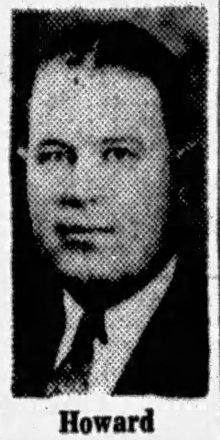 Austin L. Howard Dies Age 54; Taught at UVM. Austin Lucious Howard, former Burlington resident and electrical engineer at the Naval Research Laboratory in Washington, D.C., died there Thursday at the age of 54. Mr. Howard and two associates installed the first hydrogen bomb ever tested in an airplane, relatives said. More recently, he was with the Vanguard and other missile projects as a technical research engineer. Mr. Howard was former instructor in electrical engineering at the University of Vermont, later headmaster of schools in Milton and Alton, N.H. In 1945, he transferred to Washington. He was active in many Burlington musical organizations, conducting his own orchestra. He also was a member of the Burlington Military Band and had previously been its manager. He also belonged to Burlington Lodge, F&AM. Mr. Howard was educated in the schools of Essex Junction and Burlington and was graduated from the University of Vermont in 1931. He was born in Essex Junction July 18, 1906, son of C. Ernest and Ethel (Barnes) Howard. He made his home in Brandywine, Md., and was a member of the Methodist Church of Horsehead, Md. Besides his wife, Marjorie Henderson Howard, he leaves his mother, Mrs. Ethel Smith of 28 Clarke St., Burlington; his father of Tampa, Fla.; a sister, Mrs. George Eiss of Watertown, N.Y.; an aunt, Bertha Barnes of Burlington; two uncles, Chester L. Barnes of Essex Junction and Floyd W. Barnes of Montpelier; three nieces, a nephew and several cousins. The funeral will be held Tuesday at 2 at the Corbin and Palmer Funeral Home, 71 S. Union St., the Rev. Charles Washburn of the Church of the Nazarene officiating, assisted by the Rev. Edward Foster of the Free Methodist Church. Calling hours at the funeral home Monday from 2 to 4 and 7 to 9 (Burlington Free Press, January 23, 1961).
Robert Rettig Anderson – 1939-42
Robert R. Anderson was born in Boston, MA, June 11, 1908, son of Ruth H. (Swanson) Anderson.
Robert R. Anderson married in Houston, Harris County, TX, October 10, 1931, Lalue B. Zappa, he of Houston, TX, and she of Alexandria, LA. Rev. Harry G. Knowles performed the ceremony.
MILTON MILLS. Mr. and Mrs. Robert Anderson of Dover were week-end visitors to town (Farmington News, June 7, 1935).
MILTON MILLS. Mr. and Mrs. Robert Anderson, who have been In Dover during the winter, are occupying their home on Main street (Farmington News, June 28, 1935).
Robert Anderson and Miss Ruth Paulson, teachers at Nute High school, as well as Austin Howard, headmaster of Nute High school (see above), were the judges of a prize speaking contest at the Alton High school on Friday evening, April 22, 1938, at 8 PM. The winners were to go on to compete in the interscholastic contest held at the University of New Hampshire, May 6, 1938 (Farmington News, April 29, 1938).

Robert R. Anderson, a public school teacher, aged thirty-one years (b. MA), headed a Milton Mills household at the time of the Sixteenth (1940) Federal Census. His household included his wife, Lalue B. [(Zappa)] Anderson, aged thirty years (b. LA). Robert R. Anderson owned their house on [Milton Mills’] Main Street, which was valued at $1,000.
Robert Rettig Anderson, of Milton Mills, registered for the peacetime military draft in Milton, October 10, 1940. He was thirty-two years old (b. Boston, MA, June 11, 1908), and was employed by the Trustees of Nute High School. His next of kin was Lalue B. Anderson. He was 5’8″ tall, weighed 150 pounds, and had a light complexion, blonde hair and blue eyes.
Robert R. Anderson’s third annual headmaster’s report, for the academic year 1941-42, appeared in the Milton Town Report for 1941, i.e., for the fiscal year ending January 31, 1942.
REPORT OF THE HEADMASTER OF NUTE HIGH SCHOOL.
To the Superintendent of Schools and Members of the Board of Trustees:
I hereby submit my third annual report of the Nute High School which opened its fifty-first year September 3, 1941, with an enrollment of 105 pupils. Eleven have withdrawn for the following reasons: 3 moved to another school district; 4 were not adapted to high school work; 3 went to work; and 1 because of poor health. Our membership of 94 on this date is divided as follows: post graduate, 1; seniors, 17; juniors, 20; sophomore, 24; freshmen, 32. Records show that during the years of World War I many pupils withdrew from schools before completing their secondary work. We in the school hope that this will not be condoned now, but on the other hand that our young people will be encouraged to remain in school to prepare themselves to be better qualified to serve their community and country.
There has been one change and one addition to our teaching staff. Mr. Laurent Bosse, who teaches Trades and Industries, replaced Mr. Luther Preston; and Miss Lurlene Gordon was added to teach all the sciences and Latin. Enrollment in our Trades and Industries courses increased to such an extent that it became necessary to employ a full-time teacher for those courses alone, whereas in the previous years a part-time teacher was adequate.
The following new subjects have been added to this year’s programs of studies: General Science, Human Behavior, and Consumer Buying. Otherwise, the approved program is the same as last, except the following alternates are substituted: Physics for Chemistry; Geometry for Trigonometry and Advanced Mathematics; Economic Problems for Sociology; the Home for the Family; Automotive Shop and Cabinet Making for Practical Mechanics; French II for French I; Latin I for Latin II. We are offering Art courses by correspondence from the University of Nebraska. Those pupils studying these courses under teacher supervision find them very much worthwhile and interesting. It is possible through this medium to add to our program at a reasonable cost many of those subjects for which special teachers are often necessary.
New equipment purchased this year includes: complete equipment for Automotive Shop, 1 Burroughs Adding Machine, 1 portable sanding machine, 1 microscope, additional Physic laboratory equipment, stapler, and a supply of Philgas. New textbooks were purchased for the following classes: Bookkeeping, Junior Business Training, General Science, Human Behavior, Consumer Buying. Due to the increased enrollment of most of our classes it was necessary to purchase new books for nearly every class.
We are again this year taking advantage of the help offered by the National Youth Administration to aid needy pupils in school.
The results of the State tests are as follows: 1 test above the State average, 1 at the State average, and 1 test below the State average.
We are continuing our daily activities period. As this program progresses it becomes increasingly evident that our facilities are inadequate. We hope that after this period of world conflict or even during it that arrangement can be made to offer a complete program of health and physical education.
During the summer vacation and early in the fall the following improvements were made in the school: new rubber matting was laid on the stairs, new electrical switches were installed for all the lights in the building, new shades were hung where needed on all the windows, and an office was constructed in the hallway on the second floor.
The girls in the Home Economics classes are continuing to serve hot noon lunches. We are making use of supplies from the Surplus Marketing Administration.
At present we are making a survey of the town and the surrounding school districts which this school serves to determine the feasibility of offering out-of-school youths National Defense training classes to be given in the evenings. It is possible to offer four such classes, one at a time – woodworking, metal work, automotive and electrical.
Athletics have been self-supporting and it is hoped that there will be a surplus to purchase baseball uniforms for the boys and softball uniforms for the girls. We were admitted a member of the Southeastern League at its meeting last October. It is hoped that the rules of good sportsmanship and clean playing and the opportunity of making friends with the young people of other schools will prove a benefit to our boys and girls.
We in the school appreciate the helpful suggestions of our superintendent, Mr. Howard L. Winslow, and for the splendid cooperation we have received from the members of the Board of Trustees.
Respectfully and sincerely submitted,
ROBERT R. ANDERSON, Headmaster. [February 1942].
SOUTHEASTERN LEAGUE ELECTS PRESIDENT. At the annual winter meeting of the Southeastern league, which was held recently at Northwood, the following officers wee elected: President, Robert Anderson of Milton; vice-president, Wilfred Pourier of Epping; and secretary and treasurer, Rischard S. Ricciordi of Pittsfield Schools represented at this meeting were: Alton, Coe-Brown of Northwood, Epping, Farmington, Nute, Pittsfield and Raymond (Farmington News, March 6, 1942).
KIWANIS CLUB SPEAKER THIS WEEK WILL BE ROBERT ANDERSON, MILTON. Headmaster Robert Anderson of Nute high school will be the speaker at the Kiwanis club meeting this Thursday evening. He will talk about “Aeronautics,” a course which is being given in many high school, including Nute. Election of officers will take place at this meeting and it is hoped that all members will be present (Farmington News, December 11, 1942).
Robert R. Anderson died in Washington, DC, February 10, 1961, aged fifty-two years.
Robert Anderson. Milton Mills – Robert R. Anderson, 52, of Washington, D.C., formerly of Milton Mills, died suddenly Friday in the U.S. Air Force Hospital, Andrews AF Base, Washington. He was born in Boston, but had spent much of his life in New Hampshire. He leaves his wife, Mrs. Lalue (Zappa) Anderson; one son, Robert Paul Anderson, both of Washington; his mother, Mrs. Seth F. Dawson of Milton Mills; Two sisters, Mrs. Helen Pierson of North Easton, Mass., and Mrs. Phyllis Gelaneau of Cheshire, Conn. Anderson was a World War II veteran, a lieutenant commander in the navy. He served in the Pacific Theater of Operations. He was past master of Unity Lodge No. 62 of Masons at Union. He attended Fessenden School, Newton, Mass., Tilton Seminary, Phillips Exeter Academy, New Hampton School for Boys, Dartmouth College, and was a graduate of the University of New Hampshire. He was principal of Nute High School for several years and at the time of his death was a training officer in the Air Research and Development Command of the USAF. Funeral services were at Peaslee Funeral Home, Union, Monday. Rev. Ernest Calvert officiated. Burial will be in Milton Mills Cemetery (Farmington News, February 16, 1961).
Scholarship. MILTON – Next June the first Robert R. Anderson Music Awards will be made according to an announcement from Principal John R. Callahan. These awards will total $50 and will be in the sum of $25 each to a boy and a girl in grades 9 through 12 who has contributed most to the music program at Nute High School. The recipients will be selected by the principal and music teachers. Academic grades of the pupils will not be considered and the same pupil may receive the award more than one year so a pupil has a chance of receiving $100 during his or her four years of attendance at Nute. Robert R. Anderson, in whose memory the awards are being given, taught at Nute High School prior to becoming principal. Throughout his time at Nute High School he directed the Nute chorus and band. Mr. Anderson left Nute to serve his country during the war. His untimely death was a shock to those who knew him as teacher, principal, counsellor and friend. Mrs. Ruth H. Dawson of Milton Mills, his mother, is the donor of the awards and his family selected music as that was one of his major interests (Farmington News, October 25th, 1962).
Mrs. Lalue B. (Zappa) Anderson died in Bradenton, FL, June 6, 1967, aged fifty-seven years.
Deaths in Tampa and the Bay Area. MRS. LALUE ANDERSON. BRADENTON. – Mrs. Lalue B. Anderson, 57, of 2803 19th Ave. W., died Tuesday. Born In Louisiana, she came here in 1962 from Washington, D.C. She was a member of the Eastern Star. Survivors include a son, Robert P. Anderson of Bradenton; a brother, Julian Zappa (Tampa Tribune, [Thursday,] June 8, 1967).
John Lewis Knight – 1943-44
John Lewis Knight was born in Topsham, ME, May 14, 1915, son of Raymond E. and Dorothy C. (Cheney) Knight.
John Lewis Knight married in Washington, DC, August 18, 1940, Jane Corbin Staggers. She was born in Fairmont, WV, circa 1914, daughter of Harvey H. and Mabel L. (Fleming) Staggers. She had been employed as a requisition typist by the Works Progress Administration (WPA) in Fairmont, WV, in January 1936. She received $720 per annum).
John Lewis Knight of Washington, DC, registered for the peacetime military draft in Washington, DC, October 16, 1940. He was twenty-five years of age (b. Topsham, ME, May 14, 1915). He was 6′ tall, weighed 140 pounds, with brown hair, brown eyes, and a light complexion. He gave his next of kin as [his mother] Dorothy Cheney Knight (as opposed to his wife of two months).
South Berwick Items. Mr. and Mrs. John L. Knight leased a house in Rochester and will move there the latter part this week (Portsmouth Herald, June 19, 1941).
South Berwick. Mrs. John Knight Honored At Party. Mrs. Dorothy C. Knight and Georgiana Chaney entertained at a dessert bridge in honor of Mrs. John L. Knight at the Eastman Community house yesterday afternoon. Present were: Mrs. Frederic L. Davis, Mrs. Philip Shorey, Mrs. Frances Whitehead, Mrs. Ruel B. Rideout, Mrs. John H. Burleigh, Mrs. John Knight, Mrs. William Leonard, Mrs. Harland Goodwin, Mrs. Benjamin Nealley, Mrs Charles E. Stevens, Mrs. Mabel Norton, Mrs. H. Fred Hadden, Miss Grace G. Yeaton, Mrs. Florence Wentworth, Miss Susan Miller and Mrs. Robert M. Tyrrall (Portsmouth Herald, July 17, 1941).
Rochester. Mr. and Mrs. John L. Knight, former residents, have returned to their home in South Berwick, after visiting friends here (Portsmouth Herald, September 5, 1942).

John L. Knight’s first annual headmaster’s report, for the academic year 1943-44, appeared in the Milton Town Report for 1943, i.e., for the fiscal year ending January 31, 1944.
REPORT OF HEADMASTER OF NUTE HIGH SCHOOL
To the Superintendent of Schools and the Board of Trustees of Nute High School:
Looking over the mass of literature that came across my desk each morning, there can be little doubt that American Education has gone to war. These great piles of mail ask the schools to cooperate to sell bonds, collect scrap, teach wartime math, teach wartime physics, join the WAVES, join the WACS, join V-12, V5, offer adult courses, stress athletics, plow the roads, harvest the crops, take care of children, save paper, save fats, do rationing, and so forth, and so forth. And at the same time the schools are asked to do better teaching of the subject matter ordinarily included in its curriculum.
Lest the reader thinks this to be an alibi for any of our shortcomings, or an excuse for not having done some of things we should have done, let me explain that all this pressure that comes from the war and its activities is not nearly so hard on the teachers as it is on the pupils. Recognizing that there is a very great mental strain on the pupils in any school system makes it a little more difficult for the administration of a school to keep the academic standards high. If a boy works all night in a shop or factory can a school expect him to do good work in school the next day? Shall the school relax its standards and accept slipshod work in the classrooms as a result of this outside employment? Shall the school overlook the attendance records of those young people engaged in outside work? These and many other questions harass the schools in wartimes but most administrators are agreed on the over-all approach to the solution to the problems. Schools must be tolerant this year. As never before there must be a strong attempt made to show young people the advantage of and their duty to do good school work. (The Armed Forces have already gone on record officially concerning their whole-hearted recommendation that “getting an education is youth’s first and most important job”).
At Nute High School this year we have tried to keep the above general philosophy in mind in any of the changes made.
Quite obviously the above requires the cooperation of the home. Without it the school can do only a small part of the job. It has always been important that the school and the home work together for the welfare of youth, but more today than ever before is this necessary.
New Teachers. This year the Trustees elected to decrease the teaching staff by one teacher. To fill the vacancy in the Home Economic Department, Miss Catherine Guyer of Hanover, N.H., was chosen. Miss Guyer is a graduate of the University of New Hampshire.
New Schedule. With one less teacher than usual it was necessary to drop some of the elective courses. And in order to get in all the required courses a new schedule was made. This calls for one-hour recitation periods in place of the customary forty-minute periods. Since many of the pupils are taking five subjects in a five-period day there are few who have study time in school. Consequently much of the out-of-class study must be done at home. This new schedule has worked out very satisfactorily and pupils and teachers are in favor of its continuance.
Student Council. Anything new takes time to get organized, and the student council is no exception. Four members of each class comprise a group which handles student finances, arranges athletic schedules, assists in formulating policies of the school, and other tasks as they may appear. It is hoped that this democratic system of school management will not die of the difficulties that beset democratic processes: disinterest and slowness of operation. In a nation that has for a long time taken for granted the system of democracy it is hoped that boys and girls in school can learn that democracy is hard work – but worth working for.
General. Hot lunches are being served to about forty each day at an average cost of 10 cents. Fresh milk is sold under government subsidy for 2 cents per half-pint. It is greatly desired that regular medical and dental clinics be provided at the school. At present there are no funds provided for the school nurse to visit the high school regularly. Athletics are being carried on under difficulties. We have had a rather extensive basketball schedule this winter, and last spring we managed to get in a few baseball games, but transportation is still a problem.
Attendance. Below is a table showing the membership of the school:
Class; Enrolled; Dropped Out; Average Attendance Before Leaving; Reason for Leaving.
Senior; 14; 0; [Blank]; [Blank]
Junior; 18; 1; 7 Days; Left Town
Sophomore; 17; 1; 3 Days; Work
Freshman; 27; 4; 19 Days; 1 Work, 2 Left Town, 1 Sickness
[Total:]; 76; 6; 14 Days; [Blank]
As can be seen from this chart, we have been fortunate in having no more than two leave school permanently for work. We have not been so fortunate in the attendance day by day of those remaining in school. And many of the reasons for this attendance record are remediable. Sickness has caused many of the boys and girls to be absent, but there have been may who have stayed out of school for lesser reasons. Obviously a person who misses 15-35% of the school time can not keep up with his class. And in spite of teachers’ attempts to get pupils to male up work, there has been a noticeable dropping in the ranks of consistent absentees.
Consequently a provision has been made to help absentees make up the work missed. We now have a one-hour study hall at the end of the day, under teacher supervision, which guarantees an equal amount of time for study that the pupil has been absent.
As noted above, pupils missing a large percentage of time are handicapped when test come around. Most of our pupils could get passing marks if they were present each day and concentrated during their presence. The school tries to teach concentration, and good work habits. But attendance is very much in the hands of the parents. Parents who condone absences for insignificant reasons are in reality helping their children to fail courses and to develop bad school attitudes.
In conclusion, a school like Nute High must make up its mind as to what end it shall serve. Shall the school close its eyes to the unpleasant facts of poor classroom work, high absenteeism, and become a diploma factory, granting diplomas to those registered in the school for the requisite four years – learn or not learn – as the pupils’ spirit moves? Or shall it demand a standard of accomplishment and citizenship before awarding its diploma?
Respectfully submitted,
JOHN L. KNIGHT, Headmaster
[February 1944].
MILTON, N.H. NUTE HIGH SCHOOL: Day – Coed Ages 13-18. Est. 1891. John L. Knight, B.S. Bowdoin, Princ. Enr.: Day 75, Fac. 5. Tui: $90. Grades VII-VIII, High Sch. 1-4. Col. Prep., Secretarial, Dom. Science, Manual Arts (Sargent, 1947).
[Class of] 1936. John L. Knight has joined the faculty of Cheshire Academy, Cheshire, Conn. (Bowdoin Alumni Magazine, November 1944).
North Berwick. Mr. and Mrs. John L. Knight are in Hollywood Beach, Fla., to attend a life insurance educational conference. They also plan to visit Mrs. Knight’s mother, Mrs. Mabel Staggers of Avon Park, Fla. (Portsmouth Herald, March 22, 1954).
John L. Knight appeared in the Berwick (ME) directory of 1958, as a teacher at SHS [Somersworth High School], resident at Maple street in North Berwick.
John L. Knight and Jane C. [(Staggers)] Knight were divorced in San Diego, CA, in May 1977.
John L. Knight died in South Berwick, ME, July 12, 1996.
Elliot Winsor Burbank – 1944-49

Eliot W. Burbank was born in Sandwich, MA, July 8, 1896, son of Frank C. and Nellie A. (Taylor) Burbank.
Elliot Winsor Burbank of Worcester, MA, registered for the WW I military draft in Worcester, MA, June 5, 1918. He was a student at WPI (Worcester Polytechnic Institute), aged twenty-one years (b. Sandwich, MA, July 8, 1896). He resided at 17 Somerset Street, in Worcester, MA. His nearest relative was [his father,] F.C. Burbank, of Sandwich, MA. He was of medium height, with a medium build, blue eyes, and brown hair. The registrar noted that Burbank was “sick at Carney Hospital, Boston, Mass., from a surgical operation.”
Elliot W. Burbank appeared in the 1919 Navy Directory, as an Ensign in the Naval Reserve Force in the 1st Naval District.
He married in Alton, NH, September 6, 1922, Lydia A. Jones. She was born in Alton, February 27, 1890, daughter of Albert J. and Clara M. (Chesley) Jones.
ALTON. Mrs. Elliot Burbank of Sandwich, Mass., is spending a week with her parents, Mr. and Mrs. Albert Jones (Farmington News, May 15, 1925).
SANDWICH. The public schools opened today. Mrs. Elliot W. Burbank of Sandwich has been added to the teaching staff at the High School (Boston Globe, September 7, 1926).
Elliot W. Burbank, no occupation given, aged thirty-eight years (b. MA), headed an Alton, NH, household at the time of the Fifteenth (1930) Census. His household included his wife (of eight years), Lydia J. Burbank, aged forty years (b. NH), his children, Elliot Winsor Burbank, Jr., aged six years (b. NH), and Albert C. Jones, aged four years, three months (b. MA), and his mother-in-law, Clara M. Jones, a widow, aged seventy-seven years (b. NH). Elliot W. Burbank owned their house in Alton Town, which was valued at $1,200.
Elliot Burbank, a public school teacher, aged forty-three years (b. MA), headed a Hanover, NH, household at the time of the Sixteenth (1940) Federal Census. His household included his wife, Lydia Burbank, aged forty-six years (b. NH), and his children, Elliot Burbank, Jr., aged sixteen years (b. NH), and Albert Burbank, aged fourteen years (b. MA). Elliot Burbank rented their house on the Lyme Road, for $32 per month. They had lived in Alton, NH, in 1935.
Elliot Winsor Burbank of Alton, NH, registered for the WW II military draft in Laconia, NH, April 27, 1942. He was employed at the Hanover High School by the School District of Hanover, NH, aged forty-five years (b. Sandwich, MA, July 8, 1896). He resided at School Street, in Alton, NH, but he gave also a mailing address of Lyme Road, Hanover, NH. Mrs. Elliot W. Burbank, of School Street, Alton, NH, was his contact. They had no telephone number. He was 5′ 7″ in height, weighed 190 pounds, with blue eyes, gray hair (partly bald), and a ruddy complexion.
ALTON AND ALTON BAY. Albert, son of Mr. and Mrs. Elliot Burbank, is a patient at Wolfeboro hospital, as a result of an automobile accident which occurred on the Loon Cove road last Friday (Farmington News, September 25, 1943).
ALTON AND ALTON BAY. Mr. and Mrs. Elliot Burbank and family, who have spent the summer at their Alton home, have returned to Hanover, where Mr. Burbank is a member of the high school faculty (Farmington News, October 8, 1943).
ALTON AND ALTON BAY. Mr. and Mrs. Elliot Burbank of Milton were visitors in town on Sunday (Farmington News, September 7, 1944).
Elliot W. Burbank’s first annual headmaster’s report, for the academic year 1944-45, appeared in the Milton Town Report for 1944, i.e., for the fiscal year ending December 31, 1944.
REPORT OF THE HEADMASTER OF NUTE HIGH SCHOOL.
To the Superintendent of Schools and the Board of Trustees of Nute High School. I hereby submit the annual report of Nute High School which opened its fifty-fourth year on September 6th with an enrollment of sixty-nine pupils divided as follows: Seniors, 13, Juniors, 14; Sophomores, 19, Freshmen, 23.
The staff consists of five teachers as follows: Miss Marjorie E. Goodwin – Commercial and Economics; Miss Bertha M. Leathers – English and History; Miss Beatrice Hastings – Home Economics and English; Mr. Stephen H. Perkins – Trades and Industries; Mr. Elliot W. Burbank – Mathematics and Science.
The old and new pupils were greeted with improvements which had been made within the building during vacation. The assembly hall had been entirely redecorated including the sanding and treating of the floor. The upper and lower halls leading to it were included in the work of the carpenters and painters. New composition treads and stainless steel edges replaced the old rubber treads on the stairs. In the laboratory a new fluorescent lighting had been installed in place of the old lighting fixture. Small philgas tanks have replaced the large cylinders thus reducing the annual expense for gas. The return pipes to the steam heating plant have been replaced at the request of the insurance inspector.
New equipment has been purchased for the laboratory including much needed apparatus and chemicals. New textbooks have been obtained for Sociology, Mathematics, Chemistry, and the Shop, together with books for class reference.
The boys in the shop classes, under the direction of Mr. Perkins, have aided several members of the community by doing various types of projects, such as cement work, putting up plaster board, and assisting and observing the construction of a garage. They are called upon to do repair work about the school premises This practical work has proved very beneficial to them. The flag pole which was blown down in the September hurricane has been painted and stored with expectations of its being erected in the spring.
As has been the custom, hot lunches are being served at cost to those pupils that wish them. The lunches are being prepared by the girls from the home economics classes under the supervision of Miss Hastings. Milk is also provided at noon for two cents a half pint due to a Federal subsidy.
The critical shortage of manpower has made it necessary to call on the boys to assist in snow removal. This tends to upset the good attendance that has been enjoyed up to the winter months. Although these boys are performing a patriotic duty and a community service, their parents should recognize that time thus lost, unless made up, hampers their education.
The work of the Student Activities Association has been continued as a democratic student governing body. At present it is sponsoring musical clubs and a school orchestra. A period at the end of the school day makes time for extra-curricular activities.
The Southeastern League was revived this year with the opening of the basketball season. Games are being played with its members. It is hoped that the rules of good sportsmanship and the making of new friends from the of other schools will broaden the outlook of our boys and girls.
I wish to thank our Superintendent, Board of Trustees, teaching staff and pupils for their fullest support. The success of Nute High School depends upon the continuation of this cooperative spirit.
Respectfully submitted,
ELLIOT W. BURBANK, Headmaster
Milton, N.H., January 29, 1945.
NUTE HIGH SCHOOL, Milton, N.H. Head Master, Elliot W. Burbank, B.S. Univ. of New Hampshire. Est. 1890; Co-ed 12-20; Enrol. 75; Fac. 5; Dip. given. Sep. to June. Days: Mon. thru Fri. Grades IX to XII. Tui.: $90. Graduation from Grade 8 required (Dewart, 1946).
ALTON AND ALTON BAY. Mr. and Mrs. Elliot Burbank of Milton were in town over the week-end (Farmington News, June 21, 1946).
ALTON AND ALTON BAY. Mr. and Mrs. Winsor Burbank [Jr.] were called to Sandwich, Mass., over the week-end to attend the funeral services of the former’s grandmother, Mrs. Nellie Burbank (Farmington News, January 24, 1947).
Of Interest to Women. Mr. and Mrs. Elliot Burbank, Alton, N.H., and Albert Burbank, Middlebury, Vt., have arrived in Coshocton. The wedding of Albert Burbank and Miss Susan Shireman, Cambridge rd., will take place in the Presbyterian church Wednesday afternoon at 4 o’clock (Tribune (Coshocton, OH), December 26, 1950).
State Board Okays Aid for Alton Schools. MANCHESTER, N.H. (AP) — The state Board of Education has granted the School District building aid it had been denied on three previous occasions. Wednesday’s action means the town will receive some $120,000 from the state for a $400,000 bond issue floated several years ago for additions to Alton’s school system. The board previously held that Alton did not qualify for state building aid because its system did not meet minimum standards. But Elliot W. Burbank, chairman of the town board, said Alton’s school construction now qualifies for building aid. The $120,000 in aid will be paid to the town over the 20-year life of the bond issue. The state board also voted to issue the certificate of annexation for the Brookfield School District into the Governor Wentworth Regional School District. The unanimous vole came after the board heard lengthy arguments from proponents of the move and those who opposed it. In earlier action, the state board received a group of Nashua residents to discuss he proposed vocational institute to be established in Nashua. And it approved the exterior design for the Laconia Vocational Institute (Portsmouth Herald, February 9, 1967).
Lydia A. (Jones) Burbank died in Alton, NH, March 17, 1970. Elliot W. Burbank died in Alton, NH, September 5, 1977.
Walter John Foster – 1949-57
Walter John Foster was born in Salem, MA, September 18, 1907, son of John F. and Marie R. “Rosilda” (Cyr) Foster.
He married in Chicago, IL, August 5, 1933, Leona F. Priest. She was born in Lee, NH, September 3, 1908, daughter of William L. and Grace L. (Jenkins) Priest.
Walter Foster, a chemical lab worker in a leather finishing plant, aged thirty-two years (b. MA) headed a Chicago, IL, household at the time of the Sixteenth (1940) Federal Census. His household included his wife, Leona Foster, aged thirty-one years (b. NH), and his children Cynthia Foster, aged five years (b. NH), and Patricia Foster, aged two years (b. IL). Walter Foster rented their house at 628 Barry Avenue, for $40 per month. They had resided in the “same place,” i.e., Chicago, IL, in 1935.
Walter John Foster of Chicago, IL, registered for the peacetime military draft in Chicago, IL, October 16, 1940. He was employed by the Hart Leather Finishing Co, aged thirty-three years (b. Salem, MA, September 18, 1907). He was 5′ 8″ in height, weighed 160 pounds, with blue eyes, back hair, and a light brown complexion.
Newmarket High Teacher Named To Milton Post. A Newmarket high school teacher has been named headmaster of Nute high school in Milton. Walter Foster’s appointment as head of the Milton school has been announced by Jonathan Osgood of Somersworth, head of supervisory union 56. Mr. and Mrs. Foster and two daughters, Cynthia and Patricia, will move to Milton in the fall (Portsmouth Herald, June 20, 1949).
MILTON, N.H. NUTE HIGH SCHOOL: Day – Coed Ages 11-20. Farmington Rd. Tel. 58-2. Walter J. Foster, B.A. Univ. of N.H., Prin. Grade VIII, High Sch. 1-4. Col. Prep, General Home Economics, Business, Manual Arts. Enr. Boys 65, Girls 65, Grad. ’48-’52 – 76; Entr. Col. ’48-’52 – 31. Fac. full-time 7, part-time 1. Tui. $235. Est. 1890 (Sargent, 1954).
Cynthia G. Foster married in Rochester, NH, June 20, 1955, James J. Brezinksi, she of Milton and he of Lebanon. She was a student, aged twenty years, born Dover, NH, daughter of Walter J. and Leona (Priest) Foster. He was a teacher, aged twenty-four years, born Lebanon, ME, son of Jacob and Andella (Androwski) Brezinski.
FOSTER – BREZINSKI. Milton – Cynthia G. Foster, daughter of Principal and Mrs. Walter J. Foster of Nute High School, and James L. Brezinski of Lebanon, were wed recently in St. Mary’s Church, Rochester (Farmington News ,July 21, 1955).
Walter J. Foster’s seventh annual principal’s report, for the academic year 1955-56, appeared in the Milton Town Report for 1955, i.e., for the fiscal year ending December 31, 1955.
REPORT OF PRINCIPAL OF NUTE HIGH SCHOOL
To the Superintendent of Schools and the Board of Trustees of Nute High School:
I hereby submit my seventh annual report of the Nute High School which opened its sixty-fifth year, September 7, 1955, with an enrollment of one hundred and thirty-five. Transfers and withdrawals to date have left the present enrollment, of one hundred and twenty-nine, divided as follows: Seniors, 22; Juniors, 16, Sophomores, 29; Freshmen, 36; Grade Eight, 26.
The approved program of studies is the same as last year with the following alternates being substituted: Biology for General Science; French II for French I; Fused Geometry for Advanced Algebra and Trigonometry; Consumer Buying for Sociology; Human Behavior for Economics; Physics for Chemistry; The Home for The Family; Office Practice for Stenography and Typing; Bookkeeping for Business Law and Salesmanship.
The resignations of Mr. Louis Pagliuso, Mr. Wendel Nickerson, Mr. George Boyko, and Mr. Clyde Skelly were accepted and they were replaced by Mr. Harry Kimball of the University of New Hampshire, Mr. John Tierney of Keene Teachers College, Mr. Elton Young of the New England Conservatory of Music, and Mrs. Bertha Lord who returned to accept her previous teaching position. The veteran teachers were very happy to have Mrs. Lord return, but the jubilation was too short for Mrs. Lord became ill and had to resign. Three substitute teachers followed (Mrs. Buckler, Mrs. Nystedt, and Miss Worthley) before a permanent replacement could be found in Mr. Stuart Whipple, a graduate of the University of New Hampshire.
The lunch program is running smoothly again this year under the capable management of Mr. and Mrs. Harriman. We are serving approximately 86 meals per day of which about one-quarter are at reduced rates.
The Juniors and Seniors have been doing some automotive work in shop while the lower classes are engaged in woodwork. The usual projects have been made and several odd jobs repairing school equipment have been accomplished.
Physics students have been learning to make use of the forces found in our Universe; the flow of water and how to make it useful, the laws of motion, and heat and its uses.
The Eighth Grade Science class has learned a little about the soil, its conservation, and care. A sample of soil from one of the nearby farms has been sent to the Farm Bureau for analysis. The students have had an insight into the services of the Sanitation Department, atomic energy, and the extensive source of energy from the Sun.
The Seventh Grade did not have the opportunity to take Homemaking this year. The time usually allotted to them had been given to the Freshman and Sophomores because of the large group taking Foods and Clothing. This course has been divided into one semester of Clothing and one semester of Foods.
A course in Home Living is being offered to Juniors and Seniors this year. The units studied include: child care and development, home decoration, and home nursing.
The Home Economic laboratory has some new and very useful equipment. A Hardwick gas range was installed, making a total of three stoves, thus giving the students experience in both gas and electric cooking. A new Kenmore sewing machine has also been added.
The English classes are again using Practical English, the student magazine, and availing themselves of the many books of all types and grades furnished by the Bookmobile.
New equipment includes a set of lockers for the girl, twenty-four lockers for the boys, an electric belt sander, desks, chairs, combination locks, and two new typewriters. The policy of two new typewriters should be continued or increased for it is impossible to replace the machines at this rate as rapidly as they should be. The one electric typewriter we have came from government surplus and is now about useless. Electric typewriters are so much more expensive than manual machines, it has not seemed expedient to purchase another as more pupils can learn to type with the larger number of regular machines.
Extra-curricular activities are: Science Club, Volleyball and Softball under the guidance of Mr. Kimball; Student Council and prize speaking, Mr. Whipple; girls’ basketball, Mr. Tierney; baseball, Mr. Roberge; Nute Flash, Miss Goodwin assisted by Mr. Whipple; Dramatics, Miss White assisted by Mr. Kimball, Mr. Tierney, and Miss Goodwin; boys’ basketball and National Honor Society, Mr. Foster.
In place of the senior three-act play, the student body combined their talents and presented three successful one-act plays directed by Miss White, Mr. Kimball, and Mr. Tierney. In the spring, the Dramatics Club will enact two one-act plays for the student body.
In May the annual fashion show will be presented.
Last spring Miss Goodwin, Mr. Skelly, and Mr. Foster took a Psychology course, “The Construction of Classroom Tests,” given at Rochester by the University of New Hampshire.
The November issue of the New Hampshire Educator, the official journal of the New Hampshire Education Association, contains an article by Miss Goodwin.
The members of the Nute faculty are active in the newly formed Union 44 Teachers Association, which is a professional organization affiliated with the National Education Association. The Milton teachers entertained this group in December at Nute High School, with Mr. Robert D. Bailey, Executive Secretary of the New Hampshire Education Association, as the speaker.
We are again grateful to the Milton Parent Teacher Association for sending one of our students, Janice Griffith, to the Conservation Camp.
Again I wish to express sincere appreciation to the superintendent, trustees, teachers, and townspeople for their continued support.
Respectfully submitted,
WALTER J. FOSTER, Principal.
Walter J. Foster died in his home on Farmington Road (now Elm Street) in Milton, June 20, 1957, aged forty-nine years.
DEATHS. Walter J. Foster. Milton – Funeral services took place Sunday for Walter J. Foster, 49, principal at Nute High the last 8 years. He died suddenly last Thursday afternoon at his home on Farmington Rd. Edgerly Funeral home of Rochester was in charge of arrangements for rites at Milton Community church. Rev. Buell Maxfield officiated. Burial was in Newmarket. Mr. Foster was born in Salem, Mass., on Sept. 18, 1907. He graduated from University of New Hampshire in 1933. He taught in Newmarket before coming here. He was a member of Masonic and Eastern Star groups of Newmarket and regional and national educational associations. He leaves his mother, Mrs. Rosila C. Foster of Milton, his wife, the former Leona Priest, two daughters, Mrs. Cynthia Brezinski of Connecticut and Miss Patricia Foster of Milton, and 2 grandchildren (Farmington News, [Thursday,] June 27, 1957).
New Teachers Named. Mrs. Foster Elementary Supervisor. Mrs. Leona Foster of Milton has been named elementary school supervisory principal for Farmington, Supt. Ramon Martineau said. She will also serve as music supervisor for local schools. A UNH graduate, Mrs. Foster has taught for 20 years in Newmarket and Hampton, and for the last 3 in Milton primary grades. She is the widow of Walter Foster, late Nute principal. Mrs. Foster will succeed Arthur Enman, who is moving to Manchester (Farmington, News, July 4, 1957).
Leona F. (Priest) Foster married (2nd) in North Andover, MA, June 19, 1961, Alexander C. Haskell. Alexander C. Haskell was born in Columbia, SC, April 25, 1902. He died in Natick, MA, November 30, 1992.
SCHOOL BOARD CHAIRMAN WEDS FORMER TEACHER. Their wedding Monday in No. Andover, Mass. has been announced by Mrs. Leona Foster and Alex C. Haskell of Grove st. Rev. Clinton W. Carmichael, a lifelong friend of the bride, performed the ceremony. Mr. Haskell, for many years owner of Haskell’s Dept. store, now Reed’s, is chairman of the Farmington School Board. Mrs. Foster, widow of the late principal of Nute High in Milton, taught in the local schools for two years and then has been to Germany the past two years. She completed a tour of teaching with the United States Army Dependent’s Education group last week and arrived by air early Monday at McGuire air base near Trenton, N.J. The couple plans trips to visit their respective grandchildren and then will spend the summer at their cottage, Merrymount, on Lake Winnipesaukee. The new Mrs. Haskell will teach remedial reading in local schools next fall, the same subject she taught servicemen’s children in Europe (Farmington News, [Thursday,] June 22, 1961).
Leona F. ((Priest) Foster) Haskell died in Florida, December 12, 1992.
To be continued.
References:
Bates College. (1911, February). The Bates Student. Retrieved from books.google.com/books?id=XflRY87cp3gC&pg=PT52
Find a Grave. (2010, January 17). Austin L. Howard. Retrieved from www.findagrave.com/memorial/46770718
Find a Grave. (2019, May 1). Elliot W. Burbank, Sr. Retrieved from www.findagrave.com/memorial/198775036
Find a Grave. (2013, December 9). Eshburn Oscar Judkins. Retrieved from www.findagrave.com/memorial/121467476
Find a Grave. (2012, August 23). John Lewis Knight. Retrieved from www.findagrave.com/memorial/95856181
Find a Grave, (2016, July 17). R. Harold Gillmore. Retrieved from www.findagrave.com/memorial/167095519
Find a Grave. (2013, November 9). Ralph G. Reed. Retrieved from www.findagrave.com/memorial/120078624/ralph-g-reed
Massachusetts Free Public Library Commission. (1924). Annual Report of the Board of Free Public Library Commissioners, for the Year Ending November 30, 1923. Retrieved from books.google.com/books?id=gLcYAQAAIAAJ&pg=RA6-PA29
NH State Board of Education. (1924). Report of the State Board of Education, for the Biennial Period Ending June 30, 1924. Retrieved from books.google.com/books?id=EWsaAQAAIAAJ&pg=PA153
Sargent, Porter. (1954). Handbook of Private Schools.
Town of Oak Bluffs. (1923). Annual Financial Report of the Town of Oak Bluffs, for the Year Ending December 31, 1922. Retrieved from books.google.com/books?id=5F40AQAAMAAJ
W.P.I. (1919). Journal of the Worcester Polytechnic Institute. Retrieved from books.google.com/books?id=DNYrAQAAMAAJ&pg=PA267
 Miss Edith J. Hodgdon, proprietor of The Little House (hotel) and Pantry in Northfield, VT, recruited her niece, Joyce Hodgdon of Milton Mills for some summer assistance. She had opened the hotel in 1940, changed its location in or around 1948 and, more recently, there had been a kitchen fire there in May 1951 (Burlington Free Press, May 21, 1951).
 CARD OF THANKS. I am deeply grateful for the cards, flowers, and many kindnesses and expressions of sympathy in my recent great misfortune. Mrs. Irma Drew (Farmington News, August 17, 1951).
 The
The  MATING GAME. After 62 years, he’s an institution of marriage Preacher has heard vows of 1,200. By Bob Hohler, Globe Staff. CHICHESTER – Rev. H. Franklin Parker had just donned a railroad conductor’s cap – to remind him that he likes “to get people on the right track and keep them going” – when Michael Valenti pulled into Parker’s driveway with a marriage license. Valenti and his fiancee. Susan Leighton, wanted a holiday wedding – a small ceremony at Leighton’s family home in Barnstead. And they wanted Parker, known by some in these parts as “Marryin’ Sam,” to officiate. “Why not?” Leighton said later in a telephone interview. “He’s married just about everybody else around here.” Parker, soon to celebrate his 86th Christmas, is one of New Hampshire’s last old-time country preachers. Worn Bible in hand, he has spent much of his life crisscrossing a short stretch of the Suncook Valley east of Concord, marrying more than 1,200 residents, three generations of the Brown family of Epsom among them. Parker has gone to mountaintops and hospital wards to pronounce couples husband and wife. He has accommodated couples seeking hasty weddings, marrying them next to the old pedal-powered organ in his study or under the solitary cherry tree in his front yard, just up the road from the 140-year-old Chichester Country Store. And two years ago, in exchange for a cord of wood, Parker stood in the chill of an 18th-century gristmill in Loudon to marry a 47-year-old dairy farmer and a 42-year-old Concord secretary who had arrived on the farmer’s doorstep for a blind date on Valentine’s Day and never left. Both had been married twice before. “One reason so many people come to him may be that he doesn’t judge them that way,” said Ruth Hammen of Chichester, who was baptized and later married by Parker. “He doesn’t feel it’s his place to judge.” Last week. Parker wanted Valenti to answer only one question – had he and Leighton known each other long enough to give their marriage a strong foundation? – before he would agree to marry them. Is it any wonder Parker’s favorite television show is “The Dating Game”? “Everything else is pretty boring,” he said. For 62 years, Parker has entered hundreds of families’ living rooms – and welcomed hundreds more couples to his own – to begin marriages. He has kept the ceremonies short because he says people like it that way. And he has etched each wedding date, among other events great and small, in a diary that traces the lives of a popular country preacher and his flock. It is a story of mutual affection, beginning with Parker’s arrival in Chichester – soon after electricity – in 1926. Before he “retired” in 1969 after 41 years as pastor of the Chichester Congregational Church, Parker often doubled as a circuit rider, delivering five sermons a Sunday at churches in Chichester, Epsom, Barnstead and Gilmanton Center. His congregation grew so wide, according to Carole Brown of Epsom, that she “didn’t even know what church he was affiliated with” when Parker performed her wedding ceremony 10 years ago. “All I knew,” Brown said, “was that he. married everybody,” including Brown’s husband’s parents and grandparents. Later, Parker tracked many of the couples he married. He sometimes delivered a single red rose to women who had given birth. He baptized the children, knitted them mittens for Christmas and wrote them stories when they were sick. And he saw many of them again in his jobs as town librarian, historian, ballot clerk and chaplain for the Chichester Grange. “Rev. Parker’s a landmark, like one of those old country doctors,” said Robert Feeny of Pittsfield, whose wedding Parker conducted 37 years ago. Parker often scanned local papers to learn which area residents had been admitted to hospitals and nursing homes, and once visited more then 1,000 patients in a year. He told many of them his philosophy of life – a Latin phrase [Per aspera ad astra] that he translated as “through adversity to the stars.” “If we get to the stars,” he told the patients, “some of us will get there only through adversity.” And when congregants died, Parker conducted their funerals, sending many of them off with a poem by John Greenleaf Whittier that ends: “I know not why His islands lift their fronded palms in the air, I only know I cannot drift beyond His love and care.” Through the years, Parker has seen the coffins of dozens of men and women he once baptized lowered to their graves. But he has no philosophy of death. “It’s just one of those elements you have to reckon with,” he said. “I take it as it comes.” Recently, Parker has gotten out less and less. He still cuts firewood, gardens and walks to the store, waving his cane to passersby. He visits the local nursing home and hospital about once a week. When someone asks him to conduct a funeral service, he does. And he still performs small weddings. But big weddings worry him. “My memory doesn’t serve me as it ought to anymore.” he said, rocking slowly in his chair as a grandfather clock ticked behind him. “If I slipped up, it would be embarrassing to everyone.” So he stays at home more, sometimes sitting before his 12-inch television to watch Rev. Robert Schuller broadcast from the Crystal Cathedral. Other times, he writes poetry. Or sits by the woodstove, reading aloud to his wife, Alice, before entering the book title in his diary on the day he completes it. And when he has the energy, Parker pumps the pedals on his church organ – adorned with his childhood teddy bear – and plays spiritual tunes, among them his own composition, the “Chichester Hymn.” He regrets that his falling eyesight prevents him from driving 10 miles to Concord to see a performance of Handel’s “Messiah.” But he yearns for little else. “I’ve had a simple, uneventful life,” Parker said. “Others have drifted along, but I’ve gone at my own pace and gotten a lot of enjoyment out of it.” Now the “Happy Holidays” welcome mat lies at Parker’s front door, and much of his flock is returning. Many couples, renewing an annual tradition, are stopping by with good wishes. Some are bringing gifts. Others are sending cards. And most are saying thank you. Among them will be Feeny, who credits Parker with “tying a good tight knot” for him and his wife of 37 years. Parker is “a minister you can look up to,” Feeny said. “He’s an honest, upright man who is always there when you need him, night or day.” Hammen, too, will pay a visit soon, giving Parker a date book to help him chart another year of his life. Hammen remembers when Parker stood by her family eight years ago after their house was destroyed by fire. “It was no great big thing,’ Hammen said. “But that’s not Rev. Parker’s style. In his own way, he has showed a lot of us around here that sometimes the simplest gifts make the greatest impressions” (Boston Globe, December 18, 1988).
 Gladys Cope, a Citgo co. stenographer, aged thirty-nine years (b. PA), headed a San Francisco, CA, household at the time of the Sixteenth (1940) Federal Census. Her household included her son, David Spruance, aged twelve years (b. CA), and her lodger, Richard Jones, an assistant insurance actuary (life insurance co.), aged fifty years (b. VA). Gladys Cope rented their house at 1295 Thirty-Ninth Avenue, for $32 per month.
