By Muriel Bristol (Transcriber) | October 28, 2018
Extracted below are the Milton entries from the 1880 Lippincott’s Gazetteer of the World.
Milton, a post-village in Milton township, Strafford co., N.H., on the Salmon Falls River, and on the North Conway division of the Eastern Railroad, 14 miles N.N.W. of Great Falls. It has a superior hotel, and some manufactures of shoes and lumber, also 2 churches and a classical school. The township contains also the village of Milton Mills, and has a pop. of 1598.
Milton Mills, a post-village in Milton township, Strafford co., N.H., on a branch of Salmon Falls River, about 24 miles N. of Dover. It has 3 churches, a high school, and manufactures of flannels, blankets, piano covers, and felt goods. Pop. about 800.
West Milton, a post-hamlet in Strafford co., N.H., 3 miles from Milton Station, and about 20 miles N. by W. of Dover. It has 2 churches.
According to Mr. Edwin M. Bacon, in his 1886 Bacon’s Dictionary of Boston, a certain Mr. Frederick Tudor initiated the ice trade when he shipped 130 tons of ice from Saugus, MA, to Martinique in 1806. From that small beginning, he shipped to Jamaica, the West Indies, the southern U.S. states, even India. Bacon claimed that a separate domestic, i.e., New England, ice trade began around 1850.
Milton needed a railroad to participate in the ice trade. That makes sense, as the Salmon Falls River is not navigable. It would have been impossible to transport tons of ice out of Milton by wagon. The Portsmouth, Great Falls & Conway Railroad reached South Milton in 1850, progressed to Milton proper shortly thereafter, and had reached Union by 1855. Ms. Sarah Ricker stated that “the first ice was shipped by railroad [from Milton] to Boston in 1858.”
I have not yet found much information regarding Milton’s ice trade between that first shipment in 1858 and the creation of the Granite State Ice Company.
The Granite State Ice Company, of Milton, NH, incorporated on January 19, 1878, with a capital stock of $10,000 (NH Secretary of State, 1908). It remained active as late as 1908, but was listed as “extinct or obsolete” by 1928.
FOR THE FEVER STRICKEN. The Progress Made Yesterday by Those Who Are Attempting to Aid the Unfortunate at the South. – Additional Subscriptions, Etc. Under authority from the Committee, the Mayor forwarded $2000 Wednesday, to New Orleans, to be expended for the relief of the sufferers in that city and in other places where it is needed. The first five car-loads of ice given by Mr. W.W. Russell started Wednesday evening. They were marked “For the yellow fever sufferers, Memphis, Tenn., from the Granite State Ice Company, Wilton [Milton], N.H.,” and they will be forwarded by the Boston and Albany Railroad and its connections, free of charge, as far as Louisville, Ky. This the first of several similar consignments (Boston Post, September 12, 1878).
New Hampshire. The Granite State Ice Company of Milton are shipping 600 tons of ice per day to the South Boston Brewing Company. The Drivers’ Union Company of Boston are cutting ice on the lake eighteen inches thick, and stacking it for shipment next summer. The Lynn Ice Company are at Milton and intend to do a large business in the way of stacking for the next two weeks (Boston Post, March 1, 1880).
The Granite State Ice Company first appeared in a directory as Milton’s sole ice dealer in 1882. It remained the sole ice listing for several years. Then Granite State Ice Company, the Lynn Ice Company, and the Boston Union Ice Company all appeared together as ice dealers in an 1889 directory.
Ice Houses
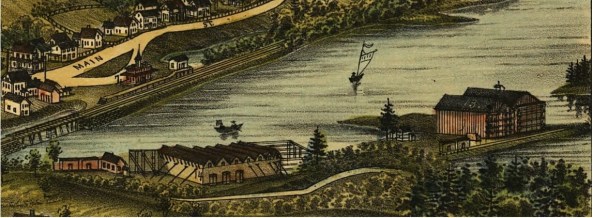
The ice companies purchased or leased lake or pond access rights, which is to say, they purchased or leased shore-front properties on which to build their ice houses. These could be quite large, especially as the industry reached its height.
The ice houses were insulated on the side with walls of sawdust a foot thick. Salt marsh hay was piled on top of a scaffold under the roof (Foster’s Daily Democrat, 2014).
1888: Lynn and Metropolitan ice houses in the foreground and train station in the background
Ice companies would first fill these ice houses to the brim, for later shipment over the course of the year.
NATURAL ICE NOTES. Extra ice trains were run during July from Milton, N.H., to Boston (Ice and Refrigeration, August 1891).
CITY BRIEFS. An extra freight train of thirty-nine cars of ice from Milton Three-Ponds, passed through here on Sunday evening, in charge of Conductor Sedgwick, consigned to Boston ice companies (Portsmouth Herald, August 22, 1898).
Then they would begin loading railroad freight cars (at 30 tons of ice per car) for immediate shipment.
Conflagrations
Milton’s ice houses were prone to catastrophic fires or, as they called them, “conflagrations.” (The same was true of its factories). As seen above, their walls were insulated with sawdust, their “attics” were packed with salt-marsh hay, and there was a generous amount of sawdust, wood shavings, and hay sprinkled on and around all the stacked ice.
Boston Ice Company Fire of May 24, 1902
LOSS $50,000. Lightning Strikes Houses of Boston Ice Company at Milton, N.H. 12 Burned. Dorchester, N.H. [Mass.], May 25. Lightning struck ice houses of the Boston Ice Company at Milton last night and 12, six of which were filled with ice, were burned. The loss is placed at $50,000, fully insured (Boston Globe, May 26, 1902).
Boston Ice Company Fire of October 9, 1909
There was large fire at the Boston Ice Company ice house on Saturday evening, October 9, 1909, which started from sparks thrown from the smokestack of a passing locomotive. Prior to the advent of diesel locomotives, it would have been either a coal-burning locomotive or, possibly, an older wood-burning locomotive.
A $65,000 Loss. At 7:30 last Saturday evening the people of Milton were aroused by the ringing of the bells for fire. It was soon discovered, that the Boston ice houses, about a mile above the railroad station, were in flames. The fire had made such rapid progress that it was impossible to save the buildings. Thirteen ice houses were burned, two being filled with ice. A barn, owned by this same company, on the opposite side of the railroad track, was burned; also four freight cars owned by the Boston & Maine R.R Co. The cause of the fire was not fully known, but it is thought that it caught from the engine of the 7 o’clock train. The building were partially insured. The loss was estimated at $65,000. The reflections on the pond made one of the most beautiful pictures imaginable. The water seemed like a large mirror, in which was reflected the buildings on the opposite shore. Many wished for a painting of that indescribable scene (Rochester Courier, October 1909).
Conflagrations. Oct. 9, Milton, N.H. Boston Ice Co.; 13 wooden ice houses wooden roofs destroyed; cause, locomotive spark; discovered at 7 pm; town has one fire engine. Rochester (16 miles distant) sent assistance. Extent of loss apparently due to combustible construction of buildings, lack of private apparatus, and inadequate public protection. Loss $200,000 (Insurance Press, October 1909).
Fires and Accidents. MILTON, N.H. – The Boston Ice Company’s entire plant consisting of thirteen ice houses, tool house and nine freight cars, was destroyed by fire on Oct 9. The loss is placed at $100,000 (Cold Storage, December 1909).
CONFLAGRATION. Milton, N.H., October 9, 1909. Fire started on roof of large wooden ice house by locomotive sparks. Thirteen buildings with wooden roofs burned. Embers were carried across Salmon Falls River to Lebanon, Me., igniting wooden roofs and starting fires that destroyed ten buildings (Insurance Engineering, February 1910).
Loss of $25,000 on Ice Houses at Milton, N.H. Thirteen ice houses, two filled with ice and another half-filled, owned by the Boston Ice Co., were destroyed by fire at Milton, N.H., on October 9, the loss being estimated at $25,000, with insurance involved amounting to $19,500. Nine box cars owned by the Boston & Maine Railroad were also destroyed. It is thought that the blaze was set by sparks from a passing locomotive. Following is a list of the insurance involved, together with the companies and amounts. On building, total loss: Ins. Co. N.A., $2,500; Continental, $1,000; Liv. & Lon. & Globe, $2,500; Phoenix Conn., $1,000; Fidelity, 1,500; Commercial Union Eng., $1,000; Springfield, $1,500; Spring Garden, $500; Granite State, $1,500; Niagara, $1,508; Total $14,500 (Standard, February 1910).
Porter Ice Company Fire of May 3, 1927
BIG PORTER ICE HOUSE DESTROYED BY FIRE, Discovered Early Tuesday Morning – Loss $100,000, Partly Insured. The big Porter ice house at Milton was destroyed by fire early Tuesday morning. The flames were discovered by Harry Staples, an employe of the company shortly after midnight. He sounded the alarm and the whole village turned out to fight the blaze. Help was summoned from neighboring places, including Rochester. The Rochester truck reached the scene in twenty minutes after being called and did fine service. It was, however, impossible to save the ice house. It was a monster building, there being a dozen ice houses under one roof. It was filled with ice and the loss will exceed $100,000, it is thought, which is partially covered by insurance. Sparks from the burning building flew across the pond and set fires in the woods. For a time, some of the cottages seemed to be in considerable danger, and the fire actually came within fifteen feet of the summer home of Morris Hayes. It is said that a pet dog, belonging to Fred Downs, by his barking called attention to the fact that something was wrong at about the same time that Mr. Staples gave the alarm (Rochester Courier, May 1927).
Ice Houses Burn at Milton, N.H. Milton, N. H., May 3–The ice houses of the Porter Milton Ice Company at Try-Echo Lake were destroyed by fire early today. Sparks, driven by a high wind set several wood fires which were extinguished by firemen called to the scene from nearby towns. The buildings were well ablaze when the fire was discovered. Insurance totaling $100,700 is involved. The buildings were insured as follows: Provident, $5,750; New Hampshire and Constitution Und., $5,000 each; Phoenix, $4,000; Aetna and Granite State, $3,000 each; Rhode Island, Continental and Home, $2,500 each; Inter State, $2,250; Coml. Union and United States, $2,000 each; Victory, $1,500; Ins. Co. No. America, $1,200; L. & L. G., American Central, Stuyvesant, Phoenix and London & Lancashire, $1,000 each; American, $800; total, $48,000. On ice: National, $24,000; London & Lancashire, $4,000; American Central, $3,500; Springfield, $3,000; Queen, Hartford, Atlas and Home, $2,500 each; Ins. Co. No. America and Caledonian, $2,000 each; Coml. Union, $1,500; total, $50,000 (Standard, 1927).
Porter Ice Company Fire of 1931
Ice houses of the Porter Milton Ice Co., at Milton, N. H., were destroyed by fire with an estimated loss of $10,000 (Industrial Refrigeration, 1931).
Concord Ice Company Fire of 1944
Milton, N. H. – A large icehouse formerly operated by the Concord Ice Co. was destroyed by a recent fire which threatened several other buildings in the vicinity. The icehouse, which had not been used since 1939, was one of a number on the Maine and New Hampshire sides of Milton Pond, which flourished for many years (Industrial Refrigeration, 1944).
Ice Harvesters
The ice companies hired gangs of temporary ice harvesters to fill their ice houses. We would consider their working conditions extremely difficult and they no doubt did too. The work took place in wet, freezing conditions, exposed constantly to the chilling winds that swept across frozen lakes and ponds.
Cutting and storing the ice was a dangerous job and took a lot of men, about 140 men worked on the ice in the winter. The men wore very heavy boots made specially with extra heavy soles imbedded with spikes to give a good grip on the ice. The boots were expensive, costing $20 a pair. Men were paid 50 to 75 cents an hour (Foster’s Daily Democrat, February 16, 2014).
A Marblehead Ice Company crew of 1905 reported Milton temperatures of 35 degrees below zero, with gale-force winds. The ice companies offered high wages, room and board, and round-trip railway fares, as inducements.
150 Ice Harvesters. FOR NEW HAMPSHIRE, boarding accommodations; we advance your railroad fares; Hire from FINN’S LABOR AGENCY, 27 Washington st. (Boston Globe, January 5, 1920).
$5 to $8 A DAY. ICE HARVESTERS for Mass., N.H., and R.I.; fine boarding conditions and fares advanced; also woodsmen to cut by cord, thousand, and month; new camps, no walking; 15 laborers for construction job. Hire and ship early today with MAC, at UNITED LABOR AGENCY, 22 Kneeland Street (Boston Globe, January 19, 1920).
The Observant Citizen. The ice harvesters are said to be finding little difficulty in securing labor to do the work this winter. The men working on the ponds at Milton, Sanbornville, and other places in New Hampshire, were paid 85 cents an hour last winter. I read that the work this year is being done for 35 cents an hour, with plenty of help available. Quite a change from the last several winters! (Boston Post, January 20, 1921).
Here follows an out-of-region Wisconsin pay-scale for February 1902, which gives some idea of the various tasks involved and their relative difficulty.
The principal ice dealers there fixed a wage scale as follows: For piking in the field $1.75, feeding elevator $2.00, tending planer $1.75, packing in cars $3.00, shovelers, plowers, sawyers, adzers, etc., $1.75 (Ice and Refrigeration, February 1902).
The basic pay-rate seems to have been $1.75 per day. The plowers, shovelers, and planers, i.e., those that clear the field, are getting that base rate. The sawyers and adzers, who are breaking off or cutting out blocks from the field, are getting also the base rate. As were the pikers, who are moving cut ice blocks through an open water channel towards the feeding elevator. Those feeding the elevator are working harder, as they must lift the slippery cut ice blocks up out of the water channel and up onto a conveyer belt. They get a higher rate of $2.00. Those packing railroad freight cars are getting the highest rate of $3.00.
Ice Horses
The ice companies seem to have been unsentimental regarding their horses. They would buy a string of horses especially for the ice harvest season and then sell them off again afterwards. No need to feed horses between ice harvests.
Horses for Sale. Nov. 16. Four heavy horses purchased from the Lynn Ice Co., suitable for heavy teaming. Inquire of R.A. SPROUL, (Bangor Daily Whig & Courier, November 16, 1886).
Lost Horses. Mr. J.O. Porter lost a pair of horses Friday at Brown’s Pond, Peabody. Some of his Marblehead employees took the horses out on the ice to groove it and before the men were aware of it the horses were on thin ice and fell through and perished (“Lost Horses,” Marblehead Messenger, 22 January 1904).
REGULAR AUCTION SALE, WEDNESDAY, APRIL 3. … At 2:15 PM. 12 Head of horses from Porter Ice Co., Milton, N.H.; been used in the work of cutting ice; as they are wholesalers they cut all of their ice and have no further use for horses; absolute sale; horses range in weight from 1200 to 1500 lbs. in pairs and singles and all good workers. I.L. McKinney, L.L. Hall, Auctioneers (Boston Globe, March 31, 1918).
Ice Companies
Five ice companies dominated the Milton ice industry scene at its height: the Boston Ice Company, the Downing Ice Company, the Lynn Ice Company, the Marblehead Ice Company, and the Metropolitan Ice Company.
The Boston Ice Company
The Boston Ice Company appeared in Milton as early as 1889. At the height of the ice industry period, their ice house was located at modern Utah Way (Foster’s Daily Democrat, 2014).
NATURAL ICE NOTES. The Boston Ice Co. are now loading forty to sixty cars daily at Milton, N.H. (Ice and Refrigeration, 1892).
NEWS OF THE HARVEST. The Boston Ice Co started in about February 1 at Lake Quannapowitt, Wakefield, with 200 men, and housed 75,000 tons. At Milton, N.H., the same company harvested 450,000 tons, and at North Chelmsford housed 50,000 tons, all this being at least twelve inches thick and of good quality (Ice and Refrigeration, 1894).
3. Boston Ice Co. Cuts at Horn Pond, Woburn, Mass.; Lake Quanapoit, Wakefield, Mass.; Newfield Pond, N. Chelmsford, Mass.; Sandy Pond, Ayer, Mass.; Salmon Falls River, Milton, N.H.; and Country Pond, Newton Jct., N.H. (City of Cambridge, 1897).
NATURAL ICE NOTES. By purchase the Boston Ice Co., Boston, Mass., has secured possession of the Drivers’ Union Ice Co., of Wakefield, Mass., which had a paid up capital stock of $100,000, thereby adding the Wenham lake, the Chebacco lake at Hamilton, Lovell’s pond at Sanbornville, N.H., and Lake Washakum at South Framingham to its large holding of ice rights. Before the consolidation the Boston Ice Co. controlled fields at Milton, N.H., Newton Junction, N.H.; Sandy pond, Ayer; North Chelmsford, Wakefield, Woburn, Sharon Heights, and Great pond at South Weymouth (Ice and Refrigeration, 1900).
Ice Harvesting. Mr. H.H. Davenport of the Fresh Pond Ice Co., Somerville, Mass., under date January 25, 1909, wrote: “We began January 21 to run ice into our houses in Brookline, N.H, 13½ inches, which we plane to 12. Boston Ice Co. have cut at Sandy Pond and Chelmsford, Mass. The Independent Ice Co. at Milton, Lakeport, and Sanbornville, N.H.; Union Ice Co., J.O. Porter and J.R. Downing at Milton, N.H. Most of the companies that are in New Hampshire have been cutting for a week or ten days. Some of the small harvesters about Boston cut ten and eleven-inch ice. The majority are waiting the next freeze. All cutting in this vicinity ceased January 23d, on account of the soft weather. There is considerable dirt in the ice, otherwise everything favorable for a full crop. Labor is easy and normal (Ice and Refrigeration, February 1909).
New Hampshire. The Boston Ice Company are building two ice houses at Milton, N.H. The Union Ice Company have been getting up a frame for a large stack at the same place (Cold Storage, February 1909).
Massachusetts. The Boston Ice Company has built ice houses at The Weirs, on Lake Winnipesaukie, N.H., and at Milton, N.H. (Cold Storage, April 1909).
The Boston Ice Co., Boston, Mass., whose 13-room ice house at Milton, N. H., was destroyed by fire in October last, has begun the work of rebuilding the house and expects to complete it in time for storage of the ice harvest this season (Industrial Refrigeration, 1910).
The Boston Ice Co. had secured about 60,000 tons of ice, North Chelmsford, 30,000 tons, at Newton, N.H. and 25,000 at Milton, N.H., or approximately half a crop, but had to suspend cutting Jan 31, owing to the warm weather (Refrigerating World, 1914).
A BIG ICE CROP. What the Several Firms Cut and Stored at Milton and Sanbornville. Few people realize the great amount of ice cut and stored each winter at Milton and Sanbornville for the several companies. The crop this year is extra large as will be seen by the following: At Sanbornville the Boston Ice Co., took out and stored 57,000 tons and the Independent Ice Co,, 50,000 tons, making a total of 107,000 tons. The Maplewood Ice Co., cut and shipped 10,000 tons from Sanbornville. At Milton, 210,000 tons were cut and stored in the houses of the several companies as follows: Downing Ice Co., 30,000; J.R. Porter, 50,000; Boston Ice Co., 50,000; Metropolitan Ice Co., 60,000; Lynn Ice Co., 20,000 (Portsmouth Herald, March 10, 1916).
AT THE time of writing this several of the larger companies have begun harvesting operations. The ice ranges from eleven to thirteen inches. These include Fresh Pond Co., at Brookline, N.H., Independent Ice Co., and Boston Ice Co., at Sanbornville, N.H., Metropolitan Ice Co. and others at Milton, N.H., Boston Ice Co., at North Chelmsford, Melville Ice Co., at Pittsfield, Mass., and Walker Ice Co., of Worcester, Mass (Ice and Refrigeration, February 1921).
The Lynn Ice Company
The Lynn Ice Company (of Lynn, MA) appeared in Milton as early as 1880. At the height of the ice industry period, their ice house was located on the Maine side of the Depot Pond opposite the Milton Railroad Station (Foster’s Daily Democrat, 2014). Ms. Sarah Ricker’s Milton and the NH Farm Museum had a postcard picture of their ice house building.
It shows a large rectangular-prism structure that is easily half again as wide as the Milton train station (now the Ray’s Marina complex) in the foreground – from its baggage shed on the left to its passenger depot building on the right – and twice its height. It would have been one of the largest structures in town. There are inclined ramps leading to its top for moving and stacking blocks of ice. It had two large barnlike buildings behind it and its own railroad siding.
MILTON. Lynn and Marblehead companies will begin cutting ice next week. The Union company is through, having filled twelve large houses (Farmington News, February 12, 1892).
Massachusetts. The Lynn Ice Company, Z.J. Chase & Son, and M.S. Coolidge & Co., of Lynn, who cut ice at Milton, N.H. built 11 houses there and had two stacks. No ice was cut by them on ponds near Lynn. They secured 36,000 tons. Their stocks last year aggregated 54,000 tons. Allowing for shrinkage their stocks will be short about 22,000 tons. Mial W. Chase, of Z.J. Chase & Son, estimates that the ice will cost nearly double what it did last year. The Lynn dealers’ expenses were greatly increased by minor accidents and the high cost of lumber for their houses at Milton. Their work was also much hindered by snow storms. The ice harvested was 16 to 19 inches thick (Cold Storage, April 1906).
The Metropolitan Ice Company
The Metropolitan Ice Company (of Millbury, MA) ice house was “just above” the Lynn Ice Company ice house, which was on the Maine side of the Depot Pond opposite the Milton Railroad Station (Foster’s Daily Democrat, 2014).
Tractor Equals Six Teams Scraping Snow Off Ice. The Metropolitan Ice Co., wholesale ice dealer, with seven ice cutting plants in New England, and furnishing most of the ice used in Boston, Mass., has installed a Cletrac at its plant at Lake Winnipesaukee, Weirs, N.H., and is negotiating for more following the excellent results achieved. Manager G. Clark Bennett is authority for the statement that the tractor works so rapidly that it has taken the place of six teams. The Cletrac is used for scraping the snow off the ice and there was naturally an unusual call for its services the past winter. It has been generally employed in connection with two two-horse scrapers, three men being necessary: one driving the tractor, and one for each pair of horses. The Mountain Ice Co., Newark, N.J., already has six Cletracs on the job of scraping the snow off the ice at its various plants. The Metropolitan Co. has also used the tractor with a field plower in planing off the top of the snow encrusted ice. The company has also found use for its Cletrac in shunting freight cars from point to point when engines have not been available (Tractor World, April 1920).
The Marblehead Ice Company / Porter Ice Company
Mr. John Oliver Porter (1850-1924), of Marblehead, MA, and his Marblehead Ice Company, appeared on the Milton ice scene around 1904.
J.O. Porter had been born in Ipswich, MA, in 1850. He relocated to Marblehead, MA, before 1870, where he worked as a harness maker, and boarded with a retired master mariner. He married there in 1873, Sally G. Glass, with whom he had three children, before she died in 1879. In 1880, he was a widowed harness maker, with three young children, a housekeeper (an in-law), and a boarder, who worked in his shop. kept a livery stable and harness-making business in Marblehead in 1880. He engaged also in the ice trade.
In 1900, he kept a livery stable in Marblehead. His daughter, his widowed mother, and a family servant resided with him. His son, John O. Porter, foreman at the livery stable, lived nearby.
At the height of the ice industry period, the Porter Ice company ice house was located at the modern site of the Lakeside Market (Foster’s Daily Democrat, 2014).
Ice Harvesters. Wednesday, a gang of Mr. J.O. Porter’s ice cutters left [Marblehead] town for Milton, N.H., to harvest ice from ponds controlled by him in that vicinity. Those who went were as follows: William Hooper, cook; S. Francis Imperial and Frank H. Dennis, engineers; J.O. Porter, Jr., William T. Green, 2d, William Stacey, Lewis Power, William Cash, Frank Gorman, William Ford, Ernest Phillips, Peter Winslow, Walter Pedrick and Nehemiah Stone. A large gang also left Salem for Milton (“Ice Harvesters,” Marblehead Messenger, 12 February 1904).
J.O. Porter’s ice cutters reported yesterday that the temperature at Milton, N.H., where they were at work, was thirty-five degrees below zero Wednesday. A gale was also blowing (“Untitled,” Marblehead Messenger, 19 February 1904).
The Porter ice men with their ice-cutting kit arrived home this week from Milton. They experienced some very cold weather, but filled all the houses (“Untitled,” Marblehead Messenger, 11 March 1904).
Massachusetts. The Porter Ice Company, of Marblehead, Mass., sent a large gang of ice cutters from that place to Triecho Lake, Milton, N.H., the week before Christmas, when the ice at the latter place was 16 inches thick, of good quality and free from snow. Later the company will take ice from Hooper Pond in Marblehead (Cold Storage, January 1905).
Massachusetts. The Porter Ice Company, of Marblehead, Mass., finished cutting ice on Triecho Lake, Milton, N.H., before January 10, at which date its houses were all filled (Cold Storage, February 1905).
Massachusetts. J.O. Porter, of Marblehead, has sent six men and a number of horses to Milton, N.H., to put his ice houses in shape for the coming winter (Cold Storage, September 1905).
Porter’s son and namesake, John O. Porter, Jr., died in Marblehead, September 20, 1905. He left a widow, Cora E. (Caswell) Porter, and a young son, John O. Porter, III. (John O. Porter, III, would continue his grandfather’s ice business after 1924. He became known as “the King of Icemen”).
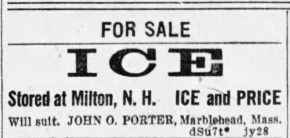
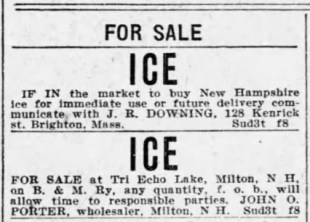
The Marblehead Ice Company, or Porter Ice Company, bought out the J.R. Downing Company in February 1920.
John O. Porter. John O. Porter, for many years in the ice business at Marblehead, died yesterday [August 13, 1924] in the Peter Bent Brigham Hospital [in Boston, MA] after a brief illness. He was born in Ipswich 73 years ago, but had lived in Marblehead for 55 years. He was head of the Porter Ice Company for many years, engaging later in the real estate business. He was a member of the Atlantic lodge of the Odd Fellows and of the Massachusetts Ice Dealers’ Association. He is survived by his widow, Mary A. Porter; a daughter, Mrs. James S. Skinner; and a son, all of Marblehead (Marblehead Messenger, August 14, 1924).
MARBLEHEAD. Prospect alley, a town way leading from Lookout ct. to Lee st., is to be made passable for the public. For years this alley has been neglected, and gradually has become almost impassable. The Selectmen have awarded the contract to the Marblehead Ice Company to build cement stairs and otherwise improve the way (Boston Globe, November 5, 1928).
On February 2, 1920, the Porter Milton Ice Co., a Massachusetts corporation, purchased the shares of stock of the J.R. Downing Co. for $200,000, of which $194,000 was for the 1,190 shares of stock owned by the estate and the balance of … including a small tract of land at Watertown, Mass., and about 40 acres of land and an ice plant at Milton, N.H., having a capacity of 25,000 tons of ice. At March 1, 1913, this property, excepting the stable, had a fair market value of $110,500.56. Other assets of the corporation, consisting of horses, wagons, and harness, machinery and tools, and current assets and inventories, had a fair market … (US Gov. Printing Off., 1929).
J.O. Porter, Marblehead, Mass., known locally as the King of Icemen, has disposed of the Marblehead business to William L. Gilley, John S. Noxley, and Arthur L. Lillis. He has conducted this business since 1883, and will now devote his entire effort to the wholesale natural ice business, which centers at Milton, N.H. (Industrial Refrigeration, 1931).
The J.R. Downing Ice Company
At the height of the ice industry period, the Downing Ice Company ice house was located at the modern Milton Town Beach (Foster’s Daily Democrat, 2014).
Its owner, Jeremiah Roberts “J.R.” Downing, had been born in Kennebunkport, ME, in 1845. He is said to have moved to Brighton, MA, about 1873. The census enumerator recorded him there in 1880 as an iceman, aged 35 years, with a wife, Elvina Downing, aged 34 years.
HORSES, CARRIAGES, ETC. FOR SALE – 2 Abbot & Downing Ice Wagons, poles and chafts in good repair. Apply to J.R. DOWNING ICE CO., Brighton, Mass. (Boston Globe, March 18, 1905).
The John [Jeremiah] R. Downing Company, of Brighton, has the bought the Dority Pond property of the Consumers’ Ice Co., of Millbury. The property is assessed at $9,900, but the purchase price was not made public. E.E. Dennison, manager for the Consumers’ company will retain that position (Cold Storage, February 1909).
Milton. J.R. Downing, who was reported ill last week, died last Thursday night, aged 68 years, He had large ice houses here in this village and shipped his ice to Massachusetts. His remains were taken to Brighton, Mass., for burial. He is survived by a wife and son (Rochester Courier, October 1911).
OBITUARY. J.R. Downing, president of the J.R. Downing Co., dealers, Brighton, Mass., died at Milton, N.H., October 3d, after a week’s illness, of pneumonia. He had gone to Milton to look after the company’s ice houses at that point and to prepare them for the coming ice harvest, when he was stricken. He was born in Kennebunk, Me., in 1845, and settled in Brighton about 38 years ago. A widow and one son, Jere. R. Downing, survive (Ice and Refrigeration, November 1911).
A lengthy lawsuit began around 1913 over the assets of the Downing Ice Company. The Marblehead Ice Company, or Porter Ice Company, bought out the J.R. Downing Company in February 1920.
Ms. Sarah Ricker mentioned that the Milton Town Beach took over the site of the defunct Downing Ice Company in 1938. (Selectman Lucier recalled picking up ice house nails there in the mid 1960s).
Other Ice Companies
Other ice companies harvested Milton ice at various times included the Drivers’ Union Ice Company (of Boston, MA), the Concord Ice Company (of Milton, NH), the Fresh Pond Ice Company (of Somerville, MA), the Granite State Ice Company (of Milton, NH), the Independent Ice Company (of Cambridge, MA), the M.S. Coolidge & Company (of Lynn, MA), the Union Ice Company (of Wilmington, MA), and the Z.J. Chase & Son (of Lynn, MA).
NATURAL ICE NOTES. New Ice Houses. – Sheriff C.A. Davis, Turner’s Falls, near Springfield, Mass., 40 X 80 feet; Thos. Miles, Mors, Pa.; Pond Ice Co., at Heart lake, New Milford, N.H.; Knickerbocker Ice Co., on Roger’s island, Saugerties, N.Y.; Hancock Ice Co., in Sussex Co., N.J.; Chas. F. Prescott and Wm. Hopp, Batavia, N.Y.; Chas. E. Hoffen, Lowville, N.Y.; Jos. H. McNeal & Son, Bell Hill, Md.; house at West Amwell; John Brandt (two), Manitowoc, Wis.; East Providence Ice Co., Riverside, R.I., 50 X 100 feet, and deepen their pond; A.W. Walker, Norway, Me.; C. and J. Michel Co., Arcadia, Wis.; Edward Gray, Old Town, Me.; Burt & Kienlie, East Hampton, Mass.; Fresh Pond Ice Co., Milton, N.H.; Condensery Co., Walton, N.Y.; Valentine Baker, Champaign, Ill; Boley Ice Co., Pekin, Ill; Chas. Ingersoll, Ithaca, N.Y.; Elliott & Pope, Damariscove Island, near Damariscotta, Me.; Michael Howe, Schuylerville, N.Y. (Ice and Refrigeration, 1895).
Henry Johnson
Henry Johnson had been a medical supplies officer for the Union Army during the Civil War, He continued in that line during the post-war years and after he left government service. Ice became gradually one of the medical supplies with which he was concerned.
He presented a paper before an ice industry convention. It dealt with proper maintenance of ice houses. He argued that proper maintenance reduced costs, rather than increasing them.
Massachusetts. Henry Johnson, of Reading, has just completed an ice house at East Milton, N.H. where he will harvest ice for his next summer’s trade (Cold Storage, February 1907).
Union Ice Company
Fred Mortimer Carter, Jr., appeared in a five-year reunion publication of Yale University’s Sheffield Scientific School in 1910. It described him as being the son of Fred M. Carter, “a wholesale ice dealer, superintendent of the Union Ice Company, of Boston, Mass.” The younger Carter remembered playing “summer baseball at Milton, N.H.” after his 1905 graduation (Barber, 1910).
State News. The roof of the mammoth ice house of the Union Ice Company of Boston, at Milton, fell in Sunday night with a terrible crash. The roof was heavily laden with ice and snow and the weight was too much for the timbers (Portsmouth Herald, January 23, 1891).
MILTON. Wednesday afternoon, at the Union ice house, the chains by which the ice is conveyed broke and Everett Brown commenced to repair the break, when the engine started, tearing out the calf of his right leg (Farmington News, February 12, 1892).
Frank B. Tasker, assistant manager of the Union Ice Company, of Boston, is spending his vacation of two weeks at his summer home in Milton, N.H. Frank Melanson is attending to Mr. Tasker’s duties (Cold Storage, September 1908).
The Union Ice Co., of Boston, Mass., are equipping their plant at Milton, N.H., with an improved chip conveyor with special drive. The additional machinery required to transform their chip conveyor was supplied by Wood Co., Hudson, N.Y. (Cold Storage, September 1908).
List of Delegates. Among those present at the Massachusetts ice dealers’ convention were the following: Carter, F.M., Milton, N.H. (Ice and Refrigeration, May 1909).
The Ice Market
Ice is a naturally occurring good that does not need to be “produced,” as such. The value proposition, for which people would pay, was having a high quality of ice and having it out of season.
Ice was “harvested.” That term suggests a lot. As with any crop that might be “grown” and then harvested, ice was dependent upon weather conditions. Obviously, it had to be cold enough for ice to form. And it had to be consistently cold enough for long enough for a sufficient depth of clear ice to form. Weather that successively cooled, warmed, and cooled again was not good weather for ice. The ice would form then in layers and wind-blown natural debris might gather on each layer, such as twigs, leaves, pine needles, dirt, and such, and become trapped within the ice.
The ice harvesters in many sections report a deal of trouble this winter with snow and slush, soft ice, etc., all of which has not served to put the natural harvesters in the best of humor. The indications of the harvest, which opened up so finely in the early part January, were in many cases spoiled by the weather in the latter half of the month, which ruined the fields and greatly increased the cost of harvesting. However, there is usually plenty of ice made in February, and there is still abundant time for securing the ice necessary, and for securing ice of the best quality. According to the Snow & Ice bulletin issued by the government weather bureau, there is more ice now than was at this season last year (Ice and Refrigeration, February 1902).
Poor weather would permit only smaller quantities of quality ice to be harvested. The Law of Supply and Demand informs us that, when supply drops, while demand remains constant, then prices will rise. Therefore, the price of ice would rise in years with unsuitable weather.
J.O. Porter, ice dealer, Marblehead, Mass., recently exhibited an old ice card of John Stone, ice dealer, dated 1855, when prices for ice were as follows: Six pounds ice daily from June 1 to October 1, $5.00; 12 pounds ice daily from June 1 to October 1, $8.00; 30 pounds ice daily from June 1 to October 1, $15.00; 25c per cwt. (Ice and Refrigeration, July 1914).
The various ice merchants were constantly competing with each other and with themselves over costs and price. Those would be the measures of their success. Reductions in costs would be the variable with which they could experiment. Occasionally, those costs appear in the record. Their capital outlays seem to have been allocated roughly as one-third for the purchase or lease of a suitable site, one-third for the ice house that they constructed upon the site, and the remaining one-third for everything else: men, tools, machinery, horses, etc. Transport costs were a consideration too.
A more remote site, such as Milton, would have lower site costs but, as one went further and further out from one’s principal market, the transport costs would rise. The ice dealer would have to balance those considerations. A supply shortage, with its attendant rise in prices, might shift the balance and make activating more remote sites feasible.
ICE SCARCE IN GLOUCESTER. Dealers Obliged to Get Their Supply In New Hampshire. Gloucester, Nov. 15. There is a scarcity of ice in Gloucester. It is estimated that over 25,000 tons are taken from here each year by the fishing fleet and fresh fish houses, and at least 10,000 tons more are purchased in various parts of the maritime provinces. The demand is increasing and the sales this year have been greater than ever before. The Fernwood Lake Ice Company, with a house at West Gloucester having a capacity of 40,000 tons, has about 100 tons of ice in stock and are supplying their trade with ice from Milton, N.H. Inquiry at the office of Nathaniel Webster, who, with the Fernwood company, furnish the entire supply of the town, shows that Mr. Webster’s stock on hand is about 1000 tons, 300 of which is thick ice. This is the first time since the Fernwood company has been in business that the stocks have bean so low. Within a few weeks it is probable that there will not be a pound of Cape Ann ice remaining unsold (Boston Globe, November 16, 1889).
Warm weather caused a poor harvest and an ice shortage in the Spring of 1913. Naturally, the prices rose. That is how the price mechanism rations the remaining stocks naturally and brings new supplies onto the market.
Amusingly (from this safe temporal distance), the Socialist party demonstrated their thorough-going economic ignorance by advocating for a government-controlled ice supply. Had they had their way, the attendant price ceilings and restrictions would have caused dire shortages. (Ask the Venezuelans).
Lynn – The new North Shore Ice Delivery Co. is having trouble here. The Socialist party finds the price charged, 50 cents a 100, too high and are advocating municipal ice, and Representative William A. Fisher, who himself was nine years in the ice business, questions the purity of the ice taken from the Flax Pond, because this year the already thin ice had not been planed off. As to shortage of ice, it is claimed that an ample supply at $4 per ton is available for Lynn at Milton, N.H., that the freight is 70 cents per ton, which, allowing ten per cent shrinkage, makes the cost of ice at platform $5.22. Hereafter, all ice scales also will be tested once a month (Cold Storage, March 1913).
Boston and Vicinity – The Boston Ice Co., Frank J. Bartlett, president and treasurer, organized in 1866, advertised ice rates as follows: April 1: Family trade, delivered, same as in 1912, or 100 pound piece, 25 cents; 50 pounds, 15 cents; 25 pounds, 10 cents. Wholesale, “until further notice,” 100-400 pounds, per delivery, 25 cents per 100; 500 pounds and upwards, per delivery, 20 cents per 100, or $4 per ton. Last year’s price was $2.46 to $3 per ton. The shortage of the company is 50,000 to 100,000 tons north of Boston, and 115,000 tons south of Boston, where only 237,000 tons were on hand April 1. The freight rate on ice from Milton, N.H. to north side of Boston was 70 cents per ton and $1 per ton to south side. To points in Cape district, $2 per ton (Cold Storage, April 1913).
The Massachusetts Board of Health became “concerned” about ice quality in July 1914. (The prior season having been a poor one). In response to their requests, various Massachusetts towns with ice-supplying ponds submitted reports. It was noted that the various New Hampshire ice sources, including Milton Three Ponds, were beyond their jurisdiction.
Several reports noted that ice quality improved if the surface ice was planed or scraped away prior to cutting. There were no Zamboni machines. The planing and the cutting was done by horse-drawn machines and equipment. J.O. Porter lost a team of horses in 1904, when they fell through thin ice on Brown’s Pond in Peabody, MA.
Frequent mentions of depths shows a concern for the size of the supply, as well as for the safety of the process and quality of the ice. Volume has three dimensions: length, width, and, in this case, depth. Greater depth allowed for preliminary planing while leaving still a satisfactory volume of ice.
Good Ice Crop. The ice harvesting season has commenced in Rochester and with the cold weather that has occurred in the past weeks, ice has formed to the depth of more than twelve inches of a good clear variety. J.A. Morrill has commenced work harvesting his crop from the Cocheco river, while Sam Baker has commenced harvesting from his pond on Washington street. Ice continues to form at the three ponds in Milton and in a few days all of the ice companies will commence cutting and offer employment to hundreds of men (Portsmouth Herald, January 10, 1925).
Final Days
The advent of electrical refrigeration rendered ice harvesting obsolete. Shortly after the turn of the century, machines had been invented that could create tons of block ice. This is the distinction that is made in the literature: “artificial” block ice versus harvested “natural” block ice. Refrigerators were also invented, which kept things cool without any block ice at all. These experimental alternate methods became more and more practicable with time. By the late 1920s and on into the 1930s, they began to replace “natural” block ice.
New methods for the old trade were invented too, but could not reverse the tide.
Home Made Ice Cutter. According to a report from Milton, N.H., a unique ice-cutting machine has been operated on the river there in cutting ice by Henry Howard, its inventor. The body is on a frame that can be raised or lowered by foot pressure. At the rear is a Ford motor with throttle that feeds the gas. Nine and one-half feet from the rear is a Gifford-Wood saw, run on Ford axle. The side guides are made of iron pipes, the body mounted on a sled. There are shoes that adjust for different depths of cutting. Mr. Howard runs the machine alone, sitting at the rear; rides across the field of ice and cuts 180 feet a minute. backs around quickly and cuts another strip. the cut ice throwing a huge spray into the air. Two men float the ice into the stream. Twenty-five thousand cakes can be cut in 10 hours’ work (Refrigerating World, 1922).
The Concord Ice Company seems to have been the last to harvest Milton ice on a significant scale.
The Concord Ice Co., Milton, N. H., had its house filled and was shipping several carloads the middle of March (Industrial Refrigeration, 1937).
They last did so in 1939. Their disused Milton ice house burned in a “conflagration” in 1944.
The Boston Ice Company advertised themselves as “manufacturers of artificial ice” in November 1946 (Bath Independent, November 7, 1946).
Epilogue
According to an article posted in Foster’s Daily Democrat in 2014,
… a man named Johnson built a small one [ice house], (capacity 1,000 tons) in the cove by the site of the Porter Ice Company. He sold it to Arthur Columbus, who later sold it to George Littlefield, and in turn sold it to Lebreque from Rochester, who operated it until it practically fell down in the 1960′s.
So, a certain Lebreque from Rochester would seem to have been the very last, over twenty years after the rest had already turned out the lights.
NH Secretary of State. (1908). First Annual Report of the Secretary of State, for the Year Ending, August 31, 1907, Containing Sixteenth Annual Report of Returns of Corporations. Retrieved from books.google.com/books?id=Ww2rLP3LxToC&pg=PT519
The Milton Board of Selectmen (BOS) have posted their agenda for an “Extra” BOS meeting to be held Monday, October 29.
The meeting is scheduled to begin with a Non-Public preliminary session at 5:45 PM. That agenda has a single Non-Public item classed as 91-A:3 II (j).
91-A:3 II (j). Consideration of confidential, commercial, or financial information that is exempt from public disclosure under RSA 91-A:5, IV in an adjudicative proceeding pursuant to RSA 541 [Rehearings and Appeals in Certain Cases] or RSA 541-A [Administrative Procedure Act].
The sole Non-Public item (the “j” item) might be a further discussion of revisions of employee manuals and employee insurance buyouts, issues that have been mentioned in the open sessions. The old fire station us still out there. And, of course, the budget.
There seem to be quite a few critical budget issues that remain unresolved. When last seen, various BOS meeting participants were declaring that aspects of the budget were “out of control.” It does make one wonder how and when overall budget solutions get discussed. In a Non-Public meeting?
Do phone calls between them constitute a 91A Public or Non-Public Meeting quorum? Chance meetings at public events make for a BOS meeting, but not phone calls between Selectmen? That seems peculiar. Or is it all done by playing “telephone” through the Town Administrator?
The BOS intend to adjourn their Non-Public BOS session at approximately (*) 6:15 PM, when they intend to return to Public session.
The Public portion of the agenda has new business and old business only.
Under new business is scheduled a single item: 1) Purchase of 1994 Spartan Pumper Truck (Nick Marique).
A new $500,000 leased pumper was rejected by the last ballot, yet it reappeared as a CIP plan item, and now it arises yet again as an agenda item regarding an older and, presumably, somewhat cheaper one. (Perhaps they should have started with a cheaper one last year?). The fire chief missed perhaps the dramatic conclusion of the last meeting. Or perhaps he just does not understand the meaning of the word “no.”
Under old business is scheduled a discussion of some of the departmental budget submissions of October 15: Recreation, Cemetery, and Insurance / Benefits.
Insurance / Benefits seems to be the item that drove the budget beyond anyone’s wildest imaginings. This should be interesting.
On a side note, Ms. McDougall published her notes from a preliminary meeting of her new ad-hoc brainstorming group, the Milton Advocates. Insurance and other possibilities were discussed. It seems that there is not a single insurance plan or rate prevailing across, or even within, departments. Consolidating them all under the least expensive alternative would be difficult, as their terms do not coincide. It would have to be done gradually as they separately expire over the 2019-20 time frame. It would seem that no immediate relief is to be found in consolidation of insurance plans.
The usual approval of prior minutes, expenditure report, Town Administrator comments, and BOS comments are not scheduled. Nor are any Public comments scheduled, either before or after.
By Muriel Bristol (Transcriber) | October 27, 2018
The Milton excerpts from the New England Business Directory, 1877.
NEW HAMPSHIRE BUSINESS DIRECTORY.
Arranged Alphabetically by Business and Towns. When the Post-Office differs from the Town, it is given immediately after the name, and preceding the Town.
Blacksmiths (See also Carriage Smiths). Duntley Hazen & Son, Milton; Osgood, Ebenezer, Milton Mills [P.O.], Milton; Rines, Nathaniel, Milton Mills [P.O.], Milton; Rines, Samuel F., Milton Mills [P.O.], Milton.
Boot and Shoe Dealers (See also Boot and Shoe Manufacturers). Grant, Solomon, Milton Mills [P.O.], Milton.
Box Makers (See also Paper Box Makers). Hayes, Charles H. (shoe), Milton.
Butchers (See also Provision Dealers). Hayes, John, Milton.
Carpenters and Builders (See also Ship Carpenters). Mathes, Joseph, Milton; Swasey, George A., Milton; Simes, Edward S., Milton Mills [P.O.], Milton; Titcomb, J.F., Milton Mills [P.O.], Milton.
Carriage and Sleigh Manufacturers (See also Wheelwrights). Brackett, John, Milton Mills [P.O.], Milton.
Chair Manufacturers (See also Furniture Manufacturers). Young, Isaac C. & Son, W. Milton [P.O.], Milton.
Clergymen. Noyes, E.P. (B.), South Acton [P.O.], Milton Mills, N.H.; Clark, Samuel W. (C.T.), Milton; Owens, E. (F.B.), Milton; Crowley, James (M.), Milton Mills [P.O.], Milton; McLean, A.S. (F.B.), Milton Mills [P.O.], Milton; Scott, D.B. (C.T.), Milton Mills [P.O.], Milton; Goodwin, Daniel B. (C.B.), West Milton [P.O.], Milton.
Country Stores. Where is kept a general assortment of dry goods, groceries, agricultural implements, & c. Those who deal in but one kind of goods will be found under their appropriate headings. (See also Grocers). Gilmore, Geo. A., Milton; Hart, John F., Milton; Fox, Asa & Son, Milton Mills [P.O.], Milton; Fox, Asa A., Milton Mills [P.O.], Milton; Morrill, J.B. & Son, Milton Mills [P.O.], Simes, John U., Milton Mills [P.O.], Milton.
Dry Goods (See also Country Stores; also Fancy Goods). Knox, Ida S. Mrs., Milton.
Flour and Grain Dealers (See also Produce Dealers). Corkery, Daniel, Milton.
Grist Mills (See also Flouring Mills). Hayes, Luther, South Milton [P.O.], Milton.
Harness Makers (See also Trunks, Valises, & c.). Sanborn, A. & Son, Milton Mills [P.O.], Milton Mills.
Hotels. Tri-Mountain House, James R. Horne, Milton; Central House, Ira Miller, Milton Mills [P.O.], Milton.
Lumber Dealers (See also Saw Mills). Hayes, Luther, South Milton [P.O.], Milton; Scates & Lyman, South Milton [P.O.], Milton.
Masons (See also Plasterers). Rines, Joseph G., Union [P.O], Milton.
Milliners (See also Dress Makers; See also Millinery Goods). Roberts, Clara M. Mrs., Milton; Farnham, Wm. P. Mrs., Milton Mills [P.O.], Milton.
Painters, House, Sign, and Ornamental (See also Painters, Carriage). Hodgdon, George F., Milton; Mathes, Robert, Milton; Came, George W., Milton Mills [P.O], Milton.
Saw Mills (See also Planing Mills; also Shingle Mills). Hayes, Charles H., Milton; Hayes, Luther, South Milton [P.O.], Milton; Plumer, C.A. & G.L., Union [P.O], Milton.
Shingle Mills (See also Saw Mills). Hayes, Luther, South Milton [P.O.], Milton; Plumer, Chas. A. & Geo. L., Union [P.O], Milton.
Stables. Horne, James R., Milton; Miller, Ira, Milton Mills [P.O.], Milton.
Teachers (See also Academies, in index). Bickford, J.P. (Classical Inst.), Milton.
Woolen Goods Manufs. (See also Hosiery; also Manufacturing Companies). Brierley, Edward & Co. (flannels, table-covers, & c.), Milton Mills [P.O.], Milton; Townsend & Co. (piano and table-covers). Milton Mills [P.O.], Milton; Waumbec Manuf. Co. (flannels), Milton Mills [P.O.], Milton.
A fair number of Acton, ME, businesses were using Milton Mills Post-Office addresses. They have not been included.
Claremont, Concord, Dover, Exeter, Great Falls (Somersworth), Hanover, Laconia, Manchester, Nashua, and Portsmouth all had gas-light companies. Milton and Rochester did not. They would have used candles and oil lamps.
LYNN. The News in Brief. Luther Hayes, one of the Fish Commissioners of Milton, N.H., was in town yesterday and took fifty white perch from Flax Pond home with him to stock a pond at Milton. The fish were caught by John Marion during the past three days (Boston Globe, August 24, 1878).
We received the following information as a comment from a Social Security recipient and pass it along, as is, for your consideration.
John S. Frum
The Town of Milton’s tax rate has been increasing steadily for over 10 years now at about 5% per year. Has your income increased that amount? One part of the population that definitely has not seen increases anywhere near that is the town’s senior citizens that are on Social Security.
The average Social Security benefit (SSI) was $1,413.37 per month in June 2018. Yes, some get more, but many get less. Often, that is a senior’s only source of income. From that, $134 is automatically deducted each month to pay for Medicare Part B insurance. Now let’s look at SSI yearly increases. OOPS, what increases?? Seniors on SSI do not get a cost of living increase every year. Over the past 10 years since 2009 there were 3 years when no increase was given, one year the increase was only 0.3%, four years showed increases of just 1.5-2.0% The other 2 years were 2.8% and 3.6%. The greatest increase of 3.6% was back in 2011. Think about Milton’s tax increases during those same years averaging 5% per year.
If you are employed and receive medical insurance from your employer, you might think seniors have quite the racket at $134/month. Believe me they don’t!! Medicare does cover most in-patient (overnight hospitalization) services at a 100% after a small deductible. Out-patient services are a different story – only covered at 80%. Out-patient services include your doctor visits, lab work, X-rays, MRI’s and CT scans; day surgery procedures (many surgeries now are done in a Day Surgery Center that previously would have been done an in-patient setting); chemotherapy and much more. Most services in this day and age are done as an out-patient. To cover that 20% you have to buy a Supplement Policy and they vary in price, but to get good coverage many are well over $200 a month. You also need to get a separate plan for prescription medications as Medicare does not cover them. So you buy a Part D plan and pay a co-pay for each prescription. Another cost that varies with each plan. Dental and eye exams are generally not covered on most plans. That $1,400 a month is dwindling fast.
Just imagine if you are single, a widow or widower, or even a couple, on SSI in Milton and trying to maintain your home and your health these past 10 years and being presented each year with a higher tax bill then the previous year. Each year you set aside a little more to cover this expense, but it seems it is never enough. So you control what you can … less home repairs, adjust your food budget, lower the heat and AC or use fans in summer. Some even limit medications. You control what you can. Like the Town, seniors have little control over insurance costs so they make major cuts elsewhere. The Town needs to do the same – make major cuts that will lower the tax rate by well more than 7.5% and continue to do it for many years. We all make sacrifices and can live with less if needed. If the Town of Milton does not lower the tax rate now, many seniors and younger residents will either lose their homes or move elsewhere. I know that many residents are hurting with such high taxes not just seniors. For the younger population, those under 65, this might help you to understand the situation from the perspective of SSI recipients.
The Boston Globe newspaper of 1876 contained the following news of fires in Milton Mills and Milton Three-Corners during this year:
New England by Mail. Milton Mills, N.H. – The store of Augustus Fox at Milton Mills, was destroyed by fire Tuesday might. Loss $6,000; insured in the Home, New York, for $4300. The second story was occupied by the Odd Fellows, who lost everything (Boston Globe, March 9, 1876).
NOTES. Milton, N.H. – Yesterday morning a house at Milton Three-Corners, formerly occupied by George B. Wentworth, was burned. Loss $6000 (Boston Globe, September 15, 1876).
By Muriel Bristol (Transcriber) | October 23, 2018
Five pieces of coal, a carrot and a scarf are lying on a hill near a remote house. Nobody put them on the lawn, but there is a perfectly logical reason why they should be there. What is it?
[Answer to Puzzle #9 to follow in the next Puzzle]
Mechanics – blacksmiths, H. Duntley & Son; carpenters Joseph Mathes, E.H. Hersom; mason, Daniel Foss; painter, G.F. Hodgdon; wheelwrights, Joseph Matthes, Daniel Jenness.
Merchants – Looney & Avery, Gilmore & Whitehouse, J. Hart; fancy goods, Mrs. Ira L. Knox; millinery, Mrs. C.M. Roberts.
Hotel & Livery Stable – Central House, Ira Miller.
Manufacturers – carriages, John Brackett; flannels, Waumbeck Manuf’g. Co.; flannels, felt cloth, piano and table covers, Edward Brierly & Son; table covers, H.H. Townsend; table and piano covers, John Meikle.
NH State Representatives for Milton were Jos. Plumer and Elbridge Fox, and for Middletown, i.e., Middleton, was Charles W. Davis. The District 5 State Senator was Edwin Wallace of Rochester.
Ezra H. Twombly, of Milton, held the office of Strafford County Register and Sealer; and Luther Hayes, of Milton, was one of nine Strafford County Deputy Sheriffs.
Tabular Statement, by Towns, of Votes for Governor in 1872 and ’73; Population in 1870; Average Valuation in 1872; and Apportionment on each $1000 of State Tax.
Milton, 222 [Votes for Straw], 131 [Votes for Weston], 10 [Votes for Cooper & scattering]; 205 [Votes for Straw], 78 [Votes for Weston], 5 [Votes for Blackmer & scattering]; 1598 [Population]; $441,955 [Valuation] 2.881 [per $1,000 State Tax Rate].
Former NH State Senator Ezekiel A. Straw (1817-1884), of Manchester, won election as NH Governor in 1872 and 1873. He was a Republican. Governor Straw did not run for a third term and was succeeded as governor by Manchester Mayor James A. Weston, whom he had twice defeated.
A Milton advertisement aimed at the emerging Summer “rusticator” market:
Summer Resorts and Hotels. In New Hampshire. BOARD – A few Summer boarders can find a pleasant home in a private family, convenient to churches, railroad, telegraph and Post Office. In a quiet and healthy little village situated between mountain and pond. For particulars address Box 30, Milton, N.H. (Boston Globe, August 7, 1874).
By Muriel Bristol (Transcriber) | October 19, 2018
The New-Hampshire Register and Political Manual for the Year 1870 directory entries for Milton in 1870. The compiler gathered his information from data available in 1869.
MILTON, (Originally part of Rochester) incorporated June 11, 1802. Population – 1820, 1232; 1850, 1619; 1860, 1862.
Elsewhere in the directory, we find the value of Milton’s land and farm stock, as of April 1868, and its votes in recent elections.
Value of Lands in New-Hampshire, and Number & Value of Farm Stock, per Inventory, April, 1868.
Milton, [Lands. Value.] $276,478, [Horses, etc. No.] 188, [Horses, etc. Value.] $12,386, [Cows, Oxen, etc. No.] 897, [Cows, Oxen, etc. Value] $30,245, [Sheep. No.] 786, [Sheep. Value.] $1,758.
TABULAR STATEMENT BY TOWNS of Distance from Concord, of Vote for Railroad Commissioner, 1869; Population of 1860; Ratable Polls; Valuation of 1868; and proportion on $1000 of State Tax.
40 [Miles from Concord], Milton, 255 [Votes for Quarles], 90 [Votes for Donahue], 1,862 [Population], 388 [Rateable Polls], $511,028 [Valuation], $3.43 [per $1,000 State Tax rate].
Vote for Governor, March, 1869, March, 1868, and for President, Nov. 1868.
NH Secretary of State Walter Harriman (1817-1884), of Concord, won election as NH Governor in 1867 and 1868. Former NH State Senator Onslow Stearns (1810-1878), of Concord, won election as NH Governor in 1869 and 1870. They were both Republicans. Governor Stearns was succeeded as governor by Manchester Mayor James A. Weston. (Weston’s election over Republican opponent James Pike was close enough that the final result was decided in the state legislature).
Under the Strafford County entry, Hayes, Luther, Milton (South), was Strafford County Sheriff.
For State Senate District No. 6, Milton voted for Republican Ezra Gould, 262 votes [70.6%], over Democrat Edwin Pease, 109 votes [29.4%], in 1868. Pease received 4,400 votes [51.6%] in the overall district vote, while Gould received 4,059 votes [47.6%], and “scattering” received 76 votes [0.9%]. The result was reported as “Pease’s majority.”
For State Senate District No. 6, Milton voted for Republican Ezra Gould, 254 votes [73.0%], over Democrat Edwin Pease, 94 votes [27.0%], in 1869. Gould received 3,754 votes [49.7%] in the overall district vote, while Pease received 3,744 votes [49.5%], and “scattering” received 61 votes [0.8%]. The result was reported as “no choice.”
Under the Government of New-Hampshire entry, CHARLES JONES, Milton, held the District No. 2 seat on the five-seat Governor’s Council in 1870, under Governor Onslow Stearns, of Concord. By virtue of his seat on the Governor’s Council, Jones also held an ex-officio seat on the State Board of Education.
Republicans George Lyman and Samuel G. Chamberlain held Milton’s two seats in the NH House of Representatives. Middleton had its own representative, Democrat Franklin Colbath.
(Note: Today, the Milton and Middleton share a single district with two representatives, versus the two towns having independently two and one representatives, respectively, for a total of three representatives. Increases in population have occurred since then, and have occurred in greater proportions elsewhere than in Milton and Middleton, thus occasioning reduced representation compared with that of the past. (See The Mathematical Limits of Representation).
The New England Farmer reported on the agricultural fair held at Great Falls, i.e., Somersworth, in September 1869, during which Hiram V. Wentworth was selected as a board member:
AGRICULTURAL FAIRS. Strafford County, N.H. Fair at Great Falls, Sept. 14-16. The Journal says that the entries of Stock, Fruit, Vegetables, implements, manufactures, &c., were large and attractive. In the procession were town teams of eleven yoke of oxen each from Barrington, Somersworth, Rollinsford, and the County Farm; and ten yoke from Dover, drawing huge carriages, tastefully ornamented, and filled with singing children and other happy people. The Journal does not give the premiums awarded, but remarks that the exhibition is ahead of all previous one, and all are perfectly satisfied. The receipts are about $5000, which will place the Society on good footing pecuniarily.
On Wednesday morning the following board of Directors was chosen – M.C. Burleigh, S.C. Chick, Great Falls; Noah Tebbetts, Joseph Nutter, Rochester; H.V. Wentworth, Milton; W.R. Garvin, Rollinsford; C.R. Meserve, Madbury; Wm. F. Jones, Durham; E. Bartlett, Lee; C.W. Davis, Farmington; A.G. Orne, Middleton; G.S. Gilman, New Durham; R.B. Peavey, Strafford; Elisha Locke, Barrington (New England Farmer, September 25, 1869).



 Milton Observer