Milton’s Free-Will Baptist Ministers of 1860-81

By Muriel Bristol | February 14, 2019

Continued from Milton’s Free-Will Baptist Ministers of 1843-50

According to Scales’ History of Strafford County, Milton’s Free-Will Baptist church reactivated (or revived) itself, through construction of a church building in 1859 and reorganization in the Spring of 1860:

Although for the lack of pecuniary ability to build a meeting-house and support the regular preaching of the gospel, this little church was obliged for the time being, to give up its organization, many of its members continued to feel a lively interest in the cause, and in 1859 succeeded in building the present very neat and tasty meeting-house, which was dedicated on the 25th day of December of that year.

On the 17th day of May, 1860, a new church was organized under the supervision of Revs. Daniel I. Cilley, Ezra Tuttle, and E.P. Gerrish, with twelve members, viz.: Ezra Tuttle, Samuel Jones, N.B. Varney, Eli G. Downs, Eleanor Hubbard, Martha A. Varney, Luther Hayes, Benjamin Scates, Fred H. Tuttle, Mary H. Tuttle, Francis Jones, Mary A. Jones.

Luther Hayes was chosen clerk, and has continued in that position to the present time.

Samuel Jones was chosen deacon, and Rev. Ezra Tuttle was called to the pastorate, and remained in charge of the church nearly three years, resigning April 26, 1863. He was succeeded by Rev J.M. Bedell, May 1864, to May 4, 1865; Rev. N.C. Lathrop, Dec. 3, 1865, to Dec. 2, 1867; Rev. I.C. Guptill, May 2, 1868, to April 3, 1869; Rev. Ezra Tuttle, April 10, 1870, to Jan. 6, 1872; Rev. J.P. Jay, Aug. 31, 1872, to June 6, 1874; Rev. E.G. York, Sept. 28, 1878, to April 5, 1879; Rev. C.L. Plumer, Aug. 12, 1879, to July 2, 1881. Rev. E. Owen of Portsmouth preached one-half the time from April 1, 1876 to Dec. 30, 1877, but was not settled over the church. His labors resulted in much good sixteen members being added to the church during his term of service (Scales, 1914).

Ezra Tuttle – First Pastorate

Ezra Gardner Tuttle was born in Nottingham, NH, July 16, 1817, son of Nicholas and Rachel (Lucy) Tuttle.
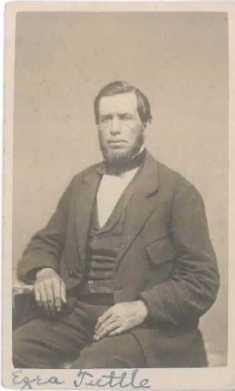
Tuttle, Ezra G. -Younger
Rev. Ezra Tuttle

Ezra Tuttle, Free Baptist, son of Nicholas and Rachel (Lucy) Tuttle, was born July 16, 1817. Licensed to preach by the Deerfield and Nottingham Quarterly Conference, at Deerfield, May 1843. Supplied the Methodist Church, West Newbury, Mass., 1843-5; Charlestown, Mass., 1845-6. Ordained an evangelist, Nottingham, Sept. 6, 1846. Laboring as an evangelist, 1846-7; Pastor, South Boston, Mass., May 1847-53; Deerfield, July 1853-60; Milton, May 1, 1860-3; Deerfield, May 1, 1863-5. Without charge, Richland Centre, Wis., Oct. 1865-6, Organized a church there and was pastor, May 1866-70; Pastor, Milton, April 10, 1870-2; North Lebanon, Me., Jan. 1872-3; Second Church, Strafford, Nov. 11, 1873-4; West Lebanon, Me., Nov. 1874-7; Without charge, Lebanon Centre, Me., meanwhile acting briefly as domestic missionary, March 11, 1877, & Pastor Second Church, Strafford, May 1878-82; North Berwick, Me., May 1, 1882-5; Without charge, Providence, R.I., 1885-8. Member of the executive boards of Education, Home, and Foreign Missionary Societies many years, clerk of the New Durham Quarterly Meeting, and often moderator; town treasurer, Richland, Wis., one year; member of school board, Deerfield, Milton, and North Berwick, Me. Died Providence, R.I., June 7, 1888. Married Mary Harris Savage, at Charlestown, Mass., April 5, 1842 (Carter, 1906).

Religious Intelligence. Rev. Ezra Tuttle, who for five years has been pastor of the Free Will Baptist Society in South Boston, has accepted an invitation to settle in Deerfield Centre, N.H. (New England Farmer, July 30, 1853).

Ezra Tuttle, of the Freewill Baptist church, of Deerfield, NH, signed the anti-slavery Memorial of 3050 New England Clergymen of all denominations in April 1854 (Washington (DC) Sentinel, April 29, 1854).

Ezra Tuttle, a clergyman, aged forty-three years (b. NH), headed a Milton household at the time of the Eighth (1860) Federal Census. His household included Mary H. Tuttle, aged thirty-nine years (b. NH), F.H. Tuttle, aged seventeen years (b. NH), P.E. Tuttle, aged five years (b. NH), A.C. Tuttle, aged one year (b. NH), and Abbie Ayer, aged fifteen years (b. NH). Ezra Tuttle had real estate valued at $500 and personal estate valued at $500. His household appeared next to that of L.L. Leighton, with unoccupied buildings on either side of them.

He moved next to Deerfield and then Wisconsin, returning to Milton in 1870 (see below).

Samuel P. Fernald

Fernald, Rev. Samuel P., was born in North Berwick, Me., May 25, 1809, and died in Melvin Village [Tuftonboro], N.H., June 9, 1888. His parents were Tobias and Sally (Pray) Fernald. He became a Christian at the age of twenty-one, received license to preach Oct. 23, 1831, and was ordained at East Wolfborough, N.H., May 26, 1833, by Rev.’s H.D. Buzzell, James Emery, Samuel Knowles, and Hiram Holmes. He itinerated a few years in Maine and New Hampshire, and had several revivals. He then settled with the East Tilton and Second Belmont churches. He organized the latter with fourteen members, and saw it increased to sixty-four members. He settled at Northwood in 1838. A large number were added, a house of worship built and equipped. He was pastor at Candia, at Gilmanton Iron Works, nine years, and three years at Bristol, where, in 1850, the church edifice was built. Returning to Northwood, fifty were added to the church, and a parsonage built. His next pastorates were in Portsmouth, Wakefield, Union, Gorham, Me., White Rock, and in Moultonborough and Tuftonborough, N.H. The church of these towns was increased from ten to fifty members, and a house of worship erected. He closed a four years pastorate here in 1870. After serving the Holderness and Centre Harbor church, one year, and the Water Village church, two years, and the Third Holderness, one year, he ceased his public labors on account of ill health. He has baptized about three hundred. He married March 28, 1838, Miss Hannah E. Palmer of Tuftonborough, N.H. who died July 1, 1888. They leave two children: Prof. O.M. Fernald of Williams College, Mass., and the wife of G.B. Files, Principal of the High School at Augusta, Me. She graduated from the Maine State Seminary at Lewiston, and taught in the Maine Central Institute, six years (Burgess, et al., 1889).

Samuel P. Fernald, a clergyman, aged sixty-one years (b. ME), headed a Tuftonboro, NH, household at the time of the Ninth (1870) Federal Census. His household included Hannah E. Fernald, keeping house, aged fifty-nine years (b. NH). Samuel P. Fernald had real estate valued at $1,000 and personal estate valued at $220.

Rev. Samuel P. Fernald died in Tuftonboro, NH, June 9, 1888. Hannah E. (Palmer) Fernald died a month later, July 1, 1888.

J.M. Bedell

Bedell, Rev. I.M., son of John and Mary (Mills) Bedell, was born in Springvale, Me., July 11, 1820. He studied at Parsonfield Seminary, and in the Biblical School at Whitestown, N.Y. Converted in 1834, he was licensed in 1850, and the next year ordained by Rev.’s G.P. Ramsey, W.H. Littlefield, C.B. Mills, and L.H. Witham. Among his pastorates have been Woolwich, Farmington, and Topsham, Me., and Meredith, Belmont, and Strafford Centre, N.H. He has seen revivals in seven of the churches with which he has labored, and one church organized June 1, 1846; he married Ella E. Roberts and has three children. He retired on account of ill health and resides in Lynn Mass. (Burgess, et al., 1889).

Isaiah M. Bedell of the 1st FW Baptist church, of Upper Gilmanton, NH, signed the anti-slavery Memorial of 3050 New England Clergymen of all denominations in April 1854. Peter Clarke, of Upper Gilmanton’s 1st Baptist church; James Polley, of its Christian church; and R.U. Sergeant, of its Centre Congregational church, signed also (Washington (DC) Sentinel, April 29, 1854).

Isaiah M. Berdell, a clergyman, aged fifty years (b. ME), headed a Gorham, ME, household at the time of the Ninth (1870) Federal Census. His household included Ellen C. Berdell, keeping house, aged forty-five years (b. ME), Lula A. Berdell, teaching school, aged twenty years (b. ME), Vianna O. Berdell, at school, aged eighteen years (b. ME), Felinda M. Berdell, at school, aged fifteen years (b. ME). Berdell has real estate valued at $1,200 and personal estate valued at $500. They resided next door to a hotel managed by Samuel B. Brown, aged seventy-two years (b. VT).

Isiah M. Bedell, no occupation, aged fifty-nine years (b. ME), headed a Lynn, MA, household at the time of the Tenth (1880) Federal Census. His household included Ellen E. Bedell, housekeeping, aged fifty-five years (ME), Lilla A. Bedell, works in shoe factory, aged twenty-seven years (b. ME), Vienna O. Bedell, works in shoe factory, aged twenty-five years (b. ME), Fida M. Bedell, a music teacher, aged twenty-three years (b. NH), and a boarder, Frederick Jones, works on ice cart, aged twenty-two years (b. ME). They resided on Rockingham Street.

Ella E. (Roberts) Bedell died in 1880. Rev. Isaiah M. Bedell died in Lynn, MA, February 9, 1893.

Nathan C. Lothrop

Lothrop, Rev. Nathan C., son of Solomon and Fanny (Chase) Lothrop, was born in Norton, Mass., June 19, 1839. He was converted at the age of seventeen under the labors of Rev. S.D. Church, in Taunton, Mass., and two years after was baptized and united with the church at Taunton. He graduated from the New Hampton Institution in 1861, and from the Theological School in 1864. In September following he was ordained at South Berwick, Me., where he was pastor eighteen months. He was pastor at Milton NH, two years, Pelham over two years of the Second Strafford church, three years of Caudia Village church, four years where he baptized thirty six and added fifty to the church. During the next four years he was at Bristol, where he baptized thirteen and twenty-six were added to the church. He then settled in Deerfield for nearly five years, and baptized thirty-seven, receiving forty-two into the church. In all he has baptized 101 converts. He is now settled at West Lebanon, Me., 1887. He was married Nov. 16, 1865, to Miss Sarah J. Lovejoy of Laconia NH, and has a son and daughter (Burgess, et al., 1889).

Nathan C. Lothrop appeared as Milton’s Free-Will Baptist minister in the Milton business directory of 1867-68.

Nathan C. Lothrop, a clergyman, aged thirty years (b. MA), headed a Strafford, NH, household at the time of the Ninth (1870) Federal Census. His household included Sarah J. Lothrop, aged twenty-six years (b. NH), Ormsby A. Lothrop, aged two years (b. NH), Fanny B. Lothrop, aged one month (b. NH; in May), and Josephine Woods, a domestic servant, aged twenty-nine years (b. NH). Nathan C. Lothrop had personal estate valued at $300.

DR. QUAIN’s MAGIC CONDITION PILLS! The Wonderful Remedy for Liver Complaint, Biliousness, Dyspepsia, Rheumatism, Neuralgia, Constipation, Sick Headache, Headache, Nervousness, Kidney Complaint, Piles, Paralysis, Fever and Ague, Scrofula, and all diseases arising from a bad slate of the blood.

TESTIMONY OF CLERGYMEN

What Rev. N.C. Dothrop [SIC] says: “Excellent for Diseases of the Stomach and Liver. One Feels Better from the Moment of Taking them.”

Candia, N.H.,

Mr. Lane – Dear Sir:- I received the package of pills you sent, and gave them a faithful trial. I find them to be a most excellent Pill for diseases of the Stomach and Liver. Unlike other Pills they have a tonic, rather than a weakening effect on the system. One feels better from the moment of taking them. I have tried other Pills, but none seemed to fit themselves to my case like QUAlN’S MAGIC CONDITION PILLS. My wife has taken them with good results. They are quite popular in this village and vicinity. One woman on the road has received great benefit from them. Thinks they are the best medicine she ever took. For my part I heartily recommend them, and hope they will have an extensive sale. Yours most truly, N.C. LOTHROP, Pastor F.W. Baptist Church, Candia Village, N.H. (Vermont Christian Messenger (Montpelier, VT), August 2, 1877).

Rev. Nathan C. Lothrop died in Bristol, NH, February 15, 1920. Sarah J. (Lovejoy) Lothrop died in Bristol, NH, April 30, 1930.

I.C. Guptill

GUPTILL, Ira Clark, M.D., of Northborough, is a native of Maine, born in Cornish, York County, April 9, 1844, son of Obadiah True and Harriet Newell (Cilley) Guptill. His ancestors on both sides were closely connected with the early history of the Pine Tree State. His great-grandfather, Daniel Guptill, was a native of North Berwick, Me., where he married Miss Sarah Morrill, and they reared a large family of children. His maternal grandfather was Benjamin Cilley of Limerick, Me. Dr. Guptill’s early education was obtained from the common high schools, and the classical institutes, and his collegiate training at Bowdoin and Dartmouth. He graduated from the medical department of Dartmouth College, November 4, 1874, and further fitted for his profession through clinical practice in connection with the office of his instructor, Dr. Alvin Brawn, who was city physician of Biddeford, Me. Soon after his graduation he settled in Manchester, N.H., and was in active practice in Manchester and Auburn for three years, when on account of poor health he travelled for a while. Upon his return he resumed practice in his native State, and in October 1879 removed to Northborough, where he has since remained in the enjoyment of an extensive practice and a very pleasant home. He is a member of the Worcester District Medical Society, and a Fellow of the Massachusetts Medical Society. He has read several papers before the societies, has been concerned in a number of literary works, and has also contributed poems to magazines and newspapers, which have been quite extensively copied. He belongs to the Masonic fraternity, the Odd Fellows, to the Royal Society of Good Fellows, and is president of the Fredonia Club of Social Fellows. He has been a lifelong Republican, and has served on the town committee. In his professional work, by offices of kindness and gratuitous service, he has done much often, at a sacrifice, to ameliorate the condition of the poor and unfortunate, which has been the pleasure of his ambition. Dr. Guptill was married November 4, 1871, to Miss Jennie J. Jones, of North Lebanon, Me., a graduate the West Lebanon Seminary and a very successful teacher. No children have been born to them (Bacon, 1896).

Ira C. Guptill is said to have been in Milton as a minister in 1868-69. I.C. Guptill was pastor in North Lebanon, ME, in 1870-71.

Ira C. Gubtail, a clergyman, aged twenty-six years (b. ME), headed a Lebanon, ME, household at the time of the Ninth (1870) Federal Census, in June 1870. His household included Mira L. Gubtail, keeping house, aged twenty-seven years (b. ME). Gubtail had real estate valued at $400 and personal estate valued at $200.

The York conference report of for 1871 stated that his North Lebanon church had 26 additions by baptism, 3 additions by letter [transfers], 1 dismissal [by letter, to another congregation], 1 exclusion, 0 deaths, 129 resident members, 12 non-resident members, 141 whole number, and 95 scholars (FWB Printing, 1871).

What followed next was certainly unusual. Ira C. Guptill obtained a divorce from Almira L. (Allen) Guptill in York County, ME, in September 1871. He then married (2nd) in Biddeford, ME, November 4, 1871, Joanna Jones, he of Biddeford [and she of North Lebanon, ME]. These events likely explain his dropping the ministry and returning to school. He went next to Dartmouth College, where he took a degree in medicine. (His ex-wife, Almira L. [(Allen)] Guptill, married (2nd) in Sanford, ME, December 21, 1873, John A. Dennett, both of Sanford).

Ira C. Guptill, a physician, aged thirty-four years (b. ME), headed a Northborough, MA, household at the time of the Tenth (1880) Federal Census. His household included Jennie J. Guptill, keeping house, aged twenty-eight years (b. ME). The Guptills shared a two-family dwelling with the household of Augustus M. Staples, a comb factory worker, aged thirty-six years (b. ME).

Northboro. Mrs. [Harriet N. (Cilley)] Guptill, who makes her home with her son, Dr I.C. Guptill, Main st,, is seriously ill with pneumonia (Boston Globe, January 1, 1904).

Jennie J. (Jones) Guptill died in September 1918. Ira C. Guptill died in Northboro, MA, December 3, 1918.

Funeral of Dr Guptill Saturday. NORTHBORO, Dec 5. The funeral of Dr. Ira C. Guptill will be held Saturday afternoon at 2 o’clock. He was 74 years old and was born in Limerick, Me. He was graduated from Bowdoin College and the Dartmouth Medical School. He came to Northboro 38 years ago. He married Miss Joanna Jones of Biddeford, Me. in January, 1871. She died last September (Boston Globe, [Thursday,] December 5, 1918).

Ezra Tuttle – Second Pastorate

Tuttle, Ezra G.
Rev. Ezra Tuttle

Rev. Ezra Tuttle (see details above) returned from Wisconsin for a second Milton pastorate in 1870 through 1872.

Ezra Tuttle, a clergyman, aged fifty years (b. NH), headed a Milton household at the time of the Ninth (1870) Federal Census. His household included Mary Tuttle, keeping house, aged forty-eight years (b. MA), Eldora Tuttle, at school, aged fifteen years (b. NH), Alvah C. Tuttle, at school, aged eleven years (b. NH), and Washington I. Tuttle, at school, aged nine years (b. NH).

Note the name of the third child. Ezra Tuttle and his wife were evidently fans of author Washington Irving (1783-1859).

Ezra Tuttle appeared as Milton’s Free-Will Baptist minister in the Milton business directory of 1871. He performed innocently a Milton marriage in that year that featured later in a sensational bigamy trial of 1886. (The Milton marriage was the first, non-bigamous marriage) (Oakland Tribune, June 9, 1886).

Ezra Tuttle, a minister, aged sixty-three years (b. NH), headed a Strafford, NH, household at the time of the Tenth (1880) Federal Census. His household included his wife, Mary H. Tuttle, keeping house, aged fifty-nine years (b. MA), A. Chesley Tuttle, a printer, aged twenty-one years (b. NH), and Irving W. Tuttle, works in a shoe shop, aged seventeen years (b. NH).

Rev. Ezra Tuttle died in Providence, RI, June 7, 1888 (Boston Transcript, July 10, 1888). Mary H. (Savage) Tuttle died in Milton, NH, January 31, 1907.

J.P. Jay

Joy, Joseph F.
Rev. Joseph F. Joy

Joseph Franklin Joy was born in New Durham, NH, May 15, 1838, son of Samuel and Watie (Pettigrew) Joy.

Joseph Franklin Joy, Free Baptist, son of Samuel and Watie (Pettigrew) Joy, was born May 15, 1838. Graduated at Dartmouth College, 1863. For a time teacher, Rochester, N.Y. Attended medical lectures at Brunswick, Me. 1865. Licensed to preach at Northwood, Jan. 1865. Ordained New Durham, May 1865. Labored in New Durham and vicinity, 1865-72; Milton, 1872-5; New Durham, 1875-83; Without charge, Frankfort Dak 1888-91; Farmington, 1891-6; New Durham, 1896-7; Farmington, 1897-1904. School committee of New Durham, several years. Married Addie F. Berry at New Durham, May 14, 1868 (Carter, 1906). 

Joseph F. Joy, a clergyman, aged thirty-two years (b. NH). headed a New Durham, NH, household at the time of the Ninth (1870) Federal Census. His household included Addie F. Joy, keeping house, aged twenty-four years (b. NH), and Anna Joy, aged six months (b. NH). Joseph F. Joy had personal estate valued at $740.

J.F. Joy appeared as Milton’s Free-Will Baptist minister in the Milton business directories of 1873 and 1874. (He served as one of three Superintendents, i.e., Superintendents of Schools, with J.U. Simes and H. Wentworth, in 1874).

Serena O. Berry, keeping house, aged fifty-eight years (b. NH), headed a New Durham, NH, household at the time of the Tenth (1880) Federal Census. Her household included her daughter, Georgianna O. Berry, a teacher, aged thirty-five years (b. NH). Serena O. Berry shared a two-family dwelling with the household of her son-in-law, Rev. Joseph F. Joy, Rev. Joseph F. Joy, a clergyman, aged forty-two years (b. NH). His household included Serena O. Berry’s daughter, aged thirty-four years (b. NH), and her [grand] daughters, Annie M. Joy, aged ten years (b. NH), Eda O. Joy, aged seven years (b. NH), and Gracie Joy, aged three years (b. NH).

Rev. Joseph F. Joy died in New Durham, NH, June 13, 1912.

E.G. York

Elbridge Gerry York was born in Gilmanton, NH, November 29, 1830, son of Jonathan and Betsy York. He married (1st) in Belmont, NH, October 5, 1858, Laura M. Bowles, he of Gilmanton and she of Whitefield. She was born in Lisbon, NH, circa 1832-33, daughter of Benjamin and Mercy L. (Taylor) Bowles.

Elbridge G. York, Free Baptist, was born Nov. 29, 1830. Began to preach, 1854. Ordained, Woodstock, Jan. 11, 1860, and pastor, 1860-2; Lower Gilmanton, 1862-4; First Church Wolfborough, 1864-74; Moultonborough and Tuftonborough, 1874-9; Nottingham, 1879-81 (Carter, 1906).

Elbridge G. York, an F.B. clergyman, aged twenty-nine years (b. NH), headed a  Woodstock, NH, household at the time of the Eighth (1860) Federal Census. His household included Laura M. York, aged twenty-seven years (b. NH), and Edwin K. York, aged three years (b. NH).

Elbridge G. York, a clergyman, aged thirty-three years (b. NH), married, registered for the Class II military draft in Londonderry, NH, in June 1863.

Elbridge G. York, a clerk, aged thirty-nine years (b. NH), headed a Wolfeborough, NH, household at the time of the Ninth (1870) Federal Census. His household included Laura M. York, keeping house, aged thirty-seven years (b. NH), Amy E. York, at home, aged five years (b. NH), Don E.E. York, at home, aged three years (b. NH), and Orland B. York, aged one year (b. NH). Elbridge G. York had real estate valued at $300 and personal estate valued at $400.

E. Tuttle appeared as Milton’s Free-Will Baptist minister in the Milton business directory of 1876. This was an error: the directory should have listed the minister as E. York or E.G. York.

Laura M. (Bowles) York died in Milton, NH, in 1878-79, aged forty-six years and ten months. Her death was “reported for year ending March 31, 1879.”

Elbridge G. York married (2nd) in Exeter, NH, April 24, 1880, Cynthia Abby ((Withee) (Thompson) (Randall)) Ellison, he of Nottingham and she of Exeter. He was a clergyman, aged forty-nine years, and she a domestic, aged forty-eight years. She was born in Skowhegan, ME, circa 1831-32, daughter of Walton and Pathenia Withee. (Yes, Pathenia). This was said to be the 4th marriage for each (It was his second and her fourth).

Elbridge Gerry York, an F.W. Baptist clergyman, aged forty-nine years (b. NH), headed a Nottingham, NH, household at the time of the Tenth (1880) Federal Census. His household included his wife, Cynthia A. York, keeping house, aged forty-eight years (b. ME), his daughter-in-law, Carrie Thompson, a table girl, aged eighteen years (b. NH), his sons-in-law, Freddie C. Randall, at school, aged thirteen years (b. NH), and Granville D. Randall, at school, aged eleven years (b. NH), and his children, Amy E. York, at school, aged fifteen years (b. NH), Don E. York, at school, aged thirteen years (b. NH), Arlen B. York, at school, aged eleven years (b. NH), and Lucia A. York, at school, aged seven years (b. NH).

Elbridge G. York died in Taunton, MA, September 7, 1900. Cynthia A. York died in 1903. (She is buried in Exeter, NH, with her first husband, Sylvester E. Thompson, who died in Potomac, VA, while serving with the 12th NH Regiment).

E. Owen

Owen, Rev. Eleazar, was born in Belchertown, Mass., Oct. 11, 1834. His parents were Artemas Owen, of Belchertown, and Betsey Wright, of Hanover, N.H. He was educated in the seminaries of Monson and Wilbraham, Mass., For a number of years he was employed as a mechanic in the U.S. Armory at Springfield. He was ordained by the Advent Christian Conference, of Connecticut, at New Britain in 1867. He organized and became pastor of the church at Westfield, Mass. For several years he was secretary of the Massachusetts Advent Christian Conference. In 1870, he accepted a call to the Hanover Street chapel, Portsmouth, N.H. He resigned his office in the Advent Conference and at his request was dismissed from that body. In 1876, he became stated supply in an abandoned Free Baptist church at Milton N.H. There was a revival, and the church was renewed and has since prospered. After two years he received a call from the Pearl Street church, Portsmouth. He became its pastor after an examination by a council consisting of Rev.’s I.D. Stewart and others. After two years with this church, he resigned and accepted a call to the Lyndon Centre church, Vt. The Lyndon Institute was closed, and the school was passing out of the control of the denomination. Through his efforts, seconded by others, the school was recovered, an endowment of $25,000 was raised, the building repaired, and the school started again in a prosperous condition. He was in the work of endowing the school considerably, for three years, and in the pastorate nearly five years. He settled at Meredith Village, N.H. in July 1885, where he is now pastor. The church there has prospered under his labors (Burgess, et al., 1889).

Eliazar Owen, a clergyman, aged thirty-five years (b. MA), headed a Westfield, MA, household at the time of the Ninth (1870) Census. His household included Mary Owen, keeping house, aged thirty-three years (b. MA), Frederic Owen, attending school, aged eleven years (b. MA), and Eliazar Owen, attending school, aged nine years (b. MA). Eliazar Owen [Sr.] had personal estate valued at $300.

E. Owens appeared as Milton’s Free-Will Baptist minister in the Milton business directory of 1877.

NEW ENGLAND NEWS. NEW HAMPSHIRE. Agreeable to an invitation from the Pearl Street Free Will Baptist Church of Portsmouth, the Council met Tuesday to advise that body in reference to a settlement of Rev. Eleazar Owen as their pastor. Mr. Owen, who was recently an advent preacher, changed his doctrinal views and become a Free Will Baptist. The Council was organized by choosing Rev. O.T. Moulton of 8onth Berwick moderator. and Rev. G.C. Waterman of Dover clerk. After a searching examination of the candidate the Council voted unanimously to recommend him to the fellowship of this church and denomination, and to advise his settlement as pastor of said church. In accordance with the above, Rev. Mr. Owen will commence his pastorate with the Free Will Baptist Church there next Sunday (Boston Post, January 2, 1878).

Eleazar Owen, a clergyman, aged forty-five years (b. MA), headed a Portsmouth, NH, household at the time of the Tenth (1880) Federal Census. His household included his wife, Mary Owen, keeping house, aged forty-two years (b. MA), and his sons, Eleazar F. Owen, an apprentice machinist, aged twenty-one years (b. MA), Ellery B. Owen, clothing store clerk, aged nineteen years (b. MA), and Bernard Owen, at school, aged nine years (b. NH).

Rev. Eleazar Owen died November 6, 1896. Mary A. (Walker) Owen died in Concord, NH, January 18, 1917.

Mrs. Mary A. Owen. – Mrs. Mary A. Owen, aged 80 years, died in Concord, N.H., January 18, at the home of her son, E. Scott Owen. She had been ill for several months. She was the widow of Rev. Eleazar Owen, a Free Baptist clergyman, who died in Portsmouth, N.H., 20 years ago. Mr. Owen held pastorates in different places in New Hampshire and Maine and was at one time in charge of the church at Lyndon Center (St. Johnsbury Caledonian (St. Johnsbury, VT), January 31, 1917).

Cyrus L. Plumer

Cyrus Lemuel Plumer was born in Fremont, NH, October 26, 1841, son of Rev. Abraham and Mary Ann (Ladd) Plumer.

A. [Abraham] Plummer, a Meth. clergyman, aged fifty years (b. ME), headed a Vinalhaven (Carver’s Harbor P.O.), ME, household at the time of the Eighth (1860) Federal Census. His household included Betsy Plummer, aged fifty-three years (b. NH), and Lemuel C. Plummer, a student, aged eighteen years (b. NH). A. Plummer had personal estate valued at $1,000.

Cyrus L. Plummer graduated from Boston University’s School of Theology, with its class of 1860.

C. Lemuel Plumer married in Concord, NH, June 17, 1863, Henrietta M. “Etta” Harrington, both of Concord. He was a clergyman. She was born in NH, circa 1841-42, daughter of Thomas and Harriet Harrington.

Plummer’s son, Edwin H. Plumer, reported his own birth as having occurred at Mt. Desert, ME, circa 1865-66 (at the time of his own 1892 marriage to Ruth Given).

C. Lemall Plummer, an M.E. preacher, aged twenty-nine years (b. NH), headed a Pembroke, ME, household at the time of the Ninth (1870) Federal Census. His household included Etta M. Plummer, keeping house, aged twenty-nine years (b. NH), Estella L. Plummer, aged six years (b. NH), and Eddy H. Plummer, aged four years (b. ME).

Cyrus L. Plumer, a clergyman, aged thirty-eight years (b. NH), headed a Milton household at the time of the Tenth (1880) Federal Census. His household included Henrietta Plumer, keeping house, aged thirty-eight years (b. NH), Estella L. Plumer, at school, aged fifteen years (b. NH), Edwin H. Plumer, at school, aged fourteen years (b. ME), and Herbert F. Plumer, aged eight months (b. NH, in October 1879). His household appeared on a “3 Ponds Village” page.

C.L. Plumer appeared as Milton’s Free-Will Baptist minister in the Milton business directories of 1880, 1881, and 1882.

Harriet H. Shapleigh, Calvin L. Hayes, and Cyrus L. Plumer served on the Kittery, ME, school committee in 1884.

Cyrus L. Plummer, Canvasser Broom Co., aged fifty-eight years (b. NH), headed a Braintree, MA, household at the time of the Twelfth (1900) Federal Census. His household included Etta M. Plummer, aged fifty-eight (b. NH), Herbert Plummer, at school, aged twenty years (b. NH), Mabel E. Plummer, at school, aged seventeen years (b. ME).

Cyrus L. Plummer died in Boston, MA, October 1, 1910.

BRAINTREE. The funeral of Cyrus L. Plummer of 29 School st., who died suddenly on the [Faneuil Hall Sq.] Street in Boston last Saturday night, was held yesterday afternoon at his home. The services were conducted by Rev Thomas Simms, pastor of the First Congregational church. Burial was in Lakeside cemetery, South Braintree (Boston Globe, [Thursday,] October 6, 1910).


Previous in sequence: Milton’s Free-Will Baptist Ministers of 1843-50; next in sequence: Milton’s Free-Will Baptist Ministers of 1882-07


References:

Bacon, Edwin Monroe. (1896). Men of Progress: One Thousand Biographical Sketches and Portraits of Leaders in Business and Professional Life in the Commonwealth of Massachusetts. Retrieved from books.google.com/books?id=5HFPAAAAYAAJ&pg=PA650

Burgess, Gideon Albert, and Ward, John T. (1889). Free Baptist Cyclopaedia. Retrieved from books.google.com/books?id=3GXiAAAAMAAJ

Carter, Nathan F. (1906). Native Ministry of New Hampshire. Retrieved from books.google.com/books?id=NXgRAAAAYAAJ&pg=PA275

Find a Grave. (2018, December 21). Cyrus L. Plummer. Retrieved from www.findagrave.com/memorial/195488677/cyrus-l-plummer

Find a Grave. (2016, March 23). Rev. Eleazar Owen. Retrieved from www.findagrave.com/memorial/159941218

Find a Grave. (2008, March 16). Rev. Ezra Tuttle. Retrieved from www.findagrave.com/memorial/25319021

Find a Grave. (2014, May 30). Ira C. Guptill. Retrieved from www.findagrave.com/memorial/130606422

Find a Grave. (2011, July 7). Rev. Isaiah M. Bedell. Retrieved from www.findagrave.com/memorial/72966744

Find a Grave. (2011, October 11). Rev. John Manter. Retrieved from www.findagrave.com/memorial/78715212/john-manter

Find a Grave. (2016, December 16). Rev. Joseph Franklin Joy. Retrieved from www.findagrave.com/memorial/174156928

Find a Grave. (2017, November 27). Rev. Nathan Chase Lothrop. Retrieved from www.findagrave.com/memorial/62270130

Find a Grave. (2015, July 8). Rev. Samuel Pray Fernald. Retrieved from www.findagrave.com/memorial/148870617

Freewill Baptist Printing Establishment (1871). Freewill Baptist Register. Retrieved from books.google.com/books?id=7eURAAAAIAAJ&pg=RA1-PA35

Granite Monthly Company. (1894). Granite Monthly: A New Hampshire Magazine. Retrieved from books.google.com/books?id=tVwSAAAAYAAJ&pg=PA141

Mitchell-Cony Company. (1908). Town Register: Farmington, Milton, Wakefield, Middleton, Brookfield, 1907-8. Retrieved from books.google.com/books?id=qXwUAAAAYAAJ&pg=PA102

Scales, John. (1914). History of Strafford County, New Hampshire, and Representative Citizens. Retrieved from books.google.com/books?id=nGsjAQAAMAAJ&pg=PA516

Wikipedia. (2019, February 4). Washington Irving. Retrieved from en.wikipedia.org/wiki/Washington_Irving

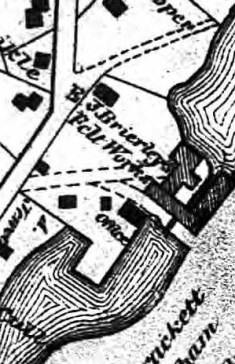
Milton in the News – 1877

By Muriel Bristol (Transcriber) | February 28, 2019

In this year, we encounter a minister’s departure, a singular woman, and a stereotyper’s heart failure.


NEW HAMPSHIRE. Rev. S.F. Lougee is called to the church in Danbury, and Rev. D.B. Scott to the church at Milton Mills (Vermont Chronicle (Bellows Falls, VT), April 28, 1877).

Rev. Darius B. Scott was not called to the church at Milton Mills. He left there when he was called to the church at Lynnfield, MA. (See his arrival in 1873).


Miss Joanna Farnham died at the American House hotel, on Hanover Street in Boston, MA,  May 19, 1877. She was a daughter of the Bunker Hill veteran Ralph Farnham, who drew so much attention in 1860. The story of her passing, and the discovery of her “nesting” trunks, became a viral story that was copied many times across the whole country. (It was even revived in 1894).

1877. March 19. Joanna Farnham, aged 81 years, 11 months, and 56 days, died at Hanover [Street], Boston, female, single, born Acton, Me., daughter of Ralph (born Lebanon, Me.) and Mehitable (born Raymond, N.H.), lung fever, buried Acton, Me., B.F. Smith, informant (Boston Vital Records).

BG760126-American House.jpg
Reduced or deflated rates after the Panic of 1873

A SINGULAR WOMAN. Foster’s Democrat, of Dover, N.H., of the 19tb, ult., gives a singular history of a Milton woman:

A short time since some of the Boston papers noticed the death of Miss Joanna Farnham, about 80 years of age, and for a long series of years known as the housekeeper at the American House in Boston. She went from Milton, N.H., in her early days, and during her long life at the hotel nobody supposed she had any property, and at her death it was not generally known that she had a surplus dollar anywhere. But she had a trunk at the American House, which was opened and found to contain a variety of dry goods, notes for $5,000 against the proprietor of the American House, a bank book of the Blackstone bank, showing deposits of $1700, a small sum of money, and also a piece of paper having a trunk key wrapped up in it, and on the paper was a writing stating that the key belonged to another trunk, which could be found at the house of a relative in Milton. This led to a visit to Milton, and there some very curious developments were made. The trunk referred to as being at Milton was found, opened with the key found in the former trunk, and this second trunk was packed full of all sorts of fine wearing apparel, and contained also a key in a piece of paper, upon which was the statement that this key belonged to another trunk at a certain other place. And so this thing was followed up until twenty very large-sized trunks and three huge packing chests were found, all crammed full of the most expensive articles of ladies’ wearing apparel and house furnishings that the Boston market afforded.

When these trunks and boxes were all collected they loaded down a four-ox team, and were drawn to a large hall in Milton, unpacked and inventoried, preparatory to an auction sale for the benefit of the heirs. Among all these valuables were 89 dresses, new and perfect, made of silk, velvet, satin and all kinds of plaid silks, black and colored thibets, poplins, alpacas, brilliantines, cashmeres, etc., three silk velvet cloaks, 19 shawls, from common to the richest paisley and wrought crape; 106 skirts of all colors; 114 pairs of hose; undergarments of all kinds, too numerous to mention; table linen, towels, handkerchiefs, counterpanes, sheets, coverlets, blankets, live geese feathers; sets of elegant China ware; a large lot of table and teaspoons of best coin silver, silver knives and forks; a fine gold watch and chain, and a large lot of fine jewelry, &c. It is said that the best dress cost not less than $200. All of these goods are perfectly new and in the best order, never having been used. There is enough of the whole to stock a large store, and the strangest legacy ever left by a housekeeper who worked for small wages all her life yet there is said to be no doubt that she came honestly by all, as it has since been ascertained where and of whom she purchased them at various times as she went along. The original cost of the goods was not less than $11000, and the owner while she lived went clad in the very cheapest sort of apparel, the strangest specimen of humanity ever known in these parts (Burlington Free Press (Burlington, VT), June 7, 1877).

The Vermont Journal carried also the same Foster’s story, with an additional detail of the auctioneer.

Park Copp will sell the whole at auction in Milton (Vermont Journal (Windsor, VT), June 2, 1877).

Joanna Farnham, a domestic, aged fifty years (born ME), was a resident employee of a Boston hotel at the time of the Seventh (1850) Federal Census. Lewis Price, hotel keeper, aged forty years, headed the hotel “household,” which included his own family, guests, as well as four resident employees. Price had real estate valued at $137,200.

Joanna Farnham, a domestic, aged sixty-five years (born ME), was a resident employee of Boston’s American House at the time of the Eighth (1860) Federal Census. Lewis Price, hotel proprietor, aged fifty years, headed the American House “household,” which included his own family, guests, as well as 104 resident employees. Price had real estate valued at $230,000 and personal estate valued at $40,000.

Johanna Farnum, a bath room girl, aged seventy-eight years (born ME), was a resident employee of Boston’s American House at the time of the Ninth (1870) Federal Census. Lewis Price, hotel proprietor, aged sixty years, headed the American House “household,” which included his own family, guests, as well as 126 resident employees: bartenders, billiards boys, cashiers, chambermaids, clerks, cooks, domestic servants, errand boys, fireman, gas man, laundresses, nurse, pantry girl, porters, seamstress, steam engineer, stewards, stove girls, sweepers, waiters, and wash girls. Price had real estate valued at $400,000 and personal estate valued at $75,000.


Stephen H. Knight, a stereotype printer (and former shoe factory employee) from Milton, aged sixty-six years, took sick and died in Boston, MA in September.

THE POLICE RECORD. Various Items, Criminal, Accidental and Otherwise, Gathered from the Courts and Police Stations. Stephen Knight, belonging in Milton, N.H., and sixty-six years old, while sitting in a slip in the saloon of Burns, 108 Portland street, was taken suddenly ill about 11 A.M. yesterday. Drs. Snow and Cilley were called, but in spite of their efforts he died shortly before noon. The deceased was a stereotyper by trade, and leaves a wife. He was, it is said, a brother to Dr. Edward Knight, at 618 Tremont street, this city. It is supposed the cause of death was heart disease (Boston Globe, September 5, 1877).

Stephen H. Knight, a shoe factory worker, aged fifty-seven years, headed a Milton (Milton Mills P.O.) household at the time of the Ninth (1870) Federal Census. His household included Louisa C. [(Clarey)] Knight, keeping house, aged fifty years, Adelaide Knight, at home, aged eighteen years, Clarinda A. Knight, at home, aged seventeen years, and Daniel B.  Nichols, a shoe factory worker, aged forty-six years. Stephen H. Knight had real estate valued at $600 and personal estate valued at $200.

Louisa Knight, keeping house, aged fifty-nine years, headed a Milton household at the time of the Tenth (1880) Federal Census. Her household included her children, Elbridge G. Knight works on shoes, aged thirty years, and Clarie A. Knight, does housework, aged twenty-seven years. Both Elbridge G. and Clarie A. Knight had been unemployed for six months of the year.


Previous in sequence: Milton in the News – 1876; next in sequence: Milton in the News – 1878


References:

Find a Grave. (2010, July 22). Joanna Farnham. Retrieved from www.findagrave.com/memorial/55312457/joanna-farnham

Find a Grave. (2014, September 18). Stephen Knight. Retrieved from www.findagrave.com/memorial/136056728

Wikipedia. (2018, October 15). American House (Boston). Retrieved from en.wikipedia.org/wiki/American_House_(Boston)

Wikipedia. (2018 November 26). Stereotype (Printing). Retrieved from en.wikipedia.org/wiki/Stereotype_(printing)


Bright Stars: Sirius

By Peter Forrester | February 13, 2019

The brightest star in the night sky, as seen from Earth, is called Sirius. It is the second brightest overall (obviously the Sun is the brightest star we can see).

Sirius is larger than the Sun, but weak and relatively dim compared to many other stars, but it is so close to the Sun (8.6 light years) that its apparent magnitude (-1.46) is almost twice as bright as any other star. It has an absolute magnitude of 1.42.

Being so bright, Sirius was important in the mythology of many ancient cultures. For example, its appearance in the sky shortly before sunrise (its “heliacal rising”) occurred just before the summer flooding in ancient Egypt and was an important omen in their religion. Their civil calendar was originally based on the return of Sirius, but wandered off within 4 years. However, they continued to observe its return and discovered a cycle that became part of the Julian and Alexandrian calendars.

The Ancient Greeks associated Sirius with hot weather, men becoming weak, and other bad consequences, terming the time right after its return “dog days” because of its constellation, Canis Major. Its association with dogs also concerned the way dogs pant in hot weather, which made some ancient people fear they might have a disease, even in some cases rabies. For more on the mythologies associated with Sirius, see the Wikipedia link below.

Sirius is in Canis Major, or the Great Dog, which is just to the left of Orion as seen in the Northern Hemisphere. Being the brightest star in this constellation, its abbreviation is α CMa. Canis Major is often depicted as a dog of Orion who is helping him hunt the Bull, Taurus.

Sirius is actually made up of two separate stars, Sirius A and Sirius B. Sirius A has an absolute magnitude of +1.42, while Sirius B (nicknamed “the Pup”) is much, much dimmer at +11.18. The distance between them is about 20 AU, or about the distance of Uranus from the Sun. 1 Astronomical Unit (AU), the distance between the Earth and the Sun, is about 93 million miles. Sirius A is blue-white, while Sirius B is a white dwarf, the second one ever discovered.

The existence of a second star was first hypothesized in 1844, and observed in 1862. A third companion star has been suggested to explain small changes in the movement of the star system but its existence has never been verified.

Sirius is one of the three stars in a shape called the “Winter Triangle”, along with Procyon in Canis Minor, and Betelgeuse in Orion. Those who know the constellation Orion should be able to find Sirius easily. You just follow the belt down to the left, the star is about 8 times the width of the belt away from it. These directions will be opposite in the Southern Hemisphere.

There are four planets brighter than Sirius (two of them, Jupiter and Venus, are always brighter when visible, with Mercury and Mars being brighter some of the time). Since it is known to be the brightest night-time star, knowing its location can help you identify planets in the sky.

It is possible to see Sirius in daylight, though there are several conditions that have to be met, such as the sky being clear, the Sun being low on the horizon, Sirius being overhead, and the observer being at a high altitude. These conditions are met more easily in the Southern Hemisphere, since the star gets higher in the sky there. Sirius is gradually moving to the south and will no longer be visible in northern or central Europe in about 7,000 years.

Sirius contains 2 of the 8 nearest stars to our solar system, and is the fifth closest stellar system to us. The Voyager 2 spacecraft launched in 1977 is expected to pass about 4 light years from Sirius in about 300,000 years. No planets have been detected in the Sirius system, and because of differences in the stars, the conditions for life being met would be much more difficult. In particular, Sirius B used to be a red giant and thus would have swallowed up any planets. Also Sirius A is much brighter than the Sun and thus habitable planets would have to be much further away than the Earth is from the Sun. Sirius A is also much younger than the Sun and thus there would have been much less time for life to have evolved on any planet there.

There are a couple of historical controversies concerning Sirius. The first is about the color of the star, which ancient authors described as red, but the star is now known to be white to blue-white in color (various colors can be seen in its twinkling, because of effects of the light passing through Earth’s atmosphere).

The second controversy concerns a native tribe in Mali, Africa, which has been claimed to have known about the second star before Western astronomers (they also said there was a third star with a planet). But the accounts have been disputed and it seems the author who wrote about it in 1938 may have been the one to tell them, or they may have learned about it from a French expedition to view an eclipse in 1893.

This is the best month of the year to observe Sirius in the early evening, although it can also be seen in the early morning during summer. Happy skywatching!


References:

Byrd, Deborah. (2019, February 7). Sirius is Dog Star and brightest star. Retrieved from https://earthsky.org/brightest-stars/sirius-the-brightest-star on February 13, 2019.

Howell, Elizabeth. (2018, October 24). Sirius: Brightest Star in Earth’s Night Sky. Retrieved from https://www.space.com/21702-sirius-brightest-star.html on February 13, 2019.

Wikipedia. (2018, December 31). Heliacal rising. Retrieved from https://en.wikipedia.org/wiki/Heliacal_rising.

Wikipedia. (2019, February 12). Sirius. Retrieved from https://en.wikipedia.org/wiki/Sirius.

The Georges Ended

By S.D. Plissken | February 10. 2019

We have “on offer” five candidates for the single open seat on the Milton Board of Selectmen. Now, things are arranged currently such that three three-year terms are overlapped or “staggered.” It would take years to completely replace the Board of Selectmen.

We are told that this is to ensure “continuity.” We are assured that someone – usually, two someones – will know always what was done before and why. Institutional memory must preserved.

One might well question that premise. It might make some sort of sense if the memory being preserved were a memory of success, but what if it is a memory of failure that is to be preserved? Well, obviously, one would want to clean house instead.

Sadly, we lack that cleaner option. The most we can hope for is to change out one failure this year and another next year. That could bring about a change for the better, over two years, or we might have to endure these people even longer before relief can occur. Because “continuity.”

At past Candidate nights, a lot of vague twaddle about “community” has been featured. Of course, that sounds good, superficially, but it means less than nothing in practice. There has been made an increasingly false equivalence between the Milton Town government apparatus and the taxpayers it supposedly “represents.” Too often, the “community” actually represented has been that Town government alone. Do not be taken in by vague generalities regarding “community.”

But how then to choose? One might hope that the candidates would distance themselves distinctly from past budget failures. The current selectmen might even see the light. Those that hope to “manage” things should make it crystal clear that they can recognize failure when they see it, and that they intend to make a clean break with the thinking and methods that produced them. To head in the opposite direction.

The philosopher William James once observed that “A great many people think they are thinking when they are merely rearranging their prejudices.”

Now, the burden of clearly breaking with past failures falls most heavily on those that actually participated in past failures. Three of the candidates need to show that they have seen the light,  and will not repeat their past failures. No vague, “going along to get along” talk from them will suffice, no blather about “community.” No simple rearrangement of their prejudices can get the job done.

Last year’s Federal Chained-CPI inflation has been calculated to have been 1.8%. One-sixth of Milton’s retired taxpayers might – I say might – get something approaching that in their Social Security pensions. Any selectman who is not working actively, right from Day One, to keep Town budget increases below that amount of increase, will be working actively against the interests of that elder segment of our “community.”

You are entitled to hear a clear and ringing rejection of any increases above that amount. If a candidate can not so commit themselves, you should pass them over. Better to vote for nobody than to vote for more “continuity” with past failures. Because, at that point, “nobody” represents you.

This pernicious management must end some day, either through electoral change or budgetary collapse. The economist Herbert Stein once observed a simple truth that is often overlooked: “If something cannot go on forever, it will stop.”

So, this will stop at some point. Taxes will come down. Count on it. We might hope that “somebody” – some two of our selectmen – will work for a soft landing instead of a crash. But, either way, it will stop, because it can not continue.

And when the last big spender is gone, when our long Town nightmare ends finally, we may feel then as English poet Walter S. Landor did when the last of the Hanoverian monarchs shuffled off the stage:

George the First was always reckoned
Vile, but viler George the Second;
And what mortal ever heard
Any good of George the Third?
When from Earth the Fourth descended
God be praised! The Georges ended!

Do not vote for one more George.

Milton in the News – 1873

By Muriel Bristol (Transcriber) | February 10, 2019

In this year, we encounter accounts of a growing boy, a new postal route, a major mill fire, a comic story, a report on the Milton Mills Congregational church, and the destruction by fire of the Nathan Jewett house at Milton Mills. (At the national level, this year closed with the financial Panic of 1873).


It is difficult to say why this merited press attention. It seems as if this sort of information must have originated with the Brown family itself. The boy, presumably Everett E. Brown, may have been large for his age, but, as his height is not mentioned, it is difficult to say. (The average person was smaller then).

MISCELLANEOUS ITEMS. Robert Brown, of Milton, N.H., has a boy 15 years of age, who weighs 230 pounds (Brooklyn Daily Eagle, January 8, 1873).

Robert Brown, a shoe factory worker, aged forty years, headed a Milton (Milton Mills P.O.) household at the time of the Ninth (1870) Federal Census. His household included Sarah A. Brown, keeping house, aged forty-four years, Everitt O. Brown, a shoe factory worker, aged fourteen years, and Elmer E. Brown, at school, aged nine years. The Brown household appeared next to William H. Huntress’ saloon in the enumeration.

Everett E. Brown lived still with his parents at the time of the Twelfth (1900) Federal Census. He was then an ice handler, aged forty-five years, for which job some measure of size and strength would have been helpful. He died in Milton, July 9, 1921, aged sixty-seven years and twenty-two days.


The Federal Post Office Department established a postal route between Milton Mills and Horne’s Mills in Wakefield.

New Hampshire. A new postal route has been established in this State, between Milton Mills and Haines Mills [Horne’s Mills in Wakefield]. It was ordered last week (Boston Globe, January 17, 1873).

See also the postal routes mentioned in Milton in the News – 1827, Milton in the News – 1839, and Milton in the News – 1848, as well as Milton’s First Postmasters (1818-c1840).


ABrierley Felt Works large-scale mill fire took place at Milton Mills in June. The reported loss was over eight times larger (in unadjusted dollar amounts) than that of the A.S. Howard & Co. mill fire of 1845, and over three times larger than the John Townsend mill fire of 1861.

Crimes and Casualties. The woolen mills of Edward Brierly at Milton, N.H., were burned on June 13. Loss, $100,000 (Netawaka Chief (Netawaka, KS), June 25, 1873).

Edward Brierley was born in Rochdale, Lancashire, England, May 19, 1817, son of John and Mary Brierley.

Edward Brierley arrived in the US at New York, NY, December 24, 1841. He resided in Lowell, MA, when he was naturalized in the local police court there, May 31, 1851.

He married Margaret M. Thompson. She was born in Paisley, Renfrewshire, Scotland, in 1812. She died in Milton, July 30, 1888, aged seventy-five years.

Edward Briley, a factory operative, aged forty=three years (born England), headed a Milton Mills household at the time of the Eighth (1860) Federal Census. His household included Hannah [SIC] Briley, aged forty years (born Ireland [SIC]).

Edward Brierly, a felt manufacturer, aged fifty-three years (born England), headed a Milton Mills household at the time of the Ninth (1870) Federal Census. His household included Margaret Brierly, keeping house, aged fifty-four years (born Scotland), and Edward J. Brierly, a clerk in a felt manufactory, aged twenty-one years (born MA). Edward Brierly had real estate valued at $3,000 and personal estate valued at $2,000.

Brierley was mentioned also in the Vulpes letter of 1864, as well as Milton business directories of 1869-70, 1871, 1873, 1874, 1876, and 1877.

Edward Brierly died in Milton Mills, July 7, 1878, aged sixty-one years.


There was a sort of comic relation of an event that supposedly took place in Milton.

A THOUGHTFUL MAN. A blood relation of the immortal Mrs. Toody dwells in Milton, N.H., He is a much marred man, having recently brought home his fourth wife. This estimable lady, two or three days after installation in her new home, was regulating the furniture according to her ideas of taste and propriety. Accompanied by a boy of seven years, she went into an attic chamber, where she found a pair of newly-made saw-horses, such as carpenters use in cutting lumber. She said: “Sammy, my son, what are these horses for?” “Well, father keeps them horses to put his wives’ coffins on.” Imagine that pair of horses taking a Sam Patch leap from the attic window of the two-story house with: “I guess my coffin won’t ride them this week” (Danbury Reporter (Danbury, NC), August 28, 1873).

Mrs. Toody was a fictional character in To Oblige Benson, an 1854 one-act comedietta by Tom Taylor. (Abraham Lincoln was assassinated at another of Taylor’s plays: Our American Cousin). A Sam Patch leap is a headlong jump from a cliff. (Note the play on words: the husband is much marred, because his wives keep dying, but, on account of that, he is also much married).


TheAL321102-Scott following mention of the Milton Mills Congregational church has been extracted from a larger report on the Strafford Congregational Conference. Despite its name, the conference included also Belknap and Carroll counties, as well as Strafford county.
CONFERENCESThe youngest of our New Hampshire churches, at Milton Mills, has been richly blessed during the year. Its pastor, D.B. Scott, was installed Sept. 1, 1872. He writes: “Some discouragements, but no defeats, for the Lord is on our side. We gratefully acknowledge the good things of the past, and hope for still greater things in the future.” Twenty-three have united with the church on profession, and fifteen have been baptized, – seven infants, – a cheering statement in the too wide-spread neglect of this ordinance, The Sabbath Hymn and Tune Book has been introduced, and a friend has given a rich communion service (Vermont Chronicle (Bellows Falls, VT), September 20, 1873).

This would be the union evangelical Congregational church organized at Milton Mills in September 1871.

Darius Bullock Scott was born in Bloomfield, NY, in October 1843. He died in Los Angeles, CA, November 1, 1932.

He served in the 17th Illinois Cavalry in 1864-65. After the war, he studied at the Chicago Theological Seminary. On a vacation from there, in 1870, he went as a missionary to the Native Americans of Alma, KS. Milton Mills was his first parish in 1872. He subsequently held pastorates in Lynnfield, MA, in 1878; Hollis, NH, 1879-1885; Clinton, MA, from 1885-92; Sioux Falls, SD; 1892-01; Lancaster, MA, 1901-10; and La Canada, CA.


One of Milton Mills’ early homesteads was destroyed by fire in October.

New Hampshire. The house known as the Nathan Jewett House at Milton Mills was destroyed by fire on the 11th inst. Loss not reported. Insured (Boston Globe, October 23, 1873).

Nathl Jewett headed a Milton household at the time of the Third (1810) Federal Census. His household included one male aged 26-44 years (himself), one female aged 26-44 years (Nancy J. (Rogers) Jewett), two males aged 16-25 years, one female aged 16-25 years, and one female aged 10-15 years. The census taker enumerated his household between those of Josiah Witham and Timothy Wentworth.

Nathaniel Jewett’s saw-mill, owned by himself and others, was one of twelve mills in Milton in 1813 (Scales, 1914).

Nathaniel Jewett died in Milton, June 2, 1847, aged sixty-six years, ten months, and nine days.


See also Milton Businesses in 1873


Previous in sequence: Milton in the News – 1871; next in sequence: Milton in the News – 1874


References:

Find a Grave. (2013, August 12). Edward Brierley. Retrieved from www.findagrave.com/memorial/115352889

Find a Grave. (2013, August 12). Margaret M. Brierley. Retrieved from www.findagrave.com/memorial/115353008/margaret-m-brierley

Find a Grave. (2013, August 14). Nathaniel Jewett. Retrieved from www.findagrave.com/memorial/115419072

Rochester (NY) Public Library. (2018, January 12). Rochester’s Daredevil: Sam Patch (1799-1829). Retrieved from rochistory.wordpress.com/2018/01/12/rochesters-daredevil-sam-patch-1799-1829/

Wheat, George W. (1876). The New York Drama. Retrieved from books.google.com/books?id=8YtYAAAAMAAJ&pg=PA19

Wikipedia. (2018, November 23). Panic of 1873. Retrieved from en.wikipedia.org/wiki/Panic_of_1873

Milton’s Free-Will Baptist Ministers of 1843-50

By Muriel Bristol | February 8, 2019

According to Scale’s History of Strafford County, Milton’s Free-Will Baptist church organized itself at Theodore Lyman‘s house in May 1843.

A Free-Will Baptist Church was organized at the house of Theodore Lyman, on the 11th day of May, 1843, with seventeen members, viz.: Hazen Duntley, Daniel M. Quimby, Luther Hayes, William Fernald, James O. Reynolds, Drusilla Jewett, Betsey Lyman, Mary H. Downs, Mrs. D.W. Wedgwood, William B. Lyman, Theodore Lyman, E.S. Edgerly, Dearborn Wedgwood, Phoebe Duntley, Sophia Quimby, Sally F. Downs, Mrs. A. Hubbard.

Luther Hayes was chosen clerk, and Theodore Lyman deacon. Rev. William H. Waldron was the first pastor, having charge of the church about one year, and was succeeded by Rev. Horace Stanton. Mr. Stanton’s health failing, he was soon obliged to resign the pastorate, and the Rev. Uriah Chase was called for a time.

This church, having no meeting house or suitable place for public worship, soon discontinued Sabbath meetings, but kept up prayer and conference meetings, until May 1, 1850, at which time the organization became extinct.

There were ten members added to the church after its organization. Although for the lack of pecuniary ability to build a meeting-house and support the regular preaching of the gospel, this little church was obliged, for the time being, to give up its organization, many of its members continued to feel a lively interest in the cause, and in 1859 succeeded in building the present very neat and tasty meeting-house, which was dedicated on the 25th day of December of that year (Scales, 1914).

Deacon Theodore Lyman (and his wife, Betsy (Bragdon) Lyman) and Church Clerk Luther Hayes were South Milton neighbors. (Benjamin Cook, the census taker of 1850, enumerated them one after the other). Lyman was a farmer and Hayes was a lumber dealer.

An 1858 Vermont paper undertook to define the various churches then prevalent in New England. As inherent in the name Baptist, the Free-Will Baptists would not have believed in infant baptism. They shared this belief with the Calvinistic Baptists and the Christian Baptists. Beyond that, they were said to have been particular in not being particular.

FREE-WILL BAPTISTS, are a sect who admit all possessing the Christian name to their communion, without particular regard to their particular doctrines (Aurora of the Valley (Newbury, VT), October 16, 1858).

Likely, a theologian could make finer distinctions.

William H. Waldron

William H. Waldron was born in Farmington, NH, July 16, 1817, son of Jeremiah and Mary (Scott) Waldron.

Waldron, Rev. W.H., son of Jeremiah and Mary (Scott) Waldron, born in Farmington, N.H., July 16, 1817. He was educated in Strafford Academy, New Hampshire, and Parsonfield Seminary, Maine, and studied in the Biblical School in connection with the latter. He was ordained Jan. 26, 1843, by E. Place and others. He held pastorates as follows: Farmington and Lake Village, N.H., Lynn, Mass., Springvale, Me., Hampton, N.H., Pascoag, R.I., Ames, Fabius, Fairport, Norwich, Lowville, N.Y., and Milton, N.H. In all these places he had revivals and baptized 175 persons. He has preached at the ordination of several ministers and at the dedication of several churches. He has been a delegate to several General Conferences. He was married 1846 to Miss Mary Green, and in 1856 to Miss Frances Payson (Burgess, et. al, 1889). 

Rev. William H. Waldron’s “about one year” in Milton would have been 1843-44. Horace Stanton succeeded him.

He married (1st) in Epsom, NH, November 6, 1846, Mary S. Green, he of Lynn, MA, and she of Epsom. She was born in 1821.

W.H. Waldron, a B. [Baptist] clergyman, aged thirty-three years (b. NH), headed a Dracut, MA, household at the time of the Seventh (1850) Federal Census. His household included Mary S. Waldron, aged thirty years (b. NH), and Mary P. Waldron, aged two years (b. MA). W.H. Waldron had real estate valued at $1,000.

He married (2nd) in Hampton, NH, November 24, 1856, Frances A. Payson, both of Hampton. She was born in Waldoboro, ME, in 1835, daughter of Edward K. and Susan (Pitts) Payson.

William H. Waldron, a F.W.B. clergyman, aged forty-three years (b. NH), headed a Burrillville, RI, household at the time of the Eighth (1860) Federal Census. His household included Frances F. Waldron, aged twenty-five years (b. ME), and Mary F. Waldron, aged two years (b. RI). William H. Waldron had real estate valued at $200 and personal estate valued at $300.

William Waldron, preacher of the Gospel, aged fifty-three years (b. NH), headed a Fabius, NY, household at the time of the Ninth (1870) Federal Census. His household included Frances Waldron, aged thirty-five years (b. ME). He had real estate valued at $900 and personal estate valued at $300.

The Liquor Traffic in New York. The liquor traffic costs the state of New York more than $100,000,000 yearly, and we pay more for tobacco than we pay for bread. Men and women ot empire state, look at this! Your yearly property and money taxes and costs are, for state government, education and religion, $46,000,000 ; for general government and war debt $40,000,000; to spread poverty, disease, and crime, $170,000,000. And the result is, we have hundreds of thousands upon the down grade without a break, whose doom is inevitable, and whose future seems to be sure. A Pacific-coast stage-driver, as he lay dying, spasmodically moved his limbs up and down, and when inquired of as to the cause, he replied: “I am on the down grade and can not reach the brake.” So this vast army of drunkards and tipplers are on the down grade and many of them can not now reach the brake, though they may make spasmodic efforts to reach it. This is true of every old sot who has signed the pledge and can’t keep it and of every young drunkard who is a slave to his appetite and to his drink, who says: ” I have tried but can’t break off; have struggled with the tempter, only to be mastered; there is no hope for me.” Liquor drinking is a down grade, even though you drink but moderately. Gambling is a down grade; so is lying and dishonesty; so is Sabbath-breaking. Every temptation to evil is a down grade. The tempted imagine there will be no difficulty in checking their speed on this grade at any moment when they choose, though every one before them had the greatest difficulty, and many were wrecked. ‘”I’ll drink only once more, says the young man, who fears the consequences of his habits. “I’ll play only this one game more, and this shall be the last” says the one who is aware of his growing passion for games. “I’ll go only this time, mother,” says the confident and innocent daughter. Neither of them seems to be aware of the fact that the one more indulgence may so increase their momentum on the down grade that the brake will be beyond their reach, and useless. Take care, young man. It is dreadful to be upon this down grade with no brake, especially when everything is at stake for time and eternity. And the only safe course is to apply the brake at once. – Rev. W.H. Waldron (Vermont Chronicle, May 17, 1879).

W.H. Waldron, a clergyman, aged sixty-three years (b. NH), headed a Charlestown, RI, household at the time of the Tenth (1880) Federal Census. His household included Frances E. Waldron, keeping house, aged forty-five years (b. ME).

Frances A. (Payson) Waldron died in Dover, NH, April 21, 1888.

He married (3rd) in Dover, NH, December 15, 1891, Sarah E. Clough. She was born in Farmington, in 1817, daughter of Rev. Philemon and Sally Clough..

Rev. William H. Waldron died in Farmington, NH, July 6, 1894. Sarah E. (Clough) Waldron died in 1922.

NECROLOGY. REV. WILLIAM H. WALDRON. Rev. William H. Waldron was born in Farmington, July 16, 1817, and died in that town July 6. As a highly respected clergyman of the Free Baptist denomination, he had filled pastorates in Rhode Island and New York and in Farmington and Milton. He had been retired from the active ministry for several years, Rev. Mr. Waldron was a descendant of Col. John Waldron of the revolution (Granite Monthly, 1894). 

Horace Stanton

Horace Stanton was born in Lebanon, ME, August 27, 1818, son of James and Sabra (Wentworth) Stanton.

Stanton, Rev. Horace, of Lebanon, Me., died Jan. 28, 1848 [1847], aged twenty-nine years. Converted in 1838, he was licensed to preach in 1844, and ordained two years later, in August, 1846. Pain could not quench his love for souls. He was a faithful and acceptable preacher and pastor. In the disposition of his property, he remembered the Foreign Mission, Home Mission, and Education Societies (Burgess, et al., 1889).

Horace Stanton succeeded Rev. William H. Waldron, in 1844, while still a preacher. Likely, he was still in Milton when ordained in August 1846. He resigned when his “health failed” and was succeeded by Rev. Uriah Chase.

Rev. Horace Stanton died January 28, 1847.

Uriah Chase

Rev. Uriah Chase was the son of Levi and Sarah (Page) Chase, and was born in Canterbury, September 28, 1820. Educated at the common schools and at Gilmanton Academy; licensed to preach by the New Durham Quarterly Meeting, May, 1843; preached as an evangelist, 1843-50; ordained as a Free Baptist at Parsonsfield, Me., March 14, 1850; pastor at Limington, Raymond, Buxton, Parsonsfield, and Cornish, Me.; also at Alton, Upper Gilmanton, East Andover, Wolfeborough, Nottingham, Strafford, Barrington, and Epsom, N.H., and at Shapleigh, Raymond, Brownfield, Madison, West Buxton, and Hollis, Me. He preached at East Andover from April, 1861, to April, 1863. He died at Waterboro, Me., August 1, 1888. Married, first, October 25, 1855, Harriet Ann, daughter of John and Susan (Weeks) Kimball of Northfield; married, second, February 17, 1863, Lizzie Guilford of Saco, Me. She was a teacher in the academy at East Andover, and was a sister to Rev. Elijah Guilford, who was in charge of the academy at East Andover for a time between 1857 and 1861 (Eastman, 1910).

Uriah Chase signed the Protests and Declaration of Sentiments of Free-Will Baptist Ministers Upon the Subject of Slavery, in March 1848 (The Liberator, March 24, 1848).

Daniel Gilkey, a farmer, aged sixty-three years (b. ME), headed a Limington, ME, household at the time of the Seventh (1850) Federal Census. His household included Betsy Gilkey, aged fifty seven years (b. ME), Reuben Gilkey, a farmer, aged thirty-one years (b. ME), Sarah Gilkey, aged twenty-nine years (b. ME), and Elizabeth Gilkey, aged three years (b. ME); also Almira Edgecomb, aged nineteen years (b. ME), Benjamin F. Stevens, aged ten years (b. ME), and Uriah Chase, a F.W.B. clergyman, aged thirty years (b. ME). Daniel Gilkey had real estate valued at $1,000.

Uriah Chase married (1st), October 25, 1855, Harriet Ann Kimball. She was born in Northfield, NH, April 1, 1836, daughter of John and Susan (Weeks) Kimball.

Uriah Chase, a clergyman, aged thirty-nine years (b. NH), headed a Gilmanton, NH, household at the time of the Eighth (1860) Federal Census. His household included Harriet A. Chase, aged twenty-four years (b. NH), and John R. Chase, aged two years (b. NH). Uriah Chase had real estate valued at $200 and personal estate valued at $500.

Harriet A. (Kimball) Chase died in Gilmanton, NH, November 18, 1862.

Uriah Chase married (2nd) in East Canterbury, NH, February 17, 1863, Elizabeth Guilford. She was born in Saco, ME, daughter of William and Barbara Guilford.

Uriah Chase, a clergyman, aged forty-two years (b. NH), registered for the Class II military draft, in June 1863.

Uriah Chase, a minister, aged fifty-seven years (b. NH), headed a Madison, NH, household at the time of the Tenth (1880) Federal Census. His household included Lizzie Chase, keeping house, aged forty-three years (b. ME), Mary N. Chase, at home, aged sixteen years (b. NH), and Charles L. Chase, at home, aged fourteen years (b. NH).

Rev. Uriah Chase died in Waterboro, ME, August 1, 1888, aged sixty-seven years. Elizabeth (Guilford) Chase died October 17, 1893.


Next in sequence: Milton’s Free-Will Baptist Ministers of 1860-81


References:

Burgess, Gideon Albert, and Ward, John T. (1889). Free Baptist Cyclopaedia. Retrieved from books.google.com/books?id=3GXiAAAAMAAJ

Eastman, John Robie. (1910). History of the Town of Andover, New Hampshire. Retrieved from books.google.com/books?id=YSUWAAAAYAAJ&pg=PA390

Find a Grave. (2010, March 8). Luther Hayes. Retrieved from www.findagrave.com/memorial/49429209/luther-hayes

Find a Grave. (2013, August 15). Theodore Lyman. Retrieved from www.findagrave.com/memorial/115539802

Find a Grave. (2013, November 26). Rev. Uriah Chase. Retrieved from www.findagrave.com/memorial/120840504

Find a Grave. (2011, May 20). Rev. William Henry Waldron. Retrieved from www.findagrave.com/memorial/70130552

Granite Monthly Company. (1894). Granite Monthly: A New Hampshire Magazine. Retrieved from books.google.com/books?id=tVwSAAAAYAAJ&pg=PA141

Scales, John. (1914). History of Strafford County, New Hampshire, and Representative Citizens. Retrieved from books.google.com/books?id=nGsjAQAAMAAJ&pg=PA516

Milton in the News – 1871

By Muriel Bristol (Transcriber) | February 7, 2019

In this year, a new congregation assembled at Milton Mills.

Religious News. CONGREGATIONAL. A union Evangelical church consisting of sixteen members was organized at Milton Mills, N.H., Sept 26. The council, of which Rev. Alvan Tobey, D.D., was moderator and Rev. H.M. Stone, scribe (Vermont Journal (St. Johnsbury, VT), October 14, 1871).

The end of the second sentence seems to be missing, and was so in all the reprints.


Previous in sequence: Milton in the News – 1870; next in sequence: Milton in the News – 1873


References:

Find a Grave. (2017, September 17). John E. Twombly. Retrieved from www.findagrave.com/memorial/183480194


Zodiac Constellation #1: Gemini

By Peter Forrester | February 6, 2019

Greetings, stargazers!

In case you’re wondering about my choice of constellations, I pointed out in the article about the Zodiac that the constellations each have the Sun in their direction for about one month; although that month is off by a little bit from the traditional astrological dates. I therefore can’t write about it in its normal month because it can’t be seen then. I will be writing about a constellation that is visible in the east in the early evening, around 6 or 7 pm in US Eastern Time.

Gemini is Latin for “twins”, and indeed, the two brightest stars in Gemini are very similar in brightness, if not in detail. Castor and Pollux were twins from Greek mythology, hunters and later sailors on Jason’s Argo. They were said to have been placed together in the sky after one of them was killed. Oddly, they are also often said to have had different fathers, with one of the fathers being the god Zeus.

Pollux is the brightest star in Gemini, with an apparent magnitude of 1.14. It is an orange giant star about 34 light-years from Earth. Castor is just behind it at 1.58, but actually consists of SIX different stars, in three binary pairs. They are 52 light-years away, and appear to be a single blue-white star.

The brightest stars in each constellation are assigned Greek letters, with the brightest one usually being designated as Alpha (α), but Gemini is an exception, with Castor being α Geminorum, or in short form α Gem (you’ll often see this short form next to the stars on sky charts). Pollux, the brightest star, gets the next letter, Beta (β Geminorum or β Gem). After proceeding through all 24 letters of the Greek alphabet, the dimmer stars will be assigned numbers.

The remainder of the constellation principally consists of two lines of stars, one extending out to the right of each of the bright stars (in the northern hemisphere). There are 85 stars in Gemini that are visible without using a telescope. Four of the stars are brighter than 3.00. Eight of the stars are known to have planets, one of them being Pollux.

In drawings of the constellation, Castor and Pollux are the heads of the twins, with the parallel line going down along towards their feet at the other end. Their feet are pointed right at the constellation Orion.

Gemini is easy to find in the sky if you can identify Orion (February is the best month to see Gemini, so I recommend braving the cold). From northern latitudes, it appears just to the east (left) and slightly above Orion. If you make a line from the right side of Orion’s belt, or the right foot, and pass through the left shoulder (from your perspective), it will lead straight to Castor and Pollux.

Gemini is important in astronomical history: the planet Uranus and the former planet, now dwarf planet Pluto, were both discovered in Gemini, in 1781 and 1930, respectively. Much earlier, Aristotle wrote about the earliest recorded occasion of a planet occulting, or passing in front of a star. The planet Jupiter passed in front of a star in Gemini; it is believed that the star was the one called 1 Geminorum (not the 25th brightest – its number comes from a catalog that was done from west to east), and that the event occurred on 5 December, 337 BC.


Next in series: Zodiac Constellation # 2: Cancer


References:

Encyclopaedia Britannica. (2009, February 18). Castor (star). Retrieved from https://www.britannica.com/place/Castor-star.

Wikipedia. (2018, July 27). 1 Geminorum. Retrieved from https://en.wikipedia.org/wiki/1_Geminorum.

Wikipedia. (2019, January 10). Castor (star). Retrieved from https://en.wikipedia.org/wiki/Castor_(star).

Wikipedia. (2019, January 29). Gemini (constellation). Retrieved from https://en.wikipedia.org/wiki/Gemini_(constellation).

Wikipedia. (2019, January 2). Pollux (star). Retrieved from https://en.wikipedia.org/wiki/Pollux_(star).

Milton’s Christian Church Elders – 1846-1888

By Muriel Bristol | February 4, 2019

Continued from Milton’s Christian Church Elders – 1827-1845

Scales’ History of Strafford County provided a list of the pastors of Milton’s Christian Church:

The pastors have been Simeon Swett, John Davis, John T.G. Colby, Samuel S. White, Jotham S. Johnson, and A.G. Comings (Scales, 1914).

Continuing from where we left off, John T.G. Colby seems to have resided in Milton, between 1850 and 1857, whereas his named successors were likely itinerant visitors only.

Not included in Scales’ list was Rev. Daniel B. Goodwin, who resided in West Milton, from at least 1850. Goodwin worked as a lay evangelist in the area for many years. He was ordained officially in 1868, and “settled” in West Milton, from 1871 to 1880. He resided there “without charge” until his death in 1888.

Elder John T.G. Colby

John Taylor Gilman Colby was born in Exeter, NH, April 7, 1796, son of Ichabod and Ruth (Norris) Colby.

John Taylor Gilman Colby, Christian, son of Ichabod and Ruth (Rowell) Colby, was born April 7, 1796. Preparatory studies at Hampton and Phillips Exeter Academies. Teaching and preaching in early life. Began preaching in York. Me., 1823. Ordained an evangelist, Durham, May 27, 1827. Labored as an itinerant in Maine, New Hampshire, and Canada East, 1827-32. Acting pastor, Wolfborough, 1832 50; Milton, Mass. [NH], 1850-7; Dover 1857-77. Died there June 5, 1877. Married Camela, daughter of Dea. Jeremiah Horne of Rochester, Nov. 24, 1830 (Carter, 1906).

Brethren John T.G. Colby and John Flanders received ordination in Durham, NH, on May 27, 1827.

On the 25th [May], the New Hampshire conference convened at the house of Elder William Demeritt, Durham, N.H. Many met, and the Lord blessed us in very deed. Elder Elias Smith made another humble and tender acknowledgement of his departure from the truth to Universalism. We held our public meetings at the Falls or Village. The meetings continued three days. On the 27th, and last day of the meeting, brethren John T.G. Colby and John Flanders were ordained to the work of the gospel ministry. In the evening I preached in the Methodist meeting house at Dover (Fernald, 1852).

Itinerant John T.G. Colby preached at a general meeting in Wolfeborough, NH, August 5, 1827.

General Meeting in Wolfborough, N.H. From Elder Joseph Banfield, we have been favored with an account of the General Meeting in Wolfborough. It was held in the east Meeting-house, on the 5th and 6th of August. On the fifth, a discourse was delivered by Elder John T.G. Colby, from Isa. Iv. 3. ”Incline your ear, and come unto me, hear, and your soul shall live.” P.M. a discourse was delivered by Elder John Flanders, from James iv. 14. “For what is your life?” In the evening, meetings were held in different neighbourhoods.

Thursday, A.M. a discourse was delivered by Elder Simeon Swett, upon Isaiah lxii. 10. “Go though, go through the gates: prepare the way of the people, cast up, cast up the highway; gather out the stones; lift up a standard for the people.” P.M. a discourse was delivered by Brother Jacob Davis, from Isa. iii. 11. “Say ye to the righteous, that it shall be well with him; for they shall eat the fruit of their doings. Woe unto the wicked! It shall be ill with him; for the reward of his hands shall be given.”

This was an interesting meeting. The preaching was spiritual, calculated to edify the saints, and awaken the careless.

Elder Banfield further observes, that within a few weeks the Lord has revived his work that town; fifteen or twenty have been brought to rejoice in the Saviour. Our congregations are large, and the prospect is, that the work will spread extensively (Gospel Banner (Woodstock, VT), November 3, 1827).

Elder John T.G. Colby married in Wolfeborough, NH, November 24, 1830, Camela Horne, he of Ossipee and she of Rochester. Rev. Isaac Willey performed the ceremony. (In a duplicate record: he was a clergyman, aged thirty-four years (born Exeter, NH), and she was aged thirty-one years (born Rochester, NH)).

Elder John T.G. Colby formed the Christian Church in East Columbia, NH, December 3, 1831.

Previous to this time, as there were here a few members of the church, they were occasionally visited and some meetings were held in the school-house by preachers from different parts of the state and Massachusetts: among whom Mark Fernald, Joseph Banfield, John T.G. Colby, O.P. Tuckerman, Simeon Sweatt, Daniel P. Pike and Elijah Shaw (Merrill, 1888).

Colby was a close associate of Elder Mark Fernald, whom he succeeded as Wolfeborough elder in 1832. The Colby children John R. Colby, Clarinda Colby, and Harriet R. Colby were all born in Wolfeborough, NH, in 1835-36, August 13, 1837, and May 14, 1846 respectively.

John T.G. Colby headed a Wolfeborough household at the time of the Sixth (1840) Federal Census. His household included one male aged 40-49 years, one female aged 30-39 years, one male aged under-5 years, one female aged under-5 years, as well as one male aged 70-79 years and one female aged 70-79 years. One person in the household was engaged in the Learned Professions or Engineering. The census taker enumerated his household between those of John Fullerton and Silas Whitehouse.

Ichabod Colby, aged seventy-nine years, a Revolutionary pensioner, resided in this Wolfeborough household of John T.G. Colby in 1840.

Elder Mark Fernald attended the NH Conference of the Christian Church in June 1849, presumably held in Milton’s Union Chapel.

In June [1849], I attended the New Hampshire conference, which was held at Milton, New Hampshire, commencing on the 6th. The session was harmonious. On the afternoon of the 6th, commenced the general meeting by a Sermon from Brother Payne, that served as a text the remainder of the meeting, which was attended with good. Visited Wolfborough, Tuftonborough, and Moultonborough. Attended in council for the ordination brother James M. Hodgdon, of Moultonborough, and assisted in ordination on the 19th (Fernald, 1852).  

John T.G. Colby, a Christian B. [Baptist] Clergyman, aged fifty-two years, headed a Milton household at the time of the Seventh (1850) Federal Census. His household included Camela Colby, aged forty-one years, John R. Colby, aged fourteen years, Clarinda Colby, aged thirteen years, Harriet R. Colby, aged four years, Harrison Kimball, a shoe manufacturer, aged thirty years, James Winn, a carpenter, aged twenty-two years, and Samuel Cloutman, a carpenter, aged twenty-five years. His real estate was valued at $1,000. The census enumerator recorded his household between those of farmer John S. Hersey and blacksmith Daniel B. Goodwin (see below).

Clarinda Abby Colby died in Milton, NH, on July 21 of the following year (1851).

The Federal government appointed John T.G. Colby as the Chestnut Hill / West Milton postmaster, July 6, 1853. He served as such until April 28, 1854, when he was replaced by John Colbath.

John T.G. Colby, a Clergyman F.B., aged sixty-four years (b. NH), headed a Dover, NH, household at the time of the Eighth (1860) Federal Census. His household included Pamelia Colby, aged fifty-one years (b. NH), and Harriet R. Colby, aged fourteen years (b. NH). He shared a two-family house with the household of Alvah Champion, a shoemaker, aged fifty-eight years. Colby had real-estate valued at $5,100 and personal estate valued at $175; Champion had person estate valued at $75.

John T.G. Colby, no occupation listed, aged seventy-four years (b. NH), headed a Dover, NH, household at the time of the Ninth (1870) Federal Census. His household included Camilla Colby, keeping house, aged sixty-one years (b. NH).

DEATH OF AN AGED CLERGYMAN. Dover, N.H., June 5. Rev. J.T.G. Colby, of the Christian Baptist church, was stricken with paralysis last Friday and died this morning, aged 82 years (Burlington Free Press (Burlington, VT), June 6, 1877).

Camela (Horne) Colby died in Dover, NH, August 4, 1886.

Elder Samuel S. White

Samuel Shepherd White was born in Palmyra, ME, January 1, 1816, son of John and Elizabeth (Jewett) White.

Reverend Samuel S. White married in Marlow, NH, September 30, 1846, Clarissa S. Perkins. Elder Mark Fernald attended the ceremony.

Returned home in a severe cold evening. 23d, had our annual address before the Temperance Society, which was good, and on the 24th, was called from my wood lot to attend the marriage of Elder S.S. White and Clarissa S. Perkins. The year throughout was one of deep depression in the churches of Christ. There were but few revivals of religion, and much backsliding. There was a wicked, cruel war between two republics, the United States and Mexico (Fernald, 1852).

Samuel S. White, an F. Will Bap. clergyman, aged thirty years (b. ME), headed a Freetown, MA, household at the time of the Seventh (1850) Federal Census. His household included Clarissa S. White, aged thirty-five years (b. ME), Moses P. White, aged five months (b. MA), and Elizabeth Durfee, aged eighty-five years (b. MA). Samuel S. White shared a two-family dwelling with the household of Job Pierce, a trader, aged fifty-nine years. Pierce had real estate valued at $6,000 and Durfee had real estate valued at $800.

Samuel S. White of the Durham Christian Church signed the anti-slavery Memorial of 3050 New England Clergymen of all denominations in April 1854 (Washington (DC) Sentinel, April 29, 1854).

Nothing definite has been found, but it seems likely that Samuel S. White spent such time as he would in Milton, NH, in the late 1850s. He was in the region – Durham in 1854 and Effingham in 1860 – but had not yet been received by the Baptists (despite what it said in the 1850 census).

The American Baptist Almanac for the Year of Our Lord 1860 noted under the heading Ministers Received from Other Denominations that Samuel S. White, of the Christian Church, of Effingham, NH, had been received as a Baptist minister (American Baptist Publication Society, 1860).

Samuel S. White, a Baptist, aged forty-five years (b. ME), headed an Effingham, NH, household at the time of the Eighth (1860) Federal Census. His household included Clarissa S. White, aged forty-six years (b. ME), Moses P. White, aged ten years (b. MA), and George Hobbs, a stage driver, aged twenty-six years (b. NH). Samuel S. White had real estate valued at $500 and personal estate valued at $925.

The New Hampshire Register and Political Manual listed Samuel S. White as a Baptist clergyman in South-Hampton, NH, in 1865, 1867 and 1868.

Rev. S.S. White, late of South Hampton, N.H., has become pastor of the Baptist church at Jamaica (Vermont Chronicle, November 16, 1867).

BAPTIST. Rev. S.S. White has closed his labors with the Baptist church in Jamaica, and accepted a call to the pastorate of the Baptist church in Pondville. Post office address, Williamsville (Vermont Chronicle, January 9, 1869).

Samuel S. White, a clergyman, aged fifty-six years (b. ME), headed a Newfane, VT (Fayetteville P.O.), household at the time of the Ninth (1870) Federal Census. His household included Clarissa S. White, keeping house, aged fifty-six years (b. ME). He had personal estate valued at $1,500.

MECHANICSVILLE. Rev. Samuel S. White of Vershire, Vt., is supplying the pulpit of the Baptist church of Mount Holly until the first of January, 1875, and the church is in hope of securing his services for the coming year (Rutland (VT) Daily Globe, November 10, 1874).

Rev. Samuel S. White died in Somerville, MA, August 3, 1890. Clarissa S. (Perkins) White died in Cambridge, MA, May 6, 1899.

Elder Jotham S. Johnson

Johnson, Jotham S.Jotham Sewall Johnson was born in Maine, May 31, 1829, son of Elisha and Betsy (Swett) Johnson. His namesake, Rev. Jotham Sewall, was a prominent Maine minister).

Jotham S. Johnson married (1st) in Hancock County, ME, December 19, 1852, Fanny P. Miller. She died October 8, 1868.

The Federal government taxed 3rd-Class Peddler Jotham S. Johnson of Cape Elizabeth, ME, $12.50 in the US Excise Tax of 1865.

Jotham S. Johnson married (2nd) in Portland, ME, September 4, 1869, Elisa C. Parker, both of Portland. Clergyman F. Southworth of Portland, ME, performed the ceremony. She was born in Gorham, ME, February 8, 1835, daughter of Isaac and Ann Parker.

Based upon the census entries, he would seem to have resided in various parts of Maine, between 1854 and 1861; Canada, in or around 1863-64; Maine again, between 1870 and 1871, New York, between 1872 and 1880; Massachusetts, between 1882 and 1883. His closest approach to Milton would seem to have been early in his career, when he was based in Maine.

Jotham Johnson, a clergyman, aged forty-one years (b. ME), headed a Poland, ME, household at the time of the Ninth (1870) Federal Census. His household included Eva [Elisa] C. Johnson, keeping house, aged thirty-five years (b. ME), Millie Johnson, aged sixteen years (b. ME), Samuel M. Johnson, aged fourteen years (b. ME), Ellie Johnson, aged eleven years (b. ME), William M. Johnson, aged nine years (b. ME), and Ellen Johnson, aged six years (born British Province). He lived next door to James Johnson, a farmer, aged sixty-five years, Rachel Johnson, aged sixty-eight years, and Lucy Johnson, aged ten years.

J.S. Johnson, a Baptist church pastor, aged forty-six years (b. ME), headed a Coeymans, NY, household at the time of the New York State Census of 1875. His household included his wife, Elisa C. Johnson, aged forty years (b. ME), and his children, Ella F. Johnson, aged sixteen years (b. ME), Willie L. Johnson, aged fourteen years (b. ME), Eddie H. Johnson, aged four years (b. ME), and Charles A. Johnson, aged three years (b. New York [City]). They resided in a framed house, valued at $3,000.

Jotham S. Johnson was the “present pastor” of the First Baptist Church at Yorkshire, NY, in 1879 (Ellis, 1879).

Rev. J.S. Johnson, Baptist clergy, aged fifty-one years (b. ME), headed a South Bradford, NY, household at the time of the Tenth (1880) Federal Census. His household included Elisa C. Johnson, keeping house, aged forty-five (b. ME), Edwin H. Johnson, at school, aged nine years (b. ME), and Charles A. Johnson, aged eight years (b. NY).

A Lynn, MA, city directory of 1883 had Rev. Jotham S. Johnson living at 2 Acorn street in Lynn. By 1885, he had “removed to New York.”

Jotham Sewall Johnson died in 1908.

Elder Albert Gallatin Comings

Albert G. Comings was born in Cornish, NH, March 19, 1812, son of Warren C. and Mary (Taylor) Comings.

Albert Gallatin Comings, Christian, son of Warren and Mary Comings, was born March 19, 1812. Preparatory studies at Woodstock, Vt. High School. Began to preach in Upton, Mass. Ordained Boston, Mass., 1837. Labored in Salem, Boston, and Freetown, Mass., 1837-57 and Lee, about 1857-87. Died there, June 8, 1887. Married Cynthia Jewett, daughter of Luther and Lydia Robbins of Mason, June 10, 1839 (Carter, 1906).

A.G. Comings of Mason, NH, attended the N.E. Christian Convention as a Member, when it was held at the Lyceum Hall, on Hanover Street in Boston, MA, May 30, 1837. The convention passed resolutions opposing slavery, intemperance, war, and licentiousness, and supporting freedom of the press (Liberator (Boston MA), June 9, 1837).

He married, probably in Mason, NH, June 10, 1838, Cynthia Jewett Robbins. She was born in Mason, NH, July 28, 1820, daughter of Luther and Lydia (Buttrick) Robbins.

A. Cummings headed a Ward 4, Salem, MA, household at the time of the Sixth (1840) Federal Census. His household included one male aged 20-29 years, one female aged 20-29 years, and one female aged 40-49 years.

A.G. Comings represented Salem, MA, at the First Annual Meeting of the New England Non-Resistance Society, when it was held in the Chardon Street Chapel in Boston, MA, September 25, 1839 (Liberator (Boston MA), October 11, 1839).

Mr. A.G. COMINGS, of Salem, Massachusetts, will PREACH at the DISCIPLES MEETING HOUSE, St. Paul’s street, on TO-MORROW, (Lord’s day) at half past ten in the morning, and at half past seven in the evening. Seats free, and the public are respectfully invited to attend (Baltimore Sun, August 27, 1842).

A monthly periodical, the Millennial Harbinger, advertised two publications by A.G. Comings in 1845. They were the Genius of Christianity, published semi-monthly in Boston, for $1, and the Mirror of Christian Evidences, published in Boston, for 50¢.

Albert G. Cummings, a Christian minister, aged thirty-eight years (b. NH), headed a Mason, NH, household at the time of the Seventh (1850) Federal Census. His household included Cynthia J. Cummings, aged thirty years (b. NH), Joseph T. Cummings, aged ten years (b. MA), Mary L. Cummings, aged six years (b. MA), Albert L. Cummings, aged four years (b. MA), and Cynthia J. Cummings, aged one year (b. NH).

A.G. Comings wrote frequently for the New England Farmer, between 1851 and 1871. He penned articles on potatoes, cows, onions, turnips, etc. He spoke at the Grafton County Cattle Show and Fair, when it was held at Lebanon, NH, September 23, 1853 (The New England Farmer printed a lengthy summary of his remarks in its issue of January 28, 1854).

At two o’clock, a discourse was listened to, (except what it was not listened to, for there was some noise), from the Rev. A.G. Comings, of Mason, Hillsborough County – a Christian minister. Among other things, he showed the wisdom of adapting cultivation to climate, and surface, and other peculiarities. New Hampshire has its own, and requires its own cultivation. The discourse was well received by those who could be interested in an agricultural subject (New England Farmer (Boston, MA), October 8, 1853).

A.G. Comings of the New Bedford (MA) Christian Church signed the anti-slavery Memorial of 3050 New England Clergymen of all denominations (Washington (DC) Sentinel, April 27, 1854).

Jesus in his Offices. Rev. A. G. Comings proposes to publish a volume containing thirty-two discourses on “Jesus in his Offices,” to be issued in four quarterly parts. We have received the first part, containing six discourses. The author may be addressed at Assonet Village, Mass. (October 16, 1858).

A.G. Cumings, a Baptist clergyman, aged forty-eight years, headed a Lee, NH, household at the time of the Eighth (1860) Federal Census. His household included Cynthia J, Cumings, aged forty years, Joseph T. Cumings, aged nineteen years, Mary L. Cumings, aged sixteen years, Albert L. Cumings, aged fourteen years, Cynthia J. Cumings, aged eleven years, Willis J. Cumings, aged seven years, Carrie W. Cumings, aged five years, and Frederick P. Cumings, aged two years.

TRAGEDY IN LEE, N.H. – The funeral of. Mr. Crawford, who was shot by his son at Lee, N.H. Tuesday, took place on Saturday at the old farm in Nottingham, and was attended by a large concourse of people from that, the adjacent towns, where the deceased was well known. A very impressive sermon was preached on the occasion by Rev. A.G.G. Comings, of Lee. The appearance of the afflicted family of the deceased excited much sympathy. His widow and children are overwhelmed with grief, especially the son who shot his father. His sorrow is acute and he has the sympathy or the entire community, who fully justify him In the deed, as committed solely in self-defence. Mr. Crawford (writes a correspondent at Lee) was a man of generous impulse and had many good qualities, but was subject of late to uncontrollable fits of passion, and many of his friends have believed that he was partially insane. The affair has occasioned great excitement, as the family was of the first respectability. – Boston Traveler, July 13 (New York Herald, July 14, 1869).

The NH Prohibitory Party held its convention at Angelos Hall in Concord, NH, December 6, 1871.

After considerable discussion, Rev. A.G. Comings of Lee, having declined a re-nomination, Dr. John Blackmer of Sandwich was nominated for Governor, receiving 42 out of 49 votes cast. Dr. Blackmer accepted the nomination (Vermont Chronicle, December 16, 1871).

The New Hampshire Register business directory of 1873 had A.G. Comings as both postmaster, Christian Church pastor, and Union Church pastor, of Lee, NH.

The Rev. A.G. Comings of Lee, having relinquished his pastorship of the Christian church, the same has been resumed by the Rev. Henry Plaisted of Wells, Maine (Vermont Chronicle (Bellows Falls, VT), October 3, 1874).

Albert G. Comings died in Lee, NH, June 8, 1887, aged seventy-seven years, and three months. Cynthia J. (Robbins) Comings died in Lee, NH, July 8, 1900.

Elder Daniel B. Goodwin

Daniel B. Goodwin was born in Middleton, NH, February 22, 1811, son of Deacon Joseph and Anna (Hanson) Goodwin.

He married in Boston, MA, November 9, 1836, Susan H. Knight, he of Hingham, MA (Columbian Centinel (Boston, MA), November 16, 1836). She was a daughter of Robert and Susan (Kimball) Knight.

Daniel Buzzell Goodwin, Christian, son of Dea. Joseph and Anna (Hanson) Goodwin, was born Feb. 22, 1811. Labored as a lay evangelist at times for many years in Middleton, Wolfborough, Tuftonborough, Moultonborough, and Milton; and in Maine in Lebanon, Sandford, Berwick, and other towns, prior to 1866. Ordained by the Strafford Conference, at Moultonborough, Jan. 1868, and pastor, 1868-71; and West Milton, 1871-80. Without charge there, 1880-8. Residence previously Middleton and Moultonborough. Died West Milton, Oct. 10, 1888. Married Susan Hanson, daughter of Robert and Susan (Kimball) Knight, at Boston, Mass., Nov. 9, 1836. She died Moultonborough, March 6, 1896, aged 89 (Carter, 1906).

Daniel Goodwin headed a Milton, NH, household at the time of the Sixth (1840) Federal Census. His household included one male aged 30-39 years, one female aged 30-39 years, and one male aged under-5 years. One member of the household was engaged in agriculture. The census enumerator recorded his household between those of Sarah Matthews and Tobias Banfield.

Daniel B. Goodwin, a blacksmith, aged thirty-eight years (b. NH), headed a Milton, NH, household at the time of the Seventh (1850) Federal Census. His household included Susan H. Goodwin, aged forty years (b. NH), Edward L. Goodwin, aged eleven years (b. NH), Martha L. Goodwin, aged nine years (b. NH), Emily A. Goodwin, aged six years (b. NH), Clara J. Goodwin, aged two years (b. NH), Ira Nute, a shoe manufacturer, aged twenty years (b. NH), Alvah Wentworth, a shoe manufacturer, aged twenty years (b. ME), and Susan Knight, aged eighty years (b. NH). Daniel B. Goodwin had real estate valued at $1,000. The census enumerator, Benjamin Cook, recorded his household between those of John T.G. Colby, a Christian B. clergyman, aged fifty-four years (see above), and Charles H. Goodwin, a trader, aged twenty-five years (b. NH).

Daniel B. Goodwin, a farmer, aged forty-nine years (b. NH), headed a Milton (West Milton P.O), NH, household at the time of the Eighth (1860) Federal Census. His household included Susan H. Goodwin, aged fifty-three years (b. NH), Edward L. Goodwin, aged twenty years (b. NH), Martha S. Goodwin, aged eighteen years (b. NH), Emily A. Goodwin, aged fifteen years (b. NH), and Clara J. Goodwin, aged eleven years (b. NH). Daniel B. Goodwin had real estate valued at $2,000 and personal estate valued at $100. The census enumerator, Elias S. Cook, recorded his household between those of John E. Goodwin, a shoe manufacturer, aged forty years, and Stephen H. Knight, a shoemaker, aged forty-seven years (b. NH).

Martha S. Goodwin, of Milton, NH, aged twenty-three years (b. Milton, NH), married in Milton, NH, December 17, 1863, Benjamin Fitch, of Boston, MA, a provisions dealer, aged twenty-four years (b. Bedford, MA). Her parents were Daniel B. and Susan H.; his parents were Nathaniel and Louisa. Rev. Ezekiel True “at Milton” performed the ceremony (Boston VRs).

Note that he did not perform the 1863 marriage of his daughter Martha S. Goodwin. The Strafford County Conference ordained him in January 1868 and he did officiate at the 1868 marriage of his daughter Clara J. Goodwin.

Clara Jane Goodwin married in Moultonborough, NH, September 12, 1868. Horace Alfred Smith, both of Moultonborough. He was a boatman, aged twenty-four years (b. Moultonborough), son of Caleb and Azilla M. (Meloon) Smith, of Moultonborough; and she was aged twenty-one years (b. West Milton), daughter of Daniel B. and Susan H. (Knight) Goodwin, of West Milton. Daniel B. Goodwin of West Milton, clergyman, performed the ceremony.

With the advent of Rev. Daniel B. Goodwin, Milton’s Christian Church center seemed to relocate from Three Ponds to West Milton.

Daniel B. Goodwin, a clergyman, aged fifty-nine years (b, NH), headed a Milton, NH, household at the time of the Ninth (1870) Federal Census. His household included Susan H. Goodwin, keeping house, aged sixty-three years (b. NH), Edward F. Goodwin, aged four years, and George E. Peavey, at school, aged eleven years (b. NH). Daniel B. Goodwin had real estate valued at $1,600 and personal estate valued at $1,500.

DIED. In Somerville, Nov. 6, Martha S., wife of Benjamin Fitch and daughter of Rev. D.B. Goodwin of W. Milton, N.H., 33 yrs. 10 mos. (New England Farmer, November 14, 1874).

Daniel B. Goodwin, a clergyman & farmer, aged sixty-nine years (b. NH), headed a Milton, NH, household at the time of the Tenth (1880) Federal Census. His household included his wife, Susan H. Goodwin, keeping house, aged seventy-two years (b. NH).

Mr. Goodwin’s Hands. A story comes from Milton, N.H., of an old clergyman named Goodwin. He was a tall, broad-shouldered man and was said to have the largest hands of any man for miles around. One noon a young man named Allen was taking dinner at the elder’s house. It was the elder’s custom to ask a blessing at the table, and Allen had not been used to this sort of thing, for instead of waiting he began to eat. The elder raised his hand with restraining gesture and said: “Pause, young man.” “Paws,” was the reply, “I should think they was paws.” – Chicago Inter Ocean (Funk & Wagners, 1906).

Milton business directories of 1873, 1874, 1876, 1877, 1880, 1881, 1882, 1884, 1887, and 1889 listed D.B. Goodwin as Christian Church pastor of Milton, NH. (They continued to so list him inaccurately in 1892 and 1898).

BROOKLINE LOCALS. The report published by several of the local papers of this vicinity, that the venerable Rev. Daniel Goodwin of Mason, formerly of this place, was dead, proves without foundation, as he is enjoying his usual good health. The mistake doubtless arose from the death of Daniel B. Goodwin of West Milton, N.H. (Hollis Tomes, October 19, 1888).

Daniel B. Goodwin died in Milton, NH, October 10, 1888. Susan H. (Knight) Goodwin died in Boston, MA, March 6, 1896.

With his passing the Milton Christian church seems to have come to an impasse, in that nobody appears to take his place.


Previous in sequence: Milton’s Christian Church Elders – 1827-1845


References:

American Baptist Publication Society. (1860). American Baptist Almanac for the Year of Our Lord 1860. Retrieved from books.google.com/books?id=Dcw7AQAAMAAJ&pg=RA3-PA29

Bell, Charles Henry. (1888). History of the Town of Exeter, New Hampshire. books.google.com/books?id=ngo1AAAAIAAJ&pg=PA205

Bittinger, John Quincy. (1888). History of Haverhill, N.H. Retrieved from books.google.com/books?id=_ejYIrp_-kAC&pg=235

Brigham, Theda Page. (1979). Appendix to Descendants of John Page (1614-1687) of Hingham and Haverhill, Massachusetts. Haverhill, MA: Haverhill Historical Society

Brigham, William Irving Tyler. (1912). The Tyler Genealogy: The Descendants of Job Tyler, of Andover, Massachusetts, 1619-1700. Retrieved from books.google.com/books?id=9Zs-AAAAYAAJ&pg=PA267

Burgess & Ward. (1889). Cyclopedia of Free Baptists. Retrieved from books.google.com/books?id=3GXiAAAAMAAJ

Campbell, Alexander, and Loos, Charles Louis. (1845). Millennial Harbinger; A Monthly Publication Devoted to Primitive Christianity. Retrieved from books.google.com/books?id=5Z8oAAAAYAAJ&pg=PA420

Carter, Nathan Franklin. (1906). The Native Ministry of New Hampshire. Retrieved from books.google.com/books?id=NXgRAAAAYAAJ

Claremont Manufacturing Company. (1830). New England Register and Farmer’s Almanac, 1830. Retrieved from books.google.com/books?id=aAAXAAAAYAAJ&pg=RA5-PA104

Claremont Manufacturing Company. (1873). The New Hampshire Register, Farmer’s Almanac and Business Directory, 1873. Retrieved from books.google.com/books?id=nQEXAAAAYAAJ&pg=PA162

Ellis, Franklin. (1879). History of Cattaraugus County, New York. Retrieved from books.google.com/books?id=o8oxAQAAMAAJ&pg=PA438

Fernald, Mark. (1852). Life of Elder Mark Fernald. Retrieved from books.google.com/books?id=WzEDAAAAYAAJ&pg=PA171

Find a Grave. (2012, April 29). Rev. Albert G. Comings. Retrieved from www.findagrave.com/memorial/89291710

Find a Grave. (2011, November 5). Rev. John Davis. Retrieved from www.findagrave.com/memorial/79896564

Find a Grave. (2015, December 13). Rev. John Taylor Gilman Colby. Retrieved from www.findagrave.com/memorial/155995415

Find a Grave. (2007, August 19). Elder Mark Fernald. Retrieved from www.findagrave.com/memorial/21026710

Find a Grave. (2010, November 8). Rev. Samuel Shepherd White. Retrieved from www.findagrave.com/memorial/61316401/wh

Merrill, George Drew. (1888). History of Coos County, New Hampshire. Syracuse, N.Y.: W.A. Fergusson & Co.

Mitchell-Cony Company. (1908). Town Register, Farmington, Milton, Wakefield, Middleton, Brookfield, 1907-8. Retrieved from books.google.com/books?id=qXwUAAAAYAAJ&pg=PA265

Whitcher, William Frederick. (1905). Some Things About Coventry-Benton, New Hampshire. Retrieved from books.google.com/books?id=dDcTAAAAYAAJ&pg=PA126

Wikipedia. (2018, December 3). Millerism. Retrieved from en.wikipedia.org/wiki/Miller

Milton in the News – 1870

By Muriel Bristol (Transcriber) | February 4, 2019

In this year, we encounter a chimney fire at John E. Twombly’s Milton Three Ponds grocery and dry goods store.

LOSSES BY FIRE. Other Losses. J.E. Twombly’s grocery and dry goods store, with the post and telegraph offices at Milton Three Ponds, New Hampshire, were burned Saturday evening. Loss $4,000; insured for $1,700 (Hartford Courant, [Friday,] December 30, 1870).

New England Items. NEW HAMPSHIRE. The store of Mr. J.E. Twombly, in Milton Three Ponds, was burned on Sunday last. The post-office, telegraph office were burned. Mr. Twombly lost his entire stock of goods, books, papers, &c. His loss on the stock is $1500; insured for $1300; loss on the building $1500; insured $400. The fire was owing to a defective chimney (Vermont Journal (South Royalton, VT), January 7, 1871).

JE Twombly Store and PO
J.E. Twombly Store & P.O.

John E. Twombly, a merchant, aged thirty-two years, married in Somersworth, NH, July 29, 1868, Annie L. Waterhouse, a lady, aged twenty-eight years, He had been born in Milton, [January 3,] 1836, son of James M. and Eunice Twombly. She had been born in Strafford, [January 4,] 1840, daughter of Benjamin F. and Lydia M. (Tuttle) Waterhouse.

John E. Twombly, a retail grocer, aged thirty-four years, headed a Milton (Middleton P.O.) household at the time of the Ninth (1870) Federal Census. His household included Lydia A. Twombly, aged thirty years, Clarence E. Twombly, aged eleven months, and Ora J. Downs, at school, aged twelve years. John E. Twombly had personal estate valued at $2,335, much of it his stock in trade. The census taker enumerated his household between those of James W. Miller, a shoe factory worker, aged forty-one years, and George W. Peavy, a physician, aged thirty-one years.

Twombly’s house may be seen on the same 1871 map detail (prepared before the fire), six houses further north on the same river or pond side of the street as his store (indicated by a red arrow). He lived more or less across the street from the Academy, i.e., the Milton Classical Institute. Note too that the train station (lower right) is on the other side of the river from the store. (The one depicted in the postcards would not be built until 1873).

John E. Twombly paid the US Excise Tax of May 1866, for being a retail dealer; and he appeared as a merchant in Milton business directories  of 1867-68, 1869-70, 1871, and 1873, but not in 1874 or thereafter. We find him next as a stonecutter, who resided at 5 Brick Street in Dover, NH, in the Dover directory of 1876.


Previous in sequence: Milton in the News – 1869; next in sequence: Milton in the News – 1871


References:

Find a Grave. (2017, September 17). John E. Twombly. Retrieved from www.findagrave.com/memorial/183480194