Milton in the News – 1878

By Muriel Bristol (Transcriber) | March 3, 2019

In this year, we encounter a Milton factory slowdown, J.O. Porter on his home ground, another centenarian, and the activities of a NH fish commissioner. (Milton’s use of White’s Arithmetic textbooks was advertised in this year: Milton’s Arithmetic Textbooks of 1878).


John Townsend’s son, Henry H. Townsend, started his own blanket mill. It appeared under his name in the Milton business directories of 1873 and 1874. He then took on Sullivan H. Atkins, as a partner.  The partnership appeared as Townsend & Company in Milton business directories of 1876, 1877, and 1880.

Townsend & Company’s woolen felt factory suspended production for a time in early 1878.

TELEGRAPHIC NOTES. Townsend & Co., at Milton Mills, N.H., have suspended, throwing 30 hands out of employment (St. Albans Daily Messenger,  January 3, 1878).

Henry H. Townsend, a woolen manufacturer (felt), aged thirty-seven years (born MA), headed a Milton (Milton Mills P.O.) household at the time of the Tenth (1880) Federal Census. His household included his wife, Agnes J. [(Brierley)] Townsend, keeping house, aged thirty-five years (born MA), his children, John E. Townsend, at school, aged eight years (born NH), and Grace M. Townsend, at home, aged six years (born NH), and his uncle, Thomas Townsend, a carder in felt mill, aged seventy-two years (born England).

Sullivan H. Atkins, a felt manufacturer, aged forty-three years, headed a Milton (Milton Mills P.O.) household at the time of the Tenth (1880) Federal Census. His household included his [third] wife, Sarah A. [(Ricker)] Atkins, keeping house, aged thirty-five years, his children, Winnifred Atkins, at house, aged sixteen years, Mary E. Atkins, at house, aged six years, and George A. Atkins, at house, aged four years, and his sister, Emma J. Atkins, at house, aged twenty-eight years.

Henry H. Townsend bought out Sullivan H. Atkins’ share in Townsend & Company in 1880. (The partnership name continued to appear in Milton business directories for several years).


John O. Porter, who would be later one of Milton’s ice magnates, appeared in his original capacity, proprietor of a Marblehead, MA, livery stable.

Miscellany. The horse and buggy stolen from John O. Porter of Marblehead on Sunday were found yesterday hitched in Abbott’s stable. Mr. Porter received a note from young Barron, who hired the vehicle, where to find his property. Mr. Barron appears to have peculiar ideas in regard to the rights of livery stable keepers. He is a sharp young man, but those eye-teeth of his may prove a trifle too keen ere long. He coolly informed Mr. Porter in the note that he hired his team to go to Salem and that he would find it in Salem. Mr. Porter desires to warn hotel keepers of this precious individual. Hereafter it will be necessary to stipulate with such sharp characters the necessity of bringing the team back. There is a trifling board-bill which Barron forgot to mention in his billet doux. Hotel keepers are warned.

The festive dandelion has appeared, and “bacon and greens” are now in order (Boston Globe, April 3, 1878).

John O. Porter, a harness maker, aged thirty years, headed a Marblehead household at the time of the Tenth (1880) Federal Census. His household included his children, John O. Porter, Jr., at school, aged seven years, Alice Porter, aged four years, Mary Porter, aged one year, his housekeeper, Hannah Glass, a housekeeper, aged sixty-five years, and a boarder, Martin Flynn, a harness shop worker, aged thirty-two years.

Porter and his Marblehead Ice Company appeared in the Milton business directories of 1892, 1901, and 1904.


As mentioned before, those that attained advanced age were always of great interest. David Hanson Evans had been born in Madbury, NH, May 24, 1778, son of Solomon and Catherine (Hanson) Evans.

New Hampshire. David Evans of Branch Hill Farm, near Milton Mills, celebrated his 100th birthday Wednesday, and thinks he is good for some years yet (Boston Post, May 24, 1878).

Albert L. Evans, a farmer, aged thirty-six years. headed a Tuftonborough household at the time of the Tenth (1880) Federal Census. His household included his wife, Harriet M. Evans, keeping house, aged twenty-nine years, his daughter, Abbie J. Evans, at school, aged eight years, his father, Joseph G. Evans, suffering from paralysis, aged seventy-five years, and his grandfather, David Evans, aged one hundred two years.

David H. Evans was indeed “good for some years yet.” He outlived his son, Joseph G. Evans, who died July 26, 1881, aged seventy-six years. David H. Evans died in Wakefield, NH, September 29, 1882, aged one hundred four years, four months, and five days.


NH Fish Commissioner Luther Hayes, of West Milton, acquired white perch with which to stock Milton ponds.

LYNN. The News in Brief. Luther Hayes, one of the Fish Commissioners of Milton, N.H., was in town yesterday, and took fifty white perch from Flax Pond home with him to stock a pond at Milton. The fish were caught by John Marior during the past three days (Boston Globe, August 24, 1878).

Luther Hayes of South Milton appeared as a justice of the peace, and as proprietor of a grist, lumber, saw, and shingle mill, in the Milton business directory of 1877.

Luther Hayes, a farmer, aged sixty years, headed a Milton household at the time of the Tenth (1880) Federal Census. His household included his [third] wife, Nellie R. [(Morrill)] Hayes, keeping house, aged thirty-nine years, his children, Lyman S. Hayes, at home, aged seventeen years, Fannie L. Hayes, at home, aged fourteen years, Hattie E. Hayes, at home, aged twelve years, Luther C. Hayes, at home, aged ten years, Clarence M. Hayes, at home, aged two years, and his mother-in-law, Rachel M. Morrill, at home, aged seventy-four years.


Previous in sequence: Milton in the News – 1877; next in sequence: Milton in the News – 1879


References:

Find a Grave. (2015, October 25). David Hanson Evans. Retrieved from www.findagrave.com/memorial/154231987

Find a Grave. (2013 August 12). Henry H. Townsend. Retrieved from www.findagrave.com/memorial/115352239

Find a Grave. (2013, January 28). John O. Porter. Retrieved from www.findagrave.com/memorial/104301616/john-o_-porter

Find a Grave. (2010, March 8). Luther Hayes. Retrieved from www.findagrave.com/memorial/49429209/luther-hayes

BOS Session Scheduled (March 4, 2019)

By Muriel Bristol | March 3, 2019

The Milton Board of Selectmen (BOS) have posted their agenda for a BOS meeting to be held Monday, March 4, 2019.


This meeting is scheduled to begin with a Public session beginning at 6:00 PM. The agenda has New Business, Old Business, and some housekeeping items.


Under New Business are scheduled six agenda items: 1) Ira Miller’s General Store Sell of Alcohol Request (Amy Darling), 2) Request Motion to Reimburse Due to Fund for Police Radio/Computer CRF (Richard Krauss), 3) Discussion on Purchase Process of Replacement Police Vehicle within CIP (Richard Krauss), 4) Discussion on Letter from DES Re.; Lockhart Field (Dave Owen), 5) Discussion on Donation of Parcel of Land to the Town Map 49 Lot 52 (Dave Owen), and 6) Request for DPW to Host Earth Day Clean-Up & Accept Donations (Pat Smith).

Ira Miller’s General Store Sell of Alcohol Request (Amy Darling). The first official act of the original Milton selectmen was the granting of a liquor license. Franklin D. Roosevelt announced the repeal of Prohibition on Tuesday, December 5, 1933. It marked the “End of an Error.” This should not take long.

Request Motion to Reimburse Due to Fund for Police Radio/Computer CRF (Richard Krauss), 3) Discussion on Purchase Process of Replacement Police Vehicle within CIP (Richard Krauss). How old is your car?

Discussion on Letter from DES Re.; Lockhart Field. A letter from the NH Department of Environmental Services.

Discussion on Donation of Parcel of Land to the Town Map 49 Lot 52. One of the phantom properties. Not buildable, only good for taxation. Would you like one, or would you like to get rid of one?

Request for DPW to Host Earth Day Clean-Up & Accept Donations. Lots of “nips,” beer cans, and other trash out on Milton roads. I’ve actually pulled televisions, broken lawn chairs, old tires, and other rubbish out of its waterways. Here is your Earth Day lesson in “unintended consequences”: if you charge for disposal of such items at the transfer station, do you think it will become more likely or less likely that such trash will be dumped in woods and rivers?


Under Old Business are scheduled three items: 7) Follow-up on Approval and Signing of Avitar Assessment Contract, 8) Follow-up on Strafford Regional Planning TAC Appointment Process, 9) Follow-up on Old Fire Station Status, and 10) Follow-up Discussion of Town Owned Properties Available for Disposition.

Approval and Signing of Avitar Assessment Contract.  We paid twice for the 2017-18 assessment: once for Corcoran to “assess” everything (said to have cost $80,000), and again for Avitar to “fix” what Corcoran had done (then predicted to cost $100,000 or more).

In the interests of “transparency” and “accountability,” no explanation has ever been given for the 2017-18 valuation problem. The overages extracted were spent in covering increased spending, rather than being returned. For accountability’s sake: then selectmen Thibault and Rawson gave Corcoran their go-ahead. (Then selectman Beaulieu’s role remains unclear). An agenda inquiry that suggested reclaiming Corcoran’s fee was disregarded.

Beaulieu and Rawson will appear on next week’s ballot as candidates to be selectmen again.

Strafford Regional Planning TAC Appointment Process. In hopes that a squeaky wheel will get some bridge grease. Note the fact that this seems to be necessary.

Old Fire Station Status. The great white elephant again. When last discussed, it had been discovered that only a warrant article or special town meeting could clear its path. This was said to be the case because it was originally a gift. (Note the donation in New Business).

Town-owned Properties Available for Disposition. All of them.


The Town Deposit Location Policy was to be sorted out by department heads before the end of January. One of the proposed solutions had the Town Clerk, an elected official in her own right, being forced to break her own campaign promises regarding office hours.

The Town government has opted instead to post an extra position. This solution is good for the department heads, who last summer off-loaded their accounting tasks and hours to the Town Clerk. (There was briefly some danger of them having to take them back). This solution is good for the Town Clerk, who was swamped, having picked up the extra hours from the departments without having been given any extra staff.

It is yet another dead loss for taxpayers, who have now an additional permanent expense incurred with no net increase in “services.” Thanks, department heads, and thanks, Selectmen. And a special thanks for the new Town Treasurer, who arranged it all.


Finally, there will be the approval of prior minutes (from the BOS meeting of February 20), the expenditure report, Public Comments “Pertaining to Topics Discussed,” Town Administrator comments (on the Town Election), and BOS comments.


Ms. McDougall has called an eighth meeting of her Milton Advocates group. It will take place again in the Nute Library’s Community Room, on a date and time not yet determined. All town residents are invited. Bring your best manners. (Not her words).


Mr. S.D. Plissken contributed to this article.


References:

State of New Hampshire. (2016, June 21). RSA Chapter 91-A. Access to Governmental Records and Meetings. Retrieved from www.gencourt.state.nh.us/rsa/html/VI/91-A/91-A-3.htm

Town of Milton. (2018, March 1). BOS Meeting Agenda, March 4, 2019. Retrieved from www.miltonnh-us.com/sites/miltonnh/files/agendas/3.4.19_bos_agenda.pdf

Wikipedia. (2018, December 22). Repeal of Prohibition in the United States. Retrieved from en.wikipedia.org/wiki/Repeal_of_Prohibition_in_the_United_States

Wintry Mix – Budget Committee

By S.D. Plissken | March 2, 2019

The Milton Meet the Candidates night went forward as planned. The winter storm had largely dissipated by late afternoon. High winds followed.

As for the presentations, they were … interesting.

Continued from Wintry Mix – School Board Candidates

For the Budget Committee – Two Three-Year Slots

Mr. Thomas McDougall and Mr. Humphrey Williams both made statements (see also Meet Mr. Williams). Both spoke to the need for beginning the budget process much earlier in the year and for setting definite goals. No more November surprises.

Both spoke also to the need for the Board of Selectmen (BOS) to manage actively the sizes of departmental budgets. (The BOS has had in spades the same diminishing marginal returns problem that puzzled so many School Board candidates).

The “new dog,” Mr. Williams, cited his experience of creating large budgets in his career at the shipyard, and seemed to be appalled at the incomprehensibility and duplication in Milton Town budgets and budget processes.

Mr. Williams claimed that it should be possible, for a time, to have every year a lower budget. Well, of course. He cited an example of having implemented a 10% annual reduction, which was carried forward over a number of years, until the budget was halved. Over the same period twice as much was being accomplished, i.e., production increases. In this case, the product is termed “services.”

These two candidates are running for two seats. They will both be “elected.”

Mr. McDougall is running for re-election. He thought the budgets are more complicated than they need to be. He has not proposed cuts in the past, as he felt it might impact services. He thought the budget process has a lot of repetition.

Mr. McDougall twice expressed his disappointment at not having any competition for his seat. And, with that kind of thinking, he would have had a good chance even in a contested race.

For the Budget Committee – One One-Year Slot

Two other candidates have thrown their hats into the ring as write-in candidates for the third empty seat. That would be the empty one-year Budget Committee spot on the ballot, and the candidates would be Mr. John Gagner and Mr. Dennis Woods.

Mr. Gagner posted a statement on February 2:

I believe that I have the technical fortitude and never-back-down attitude that our town desperately needs. It would be my honor to better my home. Please feel free to ask me about any of my ideas.

Mr. Woods has had a vacation home here for many years and is now retired here. You may find his posting of February 25 at the Milton NH Community News Facebook site. The portion that states his intentions regarding the budget process is excerpted here:

Like most Milton residents, I’m concerned about the increased spending that leads to higher taxes, and would like to apply my experience in Corporate management and finance, to see if we can make some changes that will provide relief without sacrifice.

Neither of these postings really commit their candidates to reducing Milton’s taxes. Mr. Gagner claims to have the technical “chops” and never-back-down attitude required. Unfortunately, he does not say whether he would be applying that attitude towards increasing or decreasing taxes. Mr. Woods is “concerned” about increased spending, but commits only to “relief without sacrifice.”

Muh Services

The departments will present ever larger budgets, as they have for many years. If they encounter any “never-back-down attitude,” they put on a pantomime regarding cuts to “muh services.” The last full-on Washington Monument show presented by the Town featured the claim that a 10% cut would require 20% staff reductions, i.e., an apparently disproprotionate “sacrifice.”

There used to be an old but effective shell game played on clueless managers or, in this case, budget committeemen. They would be presented with three choices: something catastrophic, something requiring “sacrifice”, and finally the thing that they are intended to choose. Not infallible, but very reliable.

Turkey VultureA “concerned” tax cutter is going to need intestinal fortitude as well as technical fortitude in order to choose lower taxes. The usually-proffered third choice also entails a less obvious “sacrifice”: sacrificing the interests of struggling taxpayers and, ultimately, sacrificing those taxpayers entirely.

Never forget Selectman Lucier gloating over the tax seizure of a home: “We’ll own that property soon, right?” It needed to be done … in the interests of the “community” … to preserve “muh services.”

Without a firm commitment to tax reduction, it is difficult to see why fence-sitters’ names should be even remembered, let alone “written in.” Perhaps they might wish to “amend” their statements?

SB2 Town Discussion

The panel’s discussion ended with a interesting description of the SB2 Town format and what would be needed to revert to the former Town Meeting format, which would permit also department-level budget votes, rather than the current whole-Town Budget up or down votes.


See also: Wintry Mix – School Committee, Wintry Mix- Fire Chief, Wintry Mix – Selectmen, and Meet Mr. Williams


References:

Town of Milton. (2019, February 24). Meet the Candidates Night (Budget Committee). Retrieved from youtu.be/nOmRUcqTf08?t=8564

Wikipedia. (2019, January 27). Marginal Utility. Retrieved from en.wikipedia.org/wiki/Marginal_utility

Wikipedia. (2018, June 22). Washington Monument Syndrome. Retrieved from en.wikipedia.org/wiki/Washington_Monument_Syndrome

Milton’s Free-Will Baptist Ministers of 1882-07

By Muriel Bristol | March 2, 2019

Continued from Milton’s Free-Will Baptist Ministers of 1860-81

Scales’ History of Strafford County did not list Milton’s Free-Will Baptist ministers after Rev. Cyrus L. Plummer’s pastorate closed in July 1881. His list is here extended out to 1907.

[William H.] Waldron

This was likely a second pastorate, or even a mere supplying of the pulpit, by former minister Rev. William H. Waldron. He had been previously Milton’s very first Free-Will Baptist pastor for “about one year” in 1843-44. (At that time there was not even a church building).

Rev. Waldron appeared as Milton’s Free-Will Baptist minister in the Milton business directory of 1884.

William H. Waldron lived then on Park street in Dover, NH, in 1884, and for some years thereafter, so he would not have been a resident pastor. His second wife died in Dover in 1888.

REV. WILLIAM H. WALDRON. Rev. William H. Waldron was born in Farmington, July 16, 1817, and died in that town, July 6 [1894]. As a highly respected clergyman of the Free Baptist denomination, he had filled pastorates in Rhode Island and New York and in Farmington and Milton. He had been retired from the active ministry for several years. Rev. Mr. Waldron was a descendant of Col. John Waldron of the revolution (Granite Monthly, 1894). 

Charles E. Mason – 1885-1888

Mason, Charles E.
Rev. Charles E. Mason

Charles E. Mason was born in Monroe, ME, December 1, 1855, son of Bradstreet and Betsy Jane (Libby) Mason.

Charles Edward Mason, A.M., 1885; B.D., Cobb Divinity Sch., 1885; b. 1 Dec. 1855, Monroe, Me. Son of Bradstreet and Betsey J. (Libby) Mason. Pastor, Free Baptist Ch., Milton, N.H., 1885-88; Bangor, Me., 1888-93; Cong’l Ch., Buena Vista, Col., 1893-94; Challis, Idaho, 1894-97; Trustee, Maine Central Inst., 1888-93; Corporate Mem. of American Board, 1907-12; Pastor, Cong’l Ch., Mountain Home, Idaho, 1897= (Bates College, 1915).

He married (1st), circa 1885-86, Mary M. Files. She was born in Maine, April 11, 1851, daughter of Ruben W. and Julia A.S. Files.

C.E. Mason, of Milton, appeared among those elected to the executive board of the NH YMCA for the ensuing year at its annual convention in Dover, NH, October 2, 1886 (Boston Globe, October 2, 1886).

C.E. Mason appeared as Milton’s Free-Will Baptist minister in the Milton business directories of 1887 and 1889. (The 1889 business directory would have been prepared and published in late 1888).

Edward F. Mason, son of Rev. Charles E. and Mary M. (Files) Mason, was  born in Milton, NH, January 3, 1888.

MINISTERIAL PERSONALS. OTHER CHURCHES. Charles E. Mason was installed as pastor of the Essex Street Baptist Church of Bangor, Me., recently (Christian Union, October 25, 1888).

BANGOR, ME. The Essex Street Free Baptist church pulpit will soon be vacant, Rev. C. E. Mason having resigned to remove to Denver, Col., for the health of his family. The parish has decided to extend a call to Rev. Thomas H. Stacy of Auburn, at a largely increased salary. Bev. Mr. Mason will preach his last sermon in May (Boston Globe, April 29, 1893).

Charles E. Mason, a minister, aged forty-six years (b. ME), headed a Mountain Home, ID, household at the time of the Twelfth (1900) Federal Census. His household included his wife (of fourteen years), Mary F. Mason, aged forty-nine years (b. ME), and his children Edward F. Mason, at school, aged twelve years (b. NH), and Edith P. Mason, aged three years (b. ID). Mary F. Mason was the mother of four children, of whom two were still living.

Mary M. (Files) Mason died in Mountain Home, ID, May 14, 1901.

NEWS FROM NEAR-BY POINTS. CONGREGATIONALISTS. A memorial service was held in memory of Mrs. Mary Mason, the wife of Rev. C. E. Mason of  Mountainhome, who had been the secretary of the Woman’s Missionary union (Idaho Statesman, October 5, 1901).

Charles E. Mason married (2nd) in Rock Springs, WY, June 30, 1903, Eleanor W. Shedden. She was born in Pennsylvania, February 21, 1872, daughter of William B. and Sarah J. (Patterson) Shedden.

Rev. C.E. Mason of this [Mountain Home, ID] city preached at the Congregational Church in Rock Springs, Wyoming, last Sunday. His marriage to Miss Ellenor W. Shedden, the former assistant principal here, occurred Tuesday evening of this week at her home in Rock Springs. Rev. H.H. Lyman, the Congregational minister at that place, performing the ceremony (Elmore Bulletin (Rocky Bar, ID, [Thursday,] July 2, 1903).

Charles E. Mason died in Boise, ID, May 25, 1937. Eleanor W. (Shedden) Mason died in Rock Springs, WY, August 5, 1948.

George F. Durgin – 1889-1890

George Francis Durgin was born in Oxford, ME, July 19, 1860, son of Joseph H. and Emma S. Durgin.

Joseph H. Durgin, works in a shoe factory, aged forty-five years (b. ME), headed a Poland, ME, household at the time of the Tenth (1880) Federal Census. His household included his wife, Emma Durgin, keeping house, aged forty-five years (b. ME), his children, George F. Durgin, works in a shoe factory, aged nineteen years (b. ME), and Cora E. Durgin, at school, aged fourteen years (b. ME), and his father, Solomon Durgin, a brick mason, aged eighty-four years (b. ME). Both Joseph H. and George F. Durgin had been unemployed for five months of the “current year” (of which there had been only six months to that point). Solomon Durgin had the “sickness or disability” of “old age.”

West Derby. Rev. Mr. Durgin lectured at the F.W.B. church last Monday eve to a full house (Orleans County Monitor (Barton, VT), December 16. 1889).

George Francis Durgin, a minister, married, probably in Milton, ME, January 29, 1890, Helen White Stanton, a teacher, he of Milton and she of Lebanon. Rev. N.C. Lothrop performed the ceremony. (The information in the Lebanon Town Records was based, at least partly, on a bible record possessed by Miss Clara E. Stanton, of Somersworth, NH). Helen W. Stanton was born in Lebanon, ME, October 13, 1863, daughter of James and Catherine Stanton.

A Methodist Conference held at Lisbon, NH, April 28, 1890, appointed G.F. Durgin as pastor in Milton Mills (Boston Globe, April 29, 1890). In the following year he was appointed to Ludlow Centre, MA (Boston Globe, April 14, 1891).

The Brigham (U.D.) of Masons in Ludlow, MA, initiated as a member George Francis Durgin, an M.E. minister, March 15, 1892. He was “passed” there, April 19, 1892 and “raised” there, May 17, 1892. The lodge suspended his membership, November 1, 1904, but reinstated it, December 6, 1904. (Ministers lead a peripatetic life. He lived elsewhere by then). The lodge’s records mention him having a “Vets. Medal, 1942” (see below) and that he deceased May 16, 1948.

George F. Durgin, a Methodist clergyman, aged thirty-nine years (b. ME), headed a Somerville, MA, household at the time of the Twelfth (1900) Federal Census. His household included his wife (of ten years), Hellen Durgin, aged thirty-six years (b. ME), and his boarders, Laura B. Underhill, a school teacher (b. MA), aged twenty-six years, and Florence Smith, aged seventeen years (b. Canada (Eng.)). Smith was a recent immigrant, having arrived only one year before, in 1898. They resided at 48 Flint Street.

Williamette University conferred a Doctor of Divinity degree (D.D.) upon Rev. George F. Durgin in June 1909 (Statesman Journal (Salem, OR), June 18, 1909).

CALLS STEFFENS WRONG. Rev. Dr. Durgin Criticises Writer’s Plan to Produce Better Moral Character. “Would God damn the nearly 300 babies buried In unconsecrated ground In Copps Hill?” inquired Rev. Dr. George F. Durgin, preaching at the Tremont-st Methodist Episcopal Church last night. Dr. Durgin was speaking of two types of men, Adam and Jesus. He compared the teachings of Lincoln Steffens with those of St. Paul, the teaching of the earth earthy and the teaching of heavenly immortality. “Lincoln Steffens is just now setting forth a pronounced and advanced doctrine of liberty,” said the speaker. “He would abolish all censorship of human associations, in speech, print and action. He would do away with all force. Thus he would abandon all government, abrogate all law, put down all rule and authority and this in order to bring about the rectitude of human living and the righteousness of human character. But Mr. Steffens’ liberty will never produce moral character. “Must all who know not Him remain forever of the earth earthy and end with earth? I think not. Would God damn the nearly 300 babies buried in unconsecrated ground in Copps Hill, and the ancient world, and the present ‘heathen’? Such Is not the God whom Jesus declared” (Boston Globe, December 11, 1911).

PASTOR AND WIFE SURPRISED Rev. Dr. and Mrs. George F. Durgin’s Parishioners Remember Their 20th Wedding Anniversary. Yesterday was the 20th anniversary of the wedding of Rev. Dr. and Mrs. George Francis Durgin, pastor of the Bromfleld-st. M.E. church. Dr. and Mrs. Durgin were enticed to the vestry by a ruse last night and found 70 parishioners and their friends awaiting them. It was a genuine surprise. F.P. Luce in a neat speech presented the couple with a handsome set of dishes and it was some minutes before Dr. Dugan could respond. Miss Barlow of the Hook and Eye club of the Tremont-st M.E. church presented Mrs. Durgin with a large bouquet and she also responded. Rev. Dillon Bronson, Rev. Seth C. Cary, Rev. Dr. George A. Crawford and Rev. Mr. Burch made brief remarks. Vocal selections were rendered by Eunice D. Parker and Mrs. Helen K. Arey. after a collation (Boston Globe, February 1, 1920).

Pepperell. George F. Durgin returned Ludlow to Mapleshade farm, this week. He is one of four members of the Masonic lodge of that place who was honored Tuesday night at a banquet and awarded a 50-year medal (Fitchburg Sentinel, September 12, 1942).

Helen W. (Stanton) Durgin died July 15, 1944. George F. Durgin died in Boston, MA, May 16, 1948.

Aged Minister Dies in Boston. BOSTON, May 17 (AP) — The Rev. George F. Durgin, 87, retired Methodist pastor, died yesterday at the New England Deaconess hospital. He retired, in 1925 after 35 years as a minister. Dr. Durgin served churches in Milton Mills, N.H., Ludlow Center, Chicopee, Somerville and Boston. He was vice president of the East Maine conference seminary in 1914 and later president of Walden university (Portsmouth Herald, May 17, 1948).

John S. Manter – 1890-1896

John Manter was born in Cape Elizabeth, ME, January 6, 1859, son of Zebulon and Mary Manter.

John Manter, b. 6 Jan. 1859, Palmyra, Me. Son of Rev. ZebuIon and Mary Manter. Pastor, Free Baptist Ch., Milton, N.H., 1890-96; Rochester, N.H., 1896-1905; Whitefield, N.H., 1905-13; State Field Sec’y for Free Baptists of N.H., 1913. Res. Milton, N.H. (Bates College, 1915).

He married in Cape Elizabeth, ME, April 30. 1883, J. [Julia] Fannie Henley, both of Cape Elizabeth. Zebulon Manter, clergyman, of Cape Elizabeth, ME, performed the ceremony. She was born in Cape Elizabeth, November 2, 1860, daughter of Benjamin F. and Julia (Trundy) Henley.

Rev. G.F. Durgin supplied the church until Rev. John Manter came to begin a pastorate which continued more than seven years. During Mr. Manter’s residence here the meetinghouse was destroyed by fire and rebuilt on the same site shortly afterward. Mr. Manter closed his pastorate here to accept one at Springvale, Maine (Mitchell-Cony Company, 1908).

The Milton Free-Will Baptist church building burned down in December 1890. The congregation met for a time in the Burley & Usher shoe factory.

MILTON. The subscription list from the sale of pews to erect a new Free Will Baptist church amounts to about $1,000. Rev. John Manter has gone abroad to raise the rest of the necessary funds, so they can commence building as soon as the weather opens Loosen your purse strings, friends , it is a good work (Farmington News, January 23, 1891).

The new church building was up by May 1892.

MILTON. Rev. John Manter preached a good home talk Sunday, as he calls it, but had many visitors in the circle, as Rev. Mr. Osgood was attending the Y.P.S.C.E. convention and no supply came for the Congregational church. The Free Baptist church is a very pleasant house of worship and the beauty is greatly enhanced by the memorial windows. Colored glass gives a subdued, chastened light in a church that seems much more appropriate than the full glare that is admitted by common glass. The new school house has a delightful location above the new church, and will be an ornament to this interesting village (Farmington News, July 15, 1892).

J.S. Manter appeared as Milton’s Free-Will Baptist minister in the Milton business directory of 1894.

John Manter, a clergyman, aged forty years (b. ME), headed a Rochester, NH, household at the time of the Twelfth (1900) Federal Census. His household included his wife, Fannie J. Manter, aged thirty-eight years (b. ME), Marion E. Manter, at school, aged eleven years (b. ME), and Franklin H. Manter, at school, aged eight years (b. NH). They resided at 7 Woodman Street.

Rev. John Manter, pastor of the True Memorial Free Baptist Church, in Rochester, NH, had his house at 7 Woodman [street], in Rochester, NH, in the Dover Directory of 1905.

Julia (Henley) Manter died in Whitefield, NH, August 28, 1938, aged seventy-seven years. John Manter died in Manhattan, New York, June 8, 1940.

Fred E. Carver – c1896-c1899

Carver, FEFred Eugene Carver was born in Canton, ME, October 16, 1861, son of Melvin H. and Phebe C. (Drake) Carver.

He married (1st) in Maine, November 19, 1892, Sadie F. Bridges, both of Dexter, ME. She was born in Maine, in September 1873, daughter of Owen W. and Lydia A. Bridges.

His [Manter’s] successor Rev. F.E. Carver remained three and a half years at the end of which time he went to Fort Fairfield, Maine (Mitchell-Coney Company, 1908).

Rev. F.E. Carver was the Milton minister that found himself on the wrong end of a dispute over liquor sales in 1897. (See The Preacher and the Druggist – 1897).

F.E. Carver appeared as Milton’s Free-Will Baptist minister in the Milton business directory of 1898.

Rev. Fred E. Carver, pastor of the Free Baptist Church, had his house on Church [street], near the Baptist Church in the Milton section of the Dover directory of 1900. This was updated in the 1902 edition to reflect the fact that he had “moved to Ft. Fairfield, Me.”

Fred E. Carver, a preacher, aged thirty-eight years (b. ME, October 1861), headed a Fort Fairfield, ME, household at the time of the Twelfth (1900) Federal Census. His household included his wife [of seven years], Sadie D. Carver, aged twenty-six years (b. ME, September 1873), and his twin children, Paul Carver, and Pauline Carver, both aged four years (b. ME, September 1895).

Sarah “Sadie” (Bridges) Carver died October 5, 1902. He married (2nd) in Maine, May 4, 1904, Jennie M. Anderson, he of Ft. Fairfield and she of Blaine, ME.

The William North Lodge of Masons in Dracut, MA, initiated as a member Fred Eugene Carver, clergyman, January 5, 1910. He was “raised” there March 9, 1910. The lodge suspended his membership, May 12, 1915.

Fred E. Carver, a church minister, aged forty-eight years (b. ME), headed a Dracut, MA, household at the time of the Thirteenth (1910) Federal Census. His household included his wife, Gennie A. Carver, aged twenty-seven years (b. ME), his children, Paul Carver, aged fourteen years (b. NH), Pauline, aged fourteen years (b. NH), Clyde, aged seven years (b. ME), and Eugene Carver, aged one year (b. NH), and a boarder, Jennie Speer, aged forty-two years (b. VT). The resided on Harris street, at it intersection with Vermont avenue and Stone street.

Fred E. Carver died in Portland, ME, August 29, 1948.

Charles B. Osborne – 1900-1907

Charles Benjamin Osborne, was born in Rochester, NH, October 7, 1872, son of Benjamin E. and Alice Osborne.

He married, circa 1892-93, Cora F. She was born in Massachusetts, circa May 1866.

Rev. C.B. Osborne came in January 1900 for a pastorate which he closed October 27, 1907, when he went to Franconia. Since that time the church has been supplied by visiting clergymen (Mitchell-Coney Company, 1908). 

Charles Osborne, a clergyman, aged twenty-seven years (b. NH), headed a Milton household at the time of the Twelfth (1900) Federal Census. His household included Cora F. Osborne, aged thirty-four years (b. MA), Alice Osborne, aged three years (b. NH), and Muriel Osborne, aged seven months (b. NH). Malcolm A.H. Hart, a physician, aged thirty-eight years (b. NH), was their neighbor in the Milton Village part of town.

Charles B. Osborne appeared as Milton’s Free-Will Baptist minister in the Milton business directories of 1901 and 1904.

The Fraternal Lodge #71 of Masons in Farmington, NH, initiated as a member Charles B. Osborne, clergyman, May 13, 1905. He was “raised” there March 29, 1906. He transferred to the Blackstone River Lodge, January 4, 1922.

Charles B. Osborne resided in Franconia, NH, in 1910; Burrillville, RI, in 1920; Blackstone, MA, in 1930; and Grafton, MA, in 1940.

Charles B. Osborne died December 16, 1959.


Previous in sequence: Milton’s Free-Will Baptist Ministers of 1860-81


References:

Bacon, Edwin Monroe. (1896). Men of Progress: One Thousand Biographical Sketches and Portraits of Leaders in Business and Professional Life in the Commonwealth of Massachusetts. Retrieved from https://books.google.com/books?id=5HFPAAAAYAAJ&pg=PA650

Bates College. (1915). General Catalogue of Bates College and Cobb Divinity School, 1863-1915. Retrieved from https://books.google.com/books?id=VsBBAAAAYAAJ&pg=PA222

Beecher, Henry Ward. (1888). The Christian Union. Retrieved from books.google.com/books?id=SxcP6vCQc1IC&pg=PA453

Burgess, Gideon Albert, and Ward, John T. (1889). Free Baptist Cyclopaedia. Retrieved from books.google.com/books?id=3GXiAAAAMAAJ

Find a Grave. (2013, November 9). Fred E. Carver. Retrieved from www.findagrave.com/memorial/120061681

Find a Grave. (2016, September 19). George F. Durgin. Retrieved from www.findagrave.com/memorial/170188765

Find a Grave. (2011, October 11). Rev. John Manter. Retrieved from https://www.findagrave.com/memorial/78715212/john-manter

Granite Monthly Company. (1894). Granite Monthly: A New Hampshire Magazine. Retrieved from books.google.com/books?id=tVwSAAAAYAAJ&pg=PA141

Mitchell-Cony Company. (1908). Town Register: Farmington, Milton, Wakefield, Middleton, Brookfield, 1907-8. Retrieved from https://books.google.com/books?id=qXwUAAAAYAAJ&pg=PA102

Scales, John. (1914). History of Strafford County, New Hampshire, and Representative Citizens. Retrieved from books.google.com/books?id=nGsjAQAAMAAJ&pg=PA516

Wikipedia. (2019, February 13). Lincoln Steffens. Retrieved from en.wikipedia.org/wiki/Lincoln_Steffens

Wikipedia. (2019, February 4). Washington Irving. Retrieved from https://en.wikipedia.org/wiki/Washington_Irving

Skies Over Milton, March Edition

By Peter Forrester | March 1, 2019

Greetings on this fine morning! Don’t forget Daylight Savings starts on Sunday, March 10.

Here are your March skywatching events, courtesy of skymaps.com:

Friday, March 1: Moon near Saturn, 2:00 PM, visible from Southwestern US.

Saturday, March 2: Moon near Venus, 6:00 PM (the planet is bright, magnitude -4.1).

Monday, March 4: Moon at apogee (farthest from Earth) at 6:00 AM.

Wednesday, March 6: New Moon at 11:04 AM.

Monday, March 11: Moon near Mars in the evening sky, 1:00 PM.

Thursday, March 14: First Quarter Moon, 6:26 AM.

Tuesday, March 19: Moon at perigee (closest to Earth) at 3:35 PM.

Wednesday, March 20: Vernal Equinox at 6:01 PM. An important event, this is the astronomical start of spring in the Northern Hemisphere, where the Sun crosses into the Northern Celestial Hemisphere. See the Wikipedia links below for more information.

Also on March 20, Full Moon at 9:42 PM.

Thursday, March 28: Last Quarter Moon at 12:10 AM.

Sunday, March 31: Mars 3 degrees from the Pleiades cluster at 3 AM.

Also there are other events I skipped involving the Moon being seen near other objects after the 11th of March. I really can’t exaggerate too much the value I’ve found from the free monthly downloads from skymaps.com. If you haven’t been to this site I highly recommend it.

One note on using skymaps – they give all their times in UTC (Coordinated Universal Time), also called Greenwich Mean Time (GMT) in English-speaking countries. This is the time in Greenwich, England. In the US Eastern Time Zone, our time is 5 hours before UTC when we are in Standard Time, and 4 hours before during Daylight Savings. I have been translating the times for you, but if you are looking at their information you will need to be able to convert the time yourself.

With all this, you ought to have another great month of looking at the stars. I wish you all the best, and looking forward to warmer weather with the start of spring this month!


Previous in series: Skies Over Milton, February Edition


References:

Thalassoudis, Kym. (2000-18). Skymaps. Retrieved March 1, 2019 from skymaps.com.

Wikipedia. (2019, February 27). Coordinated Universal Time. Retrieved from https://en.wikipedia.org/wiki/Coordinated_Universal_Time.

Wikipedia. (2019, February 27). Daylight saving time. Retrieved from https://en.wikipedia.org/wiki/Daylight_saving_time.

Wikipedia. (2019, February 28). Daylight saving time in the United States. Retrieved from https://en.wikipedia.org/wiki/Daylight_saving_time_in_the_United_States.

Wikipedia. (2019, February 19). March equinox. Retrieved from https://en.wikipedia.org/wiki/March_equinox.

Wikipedia. (2019, February 28). Pleiades. Retrieved from https://en.wikipedia.org/wiki/Pleiades.


Milton in the News – 1876

By Muriel Bristol (Transcriber) | February 27, 2019

In this year, we encounter more fires, the appointment of a NH fish commissioner, and a torchlight procession.


Asa Augustus “Augustus” Fox lost his Milton Mills grocery store to a fire. This description contains the additional interesting information that the local Independent Order of Odd Fellows (IOOF) rented his store’s second floor as their meeting hall.

Asa A. Fox, a retail grocer, aged thirty-two years (born NH), headed a Milton (Milton Mills P.O.) household at the time of the Ninth (1870) Federal Census. His household included Hannah H. Fox, keeping house, aged thirty-five years (born ME), Charles D. Fox, at school, aged fourteen years (born NH), and Willie C. Simes, at school, aged seven years (born NH). Asa A. Fox had real estate valued at $3,000 and personal estate valued at $3,800.

NEW ENGLAND BY MAIL. Milton Mills, N.H. The store of Augustus Fox at Milton Mills, was destroyed by fire Tuesday night. Loss $6000; insured in the Home, New York, for $4300. The second story was occupied by the Odd Fellows, who lost everything (Boston Globe, March 9, 1876).

District Deputy Grand Marshal Edward J. Brierly reported the March 8 loss in a letter and followed that with his annual report.

MARCH 9 – Received a letter from D.D.G.M. [District Deputy Grand Marshal] EDWARD J. BRIERLEY that Miltonia Lodge room was burned. Loss about $500. Saved charter and some of the regalias and working books. This is the only Lodge in the State that I have not visited officially, But I learn by Brother BRIERLEY that they continue to meet, and are preparing a new hall. (See D.D.G.M. BRIERLEY’s report ).

MILTONIA LODGE, No. 52, MILTON MILLS. I installed the officers in January and July. Our Lodge has during the past six months labored under unfavorable circumstances, owing to our loss by fire. However, we have met every regular night with fair attendance. By the kindness of Motolinia Lodge, we have done some work. Although we met with quite a loss, we have a better fund in the bank which we shall draw on sparingly as possible in fitting up anew. We are in hopes to occupy our new hall soon and to continue the good work. – Edward J. BRIERLEY, D.D.G.M. (IOOF, 1872-81). 


The Democrat officials mentioned were not actually “guillotined,” as such. They were simply replaced in their positions by Republicans.

NEW ENGLAND SPECIALS. More Nominations to Supply the Place of Guillotined Democrats in New Hampshire. [Special Despatch to The Boston Globe]. Concord, N.H., July 25. At a meeting of the Governor and Council today the following nominations were made: Fish Commissioners, Luther Hayes of Milton, Samuel Webber of Manchester, Albina Powers of Grantham; Judge of Probate, Hillsboro County, Henry K. Burnham, Manchester; Special Justice of Police Court of Manchester, Henry W. Tewksbury (Boston Globe, July 26, 1876).

We last encountered Luther Hayes as president of the Strafford County Fair in 1875. The newly-nominated NH Fish Commissioner will be found next busily performing his fishy duties in 1878, 1879, and 1880.


The Milton house in which shoe manufacturer George B. Wentworth had once resided was destroyed by fire in September.

NOTES. Milton, N.H. Yesterday morning a house at Milton Three-Corners, formerly occupied by George B. Wentworth, was burned. Loss $6000 (Boston Globe, September 15, 1876).

George B. Wentworth, shoe manufacturer, aged forty years (born NH), headed a Dover household at the time of the Ninth (1870) Federal Census. His household included Angie [(Leavitt)] Wentworth, keeping house, aged thirty years (born ME), Charles B. Wentworth, attending school, aged eight years (born NH), and Frederick Wentworth, aged two years (born NH). George B. Wentworth had real estate valued at $15,800 and personal estate valued at $48,800.

Wentworth had been born in Rochester, circa 1829-30, son of Beard and Sarah (Roberts) Wentworth. He died in the hospital at Haverhill, MA, January 13, 1888, aged fifty-eight years, from a punctured lung sustained in a train accident at Bradford, MA, January 10, 1888.


The Hayes and Wheeler Battalion No. 1 were Milton Mill’s Republican partisans, advocating the presidential ticket of Rutherford B. Hayes and William A. Wheeler.

New England Special Condensed. The Hayes and Wheeler Battalion No. 1 of Milton Mills, N.H., are arranging for a grand torchlight procession, with speeches, music, etc., on Monday evening October 17 (Boston Globe, October 14, 1876).

The presidential contenders were Democrats Samuel J. Tilden and Thomas A. Hendricks, Republicans Hayes and Wheeler, Greenbacks Peter Cooper and Samuel F. Cary, Prohibitionists Clay Smith and Gideon T. Stewart, and American Nationals James B. Walker and Donald Kirkpatrick.

Democrats Tilden and Patrick won the national popular vote, while Republicans Hayes and Wheeler won the state-based Electoral College vote, and, thus, the election.

Presidents are elected by States, and not by the people directly. The people determine the choice of their State. Otherwise, it would be only a bi-coastal election, of the major Federal Metropolitan Statistical Areas (MSA), rather than a true national election.

In a national popular vote, New Hampshire would not exist at all, except as a fractional minority part of the Federal Boston-Worcester-Providence, MA-RI-NH-CT Combined Statistical Area.


Previous in sequence: Milton in the News – 1875; next in sequence: Milton in the News – 1877


References:

Find a Grave. (2013, July 31). Asa Augustus Fox. Retrieved from www.findagrave.com/memorial/114695724

Find a Grave. (2016, December 2). George B. Wentworth. Retrieved from www.findagrave.com/memorial/173418957/george-b-wentworth

Find a Grave. (2018, March 8). Luther Hayes. Retrieved from www.findagrave.com/memorial/49429209/luther-hayes

I.O.O.F. (1872-81). Journal of Proceedings of the R.W. Grand Lodge of the State of New Hampshire. Retrieved from books.google.com/books?id=GcuVn6tKSTAC&pg=PA709

Wikipedia. (2018, December 16). Independent Order of Odd Fellows. Retrieved from en.wikipedia.org/wiki/Independent_Order_of_Odd_Fellows

Wikipedia. (2018, December 14). 1876 United States Presidential Election. Retrieved from en.wikipedia.org/wiki/1876_United_States_presidential_election

YouTube. (1876). For Hayes and Wheeler Too. Retrieved from www.youtube.com/watch?v=PH06u6p7UkQ

Wintry Mix – School Board Candidates

By S.D. Plissken | February 26, 2019

The Milton Meet the Candidates night went forward as planned. The winter storm had largely dissipated by late afternoon. High winds followed.

As for the presentations, they were … interesting.

They certainly revealed some differences between candidates, which may be helpful, but, sadly, more often than not they revealed differences between the candidates and reality.

Candidates for the School Board – Two Three-Year Seats

The candidates were incumbent Ms. Melissa J. Brown, challengers Ms. Emily Meehan, Mr. Carter Wentworth Terry, and write-in candidate Mr. Alfred “Mr. Al” Goodwin.

I usually stay away from school issues, although they are certainly the tax elephant in the room.

Many of the same issues that plague the Town are also affecting the School District. However, the School District has been generally more prudent than the Town in terms of the rate at which their demands increase. They have even returned overages. It is still too much.

Who Owns You?

Mr. Brown definitely “put the stick about a bit” when he asked for opinions about a bill before the legislature. It would allow for state grant money to be redirected – on a per pupil basis – to alternative vendors, such as charter schools, parochial schools, technical schools, etc. None of the candidates, including the former homeschooler, favored this purely theoretical proposition. Nor did much of the audience.

Both the candidates and some in the audience made it sound as if Milton-resident students somehow “belong” to the School District. No one should be permitted to study elsewhere and, thereby, take “our” state tax money with them. Astonishing, really.

Escaped slave and abolitionist Frederick Douglass once spoke to this conception:

I appear this evening as a thief and a robber. I stole this head, these limbs, this body from my master, and ran off with them.

Does the Milton School District “own” the students? Does it “own” State money set aside for them?

Accreditation

One woman asked about school accreditation. Was it true that Milton’s schools are not accredited? I looked into this accreditation issue myself some years ago. It seems that many, if not most, of New Hampshire’s schools are not accredited. It has more to do with infrastructure failings then academic ones. Which makes one wonder about the accreditation process.

Standardized Testing

Low test scores were also queried and not easily explained. Milton ranks near the bottom of statewide test scores and has for many years. In some years it has “won” the race to the bottom.

The candidates seemed to be agreed, to a great extent, that standardized testing is of doubtful value and legitimacy. According to them, they deform education by causing teachers “to teach to the test.” I have heard this argument many times over many years. Samples of prior years’ tests are publicly available, and seem to be pretty basic reading, ‘riting, and ‘rimatic. “Teaching to the test” should not fall much out of alignment with just plain teaching.

These “teaching to the test” arguments may not be as persuasive or comprehensive as some seem to think.

There is another explanation available, which comes from the business world: “Project teams detest progress reporting because it so vividly manifests their lack of progress.”

Meanwhile, Milton is paying about a quarter over the state average on a per pupil basis. So, insufficient expenditure can hardly be the sole explanation.

Where Does It End?

Several members of the audience asked if there was some upper limit to constantly rising school taxes. Will there finally come a day when there is “enough” – some high plateau where we might rest? Or must the increases go on forever?

For most of the candidates, this seemed to be genuinely a “poser.”

Evidently, an upper limit is a difficult concept. Sort of like: what lies outside the universe, or when was before time? And therein lies a problem, because there is such a limit.

Why are such expenditures never enough? Because of marginal utility. The first dollar spent might bring more than a dollar’s worth of utility, as might the second, and so on. Each additional expenditure is at the leading “margin” of an increasing sequence. But, and this is the point, somewhere in the sequence the value returned is less than the dollar spent. As one proceeds further out in the sequence, the value returned for each additional dollar spent becomes smaller and smaller. This is what is meant by the term “diminishing marginal returns.”

Once the point of diminishing returns has been reached, each additional dollar provides less value than the one spent before it. Eventually, it will bring no additional value at all.

Now, compare the expenditure of that next dollar – that expenditure that brings diminished returns – with the tax dollar extracted from a struggling taxpayer. You propose to take money from a new family setting out in life, or a pensioner struggling on a fixed income. (Businesses might struggle too). For them, that dollar is still returning value – mortgage, groceries, heat, etc. You propose to take dollars from where they have value still – productive value – and spend them where the value is diminishing, or even gone altogether.

Are you really so sure that you are making the world a better place by taking that next dollar?

So, for the School Board candidates: the answer was “yes.” We will arrive at a place where the next dollar is just wasted. There is such a place. (Some might say that we arrived there quite some time ago).

You need to know that, in order to represent us, you must justify each additional dollar spent as bringing increased value, rather than diminishing value.


See also: Wintry Mix – Budget Committee, Wintry Mix – Fire Chief, and Wintry Mix – Selectmen


References:

Town of Milton. (2018, February 24). Meet the Candidates Night (School Committee). Retrieved from youtu.be/nOmRUcqTf08?t=271

Wikipedia. (2019, January 27). Marginal Utility. Retrieved from en.wikipedia.org/wiki/Marginal_utility

Milton Mill’s Union Cong. Ministers of 1871-93

By Muriel Bristol | February 24, 2019

The NH Missionary Society sent theological students and a Congregational missionary to preach to a mixed Baptist and Congregational audience in Milton Mills prior to 1871, with mixed results.

Milton Mills. No Congregational church in this place. Remnant of a Baptist church have united, for several years past, with the Congregational element in sustaining Congregational preaching. How long this arrangement will last, or what will be its ultimate results, time must show. Our missionary seems to have aimed faithfully to do his work, but amid many difficulties and embarrassments has not had the success for which he had hoped and prayed (NH Missionary Society, 1870).

In the NH Missionary Society’s accounts for 1871-72, its Treasurer recorded receipts, i.e., donations, of $15 from Rev. Frank Haley [Congregational pastor at Milton Three Ponds], and $13.01 from Milton Mills.

Milton Mills – Union Evangelical Church, $8.01; Dr. Reuben Buck, $5, [Total:] $13.01 (NH Missionary Society, 1870).

Previous to 1871, the Calvin Baptists and Congregationalists of Milton Mills united in maintaining public worship in the old “Union” meetinghouse erected in 1834. Theological students supplied the pulpit here until the Congregational Church was organized Sept. 26, 1871. The church, at its formation, had a membership of about twenty people. Ebenezer Osgood and Benjamin G. Adams were the first deacons; William McGibbon, the first clerk (Mitchell-Cony, 1908).

Union Congregational Church Congregation

According to Scales’ History of Strafford County:

The Union Congregational Church at Milton Mills was organized on the 26th day of September, 1871, with a membership of sixteen, viz., Benjamin G. Adams, Sophia Adams, Dr. Reuben Buck, Mary Buck, Mary E. Brown, Margaret Brierly, Sarah E. Fox, Josiah Gerrish, Wm. McGibbon, Mary McGibbon, Betsey Hubbard, Helen Miller, Ebenezer Osgood, Ellen C. Osgood, Almira B. Osgood, Ann E. Simes (Scales, 1914).

Margaret (Thompson) Brierley of Acton, ME, was the wife of Edward Brierly, a Milton felt manufacturer. Benjamin G. Adams (1823-1905) of Milton was superintendent of the woolen mill, and Sophia (Nutter) Adams (1827-1908) was his wife.

William B. McGibbon of Acton, ME, was a block printer, and Mary (Lang) McGibbon was his wife.

Dr. Reuben Buck of Acton, ME, was a retired physician, and Mary Buck was his daughter. Sarah E. Fox was another daughter. Dr. Buck was involved in organizing this congregation, but did not live to see it. He died (September 17, 1871) in the week before September 26, 1871.

Betsy Hubbard was the widow of Benjamin F. Hubbard, Milton’s Baptist minister of 1850-52. (He died in Dover, NH, September 10, 1870).

Ebenezer Osgood of Milton Mills was a blacksmith. Ellen C. (Burrows) Osgood was his wife, and Almira B. Osgood was their daughter.

Anne E. (Lowe) Simes was the wife of George E. Simes, a Milton carpenter. They were neighbors of Josiah W. Gerrish, a Milton stone mason.

The Union Congregational Church Pastors

Among the first pastors were Revs. Almon T. Clark, D.B. Scott, George Michael, and C.F. Goldsmith (Scales, 1914).

The Mitchell-Cony Town Directory of 1908 omitted the first preacher, if not pastor, Almon T. Clark, from its list, but continued past Charles F. Goldsmith to include also G.S. Butler, H.S. Ives, E.J. Akin, and I.B. Short, i.e., Stuart or Stewart. Several seemed to have overlapping tenures, which suggests they may have been “supply” rather than settled pastors.

The first settled pastor was Rev. Darius B. Scott who came to the church in 1872. After a pastorate of several years’ duration, he was succeeded by Rev. Geo. Michael, who remained two or three years. Rev. Chas. F. Goldsmith came next and remained until May 22, 1881. Rev. G.S. Butler came Aug. 1, 1882, and preached here during a period of four of five years, part of which time he supplied the church at Union. Rev. H.S. Ives came in the fall or winter of 1887 and remained two or three years. Rev. E.J. Akin supplied here for several months during a time when the society had no settled pastor. Rev I.B. Short was the last resident preacher at the church, coming here in 1891, and remaining until about 1894. Since that time the church has depended upon theological students or visiting ministers for preaching and public worship (Mitchell-Cony, 1908). 

NARRATIVE OF THE STATE OF RELIGION. We are permitted this year to add one new name to the sisterhood of churches represented by this Association, viz., that of Milton Mills, organized September 26, 1871. It is called the Union Evangelical Church of Milton Mills, and its aim is to include all Christian believers in the town; and what is this but the very genius of Congregationalism? (NH Missionary Society, 1872).

Almon T. Clark – c1871-72

Clarke, Almon T.Almon T. Clark was born in Ticonderoga, NY, February 19, 1840, son of Nahum M. and Phila V. (Eggleston) Clark.

He married in Wadham Mills, NY, October 3, 1866, Marietta Thankful Whitney. She was born in Wadham, NY, February 2, 1842, daughter of John R. and Elmira E. (Fisk) Whitney.

Almon T. Clark can have been at Milton Mills only briefly. The church was organized there in late September 1871, and he was ordained pastor in Tiverton, RI, just about a year later, in early October 1872.

Religious Intelligence. RHODE ISLAND. Mr. Almon T. Clark, a graduate of Andover Seminary in the class of 1871, was ordained pastor of the church in Tiverton, Oct. 9 (Vermont Chronicle, October 26, 1872).

Almon T. Clark, minister of the Gospel, aged thirty-five years (b. NY), headed a Tiverton, RI, household at the time of the RI State Census of 1875. His household included his wife, Marietta T. Clark, a housekeeper, aged thirty-three years (b. NY), and his children, Almon T. Clark, a scholar, aged seven years (b. NY), and Susan E. Clark, aged two years (b. NY).

Almon T. Clark, a clergyman, aged forty years (b. NY), headed a Crown Point, NY, household at the time of the Tenth (1880) Federal Census. His household included his wife, Marietta T. Clark, keeping house, aged thirty-eight years (b. NY), and his children, Almon T. Clark, Jr., at home, aged twelve years (b. NY), Susan E. Clark, aged seven years (b. NY), and Maud E. Clark, aged four years (b. RI).

Rev. A.T. Clark of Sheldon, VT, presented a paper before the 24th annual meeting of the Franklin and Grand Isle Counties Sunday School Union, on its second day, June 24, 1886.

SUNDAY-SCHOOL CONVENTION. SECOND DAY. At 3 p.m., Rev. A.T. Clark of Sheldon read a very interesting paper on “The Bible for the Heart.” This was followed by an able address on the “Bible” by Rev. L.U. Sherburne of Swanton, at the close of which a resolution was introduced thanking the two speakers for their addresses, and adopted by a rising vote (St. Albans Daily Messenger, June 25, 1886).

Almon T. Clark was “called” to be pastor of both the Congregational church at Lake Worth, FL, and that of Tavares, FL, in 1888 (Cong. Publishing, 1888). Thereafter he held various pastorates in Florida.

Almon T. Clark died in West Palm Beach, FL, March 29, 1929. Marietta T. (Whitney) died in West Palm Beach, FL, April 12, 1931.

Darius B. Scott – First Pastorate – 1872-74

Darius Bullock Scott was born in Bloomfield, NY, October 27, 1843, son of Ira and Catherine A. (Johnson) Scott.

Darius Scott, a student, aged twenty years, of Niles, IL, mustered into Company H of 17th IL Cavalry at Chicago, IL, September 30, 1864, for the term of one year. He had dark eyes, dark hair, a fair complexion, and stood 5′ 7¾” tall. He mustered out at St. Louis, MO, May 15, 1865.

Darius B. Scott, a clergyman, aged twenty-seven years, resided in the Alma, KS, household of S.H. Fairfield, at the time of the Ninth (1870) Federal Census. Fairfield was the Wabaunsee County Treasurer. Apart from Fairfield’s family, and a family servant, Lizzie R. Burt, deputy registrar of deeds, Max Bock, a schoolteacher, and Scott lived there also. Scott was there on a school sabbatical, as a missionary to the Native Americans there.

Milton Mills. A union church was organized here, Sept. 26, 1871, with 17 members, on the principle of evangelical doctrines. A call has been extended to Mr. D.B. Scott of the last class of the Seminary, Andover, to become their pastor, with the understanding that he will accept. This is a manufacturing village, containing about 500 people, sixty of whom attend public worship with the new church. Sabbath School, 40; salary, $800; ratable property of the society, $22,000, of which $1,668 belongs to the church. Meeting house recently repaired (NH Missionary Society, 1872).

He graduated from Andover Seminary, with a class of twenty-seven students, in July 1872. He was already designated to be the pastor at “Milton Falls,” i.e., Milton Mills.

Religious News. MASSACHUSETTS. Of the twenty-five young men graduated from Andover Seminary last week in regular course, and two by the special course, the following have accepted calls to enter work in the specified fields: W.H. Cobb, Clintonville; S.H. Dana, Newton Highlands; J.H. Ecob, Augusta, Me., R.C. Flagg, North Andover; O.W. Folsom, Newbury; P.M. Griffin, A.H.M.S., Kansas; T.C. Jerome, Pacific Church, New Bedford; T.M. May, Williamstown, Vt; E.K. Rawson, Chaplain, U.S. Navy; D.B. Scott, Milton Falls, N.H.; A.P. Tinker, Auburn, Me.; A.E. Tracy, Harvard; R.W. Haskins, New York City Missions; S. Ollerenshaw, A.H.M.S.; H. Ketcham, missionary to Eastern Turkey. J.D. Eaton continues his studies in New Haven; and A. Duff and M.S. Phelps in Germany (Vermont Chronicle (Bellows Falls), July 13, 1872).

He married (1st), circa 1872-73, Hepsibah “Hepsie” Folger. She was born in Troy, NY, in 1845, daughter of Seth and Sarah A. (Sheldon) Folger.

The youngest of our New Hampshire churches, at Milton Mills, has been richly blessed during the year. Its pastor, D.B. Scott, was installed Sept. 1, 1872. He writes: “Some discouragements, but no defeats, for the Lord is on our side. We gratefully acknowledge the good things of the past, and hope for still greater things in the future.” Twenty-three have united with the church on profession, and fifteen have been baptized, seven infants, a cheering statement in the too wide-spread neglect of this ordinance. The Sabbath Hymn and Tune Book has been introduced, and a friend has given a rich communion service (Vermont Chronicle (Bellows Falls, VT), September 20, 1873).

D.B. Scott appeared in Milton [Milton Mills] business directories of 1873 and 1874.

Milton Mills. Great success has attended the labors of Mr. Scott with the church and people here, who highly appreciate his wisely directed services. The church, organized in 1871, has enjoyed an almost uninterrupted revival to the present. It now consists of 41 members; 25 of whom were admitted within the year now reported. Baptisms 16, of which seven were infant. Contributions to Christian object, $56.38. A young man, recently converted, declares his purpose to study for the ministry (NH Missionary Society, 1873).

After about two years in Milton Mills, Rev. D.B. Scott left there and took up the pastorship of Lynnfield, MA, for about two years.

After his departure, the NH Missionary Society reported in September 1874:

At Milton Mills the little church is under a cloud. The pastor has left, debt weighs upon it, the house of worship is partly owned by another denomination, and the pulpit is vacant. The plea is for aid to buy the other share of the house and that this little flock may be remembered in our prayers. The former pastor of the church at Milton recently received eleven to that church and several more will soon join it (NH Missionary Society, 1874).

George Michael – c1875-76

George Michael was born in Pennsylvania, in March 1843. He attended Penn College, in Gettysburg, PA, from which he graduated with the class of 1871. After that he studied at the Yale Theological Seminary.

New Hampshire Items. Gorham. On Wednesday evening, May 20th, at the residence of Rev. Geo. F. Tewkbury, occurred the marriage of his daughter, Miss Lizzie, to Rev. George Michael of Pennsylvania, a recent graduate of the Yale Theological Seminary. The ceremony was conducted by the bride’s father, assisted by his son, Rev. George A. Tewksbury, of Plymouth, Mass. Mr. M. is a young man of decided ministerial promise, and is soon to be settled as Pastor of the Congregational church- in Stanton, Mich. He preached on Sabbath last for Mr. Tewksbury in a way both acceptable and edifying to those who heard him (Essex County Herald (Island Pond, VT), May 30, 1874).

George Michael was a theological student from Yale Theological Seminary. He supplied services on alternate weeks at Berlin and Milan, NH, in 1873-74, prior to going for a year to Stanton, MI.

DETAILS AND RESULTS OF MISSIONARY LABOR. Milton Mills. – After being destitute of stated preaching for nearly a year and a half, this church has made a vigorous and successful effort to start anew. The services of the Rev. George Michael have been secured, and he enters upon his work with the hope and prospect that the church will, at no distant day, become self supporting (NH Missionary Society, 1875).

Rev. George Michael went next to Freeport, ME. He served there for about two years, his tenure concluding in a ministerial council. The council declined to rule on his orthodoxy, which had been questioned, but suggested that not continue in Freeport. He went, or returned, to Pennsylvania.

Rev. GEORGE MICHAEL, (Penn College, Gettysburg, 1871; Yale S, 1874,) acting Pastor of Church in Freeport from June, 1876 (General Conference, 1877).

Ministers and Churches. Maine. FREEPORT. The Christian Mirror says: “A ministerial council was held at Freeport on Tuesday of last week at the call .of the church and acting-pastor of that place, Rev. George Michael, to consider and advise, first, on the orthodoxy of the acting-pastor; second, on the expediency of his remaining with the church another year. After hearing the parties at length, the council declined expressing an opinion on the first of these questions, it being one properly coming under the cognizance of a council of the churches, in usual form. On the second question, they advised adversely to a further continuance of Mr. Michael’s ministry in this place” (Vermont Chronicle, July 27, 1878).

Mr. M. subsequently went to Pennsylvania (General Conference, 1877).

George Michael received an appointment as pastor in Moriah, NY, in October 1879 (American Home Missionary, 1880). He was recommissioned as minister for Moriah, NY, and its “outstation” in December 1880 (American Home Missionary, 1881).

George M. Michael, minister of the 1st Congl. Church, aged thirty-seven years (b. PA), headed a Moriah, NY, household at the time of the Tenth (1880) Federal Census. His household included his wife, Sarah E. Michael, aged thirty-eight years (b. ME), keeping house, and his children, Willie C. Michael, aged five years (b. MI), and Annie T. Michael, aged two years (b. ME).

The American Board of Commissioners for Foreign Missions commenced its Seventy-third Annual Meeting in the City Hall, Portland Maine, October 3, 1882, at three o’clock in the afternoon. Rev. George Michael, of Alfred, ME, attended as a Male Honorary Member (American Board, 1882).

George Michael, a Congregational clergyman, aged fifty-seven years (b. PA), headed a Township #142, Cass County. MN, household at the time of the Twelfth (1900) Federal Census. His household included his wife (of twenty-six years), Sarah E. Michael, aged fifty-nine years (b. ME). She was the mother of two children, of whom two were still living.

Minnesota. The Northeastern Corner. Unfortunately for the fellowship of the ecclesiastical children of John Robinson in this region, few churches of the Pilgrim order were founded here. Dulutb Conference numbers seven – two in the city of Duluth and five In adjacent regions. The New England Congregationalist would be astounded at the distances the messengers the churches have to travel to attend the meetings. The church at Walker is 180 miles distant from Duluth. Last year the annual was held at Biwabik, ninety miles north of Dulutb, and Rev. George Michael, pastor at Walker, traveled 270 miles to attend, a distance greater from New York to Boston. Mrs. Michael showed her appreciation of the value of these meetings and her loyally to the work by accompanying her husband. Most faithfully and nobly have these two guided and ministered unto the only church in Walker for over five years (Pilgrim Press, 1905).

George Michael, a Congregational clergyman, aged sixty-seven years (b. PA), headed a Pembina, Mahnomen County. MN, household at the time of the Thirteenth (1910) Federal Census. His household included his wife (of thirty-five years), Sarah E. Michael, aged sixty-eight years (b. ME). She was the mother of two children, of whom two were still living. They resided on Main Street.

George Michael, a farmer, aged seventy-six years (b. PA) headed a Shingobee, Cass County, MN, household at the time of the Fourteenth (1920) Federal Census. His household included his wife, Elisabeth S. Cass, aged seventy-eight years (b. ME), and his daughter, Anna T. Michael, a school teacher, aged forty-one years (b. ME).

George Michael, a retired clergyman, aged eighty-seven years (b. PA), headed a Walker, Cass County, MN, household at the time of the Fifteenth (1930) Federal Census. His household included his wife, Sarah E. Michael, aged eighty-eight years (b. ME), and his daughter, Annie T. Michael, a clerk in an auditor’s office, aged fifty-two years (b. ME). George Michael had real estate valued at $1,500. They did not have a radio set.

George Michael died in Cass County, MN, June 11, 1931. Sarah Elizabeth (Tewksbury) Michael died in Cass County, MN, in 1940.

Darius B. Scott – Second Pastorate – 1877-78

After spending about two years in Lynnfield, MA, Rev. D.B. Scott returned to Milton Mills, for a further two years.

Ministers and Churches. MASSACHUSETTS. Rev. D.B. Scott has resigned from the Lynnfield church. (Vermont Chronicle (Bellows Falls, VT), April 7, 1877).

Ministers and Churches. NEW HAMPSHIRE. Rev. S.F. Lougee is called to the church in Danburv, and Rev. D.B. Scott to the church at Milton Mills (Vermont Chronicle (Bellows Falls, VT), April 28, 1877).

D.B. Scott appeared in Milton [Milton Mills] business directories of 1876 and 1877. (The 1876 entry belonging more properly to Rev. George Michael).

Rev. D.B. Scott of Milton Mills, N.H., gave the ordination prayer at the ordination and installation of Rev. James H. Ross [formerly] of Troy, NY, February 22, 1878. Rev. Ross was installed at the Prospect Street Church in Newburyport, MA (Boston Globe, February 23, 1878).

An Andover Theological Seminary catalog would describe his early career (up to 1880) thus:

Darius Bullock Scott, born 27 Oct. 1843, Bloomfield, N.Y. Wh. C. [attended Wheaton College, IL] – Ord. 12 July 1872. a.p. [Acting Pastor] Milton Mills, N.H., ’72-’74. p. [Pastor] Lynnfield, Ms., ’74’-’76. a.p. Milton Mills, N.H., ’77-’78. p. Hollis, N.H., ’78-.

AL321102-ScottDarius B. Scott, a clergyman, aged thirty-seven years (b. NY), headed a Hollis (Hollis Village), NH, household at the time of the Tenth (1880) Federal Census. His household included his wife Hepsie F. Scott, keeping house, aged thirty-six years (b. NY), his daughters, Jennie F. Scott, aged five years (b. NH), and Catherine B. Scott, aged two years (b. NY), and his servant, Catherine L. Pocher, a servant, aged thirty-one years (b. NY).

Hepsibah (Folger) Scott died in Lancaster, MA, July 17, 1906.

Darius B. Scott, a clergyman, aged sixty-four years, married (2nd) in Lancaster, MA, August 8, 1908, Harriet A. Keyes, at home, aged sixty years. She was born in Lancaster, MA, circa 1847-48, daughter of Wright S. and Maria (Cummings) Keyes, both of Lancaster. Rev. William Wells Jordan, of Clinton, MA, performed the ceremony.

Rev. D.B. Scott, pastor of the Congregational church. was overcome by an attack of heart failure in his pulpit Sunday evening and was taken to his rooms in the house of Mrs. Imogen E. Phillips by R, J, Wells and W. II. Sherman. He is much better now and is out of danger (Sioux Falls Argus-Leader, January 19, 1916).

Darius B. Scott married (3rd) at the Seattle YWCA in Seattle, WA, May 9, 1916, Lucy Tappan, both of Seattle, WA.

Rev. Darius B. Scott died in Los Angeles, CA, November 1, 1932.

DEATHS. SCOTT. In Santa Monica, November 1, 1932. Darius Bullock Scott of Pacific Palisades, formerly of Pasadena, beloved husband of Lucy Tappan Scott; brother of Jeannie Scott Maynard and Katharine Bullock Scott. Funeral services Thursday at 2 p.m. from Memory Chapel of Ives & Warren Co., 100 North Hill avenue, Pasadena (Los Angeles Times, November 2, 1932).

Willis A. Hadley – c1879-80

Hadley, Willis A.Willis Augustus Hadley was born in Peterborough, NH, February 19, 1854, son of Joel and Sarah G. (Towns) Hadley. (Joel Hadley died in Peterborough, June 8, 1855).

Sarah Hadley, keeping house, aged fifty-six years (b. NH), headed a Peterborough, NH, household at the time of the Ninth (1870) Federal Census. Her household included Emily M. Hadley, an invalid, aged twenty-five years (b. NH), Charles C. Hadley, works in cotton mill, aged nineteen years (b. NH), Willis A. Hadley, works in cotton mill, aged sixteen years (b. NH), Anthony Whittemore, works on R.R. [railroad], aged twenty-two years (b. NH), and Anna G. Gregg, a school teacher, aged twenty-two years (b. NH). Sarah Hadley had personal estate valued at $100.

EASTERN NEW HAMPSHIRE. The Rev. Willis E. Hadley, of Newington, has accepted a call to the Congregational church at Rye. He will begin his labors on the first Sunday in January (Vermont Journal (Windsor, VT), January 5, 1878).

Ministers and Churches. New Hampshire. MR. WILLIS S. HADLEY, for nine months supplying the church at Newington. accepts a call to supply the Church at Rye for one year, and entered upon his labors January 6th (Vermont Chronicle (Bellows Falls, VT), January 19, 1878).

NEW ENGLAND NEWS. NEW HAMPSHIRE. Willis A. Hadley, a native of Peterboro, was ordained as an evangelist at Rye Beach, Aug. 21 (Boston Post, September 3, 1878).

NEW ENGLAND NEWS. NEW HAMPSHIRE, Rev. Willis E. Hadley, pastor of the Congregational Church at Rye, who had been engaged for another year, has been requested by a Committee representing the church to resign. The cause is said to be a strong sermon which was considered personal in character (Boston Post, December 16, 1878).

NEW ENGLAND NEWS. NEW HAMPSHIRE. Rev. Willis S. Hadley, late of Rye, has received a unanimous call from the Congregational Church at Milton Mills to become its pastor (Boston Post, January 21, 1879).

William A. Hadley, a student, aged twenty-six years (b. NH), was one of eight students boarding in the Tilton, NH, household of Silas E. Quimby, at the time of the Tenth (1880) Federal Census. Quimby, president, aged forty-two years (b. NH), ran the Tilton Seminary. Quimby’s family, including his mother-in-law, a housekeeper, servant, several professors, and a teacher also resided there. Several other professors had separate households in the neighborhood.

He married in New London, CT, June 27, 1883, Stella Elizabeth Beckwith, he of Peterborough, NH, and she of New London. She was born in New London, CT, in 1857, daughter of Charles and Elizabeth Beckwith.

Willis Augustus Hadley, of Peterborough, NH, graduated from the Chicago Theological Seminary in April 1886. At the graduation ceremony, he spoke on “The Problem of the World’s Evangelization” (Chicago Inter-Ocean, April 23, 1886).

New England Briefs. Rev. Willis A. Hadley of Wilmette, Ill., has accepted the call of the Belleville (Newburyport) Congregational to become its active pastor. Rev. Dr. Fiske retaining the position of senior pastor (Boston Globe, November 8, 1887),

Rev. Willis A. Hadley died in Bloomfield, CT, April 15, 1923. Stella (Beckwith) Hadley died in 1931.

NEWINGTON. The old residents of the town were to hear of the death of Rev. Mr. Willis Hadley of Bloomfield, Conn, which occurred at his home the past week. Mr. Hadley was a minister of our church in 1877. It was his first pastorate and the friends he made here at that time have remained true and staunch and many times he has visited us, sometimes passing part of his vacation here (Portsmouth Herald, April 23, 1923).

Charles H. Hickok – c1879-80

C.H. Hickok appeared in the Milton [Milton Mills] business directory of 1880, as pastor of the Congregational church there. It would seem that he could have been in Milton only briefly. He does not appear in the minister lists featured in either Scales’ History of Strafford County or the Mitchell-Cony Town Directory.

Rev. Charles Henry Hickok, second child and eldest son of Myron G. and Mary (Howard) Hickok, was born in Dunham, Province of Quebec, October 21, 1839. He acquired his early education in the public schools of Fairfax, whither his parents removed when he was one and one half years old, and with the object of preparing himself for the Baptist ministry, he entered the New Hampton Institution at Fairfax, Vermont.

The breaking out of the civil war, however, caused him to suspend his studies, as like most of the young men of that day, he was desirous of taking up arms in defense of the Union, and abruptly leaving school September 23, 1861, he proceeded on foot to St. Albans, a distance of eleven miles in order to enroll himself in Company B, First Regiment, Vermont Volunteer Cavalry, for a period of three years. On account of physical disabilities received on many battlefields and long marches he was honorably discharged in November 1862 at Alexandria, Virginia, but he subsequently re-enlisted in Company E, Thirteenth Regiment, United States Veteran Reserve Corps, with which he served until finally mustered out November 10, 1865, after the close of the war. During his army service, Mr. Hickok participated in sixteen regular field engagements, among them Mount Jackson, Virginia, April 16, 1862; Winchester, Virginia, May 25, 1862, in which his horse was shot from under him; second battle of Bull Run, August 28-31, 1862; Ashby’s Gap, September 22, 1862, and many others.

Returning to Fairfax, he resumed his studies, and having pursued an elective course in the sciences at the Boston University, he accepted a call to preach the gospel at Southfield (New Marlborough), Berkshire county, Massachusetts, in 1869, remaining there some two and one-half years (Cutter, 1908).

Charles H. Hickok, a Baptist clergyman, aged thirty years (b. Canada), headed a Marlborough, MA, household at the time of the Ninth (1870) Federal Census. His household included Fannie R. Hickok, keeping house, aged twenty-seven years (b. MA), Fannie E. Hickok, at home, aged one year (b. MA), and Elizabeth C. Hickok, no occupation, aged fifteen years (b. VT).

After preaching in Sterling, Massachusetts, for a year, he entered the Newton Theological Seminary in September 1872, where he pursued the regular course of study and was graduated with honors in the class of 1875. Responding to a call from the Baptist church in Montville, Connecticut, he occupied that pulpit for three years, and he afterward held pastorates at Quincy Point and West Harwich, Massachusetts, and Thompson, Connecticut, receiving while in the latter place a call to Sterling, Connecticut, which he accepted (Cutter, 1908).

Charles H. Hickok, minister, aged thirty-eight years (b. VT [SIC]), headed a Harwich, MA, household at the time of the Tenth (1880) Federal Census, 1-2 June 1880, His household included his wife, Fanny L. Hickok, keeping house, aged thirty-five years (b. MA), and his daughter, Fanny E. Hickok, at home, aged eleven years (b. MA).

State News Items. Mr. and Mrs. Myron G. Hickok observed their golden wedding anniversary at their home in North Fairfax a few days ago. They have seven children, all living, five of whom were present and two were absent, living in the west. Rev. C.H. Hickok, pastor of Central Baptist church, Thompson, Conn., made a brief address (Orleans County Monitor (Barton, VT), August 29, 1887).

After his pastorate in Sterling, MA:

From June, 1895, to the present time [1908], he has resided in Wakefield; having practically retired from the ministry; supplying vacant pulpits as opportunities are given, and he is honored and esteemed by a wide circle of friends and acquaintances. 

In politics, Mr. Hickok is a Republican, and although not active in civic matters, he nevertheless takes an earnest interest in the general welfare of the town and its public affairs. He is a comrade of H.M. Varnum Post No. 12, Grand Army of the Republic, which he served as chaplain for ten years, as senior vice commander for two years, and is now commander. He was chosen historian of the First Vermont Regiment of Cavalry, and has already accomplished a considerable portion of the work. He was unanimously elected chaplain of the Department of Massachusetts Grand Army of the Republic in 1901 and 1902. 

On February 28, 1867, Mr. Hickok married Miss Fannie Rebecca Clark, born April 10, 1842, daughter of Phineas and Clara (Pattee) Clark, of Bolton Massachusetts. Of this union there are three daughters, and one son – Fannie Ethel, Clara W., Mary Louise, and Charles Edward. The last three deceased. Fannie Ethel, born June I, 1869, became the wife of Walter E. Barber, April 4, 1895, and has one son, Harold H. Barber, whose birth took place May 4, 1896 (Cutter, 1908).

Charles H. Hickok died in Wakefield, MA, November 11, 1914.

Hickok, Charles H.FORMER CHAPLAIN OF STATE G.A.R. Rev. Charles H. Hickok Is Dead in Wakefield. Served in Civil War and Became a Baptist Minister Afterward. WAKEFIELD, Nov. 11. Rev. Charles H. Hickok, a retired Baptist clergyman and former chaplain of the Massachusetts Department, G.A.R., died this evening at his home, 3 Avon st,, aged 75. He had been seriously ill only a few days, but for the past year had suffered from a fall and from liver trouble. Rev. Mr. Hickok was born Oct 21, 1S39 at Dunham, Canada East. At the beginning of the Civil War he was studying at New Hampton Institution, Fairfax, Vt., and he walked 11 miles to St Albans lo enlist as a private in Co. B, 1st Vermont Cavalry, Sept 13, 1861. He participated with his regiment in 15 battles, including those of Pope’s Virginian campaign. At the second battle of Winchester, his horse was shot under him. At the close of the war he entered Boston University Theological School, from which he was graduated in 1867. Two years later he was ordained at New Marlboro and served as pastor of the Baptist Church there two years and at Sterling one year. He then studied at the Newton Theological School, being graduated in 1S75. His subsequent pastorates were at Montville, Conn; Quincy Point, West Harwich, Thompson, Conn, and Sterling. He retired from active service about 30 years ago and came here to live. For two years, 1901-3, he was chaplain of the Massachusetts department. In 1908 he was commander of Wakefield Post, G.A.R., and he had been its chaplain for IS years. He is survived by his wife, two sisters, a brother, Myron H. Hickok f Vermont, and a daughter, Mrs. Walter Barber of Sterling, Conn. Funeral services will be held at 3 Friday afternoon (Boston Globe, November 12, 1914).

Charles F. Goldsmith – 1880-81

Charles Francis Goldsmith was born in Andover, MA, May 22, 1836, son of William and Jane M. (Stickney) Goldsmith.

Charles F. Goldsmith, a cordwainer, aged twenty years filed marriage intentions in Andover, MA, June 19, 1856, with Jessie Murray, aged nineteen years, both of Andover. She was born in Scotland. Rev. Samuel Fuller, Rector of Christ Church, Andover, married them the next day, June 20, 1856.

Charles F. Goldsmith, a shoecutter, married, aged twenty-six years, registered for the military draft in Lynn, MA, in May 1863.

Charles Goldsmith, a shoemaker, aged twenty-nine years (b. Andover, MA), headed a Lynn, MA, household at the time of the Second (1865) Massachusetts State Census. His household included Jesse Goldsmith, aged twenty-three years (b. Edinburgh, Scotland). He was both a ratable poll and a legal voter.

Charles Goldsmith, a shoemaker, aged thirty-eight years (b. MA), headed a Lynn, MA, household at the time of the Ninth (1870) Federal Census. His household included Jessie H. Parker [SIC], aged thirty years. (An error occasioned by the next household being all Parkers). The resided in a multi-family dwelling with the households of George H. Tuttle, a shoemaker, aged thirty-eight years, and John S. Hillus, a shoemaker, aged twenty-six years.

Hinsdale, N.H. The Rev. C.F. Goldsmith of Lynn, Mass., occupied the pulpit in the Universalist church last Sunday morning and evening. A union picnic is now (Tuesday) attracting the consideration of our people. When and where the same will be held remains to be decided (Vermont Phoenix, August 9, 1878).

SECOND CONGREGATIONAL CHURCH [of Wakefield]. For many years there were members of the Congregational church living at Union village, at which Rev. N. Barker preached occasionally, as did Rev. W. Jenness. In 1879 Rev. Charles F. Goldsmith, then preaching at Union, was ordained to the work the ministry as an evangelist by a council called by the First Church. In 1880 Rev. Joseph Fawcett began his ministry of two years (Merrill, 1889)

The lodge of Independent Order of Good Templars, instituted at Union Village, October 9, 1879, now numbers ninety-six members, and has done a vigorous, aggressive, and helpful work. The first chief templar was Rev. C.F. Goldsmith; the last, Fred E. Stevens. C.W. Horne was chief templar for several years, also grand secretary of the Grand Lodge; Mrs. C.W. Horne was secretary for sixteen years. Grand Chief Templar George A. Bailey, who instituted the Union lodge, also instituted the Newichiwannock at Wolfboro Junction, February 1886, but it had a short life (Merrill, 1889).

Charles F. Goldsmith, a clergyman, aged forty-two years (b. MA), headed a Wakefield, NH, household at the time of the Tenth (1880) Federal Census, June 16, 1880. His household included his wife, Jessie Goldsmith, keeping house, aged thirty-one years (b. Canada).

New Hampshire Churches. Milton Mills. The people of the Union congregation held a surprise and pound party at the parsonage (Rev. C.F. Goldsmith, pastor,) on the evening of March 16th. A large number of packages of groceries were presented to the pastor. After partaking of a bountiful collation, for which ample provisions had been made by the ladies, the time was occupied in a thoroughly enjoyable way. The occasion will long be remembered for its expression of good will and feeling (Vermont Chronicle, March 26, 1881).

Strafford Conference. UNION. – Rev. C.F. Goldsmith has resigned as pastor, to take effect next Sunday (Vermont Chronicle, May 21, 1881).

Strafford Conference. MILTON MILLS. – Rev. C.F. Goldsmith has resigned at Milton Mills instead of Union, as was printed last week (Vermont Chronicle, May 29, 1881).

C.F. Goldsmith appeared in the Milton [Milton Mills] business directories of 1881 and 1882, as pastor of the Congregational church there.

Religious Intelligence. NEW HAMPSHIRE. Nelson. An informal meeting of the church, called to take action on hiring Rev. C.F. Goldsmith for another year, voted unanimously against doing so. As the clerk of the society was not present, and refused to be present, no meeting of the society was held. The plea of those in favor of employing Mr. Goldsmith another year, for absenting themselves from the meeting was its illegality. It is expected there will be regular preaching services, notwithstanding this action, and it is to be hoped that all will unite harmoniously on the preacher who may be secured (Vermont Chronicle, October 10, 1890).

Religious Intelligence. NEW HAMPSHIRE. Nelson. Without expressing any opinion as to the necessity of the controversy, we regret to learn that the question of the settlement of the Rev. C.F. Goldsmith is yet agitating this community. The church, at a legal meeting held on the 29th, voted unanimously not to hire Mr. Goldsmith for another year. The clerk of the society has offered his resignation, and another religious organization has been effected with headquarters at Munsonville. As the Nelson church has only forty-nine resident members and has been accustomed to support a minister in connection with that at Harrisville, there would seem to be little room for another religious society (Vermont Chronicle, November 14, 1890).

Religious Intelligence. NEW HAMPSHIRE. Boscawen. Rev. C.F. Goldsmith of Harrisville has accepted a call from the church here to become its acting pastor (Vermont Chronicle, July 31, 1891).

Religious Intelligence. New Hampshire. Boscawen. Rev. C.F. Goldsmith, having closed his labors with the Congregational church of Boscawen, his present address, for temporal supply or permanent engagement, will be Boscawen, N.H. (Vermont Chronicle, September 30, 1892).

JOHNSON. C.F. Goldsmith, of Boscawen, N.H., preached at the Congregational church last Sunday (St. Albans (VT) Daily Messenger, December 6, 1892).

Rev. Charles F. Goldsmith died in Lynn, MA, March 17, 1896. Jessie (Murray) Goldsmith died in Lynn, MA, February 22, 1915.

Gardner S. Butler – 1882-85

Gardner Smith Butler was born in Enosburg, VT, October 1, 1849, on of Sydney D. and Sally B. (Chaffee) Butler.

Rev. Gardener S. Butler was pastor at North Troy, VT, from January 1877 to 1879; Derby, VT, from January 1880 to 1881; and Coventry, VT, from April 1881 to May 1882 (Comstock, 1915).

DERBY [VT]. G.S. Butler of North Troy, has been engaged as pastor of the Congregational church, and has commenced his labors. The services will be held at 11 A.M., instead of 2 P.M., as heretofore (Essex County Herald (Guildhall, VT), January 23, 1880).

Perley Holt, no occupation listed, aged forty-one years (b. VT), headed a Derby, VT, household at the time of the Tenth (1880) Federal Census. His household included his wife, Eunice Holt, aged thirty-eight years (b. Canada), his boarder, G.S. Butler, a minister, aged thirty years (b. VT), and Lucius Parker, a farm laborer, aged twenty-two years (b. VT).

North Troy. Rev. G.S. Butler has received and accepted a call to preach at Milton Mills, N.H. (Express and Standard (Newport, VT), September 12, 1882).

G.S. Butler appeared in the Milton [Milton Mills] business directory of 1884, as pastor of the Congregational church there.

Gardner S. Butler of Milton, NH, married in Wakefield, NH, May 27, 1884, Rosa M. (Hutchins) Applebee of Wakefield, NH. He was a minister, aged thirty-four years, born in Enasburg, VT, son of Sydney D. Butler, a farmer. She was a lady, aged thirty-three years, born in Somersworth, NH, [October 2, 1850,] daughter of William Hutchins, a merchant. She was a widow and this was her second marriage. Walter E. Darling of Farmington, NH, performed the ceremony.

(Rosa M. Applebee, a widow, aged twenty-nine years, resided in 1880 with her parents in Wakefield – right next door to Charles F. and Jessie Goldsmith. That is to say, she lived next door to the Union village parsonage, into which Rev. Gardner S. Butler moved later).

NORTH TROY NEWS. Rev. G.S. Butler, of Milton, N.H , preached at the Congregational house last Sunday, and Rev. C.H. Smith, of Montpelier, is to preach next Sunday. The society is soon to have a preacher from New Hampshire, with a view to engaging his services (Argus and Patriot. December 10, 1884).

NORTH TROY NEWS. Rev. G.S. Butler, of Milton Mills, N.H., Fred Burdick and family, of Springfield, Mass., Post-office inspector Boynton, of Johnson, Seymour Harris and wife, of Morrisville, Mrs. Gilman, of Lawrence, Mrs. A. F Clark, of Meredith, N.H., and Fred. Braley. of Charlestown, Mass., are among recent guests In the village (Argus and Patriot, August 5, 1885).

Upon his return from North Troy, NH, he was called Rev. G.S. Butler, of Union, NH.

New Hampshire. UNION. Rev. G.S. Butler of Union, who has lately been supplying the church at Rochester, has accepted a call from the Ballardville, Mass., Congregational church (Vermont Chronicle, September 7, 1888).

New Hampshire. HILL. Rev. G.S. Butler has resigned, to accept a call from the church at Three Rivers [Palmer], Mass. (Vermont Chronicle, June 10, 1892).
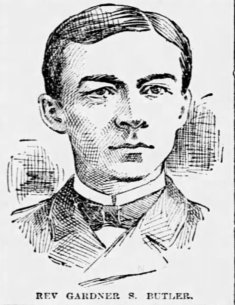
Butler, Gardner S.A Palmer, MA, town meeting elected Temperance party leaders Rev. F.E. Jenkins, Rev. Gardner S. Butler, and school superintendent L.H. Gager, as a prosecuting committee in 1896. They raided illegal liquor dealers, prosecuted over 90 cases, and secured 64 convictions, with fines totaling $3,050.

Rev G.S. Butler, pastor of the Union Evangelical church in Three Rivers, came to Palmer in May, 1892. He was born in Vermont. Since coming to Palmer, Mr. Butler has become known as an enthusiastic temperance worker. He has been a firm supporter of no-license, and demonstrated his willingness to do anything possible for the good of the cause he favored (Boston Globe, December 4, 1896).

Gardner S. Butler, a clergyman, aged fifty years (b. VT), headed a Wakefield, NH, household at the time of the Twelfth (1900) Federal Census. His household included his wife, Rose M. Butler, keeping house, aged forty-nine years, his nephew, Lisle Carl Percy, at school, aged eighteen years (b. VT), and his servant, Eliza H. Welch, a servant, aged twenty-three years (b. NH).

NORTH TROY. Rev. G.S. Butler, a former pastor here, and well known in this vicinity, was In town recently, coming with his father’s remains, from Attleboro, Mass. Mr. Butler is located at Atlanta, Ga., as a professor in a theological school (Orleans County Monitor (Barton, VT), March 30, 1903).

Rosa M. Butler died, probably in Charleston, SC,  before 1920. Gardner S. Butler died in Demorest, GA, December 28, 1930.

S.H. Atkins – c1886-87

S.H. Atkins appeared in the Milton [Milton Mills] business directory of 1887, as pastor of the Congregational church there.

Springvale. The thirteenth meeting of the York county Baptist association was held here Tuesday, and was well attended. In the evening there was preaching by Rev. S.H. Atkins, of Milton Mills, N.H. (Biddeford Daily Journal, May 6, 1887).

(And a Rev. Charles Atkins gave the prayer before the strike meeting of the Milton Mills Shoe Strike of 1889).

Henry S. Ives – 1888-91

Henry Samuel Ives was born in Canada, May 5, 1864, son of Frederick T. Ives. He emigrated to the United States, in or around 1881.

He married, in 1886, Mary Penny Caruthers. She was born in Glasgow, Scotland, in February 1867, daughter of Richard and Margaret (Thompson) Carruthers.

Durham. The Piscataqua Association will meet at Durham with the Rev. Samuel H. Barnum on Tuesday. October 16th, at ten A.M. Rev. George Lewis of South Berwick, Maine, will deliver the concio and act as moderator, Twenty minutes are to be devoted to the State of Religion and Practical Questions. Rev. G.S. Butler, now of Ballardvale, Mass., will discuss Christian Experience; Rev. H.S. Ives of Milton Mills will present an exegesis of the last clause of I. John i: 7; Rev. A. Ross of Hampton will read an essay on the Scripture meaning of the phrase, The Blood of Christ; Review by Rev. Frank Haley of Milton. Rev. J.H. Fitts, South Newmarket, Scribe (Vermont Chronicle, October 12, 1888).

H.S. Ives appeared in the Milton [Milton Mills] business directory of 1889, as pastor of the Congregational church there.

Henry S. Ives of Francestown, NH, petitioned the NH Supreme Court in Manchester, NH, April 13, 1894. He sought to become a US citizen. He renounced Queen Victoria and took the US citizenship oath in Nashua, NH, 20 October 1896.

Henry S. Ives, a clergyman, aged thirty-six years (b. Eng. Canada), headed a Francestown, NH, household at the time of the Twelfth (1900) Federal Census. His household included his wife, Mary P.C. Ives, aged thirty-three years (b. Scotland), and his children, Florence M. Ives, aged eleven years (b. NH), and Murray R. Ives, aged ten years (b. ME).

Henry S. Ives died in Newbury, VT, April 23, 1934. Mary P. (Carruthers) Ives died in 1963.

Isambert B. Stuart – 1891-93

Isambert Burnell Stuart, b. 25 Nov. 1856, Boothbay, Me, son of Thomas W. and Sarah M. (Barter) Stuart. Pastor, North Yarmouth, Me., 1889-91; Milton Mills, N.H., 1891-93; Alstead, N.H., 1893-01; Hooksett, N.H., 1901-05; Cohasset, Mass., 1905-07; d. 20 Feb. 1907, Boothbay Me. (Bates College, 1915).

Isambert B. Stewart married (1st) in Boothbay, ME, September 22, 1877, Georgia A. Greenleaf, both of Boothbay. She was born in Boothbay, ME, in 1858.

Isambert B. Stuart, a teacher, aged twenty-four years (b. ME), headed a Boothbay, ME, household at the time of the Tenth (1880) Federal Census. His household included his wife, Georgia A. Stuart, keeping house, aged twenty-three years (b. ME), and his daughter, Edith Stuart, aged eleven months (b. ME).

Religious Intelligence. New Hampshire. Milton. Rev. J.B. Stuart is beginning his ministry at Milton Mills very agreeably. His people have given him a reception, and valuable presents (Vermont Chronicle, August 14, 1891).

Religious Intelligence. New Hampshire. Milton Mills. The church here, Rev. Z.B. Stuart pastor, observed Easter by a responsive service in the morning and a Sunday-school concert in the evening. The music at both services was exceptionally fine (Vermont Chronicle, April 29, 1892).

I.E. Stuart appeared in the Milton [Milton Mills] business directory of 1894, as pastor of the Congregational church there.

Georgia A. Stuart died in 1896. Isambert B. Stuart married (2nd) in Boothbay, ME, September 5, 1901, Emma R. Greenburg, both of Boothbay She was born in Boothbay, ME, circa 1859-60, daughter of William and Mary J. (Pinkham) Greenburg.

Isambert B. Stuart died in Boothbay, ME, February 20, 1907.

Hiatus

The pulpit was vacant in the Milton [Milton Mills] business directories of 1898, 1901, and 1904.

Since that time the church has depended upon theological students or visiting ministers for preaching and public worship (Scales, 1914). 

References:

American Board of Commissioners. (1882). The Missionary Herald. Retrieved from books.google.com/books?id=wADPAAAAMAAJ&pg=PA414

American Home Missionary Society. (1880). The Home Missionary: For the Year Ending April 1880. Retrieved from books.google.com/books?id=jPTNAAAAMAAJ&pg=RA1-PA204

American Home Missionary Society. (1881). The Home Missionary: For the Year Ending April, 1881. Retrieved from books.google.com/books?id=kOTOAAAAMAAJ&pg=PA250

Andover. (1883). General Catalog of the Theological Seminary, Andover, Mass. Andover, MA: Warren F. Draper.

Bates College. (1915). General Catalogue of Bates College and Cobb Divinity School, 1863-1915. Retrieved from books.google.com/books?id=EetJAAAAMAAJ&pg=PA222

Comstock, John M. (1915). The Congregational Churches of Vermont and Their Ministry, 1762-1914. Retrieved from books.google.com/books?id=obHRAAAAMAAJ&pg=107

Congregational Publishing Society. (1888). Congregational Yearbook, 1888. Retrieved from books.google.com/books?id=0gARAAAAIAAJ&pg=PA128

Cutter, William Richard. (1908). Historic Homes and Places, and Genealogical and Personal Memoirs Relating to the Families of Middlesex County, Massachusetts. Retrieved from books.google.com/books?id=nn1yyHiYJFYC&pg=PA1438

Find a Grave. (2008, January 13). Rev. Almon Taylor Clarke. Retrieved from www.findagrave.com/memorial/23950600

Find a Grave. (2013, February 25). Benjamin Gilman Adams. Retrieved from www.findagrave.com/memorial/105828849/benjamin-gilman-adams

Find a Grave. (2011, August 26). Rev. Charles F. Goldsmith. Retrieved from www.findagrave.com/memorial/75502930

Find a Grave. (2011, September 21). Rev. Charles H. Hickok. Retrieved from www.findagrave.com/memorial/76890117

Find a Grave. (2011, October 19). George Michael. Retrieved from www.findagrave.com/memorial/78717479 

Find a Grave. (2013, January 3). Rev. Henry S. Ives. Retrieved from www.findagrave.com/memorial/122663738

Find a Grave. (2012, July 21). Rev. Isambert B. Stuart. Retrieved from www.findagrave.com/memorial/93994283

Find a Grave. (2015, August 5). Rev. Willis Augustus Hadley. Retrieved from www.findagrave.com/memorial/150217793

(General Conference). (1877) General Conference of the Congregational Churches of Maine, Fifty-First Anniversary. Retrieved from books.google.com/books?id=JkX6ebnKU04C&pg=RA1-PA49

McKillop, Dugald MacKenzie. (1902). Annals of Megantic County, Quebec. Retrieved from books.google.com/books?id=JBc1AQAAMAAJ&pg=PA131

Merrill, Georgia Drew. (1889). History of Carroll County, New Hampshire. Retrieved from books.google.com/books?id=xmMKyZxlU5MC&pg=PA513

NH Missionary Society. (1871-75). Minutes. Retrieved from books.google.com/books?id=o_oQAAAAIAAJ&pg=RA9-PA31

Pilgrim Press. (1905). The Congregationalist and Christian World. Retrieved from books.google.com/books?id=8GRMAAAAYAAJ&pg=PA683

Scales, John. (1914). History of Strafford County, New Hampshire, and Representative Citizens. Retrieved from books.google.com/books?id=nGsjAQAAMAAJ&pg=PA518

Stover, Clyde B. (1918). Alumni Directory of Pennsylvania College of Gettysburg, 1832-1918. Retrieved from books.google.com/books?id=qwoTAAAAIAAJ&pg=PA134

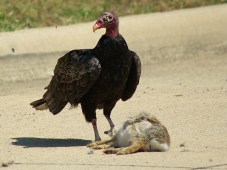
The Question

By S.D. Plissken | February 24, 2019

Meet the Candidates Night is to take place tonight, February 24, at 6:00 PM, at the Emma Ramsey Center.

There are actually few choices to be made on this year’s ballot. Most of the candidates are running unopposed.

Running Unopposed

Thomas McDougall and Humphrey Williams are the two candidates running for two seats on the Budget Committee. There is a third seat with no candidate at all.

James M. “Mike” Beaulieu and Sean Skillings are the two candidates running for two seats on the Zoning Board of Adjustment.

Bruce W. Woodruff is the sole candidate for the Cemetery Trustee seat. Miranda Myhre is the sole candidate for Library Trustee. Joseph A. Michaud is the sole candidate for a Planning Board seat. Mackenzie Campbell is the sole candidate for Treasurer. Brittney Leach is the sole candidate for Trustee of the Trust Funds. Michelle Beauchamp is the sole candidate for Town Clerk / Tax Collector.

Barring some upset write-in candidate, these people will hold these seats. Votes by themselves, their spouses, their parents, and their children would be enough to put them in office. That is nothing against them, who have stepped up to do a task, but just don’t take it as much of a “mandate.”

The only contested elections are for a single seat on the Board of Selectmen and a single three-year seat as Fire Chief.

Fire Chief – Three Year Position = Vote for not more than One

Incumbent Nicholas Marique and challenger Stephen D. Duchesneau are vying to be Fire Chief. I am not aware of any published statements issued by either candidate, except perhaps that Mr. Duchesneau’s campaign signs are frequently accompanied by similarly colored ones urging us to “Stop the Spending.”

Board of Selectmen – Three Year Position – Vote for not more than One

The five candidates for the single seat on the Board of Selectmen are Andrew “Andy” Rawson, Adam G. Sturtevant, Billy Walden, James M. “Mike” Beaulieu, and Lawrence D. “Larry” Brown.

You may recognize the names of Andrew Rawson and James M. “Mike” Beaulieu as being two of the three selectmen of the year before last: the 2017-18 year. The third of that year was the current board chairman, Ryan Thibeault.

This is the group that authorized and oversaw the massively flawed valuation of that year. James M. Beaulieu left office early, so did not take a part in the aftermath. Neither then Chairman Andrew Rawson nor then Selectman Thibeault have ever explained what caused the problem – apart from blaming the assessing contractor – or any details of its size and scope, or their role in the problem – either in its making or in offering any proposed solutions.

The current board, which includes then Selectman Thibeault as its current chairman, claimed the unauthorized overages and used the money to blur their own spending increases. Candidate Lawrence D. “Larry” Brown noted approvingly that the law permits this.

Even without the assessment problem, the trio of Rawson, Beaulieu, and Thibeault were right in line with past boards in completely failing to rein in greater-than-inflation budget increases. They were the component parts of yet another failed board – voting unanimously to spend more than we have.

So, Andrew “Andy” Rawson, James M. “Mike” Beaulieu, and, to a lesser extent, Lawrence D. “Larry” Brown, who has held nearly every office except selectman, have all quite a bit of overdue explaining to do. Of all the five candidates, these three most of all would need to demonstrate firm commitments to change – I know, the likely worth of politicians’ promises – before they are again trusted with the keys.

The Question

In terms of this Meet the Candidates Night, there is one fundamental question to be asked.

That question is not “how long have you lived in Milton,” nor is it “by how much will you cut the tax rate,” nor “by how much will you cut the rate of budget increase,” nor whether or not Milton needs “more businesses” to fuel its overspending, nor how might such cuts affect services, nor even “muh community.”  It is much too late for all those standard circumlocutions.

The only meaningful question for these candidates is: By how much will you cut the Town budget?

If, as has been reliably calculated, our current Town budget is half again what it should be, only budget cuts can restore sanity. Not fiddling of a combination of valuation and tax rate, nor level-funding a bloated budget, but cutting the overall budget.

Anyone who cannot answer this simple question in a clear and satisfactory manner can not be trusted with the keys. In effect, they will be telling you – by not answering – that they will be the reliable third vote on future budget and tax increases.

Kick start the change now. Ask the question. Vote only for candidates that can answer it.

References:

Town of Milton. (2019, February). Meet the Candidates. Retrieved from www.miltonnh-us.com/sites/miltonnh/files/agendas/2.24.19_candidates_night_.pdf

Circumpolar Constellations: Cassiopeia

By Peter Forrester | February 23, 2019

Today I begin a series on the constellations that are close to the North Star. Constellations that never set from a person’s perspective are called “circumpolar”. They rotate once around Polaris every 24 hours but never go below the horizon. Which constellations are circumpolar depend on your latitude, or distance from the equator, but from northern latitudes between 40 and 50 degrees north, there are five constellations that are definitely circumpolar, with four of them having at least some fairly bright stars.

Milton’s latitude is 43º 24′ (43 degrees 24 minutes) North. If you imagine a circle sitting on the horizon, with the North Star, Polaris, at its center, then everything inside that circle is circumpolar. So I may extend this series out over more than just the first five parts.

I begin with the one called Cassiopeia (one of Ptolemy’s original 48 constellations in the 2nd Century AD), because it is currently high and easily visible in the early evening. The five brightest stars in this constellation form an “asterism” or group of stars with a very recognizable shape, which depending on its direction can be described as a funny “E”, “W”, “M”, or “3”.

If you imagine another circle around Polaris, this one with the Big Dipper on the edge, then Cassiopeia is also on this circle, across from the Big Dipper. In other words, it’s about the same distance away from Polaris as the dipper, but on the other side. So you will always find her in a northerly direction.

Cassiopeia was a vain queen in Greek mythology, who bragged that she and her daughter Andromeda were more beautiful than the Nereids, the daughters of the sea god Nereus. In anger, the god Poseidon punished her kingdom, and she and her husband were persuaded to sacrifice Andromeda to a sea creature Cetus, but she was fortunately rescued by the hero Perseus. Some depictions of Cassiopeia show her chained to a chair of a type once used in torture, which is said to be the gods’ final punishment.

The brightest star in Cassiopeia, Schedar, or α (Alpha) Cassiopeiae, has an apparent magnitude of 2.2. The γ (Gamma)  star sometimes brightens up to 1.6 but is normally around 2.3 in magnitude. Two of the three other stars in the “W” asterism are between 2.3 and 2.7 in magnitude. The dimmest of the five stars in the asterism has a magnitude of 3.3.

The Milky Way (what appears to be a long, thin cloud but is actually the edge of the disk of the galaxy) runs through Cassiopeia. Thus there are many “deep sky” objects such as star clusters and nebulae, and two supernova remnants (including a famous supernova from the year 1572). There are also several galaxies within Cassiopeia. Some of these deep-sky objects can be seen with the naked eye, but generally it takes a telescope to get a good view.

Cassiopeia was one of the first constellations I learned to identify as a teenager because it is so bright and always so close to the North Star. I hope you will take the time to look up and see if you can find it, and happy stargazing!


References:

The Urban Astronomer. (2008, December 17). Circumpolar Stars. Retrieved from http://urbanastronomer.blogspot.com/2008/12/circumpolar-stars.html.

Wikipedia. (2019, February 12). Cassiopeia (constellation). Retrieved from https://en.wikipedia.org/wiki/Cassiopeia_(constellation) on February 19, 2019.

Wikipedia. (2019, January 22). Cassiopeia of Ethiopia. Retrieved from https://en.wikipedia.org/wiki/Cassiopeia_of_Ethiopia on February 19, 2019.

Wikipedia. (2018, January 28). Circumpolar constellation. Retrieved from https://en.wikipedia.org/wiki/Circumpolar_constellation on February 19, 2019.

Wikipedia. (2019, February 11). Latitude. Retrieved from https://en.wikipedia.org/wiki/Latitude on February 19, 2019