Milton’s NH State Representative William Palmer (1757-1815), speaking for a “respectable number of inhabitants,” petitioned NH Governor John Taylor Gilman and his Executive Council in 1813, seeking appointment of a Milton justice-of-the-peace. (Gilman was a Federalist, as opposed to a Democratic-Republican).
The nominee, John Remick, “Jr.,” was born in Kittery, ME, April 17, 1777, son of Sergeant William and Lydia (Staples) Remick. (He acquired the appellation “Junior” in Milton to distinguish him from his older cousin, John Remick, who was a son of Benjamin and Elizabeth (Deed) Remick and who came to Milton after him, in 1799).
John Remick married (1st) in Kittery, ME, August 17, 1794, Mary “Polly” Butler. She was born in Portsmouth, NH, May 18, 1770, daughter of Captain Edward and Elizabeth (Langdon) Butler.
John and his wife, Mary, bought land in Rochester, 1795, 1798 and 1799. 7 June 1799 he signed a deed as “Jr.,” and also in 1800 (Remick, 1933).
John Remick, Jr., headed a Rochester, NH, household at the time of the Second (1800) Federal Census. His household included one male aged 26-44 years [himself], one female aged 26-44 years [Mary (Butler) Remick], one female aged 16-25 years, one male aged 10-15 years, one male aged under-10 years [Edward B. Remick], and two females aged under-10 years [Lydia S. Remick and Eliza Remick].
John Remick, Jr., signed the petition seeking to divide what would be Milton from its parent Rochester, NH, in 1802. He was one of the newly established town’s first three Selectman in 1802, along with William Palmer and John Fish. He served in that capacity in 1802, 1804, 1805, 1807-11, and 1819-20 (Mitchell-Cony, 1908).
He served as a selectman from 1802 to 1812 and again in 1820 and was a Justice of the Peace from 1814 to 1838 (Remick, 1933).
In May 1806, he bought land in Wakefield of which he sold part to Andrew Libby of Kittery, 12 Apr 1809. He sold property in Milton Mills in January 1810 and April 1821, and in both deeds is called “Jr.” (Remick, 1933).
John Remick, Jun., headed a Milton household at the time of the Third (1810) Federal Census. His household included one male aged 26-44 years [himself], two females aged 26-44 years [Mary (Butler) Remick], one male aged 16-25 years, one male aged 10-15 years [Edward B. Remick], two females aged 10-15 years [Lydia S. Remick and Eliza Remick], and one female aged under-10 years [Mary B. Remick]. Their household appeared first in the enumeration, just before those of Moses Paul and Joseph Libby.
In 1813 former selectman and then NH State Representative William Palmer penned his personal petition recommending John Remick, Jr., for appointment as justice-of-the-peace. (In it he alluded to several business entities then active in the Northeasterly part of Milton, i.e., Milton Mills).
To His Excellency the Governor And the Honorable Council of the State of New Hampshire
Wm Palmer, A Representative from the town of Milton, respectfully beg leave to represent, that a respectable number of Inhabitants who live in the Northeasterly part of said town, experience many inconveniencies by reason of there not being any Justice of the peace living within three or four miles of them, that it is a considerable place of trade – 3 Sawmills, 3 Gristmills and one carding machine in the village, where much business is done, and where much company resorts – that it would be very convenient and gratifying to the inhabitants to have some suitable person, who resides among them, appointed to that office ~ that it would have a happy tendency to preserve peace, insure tranquility and promote the public good ~ I therefore ask leave to recommend Mr John Remick, Junr, as a suitable person for that office ~ A man in my opinion whose natural and acquired abilities are good, of correct morals and temperate habits ~ And if appointed it will be Gratifying to the town at large ~ And in particular to your Excellency and Honors.
Palmer’s petition was labeled on its reverse side:
For a Justice
In Milton
Nominated 1813
Court Rosters indicate that John Remick, Jr., of Milton, received his appointment as a Milton justice-of-the-peace on June 18, 1813.
The Records of Elder Joseph Spinney of Wakefield from 1835 to 1898 have been preserved and among the items contained therein were a list of marriages performed by John Remick, Jr., Justice of the Peace of Milton, N.H., from 1814 to 1838, and an extract of the will of [his father-in-law,] Captain Edward Butler (Remick, 1933).
John Remick, Jr., was Milton’s State Representative during the 1816-17 biennium.
Court Rosters indicate that John Remick, Jr., of Milton, received a renewal of his appointment as a Milton justice-of-the-peace on June 18, 1818.
Remick was at the center of the dispute that arose over Milton’s militia company in 1820.
… in 1820 an effort was made by the people living in this town below Lovell’s pond with others living in the Northerly part of Milton, to have that part of Wakefield south of Lovell’s pond and the northerly portion of Milton incorporated into a new town, Luther Dearborn of this town and John Remick, Jr., of Milton headed petitions to the legislature for the new town which was to be called Lisbon. The Rev. Mr. Piper favored the project and suggested the name Milfield for the new town (Thompson, 1886).
The NH Register and Farmer’s Almanac of 1822 identified Milton’s Justice of the Peace and Quorum, which was the higher or senior office, as being Levi Jones, and its Justices of the Peace as being Jotham Nute, D. Hayes, John Remick, Jr., and James Roberts (Claremont Manufacturing Co, 1822).
In 1822 he acted as the administrator of the estate of Mark Langdon Butler of Portsmouth, his brother-in-law (Remick, 1933).
Court Rosters indicate that John Remick, Jr., of Milton, received a renewal of his appointment as a Milton justice-of-the-peace on June 10, 1823.
His older cousin, John Remick (son of Corporal Benjamin Remick), the existence of whom had caused him, the younger cousin, to be identified for many years as “Junior,” died in Milton, June 25, 1823. The elder cousin’s widow, Susanna (Cole) Remick, died in Milton, August 28, 1824.
The NH Political Manual and Annual Register of 1824 identified Milton’s Justice of the Peace and Quorum as being Levi Jones, and its Justices of the Peace as being Jotham Nute, D. Hayes, John Remick, Jr., and J. Roberts. Jotham Nute was also identified as being Milton’s coroner (Farmer, 1824).
Mary (Butler) Remick died in Milton, sometime before February 1826.
John Remick, Esq., married (2nd) in Wakefield, NH, February 9, 1826, Sally Nudd, he of Milton and she of Wakefield, NH.
In his second marriage record he had the appellation of “Esq.” given to him, because of this latter [justice-of-the-peace] office (Remick, 1933).
Court Rosters indicate that John Remick, Jr., of Milton, received a renewal of his appointment as a Milton justice-of-the-peace on June 14, 1828.
John Remick headed a Milton household at the time of the Fifth (1830) Federal Census. His household included one male aged 50-59 years [himself], one female aged 50-59 years [Sally (Nudd) Remick], one female aged 15-19 years [Salome Remick], and one male aged 10-14 years. Their household appeared in the enumeration between those of Nathl Dearborn and Francis Chapman. (Milton Mills merchant B.U. Simes appeared on the other side of Nathl Dearborn).
Court Rosters indicate that John Remick, Jr., of Milton, received a renewal of his appointment as a Milton justice-of-the-peace on June 15, 1833. He did not continue as a justice beyond the June 1838 expiration of this last appointment.
John Remick headed a Milton household at the time of the Sixth (1840) Federal Census. His household included one male aged 60-69 years [himself], two females aged 60-69 years [Sally (Nudd) Remick and her sister, Betsy Nudd], and one male aged 20-29. One person in the household was engaged in Agriculture.
John Remick made out his last will, May 29, 1840. In it he devised a life estate in all of his real estate, as well as two cows, six sheep, furniture and personal property, to his beloved wife, Sally Remick, and her sister, Betsy Nudd, while they remained unmarried. Should either die or marry, their share in the life estate would pass to the survivor or, in the event of a marriage, to the one that remained single. Once both had either passed or married, the property was to pass to his children or trusts set up on their behalf. Daughter Lydia S. Page was to have a life estate, which would pass eventually to grandson J.W.R. Page at her decease. Of the remainder, daughter Eliza L. Copp was to receive one-third outright. Amasa Copp was to hold one-third in trust in order to pay an allowance to son Edward B. Remick. John Wingate of Wakefield, NH, was to hold one-third in trust in order to pay an allowance to daughter Mary Copp, widow of William Copp. He appointed his wife, Sally Remick, and James Berry, as joint executors. David Witham, Josiah Farnham, and Josiah Hussey signed as witnesses (Strafford County Probate, 58:325).
John Remick died in Milton, September 12, 1840. His will was proved in Somersworth, NH, October 6, 1840.
Sally (Nudd) Remick died in Milton, November 23, 1845, aged sixty-seven years, seven months.
Thompson, Rev. Albert H. (1886). Memorial of the One Hundredth Anniversary of the Organization of the First Church, and Ordination of the First Settled Town Minister of Wakefield, N.H. Retrieved from books.google.com/books?id=EKm15quwMhsC&pg=PA42
Theodore Cushing “T.C.” Lyman was not born under that name. He was born as Theodore Ham in Dover, NH, in 1770.
His grandson, John D. Lyman (1823-1902), would devise in his will a number of mementos to family and friends. Among them was a fire shovel, which he gave to his son, John T. Lyman (b. 1862).
The little old fire shovel (the one used by John Twombley born about 1732 and who lived on my father’s farm and brought up my grandfather Theodore Cushing Lyman, and my first property excepting a dollar given me by Wm. Allen Lord) (Rockingham County Probate, 220:182; Portsmouth Herald, September 25, 1902).
Through which one may learn that John Twombly (1732-1825) had raised Theodore Cushing Lyman – then Theodore Ham, – as a child, and had late in life lived on Micah Lyman’s Milton farm. (And that William Allen Lord had given a dollar to a young John D. Lyman (perhaps as a gift on the occasion of Lord’s marriage to his paternal aunt)).
The Mitchell-Cony account of Milton’s first settlement had John Twombly settling in the “Varney neighborhood” around 1771-72.
About ten or a dozen years later, in 1771 or 1772, John Twombly established himself in the so-called Varney neighborhood. His nearest neighbor was a man named Jenkins upon Goodwin Hill at the time.
As one may see later, Theodore C. Lyman had several South Milton mill associates named Varney. “Goodwinville” was later a neighborhood on the ridgeline in West Milton (along the Governor’s Road).
Milton Town Clerk Ruth L. (Plummer) Fall (1886-1960) claimed Twombly as one of her own.
John Twombly died in Milton in 1825, aged ninety-three years. He is buried on the farm of my great-great-grandfather, who was taken when a young boy by John Twombly. This Twombly was a native of Madbury. When our New Hampshire troops, stationed at Ticonderoga during the Revolution, were reported to be in need of supplies, John Twombly yoked up his oxen, and drove to Portsmouth, where his team was loaded with flour, powder, bacon and rum. Then he journeyed across New Hampshire and Vermont to Fort Ticonderoga where he was gladly welcomed by our needy soldiers (Bartlett, 1952).
John Twombly headed a Rochester, NH, household at the time of the First (1790) Federal Census. His household included two males aged 16-plus years and one female. His household appeared in the enumeration between those of Richard Mason and Ebenezer Jones. (See Northeast Parish in the First (1790) Federal Census).
Theodore Ham married (1st) in Rochester, NH, January 3, 1797, Dorothy “Dolly” Allen, both of Rochester (NEHGS, 1908). She was born in Rochester, NH, August 24, 1769, daughter of William and Hannah (Emerson) Allen.
Son Micah Ham was born in Rochester (Milton as would be), NH, November 23, 1797. Daughter Lovey Ham was born in Rochester, NH, in 1800.
Theodore Ham headed a Northeast Parish, Rochester, NH, household at the time of the Second (1800) Federal Census. His household included one male aged 26-44 years [himself], one female aged 26-44 years [Dorothy (Allen) Ham], one male aged 16-25 years, one male aged 10-15 years, one male aged under-10 years [Micah Ham], and one female aged under-10 years [Lovey Ham]. His household appeared in the enumeration between those of Clement Hayes and Nicholas Harford. (See Northeast Parish in the Second (1800) Federal Census).
Daughter Clarissa L. Ham was born in Milton, October 9, 1802. Son George D. Ham was born in Milton, August 27, 1804. Son William Blake Ham, was born in Milton, April 23, 1807.
State of New Hampshire } AN ACT AUTHORIZING THEODORE HAM AND HIS FAMILY TO ASSUME THE NAME OF LYMAN. ~ [Approved December 13, 1808. Original Acts, vol. 20, p. 26; recorded Acts, vol. 18, p. 32]
Be it enacted by the Senate and House of Representatives, in General Court convened, That Theodore Ham of Milton in the County of Strafford, be, and he hereby is authorized and empowered to assume and bear the name of Theodore C Lyman, and the children of the said Theodore are hereby authorized and empowered to assume and bear the name of Lyman, instead of that of Ham and the name of Lyman to annex to each and every of their christian, given or baptismal names instead of the name of Ham as aforesaid, and by those names respectively, in future, shall be called and known, any law, usage or custom to the contrary notwithstanding. ~
Provided, that nothing in this act contained, shall impair any contract or obligation by them or either of them made, or affect any action or suit now pending in any Court of law, within this State wherein the said Theodore or either of his children is a party ~ (NH Secretary of State, 1918).
Roxana A. Lyman was born in Milton, in 1809. She would have been the first child born under the name Lyman. (The others had their surnames changed from Ham to Lyman in the prior year).
Theodore C. Lyman and twenty-two other Strafford County inhabitants petitioned the NH Governor and his Executive Council, January 31, 1810, to have Amos Cogswell (1752-1826), Esq., of Dover, NH, appointed as Strafford County Sheriff. Cogswell had been an officer during the Revolutionary War and was a Colonel in the militia. (Beard Plumer, Levi Jones and William Jones signed also this petition).
[T.] C. Lyman headed a Milton household at the time of the Third (1810) Federal Census. His household included one male aged 26-44 years [himself], two females aged 26-44 years [including Dorothy (Allen) Lyman], one male aged 10-15 years [Micah Lyman], one female aged 10-15 years [Lovey Lyman], two females aged under-10 years [Clarissa Lyman and Roxana A. Lyman], two males aged under-10 years [George D. Lyman and William B. Lyman], and one female aged 45-plus years. His household appeared in the enumeration between those of Ebenr. Gate and Jno. Twombly.
At the U.S. Congress, in January 1811, Milton’s Theodore C. Lyman and [Rep.] John Fish (c1760-181[9?]) sought salvage rights in any public property that might be lying at the bottom of Lakes George and Champlain in New York state. (U.S. Representative William Hale (1765-1848) of Dover, NH, presented their petition).
Mr. Hale presented a petition of Theodore C. Lyman and John Fish, of the State of New Hampshire, stating that they have invented a machine for exploring the bottoms of Lakes Champlain and George; and praying that they may have the exclusive property in all articles which belonged to the public prior to being lost, and which they may recover. Ordered, That the said petition be referred to the Committee of Commerce and Manufacture (US Congress, 1826).
This begs so many questions. What was the nature of their machine? Perhaps a floating derrick, a diving bell, or something truly innovative, such as a submarine. What public property did they hope or expect to find? Perhaps something lost in those lakes during the Revolutionary War. Did they experiment by exploring the depths of Milton Three Ponds or Lake Winnipesaukee? At any event no further information has come to hand and that distant lakes region would become again a seat of war during the War of 1812.
Milton sent Theodore C. Lyman twice as its representative to the NH legislature, first in the 1811-12 biennium. (He succeeded his salvage associate, John Fish, in that office).
Theodore C. Lyman was one of ten petitioners that recommended Mr. Dominicus Hanson (b. 1760), then Strafford County Registrar of Deeds, for appointment as justice-of-the-peace. Their June 1812 petition was dated Concord, NH. (Hanson did receive his appointment as a justice in Dover, NH, November 8, 1813).
The Mitchell-Cony directory relates that there was a “famous” celebration at the T.C. Lyman tavern in [South] Milton, April 15, 1815, “which fitly manifested the joy and satisfaction of the people here over the outcome of the war,” i.e., the War of 1812. (In 1876, Betsy ((Meserve) Pinkham) Lyman would remember that there was also a thanksgiving service on that occasion at the Tuttle school in West Milton).
State of New Hampshire } AN ACT TO INCORPORATE GRAPE ISLAND MILL COMPANY
[Approved June 20, 1817. Original Acts, vol. 24 p. 73, recorded Acts, vol. 21, p. 32] Be it enacted by the Senate and House of Representatives in General Court convened, that Jacob Varney, Theodore C. Lyman and Job Varney and their associates, successors and assigns be, and they hereby are, incorporated and made a body corporate and politic, by the name and style of Grape Island Mill Company. and by that name may sue and be sued prosecute and defend to final judgment and execution. and they are hereby vested with all the powers and privileges which by law are incident to similar institutions. And be it further enacted, that said Jacob Varney and Theodore C. Lyman or either of them may call the first meeting of said Corporation, at any suitable time and place in the town of Milton, in the County of Strafford, by posting up notifications for that purpose in said Milton and in the towns of Farmington and Rochester, at some public place in each of said Towns, fourteen days prior to the time of holding said meeting; at which meeting they may elect a Clerk, who shall be sworn, and all other officers necessary for such an institution; and shall also agree on a method of calling future meetings, and determine on the time of their annual meeting, and make and establish, generally, such rules, by laws and regulations, not inconsistent with the laws of the State, as shall be deemed necessary and proper for the government of said Corporation; and may divide the same into a convenient number of shares ~ and all absent members may be represented at any meeting, by written authority, which shall be filed by the Clerk; and in all cases each share shall be entitled to one vote ~ And be it further enacted, that said Corporation be and they hereby are authorized and empowered to build, support and keep in repair in Milton aforesaid, on Salmon fall river, so called, any buildings or works necessary and convenient for sawing lumber, grinding and bolting grain and meal and carding wool and cotton, and the business necessarily connected therewith, and may purchase and hold in fee simple or otherwise any lands adjoining said buildings and works, necessary and convenient for said Proprietors not exceeding three acres. And the share or shares of any proprietor may be sold by said Corporation for non payment of assessments duly made, agreeably to the by laws of said Corporation ~ and any proprietor may alienate his share or shares in said Corporation by deed duly executed and recorded by the Clerk (NH Secretary of State, 1918).
President Monroe visited New England in the summer following his 1817 inauguration. He traveled from Boston, MA, to Portsmouth, NH, and Portland, ME, returning via Dover, NH.
The President was then escorted by the principal inhabitants of Dover, a part of Capt. [Theodore C.] Lyman’s troop from Rochester & Milton, under the command of Col. Edward Sise, and a great cavalcade of citizens to this town. On his arrival he received a national salute from the artillery. After passing a few moments at Wyatt’s Inn, the President, attended by his suite, proceeded to an eminence arranged for the purpose, near Col. Cogswell’s, decorated with the rural simplicity of evergreens and roses, where he was addressed by the Hon. Wm. King Atkinson … (Wadleigh).
Milton sent Theodore C. Lyman as its representative to the NH legislature for a second – non-contiguous – term in the 1818-19 biennium. (He succeeded William Plumer in that office).
Theodore C. Lyman and thirteen other Strafford County inhabitants petitioned the NH Governor and his Executive Council, June 24, 1818, to have Jonathan Locke of Dover, NH, appointed as Warden of the state prison. Locke was then keeper of the Strafford County jail or prison. (Amos Cogswell signed also this petition).
Theodore C. Lyman and twenty other NH Representatives from Strafford County petitioned the NH Governor and his Executive Council, June 8, 1819, to have John P. Hale (1775-1819), Esq., of Rochester, NH, appointed as Strafford County Registrar of Probate. Hale would die later that same year.
DIED. At Rochester, (N.H.,) in the 45th year of his age, John P. Hale, Esquire, counsellor at law (New York Evening Post, October 19, 1819).
(Hale was father of John P. Hale, Jr. (1806-1873), who would be U.S. Representative, U.S. Senator, and one of the principal anti-slavery politicians of the ante-bellum period. (There is a statue of him in front of the NH State House and a portrait painting of him hanging in the NH House chamber)).
Theodore C. Lyman and six others petitioned the NH Governor and his Executive Council, June 10, 1819, to have John Hill of Middleton, NH, appointed as a second Middleton justice-of-the-peace.
The NH House passed a housekeeping measure, June 30, 1819, in order to correct an error in the travel allowances of Representatives Theodore C. Lyman of Milton and Joshua Lane of Chichester.
Presented. A resolve that Theodore C. Lyman, esquire, and Joshua Lane, esquire, members of the House of Representatives, have and receive out of the Treasury the following sums, viz. the said Lyman two dollars and the said Lane one dollar and sixty çents, those sums being deficiencies in their travel the present session, as certified by the Clerk. Was brought up read and concurred (NH General Court, 1819).
Captain Theodore C. Lyman was one of fourteen officers of the Second NH Militia Regiment that petitioned the NH legislature, September 23, 1819, for appointment of a regimental surgeon’s mate. The regimental surgeon, who resided in Dover, NH, was too distant from them to fulfill all their needs alone. (Ensign Norton Scates was another of the petitioners).
Daughter Lovey Lyman married in Rochester, NH, January 27, 1820, Benjamin Scates, Jr., both of Milton. Rev. Haven performed the ceremony. He was born in Milton, April 10, 1794, son of Benjamin and Lydia (Jenness) Scates.
A dispute regarding the Milton militia company – and especially the great distances some militiamen had to travel to attend its training days – arose in 1820. The regimental field officers refused a request to divide the company into two parts. Those seeking two companies petitioned the NH legislature to simply divide the town instead, which would achieve the same object of having two companies.
Some 127 Milton men filed a remonstrance petition intended for the June 1820 session of the NH legislature. It opposed dividing the town to solve the militia problem. Company officers Jeremy Nute, James Hayes, Jr., and Norton Scates all signed this remonstrance, as did former company officers Levi Jones, Jotham Nute, and Theodore C. Lyman, and future officer Bidfield Hayes.
Some 88 Milton men filed a company division petition intended for the November 1820 session of the NH legislature. Company Captain Jeremy Nute signed this proposal, as did former company officers Levi Jones, Jotham Nute, and Theodore C. Lyman, future company officer Bidfield Hayes, and Milton selectman Hopley Meserve.
Son Micah Lyman married in Milton, December 27, 1820, Mary Kelly, both of Milton. Rev. James Walker performed the ceremony. She was born in Rochester, NH, circa 1795. (Foster grandfather John Twombly would live with them).
Theodore C. Lyman and thirteen other NH citizens petitioned the NH General Court, December 6, 1824, seeking a law to prevent rocks, stones and other debris being thrown in the Piscataqua River.
Son George D. Lyman died in Milton, August 31, 1825.
John Downs sued Theodore C. Lyman over a mill privilege – the “privilege of the floom,” i.e., the flume, in July 1825. Downs asserted a one-sixteenth share in the land of which Lyman’s mill stood. The original privilege had been granted to Samuel Ham by the city of Rochester, NH, in 1763. Ham had sold a one-eighth share to Joseph Roberts in 1769. One might suppose that this was how capital was raised. Ham’s grantees built a mill in 1770. Roberts sold his share to to D. Garland and Joseph Tibbetts in 1776. The mill had burnt in 1785, at which point some of the interested parties declined to rebuild. They seem to have developed some reason to doubt their right to do so. D. Garland sold his one-sixteenth interest (half of a one-eighth interest) to John Downs in 1797.
Lyman maintained that the actual “privilege of the floom” was a riverine feature that lay 200 rods [3,300 feet (or 5/8 of a mile)] above the mill site. The ruling had gone to the demandant, i.e., John Downs. The higher court appeal focused on this issue of whether the flume and the mill site that it fed were the same thing, and whether the unspecified verbal refusal by long-dead people to rebuild on the land might be taken as an acknowledgement by them that they did not have title to the land. The higher court sustained the verdict of the lower one, i.e., they ruled against Lyman (NH Supreme Court, 1827).
Theodore C. Lyman received his initial appointment as a Milton justice-of-the-peace on May 16, 1829.
Theoph C. Lyman headed a Milton household at the time of the Fifth (1830) Federal Census. His household included one male aged 50-59 years [himself], one female aged 60-69 years [Dorothy (Allen) Lyman], one male aged 20-29 years [William B. Lyman], two females aged 20-29 years [Clarissa Lyman and Roxana A. Lyman], and one male aged 15-19 years [Theodore Lyman]. His household appeared in the enumeration between those of Isaac Wentworth and Joseph Walker on one side and Micha~ Lyman on the other side.
Daughter Clarissa Lyman married, circa 1831, William Allen Lord. He was born in Berwick, ME, March 20, 1801, son of Samuel and Abigail (Allen) Lord. (They were cousins, being as their respective mothers, Dorothy (Allen) Lyman and Abigail (Allen) Lord, were sisters).
Theodore C. Lyman received a renewal of his appointment as a Milton justice-of-the-peace on May 20, 1834.
Son Theodore Lyman married, probably in Milton, circa 1837-38, Betsy Bragdon. She was born in Milton, in 1818, daughter of Samuel and Lydia (Walker) Bragdon. (Her younger sister, Louisa A. Bragdon, would marry in Milton, February 4, 1841, Luther Hayes, he of Rochester, NH, and she of Milton).
Theodore C. Lyman received a renewal of his appointment as a Milton justice-of-the-peace on May 21, 1839.
Theodore C. Lyman headed a Milton household at the time of the Sixth (1840) Federal Census. His household included one male aged 60-69 years [himself], and one female aged 20-29 years [Roxana A. Lyman]. (His wife, Dorothy (Allen) Lyman, does not seem to have been counted with his household). One member of his household was engaged in Agriculture. His household appeared in the enumeration between those of Isaac Wentworth on one side and his sons, Theodore Lyman, William B. Lyman, and “Michael” [Micah] Lyman on the other side.
Theodore C. Lyman appeared in the Dover, NH, directory of 1843, as a h. [house] carpenter, upper end of Waldron street. (Some much later death records of several children recorded him as having been at sometime a “contractor”).
According to Scale’s History of Strafford County, Milton’s Free-Will Baptist church organized itself at Theodore Lyman’s house in May 1843.
A Free-Will Baptist Church was organized at the house of Theodore Lyman, on the 11th day of May, 1843, with seventeen members, viz.: Hazen Duntley, Daniel M. Quimby, Luther Hayes, William Fernald, James O. Reynolds, Drusilla Jewett, Betsey Lyman, Mary H. Downs, Mrs. D.W. Wedgwood, William B. Lyman, Theodore Lyman, E.S. Edgerly, Dearborn Wedgwood, Phoebe Duntley, Sophia Quimby, Sally F. Downs, Mrs. A. Hubbard.
This church organizer would seem to have been Theodore C. Lyman’s son, Theodore (without the “C”) Lyman, based at least partly on the presence and membership of that son’s wife, Betsy [(Bragdon)] Lyman). (See also Milton’s Free-Will Baptist Ministers of 1843-50).
Son William B. Lyman had received his first appointment as a Milton justice, June 29, 1843, but there was an additional notation of “gone,” i.e., he left town before the expiration of his five-year term. Theodore C. Lyman received a renewal of his appointment as a Milton justice-of-the-peace, on May 20, 1844, there is next to his entry also a notation of “gone.” So, it would seem that for a time they found it more convenient to live where they were contracting, i.e., Waldron street in Dover, NH. (The railroad not having reached Milton at that time).
Son William B. Lyman appeared in the Dover, NH, directory of 1848, as a pump-maker, with his house at 8 Lyman’s court.
Dorothy (Allen) Lyman died in Milton, November 25, 1848.
Theodore C. Lyman, a carpenter, aged seventy-nine years (b. NH), headed a Milton household at the time of the Seventh (1850) Federal Census. His household included Roxann A. Lyman, aged forty years (b. NH). Theodore C. Lyman had real estate valued at $5,000. Their household appeared in the enumeration between those of Giles Burrows, a farmer, aged twenty-six years (b. NH), and Abigail Tuttle, aged seventy-two years (b. NH). (And Luther Hayes, a lumber dealer, aged thirty years (b. NH), just beyond Tuttle).
Theodore C. Lyman married (2nd) in Rochester, NH, in 1850-51, Betsy [(Meserve)] Pinkham, he of Milton and she of Rochester, NH. He was aged eighty-one years, and she was aged sixty-eight years. She was born in Dover, NH, in 1782, daughter of Stephen and Abigail (Yeaton) Meserve.
Betsy ((Meserve) Pinkham) Lyman’s new home in Milton would have been for a time adjoining a PGF&C railroad construction site. A legislative report of 1848 described the intended route from Great Falls, i.e., Somersworth, NH, to Conway, NH.
Commencing near the covered bridge at Great Falls and running northwesterly, on the west side of Salmon Falls river, to the Parade at Rochester Village; thence from Rochester Village, running a northerly course across the plain, to near where the road that is travelled leaves the Pine Woods; thence running in the vicinity of George Hays’s house and Theodore Lyman’s house to near where the new factory frame of A.S. Howard & Co. is erected, in Milton; thence up by the Milton Ponds and west of the Plummer bridge, so called to Union Village, in Wakefield; thence by Lovell’s Pond, in said Wakefield to the head of Pine River; thence down said river to the east side of the Ossipee Lake; thence across the Ossipee river, to near where Thomas Andrews lives, in Freedom; thence up the valley of what is called the Burke Pond, in Eaton; thence by Daniel Lacy, 2d, and Wm. Stacy’s to Eaton Corner; thence through the valley of the Pequacket, to Conway (NH Senate, 1849).
Daniel G. Rollins, treasurer of the Great Falls & Conway Railroad, sent a letter to his stockholders, June 1, 1850. The railroad intended to issue preferred stock to complete the railroad track between Rochester, NH, to Lyman’s Crossing in South Milton, and, if any funds remained, from there to Milton Three Ponds.
7th. The funds realized by the issue of this preferred stock shall first be appropriated to the completion of the road from Rochester to the road crossing in Milton, near the house of Theodore C. Lyman, and fitting the same for the transportation of passengers and freight, in providing furniture to run and operate the same, and in paying all the debts of the corporation. Any balance remaining shall be appropriated to the completing of the road from Lyman’s crossing to Milton Three Ponds (NH General Court, 1850).
Sophia ((Cushing) Hayes) Wyatt stopped to view the Lyman family tomb at South Milton in January 1854. (See Milton Teacher of 1796-1805). (Despite the coincidence of their Cushing names, they do not seem to have been related).
Son William B. Lyman appeared in the Dover, NH, directory of 1859, as a builder, with his house at 12 Charles street.
Son Micah Lyman died in Milton, September 14, 1860. Son-in-law Benjamin Scates, Jr., died of consumption in Milton, November 10, 1862, aged sixty-seven years, ten months.
Theodore C. Lyman died of old age in Milton, July 30, 1863, aged ninety-two years.
Daughter-in-law Betsy (Bragdon) Lyman died in Milton, September 22, 1864. Daughter Roxana A. Lyman died in Milton, January 19, 1865.
Betsy [((Meserve) Pinkham) Lyman of Rochester, NH, made out her last will in Rochester, NH, July 21, 1868. In it she bequeathed a life estate in her Rochester house and furniture to Louisa F. [(Davis)] Mathes [(1818-1901)], widow of Stephen Mathes [(1797-1867)], which was to go next to the son, George Frederick Mathes [(1856-1934)]. She bequeathed her wearing apparel, beds and bedding to her nieces, May Pinkham, Abigail Twombly [(1809-1893)], and Betsy M. [(Twombly)] Minot [(1820-1904)]. She bequeathed the rest and residue to her nephews, Bidfield Meserve [(1807-1891)] and Samuel Meserve [(1808-1900)], who were sons of John Meserve [(1785-1871)]; Stephen M.Y. Meserve [(1811-1876)], who was a son of Hopley Meserve [(1789-1875)]; and the Methodist Church of Rochester, NH, in equal parts. She nominated John McDuffee [(1803-1890)] of Rochester, NH, as her executor. Dominicus Hanson [(1813-1907)], Ezekiel Wentworth [(1823-1905)], and Frankin McDuffee [(1832-1880)] signed as witnesses (Strafford County Probate, 89:413).
(Witness Franklin McDuffee, A.M., wrote historical articles for the Rochester Courier, which would later be assembled, edited and printed in 1892 as The History of the Town of Rochester, New Hampshire, from 1722 to 1890).
Betsy Lyman, aged eighty-seven years (b. NH), headed a Rochester (“Gonic P.O.”), NH, household at the time of the Tenth (1870) Federal Census. She had real estate valued at $1,000.
NEW ENGLAND NEWS. NEW HAMPSHIRE. Mrs. Betsy Lyman, now living in Rochester Village, at the age of ninety-four years, took part in a thanksgiving service at the Tuttle schoolhouse in West Milton, on the occasion of the arrival of the news of peace with England in 1815, by reciting an original poem (Boston Evening Transcript, September 19, 1876).
The last will of Betsy [((Merserve) Pinkham)] Lyman, late of Rochester, deceased, was proved in Strafford County Probate Court held in Somersworth, NH, in February 1878 (Strafford County Probate, 89:413).
Things in General. Fifty years ago a Dover (N. H.) man who was on the Island of St. Helena, cut some sprigs from a willow tree grew over the grave of the great Napoleon. He afterward gave them to William B. Lyman, of Dover, who planted them at his residence, and willow tree was the result. This tree was destroyed during the high wind Friday (Standard (Albert Lea, MN, October 12, 1882).
(Napoleon died in exile on the remote South Atlantic island of St. Helena, May 5, 1821. His remains were disinterred and returned to France in 1840. The sprig would have to have been cut between 1821 and 1840. “Fifty years ago” would have been about 1832.
Daughter-in-law Mary (Kelly) Lyman died of old age in Milton, December 31, 1885, aged ninety years.
LOCALS. Mary, widow of the late Micah Lyman, Esq., of Milton, and mother of Hon. John D. Lyman, and ex County Commissioner Lyman of South Milton, died at her home in Milton, Thursday, aged 90 years 6 months She was the oldest lady in the town (Farmington News, January 8, 1886).
Son William Blake Lyman, died in Dover, NH, November 13, 1889.
Son Theodore Lyman died of heart disease and dropsy in Milton, August 1, 1891, aged seventy-eight years, eleven months, and nine days. He was a widowed farmer. J.W. Lougee, M.D., of Rochester, NH, signed the death certificate.
Daughter Clarissa L. (Lyman) Lord died of old age in Berwick, ME, March 18, 1893, aged eighty-nine years, five months, and eighteen days. O.M. Boynton, M.D., of Somersworth, NH, signed the death certificate.
Norton Scates was baptized in the First (Congregational) Church in Rochester, NH, June 27, 1790, son of Benjamin and Lydia (Jenness) Scates. His mother, Lydia (Jenness) Scates, died in Lebanon, ME, after 1800, but before May 16, 1802.
The Federal Census exists to apportion voting districts, for which a simple headcount would suffice, but the government has always found military and other purposes for it too. The age range breakdowns for males – males aged 16-plus years and males aged under-16 years – in the early enumerations were intended to assess the potential size of the militia.
Norton Scates would have been sixteen years of age, i.e., aged 16-plus years in census terms, when he was wounded seriously while marching with Captain Levi Jones’ Milton militia company in September 1806.
To the Honorable Senate and House of Representatives in General Court Convened – June 1807
The Petition of Norton Scates a private soldier in the 8th Company in 2d Regimt of Militia ~
Humbly Sheweth
That he was enrolled, Duly notified and ordered to appear on the parade at Norway plains in Rochester on the 15th day of Septr 1806 equipped according to law for Military exercise ~ that in obedience to the laws of the State at the Command of my officers, set out for the place appointed, that on the March to said place, by an accidental Discharge of a Gun, by one of my brother soldiers in arms, I received a cruel wound in my body, under my right shoulder blade, which confined me for a long time to a sick bed, and came very near to have terminated in death, but by Divine Goodness, and the assistance of Medical aid, my wound is healed ~ But your Petitioner thereby is made a criple [SIC] ~ his Constitution destroyd and he in the prime of life rendered incapable of making a comfortable living by his industry ~ that the bills of expenses occasioned by said misfortune have been considerable and your petitioner has no means to discharge them without applying to an indulgent parent who has already done to the utmost of his abilities ~ But I am informed that the Goodness and Benevolence of the General Court has heretofore extended to relieve in some measure the unfortunate in such cases ~ I am therefore incouraged to pray that your Honors would Grant me such relief as your wisdom & Justice shall think proper ~ as I in duty bound do pray ~
Milton, May 25th 1807 Norton Scates
We the undersigned, having seen the above Petition, Do hereby Certify that the facts above stated are correct and that the Petitioner, in our opinion, Merits the interference of the Legislature
(Dr. Samuel Pray (1769-1854) was a physician and surgeon at neighboring Rochester, NH. He would be one of the two NH Medical Society “Censors” that examined and approved Milton’s Dr. Stephen Drew (1791-1872) for admission to the society in 1818).
At a June 1807 session held in Hopkinton, NH (the current State House not having been completed until 1819), NH Representatives Samuel Quarles [of Ossipee], Beard Plumer [of Milton], and Harvey were assigned to a committee to consider the petition, together with such member or members that the NH Senate might designate.
The committee on the petition of Norton Scates, reported that Norton Scates receive out of the treasury of this State sixty dollars towards defraying the expence occasioned by the wound mentioned in his petition; which report was accepted, and a resolve passed for payment of said sum (NH General Court, 1807).
Benjn Scates headed a Milton household at the time of the Third (1810) Federal Census. His household included one male aged 45-plus years [himself], one female aged 26-44 years, one male aged 16-25 years [Norton Scates?], one female aged 16-25 years, and one female aged under-10 years]. Their household appeared in the enumeration between those of David Wallingford and James Twambly.
Norton Scates married (1st) in Rochester, NH, November 22, 1812, Hannah Cook, both of Rochester (NEHGS, 1908). She was born in Rochester, NH, circa 1792.
Son Thomas L. Scates was born in Milton, December 17, 1813.
Father Benjamin Scates married (2nd) in Portsmouth, NH, February 8, 1814, Abigail Folsom, he of Milton and she of Portsmouth, NH. Rev. Joseph Walton performed the ceremony.
Norton Scates had evidently recovered sufficiently to march again with Milton’s militia company seven years later, in September 1814, when it was called up during the War of 1812. (See Milton in the War of 1812).
Ensign Norton Scates was one of fourteen officers of the Second NH Militia Regiment that petitioned the NH legislature, September 23, 1819, for appointment of a surgeon’s mate. (Captain Theodore C. Lyman was another petitioner (Scates’ brother, Benjamin Scates, Jr., was married to Lyman’s daughter, Lovey Lyman)).
Captain Jeremy Nute, Lt. James Hayes, Jr., and Ensign Norton Scates petitioned the Field Officers of the 2nd Regiment, May 31, 1820, to have their Milton company divided into a northern part and a southern part. Norton Scates signed also a remonstrance intended for the June 1820 session of the NH legislature. It opposed one or more competing petitions that sought the division of Milton into two towns.
Son Eri N. Scates was born in the “Fish House” in Milton in 1820.
He was a son of Captain Norton Scates and was born in Milton at the “Fish house,” where his father dwelled and kept the post office in the early twenties (Farmington News, July 28, 1899).
The “Fish House” had nothing to do with fish, as such, but was instead the former residence of John Fish (c1760-1819[?]). Fish had been one of Milton’s original selectmen, then town clerk, and had received his appointment as a justice-of-the-peace, June 24, 1814. He was said in 1820 to have been “removed by death,” and Scates took up residence in his house.
J. Norton Scates received an appointment as Milton’s second Postmaster during the administration of Democratic-Republican James Monroe, April 8, 1822. As this was at least in part a political plum, he was likely also a Democratic-Republican, i.e., a Democrat. He had paid over $6.39 to the Postal Department by July 1823 but owed them still a further $10.09 (US Postmaster General, 1824). Norton Scates received $3.98 in compensation for being Milton postmaster in 1824 (US Dept. of the Interior, 1824).
Benjamin Gerrish succeeded Norton Scates in the postmaster position in 1826. The presidency being still held by a Democratic-Republican, President John Quincy Adams, this substitution might have arisen through Scates’ relocation to neighboring Middleton, NH.
The NH Senate considered a NH House bill on Tuesday, June 27, 1826, to revoke the militia commissions of officers that had moved from their respective militia company areas and had neglected to resign them in favor of new officers.
The Senate and House of Representatives of said State in General Court convened respectfully represent to your Excellency, that the following officers, who have been duly commissioned to command in the militia of said state, have removed from the limits of their respective commands without having resigned their commissions to wit: … Norton Scates, captain of the fourth company of infantry in the thirty-ninth regiment; and Benjamin Scates, jr., second lieutenant of the company of cavalry in said thirty-ninth regiment; and Japheth Gray ensign of the fifth company of infantry in said thirty-ninth regiment … (NH Senate, 1826).
Scates had risen to the captaincy of the Fourth Company in the Thirty-Ninth Regiment of NH Militia Infantry, but then had moved, apparently from Milton to Middleton, NH. (His brother, Benjamin Scates, Jr., had been 2nd Lieutenant of the Cavalry company of the same regiment and had also moved).
Norton Scates headed a Middleton household in that same Fifth (1830) Federal Census. His household included one male aged 40-49 years [himself], one female aged 30-39 years [Hannah (Cook) Scates], one male aged 20-29 years, one male aged 10-14 years [Thomas L. Scates], one male aged 5-9 years [Eri N. Scates], and one female aged 5-9 years.
(Father Benj. Scates headed a Milton household at the time of the Fifth (1830) Federal Census. His household included one male aged 70-79 years [himself], one female aged 40-49 years, one male aged 10-14 years, one female aged 5-9 years, and 1 male aged under-5 years. Their household appeared in the enumeration between those of Benj. Scates Jr., and Ed. Ellice).
Norton Scates was mentioned in the replevin action of York vs. Davis regarding a pasture in Middleton, NH. “Replevin” is the legal term for a lawsuit seeking return of personal property, in this case nine cows impounded by defendant Davis.
On trial, it appeared that the plaintiff in 1833 and 1834 occupied a pasture by parole permission of John York, Jr., who held the same by a conveyance from James Goodwin executed in 1832, and that the defendant owned and occupied a pasture, contiguous to that occupied by the plaintiff, which he purchased of one Norton Scates in 1830. The plaintiff offered evidence tending to show that Goodwin and Scates, while owners of the closes agreed by parol on a division of the fence between them, and built and maintained the fence accordingly until they parted with their title and occupation. The court instructed the jury that such agreement not being in writing would not be binding on their grantees or successors in the occupation (NH Supreme Court, 1844).
The lower court had decided in favor of the plaintiff, John York, Jr. The defendant Davis had appealed to the NH Supreme Court.
Norton Scates appeared only as having been the prior part-owner with one Goodwin of the meadow land. They had agreed between them to partition the shared land with a fence (Good fences make good neighbors). Scates had sold out to York in 1830, and Goodwin to Davis in 1832. Davis had not maintained his portion of the fence as faithfully as he might have, which allowed York’s nine cows to cross over. (The grass being always greener on the other side). The NH Supreme Court ruled in favor of the plaintiff York, who got his nine cows back (NH Supreme Court, 1844).
Norton Scates appeared in the Dover, NH, directory of 1833, as a clerk at Sam’l Thayer’s, and board-house, north of Ela’s tavern, on Main street. Samuel Thayer appeared as proprietor of a provisions store, near Ela’s tavern, with his house on Main street, north of that tavern. ELA’S TAVERN appeared on Main street, with N.W. Ela as proprietor.
Son Thomas L. Scates married in Boston, MA, October 11, 1835, Eliza Clarke. Rev. Hubbard Winslow performed the ceremony.
Son Eri N. Scates married in Dover, NH, April 5, 1837, Mary N. Smith, both of Dover, NH. Edward Cleveland performed the ceremony.
Son Thomas L. Scates was printer of the Groton Academy Catalog in 1838. He published the Yeoman’s Gazette, a Middlesex County, MA, newspaper, in 1838-39.
Son Norton Scates married (2nd), intentions filed in Dover, NH, October 17, 1838, Lyntha Langton (City of Dover, 1927). (Her name is given usually as “Lynthia”).
(The last will of Samuel Langton of Portsmouth, NH, mariner, which was dated November 1, 1806, devised to his wife, Olive [(Libby)] Langton, his daughter, Linthya Langton, and his son, Samuel Lee Langton. The testator died February 6, 1807, and his will was proved in a Rockingham County Probate Court, February 18, 1807 (Rockingham County Probate, 37:341). His daughter was born in Kittery, ME, March 14, 1787).
Census. His household included one male aged 50-59 years [himself], one female aged 30-39 years [Lynthia (Langton) Scates], and two females aged 15-19 years. One member of his household was engaged in “Agriculture” as opposed to the other two possibilities of Commerce or Industry.
Son Thomas L. Scates appeared in the Boston, MA, directory of 1842, as a printer, with his house at 3 Beach street.
Norton Scates appeared in the Dover, NH, directory of 1843, as a laborer, with his house on Main street. Son Eri N. Scates was a mariner, with his house on Perkins street.
Norton Scates appeared in the Dover, NH, directory of 1848, as keeper of N. & J. Young’s storehouse, with his house on Water street. (N. & J. Young were tanners & curriers on Water street). Son Eri N. Scates was a watchman at C.M. [Cocheco Manufacturing] Co., with his house near School street.
Lynthia (Langton) Scates died August 28, 1848.
Norton Scates married (3rd) in Rochester, NH, October 29, 1849, Hannah E. Matthes. She was born in Milton, April 8, 1804, daughter of Robert and Sarah (Jones) Mathes.
Norton Scates a laborer, aged fifty-nine years (b. NH), headed a Dover, NH, household at the time of the Seventh (1850) Federal Census. His household included Hannah Scates, aged forty-six years (b. NH), and William Scates, aged ten years (b. NH).
Norton Scates appeared in the Dover, NH directory of 1859, as a grocer on Main street, with his house at the rear of the store. Son Eri N. Scates was a watchman at C.M. [Cocheco Manufacturing] Co., with his house on First street.
Norton Scates, a merchant, aged seventy years (b. NH), headed a Dover, NH, household at the time of the Eighth (1860) Federal Census. His household included his wife, Hannah Scates, aged fifty-seven years (b. NH). Norton Scates had real estate valued at $1,000 and personal estate valued at $400.
Son Thomas L. Scates died of phthisis in Boston, MA, December 21, 1860, aged forty-seven years, three days.
Norton Scates was a Sealer of Weights and Measures for the city government of Dover, NH, in 1858, 1859, 1860, 1862, 1863, 1864, and 1866. A city expense report of 1862 recorded payments to him of 40¢ for sealing measures, $3.00 for goods delivered to Mrs. Martin Drew (a dependent of a Civil War volunteer). He was a Measurer of Wood and Surveyor of Lumber in 1864 (City of Dover, 1865).
Son Eri N. Scates married (2nd), May 12, 1865, Nancy J. (Clough) Davis. She was born in Effingham, NH, August 11, 1833, daughter of John B. and Sarah (Wentworth) Clough. (She had married (1st) January 19, 1852, Henry S. Davis, and they had a son, Charles H. Davis, before divorcing in June 1862).
Norton Scates, a laborer, aged eighty-one years (b. NH), headed a Dover, NH, household at the time of the Ninth (1870) Federal Census. His household included Hannah Scates, keeping house, aged sixty-seven years (b. NH), and Albert Mathes, a savings bank clerk, aged twenty-seven years (b. NH). Norton Scates had real estate valued at $1,200 and personal estate valued at $500. (See Milton in the News – 1903 for more details regarding her nephew, Albert O. Mathes (1842-1907)).
Norton Scates died in Dover, NH, August 28, 1873.
Son Eri N. Scates died in Ossipee, NH, January 8, 1877.
Hannah E. [(Mathes)] Scates later claimed a War of 1812 widow’s pension for Norton Scates’s service in Capt. William Courson’s Milton militia company. (See Milton in the War of 1812).
Hannah E. [(Mathes)] Scates appeared in the Dover, NH, directory of 1880, as a widow, boarding at Mrs. S.J. Bliss’. Sarah J. Bliss appeared as a widow, with her house on Portland street.
Daughter-in-law Nancy J. ((Clough) Davis) Scates died in 1881.
Hannah E. (Mathes) Scates died of uremia in Dover, NH, May 16, 1882, aged seventy-eight years, one month, and eight days.
City of Dover. (1927). Annual Report of the Receipts and Expenditures for the Municipal Year 1926, Together with Department Reports. Dover, NH: George J. Foster & Co.
US Department of the Interior. (1824). Official Register of the United States: Containing a List of Officers and Employees in the Civil, Military, and Naval Service. Retrieved from books.google.com/books?id=etg9AQAAMAAJ&pg=RA1-PA66
Stephen Drew was born in Newfield, ME, April 7, 1791, son of Elijah and Abigail (Clarage [or Claridge]) Drew.
(His birthplace of Maine might be regarded as being a matter of some dispute. His parents were for several years surrounding his birth in the process of moving as settlers from Durham, NH, to Newfield, ME. Dr. Drew consistently told the later census enumerators who asked him that he had been born in “N.H.,” i.e., Durham, NH).
Dr. Stephen Drew studied medicine with Dr. Ayer of Newfield, Me., attended medical lectures at Harvard University and at other medical colleges, and received his diploma in medicine about the year 1815. He first practiced his profession for more than a year at Conway, in this State, thence he removed to Milton, N.H. (Haley, 1872).
Biographical notes of Dr. James Ayer, Sr. (1781-1834), of Newfield, ME, note that he was a member of the Maine Medical Society, practiced in Newfield from 1805 until his death, and that during his life he had several medical students (Ayer, 1892).
Stephen Drew married in Wakefield, NH, October 26, 1817, Harriet Watson. He was a physician, aged twenty-six years, and she was aged twenty-two years. She was born in Milton, April 9, 1795, daughter of Stephen and Mary (Fogg) Watson.
Stephen Drew settled at Milton Mills in 1818 or 1819, and after a year or two moved to the Three Ponds. He is supposed to have been the first resident physician in town. Before his time doctors were called from other towns when needed (Scales, 1914).
Two Censors of the NH Medical Society met in Farmington, NH, July 21, 1818, and there examined Dr. Stephen Drew of Milton as a candidate for membership.
State of New Hampshire. This may certify that we the subscribers, Censors of the New Hampshire Medical Society, have examined Dr Stephen Drew of Milton in said State, a Candidate for the practice of Physic & Surgery, respecting his skill and knowledge therein, and having found him duly qualified therefor, do, in testimony of our approbation, hereunto subscribe our names at Farmington, this 21st day of July Anno Domini 1818. Asa Crosby, Samuel Pray, Censors of the N.H. Med. Society. Attest Saml Morril Sec’y (NH Medical Society, 1911).
They were censors in the ancient Roman sense of the term: examining candidates and maintaining up-to-date lists of approved physicians through the addition or removal of names. Changes would arise usually through the approval of new members, and relocations, retirements, or deaths of older ones, but also through the occasional “striking off” from their rolls of offending ones. (Dr. Drew would be himself a Censor for the society in 1833).
At the time that Dr. Drew joined them, the society had its own annually expanding medical library of eighty volumes at Portsmouth, NH (and others “at C.,’ i.e., Concord, NH):
Saunders on the Liver, 1; Cook on Tinea Capitis, 1; Fothergill’s works, 2; Willan on Cutaneous Diseases, No 3; Bostock on respiration, 1; Harty on Dysentery, 1; Bell’s Surgery, 3; Ford on the Hipjoint, 1; Burns’ Anatomy, 1; Chapman’s Midwifery, 1; Read on Electricity, 1; Rush works, 5; Currie, 1; Prize questions, 1; Rush Lectures, 1; Annals Chemistry, 1; McBride’s Essay, 1; Richerand’s Physeology, 1; Bell on Wounds, 1; Cheyne, 1; Bell on Ulcers, 1; Abernethey’s Observations, 1; Desault’s Chi Journal; Thomas’s Practice, 1, 1st at C, 1; Denman’s Aphorisms, 1; Moss on Dysentery, 1; Bell’s Operative Surgery, 2; Horne’s Observations, 2; Priestly on Air, 3; Rigby on Uterine Hem, 1; Withering’s Botany, 3; of Medical Extracts, 3, 1st c, 1 & 2 at C; Desault’s Surgery, 2; Le Drans’ consultations, 1; Smellie’s Tables, 1; Heberdon’s comment, 1; Balfour on fevers, 1; Wiseman’s Chiurgery, 1, 2nd c; Crill’s Chem Journal, 1; Medical Ethics, 1; Pemberton’s Treatise, 1; Pott on Hydrocele, 1; Watson’s Chemical Essay, 2nd, 2 at C; Fordyce on Digestion, 1; Russell on kneejoint, 1; Duncan’s Comment, 10; Beddoes on Consumption, 1; McClurg on the Bile, 1; Medical and Physical Journal, 6; Boyer on the Bones, 1; Wardrop on soft Cancer, 1; 80 volumes (NH Medical Society, 1911).
Even a modern layman might recognize at least one of these tomes: “Priestly on Air.” Joseph Priestly (1733-1804) discovered oxygen, as well as nine other gasses. The society’s member physicians seem to have been able to borrow the society’s library books for several months at a time.
Each Fellow and Associate be entituled to receive out of the library Four Volumes at a time, and keep the same three calendar months, and in case of neglect to return them at the time, he shall forfeit and pay Twelve & half cents a week for each volume so kept, to be demanded and received by the librarian (NH Medical Society, 1911).
Son Stephen Watson Drew was born in Milton, August 15, 1818. (He was a namesake for his maternal grandfather, Revolutionary soldier Stephen Watson (1762-1846)).
The Milton of fifty-six years ago was very different from the Milton of to-day. Says a reliable informant: “At that early period the large tract of country over which his visits extended was a wilderness in comparison with to-day. Very few good roads, but many bridle paths, making it necessary for him to perform much of his labor on horseback, subjecting him to much inconvenience and exposure” (Haley, 1872).
Dr. Stephen Drew of Milton became a member of the Strafford District Medical Society – the local branch of the statewide NH Medical Society – in 1819; and he was its secretary in 1823 (Scales, 1914).
The use of Quack Medicines should be discouraged, as disgraceful to the profession, injurious to health & often destructive to life. No physician or surgeon therefore shall dispense a secret nostrum whether it be his invention, or exclusive property; for if it is of real efficacy, the concealment of it is inconsistent with beneficence & professional liberality, and if mystery alone give it value and importance, such craft implies either disgraceful ignorance or fraudulent avarice (NH Medical Society, 1911).
Son David Fogg Drew was born in Milton, February 5, 1820. (He was a namesake for his maternal great uncle, Revolutionary soldier David Fogg (1759-1826) of Epping, NH).
Stephen Drew was one of a “number of respectable citizens” of Milton that petitioned the NH legislature in June 1820, opposing a proposed division of Milton into two parts. He signed also a November 1820 remonstrance regarding the same issue.
The NH Medical Society voted at their meeting held in Concord, NH, June 5, 1821, that twenty-nine [associate] members, including Dr. Stephen Drew of Milton, should be admitted as Fellows of the society. (Dr. Jacob Hammons [Hammond] of neighboring Farmington, NH, was also so admitted). Patients with difficult or unusual symptoms were examined at the meeting and treatment recommendations made. After lunch, officers were elected, reports heard, and delegates to other societies and institutions selected. Five doctors were appointed “to be a committee cloathed with discretionary powers to make application to the Legislature for the enactment of a law for the suppression of quackery and also for pecuniary aid” (NH Medical Society, 1821).
Daughter Abby Jane Drew was born in Milton, May 30, 1822.
The NH legislature authorized incorporation of the Milton Social Library by nine Milton men, including Stephen Drew, June 14, 1822.
Stephen Drew was one of nineteen Milton inhabitants who petitioned to have Gilman Jewett (1777-1856) appointed as a coroner, June 12, 1823. They observed that there was no coroner between Rochester and Wakefield, NH, a distance of twenty miles, on the “great main road from Portsmouth to Lancaster,” NH. (See Milton Seeks a Coroner – June 1823).
Daughter Clarissa Mathes Drew was born in Milton, February 28, 1824. (She was a namesake for her maternal aunt, Clarissa Watson (1799-1824), who had married in Milton, August 24, 1823, Stephen M. Mathes, and died in Milton, January 16, 1824, aged twenty-four years. (Mathes was during their short marriage Milton’s town clerk)).
Steph. Drew headed a Milton household at the time of the Fifth (1830) Federal Census. His household included one male aged 30-39 years [Stephen Drew], one female aged 30-39 years [Harriet Drew], one male aged 20-29 years, one female aged 15-19 years, two males aged 10-14 years [Stephen W. Drew and David F. Drew], one female aged 5-9 years [Abigail J. Drew], and one female aged under-5 years [Clara M. Drew]. His household was enumerated between those of Peletiah Hanscom and James Goodwin.
Stephen Drew received an appointment as a Milton justice-of-the-peace, June 29, 1830.
Third-year Maine Medical student Moses R. Warren (1804-1881) of Milton had Dr. Stephen Drew as his local instructor or preceptor during the Spring of 1832 (Bowdoin College, 1832). Warren might have been the male aged 20-29 years residing with the Drew family in 1830. Moses R. Warren, M.D., of Middleton, NH, was proposed as a Fellow in the NH Medical Society in June 1834. (By 1865, he was practicing in Rochester, NH, and was an officer of the Strafford District Medical Society).
When the NH Medical Society met at the Phoenix Hotel in Concord, NH, June 6, 1832, it appointed John McCrillis and Stephen Drew as its Strafford County Counsellors (NH Medical Society, 1911).
Milton sent Stephen Drew as its representative to the NH legislature for the 1833-34 biennium (Scales, 1914). While it would be possible to study his voting record in some detail, a single example will suffice to give some idea of the legislative process in which he was involved.
In 1833, NH Senate passed a bill entitled, “An act to repeal an act entitled an act allowing certain premiums for killing Bears, Wild Cats, Crows and Foxes.” That is to say, the NH Senate sought to repeal a previously enacted bounty on bears, wildcats, crows and foxes. One supposes that farmers might have been in favor of such bounties. Rep. Drew voted with those that sought to indefinitely postpone the bill, i.e., he voted to retain the bounties. The motion passed by a single vote, but the House Speaker threw his vote into the negative column, causing a tie, so consideration of the bill was not postponed indefinitely. Next a similar motion was made to postpone the bill only until the next session, i.e., two years out, rather than indefinitely, and that motion passed by a larger margin. So, the bounties remained in place, at least for another two years (NH General Court, 1833).
Dr. Stephen Drew was one of twelve “Censors” for the New Hampshire Medical Society in 1833 (Farmer & Lyon, 1833).
State of Newhampshire. We the Censors of the Newhampshire Medical Society have this day examined Mr. Elijah Blaisdell of Boscawen in this State in the different branches of Medicine, Surgery & Obstetricks and do recommend him as qualified to practice in those branches. Concord, June 3rd 1834. Dixi Crosby, David T. Livy, Stephen Drew } Censors. Attest Enos Hoyt, Secretary (NH Medical Society, 1911).
Mother-in-law Mary (Fogg) Watson died in Acton, ME, March 10, 1835, aged sixty-four years.
Stephen Drew received a renewal of his appointment as a Milton justice-of-the-peace, June 15, 1835. He was at this time “advanced” or promoted to justice in quorum.
Dr. Stephen Drew of Milton was president of the Strafford District Medical Society in 1836-38 (Scales, 1914).
Son David F. Drew of Milton, aged sixteen years, and his elder brother, Stephen W. Drew of Milton, aged nineteen years, entered Phillips Exeter Academy, in Exeter, NH, in January 1836 and January 1837, respectively. (In a graduate catalog of 1850 they were listed as Stephen W. Drew, M.D., of Milton, and David F. Drew, A.M., Dart. Col., of Milton) (Phillips Exeter Academy, 1838, 1850).
Stephen Drew succeeded James M. Twombly (1798-1886) as Milton postmaster, June 17, 1837. Such positions were at this time political plums given out to supporters. The incoming U.S. President who appointed him was Democrat Martin Van Buren. James Firneld [Fernald] (1779-1861) succeeded Dr. Drew in that position, March 10, 1840. The incoming U.S. President at that time was Whig William Henry Harrison. President Harrison died within a month and was replaced by his Vice President John Tyler. (Their campaign slogan had been: “Tippecanoe and Tyler Too”).
When the NH Medical Society met at the Phoenix Hotel in Concord, NH, June 5, 1838, it appointed Stephen Drew, M.D., and Noah Martin, M.D., as its Strafford County Counsellors. When it met again at the Phoenix Hotel in the following year, June 4, 1839, it appointed Stephen Drew, M.D., and J.S. Fernald, M.D., as its Strafford County Counsellors (NH Medical Society, 1911).
The article in the By-laws respecting Consultations was discussed, which resulted in the adoption of the following Resolution – That it is disreputable for any fellow of this Society to leave with any patient, his written prescription or opinion, in any case where he has satisfactory evidence that such prescription will go into the hands, and be administered by an empyrick, or any pretender, not in fellowship with the faculty of Medicine (NH Medical Society, 1911).
Empirics, as the NH Medical society defined them (and as we would now spell it), were healers or doctors who relied primarily on their practical experience – empiricism – rather than on scientific theories and principles. The NH Medical Society regarded empirics or empiricists as being charlatans, quacks, or pretenders.
It is a bit of a side-trip, but the reader might find some clarity regarding the issues and, perhaps, even some levity, in an anecdote of medical empiricist “Dr.” David B. Gray (1834-1900) of Penobscot in our neighboring State o’ Maine.
Dr. Franklin Farrow of Brooksville faces a problem. One of his maternity patients was running dangerously overdue for delivery. None of the ordinary inducements had worked. For reassurance he called in Dr. Littlefield from Blue Hill and Dr. Babcock from across the Bagaduce. The visiting doctors arrived and made their own examinations. Dr. Littlefield recommended the use of forceps. Dr. Farrow was violently opposed. The husband, growing worried and impatient, suggested that if these eminent gentlemen could not agree perhaps they had better call in Dr. David Gray. Dr. Gray was a man with a considerable reputation. His methods and his success were based on the use of old-fashioned Indian remedies and obscure procedures which the more conservative M.D.s had not found in their medical school texts. Dr. Babcock remembers him as a most impressive man who wore a tail-coat beneath a bushy beard. He had an air of solemn dignity about him that was bound to impress his patients and give confidence and authenticity to his decisions. Dr. Gray arrived and after making his examination, the fourth that the by now discouraged patient had been obliged to endure, he joined his colleagues in the parlor. Satisfied with his examination and secure in his diagnosis, he put it all in a simple question: ‘Why don’t you quill her?’ Dr. Babcock, thinking that Gray was directing the question to him and having no knowledge of ‘quilling,’ suggested that Dr. Littlefield do the honors. Dr. Littlefield, equally in ignorance, passed the buck to Dr. Farrow. Finally it was unanimously agreed that Dr. Gray was the man to carry out his own recommendation. ‘Very well,’ said Dr. Gray, and the conference moved to the bedside. With the dignity of a Tarratine chieftain performing a tribal ceremony, the doctor brought forth from an inner pocket the long tail feather of a turkey. He smoothed out the ruffled tip with his finger, holding the instrument of nature in his left hand with the grace of a conductor’s baton. The patient was too exhausted to take any notice. Watching the rhythm of her breathing, he waited for an inhalation. As deftly as a surfboarder timing a wave, he inserted the tip of the feather into the patient’s nostril, agitating it gently. In a reflex of surprise and muscular response she cut loose with an enormous sneeze. The normal forces of labor were cut loose from their shackles and a normal birth was under way (Francis W. Hatch, “I Think We’d Better Quill Her,” Ellsworth American, April 27, 1972).
Stephen Drew headed a Milton household at the time of the Sixth (1840) Federal Census. His household included one male aged 40-49 years [Stephen Drew], one female aged 40-49 years [Harriet Drew], two males aged 20-29 years [Stephen W. Drew and David F. Drew], and two females aged 15-19 years [Abigail J. Drew and Clarissa M. Drew]. One member of his household, presumably Dr. Drew himself, was employed in a learned profession. His household was enumerated between those of Paul Jewett and Lucy D. Hartford.
Stephen Drew received a renewal of his appointment as a Milton justice-of-the-peace in quorum, June 13, 1840.
When the NH Medical Society met at the Phoenix Hotel in Concord, NH, June 1, 1841, it appointed John Morrison of Alton, NH, and Stephen Drew of Milton as its Strafford County Censors (NH Medical Society, 1911).
Father Elijah Drew, Esq., died in Newfield, ME, November 18, 1841, aged ninety-four years.
Son David F. Drew of Milton was a student at Dartmouth College in Hanover, NH, in 1841. (He graduated in 1842 and studied medicine with his father in 1842-44).
Son Stephen W. Drew joined the Strafford Medical Society in 1843. S. Watson Drew married, probably in Milton, June 20, 1843, Mary Yeaton Chase. She was born in Milton Mills, June 25, 1823, daughter of Simon and Sarah (Wingate) Chase.
Stephen Drew, John L. Swinerton, and Stephen W. Drew appeared in the NH Registers of 1844 and 1846, as being Milton’s physicians (Claremont Manufacturing, 1846).
Mother Abigail (Clarage [or Claridge]) Drew died in Dover, NH, October 20, 1843, aged ninety years.
Son David F. Drew was principal of the Rochester Academy in Rochester, NH, in 1844-45 (McDuffee, 1892).
From March, 1844, to the latter part of 1845, David Fogg Drew, son of Dr. Stephen Drew of Milton, was principal (McDuffee, 1892).
Son David F. Drew was admitted to the Massachusetts Bar in July 1846 (Davis, 1895).
In 1845 became a law student in the office of Daniel M. Christy, of Dover; later studied with Theodore Otis, of Roxbury, Massachusetts; also with Willey & Hutchins, of Boston, and after his admission to the Suffolk bar in 1847 [1846] he began the practice of law in that city (Cutter, 1919).
Daniel M. Christie (1790-1876), Esq., was a fellow Dartmouth graduate, lawyer and justice in quorum at Dover, NH. Theodore Otis (1811-1873) was a counsellor, i.e., lawyer, at 4 State street, in Boston, MA, who resided in neighboring Roxbury, MA. Willey & Hutchins had their law offices at 5 Court square in Boston, MA.
Father-in-law Stephen Watson died in Acton, ME, in October 1846, aged eighty-four years.
Daughter Abbie J. Drew married September 15, 1847, Moses W. Shapleigh, Esq., she of Milton and he of Lebanon, ME. She died June 15, 1848, aged twenty-six years.
MARRIAGES AND DEATHS. MARRIAGES. SHAPLEIGH, Moses W., Esq., Lebanon, Me., to ABBA JANE, eldest daughter of Stephen Drew, M.D., Milton, N.H., Sept. 15 (NEHGS, 1847).
Son David F. Drew moved to New York, NY, where he initially practiced law but then reverted to being a school principal.
In 1849 he removed to New York City, where he opened a law office, but was shortly afterward induced to accept the mastership of one of the metropolitan schools, which position he retained for some time (Cutter, 1919).
Milton in 1856 (Detail). Dr. S. Drew is shown with the red arrow.
Stephen Drew, a physician, aged fifty-eight years (b. NH [SIC]), headed a Milton household at the time of the Seventh (1850) Federal Census. His household included Harriet Drew, aged fifty-four years (b. NH), Clara M. Drew, aged twenty-five years (b. NH), and Relief Jones, aged eleven years (b. ME). Stephen Drew had real estate valued at $2,500. (Relief G. Jones (1839-1921) was a daughter of Jonathan and Rebecca (Knox) Jones of Lebanon, ME. Her mother had died in 1848).
Son S. Watson Drew, M.D., of Woburn, MA, published in the Boston Medical & Surgical Journal an account of his attendance at the delivery of triplets on the afternoon of Sunday, January 25, 1852.
Dr. Drew’s Report of a Case of Triplets. – The following account, from Dr. Drew, of the case of triplets, alluded to in last week’s Journal, came too late for insertion in its proper place. I was called last Sunday P.M., 25th inst., at half past 1, to Mrs. Patrick Costelo of Winchester. She gave birth to a boy at 20 minutes before 4 o’clock. Presentation natural. Labor pains continued, and at 20 minutes past 5 o’clock, she gave birth to another boy. Breach presentation. About two minutes after, another boy was born. Presentation natural. The placenta came away in a short time, and the womb contracted well. The placenta was about the common width, where there is only one child. The length was three times as long as it was wide. The funis attached to the first child was once around its neck; it was three feet long and attached to one end of the placenta. That of the second was small, 2½ feet long, and attached to the other end of the placenta. The cord of the third child was two feet long, and attached to the middle of the placenta. Weight of first child, 7 lbs.; weight of second, 4 lbs. 10 oz.; weight of third, 6¾ lbs. They are all alive, and to-day, together with their mother, are doing well. S. WATSON DREW. Woburn, Mass., Jan. 30, 1852 (Cupples, Upham & Co., 1852).
James, Hugh, and Winchester Costello were born in Winchester, MA, January 25, 1852, triplet sons of Irish immigrants Patrick and Mary [(Duffy)] Costello of Winchester.
Daughter Clara M. Drew married in Milton, August 21, 1851, John Brodhead Wentworth. (J.B. Wentworth, a M.E. clergyman, aged thirty-six years (b. NH), headed a Perry, NY, household at the time of the Eighth (1860) Federal Census. His household included his wife, Clara Wentworth, aged thirty-six years (b. NH), and four children).
Dr. Stephen Drew of Milton appears to have been a Democrat when he had served as Milton postmaster in 1837-40. But the Fugitive Slave Act of 1850 and the Kansas-Nebraska Act of 1854 fractured the Democrat party over the issue of slavery. The Republican party was formed at that time by former Whigs, whose own party had collapsed already, defecting anti-slavery Democrats, such as Dr. Drew had either been or become, and others. (See Milton and Abolitionism).
His church affiliations were with the Congregationalists. He was a Master Mason. In politics he was in later years a Republican (Cutter, 1919).
Son David F. Drew returned to the study of medicine in 1853 and graduated from the medical school of the University of Albany, NY, in 1855. He married in Brooklyn, NY, in May 1856, Olivia M. Gilman. She was born in Canaan, ME, August 11, 1832, daughter of Winthrop W. and Deborah (Tupper) Gilman. (Olivia M. Gilman of New York, NY, had been a student at the Brooklyn Female Academy in the 1850-51 academic year).
Son David F. Drew and his elder brother, S. Watson Drew, both appeared in the Massachusetts Register of 1857, as Woburn, MA, physicians. S. Watson Drew of Woburn was also a surgeon’s mate with the 5th MA Militia Regiment in 1857.
Son David F. Drew appeared in the Lynn, MA, directories of 1858, 1860, and 1863, as a physician, with his house at 7 Franklin street.
Stephen Drew, a “practicing physician in Milton 40 years,” aged sixty-six years (b. NH [SIC]), headed a Milton household at the time of the Eighth (1860) Federal Census. His household included Harriet Drew, aged sixty-three years (b. NH). Stephen Drew had real estate valued at $6,000 and personal estate valued at $5,000. He was enumerated just after, i.e., in close proximity to, Joseph Jenness, landlord [of the Milton Hotel], aged thirty-six years (b. NH). Boarding with Jenness were two other doctors: Dr. Jackson, a physician, aged forty-two years (b. NH), and George Hattan, an Indian doctor, i.e., an “empiric,” aged fifty-five years (b. NH).
Son Stephen W. Drew served as surgeon for the 9th MA Volunteer Infantry Regiment during the Civil War.
MILITARY. NINTH REGIMENT. Stephen Watson Drew of Woburn, appointed Surgeon (Aug. 27, 1861), in place of Peter Pineo, promoted Brigade Surgeon, U.S.A. (Boston Evening Transcript, September 12, 1861).
Son David F. Drew, a physician, aged forty-four years (b. MA [SIC]) registered for the Civil War military draft in Lynn, MA, in May or June 1863. He was an “At Large” Lynn School Committee member in 1864.
Stephen Drew of Milton made his last will in Milton, July 9, 1866. He devised his homestead in Milton, as well as any other property, to his “beloved” wife, Harriet Drew. He gave to his two sons, Stephen Watson Drew and David Fogg Drew, “all my library, medicines, surgical instruments, splints, and office furniture,” to be divided equally between them. [Both sons were also physicians, but in Woburn and Lynn, MA, respectively]. He gave his daughter, Clara Mathes Drew Wentworth, the sum of $100, and all the remainder of his personal estate to his wife, Harriet Drew. He appointed Harriet Drew, Stephen Watson Drew, and David Fogg Drew as joint executors. Joseph Sayward, Ira S. Knox, and Nathaniel G. Pinkham signed as witnesses. The will would be proved in Farmington, NH, April 2, 1872 (Strafford County Probate, 84:46).
Stephen Drew appeared in the Milton business directories of 1867-68 and 1868, as a Milton physician.
Son David F. Drew was mentioned in the later obituary of Dr. Solomon W. Young (1835-1890), as having been in 1869 the decedent’s medical instructor or mentor in Lynn, MA. (Young appeared in the Ninth (1870) Federal Census as a Lynn shoe worker).
Dr. David F. Drew. To the extent that a son might resemble his father, or vice versa, Dr. Stephen Drew might have looked like him.
RECENT DEATHS. Dr. Solomon Walker Young, who died at Pittsfield, N.H., yesterday, was born in Alexandria, N.H., and was in the fifty-fourth year of his age. A volume entitled “Legends and Lyrics,” of which he was the author, is now ready for publication. He was educated at Pittsfield and Exeter academies, and taught school many years. He served at Winchester and Fredericksburg in the Twelfth New Hampshire Volunteers. He studied medicine with Dr. David Drew of Lynn in 1869, and attended medical lectures at Harvard in 1871 and 1872, and in 1875 received his degree of M.D. from Dartmouth. He practiced one year in Lynn and then went to Barnstead and from then to Pittsfield. He has written many poems (Boston Evening Transcript, January 25, 1890).
Stephen Drew, a physician, aged seventy-nine years (b. NH [SIC]), headed a Milton household at the time of the Ninth (1870) Federal Census. His household included Harriet W. Drew, keeping house, aged seventy-five years (b. NH). Stephen Drew had real estate valued at $5,000 and personal estate valued at $1,300.
Stephen Drew appeared in the Milton business directories of 1871, as a Milton physician.
Dr. Stephen Drew died of consumption in Milton, February 27, 1872, aged eighty-one years, ten months.
Son Stephen W. “Watson” Drew, M.D., died in Woburn, MA, February 18, 1875, aged fifty-six years, six months.
Masonic. The members of “Woburn Royal Arch Chapter and Mount Horeb Lodge, F. and A.M.,” are requested to meet at Masonic Hall, Woburn, Tuesday, Feb. 23, at 1½ o’clock, for the purpose of attending the funeral of our late companion and brother, S. Watson Drew. SPARROW HORTON, Secretary. Woburn, Feb. 20, 1875 (Boston Globe, February 22, 1875).
DEATHS. DREW – At Woburn, 18th inst., S. Watson Drew, M.D., 56 yrs., 6 mos. (Boston Evening Transcript, February 23, 1875).
Harriet Drew of Lynn, MA, made her last will in Lynn, MA, March 12, 1875. (She was then living with her son, David F. Drew). She devised $1 each to her grandchildren, Mary Josephine Drew, Harriet Watson Drew, and Carrie Brooks Drew, all of them children of her son, Stephen Watson Drew of Woburn, MA, lately deceased. She devised $1 to her other son, David F. Drew of Lynn, MA. [As he was still living, his four daughters, Carrietta H. Drew, Clara O. Drew, Alice G. Drew, and Lillian W. Drew, did not receive placeholder bequests].
Milton in 1871 (Detail). Dr. S. Drew is shown with the red arrow.
Harriet Drew devised $1 to her daughter Clara M.D. Wentworth of LeRoy, NY, wife of John Broadhead Wentworth, but also the Milton homestead of Stephen Drew, late of Milton, physician. [As she was still living, her ten children did not receive placeholder bequests]. The Milton homestead was bounded west by the Wakefield Road (so called) and east by the pond. She devised also a thirty-acre wood lot in Milton to the same Clara M.D. Wentworth. It was bounded west by the road (known as Silver street) and was called the Silver Street Wood-lot.
Harriet Drew named her daughter Clara M.D. Wentworth as residuary legatee and sole executrix, and freed her from the requirement to pay a bond. Neighbors George Deland [(1829-1910)] of 15 Farrar Street, Lynn, MA; and H. Louise [(Wood)] Houghton [(1840-1922)] of 13 Franklin Street, Lynn, MA; and granddaughter Carrietta H. Drew [(1859-1929)] of 11 Franklin Street, Lynn, MA; signed as witnesses (Essex County Probate, Docket 38042).
Rev. Dr. John B. and Clara M. (Drew) Wentworth transferred from LeRoy, NY, to Evanston, IL, in late 1875. Harriet (Watson) Drew left her son David F. Drew in Lynn, MA, and went to live with her daughter in Evanston, IL.
PERSONAL. The Rev. Dr. Wentworth, of LeRoy, New York, has been transferred to the Rock River Conference, and will take charge of the Evanston M.E. Church (Chicago Tribune, December 5, 1875).
Harriet (Watson) Drew died in Evanston, IL, May 7, 1876. aged eighty-one years.
Anack’s Diary. … Our citizens learned by telegram today [May 8, 1876,] of the death of Harriet Watson, widow of the late Stephen Drew, M.D., at Evanston, Illinois. Fifty odd years ago she was a resident of our village, coming here from Shapleigh Mills in 1816, as the young bride of our ‘beloved physician’ with whom she lived happily until his death in 1873 [1872], when she went west to make her home with her daughter Clara, the wife of the Rev. Dr. John Brodhead Wentworth (Farmington News, April 21, 1899).
SUBURBAN. Evanston. Dr. and Mrs. Wentworth have gone to New Hampshire with the remains of Mrs. Harriet Drew, Mrs. Wentworth’s mother, who died at Evanston Sunday. This will necessitate a further postponement of action in the Hurd-Brown case (Chicago Tribune, [Wednesday,] May 10, 1876).
(The Hurd-Brown case was a real-estate dispute being settled in an ecclesiastical tribunal convened by Rev. Dr. Wentworth).
May 11 [1876]. A showery day. The remains of Madam Drew arrived at noon. The funeral services were at the Congregational church. The Rev. James Thurston (Northam), a life-long friend of Dr. Wentworth, came from Dover and officiated, giving a discourse upon the faithfulness of the ‘Mothers in Israel,’ and alluding to the years of love and faithfulness of this mother who had devoted her best years to the education and training of her children for the useful lives she saw them attain to (Farmington News, April 21, 1899).
The last will of Harriet (Watson) Drew was proved in Essex County Probate Court, June 5, 1876. Executrix Clara M.D. Wentworth was by then a resident of Evanston, IL. Her brother, David F. Drew, was present at the proceedings (Essex County Probate, Docket 38042).
Son David F. Drew, a physician, died of a carbuncle and erysipelas in Lynn, MA, February 13, 1886, aged sixty-six years, eight months.
Death of David F. Drew of Lynn. Lynn, Mass., February 13. David F. Drew, one of Lynn’s prominent and respected citizens, died at his residence, 29 North Common street, at 12.45 o’clock this morning, from blood poisoning caused by a carbuncle boil. Dr. Drew was attended by Dr. I.F. Galloupe of this city and Dr. Collins Warren of Boston. The doctor graduated at Dartmouth College, and came to Lynn in 1857, where he has remained ever since. He was 66 years old, and leaves a widow and four children (Boston Globe, February 13, 1886).
Daughter Clara M. (Drew) Wentworth died in Buffalo, NY, May 2, 1890, aged sixty-six years.
Death of Mrs. Dr. Wentworth. Mrs. Clara Wentworth, the estimable wife of the Rev. Dr. J.B. Wentworth, presiding elder of the Buffalo District, M.E. Church, died yesterday, aged 66 years. Funeral Sunday at 3 p.m. from the residence of Mr. W.G. Hartwell, 274 East Utica street. Interment at Medina (Buffalo Commercial (Buffalo, NY), May 3, 1890).
Dr. Drew, his two sons, and their widows, were remembered in Farmington, NH, as late as 1901.
Gilman Estate. The settling of the estate of the late George F. Gilman of Black Rock, Conn., has called to mind the fact that Mrs. Olivia Gilman Drew of Lynn, Mass., is one of his nieces. The Boston Journal says Mrs. Drew is the widow of the late David M. [F.] Drew, at one time the most prominent physician in Lynn, and is considered the richest woman in that city. In fact, by many she is said to be the wealthiest woman in Essex County. She lives in a handsome residence fronting on Lynn Common, and moves in the highest society of that city, as do her three daughters, two of whom were recently married. Mrs. Drew is very much averse to coming into public notice, and thus far has managed to keep her connection in the affair out of the papers. Dr. Drew of Lynn and Dr. Watson Drew of Woburn were sons of Dr. Stephen Drew, a well-known physician in Milton. The widow of the Woburn physician resides in Dover, with her daughter, Mrs. A.O. Mathes, as her next neighbor, and with her younger daughters, the Misses Hattie and Carrie Drew as members of her own household, all of these being well known in this vicinity. Mrs. Drew of Dover was a Chase, sister of the late Mrs. James Farrington and Charles K. Chase of Rochester (Farmington News, March 15, 1901).
Mary Y. (Chase) Drew died in Dover, NH, November 2, 1911. Olivia M. (Gilman) Drew, widow of David F. Drew, died in Lynn, MA, October 11, 1918.
NH General Court. (1833). Journal of the House of Representatives of the State of New-Hampshire, at Their Session Holden at the Capitol in Concord Commencing Wednesday, June 5, 1833. Retrieved from books.google.com/books?id=BhItAQAAMAAJ
Twenty-four inhabitants of Wakefield, Rochester, and Dover, NH, and some from Massachusetts, in 1797 petitioned the NH General Court (its House and Senate in joint session) in hopes of keeping the Salmon Falls River clear between Wakefield and what would be Milton Mills through to what would be Milton Three Ponds.
To the Honorable General Court of New Hampshire convened at Concord in said State the 25th day of Decr in June in the Year of our Lord 1797 ~
The petition of the subscribers, Inhabitants of Wakefield, Rochester & Dover in said State with others, Inhabitants of the Commonwealth of Massachusetts, humbly sheweth that whereas that part of Salmon fall River above the three ponds so called as far up as the mills is found to be of great benefit for transporting of timber boards & slit stuff from said mills by water a considerable ways towards the market, the length of the river from the mills to & across the said three ponds & whereas said part of the river is often times obstructed by mill logs & stuff thrown into & left in it by careless or designing men so that there is no transporting of timber or boards that way to the great damage of your Petitioners ~ therefore, the prayer of the Petition is that an act pass the General Court prohibiting any Obstructions being made by any person or persons in the said part of said river to hinder a free tranportn down the river to & across the said ponds, that through the Season of the Year for transporting by water, from the first day of May to the last of November. The priviledge we pray for we consider as a public priviledge & trust that the honorable Court will take the matter into consideration & in their wisdom make such Order as will be in our favor of the publick good, as in duty bound we shall ever pray ~
[Column 1:] Paul Jewett, Jona Palmer, Aaron Hubbard, Jonathan Gilman, Jeremiah Gilman, Charles Powers, Gershom Wentworth, Stephen Watson, Francis Hatch, Daniel Dore, Solomon Lowd, Jonathan Copp,
[Column 2:] Joseph Farnham, Avery Hall, Beard Plumer, Benjn Palmer, Levi Merrill, John Rollins, Zebulon Gilman, David Copp, Jno Manning, Sam Hall, Joseph Leavitt, Jeremiah Dearborn
Rochester, NH’s Northeast Parish would be split off to form the town of Milton in 1802. Petitioner Paul Jewett (1744-1835) would be appointed its first justice-of-the-peace. (His son, Gilman Jewett (1777-1856), would be its first town clerk).
Beard Plumer (1754-1816) was an early settler on Plummer’s Ridge in Milton, and would be a member of the town meetinghouse building committee, and a NH State Senator. (See also Milton Teacher of 1796-1805).
Daniel Dorr (1754-1831) settled at Miltonridge, i.e., Plummer’s Ridge. Gersom Wentworth would sign the Milton separation petition of 1802
Jonathan Palmer (1751-1841) was a son of Maj. Barnabas Palmer (1725-1816), and an elder brother of then Rep. William Palmer (1757-1815) (who would be one of Milton’s original selectmen). The elder brother moved from Rochester, NH, to Wakefield, NH, “when two or three families constituted the entire population, and when there was scarcely a dwelling between his own and the Canadas” (Portsmouth Journal, January 30, 1841).
Zebulon Gilman, Jr. (1764-1838), Aaron Hubbard (1753-1814) and Dr. Charles Powers (1762-1844), all resided in Shapleigh, ME, apparently that western part that would become Acton, ME.
Solomon Lowd (1762-1840) resided in Lebanon, ME, in 1790, and Portsmouth, NH, in 1800. Stephen Watson (1762-1840) resided in Rochester, NH, in both 1790 and 1800.
State of New Hampshire } In the House of Representatives June 20th 1797
Upon reading and considering the foregoing petition voted, that the petitioners be heard thereon before the General Court on the Second Wednesday of the next Session and that the Petitioners Substance of the Petition and the Order of the Court thereon be published six weeks prior to said day of hearing in Bragg’s Sun a paper printed at Dover that any person or persons may then appear or shew cause, if any they have, why the prayer thereof may not be granted.
Sent up for Concurrence. Wm Plumer, Speaker.
In Senate the same Day Read & Concurred. Nathl Parker, Dey Sy
The petitioners spoke of their need to float their milled lumber from Wakefield and that part of Rochester that would soon be Milton Mills, down the Salmon Falls River to and across the Three Ponds, which was not the end destination, but only a “considerable way” to their market. They gave no indication in this document of how their lumber products might be transported further from there. (The Salmon Falls River below Milton Three Ponds was not considered navigable or, at least, not navigable by boat, and the railroad lay fifty years in the future).
The participation of petitioners from Rochester and Dover, NH, which are downstream from Three Ponds, and even from Massachusetts, suggests further “downstream” stages in this timber supply chain and perhaps even final destinations as far removed as Portsmouth, NH, and Boston, MA.
Joseph Dearborn Willey was born in Wakefield, NH, January 14, 1854, son of Aziah C. and Martha A. (Dearborn) Willey.
Joseph D. Willey moved from his native Wakefield, NH, and took up residence in neighboring Milton in or around 1877. He opened a store that carried groceries and dry goods.
George H. Staples, works on shoes, aged forty-four years (b. NH), headed a Milton (“Milton 3-Ponds Village”) household at the time of the Tenth (1880) Federal Census. His household included his wife, Lavina Staples, keeping house, aged forty-one years (b. NH), his child, Clara A. Staples, at school, aged fourteen years (b. NH), and his boarder, Joseph D. Willey, a storekeeper, aged twenty-six years (b. NH).
J.D. Willey appeared in the Milton business directories of 1880, 1881, 1882, 1884, 1887, and 1889, as a Milton merchant. (He had appeared also in 1889 as keeping a summer boarding house).
MILTON. Joseph Willey is repairing his dwelling in fine style, and is building a new stable. Go ahead, Joe, you will get a bird for your cage, by and by (Farmington News, October 29, 1880).
MILTON. Joseph Willey is about to put in a stock of boots and shoes in connection with groceries and dry goods (Farmington News, April 29, 1881).
Father Aziah C. Willey died in Wakefield, NH. February 21, 1882.
Joseph D. Willey married in Somersworth, NH, May 13, 1883, Annie O. “Olive” Roberts, he of Milton and she of Berwick, ME. He was a merchant, aged twenty-eight years, and she was a lady, aged twenty-two years. Rev. Samuel Bell performed the ceremony. She was born in North Berwick, ME, February 20, 1860, daughter of William A.C. and Catherine (Guptill) Roberts.
Son Joseph E. Willey was born in Milton, June 27, 1886.
MILTON. J.D. Willey, the grocer, has recently applied a new coat of paint to the interior of his store, which greatly improves its general appearance. The groundwork is walnut and the panels light oak (Farmington News, February 28, 1890).
CHIP’S CONTRIBUTION. The meeting of Fraternal Lodge last Friday evening was well attended. the Entered Apprentice degree was conferred on Joseph Willey of Milton. Refreshments were served at the close and a pleasant time was had (Farmington News, October 30, 1891).
CHIP’S CONTRIBUTION. The special meeting of Fraternal lodge Monday evening was well attended. The second degree was conferred on Joseph Willey of Milton. The time of meeting has been changed. The regular meeting hereafter will be held Friday on or before the full moon in each month at 7.30 p.m. sharp. The next meeting occurs this Friday evening. Work on the third degree. Let there [be] a full attendance (Farmington News, December 11, 1891).
Milton in 1892 (Detail). J.D. Willey is shown with the red arrow as having two buildings on Main Street near its intersection with Silver Street. Note his proximity to the Three Ponds schoolhouse (“S.H.”), next but two to the south, Dr. C.D. Jones, next but two to the north, and, on the other side of the street, the A.O.U.W. meeting hall next to the blacksmith shop of I.W. Duntley and the N.G. Pinkham shoe store. The Burley & Usher shoe factory may be seen along the river to the south, as well as the Riverside House at the road to Lebanon, ME, to the north.
Joseph D. Willey appeared in the Milton business directories of 1892, 1894, and 1898, as a Milton general storekeeper and merchant.
MILTON. J.D. Willey has prepared a large room at the institute by tearing down the partitions. A class will also be held in the vacant store in the new hall. … J.D. Willey is having the old school house at the foot of Silver street remodeled on the inside, and will convert it into tenements. He has also prepared a place for a large store in the basement (Farmington News, April 15, 1892).
MILTON. J.D. Willey is preparing to move the old institute nearer the road and to change it into a tenement house (Farmington News, September 15, 1893).
John A. Carrecabe, son of the John M. Carrecabe, founder of the Milton Leatherboard Co. mill, worked briefly as a clerk at J.D. Willey’s Milton grocery store in 1893.
MILTON. John A. Carrecabe is clerking at J.D. Willey’s grocery store (Farmington News, February 17, 1893).
Joseph D. Willey’s store was twice burgled in 1894. The first burglary took place on Thursday, April 5, 1894.
MILTON. J.D. Willey’s store broken into the 5th of April. Not much was taken and only a few dollars were missed. The safe was not touched (Farmington News, April 13, 1894).
Burglars struck the Murray Brothers’ store and post-office in Milton Mills in May 1894. (See Milton in the News – 1894). A month later burglars struck also at the N.G. “Gilman” Pinkham and J.D. Willey stores at Milton Three Ponds during the night of June 14-15, 1894.
Burglars Visit Dover, N.H. Dover, N.H., June 15. The store of Gilman Pinkham at Milton, which is also the post office, was entered last night and some stamps and money taken. The store of Joseph D. Willey, at the same place, was also entered, and a sum of money stolen. The safes in both places were wrecked (Boston Evening Transcript, June 15, 1894).
LOCALS. June 14. Thieves broke into the store of Gilman Pinkham where the post office is at Milton, wrecking the safe by an explosion and getting a large amount of money and stamps. They also visited the store of J.D. Willey, where they got considerable money from the safe. No clew to the thieves (Farmington News, June 22, 1894).
Mother-in-law Catherine (Guptill) Roberts died of dropsy in North Berwick, ME, August 7, 1895, aged sixty-six years. Dr. H.V. Noyes signed the death certificate.
Daughter Catherine R. Willey was born in Milton, September 24, 1895.
Mother Martha A. (Dearborn) Willey died of chronic pneumonia in Wakefield, NH, November 5, 1895, aged sixty-six years, twenty-six days. W.E. Pillsbury, M.D., signed the death certificate.
MILTON NEWS-LETTER. A lively runaway occurred Tuesday morning, the horse attached to J.D. Willey’s grocery wagon becoming frightened at a dog. No damage was done the team, but a little boy, Georgie Norton, came near meeting with a serious injury. In trying to get off from the runaway team, he fell, between the shafts, where he hung till he was rescued from his perilous position unharmed. … A concrete sidewalk is being built from the Phœnix House to J.D. Willey’s grocery store, on Main street. It would be a great improvement over the present sidewalks if concrete were used all over the village (Farmington News, March 19, 1897).
Nephew J. Herbert Willey (1875-1946) came to Milton and opened a drug store on Main Street, at its intersection with Silver Street, in May 1900.
Joseph D. Willey, a storekeeper, aged forty-six years (b. NH), headed a Milton (“Milton Village”) household at the time of the Twelfth (1900) Federal Census. His household included his wife (of seventeen years), Annie O. Willey, aged forty years (b. ME), his children, Joseph S. Willey, at school, aged thirteen years (b. NH), and Catharine R. Willey, aged four years (b. NH), his niece, Annie M. Roberts, aged sixteen years (b. ME), and his servant, Stephen E. Dixon, salesman in store, aged thirty-six years (b. NH). Joseph D. Willey owned their house, free-and-clear. Annie O. Willey was the mother of two children, of whom two were still living.
J.D. Willey appeared in the Milton business directories of 1901, 1904, 1905-06, and 1909, as proprietor of a Milton general store.
LOCAL. Columbian Chapter of Free Masons welcomed guests from neighboring towns, in the meeting on Monday evening, among whom were the Hon. J. Frank Farnham and William Lord of Union; Percy S. Jones and C.H. McDuffee of Alton; B.B. Plumer and Hazen Plumer, J.D. Willey and Mr. Willey the druggist, of Milton (Farmington News, June 14, 1901).
MILTON. Mrs. J.D. Willey and daughter Catherine are at Berwick, Me., for a two weeks’ visit (Farmington News, August 30, 1901).
Annie O. (Roberts) Willey’s nephew, Frank Roberts, died of typhoid fever in Wolfeboro Falls, Wolfeboro, NH, December 27, 1903, aged seventeen years, eleven months, and nineteen years. He was a blacksmith, who had resided in Wolfeboro only four months (his previous residence was Berwick, ME). Nathaniel H. Scott, M.D., signed the death certificate.
MILTON. J.D. Willey and family attended the funeral of Frank Roberts, Mrs. Willey’s nephew, at Berwick, Me., Dec. 30 (Farmington News, January 8, 1904).
MILTON. Miss Andrews of Boston, Mass., is the guest of Mrs. J.D. Willey (Farmington News, April 1, 1904).
Two political tickets – Republican and Democratic – appeared in the Farmington News edition published just prior to the November 1904 election. At the head of the Republican ticket stood Theodore Roosevelt, and at the head of the Democratic one stood Alton B. Parker, both of New York. (Theodore Roosevelt won). Further down the Democratic ticket were the Strafford County candidates.
For county officers – Sheriff, John F. Quinlan, Rochester; solicitor, James McCabe Dover; treasurer, Joseph D. Willey, Milton; register of deeds, John McCovey, Dover; register of probate, Walter H. Miller, New Durham; commissioners, Arthur J. Seavey Somersworth; Walter H. Smith, Barrington; Joseph Warren, Rochester (Farmington News, November 4, 1904).
Republican Stephen D. Wentworth of Rochester, NH, became county treasurer with 4,716 votes (56.5%) county-wide. Democrat Joseph D. Willey of Milton received 3,498 votes (41.9%), and Socialist C.R. Crosby received 131 votes (1.6%). The Prohibition and People’s parties did not field county-level candidates (NH Secretary of State, 1905).
CHIP’S CONTRIBUTION. A special meeting of Fraternal Lodge, A.F. and A.M., was held Saturday evening for the purpose of conferring the Master Mason’s degree on candidates George E. Jordan and Fred S. Hartford. Arthur B. Jefferson, D.D.G.M., Nashua, and Charles L. Wentworth, D.D.L.G., of Rochester were present to witness the work and complimented the officers in pleasing terms for the way in which the degrees were conferred and the manner in which the affairs of the lodge were conducted. Visitors from out of town were Dr. C.G. Rogers, C.H. Brigham, Union; Hazen Plummer, Fred B. Roberts, James H. Willey, Hazen W. Downs, George I. Jordan, S. Lyman Hayes, Charles A. Horn, Joseph D. Willey, Milton; George L. Young, George W. Pendexter, Eugene C. Howard, Rochester. At the close off work all repaired to the banquet hall in Odd Fellows hall where an oyster supper was in readiness, and an hour was happily spent, when all returned home well pleased with the entertainment of the evening (Farmington News, March 3, 1905).
Joseph D. Willey, a general store merchant, aged fifty-six years (b. NH), headed a Milton (“Milton Village”) household at the time of the Thirteenth (1910) Federal Census. His household included his wife (of twenty-nine years), Anne O. Willey, aged fifty years (b. ME), and his children, Joseph E. Willey, a general store helper, aged twenty-four years (b. NH), and Catherine R. Willey, aged fourteen years (b. NH).
J.D. Willey appeared in the Milton business directories of 1912 and 1917, as proprietor of a Milton general store.
Milton elected Joseph D. Willey as its NH State Representative for the 1913-14 biennium (NH General Court, 1913).
Strafford County Sheriff Edward S. Young charged Joseph D. Willey with “keeping for sale,” i.e., keeping liquor for sale, thus violating NH State liquor sales prohibitions. (Milton was in this year a “no license” town. (See Milton Under “Local Option” – 1903-18)).
LOCAL. Two cases from Milton were brought before Judge A.H. Wiggin in the local district court on Wednesday of this week: State vs. Joseph D. Willey, brought by high Sheriff Edward S. Young on a charge of “keeping for sale,” in which the respondent entered a plea of guilty and the court imposed the minimum fine and jail sentence. Sentence was suspended upon payment of costs. The other case, that of State vs. Robert Mcintosh brought by Fred B. Roberts, wherein the respondent was charged with using derisive language toward the complainant, the respondent plead guilty and was fined five dollars and costs (Farmington News, December 15, 1916).
Joseph D. Willey, a retail merchant (groceries), aged sixty-six years (b. NH), headed a Milton household at the time of the Fourteenth (1920) Federal Census. His household included his wife, Annie O. Willey, aged fifty-nine years (b. ME), his children, Eugene Willey, a retail merchant (groceries), aged thirty-three years (b. NH), and Catharine R. Willey, a U.S. government secretary, aged twenty-four years (b. NH), and his father-in-law, William A.C. Roberts, a widower, aged eighty-six years (b. ME). Joseph D. Willey owned their house on Upper Main Street, free-and-clear.
Father-in-law William A.C. Roberts died of atheronia (heart disease) in Milton, February 1, 1921, aged eighty-seven years, ten months. John J. Topham, M.D., signed the death certificate.
J.D. Willey appeared in the Milton business directories of 1922 and 1927, as proprietor of a Milton general store.
J.D. Willey, a general store retail merchant, aged seventy-six years (b. NH), headed a Milton household at the time of the Fifteenth (1930) Federal Census. His household included his wife (of forty-seven years), Annie Willey, aged seventy years (b. ME), and his child, Joseph E. Willey, a general store manager, aged forty-three years (b. NH). J.D. Willey owned their house on North Main Street, which was valued at $1,000. They had a radio set.
Joseph D. Willey died of apoplexy on Main Street in Milton, September 4, 1931, aged seventy-seven years, seven months, and twenty days. He had resided in Milton for fifty-three years, i.e., since circa 1877. Walter J. Roberts, M.D., signed the death certificate.
Annie O. (Roberts) Willey died of heart disease in Milton, April 12, 1937, aged seventy-seven years, one month, twenty-two days. She had resided in Milton for fifty-four years, i.e., since the time of her marriage in 1883. Walter J. Roberts, M.D., signed the death certificate.
Joseph E. Willey, a hardware store stockman, aged fifty-three years (b. NH), headed a Milton household at the time of the Sixteenth (1940) Federal Census. His household included his cousin, Ann L. Redell, a high school teacher, aged fifty-six years (b. ME). Joseph E. Willey owned their house in the Milton Community, which was valued at $1,000.
Son Joseph E. Willey died of “some form of heart disease” in Milton, November 27, 1942, aged fifty-six years, and five days. Forrest L. Keay, M.D., signed the death certificate.
Fifty-two Milton inhabitants petitioned NH Governor John Langdon and his Executive Council in August 1805, seeking appointment of a Milton justice-of-the-peace. (Langdon was a Democratic-Republican, i.e., a Democrat, as opposed to a Federalist-Republican).
The Milton petitioners prepared an initial draft copy, but the corrected text of an accompanying “fair copy” or final version is what appears below. Presumably that is what the Governor saw.
Film tropes typically portray justices-of-the-peace being awakened in the night to sleepily perform civil marriages for eloping couples. While they might perform that function also, a NH justice of this period might be compared more accurately to a modern district court judge (Bell, 1843).
The petitioners recommended Lt. Jotham Nute (1760-1836) of Nute Ridge in West Milton for an appointment as their justice-of-the-peace.
Jotham Nute [Jr.] was born in Dover, NH, November 23, 1760, son of Jotham and Mary (Canney) Nute. (Either he or his father (of the same name) served in the Revolution as a private in Newcastle, NH, in 1776, presumably in coastal defense at Fort William & Mary (now Fort Constitution)). He enlisted with the Second NH Regiment in Dover, NH, January 1, 1777, for the duration of the war. He would have been but sixteen years of age. He served in several battles of the Saratoga campaign, encamped at Valley Forge, and was promoted to corporal and then sergeant. He participated in the Sullivan expedition of 1779.
Sgt. Nute was wounded at the Second Battle of Kingsbridge, NY – a Colonial defeat – in July 1781. He mustered out of the Continental Army as an invalid. (George Washington signed his discharge, June 7, 1783). Nute appeared on the pension rolls of 1783 as receiving an invalid half-pension.
Jotham Nute married in Madbury, NH, November 7, 1785, Sarah Twombly, both of Dover, NH. She was born in Madbury, NH, November 20, 1763, daughter of John and Patience (Bunker) Twombly. They settled at Nute Ridge in West Milton – then still a part of Rochester – in 1786.
The Revolutionary War pension system went through several phases or iterations. Nute applied for a replacement or supplementary pension from the NH General Court in December 1789:
The Petition of Jotham Nute of Rochester in the County of Strafford humbly Sheweth ~ That early in the late Contest between the United States & the Kingdom of Great Britain he entered the Service of his Country in the Regiment from this State, Commanded by Colo George Reid, in which from his Fidelity and good service he was promoted to a Serjeant and continued in the faithful discharge of his duty till the month of July 1781, when in an action with the British Troops near Tarrytown [N. York], he was wounded in the thigh by a musquet ball, which lodged in his hip, where it still continues. Jona Rawson, Atty to the Petitioner (NH General Court, 1884).
(The draft copy only of the 1805 petition regarding his appointment supplied the additional detail that he had also “for a Long time bin [been] a prisoner of war” but did not specify when this might have occurred).
Jotham Nute headed a Rochester, NH, household at the time of the First (1790) Federal Census. His household included one male aged 16-plus years [himself], four males aged under-16 years [including sons John T. Nute, Jeremy Nute, and Jacob Nute], and two females [including Sarah (Twombly) Nute]. Their household appeared in the enumeration between those of James Varney and Saml Nute.
Jotham Nute headed a Rochester, NH household at the time of the Second (1800) Federal Census, and he signed the 1802 petition that sought to have Rochester’s Northeast Parish incorporated as a separate town (Milton). In 1800 and in the 1805 petition that follows he was styled “Lieutenant,” i.e., a lieutenant in the NH militia.
To his Excellency the Governor & Honorable Council of the State of New Hampshire ~
Humbly shew ~
The subscribers, inhabitants of Milton in the County of Strafford in said State and the vicinity thereof, that there is no Magistrate or Justice of the peace acting at present in commission within the distance of five miles on one side, and of Seven miles on the other side of the residence of Lieut Jotham Nute of Milton as aforesaid. That in consequence of the aforesaid want of a Magistrate within said bounds, the citizens are much incommoded in obtaining the civil assistance and official duty of a justice of the peace, as well as redress of grievance in breaches of the peace and other criminal acts incident to society. That your petitioners would beg leave to represent that the aforesaid inconveniences may be remedied by the appointment of the said Jotham Nute to said office. That his local situation alone makes the appointment in every respect desirable, were that the only reason which could be assigned. But that they also feel a confidence in recommending the said Nute to your notice as a Gentleman every way worthy of the appointment, both as it may respect his natural and acquired abilities, his moral and political conduct, and the claim which former public services and sacrifices have upon his fellow citizens. They on that head only observe that he has faithfully served his country in the revolutionary war for the term of Seven years; that he has fought and bled in her defense; and has from hence been taught duly to appreciate the blessings of liberty and good government. That by his own honest industry he has acquired a handsome property, enough to secure him from temptation in an office of so high [a] responsibility. That within the aforesaid bounds your petitioners know of no person who in that office would give so general satisfaction, or do more real good to his Country.
Wherefore your petitioners pray that the aforesaid Jotham Nute may be appointed and commissioned to act in the office of Justice of the peace within the County aforesaid, whenever and so soon as your Excellency and the honorable council may in your wisdom deem proper – and as in duty bound will pray &c &c – August 28, 1805.
[Column 1:]
Jeremiah Cook, Ebenezer Corson, Ichabod Corson, Nathaniel Rand, Joseph Rand, Eleazar Rand, William Tuttle, Caleb Wakeham, Benjamin Wakeham, Jonethan Wakeham, Daniel Wintworth, Aaron Varney, Gideon Johnson, John Hanscom, Simon Torr,
Samuel Twombly, Jr, Samuel Twombly, William Hatch, Benjamin Corson, William W. Lord, Stephen Jenkin, Jr, John Varney, Silas Whitehouse, James Roberts, Jere York, Benja Varney, James Varney, Ephraim Varney, Edmon Varney, John Jenkins, Lemuel Varney, Stephen Jenkins, Robert Knight, Joseph Lord.
The five-mile and seven-mile spans between magistrates to which the petitioners referred would be just about the distances between West Milton and Milton Three-Ponds (or Plummer’s Ridge), on the one side, and West Milton and Rochester, NH, on the other side.
(Grandson Lewis W. Nute was born in Milton, February 17, 1820, son of Ezekiel and Dorcas (Worster) Nute)).
The NH Register and Farmer’s Almanac of 1822 identified Milton’s Justice of the Peace and Quorum, which was the higher or senior office, as being Levi Jones, and its Justices of the Peace as being Jotham Nute, D. Hayes, John Remick, Jr., and James Roberts (Claremont Manufacturing Co, 1822).
The NH Political Manual and Annual Register of 1824 identified Milton’s Justice of the Peace and Quorum as being Levi Jones, and its Justices of the Peace as being Jotham Nute, D. Hayes, John Remick, Jr., and J. Roberts. Jotham Nute was also identified as being Milton’s coroner (Farmer, 1824).
The NH Annual Register and US Calendar of 1826 identified Milton’s Justice of the Peace and Quorum as being Levi Jones, and its Justices of the Peace as being Jotham Nute, D. Hayes, John Remick, Jr., and J. Roberts, Hanson Hayes, and Stephen M. Mathes (Farmer & Lyon, 1826).
Jotham Nute headed a Milton household at the time of the Fifth (1830) Federal Census. His household included one male, aged 60-69 years [himself], one female aged 60-69 years [Sarah (Twombly) Nute], one male aged 10-14 years, and one female aged 100-and-over years. Their household appeared in the enumeration between those of David Nute and Ezekl Nute.
Jotham Nute died in Milton, February 3, 1836, aged seventy-five years.
David Nute headed a Milton household at the time of the Sixth (1840) Federal Census. His household included one male aged 40-49 years [himself], one female aged 30-39 years, two males aged 10-14 years, two males aged 5-9 years, and one female aged 70-79 years. The older female was more particularly identified as [his mother,] Sarah [(Twombly)] Nute, aged seventy-seven years, recipient of a Revolutionary War widow’s pension. Their household appeared in the enumeration between those of James Varney and Ezekiel Nute.
Sarah (Twombly) Nute died November 21, 1849, aged eighty-six years.
WEST MILTON. Memorial day exercises by the pupils of Nute Ridge were held Monday, May 29, and tribute was paid to the soldier and sailor dead of all the wars by an appropriate program. Special exercises were paid at the grave of Oscar G. Morehouse, who was a teacher at the Nute Ridge school prior to his entering the service during the World war, and who died in France. Special tribute was also paid to Jotham Nute of the Revolutionary war, David Nute of the war of 1812 and Israel Nute of the Civil war (Farmington News, June 9 1939).
Jotham was highlighted, some forty years after his passing, both for his Revolutionary service and for the aggregate longevity of his children, six of them surviving still, one hundred years after the Revolution.
NEW HAMPSHIRE. The six living children of Jotham Nute of Milton, a soldier for seven years in the revolutionary war, aggregate 473 years of age, Jeremy, the oldest, being 89, and Andrew, the youngest, 72 (Springfield Daily Republican (Springfield, MA), October 14, 1875).
References:
Bell, Samuel D. (1843). Justice and Sheriff: Practical Forms for the Use of Justices of the Peace, Sheriffs, Coroners and Constables; Containing Forms of Proceedings, and the Revised Statutes of New-Hampshire, Relating to the Duties of Those Officers. Retrieved from books.google.com/books?id=52JKAAAAYAAJ
James Herbert Willey was born in Rollinsford, NH, May 27, 1875, son of James P. and Frances P. (Davis) Willey.
J. HERBERT WILLEY, postmaster at Milton, N.H., and proprietor of a drug store, was born at Salmon Falls, N.H., May 27, 1875, and is a son of James P. and Frances P. (Davis) Willey, and a grandson of A.C. Willey, of English and Scotch ancestry on the paternal side, and of John B. Davis on the maternal side. James P. Willey was born at Wakefield, N.H. (Scales, 1914).
James P. Willey, works in cotton mill, aged twenty-eight years (b. NH), headed a Rollinsford, NH, household at the time of the Tenth (1880) Federal Census. His household included his wife, Frances F. Willey, keeping house, aged twenty-seven years (b. ME), his son, James H. Willey, at school, aged five years (b. NH), and his boarders, Jane D. McFarland, works in cotton mill, aged forty-eight years (b. ME), Emmer Coolidge, works in cotton mill, aged forty-five years (b. ME), and Vietta Bowin, works in cotton mill, aged twenty years (b. ME).
J. Herbert Willey was reared at Salmon Falls, where he attended school and also at the South Berwick Academy. He was graduated from the Massachusetts College of Pharmacy at Boston, after which he came to Milton to go into business (Scales, 1914).
James Herbert Willey was one of twenty-four graduates of the Massachusetts College of Pharmacy’s Class of 1898.
TWENTY-FOUR GRADUATES. Commencement Exercises of Massachusetts College of Pharmacy. The 13th annual commencement exercises of the Massachusetts college of pharmacy took place yesterday in Pharmacy hall, corner of St Botolph and Garrison sts. Mr. Fred Strong Chapman of the graduating class presided at the exercises, and music was furnished by the Boston cadet band. Kilburn Charles Brown delivered the salutatory. A poem by Marion Cowan followed, and the address for the faculty was delivered by Robert W. Greenleaf, M.D. The class history, replete with telling hits concerning the various members of the graduating class, was given by Anthony Charles Rogers, and the oration was delivered by Horace Charles Twigg. Charles Henry Wentworth ventured on the class prophecy, and the valedictory was by Charles Henry Howard, A.B. At 1 o’clock luncheon was served. The company, including relatives and friends of the students, numbered about 300. A most enjoyable time was had. The graduation exercises proper commenced at 2.30. Pres. Linus D. Drury presided and conferred the degrees. Rev. James de Normandie delivered the graduation address. The calling of the roll by the secretary, William D. Wheeler, followed, and then the degrees were conferred by the president. The names of the graduates are: Adrian Francis Barnes, Arthur Leslie Beal, Frederick Ellsworth Bigelow, Kilburn Charles Brown, Elisha Leland Buffington, Henrietta Burden, Fred Strong Chapman, Marion Cowan, Henry Rice Dennett, Charles Walter Day, Clarence Belknap Emery, Charles Henry Howard, A.B., Frank Herbert Knight, A.B., John Thomas Loftus, Richard August Morgner, Edwin Vose Noble, Henry Hazelwood Parkis, Anthony Charles Rogers, Virgil Asa Rowe, Frank Joseph Shattuck, Michael Anthony Tobin, Horace Charles Twigg, Charles Henry Wentworth, James Herbert Willey. Henrietta Burden, Marion Cowan and Edwin Vose Noble have taken elective courses in addition to the requirements for graduation (Boston Globe, May 13, 1898).
The Milton druggists of 1898 were C.D. Jones and F.E. Fernald. Fernald was not himself a registered pharmacist, although he had hired one. He seems to have given up his shop in or after 1898. (See The Preacher and the Druggist – 1897).
Henry T. Hayes Advertisement, 1900
Henry T. Hayes (1860-1924) was the successor to Frank E. Fernald. He appeared in the Rochester, NH, directory of 1900, as a druggist in Milton, N.H., with his house at 10 Glen street in Rochester. He appeared also in the Milton directory of 1900 as a druggist on Main street, at its corner with Silver street, with his house in Rochester, NH.
James H. Willey appeared in the Rollinsford, NH, directory of 1900, as a drug clerk in Boston, MA. His father, James P. Willey appeared as foreman of the machine shop at the S.F. [Salmon Falls] Mfg. Co., with his house on South street.
MILTON. Henry T. Hayes has sold his drug business to Bert Willey and moved back to Rochester (Farmington News, May 18, 1900).
He bought the drug store of Henry Hayes, renewed his stock and made the improvements which have converted this into one of the most modern drug stores in the state (Scales, 1914).
[Charles] W. Evans, a counter-maker (shoes), aged thirty-one years (b. NH), headed a Milton (“Milton Village”) household at the time of the Twelfth (1900) Federal Census. His household included his wife (of eight years), Alice M. [(Tibbetts)] Evans, aged twenty-three years (b. NH), his children, Robert C. Evans, at school, aged seven years (b. NH), and Sumner S. Evans, at school, aged six years (b. NH), his mother-in-law, Abby [(Ellis)] Tibbets, a day laborer widow, aged fifty-nine years (b. ME), his brother-in-law, Charles Tibbets, a day laborer (b. NH), aged twenty-four years, and his lodger, J. Herbert Willey, a druggist, aged twenty-five years (b. NH). Alice M. Evans was the mother of three children, of whom two were still living; her mother, Abby Tibbets, was the mother of eight children, of whom six were still living.
J.H. Willey appeared in the Milton business directories of 1901, 1904, 1905-06, and 1909, as a Milton druggist (or apothecary). He had “rooms do.,” i.e., he kept an apartment upstairs from the store, in 1902, 1905-06, 1909, 1912 and 1917. (His drug store was situated quite close – apparently next door – to the general store of his paternal uncle, Joseph D. Willey (1854-1931), who was said to be on Main street, near Silver street).
LOCAL. Columbian Chapter of Free Masons welcomed guests from neighboring towns, in the meeting on Monday evening, among whom were the Hon. J. Frank Farnham and William Lord of Union; Percy S. Jones and C.H. McDuffee of Alton; B.B. Plumer and Hazen Plumer, J.D. Willey and Mr. Willey the druggist, of Milton (Farmington News, June 14, 1901).
Mr. Willey is a thirty-second degree Mason and a Knight Templar. He was reared in the faith of the Episcopal church and is a member of Christ church at Salmon Falls, N.H. (Scales, 1914).
J. Herbert Willey Advertisement, 1902
J. Herbert Willey was also an agent for graphophones. Graphophones were an alternate brand or type of phonograph player, competitive with Edison’s phonograph. One assumes that Willey sold the latest graphophone cylinders or records too. (Al Jolson’s You Made Me Love You topped the charts in September 1913).
J.H. Willey, Ph. G., druggist, Milton, appeared in a list of seventy-five NH bacteriological testing supply stations in 1902. W.G. Evans, druggist, appeared so in neighboring Farmington, NH; R. Dewitt Burnham, druggist, appeared for neighboring Rochester, NH; and there were none in neighboring Middleton, NH, nor Wakefield, NH.
PLACES WHERE BACTERIOLOGICAL OUTFITS MAY BE FOUND. For the convenience of the physician who desires an outfit in the shortest possible time, we have established stations where these supplies may be found in different sections of the state. We have, in most instances, chosen drugstores suggested by physicians themselves, although when more places were named in a given locality than we deemed necessary we have selected one or more, and the physicians in the vicinity have been notified. In some towns where no drugstore exists these supplies have been placed with some physician. The profession have found this arrangement of great convenience and very satisfactory. Supplies are, however, mailed directly from the laboratory to the physician when so requested; but we prefer, for our own convenience, that they be obtained from the station in the physician’s immediate vicinity. Below is a list of stations: (NH State Board of Health, 1902).
The outfits supplied at the above stations are those used in bacteriological work in connection with tuberculosis, diphtheria, typhoid fever, and malaria. Containers for the collection of samples of water for chemical analysis must be obtained directly from the laboratory at Concord. We wish again to notify the public that it is useless to send samples of water collected in any but the bottles sent out from the laboratory, which in all instances are forwarded by express free of expense. Water sent in old bottles, jugs, or any other convenient receptacle will not be analyzed at the laboratory (NH State Board of Health, 1902).
Milton was initially a “No License” town under the New Hampshire’s “Local Option” liquor law of 1903. James Herbert Willey had a Class 5 state license at Main & Silver streets in 1903, 1905-06, and 1906-07. Such a license would permit sales by a druggist for select purposes (NH License Commissioners, 1904, 1906). (See Milton Under “Local Option” – 1903-18).
ANNUAL MASQUE BALL. Entertainment Given at Milton, N.H., by Dramatic Club of That Place. MILTON, N.H., Jan 8. The Milton dramatic club gave its second annual masked ball at A.O.U.W. hall tonight. There were 92 couples in the march, which was led by Mr. and Mrs. Fred S. Hartford. The ball officers were Fred S. Hartford, chief marshal; Samuel E. Drew, Frank S. Norton, aids; George A. Gilmore, George W. Paey, Samuel Swett, assistants. Among those present were: Mr. John Hartigan, Mr. Charles Parker, Mr. Herbert Finnegan, Mr. W. Wentworth, Mr. & Mrs. E. Looney, Mr. Herbert Willey, Mr. Harry Page, Mr. William Elliott, Mr. Frank Burke, Mr. Fred Downs, Miss Alice Brock, Miss Annie Marcoux, Miss Annie Young, Miss Clara Hurd, Miss M. O’Loughlin, Miss Florence Dore, Mr. Frank Cassidy, Mr. Ernest Leighton, Miss Mary Varney, Miss Grace Pike, Miss Grace Stone; Mrs. Piercy, Mr. & Mrs. C. Wingate, Mr. & Mrs. J. O’Loughlin, Mr. Frank Jones, Mr. Philip Irish, Mr. Walter Randall, Mr. James Howard, Mr. William Dore, Mr. & Mrs. Leslie Hayes, Mr. Scott Randall, Miss Effie Howard, Mr. & Mrs. J. Marcoux, Miss Blanche Tufts, Mr. Charles Drew, Mr. & Mrs. Charles Page, Mr. Herbert Dow, Mr. Fred Emery, Mrs. John Daniels, Mr. & Mrs. Fred Home, Miss Lizzie Stead, Miss Blanch Dore (Boston Globe, January 4, 1904).
J. Herbert Willey’s parents, James P. and Frances P. (Davis) Willey, moved from Rollinsford, NH, to join him in Milton, circa 1906. James P. Willey appeared in the Milton directory of 1909, as retired, with his house at 7 Church street, Prospect Hill, Milton.
J. Herbert Willey Advertisement, 1909
James P. Willey, an odd jobs machinist, aged fifty-eight years (b. NH) headed a Milton (“Milton 3-Ponds”) household at the time of the Thirteenth (1910) Federal Census. His household included his wife (of thirty-five years), Frances P. [(Davis)] Willey, aged fifty-five years (b. ME), and his son, J. Herbert Willey, a drug store pharmacist, aged thirty-four years (b. NH). James P. Willey owned their house, free-and-clear. Frances P. Willey was the mother of one child, of whom one was still living, i.e., J. Herbert Willey. Their household appeared in the enumeration between those of Asenath Wentworth, a widow, aged sixty-two years (b. NH) [at 11 Church street], and Brackett F. Avery, a general farm farmer, aged thirty-one years (b. NH) [at 21 S. Main street].
James Herbert Willey had a Class 5 state liquor license for his store at Main & Silver streets in 1911-12, and 1912-13. Such a license would permit sales by a druggist for select purposes (NH License Commissioners, 1912, 1914). (See Milton Under “Local Option” – 1903-18).
J.H. Willey appeared in the Milton business directories of 1912, and 1917, as a Milton druggist (or apothecary). He kept his drug store at 2 Main street in Milton, at the corner of Silver street.
J. Herbert Willey Advertisement, 1912
As one may see in his 1912 advertisement, his stock included drugs, chemicals, toilet articles, perfume, candy, fine cigars, and graphophones. Not mentioned were postcards: he published some of the old Milton postcards that you may see around. (And medicinal liquor).
PERSONAL ITEMS. J.H. Willey of Milton, N.H., was here on Thursday calling on friends (Portsmouth Herald, December 27, 1912).
Here a regional sales directory identifies liquor licenses granted to Milton residents in 1913.
New Hampshire Licenses [Liquor Licenses]. MILTON, N.H.Emerson, Eugene W., Main St., P.O. Milton Mills, 5th. Willey, James Herbert, Main & Silver Sts., 5th (Denehy, 1913).
Jas. H. Willey replaced Joseph H. Avery as Milton postmaster, July 26, 1913. Postmaster appointments were political plums. Avery, having received his appointment under Theodore Roosevelt, was likely a Republican, while Willey, having received his appointment under Woodrow Wilson, was likely a Democrat. At any rate, Willey was postmaster until March 1922, i.e., until the presidency of Republican Warren G. Harding. (In the Milton section of the Dover directory of 1917: Milton Post Office, J. Herbert Willey, postmaster, 10 Main, near Silver).
In politics he is a loyal Democrat and on August 13, 1913, he was appointed postmaster to succeed Joseph H. Avery. Milton is a thriving village and is constantly growing so that there is considerable business done here and its volume is reflected in the postoffice. Mr. Willey has H.D. Coles as his assistant (Scales, 1914).
Henry D. Coles (1857-1930) had been also Milton’s assistant postmaster under Republican Joseph H. Avery.
Milton Store Interior (Cigars in Glass Case) – 1915
J.H. Willey joined with other Milton merchants, Carl E. Pinkham and Fred B. Roberts, in organizing the Milton Factory Company, August 5, 1913. One might suppose that they intended to purchase a Milton factory.
Milton Factory Company – Principal place of business, Milton; incorporated, August 5, 1913; capital authorized, $5,000; par value, $50; capital issued, $4,950; debts due from corporation, $31.25; assets, debts due corporation, $173.97; description of assets, factory; treasurer, Carl E. Pinkham; directors signing return, Carl E. Pinkham, J.H. Willey, Fred B. Roberts (NH General Court, 1915).
J.H. Willey had become a Rexall vendor or franchisee by 1917. (The Dollar General chain announced in March 2010 that it would sell Rexall-brand medications in its stores).
J.H. Willey succeeded himself as postmaster of Milton in 1917, i.e., he received a renewal under a variant of his name.
NEW HAMPSHIRE. James H. Willey to be postmaster at Milton, N.H., in place of J.H. Willey. Incumbent’s commission expired July 26, 1917 (US Congress, 1918).
A courtship might just be glimpsed between the lines of the Colby College catalog of 1920. Grace C. Willey née Fletcher was listed there as an alumna of the Class of 1917. (Colby College is situated in Waterville, ME).
Grace C. Fletcher had appeared in the Waterville, ME, directory of 1915, as a student, boarding at her father’s house at 167 College avenue. (Her father, a minister (and missionary), kept then a grocery store in neighboring Fairfield, ME, but lived in Waterville). Grace graduated from Colby College in 1917. She took a teaching job in Milton for the 1917-18 academic year, likely at the Nute High School. She did not appear in the Milton directory of that year (whose data had been compiled prior to her arrival), but she would have boarded near the school.
In Milton she evidently met J. Herbert Willey, either at his store or at some church or social function. (If not exactly a May-December romance, it would have been at least a May-September one). At the conclusion of Nute’s academic year, she accepted a position some 110 miles away as principal of the high school at Jefferson, NH. Somehow, despite the distance between them, they filed marriage intentions in Waterville, ME, only four months later, December 28, 1918.
James Herbert Willey married in Waterville, ME, January 4, 1919, Grace Constance Fletcher, he of Milton and she of Waterville, ME. He was a druggist, aged forty-three years, and she was a teacher, aged twenty-two years. Her father, Rev. William Fletcher, performed the ceremony. She was born in Cape Neddick, ME, April 19, 1896, daughter of Rev. William and Winifred E. (Roundy) Fletcher.
The NH Agricultural Experiment Station examined seeds sold by J.H. Willey of Milton at his store in 1919. His Millet seeds received a “Satisfactory” purity rating (94%) and had a “Satisfactory” (80%) germination rate; his Red Clover seeds received a “Satisfactory” purity rating (96%) and had a “Below” (91%) germination rate; and his Timothy seeds received an “Above” purity rating (99%) and had a “Satisfactory” (98%) germination rate (NHAES, 1919).
James Herbert Willey, a druggist, aged forty-four years (b. NH), headed a Milton household at the time of the Fourteenth (1920) Federal Census. His household included his wife, Grace F. Willey, aged twenty-three years (b. ME). James Herbert Willey rented their house on Upper Main Street in Milton Village. Their household appeared in the enumeration between those of Bessie M. Corson, a farmer, aged twenty-nine years (b. NH), and [his paternal uncle,] Joseph D. Willey, a retail merchant (groceries), aged sixty-six years (b. NH).
His father, James P. Willey, a retired mechanic, aged sixty-seven years (b. NH), headed a Milton household at the time of the Fourteenth (1920) Federal Census. His household included his wife, Frances P. Willey, aged sixty-four years (b. ME). James P. Willey owned their house on Church Street (now Steeple Street), near its intersection with Farmington Road (now Elm Street), free-and-clear.
Son Herbert F. Willey was born in Milton, August 9, 1920. (His father was a druggist).
J.H. Willey appeared in the Milton business directories of 1922, 1927, and 1930, as a Milton druggist (or apothecary). Samuel G. Blaisdell succeeded him as Milton postmaster, March 16, 1922.
Daughter Frances E. Willey was born in Rochester, NH, September 9, 1925. (Her father was a druggist).
James H. Willey, a druggist (drug store), aged fifty-five years (b. NH), headed a Milton household at the time of the Fifteenth (1930) Federal Census. His household included his wife (of ten years), Grace F. Willey, aged thirty-four years (b. ME), his children, Herbert F. Willey, aged nine years (b. NH), Frances E. Willey, aged four years (b. NH), and his parents, James P. Willey, retired, aged seventy-eight years (b. NH), Frances P. Willey, aged seventy-six years (b. ME). James H. Willey owned their house on North Main Street, which was valued at $2,500. They had a radio set. Their household appeared in the enumeration between those of Joseph D. Willey, a retail merchant (general store), aged sixty-six years (b. NH), and Leon Willey, an odd jobs laborer, aged thirty-four years (b. NH).
Father James P. Willey of Milton died of acute uremia at the Frisbie Memorial Hospital in Rochester, NH, December 25, 1932, aged eighty years, ten months, and eleven days. Walter J. Roberts, M.D., signed the death certificate.
IN MEMORIAM. James P. Willey. It is with sincere regret that the “News” reports the death of James P. Willey of Milton, which occurred at the Frisbie Memorial hospital in Rochester following an operation last week. He was one of the most representative men of the town and a twin brother of the late merchant prince, Joseph H. [Joseph D.] Willey, famed in ten counties for bis keen business acumen. They were alike as two peas in a pod, genial, kindly, charitable, withal astute to every business opportunity. James Willey was a native of Wakefield, the son of Aziah and Martha (Dearborn) Willey, and had been a resident of Milton for 27 years, having moved there from Rollinsford, where he had been a director of the Rollinsford Savings bank. His death occurred at the age of 81 years, and until recently he retained his virile energy and a remarkable degree of activity. He was a prominent Mason and member of Fraternal Lodge, A.F. & A.M., and Columbian Chapter, R.A.M., of Farmington. He is survived by his wife, a son, J. Herbert Willey, a druggist of Milton, and two brothers, William H. Willey of Wakefield and Aziah C. Willey of Portsmouth. Burial was in Milton (Farmington News, January 6, 1933).
Mother Frances P. (Davis) Willey died of a cerebral hemorrhage on Main Street in Milton, June 15, 1936, aged eighty-three years, nine months, and three days. She had resided in Milton for thirty years, i.e., since circa 1906 (having previously resided in Salmon Falls, Rollinsford, NH).
Drug Store of J.H. Willey, Ph. G., with his apartment above. (Note the signage for Moxie “tonics,” i.e., soft drinks, on the awning above the door, as well as the sign beneath the lefthand window indicating that Willey was also local agent for Rochester, NH’s G.T. Steam Laundry service).
Willey’s Drug Store (J. Herbert Willey) in Milton appeared in a NH Pharmaceutical Association list of non-member drug stores in 1939.
James H. Willey, a drug store druggist, aged sixty-five years (b. NH), headed a Milton household at the time of the Sixteenth (1940) Federal Census. His household included his wife, Grace F. Willey, aged forty-four years (b. ME), and his children, Herbert F. Willey, aged nineteen years (b. NH), and Frances Willey, aged fourteen years (b. NH). James H. Willey owned their house in the Milton Community, which was valued at $2,000. Both James H. and Grace F. Willey had four-year college degrees, and Herbert F. Willey had attended one year of college. Their household appeared in the enumeration between those of [his cousin,] Joseph E. Willey, a hardware store storekeeper, aged fifty-three years (b. NH), and Leon Willey, a leatherboard mill machinist, aged forty-four years (b. NH).
LOCAL. Grace F. Willey of Milton, past worthy grand matron and past worthy matron of Fraternal Chapter, O.E.S., Mrs. L. Violet Jones, of this town, past grand marshal, Mrs. Norma M. Studley of Rochester, worthy grand matron, and Mrs. Ruth Coombs of Gorham, associate grand conductress, compose one group from New Hampshire which entrained last Friday to attend the General Grand Chapter session of the Order of the Eastern Star to be held in San Francisco. They will return the last of this month (Farmington News, September 13, 1940).
EASTERN STAR OFFICERS GIVEN COMPLIMENTARY DINNER PARTY. Mrs. Grace Willey of Milton, past worthy grand matron of the order of the Eastern Star, and Mrs. L. Violet Jones, past grand marshal, complimented the officers of Fraternal Chapter, No 24, O.E.S., with a formal dinner party at the Fernald Hackett London room, ia Rochester, Monday evening. The group included eighteen ladles who as assembled at seven o’clock in the dining room where a fascinating spectacle was presented by a beautifully arranged table. The centerpiece was a work of art, consisting of a huge orange bowl filled with bayberries, bittersweet and spruce banked about a single large orange candle. At each end of the table were copper candlesticks bearing orange candles which furnished subdued light over gleaming silver and crystal accessories. The place cards were dainty and the favors were glass ash trays, for the present filled with nuts, but when emptied disclosed the initial of the ladles for whom they were intended as mementos. Other personal favors were corsages of bayberries and bittersweet, tied with silver ribbon, and fashioned by the daughter of Mrs. Willey. The menu consisted of roast lamb, flanked with a tempting array of edibles which occupied the group for a long time, after which games, guessing contests and pleasant conversation completed a most delightful occasion (Farmington News, November 22, 1940).
Father-in-law William Fletcher died in 1940. Mother-in-law Winifred E. (Roundy) Fletcher died in Waterville, ME, March 8, 1942.
Son Herbert F. Willey married in Keene, NH, July 24, 1943, Winifred L. Pearce, he of Milton and she of Syracuse, NY. He was an ensign in the US Naval Reserve, aged twenty-two years, and she was a home economics teacher, aged twenty-three years. Rev. A. Norman Janes performed the ceremony.
WOMEN’S CLUB MEMBERS TO BE GUESTS AT FORT DEVENS, MASS. Seven women, chosen by the New England Council of State Federations of Women’s clubs, will spend Friday and Saturday at Fort Devens, Mass., as guests of the WAC detachment stationed there. The trip is a reward for their efforts in aiding the recruitment of women for the Women’s Army Corps during the past several months. While at Fort Devens the club women will be housed in the WAC barracks, stand reveille at 6.m., eat in “G.I.” mess halls, and get first-hand introduction to many jobs WACS are doing at the military post. Mrs. J. Herbert Willey of Milton, president of the New Hampshire State Federation and a member of Farmington Woman’s club, will be in attendance (Farmington News, September 8, 1944).
James H. Willey died in Rochester, NH, April 27, 1946, aged seventy years, eleven months.
IN MEMORIAM. James H. Willey. Several fraternal members attended the funeral services of James H. Willey, 70, well known drug store owner of Milton, held at the Community church in that town Tuesday afternoon. He was a member of Columbian Chapter, Royal Arch Masons, and Fraternal Chapter, O.E.S. of Farmington. His wife, Mrs. Grace Willey, is worthy matron of the O.E.S. this town (Farmington News, May 3, 1946).
Mrs. Grace C. (Fletcher) Willey moved to Beverly, MA, after the death of her husband.
Society. Rippere-Willey. Mrs. J. Herbert Willey of Beverly, Mass., formerly of Milton, N.H., announces the engagement of her daughter, Frances Elizabeth, to John Burke Rippere, son of Rev. and Mrs. Robert H. Rippere, of Brooklyn and Lake Pleasant, N.Y. Miss Willey is a graduate of Colby College in Waterville, Me. Mr. Rippere is a graduate of Brooklyn Polytechnic Institute (Boston Globe, September 15, 1946).
Daughter Frances E. Willey married in Beverly, MA, March 1, 1947, John B. Rippere.
Society. Rippere-Willey. Miss Frances Elizabeth Willey, daughter of Mrs. J. Herbert Willey of 27 Princeton Ave., Beverly, Mass., formerly of Milton, N.H., and the late Mr. Willey, was married Saturday afternoon to John Burke Rippere of Pittsfield, Mass., son of the Rev. Robert H. Rippere and Mrs. Rippere of Brooklyn. The ceremony was performed at the home of the bride’s mother by the Rev. Leland L. Maxfield and a reception followed. Cecil A. Lockwood gave his niece in marriage. Mrs. H. Fletcher Willey, the bride’s sister-in-law, was matron of honor. Miss Elizabeth Kimball was bridesmaid and Lawrence Rippere, nephew of the bridegroom, was page. Oliver Rippere was best man for his brother (Brooklyn Daily Eagle (Brooklyn, NY), [Tuesday,] March 4, 1947).
Grace C. (Fletcher) Willey died in Hickory, NC, February 13, 1986, aged eighty-nine years.
Deaths and Funerals in North Carolina. HICKORY – Mrs. Grace Fletcher Willey, 89, homemaker, died Feb. 13, 1986. Memorial service will be at a later date in New Hampshire. Survivors are her son, Herbert Willey of Sherborn, Mass., daughter, Mrs. Frances Rippere, sister, Mrs. Harriet Lockwood of Port St. Lucia, Fla. Bass-Smith is in charge (Charlotte Observer (Charlotte, NC), February 16, 1986).
Eugene Willis Emerson was born in Pittsfield, NH, January 8, 1856, son of Rev. Charles S. and Harriet (Newell) Emerson.
Eugene W. Emerson was said – late in life- to have taken great pride in never having missed the annual weeklong camp-meeting at Alton Bay in Alton, NH, since its inception. Camp-meetings were a feature of Protestant revivalism. (Seth F. Dawson of the Milton Leatherboard Co. was both an officer and regular attendee of the Hedding camp-meeting in Epping, NH). Congregants gathered at a campground in order to hear sermons, participate in other religious activities, and vacation with like-minded participants. The Alton Bay camp-meeting was established in 1863 and was organized more formally in 1876. Since Emerson was but a child in 1863, one might suppose that he initially attended with his parents, or that the 1876 date was the inception to which he referred.
Over time fixed structures took gradually the place of the original tents. (The Alton Bay camp-meeting persists, although there have been fires there over the years, including the most recent one of April 12, 2009).
Eugene W. Emerson married in Pittsfield, NH, November 21, 1878, Fannie C. Chamberlain, both of Farmington, NH. He was a clerk, aged twenty-two years, and she was a shoe stitcher, aged twenty-one years. His father, Rev. C.S. Emerson, performed the ceremony. She was born in New Durham, NH, in 1857, daughter of William and Harriet A. (Elkins) Chamberlain.
Eugene W. Emerson was employed as a clerk in the Farmington, NH, drug store of his maternal uncle, Civil War-veteran Dr. Arthur C. Newell (1839-1884). William W. Roberts (1850-1933) was also a clerk there. (Eventually Roberts would have his own store).
Dr. A.C. Newell, a young physician, located here [Farmington after the Civil War] and opened an office in the rooms now occupied by Nutter’s market. A small stock of remedies together with a few fancy articles comprised his stock. To “tend store” during the doctor’s absence, W.W. Roberts, Will as he was familiarly called by his friends, assisted after school hours and in the evening, for all stores kept open six evenings a week (Farmington News, December 5, 1947).
Dr. A.C. Newell’s drug store was on the first floor at the corner of Main and Central streets.
LOCALS. James E. Davis and wife, Eugene Emerson and wife, C.W. Roberts and lady, and Will W. Roberts and lady, left for a week’s sojourn at York Beach last Monday. They take a cottage for the party (Farmington News, August 1, 1879).
Dr. Newell’s drug store was also the Farmington post office at this time (he had been appointed postmaster in 1875).
LOCALS. On Saturday last, Warren Averill, a young man of our village, and a pupil in the Grammar school, was detected pilfering in the money drawer in the post-office, by Eugene Emerson. We have not yet learned of his arrest, proceedings being suspended until the arrival of the Dr. from the west. Warren, you are old enough, and big enough to know better than that (Farmington News, November 7, 1879).
Mother-in-law Harriet A. (Elkins) Chamberlin died in American Samoa, February 14, 1880, aged forty-nine years.
Eugene W. Emerson, works in drug store, aged twenty-four years (b. NH), headed a Farmington, NH, household at the time of the Tenth (1880) Federal Census. His household included his wife, Fannie C. Emerson, keeping house, aged twenty-three years (b. NH), and his father-in-law, Wm. Chamberlain, works in shoe shop, aged fifty years (b. NH).
Father Charles S. Emerson died April 26, 1881.
LOCALS. The annual meeting of the [Farmington] High School Alumni for choice of officers occurred Monday evening in the High School building with the following result. President, Harry C. Waldron; Vice Presidents, Frank Edgerly, Ronello Burnham, Frank Roberts, Nellie Horne, Edit Jones; Secretary, Ms. Eloise Roberts; Treasurer, Nellie Glidden; Ex-com, Clifton Kimball, Elmer Upton, Mrs. Elmer Fullerton, Florence Colbath, Mrs. Fannie Emerson; Orator, Horatio Knox; Poetess, Florence Burnham (Farmington News, July 22, 1881).
Eugene W. Emerson ran for Town Clerk as a Democrat in the Farmington town election of March 1882. He won in a landslide with 292 votes (79.1%), while Republican George E. Amazeen received 60 votes (16.3%), and fellow Democrat Harry W. Parker received 17 votes (4.6%) (Farmington News, March 17, 1882).
Dr. Arthur C. Newell was in the process of relocating to Nebraska. (His younger son Arthur was born there in April 1882). He sold his stock of drugs (etc.) to the new partnership of druggist Eugene W. Emerson and dentist Albert Garland (1851-1912).
NOTICE. Having sold my stock of Drugs &c. to EMERSON & GARLAND, I trust that all my customers and friends will continue to patronize the store under the new management. For the present I shall continue the sale of PIANOS & ORGANS, and to anyone wishing a good and reliable instrument I will offer a rare bargain. Wishing to settle on my store accounts as soon as possible, I desire that all indebted will make early payment. A.C. NEWELL. Farmington, December 1, 1882 (Farmington News, December 10, 1882).
Daughter Hattie Celia Emerson was born in Farmington, NH, March 7, 1884. Her father was a Farmington druggist.
Eugene W. Emerson of Farmington, NH, received a commission as a 1st Lieutenant in Co. F of the Second Regiment, First Brigade, of the NH National Guard, November 1, 1884.
The Wilson Guards, being Company F, Second regiment, N.H.N.G., first went into camp at Concord commanded by the late Joseph Bradbury Cilley, at whose decease, in 1886, resultant largely from exposure while on duty, the captaincy devolved upon Lieut. E.W. Emerson. To the latter succeeded Charles H. Pitman who resigned in the past year, after a long term of interested and faithful service and the company made camp in 1895 under his successor, Capt. Herman J. Pike (McClintock, 1895).
(Dr. Arthur C. Newell died of exposure in Long Pine, NE, December 17, 1884, aged forty-five years, seven months, and fifteen days.
NORTH NEBRASKA NOTES. The Long Pine Journal has the following this week: “Dr. Arthur C. Newell, living about seven miles southeast of town, got out of bed about three o’clock last Wednesday morning, when his wife asked him what he was going to do. He replied that he was not going to do any harm, and grabbed her (his wife) by the hand and commenced biting her hands. She jumped out of bed, whereupon he took a chair and run the whole family to the up stairs of the house and then set the bureau against the door. He then took his clothes over his arm and left the house. As soon as his wife could get out of the room, she reported to the neighbors the occurrence. A party went in search of him, and found him in a nude condition, frozen to death. The coroner was summoned and held an inquisition and rendered verdict that the deceased came to his death by exposure and said exposure resulting from a temporary aberration of mind” (Norfolk Journal (Norfolk, NE), December 26, 1884)).
Emerson & Garland had also a soda fountain and kept also a news stand in the drug store, from which they vended, among other publications, the Farmington News.
LOCALS. The show windows of Messrs. Emerson & Garland present a very attractive appearance this week to the small boy and the sportsman, one being very tastily arranged with all the paraphernalia of that delight of a boy’s heart – base ball, while the other would delight the heart of an Izaak Walton with its varied display of fishing tackle. They also have one of the best soda fountains to be found in the State, costing over $1000. It has all the latest improvements and is well worth looking at for it is a beauty, and what is more, it is ready for use (Farmington News, May 8, 1885).
Izaak Walton was a Seventeenth century English writer best known for his book The Compleat Angler. Due to this, fly fishermen were frequently associated rhetorically with him.
Communications for this paper should be received by Wednesday night. The NEWS can be found at E.W. Emerson’s news stand (Farmington News, May 20, 1887).
Eugene W. Emerson, his wife, Frances (Chamberlain) Emerson, and their daughter, Hattie C. Emerson, went on a weeklong vacation in Maine. They intended to stay with his friend, Oscar Childs, and his wife, Lizzie M. (Fletcher) Childs, who had relocated there for a time. (Gilbertville was a village of Canton, Oxford County, ME).
PERSONAL. E.W. Emerson and family, including the pug, have gone to Gilbertville, Me., to visit Oscar Childs and wife. They intend to be away a week or more, during which time Gene and Os intend to make game and fish scarce in that vicinity (Farmington News, June 10, 1887).
Eugene W. Emerson ran next a drug store in a village of Hillsboro, NH, in 1887-89.
LOCALS. Eugene W. Emerson has purchased a drug business at Hillsboro Bridge. Although he has just taken possession, he likes the village and its people very much, and is satisfied he has struck a good vein (Farmington News, November 4, 1887).
Roberts & Avery druggists advertised their wares in the Farmington News of Friday, December 2, 1887. That advertisement contained the notation that they were the “successors to E.W. Emerson.”
1st Lieutenant Eugene W. Emerson was designated as Quartermaster of the Second Regiment of the NH National Guard, in September 1889.
LOCALS. We are pleased to learn that E.W. Emerson, formerly captain of the Wilson Guards, has been appointed quartermaster of the Second regiment, N.H.N.G. Mr. Emerson is one of the solid citizens of Hillsboro Bridge, doing a successful drug business (Farmington News September 6, 1889).
LOCALS. E.W. Emerson, who has been located at Hillsboro Bridge, has bought out Shaw’s drug store at Rochester (Farmington News, October 4, 1889).
Eugene W. Emerson appeared in the Rochester, NH, directory of 1890, as residing on Main street, opposite the M.E. [Methodist Episcopal] church.
LOCALS. Our friend, Gene Emerson, druggist at Rochester, has an electric apparatus connected with the shelves on which all his poisonous drugs are kept. It is so arranged that when a bottle is taken down the bell rings and continues to do so until the bottle is returned to its proper place. This warns the person handling the drugs to be careful and examine closely to see that no mistakes are made. This, to our mind is a first-class arrangement and one that should be in every drug store. Many serious errors might then be avoided and unintentional mistakes corrected before it was too late (Farmington News, May 16, 1890).
LOCALS. Eugene W. Emerson of Rochester was chosen chairman of the executive committee of the New Hampshire Pharmaceutical association at Keene and also a representative to visit the Massachusetts association (Farmington News, September 16, 1892).
LOCALS. Ward 6, Rochester has nominated Eugene W. Emerson as its representative. … E.W. Emerson is captain of the democratic marching club of that city. Richard Talbot, also well known here, is second lieutenant (Farmington News, October 21, 1892).
LOCALS. Eugene W. Emerson, a former druggist here but later of Rochester, has obtained an excellent situation as travelling salesman for a wholesale drug firm in Boston (Farmington News, April 7, 1893).
Father-in-law William Chamberlin died of cystitis in Farmington, NH, June 25, 1894, aged sixty-five years, six months, and nine days.
Eugene W. Emerson had taken up bottling by 1895, if not slightly before. In that year, Emerson & Co., bottlers, were among the only twenty-three telephone subscribers in Rochester, NH (AT&T, 1895). (Neither Farmington nor Milton had any at that time (See Milton Gets the Telephone)).
LOCALS. Hattie Emerson, the little daughter of Mr. and Mrs. Eugene Emerson, is quite ill at her home in Rochester (Farmington News, March 1, 1895).
LOCALS. William Cate has been setting up an engine for E.W. Emerson at Rochester. He was assisted by James White (Farmington News, May 14, 1897).
CHIP’S CONTRIBUTION. … Mr. Boody is on the ground getting things ready [at Alton, NH,] for the season and will open his store by the 20th instant, when every one can be accommodated with groceries or cooked food, and the hungry fisherman will find enough to satisfy his wants at all hours of the day. There are now several families on the grounds for the season. Among those present over the Sabbath were Oscar Childs and family from East Rochester, Eugene W. Emerson and family and others from Rochester, while Farmington people too numerous to mention were occupying their cottages and enjoying the scenery which at this season is very beautiful (Farmington News, May 12, 1899).
Harriet N. [(Newell)] Emerson of Pittsfield, NH, made out her last will, June 5, 1899. In it she devised all her real estate in Pittsfield to her son Eugene W. Emerson, and her personal property to her other son, Edwin C. Emerson. Her brother, John P. Newell (1823-1917), her sister-in-law, Elizabeth M. [(Abbott)] Newell (1834-1927), and her niece’s husband, Isaac N. Center (1863-1946) signed as witnesses. (She would later supplement this will with a codicil dated Litchfield, NH, June 13, 1908, that nominated her grandson, Winfred R. Emerson (1875-1940) of Pittsfield, NH, to be her executor) (Merrimack County Probate, 120:159).
Eugene W. Emerson, a tonics bottler, aged forty-four years (b. NH)., headed a Rochester, NH, household at the time of the Twelfth (1900) Federal Census. His household included his wife (of twenty-one years), Fannie C. Emerson, aged forty-three years (b. NH), and his child, Harriett C. Emerson, at school, aged sixteen years (b. NH). Eugene W. Emerson rented their house at 5 Pleasant Street. Fannie C. Emerson was the mother of two children, of whom one was still living. Their next-door neighbor, Fred Foss, was also a tonics bottler, aged thirty-six years (b. NH).
A “tonic” was a medicinal concoction. Many of the early soft drinks had pretensions of having at least some medicinal qualities. Coca Cola, which had cocaine in it, and “Dr.” Pepper, come to mind. Older New England residents, especially those from the greater Boston area, may even now refer still to soda and soft drinks as “tonic.”
LOCALS. Eugene W. Emerson of Rochester is circulating a petition in an effort to have the New England Telephone Co. extend the line from Farmington to Alton Bay. This would be found a great convenience to people living at the Bay, and during the summer months should be a source of good revenue as many people are building summer homes there more and more every year, and without doubt if the petition has a large list of signers from the two places named, a line will be built before another year (Farmington News, July 14, 1900).
Eugene W. Emerson appeared in the Rochester, NH, directory of 1902, as a bottler (Emerson & Co.) at 25 Summer street, with his house at 5 Pleasant street. (Fred B. Foss appeared in the Rochester, NH, directory of 1902, as a clerk at 25 Summer street, i.e., at Emerson & Co., with his house at 7 Pleasant street).
Eugene Willey [Willis] Emerson joined the New Hampshire Pharmaceutical Association in 1903 (NHPA, 1910).
Emerson & Co. (E.W. Emerson) appeared in a NH Bureau of Labor report of 1904, as being bottlers of beer and mineral waters in Rochester, NH (NH Bureau of Labor, 1904).
Stray Corks. EMERSON & CO., Rochester, N.H., have disposed of their bottling business to the Cocheco Bottling Co. (American Bottler, April 15, 1904).
Eugene W. Emerson appeared in the Rochester, NH, directory of 1905, as a registered druggist at 19 North Main street, with his house at 5 Pleasant street. Miss Harriet C. Emerson appeared as having her home at 5 Pleasant street.
Eugene W. Emerson had a liquor license (Class 5) at 21 North Main Street in Rochester, NH, in 1905 (NH License Commissioners, 1906).
Daughter Harriet C. Emerson married in Rochester, NH, September 30, 1905, Bernard L. Piper, she of Rochester, NH, and he of Abington, MA. He was a clerk, aged twenty-two years, and she was at home, aged twenty years. (Her father was a Rochester druggist). Rev. F.L. Piper performed the ceremony. Bernard L. Piper was born was born in Milton, August 3, 1886, son of Rev. Frederick L. and Anna L. (Remick) Piper.
LOCALS. The marriage of Miss Harriet C. Emerson, only child of Mr. and Mrs. Eugene W. Emerson, to Mr. Bernard L. Piper of North Abington, Mass., was solemnized Tuesday at the Emerson home in Rochester, the Rev. F.L. Piper of Boston, father of the groom, having been the officiating clergyman. The bride is a graduate of the Rochester high school, 1903, and of the Bryant and Stratton business college in Boston. Farmington friends feel a special interest in her marriage, as the family formerly resided in this village. The groom is a bookkeeper in a well known Boston business, and his many friends join with those of his bride in expressions of good will (Farmington News, October 6, 1905).
Eugene W. Emerson moved to Milton Mills in 1906. His new shop’s frontage lighting was notably bright (from its carbide lamps) in that year.
Acetylene Rays. Drug Store of Eugene Emerson, Milton Mills, N.H., puts up the brightest front on the street. Acetylene (Acetylene Journal, 1906).
Acetylene lighting was a type of gas lighting. The Central Square stores of Winfield Miller and Nicholas Mucci were also so lit.
Eugene W. Emerson had a liquor license on Main Street (Class 5) in 1906; and James H. Willey, had a license at 44 Main Street (Class 5) (NH License Commissioners, 1906).
Fifth class. – For retail druggists and apothecaries to sell liquor of any kind for medicinal, mechanical, chemical and sacramental purposes only, and for dealers in hardware, paints and decorating materials to sell alcohol for mechanical and chemical uses only, the same to be sold in accordance with the provisions of this act. Any druggist, not a registered pharmacist, who shall have been continually in active business as a druggist from January 1, 1903, and who employs a registered pharmacist, shall be entitled to a license in his own name under this sub-division provided he be otherwise qualified (NH General Court, 1912).
Such a license had an annual fee of $10. The druggist was required to keep a record of those purchasing liquor under this license. (See Milton Under “Local Option” – 1903-18).
E.W. Emerson paid $2 in dues to the NH Pharmaceutical Association, March 10, 1908 (NHPA, 1908).
Mother Harriet (Newell) Emerson died of enteritis in Pittsfield, NH, August 23, 1908, aged eighty-two years, eight months, and nine days.
E.W. Emerson appeared in the Milton business directory of 1909, as an apothecary at 44 Main street in Milton Mills. The Mills Drug Co. appeared also under the same heading and at the same address. Hannibal P. Robbins (1858-1932), a Milton Mills druggist, likely worked at Emerson’s Pharmacy in or around 1909-12. Fred E. Carswell (1891-1957) did so from 1912 through 1917. (See Milton in the News – 1914).
Milton’s NH State liquor licenses for 1911-12 and 1912-13 were held by Eugene W. Emerson, who had a license at 44 Main Street (Class 5); and James Herbert Willey, who had a license at the corner of Main and Silver streets (Class 5), in Milton (NH License Commissioners, 1906, 1912, 1914). Both men were druggists. (See Milton Under “Local Option” – 1903-18).
E.W. Emerson Advertisement, 1912
The Emerson Pharmacy appeared in the Miton business directories of 1912, and 1917, at 44 Main street, at the corner of Church street, in Milton Mills. (He resided at 4 School street, near the Central House hotel). His advertisements offered much the same stock as Milton’s J. Herbert Willey, plus stationary. (And liquor).
Emerson’s Pharmacy had also a Rexall-brand license or franchise and a telephone connection. Rexall franchises carried a line of prepackaged Rexall-brand medicines and other products. One might suppose the Rexall name was a portmanteau of “Rx” – an abbreviation for the Latin term recipere (“take thou”) for compounding a prescription – and “all.”
PERSONAL ITEMS. Eugene W. Emerson of Milton Mills, a member of the executive committee of the New Hampshire Pharmaceutical Association, was here today to arrange for the outing of the association at the Wentworth (Portsmouth Herald, June 7, 1912).
HAVING A FINE TIME. New Hampshire Druggists Making Most of Their Stay at New Castle. The members of the New Hampshire Pharmaceutical Association, who are in session at the hotel Wentworth, New Castle, are having a very enjoyable time. This morning nearly one hundred members of the party made a trip to the Isles of Shoals on steamer Juliette and partook of dinner at the Appledore. The day was an ideal one for the seagoing trip and was greatly enjoyed by all who participated. At the business meeting held this morning the following officers were elected; President, Eugene W. Emerson, Milton Mills; vice presidents, P.H. Boire of Manchester, H.S. Parker of Ashland; secretary, Charles G. Dunnington, Manchester; treasurer, Howard Bell, Derry; auditor, John Marshall, Manchester; executive committee, H.E. Rice of Nashua, Charles G. Dunnington of Manchester, C.E. Tilton of Portsmouth. This evening occurs the annual banquet of the. Association and Governor Samuel D. Felker is expected to be the principal speaker (Portsmouth Herald, June 27, 1913).
New Hampshire Licenses [Liquor Licenses]. MILTON, N.H. Emerson, Eugene W., Main St., P.O. Milton Mills, 5th. Willey, James Herbert, Main & Silver Sts., 5th (Denehy, 1913).
PERSONAL MENTION. Mrs. Eugene Emerson of Milton Mills is passing a week in this city as the guest of her daughter, Mrs. Bernard Piper. (Portsmouth Herald, May 20, 1915).
Frances C. (Chamberlain) Emerson died of asthma (and acute dilation of the heart) in Milton Mills, July 19, 1919, aged sixty-two years, five months, and twenty-six days. She was a housewife, who had resided in Milton for thirteen years, her previous residence having been Rochester, NH. Frank S. Weeks, M.D., signed the death certificate.
IN MEMORIAM. Frances C. Emerson. Mrs. Frances Chamberlain Emerson, wife of Eugene W. Emerson, died at her home in Milton Mills last Saturday after a protracted Illness. She was 62 years of age and a native of New Durham. In early life she resided in this village where she was united in marriage to the husband who survives her and for whom the sincere sympathy of the community is extended. The couple removed from Farmington to Hillsboro where they were engaged in the drug business for some time and later located in Rochester. For the past thirteen years the deceased had resided in the town where her death occurred and where she drew to herself a legion of warm and devoted friends. She was active in every good cause that affected the community welfare and was an especially valued member of the Methodist church and a member and past officer of the Rebekah lodge where she will be much missed. Possessed of gentle and motherly ways, she endeared herself to those about her and in the home, where she lavished her deepest devotion, a place has been made vacant which can never be filled. Beside the bereaved husband, she leaves one daughter, Mrs. Harriet Piper, and a granddaughter Ruth. Funeral services were held from the home Tuesday afternoon at 1.30, with Rev. L.E. Alexander officiating. Burial was made in the family lot in Farmington cemetery (Farmington News, July 25, 1919).
Eugene W. Emerson, a druggist (owner), aged sixty-three years (b. NH), headed a Milton household at the time of the Fourteenth (1920) Federal Census. Eugene W. Emerson owned his house, with a mortgage.
E.W. Emerson appeared in the Milton business directories of 1922 and 1927, as a Milton Mills druggist.
Emerson’s Pharmacy, Milton Mills, appeared in a group advertisement of nine eastern New Hampshire pharmacies offering men a Palmolive-brand bundle of a bar of soap (10¢), a tube of shaving cream (35¢), and a tin of after-shaving talc (25¢), ordinarily costing 70¢ in total, for the combined discount price of 49¢ (Portsmouth Herald, November 21, 1923).
SANBORNVILLE. Arthur Wiggin of Wolfeboro and Dr. H.E. Anderson and Eugene Emerson of Milton Mills were recent callers in the village (Farmington News, January 23, 1925).
Eugene W. Emerson died of Bright’s Disease in Milton Mills, March 9, 1927, aged seventy-two years, two months, and one day. He was a druggist and pharmacist, who had resided in Milton for twenty years, his previous residence having been Rochester, NH. H.E. Anderson, M.D., signed the death certificate.
IN MEMORIAM. Eugene W. Emerson. Eugene W. Emerson, aged 71, for many years a druggist in Farmington, passed away at his home at Milton Mills on March 9 following a period of falling health of two years duration. In early manhood he came to this town where with his uncle, Dr. Newell, he entered the drug business. While here he was united in marriage with Miss Fannie Chamberlain who passed in 1919. After leaving Farmington, he engaged in the drug business in Hillsboro and Rochester. In 1906 he moved to Milton Mills and opened a drug store and continued here up to the time of his passing. Mr. Emerson was born in Pittsfield, January 8, 1856, the son of Charles and Harriet (Newell) Emerson. He was a graduate of Pittsfield academy. He was very public spirited and took a lively interest in the affairs of Milton Mills, serving as president of its Board of Trade. He was a member of Rochester Lodge of Elks, had been half a century of the Farmington Lodge of Odd Fellows, had been through the chairs of the Knights of Pythias Lodge of Milton Mills, of which organization he was master of finance. He took pride in the fact that since its inception he had never missed being in attendance at the campmeeting at Alton Bay. He was a great lover of the Lake Winnipesaukee country and for years was one of the enthusiastic boatmen at Alton Bay, where he always owned a pleasure boat. He had served the N.H. Pharmaceutical association as its president. One daughter, Mrs. Harriet E. Piper, and one brother, Edwin, survive. Funeral was held at the Methodist church at Milton Mills March 12 (Farmington News, March 25, 1927).
The Milton Hotel stood on Toppan Street (now Tappan Court), at its then corner with Charles Street. It initially took its names from those of its proprietors or landlords and was known in succession as Drew’s, Ward’s, and Bodwell’s hotel. Later it would be known as either the Milton Hotel or the Hotel Milton.
The hotel was a many-gabled clapboard structure with a veranda on the second story as well as the first, and many shuttered windows. It must have seemed enormous to Louise [Bogan], with its endless rooms and stories and stairs, with chambermaids and waitresses and guests coming and going. Her memories begin with Bodwell’s and Milton (Frank, 1986).
The identified proprietors of the Hotel Milton during this period were Horace C. Drew, John E. Ward, Charles L. Bodwell, Harry C. Grover, and Charles A. Jeffery.
Horace C. Drew – 1890-1892
Horace C. Drew was born in Eaton, NH, July 17, 1849, son of Thomas and Sarah (Bryant) Drew.
Thomas Drew, a farmer, aged forty-five years (b. NH), headed a Middleton, NH, household at the time of the Ninth (1870) Federal Census. His household included Sarah Drew, keeping house, aged forty years (b. NH), Horace Drew, a farm laborer, aged twenty years (b. NH), Lucy A Drew, at home, aged eighteen years (b. NH), Benjamin Drew, a farm laborer, aged fifteen years (b. NH), Leander Drew, a farm laborer, aged twelve years (b. NH), Westley Drew, at home, aged eight years (b. NH), Livona Drew, at home, aged six years (b. NH), and Ellsworth Drew, aged six months (b. NH). Thomas Drew had real estate valued at $2,500 and personal estate valued at $632.
Horace C. Drew married in Ipswich, MA, March 24, 1873, Margaret E. Walker, he of Middleton, NH, and she of Ipswich, MA. He was a farmer, aged twenty-three years, and she was aged twenty years. Rev. Thomas Moroney performed the ceremony. She was born in Ireland, May 23, 1853, daughter of John and Elizabeth “Elsy” (Black) Walker.
Horace Drew, a farmer, aged twenty-nine years (b. NH), headed a Middleton, NH, household at the time of the Tenth (1880) Federal Census. His household included his wife, Maggie E. Drew, keeping house, aged twenty-seven years (b. Ireland), and his child, Elizabeth S. Drew, aged six years (b. NH).
Horace Drew was identified as having been the builder of the Milton Hotel, circa 1890 (Farmington News, November 19, 1915).
MILTON. Geo. L. Plummer has sold his place on Toppan street to John H. Maddox. … Everett Webber’s house is well under way, the brick work completed, and operations are in progress on the frame. With this house, the one just being completed by Chas. Dyer, repairs on J.H. Maddox’s, grading around several buildings, including Drew’s hotel, and the work on the new road, the lower end of our village presents a busy appearance (Farmington News, May 23, 1890).
Twin sons Clifford T. and Clifton H. Drew were born in Milton, July 10, 1890. (Their father was said to be a Milton hotel proprietor).
MILTON.J.M. Carricabe and family are at Drew’s Hotel for a few weeks (Farmington News, August 1, 1890).
Milton in 1892 (Detail). “H. Drew” on Toppan Street is indicated by the red arrow. “J.H. Maddox” was across the street, and the “Milton Mnfg. Co.” was along the river, just above the red arrow.
Horace Drew appeared in an 1891 State list of Milton hotels as landlord or proprietor of the Hotel Drew, i.e., the Hotel Milton. The Hotel Drew could accommodate up to eighty guests. It had a daily rate of $1 and a weekly rate of $5 (NH State Board of Agriculture, 1892).
Horace Drew apparently turned his hotel over to John E. Ward prior to February 1892 and instead took on the management of the Phoenix House hotel. E. Edgerly appeared in the Milton business directory of 1892, as proprietor of Milton’s Hotel Phœnix. Horace Drew appeared as its manager. (See also Milton’s Phoenix House, c1880-1908).
Subsequently, Horace C. Drew kept a farm in Middleton, NH – called the “Valley Farm” – from which he ran also a summer boarding house. (He appears to have catered there primarily to rusticators). Son John J. Drew were born in Middleton, December 18, 1893. (Their father was said to be a Middleton farmer).
LOCALS. Leslie Hurd was before Judge Tuttle Wednesday charged with shooting a Newfoundland dog belonging to Horace Drew. Hurd claimed that the shooting was done in self-defense. A fine with costs was found against Hurd, amounting to $16.82 (Farmington News, December 21, 1894).
(A Walter Leslie Hurd of Farmington, NH, died in Durham, NH, August 24, 1896, aged twenty-six years, when he was thrown from the seat of a heavy stone-laden wagon, which then ran over him).
MIDDLETON. Horace Drew, at his pleasant home on Silver street, has his usual number of summer boarders (Farmington News, August 27, 1897).
LOCALS. Horace Drew of Middleton has 33 boarders at his house for the summer season (Farmington News, August 12, 1898).
MIDDLETON. Horace Drew has quite a large number of summer boarders (Farmington News, July 7, 1899).
MIDDLETON. Christmas trees were held at the homes of Horace Drew and J.M. Tufts. All report a good time (Farmington News, December 29, 1899).
MIDDLETON. Mrs. Horace Drew is sick with pneumonia, and other members of the family are reported ill (Farmington News, April 20, 1900).
Horace Drew, a farmer, aged forty-nine years (b. NH), headed a Middleton, NH, household at the time of the Twelfth (1900) Federal Census. His household included his wife (of twenty-seven years), Margaret E. Drew, aged forty-six years (b. Ireland), his children, Edwin C. Drew, a farm laborer, aged eighteen years (b. NH), William D. Drew, at school, aged fourteen years (b. NH), Clifton Drew, at school, aged nine years (b. NH), Clifford Drew, at school, aged nine years (b. NH), John J. Drew, at school, aged six years (b. NH), and his boarders, Calvin Head, a teamster, aged forty years (b. NH), Fannie Head, aged thirty-eight years (b. NH), and George Willard, a farm laborer, aged seventy years (b. ME). Horace Drew owned their farm, free-and-clear. Margaret E. Drew was the mother of eight children, of whom six were still living.
MIDDLETON. Horace Drew has his usual number of summer boarders (Farmington News, July 27, 1900).
MIDDLETON. Horace Drew has had his usual number of guests at Valley Farm but they are now fast returning home (Farmington News, August 31, 1900).
MIDDLETON. Horace Drew has returned from visit to Boston in very poor health. His son Edwin is suffering from a painful abscess on his arm and Willie from a lame hand. Much sympathy is felt for the family (Farmington News, November 13, 1903).
MIDDLETON. A number of Massachusetts people are boarding at Horace Drew’s (Farmington News, July 22, 1904).
MIDDLETON. Mrs. Horace Drew has a few summer boarders (Farmington News, June 9, 1905).
MIDDLETON. Horace Drew is confined to the house by illness. … Annual town meeting passed off quietly, republicans winning. Town clerk, Hiram S. Stevens; selectmen, Eli S. Moore, Charles Whitehouse, Horace Drew. Our opponents, after balloting for town clerk, realized they were defeated and quietly withdrew (Farmington News, March 12, 1909).
Horace Drew, a general farmer, aged sixty years (b. NH), headed a Middleton, NH, household at the time of the Thirteenth (1910) Federal Census. His household included his wife, Margaret M. Drew, aged fifty-four years (b. Ireland), and his children, Edwin C. Drew, aged twenty-six years (b. NH), Clifton T. Drew, aged nineteen years (b. NH), Clifton H. Drew, aged nineteen years (b. NH), and John J. Drew, aged sixteen years (b. NH). Horace Drew owned their farm, with a mortgage. Margaret E. Drew was the mother of nine children, of whom six were still living.
Margaret E. (Walker) Drew died of heart disease in Middleton, NH, September 20, 1911, aged fifty-eight years, three months, and twenty-eight days. E.C. Perkins signed the death certificate.
Local. Mrs. Horace Drew of Middleton passed away Wednesday morning. Funeral will be held Friday afternoon at the home (Farmington News, September 22, 1911).
Horace C. Drew died of chronic nephritis in Middleton, NH, September 23, 1911, aged sixty-two years, two months, and five days. J.A. Stevens, M.D., signed the death certificate.
Middleton. Entered in to rest September 20, after a long illness, Mrs. Maggie Drew, wife of Horace Drew, aged 58 years. Services were held at the home Friday under the direction of B.F. Perkins. Rev. Mr. Coleman spoke comforting words to the relatives. Saturday, Mr. Drew passed away and these two dear ones who had passed a long and happy life together were reunited in the “great beyond,” after brief separation. The funeral was held Tuesday. Mr. and Mrs. Drew were among our best townspeople and they will be sadly missed. One daughter, Mrs. Frank Leighton, and five sons, Edwin C., William D., Clifton, Clifford and John, are left to mourn the loss of father and mother in the short space of three days. There are eight grandchildren also, who grieve for them. The sympathy of the entire community is with them in their double bereavement. Mr. Drew is survived by two sisters, Mrs. Charles Leighton and Mrs. Frank Woodman, also three brothers, Benjamin, Wesley and Ellsworth, and numerous nephews and nieces. (Farmington News, September 29, 1911).
John E. Ward – 1892
John E. Ward was born in Calais, ME, June 27, 1843. His early life remains somewhat obscure.
John E. Ward married Charlotte Eva “Lottie” Todd. She was born in Topsfield, ME, May 25, 1852, daughter of Benjamin F. and Irene (Parker) Todd.
John E. Ward and his wife Eva left their home in nearby Barnstead, NH, to manage a Milton hotel in February 1892.
NORTH BARNSTEAD. We are sorry to learn of the departure of our neighbors, Mr. and Mrs. John Ward, who have gone to Milton to take charge of a hotel (Farmington News, February 12, 1892).
MILTON.Officer Rines made a raid last Saturday night on Mr. Ward’s hotel, and found evidence enough to convict him of selling liquor without a license. Mr. Ward was taken to the jail and kept there until Monday, when he had his trial. He was bound over to the superior court, which will meet at Dover in September, and held in $200 bonds (Farmington News, April 15, 1892).
Milton’s police department had been only recently established; this would have been one of their very first arrests. (See Milton Policemen – c1891-1914).
MILTON. A raid was made on Ward’s hotel some time ago and he was held under bonds for the September court. Mr. Ward continued the sale of liquor without a license and last week Thursday the state took the case in hand and carried Ward to Dover, where his trial was held. He paid a large fine and returned home (Farmington News, May 6, 1892).
SUPERIOR COURT. The grand jury in the United States court reported on Wednesday of last week a short list of indictments – John Ward, Milton; John Granger, Derry; W.J. Reynolds and B.F. Howard, Plaistow, all for selling liquor without paying special tax. Ward and Granger plead guilty and were fined $25 and costs. Maggie Morse of Hanover for sending a threatening postal card through the mails was also indicted. The balance of the indictments were not given out as the parties had not been arrested. The court was busy listening to arguments on various cases (Farmington News, May 20, 1892).
MILTON. Mr. Ward has closed the Drew hotel and has started a private boarding house (Farmington News, September 16, 1892).
John E. Ward appeared in the Somersworth, NH, directory of 1895, as a teamster, with his house on Main street, at its corner with Indigo Hill road.
Thomas F. Seward, a manufacturer, aged fifty years (b. MA), headed a Barnstead, NH, household at the time of the Twelfth (1900) Federal Census. His household included his wife (of twenty-eight years), Mary A. Seward, aged forty-five years (b. NH), his child, Alice M. Seward, at school, aged sixteen years (b. NH), his father-in-law, Orrin F. Chesley, a shoe laster, aged sixty-five years (b. NH), his mother-in-law (Chesley’s wife of forty-seven years), Lidean A. Chesley, aged sixty-four years (b. NH), his boarder, John Ward, a day laborer, aged fifty-four years (b. ME), and his servant (Ward’s wife of eighteen years), Eva Ward, a servant, aged forty-eight years (b. ME). Thomas F. Seward owned their farm, with a mortgage. They shared a two-family residence with the household of Harry F. Seward, a manufacturer, aged twenty-six years (b. NH).
John W. Cater, a general farm farmer, aged fifty years (b. NH), headed a Strafford, NH, household at the time of the Thirteenth (1910) Federal Census. His household included his wife (of twenty-five years), May E. Cater, aged forty-six years (b. NH), and his servants, John E. Ward, a farm laborer, aged sixty-six years (b. ME), and (Ward’s wife of thirty-one years,) Lottie E. Ward, a private family housekeeper, aged fifty-seven years (b. ME).
John E. Ward appeared in the Farmington, NH, directory of 1917, as keeping a lunch room at 8 Mechanic street, with his house there too. His was one of four lunch rooms listed in town that year.
John E. Ward, aged seventy-eight years (b. ME), headed a Farmington, NH, household at the time of the Fourteenth (1920) Federal Census. His household included his wife, Lottie E. Ward, aged sixty-seven years (b. ME). John E. Ward rented their house on Main Street.
John E. Ward appeared in the Farmington, NH, directories of 1921 and 1924, as having his house at 22 North Main street.
John E. and Lottie E. Ward resided finally at the Strafford County Farm, both moving there on February 29, 1924. They appeared in the Dover, NH, directory of 1924, as boarding at the County Farm.
John E. Ward of Farmington, NH, died of apoplexy, i.e., a stroke, on the Strafford County Farm, in Dover, NH, June 13, 1926, aged eighty-three years.
Dies in Dover. DOVER, N.H., June 15 – John E. Ward, 84, a native of Calais, Me., who came here in 1923 from Farmington, is dead. He leaves his wife (Boston Globe, June 15, 1926).
Lottie E. (Todd) Ward of Farmington, NH, died of chronic endocarditis on the Strafford County Farm in Dover, NH, January 5, 1932, aged seventy-nine years, seven months, and ten days.
Charles L. Bodwell – 1892-1904
Charles Linwood Bodwell was born in Acton, ME, April 26, 1858, son of John E. and Louisa J. (Goodwin) Bodwell.
Charles L. Bodwell married, probably in Sanford, ME, circa 1876, Etta Murray. She was born in Sanford, ME, May 17, 1857, only child of Edmund G. and Dorothy A. (Quimby) Murray. (During the Civil War her father had risen in the ranks from corporal to captain of the Eighth ME Volunteer Infantry. Later he was a York County deputy sheriff for twenty-eight years from 1870).
Edmond G. Murray, livery stable proprietor, aged forty-five years (b. ME), headed a Sanford, ME, household at the time of the Tenth (1880) Federal Census. His household included his wife, Dorcas [Dorothy] Murray, keeping house, aged forty-five years (b. ME), his son-in-law, Charles L. Bodwell, works in shoe factory, aged twenty-three years (b. ME), his daughter, Etta Bodwell, at home, aged twenty-two years (b. ME), his granddaughter, Mabel Bodwell, aged one year (b. ME), and his servants, George Russell, a servant, aged twenty-three years (b. ME), James Bean, a servant, aged twenty-three years (b. ME), and Willie Merrill, a servant, aged seventeen years (b. ME). They shared a two-family residence with the household of Eliza Ricker, works in clothing house, aged forty-eight years (b. ME).
Charles L. Bodwell kept a billiards parlor and, evidently, a “drinking house” or saloon, in Sanford, ME, in the 1880s. He paid $108.28 in fines in York County, ME, in 1883 for being a “common seller,” i.e., a common seller of liquor; and he paid $174.59 in fines for maintaining a “drinking house” (ME Attorney General, 1883). These would have been violations of the so-called “Maine Law.”(See Milton Under “Semi-Prohibition” – 1855-02).
Father John E. Bodwell died in Acton, ME, December 28, 1884, aged sixty years.
C.L. Bodwell lost his billiards tables and furniture in one of a series of serious arson fires perpetrated in Sanford, ME, in April 1887.
Fire History. … 1887. April 16. Shortly before midnight a fire was discovered in the old bowling alley just below Hotel Hanson. The dwelling-house, stable and carriage-house adjoining were burned to the ground. Total loss, nearly 5,000. The house, owned by Mrs. David Welch, of Beverly, was only partially insured. William Merrill and Charles Ricker, occupants, lost considerable furniture. Captain Murray was also a loser by the destruction of the carriage-house. C.L. Bodwell lost billiard tables and other furniture (Emery, 1901).
The Captain Murray that lost his carriage house was Bodwell’s father-in-law. (Murray was also the local York County deputy sheriff). One might suppose that the Bodwell’s billiards tables occupied part of his father-in-law’s carriage house, which was proximate to Sanford’s Hotel Hanson.
AFTER THE FIRE BUGS. The Excitement Worked by Incendiaries in a Maine Town. Sanford, Me., April 25. The recent incendiary fires in this vicinity are causing widespread alarm. On the morning of the 16th inst., fire was discovered in Wilson’s skating rink building at Kennebunkport, spreading rapidly and resulting in the destruction of thirteen buildings. Prominent citizens have asked for an investigation of the cause of the lire, and a fire inquest will be held this week. The same evening fire broke out in the rear portion of Liberty Hall at Springvale, two miles distant from Sanford. Springvale has no fire apparatus. The Sanford Volunteer Fire Department quickly responded, but too late to be of any value. Liberty Hall, a two-story house, owned by Mrs. David Welch of Beverly, Mass., and a large barn, with almost the entire contents, besides a carriage house, were totally destroyed, while the Hotel Hanson, the fine residence of Mrs. Lewis B. Weeks and a large livery stable in the rear of Liberty Hall were all badly scorched. On Thursday at midnight the newly-erected buildings of Fred Sargent were laid in ashes. Parties returning from Sargent’s saw two men run away from the rear of Lewis Farwell’s buildings near the centre of the village, and it was found that an attempt to fire these buildings had been made. Friday morning J.F. Brooks found the woodshed adjoining his residence on Main street saturated with kerosene oil and a pile of shavings in close proximity. A committee appointed at a citizens’ meeting held in the Town Hall last Thursday evening have succeeded in raising about $800, and a hand engine will be purchased at once. It is proposed to send to Portland for a state detective to hunt up the rascally villains who have been the cause of so much devastation, and if caught they will be summarily dealt with (Boston Globe, April 26, 1887).
Daughter Flossie Bodwell was born in Somersworth, NH, February 4, 1890. (Her father was said to be a Somersworth hotel keeper). She died of cholera infantum in Somersworth, NH, September 16, 1890, aged seven months, eleven days. J.A. Hayes, M.D., signed the death certificate. (Her father was said to be a Somersworth landlord).
Charles L. Bodwell appeared in the Great Falls, [Somersworth,] NH, directory of 1892, as proprietor of the Granite State House hotel, on High street, [corner of Washington street,] with his residence there too. The Granite State House charged 40¢ per night or $1.50 per week in that year. The somewhat grander Great Falls Hotel charged 75¢ per night or $2.00 per week (B&M Railroad Co., 1892).
The Bodwells appear to have taken over the Hotel Milton in or after September 1892. E.M. Bodwell appeared in the Milton business directories of 1894, and 1898, as proprietress of the Milton Hotel. She advertised for a cook in 1896, and 1898.
Female Help Wanted. WANTED – First-class woman cook, will pay $1 per day if satisfactory. Milton Hotel, Milton, N.H. SuM (Boston Globe, June 21, 1896).
Daughter Mabel M. Bodwell married in Milton, November 25, 1896, Jesse W. Berry, he of Springvale, [Sanford,] ME, and she of Milton. He was a railroad brakeman, aged nineteen years, and she was a lady, aged eighteen years. Rev. F.E. Carver performed the ceremony. (Her father was said to be a Milton hotel proprietor).
MILTON NEWS-LETTER. A clam bake was given at Lake View cottage by Charles Bodwell of the Milton House, Sunday (Farmington News, August 20, 1897).
Female Help Wanted. WANTED – First-class cook at once, dollar a day. Milton Hotel, Milton, N.H. 2t Jy20 (Boston Globe, July 20, 1898).
Charles Bodwell, a hotel keeper, aged forty-three years (b. ME), headed a Milton (“Milton Village”) household at the time of the Twelfth (1900) Federal Census. His household included his wife (of twenty-two years), Etta M. Bodwell, aged forty-two years (b. ME), and his son, Linwood C. Bodwell, at school, aged twelve years (b. NH). Charles Bodwell rented their house; Etta M. Bodwell owned their farm, free-and-clear.
The resident staff were Cecil Fritts, house cook, aged twenty-five years (b. MI), Alice Donahue, table girl, aged twenty-four years (b. MA), Annie Marshall, kitchen girl, aged seventeen years (b. NH), Daniel Lockhart, hostler, aged thirty-four years (b. MA), William Perkins, teamster, aged forty-four years (b. NH), Frank Pray, farm laborer, aged forty-five years (b. MA), and Jonas L. Smith, a house painter, aged forty-three years (b. NH).
(The house cook, Miss Cecil Fritts, appeared next in the Durham directory of 1902, as the resident housekeeper at the University of New Hampshire’s Demeritt Hall).
The hotel boarders were Agnes Smith, [immigrated in 1875, wife of house painter Jonas L. Smith (for eleven years), and mother of one child, of whom one was still living,] aged thirty-nine years (b. Ireland), John L. Smith, aged two years (b. NH), John Pass, a house painter, aged fifty-four years (b. England (immigrated 1850)), Herman Dyer, a leather-board operative, aged thirty-one years (b. NH), Thomas B. Smith, a day laborer, aged fifty-six years (b. NH), and Charles H. King, a paper mill operative, aged forty-four years (b. Canada (Fr.)).
(Hotel guest Herman C. Dyer would die in Rochester, NH, in 1904 in a fall from a train).
Future Poet Laureate Louise B. Bogan (1897-1970), lived as a child in the Hotel Milton for two or three years from 1901.
Here, in The Hotel Milton, run by Charles Bodwell and his two sons, and familiarly known as Bodwell’s – a name that fascinated the four-year-old Louise – the Bogan family spent the next two or three years. Louise shared a room with her mother, while Daniel and Charles presumably shared another. The hotel faced both the Caricade [Carricabe] Paper Mill and the old flume, a mile-long stretch of very rapid white water dropping nearly a hundred feet over a rocky series of falls. The Hotel Milton sent a horse-drawn carriage to meet passengers at the train station, and Louise remembered riding in this carriage the day she and her mother arrived, and seeing the name of the town set in coleus and begonia beds as they rode into Milton. In the distance she saw a “long high blue mass … above the trees.” “Is it the sea?” she asked her mother. “No, it is the mountains” (Frank, 1986).
E.M. Bodwell appeared in the Milton business directories of 1901, and 1904, as proprietress of the Milton Hotel.
MILTON. Caleb Page, clerk at the Milton House, has moved into the house on Main street owned by Charles Wentworth. Charles Bodwell, proprietor of the Milton Hotel, has made an addition to his house. He is also making repairs on his stables (Farmington News, September 27, 1901).
(Charles H. Page had appeared in the Milton directory of 1900, as a clerk at the Phoenix House hotel, on Main street, with his house in Matthews court. In the Milton directory of 1902, he appeared as a clerk at the Milton House hotel, with his house at Lower Main street).
Charles L. Bodwell, had a Class 1 State liquor license for the Milton Hotel in 1903. A Class 1 license permitted sales to hotel guests only. (See Milton Under “Local Option” – 1903-18).
Police Court. Sheriff George W. Parker of Dover arrived in town Saturday noon, having in charge John A. Riley and John Comer of Lynn, Mass., who were accused of the larceny of thirty dollars or more from George Duprey of Milton. It is alleged that the two men under arrest, employed for a short time in Milton, and boarding at the Milton hotel, learned that Duprey had some money secreted in his room, and that as soon as he left the room, Wednesday of last week, they entered it, broke open his trunk, and took from it one of the little bank safes given to bank depositors, in which Duprey had put savings amounting to about fifty dollars, inclusive of three ten-dollar bills. The accused left Milton on the next train and were found in Pittsfield, Friday, by the sheriff. They were taken to Dover for the night, and were taken to Farmington the next morning, this being the police court nearest to Milton. The accused were arraigned Saturday afternoon Saturday afternoon before Judge Waldron, with Frank E. Blackburn, Esq., of Dover, attorney for the state. Witnesses examined were George Duprey, Charles L. Bodwell of the Milton hotel, and Stephen G.C. Wentworth of Rochester, and Riley and Comer spoke for themselves. The arrested men were held for hearing at the forthcoming term of the superior court at Dover, with bonds of $1000. No sureties appearing, they were taken to Dover to await the third Tuesday of September. It is said, in the evidence presented in the local court, that whereas Comer was destitute upon his arrival in Milton, he showed a roll of bills, among which were three tens, as he was about to leave town, yet there was given no reasonable explanation as to how he became possessed of such a sum of money in so short a time. Much sympathy has been expressed for Mr. Duprey in his loss of his savings (Farmington News, August 14, 1903).
The Bodwells advertised for an experienced hotel waitress in both 1903, and 1904.
FEMALE HELP WANTED. TABLE GIRL – Wanted, experienced table girl; permanent position and good wages. Milton hotel, Milton, N.H. (Boston Globe, December 27, 1903).
MILTON. Landlord Bodwell served an oyster supper to an out-of-town sleighing party last Tuesday night (Farmington News, January 29, 1904). (See Milton Mills Oyster Fritters Recipe of 1895).
FEMALE HELP WANTED. Wanted – Experienced table girl; permanent position and good wages. Milton Hotel, Milton, N.H. (Boston Globe, March 13, 1904).
MILTON. Julius Smith has moved from Church street into one of the houses owned by C.L. Bodwell, in Charles street (Farmington News, April 1, 1904).
(Julius L. Smith had appeared in the Milton directory of 1902, as a painter at the Milton Hotel, with his house on Mill street, near South Main street).
Son Edward M. Bodwell married in Portsmouth, NH, April 12, 1904, Flora Miner, both of Portsmouth, NH. He was aged eighteen years, and she was aged twenty years. Rev. Thomas Whiteside performed the ceremony. (His father was said to be a Milton hotel proprietor).
The Bodwells appear to have sold out in or around 1904. C.L. Bodwell appeared still in the Milton business directory of 1905-06 as proprietor of the Milton Hotel. (This was likely no longer the case).
Mother Louisa J. (Goodwin) Bodwell died in Springvale, [Sanford,] ME, April 29, 1908, aged seventy-eight years.
Charles L. Bodwell appeared in the Milton directory of 1909, as a farmer, with his house on South Main street, near Toppan street. Mrs. Etta M. Bodwell appeared at the same address, as did their son, Linwood C. Bodwell, a paper mill employee, who boarded with them.
Son Linwood C. Bodwell married (1st) in Milton, February 5, 1910, Myrtle G. Schofield, both of Milton. He was a laborer, aged twenty-one years, and she was aged fifteen years. Rev. John T. Clow performed the ceremony. (His father was said to be a Milton farmer).
Charles Bodwell, aged fifty-three years (b. ME), headed a Milton household at the time of the Thirteenth (1910) Federal Census. His household included his wife (of thirty-three years), Etta M. Bodwell, aged fifty-seven years (b. ME), and his servant, Frank Pray, a shoe factory bottomer, aged fifty-five years (b. NH). Charles Bodwell owned their farm, free-and-clear. Etta M. Bodwell was the mother of four children, of whom three were still living.
SPRINGVALE. Charles L. Bodwell is suffering from a severe case of blood poisoning in his foot (Sanford Journal-Tribune (Biddeford, ME), July 15, 1910).
SPRINGVALE. Charles L. Bodwell of Milton Mills has had his leg amputated above the knee Tuesday. The operation was performed by Dr. Brock of Portland, assisted by Dr. F.A. Bragdon. Blood poisoning in this foot made necessary the operation (Sanford Journal-Tribune (Biddeford, ME), July 15, 1910).
Mother-in-law Dorothy A. (Quimby) Murray died of apoplexy, i.e., a stroke, in Springvale, [Sanford,] ME, September 20, 1912, aged seventy-seven years, and twenty-one days.
Charles L. Bodwell died of chronic nephritis in Milton, May 5, 1913, aged fifty-five years, and nine days. He had been a Milton resident for twenty years. His occupation was given as “hotel,” i.e., a hotel keeper or hotelier. M.A.H. Hart, M.D., signed the death certificate.
Edward G. [Edmund G.] Murray, a boarding stable liveryman, aged eighty-six years (b. ME), headed a Sanford, ME, household at the time of the Fourteenth (1920) Federal Census. His household included his daughter, Etta M. Bodwell, a widow, aged fifty-nine years (b. ME), and his lodger, William Temple, a worsted mill weaver, aged fifty-one years (b. ME). Edward G. Murray owned their house, with a mortgage.
Edmund G. Murray died in Springvale, [Sanford,] ME, September 28, 1925.
Etta M. (Murray) Bodwell died in Springvale, [Sanford,] ME, December 30, 1928.
Harry C. Grover – 1904-1909
Harry Curtis Grover was born in Barrington, NH, May 5, 1872, son of Walter and Fannie S. (Young) Grover.
Harry C. Grover married (1st) in North Berwick, ME, December 28, 1898, Augusta B. Grover, he of Barrington, NH, and she of North Berwick, ME. He was a traveling man, aged twenty-five years, and she was aged twenty-five years. Rev. Fred W. Keene performed the ceremony. She was born in North Berwick, ME, February 8, 1872, daughter of Charles H. and Jennie M. (Littlefield) Grover.
Charles Grover, a farmer, aged fifty-six years (b. ME), headed a North Berwick, ME, household at the time of the Twelfth (1900) Federal Census. His household included his wife (of thirty-six years), Jennie Grover, aged sixty years (b. ME), his daughter, Augusta B. Grover, (married two years), aged twenty-eight years (b. ME), his son-in-law, Harry C. Grover, a painter, aged twenty-nine years (b. NH), and his boarders, Walter S. Grover, a shoemaker, aged fifty-four years (b. NH), Gertrude E. Cate, at school, aged eighteen years (b. NH), and Christopher Buffum, aged ninety-one years (b. ME). Charles Grover owned their farm, free-and-clear. Jennie Grover was the mother of four children, of whom one was still living.
Augusta B. (Grover) Grover died of consumption in North Berwick, ME, November 26, 1902, aged thirty years, eight months, and sixteen days.
Harry Grover married (2nd) in Rochester, NH, March 23, 1904, Mary F. (Emerson) Wilbur, he of North Berwick, ME, and she of Rochester, NH. He was a widowed painter, aged thirty years, and she was also widowed, and at home, aged thirty-two years. Rev. Henry A. Blake performed the ceremony. She was born in North Wakefield, NH, circa 1874, daughter of Daniel and Adelia (Suggell) Emerson.
The Milton Hotel passed to the proprietorship of Harry C. Grover and his second wife, Mary F. ((Emerson) Wilbur) Grover, sometime after their March 1904 wedding. (The newspapers of 1915 seemed to think that it was she that owned the hotel).
BAUNEG BEG. It is reported the Mr. and Mrs. Harry Grover have bought a large hotel at Milton Three Ponds (Sanford Journal-Tribune (Biddeford, ME), November 19, 1904).
Harry C. Grover had both Class 1 and Class 3 State liquor licenses for the Milton Hotel in 1905-06, and in 1906-07.
BAUNEG BEG. Mr. and Mrs. C.H. Gover visited Harry C. Grover, proprietor of the Milton house, Milton, N.H., recently (Sanford Journal-Tribune (Biddeford, ME), May 5, 1905).
NEW DURHAM RIDGE. Mr. and Mrs. Harry Grover of Milton were at Edwin Young’s Sunday (Farmington News, July 19, 1907).
(Edwin R. Young was Harry C. Grover’s cousin on his mother’s side. In 1910, Young and his wife owned a farm on the Ridge Road in New Durham, NH).
Milton Hotel Advertisement – 1909
The Milton business directory of 1909 located the Milton Hotel at Toppan street, corner of Charles. (The H.C. Brown in the advertisement of that year was an error for H.C. Grover). Grover’s father, Walter S. Grover, was employed and resident there too.
BAUNEG BEG. Mr. and Mrs. Harry C. Grover, who have sold out the Milton House, Milton, N.H., to Mr. Jeffries of Boston, have moved to their home here at Chas. Grover’s (Sanford Journal-Tribune (Biddeford, ME), February 26, 1909).
NEW DURHAM RIDGE. Walter Grover and Mr. and Mrs. H.C. Grover of Berwick have been guests at E.R. Young’s (Farmington News, June 25, 1909).
The Grovers seem to have been omitted from the Thirteenth (1910) Federal Census.
Harry C. Grover appeared in the Dover, NH, directory of 1912, as a purveyor of automobiles, supplies and repairs at 264 Central avenue, with his residence at 30 Sixth street. He was manager or owner of Wentworth’s Automobile Station.
His father, Walter S. Grover, appeared also in the 1912 directory, as an auto repairer, boarding at 30 Sixth street. He died of a cerebral hemorrhage at 30 Sixth Street in Dover, NH, September 26, 1912, aged sixty-seven years, one month, and eleven days. J.H. Richards, M.D. signed the death certificate.
Many Autoists Fined at Newburyport. NEWBURYPORT, Sept. 13 – Harry C. Grover of Dover, N.H., E.H. Penobscot of Topsfield, W.A. Morse and Herbert S. King of Lynn, William S. Hall of Methuen and H.E. Tobyne of Haverhill, automobilists, were each fined $5 in Police Court here today on complaints charging that they neglected to give proper warning in approaching intersecting streets in Rowley, where the view is obstructed. Seventeen others charged with the same offense were called and defaulted. A complaint against John S. Suckling of Boston was filed (Boston Globe, September 14, 1916).
Harry Curtis Grover, of 534 Central Avenue, Dover, NH, aged forty-five years, registered for the WW I military draft there, September 12, 1918. By way of occupation, he kept a public auto. Mary F. Grover was his nearest relation. He was tall, with a medium build, and had blue eyes and brown hair.
Harry C. Grover, runs auto, aged forty-eight years (b. NH), headed a Dover, NH, household at the time of the Fourteenth (1920) Federal Census. His household included his wife, Mary F. Grover, aged fifty years (b. NH), and his roomers, James Garmon, a druggist, aged twenty-three years (b. NH), Agnes Garmon, aged twenty-five years (b. NH), Shermon Avery, a navy yard laborer, aged twenty-one years (b. RI), Peter Johnson, a railroad brakeman, aged twenty-five years (b. US), Helen Johnson, a navy yard bookkeeper, aged twenty-three years (b. NH), David Snow, a shoe shop cutter, aged twenty-eight years (b. NH), Harry Bodgers, a shoe shop foreman, aged thirty years (b. NH), and Lestley Wilkins, a barber, aged twenty-five years (b. NH). Harry C. Grover rented their house at 534 Central Avenue.
BUILDING UNDER WAY AT YORK. York Beach, Me., July 3 – Considerable building is now under way and has been completed in York. A number of important real estate deals have also been closed and considerable valuable property has changed hands. The Andover and Lawrence property on Long Beach has been purchased by Harry C. Grover of Dover from Mrs. Marietta Perkins. Mr. Grover has also purchased the Sea View property. He has made a of improvements on the Andover, [and] Lawrence property, which is located on the Ocean front on Long Beach (Portsmouth Herald, July 3, 1928).
Harry C. Grover, an antique furniture dealer, aged fifty-seven years (b. NH), headed a York (“York Beach Village”), ME, household at the time of the Fifteenth (1930) Federal Census. His household included his wife, Mary F. Grover, aged fifty [sixty] years (b. NH), and his servant, Louise Vigent, a housemaid, aged twenty-eight years (b. ME). Harry C. Grover owned their house on Long Beach Avenue, which was valued at $30,000. They had a radio set.
PERSONALS. Mr. and Mrs. Harry Grover of York Beach are among the Maine visitors in St. Petersburg, Fla. (Portsmouth Herald, April 18, 1931).
YORK NEWS. York, May 1 – Mr. and Mrs. Harry Grover have returned to their home, “The Andover & Lawrence,” at Long Beach avenue (Portsmouth Herald, May 2, 1933).
YORK. The family of Harry Grover of York Beach has gone to St. Petersburg, Fla., for the winter months (Portsmouth Herald, December 11, 1933).
C. Harry Grover, a boarding house owner-manager, aged sixty-seven years, headed a York, ME, household at the time of the Sixteenth (1940) Federal Census. His household included his wife, Mary F. Grover, aged seventy-two years. C. Harry Grover rented their apartment.
Mrs. Mary F. ((Emerson) Wilbur) Grover died in Coatesville, PA, November 1, 1940, aged seventy-three years.
York Beach Woman Dies In Pennsylvania. Coatesville, Pa., Nov. 1 (AP) – Mrs. Mary F. Grover, 73, of York Me., died in Coatesville hospital today of injuries suffered in an automobile accident a week ago while she was en route to Florida with husband, Harry. The husband, a patient in the hospital, is recovering from his injuries. The Grover car and an ice truck were in collision (Portsmouth Herald, November 1, 1940).
Harry C. Grover died in Berwick, ME, January 3, 1951, aged seventy-eight years.
Deaths and Funerals. Harry C. Grover. Harry C. Grover, 78, of York Beach died yesterday in a Berwick home for the aged where he been a patient for the past two months. He was born in Barrington, May 5, 1872, the son of Walter S. Grover and Fannie Young Grover. Mr. Grover had been in business in Dover for 20 years and in Florida. He is survived by six cousins, Perley Kenniston of Dover, Mrs. Mertie Mattox of Rollinsford, Charles S. Young of Rollinsford, Fred L. Young of Manchester, Herman E. Young of Haverhill, Mass., and Mrs. Helen Stein of Massachusetts (Portsmouth Herald, January 4, 1951).
Charles A. Jeffery – 1910-1913
Charles Ashburn Jeffery was born in Port Maitland, Yarmouth, Nova Scotia, Canada, May 30, 1871, son of John N. and Eunice (Frost) Jeffery.
John N. Jeffery, a farmer, aged fifty-six years (b. N.S.), headed a Salmon River, Digby, Nova Scotia, household at the time of the Canadian Census of 1891. His household included his wife, Eunice Jeffery, aged fifty-five years (b. N.S.), and his children, Charles Jeffery, a farm laborer, aged twenty years (b. N.S.), and Blanche Jeffery, aged twelve years (b. N.S.). They were Baptists.
Mother Eunice (Frost) Jeffrey died in Maitland, Yarmouth, Nova Scotia, Canada, August 12, 1893. Father John N. Jeffrey died in Maitland, Yarmouth, Nova Scotia, Canada, December 10, 1902.
Charles A. Jeffery appeared in the Somerville, MA, directory of 1905, as a painter at 1 Union sq., boarding at the Union sq. hotel. The Union Square Hotel was situated at 45 Union square.
Charles A. Jeffre appeared in the Somerville, MA, directory of 1907, as proprietor of the Union Square Hotel, residing there too. Son Charles A. Jaffery, Jr., was born in Boston, MA, March 26, 1908. (His father was said to be a Boston hotel keeper).
Charles A. Jeffery married in Boston, February 9, 1909, Leona G. “Leonora” Coyne. He was a painter, aged thirty-five years, resident at the Hotel Bowdoin; and she was a waitress, aged twenty-three years, resident at 45 Bowdoin Street. Rev. J.M. Foster performed the ceremony. She was born in St. Paul, MN, November 20, 1889, daughter of Patrick J. and Delia B. “Bridget” (King) Coyne.
The Jeffreys relocated to Milton prior to August 1909. Son Robert E. Jaffery was born in Milton, NH, August 7, 1909. (His father was said to be a Milton hotel keeper).
Charles A. Jeffery, a hotel landlord, aged thirty-seven years (b. Canada (Eng.)), headed a Milton (“Milton 3-Ponds”) household at the time of the Thirteenth (1910) Federal Census (April 1910). His household included his wife (of three years), Leona G. Jeffery, aged twenty-one years (b. MN), his children, Charles Jeffery, aged two years (b. MA), and Robert Jeffery, aged eight months (b. NH). Charles A. Jeffery was a naturalized citizen, having immigrated to the U.S. in 1893. Leona G. Jeffery was the mother of two children, of whom two were still living.
The resident staff were Harry Morgan, a hotel coachman, aged thirty-two years (b. NH), Patrick Grimes, a hotel bartender, aged thirty-eight years (b. NH), James DeRosa, a hotel laborer, aged seventy-two years (b. CT), and Mary Berry, a hotel servant, aged twenty-two years (b. Ireland (Eng.)). The cook likely lived offsite.
The hotel boarders were Albert LaChance, a leather-board mill helper, aged twenty-seven years (b. Canada (Eng.)), Russell Scruton, a leather-board mill laborer, aged thirty-seven years (b. NH), Fred Cumpston [?], a leather-board mill laborer, aged twenty-one years (b. MA), and George [Greek surname not listed], a shoe shop buttoner, aged thirty years (b. Greece).
The census taker enumerated the hotel and its occupants between the households of Louis J. Marshall, Jr., a leather-board mill laborer, aged twenty-seven years (b. NH), and Arthur Marshall, a barber, aged thirty-seven years (b. Canada (Eng.)).
News articles from several years later mention the head-shaking detail that the Hotel Milton had been undercut economically around 1910-11 by a Town “No-License” vote, i.e., a vote cancelling all the town hotel liquor licenses. That would have closed its saloon bar, making it more difficult at the margin, if not impossible, for the hotel to sustain itself. Poor Jeffery had owned the hotel outright in 1910, but he would have now had to take on debt in order to stay afloat. (See also Milton Under “Local Option” – 1903-18).
Jessie B. Jeffrey was born in Newton, MA, August 27, 1910. (Her father was said to be a Milton hotel keeper).
Chas. A. Jeffrey appeared in the Milton business directory of 1912, as proprietor of the Milton Hotel, at Toppan, cor. Charles. But not for long: he would have soon to lay off its staff and close its doors.
Charles A. Jefferies tried to sell the Hotel Milton in May 1913. He claimed it was still paying, but he said also that he had the customary “good reasons” to sell.
BUSINESS CHANCES. HOTEL FOR SALE. 35 ROOMS with all modern improvements, livery connected, doing a paying business; good reasons for selling. Apply to CHAS. A. JEFFRIES, Hotel Milton, Milton, N.H. (Boston Globe, May 25, 1913).
The Milton Hotel thereupon closed and remained unoccupied for over a year, i.e., from 1913 or 1914. The Jeffreys moved away. Son Richard T. Jeffrey was born in Hudson, MA, October 26, 1914. (His father was said then to be a Hudson hotel keeper). The Milton Hotel passed into the hands of the Strafford National Bank of Dover, NH.
Charles A. Jeffrey appeared in the Hudson, MA, directory of 1915, as proprietor of the Sherman House hotel at 144 Main street, with his residence there too.
Charles A. Jeffery appeared belatedly in the Milton directory of 1917, as having “moved to Mass.” Son Arthur E. Jeffery was born in Somerville, MA, October 10, 1917.
Charles Jeffery, a painter, aged forty-eight years (b. Nova Scotia), headed a Somerville, MA, household at the time of the Fourteenth (1920) Federal Census. His household included his wife, Lenora Jeffery, aged thirty-one years (b. MN), and his children, Charles A. Jeffery, aged eleven years, nine months (b. MA), Robert E. Jeffery, aged ten years, three months (b. NH), Jessie F. Jeffery, aged nine years, three months (b. MA), Richard T. Jeffery, aged five years, two months (b. MA), Arthur E. Jeffery, aged two years, two months (b. MA), and Alice G. Jeffery, aged two months (b. MA). Charles Jeffrey rented their house at 147 Albion Street. He was an alien, i.e., a resident alien, having immigrated in 1892; she too was classed as an alien, evidently due to her marriage to an alien, as she was a native of Minnesota.
Charles A. Jeffray, a master house painter, aged fifty-eight years (b. Canada (Eng.)), headed a Somerville, MA, household at the time of the Fifteenth (1930) Federal Census. His household included his wife (of twenty-three years), Leonora G. Jeffray, aged forty-one years (b. MN), and his children, Charles A. Jeffray, a house painter, aged twenty-two years (b. MA), Robert E. Jeffray, a meat market salesman, aged twenty years (b. NH), Jessie F. Jeffray, a safety razor factory inspector, aged nineteen years (b. MA), Richard T. Jeffray, a telegraph office messenger, aged fifteen years (b. MA), Arthur E. Jeffray, aged twelve years (b. MA), Alice G. Jeffray, aged ten years, Eunice E. Jeffray, aged six years (b. MA), Donald W. Jeffray, aged two years (b. MA), and John D. Jeffray, aged five months (b. MA). Charles A. Jeffray owned their house at 129 Albion Street, which was valued at $12,500. They had a radio set.
Leonora Gertrude Jeffrey (nee Coyne) petitioned for naturalization in Boston, MA, September 28, 1938. She gave her own birth information – St. Paul, MN, November 20, 1889 – and that of her eight children. She noted that “I have not acquired any other nationality by affirmative act.” Her petition was granted and she took an oath of allegiance May 29, 1939.
Charles A. Jeffrey, aged sixty-eight years (b. Nova Scotia), headed a Somerville, MA, household at the time of the Sixteenth (1940) Federal Census. His household included his wife (of twenty-three years), Leonora G. Jeffray, aged fifty-one years (b. MN), and his children, Arthur E. Jeffray, aged twenty-two years (b. MA), Alice G. Jeffray, aged twenty years, Eunice E. Jeffray, aged sixteen years (b. MA), Donald W. Jeffray, aged twelve years (b. MA), and John D. Jeffray, aged twn years (b. MA). Charles A. Jeffrey owned their house at 129 Albion Street, which was valued at $3,000.
Charles A. Jeffrey died in Somerville, MA, July 19, 1942.
DEATHS. JEFFREY – In Somerville, July 19, Charles A., husband of Leonora (Coyne) Jeffrey. Services at the residence, 129 Albion St., Somerville, Wednesday, July 22, at 2:30 p.m. (Boston Globe, July 17, 1942).
Mother-in-law Delia B. (King) Coyne died in Cambridge, MA, April 4, 1944.
Leonora G. (Coyne) Jeffery died in Somerville, MA, April 1, 1978.
DEATHS. JEFFREY – In Somerville, April 1, Leonora G. (Coyne) Jeffrey, wife of the late Charles A. Jeffrey, Sr. Mother of Arthur E. of Somerville, Alice G. McLellan and Eunice Stockbridge of Stoneham, Donald W. of Holliston, John D. of Woburn and the late Charles A., Jr., Robert E. and Richard T. Jeffrey and Jessie Spencer, also survived by 20 grandchildren and 8 great grandchildren. Funeral from the Daniel F. O’Brien Funeral Home, 2 Benton Rd., at Summer St., SOMERVILLE, Tuesday at 9 a.m. Funeral Mass at St. Catherine’s Church at 10 a.m. Relatives and friends invited. Visiting hours Sunday 7-9, Monday 2-4 and 7-9 p.m. (Boston Globe, April 3, 1978).
Strafford National Bank – 1914-1915
Here endeth the Hotel Milton, burnt in a multi-building fire that originated in a neighbor’s barn. The whole southern end of town was threatened, until the fire crew from the Dawson Manufacturing Company, i.e., the Milton Leather-Board Company, and their “force pump” contained the fire. Their “force pump” was likely a horse-drawn hand-tub fire engine.
MILTON, N H. LOSS $10,000. Hotel and Dwelling Go – Others Damaged – Doors of Barn in Which Fire Started Found Locked. Special Dispatch to the Globe. MILTON, N.H., Nov. 11 – The large Hotel Milton, its outbuildings, including a commodious stable, the home of Charles Ricker and a barn owned by Edward Bodwell were destroyed by fire and several houses damaged early this evening. The town was threatened with one of the worst fires for years and at one time the entire lower part of the town was in danger. Milton has no fire protection and it was only through the kindness of the Dawson Manufacturing Company in extending the use of its force pump, also the absence of wind, that the flames were controlled. The fire originated in Edward Bodwell’s barn on Charles st. near the hotel, and was discovered about 6 p.m. by James Miller and Thomas Pinkham. The cause of the fire is a mystery, as the doors were locked and no one had been in the building during the day. The hotel is one of the oldest landmarks in town, formerly owned by Mrs. Harry Grover of Dover, but now by the Strafford National Bank of Dover. It was unoccupied, having been so since the town voted no-license, four years ago. Scott Dore, a fire fighter, fell 25 feet from the roof of Stephen Dixon’s residence to the ground, receiving many bruises and a bad shaking. The total damage is estimated at about $10,000. The loss on the hotel property is about $9000, insured; on Bodwell barn, $200, insured; Charles Ricker’s residence, $200, insured: Stephen Dixon’s house, $100, insured; houses of George Greenwood and Fred Welch, $100, insured. Charles Varney lost $100 worth of hay in Bodwell barn. The hotel will not be rebuilt (Boston Globe, November 12, 1915).
NEWS IN BRIEF. The Milton House, a hotel at Milton, N.H., which has been unoccupied for a year, was burned. The loss is $40,000 (Fitchburg Sentinel, November 12, 1915).
MILTON HOUSE BURNED. The Milton House, at Milton, a two story and a half, 50 room, wooden structure, untenanted during the past year, was burned to the ground last Thursday night, entailing a loss estimated at $10,000. The fire started at about six o’clock in a nearby shed and spread quickly to a barn and then to the hotel. The structure was soon a mass of flames, Hand tubs soon drained nearby wells and but for the assistance of two lines of hose from the Dawson mills, it is said that the flames might have spread to nearby dwellings. The Milton House was built some 25 years ago by the late Horace Drew of Middleton (Farmington News, November 19, 1915).
The Milton directory of 1917 listed the Milton Hotel, at Toppan, corner of Charles, as having been “(closed),” which sounds like a bit of an anticlimax when compared with the 1915 newspaper reports of its having been “destroyed.”
References:
B&M Railroad Co. (1892). Summer Excursions to the White Mountains, Mt. Desert, Montreal and Quebec, Winnipesaukee, Memphremagog, Rangeley and Moosehead Lakes, and the New England Beaches. Retrieved from books.google.com/books?id=QiJptJyBWv0C&pg=PA49

 Captain Theodore C. Lyman was one of fourteen officers of the Second NH Militia Regiment that petitioned the NH legislature, September 23, 1819, for appointment of a regimental surgeon’s mate. The regimental surgeon, who resided in Dover, NH, was too distant from them to fulfill all their needs alone. (Ensign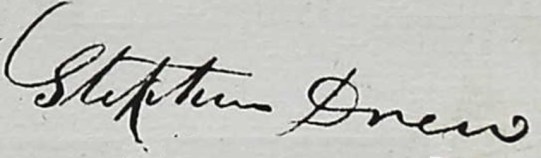


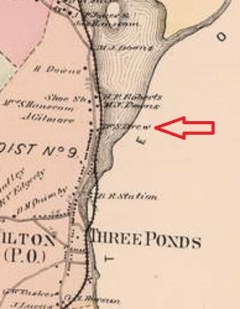
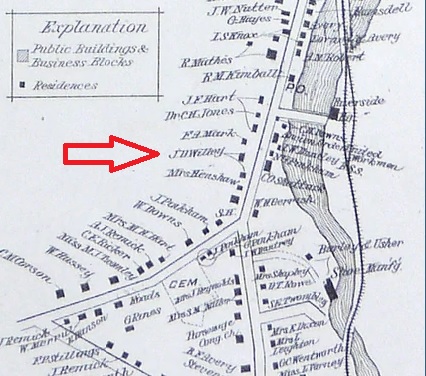



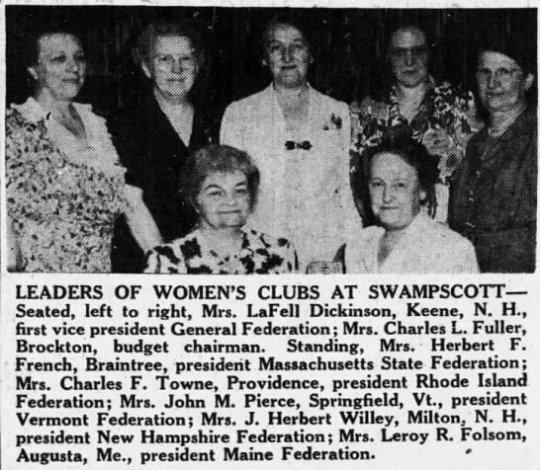 Son Herbert F. Willey married in Keene, NH, July 24, 1943, Winifred L. Pearce, he of Milton and she of Syracuse, NY. He was an ensign in the US Naval Reserve, aged twenty-two years, and she was a home economics teacher, aged twenty-three years. Rev. A. Norman Janes performed the ceremony.
 Over time fixed structures took gradually the place of the original tents. (The Alton Bay camp-meeting persists, although there have been fires there over the years, including the most recent one of April 12, 2009).
 Emerson & Garland had also a soda fountain and kept also a news stand in the drug store, from which they vended, among other publications, the Farmington News.
 Eugene W. Emerson had a liquor license on Main Street (Class 5) in 1906; and
 Emerson’s Pharmacy had also a Rexall-brand license or franchise and a

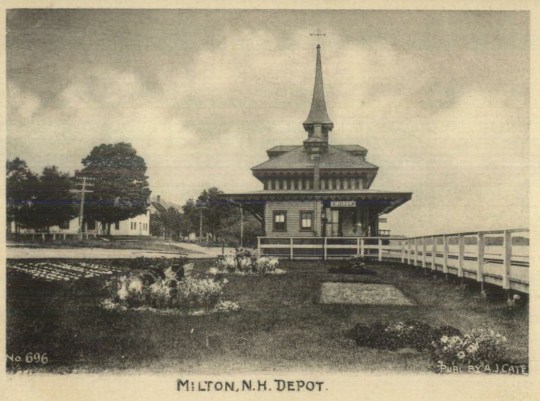 The Hotel Milton sent a horse-drawn carriage to meet passengers at the
  Charles L. Bodwell, had a Class 1 State liquor license for the Milton Hotel in 1903. A Class 1 license permitted sales to hotel guests only. (See
  Edward G. [Edmund G.] Murray, a boarding stable liveryman, aged eighty-six years (b. ME), headed a Sanford, ME, household at the time of the Fourteenth (1920) Federal Census. His household included his daughter, Etta M. Bodwell, a widow, aged fifty-nine years (b. ME), and his lodger, William Temple, a worsted mill weaver, aged fifty-one years (b. ME). Edward G. Murray owned their house, with a mortgage.
 His father, Walter S. Grover, appeared also in the 1912 directory, as an auto repairer, boarding at 30 Sixth street. He died of a cerebral hemorrhage at 30 Sixth Street in Dover, NH, September 26, 1912, aged sixty-seven years, one month, and eleven days. J.H. Richards, M.D. signed the death certificate.
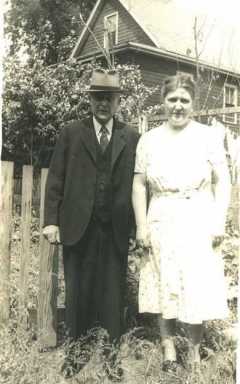 Charles A. Jeffray, a master house painter, aged fifty-eight years (b. Canada (Eng.)), headed a Somerville, MA, household at the time of the Fifteenth (1930) Federal Census. His household included his wife (of twenty-three years), Leonora G. Jeffray, aged forty-one years (b. MN), and his children, Charles A. Jeffray, a house painter, aged twenty-two years (b. MA), Robert E. Jeffray, a meat market salesman, aged twenty years (b. NH), Jessie F. Jeffray, a safety razor factory inspector, aged nineteen years (b. MA), Richard T. Jeffray, a telegraph office messenger, aged fifteen years (b. MA), Arthur E. Jeffray, aged twelve years (b. MA), Alice G. Jeffray, aged ten years, Eunice E. Jeffray, aged six years (b. MA), Donald W. Jeffray, aged two years (b. MA), and John D. Jeffray, aged five months (b. MA). Charles A. Jeffray owned their house at 129 Albion Street, which was valued at $12,500. They had a radio set.
 NEWS IN BRIEF. The Milton House, a hotel at Milton, N.H., which has been unoccupied for a year, was burned. The loss is $40,000 (Fitchburg Sentinel, November 12, 1915).
 Milton Observer