New Hampshire’s legislature or General Court is a bicameral one. It has lower and upper houses, known respectively as the House of Representatives and the Senate. All of its officers, including its Governor and his Executive Council, are elected simultaneously for two-year periods known as “biennia.”
This period marks the beginnings of preliminary primary elections, rather than local party caucus meetings, prior to the general election for these seats.
New Hampshire’s State House now furnishes material for a daily despatch to the outside newspapers on the candidacies for office there declared under the new primary law. For example, Clarence K. Car of Andover filed his application for a place as Democratic nominee Thursday morning, while at noon Colonel Bertram Ellis of Keen walked into the secretary of state’s office to deposit one hundred dollars and make his declaration. Announcements of legislative candidates come to light daily. That direct primaries work better than the caucuses is yet to be demonstrated in any part of the Union, but New Hampshire’s experience, as a piece of Yankee-land, may well be awaited with interest (Boston Evening Transcript, July 23, 1910).
In the reconstructed New Hampshire State House, dedicated yesterday, we trust the changes have not removed that famous guide, whose chief bon mot was delivered when pointing to the picture of Franklin Pierce: “This is the picture of the only President of the United States that New Hampshire ever had or ever will have” (Boston Evening Transcript, October 26, 1910).
Milton’s NH State Representatives elected during this period were:
(Where sources provided party affiliations they have been included after the Representative’s name ([d]=democrat, and [r]=republican)).
And here may be found some details of the State House’s construction and several remodeling and upgrade projects.
Concord’s First State House. THE CORNERSTONE of the first state house was laid September 24, 1816.
Three thousand dollars were originally appropriated by the legislature to commence operations. The inhabitants of Concord donated the original two acres of land. Granite for the building was hewn by convicts at the state prison and was delivered free of charge to the state by the citizens of the city.
On the eighteenth of July, 1818, the gilded eagle atop the dome was raised to its place in public ceremony. The building was completed in 1819 with a total expenditure of nearly $82,000.On September 20, 1864, ground was broken for enlargement of the state house and the building was ready for occupancy at the convening of the legislature on June 6, 1866, at a cost of $200,000. The changes made increased the depth of the building on the west side and added a French roof story on the west side and one on the north and south wings. It enlarged representatives’ hall and the senate chamber. The outward appearance of the building was materially improved by the construction of the portico and the removal of the doors leading into the north and south wings. A third remodelling and new addition was completed in 1910, when the enlarged New Hampshire state house was opened to public inspection and formally dedicated October 25 of that year. The cost for this project was $280,000 (Concord Monitor (Concord, NH), August 1, 1949).
The NH Bureau of Labor reported in 1896 on their sense of the history of shoe manufacturing in Milton.
The Bureau’s report covered first an initial phase of Milton shoe manufacturing, in which the shoe manufacturers caused shoe pieces to be cut from tanned leather to be assembled later into finished shoes by others – shoemakers – on a piecework basis. The assembling shoemakers worked either separately in their own homes or else in small groups in local shoe shops. (Period maps show buildings labeled “S.S.” for “Shoe Shop,” as distinct from those labeled “S.H.” for “School House”). This phase peaked with military production for the American Civil War.
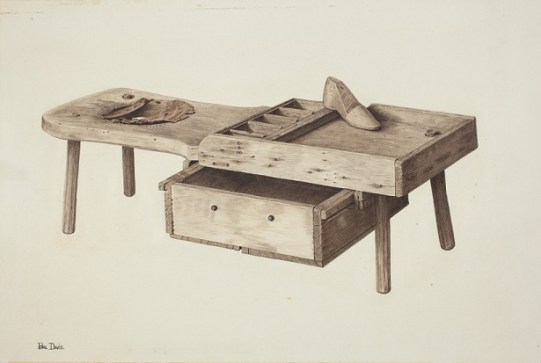
Most of their assembly work would have been done by hand at a shoemaker’s bench, perhaps assisted in some tasks by simple treadle-driven machinery. Shoemakers of this period were often quite well informed, because groups of them might pay to have a “lector” read aloud to them from newspapers, magazines or books while they worked.
MILTON. Among the early manufacturers of shoes in this town were John E. Goodwin & Co., at West Milton, who gave employment to 25 or 30 hands in cutting and putting up stock, to be fitted and bottomed by the people of the town; H.V. & Eli Wentworth, who carried on a large business at South Milton for several years, until burned out; and D. & S. Washburn, L. Berry and J. Layward [Sayward], who carried on a successful business at various times at Three Ponds, the latter continuing until burned out in 1864 (NH Bureau of Labor, 1896).
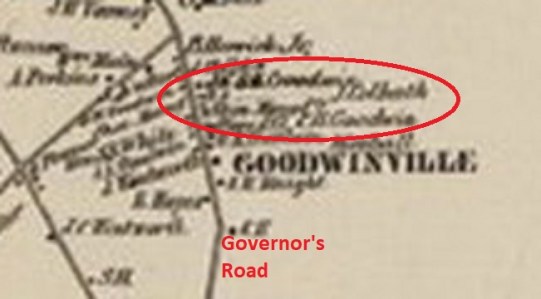
John E. and Charles H. Goodwin ran their shoe manufactory in the Goodwinville section of West Milton from the mid to late 1840s until John E. Goodwin moved the business to Dover, NH, in or after 1863. (His Dover, NH, factory would burn in a fire in 1870).
John Colbath (1828-1915) moved to Goodwinville in West Milton in 1847 to work with the Goodwins, which he did until 1853. He resided with Charles H. Goodwin in 1850. Harrison Kimball (1817-1855) was associated with the Goodwins in shoe manufacturing. He resided next door with Elder J.T.G. Colby. Alvah Wentworth (1831-1874) and Ira W. Nute (1831-1896) were associated with the Goodwins in shoe manufacturing too. They resided next door with Goodwin brother Daniel B. Goodwin.
Brothers Hiram V. and Eli Wentworth started a shoe manufactory at South Milton in the mid to late 1840s. John C. Plumer (1829-1902) was a resident associate of Eli Wentworth in 1850. Sen. Eli Wentworth received an army commission in 1861 and would die in Mississippi in 1863. Hiram V. Wentworth continued to run the shoe manufactory until it burned down in 1875.
Brothers Daniel and Samuel Washburn came to Milton Three Ponds from Natick, MA, circa 1849, and there ran a shoe manufactory until the mid 1850s, when they returned to their native Natick, MA.
In addition to those mentioned in the retrospective portion of the 1896 report, Francis D. Horn (1815-1863) and James R. Horn (b. c1826), both of Plummer’s Ridge, Ira S. Davis (1812-1889), and Daniel P. Warren (1815-1881), were all identified also in the Seventh (1850) Federal Census as being Milton shoe manufacturers, rather than shoemakers.
Lewis N. Berry was already a shoemaker when he came to Milton Three Ponds in the mid to late 1850s. He became a shoe manufacturer there from at least 1860 until his death in June 1863.
Joseph Sayward ran his shoe manufactory at Milton Three Ponds from the mid to late 1850s until it burned down in 1864. (At which point he became instead a merchant).
The Bureau’s report covered next a more machine-driven phase or style of production, which arrived here in the mid 188os. These new shoe manufactories used Milton’s rivers to power their machinery, backed up by supplementary steam power when river levels were low. (See also Milton Water Power in 1885). Most of these firms had their principal shoe manufactories elsewhere, often in Massachusetts cities, and their Milton operations were merely for overflow or supplementary operations.
In 1884 an organization composed of citizens of the town erected a shoe factory 160 x 40 and four stories high, with other accessories, at Milton, at a cost of $12,000, which was leased to Burley & Usher in 1885, who were afterwards succeeded by N.B. Thayer & Co., the present occupants. Misses’ and children’s kid and Dongola spring heel slippers are manufactured, and employment is given to 100 or more hands. Steam and water are used for power, and the firm is not exempt from taxation (NH Bureau of Labor, 1896).
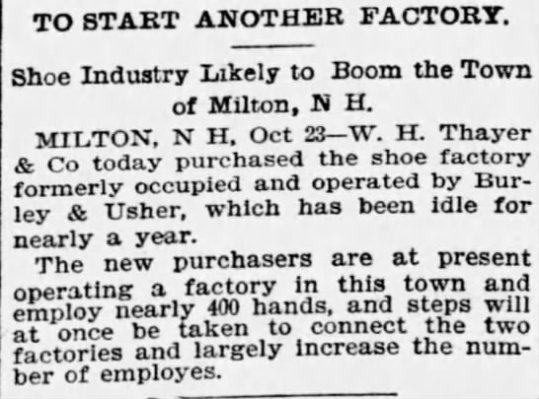
The firm of Burley & Usher occupied the subsidized shoe manufactory building at Milton Three Ponds from 1885 to 1893.
N.B. Thayer & Co. took over the shoe factory building which had formerly been occupied by Burley & Usher. They would be active there between 1894 and 1909.
Meanwhile, Varney & Lane ran briefly a subsidized shoe manufactory in the old Brierley felt mill at Milton Mills from 1888 to 1890.
In 1888 Varney & Lane began the manufacture of shoes in the factory originally built and occupied as a felt mill by E. Brierly & Son, at Milton Mills (110 x 50 and four stories high, and erected in 1873 at a cost of $13,000), and did a successful business for some time. They were succeeded by the Sale [Gale] Shoe Manufacturing company of Haverhill in 1895, who are in the manufacture of women’s kid and Dongola button boots, Oxford ties and misses’ spring heel slippers, and give employment to 75 or more hands. Water and steam are for power, and the firm is not exempt from taxation (NH Bureau of Labor, 1896).
Varney & Lane were replaced in the Brierley mill building by the Gale Shoe Manufacturing Co. from 1890-1904.
Some $60,000 capital is invested in the shoe business in Milton. Two hundred people, more or less, are employed, to whom are paid nearly $50,000 annually in wages, and the yearly output is valued at $150,000 (NH Bureau of Labor, 1896).
And, after the publication of the NH Bureau of Labor’s 1896 report, the Andrews Wasgatt Co. took over from the Gale Shoe Manufacturing Co., at the old Brierley Mill in Milton Mills, from 1904 to 1914, and the Timson Shoe Co., from 1915 to 1918.
The Mitchell-Cony directory of 1908 provided a list of Milton Selectmen from its founding until 1907.
Selectman is a term usually reserved for government officers in small New England towns. A group of selectmen make up a selectboard. In contrast to a representative council, the members of a selectboard are usually tasked with administrative duties that in larger towns and cities might be the responsibility of a mayor (Meriam-Webster, 2022).
Many, if not most, towns have three selectmen. Some have five selectmen and even seven are not unknown. Their terms are usually staggered ones, rather than concurrent ones, each selectman serving a staggered term of three years, those with five having staggered terms of five years, etc.
New Hampshire’s legislature or General Court is a bicameral one. It has lower and upper houses, known respectively as the House of Representatives and the Senate. All of its officers, including its Governor and his Executive Council, are elected for two-year periods known as “biennia.”
The NH provincial legislature sat at Portsmouth from 1689 to 1775. During and immediately after the Revolutionary War, when seacoast Portsmouth would have been exposed to possible attack by sea, the legislature moved inland. (Sometimes it held a Spring session at one location and a Fall one in another). It met at Exeter (1775-84, 1786, 1789, 1790, 1792-93, 1796, 1799-00, 1803, 1805, 1812-13, and 1815), Amherst (1778 and 1794), Concord (1785, 1788, 1791, 1795, 1797, 1802, 1804, 1808-11, and 1814), Charlestown (1787), Portsmouth (1780, 1782, 1784-91, 1797, 1805, and 1812), Dover (1792), and Hopkinton (1798, 1801, and 1806-07).
Concord has been said to have become the de facto capitol in 1808 and the de jure one in 1816. The current capitol building in Concord, NH, opened its doors in 1819. Milton Rep. Theodore C. Lyman would have been the first Milton representative to have had a seat there.
The building described in 1833 did not yet have a dome or portico, as it does now.
The New Hampshire State House 150 feet long, centre 57 feet deep, wings 49 feet deep, walls of stone, cornice wood, roof shingled – without a dome or portico, and cost $81,827 (Vermont Patriot & State Gazette, November 11, 1833).
By 1865, its dome had been added and a cupola was being placed atop it, with an eagle atop the cupola. Its granite portico was under construction.
The designs of Mr. Architect Bryant begin to assume form and shape in the progress of the work on the New Hampshire State House. The cupola is framed, and the old eagle, after a long season of rest and refreshment, again faces the rising sun, and this time from a higher perch than before. Along the front of the reconstructed edifice are to be reared twelve massive granite columns hewn from the same quarry whence were taken the immense masses of the Concord City Hall (New England Farmer (Boston, MA), September 23, 1865).
Prior to the advent of trains and automobiles, most state representatives and senators would have simply resided in the capitol city for the duration of the legislative session, rather than travel back and forth. Some sources – directories, manuals, and registers – identified the various boarding houses and hotels in which the members were residing. (For example, Milton Rep. Charles W. Gross occupied seat 03-27 in the House chambers and boarded at 45 Park street during the 1887-88 biennium).
Prior to being set off as its own town, Milton – then called the Northeast Parish of Rochester – had been represented by men sent from its parent town. Milton came into its own in 1802, which was too late to send its own representative to the 1801-02 biennium.
In some periods Milton had two representatives, usually when it constituted a larger proportion of the state’s total population than it does at present.
Milton Population, 1800-2020, as reported in Federal Census records. Milton’s nineteenth century population peaked at 1,862 persons in 1860. While the Civil War (1861-65) might account for some of the decline and stagnation that followed, the larger factor was simply that its rural farm economy had reached its capacity. Not even the larger local manufacturing concerns that would arise would be sufficient to sustain greater numbers. Its 1860 population peak would not be matched again until 1970.
John Scales provided in his 1914 History of Strafford County the names of the person or, for a period beginning in 1853, the two persons, representing Milton in the NH House of Representatives (Scales, 1914). Scales drew heavily upon an earlier work by Charles C. Hayes of Milton, whose list ended with the 1881-82 biennium. Consequently, Scales’ list ran only from the 1803-04 biennium up through that of 1881-82. (Where external sources provided party affiliations they have been included ([d]=democrat, [f]=federalist], [nr]=national republican, [r]=republican, or [w]=whig)).
There were originally fewer NH representatives overall and their number increased gradually until it was capped at the current total of four hundred. (See The Mathematical Limits of Representation).
New Hampshire has the 3rd largest legislature in the English-speaking world, just behind the British Parliament and the United States Congress. While the State Senate has fairly consistently set itself at 24 members since the late 1870s, the size of the House of Representatives has varied. In 1819 when Representatives’ Hall opened, there were 192 members. By the time the Civil War rolled around, the House had 331 members and by 1900 there were 360 members. Although we have kept the number to around 400 consistently since the latter half of the 1940s, there have been times when the legislature eclipsed that number, such as 1929 when there were 421 members and 1944 when there were 443 members (House Republican Office, 2022).
Next came a twenty-five-year period in which Milton had two NH Representatives.
Here is compiled a twenty-year list that extends the Hayes-Scales list from the 1883-84 biennium through that of 1901-02. (Where sources provided party affiliations they have been included (d=democrat, p=prohibition, or r=republican)).
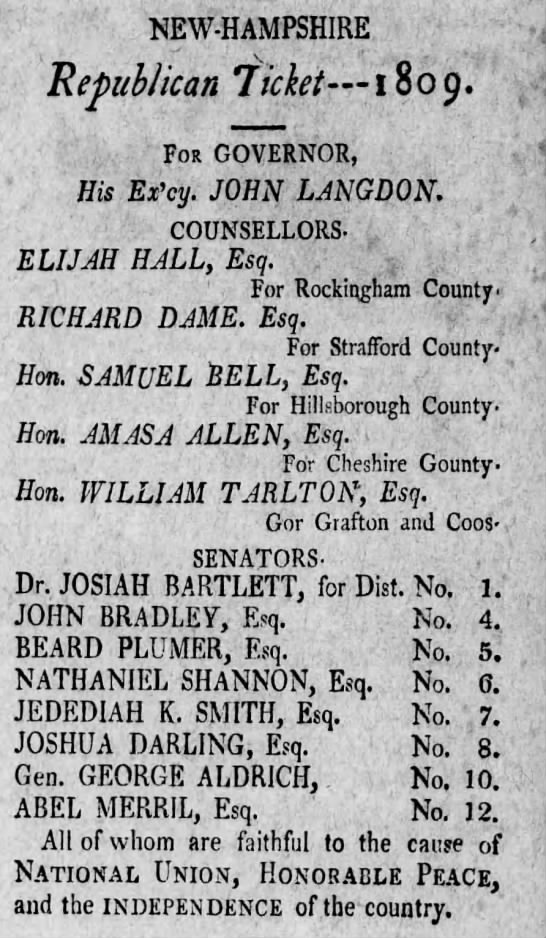
Beard Plumer. Esq., as a candidate on the statewide Republican ticket. The party names of this period can be a bit confusing. This is a Democratic-Republican ticket, i.e., a Democrat ticket. The other party were the Federalist-Republicans or the Federalists.
Senate districts encompassed multiple towns. That being the case, Milton did not have a Milton-resident senator in every year. Here follows those listed by Scales from the 1803-04 biennium up through that of 1887-88 (Scales, 1914)
NH Sen. Beard Plumer, Esq., of Milton died near the end of the first year of his fifth NH Senate biennium. The mechanism then in place required the NH House to choose his replacement from the two runners-up (if that many there were) of the election that put him in office. That is to say, the Federalist loser of the election would now replace the deceased Democrat winner.
NEW HAMPSHIRE. In the Senate of this State there are two vacancies, one occasioned by the acceptance of a judiciary appointment by the Hon. B. Badger, and the other by the decease of the Hon. Beard Plumer. These vacancies are likely to occasion some embarrassment in the government of that state. They are required by the constitution to be filled by election by the other House, from the two remaining highest candidates in their several districts. In each of the present cases it is said that the highest remaining candidates are federalists, so that the other House, though democratic, will be under the necessity of supplying the vacancies with federalists, an event which would destroy the predominance of the democratic party in the Senate, and give the federalists a check upon the proceedings. Another report is, that there are no two highest candidates in either district, all the votes in each being given to one man, except that two other persons in each district had each one vote (Burlington Gazette (Burlington, VT), December 5, 1816).
(Mr. Plissken observes that this same notion is sometimes put forward when replacing local officials. It sounds reasonable on its face, but one might argue instead that this method has a conceptual flaw, even apart from the complication of opposing political parties. In choosing or promoting the candidate with the next biggest total, one is preferring what was specifically not preferred by the majority of voters when an alternative was present).
Before the fall session, District No. 5 was vacated by the decease of Beard Plumer, and No. 6 by the appointment of William Badger judge in the court of common pleas. These two vacancies were not filled. Jonathan Harvey was chosen president in place of William Badger (NH General Court Manual, 1891).
[Editor: Here follows Ms. Bristol’s description of the Milton militia dispute of 1820. It contains references to several petition documents which will be published separately over the coming months. It will serve then also as a sort of index to those documents].
New Hampshire relied upon a militia system for its defense from colonial times through 1847.
Each and every free, able-bodied white male citizen, between the ages of 18 and 45 years, is liable to do military duty (Lyon, 1824).
Militiamen were required to present themselves – to “muster” – with their weapons once or twice a year for company-level drills, as well as a final time in the Fall for a larger regimental-level drill.
The [Rochester regimental] muster field at its best presented a gay appearance. The various companies drawn up in line, with muskets and accouterments bright and clean, the officers scattered between the lines with fine uniforms and stately plumes, the Light Infantry much like the officers but with shorter plumes, and the Artillery Company with their formidable cannon, together with the motley crowd on every side must have been an attractive and interesting scene. Gingerbread carts, candy stands, and all sorts of variety shows, with an occasional fight between heated partisans from different towns afforded abundant merriment and diversion. Liquor and gambling booths grew more and more frequent so that one year Captain Samuel Jones and his company from Farmington made a charge upon them and pitched them and their belongings over the fence. The brisk step, the martial dignity and the clear distinçt orders of the morning had in those days generally become somewhat limp, languid and indistinct toward the close of the day. Many still living can remember the great contrast between the inspiriting, clear cut, exactly timed strains of fife and drum as the companies came marching to the field in the morning and the slip shod timeless whistle and fumbling taps as they started on their homeward way (McDuffee, 1882).
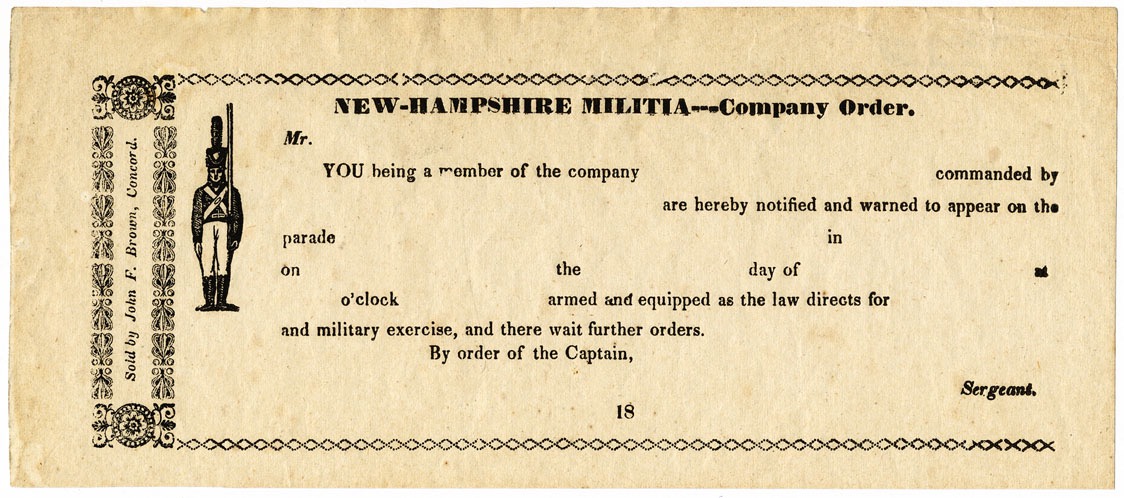
NH Militia Muster Order Form. This example is blank, with its spaces to be completed by the company sergeant at the request of the captain.
Old Fashioned Muster Gingerbread. One cup of molasses, 2 large spoons of butter, 1 teaspoon of soda dissolved in 3 tablespoons of boiling water, 1 teaspoon of ginger and flour enough to knead well but not hard. Roll into 3 sheets, mark with a fork, and bake quickly; after baking, while hot, mix 1 teaspoon each of milk and molasses and wet the top. I have sent this recipe by request of Mrs. G.L.D. of Chelsea. Portland, Me. E.E.E. (Boston Globe, November 24, 1894).
[A woodburning “quick oven” would have a modern oven temperature of between 425 to 450 F. It would take about 20 minutes to bake. A toothpick inserted in the center should come out clean when done].
Muster ginger bread. Boil 1 pt. molasses and 1 tablespoon ginger; let cool, add ½ pt. shortening, mostly butter, 2 teaspoons soda dissolved in ¼ cup hot water, ½ teaspoon alum dissolved in ¾ cup cold water, flour to make a dough that can be handled. Roll about two inches thick. Mark the top with back of fork. Bake quickly, take out as soon as done, as too long baking spoils it. Put away in jar and keep a week or so. The longer it is kept the moister becomes. Somebody try in and report. Von Edirb (Boston Globe, August 24, 1906).
Milton’s militiamen and those from southern Wakefield made up the Seventh Company of New Hampshire’s Second Regiment of militia at this time. It was led then by Captain Jeremy Nute (1788-1879), with James Hayes, Jr. (1790-1845), as its Lieutenant, and Norton Scates (1790-187[?]) as its Ensign.
The Seventh Company’s area encompassed all of Milton and that part of neighboring Wakefield that lay south of Lovell Lake. Depending upon where one lived in this company area, travel to militia musters might be rather burdensome. (Milton Mills was at least a 15-mile hike, if not more, to the regimental muster location in Rochester, where one would then spend the day drilling and marching around, before making a weary 15-mile return hike. Union village in Wakefield was at least 13 miles distant (for a round-trip of at least 26 miles)). The militiamen traveling furthest to drills and musters grew restive.
Some 134 Seventh Company militiamen took a vote on May 30, 1820. They were likely assembled together for a company-level militia drill. By their vote, 69 [51.5%] militiamen chose to seek a division of their company into two parts, while 22 [16.4%] of them preferred to leave the situation as it was. The remaining 43 [32.1%] did not express a preference either way.
The company officers petitioned the regimental field officers above them, on May 31, 1820, seeking to divide the Seventh Company into two companies. There would be a northern company, encompassing Union Village, Milton Mills, and Milton south to a certain east-west division line – the Milton town meeting house would have been north of the proposed line – and a southern company from that division line to the Rochester line, encompassing Milton Three Ponds, as well as South and West Milton. (See Milton Militia Division Request – May 1820).
The field officers rejected this proposition, although their reply has not come to hand. (They likely rode horseback to the muster). But they seem to have been unaware that “there is more than one way to skin a cat.” If the field officers refused to divide the town militia company into two parts, there was another, more drastic solution available to the petitioners. The town itself might be divided into two parts, which might achieve the same thing.
... in 1820 an effort was made by the people living in this [Wakefield] town below Lovell’s pond with others living in the Northerly part of Milton, to have that part of Wakefield south of Lovell’s pond and the northerly portion of Milton incorporated into a new town, Luther Dearborn of this [Wakefield] town and John Remick, Jr., of Milton headed petitions to the legislature for the new town which was to be called Lisbon. The Rev. Mr. Piper favored the project and suggested the name Milfield for the new town (Thompson, 1886).
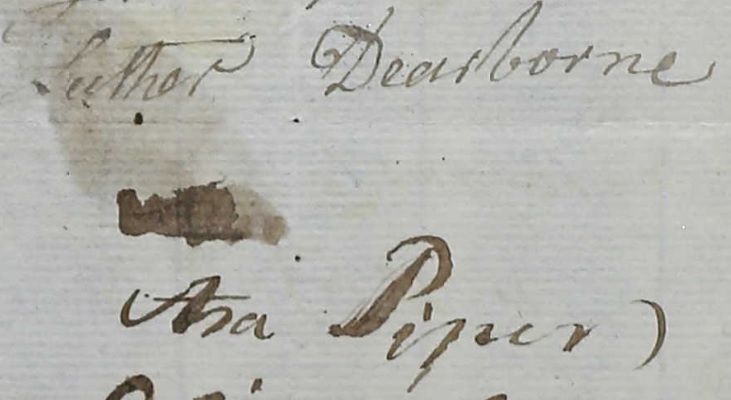
Signatures of Luther Dearborne and Rev. Asa Piper on an earlier June 1813 petition by the citizens of the “pleasant village at Wakefield Corner” recommending William Sawyer (1774-1860) as a Wakefield justice-of-the-peace.
Wakefield’s three selectmen became aware that there was trouble in paradise, so to speak, at some time after their annual March town meeting and before June 1820.
We are aware that Petitioners for the new Town will point out by Carrigain’s Map, or some other Survey, what a handsome, beautiful five-mile square Town may be made out of Wakefield and Milton, and then attempt to show and make it believed, that the remaining part of those two Towns will be equally as good as the whole and in a better form.
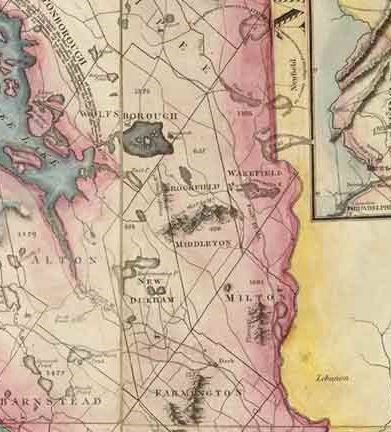
Carrigain Map of New Hampshire in 1816 (Detail). Division advocates pored over this map with prospective signers. The “Lisbon” or “Milfield” they envisaged would have run from Lovell Lake in Wakefield south to Meetinghouse Pond in Milton. It would have included what is now Union village in Wakefield, as well as Milton Mills and Plummer’s Ridge in Milton. Milton Three Ponds, South Milton, and West Milton would have been the remaining “rump” of Milton after such a division.
The “Carrigain map,” the most famous of New Hampshire maps, is named for Philip Carrigain (177[6]-1842), secretary of state of New Hampshire, who was granted much of the responsibility of compiling it. The map was authorized by the New Hampshire legislature in 1803. Carrigain may have engraved the cartographic portions, and he held the copyright. The map is based upon many individual surveys, and in its early stages, Carrigain, a lawyer, depended heavily upon the technical skills of Phinehas Merrill (1767-1815), a professional surveyor (WhiteMountainHistory, 2021).
Neither the Milton nor Wakefield pro-division petitions, although mentioned in other documents, have come to hand. If ever they were actually filed, they might have been withdrawn. Luther Dearborn (1771-1844) of Wakefield, NH, and John Remick, Jr.(1777-1840) of Milton, were said to have headed their respective lists of petitioners. (Remick was a Milton selectman and both men were justices-of-the-peace in their respective towns). Wakefield’s lifelong Congregational minister, Rev. Asa Piper (1757-1835), is said to have been also a proponent of division.
Some 127 Milton men filed an anti-division remonstrance petition intended for the June 1820 session of the NH legislature. Company officers Jeremy Nute, James Hayes, Jr., and Norton Scates all signed this remonstrance, as did former company officers Levi Jones and Jotham Nute, and future officers Theodore C. Lyman and Bidfield Hayes (1789-1842). One may note that none of Milton’s selectmen signed. (See Milton Anti-Division Remonstrance – June 1820).
Wakefield selectmen Jonathan Copp (1792-1869), Henry L. Wiggin (1791-1844), and Elias Wentworth (1774-1852) filed their own anti-division remonstrance petition intended for that same June 1820 session. It was signed also by 199 Wakefield inhabitants (See Wakefield Anti-Division Remonstrance – June 1820).
Some 27 Wakefield division petitioners later thought better of their having signed the division petition. They signed a retraction and anti-division petition, November 1, 1820. (See Wakefield Pro-Division Renunciation – November 1820).
One should note that Fourth (1820) Federal Census enumerations for Strafford County have not been preserved (although the aggregate totals have). They would have had the names of the household heads and age-based tick marks for the members of their households. The various petitions related to dividing or not dividing either the militia company or the towns are valuable in that they provide us with the names of a plurality at least of Milton’s adult male inhabitants of 1820, including many of its household heads.
Obviously, the proposed splitting of the towns never took place. Milton’s militia company was divided instead into two companies. The Milton company was reassigned to a newly-created Thirty-Ninth Regiment of militia in 1822. The new regiment included also companies from Rochester and Farmington, NH. Wakefield’s south company, which appears to have included also Milton Mills, was assigned to the Thirty-Third Regiment of militia, along with those from Alton, Brookfield, Middleton, and New Durham, NH. Its north company was assigned to the Twenty-Seventh Regiment of militia, along with those from Effingham, Ossipee, Tuftonboro, and Wolfeboro, NH.
The general muster of the militia at the same [Fall] time of year was a holiday of no less interest and importance to the people of two preceding generations. By a state law of 1792, able-bodied citizens between the ages of eighteen and forty-five were required to meet twice a year for military drill. To these spring and fall trainings for each company in its own town was afterwards added the annual muster of the Thirty-ninth Regiment. This regiment consisted of five companies of regular infantry, one from each of the villages of Farmington, West Farmington, Milton Three Ponds, Gonic, and Rochester, together with one Light Infantry Company collected from all parts of the district and the Rochester Artillery Company (McDuffee, 1892).
Luther Dearborn received a reappointment as a Wakefield justice-of-the-peace, June 14, 1828. His wife, Sarah “Sally” (Pike) Dearborn, died in 1831. His term as justice would have expired in June 1833. Instead of a reappointment, the court roster bears a marginal notation that he had “moved to Somersworth,” N.H. He was living there at the time of the Sixth (1840) Federal Census.
Thompson, Rev. Albert H. (1886). Memorial of the One Hundredth Anniversary of the Organization of the First Church, and Ordination of the First Settled Town Minister of Wakefield, N.H. Retrieved from books.google.com/books?id=EKm15quwMhsC&pg=PA42
The Mitchell-Cony directory of 1907-08 provided an index of sorts to the physicians that practiced in Milton and Milton Mills from about 1820 through its publication date.
(Dr. Russell of Wakefield, NH, prior to 1820, and Dr. J. Dearborn of Milton, NH, although only briefly, have proven somewhat elusive. Details of them will be added should they become available).
MILTON PHYSICIANS
PROFESSIONAL MEN. PHYSICIANS. Perhaps the earliest resident physician at Milton Village was Dr. Stephen Drew, a native of Newfield, Me., who came in the early days of the town about the year 1820, and practised until 1873, a long period of more than fifty years of activity. Dr. D.E. Palmer came some time in the latter part of the decade 1850-1860, and remained until about 1865, when he went to Tuftonborough. Dr. G.W. Peavey, who came here from Ossipee, carried on the practice which Dr. Palmer had left, and remained about four years, at the end of which time he removed to Somersworth, where he died. Dr. Nute succeeded Dr. Peavey, but stayed only a short time. For several years there was no resident physician at the village until Dr. H.F. Pitcher came in 1879. Dr. Pitcher, after continuing in practice here about four years, went to Haverhill, where he still carries on the practice of his profession. The Rev. Frank Haley, M.D., who acted as pastor of the Congregational Church, was also a practising physician here about the middle of the seventies. Dr. W.F. Wallace, Milton’s next physician, came in 1883. After about four years of practice here, he went to Bradford in 1887, in which year Dr. C.D. Jones, a native of Milton, and a graduate of Harvard, began practice here. Dr. Jones gave up his practice about the year 1891. Dr. J. Dearborn was here a short time in the latter eighties. Dr. M.A.H. Hart, like Dr. Jones, a Milton man, came here the same year (1891). After graduating at the University of the City of New York, Dr. Hart practised about three years in Fall River, Mass., at the end of which time he came to his native town, to begin a practice which has now grown to extensive proportions. Dr. W.F. Wallace returned to Milton in 1893, and practised until his removal to Plaistow four years later. Dr. John Wallace, a native of Ireland, came here in 1897. Three years later he removed to Roxbury, Mass. (Mitchell-Cony, 1908).
MILTON MILLS PHYSICIANS
At Milton Mills, the first physician to carry on an extensive practice was Dr. Reuben Buck, a native of Massachusetts, who lived in Acton, and visited patients in this village as early as 1830, and continued to reside here until his death. Prior to Dr. Buck’s practice here, Dr. Powers of Acton and Dr. Russell of Wakefield attended sick calls. Dr. Jonathan S. Calef, who came from Maine, married one of Dr. Buck’s daughters and settled here not many years after the latter’s arrival. He remained for some time, going from Milton to Manchester, later to Boston, Mass., and finally to San Francisco, Cal., where he died. Dr. John L. Swinerton, from Newfield, Maine, was in practice in this village, contemporary with Dr. Buck, remaining here about twenty five years. At the end of that time, he went to Union, where, later, he died. Dr. Jeremiah Crosby Buck, a son of Dr. Reuben, began practice here during the latter years of his father’s residence in this locality, and continued in active practice almost up to the time of his death, which occurred about the year 1890. Dr. Chas. E. Swasey, who had been an army surgeon during the Civil War, married another of Dr. Reuben Buck’s daughters, and began the practice of his profession shortly after close of the war. He remained here about five years, removing at the end of that time to Rochester, from which place he went to Somersworth, where he died May 30, 1907. His remains were brought to his native town and buried in the Roadside Cemetery just outside the village. Dr. Wm. E. Pillsbury, a native of Shapleigh, Me., came sometime during the latter part of the decade 1860-1870, and remained until February, 1907. Dr. Charles W. Gross came at about the same time, and has enjoyed a long and successful practice which he still carries on at the present time. Dr. Frank Weeks, a graduate of the Baltimore Medical College came to this village in March, 1902, and is one of present resident physicians. Dr. L.B. Bradford came here about the month of June, 1907, but remained only a short time. Dr. Hugh D. Grant, like Dr. Weeks an alumnus of Baltimore Medical College, began practice at this place during the latter part of the summer of 1907, and has resided here since that time (Mitchell-Cony, 1908).
One of our subscribers has asked that we provide an index to Ms. Bristol’s Milton historical articles. (I do try to connect her articles to each other through internal links). There is a bit of a problem in that her sequence of articles is an ongoing one.
Be that as it may, here you may find an index of sorts of her articles to date in a roughly chronological order.

 In the reconstructed New Hampshire State House, dedicated yesterday, we trust the changes have not removed that famous guide, whose chief bon mot was delivered when pointing to the picture of Franklin Pierce: “This is the picture of the only President of the United States that New Hampshire ever had or ever will have” (Boston Evening Transcript, October 26, 1910).
 Concord’s First State House. THE CORNERSTONE of the first state house was laid September 24, 1816.
 Most of their assembly work would have been done by hand at a shoemaker’s bench, perhaps assisted in some tasks by simple treadle-driven machinery. Shoemakers of this period were often quite well informed, because groups of them might pay to have a “lector” read aloud to them from newspapers, magazines or books while they worked.
 John Colbath (1828-1915) moved to Goodwinville in West Milton in 1847 to work with the Goodwins, which he did until 1853. He resided with Charles H. Goodwin in 1850. Harrison Kimball (1817-1855) was associated with the Goodwins in shoe manufacturing. He resided next door with
  Brothers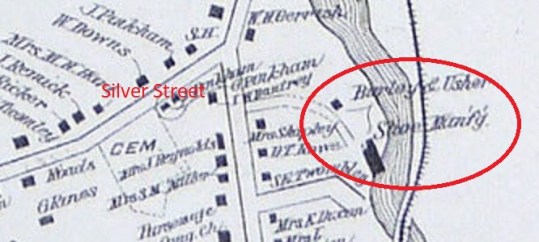
 Meanwhile,
  Varney & Lane’s Milton Mills operation ended in a contentious shoe strike. (See
  Varney & Lane were replaced in the Brierley mill building by the
  Some $60,000 capital is invested in the shoe business in Milton. Two hundred people, more or less, are employed, to whom are paid nearly $50,000 annually in wages, and the yearly output is valued at $150,000 (NH Bureau of Labor, 1896).
 And, after the publication of the NH Bureau of Labor’s 1896 report, the
  The building described in 1833 did not yet have a dome or portico, as it does now.
 Milton Observer